EP0821876B1 - Particules stables d'arylpyrrole, leur procédé de préparation et suspensions concentrées les contenant - Google Patents
Particules stables d'arylpyrrole, leur procédé de préparation et suspensions concentrées les contenant Download PDFInfo
- Publication number
- EP0821876B1 EP0821876B1 EP97305762A EP97305762A EP0821876B1 EP 0821876 B1 EP0821876 B1 EP 0821876B1 EP 97305762 A EP97305762 A EP 97305762A EP 97305762 A EP97305762 A EP 97305762A EP 0821876 B1 EP0821876 B1 EP 0821876B1
- Authority
- EP
- European Patent Office
- Prior art keywords
- arylpyrrole
- particles
- weight
- alkyl
- agent
- Prior art date
- Legal status (The legal status is an assumption and is not a legal conclusion. Google has not performed a legal analysis and makes no representation as to the accuracy of the status listed.)
- Expired - Lifetime
Links
- 239000002245 particle Substances 0.000 title claims description 108
- 239000000203 mixture Substances 0.000 title claims description 100
- 238000000034 method Methods 0.000 title claims description 38
- 239000004546 suspension concentrate Substances 0.000 title claims description 28
- 238000002360 preparation method Methods 0.000 title claims description 6
- CWFOCCVIPCEQCK-UHFFFAOYSA-N chlorfenapyr Chemical compound BrC1=C(C(F)(F)F)N(COCC)C(C=2C=CC(Cl)=CC=2)=C1C#N CWFOCCVIPCEQCK-UHFFFAOYSA-N 0.000 claims description 55
- DNIAPMSPPWPWGF-UHFFFAOYSA-N Propylene glycol Chemical group CC(O)CO DNIAPMSPPWPWGF-UHFFFAOYSA-N 0.000 claims description 21
- XLYOFNOQVPJJNP-UHFFFAOYSA-N water Substances O XLYOFNOQVPJJNP-UHFFFAOYSA-N 0.000 claims description 19
- WSFSSNUMVMOOMR-UHFFFAOYSA-N Formaldehyde Chemical compound O=C WSFSSNUMVMOOMR-UHFFFAOYSA-N 0.000 claims description 18
- 239000002270 dispersing agent Substances 0.000 claims description 18
- 229910052731 fluorine Inorganic materials 0.000 claims description 16
- -1 polycyclic aromatic compounds Chemical class 0.000 claims description 16
- 229910052794 bromium Inorganic materials 0.000 claims description 14
- 229910052801 chlorine Inorganic materials 0.000 claims description 14
- 125000005843 halogen group Chemical group 0.000 claims description 14
- 239000003381 stabilizer Substances 0.000 claims description 14
- 239000002562 thickening agent Substances 0.000 claims description 14
- 229910052739 hydrogen Inorganic materials 0.000 claims description 12
- 239000000375 suspending agent Substances 0.000 claims description 12
- 239000007798 antifreeze agent Substances 0.000 claims description 10
- 238000003860 storage Methods 0.000 claims description 10
- 239000003795 chemical substances by application Substances 0.000 claims description 9
- 125000006273 (C1-C3) alkyl group Chemical group 0.000 claims description 8
- GOOHAUXETOMSMM-UHFFFAOYSA-N Propylene oxide Chemical compound CC1CO1 GOOHAUXETOMSMM-UHFFFAOYSA-N 0.000 claims description 8
- 239000002518 antifoaming agent Substances 0.000 claims description 8
- 239000003755 preservative agent Substances 0.000 claims description 8
- IAYPIBMASNFSPL-UHFFFAOYSA-N Ethylene oxide Chemical group C1CO1 IAYPIBMASNFSPL-UHFFFAOYSA-N 0.000 claims description 7
- 239000007859 condensation product Substances 0.000 claims description 7
- 230000002335 preservative effect Effects 0.000 claims description 7
- 239000000047 product Substances 0.000 claims description 7
- 229920001285 xanthan gum Polymers 0.000 claims description 7
- 125000004765 (C1-C4) haloalkyl group Chemical group 0.000 claims description 6
- 125000004093 cyano group Chemical group *C#N 0.000 claims description 6
- 229910052740 iodine Inorganic materials 0.000 claims description 6
- 239000000230 xanthan gum Substances 0.000 claims description 6
- 235000010493 xanthan gum Nutrition 0.000 claims description 6
- 229940082509 xanthan gum Drugs 0.000 claims description 6
- 150000003839 salts Chemical group 0.000 claims description 5
- 125000004178 (C1-C4) alkyl group Chemical group 0.000 claims description 4
- DGAQECJNVWCQMB-PUAWFVPOSA-M Ilexoside XXIX Chemical compound C[C@@H]1CC[C@@]2(CC[C@@]3(C(=CC[C@H]4[C@]3(CC[C@@H]5[C@@]4(CC[C@@H](C5(C)C)OS(=O)(=O)[O-])C)C)[C@@H]2[C@]1(C)O)C)C(=O)O[C@H]6[C@@H]([C@H]([C@@H]([C@H](O6)CO)O)O)O.[Na+] DGAQECJNVWCQMB-PUAWFVPOSA-M 0.000 claims description 4
- 229920001400 block copolymer Polymers 0.000 claims description 4
- 125000004432 carbon atom Chemical group C* 0.000 claims description 4
- LYCAIKOWRPUZTN-UHFFFAOYSA-N ethylene glycol Natural products OCCO LYCAIKOWRPUZTN-UHFFFAOYSA-N 0.000 claims description 4
- 229910052708 sodium Inorganic materials 0.000 claims description 4
- 239000011734 sodium Substances 0.000 claims description 4
- BDHFUVZGWQCTTF-UHFFFAOYSA-M sulfonate Chemical compound [O-]S(=O)=O BDHFUVZGWQCTTF-UHFFFAOYSA-M 0.000 claims description 4
- 239000000391 magnesium silicate Substances 0.000 claims description 3
- 238000006277 sulfonation reaction Methods 0.000 claims description 3
- 125000004455 (C1-C3) alkylthio group Chemical group 0.000 claims description 2
- 125000000229 (C1-C4)alkoxy group Chemical group 0.000 claims description 2
- 244000215068 Acacia senegal Species 0.000 claims description 2
- 244000007835 Cyamopsis tetragonoloba Species 0.000 claims description 2
- 229920005682 EO-PO block copolymer Polymers 0.000 claims description 2
- JNCMHMUGTWEVOZ-UHFFFAOYSA-N F[CH]F Chemical compound F[CH]F JNCMHMUGTWEVOZ-UHFFFAOYSA-N 0.000 claims description 2
- 229920000084 Gum arabic Polymers 0.000 claims description 2
- 239000000205 acacia gum Substances 0.000 claims description 2
- 235000010489 acacia gum Nutrition 0.000 claims description 2
- 125000003236 benzoyl group Chemical group [H]C1=C([H])C([H])=C(C([H])=C1[H])C(*)=O 0.000 claims description 2
- 125000000051 benzyloxy group Chemical group [H]C1=C([H])C([H])=C(C([H])=C1[H])C([H])([H])O* 0.000 claims description 2
- 125000003917 carbamoyl group Chemical group [H]N([H])C(*)=O 0.000 claims description 2
- 239000000679 carrageenan Substances 0.000 claims description 2
- 235000010418 carrageenan Nutrition 0.000 claims description 2
- 229920001525 carrageenan Polymers 0.000 claims description 2
- 229940113118 carrageenan Drugs 0.000 claims description 2
- 229910052736 halogen Inorganic materials 0.000 claims description 2
- 150000002367 halogens Chemical group 0.000 claims description 2
- 239000001257 hydrogen Substances 0.000 claims description 2
- 125000004435 hydrogen atom Chemical group [H]* 0.000 claims description 2
- 125000000449 nitro group Chemical group [O-][N+](*)=O 0.000 claims description 2
- 235000010987 pectin Nutrition 0.000 claims description 2
- 229920001277 pectin Polymers 0.000 claims description 2
- 239000001814 pectin Substances 0.000 claims description 2
- 229960000292 pectin Drugs 0.000 claims description 2
- 125000000951 phenoxy group Chemical group [H]C1=C([H])C([H])=C(O*)C([H])=C1[H] 0.000 claims description 2
- 125000001997 phenyl group Chemical group [H]C1=C([H])C([H])=C(*)C([H])=C1[H] 0.000 claims description 2
- 239000000725 suspension Substances 0.000 claims description 2
- 125000000876 trifluoromethoxy group Chemical group FC(F)(F)O* 0.000 claims description 2
- UHVMMEOXYDMDKI-JKYCWFKZSA-L zinc;1-(5-cyanopyridin-2-yl)-3-[(1s,2s)-2-(6-fluoro-2-hydroxy-3-propanoylphenyl)cyclopropyl]urea;diacetate Chemical compound [Zn+2].CC([O-])=O.CC([O-])=O.CCC(=O)C1=CC=C(F)C([C@H]2[C@H](C2)NC(=O)NC=2N=CC(=CC=2)C#N)=C1O UHVMMEOXYDMDKI-JKYCWFKZSA-L 0.000 claims description 2
- 125000006274 (C1-C3)alkoxy group Chemical group 0.000 claims 3
- 239000005995 Aluminium silicate Substances 0.000 claims 3
- PZZYQPZGQPZBDN-UHFFFAOYSA-N aluminium silicate Chemical compound O=[Al]O[Si](=O)O[Al]=O PZZYQPZGQPZBDN-UHFFFAOYSA-N 0.000 claims 3
- 229910000323 aluminium silicate Inorganic materials 0.000 claims 3
- 235000012211 aluminium silicate Nutrition 0.000 claims 3
- FYYHWMGAXLPEAU-UHFFFAOYSA-N Magnesium Chemical compound [Mg] FYYHWMGAXLPEAU-UHFFFAOYSA-N 0.000 claims 2
- UFWIBTONFRDIAS-UHFFFAOYSA-N Naphthalene Chemical compound C1=CC=CC2=CC=CC=C21 UFWIBTONFRDIAS-UHFFFAOYSA-N 0.000 claims 2
- 239000011777 magnesium Substances 0.000 claims 2
- 229910052749 magnesium Inorganic materials 0.000 claims 2
- 125000003827 glycol group Chemical group 0.000 claims 1
- 125000004356 hydroxy functional group Chemical group O* 0.000 claims 1
- WGCNASOHLSPBMP-UHFFFAOYSA-N hydroxyacetaldehyde Natural products OCC=O WGCNASOHLSPBMP-UHFFFAOYSA-N 0.000 claims 1
- 229910052919 magnesium silicate Inorganic materials 0.000 claims 1
- 235000019792 magnesium silicate Nutrition 0.000 claims 1
- ZADYMNAVLSWLEQ-UHFFFAOYSA-N magnesium;oxygen(2-);silicon(4+) Chemical compound [O-2].[O-2].[O-2].[Mg+2].[Si+4] ZADYMNAVLSWLEQ-UHFFFAOYSA-N 0.000 claims 1
- 239000013078 crystal Substances 0.000 description 15
- DMSMPAJRVJJAGA-UHFFFAOYSA-N benzo[d]isothiazol-3-one Chemical compound C1=CC=C2C(=O)NSC2=C1 DMSMPAJRVJJAGA-UHFFFAOYSA-N 0.000 description 10
- QTBSBXVTEAMEQO-UHFFFAOYSA-N Acetic acid Chemical compound CC(O)=O QTBSBXVTEAMEQO-UHFFFAOYSA-N 0.000 description 9
- 150000001875 compounds Chemical class 0.000 description 6
- 230000006641 stabilisation Effects 0.000 description 5
- 238000011105 stabilization Methods 0.000 description 5
- 238000000862 absorption spectrum Methods 0.000 description 4
- 230000000694 effects Effects 0.000 description 4
- 239000000839 emulsion Substances 0.000 description 4
- 230000000087 stabilizing effect Effects 0.000 description 4
- SQAINHDHICKHLX-UHFFFAOYSA-N 1-naphthaldehyde Chemical compound C1=CC=C2C(C=O)=CC=CC2=C1 SQAINHDHICKHLX-UHFFFAOYSA-N 0.000 description 3
- PEDCQBHIVMGVHV-UHFFFAOYSA-N Glycerine Chemical compound OCC(O)CO PEDCQBHIVMGVHV-UHFFFAOYSA-N 0.000 description 3
- QAOWNCQODCNURD-UHFFFAOYSA-N Sulfuric acid Chemical class OS(O)(=O)=O QAOWNCQODCNURD-UHFFFAOYSA-N 0.000 description 3
- 239000002585 base Substances 0.000 description 3
- 238000004519 manufacturing process Methods 0.000 description 3
- 238000001238 wet grinding Methods 0.000 description 3
- 241000238631 Hexapoda Species 0.000 description 2
- VEXZGXHMUGYJMC-UHFFFAOYSA-N Hydrochloric acid Chemical compound Cl VEXZGXHMUGYJMC-UHFFFAOYSA-N 0.000 description 2
- NBIIXXVUZAFLBC-UHFFFAOYSA-N Phosphoric acid Chemical compound OP(O)(O)=O NBIIXXVUZAFLBC-UHFFFAOYSA-N 0.000 description 2
- 241000607479 Yersinia pestis Species 0.000 description 2
- 229910052784 alkaline earth metal Inorganic materials 0.000 description 2
- 229910052782 aluminium Inorganic materials 0.000 description 2
- SNAAJJQQZSMGQD-UHFFFAOYSA-N aluminum magnesium Chemical compound [Mg].[Al] SNAAJJQQZSMGQD-UHFFFAOYSA-N 0.000 description 2
- 235000014113 dietary fatty acids Nutrition 0.000 description 2
- XBDQKXXYIPTUBI-UHFFFAOYSA-N dimethylselenoniopropionate Natural products CCC(O)=O XBDQKXXYIPTUBI-UHFFFAOYSA-N 0.000 description 2
- 239000000194 fatty acid Substances 0.000 description 2
- 229930195729 fatty acid Natural products 0.000 description 2
- 150000002191 fatty alcohols Chemical class 0.000 description 2
- 239000004615 ingredient Substances 0.000 description 2
- 235000012243 magnesium silicates Nutrition 0.000 description 2
- 238000002844 melting Methods 0.000 description 2
- 230000008018 melting Effects 0.000 description 2
- 238000003801 milling Methods 0.000 description 2
- 238000002156 mixing Methods 0.000 description 2
- 230000000361 pesticidal effect Effects 0.000 description 2
- 229920000642 polymer Polymers 0.000 description 2
- 229920001296 polysiloxane Polymers 0.000 description 2
- 239000011369 resultant mixture Substances 0.000 description 2
- 238000003756 stirring Methods 0.000 description 2
- 150000003871 sulfonates Chemical class 0.000 description 2
- JNYAEWCLZODPBN-JGWLITMVSA-N (2r,3r,4s)-2-[(1r)-1,2-dihydroxyethyl]oxolane-3,4-diol Chemical compound OC[C@@H](O)[C@H]1OC[C@H](O)[C@H]1O JNYAEWCLZODPBN-JGWLITMVSA-N 0.000 description 1
- STMDPCBYJCIZOD-UHFFFAOYSA-N 2-(2,4-dinitroanilino)-4-methylpentanoic acid Chemical compound CC(C)CC(C(O)=O)NC1=CC=C([N+]([O-])=O)C=C1[N+]([O-])=O STMDPCBYJCIZOD-UHFFFAOYSA-N 0.000 description 1
- BRLQWZUYTZBJKN-UHFFFAOYSA-N Epichlorohydrin Chemical compound ClCC1CO1 BRLQWZUYTZBJKN-UHFFFAOYSA-N 0.000 description 1
- 229920001732 Lignosulfonate Polymers 0.000 description 1
- 229920000881 Modified starch Polymers 0.000 description 1
- FQYUMYWMJTYZTK-UHFFFAOYSA-N Phenyl glycidyl ether Chemical compound C1OC1COC1=CC=CC=C1 FQYUMYWMJTYZTK-UHFFFAOYSA-N 0.000 description 1
- DBMJMQXJHONAFJ-UHFFFAOYSA-M Sodium laurylsulphate Chemical compound [Na+].CCCCCCCCCCCCOS([O-])(=O)=O DBMJMQXJHONAFJ-UHFFFAOYSA-M 0.000 description 1
- 229920002125 Sokalan® Polymers 0.000 description 1
- CZMRCDWAGMRECN-UGDNZRGBSA-N Sucrose Chemical compound O[C@H]1[C@H](O)[C@@H](CO)O[C@@]1(CO)O[C@@H]1[C@H](O)[C@@H](O)[C@H](O)[C@@H](CO)O1 CZMRCDWAGMRECN-UGDNZRGBSA-N 0.000 description 1
- 229930006000 Sucrose Natural products 0.000 description 1
- 239000002253 acid Substances 0.000 description 1
- 150000007513 acids Chemical class 0.000 description 1
- 239000003513 alkali Substances 0.000 description 1
- 238000005804 alkylation reaction Methods 0.000 description 1
- 229910000147 aluminium phosphate Inorganic materials 0.000 description 1
- 150000001408 amides Chemical class 0.000 description 1
- 239000000969 carrier Substances 0.000 description 1
- 239000001913 cellulose Substances 0.000 description 1
- 229920002678 cellulose Polymers 0.000 description 1
- 239000004927 clay Substances 0.000 description 1
- 239000012141 concentrate Substances 0.000 description 1
- 229920001577 copolymer Polymers 0.000 description 1
- YRIUSKIDOIARQF-UHFFFAOYSA-N dodecyl benzenesulfonate Chemical compound CCCCCCCCCCCCOS(=O)(=O)C1=CC=CC=C1 YRIUSKIDOIARQF-UHFFFAOYSA-N 0.000 description 1
- 229940071161 dodecylbenzenesulfonate Drugs 0.000 description 1
- 239000000428 dust Substances 0.000 description 1
- 150000004665 fatty acids Chemical class 0.000 description 1
- 238000009472 formulation Methods 0.000 description 1
- 150000002334 glycols Chemical class 0.000 description 1
- 239000008187 granular material Substances 0.000 description 1
- 125000002887 hydroxy group Chemical group [H]O* 0.000 description 1
- 239000007788 liquid Substances 0.000 description 1
- 230000011987 methylation Effects 0.000 description 1
- 238000007069 methylation reaction Methods 0.000 description 1
- 229910052618 mica group Inorganic materials 0.000 description 1
- 239000004530 micro-emulsion Substances 0.000 description 1
- 235000019426 modified starch Nutrition 0.000 description 1
- 229910052901 montmorillonite Inorganic materials 0.000 description 1
- PSZYNBSKGUBXEH-UHFFFAOYSA-N naphthalene-1-sulfonic acid Chemical class C1=CC=C2C(S(=O)(=O)O)=CC=CC2=C1 PSZYNBSKGUBXEH-UHFFFAOYSA-N 0.000 description 1
- WXZMFSXDPGVJKK-UHFFFAOYSA-N pentaerythritol Chemical compound OCC(CO)(CO)CO WXZMFSXDPGVJKK-UHFFFAOYSA-N 0.000 description 1
- 239000000575 pesticide Substances 0.000 description 1
- 239000003208 petroleum Substances 0.000 description 1
- 230000000704 physical effect Effects 0.000 description 1
- 229920000058 polyacrylate Polymers 0.000 description 1
- 239000001267 polyvinylpyrrolidone Substances 0.000 description 1
- 235000013855 polyvinylpyrrolidone Nutrition 0.000 description 1
- 229920000036 polyvinylpyrrolidone Polymers 0.000 description 1
- 239000000843 powder Substances 0.000 description 1
- 235000019260 propionic acid Nutrition 0.000 description 1
- IUVKMZGDUIUOCP-BTNSXGMBSA-N quinbolone Chemical compound O([C@H]1CC[C@H]2[C@H]3[C@@H]([C@]4(C=CC(=O)C=C4CC3)C)CC[C@@]21C)C1=CCCC1 IUVKMZGDUIUOCP-BTNSXGMBSA-N 0.000 description 1
- 150000004760 silicates Chemical class 0.000 description 1
- 229920002545 silicone oil Polymers 0.000 description 1
- 235000019333 sodium laurylsulphate Nutrition 0.000 description 1
- FVEFRICMTUKAML-UHFFFAOYSA-M sodium tetradecyl sulfate Chemical compound [Na+].CCCCC(CC)CCC(CC(C)C)OS([O-])(=O)=O FVEFRICMTUKAML-UHFFFAOYSA-M 0.000 description 1
- 239000007787 solid Substances 0.000 description 1
- 239000005720 sucrose Substances 0.000 description 1
- 150000003459 sulfonic acid esters Chemical class 0.000 description 1
- 150000003467 sulfuric acid derivatives Chemical class 0.000 description 1
- 235000012222 talc Nutrition 0.000 description 1
- 235000019354 vermiculite Nutrition 0.000 description 1
Images


Classifications
-
- A—HUMAN NECESSITIES
- A01—AGRICULTURE; FORESTRY; ANIMAL HUSBANDRY; HUNTING; TRAPPING; FISHING
- A01N—PRESERVATION OF BODIES OF HUMANS OR ANIMALS OR PLANTS OR PARTS THEREOF; BIOCIDES, e.g. AS DISINFECTANTS, AS PESTICIDES OR AS HERBICIDES; PEST REPELLANTS OR ATTRACTANTS; PLANT GROWTH REGULATORS
- A01N43/00—Biocides, pest repellants or attractants, or plant growth regulators containing heterocyclic compounds
- A01N43/34—Biocides, pest repellants or attractants, or plant growth regulators containing heterocyclic compounds having rings with one nitrogen atom as the only ring hetero atom
- A01N43/36—Biocides, pest repellants or attractants, or plant growth regulators containing heterocyclic compounds having rings with one nitrogen atom as the only ring hetero atom five-membered rings
Definitions
- Arylpyrrole compounds are useful for the control of insect and acarid pests.
- arylpyrrole particles present in suspension concentrate may not maintain a stable particle size.
- certain arylpyrrole particles grow to an unacceptable size during storage.
- Chlorfenapyr (4-bromo-2-(p-chlorophenyl)-1-(ethoxymethyl)-5-(trifluoromethyl)pyrrole-3-carbonitrile) was the first arylpyrrole pesticide to be commercialized. Chlorfenapyr and methods for its preparation and use are described in U.S. Patent Number 5,010,098.
- Suspension concentrate compositions comprising arylpyrrole particles are disclosed in U.S. Patent Number 5,496,845.
- particle size stability of the arylpyrrole compounds in the reference compositions is variable.
- arylpyrrole particles known in the art increase in size during storage, i.e., an initial number of relatively small particles becomes a smaller number of larger particles. It is desirable to have particles whose sizes are predictably stable over time, to avoid undesired variations in the characteristics of formulations containing these particles.
- the present invention provides stable arylpyrrole particles wherein more than about 20% of the arylpyrrole is in a stable crystalline form thereof.
- the present invention further provides a process for the preparation of stable arylpyrrole particles which process comprises:
- the present invention also provides stable arylpyrrole particles prepared by the process of this invention, and suspension concentrate compositions comprising arylpyrrole particles of this invention.
- an object of the present invention to provide a process for stabilizing arylpyrrole particles.
- FIG. 1 is the characteristic infrared absorption spectrum of the chlorfenapyr polymorph designated as "Polymorph I”.
- FIG. 2 is the characteristic infrared absorption spectrum of the chlorfenapyr polymorph designated as "Polymorph II”.
- the present invention provides stable arylpyrrole particles which grow insignificantly during storage in suspension concentrate compositions.
- arylpyrroles may exist in at least two crystal forms.
- the predominant crystal forms of chlorfenapyr, for example, are designated herein as Polymorph I and Polymorph II.
- Polymorph I has a melting point of 95 °C and the characteristic infrared absorption spectrum shown in FIG. 1.
- Polymorph II has a melting point of 101 °C and the characteristic infrared absorption spectrum shown in FIG. 2.
- compositions containing chlorfenapyr particles having a Polymorph I to Polymorph II ratio greater than about 1:4 are significantly more storage stable than compositions having a Polymorph I to Polymorph II ratio of 1:4 to 0:1.
- the present invention relates to arylpyrrole particles comprising a stabilizing amount of a stable crystal form of the arylpyrrole.
- the stabilizing amount of the stable crystal form is that amount which prevents unacceptable particle growth during storage in compositions comprising the arylpyrrole particles and water. Unacceptable particle growth reduces the pesticidal efficacy of the arylpyrroles and/or detrimentally affects the physical properties of the compositions.
- arylpyrrole suspension concentrate compositions comprising a high percentage of one polymorph are more stable than suspension concentrate compositions comprising a low percentage of that polymorph.
- chlorfenapyr suspension concentrate compositions comprising chlorfenapyr particles containing a high percentage of Polymorph I are more stable than suspension concentrate compositions containing a low percentage of Polymorph I. Because the amount of each crystal form can be measured, stable arylpyrrole suspension concentrates can now can be achieved consistently and predictably by forming the suspension from arylpyrrole particles having sufficient stable crystal content.
- Arylpyrrole particles having the desired amount of stable crystal form may be selected from among the variety of particles formed by commercial production processes. Batches of an arylpyrrole that have different ratios of stable crystal form to unstable crystal form may be blended, using blending methods known in the art, to achieve a desired ratio. The ratio of the polymorphs present in a particular batch of chlorfenapyr particles may be determined by infrared analysis.
- the chlorfenapyr particles of the present invention preferably comprise a Polymorph I to Polymorph II ratio of about 1:3 to 1:0 and more preferably about 1:1 to 1:0.
- the volume mean diameter of the arylpyrrole particles of this invention is preferably less than about 100 ⁇ m, more preferably less than about 15 ⁇ m, and most preferably about 0.5 ⁇ m to 10 ⁇ m.
- the arylpyrrole particles of this invention may be formulated as suspension concentrates, dispersible granules, wettable powders, dusts, dust concentrates, microemulsions and the like, by methods well-known in the art. These compositions include the arylpyrrole particles of this invention and one or more agronomically acceptable solid or liquid carriers.
- the present invention provides stable suspension concentrate compositions which comprise about 10% to 50% by weight of the arylpyrrole particles of this invention, about 0.1% to 2% by weight of a dispersing agent, about 0.5% to 5% by weight of a steric stabilizer, about 0.1% to 1% by weight of a suspending agent, about 0.01% to 0.5% by weight of a thickening agent, up to about 15% by weight of an antifreeze agent, up to about 1% by weight of an antifoam agent, up to about 0.5% by weight of a preservative, and water.
- the stable suspension concentrate compositions of this invention preferably comprise 10% to 40% by weight of the arylpyrrole particles, 0.5% to 1.5% by weight of a dispersing agent, 1.5% to 3.5% by weight of a steric stabilizer, 0.1% to 1% by weight of a suspending agent, 0.01% to 0.5% by weight of a thickening agent, 5% to 10% by weight of an antifreeze agent, 0.1% to 1% by weight of an antifoam agent, 0.01% to 0.5% by weight of a preservative, and water.
- the ratio of the total amount of the dispersing agent and the steric stabilizer to the arylpyrrole particles is preferably about 1:5 to 1:15 and more preferably about 1:8 to 1:10.
- the volume mean diameter of the arylpyrrole particles present in the suspension concentrate compositions of this invention is preferably less than 15 ⁇ m, more preferably about 0.5 ⁇ m to 10 ⁇ m, and most preferably about 0.5 ⁇ m to 4 ⁇ m.
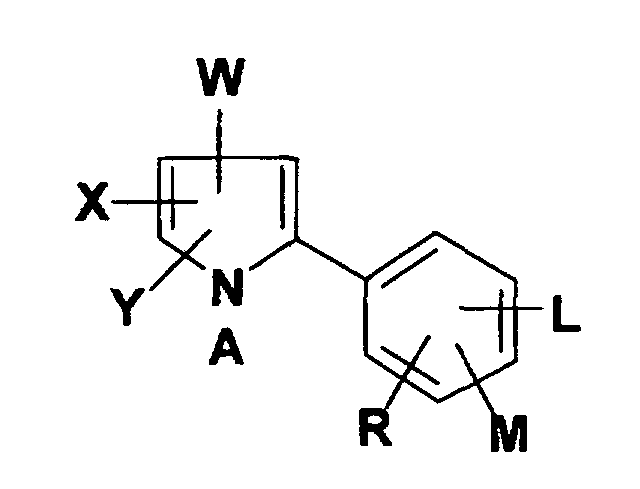
- Arylpyrrole compounds of this invention include those having the structural formula I wherein
- Preferred arylpyrrole compounds suitable for use in the present invention are those having the structural formula II wherein X, Y, W, A, L, M and R are as described above.
- Another important aspect of this invention is a process for preparing stable arylpyrrole articles, which process comprises providing a first mixture comprising arylpyrrole particles, a dispersing agent and water, characterized in that the first mixture is held a temperature range of about 25 °C to 80 °C to obtain an aged mixture and the aged mixture is milled, wherein the arylpyrrole has the structural formula I as defined above.
- stabilization refers to maintaining a relatively constant particle size. Stable particles do not grow significantly during storage at room temperature for up to three months or longer in a suspension concentrate composition.
- the stability of the arylpyrrole particles may be enhanced by the process of this invention.
- the amount of time needed to obtain a sufficiently aged mixture will vary, and will depend to some degree an the initial crystal form content, the particle size, and the temperature.
- the process of this invention is especially useful for stabilizing chlorfenapyr particles.
- the stabilization process of this invention is especially useful for improving the particle size stability of chlorfenapyr containing less than 80% of Polymorph I.
- the volume mean diameter of the arylpyrrole particles utilized in the process of this invention is preferably less than about 100 ⁇ m and more preferably about 0.5 ⁇ m to 30 ⁇ m.
- the volume mean diameter of the stabilized arylpyrrole particles prepared by the stabilization process is preferably about 0.5 ⁇ m to 10 ⁇ m and more preferably about 0.5 ⁇ m to 4 ⁇ m.
- Dispersing agents suitable for use in this invention include, but are not limited to, the salts of the condensation products of formaldehyde with the sulfonation products of polycyclic aromatic compounds; the salts of polyacrylic acids; the condensation products of fatty acids or aliphatic amines or amides containing at least about twelve carbon atoms in the molecule with ethylene oxide and/or propylene oxide; fatty acid esters of glycerol, sorbitan, sucrose or pentaerythritol and their condensation products with ethylene oxide and/or propylene oxide; condensation products of fatty alcohols or alkyl phenols with ethylene oxide and/or propylene oxide and their sulfates or sulfonates; and alkali or alkaline earth metal salts of sulfuric or sulfonic acid esters containing at least ten carbon atoms in the molecule, for example sodium lauryl sulfate and dodecylbenzene sulfonate.
- Preferred dispersing agents include the salts of the condensation products of formaldehyde with the sulfonation products of polycyclic aromatic compounds such as the salts of the condensation products of formaldehyde with naphthalene sulfonates, petroleum sulfonates and lignin sulfonates. More preferred dispersing agents include the sodium sulfonate of naphthalene formaldehyde condensates such as MORWET® D425 (Witco, Houston, Texas), LOMAR® PW (Henkel, Cincinnati, Ohio) and DARVAN® 1 (R.T. Vanderbilt Co., Norwalk, Connecticut).
- the first mixture is held in a temperature range of about 40 °C to 60 °C. In another preferred process of this invention, the first mixture is preferably held in the temperature range for about 1 hour to 72 hours, more preferably for about 2 hours to 48 hours and most preferably for about 2 hours to 24 hours.
- the first mixture of the present invention preferably comprises about 10% to 85% by weight of arylpyrrole particles, about 0.1% to 3.5% by weight of a dispersing agent, about 0.5% to 8.5% by weight of a steric stabilizer, about 0.1% to 2% by weight of a suspending agent, up to about 25% by weight of an antifreeze agent, up to about 2% by weight of an antifoam agent, up to about 1% by weight of a preservative, up to about 1% by weight of a thickening agent, and water.
- the first mixture comprises 20% to 70% by weight of arylpyrrole particles having a volume mean diameter of less than about 100 ⁇ m, 0.5% to 2.5% by weight of a dispersing agent, 1.5% to 6% by weight of a steric stabilizer, 0.1% to 2% by weight of a suspending agent, 5% to 20% by weight of an antifreeze agent, 0.1% to 2% by weight of an antifoam agent, 0.01% to 1% by weight of a preservative and water.
- the present invention also provides suspension concentrate compositions which comprise about 10% to 50% by weight of stabilized arylpyrrole particles prepared by the process of this invention, about 0.1% to 2% by weight of a dispersing agent, about 0.5% to 5% by weight of a steric stabilizer, about 0.1% to 1% by weight of a suspending agent, about 0.01% to 0.5% by weight of a thickening agent, about 5% to 15% by weight of an antifreeze agent, up to about 1% by weight of an antifoam agent, up to about 0.5% by weight of a preservative, and water.
- the suspension concentrate compositions of this invention preferably comprise 10% to 40% by weight of stabilized arylpyrrole particles having a volume mean diameter of 0.5 ⁇ m to 10 ⁇ m, 0.5% to 1.5% by weight of a dispersing agent, 1.5% to 3.5% by weight of a steric stabilizer, 0.1% to 1% by weight of a suspending agent, 0.01% to 0.5% by weight of a thickening agent, 5% to 10% by weight of an antifreeze agent, 0.1% to 1% by weight of an antifoam agent, 0.01% to 0.5% by weight of a preservative, and water.
- the ratio of the total amount of the dispersing agent and the steric stabilizer to the appropriate arylpyrrole particles is preferably about 1:5 to 1:15 and more preferably about 1:8 to 1:10.
- Steric stabilizers suitable for use in the present invention include, but are not limited to, polymers of ethylene oxide and copolymers of ethylene oxide and propylene oxide such as ethylene oxide/propylene oxide block copolymers.
- Preferred steric stabilizers are butyl-omega-hydroxypoly(oxypropylene)block polymers with poly(oxyethylene) having an average molecular weight in a range of about 2,400 to 3,500 with alpha-butyl-omega-hydroxy-ethylene oxide-propylene oxide block copolymers such as TOXIMUL® 8320 (Stepan Chemical Co., Winder, Georgia), WITCONOL® NS 500 LQ (Witco) and TERGITOL® XD (Union Carbide, Danbury, Connecticut) being most preferred.
- Suspending agents suitable for use in this invention include, but are not limited to, natural and synthetic clays and silicates, for example natural silicas such as diatomaceous earths; magnesium silicates such as talcs, magnesium aluminum silicates such as attapulgites and vermiculites; and aluminum silicates such as kaolinites, montmorillonites and micas.
- Preferred suspending agents are magnesium silicates, magnesium aluminum silicates and aluminum silicates with magnesium aluminum silicates such as VANGEL® ES (R.T. Vanderbilt), VEEGUM® (R.T. Vanderbilt), VEEGUM® T (R.T. Vanderbilt) and GELWHITE® (Southern Clay Products, Gonzales, Texas) being most preferred.
- Thickening agents useful in this invention include, but are not limited to, natural thickening agents such as xanthan gum, carrageenan, pectin, gum arabic, guar rubber and the like; semisynthetic thickening agents such as the methylation products, carboxy-alkylation products and hydroxyalkylation products of cellulose or starch derivatives; and synthetic thickening agents such as polyacrylates, polymaleinates and polyvinylpyrrolidone with xanthan gums such as KELZAN® (Kelco, San Diego, California) and RHO-DOPOL® 23 (Rhone-Poulenc, Cranbury, New Jersey) being preferred thickening agents.
- natural thickening agents such as xanthan gum, carrageenan, pectin, gum arabic, guar rubber and the like
- semisynthetic thickening agents such as the methylation products, carboxy-alkylation products and hydroxyalkylation products of cellulose or starch derivatives
- Antifreeze agents suitable for use in the present invention include glycols such as propylene glycol, ethylene glycol and the like with propylene glycol being preferred.
- Suitable antifoam agents include emulsions of silicone oils, emulsions of fatty alcohols and the like.
- Preservatives suitable for use in this invention include 1,2-benzisothiazolin-3-one, epichlorohydrin, phenylglycidyl ether, allylglycidyl ether, formaldehyde compositions and the like with 1,2-benzisothiazolin-3-one being preferred.
- Suspension concentrate compositions of the present invention may conveniently be prepared by admixing arylpyrrole particles, a dispersing agent, a steric stabilizer, a suspending agent and an antifreeze agent with water to obtain a first mixture, holding the first mixture according to the process of this invention to obtain an aged mixture, milling the aged mixture to obtain a mixture comprising stabilized arylpyrrole particles, and admixing the mixture comprising stabilized arylpyrrole particles with a thickening agent and additional water to obtain the desired suspension concentrate composition.
- the suspension concentrate compositions of this invention preferably have a pH of about pH 5 to pH 9 and more preferably about pH 6 to pH 8.
- acids such as acetic acid, propionic acid, sulfuric acid, phosphoric acid, hydrochloric acid and the like may be used.
- Propylene glycol (331 g), a 17% 1,2-benzisothiazolin-3-one solution (PROXEL® GXL, Zeneca) (6.35 g), a 30% silicone emulsion (AF 30 IND®, Harcros Chemical Co.)(29.9 g), an alpha-butyl-omega-hydroxyl-ethylene oxide/propylene oxide block copolymer (TOXIMUL® 8320, Stepan Chemical Co.)(132.5 g), a sodium sulfonate of a naphthalene formaldehyde condensate (MORWET® D425, Witco)(44 g), magnesium aluminum silicate (VANGEL® ES, R.T.
- composition Number 1 Ingredient wt/wt% Chlorfenapyr 50.00 MORWET® D425 1.43 TOXIMUL® 8320 4.30 VANGEL® ES 0.72 Propylene glycol 10.73 AF 30 IND® 0.97 PROXEL® GXL 0.21 Water 31.65
- composition numbers 1, 1 are stirred at 40 °C , 55 °C and 70 °C for 17 hours and passed through a wet milling device to obtain composition numbers 2, 3 and 4 comprising stabilized chlorfenapyr particles.
- Composition numbers 1-4 are then stored at room temperature for two months and the volume mean diameter of the chlorfenapyr particles in each composition is measured. The results are summarized in Table I.
- the volume mean diameter of the stabilized chlorfenapyr particles present in composition numbers 2, 3 and 4 increases significantly less than the volume mean diameter of the chlorfenapyr particles present in composition number 1.
- Stability of Chlorfenapyr Particles Comp. Number Temperature (°C) Stirred at for 17 Hours Initial Volume Mean Diameter of Chlorfenapyr Particles ( ⁇ m) Volume Mean Diameter of Chlorfenapyr Particles ( ⁇ m) After Storage at Room Temperature for 2 Months 1 N/A 1.58 4.47 2 40 1.42 1.41 3 55 1.49 1.41 4 70 1.50 2.72
- composition numbers 5-7 comprising stabilized chlorfenapyr particles are obtained.
- Those compositions and composition number 8 which is identical to composition number 1 from Example 1 except that the chlorfenapyr particles have a volume mean diameter of 1.44 ⁇ m, are stored at room temperature for three weeks. The volume mean diameter of the chlorfenapyr particles in each composition is then measured and the results are summarized in Table II.
- the volume mean diameter of the stabilized chlorfenapyr particles present in composition numbers 5-7 increases significantly less than the volume mean diameter of the chlorfenapyr particles present in composition number 8.
- composition numbers 9-15 comprising stabilized chlorfenapyr particles are obtained.
- Composition numbers 9-15 and non-stabilized chlorfenapyr composition number 16 which is identical to composition number 1 in Example 1 except that the chlorfenapyr particles have a volume mean diameter of 1.41 ⁇ m, are stored at room temperature for three months. The volume mean diameter of the chlorfenapyr particles in each composition is then measured and the results are summarized in Table III.
- the volume mean diameter of the stabilized chlorfenapyr particles present in composition numbers 9-15 increases significantly less than the volume mean diameter of the chlorfenapyr particles present in composition number 16.
- compositions comprising stabilized chlorfenapyr particles are obtained and identified in Table IV.
- the compositions comprising the stabilized chlorfenapyr particles and the appropriate non-stabilized composition are stored at room temperature for various periods of time. The volume mean diameter of the chlorfenapyr particles in each composition is then measured and the results are summarized in Table IV.
- chlorfenapyr particles present in stabilized compositions prepared using chlorfenapyr particles having less than about 80% Polymorph I are, in general, significantly more stable than chlorfenapyr particles present in the corresponding non-stabilized compositions.
- Propylene glycol (730 g), a 17% 1,2-benzisothiazolin-3-one solution (PROXEL® GXL, Zeneca)(14.0 g), a 30% silicone emulsion (AF 30 IND®, Harcros Chemical Co.)(66.0 g), alpha-butyl-omega-hydroxyl-ethylene oxide/propylene oxide block copolymer (TOXIMUL® 8320, Stepan Chemical Co.)(292 g), sodium sulfonate of naphthalene formaldehyde condensate (MORWET® D425, Witco)(97.0 g), magnesium aluminum silicate (VANGEL® ES, R.T.
- Vanderbilt (49.0 g) and chlorfenapyr (3,400 g, 90% real, 6.7:1 Polymorph I to Polymorph II ratio) are added sequentially with stirring to water (2,152 g).
- the resultant mixture is stirred until homogeneous and passed through a wet milling device to obtain a mill base wherein the chlorfenapyr particles have a volume mean diameter of about 1.5 ⁇ m.
- the mill base is charged into a vessel, agitated and adjusted to a pH of pH 6.5 to pH 7.2 with acetic acid (19.0 g).
- composition number 31 A 1% xanthan gum gel (1,459 g)(previously prepared from xanthan gum (15.0 g), a 17% 1,2-benzisothiazolin-3-one solution (PROXEL® GXL, Zeneca)(1.0 g) and water (1,443 g)) and water (1,453 g) are added to the pH adjusted mill base and mixing is continued to obtain the suspension concentrate composition identified below as composition number 31.
- composition Number 31 Ingredient wt/wt% Chlorfenapyr 34.94 MORWET® D425 1.00 TOXIMUL® 8320 3.00 VANGEL® ES 0.50 Propylene Glycol 7.50 AF 30 IND® 0.68 PROXEL® GXL 0.15 Xanthan Gum 0.15 Acetic Acid 0.20 Water 51.88
- the suspension concentrate compositions identified as composition numbers 32-38 in Table V are obtained. Samples of the suspension concentrate compositions are stored at room temperature for various periods of time. The volume mean diameter of the chlorfenapyr particles in each sample is then measured and the results are summarized in Table V.
- chlorfenapyr particles comprising a Polymorph I to Polymorph II ratio of greater than about 1:4 (composition numbers 31-35) are significantly more stable than chlorfenapyr particles comprising a Polymorph I to Polymorph II ratio of 1:4 to 0:1 (composition numbers 36-38).
Landscapes
- Life Sciences & Earth Sciences (AREA)
- Agronomy & Crop Science (AREA)
- Pest Control & Pesticides (AREA)
- Plant Pathology (AREA)
- Health & Medical Sciences (AREA)
- Engineering & Computer Science (AREA)
- Dentistry (AREA)
- General Health & Medical Sciences (AREA)
- Wood Science & Technology (AREA)
- Zoology (AREA)
- Environmental Sciences (AREA)
- Agricultural Chemicals And Associated Chemicals (AREA)
- Medicinal Preparation (AREA)
- Seasonings (AREA)
Claims (16)
- Procédé de préparation de particules d'arylpyrrole lequel procédé comprend la fourniture d'un premier mélange comprenant des particules d'arylpyrrole, un agent dispersant et de l'eau, caractérisé en ce que, le premier mélange est maintenu dans une plage de températures d'environ 25°C à 80°C afin d'obtenir un mélange vieilli, et le mélange vieilli est broyé,
dans lequel l'arylpyrrole répond à la formule développéedans laquelle
- X
- représente un atome de H, de F, de Cl, de Br, de I, un groupe halogénoalkyle en C1 à C4, où S (O)m(halogénoalkyle en C1 à C4);
- Y
- représente un atome de F, de Cl, de Br, de I, un groupe halogénoalkyle en C1 à C4, ou CN;
- W
- représente un groupe CN ou NO2;
- A
- représente un groupe alkyle en C1 à C4 non substitué ou substitué par un à trois atomes d'halogène, un groupe cyano, un groupe hydroxy, un groupe alcoxy en C1 à C4, un groupe alkylthio en C1 à C4, un groupe phényle, non substitué ou substitué par un groupe alkyle en C1 à C3, un groupe alcoxy en C1 à C3, ou un à trois atomes d'halogène, un groupe phénoxy, non substitué ou substitué par un à trois atomes d'halogène, ou un groupe benzyloxy, non substitué ou substitué par un atome d'halogène, un groupe (carbalcoxy en C1 à C4)-méthyle, un groupe alcényle en C3 à C4, non substitué ou substitué par un à trois atomes d'halogène, un groupe cyano, un groupe alcynyle en C3 à C4, non substitué ou substitué par un atome d'halogène, un groupe di-(alkyle en C1 à C4)aminocarbonyle, ou un groupe benzoyle, non substitué ou substitué par un à trois atomes d'halogène ou un à trois groupes alkyle en C1 à C4;
- L
- représente un atome de H, de F, de Cl, ou de Br;
- M,R
- représentent chacun indépendamment un atome de H, un groupe alkyle en C1 à C3, alcoxy en C1 à C3, alkylthio en C1 à C3, alkylsulfinyle en C1 à C3, alkysulfonyle en C1 à C3, cyano, un atome de F, de Cl, de Br, de I, un groupe nitro, halogénoalkyle en C1 à C3, R1CF2Z, R2CO ou NR3R4,
lorsque M et R sont dans des positions adjacentes et pris avec les atomes de carbone auxquels ils sont liés, ils peuvent former un cycle dans lequel MR représente la structure -OCH2O-, -OCF2O-, -OCR6R7CR8R9O-, -OCH2CH2-, -OCH2CH2CH2- ou -CH=CH-CH=CH-;- Z
- représente S(O)n, ou un atome de O;
- R1
- représente un atome de H, de F, un groupe CHF2, CHFCI ou CF3;
- R2
- représente un groupe alkyle en C1 à C3, alcoxy en C1 à C3, ou NR3R4;
- R3
- représente un atome de H ou un groupe alkyle en C1 à C3;
- R4
- représente un atome de H, un groupe alkyle en C1 à C3, ou C5CO;
- R5
- représente un atome de H ou un groupe alkyle en C1 à C3;
- R6, R7, R8 et R9
- représentent chacun indépendamment un atome d'hydrogène, d'halogène ou un groupe alkyle en C1 à C3; et
- m et n
- valent chacun indépendamment un nombre entier 0, 1 ou 2.
- Procédé selon la revendication 1, dans lequel l'arylpyrrole répond à la formule développée
- Procédé selon les revendications 1 ou 2, dans lequel
- X et Y
- représentent chacun indépendamment un atome de Cl, de Br ou un groupe CF3;
- W
- représente un groupe CN;
- A
- représente un groupe (alcoxy en C1 à C4)-méthyle;
- L
- représente un atome de H ou de F;
- M
- représente un atome de H, de F, de Cl, ou de Br; et
- R
- représente un atome de F, de Cl, de Br, un groupe CF3 ou OCF3.
- Procédé selon les revendications 1 à 3, dans lequel l'arylpyrrole est le chlorfénapyr.
- Procédé selon les revendications 1 à 4, dans lequel les particules d'arylpyrrole du premier mélange présentent un diamètre moyen en volume inférieur à 100 µm.
- Procédé selon les revendications 1 à 5, dans lequel le premier mélange est maintenu dans la plage de températures pendant 1 heure à 72 heures.
- Procédé selon les revendications 1 à 6, dans lequel la plage de température est de 40°C à 60°C.
- Procédé selon les revendications 4 à 7, dans lequel les particules de chlorfénapyr dans le premier mélange comprennent moins de 80% de la forme polymorphe I.
- Particules d'arylpyrrole stables que l'on peut obtenir à l'aide du procédé selon l'une quelconque des revendications 1 à 8.
- Particule d'arylpyrrole stable selon la revendication 9, comprenant un arylpyrrole qui peut exister sous la forme d'au moins deux formes polymorphes différentes, dont au moins l'une est stable en taille de particule pendant l'entreposage sous la forme d'une suspension à la température ambiante, dans laquelle le rapport de la forme polymorphe stable à la forme polymorphe instable dans ladite particule est supérieur à 1:4, ledit arylpyrrole étant représenté par la formule selon les revendications 1 à 4.
- Particule selon la revendication 10, dans laquelle ledit rapport est de 1:1 à 1:0.
- Composition comprenant une particule d'arylpyrrole selon les revendications 9 à 11.
- Composition de concentré de suspension qui comprend environ 10 à 50% en poids de particules d'arylpyrrole stables que l'on peut obtenir à l'aide du procédé selon les revendications 1 à 8, environ 0,1% à 2% en poids d'un agent dispersant, environ 0,5% à 5% en poids d'un stabilisant stérique, environ 0,1% à 1% en poids d'un agent de suspension, environ 0,01% à 0,5% en poids d'un épaississant, environ 5% à 15% en poids d'un agent antigel, jusqu'à environ 1% en poids d'un agent anti-mousse, jusqu'à environ 0,5% en poids d'un conservateur, et de l'eau.
- Composition selon la revendication 13, dans laquelle les particules d'arylpyrrole stables possèdent un diamètre moyen en volume d'environ 0,5 µm à 10 µm.
- Composition selon la revendication 13 ou 14, dans laquelle l'agent dispersant est un sel des produits de condensation du formaldéhyde avec les produits de sulfonation de composés aromatiques polycycliques; le stabilisant stérique est un copolymère séquencé oxyde d'éthylène/oxyde de propylène; l'agent de suspension est choisi dans le groupe formé par un aluminosilicate de magnésium, un silicate de magnésium et un silicate d'aluminium; l'agent antigel est un glycol; et l'épaississant est choisi dans le groupe formé par la gomme de xanthane, la carragénine, la pectine, la gomme arabique, et le caoutchouc guar.
- Composition selon les revendications 13 à 15, dans laquelle l'agent dispersant est le sulfonate sodique de condensats napthalène/formaldéhyde, le stabilisant stérique est un copolymère séquencé alpha-butyle/oméga-hydroxy/oxyde d'éthylène/oxyde de propylène, l'agent de suspension est un aluminosilicate de magnésium, l'agent antigel est le propylèneglycol, et l'épaississant est la gomme de xanthane.
Applications Claiming Priority (2)
| Application Number | Priority Date | Filing Date | Title |
|---|---|---|---|
| US69147896A | 1996-08-02 | 1996-08-02 | |
| US691478 | 1996-08-02 |
Publications (2)
| Publication Number | Publication Date |
|---|---|
| EP0821876A1 EP0821876A1 (fr) | 1998-02-04 |
| EP0821876B1 true EP0821876B1 (fr) | 2003-04-23 |
Family
ID=24776693
Family Applications (1)
| Application Number | Title | Priority Date | Filing Date |
|---|---|---|---|
| EP97305762A Expired - Lifetime EP0821876B1 (fr) | 1996-08-02 | 1997-07-31 | Particules stables d'arylpyrrole, leur procédé de préparation et suspensions concentrées les contenant |
Country Status (26)
| Country | Link |
|---|---|
| EP (1) | EP0821876B1 (fr) |
| JP (1) | JP4173568B2 (fr) |
| KR (1) | KR100470863B1 (fr) |
| CN (1) | CN1114477C (fr) |
| AR (1) | AR008278A1 (fr) |
| AT (1) | ATE237933T1 (fr) |
| AU (1) | AU737971B2 (fr) |
| BR (1) | BR9704253A (fr) |
| CA (1) | CA2212242C (fr) |
| CZ (1) | CZ293077B6 (fr) |
| DE (1) | DE69721145T2 (fr) |
| EE (1) | EE9700159A (fr) |
| ES (1) | ES2197974T3 (fr) |
| GE (1) | GEP19991853B (fr) |
| HR (1) | HRP970429B1 (fr) |
| HU (1) | HU224173B1 (fr) |
| ID (1) | ID19366A (fr) |
| IL (1) | IL121430A (fr) |
| MD (1) | MD1934B2 (fr) |
| NO (1) | NO973544L (fr) |
| NZ (1) | NZ328483A (fr) |
| RU (1) | RU2197087C2 (fr) |
| SK (1) | SK105197A3 (fr) |
| TR (1) | TR199700729A2 (fr) |
| YU (1) | YU33297A (fr) |
| ZA (1) | ZA976831B (fr) |
Cited By (1)
| Publication number | Priority date | Publication date | Assignee | Title |
|---|---|---|---|---|
| AU2016259360B1 (en) * | 2016-11-16 | 2017-09-07 | Rotam Agrochem International Company Limited | A novel crystalline form of chlorfenapyr, a process for its preparation and use of the same |
Families Citing this family (6)
| Publication number | Priority date | Publication date | Assignee | Title |
|---|---|---|---|---|
| ID23331A (id) * | 1998-03-31 | 2000-04-05 | American Cyanamid Co | Komposisi insektisida semprot yang memiliki kemanjuran kuat |
| CN101323584B (zh) * | 2005-04-05 | 2010-08-25 | 湖南化工研究院 | 具杀虫、杀螨、杀真菌生物活性的肟醚芳基吡咯类化合物及其制备方法 |
| CN100579962C (zh) * | 2005-04-05 | 2010-01-13 | 湖南化工研究院 | 具杀虫、杀螨、杀真菌生物活性的芳基吡咯类化合物及其制备方法 |
| PE20070182A1 (es) | 2005-07-29 | 2007-03-06 | Wyeth Corp | Derivados cianopirrol-fenil amida como moduladores del receptor de progesterona |
| JP7260480B2 (ja) | 2017-03-13 | 2023-04-18 | ビーエーエスエフ アグロ ベー.ブイ. | Dipea塩基の存在下でのアリールピロール化合物の製造 |
| CN108976157A (zh) * | 2018-09-13 | 2018-12-11 | 天津市天地创智科技发展有限公司 | 溴虫腈晶型ii及其制备方法 |
Family Cites Families (9)
| Publication number | Priority date | Publication date | Assignee | Title |
|---|---|---|---|---|
| DE2547968A1 (de) * | 1975-10-27 | 1977-05-05 | Basf Ag | Herbizid |
| CA1289065C (fr) * | 1986-05-23 | 1991-09-17 | Leonard John Morgan | Suspensions aqueuses concentrees |
| US4871392A (en) * | 1986-05-23 | 1989-10-03 | American Cyanamid Company | Aqueous suspension concentrate compositions of pendimethalin |
| US5010098A (en) * | 1987-07-29 | 1991-04-23 | American Cyanamid Company | Arylpyrrole insecticidal acaricidal and nematicidal agents and methods for the preparation thereof |
| IL100110A0 (en) * | 1990-12-26 | 1992-08-18 | American Cyanamid Co | Insecticidal and synergistic miticidal compositions |
| US5233051A (en) * | 1991-05-30 | 1993-08-03 | Bayer Aktiengesellschaft | Substituted 2-arylpyrroles |
| YU8592A (sh) * | 1991-08-28 | 1994-06-10 | Flumroc Ag. | Postupak i uređaj za izradu ploča od mineralnih vlakana primenjenih kao nosač zidnog premaza |
| CA2093737A1 (fr) * | 1992-05-01 | 1993-11-02 | Yili Guo | Compositions fongicides et methode de preparation |
| US5496845A (en) * | 1994-05-25 | 1996-03-05 | American Cyanamid Co. | Suspension concentrate compositions of arylpyrrole insecticidal and acaricidal agents |
-
1997
- 1997-07-30 CZ CZ19972428A patent/CZ293077B6/cs not_active IP Right Cessation
- 1997-07-30 IL IL12143097A patent/IL121430A/en not_active IP Right Cessation
- 1997-07-31 EP EP97305762A patent/EP0821876B1/fr not_active Expired - Lifetime
- 1997-07-31 TR TR97/00729A patent/TR199700729A2/xx unknown
- 1997-07-31 AT AT97305762T patent/ATE237933T1/de active
- 1997-07-31 DE DE69721145T patent/DE69721145T2/de not_active Expired - Lifetime
- 1997-07-31 EE EE9700159A patent/EE9700159A/xx unknown
- 1997-07-31 ES ES97305762T patent/ES2197974T3/es not_active Expired - Lifetime
- 1997-07-31 CA CA002212242A patent/CA2212242C/fr not_active Expired - Lifetime
- 1997-07-31 ZA ZA976831A patent/ZA976831B/xx unknown
- 1997-07-31 ID IDP972665A patent/ID19366A/id unknown
- 1997-08-01 GE GEAP19973835A patent/GEP19991853B/en unknown
- 1997-08-01 JP JP22101697A patent/JP4173568B2/ja not_active Expired - Lifetime
- 1997-08-01 NZ NZ328483A patent/NZ328483A/en unknown
- 1997-08-01 AU AU32451/97A patent/AU737971B2/en not_active Ceased
- 1997-08-01 YU YU33297A patent/YU33297A/sh unknown
- 1997-08-01 HR HR970429A patent/HRP970429B1/xx not_active IP Right Cessation
- 1997-08-01 RU RU97113518/04A patent/RU2197087C2/ru not_active IP Right Cessation
- 1997-08-01 SK SK1051-97A patent/SK105197A3/sk unknown
- 1997-08-01 HU HU9701346A patent/HU224173B1/hu not_active IP Right Cessation
- 1997-08-01 AR ARP970103528A patent/AR008278A1/es active IP Right Grant
- 1997-08-01 NO NO973544A patent/NO973544L/no not_active Application Discontinuation
- 1997-08-01 KR KR1019970036850A patent/KR100470863B1/ko not_active Expired - Lifetime
- 1997-08-04 MD MD97-0260A patent/MD1934B2/ro unknown
- 1997-08-04 CN CN97117469A patent/CN1114477C/zh not_active Expired - Lifetime
- 1997-08-04 BR BR9704253A patent/BR9704253A/pt not_active IP Right Cessation
Cited By (1)
| Publication number | Priority date | Publication date | Assignee | Title |
|---|---|---|---|---|
| AU2016259360B1 (en) * | 2016-11-16 | 2017-09-07 | Rotam Agrochem International Company Limited | A novel crystalline form of chlorfenapyr, a process for its preparation and use of the same |
Also Published As
Similar Documents
| Publication | Publication Date | Title |
|---|---|---|
| EP0683979B1 (fr) | Suspension concentrée des arylpyrroles insecticides et acarizides | |
| EP0821876B1 (fr) | Particules stables d'arylpyrrole, leur procédé de préparation et suspensions concentrées les contenant | |
| US6417372B2 (en) | Stable arylpyrrole particles, process for their preparation and suspension concentrate compositions comprising them | |
| IL133287A (en) | Stable arylpyrrole particles and suspension concentrate compositions comprising them | |
| CN109819992B (zh) | 一种含有吡唑醚菌酯与百里香酚的杀菌组合物 | |
| CN114190390A (zh) | 一种杀菌组合物及其在防治农作物病害中的应用 | |
| HK1009920B (en) | Suspension concentrate compositions of arylpyrrole insecticidal and acaricidal agents | |
| CN113367136A (zh) | 一种含螺螨双酯与四螨嗪的杀螨组合物 | |
| KR102822627B1 (ko) | 살균 현탁제 | |
| MXPA97005908A (en) | Particles of arilpirrol stable, the process for its preparation and the compositions of concentrate in suspension that compress | |
| KR102824687B1 (ko) | 살균 조성물 및 이를 포함하는 살균제 | |
| UA53618C2 (uk) | Спосіб одержання хлорфенапірних часток стабільної кристалічної форми, хлорфенапірні частки та композиції концентрату суспензії | |
| CN121058671A (zh) | 一种农药组合物及其应用 | |
| CN113973830A (zh) | 一种含fluoxapiprolin和丙硫菌唑的杀菌组合物 | |
| CN121845075A (zh) | 一种农药杀虫组合物及其制备方法和应用 | |
| CN121621357A (zh) | 一种杀螨组合物及其应用 | |
| KR20220030807A (ko) | 살균 조성물 |
Legal Events
| Date | Code | Title | Description |
|---|---|---|---|
| PUAI | Public reference made under article 153(3) epc to a published international application that has entered the european phase |
Free format text: ORIGINAL CODE: 0009012 |
|
| AK | Designated contracting states |
Kind code of ref document: A1 Designated state(s): AT BE CH DE DK ES FI FR GB GR IE IT LI LU NL PT SE |
|
| AX | Request for extension of the european patent |
Free format text: SI PAYMENT 970814 |
|
| 17P | Request for examination filed |
Effective date: 19980312 |
|
| AKX | Designation fees paid |
Free format text: AT BE CH DE DK ES FI FR GB GR IE IT LI LU NL PT SE |
|
| AXX | Extension fees paid |
Free format text: SI PAYMENT 970814 |
|
| RBV | Designated contracting states (corrected) |
Designated state(s): AT BE CH DE DK ES FI FR GB GR IE IT LI LU NL PT SE |
|
| 17Q | First examination report despatched |
Effective date: 20010802 |
|
| RAP1 | Party data changed (applicant data changed or rights of an application transferred) |
Owner name: BASF AKTIENGESELLSCHAFT |
|
| GRAH | Despatch of communication of intention to grant a patent |
Free format text: ORIGINAL CODE: EPIDOS IGRA |
|
| GRAH | Despatch of communication of intention to grant a patent |
Free format text: ORIGINAL CODE: EPIDOS IGRA |
|
| GRAA | (expected) grant |
Free format text: ORIGINAL CODE: 0009210 |
|
| AK | Designated contracting states |
Designated state(s): AT BE CH DE DK ES FI FR GB GR IE IT LI LU NL PT SE |
|
| AX | Request for extension of the european patent |
Extension state: SI |
|
| PG25 | Lapsed in a contracting state [announced via postgrant information from national office to epo] |
Ref country code: FI Free format text: LAPSE BECAUSE OF FAILURE TO SUBMIT A TRANSLATION OF THE DESCRIPTION OR TO PAY THE FEE WITHIN THE PRESCRIBED TIME-LIMIT Effective date: 20030423 |
|
| REG | Reference to a national code |
Ref country code: GB Ref legal event code: FG4D |
|
| REG | Reference to a national code |
Ref country code: CH Ref legal event code: EP |
|
| REF | Corresponds to: |
Ref document number: 69721145 Country of ref document: DE Date of ref document: 20030528 Kind code of ref document: P |
|
| REG | Reference to a national code |
Ref country code: IE Ref legal event code: FG4D |
|
| REG | Reference to a national code |
Ref country code: CH Ref legal event code: NV Representative=s name: ROTTMANN, ZIMMERMANN + PARTNER AG |
|
| PG25 | Lapsed in a contracting state [announced via postgrant information from national office to epo] |
Ref country code: SE Free format text: LAPSE BECAUSE OF FAILURE TO SUBMIT A TRANSLATION OF THE DESCRIPTION OR TO PAY THE FEE WITHIN THE PRESCRIBED TIME-LIMIT Effective date: 20030723 Ref country code: PT Free format text: LAPSE BECAUSE OF FAILURE TO SUBMIT A TRANSLATION OF THE DESCRIPTION OR TO PAY THE FEE WITHIN THE PRESCRIBED TIME-LIMIT Effective date: 20030723 Ref country code: DK Free format text: LAPSE BECAUSE OF FAILURE TO SUBMIT A TRANSLATION OF THE DESCRIPTION OR TO PAY THE FEE WITHIN THE PRESCRIBED TIME-LIMIT Effective date: 20030723 |
|
| PG25 | Lapsed in a contracting state [announced via postgrant information from national office to epo] |
Ref country code: LU Free format text: LAPSE BECAUSE OF NON-PAYMENT OF DUE FEES Effective date: 20030731 Ref country code: IE Free format text: LAPSE BECAUSE OF NON-PAYMENT OF DUE FEES Effective date: 20030731 |
|
| REG | Reference to a national code |
Ref country code: GR Ref legal event code: EP Ref document number: 20030402609 Country of ref document: GR |
|
| ET | Fr: translation filed | ||
| REG | Reference to a national code |
Ref country code: ES Ref legal event code: FG2A Ref document number: 2197974 Country of ref document: ES Kind code of ref document: T3 |
|
| PLBE | No opposition filed within time limit |
Free format text: ORIGINAL CODE: 0009261 |
|
| STAA | Information on the status of an ep patent application or granted ep patent |
Free format text: STATUS: NO OPPOSITION FILED WITHIN TIME LIMIT |
|
| 26N | No opposition filed |
Effective date: 20040126 |
|
| REG | Reference to a national code |
Ref country code: IE Ref legal event code: MM4A |
|
| REG | Reference to a national code |
Ref country code: CH Ref legal event code: PCAR Free format text: SCHMAUDER & PARTNER AG PATENT- UND MARKENANWAELTE VSP;ZWAENGIWEG 7;8038 ZUERICH (CH) |
|
| PGFP | Annual fee paid to national office [announced via postgrant information from national office to epo] |
Ref country code: NL Payment date: 20140728 Year of fee payment: 18 Ref country code: CH Payment date: 20140728 Year of fee payment: 18 |
|
| PGFP | Annual fee paid to national office [announced via postgrant information from national office to epo] |
Ref country code: GB Payment date: 20140729 Year of fee payment: 18 Ref country code: AT Payment date: 20140627 Year of fee payment: 18 |
|
| PGFP | Annual fee paid to national office [announced via postgrant information from national office to epo] |
Ref country code: BE Payment date: 20140828 Year of fee payment: 18 |
|
| REG | Reference to a national code |
Ref country code: FR Ref legal event code: PLFP Year of fee payment: 19 |
|
| REG | Reference to a national code |
Ref country code: CH Ref legal event code: PL |
|
| REG | Reference to a national code |
Ref country code: AT Ref legal event code: MM01 Ref document number: 237933 Country of ref document: AT Kind code of ref document: T Effective date: 20150731 |
|
| GBPC | Gb: european patent ceased through non-payment of renewal fee |
Effective date: 20150731 |
|
| REG | Reference to a national code |
Ref country code: NL Ref legal event code: MM Effective date: 20150801 |
|
| PG25 | Lapsed in a contracting state [announced via postgrant information from national office to epo] |
Ref country code: LI Free format text: LAPSE BECAUSE OF NON-PAYMENT OF DUE FEES Effective date: 20150731 Ref country code: CH Free format text: LAPSE BECAUSE OF NON-PAYMENT OF DUE FEES Effective date: 20150731 Ref country code: GB Free format text: LAPSE BECAUSE OF NON-PAYMENT OF DUE FEES Effective date: 20150731 |
|
| PG25 | Lapsed in a contracting state [announced via postgrant information from national office to epo] |
Ref country code: NL Free format text: LAPSE BECAUSE OF NON-PAYMENT OF DUE FEES Effective date: 20150801 Ref country code: AT Free format text: LAPSE BECAUSE OF NON-PAYMENT OF DUE FEES Effective date: 20150731 |
|
| REG | Reference to a national code |
Ref country code: FR Ref legal event code: PLFP Year of fee payment: 20 |
|
| PGFP | Annual fee paid to national office [announced via postgrant information from national office to epo] |
Ref country code: IT Payment date: 20160721 Year of fee payment: 20 |
|
| PGFP | Annual fee paid to national office [announced via postgrant information from national office to epo] |
Ref country code: GR Payment date: 20160725 Year of fee payment: 20 Ref country code: FR Payment date: 20160727 Year of fee payment: 20 |
|
| PGFP | Annual fee paid to national office [announced via postgrant information from national office to epo] |
Ref country code: ES Payment date: 20160829 Year of fee payment: 20 |
|
| PGFP | Annual fee paid to national office [announced via postgrant information from national office to epo] |
Ref country code: DE Payment date: 20160930 Year of fee payment: 20 |
|
| PG25 | Lapsed in a contracting state [announced via postgrant information from national office to epo] |
Ref country code: BE Free format text: LAPSE BECAUSE OF NON-PAYMENT OF DUE FEES Effective date: 20150731 |
|
| REG | Reference to a national code |
Ref country code: DE Ref legal event code: R071 Ref document number: 69721145 Country of ref document: DE |
|
| REG | Reference to a national code |
Ref country code: ES Ref legal event code: FD2A Effective date: 20180508 |
|
| PG25 | Lapsed in a contracting state [announced via postgrant information from national office to epo] |
Ref country code: ES Free format text: LAPSE BECAUSE OF EXPIRATION OF PROTECTION Effective date: 20170801 |