EP0821916A2 - Procédé de chirurgie stéréotactique au laser - Google Patents
Procédé de chirurgie stéréotactique au laser Download PDFInfo
- Publication number
- EP0821916A2 EP0821916A2 EP97305138A EP97305138A EP0821916A2 EP 0821916 A2 EP0821916 A2 EP 0821916A2 EP 97305138 A EP97305138 A EP 97305138A EP 97305138 A EP97305138 A EP 97305138A EP 0821916 A2 EP0821916 A2 EP 0821916A2
- Authority
- EP
- European Patent Office
- Prior art keywords
- tissue
- probe
- laser
- laser beam
- mirror
- Prior art date
- Legal status (The legal status is an assumption and is not a legal conclusion. Google has not performed a legal analysis and makes no representation as to the accuracy of the status listed.)
- Granted
Links
- 238000000034 method Methods 0.000 title claims abstract description 45
- 238000002430 laser surgery Methods 0.000 title description 7
- 239000000523 sample Substances 0.000 claims abstract description 89
- 230000033001 locomotion Effects 0.000 claims abstract description 31
- 238000003384 imaging method Methods 0.000 claims description 17
- 230000003211 malignant effect Effects 0.000 claims description 7
- 239000004973 liquid crystal related substance Substances 0.000 claims description 3
- 238000004519 manufacturing process Methods 0.000 claims 2
- 230000002153 concerted effect Effects 0.000 abstract 1
- 210000001519 tissue Anatomy 0.000 description 133
- 206010028980 Neoplasm Diseases 0.000 description 67
- 238000002679 ablation Methods 0.000 description 27
- 239000012530 fluid Substances 0.000 description 17
- 230000002262 irrigation Effects 0.000 description 17
- 238000003973 irrigation Methods 0.000 description 17
- 238000002591 computed tomography Methods 0.000 description 9
- 210000004204 blood vessel Anatomy 0.000 description 8
- 230000000694 effects Effects 0.000 description 8
- 230000007246 mechanism Effects 0.000 description 8
- 239000002245 particle Substances 0.000 description 8
- 238000002604 ultrasonography Methods 0.000 description 8
- 208000003174 Brain Neoplasms Diseases 0.000 description 5
- 239000012634 fragment Substances 0.000 description 5
- 208000014674 injury Diseases 0.000 description 5
- 238000007917 intracranial administration Methods 0.000 description 5
- 230000017074 necrotic cell death Effects 0.000 description 5
- 230000008733 trauma Effects 0.000 description 5
- 238000011282 treatment Methods 0.000 description 5
- 239000008280 blood Substances 0.000 description 4
- 210000004369 blood Anatomy 0.000 description 4
- 230000008569 process Effects 0.000 description 4
- 230000035939 shock Effects 0.000 description 4
- UJKPHYRXOLRVJJ-MLSVHJFASA-N CC(O)C1=C(C)/C2=C/C3=N/C(=C\C4=C(CCC(O)=O)C(C)=C(N4)/C=C4\N=C(\C=C\1/N\2)C(C)=C4C(C)O)/C(CCC(O)=O)=C3C Chemical compound CC(O)C1=C(C)/C2=C/C3=N/C(=C\C4=C(CCC(O)=O)C(C)=C(N4)/C=C4\N=C(\C=C\1/N\2)C(C)=C4C(C)O)/C(CCC(O)=O)=C3C UJKPHYRXOLRVJJ-MLSVHJFASA-N 0.000 description 3
- VEXZGXHMUGYJMC-UHFFFAOYSA-M Chloride anion Chemical compound [Cl-] VEXZGXHMUGYJMC-UHFFFAOYSA-M 0.000 description 3
- KEAYESYHFKHZAL-UHFFFAOYSA-N Sodium Chemical compound [Na] KEAYESYHFKHZAL-UHFFFAOYSA-N 0.000 description 3
- 229960003569 hematoporphyrin Drugs 0.000 description 3
- 238000012544 monitoring process Methods 0.000 description 3
- 230000003287 optical effect Effects 0.000 description 3
- 238000001959 radiotherapy Methods 0.000 description 3
- 239000007787 solid Substances 0.000 description 3
- 238000001356 surgical procedure Methods 0.000 description 3
- 230000004075 alteration Effects 0.000 description 2
- 238000013459 approach Methods 0.000 description 2
- 239000013060 biological fluid Substances 0.000 description 2
- 210000004556 brain Anatomy 0.000 description 2
- 230000003993 interaction Effects 0.000 description 2
- 230000001788 irregular Effects 0.000 description 2
- 239000007788 liquid Substances 0.000 description 2
- 238000013507 mapping Methods 0.000 description 2
- 230000001404 mediated effect Effects 0.000 description 2
- 230000005855 radiation Effects 0.000 description 2
- 238000002271 resection Methods 0.000 description 2
- 210000003625 skull Anatomy 0.000 description 2
- 239000000725 suspension Substances 0.000 description 2
- 230000033912 thigmotaxis Effects 0.000 description 2
- 230000032258 transport Effects 0.000 description 2
- 238000012285 ultrasound imaging Methods 0.000 description 2
- 230000000007 visual effect Effects 0.000 description 2
- 206010030113 Oedema Diseases 0.000 description 1
- 238000010521 absorption reaction Methods 0.000 description 1
- 230000004323 axial length Effects 0.000 description 1
- 230000000740 bleeding effect Effects 0.000 description 1
- 238000002512 chemotherapy Methods 0.000 description 1
- 230000001112 coagulating effect Effects 0.000 description 1
- 238000010276 construction Methods 0.000 description 1
- 230000034994 death Effects 0.000 description 1
- 230000003247 decreasing effect Effects 0.000 description 1
- 238000013461 design Methods 0.000 description 1
- 238000001514 detection method Methods 0.000 description 1
- 238000012631 diagnostic technique Methods 0.000 description 1
- 239000000835 fiber Substances 0.000 description 1
- 239000010419 fine particle Substances 0.000 description 1
- 230000006872 improvement Effects 0.000 description 1
- 238000003780 insertion Methods 0.000 description 1
- 230000037431 insertion Effects 0.000 description 1
- 238000013532 laser treatment Methods 0.000 description 1
- 230000004807 localization Effects 0.000 description 1
- 230000007774 longterm Effects 0.000 description 1
- 238000005259 measurement Methods 0.000 description 1
- 230000004044 response Effects 0.000 description 1
- 238000007789 sealing Methods 0.000 description 1
- 230000003595 spectral effect Effects 0.000 description 1
- 238000010186 staining Methods 0.000 description 1
- 238000003325 tomography Methods 0.000 description 1
Images



Classifications
-
- A—HUMAN NECESSITIES
- A61—MEDICAL OR VETERINARY SCIENCE; HYGIENE
- A61B—DIAGNOSIS; SURGERY; IDENTIFICATION
- A61B18/00—Surgical instruments, devices or methods for transferring non-mechanical forms of energy to or from the body
- A61B18/18—Surgical instruments, devices or methods for transferring non-mechanical forms of energy to or from the body by applying electromagnetic radiation, e.g. microwaves
- A61B18/20—Surgical instruments, devices or methods for transferring non-mechanical forms of energy to or from the body by applying electromagnetic radiation, e.g. microwaves using laser
- A61B18/22—Surgical instruments, devices or methods for transferring non-mechanical forms of energy to or from the body by applying electromagnetic radiation, e.g. microwaves using laser the beam being directed along or through a flexible conduit, e.g. an optical fibre; Couplings or hand-pieces therefor
- A61B18/24—Surgical instruments, devices or methods for transferring non-mechanical forms of energy to or from the body by applying electromagnetic radiation, e.g. microwaves using laser the beam being directed along or through a flexible conduit, e.g. an optical fibre; Couplings or hand-pieces therefor with a catheter
-
- A—HUMAN NECESSITIES
- A61—MEDICAL OR VETERINARY SCIENCE; HYGIENE
- A61B—DIAGNOSIS; SURGERY; IDENTIFICATION
- A61B90/00—Instruments, implements or accessories specially adapted for surgery or diagnosis and not covered by any of the groups A61B1/00 - A61B50/00, e.g. for luxation treatment or for protecting wound edges
- A61B90/10—Instruments, implements or accessories specially adapted for surgery or diagnosis and not covered by any of the groups A61B1/00 - A61B50/00, e.g. for luxation treatment or for protecting wound edges for stereotaxic surgery, e.g. frame-based stereotaxis
-
- A—HUMAN NECESSITIES
- A61—MEDICAL OR VETERINARY SCIENCE; HYGIENE
- A61B—DIAGNOSIS; SURGERY; IDENTIFICATION
- A61B8/00—Diagnosis using ultrasonic, sonic or infrasonic waves
- A61B8/08—Clinical applications
- A61B8/0808—Clinical applications for diagnosis of the brain
Definitions
- This invention is in the field of methods and apparatus used in the treatment of brain tumors and functional operations.
- the principle method currently in use for the treatment of brain tumors is the operative resection.
- Such treatment necessarily involves significant physical trauma to healthy surrounding tissues, especially when the tumor is deep-seated, located deep within the brain.
- the most prevalent treatment used in conjunction with the surgical resection is radiation therapy.
- Radiation therapy typically is administered with the assistance of stereotaxis to achieve precise localization of the effects of the radiation in the tumor.
- Stereotaxis is accomplished with an external framework attached to the skull of the patient.
- the radiation can be focused precisely on the tumor, to achieve a necrosis of the tumor tissue. If the volume of the tumor tissue is beyond a certain magnitude, the irradiation induced necrosis can have serious side effects. Irradiation induced necrosis can, in fact, grow like a tumor. In addition, fluid can accumulate at the site of the tumor, and the resulting edema can have long term effects, possibly even resulting in death. If chemotherapy is used in conjunction with the radiation therapy, the risks associated with irradiation induced necrosis are increased.
- the lasers used for this purpose are either a CO 2 laser or a Nd:YAG laser. Both of these lasers use thermal energy to vaporize or coagulate the tumor tissue. It happens, however, that the application of sufficient thermal energy to achieve tumor tissue necrosis through these mechanisms necessarily heats the surrounding tissues as well.
- the present invention is a method which improves the efficacy of laser surgery on brain tumors by using a type of laser which has a more effective tissue removal scheme, and by applying the laser beam from within the tumor to reduce the amount of surrounding healthy tissue that may otherwise be affected.
- a powerful solid state laser is used, with pulse durations in the one hundredth to one hundred picosecond range.
- the pulses from such a laser precisely break off small segments of tumor tissue, thereby eradicating the tumor by ablation, through a mechanism of non-thermal photodisruption of the tissue. There are no discernible effects in surrounding tissues.
- a laser probe has been devised which applies the laser energy at the precise location of the tumor, with a minimum amount of trauma to intervening tissues.
- the probe is sufficiently small to reach into a tumor with minimal trauma along the access path. Further, a single access path will often suffice, avoiding the wide range of approach angles necessitated by previously used laser equipment.
- the laser beam is emitted from a lateral opening at the distal end of the probe, perpendicular to the axis of the probe, or from a forward directed opening at the distal end of the probe, to strike a target within the tumor.
- the laser beam is then moved according to a planned sequence to progressively ablate tumor tissue until all of the tissue is removed.
- the high power picosecond laser photodisrupts target tissue by an interaction mechanism called plasma-mediated ablation.
- the laser is sharply focused on the tissue surface, creating a microplasma at the focus spot, where a high power density exists.
- the microplasma rapidly expands, generating a cavitation bubble and a shock wave.
- the cavitation bubble imposes stress on the tissue, and the shock wave creates a pressure gradient in the tissue, resulting in a mechanical disruption of the segment of tissue. In this way, the tumor tissue is fragmented into very fine particles.
- the energy level of the laser is controlled to achieve, but not greatly exceed, the ablation threshold. This results in ablation of the target tissue with negligible mechanical effects on surrounding tissue. Even at higher energies, the effects on surrounding tissues vanish within 300 microns of the focus spot.
- the laser probe has a rigid tubular section and a mounting body which can be mounted on a head ring for stereotactic control purposes.
- the tubular section of the probe has a very small overall diameter, and it consists of three coaxial tubes. Other tube arrangements could also be used.
- the first, inner, tube provides a channel for the laser beam path, and it houses the necessary optical devices for control of the laser beam, including a focusing lens.
- the second tube surrounds the first tube, and a mirror is attached near the distal end of the second tube for deflecting the laser beam.
- a space between the first tube and the second tube provides a flowpath for irrigation fluid toward the distal end of the probe.
- the irrigation fluid is pumped down the space between the first tube and the second tube to clear the mirror and to put ablated tissue particles near the distal end of the probe into suspension.
- the third, outer, tube surrounds the first and second tubes, and a space between the second tube and the third tube provides a flowpath for aspirated irrigation fluid toward the proximal end of the probe.
- the aspirated fluid transports the suspended tissue particles and any accumulated biological fluid away from the operative area near the distal end of the probe. Therefore, as ablation occurs, continual irrigation and aspiration of the operative area removes the particles of tumor tissue as they are broken loose by ablation.
- the flow in the irrigation and aspiration flowpaths also can be controlled to regulate the intracranial pressure.
- the mirror is located near the distal end of the probe.
- the laser beam passes longitudinally through the inner tube, toward the mirror at the distal end of the second tube.
- the mirror is angled so as to reflect the laser beam at approximately a ninety degree angle, causing the laser beam to exit the probe through a lateral opening in the tube, along a path approximately perpendicular to the longitudinal axis of the probe.
- the second tube, to which the mirror is attached, is movable longitudinally, both proximally and distally, to cause the laser beam exit point to move longitudinally along the probe.
- the focusing lens is situated within the inner tube proximal to the mirror.
- the placement of the focusing lens relative to the mirror is accurately controlled by movement of the inner tube relative to the second tube so as to precisely focus the laser beam at a selected distance away from the axis of the probe.
- the selected distance is chosen to place the focus point on the surface of the tumor tissue to be ablated.
- the first and second tubes also can be moved in concert to maintain a desired focal distance while moving the exit path of the laser beam longitudinally.
- the second tube can be rotated, to cause the mirror and the exit laser beam to rotate through a selected angle.
- the angle through which the mirror and laser beam are rotated can be any angle up to 360 degrees. Since the laser beam is focused at a point external to the probe, the focus point passes through an arc as the mirror rotates through the selected angle. If desired, the arc can form a full circle.
- the mirror and the focusing lens can be moved in concert along the longitudinal axis of the probe in either the distal or the proximal direction. During this movement, the distance between the mirror and the lens can be maintained precisely constant to insure that the perpendicular distance of the focus point from the probe axis remains constant.
- This longitudinal movement can be accomplished by simultaneous movement of the first and second tubes. As the mirror and lens are moved longitudinally, the position of the focus point also moves longitudinally, maintaining its selected distance from the probe axis.
- the focus point will follow a spiral path generating a cylinder, coaxial with the probe.
- a portion of a cylinder could be described by reciprocating rotation of the mirror through a lesser arc, simultaneous with the longitudinal movement of the mirror and lens.
- the mirror could be rotated through a desired arc while the longitudinal position is held stationary, followed by an incremental longitudinal movement of the mirror and lens and a subsequent rotation of the mirror.
- This stepwise scheme could also be used to generate a partial or full cylinder. It can easily be seen that combinations of mirror rotation and longitudinal movement can be devised to cause the focus point to follow any portion of a cylindrical path along the surface of the target tissue, ablating a layer of tissue as it moves.
- the distance between the mirror and the focusing lens can be slightly decreased by moving the inner tube distally, to increase the perpendicular distance of the focus point from the probe axis. This new distance can be selected to place the focus point on the newly exposed surface of the tumor tissue remaining after removal of the first cylindrical layer of tissue by the ablation of tissue at the moving focus point.
- the distal end of the probe can be initially inserted into the center of the tumor, thereby creating a cylindrical cavity in the center of the tumor, occupied by the probe.
- the focusing lens can then be moved to locate the focus point near the surface of the probe, focusing the laser beam on the adjacent surface of the tumor tissue. Longitudinal and rotational movement of the focus point can then ablate a generally cylindrical layer of tissue passing through the center of the tumor.
- a small balloon catheter, attached to the tip of the laser probe can slightly shift outwards the first layer of tissue. The ablated tissue fragments are then removed by aspiration through the probe, along with the irrigation fluid.
- Adjustment of the focus point to a location slightly farther from the probe axis, followed by repetition of the longitudinal and rotational movement, will result in ablation of a second cylindrical layer of tumor tissue. This process can be repeated until the tumor has been completely ablated and removed, from the center outwardly.
- a layer of tumor tissue can be ablated from an irregular surface by adjustment of the perpendicular distance to the focus point simultaneously with longitudinal and rotational movement of the mirror. This allows the focus point, and hence the ablation point, to follow an irregular surface of tumor tissue, rather than being restricted to a cylindrical surface. This can be important when the outer layers of the tumor are ablated, since the tumor will seldom be cylindrically shaped. Thus, the outer layers of the tumor can be photodisrupted and removed without trauma to the surrounding healthy tissue.
- a second laser like a continuous wave laser which is capable of coagulating tissue, can also be used. In either case, this calls for visual monitoring of the operative area during the surgery, to locate and identify the blood vessels as they are exposed.
- CT computer tomography
- MR magnetic resonance
- the visual monitoring in real time can be accomplished with a confocal laser scanning microscope connected to the laser probe.
- the real time image from the microscope can be matched to the previously obtained CT and MR information to facilitate accurate control of the operation.
- a computer can be programmed to follow a selected ablation path, or the probe can be directed manually by entry of computer commands in real time. In this way, a three dimensional plan can be devised for the surgery, and the plan can be stereotactically controlled by a combination of manual and computer control.
- Real time monitoring with the laser scanning microscope can be enhanced with a laser doppler flowmeter to detect details such as individual capillaries which are too small to be seen visually.
- ultrasound can be used to detect larger vessels.
- a fluorescence spectrometer can be integrated into the laser probe to identify and differentiate between tumor tissue and healthy tissue.
- ultrasound can be used to visualize the tumor borders on a macroscopic scale.
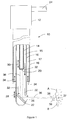
- a laser probe 10 applies the laser energy at a precise location within the tumor A.
- the tubular distal portion of the probe 10 has a diameter of approximately 5.5 millimeters, and it is sufficiently small to reach into a tumor A with minimal trauma along the access path.
- the length of the tubular portion of the probe 10 is about 10 centimeters.
- the laser beam 36 is emitted laterally from the distal end of the probe 10, perpendicular to the axis of the probe 10, to strike the target surface B within the interior of the tumor A. Focusing of the laser beam 36 on to the surface B ablates the surface tissue by photodisruption to create loose tissue fragments or particles 38.
- the distal portion of the laser probe 10 is a rigid tubular section consisting of three coaxial hollow tubes 14, 16, 18. Other tube arrangements could also be used.
- the coaxial tubes 14, 16, 18 are mounted to a mounting body 12.
- the first, inner, tube 14 provides a channel for the laser beam path, and it houses the necessary optical devices for control of the laser beam 36, including a focusing lens 20.
- the second tube 16 coaxially surrounds the first tube 14, and a mirror 22 is attached near the distal end of the second tube 16 for deflecting the laser beam 36.
- the laser beam 36 is represented pictorially in the figure as two rays for illustration purposes only.
- a space 15 between the first tube 14 and the second tube 16 provides a flowpath 32 for irrigation fluid toward the distal end of the probe 10.
- An isotonic natrium chloride solution has been found suitable as an irrigation fluid.
- the irrigation fluid is pumped down the space 15 between the first tube 14 and the second tube 16 to clear the mirror 22 and to put ablated tissue particles 38 into suspension near the distal end of the probe 10.
- the third, outer, tube 18 surrounds the first and second tubes 14, 16.
- a space 17 between the second tube 16 and the third tube 18 provides a flowpath 34 for aspirated irrigation fluid toward the proximal end of the probe 10.
- the aspirated fluid transports the suspended tissue particles 38 and any accumulated biological fluid away from the operative area near the distal end of the probe 10.
- irrigation and aspiration flowpaths 32, 34 can be controlled by currently well known means to regulate the intracranial pressure at a selected level.
- a conduit 24 attached to the probe mounting body 12 can carry the laser beam 36 from the laser to the probe 10. Other connections to the mounting body 12 can be made for the irrigation fluid, the aspirated fluid, and any imaging or diagnostic equipment.
- the mirror 22 is located near the distal end of the probe 10.
- the laser beam 36 passes longitudinally through the inner tube 14, toward the mirror 22 at the distal end of the second tube 16.
- the mirror 22 is angled so as to reflect the laser beam 36 at approximately a ninety degree angle, causing the laser beam 36 to exit the probe 10 through a lateral opening 26 in the second tube 16, along a path approximately perpendicular to the longitudinal axis of the probe 10.
- the second tube 16, to which the mirror 22 is attached is movable longitudinally as indicated by arrow 28, both proximally and distally, to cause the exit point of the laser beam 36 to move longitudinally parallel to the axis of the probe 10. Longitudinal movement of the second tube 16 is accomplished by gearing or other mechanisms known in the art, located within the mounting body 12.
- the focusing lens 20 is situated within the inner tube 14 proximal to the mirror 22.
- the placement of the focusing lens 20 relative to the mirror 22 is accurately controlled by longitudinal movement of the inner tube 14, as indicated by the arrow 30 so as to precisely focus the laser beam 36 at a selected distance away from the axis of the probe 10.
- the selected distance is chosen to place the focus point 37 on the exposed surface B of the tumor tissue to be ablated.
- Longitudinal movement of the inner tube 14 is also accomplished by gearing or other mechanisms known in the art, located within the mounting body 12.
- the first and second tubes 14, 16 also can be moved in concert to maintain a constant desired focal distance while moving the exit path of the laser beam longitudinally.
- the second tube 16 can be rotated, to cause the mirror and the exit laser beam to rotate through a selected angle. Rotation of the second tube 16 is accomplished by gearing or other mechanisms known in the art, located within the mounting body 12.
- the angle through which the mirror 22 and the laser beam 36 are rotated can be any angle up to 360 degrees. Since the laser beam 36 is focused at a point 37 external to the probe 10, the focus point 37 passes through an arc as the mirror 22 rotates through the selected angle. If desired, the arc can form a full circle.
- a powerful solid state laser is used to generate the laser beam 36, with pulse durations in the one hundredth to one hundred picosecond range. Taking into account the absorption losses in the irrigation fluid, the focal length of the laser is chosen to achieve an energy density at the tissue surface B of about 50 Joules per square centimeter.
- the ablation depth of a single laser pulse from such a laser is about 100 micrometers.
- the ablation area of such a pulse is about 100 micrometers by 100 micrometers.
- the pulses from such a laser precisely break off small segments of tumor tissue, thereby eradicating the tumor by ablation, through a mechanism of non-thermal photodisruption of the tissue. There are no discernible effects in surrounding tissues.
- the high power picosecond laser photodisrupts target tissue by an interaction mechanism called plasma-mediated ablation.
- plasma-mediated ablation Where specific ablation of localized tissue is desired, as at the surface B of the tumor tissue, the laser is sharply focused on the tissue surface, creating a microplasma at the focus spot 37 where a high power density exists.
- the microplasma rapidly expands, generating a cavitation bubble and a shock wave.
- the cavitation bubble imposes stress on the tissue, and the shock wave creates a pressure gradient in the tissue, resulting in a mechanical disruption of the segment of tissue. In this way, the tumor tissue is broken into very fine fragments 38.
- the energy level of the laser is controlled to achieve, but not greatly exceed, the ablation threshold. This results in ablation of the target tissue with negligible mechanical effects on surrounding tissue. Even at higher energies, the effects on surrounding tissues vanish within 300 micrometers of the focus spot 37.
- Figure 2 shows a section view of a tumor A, with the probe 10 inserted into the tumor A.
- the probe 10 is progressively ablating cylindrical layers C, D, E of tumor tissue from the surface B.
- the laser beam 36 is shown in the process of ablating a cylindrical layer C from the surface B, simultaneously moving in a proximal direction through the tumor A, while rotating through a full circle.
- the dashed lines illustrate the layer C currently being removed, along with the previously removed layer D, and the layer E which was removed before removal of layer D. It should be understood that other layers between the probe 10 and the layer E would have been removed prior to the removal of layer E, but they are not shown, in the interest of clarity of the drawing.
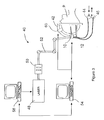
- FIG. 3 shows other equipment comprising the imaging and control system 40 in which the laser probe 10 is used.
- the laser probe 10 is shown inserted into the cranium of the patient P.
- the laser probe 10 is mounted by means of the mounting body 12 on a head ring 42 as known in the art, for stereotactic control of the positioning of the laser probe 10.
- a source 44 of irrigation fluid and an aspiration means 46 are connected to the mounting body 12 of the laser probe 10.
- a high power solid state picosecond laser 48 is also connected to the mounting body 12 via beam guiding optics 50 and a flexible mirror system 52.
- An imaging device 54 and a control microprocessor 56 are also connected to the probe 10 and the head ring 42.
- the imaging device 54 can be a laser scanning microscope, a laser doppler flowmeter, or a fluorescence spectrometer, or combinations thereof. Viewpaths for these devices can be established through the probe 10 by the use of fiber optics or other means.
- the real time imaging can be completed by ultrasound by means of a stereotactic guided ultrasound probe 60.
- the imaging device 54 can also have provision for the input of CT or MR image data, allowing the comparison of the real time image with the CT or MR image.
- the control microprocessor 56 controls the movement of the probe 10 via the head ring 42 and the movement of the tubes 14 and 16 of the probe 10.
- the control microprocessor 56 also controls the imaging device 54 and the laser 48.
- Mapping of the ablation scheme can be programmed into the control microprocessor 56, using image data obtained from ultrasound, CT, and MR devices. Manual control of the ablation process can be accomplished by entry of commands into the control microprocessor 56 while viewing the operative area in real time.
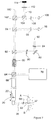
- Figure 4 shows elements of the system which can be used to adjust the position of the focusing lens 20 of the probe 10 in a way that ensures the focus spot 37 hits the current tissue surface B inside the tumor A.
- the light beam 68 of the plasma spark 62 is reflected into the detection unit 78 by means of a beam splitter 64.
- the light beam 68 is further split into two arms by means of a second beam splitter 66.
- the first arm the total intensity of beam 68 is detected by the photodetector 76.
- wavelengths capable of distinguishing between plasma light emitted from tissue and plasma light emitted from rinsing liquid, are separated and detected by means of spectral filters 70 and the photodetector 74. This arrangement allows for a comparison of the separated wavelengths and gives information whether the focus spot 37 lies before, on, or behind the tissue surface B. further this information can be put into the control microprocessor 56 to accurately position the laser beam 36.
- Figure 5 shows the method and apparatus to actively control the waveform and thereby the focus of the cutting laser beam 36 by means of an active-optical mirror 82.
- the single elements of the active-optical mirror 82 can be adjusted in a way known in the art, such that the distorted wavefront 84 of the cutting laser beam 36 can be orchestrated to achieve an optimized wavefront 88 near the tissue surface leading to a sharp focus spot 37.
- an active optical mirror can be used of a type as described in J.F. Bille, A.W. Dreher, G. Zinser "Scanning Laser Tomography of the Living Human Eye” in “Noninvasive Diagnostic Techniques in Ophthalmology", ed. By B.R. Masters, Springer-Verlag (1990).
- the waveform 86 after the active-optical mirror is adjusted to compensate for aberrations of the laser light beam at the target.
- LCLV 90 can be used instead of an active-optical mirror to accomplish the same results.
- the LCLV 90 can be a spatial light modulator (SLM) such as a LCLV as for example he ⁇ 69 spatial light modulator of Meadowlak Optics, New Jersey.
- SLM spatial light modulator
- Figure 7 illustrates two different methods to get information about the sharpness and quality of focus spot 37.
- a beam splitter 94 is used to separate a small fraction of the cutting laser light, which is reflected from the tissue surface.
- the light is imaged onto a diode array 98 by means of the lens 96.
- the diode array 98 measures the shape and thereby the sharpness of the focus spot 37.
- a pilot beam 100 having a wavelength near to 670 nm, is reflected at the tissue surface B and is used to detect the quality of the focusing means.
- the quality of the focus spot can be measured either by imaging it onto the diode array 108 by means of the lens 106, and/or by separating the light beam using the beam splitter 104 and measuring the waveform by means of a Hartmann-Schack sensor where the beam 110 is imaged by the lens array 112 onto the CCD 114.
- These methods are all characterized in that the measured intensity distribution in a plane conjugate to the focal plane of the cutting beam and/or the pilot beam is compared to an ideal intensity distribution and control signals are derived for controlling the active mirror resp. the SLM to compensate for imaging errors.
- the waveform of the pilot beam is measured by a wavefront sensor, e.g., a Hartmann-Shack wavefront sensor as described in J. Liang, B. Grimm, S. Goelz, J.F. Bille "Objective measurement of the wave aberrations of the human eye by the use of a Hartmann-Shack wavefront sensor" J. Opt. Soc. Am. Vol. 11 Nr. 7, pp. 1949-1957 (1994), is compared to an ideal waveform and control signals are derived for controlling the active mirror resp. the SLM to compensate for imaging errors.
- a wavefront sensor e.g., a Hartmann-Shack wavefront sensor as described in J. Liang, B. Grimm, S. Goelz, J.F. Bille "Objective measurement of the wave aberrations of the human eye by the use of a Hartmann-Shack wavefront sensor" J. Opt. Soc. Am. Vol. 11 Nr. 7, pp. 1949-1957 (1994)
- control signals are derived for controlling
- the brain is mapped through ultrasound, CT or MR techniques to locate the tumor A and to develop information about the size and shape of the tumor A, as well as information about the location, size, and shape of blood vessels. This information is fed into the imaging device 54 and the control microprocessor 56.
- the control microprocessor 56 is programmed to control the placement and movement of the probe 10, the orientation of the laser beam 36, and the pulsing of the laser 48, to ablate and remove the tumor tissue. This establishes a three dimensional laser treatment scheme for the particular tumor A.
- the skull of the patient is prepared for insertion of the probe 10, and the probe 10 is inserted into the cranium and approximately into the center of the tumor A.
- the laser 48 is energized and selectively pulsed by the control microprocessor 56 according to the aforementioned ablation program.
- the orientation of the laser beam 36 is controlled by the control microprocessor 56 through rotational movement of the second tube 16 and through longitudinal movement of the first and second tubes 14, 16, according to the ablation program.
- the distance of the focus spot 37 from the probe 10 is controlled by the control microprocessor 56 through longitudinal movement of the first tube 14 relative to the second tube 16, according to the ablation program.
- the tumor tissue is photodisrupted by ablation, the tissue breaks off in very small fragments 38.
- the progress of the ablation process can be observed by the surgeon on a video monitor on the imaging device, through the confocal laser scanning microscope.
- the real time image can be enhanced with the laser doppler flowmeter or the fluorescence spectrometer.
- the laser doppler flowmeter detects frequency shifts in reflected light, through well known means, to identify tumor tissue or individual capillaries too small to be seen otherwise.
- ultrasound can be used to detect larger vessels.
- a signal representative of the real time image is compared with a signal representative of the CT or MR image. The error between the two signals can be electronically compared and minimized by the control microprocessor 56 to accurately position the laser beam 36.
- the fluorescence spectrometer requires the staining of tissue with a dye.
- a dye such as Hematoporphyrin Derivate (HpD) can be injected into the operative area through well known means to enable the use of the fluorescence spectrometer in identifying tumor tissue as differentiated from healthy tissue.
- the intensity of the fluorescence can be measured to differentiate between tumor tissue and healthy tissue, according to well known procedures.
- the time delay of emitted fluorescence can be measured to identify tumor tissue and healthy tissue, according to well known procedures.
- ultrasound can be used to visualize the tumor borders on a macroscopic scale.
- Blood vessels can be located through the mapping techniques of CT and MR imaging through ultrasound imaging, visually through the laser scanning microscope, or through other means.
- the laser beam 36 can be defocused and used to heat the blood in the vessel to coagulate the blood, sealing the vessel.
- the blood vessel can also be coagulated by other means.
- the control microprocessor 56 can control the orientation, movement, and pulsing of the laser beam 36 to ablate a cylindrical layer of tumor tissue.
- the irrigation source 44 such as a pump, provides a fluid such as an isotonic natrium chloride solution to the operative area.
- the aspiration means 46 such as a vacuum pump, aspirates the solution, along with any suspended particles and other debris, from the operative area to aspirate the tumor tissue fragments 38. After ablating a cylindrical layer, the focal distance can be increased to locate the focus spot on the newly exposed surface of tumor tissue. Repeated manipulation of the laser beam 36 then removes an additional layer of tumor tissue.
- the axial length of the cylinder which can be ablated depends upon the focal length of the laser beam 36, which depends upon the power output of the picosecond laser 48.
- a typical apparatus having a relatively limited laser power might be limited to an axial movement of the laser beam 36 of approximately 20 millimeters.
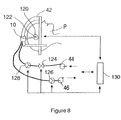
- Figure 8 shows the schematic of the arrangement used to control the intracranial pressure.
- a miniaturized pressure sensor 122 is attached to the tip of the probe and accurately measures the pressure within the ablation cavity 120.
- the signal is put into the microprocessor interface 130.
- the pumps 44 and 46, and the valve 124 the flow of rinsing liquid can be controlled.
- the fluid can be measured by the flow meters 126 and 128, which measure the aspiration and irrigation, respectively.
- the signal of the flow meters is also put into the interface 130.
- the ablation velocity is approximately 4 cubic millimeters per second, or 15 cubic centimeters per hour.
- the desired power density at the surface of the tumor tissue is about 50 Joules per square centimeter.
- the layers removed can be fully cylindrical as illustrated, or they can be partial cylinders. Further, they can have other shapes, according to the ablation scheme programmed into the control microprocessor 56.
- the present invention provides a method for using a laser beam in stereotactic laser neurosurgery for the photodisruption of malignant tissue which comprises the steps of:
- said moving step further comprises the steps of:
- said arc is approximately three hundred and sixty degrees.
- a range for movement in said proximal/distal direction is approximately twenty millimeters.
- the method further comprises the step of moving said lens in said proximal/distal direction relative to said mirror to vary said radial distance of said focal point relative to said mirror.
- photodisruption of said tissue creates a plasma spark and said method further comprises the step of controlling the said movement of said lens in said proximal distal direction relative to said mirror, by detecting the light of the plasma spark to measure the position of said focal point relative to the current tissue surface.
- the method further comprising the step of controlling the waveform of the cutting beam by an active mirror.
- the method further comprises a step of controlling the waveform of the cutting beam by a spatial light modulator.
- the method includes the steps of:
- the method includes the steps of:
- said laser beam has an energy density of approximately 50 J/cm 2 .
- said laser beam comprises a plurality of pulses having a pulse duration in the range of from one hundredth to one hundred picoseconds.
- each said pulse in said laser beam has a pulse energy of approximately 2.5 mJ and the repetition rate for said pulses of said laser beam is approximately 4 kHz.
- the method includes the steps of:
- the method further comprises the steps of:
- said identifying step is accomplished using a confocal laser scanning microscope for real time viewing of the tissue.
- said identifying step is accomplished using a laser doppler flowmeter for real time viewing of the tissue.
- said identifying step includes the steps of:
- said dying step is accomplished using Hematoporphyrin Derivate (HpD).
- HpD Hematoporphyrin Derivate
- said identifying step includes the steps of:
- said dying step is accomplished using Hematoporphyrin Derivate (HpD).
- HpD Hematoporphyrin Derivate
- the method includes the steps of determining a boundary between the malignant tissue to be photodisrupted and healthy tissue.
- said determining step is accomplished using ultrasound imaging for real time viewing of the tissue.
- said determining step is accomplished using a confocal laser scanning microscope for real time viewing of the tissue.
- said determining step is accomplished using a laser doppler flowmeter for real time viewing of the tissue.
- said determining step includes the steps of:
- the method includes the steps of:
- the method includes the steps of:
- said predetermined manner in said step of moving said mirror creates a separate piece of the tissue to be photodisrupted.
- the method further comprises the steps of:
- the method further comprises the steps of:
Landscapes
- Health & Medical Sciences (AREA)
- Surgery (AREA)
- Life Sciences & Earth Sciences (AREA)
- Molecular Biology (AREA)
- General Health & Medical Sciences (AREA)
- Physics & Mathematics (AREA)
- Engineering & Computer Science (AREA)
- Biomedical Technology (AREA)
- Heart & Thoracic Surgery (AREA)
- Medical Informatics (AREA)
- Nuclear Medicine, Radiotherapy & Molecular Imaging (AREA)
- Animal Behavior & Ethology (AREA)
- Veterinary Medicine (AREA)
- Public Health (AREA)
- Pathology (AREA)
- Oral & Maxillofacial Surgery (AREA)
- Optics & Photonics (AREA)
- Electromagnetism (AREA)
- Otolaryngology (AREA)
- Laser Surgery Devices (AREA)
- Radiation-Therapy Devices (AREA)
Applications Claiming Priority (2)
| Application Number | Priority Date | Filing Date | Title |
|---|---|---|---|
| US08/688,039 US5785704A (en) | 1996-07-29 | 1996-07-29 | Method for performing stereotactic laser surgery |
| US688039 | 1996-07-29 |
Publications (3)
| Publication Number | Publication Date |
|---|---|
| EP0821916A2 true EP0821916A2 (fr) | 1998-02-04 |
| EP0821916A3 EP0821916A3 (fr) | 1998-07-15 |
| EP0821916B1 EP0821916B1 (fr) | 2004-01-14 |
Family
ID=24762867
Family Applications (1)
| Application Number | Title | Priority Date | Filing Date |
|---|---|---|---|
| EP97305138A Expired - Lifetime EP0821916B1 (fr) | 1996-07-29 | 1997-07-11 | Appareil de chirurgie stéréotactique au laser |
Country Status (4)
| Country | Link |
|---|---|
| US (1) | US5785704A (fr) |
| EP (1) | EP0821916B1 (fr) |
| JP (1) | JP3590506B2 (fr) |
| DE (1) | DE69727176T2 (fr) |
Cited By (15)
| Publication number | Priority date | Publication date | Assignee | Title |
|---|---|---|---|---|
| EP0960601A3 (fr) * | 1998-05-28 | 2000-04-26 | Terumo Kabushiki Kaisha | Appareil pour l'irradiation de tissus |
| EP0947221A3 (fr) * | 1998-03-31 | 2000-04-26 | Terumo Kabushiki Kaisha | Dispositif d'irradiation à laser |
| WO2002056785A3 (fr) * | 2001-01-19 | 2002-09-12 | Storz Endoskop Gmbh | Dispositif pour l'application d'une lumiere sur une paroi d'un recipient |
| US7091991B2 (en) | 1996-02-08 | 2006-08-15 | Palm Charles S | 3D stereo browser for the internet |
| WO2009023774A1 (fr) * | 2007-08-15 | 2009-02-19 | The Cleveland Clinic Foundation | Rupture précise d'un tissu en des structures rétiniennes et prérétiniennes |
| WO2009135213A3 (fr) * | 2008-05-02 | 2010-01-21 | Zelickson Brian D | Dispositifs à énergie laser et procédés d'enlèvement de tissu mou |
| WO2011151064A1 (fr) * | 2010-06-03 | 2011-12-08 | Carl Zeiss Meditec Ag | Dispositif et procédé de chirurgie du corps vitré |
| WO2012037954A1 (fr) * | 2010-09-24 | 2012-03-29 | Fotona D.D. | Système laser pour le traitement de tissu corporel |
| RU2510248C2 (ru) * | 2012-04-23 | 2014-03-27 | Федеральное государственное бюджетное учреждение науки Институт физики твердого тела Российской академии наук (ИФТТ РАН) | Способ удаления опухолей мозга с выделением границ опухоли флуоресцентной диагностикой с одновременной коагуляцией и аспирацией и устройство для его осуществления |
| CN104116561A (zh) * | 2014-07-29 | 2014-10-29 | 成都千里电子设备有限公司 | 具有防尘功能的治疗机 |
| EP3142586A4 (fr) * | 2014-05-14 | 2018-04-04 | President and Fellows of Harvard College | Dispositif de cathéter pour transmettre et réfléchir la lumière |
| EP3622910A1 (fr) * | 2008-03-06 | 2020-03-18 | AquaBeam LLC | Ablation et cautérisation de tissus à l'aide de l'énergie optique véhiculée dans un courant de fluide |
| US11350964B2 (en) | 2007-01-02 | 2022-06-07 | Aquabeam, Llc | Minimally invasive treatment device for tissue resection |
| US11464536B2 (en) | 2012-02-29 | 2022-10-11 | Procept Biorobotics Corporation | Automated image-guided tissue resection and treatment |
| US12108964B2 (en) | 2007-01-02 | 2024-10-08 | Aquabeam, Llc | Minimally invasive tissue treatment device |
Families Citing this family (74)
| Publication number | Priority date | Publication date | Assignee | Title |
|---|---|---|---|---|
| US5980513A (en) | 1994-04-25 | 1999-11-09 | Autonomous Technologies Corp. | Laser beam delivery and eye tracking system |
| DE19640495C2 (de) * | 1996-10-01 | 1999-12-16 | Leica Microsystems | Vorrichtung zur konfokalen Oberflächenvermessung |
| US6119031A (en) | 1996-11-21 | 2000-09-12 | Boston Scientific Corporation | Miniature spectrometer |
| US20010041884A1 (en) * | 1996-11-25 | 2001-11-15 | Frey Rudolph W. | Method for determining and correcting vision |
| US6271914B1 (en) | 1996-11-25 | 2001-08-07 | Autonomous Technologies Corporation | Objective measurement and correction of optical systems using wavefront analysis |
| US6190376B1 (en) | 1996-12-10 | 2001-02-20 | Asah Medico A/S | Apparatus for tissue treatment |
| US5777719A (en) * | 1996-12-23 | 1998-07-07 | University Of Rochester | Method and apparatus for improving vision and the resolution of retinal images |
| US6238348B1 (en) * | 1997-07-22 | 2001-05-29 | Scimed Life Systems, Inc. | Miniature spectrometer system and method |
| US6771417B1 (en) * | 1997-08-01 | 2004-08-03 | Carl Zeiss Jena Gmbh | Applications of adaptive optics in microscopy |
| WO1999047041A1 (fr) * | 1998-03-19 | 1999-09-23 | Board Of Regents, The University Of Texas System | Appareil d'imagerie confocal a fibres optiques et ses procedes d'utilisation |
| PT1105037E (pt) | 1998-08-19 | 2002-11-29 | Autonomous Technologies Corp | Aparelho e metodo para medir defeitos de visao de um olho humano |
| US20030081310A1 (en) * | 1998-09-09 | 2003-05-01 | Mcmanus Dennis Q. | Microscopy method and apparatus |
| EP1028649A4 (fr) * | 1998-09-09 | 2004-10-20 | Dennis Q Mcmanus | Procede et dispositif de microscopie |
| US6445944B1 (en) * | 1999-02-01 | 2002-09-03 | Scimed Life Systems | Medical scanning system and related method of scanning |
| DE19938203A1 (de) * | 1999-08-11 | 2001-02-15 | Aesculap Meditec Gmbh | Verfahren und Vorrichtung zur Korrektur von Sehfehlern des menschlichen Auges |
| KR100316124B1 (ko) * | 1999-10-14 | 2001-12-12 | 김춘영 | 레이저치료기용 레이저빔 안내장치 |
| BR0106071A (pt) | 2000-04-19 | 2002-04-02 | Alcon Universal Ltd | Sensor de frente de onda para mensuração objetiva de um sistema ótico e métodos associados |
| US6460997B1 (en) | 2000-05-08 | 2002-10-08 | Alcon Universal Ltd. | Apparatus and method for objective measurements of optical systems using wavefront analysis |
| US8256430B2 (en) | 2001-06-15 | 2012-09-04 | Monteris Medical, Inc. | Hyperthermia treatment and probe therefor |
| US6418337B1 (en) | 2000-06-15 | 2002-07-09 | Autolitt Inc. | MRI guided hyperthermia surgery |
| DE10066062A1 (de) * | 2000-08-04 | 2004-05-27 | Sca Hygiene Products Gmbh | Vorrichtung zum Trennen und/oder Perforieren |
| US6486943B1 (en) | 2000-09-19 | 2002-11-26 | The Schepens Eye Research Institute, Inc. | Methods and apparatus for measurement and correction of optical aberration |
| US6827442B2 (en) | 2001-09-12 | 2004-12-07 | Denwood F. Ross | Ophthalmic wavefront measuring devices |
| DE10146762B4 (de) * | 2001-09-22 | 2004-10-28 | Mrc Systems Gmbh | Vorrichtung zur Lagebestimmung eines zu behandelnden Zielgebiets im Gehirn |
| US6688745B2 (en) | 2001-10-25 | 2004-02-10 | Johnson & Johnson Vision Care, Inc. | Subjective refinement of wavefront measurements |
| ES2305320T3 (es) * | 2001-12-14 | 2008-11-01 | Monteris Medical Inc. | Tratamiento de hipertermia y sonda para ello. |
| US6780178B2 (en) | 2002-05-03 | 2004-08-24 | The Board Of Trustees Of The Leland Stanford Junior University | Method and apparatus for plasma-mediated thermo-electrical ablation |
| US8043286B2 (en) | 2002-05-03 | 2011-10-25 | The Board Of Trustees Of The Leland Stanford Junior University | Method and apparatus for plasma-mediated thermo-electrical ablation |
| US7258687B2 (en) * | 2002-12-11 | 2007-08-21 | The Regents Of The University Of California | Device and method for inducing vascular injury and/or blockage in an animal model |
| US7736361B2 (en) | 2003-02-14 | 2010-06-15 | The Board Of Trustees Of The Leland Stamford Junior University | Electrosurgical system with uniformly enhanced electric field and minimal collateral damage |
| WO2004073752A2 (fr) * | 2003-02-14 | 2004-09-02 | The Board Of Trustees Of The Leland Stanford Junior University | Systeme electrochirugical avec champ electrique renforce uniformement et degats colateraux minimum |
| WO2004084749A1 (fr) * | 2003-03-26 | 2004-10-07 | Mrc Systems Gmbh | Dispositif pour determiner la position d'une region cible du cerveau a traiter |
| US20050021028A1 (en) * | 2003-06-18 | 2005-01-27 | Daniel Palanker | Electro-adhesive tissue manipulator |
| JP2005040300A (ja) * | 2003-07-28 | 2005-02-17 | Terumo Corp | エネルギー治療装置 |
| JP4694139B2 (ja) * | 2004-04-01 | 2011-06-08 | オリンパス株式会社 | 顕微鏡 |
| US8801764B2 (en) * | 2005-05-05 | 2014-08-12 | Biolitec Pharma Marketing Ltd | Cosmetic laser treatment device and method for localized lipodystrophies and flaccidity |
| US7909817B2 (en) | 2005-06-08 | 2011-03-22 | Innovaquartz, Inc. (AMS Research Corporation) | Lateral laser fiber for high average power and peak pulse energy |
| JP2007029603A (ja) * | 2005-07-29 | 2007-02-08 | Fujinon Corp | 光診断治療装置 |
| FR2889813B1 (fr) * | 2005-08-18 | 2008-06-06 | Assist Publ Hopitaux De Paris | Sonde intra-cerebrale et dispositif de traitement de dysfonctionnements neurologiques ou psychiatriques |
| US8221400B2 (en) * | 2005-08-22 | 2012-07-17 | Sie Surgical Instruments Engineering Ag | Apparatus for and method of refractive surgery with laser pulses |
| US20070185474A1 (en) * | 2006-02-07 | 2007-08-09 | Ams Research Corporation | Laparoscopic Laser Device and Method |
| CN1895184B (zh) * | 2006-03-07 | 2010-04-07 | 赵世光 | 自动荧光检测系统 |
| AU2007317958B2 (en) | 2006-11-02 | 2013-08-22 | Peak Surgical, Inc. | Electric plasma-mediated cutting and coagulation of tissue and surgical apparatus |
| WO2008073263A1 (fr) | 2006-12-07 | 2008-06-19 | Ams Research Corporation | Dispositif optique à tir latéral pour réorienter latéralement une énergie électromagnétique de grande puissance |
| US8858542B2 (en) | 2007-08-03 | 2014-10-14 | Ams Research Corporation | Side-firing fiber delivery device with active cooling cap |
| US8480662B2 (en) * | 2007-08-22 | 2013-07-09 | Cardiac Pacemakers, Inc. | Systems and devices for photoablation |
| US20110040287A1 (en) * | 2007-11-12 | 2011-02-17 | Jeff Ference | Surgical liposuction instrument with radiant energy source |
| US8663321B2 (en) | 2007-12-06 | 2014-03-04 | L. Van Thomas Crisco | Minimally invasive method for coronary bypass and other treatments |
| WO2009094451A2 (fr) * | 2008-01-22 | 2009-07-30 | Board Of Regents, The University Of Texas System | Systèmes, dispositifs et procédés d'imagerie et de chirurgie |
| US20090306642A1 (en) * | 2008-06-10 | 2009-12-10 | Vankov Alexander B | Method for low temperature electrosugery and rf generator |
| US8728092B2 (en) | 2008-08-14 | 2014-05-20 | Monteris Medical Corporation | Stereotactic drive system |
| US8747418B2 (en) | 2008-08-15 | 2014-06-10 | Monteris Medical Corporation | Trajectory guide |
| US8899844B2 (en) | 2008-12-01 | 2014-12-02 | Ams Research Corporation | Optical device |
| US8137345B2 (en) | 2009-01-05 | 2012-03-20 | Peak Surgical, Inc. | Electrosurgical devices for tonsillectomy and adenoidectomy |
| US8979871B2 (en) | 2009-08-13 | 2015-03-17 | Monteris Medical Corporation | Image-guided therapy of a tissue |
| EP2521505B1 (fr) * | 2010-01-07 | 2017-09-06 | Omni MedSci, Inc. | Lasers à fibre, et sources de lumière dans l'infrarouge moyen, dans des procédés et systèmes pour le traitement et la spectroscopie sélective de tissus biologiques |
| WO2011091283A1 (fr) | 2010-01-22 | 2011-07-28 | Board Of Regents, The University Of Texas System | Systèmes, dispositifs et procédés pour une imagerie et une chirurgie |
| US9791313B2 (en) * | 2010-12-01 | 2017-10-17 | MKS Technology | Spectrometer |
| WO2012170364A1 (fr) | 2011-06-10 | 2012-12-13 | Medtronic, Inc. | Dispositifs d'électrode en fil pour une amygdalectomie et une adénoïdectomie |
| US20150272678A1 (en) * | 2012-10-08 | 2015-10-01 | Lutronic Corporation | Laser surgical instrument for spine surgery and method thereof |
| US20140121656A1 (en) * | 2012-10-26 | 2014-05-01 | Warsaw Orthopedic, Inc. | Nerve and soft tissue cutting device |
| US9848899B2 (en) * | 2013-03-15 | 2017-12-26 | St. Jude Medical, Atrial Fibrillation Division, Inc. | Pressure sensing of irrigant backpressure for aligning directional medical devices with target tissue |
| US20140276741A1 (en) * | 2013-03-15 | 2014-09-18 | Warsaw Orthopedic, Inc. | Peak plasma blade for soft tissue decompression |
| EP3073952B1 (fr) * | 2013-11-27 | 2020-01-08 | Convergent Dental, Inc. | Systèmes de protection du système optique d'un appareil à base de lumière laser |
| US9492121B2 (en) | 2014-03-18 | 2016-11-15 | Monteris Medical Corporation | Image-guided therapy of a tissue |
| US9700342B2 (en) | 2014-03-18 | 2017-07-11 | Monteris Medical Corporation | Image-guided therapy of a tissue |
| US10675113B2 (en) | 2014-03-18 | 2020-06-09 | Monteris Medical Corporation | Automated therapy of a three-dimensional tissue region |
| US10327830B2 (en) | 2015-04-01 | 2019-06-25 | Monteris Medical Corporation | Cryotherapy, thermal therapy, temperature modulation therapy, and probe apparatus therefor |
| US10573506B2 (en) * | 2016-03-11 | 2020-02-25 | Michael Vidra | Method and device for etching patterns inside objects |
| EP3559714B1 (fr) | 2016-12-20 | 2020-09-09 | Boston Scientific Scimed Inc. | Fibre optique refroidie par fluide |
| CN106901833B (zh) * | 2017-05-04 | 2023-08-22 | 吉林省科英医疗激光有限责任公司 | 一种可调光斑尺寸的激光治疗手具 |
| KR102372812B1 (ko) * | 2018-11-01 | 2022-03-11 | 주식회사 일링크스 | 저출력 레이저를 적용한 전기식 온구기 |
| US12274497B2 (en) * | 2019-12-18 | 2025-04-15 | Bolt Medical, Inc. | Multiplexer for laser-driven intravascular lithotripsy device |
| US12611253B2 (en) * | 2020-03-18 | 2026-04-28 | Boston Scientific Scimed, Inc. | Optical analyzer assembly and method for intravascular lithotripsy device |
Family Cites Families (24)
| Publication number | Priority date | Publication date | Assignee | Title |
|---|---|---|---|---|
| US3653743A (en) * | 1970-11-23 | 1972-04-04 | Hughes Aircraft Co | Electro-optic devices with acousto-optic effect suppression |
| US3693623A (en) * | 1970-12-25 | 1972-09-26 | Gregory System Inc | Photocoagulation means and method for depilation |
| US4638798A (en) * | 1980-09-10 | 1987-01-27 | Shelden C Hunter | Stereotactic method and apparatus for locating and treating or removing lesions |
| US4388924A (en) * | 1981-05-21 | 1983-06-21 | Weissman Howard R | Method for laser depilation |
| GB2123287B (en) * | 1982-07-09 | 1986-03-05 | Anna Gunilla Sutton | Depilaton device |
| US4754328A (en) * | 1984-01-03 | 1988-06-28 | Medical Dynamics, Inc. | Laser endoscope |
| JPS60148567A (ja) * | 1984-01-13 | 1985-08-05 | 株式会社東芝 | レ−ザ治療装置 |
| US4608980A (en) * | 1984-04-13 | 1986-09-02 | Osada Electric Co., Ltd. | Laser hand piece |
| US4638800A (en) * | 1985-02-08 | 1987-01-27 | Research Physics, Inc | Laser beam surgical system |
| US4887605A (en) * | 1988-02-18 | 1989-12-19 | Angelsen Bjorn A J | Laser catheter delivery system for controlled atheroma ablation combining laser angioplasty and intra-arterial ultrasonic imagining |
| US4998930A (en) * | 1988-08-03 | 1991-03-12 | Phototherapeutic Systems | Intracavity laser phototherapy method |
| US5354314A (en) * | 1988-12-23 | 1994-10-11 | Medical Instrumentation And Diagnostics Corporation | Three-dimensional beam localization apparatus and microscope for stereotactic diagnoses or surgery mounted on robotic type arm |
| JPH03159642A (ja) * | 1989-11-20 | 1991-07-09 | Matsushita Electric Ind Co Ltd | マイクロスコープ |
| DE9116216U1 (de) * | 1990-12-19 | 1992-05-27 | Dornier MedizinLaser GmbH, 82110 Germering | Applikationsvorrichtung für Laserstrahlung |
| US5163935A (en) * | 1991-02-20 | 1992-11-17 | Reliant Laser Corporation | Surgical laser endoscopic focusing guide with an optical fiber link |
| US5298026A (en) * | 1992-07-23 | 1994-03-29 | General Electric Company | Method and apparatus for laser medical treatment |
| US5439000A (en) * | 1992-11-18 | 1995-08-08 | Spectrascience, Inc. | Method of diagnosing tissue with guidewire |
| US5413555A (en) * | 1993-04-30 | 1995-05-09 | Mcmahan; William H. | Laser delivery system |
| US5454807A (en) * | 1993-05-14 | 1995-10-03 | Boston Scientific Corporation | Medical treatment of deeply seated tissue using optical radiation |
| IL105957A (en) * | 1993-06-08 | 1999-06-20 | Laser Ind Ltd | Handpiece for laser apparatus |
| JPH07171162A (ja) * | 1993-09-07 | 1995-07-11 | Olympus Optical Co Ltd | レーザプローブ |
| US5496307A (en) * | 1993-09-10 | 1996-03-05 | S.L.T. Japan Co., Ltd. | Laser light irradiation apparatus for medical treatment |
| JP2524684B2 (ja) * | 1993-12-27 | 1996-08-14 | 技術研究組合医療福祉機器研究所 | レ―ザハンドピ―ス |
| JP3675852B2 (ja) * | 1994-02-28 | 2005-07-27 | 株式会社ニデック | 眼科手術装置 |
-
1996
- 1996-07-29 US US08/688,039 patent/US5785704A/en not_active Expired - Fee Related
-
1997
- 1997-07-11 EP EP97305138A patent/EP0821916B1/fr not_active Expired - Lifetime
- 1997-07-11 DE DE69727176T patent/DE69727176T2/de not_active Expired - Fee Related
- 1997-07-28 JP JP20134497A patent/JP3590506B2/ja not_active Expired - Fee Related
Cited By (31)
| Publication number | Priority date | Publication date | Assignee | Title |
|---|---|---|---|---|
| US7091991B2 (en) | 1996-02-08 | 2006-08-15 | Palm Charles S | 3D stereo browser for the internet |
| US6520959B1 (en) | 1998-03-31 | 2003-02-18 | Terumo Kabushiki Kaisha | Laser irradiation device and method for therapy of prostate gland by use thereof |
| EP0947221A3 (fr) * | 1998-03-31 | 2000-04-26 | Terumo Kabushiki Kaisha | Dispositif d'irradiation à laser |
| EP0960601A3 (fr) * | 1998-05-28 | 2000-04-26 | Terumo Kabushiki Kaisha | Appareil pour l'irradiation de tissus |
| US6562029B2 (en) | 1998-05-28 | 2003-05-13 | Terumo Kabushiki Kaisha | Energy irradiation apparatus |
| US6379347B1 (en) | 1998-05-28 | 2002-04-30 | Terumo Kabushiki Kaisha | Energy irradiation apparatus |
| WO2002056785A3 (fr) * | 2001-01-19 | 2002-09-12 | Storz Endoskop Gmbh | Dispositif pour l'application d'une lumiere sur une paroi d'un recipient |
| US7108692B2 (en) | 2001-01-19 | 2006-09-19 | Storz-Endoskop Gmbh | Apparatus for applying light to a vessel wall |
| US12290277B2 (en) | 2007-01-02 | 2025-05-06 | Aquabeam, Llc | Tissue resection with pressure sensing |
| US11350964B2 (en) | 2007-01-02 | 2022-06-07 | Aquabeam, Llc | Minimally invasive treatment device for tissue resection |
| US11478269B2 (en) | 2007-01-02 | 2022-10-25 | Aquabeam, Llc | Minimally invasive methods for multi-fluid tissue ablation |
| US12108964B2 (en) | 2007-01-02 | 2024-10-08 | Aquabeam, Llc | Minimally invasive tissue treatment device |
| WO2009023774A1 (fr) * | 2007-08-15 | 2009-02-19 | The Cleveland Clinic Foundation | Rupture précise d'un tissu en des structures rétiniennes et prérétiniennes |
| US12102383B2 (en) | 2008-03-06 | 2024-10-01 | Aquabeam, Llc | Tissue resection device with motors and control circuitry |
| US12318137B2 (en) | 2008-03-06 | 2025-06-03 | Aquabeam, Llc | Controlled tissue treatment with energy and control circuitry |
| US11759258B2 (en) | 2008-03-06 | 2023-09-19 | Aquabeam, Llc | Controlled ablation with laser energy |
| EP3622910A1 (fr) * | 2008-03-06 | 2020-03-18 | AquaBeam LLC | Ablation et cautérisation de tissus à l'aide de l'énergie optique véhiculée dans un courant de fluide |
| US11033330B2 (en) | 2008-03-06 | 2021-06-15 | Aquabeam, Llc | Tissue ablation and cautery with optical energy carried in fluid stream |
| US11172986B2 (en) | 2008-03-06 | 2021-11-16 | Aquabeam Llc | Ablation with energy carried in fluid stream |
| WO2009135213A3 (fr) * | 2008-05-02 | 2010-01-21 | Zelickson Brian D | Dispositifs à énergie laser et procédés d'enlèvement de tissu mou |
| WO2011151064A1 (fr) * | 2010-06-03 | 2011-12-08 | Carl Zeiss Meditec Ag | Dispositif et procédé de chirurgie du corps vitré |
| WO2012037954A1 (fr) * | 2010-09-24 | 2012-03-29 | Fotona D.D. | Système laser pour le traitement de tissu corporel |
| US11464536B2 (en) | 2012-02-29 | 2022-10-11 | Procept Biorobotics Corporation | Automated image-guided tissue resection and treatment |
| US11737776B2 (en) | 2012-02-29 | 2023-08-29 | Procept Biorobotics Corporation | Automated image-guided tissue resection and treatment |
| US12440235B2 (en) | 2012-02-29 | 2025-10-14 | Procept Biorobotics Corporation | Automated image-guided tissue resection and treatment |
| RU2510248C2 (ru) * | 2012-04-23 | 2014-03-27 | Федеральное государственное бюджетное учреждение науки Институт физики твердого тела Российской академии наук (ИФТТ РАН) | Способ удаления опухолей мозга с выделением границ опухоли флуоресцентной диагностикой с одновременной коагуляцией и аспирацией и устройство для его осуществления |
| US11627949B2 (en) | 2014-05-14 | 2023-04-18 | President And Fellows Of Harvard College | Insertable catheter device for patch application |
| US10588695B2 (en) | 2014-05-14 | 2020-03-17 | President And Fellows Of Harvard College | Catheter device for transmitting and reflecting light |
| EP3142586A4 (fr) * | 2014-05-14 | 2018-04-04 | President and Fellows of Harvard College | Dispositif de cathéter pour transmettre et réfléchir la lumière |
| CN104116561B (zh) * | 2014-07-29 | 2016-08-24 | 成都千里电子设备有限公司 | 具有防尘功能的治疗机 |
| CN104116561A (zh) * | 2014-07-29 | 2014-10-29 | 成都千里电子设备有限公司 | 具有防尘功能的治疗机 |
Also Published As
| Publication number | Publication date |
|---|---|
| JP3590506B2 (ja) | 2004-11-17 |
| DE69727176T2 (de) | 2004-09-02 |
| EP0821916A3 (fr) | 1998-07-15 |
| EP0821916B1 (fr) | 2004-01-14 |
| US5785704A (en) | 1998-07-28 |
| DE69727176D1 (de) | 2004-02-19 |
| JPH10155805A (ja) | 1998-06-16 |
Similar Documents
| Publication | Publication Date | Title |
|---|---|---|
| US5785704A (en) | Method for performing stereotactic laser surgery | |
| US12053201B2 (en) | Water enucleation of the prostate | |
| US20250120736A1 (en) | Multi-image information fusion system and method for tissue cutting path planning | |
| JP6461971B2 (ja) | 飛散パルスを用いた組織切除および処置 | |
| JP4732330B2 (ja) | 放射エネルギーでアブレーションするための同軸カテーテル器具 | |
| CN105431096B (zh) | 液体消融液体束眼外科手术的方法和装置 | |
| US20140031802A1 (en) | Guided cardiac ablation catheters | |
| JPH09117407A (ja) | 光ファイバ分光カテーテル | |
| WO2004110258A2 (fr) | Catheters d'ablation cardiaque guides | |
| JPS6148953B2 (fr) | ||
| US20230225586A1 (en) | Hemostasis methods and apparatuses | |
| JPH04501963A (ja) | レーザーによる外科及び歯科手術用ハンドピース及び関連装置 | |
| Goetz et al. | Computer-guided laser probe for ablation of brain tumours with ultrashort laser pulses | |
| US20250143791A1 (en) | Systems, devices and methods for targeted tissue therapy | |
| US20230149000A1 (en) | Apparatus and methods for acquisition of microbiopsy tissue samples using a laser | |
| JPH04285547A (ja) | レーザ照射装置 | |
| Götz | Neurosurgical applications |
Legal Events
| Date | Code | Title | Description |
|---|---|---|---|
| PUAI | Public reference made under article 153(3) epc to a published international application that has entered the european phase |
Free format text: ORIGINAL CODE: 0009012 |
|
| AK | Designated contracting states |
Kind code of ref document: A2 Designated state(s): DE FR GB |
|
| PUAL | Search report despatched |
Free format text: ORIGINAL CODE: 0009013 |
|
| AK | Designated contracting states |
Kind code of ref document: A3 Designated state(s): AT BE CH DE DK ES FI FR GB GR IE IT LI LU MC NL PT SE |
|
| 17P | Request for examination filed |
Effective date: 19990114 |
|
| AKX | Designation fees paid |
Free format text: DE FR GB |
|
| RBV | Designated contracting states (corrected) |
Designated state(s): DE FR GB |
|
| 17Q | First examination report despatched |
Effective date: 20030210 |
|
| GRAP | Despatch of communication of intention to grant a patent |
Free format text: ORIGINAL CODE: EPIDOSNIGR1 |
|
| RIC1 | Information provided on ipc code assigned before grant |
Ipc: 7A 61B 19/00 B Ipc: 7A 61B 18/24 A |
|
| RTI1 | Title (correction) |
Free format text: APPARATUS FOR STEREOTACTIC LASER SURGERY |
|
| GRAS | Grant fee paid |
Free format text: ORIGINAL CODE: EPIDOSNIGR3 |
|
| GRAA | (expected) grant |
Free format text: ORIGINAL CODE: 0009210 |
|
| AK | Designated contracting states |
Kind code of ref document: B1 Designated state(s): DE FR GB |
|
| REG | Reference to a national code |
Ref country code: GB Ref legal event code: FG4D |
|
| REF | Corresponds to: |
Ref document number: 69727176 Country of ref document: DE Date of ref document: 20040219 Kind code of ref document: P |
|
| ET | Fr: translation filed | ||
| PLBE | No opposition filed within time limit |
Free format text: ORIGINAL CODE: 0009261 |
|
| STAA | Information on the status of an ep patent application or granted ep patent |
Free format text: STATUS: NO OPPOSITION FILED WITHIN TIME LIMIT |
|
| 26N | No opposition filed |
Effective date: 20041015 |
|
| PGFP | Annual fee paid to national office [announced via postgrant information from national office to epo] |
Ref country code: GB Payment date: 20060530 Year of fee payment: 10 |
|
| PGFP | Annual fee paid to national office [announced via postgrant information from national office to epo] |
Ref country code: FR Payment date: 20060531 Year of fee payment: 10 |
|
| GBPC | Gb: european patent ceased through non-payment of renewal fee |
Effective date: 20070711 |
|
| PG25 | Lapsed in a contracting state [announced via postgrant information from national office to epo] |
Ref country code: GB Free format text: LAPSE BECAUSE OF NON-PAYMENT OF DUE FEES Effective date: 20070711 |
|
| REG | Reference to a national code |
Ref country code: FR Ref legal event code: ST Effective date: 20080331 |
|
| PG25 | Lapsed in a contracting state [announced via postgrant information from national office to epo] |
Ref country code: FR Free format text: LAPSE BECAUSE OF NON-PAYMENT OF DUE FEES Effective date: 20070731 |
|
| PGFP | Annual fee paid to national office [announced via postgrant information from national office to epo] |
Ref country code: DE Payment date: 20090328 Year of fee payment: 13 |
|
| PG25 | Lapsed in a contracting state [announced via postgrant information from national office to epo] |
Ref country code: DE Free format text: LAPSE BECAUSE OF NON-PAYMENT OF DUE FEES Effective date: 20110201 |
|
| REG | Reference to a national code |
Ref country code: DE Ref legal event code: R119 Ref document number: 69727176 Country of ref document: DE Effective date: 20110201 |