EP0823068B1 - Farbbildende verbindungen - Google Patents
Farbbildende verbindungen Download PDFInfo
- Publication number
- EP0823068B1 EP0823068B1 EP97907573A EP97907573A EP0823068B1 EP 0823068 B1 EP0823068 B1 EP 0823068B1 EP 97907573 A EP97907573 A EP 97907573A EP 97907573 A EP97907573 A EP 97907573A EP 0823068 B1 EP0823068 B1 EP 0823068B1
- Authority
- EP
- European Patent Office
- Prior art keywords
- image
- dye
- carbon atoms
- compound
- layer
- Prior art date
- Legal status (The legal status is an assumption and is not a legal conclusion. Google has not performed a legal analysis and makes no representation as to the accuracy of the status listed.)
- Expired - Lifetime
Links
- 150000001875 compounds Chemical class 0.000 title claims description 147
- -1 methoxy, ethoxy, 2,4-di-t-amylphenoxy, acetyloxy, methanesulfonyloxy, dimethylamino, anilino, p-t-octylanilino, methanesulfonylamino, p-toluenesulfonyl Chemical group 0.000 claims description 95
- 229910052709 silver Inorganic materials 0.000 claims description 90
- 239000004332 silver Substances 0.000 claims description 90
- 239000000463 material Substances 0.000 claims description 71
- 239000000839 emulsion Substances 0.000 claims description 44
- 125000004432 carbon atom Chemical group C* 0.000 claims description 40
- 238000000034 method Methods 0.000 claims description 34
- 239000003638 chemical reducing agent Substances 0.000 claims description 17
- 238000012546 transfer Methods 0.000 claims description 17
- 238000009792 diffusion process Methods 0.000 claims description 15
- 125000000217 alkyl group Chemical group 0.000 claims description 14
- 230000008569 process Effects 0.000 claims description 12
- 125000002373 5 membered heterocyclic group Chemical group 0.000 claims description 8
- 125000004070 6 membered heterocyclic group Chemical group 0.000 claims description 8
- 125000003710 aryl alkyl group Chemical group 0.000 claims description 8
- 125000000623 heterocyclic group Chemical group 0.000 claims description 8
- 229910052739 hydrogen Inorganic materials 0.000 claims description 7
- 239000001257 hydrogen Substances 0.000 claims description 7
- 125000004105 2-pyridyl group Chemical group N1=C([*])C([H])=C([H])C([H])=C1[H] 0.000 claims description 5
- 125000004429 atom Chemical group 0.000 claims description 5
- 125000000113 cyclohexyl group Chemical group [H]C1([H])C([H])([H])C([H])([H])C([H])(*)C([H])([H])C1([H])[H] 0.000 claims description 5
- 125000001424 substituent group Chemical group 0.000 claims description 5
- UFHFLCQGNIYNRP-UHFFFAOYSA-N Hydrogen Chemical compound [H][H] UFHFLCQGNIYNRP-UHFFFAOYSA-N 0.000 claims description 4
- 125000001997 phenyl group Chemical group [H]C1=C([H])C([H])=C(*)C([H])=C1[H] 0.000 claims description 4
- 125000001637 1-naphthyl group Chemical group [H]C1=C([H])C([H])=C2C(*)=C([H])C([H])=C([H])C2=C1[H] 0.000 claims description 3
- 125000002877 alkyl aryl group Chemical group 0.000 claims description 3
- 125000002496 methyl group Chemical group [H]C([H])([H])* 0.000 claims description 3
- 125000003903 2-propenyl group Chemical group [H]C([*])([H])C([H])=C([H])[H] 0.000 claims description 2
- 125000001054 5 membered carbocyclic group Chemical group 0.000 claims description 2
- 125000004008 6 membered carbocyclic group Chemical group 0.000 claims description 2
- 125000004435 hydrogen atom Chemical group [H]* 0.000 claims description 2
- 125000001984 thiazolidinyl group Chemical group 0.000 claims description 2
- 125000002023 trifluoromethyl group Chemical group FC(F)(F)* 0.000 claims description 2
- 239000000975 dye Substances 0.000 description 117
- 239000010410 layer Substances 0.000 description 92
- YMWUJEATGCHHMB-UHFFFAOYSA-N Dichloromethane Chemical compound ClCCl YMWUJEATGCHHMB-UHFFFAOYSA-N 0.000 description 45
- XLYOFNOQVPJJNP-UHFFFAOYSA-N water Substances O XLYOFNOQVPJJNP-UHFFFAOYSA-N 0.000 description 33
- 238000011161 development Methods 0.000 description 32
- 238000012545 processing Methods 0.000 description 28
- 108010010803 Gelatin Proteins 0.000 description 25
- 239000008273 gelatin Substances 0.000 description 25
- 229920000159 gelatin Polymers 0.000 description 25
- 235000019322 gelatine Nutrition 0.000 description 25
- 235000011852 gelatine desserts Nutrition 0.000 description 25
- 239000000543 intermediate Substances 0.000 description 25
- 125000004122 cyclic group Chemical group 0.000 description 24
- BQCADISMDOOEFD-UHFFFAOYSA-N Silver Chemical compound [Ag] BQCADISMDOOEFD-UHFFFAOYSA-N 0.000 description 20
- 238000006243 chemical reaction Methods 0.000 description 19
- 238000003776 cleavage reaction Methods 0.000 description 18
- 238000003384 imaging method Methods 0.000 description 18
- 239000006185 dispersion Substances 0.000 description 17
- 239000002904 solvent Substances 0.000 description 17
- 239000003153 chemical reaction reagent Substances 0.000 description 16
- 239000011324 bead Substances 0.000 description 15
- VLKZOEOYAKHREP-UHFFFAOYSA-N n-Hexane Chemical class CCCCCC VLKZOEOYAKHREP-UHFFFAOYSA-N 0.000 description 15
- XLOMVQKBTHCTTD-UHFFFAOYSA-N Zinc monoxide Chemical compound [Zn]=O XLOMVQKBTHCTTD-UHFFFAOYSA-N 0.000 description 14
- 239000002585 base Substances 0.000 description 14
- GGCZERPQGJTIQP-UHFFFAOYSA-N sodium;9,10-dioxoanthracene-2-sulfonic acid Chemical compound [Na+].C1=CC=C2C(=O)C3=CC(S(=O)(=O)O)=CC=C3C(=O)C2=C1 GGCZERPQGJTIQP-UHFFFAOYSA-N 0.000 description 14
- 0 C*(C)(C)N(C)S(c1cc(S(Nc2cccc3c2c(/N=N/c(c(S(C)(=O)=O)c2)ccc2[N+]([O-])=O)cc(S(=O)=O)c3O)(=O)=O)ccc1)(=O)=O Chemical compound C*(C)(C)N(C)S(c1cc(S(Nc2cccc3c2c(/N=N/c(c(S(C)(=O)=O)c2)ccc2[N+]([O-])=O)cc(S(=O)=O)c3O)(=O)=O)ccc1)(=O)=O 0.000 description 13
- 239000000203 mixture Substances 0.000 description 13
- 230000007017 scission Effects 0.000 description 13
- AFVFQIVMOAPDHO-UHFFFAOYSA-N Methanesulfonic acid Chemical compound CS(O)(=O)=O AFVFQIVMOAPDHO-UHFFFAOYSA-N 0.000 description 12
- OKKJLVBELUTLKV-UHFFFAOYSA-N Methanol Chemical compound OC OKKJLVBELUTLKV-UHFFFAOYSA-N 0.000 description 12
- YXFVVABEGXRONW-UHFFFAOYSA-N Toluene Chemical compound CC1=CC=CC=C1 YXFVVABEGXRONW-UHFFFAOYSA-N 0.000 description 12
- 239000002243 precursor Substances 0.000 description 12
- IAZDPXIOMUYVGZ-UHFFFAOYSA-N Dimethylsulphoxide Chemical compound CS(C)=O IAZDPXIOMUYVGZ-UHFFFAOYSA-N 0.000 description 11
- ZMANZCXQSJIPKH-UHFFFAOYSA-N Triethylamine Chemical compound CCN(CC)CC ZMANZCXQSJIPKH-UHFFFAOYSA-N 0.000 description 11
- 239000011230 binding agent Substances 0.000 description 11
- 239000000837 restrainer Substances 0.000 description 11
- 230000006870 function Effects 0.000 description 10
- 238000010438 heat treatment Methods 0.000 description 10
- 229920002451 polyvinyl alcohol Polymers 0.000 description 9
- BWHMMNNQKKPAPP-UHFFFAOYSA-L potassium carbonate Chemical class [K+].[K+].[O-]C([O-])=O BWHMMNNQKKPAPP-UHFFFAOYSA-L 0.000 description 9
- 238000002360 preparation method Methods 0.000 description 9
- XEEYBQQBJWHFJM-UHFFFAOYSA-N Iron Chemical compound [Fe] XEEYBQQBJWHFJM-UHFFFAOYSA-N 0.000 description 8
- 239000004372 Polyvinyl alcohol Substances 0.000 description 8
- FOIXSVOLVBLSDH-UHFFFAOYSA-N Silver ion Chemical compound [Ag+] FOIXSVOLVBLSDH-UHFFFAOYSA-N 0.000 description 8
- 229910052757 nitrogen Inorganic materials 0.000 description 8
- 235000019422 polyvinyl alcohol Nutrition 0.000 description 8
- 239000002002 slurry Substances 0.000 description 8
- 230000003595 spectral effect Effects 0.000 description 8
- VYPSYNLAJGMNEJ-UHFFFAOYSA-N Silicium dioxide Chemical compound O=[Si]=O VYPSYNLAJGMNEJ-UHFFFAOYSA-N 0.000 description 7
- KZHJGOXRZJKJNY-UHFFFAOYSA-N dioxosilane;oxo(oxoalumanyloxy)alumane Chemical compound O=[Si]=O.O=[Si]=O.O=[Al]O[Al]=O.O=[Al]O[Al]=O.O=[Al]O[Al]=O KZHJGOXRZJKJNY-UHFFFAOYSA-N 0.000 description 7
- 238000002955 isolation Methods 0.000 description 7
- 229910052863 mullite Inorganic materials 0.000 description 7
- 125000004433 nitrogen atom Chemical group N* 0.000 description 7
- 239000007787 solid Substances 0.000 description 7
- 239000000243 solution Substances 0.000 description 7
- CSCPPACGZOOCGX-UHFFFAOYSA-N Acetone Chemical compound CC(C)=O CSCPPACGZOOCGX-UHFFFAOYSA-N 0.000 description 6
- XEKOWRVHYACXOJ-UHFFFAOYSA-N Ethyl acetate Chemical compound CCOC(C)=O XEKOWRVHYACXOJ-UHFFFAOYSA-N 0.000 description 6
- KWYUFKZDYYNOTN-UHFFFAOYSA-M Potassium hydroxide Chemical compound [OH-].[K+] KWYUFKZDYYNOTN-UHFFFAOYSA-M 0.000 description 6
- 206010070834 Sensitisation Diseases 0.000 description 6
- PCSMJKASWLYICJ-UHFFFAOYSA-N Succinic aldehyde Chemical compound O=CCCC=O PCSMJKASWLYICJ-UHFFFAOYSA-N 0.000 description 6
- GWEVSGVZZGPLCZ-UHFFFAOYSA-N Titan oxide Chemical compound O=[Ti]=O GWEVSGVZZGPLCZ-UHFFFAOYSA-N 0.000 description 6
- 230000015572 biosynthetic process Effects 0.000 description 6
- 238000000576 coating method Methods 0.000 description 6
- 239000003446 ligand Substances 0.000 description 6
- 229940098779 methanesulfonic acid Drugs 0.000 description 6
- 239000004848 polyfunctional curative Substances 0.000 description 6
- 239000000047 product Substances 0.000 description 6
- 239000011541 reaction mixture Substances 0.000 description 6
- 238000007142 ring opening reaction Methods 0.000 description 6
- 150000003839 salts Chemical class 0.000 description 6
- 230000008313 sensitization Effects 0.000 description 6
- 239000004094 surface-active agent Substances 0.000 description 6
- 239000000725 suspension Substances 0.000 description 6
- 239000011787 zinc oxide Substances 0.000 description 6
- RTPBEMVDAXPYRC-JLAZNSOCSA-N (2r)-4-amino-2-[(1s)-1,2-dihydroxyethyl]-3-hydroxy-2h-furan-5-one Chemical compound NC1=C(O)[C@@H]([C@@H](O)CO)OC1=O RTPBEMVDAXPYRC-JLAZNSOCSA-N 0.000 description 5
- 239000003513 alkali Substances 0.000 description 5
- 239000003795 chemical substances by application Substances 0.000 description 5
- 239000011248 coating agent Substances 0.000 description 5
- 125000005647 linker group Chemical group 0.000 description 5
- 239000007800 oxidant agent Substances 0.000 description 5
- 230000001590 oxidative effect Effects 0.000 description 5
- 229920000642 polymer Polymers 0.000 description 5
- 230000000717 retained effect Effects 0.000 description 5
- 239000000741 silica gel Substances 0.000 description 5
- 229910002027 silica gel Inorganic materials 0.000 description 5
- SJRJJKPEHAURKC-UHFFFAOYSA-N CN1CCOCC1 Chemical compound CN1CCOCC1 SJRJJKPEHAURKC-UHFFFAOYSA-N 0.000 description 4
- QIGBRXMKCJKVMJ-UHFFFAOYSA-N Hydroquinone Chemical compound OC1=CC=C(O)C=C1 QIGBRXMKCJKVMJ-UHFFFAOYSA-N 0.000 description 4
- JGFZNNIVVJXRND-UHFFFAOYSA-N N,N-Diisopropylethylamine (DIPEA) Chemical compound CCN(C(C)C)C(C)C JGFZNNIVVJXRND-UHFFFAOYSA-N 0.000 description 4
- 229920004890 Triton X-100 Polymers 0.000 description 4
- 230000008859 change Effects 0.000 description 4
- 239000011521 glass Substances 0.000 description 4
- 229910052742 iron Inorganic materials 0.000 description 4
- 229910052751 metal Inorganic materials 0.000 description 4
- 239000002184 metal Substances 0.000 description 4
- 229920000036 polyvinylpyrrolidone Polymers 0.000 description 4
- 235000013855 polyvinylpyrrolidone Nutrition 0.000 description 4
- 229910000027 potassium carbonate Inorganic materials 0.000 description 4
- 239000002516 radical scavenger Substances 0.000 description 4
- 230000001603 reducing effect Effects 0.000 description 4
- 230000001235 sensitizing effect Effects 0.000 description 4
- 239000000126 substance Substances 0.000 description 4
- 229910052717 sulfur Inorganic materials 0.000 description 4
- OGYGFUAIIOPWQD-UHFFFAOYSA-N 1,3-thiazolidine Chemical compound C1CSCN1 OGYGFUAIIOPWQD-UHFFFAOYSA-N 0.000 description 3
- FECNOIODIVNEKI-UHFFFAOYSA-N 2-[(2-aminobenzoyl)amino]benzoic acid Chemical class NC1=CC=CC=C1C(=O)NC1=CC=CC=C1C(O)=O FECNOIODIVNEKI-UHFFFAOYSA-N 0.000 description 3
- DSVIHYOAKPVFEH-UHFFFAOYSA-N 4-(hydroxymethyl)-4-methyl-1-phenylpyrazolidin-3-one Chemical compound N1C(=O)C(C)(CO)CN1C1=CC=CC=C1 DSVIHYOAKPVFEH-UHFFFAOYSA-N 0.000 description 3
- QTBSBXVTEAMEQO-UHFFFAOYSA-N Acetic acid Chemical compound CC(O)=O QTBSBXVTEAMEQO-UHFFFAOYSA-N 0.000 description 3
- WEVYAHXRMPXWCK-UHFFFAOYSA-N Acetonitrile Chemical compound CC#N WEVYAHXRMPXWCK-UHFFFAOYSA-N 0.000 description 3
- LFQSCWFLJHTTHZ-UHFFFAOYSA-N Ethanol Chemical compound CCO LFQSCWFLJHTTHZ-UHFFFAOYSA-N 0.000 description 3
- WSFSSNUMVMOOMR-UHFFFAOYSA-N Formaldehyde Chemical compound O=C WSFSSNUMVMOOMR-UHFFFAOYSA-N 0.000 description 3
- VEXZGXHMUGYJMC-UHFFFAOYSA-N Hydrochloric acid Chemical compound Cl VEXZGXHMUGYJMC-UHFFFAOYSA-N 0.000 description 3
- NINIDFKCEFEMDL-UHFFFAOYSA-N Sulfur Chemical compound [S] NINIDFKCEFEMDL-UHFFFAOYSA-N 0.000 description 3
- 125000002837 carbocyclic group Chemical group 0.000 description 3
- 229910052799 carbon Inorganic materials 0.000 description 3
- 239000012530 fluid Substances 0.000 description 3
- FVIZARNDLVOMSU-UHFFFAOYSA-N ginsenoside K Natural products C1CC(C2(CCC3C(C)(C)C(O)CCC3(C)C2CC2O)C)(C)C2C1C(C)(CCC=C(C)C)OC1OC(CO)C(O)C(O)C1O FVIZARNDLVOMSU-UHFFFAOYSA-N 0.000 description 3
- 238000011065 in-situ storage Methods 0.000 description 3
- 150000002736 metal compounds Chemical class 0.000 description 3
- IJGRMHOSHXDMSA-UHFFFAOYSA-N nitrogen Substances N#N IJGRMHOSHXDMSA-UHFFFAOYSA-N 0.000 description 3
- 239000012044 organic layer Substances 0.000 description 3
- CMCWWLVWPDLCRM-UHFFFAOYSA-N phenidone Chemical compound N1C(=O)CCN1C1=CC=CC=C1 CMCWWLVWPDLCRM-UHFFFAOYSA-N 0.000 description 3
- 229920002401 polyacrylamide Polymers 0.000 description 3
- 229920006267 polyester film Polymers 0.000 description 3
- 229920000915 polyvinyl chloride Polymers 0.000 description 3
- 239000004800 polyvinyl chloride Substances 0.000 description 3
- 238000010992 reflux Methods 0.000 description 3
- 238000011160 research Methods 0.000 description 3
- 230000003381 solubilizing effect Effects 0.000 description 3
- 239000011593 sulfur Substances 0.000 description 3
- 150000003548 thiazolidines Chemical class 0.000 description 3
- 235000012773 waffles Nutrition 0.000 description 3
- KEQGZUUPPQEDPF-UHFFFAOYSA-N 1,3-dichloro-5,5-dimethylimidazolidine-2,4-dione Chemical compound CC1(C)N(Cl)C(=O)N(Cl)C1=O KEQGZUUPPQEDPF-UHFFFAOYSA-N 0.000 description 2
- SNUSZUYTMHKCPM-UHFFFAOYSA-N 1-hydroxypyridin-2-one Chemical compound ON1C=CC=CC1=O SNUSZUYTMHKCPM-UHFFFAOYSA-N 0.000 description 2
- CDAWCLOXVUBKRW-UHFFFAOYSA-N 2-aminophenol Chemical class NC1=CC=CC=C1O CDAWCLOXVUBKRW-UHFFFAOYSA-N 0.000 description 2
- LPYUENQFPVNPHY-UHFFFAOYSA-N 3-methoxycatechol Chemical compound COC1=CC=CC(O)=C1O LPYUENQFPVNPHY-UHFFFAOYSA-N 0.000 description 2
- PLIKAWJENQZMHA-UHFFFAOYSA-N 4-aminophenol Chemical compound NC1=CC=C(O)C=C1 PLIKAWJENQZMHA-UHFFFAOYSA-N 0.000 description 2
- KFDVPJUYSDEJTH-UHFFFAOYSA-N 4-ethenylpyridine Chemical compound C=CC1=CC=NC=C1 KFDVPJUYSDEJTH-UHFFFAOYSA-N 0.000 description 2
- IQUALAPSBSKLOO-UHFFFAOYSA-N 6-(butylsulfanylmethyl)-1h-pyrimidine-2,4-dione Chemical compound CCCCSCC1=CC(=O)NC(=O)N1 IQUALAPSBSKLOO-UHFFFAOYSA-N 0.000 description 2
- HGINCPLSRVDWNT-UHFFFAOYSA-N Acrolein Chemical compound C=CC=O HGINCPLSRVDWNT-UHFFFAOYSA-N 0.000 description 2
- GUSFUHKMZBDCAN-UHFFFAOYSA-N CC1(C)SC(c(cc(cc2)S(=O)=O)c2O)N(C)C1 Chemical compound CC1(C)SC(c(cc(cc2)S(=O)=O)c2O)N(C)C1 GUSFUHKMZBDCAN-UHFFFAOYSA-N 0.000 description 2
- VTYYLEPIZMXCLO-UHFFFAOYSA-L Calcium carbonate Chemical compound [Ca+2].[O-]C([O-])=O VTYYLEPIZMXCLO-UHFFFAOYSA-L 0.000 description 2
- 229940126062 Compound A Drugs 0.000 description 2
- 229920000084 Gum arabic Polymers 0.000 description 2
- NLDMNSXOCDLTTB-UHFFFAOYSA-N Heterophylliin A Natural products O1C2COC(=O)C3=CC(O)=C(O)C(O)=C3C3=C(O)C(O)=C(O)C=C3C(=O)OC2C(OC(=O)C=2C=C(O)C(O)=C(O)C=2)C(O)C1OC(=O)C1=CC(O)=C(O)C(O)=C1 NLDMNSXOCDLTTB-UHFFFAOYSA-N 0.000 description 2
- QAQJMLQRFWZOBN-LAUBAEHRSA-N L-ascorbyl-6-palmitate Chemical compound CCCCCCCCCCCCCCCC(=O)OC[C@H](O)[C@H]1OC(=O)C(O)=C1O QAQJMLQRFWZOBN-LAUBAEHRSA-N 0.000 description 2
- 239000011786 L-ascorbyl-6-palmitate Substances 0.000 description 2
- CSNNHWWHGAXBCP-UHFFFAOYSA-L Magnesium sulfate Chemical compound [Mg+2].[O-][S+2]([O-])([O-])[O-] CSNNHWWHGAXBCP-UHFFFAOYSA-L 0.000 description 2
- 239000004698 Polyethylene Substances 0.000 description 2
- 241000978776 Senegalia senegal Species 0.000 description 2
- UIIMBOGNXHQVGW-UHFFFAOYSA-M Sodium bicarbonate Chemical compound [Na+].OC([O-])=O UIIMBOGNXHQVGW-UHFFFAOYSA-M 0.000 description 2
- 239000013504 Triton X-100 Substances 0.000 description 2
- 239000000205 acacia gum Substances 0.000 description 2
- 235000010489 acacia gum Nutrition 0.000 description 2
- 239000002253 acid Substances 0.000 description 2
- 239000012190 activator Substances 0.000 description 2
- 125000002252 acyl group Chemical group 0.000 description 2
- 239000000654 additive Substances 0.000 description 2
- 150000001299 aldehydes Chemical class 0.000 description 2
- 239000008346 aqueous phase Substances 0.000 description 2
- 239000007864 aqueous solution Substances 0.000 description 2
- 235000010385 ascorbyl palmitate Nutrition 0.000 description 2
- 238000009835 boiling Methods 0.000 description 2
- 239000002775 capsule Substances 0.000 description 2
- YCIMNLLNPGFGHC-UHFFFAOYSA-N catechol Chemical compound OC1=CC=CC=C1O YCIMNLLNPGFGHC-UHFFFAOYSA-N 0.000 description 2
- 239000008199 coating composition Substances 0.000 description 2
- 239000008119 colloidal silica Substances 0.000 description 2
- 238000013270 controlled release Methods 0.000 description 2
- 239000002274 desiccant Substances 0.000 description 2
- 125000003438 dodecyl group Chemical group [H]C([H])([H])C([H])([H])C([H])([H])C([H])([H])C([H])([H])C([H])([H])C([H])([H])C([H])([H])C([H])([H])C([H])([H])C([H])([H])C([H])([H])* 0.000 description 2
- 230000000694 effects Effects 0.000 description 2
- 229920001971 elastomer Polymers 0.000 description 2
- 239000003480 eluent Substances 0.000 description 2
- 238000005516 engineering process Methods 0.000 description 2
- 125000001495 ethyl group Chemical group [H]C([H])([H])C([H])([H])* 0.000 description 2
- 239000004744 fabric Substances 0.000 description 2
- LEQAOMBKQFMDFZ-UHFFFAOYSA-N glyoxal Chemical compound O=CC=O LEQAOMBKQFMDFZ-UHFFFAOYSA-N 0.000 description 2
- 238000004128 high performance liquid chromatography Methods 0.000 description 2
- XMBWDFGMSWQBCA-UHFFFAOYSA-N hydrogen iodide Chemical compound I XMBWDFGMSWQBCA-UHFFFAOYSA-N 0.000 description 2
- 150000002500 ions Chemical class 0.000 description 2
- 150000002605 large molecules Chemical class 0.000 description 2
- 229910017464 nitrogen compound Inorganic materials 0.000 description 2
- 239000004417 polycarbonate Substances 0.000 description 2
- 229920000515 polycarbonate Polymers 0.000 description 2
- 229920000728 polyester Polymers 0.000 description 2
- 229920000573 polyethylene Polymers 0.000 description 2
- 239000005020 polyethylene terephthalate Substances 0.000 description 2
- 239000001267 polyvinylpyrrolidone Substances 0.000 description 2
- 239000002244 precipitate Substances 0.000 description 2
- 238000007639 printing Methods 0.000 description 2
- 239000011241 protective layer Substances 0.000 description 2
- LVTJOONKWUXEFR-FZRMHRINSA-N protoneodioscin Natural products O(C[C@@H](CC[C@]1(O)[C@H](C)[C@@H]2[C@]3(C)[C@H]([C@H]4[C@@H]([C@]5(C)C(=CC4)C[C@@H](O[C@@H]4[C@H](O[C@H]6[C@@H](O)[C@@H](O)[C@@H](O)[C@H](C)O6)[C@@H](O)[C@H](O[C@H]6[C@@H](O)[C@@H](O)[C@@H](O)[C@H](C)O6)[C@H](CO)O4)CC5)CC3)C[C@@H]2O1)C)[C@H]1[C@H](O)[C@H](O)[C@H](O)[C@@H](CO)O1 LVTJOONKWUXEFR-FZRMHRINSA-N 0.000 description 2
- NDGRWYRVNANFNB-UHFFFAOYSA-N pyrazolidin-3-one Chemical class O=C1CCNN1 NDGRWYRVNANFNB-UHFFFAOYSA-N 0.000 description 2
- 238000000926 separation method Methods 0.000 description 2
- 159000000000 sodium salts Chemical class 0.000 description 2
- GEHJYWRUCIMESM-UHFFFAOYSA-L sodium sulfite Chemical compound [Na+].[Na+].[O-]S([O-])=O GEHJYWRUCIMESM-UHFFFAOYSA-L 0.000 description 2
- 125000006850 spacer group Chemical group 0.000 description 2
- 238000010561 standard procedure Methods 0.000 description 2
- 125000004079 stearyl group Chemical group [H]C([*])([H])C([H])([H])C([H])([H])C([H])([H])C([H])([H])C([H])([H])C([H])([H])C([H])([H])C([H])([H])C([H])([H])C([H])([H])C([H])([H])C([H])([H])C([H])([H])C([H])([H])C([H])([H])C([H])([H])C([H])([H])[H] 0.000 description 2
- YBBRCQOCSYXUOC-UHFFFAOYSA-N sulfuryl dichloride Chemical compound ClS(Cl)(=O)=O YBBRCQOCSYXUOC-UHFFFAOYSA-N 0.000 description 2
- 238000001931 thermography Methods 0.000 description 2
- ANRHNWWPFJCPAZ-UHFFFAOYSA-M thionine Chemical compound [Cl-].C1=CC(N)=CC2=[S+]C3=CC(N)=CC=C3N=C21 ANRHNWWPFJCPAZ-UHFFFAOYSA-M 0.000 description 2
- 239000004408 titanium dioxide Substances 0.000 description 2
- 229910052724 xenon Inorganic materials 0.000 description 2
- FHNFHKCVQCLJFQ-UHFFFAOYSA-N xenon atom Chemical compound [Xe] FHNFHKCVQCLJFQ-UHFFFAOYSA-N 0.000 description 2
- GEYOCULIXLDCMW-UHFFFAOYSA-N 1,2-phenylenediamine Chemical class NC1=CC=CC=C1N GEYOCULIXLDCMW-UHFFFAOYSA-N 0.000 description 1
- CBCKQZAAMUWICA-UHFFFAOYSA-N 1,4-phenylenediamine Chemical compound NC1=CC=C(N)C=C1 CBCKQZAAMUWICA-UHFFFAOYSA-N 0.000 description 1
- GGZHVNZHFYCSEV-UHFFFAOYSA-N 1-Phenyl-5-mercaptotetrazole Chemical compound SC1=NN=NN1C1=CC=CC=C1 GGZHVNZHFYCSEV-UHFFFAOYSA-N 0.000 description 1
- OSNILPMOSNGHLC-UHFFFAOYSA-N 1-[4-methoxy-3-(piperidin-1-ylmethyl)phenyl]ethanone Chemical compound COC1=CC=C(C(C)=O)C=C1CN1CCCCC1 OSNILPMOSNGHLC-UHFFFAOYSA-N 0.000 description 1
- 125000001731 2-cyanoethyl group Chemical group [H]C([H])(*)C([H])([H])C#N 0.000 description 1
- ALNUOSXDMYFQNQ-UHFFFAOYSA-N 2-nitro-1,3-thiazole Chemical compound [O-][N+](=O)C1=NC=CS1 ALNUOSXDMYFQNQ-UHFFFAOYSA-N 0.000 description 1
- XBNVWXKPFORCRI-UHFFFAOYSA-N 2h-naphtho[2,3-f]quinolin-1-one Chemical compound C1=CC=CC2=CC3=C4C(=O)CC=NC4=CC=C3C=C21 XBNVWXKPFORCRI-UHFFFAOYSA-N 0.000 description 1
- PZFMWYNHJFZBPO-UHFFFAOYSA-N 3,5-dibromophenol Chemical compound OC1=CC(Br)=CC(Br)=C1 PZFMWYNHJFZBPO-UHFFFAOYSA-N 0.000 description 1
- USGNZHHNWYDCTC-UHFFFAOYSA-N 4-amino-1,4-dihydropyrazol-5-one Chemical class NC1C=NNC1=O USGNZHHNWYDCTC-UHFFFAOYSA-N 0.000 description 1
- HDGMAACKJSBLMW-UHFFFAOYSA-N 4-amino-2-methylphenol Chemical compound CC1=CC(N)=CC=C1O HDGMAACKJSBLMW-UHFFFAOYSA-N 0.000 description 1
- QNGVNLMMEQUVQK-UHFFFAOYSA-N 4-n,4-n-diethylbenzene-1,4-diamine Chemical compound CCN(CC)C1=CC=C(N)C=C1 QNGVNLMMEQUVQK-UHFFFAOYSA-N 0.000 description 1
- YLMMYIIRADIZJQ-UHFFFAOYSA-N 5-(methylsulfanylmethyl)-1h-pyrimidine-2,4-dione Chemical compound CSCC1=CNC(=O)NC1=O YLMMYIIRADIZJQ-UHFFFAOYSA-N 0.000 description 1
- VHUUQVKOLVNVRT-UHFFFAOYSA-N Ammonium hydroxide Chemical compound [NH4+].[OH-] VHUUQVKOLVNVRT-UHFFFAOYSA-N 0.000 description 1
- LSNNMFCWUKXFEE-UHFFFAOYSA-M Bisulfite Chemical compound OS([O-])=O LSNNMFCWUKXFEE-UHFFFAOYSA-M 0.000 description 1
- CPELXLSAUQHCOX-UHFFFAOYSA-M Bromide Chemical compound [Br-] CPELXLSAUQHCOX-UHFFFAOYSA-M 0.000 description 1
- JSLZMSXAGRNECL-UHFFFAOYSA-N CC1(C)SC(c(cc(C)cc2)c2O)N(C)C1 Chemical compound CC1(C)SC(c(cc(C)cc2)c2O)N(C)C1 JSLZMSXAGRNECL-UHFFFAOYSA-N 0.000 description 1
- WJHMBXMSOHPKMJ-FMQUCBEESA-N Cc(cc1)ccc1/N=N/C(C(C#N)=NN1c2ccccc2)C1=O Chemical compound Cc(cc1)ccc1/N=N/C(C(C#N)=NN1c2ccccc2)C1=O WJHMBXMSOHPKMJ-FMQUCBEESA-N 0.000 description 1
- JJYPMNFTHPTTDI-UHFFFAOYSA-N Cc1cc(N)ccc1 Chemical compound Cc1cc(N)ccc1 JJYPMNFTHPTTDI-UHFFFAOYSA-N 0.000 description 1
- 239000004971 Cross linker Substances 0.000 description 1
- 229920004934 Dacron® Polymers 0.000 description 1
- SNRUBQQJIBEYMU-UHFFFAOYSA-N Dodecane Natural products CCCCCCCCCCCC SNRUBQQJIBEYMU-UHFFFAOYSA-N 0.000 description 1
- NVXLIZQNSVLKPO-UHFFFAOYSA-N Glucosereductone Chemical compound O=CC(O)C=O NVXLIZQNSVLKPO-UHFFFAOYSA-N 0.000 description 1
- DGAQECJNVWCQMB-PUAWFVPOSA-M Ilexoside XXIX Chemical compound C[C@@H]1CC[C@@]2(CC[C@@]3(C(=CC[C@H]4[C@]3(CC[C@@H]5[C@@]4(CC[C@@H](C5(C)C)OS(=O)(=O)[O-])C)C)[C@@H]2[C@]1(C)O)C)C(=O)O[C@H]6[C@@H]([C@H]([C@@H]([C@H](O6)CO)O)O)O.[Na+] DGAQECJNVWCQMB-PUAWFVPOSA-M 0.000 description 1
- 150000000996 L-ascorbic acids Chemical class 0.000 description 1
- HWGBHCRJGXAGEU-UHFFFAOYSA-N Methylthiouracil Chemical compound CC1=CC(=O)NC(=S)N1 HWGBHCRJGXAGEU-UHFFFAOYSA-N 0.000 description 1
- FXHOOIRPVKKKFG-UHFFFAOYSA-N N,N-Dimethylacetamide Chemical compound CN(C)C(C)=O FXHOOIRPVKKKFG-UHFFFAOYSA-N 0.000 description 1
- 239000002202 Polyethylene glycol Substances 0.000 description 1
- 239000004642 Polyimide Substances 0.000 description 1
- 239000004743 Polypropylene Substances 0.000 description 1
- 239000004793 Polystyrene Substances 0.000 description 1
- BUGBHKTXTAQXES-UHFFFAOYSA-N Selenium Chemical group [Se] BUGBHKTXTAQXES-UHFFFAOYSA-N 0.000 description 1
- 229910021607 Silver chloride Inorganic materials 0.000 description 1
- PMZURENOXWZQFD-UHFFFAOYSA-L Sodium Sulfate Chemical compound [Na+].[Na+].[O-]S([O-])(=O)=O PMZURENOXWZQFD-UHFFFAOYSA-L 0.000 description 1
- DWAQJAXMDSEUJJ-UHFFFAOYSA-M Sodium bisulfite Chemical compound [Na+].OS([O-])=O DWAQJAXMDSEUJJ-UHFFFAOYSA-M 0.000 description 1
- 229920002125 Sokalan® Polymers 0.000 description 1
- 229920002472 Starch Polymers 0.000 description 1
- 229920002359 Tetronic® Polymers 0.000 description 1
- RHQDFWAXVIIEBN-UHFFFAOYSA-N Trifluoroethanol Chemical compound OCC(F)(F)F RHQDFWAXVIIEBN-UHFFFAOYSA-N 0.000 description 1
- HCHKCACWOHOZIP-UHFFFAOYSA-N Zinc Chemical compound [Zn] HCHKCACWOHOZIP-UHFFFAOYSA-N 0.000 description 1
- 239000006096 absorbing agent Substances 0.000 description 1
- 238000010521 absorption reaction Methods 0.000 description 1
- 230000001133 acceleration Effects 0.000 description 1
- 125000003668 acetyloxy group Chemical group [H]C([H])([H])C(=O)O[*] 0.000 description 1
- 150000007513 acids Chemical class 0.000 description 1
- 239000012042 active reagent Substances 0.000 description 1
- 230000010933 acylation Effects 0.000 description 1
- 238000005917 acylation reaction Methods 0.000 description 1
- 230000002411 adverse Effects 0.000 description 1
- 150000001298 alcohols Chemical class 0.000 description 1
- 239000012670 alkaline solution Substances 0.000 description 1
- 239000000908 ammonium hydroxide Substances 0.000 description 1
- 238000012863 analytical testing Methods 0.000 description 1
- 125000002490 anilino group Chemical group [H]N(*)C1=C([H])C([H])=C([H])C([H])=C1[H] 0.000 description 1
- PYKYMHQGRFAEBM-UHFFFAOYSA-N anthraquinone Natural products CCC(=O)c1c(O)c2C(=O)C3C(C=CC=C3O)C(=O)c2cc1CC(=O)OC PYKYMHQGRFAEBM-UHFFFAOYSA-N 0.000 description 1
- 150000004056 anthraquinones Chemical class 0.000 description 1
- 239000003963 antioxidant agent Substances 0.000 description 1
- 235000006708 antioxidants Nutrition 0.000 description 1
- 239000002216 antistatic agent Substances 0.000 description 1
- 238000013459 approach Methods 0.000 description 1
- 239000011260 aqueous acid Substances 0.000 description 1
- 238000010936 aqueous wash Methods 0.000 description 1
- 235000010323 ascorbic acid Nutrition 0.000 description 1
- 125000000751 azo group Chemical group [*]N=N[*] 0.000 description 1
- QVQLCTNNEUAWMS-UHFFFAOYSA-N barium oxide Chemical compound [Ba]=O QVQLCTNNEUAWMS-UHFFFAOYSA-N 0.000 description 1
- 229910001864 baryta Inorganic materials 0.000 description 1
- 125000002511 behenyl group Chemical group [H]C([*])([H])C([H])([H])C([H])([H])C([H])([H])C([H])([H])C([H])([H])C([H])([H])C([H])([H])C([H])([H])C([H])([H])C([H])([H])C([H])([H])C([H])([H])C([H])([H])C([H])([H])C([H])([H])C([H])([H])C([H])([H])C([H])([H])C([H])([H])C([H])([H])C([H])([H])[H] 0.000 description 1
- XPPNSELABNIYLQ-UHFFFAOYSA-N benzyl(3-methylbut-2-en-2-yl)azanium;chloride Chemical group [Cl-].CC(C)=C(C)[NH2+]CC1=CC=CC=C1 XPPNSELABNIYLQ-UHFFFAOYSA-N 0.000 description 1
- REFPSALNGNMWOT-UHFFFAOYSA-N benzyl(4-ethylhex-3-en-3-yl)azanium;chloride Chemical group [Cl-].CCC(CC)=C(CC)[NH2+]CC1=CC=CC=C1 REFPSALNGNMWOT-UHFFFAOYSA-N 0.000 description 1
- ROFVCBDOBXSSLH-UHFFFAOYSA-N benzyl-dodecyl-(2-methylprop-1-enyl)azanium;chloride Chemical group [Cl-].CCCCCCCCCCCC[NH+](C=C(C)C)CC1=CC=CC=C1 ROFVCBDOBXSSLH-UHFFFAOYSA-N 0.000 description 1
- 230000000903 blocking effect Effects 0.000 description 1
- KKAXNAVSOBXHTE-UHFFFAOYSA-N boranamine Chemical class NB KKAXNAVSOBXHTE-UHFFFAOYSA-N 0.000 description 1
- CODNYICXDISAEA-UHFFFAOYSA-N bromine monochloride Chemical compound BrCl CODNYICXDISAEA-UHFFFAOYSA-N 0.000 description 1
- 229910000019 calcium carbonate Inorganic materials 0.000 description 1
- 150000001735 carboxylic acids Chemical group 0.000 description 1
- 150000001768 cations Chemical class 0.000 description 1
- 239000001913 cellulose Substances 0.000 description 1
- 229920002678 cellulose Polymers 0.000 description 1
- AJPXTSMULZANCB-UHFFFAOYSA-N chlorohydroquinone Chemical compound OC1=CC=C(O)C(Cl)=C1 AJPXTSMULZANCB-UHFFFAOYSA-N 0.000 description 1
- 239000000084 colloidal system Substances 0.000 description 1
- JNGZXGGOCLZBFB-IVCQMTBJSA-N compound E Chemical compound N([C@@H](C)C(=O)N[C@@H]1C(N(C)C2=CC=CC=C2C(C=2C=CC=CC=2)=N1)=O)C(=O)CC1=CC(F)=CC(F)=C1 JNGZXGGOCLZBFB-IVCQMTBJSA-N 0.000 description 1
- 230000021615 conjugation Effects 0.000 description 1
- 229920001577 copolymer Polymers 0.000 description 1
- 238000005859 coupling reaction Methods 0.000 description 1
- 238000000354 decomposition reaction Methods 0.000 description 1
- 125000002704 decyl group Chemical group [H]C([H])([H])C([H])([H])C([H])([H])C([H])([H])C([H])([H])C([H])([H])C([H])([H])C([H])([H])C([H])([H])C([H])([H])* 0.000 description 1
- 239000008367 deionised water Substances 0.000 description 1
- 229910021641 deionized water Inorganic materials 0.000 description 1
- 150000004985 diamines Chemical class 0.000 description 1
- 150000005205 dihydroxybenzenes Chemical class 0.000 description 1
- 238000007598 dipping method Methods 0.000 description 1
- PPWUVXSIILSHKU-UHFFFAOYSA-N ethanol;2-nonyl-2-phenoxyoxirane Chemical compound CCO.C=1C=CC=CC=1OC1(CCCCCCCCC)CO1 PPWUVXSIILSHKU-UHFFFAOYSA-N 0.000 description 1
- 125000001301 ethoxy group Chemical group [H]C([H])([H])C([H])([H])O* 0.000 description 1
- 238000001704 evaporation Methods 0.000 description 1
- 230000008020 evaporation Effects 0.000 description 1
- 238000011066 ex-situ storage Methods 0.000 description 1
- 239000000284 extract Substances 0.000 description 1
- 238000001914 filtration Methods 0.000 description 1
- 239000012634 fragment Substances 0.000 description 1
- 229940015043 glyoxal Drugs 0.000 description 1
- PCHJSUWPFVWCPO-UHFFFAOYSA-N gold Chemical compound [Au] PCHJSUWPFVWCPO-UHFFFAOYSA-N 0.000 description 1
- 229910052737 gold Inorganic materials 0.000 description 1
- 239000010931 gold Substances 0.000 description 1
- 238000000227 grinding Methods 0.000 description 1
- 229910052736 halogen Inorganic materials 0.000 description 1
- 150000002367 halogens Chemical class 0.000 description 1
- 229940042795 hydrazides for tuberculosis treatment Drugs 0.000 description 1
- 150000002429 hydrazines Chemical class 0.000 description 1
- 150000002430 hydrocarbons Chemical group 0.000 description 1
- 150000002431 hydrogen Chemical group 0.000 description 1
- 230000007062 hydrolysis Effects 0.000 description 1
- 238000006460 hydrolysis reaction Methods 0.000 description 1
- 150000002443 hydroxylamines Chemical class 0.000 description 1
- 230000003100 immobilizing effect Effects 0.000 description 1
- 239000012535 impurity Substances 0.000 description 1
- CBEQRNSPHCCXSH-UHFFFAOYSA-N iodine monobromide Chemical compound IBr CBEQRNSPHCCXSH-UHFFFAOYSA-N 0.000 description 1
- 125000001449 isopropyl group Chemical group [H]C([H])([H])C([H])(*)C([H])([H])[H] 0.000 description 1
- 150000002576 ketones Chemical class 0.000 description 1
- 230000000670 limiting effect Effects 0.000 description 1
- 229910052943 magnesium sulfate Inorganic materials 0.000 description 1
- 230000000873 masking effect Effects 0.000 description 1
- 239000006224 matting agent Substances 0.000 description 1
- 230000007246 mechanism Effects 0.000 description 1
- QSHDDOUJBYECFT-UHFFFAOYSA-N mercury Chemical compound [Hg] QSHDDOUJBYECFT-UHFFFAOYSA-N 0.000 description 1
- DZVCFNFOPIZQKX-LTHRDKTGSA-M merocyanine Chemical compound [Na+].O=C1N(CCCC)C(=O)N(CCCC)C(=O)C1=C\C=C\C=C/1N(CCCS([O-])(=O)=O)C2=CC=CC=C2O\1 DZVCFNFOPIZQKX-LTHRDKTGSA-M 0.000 description 1
- 229910021645 metal ion Inorganic materials 0.000 description 1
- 150000002739 metals Chemical class 0.000 description 1
- 125000000956 methoxy group Chemical group [H]C([H])([H])O* 0.000 description 1
- 125000000325 methylidene group Chemical group [H]C([H])=* 0.000 description 1
- 229960002545 methylthiouracil Drugs 0.000 description 1
- 238000013508 migration Methods 0.000 description 1
- 230000005012 migration Effects 0.000 description 1
- 230000001617 migratory effect Effects 0.000 description 1
- 125000001117 oleyl group Chemical group [H]C([*])([H])C([H])([H])C([H])([H])C([H])([H])C([H])([H])C([H])([H])C([H])([H])C([H])([H])/C([H])=C([H])\C([H])([H])C([H])([H])C([H])([H])C([H])([H])C([H])([H])C([H])([H])C([H])([H])C([H])([H])[H] 0.000 description 1
- 239000003960 organic solvent Substances 0.000 description 1
- 125000003544 oxime group Chemical group 0.000 description 1
- 239000002245 particle Substances 0.000 description 1
- 125000000843 phenylene group Chemical group C1(=C(C=CC=C1)*)* 0.000 description 1
- 150000004986 phenylenediamines Chemical class 0.000 description 1
- 150000003009 phosphonic acids Chemical group 0.000 description 1
- IEQIEDJGQAUEQZ-UHFFFAOYSA-N phthalocyanine Chemical compound N1C(N=C2C3=CC=CC=C3C(N=C3C4=CC=CC=C4C(=N4)N3)=N2)=C(C=CC=C2)C2=C1N=C1C2=CC=CC=C2C4=N1 IEQIEDJGQAUEQZ-UHFFFAOYSA-N 0.000 description 1
- 239000001007 phthalocyanine dye Substances 0.000 description 1
- 239000000049 pigment Substances 0.000 description 1
- 229920003229 poly(methyl methacrylate) Polymers 0.000 description 1
- 229920001223 polyethylene glycol Polymers 0.000 description 1
- 229920000139 polyethylene terephthalate Polymers 0.000 description 1
- 229920001721 polyimide Polymers 0.000 description 1
- 239000004926 polymethyl methacrylate Substances 0.000 description 1
- 229920001155 polypropylene Polymers 0.000 description 1
- 229920002223 polystyrene Polymers 0.000 description 1
- 238000001556 precipitation Methods 0.000 description 1
- 235000018102 proteins Nutrition 0.000 description 1
- 108090000623 proteins and genes Proteins 0.000 description 1
- 102000004169 proteins and genes Human genes 0.000 description 1
- 239000012264 purified product Substances 0.000 description 1
- 230000005855 radiation Effects 0.000 description 1
- 239000012429 reaction media Substances 0.000 description 1
- 238000006479 redox reaction Methods 0.000 description 1
- 239000011347 resin Substances 0.000 description 1
- 229920005989 resin Polymers 0.000 description 1
- 229920006395 saturated elastomer Polymers 0.000 description 1
- 229910052711 selenium Inorganic materials 0.000 description 1
- 230000035945 sensitivity Effects 0.000 description 1
- ADZWSOLPGZMUMY-UHFFFAOYSA-M silver bromide Chemical compound [Ag]Br ADZWSOLPGZMUMY-UHFFFAOYSA-M 0.000 description 1
- HKZLPVFGJNLROG-UHFFFAOYSA-M silver monochloride Chemical compound [Cl-].[Ag+] HKZLPVFGJNLROG-UHFFFAOYSA-M 0.000 description 1
- 239000002356 single layer Substances 0.000 description 1
- 239000012748 slip agent Substances 0.000 description 1
- 239000011734 sodium Substances 0.000 description 1
- 229910052708 sodium Inorganic materials 0.000 description 1
- 229910000030 sodium bicarbonate Inorganic materials 0.000 description 1
- 229940079827 sodium hydrogen sulfite Drugs 0.000 description 1
- 235000010267 sodium hydrogen sulphite Nutrition 0.000 description 1
- 229910052938 sodium sulfate Inorganic materials 0.000 description 1
- 235000011152 sodium sulphate Nutrition 0.000 description 1
- 235000010265 sodium sulphite Nutrition 0.000 description 1
- SONHXMAHPHADTF-UHFFFAOYSA-M sodium;2-methylprop-2-enoate Chemical compound [Na+].CC(=C)C([O-])=O SONHXMAHPHADTF-UHFFFAOYSA-M 0.000 description 1
- 125000003003 spiro group Chemical group 0.000 description 1
- 235000019698 starch Nutrition 0.000 description 1
- 239000007858 starting material Substances 0.000 description 1
- 238000003756 stirring Methods 0.000 description 1
- 238000003860 storage Methods 0.000 description 1
- 125000005504 styryl group Chemical group 0.000 description 1
- 238000000967 suction filtration Methods 0.000 description 1
- HXJUTPCZVOIRIF-UHFFFAOYSA-N sulfolane Chemical compound O=S1(=O)CCCC1 HXJUTPCZVOIRIF-UHFFFAOYSA-N 0.000 description 1
- 150000003460 sulfonic acids Chemical group 0.000 description 1
- 125000000472 sulfonyl group Chemical group *S(*)(=O)=O 0.000 description 1
- 125000004434 sulfur atom Chemical group 0.000 description 1
- 229920001897 terpolymer Polymers 0.000 description 1
- 229920005992 thermoplastic resin Polymers 0.000 description 1
- 239000002562 thickening agent Substances 0.000 description 1
- AAAQKTZKLRYKHR-UHFFFAOYSA-N triphenylmethane Chemical compound C1=CC=CC=C1C(C=1C=CC=CC=1)C1=CC=CC=C1 AAAQKTZKLRYKHR-UHFFFAOYSA-N 0.000 description 1
- WFKWXMTUELFFGS-UHFFFAOYSA-N tungsten Chemical compound [W] WFKWXMTUELFFGS-UHFFFAOYSA-N 0.000 description 1
- 229910052721 tungsten Inorganic materials 0.000 description 1
- 239000010937 tungsten Substances 0.000 description 1
- 125000000391 vinyl group Chemical group [H]C([*])=C([H])[H] 0.000 description 1
- 229920002554 vinyl polymer Polymers 0.000 description 1
- 238000010792 warming Methods 0.000 description 1
- 238000010626 work up procedure Methods 0.000 description 1
- 229910052727 yttrium Inorganic materials 0.000 description 1
- 229910052725 zinc Inorganic materials 0.000 description 1
- 239000011701 zinc Substances 0.000 description 1
Classifications
-
- G—PHYSICS
- G03—PHOTOGRAPHY; CINEMATOGRAPHY; ANALOGOUS TECHNIQUES USING WAVES OTHER THAN OPTICAL WAVES; ELECTROGRAPHY; HOLOGRAPHY
- G03C—PHOTOSENSITIVE MATERIALS FOR PHOTOGRAPHIC PURPOSES; PHOTOGRAPHIC PROCESSES, e.g. CINE, X-RAY, COLOUR, STEREO-PHOTOGRAPHIC PROCESSES; AUXILIARY PROCESSES IN PHOTOGRAPHY
- G03C8/00—Diffusion transfer processes or agents therefor; Photosensitive materials for such processes
- G03C8/40—Development by heat ; Photo-thermographic processes
- G03C8/4013—Development by heat ; Photo-thermographic processes using photothermographic silver salt systems, e.g. dry silver
- G03C8/4033—Transferable dyes or precursors
-
- G—PHYSICS
- G03—PHOTOGRAPHY; CINEMATOGRAPHY; ANALOGOUS TECHNIQUES USING WAVES OTHER THAN OPTICAL WAVES; ELECTROGRAPHY; HOLOGRAPHY
- G03C—PHOTOSENSITIVE MATERIALS FOR PHOTOGRAPHIC PURPOSES; PHOTOGRAPHIC PROCESSES, e.g. CINE, X-RAY, COLOUR, STEREO-PHOTOGRAPHIC PROCESSES; AUXILIARY PROCESSES IN PHOTOGRAPHY
- G03C8/00—Diffusion transfer processes or agents therefor; Photosensitive materials for such processes
- G03C8/02—Photosensitive materials characterised by the image-forming section
- G03C8/08—Photosensitive materials characterised by the image-forming section the substances transferred by diffusion consisting of organic compounds
- G03C8/10—Photosensitive materials characterised by the image-forming section the substances transferred by diffusion consisting of organic compounds of dyes or their precursors
-
- G—PHYSICS
- G03—PHOTOGRAPHY; CINEMATOGRAPHY; ANALOGOUS TECHNIQUES USING WAVES OTHER THAN OPTICAL WAVES; ELECTROGRAPHY; HOLOGRAPHY
- G03C—PHOTOSENSITIVE MATERIALS FOR PHOTOGRAPHIC PURPOSES; PHOTOGRAPHIC PROCESSES, e.g. CINE, X-RAY, COLOUR, STEREO-PHOTOGRAPHIC PROCESSES; AUXILIARY PROCESSES IN PHOTOGRAPHY
- G03C1/00—Photosensitive materials
- G03C1/494—Silver salt compositions other than silver halide emulsions; Photothermographic systems ; Thermographic systems using noble metal compounds
- G03C1/498—Photothermographic systems, e.g. dry silver
- G03C1/4989—Photothermographic systems, e.g. dry silver characterised by a thermal imaging step, with or without exposure to light, e.g. with a thermal head, using a laser
Definitions
- the present invention relates to image-recording elements and, more particularly, to color-providing compounds which, in the presence of silver ions and/or a soluble silver complex, undergo a cleavage reaction to liberate a color-providing moiety.
- color images are produced by using as the compounds, color-providing compounds which are substantially non-diffusible in the photographic processing composition but capable of undergoing cleavage in the presence of the imagewise distribution of silver ions and/or soluble silver complex made available in the undeveloped and partially developed areas of a silver halide emulsion as a function of development to liberate a more mobile and diffusible color-providing moiety up in an imagewise distribution corresponding to the imagewise distribution of said ions and/or said complex.
- the subsequent formation of a color image is the result of the differential in diffusibility between the parent compound and liberated color-providing group whereby the imagewise distribution of the more diffusible color-providing moiety released in the undeveloped and partially developed areas is free to transfer.
- Color-providing compounds useful in the above process form the subject matter of U.S. Patent No. 4,098,783, a continuation in part of said U.S. Patent No. 3,719,489.
- the color-providing compounds disclosed therein may include one or more dye radicals and one or more 1,3-sulfur-nitrogen moieties.
- they may comprise one complete dye or dye intermediate and one cyclic 1,3-sulfur-nitrogen moiety.
- the color-providing compounds may comprise two or more cyclic moieties for each dye radical or dye intermediate or vice versa.
- the dye-providing compounds of the present invention comprise two cyclic 1,3-sulfur-nitrogen moieties and one dye radical or dye intermediate.
- the color-providing compounds according to the present invention are useful for forming color images in thermographic imaging systems processed by imagewise heating and in photographic imaging systems utilizing silver halide wherein the method of processing employs either wet processing to develop the image or thermal processing which develops the image by heating.
- the integral-type film configuration photographic imaging systems utilizing silver halide and employing wet processing are particularly useful.
- Color photosensitive imaging materials are well known in the art. Further, it is known in the art that such imaging materials may include various image dye-providing materials to provide the desired image.
- image dye-providing materials for example, Japanese Kokai 59-180548 having a Laid-Open date of October 13, 1984 discloses a heat-developable silver halide photosensitive imaging system wherein the dye-providing material contains a heterocyclic ring containing a nitrogen atom and a sulfur or selenium atom which heterocyclic ring is subject to cleavage in the presence of silver ions to release a diffusible dye.
- an example of a suitable dye-providing material is a thiazolidine dye such as disclosed in U.S. Patent No. 4,098,783.
- the process involves imagewise exposing the photosensitive system to light and subsequently or simultaneously heating the photosensitive system, in the presence of a base or base precursor, under a substantially water-free condition whereby an oxidation-reduction reaction between the exposed photosensitive silver halide and a reducing agent occurs. In the exposed areas, a negative silver image is formed. In the unexposed areas, the silver ion, present in inverse proportion to the silver image, causes the heterocyclic ring of the dye-providing material to be cleaved, releasing a diffusible dye. The diffusible dye is then transferred to an image-receiving layer, whereby a positive dye image is formed.
- U.S. Patent No. 5,415,970 discloses additional dye providing radicals as ballast groups to decrease diffusion of the uncleaved parent compound to the receptive layer of the film unit while increasing the image-forming efficiency of the color-providing materials, i.e., releasing more dye-providing moieties per molecule of uncleaved color-providing material.
- these techniques do lessen such diffusion of the uncleaved parent compound to the receptive layer of the film unit, the results obtained are not entirely satisfying.
- the present invention relates to dye-providing compounds.
- Y is preferably alkyl having from 1 to 22 carbon atoms.
- Y is alkyl having from 1 to 9 carbon atoms such as methyl, ethyl or isopropyl.
- Y is aralkyl having from 7 to 18 carbon atoms.
- Y is a ballast group, i.e., a group which renders the compound substantially immobile and nondiffusible in the imaging media.
- a ballast group i.e., a group which renders the compound substantially immobile and nondiffusible in the imaging media.
- a preferred ballast group is an alkyl group having at least 10 carbon atoms, and preferably having from 10 to 22 carbon atoms such as C 18 H 37 or C 22 H 45 .
- Another preferred ballast group is an aralkyl group having at least 12 carbon atoms, and preferably having from 12 to 18 carbon atoms such as
- ballast group may be attached also to at least one of the carbon atoms represented by Z in formula (I).
- additional color-providing moieties as ballast groups, such as disclosed and claimed in, for example, U.S. Patent No. 5,430,156 wherein the color-providing moieties arc connected to each other by multivalent chemical linkages which link the cyclic 1,3-sulfur-nitrogen groups through the nitrogen atom or the carbon atoms of the, e.g., thiazolidine, ring system.
- the color-providing compounds of the invention may have two or more cyclic 1,3-sulfur-nitrogen groups.
- the color-providing compounds of the invention have two cyclic 1,3-sulfur-nitrogen moieties symmetrically-linked as shown by formula (II).
- the present invention also provides dyes or dye intermediates which are released from the dye-providing compounds upon the silver ion assisted cleavage of the above-described dye-providing compounds.
- the present invention further provides photographic, photothermographic and thermographic diffusion transfer image-recording elements using the above described dye-providing compounds.
- the compounds of the present invention are useful in photographic imaging systems utilizing silver halide wherein the method of processing employs either wet processing to develop the image such as disclosed in U.S. Patent Nos. 3,719,489 and 4,740,448, photothermographic or thermographic processing wherein image formation includes a heating step.
- the thermally processed photographic systems may be those processed in the presence or absence of water.
- thermally processed photographic systems may be those processed in the presence or absence of a base or a base-precursor, i.e., a compound which generates a base under the processing conditions, such as those disclosed in U.S. Patent No. 3,260,598.
- the color-providing compounds are capable of releasing a color providing group in the presence of the imagewise distribution of silver ions or silver salt complex made available during processing of a silver halide emulsion, in an imagewise distribution corresponding to that of the silver ions.
- color-providing compounds are in thermographic imaging systems where a source of silver ions or a soluble silver complex becomes available, upon heating in an imagewise manner, to cleave the color-providing compound.
- the compound of the present invention contains at least two cyclic 1,3-sulfur-nitrogen moieties, having the group -S-C-N-included in the ring, and one complete dye or dye intermediate.
- the cyclic moiety containing the group -S-C-N- included in the ring undergoes cleavage between the sulfur atom and the carbon atom common to the sulfur and nitrogen atoms and between the nitrogen atom and the common carbon atom in the presence of silver ions or a soluble silver complex to release the color-providing moiety.
- Cleavage occurs in the presence of the imagewise distribution of silver ions and/or soluble silver complex made available in the undeveloped and partially developed areas of the photosensitive emulsion in an imagewise distribution corresponding to the imagewise distribution of said ions and/or said complex.
- a more mobile and diffusible reagent is liberated which contains a dye or dye intermediate.
- color-providing moiety is used herein to mean a complete dye or dye intermediate capable of yielding a complete dye upon subsequent reaction.
- complete dye is used herein to mean a dye radical comprising the chromophoric system of a dye.
- the color-providing compounds of the present invention may be symmetrical or asymmetrical with respect to the location of the two cyclic 1,3-sulfur-nitrogen moieties, as illustrated, for example, by formulae (II) and (III) below: and wherein: Dye, Z, Y and q are as described above.
- color-providing compounds of the present invention may be represented as shown in formula (IV) wherein:
- the ballast group may be those described previously for Y, or any other suitable ballast group known in the art, for example, as disclosed in U.S. Patent Nos 5,320,929 and 5,415,970.
- the color-providing moieties according to the present invention may be complete dyes or dye intermediates capable of yielding complete dyes upon subsequent reaction, for example, upon reaction with a suitable coupler to form a complete dye.
- the coupling reaction may take place directly after cleavage of the cyclic 1,3-sulfur-nitrogen groups to liberate the dye intermediate, or it may take place after diffusion of the dye intermediate to, e.g., the image-receiving layer.
- Complete dyes which may be used in the present invention include any of the general classes of dyes heretofore known in the art, for example, nitro, thiazole, cyanine, di- and triphenylmethane, anthrapyridone, azo such as shown in examples IV and V herein, anthraquinone, phthalocyanine and metal complexed azo, azomethine and phthalocyanine dyes.
- Specific radicals of organic dyes that may be used include the dye radicals comprising the dye portion of the dye developers disclosed in U.S. Patent Nos.
- the dye intermediates which may be used in the present invention may be any molecule which when released is capable of forming a dye upon reaction with another molecule.
- U.S. Patent No. 3,719,488 which discloses the use of 1,3-sulfur-nitrogen compounds to provide the imagewise distribution of dye intermediate and/or color-forming reagent, e.g., a colorless aldehyde or ketone dye intermediate which, when released is capable of reacting with a color-forming reagent, such as a methylene coupler, to form a complete dye.
- useful color-providing groups include compounds which are colorless or of a color other than that ultimately desired in a certain environment, such as at a particular pH level, but upon a change in the environment, e.g., from acid to alkaline conditions, undergo a color change
- Color-providing materials of this nature include indicator dyes and leuco dyes. It is also contemplated that dyes may be employed which undergo a color shift or change in spectral absorption characteristics during or after processing. Such dyes may be referred to as 'temporarily shifted' dyes.
- the temporary shift may, for example, be effected by acylation, the acyl group being removable by hydrolysis in an alkaline environment, see for example, U.S. Patent No.
- color-providing group is primarily limited by the spectral characteristics it is desired to have in the dye product comprising the dye radical and the cyclic 1,3-sulfur-nitrogen moieties.
- color-providing moieties are linked indirectly to the ring system through the appropriate linking group, for example, as represented by formulae (V) and (VI) below: wherein: q is as described above; and
- Linking groups are well known in the photographic art, and as discussed in U.S. Patent Nos. 2,983,606 and 3,255,001, they are used to unite a dye radical of a desired predetermined color with a group possessing a silver halide developing function to obtain a dye developer. Ordinarily, the linking group functions as an insulating linkage to prevent or interrupt any system of conjugation or resonance extending from the dye radical comprising the chromophoric system of a dye to the developer group.
- q is 3 the linking groups used in the compounds of the invention to connect the complete dye or dye intermediate to the cyclic 1,3-sulfur-nitrogen groups.
- the cyclic 1,3-sulfur-nitrogen groups are either substituted or unsubstituted 5- or 6-membered heterocyclic rings.
- Z in formula (I) represents the atoms necessary to complete either a substituted or unsubstituted 5- or 6-membered heterocyclic ring.
- the heterocyclic ring is a 5-membered thiazolidine ring as represented by formula (IV) above.
- substituents e.g., solubilizing groups such as those described in U.S. Patent No. 4,886,744, so that they will function as desired in a particular system.
- Y in formula (I), is an alkyl ballast group having at least 10 carbon atoms, preferably, having from 10 to 22 carbon atoms, or an aralkyl ballast group having at least 12 carbon atoms, preferably, having from 12 to 18 carbon atoms.
- a function of the ballast group is to render the compound of the invention substantially immobile and nondiffusible in the imaging media.
- any group e.g., ballast group, which would not interfere with ring-opening is preferred.
- Groups which would cause such interference are, for example, a sulfonyl group or an acyl group.
- a ballast group may be attached to at least one of the carbon atoms represented by Z.
- Any suitable ballast group known in the art for example, as disclosed in U.S. Patent Nos. 5,320,929; 5,340,689; and 5,415,970, and including those ballast groups described previously for Y, may be used.
- Y is not a ballast group, e.g., Y is methyl or ethyl
- Z is represented by R 1 , R 2 , R 3 or R 4
- at least one of R 1 , R 2 , R 3 or R 4 is a ballast group as described above.
- ballast group if any, will depend on a number of factors, e.g., on the particular imaging system in which the compounds are to be used, e.g., a thiazolidine, and whether it is desired to employ only one ballast group or to employ more than one group capable of insolubilizing or immobilizing the compound Where only one group is utilized for ballasting, it is preferable to employ, for example, a higher alkyl radical, such as decyl, dodecyl, lauryl, stearyl, and oleyl; -N-(alkyl) 2 when R 1 , R 2 , R 3 or R 4 is a ballast group, or a carbocyclic or heterocyclic ring having 6 members Where cyclic ballast groups are used, the carbocyclic or heterocyclic ballast group may be bonded to a single atom or to adjacent atoms of the parent molecule and may be bonded to a single atom by a valence bond or through
- ballast is a polymeric residue represented by formula (VII) wherein:
- the dye-providing compounds of the invention may include two or more cyclic 1,3-sulfur-nitrogen moieties. Besides undergoing cleavage in the presence of an imagewise distribution of silver ions and/or soluble silver complex, these additional cyclic 1,3-sulfur-nitrogen moieties may decrease diffusion of the uncleaved parent compound to the receptive layer of the film unit while increasing the image-forming efficiency of the reagents, for example, by releasing more dye-providing moieties per molecule of uncleaved color-providing material.
- the compounds of the present invention can be prepared using reactions which are known in the art and these will be apparent particularly in view of the specific examples provided herein.
- Illustrative examples of the color-providing compounds within the scope of the present invention are represented by the formulae below:
- the color-providing compounds according to the present invention are useful for forming color images in photographic, photothermographic and thermographic color imaging systems such as diffusion transfer processes.
- the color-providing compounds may be used in any suitable image-recording element to form a color image by transferring complete dyes or dye precursors to an image-receiving layer as a function of imagewise heating or exposure, in the presence or absence of water.
- Image-recording elements useful in color photographic imaging systems are well known in the art and, therefore, extensive discussion of such materials is not necessary.
- the color-providing compounds of the present invention may also be used in the novel image-recording elements disclosed and claimed in copending, commonly-assigned application, serial no. (case no. 8201) filed on even date herewith which is a continuation-in-part of prior copending application serial no. 08/607,680 filed February 26, 1996, which contain a novel alkali-generating system.
- Color photographic image-recording elements can be prepared in accordance with those procedures known in the art, as well as those methods described herein.
- the color photothermographic image-recording elements using the color-providing compounds of this invention can be prepared in accordance with such procedures as described in Research Disclosure No. 17029. issued June 1978.
- the thermographic image-recording elements using the color-providing compounds of this invention can be prepared as described in U.S. Patent Nos. 5,328,799 and 5,436,108.
- color-providing compounds of the present invention may be used in color image-recording elements which typically include:
- the color photosensitive image-recording material generally includes a silver salt oxidizing material which may function as the sole silver ion source or as an additional source when a photosensitive silver halide is present.
- the color-providing compound i.e., dye-providing compound
- the color-providing compound may be added in the same layer as the photosensitive silver halide/silver salt oxidizer emulsion layer or in a layer on either side of the photosensitive emulsion layer.
- the color-providing compound it is generally preferred that the color-providing compound be placed so that exposure does not occur through the dye because the dye may absorb the light needed to expose the silver halide
- the compound be in a separate layer and more preferably, that it be in a layer furthest from the image-receiving layer.
- the amount of color-providing compound used varies with the type chosen but generally an amount of 0.25 to 2.0 mmol/m 2 is used.
- the color-providing compounds of the invention may be incorporated into the photographic layer(s) of the heat-developable photosensitive system by any suitable method.
- the color-providing compounds can be dissolved in a low boiling and/or high boiling solvent and dispersed in the binder, they can be dispersed in aqueous solutions of suitable polymers, e.g., gelatin, by means of a ball mill, or they can be solvent coated using any organic solvent that will also dissolve gelatin, e.g., trifluoroethanol or dimethylsulfoxide.
- a light-sensitive photographic element containing a photosensitive silver halide emulsion layer is exposed to form a latent image, then the exposed silver halide is developed to a visible silver image by a developer solution, typically contained within a rupturable container.
- a developer solution typically contained within a rupturable container.
- Such a developer is generally an aqueous alkaline processing composition and, in general, developer activity increases as the amount of alkali in the developer is increased.
- example IV herein shows the use of the color-providing compounds of the present invention in a heat-developable photosensitive multi-color image-recording element which has an alkali-generating system incorporated therein, as disclosed and claimed in copending, commonly-assigned application, serial no. (case no. 8201) filed on even date herewith which is a continuation-in-part of prior copending application serial no. 08/607,680 filed February 26, 1996.
- a slightly water-soluble metal compound i.e., zinc oxide
- a ligand i.e., a sodium salt of 2-hydroxy-pyridine-N-oxide
- a fluid i.e., water
- the photographically-acceptable cation of the ligand i.e., sodium
- coordinates the metal ion i.e., zinc
- alkali alkali is formed.
- the generation of the base increases the pH of the system by generally 2 to 3 pH units, thus providing the alkaline environment required for effective development of the photosensitive silver halide.
- the color-providing compounds of the present invention may be used in image-recording materials which are developed using alkali contained within either an aqueous alkaline processing composition distributed to the materials after exposure such as from a rupturable container or generated in situ as mentioned above.
- the image-recording material of the present invention which is developed using an aqueous alkaline processing composition further comprises means for applying a photographic processing composition typically comprising an aqueous alkaline solution of silver halide developing agent and a silver halide solvent.
- the color-providing compounds of the present invention may be used as the image dye-releasing thiazolidines in subtractive color transfer films which utilize image dye-releasing thiazolidines as the imaging mechanism. Accordingly, the color-providing compounds of the present invention are substantially non-diffusible in the thermographic, photothermographic and photographic elements but are capable of undergoing cleavage in the presence of the imagewise distribution of silver ions and/or soluble silver salt complex made available in the undeveloped and partially developed areas as a function of development to liberate a more mobile and diffusible dye or dye intermediate in a corresponding imagewise distribution.
- a color-providing compound according to an embodiment of the present invention can be used in both monochrome and full-color imaging systems such as disclosed in U.S. Patent Nos. 4,098,783 and 3,719,489.
- a color-providing compound e.g., a complete dye or dye intermediate
- a light-sensitive silver halide emulsion which, after being exposed, is developed with an aqueous alkaline processing solution, generally released from a rupturable container, which includes a silver halide developing agent and a silver halide solvent.
- the subsequent formation of a color image is the result of the differential in diffusibility between the color-providing compound and the liberated complete dye or dye intermediate whereby the imagewise distribution of the more diffusible complete dye or dye intermediate released in undeveloped and partially developed areas is free to transfer to the image-receiving layer.
- the color photographic image-recording elements using the compounds of this invention can be prepared in accordance with such procedures as described in U.S. Patent Nos. 4,098,783 and 3,719,489, the disclosures of both being herein incorporated by reference.
- the color-providing compounds of the present invention may be used in photosensitive image-recording elements to form monochrome, e.g., see example V herein, or multi-color, e.g., see example IV herein, images. If the photosensitive image-recording material is to be used to generate a full-color image, it generally has three different light-sensitive layers each releasing a different color dye as a result of development.
- thermographic image-recording materials full-color images may be obtained by using the three subtractive primaries: yellow, magenta and cyan. This may be achieved, e.g., by employing three separate thermosensitive sheets, each designed to release a different diffusible dye as a result of thermal development.
- the image to be reproduced is generally separated into its blue, green and red components and each color record is printed in registration, using the corresponding thermosensitive sheet, on the same receiving sheet in a manner analogous to that used in conventional dye diffusion thermal transfer processes, such as described, for example, in Advanced Printing of Conference Summaries, SPSE's 43rd Annual Conference, May 20-25, 1990, pp. 266-268, SPSE, Springfield, VA., D.J. Harrison, Thermal Dye Transfer Hard Copy Chemistry and Technology, Eastman Kodak Company, Rochester, NY.
- one or more layers containing a scavenger for silver ion and/or soluble silver complex may be employed between the photosensitive emulsion layers to enhance color separation.
- the silver scavenger layer(s) being positioned between the emulsion layers, the migration of the imagewise distribution of soluble silver ions or soluble silver complex formed during processing of each emulsion layer is confined to the area of the compound associated with each emulsion layer and prevented from diffusing into the area of the compound associated with the other emulsion layer or layers.
- Silver scavengers which may be employed in the present invention include those described in U.S. Patent No. 4,060,417.
- the source of silver ions may be any of those materials commonly employed in the photographic art to provide silver ions provided the silver ion is made available imagewise upon processing to cleave the cyclic 1,3-sulfur-nitrogen moiety(ies) of the compound and release the diffusible reagent, i.e., complete dye or dye intermediate.
- Useful materials include silver halides and any of the silver salt oxidizing materials known in the art, such as those described in Research Disclosure No 17029.
- the silver salt oxidizing material is generally an organic silver salt or silver salt complex as is known in the art such as described in U.S. Patent Nos. 4,260,677; 4,729,942; 5,320,929; and 5,436,108.
- the photosensitive silver halide used in the present invention may be any photosensitive silver halide employed in the photographic art, such as, silver chloride, iodide, bromide, iodobromide, chlorobromide, etc., and it may be prepared in situ or ex situ by any known method including using a light-sensitive silver halide-forming component in the presence of the silver salt oxidizing material so as to form the light-sensitive silver halide in part of the silver salt oxidizer.
- the silver salt oxidizer used in embodiments of the present invention can be prepared in a suitable binder by any known means and then used immediately without being isolated. Alternatively, the silver salt oxidizer may be isolated and then dispersed in a suitable binder.
- the silver salt oxidizer is generally used in an amount ranging from 0.5 to 12.0 mmol/m 2 , and preferably from 0.5 to 4.0 mmol/m 2 .
- the photosensitive silver halide emulsions are typically aqueous silver halide emulsions, and any conventional silver halide precipitation methods may be employed in the preparation of the emulsions.
- the photosensitive silver halide emulsions may be spectrally sensitized by any suitable spectral sensitization method in order to extend the photographic sensitivity to wavelengths other than those absorbed by the unsensitized silver halide.
- suitable sensitizing materials include cyanine dyes, merocyanine, styryl dyes, hemicyanine dyes and oxonole dyes.
- the silver halide emulsions may be chemically sensitized using any suitable chemical sensitization technique.
- the silver halide emulsion is generally added to each photosensitive layer in an amount calculated to give a coated coverage in the range of 0.5 to 8.0 mmol/m 2 , preferably 0.5 to 4.0 mmol/ m 2 .
- the silver halide developing agent may be selected from those commonly employed, such as inorganic reducing agents, e.g., sodium sulfite and sodium hydrogen sulfite; hydroxylamines; hydrazines; hydrazides; boran-amine complexes; the diaminobenzenes, e.g., paraphenylenediamine; aminophenols, e.g., methyl-p-aminophenol; and dihydroxybenzenes, e.g., hydroquinone.
- inorganic reducing agents e.g., sodium sulfite and sodium hydrogen sulfite
- hydroxylamines hydroxylamines
- hydrazines hydrazides
- boran-amine complexes the diaminobenzenes, e.g., paraphenylenediamine
- aminophenols e.g., methyl-p-aminophenol
- dihydroxybenzenes e.g., hydroquino
- Reducing agents which may be used in the heat-developable photographic materials of the invention may be selected from among those commonly used in heat-developable photographic materials.
- Illustrative reducing agents useful in the present invention include hydroquinone and its derivatives, e.g., 2-chlorohydroquinone; aminophenol derivatives, e.g., 4-aminophenol and 3,5-dibromophenol; catechol and its derivatives, e.g., 3-methoxycatechol; phenylenediamine derivatives, e.g., N,N-diethyl-p-phenylenediamine; and, 3-pyrazolidone derivatives, e.g., 1-phenyl-3-pyrazolidone and 4-hydroxymethyl-4-methyl-1-phenyl-3-pyrazolidone; 3-pyrazolidinones; hydroxy-tetronic acids; ascorbic acids; and, 4-amino-5-pyrazolones.
- Preferred reducing agents include: 1-phenyl-3-pyrazolidone, commercially available under the tradename Phenidone, and 4-hydroxymethyl-4-methyl-1-phenyl-3-pyrazolidone, commercially available under the tradename Dimezone-S.
- Reductone developer agents such as aminoreductone may also be used in the heat-developable photosensitive image-recording elements of the present invention. see U.S Patent No. 5,427,905; and, for use in photothermographic elements, U.S. Patent Nos. 4,433,037; 4,550,071; and 4,639,407.
- the reducing agents may be used singly or in combination and they are generally employed in amounts ranging from 0.5 to 10.0 mmol/m 2 , and preferably 1.0 to 8.0 mmol/m 2 .
- Reducing agent precursors which do not have a reducing property by themselves but may express a reducing capacity with the aid of a nucleating reagent or under heat during the step of development may also be employed.
- Examples of reducing agent precursors which may be employed in the present invention are described in U.S. Patent Nos. 5,336,761 and 4,500,626.
- the image-recording elements of the present invention may additionally contain a thermal solvent(s).
- the thermal solvent(s) may be incorporated in one or more layers in the photosensitive and/or image-receiving elements.
- Thermal solvents which are useful in heat-developable imaging materials and methods are nonhydrolyzable, thermally-stable compounds which are solids at ambient temperature but which melt at or below the temperature used in thermal processing.
- the thermal solvent acts as a solvent for various components of the heat-developable photosensitive material, assists in the acceleration of thermal development, and provides the medium for diffusion of various components including silver ions and/or complexes, reducing agents and image dye materials.
- the amount of thermal solvent present in a single layer is typically from 0 to about 10 g/m 2 and preferably from about 0.1 to about 1.5 g/m 2 .
- thermal solvents for use in heat-developable photosensitive image recording elements are known in the art such as those described in U.S. Patent Nos. 3,347,675 and 3,667,959. Accordingly, any suitable, e.g., for use with gelatin as described in U.S. Patent No. 5,368,979, thermal solvent may be incorporated in embodiments of the image-recording elements of the present invention. Moreover, it would be apparent to those skilled in the art that the choice of a thermal solvent(s) should be made such that its use in the image-recording material would not have any adverse effect upon the image formation process.
- the color-providing compounds of the present invention may be used in a heat-developable image-recording element which has an alkali-generating system incorporated therein.
- the alkali-generating systems referred to above typically require a fluid such as water to generate the base.
- a thermal solvent such as those described above, may act as the fluid required for alkali generation.
- the photosensitive silver halide emulsion layer(s) and other layers of the heat-developable image-recording material according to embodiments of the present invention may contain various materials as binders.
- Suitable binders for photosensitive silver halide emulsion layers include water-soluble synthetic, high-molecular weight compounds such as polyvinyl alcohol and polyvinylpyrrolidone and synthetic or naturally-occurring high molecular weight compounds such as gelatin, gelatin derivatives, cellulose derivatives, proteins, starches and gum arabic.
- a single binder or mixture of binders may be used.
- a preferred binder material is gelatin.
- the amount of binder used in each layer is generally from about 0.5 to about 5.0 g/m 2 , preferably from about 0.5 to about 3.0 g/m 2 .
- the layers of the heat-developable photosensitive system according to embodiments of the present invention which contain a crosslinkable colloid as a binder, e.g., gelatin, can be hardened by using various organic and inorganic hardeners such as those described in T.H. James, The Theory of the Photographic Process, 4th Ed., MacMillan, 1977, pp. 77-87.
- the hardeners can be used alone or in combination.
- the image-recording elements according to the present invention contain a hardener in the photosensitive silver halide emulsion layer. Any suitable hardener known in the photographic art may be used; however, aldehyde hardeners, e.g. succinaldehyde and glyoxal, have been found to be particularly useful when gelatin is employed as the binder.
- the hardeners are generally used in amounts ranging from 1 to 10% by weight of the total amount of gelatin coated.
- the support(s) for the heat-developable image-recording elements must necessarily be able to withstand the heat required for processing the image.
- the support can be transparent or opaque. Any suitable support can be employed such as those described for photothermographic materials in Research Disclosure No. 17029, issued June 1978. Specific examples of suitable supports include synthetic polymeric films, such as polyethylene terephthalate, polycarbonate, polyvinyl chloride, polystyrene, polyethylene, polypropylene and polyimide. The above described supports can be made opaque by incorporating pigments therein such as titanium dioxide and calcium carbonate. Other supports include paper supports, such as photographic raw paper, printing paper, baryta paper and resin-coated paper having paper laminated with pigmented thermoplastic resins, fabrics, glass and metals. Preferably, a polyester film is used.
- a subcoat may be added to the face of the support which carries the heat-developable photosensitive materials of embodiments of the present invention in order to increase adhesion.
- a polyester base coated with a gelatin subcoat has been found to enhance adhesion of aqueous based layers.
- mordants in photographic products and processes including those of the diffusion transfer type.
- the mordants used herein may be selected from a variety of mordants although polymeric mordants are preferred.
- polymeric mordants suited to application in diffusion transfer products and processes for the formation of photographic images in dye are described, for example, in U.S. Patent Nos. 3,148,061; 3,758,445 ; 3,770,439; 3,898,088; 4,080,346; 4,308,335; 4,322,489; 4,563,411; 4,749,067; and 5,395,731.
- the mordant layer for use with the image-recording elements of the invention which have an alkali-generating system incorporated therein, as discussed above, preferably includes poly-4-vinylpyridine (P4VP), polyvinylalcohol (PVA), crosslinkers and a surfactant.
- P4VP poly-4-vinylpyridine
- PVA polyvinylalcohol
- surfactant preferably includes poly-4-vinylpyridine (P4VP), polyvinylalcohol (PVA), crosslinkers and a surfactant.
- the heat-developable photosensitive image-recording material of embodiments of the present invention optionally may include other materials known in the art for use in photothermographic image-recording elements. These include, but are not limited to, antifoggants such as described in U.S. Patent No. 4,743,533, antistatic materials, coating aids e.g, surfactants, activators and the like.
- U.S. Patent No. 4,009,029 which discloses a class of cyanoethyl-containing blocked development restrainers; and German Offenlegungsschrift No. 2,427,813 which discloses various blocked development restrainers.
- U.S. Patent No. 4,946,964 discloses and claims compounds capable of providing controlled release of development restrainers during the development process.
- the developer itself may be blocked, i.e., reducing agent precursors which do not have a reducing property by themselves but may express a reducing capacity with the aid of a nucleating reagent or under heat during the step of development.
- Development activators may also be used such as those described in U.S. Patent Nos. 2,162,714, 3,173,786; 3,301,678; 3,669,670; 3,839,041; 3,844,788; 3,877,940; 3,893,859; 4,012,260; 4,060,420; and 4,677,206; and, in Belgian Patent No. 768,071.
- the photosensitive elements optionally may contain additional layers commonly used in the art, such as spacer layers, a layer of an antihalation dye, and/or a layer of a filter dye arranged between differentially color-sensitive emulsion layers.
- a protective layer may also be present in the image-recording material of the present invention.
- the protective layer may contain a variety of additives commonly employed in the photographic art Suitable additives include matting agents, colloidal silica, slip agents, toning agents, organofluoro compounds, ultraviolet absorbers, accelerators, antioxidants, etc.
- thermographic and photothermographic imaging materials of the present invention Any image-receiving layer which has the capability of receiving the complete dye or dye intermediate released as a result of thermal development may be used in the thermographic and photothermographic imaging materials of the present invention.
- Typical image-receiving layers which can be used are prepared by coating a support material with a suitable polymer for receiving the dye.
- Suitable polymers to be coated on the image-receiving support to receive the dye include polyvinyl chloride, poly(methyl methacrylate), polyester and polycarbonate.
- a combination of polyvinyl alcohol and poly-4-vinyl-pyridine is used.
- certain polymers may be used as both the support and the dye-receiving material.
- the image-receiving layer may be superposed on the photosensitive element after exposure and the two heated simultaneously to develop the image and cause, in this embodiment, the dye to transfer.
- the negative may be exposed and then processed with heat, followed by superposing the image-receiving sheet on the exposed and developed photosensitive material and applying heat and pressure to transfer the dye. After heat-development, the two layers may be retained together as a single element or they can be peeled apart from one another.
- thermographic and photothermographic processed photographic systems may be processed in the presence of a base or a base-precursor. It is known in the art that the base or base-precursor may be either added to the system or generated internally by reactions of compounds incorporated in photographic systems. It is also known in the art that thermographic and photothermographic processed photographic systems may be processed in the absence of a base or a base-precursor, for example, the color-providing moiety transfers due to the hydrophobicity of the polymer such as polyvinylchloride which is coated on the image-receiving support, as described above, to receive the color-providing moiety.
- film products comprising sheets that are separated after processing are described as "peel-apart" films.
- the sheets together with a rupturable container which contains an aqueous alkaline processing composition such as described in U.S. Patent No. 3,719,489, or an alkali-generating system such as disclosed and claimed in copending, commonly-assigned application, serial no. (case no. 8201) filed on even date herewith which is a continuation-in-part of prior copending application serial no. 08/607,680 filed February 26, 1996, are retained as sealed film units, providing images that are ready for viewing without separation of the two sheets.
- One integral color print film structure comprises a multilayer negative sheet and a positive sheet preassembled with a rupturable container or an alkali-generating system and sealed together at the edges, as described in U.S. Patent No. 3,415,644. In these film units, exposure and viewing of the image take place through the same surface.
- An alternative integral film configuration provides both emulsion and receiving layers as coatings on the same support, in combination with the spreader sheet.
- This film unit is exposed through one surface and the image is viewed through the opposite surface, as described in U.S. Patent Nos. 3,594,165 and 3,689,262; Belgian Patent No. 757,960; and Hanson, W.T., Jr. 1976, "A Fundamentally New Imaging Technology for Instant Photography," Photogr. Sci. Eng., 20, 155-160.
- Embodiments of the present invention include the alternative film configurations described above.
- the color-providing compounds of the present invention may be used in image-recording elements wherein the photosensitive silver halide emulsion layer(s) and the image-receiving layer are initially contained in separate elements which are brought into superposition subsequent or prior to exposure. After development the two layers may be retained together in a single element, i.e., an integral negative-positive film unit or they can be peeled apart from one another.
- a masking layer e.g., titanium dioxide, is necessary to conceal the untransferred dye from the final image.
- the photosensitive layer(s) and the image-receiving layer of the image-recording materials containing the color-providing compounds of the present invention may initially be in a single element wherein the negative and positive components are contained in a heat-developable photosensitive laminate, as described above, or otherwise retained together in an integral structure.
- the photosensitive image-recording material containing the dye-providing compounds of the present invention may be exposed by any of the methods used in the photographic art, e.g., a tungsten lamp, a mercury vapor lamp, a halogen lamp, fluorescent light, a xenon flash lamp or a light emitting diode including those which emit infrared radiation.
- a tungsten lamp e.g., a mercury vapor lamp, a halogen lamp, fluorescent light, a xenon flash lamp or a light emitting diode including those which emit infrared radiation.
- photosensitive image-recording elements containing the dye-providing compounds of the invention are heat-developed after imagewise exposure. This is generally accomplished by heating the material at a temperature in the range of from about 80° to 160°C, preferably in the range of from about 100° to 120°C, for a period of from about 1 to 720 seconds, preferably from about 1.5 to 180 seconds.
- the preferred temperature range is 80° to 120°C for embodiments in which the image-recording material has an alkali-generating system incorporated therein.
- Heat may be used alone or heat may be applied simultaneously with pressure, if necessary, to create good thermal contact between the photosensitive and image-receiving elements. Pressure can be applied simultaneously with the heat required for thermal development by using heated rollers or heated plates. Alternatively, heat and, if required, pressure can be applied subsequent to thermal development in order to transfer the released reagent.
- heating may be accomplished by using a hot plate, an iron such as a waffle iron, heated rollers or a hot drum.
- water is used as a reaction medium.
- Water may be available by any suitable means, for example, by supplying water from without the system, or by previously incorporating water-containing capsules or similar means in the system and breaking the capsules by heating or the like to release the water.
- a water-releasing compound may be used which releases water by decomposition during heat development, such as described in U.S. Patent No. 4,550,071.
- N,N-diisopropylethylamine 38 ml, 216 mmol was added dropwise and the reaction mixture was stirred overnight at 25°C.
- the reaction mixture was concentrated in vacuo and the residue was dissolved in ethyl acetate (500 ml) and extracted with 1N HCl (2 x 100 ml) and NaHCO 3 (2 x 100 ml).
- the aqueous phases were back extracted with ethyl acetate (1 x 50 ml) and the combined organics were dried over anhydrous MgSO 4 , filtered, and concentrated in vacuo.
- the residue (74% area) was purified by preparative L.C.
- Methane sulfonic acid 700 ml was added neat over a time period of 20-30 minutes, increasing the temperature of the reaction to 29°C (an orange precipitate forming after 200/700 ml).
- the temperature cooled to 25°C the ice bath was removed and the reaction was stirred at room temperature for 48 hours. The orange mixture was then filtered.
- the solids were washed with THF (1L) and acetone (2L), pressed dry using a rubber dam, slurried in hexane (2L), filtered and allowed to air dry overnight. (yield: 697 g of Compound G).
- the reaction was quenched by adding 2L of 1M HCl and stirred for 5-10 minutes. NaCI (100 ml saturated) was added and the layers were separated. The organic layer was then washed with potassium carbonate (1L of 2M) and the layers were separated. The organic layers were evaporated under vacuum, leaving the crude CPM. Any remaining water was decanted off the crude CPM.
- the crude CPM was divided roughly into thirds and each portion was dissolved in a minimum amount of methylene chloride and passed through 1 kg of silica gel in a 3L sintered glass Buchner funnel, no vacuum, using 2% MeOH/methylene chloride as eluent (approximately 8L per portion). The desired fractions from all three portions were combined and the solvent evaporated under vacuum.
- the partially-purified product was resubmitted to the same silica gel treatment described above. Evaporation of the solvent and the recombining of the three portions yielded 725 g of the azo cyan dye (Compound (i)) which is a 63% overall yield from Compound F. This material was virtually one spot by TLC (R f 0.6, 5% MeOH/methylene chloride) with only small amounts of less polar impurities. HPLC analysis showed 100% (area) purity of the CPM : the ⁇ max in DMSO was 640, with an ⁇ of 55,000
- the azo cyan and azo magenta dyes may be synthesized using the following common intermediate:
- the magenta color-providing material was then synthesized from the bis methane sulfonic acid chromophore salt (Compound I) and TSC. Specifically, the bis methane sulfonic acid chromophore salt was stirred in 4 liters of methylene chloride while 555 ml (4 mol) of TEA was added dropwise over a 45 minute period, resulting in a nearly homogeneous reaction mixture Next, 605 grams (1.03 mol) of TSC in 1.5 liters of methylene chloride was added to the reaction over the course of 1-1.5 hours. The reaction was then stirred overnight.
- Compound I bis methane sulfonic acid chromophore salt
- TSC bis methane sulfonic acid chromophore salt
- the methylene chloride was concentrated to approximately 2 liters and applied to a silica gel packed column (4 kg of silica gel packed as a slurry from 1:1 hexanes:methylene chloride).
- the column was initially 1:1 hexanes:methylene chloride, then straight methylene chloride followed by 2% methanol/methylene chloride at which time the desired magenta color-providing material fractions began to elude.
- a final eluent change to 5% methanol/methylene chloride eluded the remaining desired magenta color-providing material fractions from the silica gel.
- Image-recording element utilizing the color-providing compounds
- the light-sensitive layers used a pure silver bromide 0.92 ⁇ m mono-dispersed emulsion prepared by standard techniques known in the art. Sensitization was performed using a spectral dye first technique known in the art. The blue-sensitive emulsion did not use a blue spectral sensitizing dye. The green emulsion used a green spectral sensitizing dye. The red emulsion used a red spectral sensitizing dye. The red and green emulsions were also chemically-sensitized using gold and sulfur.
- the color-providing material and the reducing agents used in the example were added to the coating compositions as dispersions.
- the various dispersions were prepared by the specific procedures described below or by analogous procedures but using different reagents as noted.
- images have been obtained using a broad range of emulsion with respect to grain size, iodide levels, sensitization and morphology.
- the other components of the layers, e.g., succinaldehyde, when added were added to the coating compositions as aqueous solutions.
- Compound (A) i.e., 6-butylthiomethyluracil
- 1.0 g of 20% triton X-100 5.8 g of 6.5% aqueous Tamol-731 (adjusted to pH 7) and 8.2 g of water were allowed to grind for 24 hours using 1/8" mullite beads in an attritor.
- the dispersion was diluted with water during the isolation of the beads from the ligand to a concentration of approximately 20%.
- Graphidone B i.e., 4-methyl-phenidone
- 2.5 g of 10% aqueous Alkanol XC, 0.1 g of ascorbyl palmitate and 12.4 g water were allowed to grind for 24 hours using 1/8" mullite beads in an attritor.
- the dispersion was diluted with water during the isolation of the beads from the reducing agent to a concentration of approximately 20%.
- Compound D i.e., scavenger
- 2.5 g of 10% aqueous PVA, 1.25 g of 20% aqueous Triton X-100 and 11.25 g of water were first slurried in a meyers mill until a uniform mixture was achieved.
- the slurry was ground in a Dyno-Mill using 0.8 mm glass beads. After the grinding, the dispersion was homogenized in order to break up aggregates.
- aqueous Tamol-731 4.0 g was added to a wet cake (5.0 g dry, Compound G, i.e., benzidine yellow 14) and homogenized until a fine suspension was obtained.
- Compound B i.e., releasable antifoggant
- 3 85 g of 6.5% aqueous Tamol-731 (adjusted to pH 7) and 11.15 g of water were allowed to grind for 24 hours using 1/8" mullite beads in an attritor.
- the dispersion was diluted with water during the isolation of the beads from the releasable antifoggant to a concentration of approximately 20%.
- a heat-developable photosensitive image-recording element which has an alkali-generating system incorporated therein as described in copending, commonly-assigned application, serial no. (case no. 8201) filed on even date herewith which is a continuation-in-part of prior copending application serial no.
- the receiver materials of the element comprised the following layers coated in succession on a white-pigmented polyethylene-coated paper base: Layer 1 P4VP 4500 mg/m 2 PVA (Airvol 165) 900 mg/m 2 Diepoxy 37 mg/m 2 4010 Acrite 100 (copolymer, formaldehyde and acrolein) 54 mg/m 2 Layer 2 Gum Arabic (TIC Gums) 220 mg/m 2
- Layer 1 i.e., the mordant or "D" coat layer, was coated at a pH of 4.0 adjusted using acetic acid and included Triton X100 (Union Carbide) as the surfactant at 0.038% based on the total volume of coating solution.
- Layer 2 i.e., the strip coat, was coated at a pH of 12.0 adjusted using ammonium hydroxide and included Triton X100 as the surfactant at 0.1% based on the total volume of coating solution.
- Layer 3 i.e., the chelating layer, was coated at a pH of 8.5 adjusted using potassium hydroxide and included Zonyl FSN (DuPont) as the surfactant at 0.25% based on the total volume of coating solution.
- the assembly was processed by dipping the exposed negative in 42°C deionized water for 5 seconds.
- the photosensitive element and the image-receiving sheet were laminated using a zero gap rubber roller resulting in the superimposition of the sheet on the wet photosensitive element for 8 seconds.
- the whole was immediately placed into a waffle iron and heated for 30 seconds at 90°C. Finally, the whole was removed from the waffle iron and peeled apart.
- D max The maximum reflection density (D max ) and the minimum reflection density (D min ) of the resulting image were measured using a reflection densitometer (MacBeth, model RD 514): D max D min Red 1.84 0.12 Green 1.84 0.14 Blue 1.59 0.17
- example IV demonstrates the use of the color-providing compounds of the invention in an image-recording element utilizing a peel-apart film configuration; however, as stated earlier, the image-recording elements containing the compounds of the present invention also use other film configurations including integral, as described below in example V.
- Image-recording element utilizing the color-providing compounds
- the color-providing compounds of the present invention may be used to form both monochrome and multi-color images. Accordingly, unlike the trichrome structure used in example IV, this example uses a magenta monochrome structure. Furthermore, as mentioned previously, the color-providing compounds of the present invention may be used in film products having various film configurations including peel-apart and integral. Unlike example IV which used a peel-apart configuration, this example uses an integral film configuration.
- a photosensitive image-recording element was prepared wherein the photosensitive material comprised a clear polyester film base having coated thereon in succession the following layers: Layer 1 Gelatin 329 mg/m 2 Compound (ii) (magenta dye-providing compound) 646 mg/m 2 Layer 2 Gelatin 329 mg/m 2 Emulsion (green - sensitive) 269 mg/m 2 Layer 3 Gelatin 329 mg/m 2 Aminoreductone B 538 mg/m 2 Layer 4 Gelatin 53.8 mg/m 2 Succinaldehyde 53.8 mg/m 2
- the monochrome was first exposed for 0.5 mcs on a xenon exposure device using a sensitometric target.
- the monochrome was then processed against an image-receiving sheet prepared by obtaining an approximately 3.5 mil melinex transparent base (available from the Imperial Chemical Industries Americas Co.), upon which the following layers are coated in succession:
- Layer 1 Terpolymer (6.7TMQ, 2.3TEQ, 1.0DMQ):
- TMQ is trimethylvinylbenzylammonium chloride.
- TEQ is triethylvinylbenzylammonium chloride.
- DMQ is dodecyldimethylvinylbenzylammonium chloride.
- Layer 2 (Igepal CO-997/PVP): Dantoin (1:1.25) 790 mg/m 2 Igepal is nonylphenoxyethylene oxide ethanol. PVP is polyvinylpyrrolidone. Dantoin is N-hydroxymethyl-pthalimide.
- Layer 3 Petrolite D 110 Polyox (N80) (3:1) 323 mg/m 2 Petrolite D110 is a 10% unithox 480 ethoxylated alcohol, H 61 C 30 -(CH 2 CHO) 40 - OH, which contains 0.2% surfanol, as a surfactant.
- the monochrome was processed against this image-receiving sheet at a 0.028" gap using a reagent that contained the following components: 43 - 70% TiO 2 , 5.03% KOH, 1.24% Carbopol (thickener), 0.63% colloidal silica, 44.4% water and 5.0% methylthiouracil. After processing, the negative/positive sandwich was kept in a black box for 5 minutes before bringing it out into the light.
Landscapes
- Physics & Mathematics (AREA)
- General Physics & Mathematics (AREA)
- Non-Silver Salt Photosensitive Materials And Non-Silver Salt Photography (AREA)
- Silver Salt Photography Or Processing Solution Therefor (AREA)
- Thiazole And Isothizaole Compounds (AREA)
- Plural Heterocyclic Compounds (AREA)
Claims (13)
- Verbindung, dargestellt durch die Formel:worin bedeuten:
 "Dye" bedeutet einen vollständigen Farbstoff oder ein Farbstoff-Zwischenprodukt;q ist gleich 2, 3 oder 4;X bedeutetworin bedeuten:
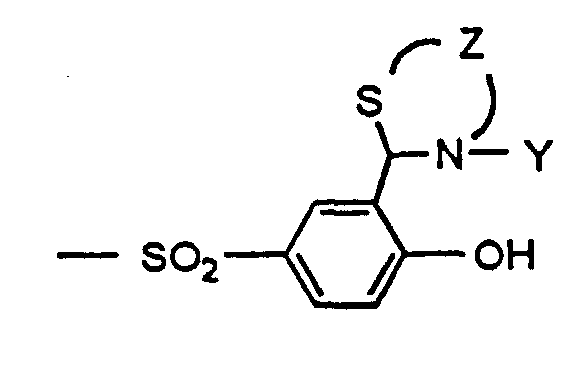 Z bedeutet die zur Vervollständigung eines 5- oder 6-gliedrigen heterocyclischen Ringsystems erforderlichen Kohlenstoffatome;Y ist ausgewählt aus der Gruppe bestehend aus: Alkyl mit 1 bis 22 Kohlenstoffatomen, mit R6 substituiertes Alkyl mit 1 bis 22 Kohlenstoffatomen, Cyclohexyl, mit R6 substituiertes Cyclohexyl, Phenyl, mit R6 substituiertes Phenyl, 1-Naphthyl, mit R6 substituiertes 1-Naphthyl, Alkaryl mit 7 bis 18 Kohlenstoffatomen, mit R6 substituiertes Alkaryl mit 7 bis 18 Kohlenstoffatomen, 2-Pyridyl und mit R6 substituiertes 2-Pyridyl,
worin R6 ausgewählt ist aus der Gruppe, bestehend aus Trifluormethyl, 2-Propenyl, Methoxy, Ethoxy, 2,4-Di-t-amylphenoxy, Acetyloxy, Methansulfonyloxy, Dimethylamino, Anilino, p-t-Octylanilino, Methansulfonylamino, p-Toluolsulfonyl, Cyclohexyl, 2-Pyridyl undworin m gleich 1, 2 oder 3 ist; und E und F bedeuten jeweils unabhängig voneinander Wasserstoff odermit der Maßgabe, daß mindestens eines von E und F die Gruppe
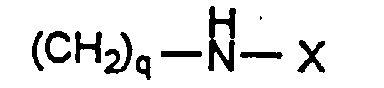 bedeutet.
- Verbindung nach Anspruch 1, dargestellt durch die Formeloder durch die Formel

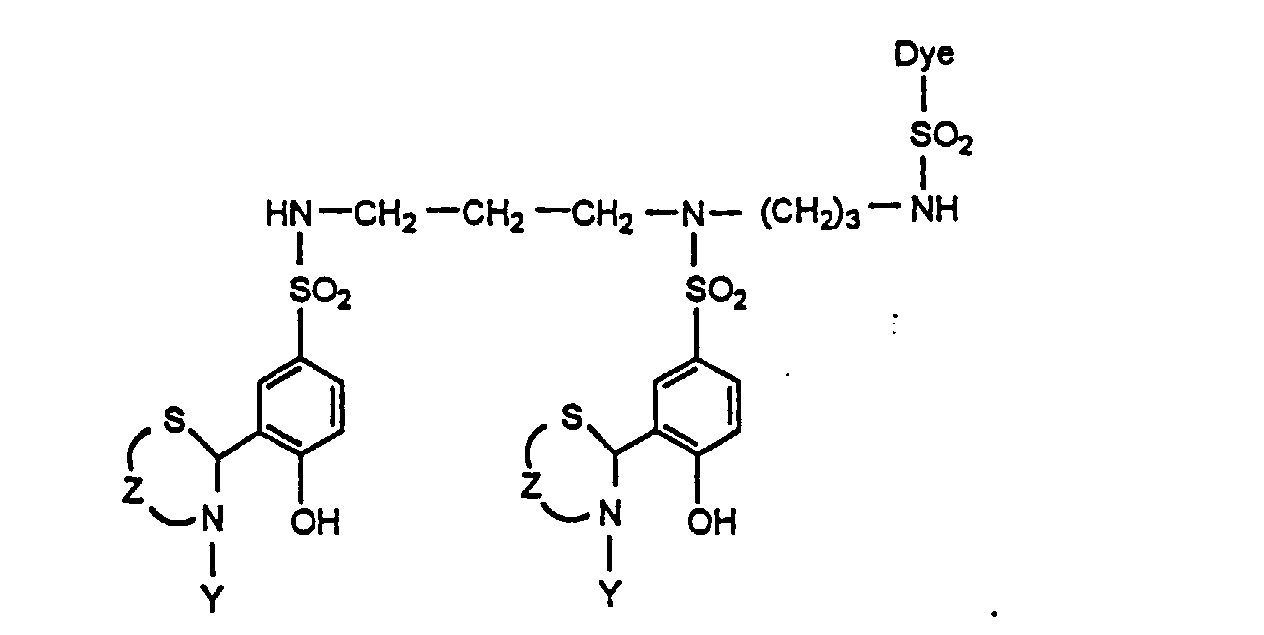
- Verbindung nach Anspruch 1 oder 2, worin Z die zur Vervollständigung einer Thiazolidin-Gruppierung erforderlichen Atome darstellt.
- Verbindung nach Anspruch 3, dargestellt durch die Formel:worin bedeuten:
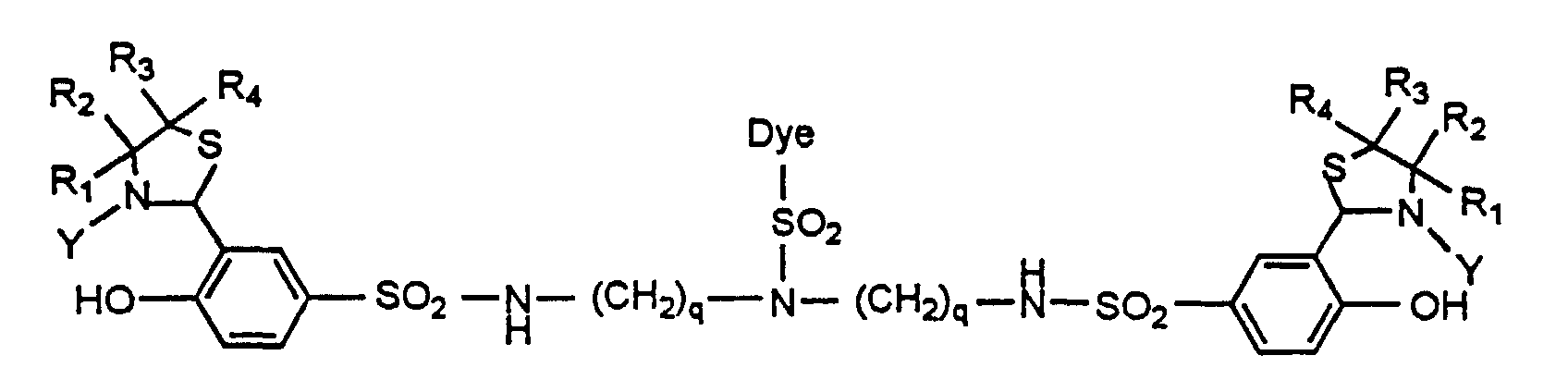
R1, R2, R3 und R4 bedeuten unabhängig voneinander Wasserstoff oder einen einwertigen organischen Rest; oder zusammengenommen bilden R1 und R2, R2 und R3, oder R3 und R4 einen 5- oder 6-gliedrigen carbocyclischen oder heterocyclischen Ring, und worin Y Alkyl mit 10 bis 22 Kohlenstoffatomen oder Aralkyl mit 12 bis 18 Kohlenstoffatomen und R1, R2, R3 und R4 Wasserstoff oder Methyl bedeuten. - Verbindung nach einem der Ansprüche 1 bis 4, worin "Dye" aus der Gruppe bestehend ausund
 ausgewählt ist.
- Bildaufzeichnungselement, enthaltend:eine Bildempfangsschicht.eine erste Unterlage und fakultativ eine zweite Unterlage, wobei von der ersten Unterlage getragen oder zwischen der ersten und der zweiten Unterlage eingeschlossen ist: ein lichtempfindliches Silberhalogenid;ein Reduktionsmittel;eine Verbindung, dargestellt durch die Formel:worin bedeuten:
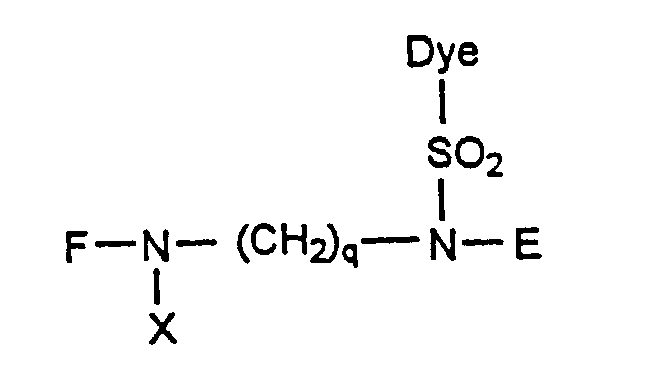 "Dye" bedeutet einen vollständigen Farbstoff oder ein Farbstoff-Zwischenprodukt;q ist gleich 2, 3 oder 4;X bedeutetworin bedeuten:
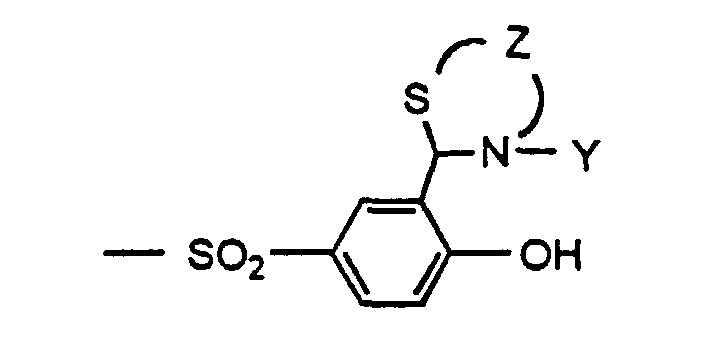 Z bedeutet die zur Vervollständigung eines 5- oder 6-gliedrigen heterocyclischen Ringsystems erforderlichen Kohlenstoffatome;Y bedeutet einen photographisch akzeptablen Substituenten; undE und F bedeuten jeweils unabhängig voneinander Wasserstoff odermit der Maßgabe, daß mindestens eines von E und F die Gruppe
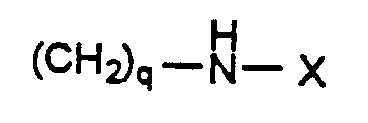 bedeutet; und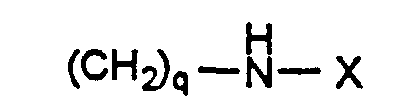
- Bildaufzeichnungselement nach Anspruch 6, worin die Verbindung wie in einem der Ansprüche 2 bis 5 definiert ist.
- Bildaufzeichnungselement nach Anspruch 6, worin die Verbindung wie in Anspruch 4 definiert ist, mit der Maßgabe, daß Y aus der Gruppe bestehend aus Alkyl mit 1 bis 9 Kohlenstoffatomen, Aralkyl mit 7 bis 11 Kohlenstoffatomen und einer Ballastgruppe ausgewählt ist; mit der Maßgabe, daß, wenn Y keine Ballastgruppe darstellt, mindestens eines von R1, R2, R3 oder R4 eine Ballastgruppe darstellt, wobei die Ballastgruppe vorzugsweise eine Alkylgruppe mit 10 bis 22 Kohlenstoffatomen oder eine Aralkylgruppe mit 12 bis 18 Kohlenstoffatomen darstellt.
- Bildaufzeichnungselement nach Anspruch 6, worin der photographisch akzeptable Substituent eine Ballastgruppe, vorzugsweise eine Alkylgruppe mit 10 bis 22 Kohlenstoffatomen, oder eine Aralkylgruppe mit 12 bis 18 Kohlenstoffatomen darstellt.
- Bildaufzeichnungselement nach Anspruch 6, worin "Dye" aus der Gruppe bestehend ausund
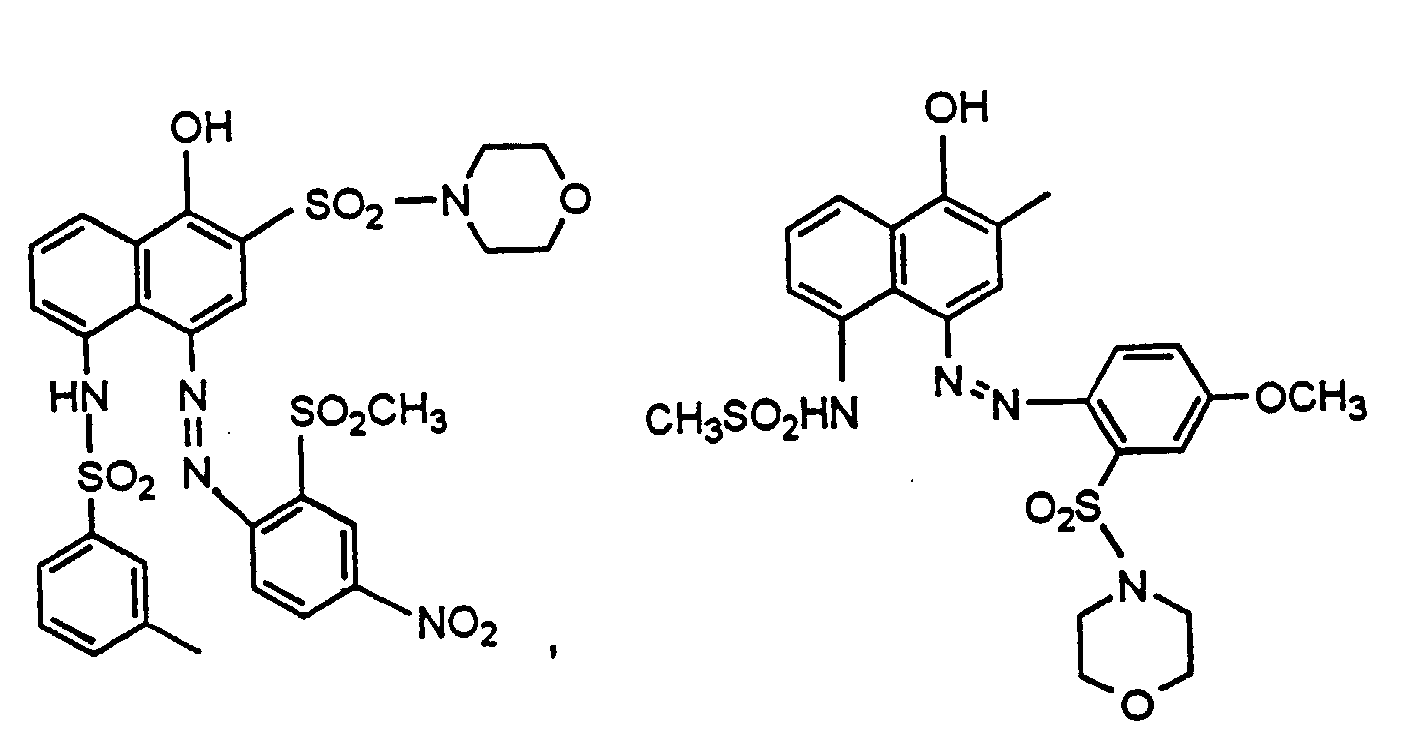 ausgewählt ist.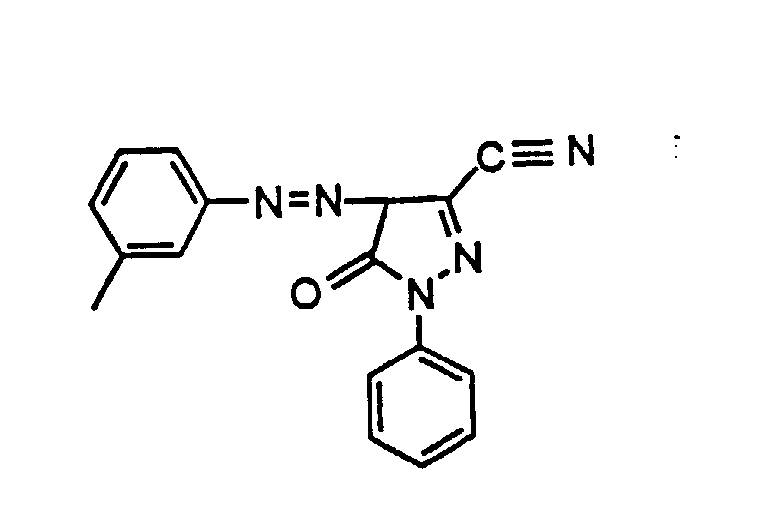
- Bildaufzeichnungselement nach einem der Ansprüche 6 bis 10, worin die erste Unterlage die lichtempfindliche Silberhalogenidschicht trägt, enthaltend ein einen blaugrünen Bildfarbstoff lieferndes Material, zugeordnet zu einer rotempfindlichen Silberhalogenid-Emulsionsschicht, ein einen purpurnen Bildfarbstoff lieferndes Material, zugeordnet zu einer grünempfindlichen Silberhalogenid-Emulsionsschicht, und ein einen gelben Bildfarbstoff lieferndes Material, zugeordnet zu einer blauempfindlichen Silberhalogenid-Emulsionsschicht, und die zweite Unterlage die Bildempfangsschicht trägt oder worin die zweite Unterlage eine Verzögerungsschicht und eine polymere sauer reagierende Schicht zwischen der zweiten Unterlage und der Bildempfangsschicht trägt.
- Hitzeentwickelbares Bildaufzeichnungselement zur Verwendung in einem Farbdiffusions-Übertragungsverfahren, enthaltend:eine erste Unterlage und fakultativ eine zweite Unterlage, wobei von der ersten Unterlage getragen oder zwischen der ersten und der zweiten Unterlage eingeschlossen ist:ein lichtempfindliches Silberhalogenid;ein Reduktionsmittel;eine Verbindung, die wie in einem der Ansprüche 1 bis 5 definiert ist;eine Bildempfangsschicht; undein alkalierzeugendes System.
- Durch Hitze entwickelbares Bildaufzeichnungselement nach Anspruch 12, worin die erste Unterlage die lichtempfindliche Silberhalogenidschicht trägt, enthaltend ein einen blaugrünen Bildfarbstoff lieferndes Material, zugeordnet zu einer rotempfindlichen Silberhalogenid-Emulsionsschicht, ein einen purpurnen Bildfarbstoff lieferndes Material, zugeordnet zu einer grünempfindlichen Silberhalogenid-Emulsionsschicht, und ein einen gelben Bildfarbstoff lieferndes Material, zugeordnet zu einer blauempfindlichen Silberhalogenid-Emulsionsschicht, und die zweite Unterlage die Bildempfangsschicht trägt oder worin die zweite Unterlage eine Verzögerungsschicht und eine polymere sauer reagierende Schicht zwischen der zweiten Unterlage und der Bildempfangsschicht trägt.
Applications Claiming Priority (5)
| Application Number | Priority Date | Filing Date | Title |
|---|---|---|---|
| US60729696A | 1996-02-26 | 1996-02-26 | |
| US08/754,286 US5658705A (en) | 1996-02-26 | 1996-11-20 | Image-recording materials with 1,3-sulfur-nitrogen dye releasers |
| US754286 | 1996-11-20 | ||
| PCT/US1997/001968 WO1997031295A1 (en) | 1996-02-26 | 1997-01-31 | Color-providing compounds |
| US607296 | 2000-06-30 |
Publications (2)
| Publication Number | Publication Date |
|---|---|
| EP0823068A1 EP0823068A1 (de) | 1998-02-11 |
| EP0823068B1 true EP0823068B1 (de) | 2000-08-09 |
Family
ID=27085483
Family Applications (1)
| Application Number | Title | Priority Date | Filing Date |
|---|---|---|---|
| EP97907573A Expired - Lifetime EP0823068B1 (de) | 1996-02-26 | 1997-01-31 | Farbbildende verbindungen |
Country Status (6)
| Country | Link |
|---|---|
| US (2) | US5658705A (de) |
| EP (1) | EP0823068B1 (de) |
| JP (1) | JPH11504975A (de) |
| CA (1) | CA2213342A1 (de) |
| DE (1) | DE69702739T2 (de) |
| WO (1) | WO1997031295A1 (de) |
Families Citing this family (5)
| Publication number | Priority date | Publication date | Assignee | Title |
|---|---|---|---|---|
| US5716754A (en) * | 1996-09-18 | 1998-02-10 | Polaroid Corporation | Image-recording materials |
| JP2001207073A (ja) * | 2000-01-27 | 2001-07-31 | Fuji Photo Film Co Ltd | アゾメチン色素前駆体、画像形成材料および画像形成方法 |
| US6396621B1 (en) * | 2000-12-28 | 2002-05-28 | Xerox Corporation | Gyricon display containing chemical absorbents |
| US7410738B2 (en) | 2004-02-10 | 2008-08-12 | Xerox Corporation | Imaging member having first and second charge transport layers |
| USD752306S1 (en) | 2012-07-23 | 2016-03-22 | Kenneth Mak | Loose material collection device |
Family Cites Families (17)
| Publication number | Priority date | Publication date | Assignee | Title |
|---|---|---|---|---|
| US3719489A (en) * | 1971-06-21 | 1973-03-06 | Polaroid Corp | Novel photographic processes and products |
| US3942987A (en) * | 1973-02-12 | 1976-03-09 | Eastman Kodak Company | Photographic materials with ballasted, alkali cleavable azo dyes |
| US3929760A (en) * | 1973-02-12 | 1975-12-30 | Eastman Kodak Co | Cyan image-providing phenylazonaphthyl dyes |
| US3954476A (en) * | 1974-02-05 | 1976-05-04 | Eastman Kodak Company | Diffusable dye-releasing compounds which are cleavable upon oxidation |
| US4098783A (en) * | 1974-04-30 | 1978-07-04 | Polaroid Corporation | Dye substituted cyclic 1,3-sulfur-nitrogen compounds as dye image-forming materials in photography |
| US4013635A (en) * | 1975-02-26 | 1977-03-22 | Eastman Kodak Company | Cyan azo dye-providing compounds |
| US4619784A (en) * | 1979-12-26 | 1986-10-28 | Polaroid Corporation, Patent Dept. | Image dye-providing materials |
| US4598158A (en) * | 1981-12-18 | 1986-07-01 | Polaroid Corporation, Patent Dept. | Novel image dye-providing materials and photographic products and processes |
| US4415737A (en) * | 1982-12-20 | 1983-11-15 | Polaroid Corporation | Thiazolidine-substituted phenyl sulfonamides |
| JPS59180548A (ja) * | 1983-03-31 | 1984-10-13 | Fuji Photo Film Co Ltd | 画像形成方法 |
| JPS6093434A (ja) * | 1983-10-27 | 1985-05-25 | Fuji Photo Film Co Ltd | カラ−感光材料 |
| US5223387A (en) * | 1986-08-06 | 1993-06-29 | Fuji Photo Film Co., Ltd. | Color photographic light-sensitive material containing a naphthyl azo dicyano halo phenyl compound |
| DE69326796T2 (de) * | 1992-06-05 | 2000-03-02 | Konica Corp., Tokio/Tokyo | Verfahren zur Herstellung eines Bildes |
| US5340689A (en) * | 1992-07-31 | 1994-08-23 | Polaroid Corporation | Image-recording materials with cyclic 1,3-sulfur-nitrogen dye providing compounds |
| US5316887A (en) * | 1992-07-31 | 1994-05-31 | Polaroid Corporation | Thermally developable photosensitive material |
| US5320929A (en) * | 1992-12-22 | 1994-06-14 | Polaroid Corporation | Image-recording materials |
| EP0656562A2 (de) * | 1993-12-03 | 1995-06-07 | Konica Corporation | Wärmeentwickelbares Lichtempfindliches Diffusionsübertragungsmaterial |
-
1996
- 1996-11-20 US US08/754,286 patent/US5658705A/en not_active Expired - Fee Related
-
1997
- 1997-01-31 WO PCT/US1997/001968 patent/WO1997031295A1/en not_active Ceased
- 1997-01-31 JP JP9530191A patent/JPH11504975A/ja active Pending
- 1997-01-31 EP EP97907573A patent/EP0823068B1/de not_active Expired - Lifetime
- 1997-01-31 CA CA002213342A patent/CA2213342A1/en not_active Abandoned
- 1997-01-31 DE DE69702739T patent/DE69702739T2/de not_active Expired - Fee Related
- 1997-03-10 US US08/815,281 patent/US5717079A/en not_active Expired - Fee Related
Also Published As
| Publication number | Publication date |
|---|---|
| EP0823068A1 (de) | 1998-02-11 |
| US5658705A (en) | 1997-08-19 |
| DE69702739D1 (de) | 2000-09-14 |
| WO1997031295A1 (en) | 1997-08-28 |
| CA2213342A1 (en) | 1997-08-28 |
| US5717079A (en) | 1998-02-10 |
| JPH11504975A (ja) | 1999-05-11 |
| DE69702739T2 (de) | 2000-12-07 |
Similar Documents
| Publication | Publication Date | Title |
|---|---|---|
| EP0606465B1 (de) | Thermisch entwickelbares lichtempfindliches material | |
| EP0627096B1 (de) | Bildaufzeichnungsmaterialien | |
| EP0823068B1 (de) | Farbbildende verbindungen | |
| EP0665465B1 (de) | Wärme entwickelbares photoempfindliches Element | |
| EP0861456B1 (de) | Bildaufzeichnungsmaterialien | |
| CA1174671A (en) | Image dye-providing materials, photographic products and processes | |
| EP0803083B1 (de) | Bildaufzeichnungsmaterialien | |
| US5667933A (en) | Image-recording element | |
| EP0626077B1 (de) | Bildaufzeichnungsmaterialien | |
| US5414091A (en) | Dye-providing compounds | |
| JPH0827529B2 (ja) | 熱現像感光材料 | |
| JPH07209836A (ja) | 色素固定要素 | |
| JP2000122248A (ja) | ハロゲン化銀写真感光材料 |
Legal Events
| Date | Code | Title | Description |
|---|---|---|---|
| PUAI | Public reference made under article 153(3) epc to a published international application that has entered the european phase |
Free format text: ORIGINAL CODE: 0009012 |
|
| 17P | Request for examination filed |
Effective date: 19970923 |
|
| AK | Designated contracting states |
Kind code of ref document: A1 Designated state(s): DE FR GB NL |
|
| GRAG | Despatch of communication of intention to grant |
Free format text: ORIGINAL CODE: EPIDOS AGRA |
|
| 17Q | First examination report despatched |
Effective date: 19990924 |
|
| GRAG | Despatch of communication of intention to grant |
Free format text: ORIGINAL CODE: EPIDOS AGRA |
|
| GRAH | Despatch of communication of intention to grant a patent |
Free format text: ORIGINAL CODE: EPIDOS IGRA |
|
| GRAH | Despatch of communication of intention to grant a patent |
Free format text: ORIGINAL CODE: EPIDOS IGRA |
|
| GRAH | Despatch of communication of intention to grant a patent |
Free format text: ORIGINAL CODE: EPIDOS IGRA |
|
| GRAA | (expected) grant |
Free format text: ORIGINAL CODE: 0009210 |
|
| AK | Designated contracting states |
Kind code of ref document: B1 Designated state(s): DE FR GB NL |
|
| PG25 | Lapsed in a contracting state [announced via postgrant information from national office to epo] |
Ref country code: NL Free format text: LAPSE BECAUSE OF FAILURE TO SUBMIT A TRANSLATION OF THE DESCRIPTION OR TO PAY THE FEE WITHIN THE PRESCRIBED TIME-LIMIT Effective date: 20000809 Ref country code: FR Free format text: LAPSE BECAUSE OF FAILURE TO SUBMIT A TRANSLATION OF THE DESCRIPTION OR TO PAY THE FEE WITHIN THE PRESCRIBED TIME-LIMIT Effective date: 20000809 |
|
| REF | Corresponds to: |
Ref document number: 69702739 Country of ref document: DE Date of ref document: 20000914 |
|
| NLV1 | Nl: lapsed or annulled due to failure to fulfill the requirements of art. 29p and 29m of the patents act | ||
| EN | Fr: translation not filed | ||
| PLBE | No opposition filed within time limit |
Free format text: ORIGINAL CODE: 0009261 |
|
| STAA | Information on the status of an ep patent application or granted ep patent |
Free format text: STATUS: NO OPPOSITION FILED WITHIN TIME LIMIT |
|
| 26N | No opposition filed | ||
| REG | Reference to a national code |
Ref country code: GB Ref legal event code: IF02 |
|
| PGFP | Annual fee paid to national office [announced via postgrant information from national office to epo] |
Ref country code: GB Payment date: 20031211 Year of fee payment: 8 |
|
| PGFP | Annual fee paid to national office [announced via postgrant information from national office to epo] |
Ref country code: DE Payment date: 20031212 Year of fee payment: 8 |
|
| PG25 | Lapsed in a contracting state [announced via postgrant information from national office to epo] |
Ref country code: GB Free format text: LAPSE BECAUSE OF NON-PAYMENT OF DUE FEES Effective date: 20050131 |
|
| PG25 | Lapsed in a contracting state [announced via postgrant information from national office to epo] |
Ref country code: DE Free format text: LAPSE BECAUSE OF NON-PAYMENT OF DUE FEES Effective date: 20050802 |
|
| GBPC | Gb: european patent ceased through non-payment of renewal fee |
Effective date: 20050131 |