EP0823302B1 - Unité d'électrodes pour le soudage par résistance - Google Patents
Unité d'électrodes pour le soudage par résistance Download PDFInfo
- Publication number
- EP0823302B1 EP0823302B1 EP97305942A EP97305942A EP0823302B1 EP 0823302 B1 EP0823302 B1 EP 0823302B1 EP 97305942 A EP97305942 A EP 97305942A EP 97305942 A EP97305942 A EP 97305942A EP 0823302 B1 EP0823302 B1 EP 0823302B1
- Authority
- EP
- European Patent Office
- Prior art keywords
- electrode unit
- resistance welding
- shank
- platen
- work according
- Prior art date
- Legal status (The legal status is an assumption and is not a legal conclusion. Google has not performed a legal analysis and makes no representation as to the accuracy of the status listed.)
- Expired - Lifetime
Links
- 238000003466 welding Methods 0.000 title claims description 46
- XLYOFNOQVPJJNP-UHFFFAOYSA-N water Substances O XLYOFNOQVPJJNP-UHFFFAOYSA-N 0.000 claims description 11
- 239000000498 cooling water Substances 0.000 claims description 9
- 230000007246 mechanism Effects 0.000 claims description 8
- 239000000463 material Substances 0.000 claims description 5
- 229910001018 Cast iron Inorganic materials 0.000 description 2
- VYZAMTAEIAYCRO-UHFFFAOYSA-N Chromium Chemical compound [Cr] VYZAMTAEIAYCRO-UHFFFAOYSA-N 0.000 description 2
- RYGMFSIKBFXOCR-UHFFFAOYSA-N Copper Chemical compound [Cu] RYGMFSIKBFXOCR-UHFFFAOYSA-N 0.000 description 2
- 230000008901 benefit Effects 0.000 description 2
- 238000001816 cooling Methods 0.000 description 2
- 229910052802 copper Inorganic materials 0.000 description 2
- 239000010949 copper Substances 0.000 description 2
- 230000000694 effects Effects 0.000 description 2
- OKTJSMMVPCPJKN-UHFFFAOYSA-N Carbon Chemical compound [C] OKTJSMMVPCPJKN-UHFFFAOYSA-N 0.000 description 1
- 230000004075 alteration Effects 0.000 description 1
- 230000008859 change Effects 0.000 description 1
- 230000007423 decrease Effects 0.000 description 1
- 238000006073 displacement reaction Methods 0.000 description 1
- 230000002349 favourable effect Effects 0.000 description 1
- 229910002804 graphite Inorganic materials 0.000 description 1
- 239000010439 graphite Substances 0.000 description 1
- 238000003780 insertion Methods 0.000 description 1
- 230000037431 insertion Effects 0.000 description 1
- 238000004519 manufacturing process Methods 0.000 description 1
- 230000000737 periodic effect Effects 0.000 description 1
- 230000008439 repair process Effects 0.000 description 1
Images


Classifications
-
- B—PERFORMING OPERATIONS; TRANSPORTING
- B23—MACHINE TOOLS; METAL-WORKING NOT OTHERWISE PROVIDED FOR
- B23K—SOLDERING OR UNSOLDERING; WELDING; CLADDING OR PLATING BY SOLDERING OR WELDING; CUTTING BY APPLYING HEAT LOCALLY, e.g. FLAME CUTTING; WORKING BY LASER BEAM
- B23K11/00—Resistance welding; Severing by resistance heating
- B23K11/30—Features relating to electrodes
- B23K11/31—Electrode holders and actuating devices therefor
- B23K11/318—Supporting devices for electrode holders
Definitions
- the present invention relates to an electrode unit for resistance welding.
- a resistance welder The welding of a plurality of wires by use of a resistance welder is known and disclosed, for instance, in Japanese Unexamined Patent Application No. HEI 7-65927.
- a welding apparatus has a pair of platens that are positioned facing one another in a fastening-separating relationship.
- a guiding member with a bottom and sides is provided, the bottom of which is integral with a fixed electrode that is electrically connected to the platen.
- a movable electrode is provided for applying voltage to a work positioned between the fixed electrode and the movable electrode.
- resistance welding is carried out by nipping a work which is positioned between the surrounding guide members, the fixed electrode and the movable electrode, with substantial voltage being applied between the electrodes.
- each electrode is individually loaded on a platen, so that it is extremely difficult to accurately position the center of each electrode, when electrodes are changed according to the different types of work to be welded.
- wire harnesses where integrated joint welding with many wires bundled, and then connected in a batch manner, is to be carried out, a considerable period of time is needed for initial start-up, due to frequent changing of electrodes.
- the positioning of the electrodes is incorrect, there exists the possibility of failure and consequent damage to the electrodes and the like, because of interference between the movable electrode and the edge of the surrounding members.
- EP A 0 259 591 discloses a projection welding device for resistance welding a right angled projection to a girder.
- the device comprises upper and lower electrodes connected to upper and lower tool members respectively.
- the lower tool member is releasably securable to a table of the projection welding device and the upper tool member is releasably securable to an upwardly and downwardly movable ram or hammer.
- a plurality of vertical sleeves on the upper tool member co-operate with a plurality of columns on the lower tool member for guiding the tool members during displacement of the tools with respect to each other.
- the present invention was made in view of the above-mentioned, problems, and with the object of providing an electrode unit for resistance welding capable of carrying out easy and fast exchange of platens.
- the present invention provides an electrode unit for resistance welding a work comprising an upper electrode attached to a shank releasably attachable to a first platen, and a lower electrode attached to a shank holder releasably attachable to a second platen wherein the shank holder integrally supports the shank for up and down movement relative to the shank holder in accordance with the movement of the first platen, and the shank holder includes a device for positioning the work between the electrodes, the device comprising a fixed guide member and a guide member movable towards a face of the fixed guide member whereby the work is held between the face and the movable guide member during resistance welding of the work.
- the present invention enables the desired electrodes to be loaded or changed in a resistance welder without the extra need for adjusting the position of each electrode, by merely loading or detaching the shank and the shank holder from its corresponding platen.
- the shank holder integrally supports the shank, thereby allowing the respective electrodes to be aligned in the correct positions.
- the present invention enables resistance welding to be carried out with the work surrounded by the guide members. Additionally, the movable electrode does not interfere with the guiding members because the electrodes are held in place by the shank and the shank holder.
- the movable guide member may separate the work after welding by surrounding the work with the fixed guide member before the upper electrode engages the work with the lower electrode.
- the electrode unit further comprises an interlocking mechanism which sequentially moves the movable guide member in cooperation with the shank.
- the invention enables the movable guide member to be displaced utilising force from the resistance welding device to drive a platen.
- the interlocking mechanism may include a link arm having a cam groove, a connecting member affixed to the shank, a cam roller attached to the connecting member and positioned in the cam groove of the link arm, and a connecting link connected to the link arm and movably attached to the movable guide member.
- the shank holder further comprises a set of water supply and drain pipes, with the shank holder having a channel connected with this piping for enabling cooling water to circulate therethrough.
- This makes it possible to cool areas in the shank holder, by circulating cooling water through the cooling water channel, thereby allowing the lower electrode to be integrally housed therein.
- the present invention allows cooling water to circulate within the electrode unit, which makes piping simpler and smaller, and improves workability.
- the electrode unit includes a base plate connected to the shank holder and detachably fastened to the second platen.
- the base plate may include a bolt having a head with a flange, wherein the bolt head is mated with a concave shaped groove in the second platen for connecting the base plate with the second platen.
- the second platen may have a guide block and a stopper block attached thereto, such that the base plate of the electrode unit is detachably guided onto the second platen.
- FIG. 1 is a perspective view of one embodiment of the present invention. As shown in the drawing, an aspect of this embodiment is a provision for an electrode unit 10 having a detachably integrated structure.
- platens 2 and 3 of a resistance welder 1 are conductive members of substantially square shape, and are arranged in opposing upward and downward relationship with respect to each other.
- the platen 2 is fixedly mounted to a body frame 5 of resistance welder 1 by means of a supporting member 4.
- the platen 3 is also secured to the body frame 5 by means of a flexible conductive member 8, and provides a detachable mounting for a press device 6 (only a rod of which is shown in Figure 1) of the resistance welder.
- the platen 3 is thereby movable upwardly and downwardly.
- Conductive members 7 and 8 connected with the platens 2 and 3, respectively, are also connected to an electric circuit (not shown) provided in the body frame 5.
- FIG 2A of the drawings is a front perspective view and Figure 2B is a side perspective view of an electrode unit 10 of the welder depicted in Figure 1.
- the electrode unit 10 of the present invention provides for integral welding of stripped ends of bundled coiled wires.
- the electrode unit 10 is equipped with a base plate 11 connected with the platen 2.
- the base plate 11 is detachably and electrically conductively fastened to the platen 2 with bolts B inserted through insertion holes 11A formed in the four corners of base plate 11.
- the platen 2 has two substantially concave shaped or T-shaped grooves 2A running fore and aft, such that the heads of bolts B can be inserted thereinto and are movable within a limited range.
- Nuts for the bolts B are not shown in Figure 1, but are screw fitted therewith from the upper side of base plate 11.
- the base plate 11 is formed of a material with high conductivity such as chrome copper, and is fastened with a shank holder 12 by small screws (not shown).
- FIG 3A is a side view
- Figure 3B is a rear elevation view
- Figure 3C is a bottom view of the shank holder of the electrode unit depicted in the embodiment of Figure 1.
- the shank holder 12 is formed of a material of high electrical resistance such as cast iron (for instance, nodular graphite cast iron; JIS-FCD-45).
- the interior of shank holder 12 contains a channel 121 covered by a back plate 13, such that cooling water circulates through a set of pipes 14 mounted on the back plate 13.
- a pipe set 14 enables water supply and drainage, and includes a water supply inlet at one end and a water drain outlet at the other end.
- the channel 121 contains sections which permit the circulation of cooling water to cool the necessary areas of the shank holder 12, which is integrated with electrodes 15 and 17 and is to be later described.
- the channel 121 contains sections which permit the circulation of cooling water to cool the necessary areas of the shank holder 12, which is integrated with electrodes 15 and 17 and is to be later described.
- holders of a pair of electrodes have heretofore been separated, it has been necessary to section the channel which circulates cooling water from a plurality of water supply and drain pipes to obtain the required cooling effect.
- various problems have been encountered, such as complicated forms of piping, decreases in workability, larger applicator sizes, regular repair and replacement of piping, etc.
- piping since piping has been required in working areas, such structures have been susceptible to water leakage.
- the shank holder 12 includes a guide block 12A which is mounted on the base plate 11.
- the guide block 12A is formed of substantially square shape which extends left and right from a side perspective view and on the upper surface of which is positioned the lower front end of a step 12B.
- the upper surface 15A of the electrode 15 which is fixed is integral with a surface 12C at the bottom of the step 12B, and is electrically conductively connected with the base plate 11.
- the shank holder 12 is equipped with a shank guide 12E and is connected with the guide block 12A through a plate area 12D.
- a shank guide 12E is block-shaped with a vertical channel as viewed from above. This allows the shank 16 to move upwardly and downwardly against the upper surface 15A of the lower electrode 15.
- the shank 16 is composed of a material high conductivity, such as chrome copper, and its upper end contains a concave shaped or T-shaped groove 16A running fore and aft.
- the groove 16A is mated with a rod 9 having a flange for connection with the platen 3.
- the groove 16A allows rod 9 to be inserted in a forward and aft direction, and the shank 16 is structurally integral to, and electrically conductive with the platen 3.
- the upper electrode 17 which is movable is fastened to the lower end of the shank 16, and applies voltage. to the work in. collaboration with the fixed electrode 15.
- the upper electrode 17 is electrically conductively connected with the platen 3 through the shank 16.
- 12H is a front guide plate which controls the shank 16 for passage through the shank guide 12E in the upward and downward directions.
- the lower electrode 15 is integrally mounted to guide the block 12A on the shank holder 12, whilst the upper electrode 17 is integrally fastened to the shank 16, the position of which is guided by the shank holder 12. Therefore, the position of the electrodes 15 and 17 in fore and aft directions and in right and left directions are precisely controlled. Moreover, with the embodiment shown in the drawings, by merely mounting the electrodes 15 and 17 onto the platens 2 and 3 by use of the shank holder 12 and the shank 16, the alignment of the electrodes of a resistance welder is made possible without any need for position adjustment.
- the electrode 15 has an oblong rectangular surface area 15A running in the forward and aft directions, when viewed from the front.
- the exposed electrode surface 15A is flush with the surface 12C of the guide block 12A, and two portions of surface 15A are positioned at right angles to faces 12F and 12G of the fixed guide member 12B.
- the faces 12F and 12G of the fixed guide member 12B cooperate to position the wire against the fixed electrode 15 in the embodiment depicted in the drawing.
- the face 12F which extends in a direction perpendicular to electrode surface 15A, also guides a guide member 18 on a movable path along the surface 12C.
- the guide member 18 is positioned in opposing relationship to the face 12G, and is movable fore and aft in a direction perpendicular to the surface 15A of the electrode 15.
- the mechanism comprises a link arm 19 having an upper end supported by means of a rotating pin 20, and a lower end of the link arm 19 connected with a fork-shaped end 18A of the guide member 18 through connecting link 21.
- the link arm 19 has a cam groove 22 with longitudinally extending guide edges, and a cam roller 23 is slidably coupled for longitudinal movement in the cam groove 22.
- the cam roller 23 is fastened to the shank 16 through a connecting member 24 such that when the shank 16 is at its upper position (when welding is not being performed), the cam roller 23 is positioned at the top of the cam groove 22 and the guide member 18 is displaced away from the face 12G of the guide member 12.
- downward movement of the shank 16 during welding causes the link arm 19 to rotate about the pin 20 such that the link arm 19 is moved in a counterclockwise direction as depicted in Figure 2A. This thereby enables the guide member 18 to nip the cable or wire between its end face and the face 12G, as the cable or wire is positioned between the electrodes 15 and 17.
- the electrode unit 10 can be mounted on the resistance welder 1 such that the electrodes 15 and 17 can be accurately aligned without the need of adjusting the relative positions of the electrodes. This is achieved by fastening base plate 11 to the platen 2 and by connecting the shank 16 to the platen 3.
- the press device 6 of the resistance welder 1 is driven by a foot switch (not shown here), and the cable is nipped between the electrodes 15 and 17 as the platen 3 is lowered towards the platen 2 and power is applied for predetermined time while resistance welding is carried out.
- the guide member 18 encloses a cable between the faces 12F and 12G, resistance welding is carried out with the upper electrode 17 and the lower electrode 15 nipping the cable between them, thereby securely positioning the cable between the electrodes and allowing for a favorable welding area.
- the mounting and changing of the desired electrodes on the resistance welder can be made possible without the need for adjustment of the position of respective electrodes 15 and 17.
- This is achieved by detaching a shank 16 and a shank holder 12 from the platens 2 and 3. Consequently, even where the electrodes 15 and 17 are changed according to the work to be welded, adjusting the positions of both electrodes becomes unnecessary, resulting in faster changeover. Therefore, according to the above-noted embodiment, the remarkable effects of easy and fast electrode changeover can be attained.
- the press device 6 of the resistance welder 1 provides the necessary motive force to displace the guide member 18, the provision of another driving mechanism for the guide member 18 is unnecessary. This therefore provides the advantage of lower cost of manufacturing.
- cooling water is circulated by the water supply and drainage pipes 14, and thus allows for cooling where needed, the advantages of simple piping, higher workability and smaller size of electrode unit, and the like can be attained.
- the channel 121 and the water supply and drainage pipes 14 are provided on the shank holder 12, which is a non-moving member, the potential for water leakage is minimized.
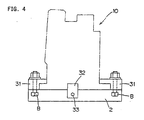
- FIG. 4 is a schematic elevation view showing the essential parts of a modified example of the present invention.
- a pair of guide blocks 31 and a stopper member 32 are provided on the platen 2.
- the guide blocks 31 detachably guide the electrode unit only in the forward and aft directions.
- the stopper 32 which is attached to bolt 33, limits movement in the forward and aft directions. Therefore, by rotating the stopper member 32 by loosening the bolt 33, and then by releasing the electrode unit 10, the electrode unit 10 can be withdrawn forward and removed from the resistance welding device. Conversely, the electrode unit 10 can be loaded onto the platen 2 and fastened securely thereon with the stopper member 32.
Landscapes
- Engineering & Computer Science (AREA)
- Mechanical Engineering (AREA)
- Resistance Welding (AREA)
- Manufacturing Of Electrical Connectors (AREA)
- Connections Effected By Soldering, Adhesion, Or Permanent Deformation (AREA)
Claims (21)
- Unité d'électrodes pour soudage par résistance d'une pièce, comprenant une électrode supérieure (17) attachée à un coulisseau (16) qui peut être attaché de façon démontable à un premier plateau (3), et une électrode inférieure (15) attachée à un porte-coulisseau (12) qui peut être attaché de façon démontable à un deuxième plateau (2), dans laquelle le porte-coulisseau (12) supporte solidairement le coulisseau (16) pour un mouvement vers le haut et le bas par rapport au porte-coulisseau (12) conformément au mouvement du premier plateau (3), et le porte-coulisseau (12) comprend un dispositif de positionnement de la pièce entre les électrodes (15, 17), ce dispositif comprenant un élément de guidage fixe (12B) et un élément de guidage (18) déplaçable vers une face (12G) de l'élément de guidage fixe (12B) de sorte que la pièce est tenue entre la face (12G) et l'élément de guidage mobile (18) pendant le soudage par résistance de la pièce.
- Unité d'électrodes pour soudage par résistance d'une pièce selon la revendication 1, dans laquelle le dispositif comprend une autre face (12F) de l'élément de guidage fixe (12B) qui coopère avec la face (12G) de l'élément de guidage fixe (12B) pour positionner la pièce, et qui est agencée de manière à guider l'élément de guidage (18) vers la face (12G) du côté fixe (12B).
- Unité d'électrodes pour soudage par résistance d'une pièce selon la revendication 2, dans lequel la face (12G) du côté fixe (12B) est perpendiculaire à une surface d'électrode (15A) de l'électrode inférieure (15), et l'autre face fixe (12F) du côté fixe (12B) est perpendiculaire à la fois à la face (12G) du côté fixe (12B) et à la surface d'électrode (15A) de l'électrode inférieure (15).
- Unité d'électrodes pour soudage par résistance d'une pièce selon une quelconque des revendications précédentes, comprenant en outre un mécanisme d'interconnexion pour commander l'élément de guidage (18) de sorte qu'il se déplace vers la face (12G) du côté fixe (12B) en conjonction avec le mouvement de descente du coulisseau (16).
- Unité d'électrodes pour soudage par résistance d'une pièce selon la revendication 4, dans laquelle le mécanisme d'interconnexion comprend en outre un bras de liaison (19) comportant une rainure de came (22), un élément de connexion (24) ayant une première extrémité et une deuxième extrémité, la première extrémité de l'élément de connexion (24) étant fixée au coulisseau (16), un galet de came (23) attaché à la deuxième extrémité de l'élément de connexion (24) et placé dans la rainure de came (22) du bras de liaison (19), et une biellette (21) connectée au bras de liaison (19), l'élément de guidage (18) étant attaché de façon mobile à la biellette (21).
- Unité d'électrodes pour soudage par résistance d'une pièce selon la revendication 5, dans laquelle l'élément de guidage (18) a une extrémité fourchue (18A) attachée de façon mobile à la biellette (21).
- Unité d'électrodes pour soudage par résistance d'une pièce selon une quelconque des revendications précédentes, dans laquelle l'élément de guidage (18) est agencé de manière à se déplacer sensiblement horizontalement.
- Unité d'électrodes pour soudage par résistance d'une pièce selon une quelconque des revendications précédentes, dans laquelle le coulisseau (16) a une extrémité supérieure comportant une rainure (16A) prévue pour s'accoupler avec une tige (9) ayant une collerette et s'étendant à partir d'une extrémité inférieure du premier plateau (3), pour connecter l'électrode supérieure (15) au plateau (3).
- Unité d'électrodes pour soudage par résistance selon la revendication 8, dans laquelle la rainure (16A) du coulisseau (16) est en forme de T.
- Unité d'électrodes pour soudage par résistance d'une pièce selon une quelconque des revendications précédentes, dans laquelle le porte-coulisseau (12) comprend un guidage de coulisseau (12E) ayant un profil en U qui permet un mouvement vertical du coulisseau (16).
- Unité d'électrodes pou soudage par résistance d'une pièce selon la revendication 10, dans laquelle le guidage de coulisseau à profil en U (12E) est en forme de bloc.
- Unité d'électrodes pour soudage par résistance d'une pièce selon la revendication 10 ou la revendication 11, dans laquelle le guidage de coulisseau (12E) est fabriqué en une matière de résistance électrique élevée.
- Unité d'électrodes pour soudage par résistance d'une pièce selon une quelconque des revendications 10, 11 ou 12, dans laquelle le guidage de coulisseau (12E) est monté de façon fixe sur le porte-coulisseau (12).
- Unité d'électrodes pour soudage par résistance d'une pièce selon une quelconque des revendications précédentes, comprenant en outre une plaque de base (11) reliée au porte-coulisseau (12), dans laquelle la plaque de base (11) peut être attachée de façon démontable au deuxième plateau (2).
- Unité d'électrodes pour soudage par résistance d'une pièce selon la revendication 14, dans laquelle la plaque de base (11) peut être attachée de façon démontable au deuxième plateau (2) de façon à être en contact électrique avec le deuxième plateau (2).
- Unité d'électrodes pour soudage par résistance d'une pièce selon la revendication 14 ou la revendication 15, dans laquelle la plaque de base (11) est fabriquée en une matière de conductivité électrique élevée.
- Unité d'électrodes pour soudage par résistance d'une pièce selon une quelconque des revendications 14 à 16, dans laquelle la plaque de base (11) comprend en outre une vis (B) attachée à la plaque de base (11), et la vis (B) a une tête avec une collerette, la tête de vis étant en prise avec une rainure (2A) du deuxième plateau (2) pour fixation de façon démontable de la plaque de base (11) au deuxième plateau (2).
- Unité d'électrodes pour soudage par résistance d'une pièce selon la revendication 17, dans laquelle la rainure (2A) du deuxième plateau (2) est en forme de T.
- Unité d'électrodes pour soudage par résistance d'une pièce selon une quelconque des revendications précédentes, dans laquelle l'unité d'électrodes est attachée de façon démontable au deuxième plateau (2) par un bloc de guidage (31) attaché au deuxième plateau (2), et un élément de butée (32) est attaché au deuxième plateau (2).
- Unité d'électrodes pour soudage par résistance d'une pièce selon la revendication 19, dans laquelle le bloc de guidage (31) guide de façon libérable la plaque de base (11) sur le deuxième plateau (2).
- Unité d'électrodes pour soudage par résistance d'une pièce selon une quelconque des revendications précédentes, dans laquelle le porte-coulisseau (12) comprend en outre un ensemble de tuyaux d'amenée et d'évacuation d'eau (14), et un canal (121) connecté entre ces tuyaux permet la circulation d'eau de refroidissement dans le porte-coulisseau.
Applications Claiming Priority (3)
| Application Number | Priority Date | Filing Date | Title |
|---|---|---|---|
| JP20847996A JP3344230B2 (ja) | 1996-08-07 | 1996-08-07 | 抵抗溶接用の電極ユニット |
| JP20847996 | 1996-08-07 | ||
| JP208479/96 | 1996-08-07 |
Publications (2)
| Publication Number | Publication Date |
|---|---|
| EP0823302A1 EP0823302A1 (fr) | 1998-02-11 |
| EP0823302B1 true EP0823302B1 (fr) | 2003-04-02 |
Family
ID=16556854
Family Applications (1)
| Application Number | Title | Priority Date | Filing Date |
|---|---|---|---|
| EP97305942A Expired - Lifetime EP0823302B1 (fr) | 1996-08-07 | 1997-08-05 | Unité d'électrodes pour le soudage par résistance |
Country Status (5)
| Country | Link |
|---|---|
| US (1) | US6075219A (fr) |
| EP (1) | EP0823302B1 (fr) |
| JP (1) | JP3344230B2 (fr) |
| CN (1) | CN1059763C (fr) |
| DE (1) | DE69720339T2 (fr) |
Families Citing this family (15)
| Publication number | Priority date | Publication date | Assignee | Title |
|---|---|---|---|---|
| EP1671738B1 (fr) * | 1998-12-16 | 2016-03-02 | Dengensha Manufacturing Company Limited | Appareil de soudage par résistance |
| US6460007B1 (en) * | 2000-03-20 | 2002-10-01 | Daimlerchrysler Corporation | Method and apparatus for determination of resistance spot welded flange width |
| JP3972609B2 (ja) | 2001-07-23 | 2007-09-05 | 住友電装株式会社 | 抵抗溶接ヘッド並びにそれを用いた抵抗溶接装置及び抵抗溶接方法 |
| JP4520474B2 (ja) * | 2007-02-15 | 2010-08-04 | アキム株式会社 | シーム溶接ローラユニット、シーム溶接装置 |
| TWI411482B (zh) * | 2008-06-19 | 2013-10-11 | Akim Corp | Seam welding unit, seam welding device |
| DE102009007699A1 (de) * | 2009-02-05 | 2010-08-19 | Andreas Clasvogt | Stumpfschweißadapter und Schweißpresse mit Stumpfschweißadapter |
| FR2969519B1 (fr) * | 2010-12-23 | 2012-12-28 | Peugeot Citroen Automobiles Sa | Dispositif pour souder ensemble deux pieces en tole, pour machine a souder mono-point |
| CN102751557B (zh) * | 2012-07-05 | 2014-03-12 | 江苏华灿电讯股份有限公司 | 一种功分器跳线焊接工装 |
| CN103840354A (zh) * | 2012-11-22 | 2014-06-04 | 苏州工业园区高登威科技有限公司 | 电极更换装置 |
| CN103071884B (zh) * | 2012-12-31 | 2016-07-06 | 肇庆理士电源技术有限公司 | 一种电池极群组烧焊装置与烧焊方法 |
| CN104339076B (zh) * | 2013-11-13 | 2017-06-23 | 浙江吉利控股集团有限公司 | 一种固定点焊电流传送夹紧装置 |
| CN103934563B (zh) * | 2014-04-29 | 2015-09-09 | 张伟 | 一种可定位式电阻焊接电极 |
| CN105195850B (zh) * | 2015-10-22 | 2017-07-04 | 张空军 | 双晶片的校准式多功能焊接治具 |
| JP6284599B1 (ja) * | 2016-09-14 | 2018-02-28 | 本田技研工業株式会社 | 電極チップ取付装置 |
| US20230311238A1 (en) * | 2022-03-29 | 2023-10-05 | BWXT Advanced Technologies LLC | Insulated electrode fixture for resistance welding and method of welding using same |
Citations (1)
| Publication number | Priority date | Publication date | Assignee | Title |
|---|---|---|---|---|
| US5495663A (en) * | 1993-06-04 | 1996-03-05 | Saito; Akihiro | Apparatus for removing an electrode chip from a shank of a resistance welding machine |
Family Cites Families (14)
| Publication number | Priority date | Publication date | Assignee | Title |
|---|---|---|---|---|
| US3036199A (en) * | 1959-07-28 | 1962-05-22 | Pa Co Inc Du | Resistance welding head |
| FR1395907A (fr) * | 1964-03-27 | 1965-04-16 | Wells Electronics | Tête de soudage électrique de précision |
| GB1577917A (en) * | 1977-02-14 | 1980-10-29 | Lucas Industries Ltd | Resistance welding apparatus |
| DE3018426A1 (de) * | 1980-05-14 | 1981-11-19 | Rossell Electronique S.A., Lausanne | Elektrodenkopf |
| US4504724A (en) * | 1980-11-03 | 1985-03-12 | Joyal Products, Inc. | Fusing machine |
| US4473734A (en) * | 1982-09-27 | 1984-09-25 | Rca Corporation | Modular welding apparatus |
| JPS5967891A (ja) * | 1982-10-08 | 1984-04-17 | Hitachi Ltd | サイリスタレオナ−ド装置 |
| JPS5966985A (ja) * | 1982-10-08 | 1984-04-16 | Hitachi Ltd | プロジエクシヨン溶接機の電極位置決め装置 |
| JPH073762B2 (ja) * | 1984-10-29 | 1995-01-18 | 古河電気工業株式会社 | ワイヤーハーネスの製造方法 |
| CH670411A5 (fr) * | 1986-09-10 | 1989-06-15 | Elpatronic Ag | |
| JPS6487084A (en) * | 1987-09-28 | 1989-03-31 | Mie Koki Kk | Spot gun for spot welding machine |
| DE3822150A1 (de) * | 1988-06-30 | 1990-01-04 | Finzer Saeckinger Maschinen Fa | Schweissaggregat zum schweissen eines vereinzelten kontaktelementes auf ein traegerelement |
| DE4107984C2 (de) * | 1991-03-13 | 1996-05-30 | Hess Eng Inc | Elektrodenbock für Preßstumpf- und Abbrennstumpfschweißmaschinen |
| JP2973389B2 (ja) * | 1993-08-27 | 1999-11-08 | 矢崎総業株式会社 | ジョイント熱圧着機の圧着ワイドの切換方法及び装置 |
-
1996
- 1996-08-07 JP JP20847996A patent/JP3344230B2/ja not_active Expired - Fee Related
-
1997
- 1997-07-15 US US08/893,158 patent/US6075219A/en not_active Expired - Lifetime
- 1997-08-05 DE DE69720339T patent/DE69720339T2/de not_active Expired - Fee Related
- 1997-08-05 EP EP97305942A patent/EP0823302B1/fr not_active Expired - Lifetime
- 1997-08-06 CN CN97115395A patent/CN1059763C/zh not_active Expired - Fee Related
Patent Citations (1)
| Publication number | Priority date | Publication date | Assignee | Title |
|---|---|---|---|---|
| US5495663A (en) * | 1993-06-04 | 1996-03-05 | Saito; Akihiro | Apparatus for removing an electrode chip from a shank of a resistance welding machine |
Also Published As
| Publication number | Publication date |
|---|---|
| EP0823302A1 (fr) | 1998-02-11 |
| DE69720339T2 (de) | 2004-02-12 |
| US6075219A (en) | 2000-06-13 |
| CN1173753A (zh) | 1998-02-18 |
| CN1059763C (zh) | 2000-12-20 |
| JPH1052763A (ja) | 1998-02-24 |
| JP3344230B2 (ja) | 2002-11-11 |
| DE69720339D1 (de) | 2003-05-08 |
Similar Documents
| Publication | Publication Date | Title |
|---|---|---|
| EP0823302B1 (fr) | Unité d'électrodes pour le soudage par résistance | |
| EP0264716B1 (fr) | Dispositif d'usinage par décharge électrique avec fil-électrode | |
| KR101448771B1 (ko) | 편 방향 스폿 용접장치 | |
| KR930007659B1 (ko) | 평판재의 위치 결정장치 | |
| EP1786073B1 (fr) | Dispositif pour le réglage de hauteur de sertissage | |
| US6720517B2 (en) | Resistance welding head and resistance welding apparatus and method using the head | |
| CN116288118B (zh) | 一种多尺寸pcb板表面热气式均匀喷锡装置及其喷涂方法 | |
| KR19990054797A (ko) | 맞대기 조인트 용접용 캐리지 | |
| CN218874080U (zh) | 一种搅拌摩擦焊工装 | |
| KR101044758B1 (ko) | 전자석플레이트가 구비된 롤폴리셔장치 | |
| JP4233674B2 (ja) | 金型交換機構 | |
| JP3250178U (ja) | 誘導加熱ろう付け用冶具 | |
| CN220128163U (zh) | 一种定位工装及采用该工装的物料定位装置 | |
| CN224059025U (zh) | 一种汽车电池壳定位机构及点焊机 | |
| CN221064805U (zh) | 一种具有打标功能的光纤激光焊接机 | |
| CN112170660A (zh) | 一种用于模具及工件位置的模拟设备 | |
| CN223114357U (zh) | 多方位调整的热压焊接治具 | |
| JPH07314145A (ja) | スポット溶接装置 | |
| JPS6145938Y2 (fr) | ||
| CN217394030U (zh) | 焊接装置及电池 | |
| CN217513062U (zh) | 一种护栏加工用的焊接机 | |
| GB2083771A (en) | Resistance spot welding gun | |
| CN218648318U (zh) | 一种插壳夹线机构 | |
| JP2004283887A (ja) | 折曲げ加工装置における分割金型支持方法及びその装置 | |
| JPH0226580Y2 (fr) |
Legal Events
| Date | Code | Title | Description |
|---|---|---|---|
| PUAI | Public reference made under article 153(3) epc to a published international application that has entered the european phase |
Free format text: ORIGINAL CODE: 0009012 |
|
| 17P | Request for examination filed |
Effective date: 19970816 |
|
| AK | Designated contracting states |
Kind code of ref document: A1 Designated state(s): DE ES FR GB IT PT |
|
| AX | Request for extension of the european patent |
Free format text: AL;LT;LV;RO;SI |
|
| AKX | Designation fees paid |
Free format text: DE ES FR GB IT PT |
|
| RBV | Designated contracting states (corrected) |
Designated state(s): DE ES FR GB IT PT |
|
| 17Q | First examination report despatched |
Effective date: 20010430 |
|
| GRAH | Despatch of communication of intention to grant a patent |
Free format text: ORIGINAL CODE: EPIDOS IGRA |
|
| GRAH | Despatch of communication of intention to grant a patent |
Free format text: ORIGINAL CODE: EPIDOS IGRA |
|
| GRAA | (expected) grant |
Free format text: ORIGINAL CODE: 0009210 |
|
| AK | Designated contracting states |
Designated state(s): DE ES FR GB IT PT |
|
| PG25 | Lapsed in a contracting state [announced via postgrant information from national office to epo] |
Ref country code: IT Free format text: LAPSE BECAUSE OF FAILURE TO SUBMIT A TRANSLATION OF THE DESCRIPTION OR TO PAY THE FEE WITHIN THE PRESCRIBED TIME-LIMIT;WARNING: LAPSES OF ITALIAN PATENTS WITH EFFECTIVE DATE BEFORE 2007 MAY HAVE OCCURRED AT ANY TIME BEFORE 2007. THE CORRECT EFFECTIVE DATE MAY BE DIFFERENT FROM THE ONE RECORDED. Effective date: 20030402 Ref country code: FR Free format text: LAPSE BECAUSE OF FAILURE TO SUBMIT A TRANSLATION OF THE DESCRIPTION OR TO PAY THE FEE WITHIN THE PRESCRIBED TIME-LIMIT Effective date: 20030402 |
|
| REG | Reference to a national code |
Ref country code: GB Ref legal event code: FG4D |
|
| REF | Corresponds to: |
Ref document number: 69720339 Country of ref document: DE Date of ref document: 20030508 Kind code of ref document: P |
|
| PG25 | Lapsed in a contracting state [announced via postgrant information from national office to epo] |
Ref country code: PT Free format text: LAPSE BECAUSE OF FAILURE TO SUBMIT A TRANSLATION OF THE DESCRIPTION OR TO PAY THE FEE WITHIN THE PRESCRIBED TIME-LIMIT Effective date: 20030702 |
|
| PG25 | Lapsed in a contracting state [announced via postgrant information from national office to epo] |
Ref country code: ES Free format text: LAPSE BECAUSE OF FAILURE TO SUBMIT A TRANSLATION OF THE DESCRIPTION OR TO PAY THE FEE WITHIN THE PRESCRIBED TIME-LIMIT Effective date: 20031030 |
|
| PLBE | No opposition filed within time limit |
Free format text: ORIGINAL CODE: 0009261 |
|
| STAA | Information on the status of an ep patent application or granted ep patent |
Free format text: STATUS: NO OPPOSITION FILED WITHIN TIME LIMIT |
|
| EN | Fr: translation not filed | ||
| 26N | No opposition filed |
Effective date: 20040105 |
|
| PGFP | Annual fee paid to national office [announced via postgrant information from national office to epo] |
Ref country code: DE Payment date: 20080821 Year of fee payment: 12 |
|
| PGFP | Annual fee paid to national office [announced via postgrant information from national office to epo] |
Ref country code: GB Payment date: 20080813 Year of fee payment: 12 |
|
| GBPC | Gb: european patent ceased through non-payment of renewal fee |
Effective date: 20090805 |
|
| PG25 | Lapsed in a contracting state [announced via postgrant information from national office to epo] |
Ref country code: DE Free format text: LAPSE BECAUSE OF NON-PAYMENT OF DUE FEES Effective date: 20100302 |
|
| PG25 | Lapsed in a contracting state [announced via postgrant information from national office to epo] |
Ref country code: GB Free format text: LAPSE BECAUSE OF NON-PAYMENT OF DUE FEES Effective date: 20090805 |