EP0824122A2 - Verfahren zur Herstellung von hochkautschukhaltigen ABS-Formmassen - Google Patents
Verfahren zur Herstellung von hochkautschukhaltigen ABS-Formmassen Download PDFInfo
- Publication number
- EP0824122A2 EP0824122A2 EP97113198A EP97113198A EP0824122A2 EP 0824122 A2 EP0824122 A2 EP 0824122A2 EP 97113198 A EP97113198 A EP 97113198A EP 97113198 A EP97113198 A EP 97113198A EP 0824122 A2 EP0824122 A2 EP 0824122A2
- Authority
- EP
- European Patent Office
- Prior art keywords
- weight
- parts
- bis
- gew
- monomers
- Prior art date
- Legal status (The legal status is an assumption and is not a legal conclusion. Google has not performed a legal analysis and makes no representation as to the accuracy of the status listed.)
- Granted
Links
- 238000000034 method Methods 0.000 title claims abstract description 20
- 238000002360 preparation method Methods 0.000 title claims abstract description 4
- 229920001971 elastomer Polymers 0.000 title description 53
- 239000005060 rubber Substances 0.000 title description 47
- 238000000465 moulding Methods 0.000 title description 12
- 239000000203 mixture Substances 0.000 claims abstract description 42
- 239000002904 solvent Substances 0.000 claims abstract description 36
- 239000003999 initiator Substances 0.000 claims abstract description 34
- 239000000178 monomer Substances 0.000 claims abstract description 34
- 238000006116 polymerization reaction Methods 0.000 claims abstract description 34
- 150000001875 compounds Chemical class 0.000 claims abstract description 19
- 238000002156 mixing Methods 0.000 claims abstract description 14
- 150000002825 nitriles Chemical class 0.000 claims abstract description 11
- LFQSCWFLJHTTHZ-UHFFFAOYSA-N Ethanol Chemical compound CCO LFQSCWFLJHTTHZ-UHFFFAOYSA-N 0.000 claims abstract description 10
- 229920002587 poly(1,3-butadiene) polymer Polymers 0.000 claims abstract description 8
- 229920000642 polymer Polymers 0.000 claims abstract description 8
- 125000003118 aryl group Chemical group 0.000 claims abstract description 7
- 150000002148 esters Chemical class 0.000 claims abstract description 7
- RTZKZFJDLAIYFH-UHFFFAOYSA-N Diethyl ether Chemical compound CCOCC RTZKZFJDLAIYFH-UHFFFAOYSA-N 0.000 claims abstract description 6
- 125000001931 aliphatic group Chemical group 0.000 claims abstract description 6
- 238000009757 thermoplastic moulding Methods 0.000 claims abstract description 6
- 150000004945 aromatic hydrocarbons Chemical class 0.000 claims abstract description 4
- 150000002576 ketones Chemical class 0.000 claims abstract description 4
- 239000000243 solution Substances 0.000 description 37
- ZWEHNKRNPOVVGH-UHFFFAOYSA-N 2-Butanone Chemical compound CCC(C)=O ZWEHNKRNPOVVGH-UHFFFAOYSA-N 0.000 description 20
- PPBRXRYQALVLMV-UHFFFAOYSA-N Styrene Chemical compound C=CC1=CC=CC=C1 PPBRXRYQALVLMV-UHFFFAOYSA-N 0.000 description 16
- CSCPPACGZOOCGX-UHFFFAOYSA-N Acetone Chemical compound CC(C)=O CSCPPACGZOOCGX-UHFFFAOYSA-N 0.000 description 15
- 239000000047 product Substances 0.000 description 13
- YNQLUTRBYVCPMQ-UHFFFAOYSA-N Ethylbenzene Chemical compound CCC1=CC=CC=C1 YNQLUTRBYVCPMQ-UHFFFAOYSA-N 0.000 description 12
- NLHHRLWOUZZQLW-UHFFFAOYSA-N Acrylonitrile Chemical compound C=CC#N NLHHRLWOUZZQLW-UHFFFAOYSA-N 0.000 description 9
- ZMXDDKWLCZADIW-UHFFFAOYSA-N N,N-Dimethylformamide Chemical compound CN(C)C=O ZMXDDKWLCZADIW-UHFFFAOYSA-N 0.000 description 9
- YXFVVABEGXRONW-UHFFFAOYSA-N Toluene Chemical compound CC1=CC=CC=C1 YXFVVABEGXRONW-UHFFFAOYSA-N 0.000 description 9
- 230000006641 stabilisation Effects 0.000 description 9
- 238000011105 stabilization Methods 0.000 description 9
- IJGRMHOSHXDMSA-UHFFFAOYSA-N Atomic nitrogen Chemical compound N#N IJGRMHOSHXDMSA-UHFFFAOYSA-N 0.000 description 8
- 229920000122 acrylonitrile butadiene styrene Polymers 0.000 description 8
- 238000006243 chemical reaction Methods 0.000 description 8
- 239000007787 solid Substances 0.000 description 8
- 239000008187 granular material Substances 0.000 description 7
- 229930195733 hydrocarbon Natural products 0.000 description 7
- 150000002430 hydrocarbons Chemical class 0.000 description 7
- 239000011145 styrene acrylonitrile resin Substances 0.000 description 7
- WYURNTSHIVDZCO-UHFFFAOYSA-N Tetrahydrofuran Chemical compound C1CCOC1 WYURNTSHIVDZCO-UHFFFAOYSA-N 0.000 description 6
- 238000001704 evaporation Methods 0.000 description 6
- KWGKDLIKAYFUFQ-UHFFFAOYSA-M lithium chloride Chemical compound [Li+].[Cl-] KWGKDLIKAYFUFQ-UHFFFAOYSA-M 0.000 description 6
- 239000002245 particle Substances 0.000 description 6
- 229920002554 vinyl polymer Polymers 0.000 description 6
- YAJYJWXEWKRTPO-UHFFFAOYSA-N 2,3,3,4,4,5-hexamethylhexane-2-thiol Chemical compound CC(C)C(C)(C)C(C)(C)C(C)(C)S YAJYJWXEWKRTPO-UHFFFAOYSA-N 0.000 description 5
- 238000012662 bulk polymerization Methods 0.000 description 5
- 239000003795 chemical substances by application Substances 0.000 description 5
- 230000008020 evaporation Effects 0.000 description 5
- 239000003381 stabilizer Substances 0.000 description 5
- 230000007306 turnover Effects 0.000 description 5
- AKNMPWVTPUHKCG-UHFFFAOYSA-N 2-cyclohexyl-6-[(3-cyclohexyl-2-hydroxy-5-methylphenyl)methyl]-4-methylphenol Chemical compound OC=1C(C2CCCCC2)=CC(C)=CC=1CC(C=1O)=CC(C)=CC=1C1CCCCC1 AKNMPWVTPUHKCG-UHFFFAOYSA-N 0.000 description 4
- OWYWGLHRNBIFJP-UHFFFAOYSA-N Ipazine Chemical compound CCN(CC)C1=NC(Cl)=NC(NC(C)C)=N1 OWYWGLHRNBIFJP-UHFFFAOYSA-N 0.000 description 4
- 239000005662 Paraffin oil Substances 0.000 description 4
- 238000001816 cooling Methods 0.000 description 4
- 229920001577 copolymer Polymers 0.000 description 4
- 238000009826 distribution Methods 0.000 description 4
- VLKZOEOYAKHREP-UHFFFAOYSA-N n-Hexane Chemical group CCCCCC VLKZOEOYAKHREP-UHFFFAOYSA-N 0.000 description 4
- 229910052757 nitrogen Inorganic materials 0.000 description 4
- 238000012545 processing Methods 0.000 description 4
- 229920000638 styrene acrylonitrile Polymers 0.000 description 4
- OPQYOFWUFGEMRZ-UHFFFAOYSA-N tert-butyl 2,2-dimethylpropaneperoxoate Chemical compound CC(C)(C)OOC(=O)C(C)(C)C OPQYOFWUFGEMRZ-UHFFFAOYSA-N 0.000 description 4
- 239000010409 thin film Substances 0.000 description 4
- KDBZVULQVCUNNA-UHFFFAOYSA-N 2,5-di-tert-butylphenol Chemical compound CC(C)(C)C1=CC=C(C(C)(C)C)C(O)=C1 KDBZVULQVCUNNA-UHFFFAOYSA-N 0.000 description 3
- WEVYAHXRMPXWCK-UHFFFAOYSA-N Acetonitrile Chemical compound CC#N WEVYAHXRMPXWCK-UHFFFAOYSA-N 0.000 description 3
- NIXOWILDQLNWCW-UHFFFAOYSA-M Acrylate Chemical compound [O-]C(=O)C=C NIXOWILDQLNWCW-UHFFFAOYSA-M 0.000 description 3
- UHOVQNZJYSORNB-UHFFFAOYSA-N Benzene Chemical compound C1=CC=CC=C1 UHOVQNZJYSORNB-UHFFFAOYSA-N 0.000 description 3
- XEKOWRVHYACXOJ-UHFFFAOYSA-N Ethyl acetate Chemical compound CCOC(C)=O XEKOWRVHYACXOJ-UHFFFAOYSA-N 0.000 description 3
- OKKJLVBELUTLKV-UHFFFAOYSA-N Methanol Chemical compound OC OKKJLVBELUTLKV-UHFFFAOYSA-N 0.000 description 3
- 239000000654 additive Substances 0.000 description 3
- XYLMUPLGERFSHI-UHFFFAOYSA-N alpha-Methylstyrene Chemical compound CC(=C)C1=CC=CC=C1 XYLMUPLGERFSHI-UHFFFAOYSA-N 0.000 description 3
- 238000005516 engineering process Methods 0.000 description 3
- 238000010438 heat treatment Methods 0.000 description 3
- 238000002347 injection Methods 0.000 description 3
- 239000007924 injection Substances 0.000 description 3
- 238000001746 injection moulding Methods 0.000 description 3
- 238000004519 manufacturing process Methods 0.000 description 3
- OFBQJSOFQDEBGM-UHFFFAOYSA-N n-pentane Natural products CCCCC OFBQJSOFQDEBGM-UHFFFAOYSA-N 0.000 description 3
- YLQBMQCUIZJEEH-UHFFFAOYSA-N tetrahydrofuran Natural products C=1C=COC=1 YLQBMQCUIZJEEH-UHFFFAOYSA-N 0.000 description 3
- XLYOFNOQVPJJNP-UHFFFAOYSA-N water Substances O XLYOFNOQVPJJNP-UHFFFAOYSA-N 0.000 description 3
- JAHNSTQSQJOJLO-UHFFFAOYSA-N 2-(3-fluorophenyl)-1h-imidazole Chemical compound FC1=CC=CC(C=2NC=CN=2)=C1 JAHNSTQSQJOJLO-UHFFFAOYSA-N 0.000 description 2
- SYBYTAAJFKOIEJ-UHFFFAOYSA-N 3-Methylbutan-2-one Chemical compound CC(C)C(C)=O SYBYTAAJFKOIEJ-UHFFFAOYSA-N 0.000 description 2
- XQMVBICWFFHDNN-UHFFFAOYSA-N 5-amino-4-chloro-2-phenylpyridazin-3-one;(2-ethoxy-3,3-dimethyl-2h-1-benzofuran-5-yl) methanesulfonate Chemical compound O=C1C(Cl)=C(N)C=NN1C1=CC=CC=C1.C1=C(OS(C)(=O)=O)C=C2C(C)(C)C(OCC)OC2=C1 XQMVBICWFFHDNN-UHFFFAOYSA-N 0.000 description 2
- -1 Acrylic ethers Chemical class 0.000 description 2
- RGSFGYAAUTVSQA-UHFFFAOYSA-N Cyclopentane Chemical compound C1CCCC1 RGSFGYAAUTVSQA-UHFFFAOYSA-N 0.000 description 2
- GHKOFFNLGXMVNJ-UHFFFAOYSA-N Didodecyl thiobispropanoate Chemical compound CCCCCCCCCCCCOC(=O)CCSCCC(=O)OCCCCCCCCCCCC GHKOFFNLGXMVNJ-UHFFFAOYSA-N 0.000 description 2
- VZCYOOQTPOCHFL-OWOJBTEDSA-N Fumaric acid Chemical compound OC(=O)\C=C\C(O)=O VZCYOOQTPOCHFL-OWOJBTEDSA-N 0.000 description 2
- KFZMGEQAYNKOFK-UHFFFAOYSA-N Isopropanol Chemical compound CC(C)O KFZMGEQAYNKOFK-UHFFFAOYSA-N 0.000 description 2
- LRHPLDYGYMQRHN-UHFFFAOYSA-N N-Butanol Chemical compound CCCCO LRHPLDYGYMQRHN-UHFFFAOYSA-N 0.000 description 2
- IMNFDUFMRHMDMM-UHFFFAOYSA-N N-Heptane Chemical compound CCCCCCC IMNFDUFMRHMDMM-UHFFFAOYSA-N 0.000 description 2
- XBDQKXXYIPTUBI-UHFFFAOYSA-M Propionate Chemical compound CCC([O-])=O XBDQKXXYIPTUBI-UHFFFAOYSA-M 0.000 description 2
- DKGAVHZHDRPRBM-UHFFFAOYSA-N Tert-Butanol Chemical compound CC(C)(C)O DKGAVHZHDRPRBM-UHFFFAOYSA-N 0.000 description 2
- 239000002253 acid Substances 0.000 description 2
- 239000007795 chemical reaction product Substances 0.000 description 2
- 238000007334 copolymerization reaction Methods 0.000 description 2
- JHIVVAPYMSGYDF-UHFFFAOYSA-N cyclohexanone Chemical compound O=C1CCCCC1 JHIVVAPYMSGYDF-UHFFFAOYSA-N 0.000 description 2
- HGCIXCUEYOPUTN-UHFFFAOYSA-N cyclohexene Chemical compound C1CCC=CC1 HGCIXCUEYOPUTN-UHFFFAOYSA-N 0.000 description 2
- BGTOWKSIORTVQH-UHFFFAOYSA-N cyclopentanone Chemical compound O=C1CCCC1 BGTOWKSIORTVQH-UHFFFAOYSA-N 0.000 description 2
- 230000002349 favourable effect Effects 0.000 description 2
- PHTQWCKDNZKARW-UHFFFAOYSA-N isoamylol Chemical compound CC(C)CCO PHTQWCKDNZKARW-UHFFFAOYSA-N 0.000 description 2
- ZXEKIIBDNHEJCQ-UHFFFAOYSA-N isobutanol Chemical compound CC(C)CO ZXEKIIBDNHEJCQ-UHFFFAOYSA-N 0.000 description 2
- 239000000314 lubricant Substances 0.000 description 2
- DUVTXUGBACWHBP-UHFFFAOYSA-N methyl 2-(1h-benzimidazol-2-ylmethoxy)benzoate Chemical compound COC(=O)C1=CC=CC=C1OCC1=NC2=CC=CC=C2N1 DUVTXUGBACWHBP-UHFFFAOYSA-N 0.000 description 2
- LVHBHZANLOWSRM-UHFFFAOYSA-N methylenebutanedioic acid Natural products OC(=O)CC(=C)C(O)=O LVHBHZANLOWSRM-UHFFFAOYSA-N 0.000 description 2
- SSDSCDGVMJFTEQ-UHFFFAOYSA-N octadecyl 3-(3,5-ditert-butyl-4-hydroxyphenyl)propanoate Chemical compound CCCCCCCCCCCCCCCCCCOC(=O)CCC1=CC(C(C)(C)C)=C(O)C(C(C)(C)C)=C1 SSDSCDGVMJFTEQ-UHFFFAOYSA-N 0.000 description 2
- 125000002347 octyl group Chemical group [H]C([*])([H])C([H])([H])C([H])([H])C([H])([H])C([H])([H])C([H])([H])C([H])([H])C([H])([H])[H] 0.000 description 2
- 210000000056 organ Anatomy 0.000 description 2
- 150000002978 peroxides Chemical class 0.000 description 2
- 229920002857 polybutadiene Polymers 0.000 description 2
- 150000003254 radicals Chemical class 0.000 description 2
- 239000011347 resin Substances 0.000 description 2
- 229920005989 resin Polymers 0.000 description 2
- 230000008961 swelling Effects 0.000 description 2
- 229920001897 terpolymer Polymers 0.000 description 2
- BWSZXUOMATYHHI-UHFFFAOYSA-N tert-butyl octaneperoxoate Chemical compound CCCCCCCC(=O)OOC(C)(C)C BWSZXUOMATYHHI-UHFFFAOYSA-N 0.000 description 2
- RYHBNJHYFVUHQT-UHFFFAOYSA-N 1,4-Dioxane Chemical compound C1COCCO1 RYHBNJHYFVUHQT-UHFFFAOYSA-N 0.000 description 1
- BQTPKSBXMONSJI-UHFFFAOYSA-N 1-cyclohexylpyrrole-2,5-dione Chemical group O=C1C=CC(=O)N1C1CCCCC1 BQTPKSBXMONSJI-UHFFFAOYSA-N 0.000 description 1
- HIDBROSJWZYGSZ-UHFFFAOYSA-N 1-phenylpyrrole-2,5-dione Chemical compound O=C1C=CC(=O)N1C1=CC=CC=C1 HIDBROSJWZYGSZ-UHFFFAOYSA-N 0.000 description 1
- SMZOUWXMTYCWNB-UHFFFAOYSA-N 2-(2-methoxy-5-methylphenyl)ethanamine Chemical compound COC1=CC=C(C)C=C1CCN SMZOUWXMTYCWNB-UHFFFAOYSA-N 0.000 description 1
- NIXOWILDQLNWCW-UHFFFAOYSA-N 2-Propenoic acid Natural products OC(=O)C=C NIXOWILDQLNWCW-UHFFFAOYSA-N 0.000 description 1
- SBYMUDUGTIKLCR-UHFFFAOYSA-N 2-chloroethenylbenzene Chemical class ClC=CC1=CC=CC=C1 SBYMUDUGTIKLCR-UHFFFAOYSA-N 0.000 description 1
- BWDBEAQIHAEVLV-UHFFFAOYSA-N 6-methylheptan-1-ol Chemical compound CC(C)CCCCCO BWDBEAQIHAEVLV-UHFFFAOYSA-N 0.000 description 1
- DKPFZGUDAPQIHT-UHFFFAOYSA-N Butyl acetate Natural products CCCCOC(C)=O DKPFZGUDAPQIHT-UHFFFAOYSA-N 0.000 description 1
- XDTMQSROBMDMFD-UHFFFAOYSA-N Cyclohexane Chemical compound C1CCCCC1 XDTMQSROBMDMFD-UHFFFAOYSA-N 0.000 description 1
- RWSOTUBLDIXVET-UHFFFAOYSA-N Dihydrogen sulfide Chemical class S RWSOTUBLDIXVET-UHFFFAOYSA-N 0.000 description 1
- ZDQWESQEGGJUCH-UHFFFAOYSA-N Diisopropyl adipate Chemical compound CC(C)OC(=O)CCCCC(=O)OC(C)C ZDQWESQEGGJUCH-UHFFFAOYSA-N 0.000 description 1
- 239000005977 Ethylene Substances 0.000 description 1
- 230000005526 G1 to G0 transition Effects 0.000 description 1
- 241000237858 Gastropoda Species 0.000 description 1
- 239000004609 Impact Modifier Substances 0.000 description 1
- CERQOIWHTDAKMF-UHFFFAOYSA-N Methacrylic acid Chemical compound CC(=C)C(O)=O CERQOIWHTDAKMF-UHFFFAOYSA-N 0.000 description 1
- GYCMBHHDWRMZGG-UHFFFAOYSA-N Methylacrylonitrile Chemical compound CC(=C)C#N GYCMBHHDWRMZGG-UHFFFAOYSA-N 0.000 description 1
- AMQJEAYHLZJPGS-UHFFFAOYSA-N N-Pentanol Chemical compound CCCCCO AMQJEAYHLZJPGS-UHFFFAOYSA-N 0.000 description 1
- 238000004497 NIR spectroscopy Methods 0.000 description 1
- 150000001298 alcohols Chemical class 0.000 description 1
- 150000001338 aliphatic hydrocarbons Chemical class 0.000 description 1
- 150000001336 alkenes Chemical class 0.000 description 1
- 125000005907 alkyl ester group Chemical group 0.000 description 1
- 150000001408 amides Chemical class 0.000 description 1
- 230000003712 anti-aging effect Effects 0.000 description 1
- 239000003963 antioxidant agent Substances 0.000 description 1
- 230000005540 biological transmission Effects 0.000 description 1
- 238000009835 boiling Methods 0.000 description 1
- 239000001273 butane Substances 0.000 description 1
- 238000007796 conventional method Methods 0.000 description 1
- HPXRVTGHNJAIIH-UHFFFAOYSA-N cyclohexanol Chemical compound OC1CCCCC1 HPXRVTGHNJAIIH-UHFFFAOYSA-N 0.000 description 1
- 239000012933 diacyl peroxide Substances 0.000 description 1
- 125000004177 diethyl group Chemical group [H]C([H])([H])C([H])([H])* 0.000 description 1
- 238000010790 dilution Methods 0.000 description 1
- 239000012895 dilution Substances 0.000 description 1
- WNAHIZMDSQCWRP-UHFFFAOYSA-N dodecane-1-thiol Chemical compound CCCCCCCCCCCCS WNAHIZMDSQCWRP-UHFFFAOYSA-N 0.000 description 1
- 239000000975 dye Substances 0.000 description 1
- 230000000694 effects Effects 0.000 description 1
- 239000000839 emulsion Substances 0.000 description 1
- 238000007720 emulsion polymerization reaction Methods 0.000 description 1
- 150000002170 ethers Chemical class 0.000 description 1
- 125000001495 ethyl group Chemical group [H]C([H])([H])C([H])([H])* 0.000 description 1
- 239000011552 falling film Substances 0.000 description 1
- 239000000945 filler Substances 0.000 description 1
- 238000010528 free radical solution polymerization reaction Methods 0.000 description 1
- 239000001530 fumaric acid Substances 0.000 description 1
- 229920000578 graft copolymer Polymers 0.000 description 1
- DMEGYFMYUHOHGS-UHFFFAOYSA-N heptamethylene Natural products C1CCCCCC1 DMEGYFMYUHOHGS-UHFFFAOYSA-N 0.000 description 1
- FUZZWVXGSFPDMH-UHFFFAOYSA-N hexanoic acid Chemical compound CCCCCC(O)=O FUZZWVXGSFPDMH-UHFFFAOYSA-N 0.000 description 1
- 230000006698 induction Effects 0.000 description 1
- 238000011835 investigation Methods 0.000 description 1
- 238000002955 isolation Methods 0.000 description 1
- 238000004898 kneading Methods 0.000 description 1
- 150000002688 maleic acid derivatives Chemical class 0.000 description 1
- FPYJFEHAWHCUMM-UHFFFAOYSA-N maleic anhydride Chemical compound O=C1OC(=O)C=C1 FPYJFEHAWHCUMM-UHFFFAOYSA-N 0.000 description 1
- 238000000691 measurement method Methods 0.000 description 1
- 238000011326 mechanical measurement Methods 0.000 description 1
- 239000000155 melt Substances 0.000 description 1
- 125000002496 methyl group Chemical group [H]C([H])([H])* 0.000 description 1
- YKYONYBAUNKHLG-UHFFFAOYSA-N n-Propyl acetate Natural products CCCOC(C)=O YKYONYBAUNKHLG-UHFFFAOYSA-N 0.000 description 1
- IJDNQMDRQITEOD-UHFFFAOYSA-N n-butane Chemical compound CCCC IJDNQMDRQITEOD-UHFFFAOYSA-N 0.000 description 1
- TVMXDCGIABBOFY-UHFFFAOYSA-N octane Chemical compound CCCCCCCC TVMXDCGIABBOFY-UHFFFAOYSA-N 0.000 description 1
- 229910000489 osmium tetroxide Inorganic materials 0.000 description 1
- 239000012285 osmium tetroxide Substances 0.000 description 1
- 150000004978 peroxycarbonates Chemical class 0.000 description 1
- 125000005634 peroxydicarbonate group Chemical group 0.000 description 1
- 229920003023 plastic Polymers 0.000 description 1
- 239000004033 plastic Substances 0.000 description 1
- 238000013001 point bending Methods 0.000 description 1
- 229920002959 polymer blend Polymers 0.000 description 1
- 238000001556 precipitation Methods 0.000 description 1
- BDERNNFJNOPAEC-UHFFFAOYSA-N propan-1-ol Chemical compound CCCO BDERNNFJNOPAEC-UHFFFAOYSA-N 0.000 description 1
- 239000003380 propellant Substances 0.000 description 1
- FVSKHRXBFJPNKK-UHFFFAOYSA-N propionitrile Chemical compound CCC#N FVSKHRXBFJPNKK-UHFFFAOYSA-N 0.000 description 1
- 229940090181 propyl acetate Drugs 0.000 description 1
- 238000010526 radical polymerization reaction Methods 0.000 description 1
- 238000010008 shearing Methods 0.000 description 1
- 239000011877 solvent mixture Substances 0.000 description 1
- 238000004611 spectroscopical analysis Methods 0.000 description 1
- 230000003068 static effect Effects 0.000 description 1
- 238000003756 stirring Methods 0.000 description 1
- 229920003048 styrene butadiene rubber Polymers 0.000 description 1
- 239000006188 syrup Substances 0.000 description 1
- 235000020357 syrup Nutrition 0.000 description 1
- 125000000999 tert-butyl group Chemical group [H]C([H])([H])C(*)(C([H])([H])[H])C([H])([H])[H] 0.000 description 1
- 238000012360 testing method Methods 0.000 description 1
- 229920001169 thermoplastic Polymers 0.000 description 1
- 239000004416 thermosoftening plastic Substances 0.000 description 1
- VZCYOOQTPOCHFL-UHFFFAOYSA-N trans-butenedioic acid Natural products OC(=O)C=CC(O)=O VZCYOOQTPOCHFL-UHFFFAOYSA-N 0.000 description 1
- NQPDZGIKBAWPEJ-UHFFFAOYSA-N valeric acid Chemical compound CCCCC(O)=O NQPDZGIKBAWPEJ-UHFFFAOYSA-N 0.000 description 1
- 125000000391 vinyl group Chemical group [H]C([*])=C([H])[H] 0.000 description 1
- 239000002351 wastewater Substances 0.000 description 1
- 239000008096 xylene Substances 0.000 description 1
- 150000003738 xylenes Chemical class 0.000 description 1
Images

Classifications
-
- C—CHEMISTRY; METALLURGY
- C08—ORGANIC MACROMOLECULAR COMPOUNDS; THEIR PREPARATION OR CHEMICAL WORKING-UP; COMPOSITIONS BASED THEREON
- C08F—MACROMOLECULAR COMPOUNDS OBTAINED BY REACTIONS ONLY INVOLVING CARBON-TO-CARBON UNSATURATED BONDS
- C08F279/00—Macromolecular compounds obtained by polymerising monomers on to polymers of monomers having two or more carbon-to-carbon double bonds as defined in group C08F36/00
- C08F279/02—Macromolecular compounds obtained by polymerising monomers on to polymers of monomers having two or more carbon-to-carbon double bonds as defined in group C08F36/00 on to polymers of conjugated dienes
- C08F279/04—Vinyl aromatic monomers and nitriles as the only monomers
Definitions
- the invention relates to a single-stage polymerization process for the production of impact-resistant, thermoplastically processable molding compounds due to free radicals Polymerization of aromatic monoalkenyl compounds, ethylenic unsaturated nitriles and optionally other copolymerizable compounds in the presence of soluble, gel-free polybutadiene rubber as a graft base in the solvent.
- the process according to the invention is characterized by simple polymerization technology and economy and the products of the invention by high Impact strength with high hardness, translucency, matt surface, light raw tone with excellent workability.
- the aim of the invention is an economical, reliable method of manufacture of thermoplastically processable ABS molding compounds that are technically can carry out simple devices and ABS with good processing and Application properties with excellent impact resistance of the graft rubber delivers.
- Another object of the invention is to provide ABS molding compounds with high Provide rubber content that works as blend components and impact modifiers are suitable and those which can be prepared by aqueous emulsion polymerization Molding compounds are equivalent.
- the polymer content is at the same time the total mixture 30 to 60 wt .-%, in particular 35 to 50 wt .-%, the Total solvent content 25 to 60 wt .-% and the rest are not reacted monomers.
- the content of butadiene polymer in the molding composition is 20-40% by weight, preferably 25 to 40% by weight, in particular 28 to 40% by weight.
- the products according to the invention are distinguished by a low degree of grafting between 0.05 and 1, preferably between 0.2 and 0.8.
- the degree of grafting is the ratio Gel content - rubber content Rubber content .
- the gel content means the proportion of the molding composition which is insoluble in tetrahydrofuran.
- the products contain a finely dispersed rubber phase with particle sizes between 0.05 and 10 ⁇ m, preferably between 0.05 and 5 ⁇ m.
- Particle size means the weight average of the particle size distribution. He will determined with the ultracentrifuge.
- the high-rubber products produced according to the invention can be used as such are used; however, they are preferred with copolymers or terpolymers from aromatic monoalkenyl monomers, ethylenically unsaturated nitrile monomers and optionally further copolymerizable vinyl monomers and / or maleic monomers also tough but improved in hardness Molding compositions in a weight ratio of 1: 0.25 to 1:10 by customary methods mixed plastic processing.
- solvents (B) alone is also in bulk polymerization (cf. EP-A 277 687, EP-A 657 479, US Pat. No. 3,538,190, DE-A 2 516 834, US Pat. No. 3,449,471), where they are used in small amounts for dilution be used.
- the rubber content in the polymerization mixture is also small.
- Non-aqueous polymerization processes result in improved product properties such as raw tone, translucency, rubber effectiveness and matt surfaces. There is no waste water.
- These advantages are according to the invention with a simple Technology through at low polymerization temperatures 60 to about 150 ° C, preferably at 70 to 120 ° C under normal pressure or only slightly elevated Pressure achieved, with only viscosities below 150 Pa.s occur.
- One can according to the invention also ABS resins with a high rubber content of up to approximately Produce 40 wt .-%. Such high rubber ABS resins are called additives needed for thermoplastics. So far they could only be polymerized in aqueous emulsion.
- Draw the products of the invention are characterized by excellent processing and usage properties. By the significantly higher rubber content compared to bulk polymerization ABS resin and the simpler technology also become the economic disadvantages compensated for the higher amounts of solvent.
- the essence of the present invention is the use of larger amounts a solvent or a solvent mixture of those defined above Group (A) with high rubber contents in the monomer mixture and in the end product as well as incomplete conversion of the monomers.
- Deviations from the conditions according to the invention occur, e.g.
- solvents from group (B) no longer for Phase inversion and a steep increase in viscosity, or too early Phase inversion, the disperse phase then formed due to insufficient Grafting becomes so coarse that it leads to poor product properties and too heavy deposits in the reactors.
- the solvents from the Group (A) are non-solvents for the rubbers, they can also with high Rubber content in the monomer mixture in large quantities even before the start of polymerization be added without rubber falling out; on the other hand let a particularly favorable rheological behavior of the Achieve polymerization solutions and favorable product properties.
- the process according to the invention can be carried out batchwise, semi-continuously and be carried out continuously.
- the batch and semi-batch polymerization can be carried out in one or several successively filled or partially filled mixed Stirring kettles with presentation of the monomers of the rubber and the Solvent and polymerization up to the specified monomer conversion of 30 up to 70% by weight.
- the average residence time is 1 to 10 hours.
- the polymerization becomes advantageous at 60 to 120 ° C, preferably at the boiling point of the solvent / polymer mixture carried out. It is advantageous to polymerize at normal pressure it is also possible to carry out the polymerization at a slight excess pressure up to to 6 bar.
- the viscosity of the agitated or transported media is in the range of maximum 150 Pa.s.
- the graft polymer can be prepared in a known manner by precipitation in solvent, by stripping with water and / or water vapor or by evaporation Polymer melt e.g. on expansion evaporators, strand evaporators, spiral tube evaporators, Thin film evaporators, certain thin film evaporators, falling film evaporators, Snail earners, are isolated.
- Stabilizers During the polymerization and during the polymer isolation additives, Stabilizers, anti-aging agents, fillers, lubricants are added.
- the impact-resistant ABS molding compositions produced by the process according to the invention show after contrasting with osmium tetroxide in electron microscope Inclusion of a mono- or polymodal size distribution of the graft rubber with a high percentage of internal graft and large "rubber phase volume". Such distributions and structures, as shown in FIG. 1, have advantageous effects Processing and usage properties (see US Pat. No. 5,166,261).
- the Rubber particles have a diameter of ⁇ 0.1 to 10 ⁇ m.
- Group (A) solvents are alcohols such as methanol, ethanol, propanol, Isopropanol, butanol, isobutanol, tert-butanol, amyl alcohol, isoamyl alcohol, Isooctanol, cyclohexanol; Ketones such as acetone, methyl ethyl ketone, methyl isopropyl ketone, Cyclopentanone, cyclohexanone; Ethers such as tetrahydrofuran, dioxane, Ethylene ethyl dimethyl, diethyl, dipropyl, diisopropyl ester; Esters such as ethyl acetate, Propyl acetate, butyl acetate and others, nitriles such as acetonitrile, propionitrile, buryronitrile. Methyl ethyl ketone and acetone are preferred.
- Group (B) solvents are aliphatic hydrocarbons such as butane, Pentane, hexane, heptane, octane or their iso-derivatives, cycloaliphatic hydrocarbons such as cyclopentane, cyclohexane, alkyl-cyclopentane, alkyl-cyclohexane, aromatic hydrocarbons such as benzene, toluene, xylenes, ethylbenzene. Prefers becomes toluene and ethylbenzene.
- Mixtures of acetone and ethylbenzene and of acetone are particularly preferred and toluene.
- Solvents from group (A) can also be used. Is preferred then methyl ethyl ketone.
- molecular weight regulators such as mercaptans can be used to adjust the molecular weights and olefins, e.g. tert-dodecyl mercaptan, n-dodecyl mercaptan, cyclohexene, terpinols, dimeric ⁇ -methylstyrene etc. in amounts of 0.05 to 1.0% by weight be used on copolymerizing monomers.
- Suitable initiators for radical polymerization are graft-active, in Radically disintegrating peroxides such as peroxycarbonates, peroxydicarbonates, diacyl peroxides, Perketals or dialkyl peroxides and / or azo compounds or mixtures from here.
- peroxides such as peroxycarbonates, peroxydicarbonates, diacyl peroxides, Perketals or dialkyl peroxides and / or azo compounds or mixtures from here.
- Examples are azodiisobutyric acid dinitrile, azoisobutyric acid alkyl esters, tert-butyl perpivalate, peroctoate, perbenzoate, perneodecanoate.
- This Initiators are used in amounts of 0.01 to 1% by weight, based on monomers I. to 3rd, used.
- Customary additives can be used during the polymerization or prior to working up such as dyes, antioxidants, lubricants, stabilizers, such as those skilled in the art known to be added.
- Soluble, gel-free butadiene polymers are polybutadienes and styrene-butadiene copolymers in statistical and / or block form, with a high 1,2-vinyl content of 2 to 40%, preferably from 8 to 25%, based on the double bonds, with Molar masses from 50,000 to 500,000, including branched and star-shaped Polymer with gel contents ⁇ 1,000 ppm.
- Aromatic monoalkenyl compounds 1. are preferably styrene, ⁇ -methylstyrene, nucleus-substituted alkylstyrenes, nucleus-substituted chlorostyrenes.
- Ethylenically unsaturated nitriles are preferably acrylonitrile, methacrylonitrile.
- Copolymerizable compounds are e.g. Acrylic ethers such as methyl (meth) acrylate, Ethyl (meth) acrylate, tert-butyl (meth) acrylate, esters of furmar, itaconic acid, maleine derivatives such as maleic anhydride, maleic acid esters, N-substituted maleimides how advantageous N-cyclohexyl- or N-phenyl-maleimide, N-alkyl-phenyl-maleimide, further acrylic acid, methacrylic acid, fumaric acid, itaconic acid or their Amides.
- Acrylic ethers such as methyl (meth) acrylate, Ethyl (meth) acrylate, tert-butyl (meth) acrylate, esters of furmar, itaconic acid, maleine derivatives such as maleic anhydride, maleic acid esters, N-substituted maleimides how advantageous N-cyclohexyl- or
- ABS resins can in a manner known per se, preferably in the form of granules Copolymers or terpolymers of aromatic monoalkenyl compounds, ethylenically unsaturated nitriles and optionally other copolymerizable compounds according to the definition given above also to toughen up but in the hardness-improved molding compounds are compounded.
- Styrene / acrylonitrile copolymers and ⁇ -methylstyrene / acrylonitrile copolymers are preferred Styrene / acrylonitrile copolymers and ⁇ -methylstyrene / acrylonitrile copolymers.
- the molding compounds produced in this way are characterized by a Properties combination of high toughness and hardness not previously achieved. The properties of the mixtures can be adjusted within a wide range Mixing ratio vary. Another advantage of this procedure is also that the economy of the overall process is improved by that the more complicated to carry out compared to the simple copolymerization Graf
- the sales were determined either by solids determination by evaporation at 200 ° C or by online near infrared spectroscopy. The course of the viscosity was recorded during the polymerization by absorbing the torque on the stirrer shaft. The rubber content in the end product was determined either from the mass balance, by IR spectroscopic methods or by measuring the free induction drop (FID) (pulsed NMR, NMS 100 minispek). Gel contents and degrees of swelling were determined in tetrahydrofuran. The transmission electron microscope (TEM) images were taken on ultrathin sections contrasted with OsO 4 .
- FID free induction drop
- the investigation of the sheet behavior was carried out on the V-notch by means of rapid three-point bending (impact stress in a standard small bar) using a 40 mm span of the support points.
- the phase structure was examined by dynamic mechanical measurement of the shear modulus characteristic G * (T) at the NPS at the frequency of approx. 1 Hz in the temperature range from - 150 ° C to 200 ° C with the RDS from Rheometrics.
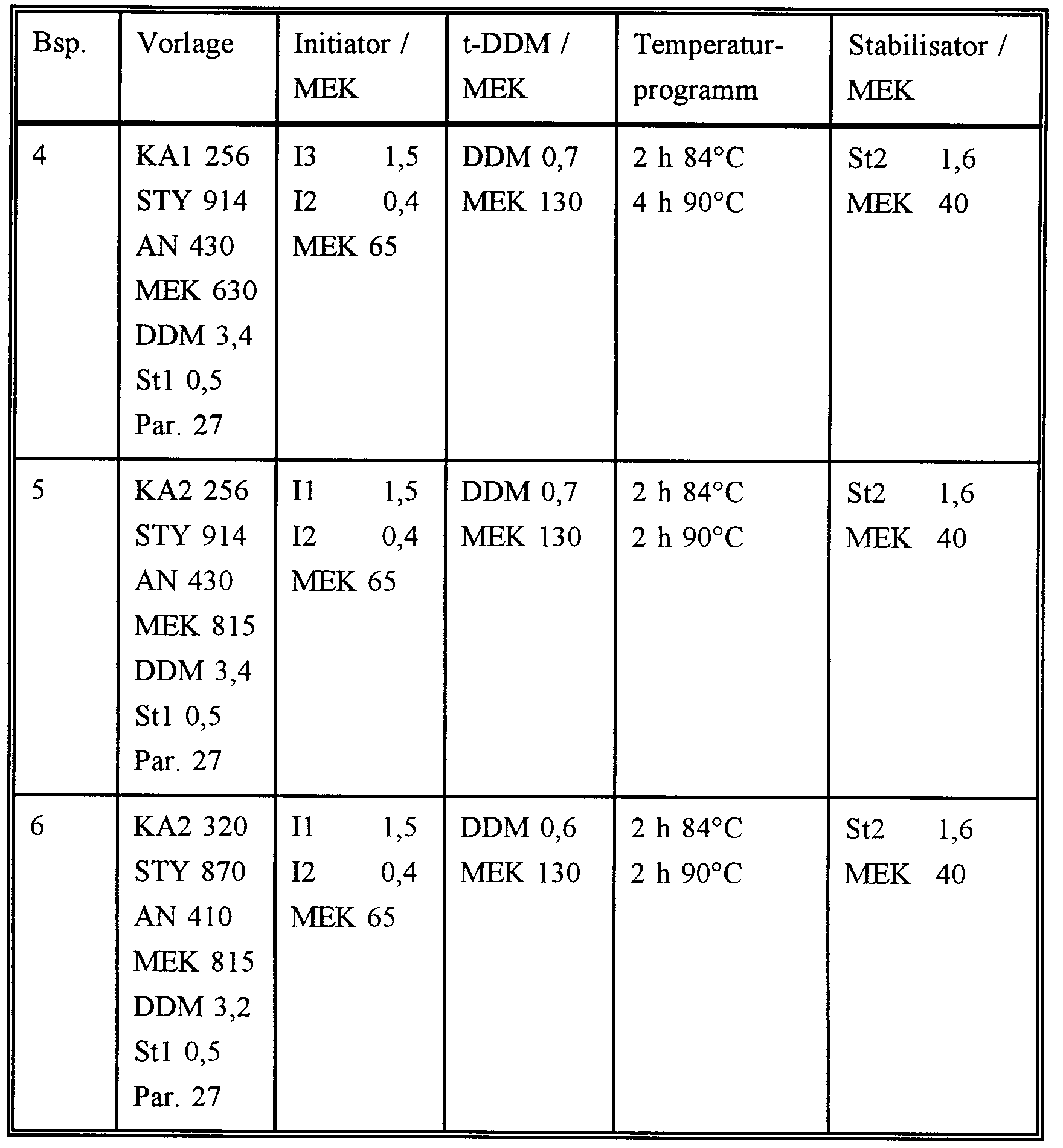
- the discontinuous polymerizations were carried out in a 5 l laboratory reactor wall-mounted stirrer performed.
- the template was made by dissolving the rubber poly-cis-butadiene with a 1,2-vinyl content of 11% of the double bonds and a 1,4-cis portion of 38% the double bonds (Buna CB HX 502 C, Bayer Elastomeres Frances) "KA1" or poly-cis-butadiene-co-styrene, 11% by weight of styrene, solution viscosity 27.5 mPa.s 5% in styrene (Buna BL Bayer 8497, Bayer Elastomeres Frances) "KA2" in Monomers, solvents, regulators and auxiliaries, if necessary add more of acrylonitrile and solvent, at 40 to 50 ° C under nitrogen.
- tert-dodecyl mercaptan As a controller tert-dodecyl mercaptan “DDM” was used as initiator tert-butyl perpivalate (approx. 60% solution in hydrocarbons) "I1”, tert-amyl perpivalate (approx. 60% solution in hydrocarbons) “I2” and tert-butyl peroctoate “I3”. Styrene "STY” and 2-butanone “MEK” were distilled before use, acrylonitrile "AN” was used raw.
- DDM tert-dodecyl mercaptan
- FIG. 1 shows the test data of Example 6 in comparison to a product produced by mass polymerization processes ("Magnum 3504", DOW).
- the notched impact strengths (a K -IZOD) at 23 ° C (I) and -40 ° C (II), the heat resistance (Vicat B / 120) (III) and the melt volume index MVI (10/220) (IV) were measured Hardness (HC 30 "in MPa) (V) and the rubber content of the product (% by weight) (VI).
- the solid line (-) corresponds to Example 6, the dashed (----)" Magnum 3504 ".
- the batch polymerizations were carried out in a 5 l laboratory reactor at a Pressure ⁇ 3 bar carried out with a wall-mounted stirrer.
- the template was made by dissolving the rubber (poly-cis-butadiene with a 1,2-vinyl content of 11% of the double bonds and a 1,4-cis portion of 38% the double bonds (Buna CB HX 502 C, Bayer Elastomeres Frances) "KA1” or poly-cis-butadiene-co-styrene (Buna BL Bayer 8497, Bayer Elastomeres Frances) "KA2" in monomers, solvents, regulators and auxiliaries, if necessary with further dosing of acrylonitrile and solvent, at 40 to 50 ° C made under nitrogen.
- tert-dodecyl mercaptan As a regulator tert-dodecyl mercaptan “DDM” was used as Initiators tert-butyl perpivalate (approx. 60% solution in hydrocarbons) "I1". Styrene "STY” was distilled before use, acrylonitrile “AN”, acetone “AC” and Ethylbenzene “EB” was used raw.
- Example 11 was carried out in a manner similar to Examples 7-10.
- the mixture was heated to 90 ° C. and the initiator solution I was metered in from 0 to 80 min.
- the initiator solution II was metered in from 180 to 270 min.
- the mixture was cooled from 90 ° C. to room temperature.
- template Initiator solution I Initiator solution II stabilization KA2 466 STY 1326 ON 591 18th EB 512 40 AC 965 60 62 40 DDM 7.74 St1 0.93 St3 3.5 St4 4.7 Par. 37 I1 3.87 2.26 Dosage, t [min] 0-80 180-270 330
- the semi-continuous polymerization was carried out in a 5 l laboratory reactor with a wall Stirrer performed.
- the template was made by dissolving the rubber poly-cis-butadiene with a 1,2-vinyl content of 11% of the double bonds and a 1,4-cis portion of 38% the double bonds (Buna CB HX 502 C, Bayer Elastomeres Frances) "KA1" in Monomers, solvents, regulators and auxiliaries, if necessary with additional dosing of acrylonitrile and solvents, at 40 to 50 ° C under nitrogen produced.
- the continuous polymerization was composed of in a cascade a 5 l and 10 l laboratory reactor at a pressure ⁇ 3 bar with wall-accessible Stirrer performed.
- the rubber solution was prepared by dissolving the rubber (poly-cis-butadiene with a 1,2-vinyl portion of 11% of the double bonds and a 1,4-cis portion 38% of the double bonds (Buna CB HX 502 C, Bayer Elastomeres Frances) "KA1" in monomers, solvents, regulators and auxiliaries, if necessary with further dosing of acrylonitrile and solvent, at 40 to 50 ° C under nitrogen produced.
- the initiator solution I is in the reactor I (5 l volume), the Initiator solution II metered into the reactor II (10 l volume). The stabilization will metered into the discharge of the reactor II.
- compositions of the solutions, the metering flows, the average residence times and the reactor temperatures are shown in the tables below.
- Styrene "STY” was distilled before use, acrylonitrile “AN”, acetone “AC” and ethylbenzene “EB” were used raw.
- Dosing flow [g / h] 1736.9 264.1 59.7 58.4 Reactor I Reactor II Mean residence time 1 3rd T [° C] 90 90 Turnover [% by weight] 14.45 60.42
- the solution was then evaporated on a ZSK laboratory evaporation screw and granulated.
- the solid granules were mixed with styrene-acrylonitrile resin (Staudinger index: 0.58 dL / g in dimethylformamide + 1 g / L LiCl) so that the mixtures contained 14% by weight of rubber, via a conical, counter-rotating twin-shaft Laboratory screw from Haake, Düsseldorf, extruded and granulated at 117 rpm.
- the granules obtained in this way were hosed down to standard small bars (conditions of injection molding: melt temperature: 210 ° C., mold temperature 60 ° C., injection time 2.8 seconds).
Landscapes
- Chemical & Material Sciences (AREA)
- Health & Medical Sciences (AREA)
- Chemical Kinetics & Catalysis (AREA)
- Medicinal Chemistry (AREA)
- Polymers & Plastics (AREA)
- Organic Chemistry (AREA)
- Graft Or Block Polymers (AREA)
- Polymerisation Methods In General (AREA)
- Compositions Of Macromolecular Compounds (AREA)
Abstract
- 15 bis 50 Gew.-Teilen pro 100 Gew.-Teile Monomere eines löslichen gelfreien Butadienpolymerisats und in Gegenwart von
- 50 bis 200 Gew.-Teilen pro 100 Gew.-Teile Monomere eines Lösungsmittels radikalisch polymerisiert,
Description
- 15 bis 50 Gew.-Teilen pro 100 Gew.-Teile Monomere eines löslichen gelfreien Butadienpolymerisats und in Gegenwart von
- 50 bis 200 Gew.-Teilen pro 100 Gew.-Teile Monomere eines Lösungsmittels radikalisch polymerisiert,

| Bsp. | Feststoff nach Polymerisation (Gew.-%) | Umsatz (Gew.-%) | Kautschukgehalt (Gew.-%) nach Polymerisation | Kautschukgehalt nach Abmischung mit SAN | Kerbschlagzähigkeit der Mischung (kJ/m2) |
| 1 | 35 | 50 | 27,5 | 14 | 31,5 |
| 2 | 36 | 46 | 29,5 | 14 | 31 |
| 3 | 41 | 55,7 | 25,5 | 14 | 26 |
| 4 | 43 | 58 | 25 | 14 | 30 |
| 5 | 30,2 | 41,3 | 31,6 | 14 | 28,7 |
| 6 | 35 | 50 | 34,5 | 14 | 26 |
| Vorlage | Initiatorlösung I | Initiatorlösung II | Stabilisierung | |
| KA1 | 504 | |||
| STY | 1263 | 24 | ||
| AN | 594 | 15 | ||
| EB | 683 | 37 | ||
| AC | 775 | 60 | 45 | 10 |
| DDM | 6,63 | |||
| St1 | 1,01 | |||
| St3 | 3,8 | |||
| St4 | 4,0 | |||
| Par. | 40 | |||
| I1 | 2,21 | 3,16 | ||
| Dosierung, t [min] | 0 | 30-300 | 420 | |
| Temperaturprogramm | t [min] | T [°C] | ||
| 120 | 80 | |||
| 150 | 85 | |||
| 210 | 90 | |||
| 360 | abkühlen |
| Vorlage | Initiatorlösung I | Initiatorlösung II | Stabilisierung | |
| KA1 | 504 | |||
| STY | 1392 | 31 | ||
| AN | 655 | 18 | ||
| EB | 532 | 28 | ||
| AC | 737 | 60 | 43 | 10 |
| DDM | 7,75 | |||
| St1 | 1,01 | |||
| St3 | 3,8 | |||
| St4 | 5,0 | |||
| Par. | 40 | |||
| I1 | 2,10 | 2,45 | ||
| Dosierung, t [min] | 0 | 30-270 | 390 | |
| Temperaturprogramm | t [min] | T [°C] | ||
| 90 | 80 | |||
| 150 | 85 | |||
| 210 | 90 | |||
| 330 | abkühlen |
| Vorlage | Initiatorlösung I | Initiatorlösung II | Stabilisierung | |
| KA1 | 504 | |||
| STY | 1521 | 38 | ||
| AN | 716 | 21 | ||
| EB | 399 | 21 | ||
| AC | 681 | 60 | 39 | 10 |
| DDM | 9,18 | |||
| St1 | 1,01 | |||
| St3 | 3,8 | |||
| St4 | 5,0 | |||
| Par. | 40 | |||
| I1 | 1,92 | 1,92 | ||
| Dosierung, t [min] | 0 | 30-240 | 360 | |
| Temperaturprogramm | t [min] | T [°C] | ||
| 90 | 80 | |||
| 150 | 85 | |||
| 210 | 90 | |||
| 300 | abkühlen |
| Vorlage | Initiatorlösung I | Initiatorlösung II | Stabilisierung | |
| KA1 | 504 | |||
| STY | 1650 | 45 | ||
| AN | 776 | 25 | ||
| EB | 289 | 15 | ||
| AC | 614 | 60 | 36 | 10 |
| DDM | 9,98 | |||
| St1 | 1,01 | |||
| St3 | 3,8 | |||
| St4 | 5,0 | |||
| Par. | 40 | |||
| I1 | 1,66 | 1,66 | ||
| Dosierung, t [min] | 0 | 30-210 | 330 | |
| Temperaturprogramm | t [min] | T [°C] | ||
| 60 | 80 | |||
| 120 | 85 | |||
| 180 | 90 | |||
| 270 | abkühlen |
| Vorlage | Initiatorlösung I | Initiatorlösung II | Stabilisierung | |
| KA2 | 466 | |||
| STY | 1326 | |||
| AN | 591 | 18 | ||
| EB | 512 | 40 | ||
| AC | 965 | 60 | 62 | 40 |
| DDM | 7,74 | |||
| St1 | 0,93 | |||
| St3 | 3,5 | |||
| St4 | 4,7 | |||
| Par. | 37 | |||
| I1 | 3,87 | 2,26 | ||
| Dosierung, t [min] | 0-80 | 180-270 | 330 |
| Beispiel | 7 | 8 | 9 | 10 | 11 |
| Feststoff nach Polymerisation (Gew.%) | 42,91 | 42,39 | 42,71 | 41,25 | 38,41 |
| Umsatz [Gew.-%] | 63,97 | 56,02 | 51,73 | 45,21 | 55,8 |
| Kautschukgehalt [Gew.-%] nach Polymerisation | 28,7 | 29,3 | 29,1 | 30,1 | 29,3 |
| Gelgehalt [%] | 40,42 | 38,90 | 35,1 | 32,2 | |
| Quellungsgrad | 17,8 | 17,1 | 17,7 | 18,8 | |
| Kautschukgehalt [Gew.-%] nach Abmischung mit SAN-Harz | 14 | 14 | 14 | 14 | 14 |
| Kerbschlagzähigkeit [kJ/m2] der Mischung | 32,3 | 27,3 | 24,8 | 24,9 | 27,5 |
| Beispiel | Vorlage | Initiatorlsg. I | Initiatorlsg. II | Stabilisatorlösung |
| 12 | KA1 384 | I1 0,78 | I1 3,9 | St2 2,4 |
| STY 1371 | MEK 25 | MEK 215 | MEK 40 | |
| AN 645 | ||||
| MEK 1000 | ||||
| DDM 6,05 | ||||
| St1 0,77 | ||||
| Par. 40 |
| Bsp. | Feststoff nach Polymerisation (Gew.-%) | Umsatz (Gew.-%) | Kautschukgehalt (Gew.-%) nach Polymerisation | Kautschukgehalt nach Abmischung mit SAN | Kerbschlagzähigkeit der Mischung (kJ/m2) |
| 12 | 41,6 | 52,6 | 27 | 14 | 29 |
| Kautschuklösung | Initiatorlösung I | Initiatorlösung II | Stabilisierung | |
| KA1 | 3528 | |||
| Par. | 280 | |||
| EB | 3360 | 420 | ||
| AC | 6097 | 1078 | 658 | 420 |
| STY | 9037 | |||
| AN | 1554 | 2506 | 182 | |
| DDM | 46,48 | |||
| I1 | 17,73 | 53,08 | ||
| St1 | 7,06 | |||
| St3 | 26,46 | |||
| St4 | 35,28 | |||
| Dosierstrom [g/h] | 1736,9 | 264,1 | 59,7 | 58,4 |
| Reaktor I | Reaktor II | |
| Mittlere Verweilzeit | 1 | 3 |
| T [°C] | 90 | 90 |
| Umsatz [Gew.-%] | 14,45 | 60,42 |
| Beispiel | 13 |
| Feststoff nach Polymerisation [Gew.-%] | 40,6 |
| Umsatz [Gew.-%] | 60,42 |
| Kautschukgehalt [Gew.-%] nach Polymerisation | 29,8 |
| Kautschukgehalt [Gew.-%] nach Abmischung mit SAN-Harz | 14 |
| Kerbschlagzähigkeit [kJ/m2] der Mischung | 33,2 |
Claims (1)
- Verfahren zur Herstellung von schlagzähen thermoplastischen Formmassen, das dadurch gekennzeichnet ist, daß man ein Monomerengemisch ausin Gegenwart von90 bis 20 Gew.-Teilen aromatischer Monoalkenylverbindung,10 bis 50 Gew.-Teilen ethylenisch ungesättigtes Nitril,0 bis 30 Gew.-Teilen weiterer copolymerisierbarer Verbindungen,wobei das Lösungsmittel ausgewählt ist aus einem aliphatischen (C1-C8) oder cycloaliphatischen Alkohol, Keton, Ether, Ester, Nitril (A) oder Mischungen davon oder ein Gemisch von (A) mit einem aliphatischen (C4-C10) cycloaliphtischen oder aromatischen Kohlenwasserstoff (B) im Gewichtsverhältnis A:B von 100:0 bis 30:70 ist und die Polymerisation bis zu einem Polymerengehalt der Gesamtmischung von 30 bis 70 Gew.-% unter Durchmischen und gegebenenfalls Nachdosieren von Regler und Initiator geführt wird, so daß die isolierte thermoplastische Formmasse 20 bis 40 Gew.-% Butadienpolymerisat enthält.15 bis 50 Gew.-Teilen pro 100 Gew.-Teile Monomere eines löslichen gelfreien Butadienpolymerisats und in Gegenwart von50 bis 200 Gew.-Teilen pro 100 Gew.-Teile Monomere eines Lösungsmittels radikalisch polymerisiert,
Applications Claiming Priority (2)
| Application Number | Priority Date | Filing Date | Title |
|---|---|---|---|
| DE19632556A DE19632556A1 (de) | 1996-08-13 | 1996-08-13 | Verfahren zur Herstellung von hochkautschukhaltigen ABS-Formmassen |
| DE19632556 | 1996-08-13 |
Publications (3)
| Publication Number | Publication Date |
|---|---|
| EP0824122A2 true EP0824122A2 (de) | 1998-02-18 |
| EP0824122A3 EP0824122A3 (de) | 1998-10-14 |
| EP0824122B1 EP0824122B1 (de) | 2002-11-06 |
Family
ID=7802484
Family Applications (1)
| Application Number | Title | Priority Date | Filing Date |
|---|---|---|---|
| EP97113198A Expired - Lifetime EP0824122B1 (de) | 1996-08-13 | 1997-07-31 | Verfahren zur Herstellung von hochkautschukhaltigen ABS-Formmassen |
Country Status (6)
| Country | Link |
|---|---|
| US (1) | US6482897B1 (de) |
| EP (1) | EP0824122B1 (de) |
| JP (1) | JPH1087758A (de) |
| BR (1) | BR9704348A (de) |
| DE (2) | DE19632556A1 (de) |
| ES (1) | ES2185848T3 (de) |
Cited By (1)
| Publication number | Priority date | Publication date | Assignee | Title |
|---|---|---|---|---|
| US6585563B1 (en) | 1999-02-04 | 2003-07-01 | Applied Materials, Inc. | In-situ monitoring of linear substrate polishing operations |
Families Citing this family (2)
| Publication number | Priority date | Publication date | Assignee | Title |
|---|---|---|---|---|
| ITMI20071468A1 (it) | 2007-07-20 | 2009-01-21 | Polimeri Europa Spa | Procedimento per la preparazione di copolimeri vinilaromatici antiurto trasparenti |
| WO2016198508A1 (en) * | 2015-06-12 | 2016-12-15 | Ineos Styrolution Group Gmbh | Process for the production of thermoplastic moulding compounds |
Family Cites Families (17)
| Publication number | Priority date | Publication date | Assignee | Title |
|---|---|---|---|---|
| DE1495837C3 (de) | 1964-09-30 | 1974-02-14 | Bayer Ag, 5090 Leverkusen | Verfahren zur Herstellung thermoplastisch-elastischer Formmassen |
| US3538190A (en) | 1967-03-30 | 1970-11-03 | Copolymer Rubber & Chem Corp | Process for preparing improved plastic compositions and the resulting products |
| JPS5230994B2 (de) * | 1972-01-17 | 1977-08-11 | ||
| IT1044281B (it) | 1974-04-15 | 1980-03-20 | Japan Synthetic Rubber Co Ltd | Processo per preparare resine termoplastiche modificate con gomma |
| DE3047293A1 (de) * | 1980-12-16 | 1982-07-29 | Basf Ag, 6700 Ludwigshafen | Verfahren zur herstellung von abs-polymerisaten, verwendung derselben, sowie formteile aus diesen |
| JPS5984912A (ja) | 1982-11-04 | 1984-05-16 | Mitsui Toatsu Chem Inc | ゴム変性耐衝撃性樹脂の連続的製造方法 |
| NL8700208A (nl) | 1987-01-28 | 1988-08-16 | Dow Chemical Nederland | Verbeterde met rubber versterkte monovinylideen-aromatische polymeerharsen en een werkwijze voor de bereiding daarvan. |
| IT1218559B (it) * | 1987-04-07 | 1990-04-19 | Montedipe Spa | Processo per la produzione in soluzione e in continuo di resine termoplastiche stireniche |
| DE68917447T2 (de) | 1988-12-28 | 1995-03-30 | Mitsui Toatsu Chemicals | Kontinuierliches Verfahren zur Herstellung von mit Kautschuk modifizierten schlagfesten Harzen. |
| US5286792A (en) | 1990-09-04 | 1994-02-15 | Monsanto Company | ABS with novel morphology |
| DE4030352A1 (de) | 1990-09-26 | 1992-04-02 | Basf Ag | Verfahren zur herstellung von abs-formmassen |
| DE4030512A1 (de) * | 1990-09-27 | 1992-04-02 | Basf Ag | Verfahren zur herstellung von abs-formmassen |
| DE4110009A1 (de) * | 1991-03-27 | 1992-10-01 | Basf Ag | Verfahren zur herstellung von abs-formmassen |
| MY111227A (en) * | 1993-06-29 | 1999-09-30 | Mitsui Chemicals Inc | Process for continuously preparing rubber modified styrene resins |
| AT400845B (de) | 1993-12-06 | 1996-03-25 | Chem Pharm Forsch Gmbh | Neue thienothiazinderivate, ein verfahren zu ihrer herstellung und ihre verwendung |
| DE4429320A1 (de) * | 1994-08-18 | 1996-02-22 | Bayer Ag | Verfahren zur Herstellung von kautschukmodifizierten ABS-Formmassen durch nichtwäßrige Polymerisation in Gegenwart von Lösungsmitteln |
| IT1274361B (it) * | 1995-02-16 | 1997-07-17 | Enichem Spa | Procedimento per la preparazione di copolimeri vinilaromatici rinforzati con gomma |
-
1996
- 1996-08-13 DE DE19632556A patent/DE19632556A1/de not_active Withdrawn
-
1997
- 1997-07-31 DE DE59708654T patent/DE59708654D1/de not_active Expired - Fee Related
- 1997-07-31 EP EP97113198A patent/EP0824122B1/de not_active Expired - Lifetime
- 1997-07-31 ES ES97113198T patent/ES2185848T3/es not_active Expired - Lifetime
- 1997-08-06 US US08/907,202 patent/US6482897B1/en not_active Expired - Fee Related
- 1997-08-12 BR BR9704348A patent/BR9704348A/pt active Search and Examination
- 1997-08-12 JP JP9228934A patent/JPH1087758A/ja active Pending
Cited By (2)
| Publication number | Priority date | Publication date | Assignee | Title |
|---|---|---|---|---|
| US6585563B1 (en) | 1999-02-04 | 2003-07-01 | Applied Materials, Inc. | In-situ monitoring of linear substrate polishing operations |
| US6991517B2 (en) | 1999-02-04 | 2006-01-31 | Applied Materials Inc. | Linear polishing sheet with window |
Also Published As
| Publication number | Publication date |
|---|---|
| BR9704348A (pt) | 1999-01-12 |
| DE19632556A1 (de) | 1998-02-19 |
| ES2185848T3 (es) | 2003-05-01 |
| DE59708654D1 (de) | 2002-12-12 |
| EP0824122B1 (de) | 2002-11-06 |
| EP0824122A3 (de) | 1998-10-14 |
| JPH1087758A (ja) | 1998-04-07 |
| US6482897B1 (en) | 2002-11-19 |
Similar Documents
| Publication | Publication Date | Title |
|---|---|---|
| DE2420358A1 (de) | Formmassen | |
| DE2420357B2 (de) | Formmassen | |
| EP0022200A1 (de) | Thermoplastische Formmassen und Formteile aus diesen | |
| EP0678531B1 (de) | ABS-Formmassen mit verbesserter Zähigkeit | |
| EP0678553B1 (de) | Thermoplastische Formmassen vom ABS-Typ | |
| DE60030328T2 (de) | Verfahren zur herstellung eines extrusionsfähigen abs-polymeren mit verbesserten eigenschaften | |
| DE2533991A1 (de) | Schlagzaehe alterungsbestaendige aes-polymerisate | |
| EP0253236B1 (de) | Verfahren zur Herstellung thermoplastischer Formmassen | |
| EP0255889A2 (de) | Verfahren zur Herstellung von binären Alpha-Methylstyrol-Acrylnitril-Harzen durch mehrstufige Massepolymerisation | |
| DE69115159T2 (de) | Verfahren zur Herstellung von Stossresistenten Thermoplastischen Harzen mit Hochglänzender Oberfläche. | |
| EP0824122B1 (de) | Verfahren zur Herstellung von hochkautschukhaltigen ABS-Formmassen | |
| EP0872520B1 (de) | Emulsionsfrei hergestellte ABS-Formmassen mit sehr hoher Kerbschlagzähigkeit | |
| EP0700941B1 (de) | Verfahren zur Herstellung von kautschukmodifizierten ABS-Formmassen durch nichtwässrige Polymerisation in Gegenwart von Lösungsmitteln | |
| EP1187862A1 (de) | Verfahren zur herstellung von thermoplastischen formmassen unter verwendung von kautschuklösungen | |
| EP1274754A1 (de) | Verfahren zur polymerisation von konjugierten diolefinen (dienen) mit katalysatoren der seltenen erden in gegenwart vinylaromatischer lösungsmittel | |
| DE2304377A1 (de) | Binaere oder ternaere thermoplastische pfropfcopolymerisate und verfahren zu ihrer herstellung | |
| DE1921112B2 (de) | Verfahren zur herstellung schlagfester formmassen | |
| DE1296802B (de) | Thermoplastische Formmassen | |
| DE1770229A1 (de) | Verfahren zur Herstellung von kautschukmodifizierten Polymerisaten | |
| DE19610931A1 (de) | Verfahren zur Herstellung von ABS-Formmassen | |
| DD142555A5 (de) | Verfahren zur herstellung von styrolharzen | |
| DE1745164A1 (de) | Pfropfmischpolymerisate und Verfahren zu ihrer Herstellung | |
| DE2516834C3 (de) | Verfahren zur Herstellung von kautschukmodifizierten thermoplastischen Harzen | |
| DE3038264A1 (de) | Verfahren zur kontinuierlichen herstellung von mit kautschuk von mit kautschuk modifizierten polymerisaten von vinylaromaten | |
| DE2135348A1 (de) | Thermoplastisch-elastische formmassen |
Legal Events
| Date | Code | Title | Description |
|---|---|---|---|
| PUAI | Public reference made under article 153(3) epc to a published international application that has entered the european phase |
Free format text: ORIGINAL CODE: 0009012 |
|
| AK | Designated contracting states |
Kind code of ref document: A2 Designated state(s): BE DE ES FR GB IT NL |
|
| PUAL | Search report despatched |
Free format text: ORIGINAL CODE: 0009013 |
|
| AK | Designated contracting states |
Kind code of ref document: A3 Designated state(s): AT BE CH DE DK ES FI FR GB GR IE IT LI LU MC NL PT SE |
|
| 17P | Request for examination filed |
Effective date: 19990414 |
|
| AKX | Designation fees paid |
Free format text: BE DE ES FR GB IT NL |
|
| 17Q | First examination report despatched |
Effective date: 20000927 |
|
| GRAG | Despatch of communication of intention to grant |
Free format text: ORIGINAL CODE: EPIDOS AGRA |
|
| GRAG | Despatch of communication of intention to grant |
Free format text: ORIGINAL CODE: EPIDOS AGRA |
|
| GRAH | Despatch of communication of intention to grant a patent |
Free format text: ORIGINAL CODE: EPIDOS IGRA |
|
| GRAH | Despatch of communication of intention to grant a patent |
Free format text: ORIGINAL CODE: EPIDOS IGRA |
|
| GRAA | (expected) grant |
Free format text: ORIGINAL CODE: 0009210 |
|
| AK | Designated contracting states |
Kind code of ref document: B1 Designated state(s): BE DE ES FR GB IT NL |
|
| REG | Reference to a national code |
Ref country code: GB Ref legal event code: FG4D Free format text: NOT ENGLISH |
|
| REF | Corresponds to: |
Ref document number: 59708654 Country of ref document: DE Date of ref document: 20021212 |
|
| GBT | Gb: translation of ep patent filed (gb section 77(6)(a)/1977) |
Effective date: 20021129 |
|
| REG | Reference to a national code |
Ref country code: ES Ref legal event code: FG2A Ref document number: 2185848 Country of ref document: ES Kind code of ref document: T3 |
|
| ET | Fr: translation filed | ||
| PGFP | Annual fee paid to national office [announced via postgrant information from national office to epo] |
Ref country code: NL Payment date: 20030630 Year of fee payment: 7 |
|
| PLBE | No opposition filed within time limit |
Free format text: ORIGINAL CODE: 0009261 |
|
| STAA | Information on the status of an ep patent application or granted ep patent |
Free format text: STATUS: NO OPPOSITION FILED WITHIN TIME LIMIT |
|
| 26N | No opposition filed |
Effective date: 20030807 |
|
| PG25 | Lapsed in a contracting state [announced via postgrant information from national office to epo] |
Ref country code: NL Free format text: LAPSE BECAUSE OF NON-PAYMENT OF DUE FEES Effective date: 20050201 |
|
| NLV4 | Nl: lapsed or anulled due to non-payment of the annual fee |
Effective date: 20050201 |
|
| REG | Reference to a national code |
Ref country code: GB Ref legal event code: 732E |
|
| REG | Reference to a national code |
Ref country code: GB Ref legal event code: 732E |
|
| REG | Reference to a national code |
Ref country code: FR Ref legal event code: TP |
|
| PGFP | Annual fee paid to national office [announced via postgrant information from national office to epo] |
Ref country code: FR Payment date: 20090717 Year of fee payment: 13 Ref country code: ES Payment date: 20090727 Year of fee payment: 13 |
|
| PGFP | Annual fee paid to national office [announced via postgrant information from national office to epo] |
Ref country code: GB Payment date: 20090727 Year of fee payment: 13 Ref country code: DE Payment date: 20090729 Year of fee payment: 13 |
|
| PGFP | Annual fee paid to national office [announced via postgrant information from national office to epo] |
Ref country code: BE Payment date: 20090818 Year of fee payment: 13 |
|
| PGFP | Annual fee paid to national office [announced via postgrant information from national office to epo] |
Ref country code: IT Payment date: 20090729 Year of fee payment: 13 |
|
| BERE | Be: lapsed |
Owner name: *LANXESS DEUTSCHLAND G.M.B.H. Effective date: 20100731 |
|
| GBPC | Gb: european patent ceased through non-payment of renewal fee |
Effective date: 20100731 |
|
| REG | Reference to a national code |
Ref country code: FR Ref legal event code: ST Effective date: 20110331 |
|
| PG25 | Lapsed in a contracting state [announced via postgrant information from national office to epo] |
Ref country code: DE Free format text: LAPSE BECAUSE OF NON-PAYMENT OF DUE FEES Effective date: 20110201 |
|
| REG | Reference to a national code |
Ref country code: DE Ref legal event code: R119 Ref document number: 59708654 Country of ref document: DE Effective date: 20110201 |
|
| PG25 | Lapsed in a contracting state [announced via postgrant information from national office to epo] |
Ref country code: IT Free format text: LAPSE BECAUSE OF NON-PAYMENT OF DUE FEES Effective date: 20100731 Ref country code: FR Free format text: LAPSE BECAUSE OF NON-PAYMENT OF DUE FEES Effective date: 20100802 |
|
| PG25 | Lapsed in a contracting state [announced via postgrant information from national office to epo] |
Ref country code: BE Free format text: LAPSE BECAUSE OF NON-PAYMENT OF DUE FEES Effective date: 20100731 |
|
| PG25 | Lapsed in a contracting state [announced via postgrant information from national office to epo] |
Ref country code: GB Free format text: LAPSE BECAUSE OF NON-PAYMENT OF DUE FEES Effective date: 20100731 |
|
| REG | Reference to a national code |
Ref country code: ES Ref legal event code: FD2A Effective date: 20111118 |
|
| PG25 | Lapsed in a contracting state [announced via postgrant information from national office to epo] |
Ref country code: ES Free format text: LAPSE BECAUSE OF NON-PAYMENT OF DUE FEES Effective date: 20100801 |