EP0825182A1 - Verfahren zur Herstellung von 2,2,6,6-Tetramethylpiperidin-4-on (TAA) - Google Patents
Verfahren zur Herstellung von 2,2,6,6-Tetramethylpiperidin-4-on (TAA) Download PDFInfo
- Publication number
- EP0825182A1 EP0825182A1 EP97114469A EP97114469A EP0825182A1 EP 0825182 A1 EP0825182 A1 EP 0825182A1 EP 97114469 A EP97114469 A EP 97114469A EP 97114469 A EP97114469 A EP 97114469A EP 0825182 A1 EP0825182 A1 EP 0825182A1
- Authority
- EP
- European Patent Office
- Prior art keywords
- acetone
- taa
- reaction
- ammonia
- molar ratio
- Prior art date
- Legal status (The legal status is an assumption and is not a legal conclusion. Google has not performed a legal analysis and makes no representation as to the accuracy of the status listed.)
- Withdrawn
Links
- JWUXJYZVKZKLTJ-UHFFFAOYSA-N Triacetonamine Chemical compound CC1(C)CC(=O)CC(C)(C)N1 JWUXJYZVKZKLTJ-UHFFFAOYSA-N 0.000 title claims abstract description 11
- 238000002360 preparation method Methods 0.000 title claims abstract description 5
- 238000000034 method Methods 0.000 title claims description 19
- CSCPPACGZOOCGX-UHFFFAOYSA-N Acetone Chemical compound CC(C)=O CSCPPACGZOOCGX-UHFFFAOYSA-N 0.000 claims abstract description 84
- QGZKDVFQNNGYKY-UHFFFAOYSA-N Ammonia Chemical compound N QGZKDVFQNNGYKY-UHFFFAOYSA-N 0.000 claims abstract description 30
- 229910021529 ammonia Inorganic materials 0.000 claims abstract description 13
- 238000006243 chemical reaction Methods 0.000 claims abstract description 13
- VAYGXNSJCAHWJZ-UHFFFAOYSA-N dimethyl sulfate Chemical compound COS(=O)(=O)OC VAYGXNSJCAHWJZ-UHFFFAOYSA-N 0.000 claims abstract description 10
- SWXVUIWOUIDPGS-UHFFFAOYSA-N diacetone alcohol Chemical compound CC(=O)CC(C)(C)O SWXVUIWOUIDPGS-UHFFFAOYSA-N 0.000 claims abstract description 8
- CQTRUFMMCCOKTA-UHFFFAOYSA-N diacetoneamine hydrogen oxalate Natural products CC(=O)CC(C)(C)N CQTRUFMMCCOKTA-UHFFFAOYSA-N 0.000 claims abstract description 7
- 239000011541 reaction mixture Substances 0.000 claims abstract description 7
- OZXIZRZFGJZWBF-UHFFFAOYSA-N 1,3,5-trimethyl-2-(2,4,6-trimethylphenoxy)benzene Chemical group CC1=CC(C)=CC(C)=C1OC1=C(C)C=C(C)C=C1C OZXIZRZFGJZWBF-UHFFFAOYSA-N 0.000 claims abstract description 5
- SHOJXDKTYKFBRD-UHFFFAOYSA-N mesityl oxide Natural products CC(C)=CC(C)=O SHOJXDKTYKFBRD-UHFFFAOYSA-N 0.000 claims abstract description 5
- 239000000203 mixture Substances 0.000 claims abstract description 4
- MTZWHHIREPJPTG-UHFFFAOYSA-N phorone Chemical compound CC(C)=CC(=O)C=C(C)C MTZWHHIREPJPTG-UHFFFAOYSA-N 0.000 claims abstract description 4
- PIFBMJMXJMZZRG-UHFFFAOYSA-N 2,2,4,6,6-pentamethyl-1,5-dihydropyrimidine Chemical compound CC1=NC(C)(C)NC(C)(C)C1 PIFBMJMXJMZZRG-UHFFFAOYSA-N 0.000 claims abstract description 3
- 239000007788 liquid Substances 0.000 claims abstract description 3
- 229910000069 nitrogen hydride Inorganic materials 0.000 abstract 2
- 229930193351 phorone Natural products 0.000 abstract 1
- 230000015572 biosynthetic process Effects 0.000 description 11
- 238000003786 synthesis reaction Methods 0.000 description 11
- 239000003054 catalyst Substances 0.000 description 9
- 239000007795 chemical reaction product Substances 0.000 description 3
- 238000004817 gas chromatography Methods 0.000 description 3
- 239000000047 product Substances 0.000 description 3
- IJGRMHOSHXDMSA-UHFFFAOYSA-N Atomic nitrogen Chemical compound N#N IJGRMHOSHXDMSA-UHFFFAOYSA-N 0.000 description 2
- UXVMQQNJUSDDNG-UHFFFAOYSA-L Calcium chloride Chemical compound [Cl-].[Cl-].[Ca+2] UXVMQQNJUSDDNG-UHFFFAOYSA-L 0.000 description 2
- 150000002366 halogen compounds Chemical class 0.000 description 2
- 239000011973 solid acid Substances 0.000 description 2
- 239000007858 starting material Substances 0.000 description 2
- 239000000126 substance Substances 0.000 description 2
- 239000002841 Lewis acid Substances 0.000 description 1
- 239000002253 acid Substances 0.000 description 1
- 150000007513 acids Chemical class 0.000 description 1
- 238000004458 analytical method Methods 0.000 description 1
- 238000010923 batch production Methods 0.000 description 1
- 229910001628 calcium chloride Inorganic materials 0.000 description 1
- 239000001110 calcium chloride Substances 0.000 description 1
- 238000006482 condensation reaction Methods 0.000 description 1
- 238000011109 contamination Methods 0.000 description 1
- 230000001419 dependent effect Effects 0.000 description 1
- 239000011261 inert gas Substances 0.000 description 1
- 150000007517 lewis acids Chemical class 0.000 description 1
- 238000004519 manufacturing process Methods 0.000 description 1
- 229910052757 nitrogen Inorganic materials 0.000 description 1
- 230000035484 reaction time Effects 0.000 description 1
- 238000007363 ring formation reaction Methods 0.000 description 1
- 239000011949 solid catalyst Substances 0.000 description 1
- 229910001220 stainless steel Inorganic materials 0.000 description 1
- 239000010935 stainless steel Substances 0.000 description 1
- 238000003756 stirring Methods 0.000 description 1
- 239000002699 waste material Substances 0.000 description 1
Classifications
-
- C—CHEMISTRY; METALLURGY
- C07—ORGANIC CHEMISTRY
- C07D—HETEROCYCLIC COMPOUNDS
- C07D211/00—Heterocyclic compounds containing hydrogenated pyridine rings, not condensed with other rings
- C07D211/04—Heterocyclic compounds containing hydrogenated pyridine rings, not condensed with other rings with only hydrogen or carbon atoms directly attached to the ring nitrogen atom
- C07D211/68—Heterocyclic compounds containing hydrogenated pyridine rings, not condensed with other rings with only hydrogen or carbon atoms directly attached to the ring nitrogen atom having one double bond between ring members or between a ring member and a non-ring member
- C07D211/72—Heterocyclic compounds containing hydrogenated pyridine rings, not condensed with other rings with only hydrogen or carbon atoms directly attached to the ring nitrogen atom having one double bond between ring members or between a ring member and a non-ring member with hetero atoms or with carbon atoms having three bonds to hetero atoms, with at the most one bond to halogen, directly attached to ring carbon atoms
- C07D211/74—Oxygen atoms
Definitions
- the invention relates to a process for the preparation of 2,2,6,6-tetramethylpiperidin-4-one (TAA).
- TAA 2,2,6,6-tetramethylpiperidin-4-one
- Triacetonamine (2,2,6,6-tetramethylpiperidin-4-one; TAA) can be reacted of acetone or of acetone-containing solutions of acetone derivatives or condensates, such as mesityl oxide, diacetone alcohol, diacetonamine, Acetonin or Phoron with ammonia in a cyclocondensation reaction getting produced.
- the synthesis can be carried out in one or two stages.
- the two-stage Procedure is less expensive.
- the synthesis of the TAA proceeds via intermediate acetone formed as an intermediate.
- reaction temperatures used are usually in the range of 50 to 100 ° C.
- EP-B 0 004 104 discloses a process for the preparation of TAA, in the acetone and ammonia in a molar ratio of 2: 1 to 25: 1 in the presence of a solid acid catalyst at a temperature in a range of 80 ° C to 130 ° C for the system's own pressure, which too can be increased by adding inert gas.
- the one at this Solid acid catalysts used in known processes are both in the starting materials and in the reaction mixture practically insoluble. Such solid catalysts offer the advantage that their chemical resistance is very large.
- this known method can run continuously be performed. Nevertheless, the process is disadvantageous in that than the yields achieved are low. They’re around 19%, based on acetone used.
- TAA synthesis processes are carried out batchwise Conditions that result in increased work and time expenditure (see e.g. DE-C 29 10 761).
- the object of the invention is therefore to provide a method - in particular one of the continuous type - to provide, in which the synthesis product TAA in great yield is obtained and at the same time the time and effort is low. It is also said to be in relation to the above Problems are less problematic in ecological terms.
- This task is solved by a process for the production of TAA, comprising the steps of a mixture containing acetone and / or Acetone condensates and ammonia in a molar ratio of 20: 1 to 3: 1 at a temperature of 50 ° C to 130 ° C in the presence of dimethyl sulfate is reacted, the amount of the dimethyl sulfate, based on acetone, 0.5 to 5 mol%.
- dimethyl sulfate H 3 C-OSO 3 -CH 3 ; DMS
- DMS dimethyl sulfate
- This catalyst fulfills all of the requirements mentioned above at the same time. It is readily soluble in acetone and ammonia, ie it can also be easily metered. The catalyst is also inexpensive.
- this catalyst when the synthesis is carried out using this catalyst, there are homogeneous, halogen-free reaction products, which is a clear advantage, particularly from an ecological point of view.
- the dimethyl sulfate is in a Amount of 0.5 to 5 mol%, based on acetone, used.
- the molar ratio Acetone to ammonia in the reaction mixture is 20: 1 to 3: 1, preferably however 10: 1 to 3: 1. Particularly good selectivity of implementation at a molar ratio of acetone to ammonia in the range of 10: 1 to 6: 1 achieved. If the reaction mixture contains acetone condensates, so they are converted to acetone; for example corresponds to 1 mole Mesityl oxide 2 mol acetone.
- the method according to the invention is also outstandingly suitable for continuous synthesis.
- the pressure is adjusted so that all components are liquid under the reaction conditions; with continuous driving in a temperature range from 50 ° C to 100 ° C, the pressure is then in a range from 10-100 bar [1x10 6 - 1x10 7 Pa].
- acetone can be used as starting material in the process according to the invention.
- secondary products of acetone in particular secondary products obtained by condensation reaction, such as mesityl oxide, diacetone alcohol, diacetonamine, acetone or phoron, can also be used alone or as a mixture in combination with acetone.
- a feed stream premixed from the two partial streams of 19.8 g / h of a solution with 2.0 mol% of dimethyl sulfate in acetone and 1.25 g / h of ammonia was introduced , while the reaction discharge was continuously removed from the top of the reactor.
- the reactor was operated in flooded mode, the pressure was 14 bar.
- the contents of the reactor were thoroughly mixed using a disk stirrer and the reactor was heated in an oil bath so that the reaction mixture had a temperature of 60 ° C.
- the reactor outlet was checked for its single-phase in a downstream viewing cell (volume 5 ml) under reaction conditions with regard to pressure and temperature.
- the homogeneous reaction discharge was depressurized in a phase separator, collected, and analyzed by gas chromatography.
Landscapes
- Chemical & Material Sciences (AREA)
- Organic Chemistry (AREA)
- Hydrogenated Pyridines (AREA)
- Catalysts (AREA)
- Low-Molecular Organic Synthesis Reactions Using Catalysts (AREA)
Abstract
Es wird ein Verfahren zur Herstellung von 2,2,6,6-Tetramethylpiperidin-4-on (TAA) beschrieben, bei dem eine Mischung, enthaltend Aceton und/oder Aceton-Kondensate und Ammoniak in einem Molverhältnis von 20:1 bis 3:1, bei einer Temperatur von 50°C bis 130°C, in Gegenwart von Dimethylsulfat zur Reaktion gebracht wird, wobei die Menge des Dimethylsulfats 0,5 bis 5 Mol-%, bezogen auf Aceton, beträgt.
Description
Die Erfindung betrifft ein Verfahren zur Herstellung von 2,2,6,6-Tetramethylpiperidin-4-on
(TAA).
Triacetonamin (2,2,6,6-Tetramethylpiperidin-4-on; TAA) kann durch Umsetzung
von Aceton oder von acetonhaltigen Lösungen von Aceton-Folgeprodukten
bzw. -Kondensaten, wie etwa Mesityloxid, Diacetonalkohol, Diacetonamin,
Acetonin oder Phoron mit Ammoniak in einer Cyclokondensationreaktion
hergestellt werden.
Die Synthese kann ein- oder zweistufig durchgeführt werden. Das zweistufige
Verfahren ist kostenungünstiger. Dabei verläuft die Synthese des TAA
über intermediär gebildetes Acetonin als Zwischenstufe.
Die kostengünstigere einstufige Synthese kann sowohl homogen- als auch heterogenkatalysiert
erfolgen. Die dabei eingesetzten Reaktionstemperaturen
liegen üblicherweise im Bereich von 50 bis 100°C.
Aus der EP-B 0 004 104 ist ein Verfahren zur Herstellung von TAA bekannt,
bei dem Aceton und Ammoniak in einem Molverhältnis von 2:1 bis
25:1 in Gegenwart eines festen, sauren Katalysators bei einer Temperatur in
einem Bereich von 80°C bis 130°C beim Eigendruck des Systems, der auch
durch Inertgaszugabe erhöht werden kann, umgesetzt werden. Die bei diesem
bekannten Verfahren eingesetzten festen, sauren Katalysatoren sind sowohl in
den Ausgangsstoffen als auch im Reaktionsgemisch praktisch unlöslich. Derartig
feste Katalysatoren bieten den Vorteil, daß ihre chemische Beständigkeit
sehr groß ist. Außerdem kann dieses bekannte Verfahren kontinuierlich
durchgeführt werden. Nichtsdestotrotz ist das Verfahren insofern nachteilig,
als die dabei erzielten Ausbeuten gering sind. Sie liegen etwa bei 19 %,
bezogen auf eingesetztes Aceton.
Andere bekannte TAA-Syntheseverfahren erfolgen unter diskontinuierlichen
Bedingungen, was einen erhöhten Arbeits- und Zeitaufwand zur Folge hat
(vgl. z.B. DE-C 29 10 761).
Bei den diskontinuierlichen Verfahren sind unterschiedliche Katalysatoren eingesetzt
worden, z.B. Lewis-Säuren, Brönstedt-Säuren, Halogenverbindungen
u.a. Allen diesen Verfahren ist gemeinsam, daß der Katalysator nach Durchführung
der Reaktion unter großem Aufwand abgetrennt und beseitigt werden
muß. Wenn beispielsweise Calciumchlorid verwendet wird (vgl. ES-A 479
049), so fallen bei der Reaktion größere Mengen an wäßriger Calciumchloridlösung
an, die wegen ihrer Verunreingung mit organischen Substanzen
nur schwierig zu beseitigen sind.
Ähnliche Schwierigkeiten ergeben sich auch bei der Synthese des TAA unter
Verwendung von Katalysatoren, die zu den Halogenverbindungen gehören.
Die dabei entstehenden Abfallstoffe sind vor allem unter ökologischen Gesichtspunkten
problematisch.
Aufgabe der Erfindung ist es daher, ein Verfahren - insbesondere eines der
kontinuierlichen Art - bereitzustellen, bei dem das Syntheseprodukt TAA in
großer Ausbeute erhalten wird und bei dem zugleich der Zeit- und Arbeitsaufwand
gering ist. Außerdem soll es in Hinsicht auf die vorstehend genannten
Probleme in ökologischer Hinsicht weniger problematisch sein.
Diese Aufgabe wird durch ein Verfahren zur Herstellung von TAA gelöst,
umfassend die Schritte, daß eine Mischung, enthaltend Aceton und/oder
Aceton-Kondensate und Ammoniak in einem Molverhältnis von 20:1 bis 3:1
bei einer Temperatur von 50°C bis 130°C in Gegenwart von Dimethylsulfat
zur Reaktion gebracht wird, wobei die Menge des Dimethylsulfats, bezogen
auf Aceton, 0,5 bis 5 Mol-% beträgt.
Bevorzugte Ausführungsformen sind Gegenstand der Unteransprüche.
Kernpunkt der Erfindung ist, daß Dimethylsulfat (H3C-OSO3-CH3;DMS) einen
ausgezeichneten Katalysator für die Synthese von TAA aus Aceton und
Ammoniak darstellt. Dieser Katalysator erfüllt alle vorstehend erwähnten Anforderungen
gleichzeitig. Er ist in Aceton und Ammoniak gut löslich, d.h.
also auch gut dosierbar. Außerdem ist der Katalysator kostengünstig. Hinzu
kommt, daß es bei Durchführung der Synthese unter Einsatz dieses Katalysators
zu homogenen, halogenfreien Reaktionsausträgen kommt, was insbesondere
unter ökologischen Gesichtspunkten ein deutlicher Vorteil ist.
Bei dem erfindungsgemäßen Verfahren wird das Dimethylsulfat in einer
Menge von 0,5 bis 5 Mol-%, bezogen auf Aceton, eingesetzt. Das Molverhältnis
Aceton zu Ammoniak im Reaktionsansatz beträgt 20:1 bis 3:1, bevorzugt
jedoch 10:1 bis 3:1. Besonders gute Selektivitäten der Umsetzung
weden bei einem Molverhältnis von Aceton zu Ammoniak im Bereich von
10:1 bis 6:1 erzielt. Falls die Reaktionsmischung Aceton-Kondensate enthält,
so werden diese auf Aceton umgerechnet; beispielsweise entspricht 1 Mol
Mesityloxid 2 Mol Aceton.
Desweiteren eignet sich das erfindungsgemäße Verfahren auch hervorragend
für die kontinuierliche Synthese. Dabei wird der Druck derart eingestellt,
daß unter den Reaktionsbedingungen alle Komponenten flüssig vorliegen; bei
kontinuierlicher Fahrweise in einem Temperaturbereich von 50°C bis 100°C
liegt der Druck dann in einem Bereich von 10-100 bar [1x10⁶ - 1x10⁷ Pa].
Außerdem kann bei dem erfindungsgemäßen Verfahren nicht nur Aceton als
Ausgangsstoff eingesetzt werden. Vielmehr können auch Folgeprodukte des
Acetons, insbesondere durch Kondensationsreaktion erhaltene Folgeprodukte
wie Mesityloxid, Diacetonalkohol, Diacetonamin, Acetonin oder Phoron alleine
oder als Mischung in Kombination mit Aceton eingesetzt werden.
Die Erfindung wird nachfolgend durch Beispiele näher erläutert:
In einem 3,5 l Autoklaven aus nichtrostendem Suthl wurden 30,2 Mol Aceton
und 0,60 Mol Dimethylsulfat vorgelegt. Nach dem Inertisieren des Autoklaven
mit Stickstoff wurden 4,5 Mol Ammoniak aufgepreßt und unter intensivem
Rühren die Reaktionsmischung auf 60°C erwärmt. Es stellte sich ein
Druck von ca. 5 bar ein.
Nach einer Reaktionszeit von 4 h kühlte man den Autoklaven auf Raumtemperatur
ab, entspannte und analysierte den Reaktionsaustrag gaschromatographisch.

Hieraus ergibt sich im Mittel eine TAA-Ausbeute von 26,0 %, bezogen auf
eingesetztes Aceton, bei einem Aceton-Umsatz von 51,0 %
Die analoge Umsetzung von 30,2 Mol Aceton entsprechend dem Beispiel
Nr. 1, jedoch mit einer veränderten Menge an Ammoniak von 3,0 Mol ergab
nach gaschromatographischer Analyse des Reaktionsaustrags folgendes
Ergebnis:

Hieraus ergibt sich im Mittel eine TAA-Ausbeute von 19,6 %, bezogen auf
eingesetztes Aceton, bei einem Aceton-Umsatz von 40,6 %.
Am Boden eines druckbeständigen Rührkessel-Reaktors mit einem Volumen
von 184 cm3 wurde ein aus den beiden Teilströmen von 19,8 g/h einer Lösung
mit 2,0 Mol-% Dimethylsulfat in Aceton und 1,25 g/h Ammoniak vorgemischter
Zufuhrstrom eingeführt, während am Kopf des Reaktors der Reaktionsaustrag
kontinuierlich entnommen wurde. Der Reaktor wurde in gefluteter
Fahrweise betrieben, der Druck betrug 14 bar. Der Inhalt des
Reaktors wurde mittels eines Scheibenrührers intensiv durchmischt und der
Reaktor in einem Ölbad erhitzt, so daß das Reaktionsgemisch eine Temperatur
von 60°C besaß. Den Reaktorablauf kontrollierte man in einer nachgeschalteten
Sichtzelle (Volumen 5 ml) unter Reaktionsbedingungen bezüglich-Druck
und Temperatur auf seine Einphasigkeit. Der homogene Reaktionsaustrag
wurde druckgeregelt in einem Phasenscheider entspannt, gesammelt und
gaschromatographisch analysiert.
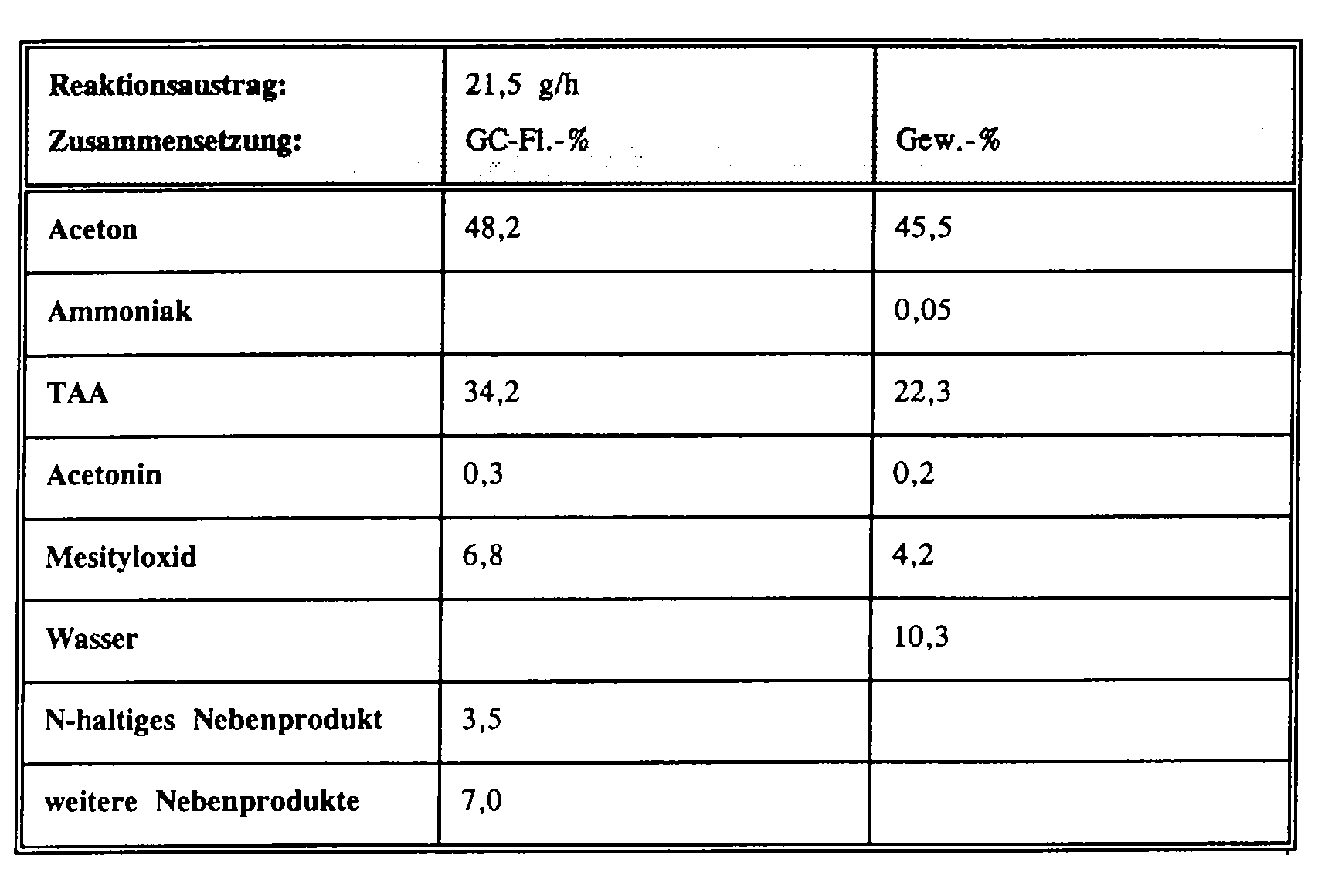
Hieraus ergibt sich eine TAA-Ausbeute von 27,9 %, bezogen auf eingesetztes
Aceton, bei einem Aceton-Umsatz von 49,5 %.
Claims (5)
- Verfahren zur Herstellung von 2,2,6,6-Tetramethylpiperidin-4-on (TAA), umfassend die Schritte, daßeine Mischung, enthaltend Aceton und/oder Aceton-Kondensate und Ammoniak in einem Molverhältnis von 20:1 bis 3:1bei einer Temperatur von 50°C bis 130°Cin Gegenwart von Dimethylsulfat zur Reaktion gebracht wird, wobei die Menge des Dimethylsulfats 0,5 bis 5 Mol-%, bezogen auf Aceton, beträgt.
- Verfahren nach Anspruch 1, dadurch gekennzeichnet, daß das Molverhältnis von Aceton und/oder Aceton-Kondensaten zu Ammoniak 10:1 bis 3:1 beträgt.
- Verfahren nach Anspruch 1 oder 2, dadurch gekennzeichnet, daß die Reaktion kontinuierlich erfolgt.
- Verfahren nach einem der Ansprüche 1 bis 3, dadurch gekennzeichnet, daß das Reaktionsgemisch in flüssiger Form vorliegt.
- Verfahren nach einem der Ansprüche 1 bis 4, dadurch gekennzeichnet, daß es sich bei den Aceton-Kondensaten um Mesityloxid, Diacetonalkohol, Diacetonamin, Acetonin oder Phoron handelt.
Applications Claiming Priority (2)
| Application Number | Priority Date | Filing Date | Title |
|---|---|---|---|
| DE19634157A DE19634157A1 (de) | 1996-08-23 | 1996-08-23 | Verfahren zur Herstellung von 2,2,6,6-Tetramethylpiperidin-4-on |
| DE19634157 | 1996-08-23 |
Publications (1)
| Publication Number | Publication Date |
|---|---|
| EP0825182A1 true EP0825182A1 (de) | 1998-02-25 |
Family
ID=7803541
Family Applications (1)
| Application Number | Title | Priority Date | Filing Date |
|---|---|---|---|
| EP97114469A Withdrawn EP0825182A1 (de) | 1996-08-23 | 1997-08-21 | Verfahren zur Herstellung von 2,2,6,6-Tetramethylpiperidin-4-on (TAA) |
Country Status (4)
| Country | Link |
|---|---|
| US (1) | US5856494A (de) |
| EP (1) | EP0825182A1 (de) |
| JP (1) | JPH1087620A (de) |
| DE (1) | DE19634157A1 (de) |
Cited By (2)
| Publication number | Priority date | Publication date | Assignee | Title |
|---|---|---|---|---|
| US9969864B2 (en) | 2013-07-08 | 2018-05-15 | Basf Se | Light stabilizers |
| WO2026068539A1 (en) | 2024-09-27 | 2026-04-02 | Basf Se | Process for the preparation of triacetoneamine |
Families Citing this family (1)
| Publication number | Priority date | Publication date | Assignee | Title |
|---|---|---|---|---|
| CN114853663A (zh) * | 2022-05-11 | 2022-08-05 | 宿迁联盛助剂有限公司 | 一种制备2,2,6,6-四甲基-4-哌啶酮的方法 |
Citations (10)
| Publication number | Priority date | Publication date | Assignee | Title |
|---|---|---|---|---|
| DE2429937A1 (de) * | 1973-06-25 | 1975-01-16 | Ciba Geigy Ag | Verfahren zur herstellung von 2,2,6,6tetramethyl-4-oxo-piperidin |
| EP0004104A2 (de) * | 1978-02-20 | 1979-09-19 | Hüls Aktiengesellschaft | Verfahren zur Herstellung von 2,2,6,6-Tetramethylpiperidon-(4) |
| DE2910761A1 (de) * | 1978-03-31 | 1979-10-04 | Chimosa Chimica Organica Spa | Verfahren zur herstellung von 2,2,6,6-tetramethyl-4-piperidon |
| ES479049A1 (es) * | 1979-03-29 | 1979-12-16 | Chimosa Chimica Organica Spa | Un procedimiento para la preparacion de 2,2,6,6-tetrametil-4-piperidona. |
| DE2916471A1 (de) * | 1979-04-24 | 1980-11-06 | Hoechst Ag | Verfahren zur herstellung von 2,2, 6,6-tetramethylpiperidon-4 |
| GB2047681A (en) * | 1979-04-30 | 1980-12-03 | Argus Chem | Preparation of 2,2,6,6- tetramethyl-4-oxopiperidine |
| DE3013403A1 (de) * | 1980-04-05 | 1981-10-08 | Hoechst Ag, 6000 Frankfurt | Verfahren zur herstellung von 2,2,6,6-tetramethylpiperdon-4 |
| EP0074607A1 (de) * | 1981-09-16 | 1983-03-23 | ADEKA ARGUS CHEMICAL CO., Ltd. | Verfahren zur Herstellung von Triacetonamin |
| DE3525385A1 (de) * | 1981-05-13 | 1987-01-22 | Nii Khim Dlya Polimernykh Mate | Verfahren zur herstellung von 2,2,6,6-tetramethyl-4-oxopiperidin |
| US4734502A (en) * | 1986-12-22 | 1988-03-29 | Ici Americas Inc. | Process for the preparation of 2,2,6,6-tetramethyl-4-oxopiperidine |
Family Cites Families (1)
| Publication number | Priority date | Publication date | Assignee | Title |
|---|---|---|---|---|
| US3959295A (en) * | 1973-05-17 | 1976-05-25 | Ciba-Geigy Corporation | Process for the preparation of 2,2,6,6-tetramethyl-4-oxopiperidine |
-
1996
- 1996-08-23 DE DE19634157A patent/DE19634157A1/de not_active Withdrawn
-
1997
- 1997-08-14 US US08/911,456 patent/US5856494A/en not_active Expired - Fee Related
- 1997-08-20 JP JP9223460A patent/JPH1087620A/ja not_active Withdrawn
- 1997-08-21 EP EP97114469A patent/EP0825182A1/de not_active Withdrawn
Patent Citations (10)
| Publication number | Priority date | Publication date | Assignee | Title |
|---|---|---|---|---|
| DE2429937A1 (de) * | 1973-06-25 | 1975-01-16 | Ciba Geigy Ag | Verfahren zur herstellung von 2,2,6,6tetramethyl-4-oxo-piperidin |
| EP0004104A2 (de) * | 1978-02-20 | 1979-09-19 | Hüls Aktiengesellschaft | Verfahren zur Herstellung von 2,2,6,6-Tetramethylpiperidon-(4) |
| DE2910761A1 (de) * | 1978-03-31 | 1979-10-04 | Chimosa Chimica Organica Spa | Verfahren zur herstellung von 2,2,6,6-tetramethyl-4-piperidon |
| ES479049A1 (es) * | 1979-03-29 | 1979-12-16 | Chimosa Chimica Organica Spa | Un procedimiento para la preparacion de 2,2,6,6-tetrametil-4-piperidona. |
| DE2916471A1 (de) * | 1979-04-24 | 1980-11-06 | Hoechst Ag | Verfahren zur herstellung von 2,2, 6,6-tetramethylpiperidon-4 |
| GB2047681A (en) * | 1979-04-30 | 1980-12-03 | Argus Chem | Preparation of 2,2,6,6- tetramethyl-4-oxopiperidine |
| DE3013403A1 (de) * | 1980-04-05 | 1981-10-08 | Hoechst Ag, 6000 Frankfurt | Verfahren zur herstellung von 2,2,6,6-tetramethylpiperdon-4 |
| DE3525385A1 (de) * | 1981-05-13 | 1987-01-22 | Nii Khim Dlya Polimernykh Mate | Verfahren zur herstellung von 2,2,6,6-tetramethyl-4-oxopiperidin |
| EP0074607A1 (de) * | 1981-09-16 | 1983-03-23 | ADEKA ARGUS CHEMICAL CO., Ltd. | Verfahren zur Herstellung von Triacetonamin |
| US4734502A (en) * | 1986-12-22 | 1988-03-29 | Ici Americas Inc. | Process for the preparation of 2,2,6,6-tetramethyl-4-oxopiperidine |
Cited By (2)
| Publication number | Priority date | Publication date | Assignee | Title |
|---|---|---|---|---|
| US9969864B2 (en) | 2013-07-08 | 2018-05-15 | Basf Se | Light stabilizers |
| WO2026068539A1 (en) | 2024-09-27 | 2026-04-02 | Basf Se | Process for the preparation of triacetoneamine |
Also Published As
| Publication number | Publication date |
|---|---|
| JPH1087620A (ja) | 1998-04-07 |
| US5856494A (en) | 1999-01-05 |
| DE19634157A1 (de) | 1998-02-26 |
Similar Documents
| Publication | Publication Date | Title |
|---|---|---|
| DE69323140T2 (de) | Verfahren zur Herstellung von Phenol, Aceton und alpha-Methylstyrol | |
| DE3821965A1 (de) | Verfahren zur herstellung von essigsaeure, methylacetat, acetanhydrid oder mischungen davon | |
| DE68902575T2 (de) | Verfahren zur herstellung von dihydroxybenzolen. | |
| DE69615022T2 (de) | Verfahren zur herstellung von 3-(methylthio)propanal und 2-hydroxy-4-(methylthio)butansäurenitril | |
| CH642045A5 (de) | Verfahren zur herstellung von methacrolein. | |
| DE69407720T2 (de) | Verfahren zur Hydroxycarbonylierung von Butadien | |
| EP0186076B1 (de) | Verfahren zur Herstellung von 2,2,4-Trimethyl-1,3-pentandiolmonoisobutyrat | |
| DE69701822T2 (de) | Verfahren zur Herstellung von Polyalkoholen | |
| EP0700892B1 (de) | Verfahren zur Herstellung von Mono- oder Dicarbonsäuren aus Aldehyden, deren Vollacetalen oder Halbacetalen, sowie aus Gemischen davon | |
| DE69201756T2 (de) | Verfahren zur gleichzeitigen Herstellung von Arylformiat und von aromatischer Carbonsäure. | |
| DE4333642A1 (de) | Verfahren zur Herstellung von Formylimidazolen | |
| DE69803252T2 (de) | Verfahren zur Herstellung eines polyhydrischen Alkohols | |
| DE3325983C2 (de) | ||
| DE2459122C2 (de) | Verfahren zur kontinuierlichen Herstellung von Sorbinsäure | |
| DE2508452C2 (de) | Verfahren zur Herstellung von Alkylphenolen | |
| DE69429789T2 (de) | Verfahren zur Herstellung von Phenolen | |
| DE19634157A1 (de) | Verfahren zur Herstellung von 2,2,6,6-Tetramethylpiperidin-4-on | |
| DE3205588C2 (de) | Verfahren zur Herstellung von Dicumylperoxid | |
| DE2558522C3 (de) | Verfahren zur kontinuierlichen Herstellung von Di-tertiär-butylkresolen | |
| EP0111861A2 (de) | Verfahren zur Herstellung von Aminen | |
| DE4203456A1 (de) | Verfahren zur kontinuierlichen herstellung von 3-cyano-3,5,5-trimethylcyclohexanon | |
| DE3780107T2 (de) | Verfahren zur herstellung von hydroxynaphthalenen. | |
| DE2061538C3 (de) | Verfahren zur Herstellung von Kobalt (III)-bis-salicylaldehydäthylendiiminat -Komplexen | |
| DE3129194C2 (de) | "Verfahren zur Herstellung von aromatischen Aldehyden" | |
| DE3811849A1 (de) | Verfahren zur herstellung von tertiaerem butanol |
Legal Events
| Date | Code | Title | Description |
|---|---|---|---|
| PUAI | Public reference made under article 153(3) epc to a published international application that has entered the european phase |
Free format text: ORIGINAL CODE: 0009012 |
|
| AK | Designated contracting states |
Kind code of ref document: A1 Designated state(s): BE CH DE ES FR GB IT LI NL |
|
| AX | Request for extension of the european patent |
Free format text: AL;LT;LV;RO;SI |
|
| 17P | Request for examination filed |
Effective date: 19980825 |
|
| AKX | Designation fees paid |
Free format text: BE CH DE ES FR GB IT LI NL |
|
| RBV | Designated contracting states (corrected) |
Designated state(s): BE CH DE ES FR GB IT LI NL |
|
| STAA | Information on the status of an ep patent application or granted ep patent |
Free format text: STATUS: THE APPLICATION HAS BEEN WITHDRAWN |
|
| 18W | Application withdrawn |
Withdrawal date: 20011203 |