EP0825665A2 - Structures pour hyperfréquences passives et méthodes à intermodulation passive réduite - Google Patents
Structures pour hyperfréquences passives et méthodes à intermodulation passive réduite Download PDFInfo
- Publication number
- EP0825665A2 EP0825665A2 EP97111889A EP97111889A EP0825665A2 EP 0825665 A2 EP0825665 A2 EP 0825665A2 EP 97111889 A EP97111889 A EP 97111889A EP 97111889 A EP97111889 A EP 97111889A EP 0825665 A2 EP0825665 A2 EP 0825665A2
- Authority
- EP
- European Patent Office
- Prior art keywords
- aperture
- lid
- periphery
- dimension
- differential
- Prior art date
- Legal status (The legal status is an assumption and is not a legal conclusion. Google has not performed a legal analysis and makes no representation as to the accuracy of the status listed.)
- Granted
Links
Images

Classifications
-
- H—ELECTRICITY
- H01—ELECTRIC ELEMENTS
- H01P—WAVEGUIDES; RESONATORS, LINES, OR OTHER DEVICES OF THE WAVEGUIDE TYPE
- H01P7/00—Resonators of the waveguide type
- H01P7/04—Coaxial resonators
-
- H—ELECTRICITY
- H01—ELECTRIC ELEMENTS
- H01P—WAVEGUIDES; RESONATORS, LINES, OR OTHER DEVICES OF THE WAVEGUIDE TYPE
- H01P11/00—Apparatus or processes specially adapted for manufacturing waveguides or resonators, lines, or other devices of the waveguide type
- H01P11/008—Manufacturing resonators
-
- Y—GENERAL TAGGING OF NEW TECHNOLOGICAL DEVELOPMENTS; GENERAL TAGGING OF CROSS-SECTIONAL TECHNOLOGIES SPANNING OVER SEVERAL SECTIONS OF THE IPC; TECHNICAL SUBJECTS COVERED BY FORMER USPC CROSS-REFERENCE ART COLLECTIONS [XRACs] AND DIGESTS
- Y10—TECHNICAL SUBJECTS COVERED BY FORMER USPC
- Y10T—TECHNICAL SUBJECTS COVERED BY FORMER US CLASSIFICATION
- Y10T29/00—Metal working
- Y10T29/49—Method of mechanical manufacture
- Y10T29/49826—Assembling or joining
-
- Y—GENERAL TAGGING OF NEW TECHNOLOGICAL DEVELOPMENTS; GENERAL TAGGING OF CROSS-SECTIONAL TECHNOLOGIES SPANNING OVER SEVERAL SECTIONS OF THE IPC; TECHNICAL SUBJECTS COVERED BY FORMER USPC CROSS-REFERENCE ART COLLECTIONS [XRACs] AND DIGESTS
- Y10—TECHNICAL SUBJECTS COVERED BY FORMER USPC
- Y10T—TECHNICAL SUBJECTS COVERED BY FORMER US CLASSIFICATION
- Y10T29/00—Metal working
- Y10T29/49—Method of mechanical manufacture
- Y10T29/49826—Assembling or joining
- Y10T29/49863—Assembling or joining with prestressing of part
- Y10T29/49865—Assembling or joining with prestressing of part by temperature differential [e.g., shrink fit]
Definitions
- the present invention relates generally to passive microwave structures.
- Intermodulation distortion results from nonlinearities in the transmission function of an electronic device and is characterized by the appearance of signals in the device output whose frequencies are equal to the sums and differences of the input signal frequencies.
- the device output will include intermodulation products whose frequencies are nf 1 ⁇ mf 2 , in which n and m are integers.
- PIM passive intermodulation
- bolted joints reduce PIM by inducing stresses in opposing surfaces that are sufficient to reduce PIM generating sources, e.g., intersurface oxide films.
- PIM generating sources e.g., intersurface oxide films.
- bolted joints increase the weight, size, fabrication cost and assembly time of passive microwave structures.
- the present invention is directed to passive microwave structures which reduce PIM effects and which are lightweight, spatially economic, easily fabricated and easily assembled.
- passive structures are realized with a process for joining first and second structure members that includes an initial step of providing the first member with an aperture that is smaller than the second member by a dimension differential.
- the members are then joined by first causing them to have a temperature differential that is sufficient to permit the second member to drop into the aperture, i.e., be positioned across the aperture.
- the temperature differential is then removed.
- the dimension differential is selected to be sufficient to create mutually-induced radial stresses in the first and second members (after the temperature differential is removed) which enhance the metal-to-metal contact between the members and thereby reduce PIM.
- the dimension differential is selected to be sufficient to elastically buckle the second member and thereby cause the second member to exert a buckling stress against the periphery of the aperture.
- the first member is a housing and the second member is a lid.
- a groove is formed in the periphery of the lid and the periphery of the aperture is wedged into the groove by the mutually-induced radial stresses. This structure reduces the interface area between the lid periphery and the aperture periphery and thereby further enhances the reduction of PIM. It also increases the resistance to operational axial forces, e.g., vibration, that tend to dislodge the lid 24 from the aperture 28.
- a slanted aperture periphery and a lid periphery that has a beveled edge and a lip.
- the beveled edge abuts the slanted aperture perhiphery to generate mutually-induced radial stresses that enhance PIM performance.
- the slanted aperture periphery and the lip increase the resistance to operational axial forces that tend to dislodge the lid.
- the structural teachings of the invention can be adapted to form various microwave passive structures, e.g., enclosures and filters.
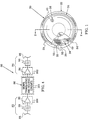
- FIGS. 1 and 2 illustrate a passive microwave structure in the form of a microwave filter 20.
- the filter 20 includes a cylindrical housing 22 which is formed about an axis 23 and a lid 24 which is positioned across an aperture 28 of the housing 22.
- the housing 22 has a cylindrical wall 29 and, opposite the aperture 28, a transverse floor 30.
- the housing 22 also includes a cylindrical filter stub 32 which extends upward from the transverse floor 30, is generally coaxially arranged with the housing 22 and is directed towards the lid 24.
- the filter 20 also includes first and second access ports 34 and 36 which provide signal access to the interior of the housing 22.
- the first access port 34 is a hole 40 in the floor 30 which can receive a radiative and/or receptive element, e.g., an antenna feed structure, and the second access port 36 is a microwave coaxial connector 42 which has a center conductor that extends into the housing 22 to form a coupling probe 44.
- the housing 22 can be easily formed as an integral member, e.g., by machining, it is impossible (or prohibitively expensive) to form the filter 20 of a single member. Accordingly, such passive microwave structures have conventionally been formed of separate members which are then joined by a conventional joining process, e.g., welding, brazing or bolting.
- the housing 22 and lid 24 of the microwave filter 20 are joined, in accordance with the present invention, by the action of mutually-induced stresses which are developed in abutting peripheries of the lid 24 and the housing 22.
- a full description of these joining structures and methods will be enhanced by preceding it with the following operational description of the filter 20.
- the general shape of the filter 20 forms a conventional coaxial resonator which is dimensioned to resonate for signals having a predetermined wavelength ⁇ res . Accordingly, the length of the housing 22 along its axis 23 is nominally ⁇ res /4. The space between the end 48 of the coaxial stub 32 and the lid 24 forms a capacitance which loads the resonator. This loading along with loading from the first and second access ports 34 and 36 generally shortens the length of the housing in specific filter structures, e.g., to a length on the order of ⁇ res /6.
- microwave transmission between the first and second access ports 34 and 42 is enhanced for signals having the predetermined wavelength ⁇ res and is increasingly attenuated as the wavelength changes from ⁇ res (at an attenuation rate determined by the quality factor Q of the filter).
- the microwave filter 20 is especially suited for use as a bandpass filtering element for a variety of microwave systems, e.g., a satellite repeater.
- FIG. 3A shows that the upper end of the cylindrical wall 29 of the housing 22 has an inward-directed rim 54 which terminates to form a periphery 56 of the aperture (28 in FIGS. 1 and 2).
- the lid 24 has a corresponding lid periphery 58 and the lid is positioned into the aperture 28 with its lid periphery 58 abutting the aperture periphery 56.
- the lid 24 has a thin, central web 60 which thickens adjacent the periphery 58 to form an annular rim 62.
- the rim 62 includes an annular lip 64 which extends outward over the periphery 56 of the aperture 28.
- the lid periphery 58 is slanted inward from its bottom to its top to form a groove 66 in association with the lip 64.
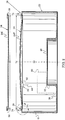
- FIG. 2 shows the lid 24 in an initial configuration 24I before installation into the housing 22 and in a final configuration 24F after its installation.
- the lid 24 has a lid dimension 70 across the lid, i.e., across opposite sides of the lid periphery 58 to where it abuts the aperture periphery 56 in FIG. 3A.
- the aperture 28 has an aperture dimension 72 across the aperture 28, i.e., across opposite sides of the aperture periphery 56.
- the lid dimension 70 exceeds the aperture dimension 72 by a dimension differential.
- the housing 22 and lid 24 are caused to have a temperature differential.
- the temperature differential is selected to expand the housing 22 and shrink the lid 24 sufficiently to permit the lid 24 to be placed into the aperture 28, i.e., positioned across the aperture 28 with the lid periphery 58 within the aperture periphery 56.
- This positioning operation is indicated in FIG. 2 by the positioning arrows 74.
- the temperature differential is then removed so that the lid 24 expands and the housing 22 shrinks.
- the dimension differential between the lid dimension 70 and the aperture dimension 72 is selected to cause the lid periphery 58 to then abut the aperture periphery 56 and create mutually-induced radial stresses in the lid 24 and the housing 22. These stresses wedge the aperture periphery 56 into the groove 66 as shown in FIG. 3A.
- the dimension differential is selected to be sufficient to elastically buckle the lid 24 into its final configuration 24F of FIG. 2 and thereby cause the lid periphery 58 to exert a buckling stress against the aperture periphery 56.
- the lid 24 and the housing 22 of FIGS. 1, 2 and 3A were formed from 6061-T6 aluminum.
- the lid 24 was fabricated with a lid dimension 70 of 9.144 centimeters and a thickness (in the web 60) of 0.51 millimeter. When these dimensions are substituted into equation (1), it is found that the buckling stress is ⁇ 3.3x10 6 newtons per square meter.
- the aperture 28 was formed with an aperture dimension 72 of 9.1643 centimeters.
- the lid dimension 70 exceeded the aperture dimension 72 by a dimension differential of ⁇ 0.2 millimeter.
- the housing 22 was heated to ⁇ 94 degrees Centigrade and the lid 24 was cooled to ⁇ -168 degrees Centigrade (with the aid of liquid nitrogen). This temperature differential was sufficient to permit the lid 24 to be positioned into the aperture with the lid periphery within the aperture periphery. The temperature differential was then removed and the dimension differential was sufficient to cause the lid to elastically buckle and exert a buckling stress against the aperture periphery.
- the lip 64 extends outward over the aperture periphery 56 and the aperture periphery 56 is wedged into the groove 66 by the mutually-induced stresses.
- This structure increases the stability of the lid 24 and housing 22 interface. Although the mutually-induced radial forces between the lid and the housing have been found to effectively reduce PIM, they alone may not adequately resist operational axial forces, e.g., vibration, that tend to dislodge the lid 24 from the aperture 28. This resistance is enhanced with the periphery 56 wedged into the groove 66. At the same time, this structure forms the abutting relationship between the corner 78 and the lid periphery 58 that reduces PIM.
- FIG. 3B illustrates another embodiment of the housing and lid interface structure. This figure is similar to FIG. 3A with like elements indicated by like reference numbers.
- the housing 22 is modified to a housing 22A in which the aperture periphery 56 is slanted to become an aperture periphery 56A.
- the lid 24 is modified to a lid 24A which has a lid periphery in the form of a beveled edge 79 that is abutted by the aperture periphery 56A.
- the periphery abutment area in FIG. 3B is reduced to that of the sharp edge of the beveled edge 79 in a reduction manner similar to that obtained with the sharp corner 78 in the housing and lid structure of FIG. 3A.
- the beveled edge 79 and slanted aperture periphery 56A restrain the lid 24A from moving upward and the lip 64 restrains the lid 24A from moving downward. Similar to the structures of FIG. 3A, e.g., the wedge 66, these combined structures insure that the lid 24A will not move vertically out of the aperture 28 under the influence of operational forces such as vibration.
- FIG. 3B Another exemplary filter prototype was fabricated with the housing and lid structure of FIG. 3B. PIM tests on this prototype yielded PIM results which were substantially equivalent to the improved PIM results discussed above with reference to the housing and lid structure of FIG. 3A.
- FIGS. 1, 2, 3A and 3B have been demonstrated to reduce PIM.
- their highly stressed metal-to-metal interfaces also cause them to be well suited for microwave shielding applications, i.e., reducing microwave leakage into or out of microwave circuits.
- the teachings of the invention are particularly suited for realizing any passive microwave structure with the features of low PIM and high microwave isolation.
- the microwave filter 20 can be used in input and output circuits of a microwave satellite repeater 80 as shown in FIG. 4.
- the repeater 80 includes a receiver 82 and a transmitter 84 which are coupled by signal translating and routing circuits 86.
- the receiver 82 has a receive antenna 88, a bandpass receive filter 90 and a low-noise amplifier 92.
- the transmitter 84 has a power amplifier 94, a bandpass transmit filter 96 and a transmit antenna 98.
- the repeater 80 receives a plurality of signals in a receive frequency band through its receive antenna 82.
- the signals are filtered through the bandpass receive filter 90 and amplified by the low-noise amplifier 92.
- the received signals are translated in frequency to a transmit frequency band where they are also routed to occupy predetermined frequency slots.
- the translated and routed signals are then amplified in the power amplifier 94, filtered by the transmit filter 96 and radiated through the transmit antenna 98.
- the filter 20 is especially suited for use as the receive filter 90 and the transmit filter 96.
- a feed structure of the receive antenna 88 would be coupled into the first access port 34 and the second access port 36 would be coupled, e.g., by a coaxial cable, to the low-noise amplifier 92.
- the filtering characteristics required by a particular repeater may require several resonator stages for each of the filters 90 and 96 of FIG. 4, e.g., four stages. Accordingly, these filters would be formed with a corresponding number of the filter 20 of FIGS. 1 and 2 which are serially connected.
- This serial connection between resonator stages can be made, for example, through a coupling window 99 (as shown in broken lines in FIG. 2).
- the window 99 is in the housing's wall 29 and preferably adjoins the transverse floor 32.
- Each window 99 thus couples microwave energy between resonator stages and the first and second access ports 34 and 36 would be positioned in input and output stages of the multistage filter.
- the passive microwave structures of FIGS. 1, 2, 3A and 3B are also suited for use in other microwave elements of the repeater.
- the housing and lid structures of FIGS. 1, 2, 3A and 3B can be adapted (by removing the coaxial stub 32 and suitably configuring the overall shape) to form a low-noise amplifier enclosure 100 as indicated by broken lines in FIG. 4.
- Similar enclosures 102 and 104 are indicated by broken lines in FIG. 4 for respectively the power amplifier 94 and the signal translating and routing circuits 86.
- These enclosures can be equipped with suitable input and output ports, e.g., coaxial connectors similar to the connector 42 of FIG. 1.
- the teachings of the invention can be applied to member joining processes in other passive microwave structures, e.g., waveguides and waveguide-based components.
- the passive microwave structures of the invention have been shown by prototype tests to effectively reduce PIM.
- the structures are lightweight, spatially economic and eliminate many of the negative features of conventional joining techniques, e.g., the warpage of brazing, the cracking of welding and the size, weight and time-consuming assembly of bolting.
- a simple joining process for members 22, 24 of passive microwave structures 20; 90; 96; 100; 102; 104 which reduces passive intermodulation.
- the process forms an aperture 28 in a first member 22 and forms a second member 24 to have dimension 70 which exceeds the aperture dimension 72 by a dimension differential.
- the members 22, 24 are joined by initially causing them to have a temperature differential that is sufficient to permit the second member 24 to be positioned across the aperture 28.
- the dimension differential is selected to generate mutually-induced radial stresses in the members 22, 24, after the temperature differential is removed which enhance the metal-to-metal contact between the members 22, 24 and, thereby, improve passive intermodulation (PIM) performance.
- PIM passive intermodulation
- the dimension differential is selected to cause the second member 24 to elastically buckle and exert a buckling stress against the first member (22).
- Additional interface structures are provided to resist operational axial forces, e.g., vibration, that tend to dislodge the members 22, 24. While several illustrative embodiments of the invention have been shown and described, numerous variations and alternate embodiments will occur to those skilled in the art. Such variations and alternate embodiments are comtemplated, and can be made without departing from the spirit and scope of the invention as defined in the appended claims.
Landscapes
- Engineering & Computer Science (AREA)
- Manufacturing & Machinery (AREA)
- Control Of Motors That Do Not Use Commutators (AREA)
- Pressure Welding/Diffusion-Bonding (AREA)
- Non-Reversible Transmitting Devices (AREA)
Applications Claiming Priority (2)
| Application Number | Priority Date | Filing Date | Title |
|---|---|---|---|
| US08/699,748 US5834993A (en) | 1996-08-20 | 1996-08-20 | Passive microwave structure and methods having reduced passive intermodulation |
| US699748 | 1996-08-20 |
Publications (3)
| Publication Number | Publication Date |
|---|---|
| EP0825665A2 true EP0825665A2 (fr) | 1998-02-25 |
| EP0825665A3 EP0825665A3 (fr) | 1999-05-19 |
| EP0825665B1 EP0825665B1 (fr) | 2003-04-02 |
Family
ID=24810732
Family Applications (1)
| Application Number | Title | Priority Date | Filing Date |
|---|---|---|---|
| EP97111889A Expired - Lifetime EP0825665B1 (fr) | 1996-08-20 | 1997-07-12 | Structures pour hyperfréquences passives et méthodes à intermodulation passive réduite |
Country Status (4)
| Country | Link |
|---|---|
| US (2) | US5834993A (fr) |
| EP (1) | EP0825665B1 (fr) |
| CA (1) | CA2210113C (fr) |
| DE (1) | DE69720350T2 (fr) |
Cited By (2)
| Publication number | Priority date | Publication date | Assignee | Title |
|---|---|---|---|---|
| US6501349B2 (en) | 1999-12-01 | 2002-12-31 | Remec Oy | Method and arrangement for fastening inner conductor of resonator structure |
| KR100445743B1 (ko) * | 2001-09-04 | 2004-08-25 | 한국전자통신연구원 | 필터용 공진기 및 그를 이용한 필터 설계 방법과 그 설계방법에 의해 제작된 필터 |
Families Citing this family (3)
| Publication number | Priority date | Publication date | Assignee | Title |
|---|---|---|---|---|
| US5834993A (en) * | 1996-08-20 | 1998-11-10 | Hughes Electronics Corporation | Passive microwave structure and methods having reduced passive intermodulation |
| USD452774S1 (en) | 2000-06-21 | 2002-01-08 | Hyung Tae Kim | Strap connection device for bags |
| USD459079S1 (en) | 2000-07-01 | 2002-06-25 | Hyung Tae Kim | Strap catch device for bags |
Family Cites Families (25)
| Publication number | Priority date | Publication date | Assignee | Title |
|---|---|---|---|---|
| CA518595A (fr) * | 1955-11-15 | Star Watch Case Company | Methode de montage de verre dans biseaux de montre | |
| US1981334A (en) * | 1930-07-17 | 1934-11-20 | Colt S Mfg Co | Article of manufacture |
| US3371413A (en) * | 1966-10-26 | 1968-03-05 | Amphenol Corp | Hermetically sealed connector |
| DE1949924B2 (de) * | 1969-10-03 | 1970-08-20 | Schenck Gmbh Carl | Elektromechanische Kraftmessdose |
| US3714606A (en) * | 1971-07-12 | 1973-01-30 | Motorola Inc | Temperature compensated tuner and oscillator |
| US3928167A (en) * | 1971-12-23 | 1975-12-23 | Rhone Progil | Improvements in methods of producing electrolytic anode assemblies |
| US4001928A (en) * | 1973-01-04 | 1977-01-11 | Raychem Corporation | Method for plugging an aperture with a heat recoverable plug |
| US4126758A (en) * | 1973-12-03 | 1978-11-21 | Raychem Corporation | Method for sealing integrated circuit components with heat recoverable cap and resulting package |
| US4015319A (en) * | 1975-03-20 | 1977-04-05 | Bindicator Company | Method for manufacturing an ultrasonic transducer |
| US4879799A (en) * | 1976-10-29 | 1989-11-14 | Raychem Corporation | Heat-recoverable article |
| US4104556A (en) * | 1976-11-15 | 1978-08-01 | Gte Laboratories Incorporated | High energy radio frequency pulse generators |
| US4074407A (en) * | 1977-03-17 | 1978-02-21 | Roll-Rite Corporation | Method for making a hollow-bodied caster wheel |
| CH623711B (de) * | 1978-12-15 | Bbc Brown Boveri & Cie | Uhr. | |
| DE2936781A1 (de) * | 1979-09-12 | 1981-04-02 | Varta Batterie Ag, 3000 Hannover | Galvanisches element |
| US4628283A (en) * | 1983-11-07 | 1986-12-09 | The Narda Microwave Corporation | Hermetically sealed oscillator with dielectric resonator tuned through dielectric window by adjusting screw |
| US4648124A (en) * | 1985-04-04 | 1987-03-03 | The United States Of America As Represented By The Secretary Of The Air Force | Apparatus for locating passive intermodulation interference sources |
| CH667832A5 (de) * | 1985-04-10 | 1988-11-15 | Metoxit Ag | Verfahren zum kraftschluessigen verbinden eines zylindrrischen keramikteils mit einem aus eisenwerksstoff besstehenden flansch. |
| DE3542176A1 (de) * | 1985-11-29 | 1987-06-04 | Vaw Ver Aluminium Werke Ag | Fluessigkeitsbehaelter aus einer aluminium-gusslegierung |
| JPS63289306A (ja) * | 1987-05-22 | 1988-11-25 | 日本特殊陶業株式会社 | 摺動部品の製造法 |
| US4907330A (en) * | 1987-06-04 | 1990-03-13 | Ngk Spark Plug Co., Ltd. | Sintered body assembly formed from a plurality of independent compacts and method of producing same |
| JPH0271595A (ja) * | 1988-09-06 | 1990-03-12 | Maspro Denkoh Corp | シールドケース |
| DE4032803A1 (de) * | 1990-10-16 | 1992-04-30 | D O R N E Y Technologie Gmbh | Formteil aus einem metallischen und einem keramischen koerper |
| US5456779A (en) * | 1994-06-27 | 1995-10-10 | Lockheed Missiles & Space Company, Inc. | Method of attaching antenna mesh |
| US5834993A (en) * | 1996-08-20 | 1998-11-10 | Hughes Electronics Corporation | Passive microwave structure and methods having reduced passive intermodulation |
| US5818314A (en) * | 1997-05-12 | 1998-10-06 | Hughes Electronics Corporation | Tunable electromagnetic wave resonant filter |
-
1996
- 1996-08-20 US US08/699,748 patent/US5834993A/en not_active Expired - Fee Related
-
1997
- 1997-07-09 CA CA002210113A patent/CA2210113C/fr not_active Expired - Lifetime
- 1997-07-12 DE DE69720350T patent/DE69720350T2/de not_active Expired - Lifetime
- 1997-07-12 EP EP97111889A patent/EP0825665B1/fr not_active Expired - Lifetime
-
1998
- 1998-04-09 US US09/057,945 patent/US6044538A/en not_active Expired - Lifetime
Cited By (2)
| Publication number | Priority date | Publication date | Assignee | Title |
|---|---|---|---|---|
| US6501349B2 (en) | 1999-12-01 | 2002-12-31 | Remec Oy | Method and arrangement for fastening inner conductor of resonator structure |
| KR100445743B1 (ko) * | 2001-09-04 | 2004-08-25 | 한국전자통신연구원 | 필터용 공진기 및 그를 이용한 필터 설계 방법과 그 설계방법에 의해 제작된 필터 |
Also Published As
| Publication number | Publication date |
|---|---|
| CA2210113A1 (fr) | 1998-02-20 |
| US5834993A (en) | 1998-11-10 |
| CA2210113C (fr) | 2002-01-01 |
| DE69720350D1 (de) | 2003-05-08 |
| EP0825665A3 (fr) | 1999-05-19 |
| DE69720350T2 (de) | 2004-02-12 |
| EP0825665B1 (fr) | 2003-04-02 |
| US6044538A (en) | 2000-04-04 |
Similar Documents
| Publication | Publication Date | Title |
|---|---|---|
| US6803835B2 (en) | Integrated filter balun | |
| JP6526345B1 (ja) | Pim測定のためのフィルタ構造 | |
| US10230348B2 (en) | Sub-network enhanced reflectionless filter topology | |
| EP0131633A1 (fr) | Convertisseur de frequence | |
| US8005451B2 (en) | Filter circuit and radio communication apparatus | |
| EP0110324B1 (fr) | Récepteur à hyperfréquences comportant un filtre à guide d'ondes | |
| US4331943A (en) | Acoustic wave devices having transverse mode distortions eliminated structurally | |
| US6044538A (en) | Passive microwave structures and methods having reduced passive intermodulation | |
| US5132651A (en) | Filter apparatus | |
| CN111082819B (zh) | 一种消弱射频多通道间耦合的装置 | |
| EP0190902B1 (fr) | Circuit mélangeur | |
| US5274340A (en) | Microwave multistage amplifier | |
| JP3071528B2 (ja) | 誘電体フィルタ | |
| US4423395A (en) | Surface acoustic wave filter | |
| JPH09205302A (ja) | 誘電体フィルタ | |
| KR101134832B1 (ko) | 프론트앤드모듈의 공진기 | |
| US11749873B2 (en) | High-frequency module | |
| US4603437A (en) | Balanced mixer | |
| Loyka | Characteristics of a receiving intermodulation channel of active array antennas | |
| Subramanyam et al. | High power combline filter for deep space applications | |
| US5093629A (en) | Amplifier circuit having second order signal cancellation | |
| JPS62291201A (ja) | マイクロ波集積回路 | |
| EP0491505B1 (fr) | Combinateur intégré à guides d'ondes | |
| JP3467747B2 (ja) | 誘電体フィルタ回路及びその構成方法 | |
| Kreutel | The orthogonalization of polarized fields in dual-polarized radio transmission systems |
Legal Events
| Date | Code | Title | Description |
|---|---|---|---|
| PUAI | Public reference made under article 153(3) epc to a published international application that has entered the european phase |
Free format text: ORIGINAL CODE: 0009012 |
|
| AK | Designated contracting states |
Kind code of ref document: A2 Designated state(s): DE FR GB |
|
| RAP1 | Party data changed (applicant data changed or rights of an application transferred) |
Owner name: HUGHES ELECTRONICS CORPORATION |
|
| PUAL | Search report despatched |
Free format text: ORIGINAL CODE: 0009013 |
|
| AK | Designated contracting states |
Kind code of ref document: A3 Designated state(s): AT BE CH DE DK ES FI FR GB GR IE IT LI LU MC NL PT SE |
|
| 17P | Request for examination filed |
Effective date: 19991021 |
|
| AKX | Designation fees paid |
Free format text: DE FR GB |
|
| 17Q | First examination report despatched |
Effective date: 20011218 |
|
| GRAH | Despatch of communication of intention to grant a patent |
Free format text: ORIGINAL CODE: EPIDOS IGRA |
|
| GRAH | Despatch of communication of intention to grant a patent |
Free format text: ORIGINAL CODE: EPIDOS IGRA |
|
| GRAA | (expected) grant |
Free format text: ORIGINAL CODE: 0009210 |
|
| AK | Designated contracting states |
Designated state(s): DE FR GB |
|
| REG | Reference to a national code |
Ref country code: GB Ref legal event code: FG4D |
|
| REF | Corresponds to: |
Ref document number: 69720350 Country of ref document: DE Date of ref document: 20030508 Kind code of ref document: P |
|
| ET | Fr: translation filed | ||
| PLBE | No opposition filed within time limit |
Free format text: ORIGINAL CODE: 0009261 |
|
| STAA | Information on the status of an ep patent application or granted ep patent |
Free format text: STATUS: NO OPPOSITION FILED WITHIN TIME LIMIT |
|
| 26N | No opposition filed |
Effective date: 20040105 |
|
| REG | Reference to a national code |
Ref country code: FR Ref legal event code: PLFP Year of fee payment: 20 |
|
| PGFP | Annual fee paid to national office [announced via postgrant information from national office to epo] |
Ref country code: DE Payment date: 20160726 Year of fee payment: 20 Ref country code: GB Payment date: 20160727 Year of fee payment: 20 |
|
| PGFP | Annual fee paid to national office [announced via postgrant information from national office to epo] |
Ref country code: FR Payment date: 20160726 Year of fee payment: 20 |
|
| REG | Reference to a national code |
Ref country code: DE Ref legal event code: R071 Ref document number: 69720350 Country of ref document: DE |
|
| REG | Reference to a national code |
Ref country code: GB Ref legal event code: PE20 Expiry date: 20170711 |
|
| PG25 | Lapsed in a contracting state [announced via postgrant information from national office to epo] |
Ref country code: GB Free format text: LAPSE BECAUSE OF EXPIRATION OF PROTECTION Effective date: 20170711 |