EP0825771A2 - Videoaufzeichnung - Google Patents
Videoaufzeichnung Download PDFInfo
- Publication number
- EP0825771A2 EP0825771A2 EP97306404A EP97306404A EP0825771A2 EP 0825771 A2 EP0825771 A2 EP 0825771A2 EP 97306404 A EP97306404 A EP 97306404A EP 97306404 A EP97306404 A EP 97306404A EP 0825771 A2 EP0825771 A2 EP 0825771A2
- Authority
- EP
- European Patent Office
- Prior art keywords
- program
- data
- reserved
- pil
- reservation
- Prior art date
- Legal status (The legal status is an assumption and is not a legal conclusion. Google has not performed a legal analysis and makes no representation as to the accuracy of the status listed.)
- Withdrawn
Links
Images





Classifications
-
- H—ELECTRICITY
- H04—ELECTRIC COMMUNICATION TECHNIQUE
- H04N—PICTORIAL COMMUNICATION, e.g. TELEVISION
- H04N5/00—Details of television systems
- H04N5/76—Television signal recording
- H04N5/78—Television signal recording using magnetic recording
- H04N5/782—Television signal recording using magnetic recording on tape
Definitions
- the present invention relates generally to video recording and can provide a video recording apparatus such as a VCR or VTR with a reserved recording function and also a video recording method adapted to realize such a function.
- a video recording apparatus such as a VCR or VTR with a reserved recording function
- a video recording method adapted to realize such a function.
- it relates to an apparatus and a method capable of performing a reserved recording operation exactly even when any time difference is existent between the standard time of a receiving site and that of a broadcasting station.
- the concrete contents of such data include “program data” , "station ID” and “current time” in VPS and PDC; "current date and time” in 8/30/Format1” ; and "station name” and “current (date) time” in Page Header.
- Utilizing such broadcast service is effective to execute simplified reservation of video recording.
- the service of PDC or VPS is so performed that, as a broadcasting station transmits a program by superimposing, on the vertical blanking interval of a broadcast signal, ID (broadcast start hour) of the program being currently broadcast, hence enabling an apparatus, which is equipped with a reserved recording function, to comply flexibly to an extension of the program or a change of the start hour.
- a date and a time can be set by the use of "current date and time” included in the function.
- the name of the broadcasting station of the channel being currently received can be identified.
- each of programs is labeled (termed PIL) in advance, and during broadcast of any one program, the label thereof is transmitted continuously.
- such program label signifies an actual broadcast start hour (in a county where the relevant station is sited), so that when the program is received in that country where no time difference is existent, effective use is possible.
- the apparatus starts its recording operation upon reception of a coincident label, and stops the recording operation in response to noncoincidence of the label.
- program tables of television broadcasts and the like are printed in newspapers or magazines.
- Figs. 13A and 13B show examples of program tables printed in newspapers or magazines, in which Fig. 13A represents an excerpt of the program table of BBC1 printed in the UK newspaper TV column, and Fig. 13B represents excerpts of program tables of the Netherlands NED1 and the UK BBC1 printed in TV magazines.
- the BBC1 program table of April 20, 1996 printed in the UK newspaper TV column is such as shown in Fig. 13A.
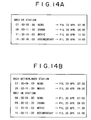
- Figs. 14A and 14B represent PDC program labels (PIL) relative respectively to the program tables shown in Figs. 13A and 13B.
- Figs. 14A and 14B showing examples of program ID set in the program tables of Figs. 13A and 13B by broadcasting stations
- Fig. 14A represents a program table of BBC1 and its program ID
- Fig. 14B represents a program table and its program ID of NED1 in the Netherlands and those of BBC1 in the UK.
- the program ID (program label: PIL) of the table shown in Fig. 13A is such as represented in Fig. 14A.
- the program ID of the program table is set by each broadcasting station, it is kept unchanged regardless of any of different receiving sites.
- the program ID of the program tables shown in Figs. 14A and 14B are not printed in TV columns of newspapers or magazines, PDC program ID are additionally annexed here to the program table of the UK BBC1 printed in a Dutch TV magazine, so as to explain the program ID.
- the hours signify those in the UK where the broadcasting station is sited.
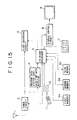
- Fig. 15 is a function block diagram showing a structural example of principal components in a video recording apparatus equipped with a known reserved recording function.
- an antenna 1 a tuner circuit 2, a video recording circuit 3, a data detector (program data/station code/date-time data detector) 4, a VTR microprocessor 5, first to third memories 6a - 6c, a key input manipulator 7, a display control circuit 8, a monitor TV unit 9, an infrared sensing circuit 10, and a remote commander 11.
- Pos data set in the video recording apparatus is stored in the second memory 6b, and the data of station code and station name is stored in the third memory 6c.
- the contents of the data stored in the first to third memories 6a - 6c are such as those shown in Figs. 16A to 16C respectively.
- Figs. 16A to 16C are explanatory diagrams representing the states of storage of such data in individual areas of the first to third memories shown in Fig. 15.
- Fig. 16A shows the content of the first memory 6a to store the reserved program data;
- Fig. 16B shows the content of the second memory 6b to store the Pos data;
- 16C shows the content of the third memory 6c to store the station code and station name data.
- the reserved program data is composed of "PIL Reserved” and "PDC ON/OFF” .
- NED1 conforms with the PDC
- PDC ON/OFF is set to ON. In the UK or any similar country where there are many broadcasting stations conforming with the PDC, it may be initially set to ON in a reserved recording operation automatically.
- the Pos data stored in the second memory 6b is composed of CH (channel) and station code, as shown in Fig. 16B.
- the Pos data is settable per video recording apparatus.
- the data of station code and station name are stored.
- Fig. 16C shows codes of "NED1" to “NED3” representing the Netherlands broadcast stations, and codes of "BBC1" and “BBC2” representing the UK broadcasting stations.
- a station code is composed of four-digit numerical data, wherein high-order two digits are used as a country code which is allocated to each relevant country to represent the same.
- the station code of Posl is "4801"
- the country code thereof is "48”.
- Figs. 16B and 16C signify exemplary states where Posl is preset to NED1, Pos2 to NED2, Pos3 to NED3, and Pos4 to BBC1, respectively.
- Input of such reservation data is executed by manipulating an up, down, left or right cursor key (" ⁇ ", " ⁇ ",” ⁇ ", or " ⁇ ") of the remote commander 11. A detailed explanation thereof is omitted here.
- any broadcasting station conforming with the PDC or VPS continuously transmits the label of a program (program ID) during broadcast of that program.
- NED1 continuously transmits PIL of "20 Apr. 1996 07:00" as program ID set individually by the station.
- BBC1 also keeps transmission of the program ID set individually by the station.
- broadcast signals of the reserved channels are received in succession alternately by the tuner circuit 2 at a predetermined time interval for each channel, and the VTR microprocessor 5 controls the data detector 4 to extract the data superimposed on the received broadcast signals.
- the program ID set by the broadcasting station is fundamentally the same as PIL of "20 Apr. 1996 07:00" with regard to the program start hour, and during a news broadcast, such PIL superimposed on the broadcast signal is transmitted from the station.
- the VTR microprocessor 5 instructs execution of reserved recording, as the detected PIL coincides with PIL Reserved No. 1 stored in the first memory 6a, i.e., 20 Apr. 1996 07:00 NED1 (Pos1).
- the program ID set by the broadcasting station coincides with the program start hour in the transmission source (UK).
- PIL is "20 Apr. 1996 08:00" , and this PIL is transmitted continuously during broadcast of the drama.
- the VTR microprocessor 5 fails to detect a coincidence between the PILs, whereby it is rendered impossible to perform proper recording of the reserved program.
- the PDC program ID (PIL) is fundamentally the data incidental to the program, and when the program transmission source is in the UK, it is customary that PIL for the UK is annexed regardless of any receiving site. Accordingly, as shown in Fig. 14B representing some programs and incidental program ID (PIL) data, any program table in magazines or the like published in the Netherlands is based on the Netherlands time, whereas the program ID (PIL) is based on the transmission source UK time, as shown in Fig. 14A.
- a video recording apparatus such as a VCR holds the reserved program content (program data) in an internal RAM (random-access memory), wherein the content is compared with the program code (PIL) transmitted from the station during actual broadcast of the program, and the program is recorded only when a coincidence is attained therebetween (with the exception of a special code).
- PIL program code
- a video recording apparatus having a storage means to store program reservation data and equipped with a reserved recording function which utilizes program ID superimposed on broadcast signal.
- a time difference table is included to store data of time differences between the sites of broadcasting stations and a receiving site, and when the program ID is to be stored as reservation data, the program ID is corrected with reference to the time difference table and then the corrected program ID is stored.
- a further aspect of the invention is set forth in claim 4.
- Embodiments of the present invention provide improvements in a video recording apparatus and method adapted for enhancing both operability and reliability, wherein, when reserved recording is to be performed by utilizing PDC or VPS, a desired program can be recorded exactly with a reservation through mere setting of a country by a user despite different PIL data derived from the time difference between a broadcasting station and a receiving site.
- the feature of the present embodiment resides in that, regarding any program of a broadcasting station where its standard time is different from that of a user's country (any country or site having a time difference), proper reserved recording can be performed in accordance with program ID such as VPS or PDC.
- the user needs merely to set a desired country in advance, so that the apparatus searches for "station ID" automatically out of the preset channels and then finds out the channel of the user's country, hence acquiring LTO (Local Time Offset) data of the user's country from the data of 8/30/Formatl or Page Header service.
- LTO Local Time Offset
- the data of the reserved program set by the user is corrected in accordance with the data thus acquired, and then a coincidence of the PIL data is detected, whereby a desired broadcast program of any time-different country can be recorded accurately with a reservation.
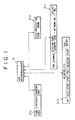
- Fig. 1 is a function block diagram of a preferred embodiment of the video recording apparatus of the present invention equipped with a reserved recording function. Reference numerals in this diagram are similar to those used in Fig. 15, wherein numerals 21a to 21d denote fourth to seventh memories.
- Fig. 1 shows only a VTR microprocessor 5 and four memories, i.e., fourth to seventh memories 21a - 21d.
- the constitution of this apparatus is fundamentally the same as that of the aforementioned apparatus of Fig. 15 with the exception that the number of the memories and the contents thereof are different.
- the data of program reservation are stored in the first to third memories 6a - 6c respectively.
- the relationship of mutual correspondence between the first to third memories 6a - 6c of Fig. 15 and the fourth to seventh memories 21a - 21d of Fig. 1 is such that the first to third memories 6a - 6c correspond substantially to the fifth to seventh memories 21b - 21d, and the fourth memory 21a of Fig. 1 is newly added.
- Figs. 2A and 2B show the storage states of data in the fourth and fifth memories 21a and 21b of Fig. 1, wherein Fig. 2A relates to the fourth memory 21a, and Fig. 2B to the fifth memory 21b respectively.
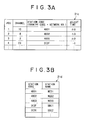
- Figs. 3A and 3B show the storage states of data in the sixth and seventh memories 21c and 21d of Fig. 1, wherein Fig. 3A relates to the sixth memory 21c, and Fig. 3B to the seventh memory 21d respectively.
- Time difference area tables for individual countries are provided in the fourth memory 21a newly added.
- a time difference area, countries and an area name are described with mutual correspondence in each time difference area table.
- the area 1 includes UK and Ireland, and a two-digit country code explained in connection with Figs. 16B and 16C is given correspondingly to each of the countries.
- a reserved recording operation is executed on the basis of the corrected PIL (broadcast start hour).
- the adjust time data in the second memory 6b of Fig. 15B is added to the sixth memory 21c of Fig. 3A.
- the content of the seventh memory 21d shown in Fig. 3B is the same as that of the third memory 6c shown in Fig. 15C.
- the program reservation data shown in Figs. 2A, 2B, 3A and 3B are stored respectively in the fourth to seventh memories 21a - 21d.
- the diagrams show an exemplary case where the program reservation data stored in the fourth to seventh memories 21a to 21d and the contents (program reservation data) in the first to third memories 6a to 6c of Figs. 15A to 15C are mutually the same.
- the label of the reserved program is held in the internal RAM (memory) of the apparatus, and a search is executed continuously while the broadcast signal is being received until arrival of the same label.
- the data of "station ID (Country Code + Network Identification)" relative to the transmission channel of a reserved program and "current date and time” thereof are checked, and then a decision is made as to whether the channel is in any country having a time difference from the user's country (receiving site). And if the result of such a decision signifies that the channel is in a time-different country, the label of the reserved program held in the internal RAM (memory) of the apparatus is changed to a value obtained by adding the time difference ⁇ (LTO of user's country) - (LTO of transmission channel of reserved program) ⁇ .
- the two PIL data are rendered coincident with each other to thereby enable reserved recording based on the PDC or VPS.
- the function is broadly classified into an initial set mode, a program reservation set mode and a reserved recording mode, which will be described below successively in this order.
- the apparatus is placed in an initial set mode by depressing an "automatic initial set" key disposed in a key input manipulator 7 (Fig. 15; omitted in Fig. 1).
- a language set menu, a country set menu and a channel list are displayed sequentially on the screen of a monitor TV unit 9.
- Fig. 4 shows an example of a language set menu displayed on the monitor TV unit 9.
- Fig. 5 shows an example of a country set menu displayed on the monitor TV unit 9.
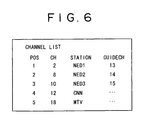
- Fig. 6 shows an example of a receivable channel list displayed on the monitor television unit 9.
- a language set menu such as shown in Fig. 4 is displayed on the screen of the monitor TV unit 9.
- the display on the screen of the monitor TV unit 9 is switched to a country set menu such as shown in Fig. 5.
- the desired country is indicated by manipulating the up or down cursor key of the remote commander 11, and then the "EXECUTE" key is depressed to select the indicated country.
- the VTR microprocessor 5 shown in Fig. 1 calculates the time difference of the preset country from the time difference area table in the fourth memory 21a where the time difference data of the listed countries are stored.
- the area 2 of the time difference area table is regarded as a standard.
- the VTR microprocessor 5 controls a tuner circuit 2 and a data detector circuit 4 (of Fig. 15) to thereby tune in the entire receivable channels automatically, and then extracts the station ID data superimposed on the broadcast waves of the channels.
- sorting is executed in accordance with the preset languages and countries by the use of such station ID data.
- the adjust time in the sixth memory 21c is set to ⁇ 0 as an initial value.
- a search is executed for the channel (Pos) that has the country code belonging to the same area as the standard area set by the user in the fourth memory 21a of Fig. 2A.
- the Pos is set to its initial value "1" , and the station code of such Pos1 is read out from the sixth memory 21c of Fig. 3A.
- each broadcasting station code is composed of four-digit numerical data, of which high-order two digits are used as a country code representing the relevant country.
- the station code of Posl is "4801" , so that the country code is "48".
- Pos is changed by "+1" to be set to Pos2.
- the channel of that Pos is selected, then the date and time data on the 8/30/Formatl service data is acquired, and the counter in the VTR microprocessor 5 of Fig. 1 is actuated to start its internal clock operation in synchronism with the acquired data.
- the Pos is incremented by +1 and then the standard time data is sought again. This process is repeated up to MAXpos.
- the time data of the next registered channel is extracted, and the difference from the standard time is calculated and processed as adjust time data.
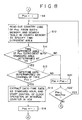
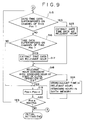
- Figs. 7 to 9 are flowcharts showing a flow of principal processes executed at initial setting in the video recording apparatus of the present embodiment.
- S1 to S24 denote processing steps
- (1) to (3) denote connections.
- a processing flow of Fig. 7 is started, and a decision is made at step S1 as to whether a language is to be set or changed.
- step S2 a desired language is selected on the aforementioned language set menu shown in Fig. 4.
- step S3 When no language is to be set or changed or upon completion of setting or changing a language, a decision is made at step S3 as to whether a country is to be set or changed.
- step S4 a desired country is selected on the aforementioned country set menu shown in Fig. 5.
- the VTR microprocessor 5 calculates, at step S5, the time difference relative to the set country with reference to the time difference area table of countries shown in Fig. 2A, and thus a standard area is determined.
- next step S6 a search is executed for station ID of entire receivable channels (CH), and station ID data superimposed on the tuned channels are also extracted.
- CH entire receivable channels
- step S7 sorting is executed in accordance with the languages and countries by the use of such station ID data.
- step S8 the sorted data are stored in the sixth memory 21c of Fig. 3A.
- the adjust time in the sixth memory 21c is set to " ⁇ 0" as an initial value.
- a search is executed for the channel (Pos) which has a country code belonging to the same area as the standard area set by the user.
- step S9 from connection (1) of Fig. 7 to connection (1) of Fig. 8
- Pos is set to its initial value "1".
- step S11 a decision is made as to whether a coincidence is attained or not between the time-different area of Posl and the standard area determined at step S5.
- step S12 a decision is made as to whether the date and time data are superimposed on the channel of Pos1.
- step S13 the date and time data are extracted to be used as a standard hour, whereby the internal counter in the apparatus is actuated to start control of a clock operation.
- the operation proceeds to a next process of extracting the time data of the channel registered in each Pos, then calculating the difference thereof from the standard hour, and inputting the time data as an adjust time.
- step S23 If the result of the above decision signifies that the date and time data are superimposed, such data are acquired, at step S23, as 8/30/Format1 service data to be used as a relevant hour, and then the operation proceeds to step S18.
- step S15 the operation proceeds to step S16, where another decision is made as to whether the date and time data are superimposed on the channel of, e.g., Teletext Page Header.
- step S17 if the result of the above decision signifies that the date and time data are superimposed, such data are acquired, at step S17, as Teletext Page Header service data to be used as a relevant hour, and then the operation proceeds to step S18.
- step S18 a decision is made at step S18 as to whether the relevant hour is coincident with the standard hour corresponding to the start of the clock operation determined at step S13.
- step S24 the adjust time obtained by calculating the difference between the relevant hour and the standard hour is stored in the adjust time column of the pertinent Pos in the sixth memory 21c of Fig. 3A, and then the operation proceeds to step S19.
- the Pos is incremented by +1 at step S19 for repeating the same process at the next Pos.
- step S22 Thereafter a decision is made at step S22 as to whether the Pos is smaller than the maximum value (MAXPos) or not.
- step S11 signifies no coincidence between the time-different area of Posl and the standard area or if the result of the decision at step S12 signifies no superimposition of date and time data, the operation proceeds to step S21 where the Pos is incremented by +1.
- step S22 a decision is made as to whether the Pos is smaller than the maximum value (MAXPos) or not.
- initial setting is completed due to the above processes executed at steps S1 to S24, and program reservation is rendered settable. That is, completion of initial setting is the requisite condition to set program reservation.
- the video recording apparatus such as a VCR having a reserved recording function receives a command via the infrared sensing circuit 10, whereby a reserved recording set menu is displayed on the screen of the monitor TV unit 9 under control of the display control circuit 8.
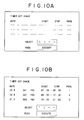
- Figs. 10A and 10B show examples of a reserved recording set menu displayed on the screen of the monitor TV unit 9, in which Fig. 10A represents an initial image, and Fig. 10B represents a state where partial reservation data is inputted.
- the user reserves a desired program by manipulating the up, down, left and right ( ⁇ , ⁇ , ⁇ , ⁇ ) cursor keys.
- a reservation of one program is completed when the whole data of the broadcast date, start hour, end hour, recording speed and Pos (channel) of the program have been entirely inputted. Unless these whole data are inputted, a reservation of the program is not settled.
- Fig. 10B shows an exemplary menu displayed when reservations of three programs have been settled.
- the first is "Program 1 (Posl: NED1) of April 20, 1996 (Saturday), 7:00 - 8:00" ; the second is “Program 4 (Pos4: BBC1) of April 20, 1996 ( Saturday), 9:00 - 12:30" ; and the third is "Program 2 (Pos2: NED2) of April 21, 1996 (Sunday), 20:00 - 21:00".
- the adjust time of Pos1 is detected to be " ⁇ 0" from the sixth memory 21c shown in Figs. 1 and 3A.
- the channel is Pos4 and its adjust time is detected to be "-1" from the sixth memory 21c shown in Figs. 1 and 3A.
- the adjust time "-1" is added to the start hour 7:00 of the reserved program for adjusting the same to obtain corrected PIL, i.e., 8:00, which is then stored in the corresponding storage area of the fifth memory 21b shown in Figs. 1 and 2B.
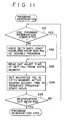
- Fig. 11 is a flowchart showing principal processes executed for setting of program reservation in the video recording apparatus of the present embodiment.
- S31 - S35 denote processing steps.
- step S31 a decision is made as to whether a reservation of one program has been completed or not.
- step S32 the date, start hour, end hour and Pos of the desired program are set.
- step S33 where the adjust time of the set Pos is read out from the sixth memory 21c shown in Fig. 3A.
- corrected PIL is calculated by adding the adjust time to the start hour of the reserved program and then is stored in the corresponding storage area of the fifth memory 21b shown in Fig. 2B.
- step S35 a decision is made as to whether the reservation set mode has been terminated or not.
- step S31 the operation returns to step S31 again, and a similar process is repeated.
- the apparatus When the power supply for the apparatus is switched off after reservation of any program, the apparatus is placed in a reserved recording standby or execution mode.
- the Pos (channel) of Program 1 is selected first.
- the program data is detected from the broadcast signal of the selected Posl and is compared with the corrected PIL of Program 1 stored in the fifth memory 21b of Figs. 1 and 2B.
- Program 1 begins to be recorded.
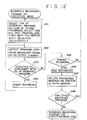
- Fig. 12 is a flowchart of principal processes executed in a reserved recording standby or execution mode in the video recording apparatus of the presentembodiment.
- S41 to S48 denote processing steps.
- step S41 the Pos (channel) of the reserved program is selected.
- the Pos (channel) of Program 1 is selected first.
- step S42 the program data (PIL) is detected from the broadcast signal of the selected Pos.
- step S43 the detected PIL is compared with the corrected PIL (broadcast start hour) of Program 1 stored in the fifth memory 21b of Fig. 2B.
- step S44 Program 1 begins to be recorded. Subsequently the operation returns to step S42 again, and a similar process is executed.
- step S45 a decision is made at step S45 as to whether the reserved program is being recorded or not.
- step S46 a predetermined process is executed to terminate the recording.
- step S47 there is deleted the entire data relative to the program reservation stored in the fifth memory 21b of Fig. 2B, and then the operation proceeds to step S48 to make a decision as to whether any other reserved program is existent or not.
- step S45 the operation returns to step S41, and a similar process is executed with regard to Program 2.
- step S48 upon detection at step S48 that there is no more program reservation data, the processing flow in the reserved recording standby or execution mode of Fig. 12 is brought to an end.
- the program ID i.e., PIL superimposed on the broadcast signal from the station
- PIL superimposed on the broadcast signal from the station
- a time difference table to store the data of time differences between the sites of broadcasting stations and a receiving site. And when program ID is to be stored as reservation data, the program ID is corrected with reference to the time difference table and then the corrected data is stored.
- a proper operation can be performed in compliance with any extension of a program or any change thereof.
Landscapes
- Engineering & Computer Science (AREA)
- Multimedia (AREA)
- Signal Processing (AREA)
- Television Signal Processing For Recording (AREA)
- Two-Way Televisions, Distribution Of Moving Picture Or The Like (AREA)
Applications Claiming Priority (2)
| Application Number | Priority Date | Filing Date | Title |
|---|---|---|---|
| JP221149/96 | 1996-08-22 | ||
| JP8221149A JPH1064136A (ja) | 1996-08-22 | 1996-08-22 | 予約録画機能を有するビデオ記録装置 |
Publications (2)
| Publication Number | Publication Date |
|---|---|
| EP0825771A2 true EP0825771A2 (de) | 1998-02-25 |
| EP0825771A3 EP0825771A3 (de) | 1998-12-16 |
Family
ID=16762243
Family Applications (1)
| Application Number | Title | Priority Date | Filing Date |
|---|---|---|---|
| EP97306404A Withdrawn EP0825771A3 (de) | 1996-08-22 | 1997-08-21 | Videoaufzeichnung |
Country Status (3)
| Country | Link |
|---|---|
| US (1) | US6470136B1 (de) |
| EP (1) | EP0825771A3 (de) |
| JP (1) | JPH1064136A (de) |
Cited By (3)
| Publication number | Priority date | Publication date | Assignee | Title |
|---|---|---|---|---|
| WO2001047249A3 (en) * | 1999-12-21 | 2002-01-03 | Tivo Inc | Broadcast program recording overrun and underrun scheduling system |
| US7877768B2 (en) | 2002-04-26 | 2011-01-25 | Tivo Inc. | Smart broadcast program recording padding and scheduling system |
| US7882520B2 (en) | 2000-12-20 | 2011-02-01 | Tivo Inc. | Broadcast program recording overrun and underrun scheduling system |
Families Citing this family (13)
| Publication number | Priority date | Publication date | Assignee | Title |
|---|---|---|---|---|
| JP2000348403A (ja) * | 1999-06-03 | 2000-12-15 | Mitsubishi Electric Corp | 番組予約装置 |
| JP2003109359A (ja) * | 2001-09-28 | 2003-04-11 | Pioneer Electronic Corp | 情報記録装置、情報記録方法、情報再生装置、情報再生方法、記録媒体並びにプログラムがコンピュータで読取可能に記録された情報記録媒体及びプログラム |
| KR100438546B1 (ko) * | 2001-10-26 | 2004-07-03 | 엘지전자 주식회사 | 이동통신 단말기의 자동 시간설정 방법 |
| KR100430019B1 (ko) * | 2002-06-25 | 2004-05-03 | 엘지전자 주식회사 | 브이씨알/디브이디피 복합제품의 언어 설정 방법 |
| US20040197087A1 (en) * | 2003-04-07 | 2004-10-07 | Lg Electronics Inc. | Method for displaying available languages supported by the content recorded on a recording medium |
| US20050100320A1 (en) * | 2003-11-11 | 2005-05-12 | Haas William R. | Device and method for recording a media transmission for later playback |
| JP4059872B2 (ja) * | 2004-08-02 | 2008-03-12 | 三洋電機株式会社 | 移動型地上デジタル放送受信機 |
| TW200633449A (en) * | 2005-03-10 | 2006-09-16 | Cheerteck Inc | System and method for utilizing broadcast time |
| JP4664732B2 (ja) * | 2005-05-16 | 2011-04-06 | シャープ株式会社 | 録画装置 |
| KR100856261B1 (ko) * | 2006-10-17 | 2008-09-03 | 삼성전자주식회사 | 방송 수신 단말기에서 자동 예약 녹화 제어 장치 및 방법 |
| KR101266480B1 (ko) * | 2006-11-09 | 2013-05-23 | 삼성전자주식회사 | 지역별 방송 채널 리스트를 표시하는 방송 수신 장치 및 그방법 |
| KR20100063934A (ko) * | 2008-12-04 | 2010-06-14 | (주)휴맥스 | 방송 녹화 기기와 예약 녹화 방법 |
| US9237298B2 (en) | 2011-12-28 | 2016-01-12 | Mitsubishi Electric Corporation | Digital broadcast receiving device and station selection method |
Family Cites Families (15)
| Publication number | Priority date | Publication date | Assignee | Title |
|---|---|---|---|---|
| DE3856057T2 (de) * | 1987-07-20 | 1998-10-29 | Philips Electronics Nv | Fernseh-Übertragungssystem |
| DE3735780A1 (de) * | 1987-10-22 | 1989-05-03 | Grundig Emv | Verfahren zur programmierung eines empfaengers mit videorecorder zur aufzeichnung von ueber satellit uebertragenen fernsehprogrammbeitraegen |
| DE3735782A1 (de) | 1987-10-22 | 1989-05-03 | Grundig Emv | Verfahren zur programmierung eines empfaengers mit videorecorder zur aufzeichnung von ueber satellit uebertragenen fernsehprogrammbeitraegen |
| JPH03201237A (ja) | 1989-12-27 | 1991-09-03 | Matsushita Electric Ind Co Ltd | 番組録画予約装置 |
| KR0165246B1 (ko) * | 1992-09-04 | 1999-03-20 | 윤종용 | 문자입력 예약녹화 방법 및 장치 |
| JPH06251450A (ja) | 1993-02-25 | 1994-09-09 | Sharp Corp | 時差対応pdc録画予約システム |
| ES2142888T5 (es) * | 1993-06-24 | 2005-04-01 | Lg Electronics Inc. | Aparato y metodo para realizar una grabacion por reserva de una grabadora de videocasete. |
| FR2717026B1 (fr) * | 1994-03-01 | 1996-03-29 | Thomson Consumer Electronics | Procédé de programmation de tuner et dispositif de mise en Óoeuvre. |
| KR950034233A (ko) | 1994-05-09 | 1995-12-26 | 이헌조 | 브이시알(vcr)의 예약녹화방법 |
| JPH07312536A (ja) * | 1994-05-17 | 1995-11-28 | Sony Corp | 短波受信機 |
| GB9414447D0 (en) * | 1994-07-18 | 1994-09-07 | Thomson Consumer Electronics | Method and apparatus for accurate setting of time of day clock in a video receiver |
| JP3644455B2 (ja) * | 1994-09-29 | 2005-04-27 | ソニー株式会社 | 番組情報放送方式、番組情報表示方法および受信装置 |
| JP3360468B2 (ja) * | 1995-01-30 | 2002-12-24 | ソニー株式会社 | 録画装置 |
| JPH08214224A (ja) * | 1995-02-03 | 1996-08-20 | Sony Corp | テレビジョン装置 |
| JPH08214223A (ja) * | 1995-02-03 | 1996-08-20 | Sony Corp | テレビジョン装置 |
-
1996
- 1996-08-22 JP JP8221149A patent/JPH1064136A/ja active Pending
-
1997
- 1997-08-21 US US08/917,007 patent/US6470136B1/en not_active Expired - Lifetime
- 1997-08-21 EP EP97306404A patent/EP0825771A3/de not_active Withdrawn
Cited By (7)
| Publication number | Priority date | Publication date | Assignee | Title |
|---|---|---|---|---|
| WO2001047249A3 (en) * | 1999-12-21 | 2002-01-03 | Tivo Inc | Broadcast program recording overrun and underrun scheduling system |
| CN100440956C (zh) * | 1999-12-21 | 2008-12-03 | 提维股份有限公司 | 广播节目记录超时和欠时排程系统 |
| EP2306712A1 (de) * | 1999-12-21 | 2011-04-06 | TiVo, Inc. | Intelligentes System und Verfahren zum empfehlen von Teilen von Medieninhalt auf der Basis von Benutzerpräferenzen |
| US8965182B2 (en) | 1999-12-21 | 2015-02-24 | Tivo Inc. | Broadcast program recording overrun and underrun scheduling system |
| US7882520B2 (en) | 2000-12-20 | 2011-02-01 | Tivo Inc. | Broadcast program recording overrun and underrun scheduling system |
| USRE45774E1 (en) | 2000-12-20 | 2015-10-20 | Tivo Inc. | Smart broadcast program recording padding and scheduling system |
| US7877768B2 (en) | 2002-04-26 | 2011-01-25 | Tivo Inc. | Smart broadcast program recording padding and scheduling system |
Also Published As
| Publication number | Publication date |
|---|---|
| EP0825771A3 (de) | 1998-12-16 |
| US6470136B1 (en) | 2002-10-22 |
| JPH1064136A (ja) | 1998-03-06 |
Similar Documents
| Publication | Publication Date | Title |
|---|---|---|
| US6470136B1 (en) | Video recording apparatus and method with reserved recording function for recording programs broadcast from any time zone | |
| JP3500741B2 (ja) | テレビ放送の選局方法及び選局装置 | |
| US6701526B1 (en) | Method and apparatus for capturing broadcast EPG data for program title display | |
| EP0589369B1 (de) | Videorekorder zur Aufnahme vorher programmierter Sendungen | |
| EP0337336A2 (de) | Anwendungen für die in den vertikalen Austastlücken eines Fernsehsignalesgesendeten Daten | |
| US20010004418A1 (en) | Apparatus and method for controlling the recording of television programs | |
| JP2004080822A (ja) | 映像受信機 | |
| EP0660603A2 (de) | Vorrichtung zum Abspeichern von Fernsehkanälen und Verfahren zur Kanalprogrammierung | |
| EP0624979B1 (de) | Übertragungsstation um verschiedene Fernsehprogramme zu übertragen und Empfänger um die Programme zu empfangen | |
| KR100443609B1 (ko) | 채널 선택 장치 및 이의 자동 채널 프리세트 방법 | |
| KR100231942B1 (ko) | 지역시차 자동 보정방법 | |
| KR100404531B1 (ko) | 방송신호수신기 | |
| EP0800313B1 (de) | Vorrichtung zur automatischen Voreinstellung der Kanäle für Fernsehsignale | |
| JP3500754B2 (ja) | 選局装置及びその自動チャンネルプリセット方法 | |
| EP0843469B1 (de) | Verfahren zur programmierten Aufnahme fernsehübertragener Programme | |
| US6907185B1 (en) | Method and apparatus for reserve-recording a viewing broadcast program | |
| JPH10322668A (ja) | テレビ受像機 | |
| JP3609726B2 (ja) | ディジタル・アナログ放送受信装置 | |
| JP3326307B2 (ja) | テレビジョン受信機 | |
| JP3362543B2 (ja) | 録画装置 | |
| KR100202449B1 (ko) | 브이시알의 예약녹화 시스템 자동 지정방법 | |
| KR100245450B1 (ko) | 방송프로그램 안내장치 | |
| JP2003274298A (ja) | 予約設定方法および予約設定装置 | |
| JPH09130689A (ja) | 受信装置および受信方法 | |
| KR0178614B1 (ko) | 자동 동조 시스템의 자동클럭 설정방법 |
Legal Events
| Date | Code | Title | Description |
|---|---|---|---|
| PUAI | Public reference made under article 153(3) epc to a published international application that has entered the european phase |
Free format text: ORIGINAL CODE: 0009012 |
|
| AK | Designated contracting states |
Kind code of ref document: A2 Designated state(s): DE GB NL |
|
| PUAL | Search report despatched |
Free format text: ORIGINAL CODE: 0009013 |
|
| AK | Designated contracting states |
Kind code of ref document: A3 Designated state(s): AT BE CH DE DK ES FI FR GB GR IE IT LI LU MC NL PT SE |
|
| 17P | Request for examination filed |
Effective date: 19990527 |
|
| AKX | Designation fees paid |
Free format text: DE GB NL |
|
| STAA | Information on the status of an ep patent application or granted ep patent |
Free format text: STATUS: THE APPLICATION HAS BEEN WITHDRAWN |
|
| 18W | Application withdrawn |
Withdrawal date: 20020710 |