EP0826150B1 - Solutions proteiques stables pour les diagnostics et leur procede de fabrication et d'utilisation - Google Patents
Solutions proteiques stables pour les diagnostics et leur procede de fabrication et d'utilisation Download PDFInfo
- Publication number
- EP0826150B1 EP0826150B1 EP96912183A EP96912183A EP0826150B1 EP 0826150 B1 EP0826150 B1 EP 0826150B1 EP 96912183 A EP96912183 A EP 96912183A EP 96912183 A EP96912183 A EP 96912183A EP 0826150 B1 EP0826150 B1 EP 0826150B1
- Authority
- EP
- European Patent Office
- Prior art keywords
- suspension
- thiol
- particles
- protein
- blocked
- Prior art date
- Legal status (The legal status is an assumption and is not a legal conclusion. Google has not performed a legal analysis and makes no representation as to the accuracy of the status listed.)
- Expired - Lifetime
Links
- 238000004519 manufacturing process Methods 0.000 title claims description 7
- 239000012460 protein solution Substances 0.000 title description 6
- 125000003396 thiol group Chemical group [H]S* 0.000 claims abstract description 95
- 239000002245 particle Substances 0.000 claims abstract description 65
- 102000004169 proteins and genes Human genes 0.000 claims abstract description 45
- 108090000623 proteins and genes Proteins 0.000 claims abstract description 45
- 239000003153 chemical reaction reagent Substances 0.000 claims abstract description 39
- 230000015572 biosynthetic process Effects 0.000 claims abstract description 20
- 239000000463 material Substances 0.000 claims abstract description 19
- 239000007790 solid phase Substances 0.000 claims abstract description 18
- 239000000725 suspension Substances 0.000 claims description 56
- 239000012491 analyte Substances 0.000 claims description 26
- 238000006243 chemical reaction Methods 0.000 claims description 24
- 239000000376 reactant Substances 0.000 claims description 22
- 238000000034 method Methods 0.000 claims description 20
- 108010088751 Albumins Proteins 0.000 claims description 17
- 102000009027 Albumins Human genes 0.000 claims description 17
- 238000006467 substitution reaction Methods 0.000 claims description 17
- 150000001412 amines Chemical group 0.000 claims description 16
- 150000001408 amides Chemical group 0.000 claims description 15
- 230000000903 blocking effect Effects 0.000 claims description 15
- 150000003949 imides Chemical group 0.000 claims description 15
- -1 C3-C12 cycloalkyl Chemical group 0.000 claims description 14
- 230000005298 paramagnetic effect Effects 0.000 claims description 14
- 125000004414 alkyl thio group Chemical group 0.000 claims description 13
- 125000005113 hydroxyalkoxy group Chemical group 0.000 claims description 13
- 125000001997 phenyl group Chemical group [H]C1=C([H])C([H])=C(*)C([H])=C1[H] 0.000 claims description 13
- 125000000229 (C1-C4)alkoxy group Chemical group 0.000 claims description 12
- 125000004768 (C1-C4) alkylsulfinyl group Chemical group 0.000 claims description 11
- 125000004769 (C1-C4) alkylsulfonyl group Chemical group 0.000 claims description 11
- 125000006643 (C2-C6) haloalkenyl group Chemical group 0.000 claims description 11
- 125000000882 C2-C6 alkenyl group Chemical group 0.000 claims description 11
- 125000004767 (C1-C4) haloalkoxy group Chemical group 0.000 claims description 10
- 125000004169 (C1-C6) alkyl group Chemical group 0.000 claims description 10
- 125000000171 (C1-C6) haloalkyl group Chemical group 0.000 claims description 10
- 125000005913 (C3-C6) cycloalkyl group Chemical group 0.000 claims description 10
- 125000006577 C1-C6 hydroxyalkyl group Chemical group 0.000 claims description 10
- 125000003601 C2-C6 alkynyl group Chemical group 0.000 claims description 10
- 125000000232 haloalkynyl group Chemical group 0.000 claims description 10
- 125000005020 hydroxyalkenyl group Chemical group 0.000 claims description 10
- 125000005016 hydroxyalkynyl group Chemical group 0.000 claims description 9
- 239000004033 plastic Substances 0.000 claims description 9
- 229920003023 plastic Polymers 0.000 claims description 9
- XLYOFNOQVPJJNP-UHFFFAOYSA-N water Substances O XLYOFNOQVPJJNP-UHFFFAOYSA-N 0.000 claims description 8
- 125000004400 (C1-C12) alkyl group Chemical group 0.000 claims description 5
- 125000004641 (C1-C12) haloalkyl group Chemical group 0.000 claims description 5
- 125000006711 (C2-C12) alkynyl group Chemical group 0.000 claims description 5
- 239000007795 chemical reaction product Substances 0.000 claims description 5
- 125000006710 (C2-C12) alkenyl group Chemical group 0.000 claims description 4
- 241000283690 Bos taurus Species 0.000 claims description 4
- 230000008878 coupling Effects 0.000 claims description 3
- 238000010168 coupling process Methods 0.000 claims description 3
- 238000005859 coupling reaction Methods 0.000 claims description 3
- 239000001257 hydrogen Substances 0.000 claims description 3
- 229910052739 hydrogen Inorganic materials 0.000 claims description 3
- 125000002887 hydroxy group Chemical group [H]O* 0.000 claims description 3
- 239000000375 suspending agent Substances 0.000 claims description 2
- 125000004438 haloalkoxy group Chemical group 0.000 claims 3
- 125000000027 (C1-C10) alkoxy group Chemical group 0.000 claims 2
- 125000004644 alkyl sulfinyl group Chemical group 0.000 claims 2
- 125000004390 alkyl sulfonyl group Chemical group 0.000 claims 2
- 125000004435 hydrogen atom Chemical class [H]* 0.000 claims 1
- 125000002768 hydroxyalkyl group Chemical group 0.000 claims 1
- 238000012544 monitoring process Methods 0.000 claims 1
- 244000144977 poultry Species 0.000 claims 1
- 239000004067 bulking agent Substances 0.000 abstract description 14
- 239000000126 substance Substances 0.000 abstract description 12
- 239000002981 blocking agent Substances 0.000 abstract description 10
- 108091003079 Bovine Serum Albumin Proteins 0.000 description 54
- 229940098773 bovine serum albumin Drugs 0.000 description 54
- 238000009739 binding Methods 0.000 description 41
- 230000027455 binding Effects 0.000 description 40
- 239000000523 sample Substances 0.000 description 38
- 239000000243 solution Substances 0.000 description 38
- 235000018102 proteins Nutrition 0.000 description 35
- 239000011550 stock solution Substances 0.000 description 16
- 239000000178 monomer Substances 0.000 description 13
- 238000003556 assay Methods 0.000 description 9
- 239000002609 medium Substances 0.000 description 9
- 230000009467 reduction Effects 0.000 description 8
- 239000000872 buffer Substances 0.000 description 7
- 230000033001 locomotion Effects 0.000 description 7
- FAPWRFPIFSIZLT-UHFFFAOYSA-M Sodium chloride Chemical compound [Na+].[Cl-] FAPWRFPIFSIZLT-UHFFFAOYSA-M 0.000 description 6
- 230000007935 neutral effect Effects 0.000 description 6
- 238000004458 analytical method Methods 0.000 description 5
- 239000011248 coating agent Substances 0.000 description 5
- 238000000576 coating method Methods 0.000 description 5
- 108090000790 Enzymes Proteins 0.000 description 4
- 102000004190 Enzymes Human genes 0.000 description 4
- BLRPTPMANUNPDV-UHFFFAOYSA-N Silane Chemical compound [SiH4] BLRPTPMANUNPDV-UHFFFAOYSA-N 0.000 description 4
- 239000012736 aqueous medium Substances 0.000 description 4
- 238000010668 complexation reaction Methods 0.000 description 4
- 238000001514 detection method Methods 0.000 description 4
- 230000007717 exclusion Effects 0.000 description 4
- 239000000203 mixture Substances 0.000 description 4
- 239000000047 product Substances 0.000 description 4
- 150000003839 salts Chemical class 0.000 description 4
- 229910000077 silane Inorganic materials 0.000 description 4
- HEMHJVSKTPXQMS-UHFFFAOYSA-M Sodium hydroxide Chemical compound [OH-].[Na+] HEMHJVSKTPXQMS-UHFFFAOYSA-M 0.000 description 3
- 150000001875 compounds Chemical class 0.000 description 3
- 239000013068 control sample Substances 0.000 description 3
- 235000018417 cysteine Nutrition 0.000 description 3
- XUJNEKJLAYXESH-UHFFFAOYSA-N cysteine Natural products SCC(N)C(O)=O XUJNEKJLAYXESH-UHFFFAOYSA-N 0.000 description 3
- 239000012530 fluid Substances 0.000 description 3
- 230000005291 magnetic effect Effects 0.000 description 3
- 230000009871 nonspecific binding Effects 0.000 description 3
- 239000008363 phosphate buffer Substances 0.000 description 3
- 238000011084 recovery Methods 0.000 description 3
- 239000011780 sodium chloride Substances 0.000 description 3
- 241000894007 species Species 0.000 description 3
- 239000000758 substrate Substances 0.000 description 3
- 125000004642 (C1-C12) alkoxy group Chemical group 0.000 description 2
- 125000004643 (C1-C12) haloalkoxy group Chemical group 0.000 description 2
- 102000014914 Carrier Proteins Human genes 0.000 description 2
- 239000004793 Polystyrene Substances 0.000 description 2
- PXIPVTKHYLBLMZ-UHFFFAOYSA-N Sodium azide Chemical compound [Na+].[N-]=[N+]=[N-] PXIPVTKHYLBLMZ-UHFFFAOYSA-N 0.000 description 2
- 125000000217 alkyl group Chemical group 0.000 description 2
- 230000001263 anti-prolactin effect Effects 0.000 description 2
- 239000000427 antigen Substances 0.000 description 2
- 108091007433 antigens Proteins 0.000 description 2
- 102000036639 antigens Human genes 0.000 description 2
- 239000007864 aqueous solution Substances 0.000 description 2
- 239000007982 barbital buffer Substances 0.000 description 2
- 239000000470 constituent Substances 0.000 description 2
- 238000002405 diagnostic procedure Methods 0.000 description 2
- 239000000539 dimer Substances 0.000 description 2
- 230000000694 effects Effects 0.000 description 2
- 108010074605 gamma-Globulins Proteins 0.000 description 2
- 230000008642 heat stress Effects 0.000 description 2
- 239000005556 hormone Substances 0.000 description 2
- 229940088597 hormone Drugs 0.000 description 2
- 150000002431 hydrogen Chemical class 0.000 description 2
- 238000003018 immunoassay Methods 0.000 description 2
- 230000003993 interaction Effects 0.000 description 2
- PGLTVOMIXTUURA-UHFFFAOYSA-N iodoacetamide Chemical compound NC(=O)CI PGLTVOMIXTUURA-UHFFFAOYSA-N 0.000 description 2
- 239000006249 magnetic particle Substances 0.000 description 2
- 239000012528 membrane Substances 0.000 description 2
- QJGQUHMNIGDVPM-UHFFFAOYSA-N nitrogen group Chemical class [N] QJGQUHMNIGDVPM-UHFFFAOYSA-N 0.000 description 2
- ZVEZMVFBMOOHAT-UHFFFAOYSA-N nonane-1-thiol Chemical compound CCCCCCCCCS ZVEZMVFBMOOHAT-UHFFFAOYSA-N 0.000 description 2
- 102000039446 nucleic acids Human genes 0.000 description 2
- 108020004707 nucleic acids Proteins 0.000 description 2
- 150000007523 nucleic acids Chemical class 0.000 description 2
- 229920000642 polymer Polymers 0.000 description 2
- 229920002223 polystyrene Polymers 0.000 description 2
- 230000008569 process Effects 0.000 description 2
- FZHAPNGMFPVSLP-UHFFFAOYSA-N silanamine Chemical compound [SiH3]N FZHAPNGMFPVSLP-UHFFFAOYSA-N 0.000 description 2
- 230000009870 specific binding Effects 0.000 description 2
- 239000004094 surface-active agent Substances 0.000 description 2
- IHPYMWDTONKSCO-UHFFFAOYSA-N 2,2'-piperazine-1,4-diylbisethanesulfonic acid Chemical compound OS(=O)(=O)CCN1CCN(CCS(O)(=O)=O)CC1 IHPYMWDTONKSCO-UHFFFAOYSA-N 0.000 description 1
- JKMHFZQWWAIEOD-UHFFFAOYSA-N 2-[4-(2-hydroxyethyl)piperazin-1-yl]ethanesulfonic acid Chemical compound OCC[NH+]1CCN(CCS([O-])(=O)=O)CC1 JKMHFZQWWAIEOD-UHFFFAOYSA-N 0.000 description 1
- NUFBIAUZAMHTSP-UHFFFAOYSA-N 3-(n-morpholino)-2-hydroxypropanesulfonic acid Chemical compound OS(=O)(=O)CC(O)CN1CCOCC1 NUFBIAUZAMHTSP-UHFFFAOYSA-N 0.000 description 1
- BTBUEUYNUDRHOZ-UHFFFAOYSA-N Borate Chemical compound [O-]B([O-])[O-] BTBUEUYNUDRHOZ-UHFFFAOYSA-N 0.000 description 1
- 241000283707 Capra Species 0.000 description 1
- 108010078791 Carrier Proteins Proteins 0.000 description 1
- 241000700199 Cavia porcellus Species 0.000 description 1
- VEXZGXHMUGYJMC-UHFFFAOYSA-M Chloride anion Chemical compound [Cl-] VEXZGXHMUGYJMC-UHFFFAOYSA-M 0.000 description 1
- 241000272201 Columbiformes Species 0.000 description 1
- 241000699800 Cricetinae Species 0.000 description 1
- 238000009007 Diagnostic Kit Methods 0.000 description 1
- 241000283074 Equus asinus Species 0.000 description 1
- 241000283073 Equus caballus Species 0.000 description 1
- 241000282326 Felis catus Species 0.000 description 1
- 241000287828 Gallus gallus Species 0.000 description 1
- 239000006173 Good's buffer Substances 0.000 description 1
- 239000007995 HEPES buffer Substances 0.000 description 1
- DGAQECJNVWCQMB-PUAWFVPOSA-M Ilexoside XXIX Chemical compound C[C@@H]1CC[C@@]2(CC[C@@]3(C(=CC[C@H]4[C@]3(CC[C@@H]5[C@@]4(CC[C@@H](C5(C)C)OS(=O)(=O)[O-])C)C)[C@@H]2[C@]1(C)O)C)C(=O)O[C@H]6[C@@H]([C@H]([C@@H]([C@H](O6)CO)O)O)O.[Na+] DGAQECJNVWCQMB-PUAWFVPOSA-M 0.000 description 1
- 108090001090 Lectins Proteins 0.000 description 1
- 102000004856 Lectins Human genes 0.000 description 1
- 241000282560 Macaca mulatta Species 0.000 description 1
- FYYHWMGAXLPEAU-UHFFFAOYSA-N Magnesium Chemical compound [Mg] FYYHWMGAXLPEAU-UHFFFAOYSA-N 0.000 description 1
- 241000283973 Oryctolagus cuniculus Species 0.000 description 1
- 239000007990 PIPES buffer Substances 0.000 description 1
- 229910019142 PO4 Inorganic materials 0.000 description 1
- 241001494479 Pecora Species 0.000 description 1
- 241000009328 Perro Species 0.000 description 1
- 239000004698 Polyethylene Substances 0.000 description 1
- 239000004743 Polypropylene Substances 0.000 description 1
- 241000700159 Rattus Species 0.000 description 1
- 108091006629 SLC13A2 Proteins 0.000 description 1
- QAOWNCQODCNURD-UHFFFAOYSA-L Sulfate Chemical compound [O-]S([O-])(=O)=O QAOWNCQODCNURD-UHFFFAOYSA-L 0.000 description 1
- 239000007983 Tris buffer Substances 0.000 description 1
- 241000700605 Viruses Species 0.000 description 1
- 230000002411 adverse Effects 0.000 description 1
- 238000005054 agglomeration Methods 0.000 description 1
- 238000007818 agglutination assay Methods 0.000 description 1
- 230000002776 aggregation Effects 0.000 description 1
- 238000013019 agitation Methods 0.000 description 1
- 239000013566 allergen Substances 0.000 description 1
- 235000001014 amino acid Nutrition 0.000 description 1
- 238000000137 annealing Methods 0.000 description 1
- 239000012062 aqueous buffer Substances 0.000 description 1
- 239000007900 aqueous suspension Substances 0.000 description 1
- 238000002820 assay format Methods 0.000 description 1
- 125000004429 atom Chemical group 0.000 description 1
- 108091008324 binding proteins Proteins 0.000 description 1
- 230000003139 buffering effect Effects 0.000 description 1
- 150000001720 carbohydrates Chemical class 0.000 description 1
- 230000015556 catabolic process Effects 0.000 description 1
- 239000003054 catalyst Substances 0.000 description 1
- 238000005119 centrifugation Methods 0.000 description 1
- 239000013043 chemical agent Substances 0.000 description 1
- 239000003638 chemical reducing agent Substances 0.000 description 1
- 239000003795 chemical substances by application Substances 0.000 description 1
- 238000012875 competitive assay Methods 0.000 description 1
- 230000000295 complement effect Effects 0.000 description 1
- 230000000536 complexating effect Effects 0.000 description 1
- 238000004132 cross linking Methods 0.000 description 1
- 238000006731 degradation reaction Methods 0.000 description 1
- 230000001419 dependent effect Effects 0.000 description 1
- 239000003599 detergent Substances 0.000 description 1
- 239000012502 diagnostic product Substances 0.000 description 1
- 239000000975 dye Substances 0.000 description 1
- 239000012636 effector Substances 0.000 description 1
- 238000001914 filtration Methods 0.000 description 1
- 239000007850 fluorescent dye Substances 0.000 description 1
- 238000004374 forensic analysis Methods 0.000 description 1
- 125000000524 functional group Chemical group 0.000 description 1
- 230000002489 hematologic effect Effects 0.000 description 1
- 238000000338 in vitro Methods 0.000 description 1
- 239000000411 inducer Substances 0.000 description 1
- 239000003112 inhibitor Substances 0.000 description 1
- 238000011835 investigation Methods 0.000 description 1
- 239000002523 lectin Substances 0.000 description 1
- 238000011068 loading method Methods 0.000 description 1
- 239000000891 luminescent agent Substances 0.000 description 1
- 239000011777 magnesium Substances 0.000 description 1
- 229910052749 magnesium Inorganic materials 0.000 description 1
- 230000003278 mimic effect Effects 0.000 description 1
- 238000002156 mixing Methods 0.000 description 1
- 229940126619 mouse monoclonal antibody Drugs 0.000 description 1
- IJGRMHOSHXDMSA-UHFFFAOYSA-N nitrogen Substances N#N IJGRMHOSHXDMSA-UHFFFAOYSA-N 0.000 description 1
- 229910052757 nitrogen Inorganic materials 0.000 description 1
- 239000002773 nucleotide Substances 0.000 description 1
- 125000003729 nucleotide group Chemical group 0.000 description 1
- 239000002831 pharmacologic agent Substances 0.000 description 1
- NBIIXXVUZAFLBC-UHFFFAOYSA-K phosphate Chemical compound [O-]P([O-])([O-])=O NBIIXXVUZAFLBC-UHFFFAOYSA-K 0.000 description 1
- 239000010452 phosphate Substances 0.000 description 1
- 229920000515 polycarbonate Polymers 0.000 description 1
- 239000004417 polycarbonate Substances 0.000 description 1
- 229920000573 polyethylene Polymers 0.000 description 1
- 229920001155 polypropylene Polymers 0.000 description 1
- 229920000136 polysorbate Polymers 0.000 description 1
- 230000001376 precipitating effect Effects 0.000 description 1
- 238000002360 preparation method Methods 0.000 description 1
- 230000004845 protein aggregation Effects 0.000 description 1
- 230000002285 radioactive effect Effects 0.000 description 1
- 238000005057 refrigeration Methods 0.000 description 1
- 230000035945 sensitivity Effects 0.000 description 1
- 229910052708 sodium Inorganic materials 0.000 description 1
- 239000011734 sodium Substances 0.000 description 1
- 239000001509 sodium citrate Substances 0.000 description 1
- NLJMYIDDQXHKNR-UHFFFAOYSA-K sodium citrate Chemical compound O.O.[Na+].[Na+].[Na+].[O-]C(=O)CC(O)(CC([O-])=O)C([O-])=O NLJMYIDDQXHKNR-UHFFFAOYSA-K 0.000 description 1
- RGHFKWPGWBFQLN-UHFFFAOYSA-M sodium;5,5-diethylpyrimidin-3-ide-2,4,6-trione Chemical compound [Na+].CCC1(CC)C([O-])=NC(=O)NC1=O RGHFKWPGWBFQLN-UHFFFAOYSA-M 0.000 description 1
- 238000000638 solvent extraction Methods 0.000 description 1
- 230000006641 stabilisation Effects 0.000 description 1
- 238000011105 stabilization Methods 0.000 description 1
- 230000000087 stabilizing effect Effects 0.000 description 1
- 239000007858 starting material Substances 0.000 description 1
- 238000003756 stirring Methods 0.000 description 1
- 238000003860 storage Methods 0.000 description 1
- 239000008399 tap water Substances 0.000 description 1
- 235000020679 tap water Nutrition 0.000 description 1
- UEUXEKPTXMALOB-UHFFFAOYSA-J tetrasodium;2-[2-[bis(carboxylatomethyl)amino]ethyl-(carboxylatomethyl)amino]acetate Chemical compound [Na+].[Na+].[Na+].[Na+].[O-]C(=O)CN(CC([O-])=O)CCN(CC([O-])=O)CC([O-])=O UEUXEKPTXMALOB-UHFFFAOYSA-J 0.000 description 1
- 239000003053 toxin Substances 0.000 description 1
- 231100000765 toxin Toxicity 0.000 description 1
- 108700012359 toxins Proteins 0.000 description 1
- GPRLSGONYQIRFK-MNYXATJNSA-N triton Chemical compound [3H+] GPRLSGONYQIRFK-MNYXATJNSA-N 0.000 description 1
- 239000011782 vitamin Substances 0.000 description 1
- 235000013343 vitamin Nutrition 0.000 description 1
- 229940088594 vitamin Drugs 0.000 description 1
- 229930003231 vitamin Natural products 0.000 description 1
- 150000003722 vitamin derivatives Chemical class 0.000 description 1
Images


Classifications
-
- G—PHYSICS
- G01—MEASURING; TESTING
- G01N—INVESTIGATING OR ANALYSING MATERIALS BY DETERMINING THEIR CHEMICAL OR PHYSICAL PROPERTIES
- G01N33/00—Investigating or analysing materials by specific methods not covered by groups G01N1/00 - G01N31/00
- G01N33/48—Biological material, e.g. blood, urine; Haemocytometers
- G01N33/50—Chemical analysis of biological material, e.g. blood, urine; Testing involving biospecific ligand binding methods; Immunological testing
- G01N33/53—Immunoassay; Biospecific binding assay; Materials therefor
- G01N33/543—Immunoassay; Biospecific binding assay; Materials therefor with an insoluble carrier for immobilising immunochemicals
- G01N33/54393—Improving reaction conditions or stability, e.g. by coating or irradiation of surface, by reduction of non-specific binding, by promotion of specific binding
-
- G—PHYSICS
- G01—MEASURING; TESTING
- G01N—INVESTIGATING OR ANALYSING MATERIALS BY DETERMINING THEIR CHEMICAL OR PHYSICAL PROPERTIES
- G01N33/00—Investigating or analysing materials by specific methods not covered by groups G01N1/00 - G01N31/00
- G01N33/48—Biological material, e.g. blood, urine; Haemocytometers
- G01N33/50—Chemical analysis of biological material, e.g. blood, urine; Testing involving biospecific ligand binding methods; Immunological testing
- G01N33/53—Immunoassay; Biospecific binding assay; Materials therefor
- G01N33/531—Production of immunochemical test materials
Definitions
- the invention relates to solutions containing dissolved proteins which are used or stored in plastic containment vessels and methods of making and using such solutions.
- Such protein solutions are commonly used in analytical or diagnostic applications as bulking agents. That is, the proteins impart on the aqueous solution an environment of viscosity and electrogenic character which is consistent with a biological environment.
- the invention also relates to blocking agents coupled to solid phase materials or particles.
- Diagnostic products are increasingly using solid phase materials, including particles having binding partners attached thereto in order to effect capture of an analyte.
- the solid phase materials or particles are dispersed in the aqueous medium to form a reagent suspension having kinetics which mimic in solution reactions.
- the particles are isolated after the analyte is captured.
- a particularly useful particle is a paramagnetic particle.
- Paramagnetic particles having an attached binding partner are used in diagnostic kits for the detection of various analytes.
- the binding partner is specific to a reactant or analyte sought to be detected and quantitated.
- a binding partner/reactant complex is formed in the presence of analyte in a test sample.
- This complex can be detected with signal developing reagents.
- Signal developing reagents may comprise further binding partners to the analyte which carry a label for detection.
- Paramagnetic particles are typically of micron size and are normally invisible to the naked eye. The small size of the particle allows such particle to be readily dispersed in an aqueous medium and readily isolated with a magnetic field. Paramagnetic particles are made or are processed to provide a reactive or silane coat on their surface. The coating provides an attachment site for further reactive species or binding partners on the surface of the particle. The particles are first chemically activated to couple the reactive or silane coating, by known chemistries, to the surface. The silane coating offers a reactive moiety to couple binding partners to the particle surface.
- the chemically activated particle is then placed in contact with a binding partner which needs to be attached to the particle.
- a binding partner which needs to be attached to the particle.
- the reaction is performed typically in excess of the binding partner to ensure a complete reaction.
- the excess protein is removed by reacting the particle with bovine serum albumin (BSA) at 50°C. Reacting the particle with BSA at 50° is commonly referred to as a heat stress reaction or blocking agent reaction.
- BSA bovine serum albumin
- Reacting the particle with BSA at 50° is commonly referred to as a heat stress reaction or blocking agent reaction.
- the finished particle is then suspended in a buffer containing BSA and other protein, i.e. a bulking agent.
- products or reagent suspensions of this type are often packaged in plastic bottles and shipped to end users.
- the bulking agent solutions of the prior art are not particularly stable. Even with refrigeration, such solutions show evidence of degradation. In solutions suspending particles, the particles, over time, form clumps which are visible to the naked eye, even though the products are stored at 4°C. This problem is particularly severe where the pH of the solution is above 7.5. The problem also manifests itself where the bulking agents are maintained in containment vessels comprising normal laboratory plastics, such as polyethylene, polyethyletetrathalate, polystyrene, polycarbonate, and polypropylene. Movement or agitation of the solution also increases the rate of aggregate or fibril formation.
- GB 2 052 059 deals with improved sensitivity of direct particle agglutination assays, which is accomplished by using reducing agents.
- binding partner/reactant refers to any pair of molecules which exhibits affinity, complexation or binding capacity, typically specific binding or interacting (complex-forming) or annealing pairs, such as antibody/antigen, antibody/hapten, enzyme/substrate, enzyme/inhibitor, enzyme/cofactor, binding protein/substrate, carrier protein/substrate, lectin/carbohydrate, receptor/hormone, receptor/effector, complementary strands of nucleic acid, repressor/inducer, and the like.
- binding partner refers to that member of a binding partner/reactant pair which is coupled to a solid phase.
- blocking agent refers to a material which, on being coated to a solid phase, reduces non-specific binding while allowing less than maximal binding partner loading to the solid phase.
- reactant refers to that member of a binding partner/reactant complex, the existence and/or concentration of which is to be determined, or the recovery of which is desired, and which is to be captured by the binding partner from a medium in which it is dispersed.
- An analyte in a test medium is an exemplary reactant, as is a specifically-binding industrial reagent to be recovered.
- test assay generally refers to any procedure in which a member of a binding partner/reactant in a test sample is to be detected and/or quantitated in a medium by various assay formats.
- test assay may be used to describe a diagnostic procedure, analytical procedure, microanalytical procedure, forensic analysis, pharmacokinetic study, cell sorting procedure, affinity chromatogram, industrial or laboratory recovery or analysis of one or more species such as toxins, catalysts, or starting materials or products, and the like.
- the term may be used to describe a procedure in which a plurality of reagents, each including a different binding partner, is employed to capture a plurality of corresponding reactants.
- a typical test assay is an immunoassay.
- complex refers to the specific binding or interaction or association of two or more species, for example, a binding partner and reactant.
- capturing refers to the analysis, recovery, detection, or other qualitative or quantitative determination of a reactant in a medium, for example via complexation in a test assay.
- a surface-coupled binding partner will form a complex with a reactant, before or after the reactant forms a complex with another (generally labeled) binding partner or reactant.
- labeled and unlabeled reactants typically compete for complexation with a surface-coupled binding partner.
- inert refers to a chemical or biological state in which a material does not interact with the binding partner of the test assay in which it is employed in the way in which the binding partner and reactant interact.
- the term may also refer to a chemical or biological state in which the material does not chemically interact with other reactive moities in a test reaction or reagent suspension.
- solid phase refers to any material which is insoluble in a medium containing a reactant to be captured in a particular test assay.
- the term describes any entity which can be substantially dispersed within a medium and removed or separated from the medium by immobilization, filtering, partitioning, centrifugation or into which the medium can be dispensed, or the like.
- a blocking agent may be attached to the solid phase to reduce non-specific binding.
- reaction suspension refers generally to a processed material modified to participate in a complexing reaction such as a test assay, more specifically to a solid phase material to which a binding partner is coupled and suspended in a bulking agent solution.
- non-specific binding refers to a nondesired interaction between a reagent and any other species present in a test assay other than binding partner/reactant complexation.
- label refers to an atom or a molecular moiety capable of generating a signal for detection of the binding reaction. It includes, without limitation, radioactive isotopes, enzymes, luminescent agents, precipitating agents, and dyes.
- sample refers to any medium containing a reactant or analyte to be captured and detected and quantitated in a test assay.
- analyte refers to any hormone, pharmacologic agent, vitamin or cofactor, hematological substances, virus antigens, nucleic acids, nucleotides, allergens, or other markers sought to be detected and quantitated.
- substitutions refers to the substitution of nitrogen for one or more carbons.
- derivative thereof refers to an addition of a nitrogen containing functional group.
- the present invention features articles of manufacture and methods for making a reagent suspension of solid phase material or particles and bulking agents.
- the suspension retards the formation of protein aggregate or fibril formation.
- the present invention provides a reagent suspension comprising,
- Blocking groups for reaction with thiol groups are well known in the art.
- Representative blocking groups comprise of C 1 -C 12 alkyl, C 3 -C 12 cycloalkyl, C 1 -C 12 haloalkyl, C 1 -C 12 hydroxyalkyl.
- thiol blocked protein in a reagent suspension retards the formation of fibrils or protein aggregates where the suspension of particles is stored in plastic bottles and which may also be subjected to movement.
- the protein, P is albumin.
- the albumin may be derived from any source, any of which are commercially available. Common forms of albumin comprise human, bovine, porcine, cat, chicken, dog, donkey, egg, goat, guinea pig, hamster, horse, rat, rabbit, pigeon, sheep, rhesus monkey, turkey, as well as other sources.
- compositions may also be utilized as bulking agents and blocking agents, according to the present invention, provided that thiol groups, if present, are blocked or chemically inert.
- the particle is a paramagnetic particle.
- a preferred X is a thiol alkyl group represented by the formula set forth below: wherein R is C 1 -C 6 alkyl, C 3 -C 6 cycloalkyl, C 1 -C 6 haloalkyl, C 1 -C 6 hydroxyalkyl, C 2 -C 6 alkenyl, C 2 -C 6 haloalkenyl, C 2 -C 6 hydroxyalkenyl, C 2 -C 6 alkynyl, 2 3 -C 6 haloalkynyl, C 2 -C 6 hydroxyakynyl, C 6 H 5 , C 1 -C 4 alkoxy, C 1 -C 4 haloalkoxy, C 1 -C 4 hydroxyalkoxy, C 1 -C 4 alkylthio, C 1 -C 4 alkylsulfinyl, C 1 -C 4 alkylsulfonyl, and amine, amide, imide, derivatives and substitutions
- the blocking group X may comprise a group set forth below:
- Z is hydroxyl, C 1 -C 6 alkyl, C 3 -C 6 cycloalkyl, C 1 -C 6 haloalkyl, C 1 -C 6 hydroxyalkyl, C 2 -C 6 alkenyl, C 2 -C 6 haloalkenyl, C 2 -C 6 hydroxyalkenyl, C 2 -C 6 alkynyl, C 2 -C 6 haloalkynyl, C 2 -C 6 hydroxyalkynyl, C 6 H 5 , C 1 -C 4 alkoxy, C 1 -C 4 haloalkoxy, C 1 -C 4 hydroxyalkoxy, C 1 -C 4 alkylthio, C 1 -C 4 alkylsulfinyl, C 1 -C 4 alkylsulfonyl, and amine, amide, and imide substitutions and derivatives and derivatives and derivative
- a preferred X is represented by the formula below: wherein n is an integer from 1-3. Preferably, n is 1.
- Embodiments of the present invention further feature a method of making a reagent suspension.
- the method comprises the steps of combining water, a thiol blocked chemical compound, preferably a protein, and one or more particles having a binding partner attached thereto, to form an aqueous medium.
- the thiol blocked protein is placed in solution.
- the one or more suspended magnetic particles are suspended in the aqueous medium.
- the thiol blocked protein has the formula: P-X wherein P is a protein having a thiol group and X is a blocking group covalently bonded to the thiol group.
- Blocking groups include C 1 -C 6 alkyl, C 3 -C 6 cycloalkyl, C 1 -C 6 haloalkyl, C 1 -C 6 hydroxyalkyl, C 2 -C 6 alkenyl, C 2 -C 6 haloalkenyl, C 2 -C 6 hydroxyalkenyl, C 2 -C 6 alkynyl, C 2 -C 6 haloalkynyl, C 2 -C 6 hydroxyalkynyl, C 6 H 5 , C 1 -C 4 alkoxy, C 1 -C 4 haloalkoxy,C 1 -C 4 hydroxyalkoxy, C 1 -C 4 alkylthio, C 1 -C 4 alkylsulfinyl, C 1 -C 4 alkylsulfonyl, and amine, amide, and imide substitutions and derivatives thereof.
- the method further comprises the addition of appropriate buffers, inorganic or organic salts, and surfactants, i.e. triton, to the reagent suspension.
- One embodiment of this invention is a method to detect the presence or absence of an analyte in a test sample.
- the analyte may be a chemical in a physiological fluid or other fluid or product for which analysis is to be made.
- the method comprises the steps of combining the sample to be tested, which may or may not contain the chemical or analyte or reactant, with the reagent suspension of this invention.
- the suspension comprises particles coated with a binding partner capable of reacting with the analyte, a thiol blocked bulking agent, and water.
- reaction conditions are imposed on the suspension to form a reaction product or complex in the presence of the analyte, if present, and the suspension is monitored or detected by means of a label to determine the presence of the reaction product as an indication of the presence of the analyte.
- the diagnostic or other analytical test for the analyte can be quantitative as well as qualitative in accordance with known practice.
- an object of the invention to provide a diagnostic reagent of a solid phase material or particle suspended in a chemical solution, preferably a protein solution, wherein thiol groups are blocked or chemically inert such that aggregates or fibril formation is retarded.
- Another object of the invention is to provide diagnostic reagent of a solid phase material having coupled thereto a binding partner and a blocking agent which is devoid of chemically reactive thiol groups.
- Another object of the invention is to provide a bulking agent for a diagnostic reagent, the bulking agent being a chemical solution wherein thiol groups, if present in the solution, are blocked or chemically inert.
- a further objection of the invention is to provide a solid phase material having coupled thereto a binding partner and a blocking agent including a chemical compound wherein thiol groups, if present in the compound, are blocked or chemically inert.
- the present invention features ways of stabilizing protein containing solutions used in in vitro applications, such as diagnostics.
- Embodiments of the present invention have particular application with respect to reagent suspensions.
- the reagent suspensions made in accordance with the present invention are stable and visible aggregates or fibril formation were retarded.
- the present invention will be described in detail as an article of manufacture, a reagent suspension of particles or solid phase materials, and a method of making the same, with the understanding that the present disclosure is to be considered an exemplification of the principles of the invention and is not intended to limit the invention to the embodiment described.
- the present invention has application in analytical laboratory and diagnostic processes involving any reagent suspensions which exhibit a tendency to clump or aggregate.
- the reagent suspension of the present invention comprise a suspension of particles and a thiol blocked protein or chemical solution.
- a blocking agent comprising a thiol blocked chemical, preferably a protein is also provided.
- paramagnetic particles as the solid phase material.
- Paramagnetic particles are described in U.S. Patent 4,554,088, which reference is incorporated herein and are commercially available from Advanced Magnetics, Cambridge, MA. Diagnostic reagents employing such magnetic particles are commercially available from Ciba Corning Diagnostics Corp.
- the described paramagnetic particles have a settling times in aqueous solutions of about 1.5 hours.
- the particles are about 0.1 to 10 ⁇ in diameter and are responsive to low magnetic fields of 100-1000 oersteds. This particle size normally invisible to the naked eye.
- these particles typically have an amino silane coating to act as attachment points for further reactive species or binding partners.
- Silane coating procedures are described in U.S. Patents 3,652,761 and 4,554,088 and which references are incorporated herein.
- the particles are chemically activated with a reagent which couples to the amino silane and offers a reactive moiety to couple or attach binding partners to the particle surface.
- the reactive particles prepared are placed in contact with a binding partner which needs to be coupled to the particle.
- the reaction is typically performed in an excess of the binding partner to drive the reaction to completeness.
- the excess protein is removed by reacting the reagent with bovine serum albumin (BSA) at 50°C.
- BSA bovine serum albumin
- a thiol blocked BSA is utilized as a blocking agent.
- This reaction is referred to as a heat stress reaction or blocking reaction.
- the coated particle is next placed in an aqueous buffer containing BSA and other proteins to form a reagent suspension.
- BSA or other proteins are preferably thiol blocked and act as bulking proteins. These bulking proteins are biologically compatible but not reactive with the desired binding partner which is coupled to the particle surface and with the particle itself.
- the particles are packaged in plastic bottles, labeled and put in storage prior to shipping to customers.
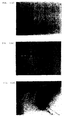
- FIG. 1 shows a series of photographs showing fibrils or aggregates in a reagent suspension of the prior art.
- the particles themselves, do not appear to contribute to the film making process.
- the films were formed on a template or surface, such as a water-air interface or a water-plastic interface.
- the formation of the film suggested a cross-linking reaction which caused stabilization of the monomer.
- the agglomeration reaction favored a high pH, elevated temperatures. the presence of plastic surfaces and fluid movement.
- the bulking chemical agents preferably proteins are treated to block thiol constituents thereof and thus form stable suspensions of this invention.
- the thiol blocked protein has the formula: P-X wherein P is a protein having one or more thiol groups.
- X is a blocking group covalently bonded to the S of the thiol group.
- Blocking groups for reaction with thiol groups are well known in the art. Representative blocking groups comprise of C 1 -C 12 alkyl, C 3 -C 12 cycloalkyl, C 1 -C 12 haloalkyl, C 1 -C 12 hydroxyalkyl.
- a preferred X is a thiol alkyl group represented by the formula set forth below: -S -R wherein R is C 1 -C 6 alkyl, C 3 -C 6 cycloalkyl, C 1 -C 6 haloalkyl, C 1 -C 6 hydroxyalkyl, C 2 -C 6 alkenyl, C 2 -C 6 haloalkenyl, C 2 -C 6 hydroxyalkenyl, C 2 -C 6 alkynyl, 2 3 -C 6 haloalkynyl, C 2 -C 6 hydroxyakynyl, C 6 H 5 , C 1 -C 4 alkoxy, C 1 -C 4 haloalkoxy, C 1 -C 4 hydroxyalkoxy, C 1 -C 4 alkylthio, C 1 -C 4 alkylsulfinyl, C 1 -C 4 alkylsulfonyl, and amine, amide, imide
- the blocking group X may comprise a group set forth below:
- Z is hydroxyl, C 1 -C 6 alkyl, C 3 -C 6 cycloalkyl, C 1 -C 6 haloalkyl, C 1 -C 6 hydroxyalkyl, C 2 -C 6 alkenyl, C 2 -C 6 haloalkenyl, C 2 -C 6 hydroxyalkenyl, C 2 -C 6 alkynyl, C 2 -C 6 haloalkynyl, C 2 -C 6 hydroxyalkynyl, C 6 H 5 , C 1 -C 4 alkoxy, C 1 -C 4 haloalkoxy, C 1 -C 4 hydroxyalkoxy, C 1 -C 4 alkylthio, C 1 -C 4 alkylsulfinyl, C 1 -C 4 alkylsulfonyl, and amine, amide, and imide substitutions and derivatives and derivatives and derivative
- a preferred X is represented by the formula below: wherein n is an integer from 1-3. Preferably, n is 1.
- the suspensions are aqueous and are buffered to a pH of from 6.0 to 9.0 and preferably 7.5 to 8.5 and, more preferably, at 7.5. It is noted that the pH of the suspension is dependent, to some extent, on the binding partners, with some binding partners requiring a lower pH for the bulking agents.
- Conventional buffers comprise phosphate, borate, Goods buffers, PIPES, HEPES, MOPSO and TRIS can be used..
- the particles are commercially used in amounts of 50 micrograms to 250 micrograms of solution and more preferably 60 to 75 micrograms of solution.
- the carrier for the particles is preferably water which can be distilled, deionized or regular tap water, having minimal amounts of salts and the like which do not react adversely with the components of the aqueous suspensions of this invention.
- the bulking agent chemical solutions of this invention are thiol blocked, if thiol groups are present and chemically reactive.
- thiol blocked albumin is used since it is readily available and has good bulking properties.
- the thiol blocked proteins are preferably used in amounts of.05 to 4.0% by weight of the solution and more preferably .05 to 2.0%.
- the suspensions can further have incorporated therein standard diagnostic reagents and the like including inorganic and organic salts and surfactants found in typical buffers and reagents.
- Useful salts include sodium chloride, sodium citrate, magnesium and the chloride like benefactors include sodium dodocyl sulfate, tween and detergents.
- the suspensions of this invention can be made by conventional mixing at room temperature.
- water, buffering reagents and thiol blocked protein are admixed at room temperative with gentle stirring by rod to form stable suspensions and then the pH is adjusted as necessary.
- the solution is then filtered after which the particles are added to the solution.
- the thiol group of the protein can be treated to block it by known reactions.
- Thiol blocked albumin having less than 0.02 moles sulfhydryl per mole of albumin is available commercially from Miles Laboratories (now Bayer), Kankakee, IL, USA (Miles Catalog No. 81-024TM).
- the suspensions of the present invention can be used in conventional diagnostic and detecting procedures. For example, the presence or absence of an analyte in a sample can be determined by combining the sample with particles for reaction with the analyte, a thiol blocked protein and water to form a suspension. The suspension is then placed under normal reaction conditions for the reaction to take place if the analyte is present. The suspension is monitored for the reaction product as an indication of the presence of an analyte.
- This Example describes the relationship of a reactive thiol group in albumin with the formation of polymers.
- a second sample comprised a 1% solution of BSA maintained at neutral pH and heated to 50°C for 16 hours.
- a third sample was a 1% solution of BSA at neutral pH heated to 55°C for 16 hours.
- a fourth sample comprised a 1% solution of BSA at neutral pH heated to 60°C for 16 hours.
- Sample 1 is a control value of 100% with respect to monomer concentration and thiol context.
- FIG. 1 depicts the percent monomer and thiol content versus the temperature in degrees Centigrade. Bars with angled lines depict monomer concentration. Bars without angled lines depict thiol concentration.
- Sample 2 heated to 50°C exhibited a 17% reduction in monomer concentration and a 29% reduction in percent of thiol present.
- This example describes the relationship of thiol blocked albumin with the formation of fibrils and protein aggregates.
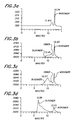
- Four samples of thiol-blocked BSA were prepared from a stock solution of 1% thiol-blocked BSA in 100mM phosphate buffer.
- the thiol blocked BSA used in this Example is represented by the formula: P - X wherein P is albumin and X is represented by the formula: and n is 1.
- This thiol blocked BSA composition is formed by reacting the thiol group of the cysteine associated with albumin with a second cysteine to form a disulfide bond. This composition is available from Miles, Catalog No. 81-024TM as noted above
- the first sample, Sample 1 comprised a 1% thiol blocked BSA solution, which solution was maintained at 4°C for 16 hours. This first sample was a control for monomer and reactive thiol content.
- a second sample, Sample 2 comprised a 1% solution of thiol blocked BSA, which solution was maintained at neutral pH and heated to 50°C for 16 hours.
- a third sample, Sample 3, comprised a 1% solution of thiol blocked BSA, which solution was maintained at neutral pH and heated to 55°C for 16 hours.
- a fourth sample, Sample 4, comprised a 1% solution of third blocked BSA which solution was maintained at neutral pH and heated to 60°C for 16 hours.
- FIG. 4a with respect to Sample 1
- FIG. 4b with respect to Sample 2
- FIG. 4c with respect to Sample 3
- FIG. 4d with respect to Sample 4.
- This example describes further comparisons of protein solutions with unblocked thiol groups with protein solutions in which the thiol group has been blocked.
- two stock solutions were made.
- a first stock solution comprised 5 mM barbital buffer at pH 8.5, 150 mM NaCl, 0.05% BSA and 0.15% bovine gamma globulin (BGG).
- BSA and BGG contained unblocked thiol groups. That is, each had reactive thiol groups.
- a second stock solution comprised 5 mM barbital buffer at pH 8.5, 150 mM NaC1, 0.05% thiol blocked BSA and 0.15% BGG.
- the thiol blocked BSA was as described in Example 2.
- Samples containing unblocked thiol group BSA developed a sheet or membrane within thirty minutes. Samples containing thiol blocked BSA did not exhibit a sheet or membrane formation for approximately three hours. After twenty hours, the amount of clumping and aggregate formation exhibited in samples containing unblocked thiol group BSA exceeded the aggregate formation of the thiol blocked BSA.
- Example 4 describes further the stability of thiol blocked BSA.
- the protocol of Example 3 was repeated; however, the samples were subjected to rocking motion while being maintained at a temperature of 4°C.
- This example features the preparation of a thiol blocked protein of the formula: P - X wherein P is albumin and X is an amine derivative of a C 1 -C 4 alkoxy. More specifically, X is:
- a one gram aliquot of albumin was dissolved in water.
- the pH of the solution was adjusted to pH 8.0 with sodium hydroxide solution.
- a molar excess, 3.3 mg. of iodoacetamide was added to the solution and stirred until the reaction was completed, approximately 2 hours.
- the thiol group of the cysteine amino acid of the albumin reacts with the iodoacetamide to form a thiol blocked albumin.
- This example features a comparison of thiol blocked and unblocked BSA buffers and motion at different temperatures.
- Two aqueous stock solutions of bulking agent were made.
- the composition of this buffer is set forth below:
- One stock solution comprised normal BSA (non thiol blocked) and was prepared from Miles Lot 482.
- a second stock solution comprised blocked BSA sample and was prepared from Miles Lot 1017.
- Paramagnetic particles coupled with anti-prolactin mouse monoclonal were suspended in each stock solution. Aliquots of each stock solution were placed in tissue culture flasks. Each sample was rocked at room temperature. Each sample was inspected at various times and an assessment was made as to the degree of fibril or aggregate formation.
- Table 1 sets forth the results where BSA Miles Lot 482 and BSA Miles Lot 1017 at pH 8.5 were rocked at room temperature. Degree of Clumping (pH 8.5, Room temperature) Time Hours BSA Lot 482 BSA Lot 1017 1 ++ - - 2 ++ - - 3.5 +++ + 8 +++ ++ 18 + + + + + ++
- Table 2 sets forth the results where BSA Miles Lot 482 and BSA Miles Lot 1017 at pH 8.5 and held at 4°C and subjected to rocking. Degree of Clumping (pH 8.5, 4°C) Time Hours BSA Lot 482 BSA Lot 1017 1 - - - - 2 - - - - 3 - - - - 4 + - - 20 +++ - -
- Two aqueous stock solutions were made of 0.1 M phosphate buffer pH 7.5 with 1% BSA.
- One stock solution was made with unblocked BSA and designated BSA Miles Lot 482.
- One stock solution was made with thiol blocked BSA and was designated BSA Miles Lot 1017. These two stock solutions also received anti-prolactin mouse monoclonal antibody bonded paramagnetic particles.
- Table 3 sets forth the results of BSA Miles Lot 482 and BSA Miles Lot 1017, at pH 7.5 held at room temperature and subjected to rocking. Degree of Clumping (pH 7.5, Room temperature) Time Hours BSA Lot 482 BSA Lot 1017 2 - - - - 4 - - - - 6 - - - - 23 + + + + + - - 29 + + + + + + - - -
Landscapes
- Health & Medical Sciences (AREA)
- Immunology (AREA)
- Life Sciences & Earth Sciences (AREA)
- Engineering & Computer Science (AREA)
- Chemical & Material Sciences (AREA)
- Molecular Biology (AREA)
- Biomedical Technology (AREA)
- Hematology (AREA)
- Urology & Nephrology (AREA)
- Biotechnology (AREA)
- Biochemistry (AREA)
- Cell Biology (AREA)
- Food Science & Technology (AREA)
- Medicinal Chemistry (AREA)
- Physics & Mathematics (AREA)
- Analytical Chemistry (AREA)
- Microbiology (AREA)
- General Health & Medical Sciences (AREA)
- General Physics & Mathematics (AREA)
- Pathology (AREA)
- Chemical Kinetics & Catalysis (AREA)
- Peptides Or Proteins (AREA)
- Investigating Or Analysing Biological Materials (AREA)
Claims (15)
- Suspension de réactif, comprenant :dans laquelle P est une protéine ayant un ou plusieurs groupes thiols et X est un groupe bloquant lié de façon covalente audit groupe thiol, de sorte que les groupes thiols sont bloqués ou chimiquement inertes.un agent de suspension aqueux,plusieurs particules se couplant avec un réactant apte à réagir avec un analyte, etune protéine à groupes thiols bloqués, portée par ladite suspension et ayant la formule :
- Suspension selon la revendication 1, dans laquelle lesdits groupes bloquants comprennent : les groupes alkyles en C1 à C12, cycloalkyles en C3 à C12, haloalkyles en C1 à C12, hydroxyalkyles en C1 à C12, alcényles en C2 à C12, haloalcényles en C2 à C12, hydroxyalcényles en C1 à C12, alcynyles en C2 à C12, haloalcynyles en C3 à C12, hydroxyalcynyles en C2 à C6, C6H5, alcoxy en C1 à C10, haloalcoxy en C1 à C10, hydroxyalcoxy en C1 à C10, alkylthio en C1 à C10, alkylsulfinyles en C1 à C10, alkylsulfonyles en C1 à C10, et les substitutions amines, amides et imides de ceux-ci et leurs dérivés.
- Suspension selon la revendication 1, dans laquelle P est de l'albumine.
- Suspension selon la revendication 3, dans laquelle ladite albumine provient de l'une des sources suivantes consistant en des sources humaines, bovines, porcines et de volaille.
- Suspension selon la revendication 1, dans laquelle X consiste en :
- Suspension selon la revendication 5, dans laquelle R est :où n est un entier de 1 à 3.

- Suspension selon la revendication 6, dans laquelle n est 1.
- Suspension selon la revendication 1, dans laquelle X est :où Z est un groupe hydroxyle, alkyle en C1 à C6, cycloalkyle en C3 à C6, haloalkyle en C1 à C6, hydroxyalkyle en C1 à C6, alcényle en C2 à C6, haloalcényle en C2 à C6, hydroxyalcényle en C2 à C6, alcynyle en C2 à C6, haloalcynyle en C2 à C6, hydroxyalcynyle en C2 à C6, C6H5, alcoxy en C1 à C4, haloalcoxy en C1 à C4, hydroxyalcoxy en C1 à C4, alkylthio en C1 à C4, alkylsulfinyle en C1 à C4, alkylsulfonyle en C1 à C4, et les substitutions amines, amides, imides et thiols de ceux-ci et leurs dérivés, ou Z est
 où U ou W, indépendamment, sont un hydrogène, un groupe alkyle en C1 à C6, cycloalkyle en C3 à C6, haloalkyle en C1 à C6, hydroxyalkyle en C1 à C6, alcényle en C2 à C6, haloalcényle en C2 à C6, hydroxyalcényle en C2 à C6, alcynyle en C2 à C6, haloalcynyle en C3 à C6, hydroxyalcynyle en C3 à C6, C6H5, alcoxy en C1 à C4, haloalcoxy en C1 à C4, hydroxyalcoxy en C1 à C4, alkylthio en C1 à C4, alkylsulfinyle en C1 à C4, alkylsulfonyle en C1 à C4, et les substitutions amines, amides et imides de ceux-ci et leurs dérivés.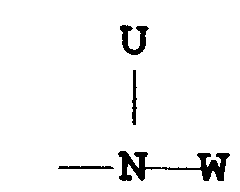
- Suspension selon la revendication 3, dans laquelle lesdites particules sont paramagnétiques et ont un diamètre de 0,1 à 10 µm.
- Suspension selon la revendication 1, dans laquelle lesdites particules sont paramagnétiques et ladite suspension est contenue dans un récipient en plastique.
- Procédé de préparation d'une suspension de réactif, comprenant les étapes consistant à combiner de l'eau et une protéine à groupes thiols bloqués, et un ou plusieurs matériaux en phase solide.
- Procédé de détection de la présence ou de l'absence d'un analyte dans un échantillon aqueux placé dans un récipient en plastique, ledit procédé comprenant les étapes consistant à :combiner ledit échantillon avec des particules pour réagir avec ledit analyte, une protéine à groupes thiols bloqués, et de l'eau, pour former une suspension desdites particules et de la protéine à groupes thiols bloqués, cette suspension résistant à la formation d'agrégats,soumettre ladite suspension à des conditions de réaction imposées pour former un produit de réaction en présence de l'analyte ; etrechercher ledit produit de réaction dans la suspension en tant qu'indication de la présence dudit analyte.
- Procédé selon la revendication 12, dans lequel ladite protéine à groupes thiols bloqués correspond à la formule :
- Procédé selon la revendication 13, dans lequel X consiste en :
- Procédé selon la revendication 14, dans lequel ladite protéine est de l'albumine à groupes thiols bloqués et lesdites particules sont des particules paramagnétiques ayant un diamètre d'environ 0,1 à 10 µm.
Applications Claiming Priority (3)
| Application Number | Priority Date | Filing Date | Title |
|---|---|---|---|
| US445157 | 1995-05-19 | ||
| US08/445,157 US5817525A (en) | 1995-05-19 | 1995-05-19 | Stable protein solutions for diagnostics and method of making and using the same |
| PCT/IB1996/000465 WO1996036876A1 (fr) | 1995-05-19 | 1996-05-17 | Solutions proteiques stables pour les diagnostics et leur procede de fabrication et d'utilisation |
Publications (2)
| Publication Number | Publication Date |
|---|---|
| EP0826150A1 EP0826150A1 (fr) | 1998-03-04 |
| EP0826150B1 true EP0826150B1 (fr) | 1999-09-08 |
Family
ID=23767821
Family Applications (1)
| Application Number | Title | Priority Date | Filing Date |
|---|---|---|---|
| EP96912183A Expired - Lifetime EP0826150B1 (fr) | 1995-05-19 | 1996-05-17 | Solutions proteiques stables pour les diagnostics et leur procede de fabrication et d'utilisation |
Country Status (11)
| Country | Link |
|---|---|
| US (1) | US5817525A (fr) |
| EP (1) | EP0826150B1 (fr) |
| JP (1) | JP3803116B2 (fr) |
| KR (1) | KR19990014918A (fr) |
| AT (1) | ATE184398T1 (fr) |
| AU (1) | AU699935B2 (fr) |
| BR (1) | BR9608778A (fr) |
| CA (1) | CA2219928A1 (fr) |
| DE (1) | DE69604171T2 (fr) |
| PL (1) | PL323259A1 (fr) |
| WO (1) | WO1996036876A1 (fr) |
Families Citing this family (5)
| Publication number | Priority date | Publication date | Assignee | Title |
|---|---|---|---|---|
| FI100276B (fi) * | 1996-02-06 | 1997-10-31 | Orion Yhtymae Oy | Menetelmä analyyttien ei-kilpailevaa määritystä varten |
| US6833275B1 (en) * | 1997-07-22 | 2004-12-21 | Roche Diagnostics Gmbh | Gold conjugates containing detergent |
| US7219843B2 (en) * | 2002-06-04 | 2007-05-22 | Hand Held Products, Inc. | Optical reader having a plurality of imaging modules |
| WO2004046723A1 (fr) * | 2002-11-18 | 2004-06-03 | Denka Seiken Co., Ltd. | Methode de dosage immunologique supprimant les variations entre les donnees de mesure seriques et plasmatiques |
| JP5356951B2 (ja) * | 2009-08-27 | 2013-12-04 | シスメックス株式会社 | 免疫測定用試薬及び免疫測定用試薬キット |
Family Cites Families (5)
| Publication number | Priority date | Publication date | Assignee | Title |
|---|---|---|---|---|
| US4310508A (en) * | 1979-06-19 | 1982-01-12 | Siber George | Diagnostic test and reagent therefor |
| US4554088A (en) * | 1983-05-12 | 1985-11-19 | Advanced Magnetics Inc. | Magnetic particles for use in separations |
| JP2736058B2 (ja) * | 1987-08-20 | 1998-04-02 | ヘキスト薬品工業株式会社 | 免疫検定用器具の製造方法 |
| ATE92633T1 (de) * | 1988-05-11 | 1993-08-15 | Abbott Lab | Verfahren zur erhoehung der spezifizitaet in kompetitiven immuntests. |
| US5217890A (en) * | 1991-08-20 | 1993-06-08 | Eastman Kodak Company | Stabilized composition containing creatine kinase and protein having blocked sulfhydryl groups |
-
1995
- 1995-05-19 US US08/445,157 patent/US5817525A/en not_active Expired - Lifetime
-
1996
- 1996-05-17 BR BR9608778-1A patent/BR9608778A/pt not_active Application Discontinuation
- 1996-05-17 DE DE69604171T patent/DE69604171T2/de not_active Expired - Lifetime
- 1996-05-17 AT AT96912183T patent/ATE184398T1/de active
- 1996-05-17 CA CA002219928A patent/CA2219928A1/fr not_active Abandoned
- 1996-05-17 WO PCT/IB1996/000465 patent/WO1996036876A1/fr not_active Ceased
- 1996-05-17 AU AU55117/96A patent/AU699935B2/en not_active Ceased
- 1996-05-17 EP EP96912183A patent/EP0826150B1/fr not_active Expired - Lifetime
- 1996-05-17 KR KR1019970708264A patent/KR19990014918A/ko not_active Withdrawn
- 1996-05-17 JP JP53467796A patent/JP3803116B2/ja not_active Expired - Fee Related
- 1996-05-17 PL PL96323259A patent/PL323259A1/xx unknown
Also Published As
| Publication number | Publication date |
|---|---|
| CA2219928A1 (fr) | 1996-11-21 |
| AU5511796A (en) | 1996-11-29 |
| WO1996036876A1 (fr) | 1996-11-21 |
| PL323259A1 (en) | 1998-03-16 |
| BR9608778A (pt) | 1999-10-13 |
| AU699935B2 (en) | 1998-12-17 |
| US5817525A (en) | 1998-10-06 |
| JP3803116B2 (ja) | 2006-08-02 |
| JPH11505616A (ja) | 1999-05-21 |
| DE69604171T2 (de) | 1999-12-30 |
| EP0826150A1 (fr) | 1998-03-04 |
| MX9708892A (es) | 1998-03-31 |
| KR19990014918A (ko) | 1999-02-25 |
| ATE184398T1 (de) | 1999-09-15 |
| DE69604171D1 (de) | 1999-10-14 |
Similar Documents
| Publication | Publication Date | Title |
|---|---|---|
| US5294369A (en) | Ligand gold bonding | |
| US4582810A (en) | Immuno-agglutination particle suspensions | |
| US4181636A (en) | Process for producing immunological diagnostic reagents | |
| US6696304B1 (en) | Particulate solid phase immobilized protein quantitation | |
| JP2625577B2 (ja) | 磁気標識した結合要素を用いた磁気制御型結合アッセイ | |
| EP0137678B1 (fr) | Immuno-réactions accélérées ultrasoniquement | |
| JPH03502244A (ja) | 試験方法およびそのための試薬キツト | |
| CN101133328A (zh) | 检测非人血清中的人抗体 | |
| JPS612078A (ja) | 凝集免疫検定における非特異的干渉を減少する方法 | |
| JPH09504094A (ja) | 磁性ラテックス粒子および非磁性粒子を用いて免疫物質をアッセイする方法 | |
| AU610564B2 (en) | Analyte detection in particulate-containing samples | |
| EP0826150B1 (fr) | Solutions proteiques stables pour les diagnostics et leur procede de fabrication et d'utilisation | |
| EP0369546A1 (fr) | Méthode pour augmenter la visibilité du produit de réaction d'une substance réactive spécifique et d'une substance réactive correspondante et installation de détection | |
| JP2625578B2 (ja) | 磁気標識した結合要素を用いた結合親和力の測定方法 | |
| US5348891A (en) | Method for an increased visualization of the reaction product of a specifically binding substance and a corresponding bindable substance and test kit therefor | |
| US5183735A (en) | Method and diagnostic test kit for detection of anti-dsDNA antibodies | |
| JPH0712818A (ja) | 免疫学的検出方法 | |
| MXPA97008892A (en) | Stable protein solutions for diagnosis and method to make and use | |
| JP2545503B2 (ja) | 免疫学的診断試薬 | |
| EP0417301A1 (fr) | Procede de depistage d'agglutination indirecte | |
| JP3520757B2 (ja) | 非特異反応吸収剤及び該吸収剤を用いる免疫測定法 | |
| JPH02168162A (ja) | 免疫測定法 | |
| JP3655657B2 (ja) | アッセイ試薬及びそれを使用した測定方法 | |
| JPS61274261A (ja) | 免疫学的診断試薬 | |
| JPS61296270A (ja) | 免疫学的反応用試薬 |
Legal Events
| Date | Code | Title | Description |
|---|---|---|---|
| PUAI | Public reference made under article 153(3) epc to a published international application that has entered the european phase |
Free format text: ORIGINAL CODE: 0009012 |
|
| 17P | Request for examination filed |
Effective date: 19971021 |
|
| AK | Designated contracting states |
Kind code of ref document: A1 Designated state(s): AT BE CH DE DK ES FR GB IT LI |
|
| GRAG | Despatch of communication of intention to grant |
Free format text: ORIGINAL CODE: EPIDOS AGRA |
|
| 17Q | First examination report despatched |
Effective date: 19980923 |
|
| GRAG | Despatch of communication of intention to grant |
Free format text: ORIGINAL CODE: EPIDOS AGRA |
|
| GRAG | Despatch of communication of intention to grant |
Free format text: ORIGINAL CODE: EPIDOS AGRA |
|
| GRAH | Despatch of communication of intention to grant a patent |
Free format text: ORIGINAL CODE: EPIDOS IGRA |
|
| GRAH | Despatch of communication of intention to grant a patent |
Free format text: ORIGINAL CODE: EPIDOS IGRA |
|
| GRAA | (expected) grant |
Free format text: ORIGINAL CODE: 0009210 |
|
| AK | Designated contracting states |
Kind code of ref document: B1 Designated state(s): AT BE CH DE DK ES FR GB IT LI |
|
| PG25 | Lapsed in a contracting state [announced via postgrant information from national office to epo] |
Ref country code: LI Free format text: LAPSE BECAUSE OF FAILURE TO SUBMIT A TRANSLATION OF THE DESCRIPTION OR TO PAY THE FEE WITHIN THE PRESCRIBED TIME-LIMIT Effective date: 19990908 Ref country code: ES Free format text: THE PATENT HAS BEEN ANNULLED BY A DECISION OF A NATIONAL AUTHORITY Effective date: 19990908 Ref country code: CH Free format text: LAPSE BECAUSE OF FAILURE TO SUBMIT A TRANSLATION OF THE DESCRIPTION OR TO PAY THE FEE WITHIN THE PRESCRIBED TIME-LIMIT Effective date: 19990908 Ref country code: BE Free format text: LAPSE BECAUSE OF FAILURE TO SUBMIT A TRANSLATION OF THE DESCRIPTION OR TO PAY THE FEE WITHIN THE PRESCRIBED TIME-LIMIT Effective date: 19990908 Ref country code: AT Free format text: LAPSE BECAUSE OF FAILURE TO SUBMIT A TRANSLATION OF THE DESCRIPTION OR TO PAY THE FEE WITHIN THE PRESCRIBED TIME-LIMIT Effective date: 19990908 |
|
| REF | Corresponds to: |
Ref document number: 184398 Country of ref document: AT Date of ref document: 19990915 Kind code of ref document: T |
|
| REG | Reference to a national code |
Ref country code: CH Ref legal event code: EP |
|
| ITF | It: translation for a ep patent filed | ||
| REF | Corresponds to: |
Ref document number: 69604171 Country of ref document: DE Date of ref document: 19991014 |
|
| PG25 | Lapsed in a contracting state [announced via postgrant information from national office to epo] |
Ref country code: DK Free format text: LAPSE BECAUSE OF FAILURE TO SUBMIT A TRANSLATION OF THE DESCRIPTION OR TO PAY THE FEE WITHIN THE PRESCRIBED TIME-LIMIT Effective date: 19991208 |
|
| ET | Fr: translation filed | ||
| REG | Reference to a national code |
Ref country code: CH Ref legal event code: PL |
|
| PLBE | No opposition filed within time limit |
Free format text: ORIGINAL CODE: 0009261 |
|
| STAA | Information on the status of an ep patent application or granted ep patent |
Free format text: STATUS: NO OPPOSITION FILED WITHIN TIME LIMIT |
|
| 26N | No opposition filed | ||
| REG | Reference to a national code |
Ref country code: GB Ref legal event code: IF02 |
|
| REG | Reference to a national code |
Ref country code: GB Ref legal event code: 732E Free format text: REGISTERED BETWEEN 20100923 AND 20100929 |
|
| REG | Reference to a national code |
Ref country code: FR Ref legal event code: TP |
|
| REG | Reference to a national code |
Ref country code: GB Ref legal event code: 732E Free format text: REGISTERED BETWEEN 20101104 AND 20101110 |
|
| REG | Reference to a national code |
Ref country code: FR Ref legal event code: TP |
|
| PGFP | Annual fee paid to national office [announced via postgrant information from national office to epo] |
Ref country code: DE Payment date: 20140718 Year of fee payment: 19 |
|
| REG | Reference to a national code |
Ref country code: FR Ref legal event code: PLFP Year of fee payment: 20 |
|
| PGFP | Annual fee paid to national office [announced via postgrant information from national office to epo] |
Ref country code: GB Payment date: 20150511 Year of fee payment: 20 |
|
| PGFP | Annual fee paid to national office [announced via postgrant information from national office to epo] |
Ref country code: IT Payment date: 20150514 Year of fee payment: 20 Ref country code: FR Payment date: 20150513 Year of fee payment: 20 |
|
| REG | Reference to a national code |
Ref country code: DE Ref legal event code: R119 Ref document number: 69604171 Country of ref document: DE |
|
| PG25 | Lapsed in a contracting state [announced via postgrant information from national office to epo] |
Ref country code: DE Free format text: LAPSE BECAUSE OF NON-PAYMENT OF DUE FEES Effective date: 20151201 |
|
| REG | Reference to a national code |
Ref country code: GB Ref legal event code: PE20 Expiry date: 20160516 |
|
| PG25 | Lapsed in a contracting state [announced via postgrant information from national office to epo] |
Ref country code: GB Free format text: LAPSE BECAUSE OF EXPIRATION OF PROTECTION Effective date: 20160516 |