EP0826677B1 - Diaza-18-crown-6-éther-chromoionophores spécifiques du calcium - Google Patents
Diaza-18-crown-6-éther-chromoionophores spécifiques du calcium Download PDFInfo
- Publication number
- EP0826677B1 EP0826677B1 EP97306178A EP97306178A EP0826677B1 EP 0826677 B1 EP0826677 B1 EP 0826677B1 EP 97306178 A EP97306178 A EP 97306178A EP 97306178 A EP97306178 A EP 97306178A EP 0826677 B1 EP0826677 B1 EP 0826677B1
- Authority
- EP
- European Patent Office
- Prior art keywords
- nitro
- alkyl
- compound
- hydrogen
- trifluoromethyl
- Prior art date
- Legal status (The legal status is an assumption and is not a legal conclusion. Google has not performed a legal analysis and makes no representation as to the accuracy of the status listed.)
- Expired - Lifetime
Links
- OYPRJOBELJOOCE-UHFFFAOYSA-N Calcium Chemical compound [Ca] OYPRJOBELJOOCE-UHFFFAOYSA-N 0.000 title claims description 29
- 229910052791 calcium Inorganic materials 0.000 title claims description 29
- 239000011575 calcium Substances 0.000 title claims description 29
- 150000001875 compounds Chemical class 0.000 claims abstract description 51
- -1 acetamido, mercapto Chemical class 0.000 claims abstract description 30
- 125000000449 nitro group Chemical group [O-][N+](*)=O 0.000 claims abstract description 26
- 229910052739 hydrogen Inorganic materials 0.000 claims abstract description 25
- 239000001257 hydrogen Substances 0.000 claims abstract description 25
- BHPQYMZQTOCNFJ-UHFFFAOYSA-N Calcium cation Chemical compound [Ca+2] BHPQYMZQTOCNFJ-UHFFFAOYSA-N 0.000 claims abstract description 24
- 229910001424 calcium ion Inorganic materials 0.000 claims abstract description 24
- ISWSIDIOOBJBQZ-UHFFFAOYSA-N phenol group Chemical group C1(=CC=CC=C1)O ISWSIDIOOBJBQZ-UHFFFAOYSA-N 0.000 claims abstract description 21
- 125000002023 trifluoromethyl group Chemical group FC(F)(F)* 0.000 claims abstract description 17
- 125000000217 alkyl group Chemical group 0.000 claims abstract description 15
- 125000003118 aryl group Chemical group 0.000 claims abstract description 15
- 125000002252 acyl group Chemical group 0.000 claims abstract description 14
- 125000004391 aryl sulfonyl group Chemical group 0.000 claims abstract description 14
- 125000004093 cyano group Chemical group *C#N 0.000 claims abstract description 14
- 125000001475 halogen functional group Chemical group 0.000 claims abstract description 14
- 125000004169 (C1-C6) alkyl group Chemical group 0.000 claims abstract description 12
- 150000002431 hydrogen Chemical group 0.000 claims abstract description 11
- UFHFLCQGNIYNRP-UHFFFAOYSA-N Hydrogen Chemical compound [H][H] UFHFLCQGNIYNRP-UHFFFAOYSA-N 0.000 claims abstract description 10
- 125000001997 phenyl group Chemical group [H]C1=C([H])C([H])=C(*)C([H])=C1[H] 0.000 claims abstract description 10
- 125000001624 naphthyl group Chemical group 0.000 claims abstract description 6
- 125000003107 substituted aryl group Chemical group 0.000 claims abstract description 5
- KJCVRFUGPWSIIH-UHFFFAOYSA-N 1-naphthol Chemical group C1=CC=C2C(O)=CC=CC2=C1 KJCVRFUGPWSIIH-UHFFFAOYSA-N 0.000 claims abstract description 4
- LISFMEBWQUVKPJ-UHFFFAOYSA-N quinolin-2-ol Chemical group C1=CC=C2NC(=O)C=CC2=C1 LISFMEBWQUVKPJ-UHFFFAOYSA-N 0.000 claims abstract description 3
- KRKNYBCHXYNGOX-UHFFFAOYSA-N citric acid Chemical compound OC(=O)CC(O)(C(O)=O)CC(O)=O KRKNYBCHXYNGOX-UHFFFAOYSA-N 0.000 claims description 30
- 239000000203 mixture Substances 0.000 claims description 21
- KRKNYBCHXYNGOX-UHFFFAOYSA-K Citrate Chemical compound [O-]C(=O)CC(O)(CC([O-])=O)C([O-])=O KRKNYBCHXYNGOX-UHFFFAOYSA-K 0.000 claims description 15
- 230000007480 spreading Effects 0.000 claims description 15
- 238000003892 spreading Methods 0.000 claims description 15
- 239000003153 chemical reaction reagent Substances 0.000 claims description 14
- 238000000034 method Methods 0.000 claims description 14
- 239000002904 solvent Substances 0.000 claims description 12
- 125000006575 electron-withdrawing group Chemical group 0.000 claims description 9
- 238000010668 complexation reaction Methods 0.000 claims description 8
- 239000012876 carrier material Substances 0.000 claims description 5
- 239000002250 absorbent Substances 0.000 claims description 4
- 230000002745 absorbent Effects 0.000 claims description 4
- 238000010521 absorption reaction Methods 0.000 claims description 4
- 125000004432 carbon atom Chemical group C* 0.000 claims description 4
- 230000008859 change Effects 0.000 claims description 4
- 125000004435 hydrogen atom Chemical group [H]* 0.000 claims description 4
- 239000007788 liquid Substances 0.000 claims description 3
- 230000003287 optical effect Effects 0.000 claims description 3
- 238000003556 assay Methods 0.000 abstract description 23
- 239000010409 thin film Substances 0.000 abstract description 10
- 230000008901 benefit Effects 0.000 abstract description 6
- NLMDJJTUQPXZFG-UHFFFAOYSA-N 1,4,10,13-tetraoxa-7,16-diazacyclooctadecane Chemical class C1COCCOCCNCCOCCOCCN1 NLMDJJTUQPXZFG-UHFFFAOYSA-N 0.000 abstract description 3
- 238000001514 detection method Methods 0.000 abstract description 3
- 239000000243 solution Substances 0.000 description 11
- QTBSBXVTEAMEQO-UHFFFAOYSA-N Acetic acid Chemical compound CC(O)=O QTBSBXVTEAMEQO-UHFFFAOYSA-N 0.000 description 9
- WEVYAHXRMPXWCK-UHFFFAOYSA-N Acetonitrile Chemical compound CC#N WEVYAHXRMPXWCK-UHFFFAOYSA-N 0.000 description 9
- RTZKZFJDLAIYFH-UHFFFAOYSA-N Diethyl ether Chemical compound CCOCC RTZKZFJDLAIYFH-UHFFFAOYSA-N 0.000 description 8
- GWEVSGVZZGPLCZ-UHFFFAOYSA-N Titan oxide Chemical compound O=[Ti]=O GWEVSGVZZGPLCZ-UHFFFAOYSA-N 0.000 description 8
- 238000000576 coating method Methods 0.000 description 8
- 239000012530 fluid Substances 0.000 description 8
- 210000002966 serum Anatomy 0.000 description 8
- XLYOFNOQVPJJNP-UHFFFAOYSA-N water Chemical compound O XLYOFNOQVPJJNP-UHFFFAOYSA-N 0.000 description 8
- 0 Oc1c(CN2CCOCCOCCN(CC(CCC=C3)=C3O)CC*CCOCC2)cccc1 Chemical compound Oc1c(CN2CCOCCOCCN(CC(CCC=C3)=C3O)CC*CCOCC2)cccc1 0.000 description 7
- 239000000872 buffer Substances 0.000 description 7
- XEKOWRVHYACXOJ-UHFFFAOYSA-N Ethyl acetate Chemical compound CCOC(C)=O XEKOWRVHYACXOJ-UHFFFAOYSA-N 0.000 description 6
- OKKJLVBELUTLKV-UHFFFAOYSA-N Methanol Chemical compound OC OKKJLVBELUTLKV-UHFFFAOYSA-N 0.000 description 6
- 238000006243 chemical reaction Methods 0.000 description 6
- 239000006185 dispersion Substances 0.000 description 6
- 108010010803 Gelatin Proteins 0.000 description 5
- 239000011248 coating agent Substances 0.000 description 5
- 229920000159 gelatin Polymers 0.000 description 5
- 239000008273 gelatin Substances 0.000 description 5
- 235000019322 gelatine Nutrition 0.000 description 5
- 235000011852 gelatine desserts Nutrition 0.000 description 5
- 239000000463 material Substances 0.000 description 5
- VEXZGXHMUGYJMC-UHFFFAOYSA-N Hydrochloric acid Chemical compound Cl VEXZGXHMUGYJMC-UHFFFAOYSA-N 0.000 description 4
- 230000000536 complexating effect Effects 0.000 description 4
- 238000001914 filtration Methods 0.000 description 4
- 238000002360 preparation method Methods 0.000 description 4
- 239000000047 product Substances 0.000 description 4
- LPXPTNMVRIOKMN-UHFFFAOYSA-M sodium nitrite Chemical compound [Na+].[O-]N=O LPXPTNMVRIOKMN-UHFFFAOYSA-M 0.000 description 4
- LFQSCWFLJHTTHZ-UHFFFAOYSA-N Ethanol Chemical compound CCO LFQSCWFLJHTTHZ-UHFFFAOYSA-N 0.000 description 3
- KFZMGEQAYNKOFK-UHFFFAOYSA-N Isopropanol Chemical compound CC(C)O KFZMGEQAYNKOFK-UHFFFAOYSA-N 0.000 description 3
- ZMXDDKWLCZADIW-UHFFFAOYSA-N N,N-Dimethylformamide Chemical compound CN(C)C=O ZMXDDKWLCZADIW-UHFFFAOYSA-N 0.000 description 3
- HEMHJVSKTPXQMS-UHFFFAOYSA-M Sodium hydroxide Chemical compound [OH-].[Na+] HEMHJVSKTPXQMS-UHFFFAOYSA-M 0.000 description 3
- 238000005259 measurement Methods 0.000 description 3
- 125000001424 substituent group Chemical group 0.000 description 3
- 239000004094 surface-active agent Substances 0.000 description 3
- BPYKTIZUTYGOLE-IFADSCNNSA-N Bilirubin Chemical compound N1C(=O)C(C)=C(C=C)\C1=C\C1=C(C)C(CCC(O)=O)=C(CC2=C(C(C)=C(\C=C/3C(=C(C=C)C(=O)N\3)C)N2)CCC(O)=O)N1 BPYKTIZUTYGOLE-IFADSCNNSA-N 0.000 description 2
- 201000009030 Carcinoma Diseases 0.000 description 2
- YMWUJEATGCHHMB-UHFFFAOYSA-N Dichloromethane Chemical compound ClCCl YMWUJEATGCHHMB-UHFFFAOYSA-N 0.000 description 2
- JGFZNNIVVJXRND-UHFFFAOYSA-N N,N-Diisopropylethylamine (DIPEA) Chemical compound CCN(C(C)C)C(C)C JGFZNNIVVJXRND-UHFFFAOYSA-N 0.000 description 2
- 239000007983 Tris buffer Substances 0.000 description 2
- RHZMCEFGRRLLAP-UHFFFAOYSA-N [2-(bromomethyl)phenyl] acetate Chemical compound CC(=O)OC1=CC=CC=C1CBr RHZMCEFGRRLLAP-UHFFFAOYSA-N 0.000 description 2
- 238000000862 absorption spectrum Methods 0.000 description 2
- 238000004458 analytical method Methods 0.000 description 2
- TZCXTZWJZNENPQ-UHFFFAOYSA-L barium sulfate Chemical compound [Ba+2].[O-]S([O-])(=O)=O TZCXTZWJZNENPQ-UHFFFAOYSA-L 0.000 description 2
- 125000001797 benzyl group Chemical group [H]C1=C([H])C([H])=C(C([H])=C1[H])C([H])([H])* 0.000 description 2
- 239000013060 biological fluid Substances 0.000 description 2
- 150000001768 cations Chemical class 0.000 description 2
- 230000000875 corresponding effect Effects 0.000 description 2
- 150000003983 crown ethers Chemical class 0.000 description 2
- 230000007613 environmental effect Effects 0.000 description 2
- 238000004519 manufacturing process Methods 0.000 description 2
- 239000002736 nonionic surfactant Substances 0.000 description 2
- 239000002245 particle Substances 0.000 description 2
- 229920000139 polyethylene terephthalate Polymers 0.000 description 2
- 239000005020 polyethylene terephthalate Substances 0.000 description 2
- 239000002244 precipitate Substances 0.000 description 2
- 235000010288 sodium nitrite Nutrition 0.000 description 2
- 238000003756 stirring Methods 0.000 description 2
- 239000000725 suspension Substances 0.000 description 2
- 238000003786 synthesis reaction Methods 0.000 description 2
- 239000004408 titanium dioxide Substances 0.000 description 2
- LENZDBCJOHFCAS-UHFFFAOYSA-N tris Chemical compound OCC(N)(CO)CO LENZDBCJOHFCAS-UHFFFAOYSA-N 0.000 description 2
- SVZPXSUXVWWQNA-UHFFFAOYSA-N 1,4,10,13-tetraoxacyclooctadecane Chemical compound C1CCOCCOCCCCCOCCOCC1 SVZPXSUXVWWQNA-UHFFFAOYSA-N 0.000 description 1
- KAMCBFNNGGVPPW-UHFFFAOYSA-N 1-(ethenylsulfonylmethoxymethylsulfonyl)ethene Chemical compound C=CS(=O)(=O)COCS(=O)(=O)C=C KAMCBFNNGGVPPW-UHFFFAOYSA-N 0.000 description 1
- HBXWUCXDUUJDRB-UHFFFAOYSA-N 1-octadecoxyoctadecane Chemical compound CCCCCCCCCCCCCCCCCCOCCCCCCCCCCCCCCCCCC HBXWUCXDUUJDRB-UHFFFAOYSA-N 0.000 description 1
- JKXYOQDLERSFPT-UHFFFAOYSA-N 2-[2-[2-[2-[2-[2-[2-[2-[2-[2-[2-[2-[2-[2-[2-[2-[2-[2-[2-(2-octadecoxyethoxy)ethoxy]ethoxy]ethoxy]ethoxy]ethoxy]ethoxy]ethoxy]ethoxy]ethoxy]ethoxy]ethoxy]ethoxy]ethoxy]ethoxy]ethoxy]ethoxy]ethoxy]ethoxy]ethanol Chemical compound CCCCCCCCCCCCCCCCCCOCCOCCOCCOCCOCCOCCOCCOCCOCCOCCOCCOCCOCCOCCOCCOCCOCCOCCOCCOCCO JKXYOQDLERSFPT-UHFFFAOYSA-N 0.000 description 1
- 125000006290 2-hydroxybenzyl group Chemical group [H]OC1=C(C([H])=C([H])C([H])=C1[H])C([H])([H])* 0.000 description 1
- KIMXIMWZIRTKCQ-UHFFFAOYSA-N 2-methylsulfonyl-4-nitroaniline Chemical group CS(=O)(=O)C1=CC([N+]([O-])=O)=CC=C1N KIMXIMWZIRTKCQ-UHFFFAOYSA-N 0.000 description 1
- UQHVTNUJRKELCE-UHFFFAOYSA-N 3,6-bis[(2-arsonophenyl)diazenyl]-4,5-dihydroxynaphthalene-2,7-disulfonic acid Chemical compound OS(=O)(=O)C1=CC2=CC(S(O)(=O)=O)=C(N=NC=3C(=CC=CC=3)[As](O)(O)=O)C(O)=C2C(O)=C1N=NC1=CC=CC=C1[As](O)(O)=O UQHVTNUJRKELCE-UHFFFAOYSA-N 0.000 description 1
- CHFOOTMHNNTSDP-UHFFFAOYSA-N 4-nitro-2-(trifluoromethyl)benzenediazonium Chemical compound [O-][N+](=O)C1=CC=C([N+]#N)C(C(F)(F)F)=C1 CHFOOTMHNNTSDP-UHFFFAOYSA-N 0.000 description 1
- ACXFYBUIPDQXKX-UHFFFAOYSA-N 4-nitro-n-(trifluoromethyl)aniline Chemical compound [O-][N+](=O)C1=CC=C(NC(F)(F)F)C=C1 ACXFYBUIPDQXKX-UHFFFAOYSA-N 0.000 description 1
- 208000010444 Acidosis Diseases 0.000 description 1
- 229930185605 Bisphenol Natural products 0.000 description 1
- KUFFULVDNCHOFZ-UHFFFAOYSA-N Cc(cc1)cc(C)c1O Chemical compound Cc(cc1)cc(C)c1O KUFFULVDNCHOFZ-UHFFFAOYSA-N 0.000 description 1
- 208000037147 Hypercalcaemia Diseases 0.000 description 1
- DGAQECJNVWCQMB-PUAWFVPOSA-M Ilexoside XXIX Chemical compound C[C@@H]1CC[C@@]2(CC[C@@]3(C(=CC[C@H]4[C@]3(CC[C@@H]5[C@@]4(CC[C@@H](C5(C)C)OS(=O)(=O)[O-])C)C)[C@@H]2[C@]1(C)O)C)C(=O)O[C@H]6[C@@H]([C@H]([C@@H]([C@H](O6)CO)O)O)O.[Na+] DGAQECJNVWCQMB-PUAWFVPOSA-M 0.000 description 1
- PAYRUJLWNCNPSJ-UHFFFAOYSA-N N-phenyl amine Natural products NC1=CC=CC=C1 PAYRUJLWNCNPSJ-UHFFFAOYSA-N 0.000 description 1
- UFWIBTONFRDIAS-UHFFFAOYSA-N Naphthalene Chemical compound C1=CC=CC2=CC=CC=C21 UFWIBTONFRDIAS-UHFFFAOYSA-N 0.000 description 1
- 208000001132 Osteoporosis Diseases 0.000 description 1
- 206010033645 Pancreatitis Diseases 0.000 description 1
- 206010033647 Pancreatitis acute Diseases 0.000 description 1
- 229920003171 Poly (ethylene oxide) Polymers 0.000 description 1
- 241000206607 Porphyra umbilicalis Species 0.000 description 1
- 206010036790 Productive cough Diseases 0.000 description 1
- YSMRWXYRXBRSND-UHFFFAOYSA-N TOTP Chemical compound CC1=CC=CC=C1OP(=O)(OC=1C(=CC=CC=1)C)OC1=CC=CC=C1C YSMRWXYRXBRSND-UHFFFAOYSA-N 0.000 description 1
- 229920004896 Triton X-405 Polymers 0.000 description 1
- 239000002253 acid Substances 0.000 description 1
- 230000007950 acidosis Effects 0.000 description 1
- 201000003229 acute pancreatitis Diseases 0.000 description 1
- 239000000853 adhesive Substances 0.000 description 1
- 230000001070 adhesive effect Effects 0.000 description 1
- 238000012801 analytical assay Methods 0.000 description 1
- SMWDFEZZVXVKRB-UHFFFAOYSA-N anhydrous quinoline Natural products N1=CC=CC2=CC=CC=C21 SMWDFEZZVXVKRB-UHFFFAOYSA-N 0.000 description 1
- 239000011668 ascorbic acid Substances 0.000 description 1
- 238000001479 atomic absorption spectroscopy Methods 0.000 description 1
- 238000000498 ball milling Methods 0.000 description 1
- 239000011324 bead Substances 0.000 description 1
- 229940007550 benzyl acetate Drugs 0.000 description 1
- QUKGYYKBILRGFE-UHFFFAOYSA-N benzyloxyacetoaldehyde Natural products CC(=O)OCC1=CC=CC=C1 QUKGYYKBILRGFE-UHFFFAOYSA-N 0.000 description 1
- 210000000941 bile Anatomy 0.000 description 1
- 239000011230 binding agent Substances 0.000 description 1
- IISBACLAFKSPIT-UHFFFAOYSA-N bisphenol A Chemical compound C=1C=C(O)C=CC=1C(C)(C)C1=CC=C(O)C=C1 IISBACLAFKSPIT-UHFFFAOYSA-N 0.000 description 1
- 210000004369 blood Anatomy 0.000 description 1
- 239000008280 blood Substances 0.000 description 1
- 210000001185 bone marrow Anatomy 0.000 description 1
- 210000004556 brain Anatomy 0.000 description 1
- 239000007853 buffer solution Substances 0.000 description 1
- 238000011088 calibration curve Methods 0.000 description 1
- 229920002301 cellulose acetate Polymers 0.000 description 1
- 238000007398 colorimetric assay Methods 0.000 description 1
- 239000000470 constituent Substances 0.000 description 1
- 230000002596 correlated effect Effects 0.000 description 1
- 239000013078 crystal Substances 0.000 description 1
- 238000011161 development Methods 0.000 description 1
- 229940039227 diagnostic agent Drugs 0.000 description 1
- 239000000032 diagnostic agent Substances 0.000 description 1
- 150000001989 diazonium salts Chemical class 0.000 description 1
- 238000010790 dilution Methods 0.000 description 1
- 239000012895 dilution Substances 0.000 description 1
- 238000007598 dipping method Methods 0.000 description 1
- 208000037265 diseases, disorders, signs and symptoms Diseases 0.000 description 1
- 208000035475 disorder Diseases 0.000 description 1
- 239000000975 dye Substances 0.000 description 1
- 229920001971 elastomer Polymers 0.000 description 1
- 239000000806 elastomer Substances 0.000 description 1
- 238000001704 evaporation Methods 0.000 description 1
- 230000008020 evaporation Effects 0.000 description 1
- 239000000284 extract Substances 0.000 description 1
- 239000004744 fabric Substances 0.000 description 1
- 239000000835 fiber Substances 0.000 description 1
- 239000002657 fibrous material Substances 0.000 description 1
- 210000002216 heart Anatomy 0.000 description 1
- 229910001385 heavy metal Inorganic materials 0.000 description 1
- 125000001165 hydrophobic group Chemical group 0.000 description 1
- 125000006289 hydroxybenzyl group Chemical group 0.000 description 1
- 230000000148 hypercalcaemia Effects 0.000 description 1
- 208000030915 hypercalcemia disease Diseases 0.000 description 1
- 238000010348 incorporation Methods 0.000 description 1
- 238000011534 incubation Methods 0.000 description 1
- 210000003734 kidney Anatomy 0.000 description 1
- 210000004072 lung Anatomy 0.000 description 1
- 210000002751 lymph Anatomy 0.000 description 1
- 238000003801 milling Methods 0.000 description 1
- 238000012986 modification Methods 0.000 description 1
- 230000004048 modification Effects 0.000 description 1
- 150000004780 naphthols Chemical class 0.000 description 1
- UYDLBVPAAFVANX-UHFFFAOYSA-N octylphenoxy polyethoxyethanol Chemical compound CC(C)(C)CC(C)(C)C1=CC=C(OCCOCCOCCOCCO)C=C1 UYDLBVPAAFVANX-UHFFFAOYSA-N 0.000 description 1
- 230000000849 parathyroid Effects 0.000 description 1
- 210000002990 parathyroid gland Anatomy 0.000 description 1
- 239000011236 particulate material Substances 0.000 description 1
- 230000001575 pathological effect Effects 0.000 description 1
- 229920003213 poly(N-isopropyl acrylamide) Polymers 0.000 description 1
- 239000004848 polyfunctional curative Substances 0.000 description 1
- 229920000642 polymer Polymers 0.000 description 1
- 239000011148 porous material Substances 0.000 description 1
- 125000006239 protecting group Chemical group 0.000 description 1
- 125000002943 quinolinyl group Chemical group N1=C(C=CC2=CC=CC=C12)* 0.000 description 1
- 230000005855 radiation Effects 0.000 description 1
- 230000035484 reaction time Effects 0.000 description 1
- 201000000306 sarcoidosis Diseases 0.000 description 1
- 238000006748 scratching Methods 0.000 description 1
- 230000002393 scratching effect Effects 0.000 description 1
- 230000028327 secretion Effects 0.000 description 1
- 210000002027 skeletal muscle Anatomy 0.000 description 1
- 210000003491 skin Anatomy 0.000 description 1
- 229910052708 sodium Inorganic materials 0.000 description 1
- 239000011734 sodium Substances 0.000 description 1
- PNGLEYLFMHGIQO-UHFFFAOYSA-M sodium;3-(n-ethyl-3-methoxyanilino)-2-hydroxypropane-1-sulfonate;dihydrate Chemical compound O.O.[Na+].[O-]S(=O)(=O)CC(O)CN(CC)C1=CC=CC(OC)=C1 PNGLEYLFMHGIQO-UHFFFAOYSA-M 0.000 description 1
- 239000007787 solid Substances 0.000 description 1
- 230000003595 spectral effect Effects 0.000 description 1
- 210000003802 sputum Anatomy 0.000 description 1
- 208000024794 sputum Diseases 0.000 description 1
- 239000007858 starting material Substances 0.000 description 1
- BDHFUVZGWQCTTF-UHFFFAOYSA-M sulfonate Chemical compound [O-]S(=O)=O BDHFUVZGWQCTTF-UHFFFAOYSA-M 0.000 description 1
- 238000012360 testing method Methods 0.000 description 1
- 210000001685 thyroid gland Anatomy 0.000 description 1
- 210000001519 tissue Anatomy 0.000 description 1
- 231100000331 toxic Toxicity 0.000 description 1
- 230000002588 toxic effect Effects 0.000 description 1
- 230000009466 transformation Effects 0.000 description 1
- 210000002700 urine Anatomy 0.000 description 1
- 238000010792 warming Methods 0.000 description 1
Images

Classifications
-
- C—CHEMISTRY; METALLURGY
- C07—ORGANIC CHEMISTRY
- C07D—HETEROCYCLIC COMPOUNDS
- C07D273/00—Heterocyclic compounds containing rings having nitrogen and oxygen atoms as the only ring hetero atoms, not provided for by groups C07D261/00 - C07D271/00
-
- G—PHYSICS
- G01—MEASURING; TESTING
- G01N—INVESTIGATING OR ANALYSING MATERIALS BY DETERMINING THEIR CHEMICAL OR PHYSICAL PROPERTIES
- G01N33/00—Investigating or analysing materials by specific methods not covered by groups G01N1/00 - G01N31/00
- G01N33/48—Biological material, e.g. blood, urine; Haemocytometers
- G01N33/50—Chemical analysis of biological material, e.g. blood, urine; Testing involving biospecific ligand binding methods; Immunological testing
- G01N33/84—Chemical analysis of biological material, e.g. blood, urine; Testing involving biospecific ligand binding methods; Immunological testing involving inorganic compounds or pH
-
- G—PHYSICS
- G01—MEASURING; TESTING
- G01N—INVESTIGATING OR ANALYSING MATERIALS BY DETERMINING THEIR CHEMICAL OR PHYSICAL PROPERTIES
- G01N2800/00—Detection or diagnosis of diseases
- G01N2800/04—Endocrine or metabolic disorders
Definitions
- the present invention relates to the field of clinical chemistry, particularly novel compounds for use in calcium assays and to analytical compositions, elements and methods of using the same.
- Analytical assays for determination of calcium content have application in a variety of fields.
- One important application is in the field of clinical chemistry where the measurement of calcium levels in biological fluids such as serum can be used for diagnostic purposes as an indication of certain pathological conditions.
- elevated serum calcium can be an indication of disorders of the parathyroid and thyroid glands, in sarcoidosis and in several metastasizing carcinomas.
- Hypercalcemia is also connected with osteoporosis, osteoplastic carcinomas, acute pancreatitis and acidosis.
- Calcium levels can be determined quantitatively using a number of analytical methods. In general, direct colorimetric procedures involving the complexation of a dye with calcium ions are preferred over other, more complex methods. In the colorimetric assay, contact of the calcium ion with a chromoionophore causes a shift in the absorbance spectrum of the chromophore which can be measured quantitatively.
- a chromoionophore a chromoionophore which can be measured quantitatively.
- One such dye that is commonly used for such purposes is known as Arsenazo III (2,2'-(1,8-dihydroxy-3,6-disulfonaphthylene-2,7-bisazo)bisbenzenearsonic acid (See Anal.Chim.Acta, 71 , 375 (1974)). While this dye works quite well, its use on a large scale is limited due to environmental concerns.
- Crown ether compounds including diaza-18-crown-6 compounds, have been known for some time for their cation complexing properties.
- the introduction into a crown ether of a chromophore which changes color upon complexation of a cation with the crown ether has been reported. See e.g. Anal. Letters, 10(13) , 1115-1122 (1977). M.
- photometers in commercial analyzers are typically filtered to read at or above 600 nm to avoid interference from bilirubin and other sample or assay components which absorb below 600 nm.
- the dinitrophenylazo compound of Shiga et al has an absorption peak below the desired read window, i.e. its ⁇ max is about 575 nm.
- R 1 , R 2 , R 3 , R 4 and R 5 are independently selected from hydrogen, halo, cyano, nitro, (C 1 -C 6 ) alkyl, (C 2 -C 8 ) acyl, acetamido, mercapto, alkyl or arylsulfonyl, trifluoromethyl, aryl, and substituted aryl wherein the aryl moiety is selected from phenyl and naphthyl and the aryl substituent is selected from halo, cyano, nitro, (C 1 -C 6 ) alkyl, (C 2 -C 8 ) acyl, phenyl, acetamido, mercapto, alkyl or arylsulfonyl and trifluoromethyl;
- Compounds of the above formula are useful as chromoionophores for the detection of calcium ions in solution or dry assays, but are of particular advantage when used in dry, thin-film multilayer analytical elements because they can be readily dispersed in coupler solvents and uniformly coated as a thin-film to provide dry slide analytical elements for calcium.
- the compounds of the above formula having electron withdrawing substituents in the R 1 , R 2 or R 4 positions can be read at an absorbance spectrum at or above 600 nm, which is of particular benefit in those assay systems where there are interferences at the lower wavelengths.
- compounds of the present invention which absorb at a wavelength greater than 560 nm, preferably greater than 580 nm, when complexed with calcium ions, are preferred.
- the invention also provides an analytical element for the determination of calcium ions comprising an absorbent carrier material containing the chromoionophore compound described above.
- a method for quantitative determination of calcium ions which comprises:
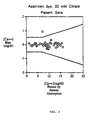
- FIG. 1 is a graph of the calcium levels measured in serum samples using the analytical elements of the present invention without added citrate and showing the bias from the predicted calcium levels.
- FIG. 2 is a graph of the calcium levels measured in serum samples using the analytical elements of the present invention with added citrate and showing the bias from the predicted calcium levels.
- compounds of Formula I which are preferred for thin-film multilayer dry slide analytical elements for use with analyzers which operate at wavelengths of 580 nm or greater are those compounds wherein X is phenol, R 1 and R 2 are independently selected from hydrogen and an electron withdrawing group selected from halo, cyano, nitro, acyl of 2 to 8 carbon atoms, alkyl or arylsulfonyl, and triflouromethyl, provided that at least one of R 1 and R 2 is an electron withdrawing group; R 3 is selected from hydrogen, halo, cyano, nitro, (C 1 -C 6 ) alkyl, (C 2 -C 8 ) acyl, acetamido, mercapto, alkyl or arylsulfonyl, trifluoromethyl, aryl, and substituted aryl wherein the aryl moiety is selected from phenyl and naphthyl and the aryl substituent is selected from hal
- R 1 and R 2 are independently selected from hydrogen and an electron withdrawing group selected from halo, cyano, nitro, acyl of 2 to 8 carbon atoms, alkyl or arylsulfonyl, and triflouromethyl, provided that at least one of R 1 and R 2 is an electron withdrawing group;
- R 3 is (C 1 -C 6 ) alkyl;
- R 4 is nitro and R 5 is hydrogen, provided that when one of R 1 or R 2 is trifluoromethyl and the other is hydrogen, R 3 may also be hydrogen.
- Compounds of Formula I which are most preferred for such purposes are those in which X is phenol, R 1 is trifluoromethyl; R 2 and R 3 are hydrogen and R 4 is nitro.
- the trifluoromethyl group serves as both the hydrophobic group to facilitate dispersability in coupler solvents and as the electron withdrawing group to provide high (peak) absorption at or above 580 nm.
- a substituted aniline compound of general formula 5 is first reacted with sodium nitrite in hydrochloric acid and then treated with hexafluorophosphoric acid to produce the phenyldiazonium hexafluorophosphate intermediate 6.
- Two equivalents of intermediate 6 are then reacted with one equivalent of the hydroxybenzyldiaza-18-crown-6 intermediate 4 from Scheme I in a suitable solvent to yield the final compound of Formula I.
- the appropriately substituted naphthol or quinolinol compound may of course be substituted for the hydroxybenzyl intermediate 4.
- novel chromoionophore compositions that can be used for the qualitative or quantitative determination of calcium ions in aqueous liquids.
- the compositions can be used in analytical methods for the determination of calcium levels in biological fluids such as whole blood, plasma, sera, lymph, bile, urine, spinal fluid, sputum, perspiration, stool secretions and the like.
- Fluid preparations of human or animal tissue such as skeletal muscle, heart, kidney, lung, brain, bone marrow, skin and the like can also be assayed for calcium levels in accordance with the present invention.
- the compounds of the present invention exhibit a number of advantages over the compositions of the prior art. Specifically, the dye produced by the chromoionophore compounds of the present invention, on complexation with calcium ions, can be measured on peak for best performance. Further, a wider range of calcium concentrations can be measured without dilution and, as mentioned, the compounds can be readily dispersed in coupler solvents and uniformly coated as a thin film to provide dry slide analytical elements. Finally, the compounds are easily synthesized and do not require any toxic heavy metals.
- the compounds can be used in solution assays or in dry analytical elements.
- the compounds When used in solution assays, the compounds are dissolved in an appropriate buffer solution to a pH of about 6 to 9.
- the aqueous composition for solution assay usually contains about 50, and preferably about 100, to about 300, ⁇ molar calcium complexing compound of the invention.
- the assay is carried out by admixing the chromoionophore compound of the invention with a sample of fluid suspected of containing ionic calcium for a short time.
- the concentration of calcium ion is then determined by measuring the optical density change, (i.e., the shift in spectral absorption) caused by the complexation of the compound with calcium ions at the appropriate wavelength using suitable colorimetric detection equipment.
- the compounds can be selected to absorb at a wavelength at or about 600 nm upon complexation.
- the chromoionophore compounds of the invention can also be utilized in dry analytical elements.
- the simplest element can be composed of an absorbent carrier material, for example, a thin sheet of a self-supporting absorbent or bibulous material, such as filter paper or strips, which contain the complexing compound of this invention.
- the element can be divided into two or more discrete zones with different reagents incorporated into different zones of the carrier material.
- Such elements are known in the art as test strips, diagnostic elements, dip sticks, diagnostic agents and the like.
- the chromoionophore compounds of the present invention are particularly useful when employed in dry analytical elements.
- the compounds are generally incorporated into, or coated upon, a suitable carrier material.
- the compound can be added to the element during an assay.
- the dry analytical element can be multilayered and can be made by techniques well known in the dry analytical element art. For example, such elements and methods for their production are disclosed in U. S. Patent No. 4,357,363.
- the element indudes a spreading layer, a subbing layer, a gelatin buffer layer and a reagent layer containing the compound and buffer. All of the foregoing layers are coated upon a support.
- one embodiment includes a combined reagent/spreading layer along with a subbing layer having at least two distinct zones.
- buffer is incorporated into the spreading layer by means of either coating on the complete element or ball milling buffer into the spreading layer prior to coating.
- the layers are generally in fluid contact with each other, meaning that fluids can be transported between superposed regions of adjacent zones.
- all diffusable reagents of the analytical composition of this invention and the diffusable constituents of the aqueous fluid are mixed to form a homogeneous blend.
- Useful spreading layers can be prepared using fibrous materials, either mixed with a suitable binder material or woven into a fabric, as described in U.S. Patent No. 4,292,272 to Katajima et al., polymeric compositions or particulate materials, for example a blush polymer as disclosed in U.S. Patent No. 3,992,158, beads bound together with or without binding adhesives, as described in U.S. Patent No. 4,258,001 to Pierce et al.
- Particularly useful spreading layers comprise barium sulphate or titanium dioxide. Since the sample is generally applied directly to the spreading layer, it is desirable that the spreading layer be isotropically porous, meaning that the porosity is the same in each direction in the layer as caused by interconnected spaces or pores between particle, fibers or polymeric strands.
- the elements can also contain one or more other addenda commonly put in the elements for various manufacturing and operational advantages.
- addenda include surfactants, buffers, bacteriostats, solvents, hardeners and other materials known in the art.
- the layers can be coated on transparent (i.e. radiation transmissive) supports such as poly(ethylene terephthalate).
- transparent supports such as poly(ethylene terephthalate).
- Other supports are well known in the art.
- the chromoionophore compound of this invention is generally present in one or more zones in a coverage of at least about 0.10, and preferably from about 0.10 to about 1.5 g/m 2 .
- Other reagents and materials are present in coverages within the skill of a worker in the art.
- the elements of the invention can be configured in a variety of forms, including elongated tapes of any desired width, sheets, slides or chips.
- the elements can be used in manual or automated assay techniques.
- calcium ion determination is made by taking the element from a supply roll, chip packet or other source and physically contacting it with the sample (for example from 1 ⁇ L to up to 200ml) of the fluid to be tested so that the sample and reagents within the element become mixed.
- Such contact can be accomplished by any suitable manner, for example, by dipping or immersing the element into the sample or, preferably, by spotting the element by hand or machine with a drop of the sample with a suitable dispensing means.
- the element is incubated at a temperature within a range of 15° to 50°C, preferably 20° to 40°C, and most preferably 25° to 37°C, for a period of up to about 5 minutes, to facilitate color development.
- incubation it is meant that the reagents are maintained in contact with each other for the prescribed time interval at the desired temperature before or while color measurements are taken.
- random bias can be avoided by the addition of citrate (or citric acid) to the assay composition described above or to the sample to be assayed.
- the citrate (or citric acid) is present in amounts ranging from 1 to 200 mM, preferably 10 to 100 mM.
- the assay is conducted using a thin-film element as described above, where the element contains citrate or citric add in one or more layers of the assay element having a coated range of citrate or citric acid equivalent to 0.1 to 20 mmol/m 2 . A more preferred range is 1 to 10 mmol/m 2 .
- the citrate or citric add is incorporated into the spreading layer during the coating process.
- 7,16-Diazo-1,4,10,13-tetraoxacyclooctadecane 13g., 0.05 mole was added to acetonitrile (150 ml) along with 2-acetoxybenzyl bromide (0.12 mole) and N,N-diisopropyl-N-ethylamine (0.25 mole).
- the mixture was kept at room temperature for 24 hours, and the solvent was removed until a paste formed.
- the paste was dissolved in water and the solution extracted twice with methylene dichloride. The extracts were dried to yield 25 g of a thick oil.
- the oil was dissolved in a mixture of 100 ml of methanol, 10 ml of water, and 1 ml of acetic acid, and the mixture was kept at room temperature for 2 hours. The mixture was chilled, and white crystals formed upon scratching the container with a stirring rod. Diethyl ether was added and the product separated by filtration and dried.
- An analytical element of the present invention was prepared in the following format and cut and mounted as slides for calcium assays.
- a dye dispersion of 1% chromoionophore from Example 1, 5% tricresyl phosphate coupler solvent, 0.6% Alkanol XC sodium alkyl napthalene sulfonate surfactant, and 6% gelatin was prepared by standard photographic coupler dispersion methods involving milling of the dye, solvent , and surfactants to a uniform, stable dispersion of desired particle size.
- This dye dispersion was then coated on a poly(ethylene terephthalate) support, with the following layer composition:
- This element was used to determine calcium concentration in 50 patient sera ranging in calcium concentration from 1.57 to 16.5 mg/dL, 3 replicates per serum sample.
- the reflection density resulting from complexation of the calcium ions with the chromoionophore compounds of the present invention was read at 600 nm using a commercially available Johnson & Johnson VITROS slide analyzer.
- the calcium levels determined experimentally with the above analytical element correlated with those determined on the same sera samples using commercially available calcium analytical elements.
Landscapes
- Chemical & Material Sciences (AREA)
- Health & Medical Sciences (AREA)
- Life Sciences & Earth Sciences (AREA)
- Organic Chemistry (AREA)
- Engineering & Computer Science (AREA)
- Immunology (AREA)
- Biomedical Technology (AREA)
- Urology & Nephrology (AREA)
- Molecular Biology (AREA)
- Hematology (AREA)
- Food Science & Technology (AREA)
- Pathology (AREA)
- Cell Biology (AREA)
- Biotechnology (AREA)
- Inorganic Chemistry (AREA)
- Medicinal Chemistry (AREA)
- Physics & Mathematics (AREA)
- Analytical Chemistry (AREA)
- Biochemistry (AREA)
- General Health & Medical Sciences (AREA)
- General Physics & Mathematics (AREA)
- Microbiology (AREA)
- Investigating Or Analysing Biological Materials (AREA)
- Investigating Or Analyzing Non-Biological Materials By The Use Of Chemical Means (AREA)
- Heterocyclic Carbon Compounds Containing A Hetero Ring Having Nitrogen And Oxygen As The Only Ring Hetero Atoms (AREA)
- Inorganic Insulating Materials (AREA)
- Compounds Of Alkaline-Earth Elements, Aluminum Or Rare-Earth Metals (AREA)
- Investigating Or Analysing Materials By The Use Of Chemical Reactions (AREA)
- Plural Heterocyclic Compounds (AREA)
- Materials For Medical Uses (AREA)
- Dental Preparations (AREA)
Claims (14)
- Composé selon la formule I :dans laquelle X est un résidu phénol, naphtol ou quinolinol choisi parmi ceux selon la formule :
 R1, R2, R3, R4 et Rs sont indépendamment choisis parmi l'ensemble comprenant les groupes hydrogène, halo, cyano, nitro, alkyl (C1-C6), acyl (C2-C8), acétamido, mercapto, alkyle ou arylsulfonyle, trifluorométhyle, aryle, et des aryles substitués dans lesquels le résidu aryl est choisi parmi les groupes phényle et naphtyle et le substituant de l'aryle est choisi parmi l'ensemble constitué par les groupes halo, cyano, nitro, alkyl (C1-C6), acyl (C2-C8), phényle, acétamido, mercapto, alkyle ou arylsulfonyle, le trifluorométhyle ;
pourvu que lorsque R1, R2, R3 et Rs sont l'hydrogène et X est le phénol, R4 ne soit pas le nitro ; et pourvu que lorsque X est le phénol et R5 est l'hydrogène, R1 (ou R2) et R4 ne soient pas les deux un nitro ;
dans lequel ledit composé de formule I a un pic d'absorption à une longueur d'onde supérieure à environ 580 nm lorsqu'il est complexé avec l'ion calcium, et est soluble dans des solvants de couplage organiques. - Composé selon la revendication 1 dans lequel X est le phénol, R1 et R2 sont choisis indépendamment parmi l'hydrogène et un groupe accepteur d'électrons chois parmi les groupes halo, cyano, nitro, acyl comprenant 2 à 8 atomes de carbone, alkyle ou arylsulfonyle, et trifluorométhyle, pourvu qu'au moins un des groupes R1 et R2 soit un groupe accepteur d'électron ; R3 est choisi parmi les groupes hydrogène, halo, cyano, nitro, alkyl (C1-C6), acyl (C2-C8), acétamido, mercapto, alkyle ou arylsulfonyle, trifluorométhyle, aryle et aryle substitué, dans lequel le résidu aryle est choisi entre le phényle et le naphtyle et le substituant de l'aryle est choisi parmi les groupes halo, cyano, nitro, alkyl (C1-C6), acyl (C2-C8), phényle, acétamido, mercapto, alkyle ou arylsulfonyle et trifluorométhyle ; R4 est le nitro et R5 est l'hydrogène.
- Composé selon la revendication 1, dans lequel X est le phénol, R1 et R2 sont indépendamment choisis parmi l'hydrogène et un groupe accepteur d'électrons choisi parmi l'ensemble constitué par les groupes halo, cyano, nitro, acyle comprenant 2 à 8 atomes de carbone, alkyle ou arylsulfonyle, et trifluorométhyle, pourvu qu'au moins un des groupes R1 et R2 soit un groupe accepteur d'électron ; R4 est le nitro, R5 est l'hydrogène et R3 est un groupe alkyl (C1-C6), pourvu que lorsque l'un des R1 ou R2 est le trifluorométhyle et l'autre est l'hydrogène, R3 peut également être l'hydrogène.
- Composé selon la revendication 1, dans lequel X est le phénol, R1 est le trifluorométhyle ; R2, R3 et R5 sont l'hydrogène et R4 est le nitro.
- Composition aqueuse tamponnée à un pH compris entre environ 6 et environ 9, contenant un composé selon l'une quelconque des revendications 1 à 4.
- Élément analytique pour le dosage des ions calcium comprenant un matériau de support absorbant contenant un composé selon la formule I tel que ceux définis dans l'une quelconque des revendications 1 à 4.
- Élément analytique pour le dosage des ions calcium comprenant un support non poreux ayant à sa surface une zone de réactif et une zone poreuse de dispersion, ledit élément contenant dans au moins une desdites zones un composé selon la formule I tel que ceux définis dans l'une quelconque des revendications 1 à 4.
- Élément selon la revendication 7, dans lequel lesdites zones sont des couches superposées.
- Élément selon la revendication 7, dans lequel ledit composé selon la formule I est dans ladite zone de réactif.
- Élément selon la revendication 7, contenant en outre 1 à 200 mM de citrate ou d'acide citrique.
- Élément selon la revendication 10, dans lequel le citrate ou l'acide citrique est contenu dans la zone de dispersion à une concentration comprise entre 0,1 et 20 mmole/m2.
- Méthode de dosage quantitatif des ions calcium comprenant :(a) la mise en contact d'un échantillon liquide supposé contenir des ions calcium avec un composé chromoionophore selon la formule I tel que défini dans l'une quelconque des revendications 1 à 4 ; et(b) la détermination colorimétrique de la présence quantitative de calcium dans l'échantillon en mesurant le changement de densité optique résultant de la complexation des ions calcium avec le composé selon la formule I.
- Méthode selon la revendication 12, dans laquelle le composé chromoionophore est contenu dans un élément analytique sec pour la détermination des ions calcium comprenant un support non poreux ayant à sa surface une zone de réactif et une zone poreuse de dispersion.
- Méthode selon la revendication 13, dans laquelle la zone de dispersion contient 0,1 à 20 mmole/m2 de citrate ou d'acide citrique.
Priority Applications (1)
| Application Number | Priority Date | Filing Date | Title |
|---|---|---|---|
| SI9730173T SI0826677T1 (en) | 1996-08-15 | 1997-08-14 | Calcium specific diaza-18-crown-6-ether chromoionophores |
Applications Claiming Priority (2)
| Application Number | Priority Date | Filing Date | Title |
|---|---|---|---|
| US698316 | 1996-08-15 | ||
| US08/698,316 US5747345A (en) | 1996-08-15 | 1996-08-15 | Calcium specific diaza-18-crown-6-ether chromoionophores |
Publications (2)
| Publication Number | Publication Date |
|---|---|
| EP0826677A1 EP0826677A1 (fr) | 1998-03-04 |
| EP0826677B1 true EP0826677B1 (fr) | 2001-10-24 |
Family
ID=24804748
Family Applications (1)
| Application Number | Title | Priority Date | Filing Date |
|---|---|---|---|
| EP97306178A Expired - Lifetime EP0826677B1 (fr) | 1996-08-15 | 1997-08-14 | Diaza-18-crown-6-éther-chromoionophores spécifiques du calcium |
Country Status (10)
| Country | Link |
|---|---|
| US (1) | US5747345A (fr) |
| EP (1) | EP0826677B1 (fr) |
| JP (1) | JP4361617B2 (fr) |
| AT (1) | ATE207472T1 (fr) |
| CA (1) | CA2212466C (fr) |
| DE (1) | DE69707610T2 (fr) |
| DK (1) | DK0826677T3 (fr) |
| ES (1) | ES2163714T3 (fr) |
| PT (1) | PT826677E (fr) |
| SI (1) | SI0826677T1 (fr) |
Families Citing this family (8)
| Publication number | Priority date | Publication date | Assignee | Title |
|---|---|---|---|---|
| FR2841468B1 (fr) * | 2002-06-28 | 2004-09-10 | Oreal | Utilisation pour la teinture des fibres keratiniques humaines d'un chromoionophore et/ou un fluoroionophore, compositions et procedes de teinture |
| US6997963B2 (en) | 2002-06-28 | 2006-02-14 | L'oreal | Use of a chromoionophore and/or fluoroionophore for dyeing human keratin fibres, dyeing compositions and methods |
| US20040108509A1 (en) * | 2002-09-03 | 2004-06-10 | Caballero Gabriel Joseph | Light emitting molecules and organic light emitting devices including light emitting molecules |
| US20040191567A1 (en) * | 2002-09-03 | 2004-09-30 | Caballero Gabriel Joseph | Light emitting molecules and organic light emitting devices including light emitting molecules |
| WO2005097209A1 (fr) * | 2004-03-10 | 2005-10-20 | Coled Technologies, Inc. | Molecules d'emission de lumiere et dispositifs d'emission de lumiere organiques contenant lesdites molecules |
| US7393598B2 (en) * | 2004-03-10 | 2008-07-01 | Hcf Partners, L.P. | Light emitting molecules and organic light emitting devices including light emitting molecules |
| IL269763B2 (en) * | 2017-03-30 | 2024-08-01 | Univ Cornell | Macrocyclic complexes of alpha-emitting radionuclides and their use in targeted radiotherapy of cancer |
| US11708283B2 (en) * | 2018-06-01 | 2023-07-25 | Cornell University | Metal-chelating compositions and their use in methods of removing or inhibiting barium scale |
Family Cites Families (13)
| Publication number | Priority date | Publication date | Assignee | Title |
|---|---|---|---|---|
| DE2842862A1 (de) * | 1978-10-02 | 1980-04-10 | Boehringer Mannheim Gmbh | Verfahren zur bestimmung von ionen, polaren und/oder lipophilen substanzen in fluessigkeiten |
| US4649123A (en) * | 1983-05-12 | 1987-03-10 | Miles Laboratories, Inc. | Ion test means having a hydrophilic carrier matrix |
| US4597903A (en) * | 1984-08-21 | 1986-07-01 | University Of Maryland | Process for the direct preparation of N,N-disubstituted derivatives for 4,13-diaza-18-crown-6 |
| US4603209A (en) * | 1984-09-07 | 1986-07-29 | The Regents Of The University Of California | Fluorescent indicator dyes for calcium ions |
| EP0254202B1 (fr) * | 1986-07-15 | 1991-09-18 | Fuji Photo Film Co., Ltd. | Méthode de production d'un dispositif d'analyse multi-couche intégrant |
| US4795712A (en) * | 1987-04-10 | 1989-01-03 | Eastman Kodak Company | Calcium complexing dyes and their use in analytical compositions, elements and methods |
| ATE134369T1 (de) * | 1988-11-14 | 1996-03-15 | Univ California | Fluoreszierende indikatorfarbstoffe für alkalimetall-kationen, ihre herstellung und verwendung |
| US5405975A (en) * | 1993-03-29 | 1995-04-11 | Molecular Probes, Inc. | Fluorescent ion-selective diaryldiaza crown ether conjugates |
| CA2031109C (fr) * | 1990-07-27 | 1992-01-28 | Susan J. Danielson | Analogues de ligand pour des immunodosages derives de produits d'oxydation d'un acide dicarboxylique |
| US5245021A (en) * | 1991-05-28 | 1993-09-14 | Eastman Kodak Company | 14-crown-4-ether derivatives |
| DE69324855T2 (de) * | 1992-07-17 | 1999-11-04 | Johnson & Johnson Clinical Diagnostics, Inc. | Trockenes, analytisches Element und Methode zur kolorimetrischen Bestimmung von Lithiumionen |
| US5310888A (en) * | 1992-10-22 | 1994-05-10 | Miles Inc. | Arylazo chromoionophores |
| CA2125832A1 (fr) * | 1993-09-23 | 1995-03-24 | Eddy Chapoteau | Composition reactive et methode de dosage du lithium |
-
1996
- 1996-08-15 US US08/698,316 patent/US5747345A/en not_active Expired - Lifetime
-
1997
- 1997-08-06 CA CA002212466A patent/CA2212466C/fr not_active Expired - Fee Related
- 1997-08-14 JP JP21939697A patent/JP4361617B2/ja not_active Expired - Fee Related
- 1997-08-14 EP EP97306178A patent/EP0826677B1/fr not_active Expired - Lifetime
- 1997-08-14 DK DK97306178T patent/DK0826677T3/da active
- 1997-08-14 SI SI9730173T patent/SI0826677T1/xx unknown
- 1997-08-14 PT PT97306178T patent/PT826677E/pt unknown
- 1997-08-14 DE DE69707610T patent/DE69707610T2/de not_active Expired - Lifetime
- 1997-08-14 AT AT97306178T patent/ATE207472T1/de active
- 1997-08-14 ES ES97306178T patent/ES2163714T3/es not_active Expired - Lifetime
Also Published As
| Publication number | Publication date |
|---|---|
| CA2212466C (fr) | 2006-03-21 |
| PT826677E (pt) | 2002-02-28 |
| US5747345A (en) | 1998-05-05 |
| DE69707610D1 (de) | 2001-11-29 |
| JP4361617B2 (ja) | 2009-11-11 |
| ATE207472T1 (de) | 2001-11-15 |
| JPH10130249A (ja) | 1998-05-19 |
| DK0826677T3 (da) | 2001-11-19 |
| ES2163714T3 (es) | 2002-02-01 |
| EP0826677A1 (fr) | 1998-03-04 |
| CA2212466A1 (fr) | 1998-02-15 |
| SI0826677T1 (en) | 2002-06-30 |
| DE69707610T2 (de) | 2002-05-08 |
Similar Documents
| Publication | Publication Date | Title |
|---|---|---|
| US4627014A (en) | Method and apparatus for determination of an analyte and method of calibrating such apparatus | |
| US5302346A (en) | Test carrier for the determination of ions | |
| EP0517050A2 (fr) | Dispositif contenant merocyanine et phénolsulfonephtaléines polyhalogénés et nitro ou nitroso substitués comme indicateurs de protéine | |
| US4568647A (en) | Method and element for albumin assay | |
| EP0244197B1 (fr) | Elément analitique et procédé pour la détermination des ions de magnésium | |
| EP0287329B1 (fr) | Cryptahémisphérands chromogéniques utiles pour la détection d'électrolytes | |
| US4808539A (en) | Compounds, reagents and procedures for determining cations | |
| US4786605A (en) | Analytical method and element for protein assay | |
| JPS58134097A (ja) | カリウム試薬およびカリウムイオンの分析方法 | |
| EP0826677B1 (fr) | Diaza-18-crown-6-éther-chromoionophores spécifiques du calcium | |
| US4795712A (en) | Calcium complexing dyes and their use in analytical compositions, elements and methods | |
| US4672029A (en) | Color-forming couplers and their use in the analytical determination of hydrogen peroxide or other analytes | |
| US4594225A (en) | Elements for analysis of calcium | |
| EP0561160B1 (fr) | Méthodes colorimétriques et réactifs pour l'essai de calcium dans un échantillon d'épreuve | |
| EP0158507B1 (fr) | Composition de réactif, élément sec et procédé pour déterminer la bilirubine totale | |
| US4885240A (en) | Use of organic buffers to reduce dehydroascorbic acid interference in analytical methods | |
| US4789525A (en) | Analytical method and multilayer element for total ionic iron determination | |
| US5096831A (en) | Reagents for determining cations | |
| US5045475A (en) | Reagent for determining cations | |
| US4803157A (en) | Hydrolyzable fluorescent substrates for phosphatases and analytical use thereof | |
| US4892937A (en) | Tetra-substituted aryl cyclic formazan dyes | |
| US5073501A (en) | Method for determining the concentration of cations in a sample | |
| US5051367A (en) | Assay for lithium using tetra-substituted aryl cyclic formazan dyes | |
| JPH0599A (ja) | ホスフアターゼの活性測定法 | |
| JPH01129164A (ja) | 体液中のクレアチニン定量用試験片及びその製法 |
Legal Events
| Date | Code | Title | Description |
|---|---|---|---|
| PUAI | Public reference made under article 153(3) epc to a published international application that has entered the european phase |
Free format text: ORIGINAL CODE: 0009012 |
|
| AK | Designated contracting states |
Kind code of ref document: A1 Designated state(s): AT BE CH DE DK ES FI FR GB GR IE IT LI LU MC NL PT SE |
|
| AX | Request for extension of the european patent |
Free format text: AL;LT;LV;RO;SI |
|
| 17P | Request for examination filed |
Effective date: 19980812 |
|
| AKX | Designation fees paid |
Free format text: AT BE CH DE DK ES FI FR GB GR IE IT LI LU MC NL PT SE |
|
| AXX | Extension fees paid |
Free format text: SI PAYMENT 980812 |
|
| RBV | Designated contracting states (corrected) |
Designated state(s): AT BE CH DE DK ES FI FR GB GR IE IT LI LU MC NL PT SE |
|
| 17Q | First examination report despatched |
Effective date: 19991006 |
|
| GRAG | Despatch of communication of intention to grant |
Free format text: ORIGINAL CODE: EPIDOS AGRA |
|
| GRAG | Despatch of communication of intention to grant |
Free format text: ORIGINAL CODE: EPIDOS AGRA |
|
| GRAH | Despatch of communication of intention to grant a patent |
Free format text: ORIGINAL CODE: EPIDOS IGRA |
|
| GRAH | Despatch of communication of intention to grant a patent |
Free format text: ORIGINAL CODE: EPIDOS IGRA |
|
| GRAA | (expected) grant |
Free format text: ORIGINAL CODE: 0009210 |
|
| AK | Designated contracting states |
Kind code of ref document: B1 Designated state(s): AT BE CH DE DK ES FI FR GB GR IE IT LI LU MC NL PT SE |
|
| AX | Request for extension of the european patent |
Free format text: SI PAYMENT 19980812 |
|
| REF | Corresponds to: |
Ref document number: 207472 Country of ref document: AT Date of ref document: 20011115 Kind code of ref document: T |
|
| REG | Reference to a national code |
Ref country code: CH Ref legal event code: NV Representative=s name: E. BLUM & CO. PATENTANWAELTE Ref country code: CH Ref legal event code: EP |
|
| REG | Reference to a national code |
Ref country code: IE Ref legal event code: FG4D |
|
| REG | Reference to a national code |
Ref country code: DK Ref legal event code: T3 |
|
| REF | Corresponds to: |
Ref document number: 69707610 Country of ref document: DE Date of ref document: 20011129 |
|
| REG | Reference to a national code |
Ref country code: GB Ref legal event code: IF02 |
|
| REG | Reference to a national code |
Ref country code: ES Ref legal event code: FG2A Ref document number: 2163714 Country of ref document: ES Kind code of ref document: T3 |
|
| REG | Reference to a national code |
Ref country code: PT Ref legal event code: SC4A Free format text: AVAILABILITY OF NATIONAL TRANSLATION Effective date: 20011025 |
|
| ET | Fr: translation filed | ||
| REG | Reference to a national code |
Ref country code: GR Ref legal event code: EP Ref document number: 20020400042 Country of ref document: GR |
|
| PG25 | Lapsed in a contracting state [announced via postgrant information from national office to epo] |
Ref country code: LU Free format text: LAPSE BECAUSE OF NON-PAYMENT OF DUE FEES Effective date: 20020814 |
|
| PLBE | No opposition filed within time limit |
Free format text: ORIGINAL CODE: 0009261 |
|
| STAA | Information on the status of an ep patent application or granted ep patent |
Free format text: STATUS: NO OPPOSITION FILED WITHIN TIME LIMIT |
|
| 26N | No opposition filed | ||
| PG25 | Lapsed in a contracting state [announced via postgrant information from national office to epo] |
Ref country code: PT Free format text: LAPSE BECAUSE OF NON-PAYMENT OF DUE FEES Effective date: 20030228 |
|
| PG25 | Lapsed in a contracting state [announced via postgrant information from national office to epo] |
Ref country code: MC Free format text: LAPSE BECAUSE OF NON-PAYMENT OF DUE FEES Effective date: 20030301 |
|
| PGFP | Annual fee paid to national office [announced via postgrant information from national office to epo] |
Ref country code: SE Payment date: 20040806 Year of fee payment: 8 |
|
| REG | Reference to a national code |
Ref country code: SI Ref legal event code: IF |
|
| PGFP | Annual fee paid to national office [announced via postgrant information from national office to epo] |
Ref country code: GR Payment date: 20050713 Year of fee payment: 9 |
|
| PGFP | Annual fee paid to national office [announced via postgrant information from national office to epo] |
Ref country code: NL Payment date: 20050803 Year of fee payment: 9 |
|
| PGFP | Annual fee paid to national office [announced via postgrant information from national office to epo] |
Ref country code: FI Payment date: 20050812 Year of fee payment: 9 |
|
| PG25 | Lapsed in a contracting state [announced via postgrant information from national office to epo] |
Ref country code: SE Free format text: LAPSE BECAUSE OF NON-PAYMENT OF DUE FEES Effective date: 20050815 |
|
| PGFP | Annual fee paid to national office [announced via postgrant information from national office to epo] |
Ref country code: DK Payment date: 20050815 Year of fee payment: 9 |
|
| PGFP | Annual fee paid to national office [announced via postgrant information from national office to epo] |
Ref country code: BE Payment date: 20051014 Year of fee payment: 9 |
|
| EUG | Se: european patent has lapsed | ||
| PG25 | Lapsed in a contracting state [announced via postgrant information from national office to epo] |
Ref country code: FI Free format text: LAPSE BECAUSE OF NON-PAYMENT OF DUE FEES Effective date: 20060814 |
|
| PG25 | Lapsed in a contracting state [announced via postgrant information from national office to epo] |
Ref country code: DK Free format text: LAPSE BECAUSE OF NON-PAYMENT OF DUE FEES Effective date: 20060831 Ref country code: BE Free format text: LAPSE BECAUSE OF NON-PAYMENT OF DUE FEES Effective date: 20060831 |
|
| PGFP | Annual fee paid to national office [announced via postgrant information from national office to epo] |
Ref country code: IT Payment date: 20060831 Year of fee payment: 10 |
|
| PG25 | Lapsed in a contracting state [announced via postgrant information from national office to epo] |
Ref country code: NL Free format text: LAPSE BECAUSE OF NON-PAYMENT OF DUE FEES Effective date: 20070301 |
|
| REG | Reference to a national code |
Ref country code: DK Ref legal event code: EBP |
|
| NLV4 | Nl: lapsed or anulled due to non-payment of the annual fee |
Effective date: 20070301 |
|
| REG | Reference to a national code |
Ref country code: CH Ref legal event code: PFA Owner name: JOHNSON & JOHNSON CLINICAL DIAGNOSTICS, INC. Free format text: JOHNSON & JOHNSON CLINICAL DIAGNOSTICS, INC.#100 INDIGO CREEK DRIVE#ROCHESTER NEW YORK 14650 (US) -TRANSFER TO- JOHNSON & JOHNSON CLINICAL DIAGNOSTICS, INC.#100 INDIGO CREEK DRIVE#ROCHESTER NEW YORK 14650 (US) |
|
| BERE | Be: lapsed |
Owner name: *JOHNSON & JOHNSON CLINICAL DIAGNOSTICS INC. Effective date: 20060831 |
|
| PG25 | Lapsed in a contracting state [announced via postgrant information from national office to epo] |
Ref country code: GR Free format text: LAPSE BECAUSE OF NON-PAYMENT OF DUE FEES Effective date: 20070302 |
|
| PG25 | Lapsed in a contracting state [announced via postgrant information from national office to epo] |
Ref country code: IT Free format text: LAPSE BECAUSE OF NON-PAYMENT OF DUE FEES Effective date: 20070814 |
|
| PGFP | Annual fee paid to national office [announced via postgrant information from national office to epo] |
Ref country code: IE Payment date: 20100812 Year of fee payment: 14 Ref country code: ES Payment date: 20100915 Year of fee payment: 14 Ref country code: CH Payment date: 20100812 Year of fee payment: 14 |
|
| PGFP | Annual fee paid to national office [announced via postgrant information from national office to epo] |
Ref country code: FR Payment date: 20100824 Year of fee payment: 14 Ref country code: DE Payment date: 20100812 Year of fee payment: 14 Ref country code: AT Payment date: 20100812 Year of fee payment: 14 |
|
| PGFP | Annual fee paid to national office [announced via postgrant information from national office to epo] |
Ref country code: GB Payment date: 20100811 Year of fee payment: 14 |
|
| REG | Reference to a national code |
Ref country code: CH Ref legal event code: PL |
|
| GBPC | Gb: european patent ceased through non-payment of renewal fee |
Effective date: 20110814 |
|
| PG25 | Lapsed in a contracting state [announced via postgrant information from national office to epo] |
Ref country code: LI Free format text: LAPSE BECAUSE OF NON-PAYMENT OF DUE FEES Effective date: 20110831 Ref country code: CH Free format text: LAPSE BECAUSE OF NON-PAYMENT OF DUE FEES Effective date: 20110831 |
|
| REG | Reference to a national code |
Ref country code: FR Ref legal event code: ST Effective date: 20120430 |
|
| REG | Reference to a national code |
Ref country code: IE Ref legal event code: MM4A |
|
| REG | Reference to a national code |
Ref country code: DE Ref legal event code: R119 Ref document number: 69707610 Country of ref document: DE Effective date: 20120301 |
|
| PG25 | Lapsed in a contracting state [announced via postgrant information from national office to epo] |
Ref country code: IE Free format text: LAPSE BECAUSE OF NON-PAYMENT OF DUE FEES Effective date: 20110814 |
|
| PG25 | Lapsed in a contracting state [announced via postgrant information from national office to epo] |
Ref country code: FR Free format text: LAPSE BECAUSE OF NON-PAYMENT OF DUE FEES Effective date: 20110831 Ref country code: GB Free format text: LAPSE BECAUSE OF NON-PAYMENT OF DUE FEES Effective date: 20110814 |
|
| REG | Reference to a national code |
Ref country code: AT Ref legal event code: MM01 Ref document number: 207472 Country of ref document: AT Kind code of ref document: T Effective date: 20110814 |
|
| PG25 | Lapsed in a contracting state [announced via postgrant information from national office to epo] |
Ref country code: AT Free format text: LAPSE BECAUSE OF NON-PAYMENT OF DUE FEES Effective date: 20110814 |
|
| REG | Reference to a national code |
Ref country code: SI Ref legal event code: KO00 Effective date: 20130318 |
|
| REG | Reference to a national code |
Ref country code: ES Ref legal event code: FD2A Effective date: 20130531 |
|
| PG25 | Lapsed in a contracting state [announced via postgrant information from national office to epo] |
Ref country code: DE Free format text: LAPSE BECAUSE OF NON-PAYMENT OF DUE FEES Effective date: 20120301 |
|
| PG25 | Lapsed in a contracting state [announced via postgrant information from national office to epo] |
Ref country code: ES Free format text: LAPSE BECAUSE OF NON-PAYMENT OF DUE FEES Effective date: 20110815 |