EP0826822A2 - Matière composite à partir d'un substrate macromoléculaire hydrophile et des cristaux inorganique poreuses - Google Patents
Matière composite à partir d'un substrate macromoléculaire hydrophile et des cristaux inorganique poreuses Download PDFInfo
- Publication number
- EP0826822A2 EP0826822A2 EP97114717A EP97114717A EP0826822A2 EP 0826822 A2 EP0826822 A2 EP 0826822A2 EP 97114717 A EP97114717 A EP 97114717A EP 97114717 A EP97114717 A EP 97114717A EP 0826822 A2 EP0826822 A2 EP 0826822A2
- Authority
- EP
- European Patent Office
- Prior art keywords
- inorganic porous
- zeolite
- hydrophilic
- porous crystals
- holding
- Prior art date
- Legal status (The legal status is an assumption and is not a legal conclusion. Google has not performed a legal analysis and makes no representation as to the accuracy of the status listed.)
- Granted
Links
Images





Classifications
-
- D—TEXTILES; PAPER
- D21—PAPER-MAKING; PRODUCTION OF CELLULOSE
- D21H—PULP COMPOSITIONS; PREPARATION THEREOF NOT COVERED BY SUBCLASSES D21C OR D21D; IMPREGNATING OR COATING OF PAPER; TREATMENT OF FINISHED PAPER NOT COVERED BY CLASS B31 OR SUBCLASS D21G; PAPER NOT OTHERWISE PROVIDED FOR
- D21H17/00—Non-fibrous material added to the pulp, characterised by its constitution; Paper-impregnating material characterised by its constitution
- D21H17/63—Inorganic compounds
- D21H17/67—Water-insoluble compounds, e.g. fillers, pigments
- D21H17/68—Water-insoluble compounds, e.g. fillers, pigments siliceous, e.g. clays
-
- C—CHEMISTRY; METALLURGY
- C08—ORGANIC MACROMOLECULAR COMPOUNDS; THEIR PREPARATION OR CHEMICAL WORKING-UP; COMPOSITIONS BASED THEREON
- C08K—Use of inorganic or non-macromolecular organic substances as compounding ingredients
- C08K9/00—Use of pretreated ingredients
- C08K9/08—Ingredients agglomerated by treatment with a binding agent
-
- D—TEXTILES; PAPER
- D21—PAPER-MAKING; PRODUCTION OF CELLULOSE
- D21H—PULP COMPOSITIONS; PREPARATION THEREOF NOT COVERED BY SUBCLASSES D21C OR D21D; IMPREGNATING OR COATING OF PAPER; TREATMENT OF FINISHED PAPER NOT COVERED BY CLASS B31 OR SUBCLASS D21G; PAPER NOT OTHERWISE PROVIDED FOR
- D21H11/00—Pulp or paper, comprising cellulose or lignocellulose fibres of natural origin only
- D21H11/16—Pulp or paper, comprising cellulose or lignocellulose fibres of natural origin only modified by a particular after-treatment
-
- D—TEXTILES; PAPER
- D21—PAPER-MAKING; PRODUCTION OF CELLULOSE
- D21H—PULP COMPOSITIONS; PREPARATION THEREOF NOT COVERED BY SUBCLASSES D21C OR D21D; IMPREGNATING OR COATING OF PAPER; TREATMENT OF FINISHED PAPER NOT COVERED BY CLASS B31 OR SUBCLASS D21G; PAPER NOT OTHERWISE PROVIDED FOR
- D21H21/00—Non-fibrous material added to the pulp, characterised by its function, form or properties; Paper-impregnating or coating material, characterised by its function, form or properties
- D21H21/14—Non-fibrous material added to the pulp, characterised by its function, form or properties; Paper-impregnating or coating material, characterised by its function, form or properties characterised by function or properties in or on the paper
- D21H21/36—Biocidal agents, e.g. fungicidal, bactericidal, insecticidal agents
-
- Y—GENERAL TAGGING OF NEW TECHNOLOGICAL DEVELOPMENTS; GENERAL TAGGING OF CROSS-SECTIONAL TECHNOLOGIES SPANNING OVER SEVERAL SECTIONS OF THE IPC; TECHNICAL SUBJECTS COVERED BY FORMER USPC CROSS-REFERENCE ART COLLECTIONS [XRACs] AND DIGESTS
- Y10—TECHNICAL SUBJECTS COVERED BY FORMER USPC
- Y10T—TECHNICAL SUBJECTS COVERED BY FORMER US CLASSIFICATION
- Y10T428/00—Stock material or miscellaneous articles
- Y10T428/249921—Web or sheet containing structurally defined element or component
- Y10T428/249953—Composite having voids in a component [e.g., porous, cellular, etc.]
-
- Y—GENERAL TAGGING OF NEW TECHNOLOGICAL DEVELOPMENTS; GENERAL TAGGING OF CROSS-SECTIONAL TECHNOLOGIES SPANNING OVER SEVERAL SECTIONS OF THE IPC; TECHNICAL SUBJECTS COVERED BY FORMER USPC CROSS-REFERENCE ART COLLECTIONS [XRACs] AND DIGESTS
- Y10—TECHNICAL SUBJECTS COVERED BY FORMER USPC
- Y10T—TECHNICAL SUBJECTS COVERED BY FORMER US CLASSIFICATION
- Y10T428/00—Stock material or miscellaneous articles
- Y10T428/249921—Web or sheet containing structurally defined element or component
- Y10T428/249953—Composite having voids in a component [e.g., porous, cellular, etc.]
- Y10T428/249962—Void-containing component has a continuous matrix of fibers only [e.g., porous paper, etc.]
-
- Y—GENERAL TAGGING OF NEW TECHNOLOGICAL DEVELOPMENTS; GENERAL TAGGING OF CROSS-SECTIONAL TECHNOLOGIES SPANNING OVER SEVERAL SECTIONS OF THE IPC; TECHNICAL SUBJECTS COVERED BY FORMER USPC CROSS-REFERENCE ART COLLECTIONS [XRACs] AND DIGESTS
- Y10—TECHNICAL SUBJECTS COVERED BY FORMER USPC
- Y10T—TECHNICAL SUBJECTS COVERED BY FORMER US CLASSIFICATION
- Y10T428/00—Stock material or miscellaneous articles
- Y10T428/249921—Web or sheet containing structurally defined element or component
- Y10T428/249953—Composite having voids in a component [e.g., porous, cellular, etc.]
- Y10T428/249962—Void-containing component has a continuous matrix of fibers only [e.g., porous paper, etc.]
- Y10T428/249964—Fibers of defined composition
- Y10T428/249965—Cellulosic
-
- Y—GENERAL TAGGING OF NEW TECHNOLOGICAL DEVELOPMENTS; GENERAL TAGGING OF CROSS-SECTIONAL TECHNOLOGIES SPANNING OVER SEVERAL SECTIONS OF THE IPC; TECHNICAL SUBJECTS COVERED BY FORMER USPC CROSS-REFERENCE ART COLLECTIONS [XRACs] AND DIGESTS
- Y10—TECHNICAL SUBJECTS COVERED BY FORMER USPC
- Y10T—TECHNICAL SUBJECTS COVERED BY FORMER US CLASSIFICATION
- Y10T428/00—Stock material or miscellaneous articles
- Y10T428/249921—Web or sheet containing structurally defined element or component
- Y10T428/249953—Composite having voids in a component [e.g., porous, cellular, etc.]
- Y10T428/249967—Inorganic matrix in void-containing component
-
- Y—GENERAL TAGGING OF NEW TECHNOLOGICAL DEVELOPMENTS; GENERAL TAGGING OF CROSS-SECTIONAL TECHNOLOGIES SPANNING OVER SEVERAL SECTIONS OF THE IPC; TECHNICAL SUBJECTS COVERED BY FORMER USPC CROSS-REFERENCE ART COLLECTIONS [XRACs] AND DIGESTS
- Y10—TECHNICAL SUBJECTS COVERED BY FORMER USPC
- Y10T—TECHNICAL SUBJECTS COVERED BY FORMER US CLASSIFICATION
- Y10T428/00—Stock material or miscellaneous articles
- Y10T428/249921—Web or sheet containing structurally defined element or component
- Y10T428/249953—Composite having voids in a component [e.g., porous, cellular, etc.]
- Y10T428/249967—Inorganic matrix in void-containing component
- Y10T428/249968—Of hydraulic-setting material
-
- Y—GENERAL TAGGING OF NEW TECHNOLOGICAL DEVELOPMENTS; GENERAL TAGGING OF CROSS-SECTIONAL TECHNOLOGIES SPANNING OVER SEVERAL SECTIONS OF THE IPC; TECHNICAL SUBJECTS COVERED BY FORMER USPC CROSS-REFERENCE ART COLLECTIONS [XRACs] AND DIGESTS
- Y10—TECHNICAL SUBJECTS COVERED BY FORMER USPC
- Y10T—TECHNICAL SUBJECTS COVERED BY FORMER US CLASSIFICATION
- Y10T428/00—Stock material or miscellaneous articles
- Y10T428/249921—Web or sheet containing structurally defined element or component
- Y10T428/249953—Composite having voids in a component [e.g., porous, cellular, etc.]
- Y10T428/249967—Inorganic matrix in void-containing component
- Y10T428/249969—Of silicon-containing material [e.g., glass, etc.]
Definitions
- the present invention relates to an inorganic porous crystals-hydrophilic macromolecule composite, production method thereof and use thereof.
- an inorganic compound such as zeolite and aluminosilica gel
- a hydrophilic macromolecular substrate such as cellulose substrate (e.g. paper)
- Such attempts conventionally include coating and addition during paper making process.
- the above-mentioned inorganic compound which is generally called a filler, is merely held on the surface of a substrate, or when the substrate is paper, in gaps between fiber and fiber, by the action of an adhesive, yield improving agents, binder and the like.
- the filler When paper is manufactured by these methods, the filler coagulates as a result of the action of the above-mentioned binder and the like, thereby clogging a paper making wire. Thus, the paper making process itself is difficult to complete. In addition, the resulting paper sometimes loses strength significantly, because the filler held on between fibers inhibits the hydrogen bonding between fibers.
- Japanese Patent Unexamined Publication No. 125694/1993 discloses a method comprising impregnating paper with an aqueous solution of an alkali metal salt of silicic acid (silicate) to allow contact with an acidic gas, thereby carrying the silicic acid, to manufacture an inorganic paper having optical property, adsorbability, oil absorbability and printability.
- Japanese Patent Unexamined Publication No. 125694/1993 discloses a method comprising impregnating paper with an aqueous solution of an alkali metal salt of silicic acid (silicate) to allow contact with an acidic gas, thereby carrying the silicic acid, to manufacture an inorganic paper having optical property, adsorbability, oil absorbability and printability.
- 106199/1993 discloses a method comprising immersing fiber holding an inorganic silicon compound, in an aqueous solution of aluminate, and immersing same in an aqueous solution containing at least one member selected from water-soluble salts of copper, silver and zinc, to afford antibacterial property, deodorizing property and adsorbability of the fiber.
- inorganic porous crystals such as zeolite and hydrotalcite capable of holding metal and the like better than aluminosilica gel and the like, are desired to be held in the inner matrix of hydrophilic macromolecular substrate such as cellulose.
- Another object of the present invention is to provide a method for producing the above-mentioned hydrophilic macromolecule composite.
- Yet another object of the present invention is to provide a metal-holding inorganic porous crystals-hydrophilic macromolecule composite.
- inorganic porous crystals can be formed in the inner matrix of a hydrophilic macromolecular substrate swollen in an aqueous solution from among the synthetic conditions of the inorganic porous crystals to be held by the hydrophilic macromolecular substrate, which resulted in the completion of the invention.
- the present invention provides the following.
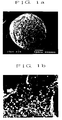
- Fig. 1a is a scanning electron microscopic (hereinafter SEM) photograph of 4A zeolite-holding cellulose beads obtained in Example 1, and Fig. 1b is an SEM photograph showing an enlarged view of the cellulose beads.
- SEM scanning electron microscopic
- Fig. 2a is an SEM photograph of 4A zeolite-holding paper obtained in Example 2
- Fig. 2b is an SEM photograph showing an enlarged view of the paper.
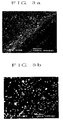
- Fig. 3a is an SEM photograph of 4A zeolite-holding cellophane obtained in Example 3
- Fig. 3b is an SEM photograph showing an enlarged view of the cellophane.
- Fig. 4a is an SEM photograph of Y type zeolite-holding cellulose beads obtained in Example 4, and Fig. 4b is an SEM photograph showing an enlarged view of the cellulose beads.
- Fig. 5a is an SEM photograph of hydroxyapatite-holding cellulose beads obtained in Example 5, and Fig. 5b is an SEM photograph showing an enlarged view of the cellulose beads.
- Fig. 6a is an SEM photograph of hydrotalcite-holding cellulose beads obtained in Example 6, and Fig. 6b is an SEM photograph showing an enlarged view of the cellulose beads.
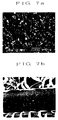
- Fig. 7a is an SEM photograph of the surface of 4A zeolite-holding ethylene-vinyl acetate copolymer obtained in Example 7, and Fig. 7b is an SEM photograph showing the cross section thereof.
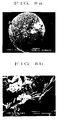
- Fig. 8a is an SEM photograph of aluminosilica gel-holding cellulose beads obtained in Comparative Example 1
- Fig. 8b is an SEM photograph showing an enlarged view of the cellulose beads.
- Fig. 9a is an SEM photograph of 4A zeolite-carrying paper obtained in Comparative Example 2
- Fig. 9b is an SEM photograph showing an enlarged view of the paper.
- Fig. 10a is an SEM photograph of 4A zeolite-carrying cellulose beads obtained in Comparative Example 3, and Fig. 10b is an SEM photograph showing an enlarged view of the cellulose beads.
- Fig. 11 shows time course changes in hydrogen sulfide gas adsorption by metal-substituted 4A zeolite-holding cellulose beads (inventive products (silver or copper)), metal-substituted aluminosilica gel-holding cellulose beads (Comparative Example 1 (copper), Comparative Example 3 (copper) and Comparative Example 4 (copper)) and copper powder.
- the hydrophilic macromolecular substrate to be used in the present invention is subject to no particular limitation as long as it swells in water.
- Examples thereof include pulp, cellulose, regenerated cellulose (e.g., cellophane, cellulose beads, rayon, cellulose sponge and the like), cotton, bacterial cellulose, cellulose derivative which is a chemically modified cellulose, such as ethyl cellulose, hydroxyethylcellulose, hydroxypropylcellulose, methylcellulose, ethylhydroxyethylcellulose, carboxymethylcellulose and the like, natural or artificial hydrophilic macromolecules such as silk, wool, polyvinyl alcohol, crosslinked polyvinyl alcohol, chitin, chitosan, ethylene-vinyl acetate copolymer, polyvinyl formal and the like, highly water-absorbable macromolecular gels such as polyacrylamide, and the like.
- pulp and regenerated cellulose are preferably used as carrying substrates from the aspect of actual use, cost and easiness of handling.
- the inner matrix of hydrophilic macromolecular substrate in the present invention means, when the substrate is a cellulose, the inside of the macromolecular substance constituting the cellulose substrate, excluding the surface of the cell wall of cellulose fiber, fine pores present in the cell wall and lumen.
- the inorganic porous crystal in the inner matrix of cellulose substrate means that a part or the entirety of inorganic porous crystals is present in the inner matrix of cellulose substrate.
- the inorganic porous crystal to be used in the present invention is exemplified by inorganic ion exchanger crystals having ion exchange capability and adsorber crystals capable of adsorbing to the porous part, and is free of limitation as long as it does not dissolve, decompose or disintegrate hydrophilic macromolecular substrate.
- inorganic ion exchanger crystals having ion exchange capability and adsorber crystals capable of adsorbing to the porous part, and is free of limitation as long as it does not dissolve, decompose or disintegrate hydrophilic macromolecular substrate.
- zeolite, hydrotalcite, hydroxyapatite, clay minerals and the like may be used.
- zeolite is preferable in that it offers a wide range of use.
- 4A zeolite Na 12 Si 12 Al 12 O 48 ⁇ 27H 2 O is preferable, since it can be synthesized rather easily.
- the inorganic porous crystals-hydrophilic macromolecule composite of the present invention can be prepared by reacting plural water-soluble compounds and at least one basic substance in the inner matrix of swollen hydrophilic macromolecular substrate.
- the inorganic porous crystal is zeolite, at least one silicon compound, at least one aluminum compound and at least one basic substance are used; and when the inorganic porous crystal is hydroxyapatite, at least one phosphorus compound (e.g., disodium hydrogen phosphate), at least one calcium compound (e.g., calcium nitrate) and at least one basic substance are used, whereby the inorganic porous crystals are held on a hydrophilic macromolecular substrate.
- the combination of plural water-soluble compounds is not particularly limited.
- a production method of an inorganic porous crystals-hydrophilic macromolecule composite when the inorganic porous crystal is zeolite and the hydrophilic macromolecule is a cellulose substrate, is exemplarily shown in the following to explain the method (Method I) in detail.
- a zeolite-cellulose composite can be produced by, for example, impregnating a cellulose substrate with an aqueous solution of a silicon compound.
- the method for impregnation is not particularly limited, and the cellulose substrate may be immersed in the aqueous solution, or an aqueous solution may be sprayed on a cellulose substrate or applied using various coaters.
- the silicon compound may be any as long as it dissolves in water, and is exemplified by sodium metasilicate, potassium metasilicate, potassium orthosilicate, water glass, silica sol and the like. In view of the fact that zeolite having high solubility in water and high crystallizability can be obtained, sodium metasilicate is preferably used.
- the concentration of the aqueous solution of silicon compound is not particularly limited, but it is preferably 1.0 - 100 mmol/l, more preferably 10 - 50 mmol/l.
- the amount of the solution is preferably controlled.
- the method therefor includes scraping off with a blade, squeezing between rolls, squeezing with a press and the like.
- the amount of the solution after control is not particularly limited, but it is preferable that it be controlled to 1.0-20 fold amount of the dry weight of the cellulose substrate.
- the cellulose substrate impregnated with an aqueous solution of silicon compound may be given an impregnating time before or after controlling the amount of the solution, so that the solution can sufficiently infiltrate therethrough.
- the impregnating time is from 10 minutes to 2 hours, which can be appropriately determined according to the kind of cellulose substrate to be used.
- the cellulose substrate having a controlled amount of solution is then immersed in a mixed aqueous solution of aluminum compound and basic substance.
- aluminum compound include sodium aluminate, potassium aluminate, aluminum sulfate, aluminum chloride, aluminum nitrate and the like, with preference given to sodium aluminate, since it affords zeolite having high solubility in water and high crystallizability.
- concentration of the aqueous solution of aluminate is not particularly limited, it is preferably 1.0 - 1000 mmol/l, more preferably 10 - 500 mmol/l.
- Examples of basic substance include sodium hydroxide, potassium hydroxide and the like, with preference given to sodium hydroxide, since it affords zeolite having high solubility in water and high crystallizability.
- the concentration of the basic substance need be considerably high to crystallize zeolite and is 10 - 5000 mmol/l, preferably 100 - 2500 mmol/l.
- One or more silicon compound(s), aluminum compound(s) and basic substance(s) may be used in the present invention.
- the temperature at which the substrate is immersed is 20-90°C, preferably 40-60°C.
- the immersing time is from 2 hours to 20 days, preferably from 12 hours to 2 days.
- the mixing ratio (molar ratio) of the silicon compound, aluminum compound and basic substance in the presence of swollen cellulose substrate is silicon compound:aluminum compound:basic substance of 1:1-10:10-50, preferably 1:3-5:12-30.
- the basic substance is added in excess of the silicon compound and aluminum compound. This is because, particularly in the case of 4A zeolite, zeolite crystal itself is in a metastable phase and cannot be synthesized under the conditions other than excess alkali conditions.
- the immersing temperature is from 20°C to 90°C
- the immersing time is from 2 hours to 20 days
- the mixing ratio (molar ratio) of the silicon compound, aluminum compound and basic substance is 1:1-10:10-50
- the inorganic porous crystals can be efficiently produced in the inner matrix of cellulose substrate.
- a different method for producing a zeolite-cellulose composite includes first impregnating a cellulose substrate with an aqueous solution of aluminum compound, and then immersing same in a mixed aqueous solution of silicon compound and basic substance.
- a cellulose substrate is first impregnated with a mixed aqueous solution of basic substance and one of silicon compound and aluminum compound, and then immersed in an aqueous solution of the remaining compound. That is, an aqueous solution of the silicon compound and that of aluminum compound produce gee upon mixing the two compounds. Thus, they cannot be used simultaneously for impregnating the cellulose substrate. Any immersing order except this can be employed.
- the cellulose substrate is impregnated with an aqueous solution of basic substance, and then immersed in an aqueous solution of silicon compound, whereafter finally immersed in an aqueous solution of aluminum compound, thus resulting in three steps.
- Method I inasmuch as the zeolite-cellulose composite produced by these methods is somewhat inferior to the zeolite-cellulose composite produced by Method I in the zeolite-holding ratio, it is preferable that Method I be used.
- Method I employs very mild synthetic conditions as compared to those of general synthesis of zeolite, so that zeolite can be held without causing damages to the cellulose substrate.
- the above-mentioned inorganic porous crystals-hydrophilic macromolecule composite has superior strength, smoothness, flame retardance, opacity and dimensional stability, besides functions as ion exchanger and adsorber. Consequently, when the hydrophilic macromolecular substrate is a cellulose fiber and paper is to be manufactured therefrom, no operation difficulty is encountered such as clogging of paper making wire.
- the above-mentioned inorganic porous crystals-hydrophilic macromolecule composite is taken out from the solution and washed with water, and then immersed in an aqueous solution of a metal salt capable of functioning as a catalyst, whereby a metal-holding inorganic porous crystals-hydrophilic macromolecule composite can be obtained.
- the metal to be used is exemplified by silver, copper, zinc, iron, nickel, cobalt, palladium and platinum, which may be used in combination.
- the aqueous solution of metal salt may have optional concentration, which is preferably 1.0 - 100 mmol/l, and is free of particular limitation on the temperature and time of immersion.
- the hydrophilic macromolecular substrate allows infiltration of an aqueous solution, so that the entirety of the inorganic porous crystals in the inner matrix of a hydrophilic macromolecular substrate can hold metal efficiently.
- a silver, copper or zinc-holding inorganic porous crystals-hydrophilic macromolecule composite shows antibacterial property
- a palladium or platinum-holding inorganic porous crystals-hydrophilic macromolecule composite can adsorb ethylene to retain freshness of fruits and vegetables.
- a silver or copper-holding inorganic porous crystals-hydrophilic macromolecule composite can adsorb and decompose hydrogen sulfide, thereby affording rust proof effect of metal and deodorizing effect, and can adsorb and decompose ammonia, thereby affording deodorizing effect.
- a silver-holding inorganic porous crystals-hydrophilic macromolecule composite can adsorb and decompose methyl mercaptane, thereby affording deodorizing effect.
- a hydrophilic macromolecular substrate can sufficiently permeate gases, it can adsorb and decompose gasses while using the entire metal-holding inorganic porous crystals in the inner matrix of the hydrophilic macromolecular substrate.
- a volatile substance may be added to the inorganic porous crystals-hydrophilic macromolecule composite to provide paper having various high functions.
- the volatile substance include L-menthol, hinokitiol, fitontsid, allyl isothiocyanate, limonene and the like. These can be held by a method known per se , such as impregnation, coating, injection and the like.
- Cellulose beads (10.0 g, average particle size 5 mm) were impregnated with an aqueous solution (5.68 g/100 ml) of sodium metasilicate ⁇ 9 hydrate, and a mixed aqueous solution (100 ml) of sodium aluminate (4.68 g) and sodium hydroxide (10.00 g) was added, which was followed by immersion at 25°C for 10 days, to give 4A zeolite-holding cellulose beads (11.2 g).
- the 4A zeolite-holding cellulose beads had a 4A zeolite-holding percentage of 20.8 wt%.
- An SEM photograph of the obtained 4A zeolite-holding cellulose beads is shown in Fig. 1a and an enlarged view thereof is shown in Fig. 1b.
- Pulp (4.0 g) was impregnated with an aqueous solution (5.68 g/100 ml) of sodium metasilicate ⁇ 9 hydrate, and a mixed aqueous solution (100 ml) of sodium aluminate (4.68 g) and sodium hydroxide (10.00 g) was added, which was followed by immersion at 90°C for 2 hours, to give 4A zeolite-holding pulp.
- the 4A zeolite-holding pulp was prepared into paper using Square Type Sheet Machine manufactured by KUMAGAYA RIKI INDUSTRY Co., Ltd. (conditions: 80 mesh, natural water, suction, water 15 l).
- the 4A zeolite-holding paper thus obtained had a 4A zeolite-holding percentage of 18.1 wt%.
- An SEM photograph of the obtained 4A zeolite-holding paper is shown in Fig. 2a and an enlarged view thereof is shown in Fig. 2b.
- Cellophane (0. 548 g) was impregnated with an aqueous solution (0.2904 g/5 ml) of sodium metasilicate ⁇ 9 hydrate, and a mixed aqueous solution (5 ml) of sodium aluminate (0.2360 g) and sodium hydroxide (0.5219 g) was added, which was followed by immersion at room temperature for 11 days, to give 4A zeolite-holding cellophane (0.652 g).
- the 4A zeolite-holding cellophane had a 4A zeolite-holding percentage of 23.8 wt%.
- An SEM photograph of the obtained 4A zeolite-holding cellophane is shown in Fig. 3a and an enlarged view thereof is shown in Fig. 3b.
- hydroxyapatite-holding cellulose beads (12.2 g).
- the obtained hydroxyapatite-holding cellulose beads had a hydroxyapatite-holding percentage of 18.0 wt%.
- An SEM photograph of the obtained hydroxyapatite-holding cellulose beads is shown in Fig. 5a and an enlarged view thereof is shown in Fig. 5b.
- a film of ethylene-vinyl acetate copolymer (5 ⁇ 7 cm piece, 4 pieces, 0.6860 g) was impregnated with an aqueous solution (0.1022 g/1.8 ml) of sodium metasilicate ⁇ 9 hydrate, and a mixed aqueous solution (1.8 ml) of sodium aluminate (0.0842 g) and sodium hydroxide (0.1800 g) was added, which was followed by immersion at 50°C for 48 hours, to give 4A zeolite-holding ethylene-vinyl acetate copolymer (0.7228 g).
- the obtained 4A zeolite-holding ethylene-vinyl acetate copolymer had a 4A zeolite-holding percentage of 5.1 wt%.
- An SEM photograph of the surface of the obtained 4A zeolite-holding ethylene-vinyl acetate copolymer is shown in Fig. 7a and an SEM photograph of the cross section thereof is shown in Fig. 7b.
- aluminosilica gel-holding cellulose beads (11.3 g).
- the aluminosilica gel-holding cellulose beads had an aluminosilica gel-holding percentage of 19.8 wt%.
- An SEM photograph of the obtained aluminosilica gel-holding cellulose beads is shown in Fig. 8a and an enlarged view thereof is shown in Fig. 8b.
- Pulp (4.0 g) was impregnated with an aqueous suspension of commercially available zeolite (manufactured by TOSOH CO., LTD., 4A Zeolum, 3.7 g/100 ml) at 90°C for 2 hours, to give 4A zeolite-carrying pulp.
- the 4A zeolite-carrying pulp was processed into paper using Square Type Sheet Machine manufactured by KUNAGAYA RIKI INDUSTRY Co., Ltd. (conditions: 80 mesh, natural water, suction, water 15 l).
- the 4A zeolite-carrying paper thus obtained had a 4A zeolite-carrying percentage of 6.8 wt%.
- An SEM photograph of the obtained 4A zeolite-carrying paper is shown in Fig. 9a and an enlarged view thereof is shown in Fig. 9b.
- Cellulose beads (10.0 g, average particle size 5 mm) were impregnated with an aqueous suspension of commercially available zeolite (manufactured by TOSOH CO., LTD., 4A Zeolum, 2.5 g/100 ml) at 90°C for 2 hours, to give 4A zeolite-carrying cellulose beads.
- the 4A zeolite-carrying cellulose beads had a 4A zeolite-carrying percentage of 5.5 wt%.
- An SEM photograph of the obtained 4A zeolite-carrying cellulose beads is shown in Fig. 10a and an enlarged view thereof is shown in Fig. 10b.
- the particle size of hydroxyapatite and hydrotalcite is too small even in SEM photographs, and it is inconclusive if the hydroxyapatite and hydrotalcite were held in the inner matrix of the cellulose beads.
- the ash obtained from incineration of hydroxyapatite-holding cellulose beads and hydrotalcite-holding cellulose beads retained the shape of cellulose beads. In consideration of greater amount held by the beads, moreover, it is appreciated that the beads held hydroxyapatite and hydrotalcite.
- Example 1 Each sample (1.0 g) obtained in Example 1, and Comparative Examples 1, 3 and 4 was immersed in an aqueous solution of silver nitrate (2.33 g/l, 1480 ppm) or an aqueous solution of copper sulfate ⁇ 5 hydrate (1.71 g/l, 435 ppm) at 25°C for 2 hours, and the removal percentage of metal ion ((initial concentration-final concentration) ⁇ 100/initial concentration) was calculated.
- inventive 4A zeolite-holding cellulose beads were extremely superior in silver ion and copper ion removing performance. It is also evident from Table 2 and Fig. 11 that the inventive silver-substituted 4A zeolite-holding cellulose beads and copper-substituted 4A zeolite-holding cellulose beads both showed quick hydrogen sulfide adsorption to the extent that hydrogen sulfide was completely removed in 3 hours. The superior hydrogen sulfide removing property was apparent, as compared to that by the copper powder.
- an inorganic porous crystals-hydrophilic macromolecule composite holding the inorganic porous crystals in the inner matrix of hydrophilic macromolecular substrate can be obtained.
- Said hydrophilic macromolecule composite is particularly superior in adsorption of metal ion, specifically silver and copper ions, and the metal-holding inorganic porous crystals-hydrophilic macromolecule composite showed noticeably strong adsorption of hydrogen sulfide, so that it can be used as a deodorizer, antimicrobial material and freshness retention material for fruits and vegetables.
Landscapes
- Chemical & Material Sciences (AREA)
- Dispersion Chemistry (AREA)
- Chemical Kinetics & Catalysis (AREA)
- Medicinal Chemistry (AREA)
- Polymers & Plastics (AREA)
- Organic Chemistry (AREA)
- Health & Medical Sciences (AREA)
- Inorganic Chemistry (AREA)
- Solid-Sorbent Or Filter-Aiding Compositions (AREA)
- Compositions Of Macromolecular Compounds (AREA)
- Paper (AREA)
- Silicates, Zeolites, And Molecular Sieves (AREA)
- Agricultural Chemicals And Associated Chemicals (AREA)
Applications Claiming Priority (3)
| Application Number | Priority Date | Filing Date | Title |
|---|---|---|---|
| JP24553896 | 1996-08-27 | ||
| JP245538/96 | 1996-08-27 | ||
| JP24553896 | 1996-08-27 |
Publications (3)
| Publication Number | Publication Date |
|---|---|
| EP0826822A2 true EP0826822A2 (fr) | 1998-03-04 |
| EP0826822A3 EP0826822A3 (fr) | 1998-11-11 |
| EP0826822B1 EP0826822B1 (fr) | 2004-06-09 |
Family
ID=17135196
Family Applications (1)
| Application Number | Title | Priority Date | Filing Date |
|---|---|---|---|
| EP97114717A Expired - Lifetime EP0826822B1 (fr) | 1996-08-27 | 1997-08-26 | Matière composite à partir d'un substrate macromoléculaire hydrophile et des cristaux inorganique poreuses |
Country Status (4)
| Country | Link |
|---|---|
| US (1) | US5981052A (fr) |
| EP (1) | EP0826822B1 (fr) |
| CA (1) | CA2213936C (fr) |
| DE (1) | DE69729412T2 (fr) |
Cited By (17)
| Publication number | Priority date | Publication date | Assignee | Title |
|---|---|---|---|---|
| EP0938925A1 (fr) * | 1998-02-25 | 1999-09-01 | Rengo Co., Ltd. | Composition contenant un materiau composite fabriqué à partir de cristaux inorganiques poreux et de macromolecules hydrophiles et produit obtenu à partir de celle-ci |
| US6372333B1 (en) | 1998-02-25 | 2002-04-16 | Rengo Co., Ltd. | Composition containing inorganic porous crystals-hydrophilic macromolecule composite and product made therefrom |
| US6843936B1 (en) * | 1998-10-22 | 2005-01-18 | Texas Instruments Incorporated | Getter for enhanced micromechanical device performance |
| EP1530998A3 (fr) * | 2003-11-17 | 2006-03-08 | Universita' Degli Studi di Salerno | Adsorbant destiné à prolonger la durée de conservation de denrées alimentaires |
| EP1873202A1 (fr) * | 2006-06-29 | 2008-01-02 | Clariant International Ltd. | Matériau transparent hybride zeolite-polymère avec des caractéristiques réglables |
| EP1810697A3 (fr) * | 2005-11-07 | 2008-04-02 | Jeffrey L. Horn | Dispositifs pour la délivrance de tamis moléculaire pour la formation de caillots sanguins |
| US7595429B2 (en) | 2003-09-12 | 2009-09-29 | Z-Medica Corporation | Calcium zeolite hemostatic agent |
| US7604819B2 (en) | 2006-05-26 | 2009-10-20 | Z-Medica Corporation | Clay-based hemostatic agents and devices for the delivery thereof |
| DE102008022726A1 (de) | 2008-05-06 | 2009-11-12 | Winkler, Kurt, Dr. | Verfahren für den Kontakt einer Gasphase mit einer Flüssigkeit in Anwesenheit eines Feststoffes |
| US7968114B2 (en) | 2006-05-26 | 2011-06-28 | Z-Medica Corporation | Clay-based hemostatic agents and devices for the delivery thereof |
| US8252344B2 (en) | 2003-09-12 | 2012-08-28 | Z-Medica Corporation | Partially hydrated hemostatic agent |
| US8938898B2 (en) | 2006-04-27 | 2015-01-27 | Z-Medica, Llc | Devices for the identification of medical products |
| US9603964B2 (en) | 2012-06-22 | 2017-03-28 | Z-Medica, Llc | Hemostatic devices |
| US9821084B2 (en) | 2005-02-15 | 2017-11-21 | Virginia Commonwealth University | Hemostasis of wound having high pressure blood flow using kaolin and bentonite |
| US9889154B2 (en) | 2010-09-22 | 2018-02-13 | Z-Medica, Llc | Hemostatic compositions, devices, and methods |
| US10174457B2 (en) * | 2014-05-09 | 2019-01-08 | Uniwersytet Jagiellonski | Modified nanocomposite material, method for its production and its application |
| LU500847B1 (en) * | 2021-11-11 | 2023-05-11 | Kolicevo Karton D O O | Use of hydrophilic zeolites in the production of cellulose-based (cardboard) packaging |
Families Citing this family (29)
| Publication number | Priority date | Publication date | Assignee | Title |
|---|---|---|---|---|
| GB9826486D0 (en) * | 1998-12-03 | 1999-01-27 | Johnson Matthey Plc | Improvements in coatings |
| MXPA01011828A (es) | 1999-05-20 | 2004-12-06 | Exxon Chemical Patents Inc | Proceso de conversion de hidrocarburos y catalizador util en el mismo. |
| US8110222B2 (en) * | 2002-11-15 | 2012-02-07 | Ut-Battelle, Llc. | Composite material |
| US20060141060A1 (en) * | 2004-12-27 | 2006-06-29 | Z-Medica, Llc | Molecular sieve materials having increased particle size for the formation of blood clots |
| US20060178609A1 (en) | 2005-02-09 | 2006-08-10 | Z-Medica, Llc | Devices and methods for the delivery of molecular sieve materials for the formation of blood clots |
| JP2008529520A (ja) * | 2005-02-10 | 2008-08-07 | フイルメニツヒ ソシエテ アノニム | カプセル化された風味剤のコーティングを有する加熱された食品 |
| US20060211971A1 (en) * | 2005-03-16 | 2006-09-21 | Z-Medica, Llc | Pillow for the delivery of blood clotting materials to a wound site |
| US20060211965A1 (en) * | 2005-03-16 | 2006-09-21 | Z-Medica, Llc | Device for the delivery of blood clotting materials to a wound site |
| US9326995B2 (en) | 2005-04-04 | 2016-05-03 | The Regents Of The University Of California | Oxides for wound healing and body repair |
| US20060282046A1 (en) * | 2005-04-13 | 2006-12-14 | Horn Jeffrey L | Device and method for subcutaneous delivery of blood clotting agent |
| US20070004995A1 (en) * | 2005-06-30 | 2007-01-04 | Horn Jeffrey L | Swab device and kit for the delivery of blood clotting materials to a wound site |
| US20070092725A1 (en) * | 2005-10-20 | 2007-04-26 | Nisshinbo Industries, Inc. | Process for producing zeolite-coated glass fibers and fibrous structure produced by the same |
| US20070104768A1 (en) * | 2005-11-07 | 2007-05-10 | Z-Medica Corporation | Devices for the delivery of molecular sieve materials for the formation of blood clots |
| US20070142783A1 (en) * | 2005-12-16 | 2007-06-21 | Huey Raymond J | Devices and methods for promoting the formation of blood clots at dialysis access sites |
| US20070154509A1 (en) * | 2005-12-30 | 2007-07-05 | Wilcher Steve A | Adsorbent-Containing Hemostatic Devices |
| US20070154510A1 (en) * | 2005-12-30 | 2007-07-05 | Wilcher Steve A | Adsorbent-Containing Hemostatic Devices |
| US8202532B2 (en) | 2006-05-26 | 2012-06-19 | Z-Medica Corporation | Clay-based hemostatic agents and devices for the delivery thereof |
| US20070276308A1 (en) * | 2006-05-26 | 2007-11-29 | Huey Raymond J | Hemostatic agents and devices for the delivery thereof |
| US20080063697A1 (en) * | 2006-09-08 | 2008-03-13 | Bedard Robert L | Use of Unactivated Calcium Exchanged Zeolites in Hemostatic Devices and Products |
| US20080145455A1 (en) * | 2006-12-13 | 2008-06-19 | Bedard Robert L | Combination of Inorganic Hemostatic Agents with Other Hemostatic Agents |
| CN101801527A (zh) | 2007-05-21 | 2010-08-11 | 缅因大学理事会 | 用于垃圾异味控制的沸石复合材料 |
| US20090047366A1 (en) * | 2007-08-15 | 2009-02-19 | Bedard Robert L | Inorganic Coagulation Accelerators for Individuals taking Platelet Blockers or Anticoagulants |
| US20090074837A1 (en) * | 2007-09-19 | 2009-03-19 | Ut-Battelle, Llc | Bioresorbable Calcium-Deficient Hydroxyapatite Hydrogel Composite |
| US8883194B2 (en) * | 2007-11-09 | 2014-11-11 | Honeywell International, Inc. | Adsorbent-containing hemostatic devices |
| US8795718B2 (en) * | 2008-05-22 | 2014-08-05 | Honeywell International, Inc. | Functional nano-layered hemostatic material/device |
| JP6336396B2 (ja) * | 2011-11-24 | 2018-06-06 | インディアン インスティテュート オブ テクノロジー | 水精製のための多層有機−テンプレート−ベーマイト−ナノアーキテクチャ |
| CN104520706B (zh) | 2012-04-17 | 2017-03-01 | 印度理工学院 | 使用量子簇检测水流量 |
| AU2014265845B2 (en) | 2013-05-17 | 2016-11-17 | 3M Innovative Properties Company | Easy-clean surface and method of making the same |
| JP6403932B1 (ja) | 2017-02-14 | 2018-10-10 | 日本製紙株式会社 | 組成物 |
Family Cites Families (11)
| Publication number | Priority date | Publication date | Assignee | Title |
|---|---|---|---|---|
| US3099570A (en) * | 1961-07-19 | 1963-07-30 | West Virginia Pulp & Paper Co | Filler for paper and method of making the same |
| JPS55144489A (en) * | 1979-04-24 | 1980-11-11 | Meisei Chemical Works Ltd | Paper made sound absorbing material and its manufacture |
| JPS57129779A (en) * | 1981-02-05 | 1982-08-11 | Sanyo Electric Co Ltd | Recording paper |
| JPS59133235A (ja) * | 1983-01-21 | 1984-07-31 | Kanebo Ltd | 殺菌性ポリマー組成物及びその製造法 |
| JPS6272938A (ja) * | 1985-09-26 | 1987-04-03 | Akebono Brake Res & Dev Center Ltd | 湿式使用のペ−パ−系摩擦材 |
| US4826667A (en) * | 1986-01-29 | 1989-05-02 | Chevron Research Company | Zeolite SSZ-25 |
| JPH04122743A (ja) * | 1990-09-13 | 1992-04-23 | Kanebo Ltd | 抗菌性セルロース粒子 |
| JP2776998B2 (ja) * | 1991-03-08 | 1998-07-16 | 工業技術院長 | アパタイトシ−ト及びその製造方法 |
| JPH0761857B2 (ja) * | 1991-07-02 | 1995-07-05 | 工業技術院長 | ケイ酸塩/高分子複合体、ケイ酸塩成形体及びそれらの製造方法 |
| JPH05106199A (ja) * | 1991-10-15 | 1993-04-27 | Oji Paper Co Ltd | 抗菌性繊維 |
| JPH05125694A (ja) * | 1991-10-31 | 1993-05-21 | Oji Paper Co Ltd | 無機質紙の製造方法 |
-
1997
- 1997-08-26 CA CA002213936A patent/CA2213936C/fr not_active Expired - Fee Related
- 1997-08-26 DE DE69729412T patent/DE69729412T2/de not_active Expired - Lifetime
- 1997-08-26 US US08/918,385 patent/US5981052A/en not_active Expired - Lifetime
- 1997-08-26 EP EP97114717A patent/EP0826822B1/fr not_active Expired - Lifetime
Cited By (30)
| Publication number | Priority date | Publication date | Assignee | Title |
|---|---|---|---|---|
| US6372333B1 (en) | 1998-02-25 | 2002-04-16 | Rengo Co., Ltd. | Composition containing inorganic porous crystals-hydrophilic macromolecule composite and product made therefrom |
| EP0938925A1 (fr) * | 1998-02-25 | 1999-09-01 | Rengo Co., Ltd. | Composition contenant un materiau composite fabriqué à partir de cristaux inorganiques poreux et de macromolecules hydrophiles et produit obtenu à partir de celle-ci |
| US6843936B1 (en) * | 1998-10-22 | 2005-01-18 | Texas Instruments Incorporated | Getter for enhanced micromechanical device performance |
| US8252344B2 (en) | 2003-09-12 | 2012-08-28 | Z-Medica Corporation | Partially hydrated hemostatic agent |
| US7595429B2 (en) | 2003-09-12 | 2009-09-29 | Z-Medica Corporation | Calcium zeolite hemostatic agent |
| EP1530998A3 (fr) * | 2003-11-17 | 2006-03-08 | Universita' Degli Studi di Salerno | Adsorbant destiné à prolonger la durée de conservation de denrées alimentaires |
| US11167058B2 (en) | 2005-02-15 | 2021-11-09 | Virginia Commonwealth University | Hemostasis of wound having high pressure blood flow |
| US9821084B2 (en) | 2005-02-15 | 2017-11-21 | Virginia Commonwealth University | Hemostasis of wound having high pressure blood flow using kaolin and bentonite |
| EP1810697A3 (fr) * | 2005-11-07 | 2008-04-02 | Jeffrey L. Horn | Dispositifs pour la délivrance de tamis moléculaire pour la formation de caillots sanguins |
| US8938898B2 (en) | 2006-04-27 | 2015-01-27 | Z-Medica, Llc | Devices for the identification of medical products |
| US7604819B2 (en) | 2006-05-26 | 2009-10-20 | Z-Medica Corporation | Clay-based hemostatic agents and devices for the delivery thereof |
| US8114433B2 (en) | 2006-05-26 | 2012-02-14 | Z-Medica Corporation | Clay-based hemostatic agents and devices for the delivery thereof |
| US7968114B2 (en) | 2006-05-26 | 2011-06-28 | Z-Medica Corporation | Clay-based hemostatic agents and devices for the delivery thereof |
| US12076448B2 (en) | 2006-05-26 | 2024-09-03 | Teleflex Life Sciences Ii Llc | Hemostatic devices |
| US9867898B2 (en) | 2006-05-26 | 2018-01-16 | Z-Medica, Llc | Clay-based hemostatic agents |
| US10086106B2 (en) | 2006-05-26 | 2018-10-02 | Z-Medica, Llc | Clay-based hemostatic agents |
| US11123451B2 (en) | 2006-05-26 | 2021-09-21 | Z-Medica, Llc | Hemostatic devices |
| US10960101B2 (en) | 2006-05-26 | 2021-03-30 | Z-Medica, Llc | Clay-based hemostatic agents |
| KR101361434B1 (ko) * | 2006-06-29 | 2014-02-10 | 옵티칼 어디티브스 게엠베하 | 조정 가능한 특성을 가진 투명한 제올라이트-중합체 혼성물질 |
| US7655300B2 (en) | 2006-06-29 | 2010-02-02 | Clariant International Ltd. | Transparent zeolite-polymer hybrid material with tunable properties |
| EP1873202A1 (fr) * | 2006-06-29 | 2008-01-02 | Clariant International Ltd. | Matériau transparent hybride zeolite-polymère avec des caractéristiques réglables |
| DE102008022726A1 (de) | 2008-05-06 | 2009-11-12 | Winkler, Kurt, Dr. | Verfahren für den Kontakt einer Gasphase mit einer Flüssigkeit in Anwesenheit eines Feststoffes |
| US11007218B2 (en) | 2010-09-22 | 2021-05-18 | Z-Medica, Llc | Hemostatic compositions, devices, and methods |
| US9889154B2 (en) | 2010-09-22 | 2018-02-13 | Z-Medica, Llc | Hemostatic compositions, devices, and methods |
| US10960100B2 (en) | 2012-06-22 | 2021-03-30 | Z-Medica, Llc | Hemostatic devices |
| US11559601B2 (en) | 2012-06-22 | 2023-01-24 | Teleflex Life Sciences Limited | Hemostatic devices |
| US9603964B2 (en) | 2012-06-22 | 2017-03-28 | Z-Medica, Llc | Hemostatic devices |
| US10174457B2 (en) * | 2014-05-09 | 2019-01-08 | Uniwersytet Jagiellonski | Modified nanocomposite material, method for its production and its application |
| LU500847B1 (en) * | 2021-11-11 | 2023-05-11 | Kolicevo Karton D O O | Use of hydrophilic zeolites in the production of cellulose-based (cardboard) packaging |
| EP4180573A1 (fr) * | 2021-11-11 | 2023-05-17 | Kemijski Institut | Utilisation de zeolites a faible rapport molaire si/ai pour la production d'emballages a base de cellulose (carton de carton) |
Also Published As
| Publication number | Publication date |
|---|---|
| CA2213936C (fr) | 2002-01-29 |
| US5981052A (en) | 1999-11-09 |
| DE69729412T2 (de) | 2005-06-16 |
| CA2213936A1 (fr) | 1998-02-27 |
| EP0826822B1 (fr) | 2004-06-09 |
| EP0826822A3 (fr) | 1998-11-11 |
| DE69729412D1 (de) | 2004-07-15 |
Similar Documents
| Publication | Publication Date | Title |
|---|---|---|
| US5981052A (en) | Inorganic porous crystals-hydrophilic macromolecule composite | |
| JP3317660B2 (ja) | 無機多孔結晶−親水性高分子複合体 | |
| US5888526A (en) | Antibacterial antifungal agent and fibrous material containing the same | |
| CA2262348C (fr) | Composition contenant un composite de macromolecules-cristaux hydrophiles poreuses et inorganiques et produits fabriques de cette composition | |
| KR980001911A (ko) | 복합분자체 화합물의 제조방법 | |
| CA2699334A1 (fr) | Cartouches de dialyse comprenant du carbonate de sodium et de zirconium et du carbonate basique de zirconium, et methodes pour les fabriquer | |
| WO2010004735A1 (fr) | Matériau de filtre constitué de silice poreuse et filtre de cigarette l’utilisant | |
| JP4149066B2 (ja) | 無機多孔結晶−親水性高分子複合体を含有する織物、不織布または紙 | |
| EP0379581B1 (fr) | Substance deodorante et procede de production | |
| JP4018284B2 (ja) | 無機多孔結晶−親水性高分子複合体を含有する組成物およびその成型物 | |
| JP2001070741A (ja) | 調湿剤 | |
| JP3254345B2 (ja) | 酸化チタン担持紙 | |
| JP2005054086A (ja) | 触媒物質含有機能材およびその製造方法 | |
| US5254195A (en) | Process for manufacturing moisture exchange element | |
| JP4666826B2 (ja) | X型ゼオライト−親水性高分子複合体の製造方法 | |
| JPH05106199A (ja) | 抗菌性繊維 | |
| JP3891714B2 (ja) | 無機多孔結晶−親水性高分子傾斜複合体及びその製造方法 | |
| JP2781865B2 (ja) | 消臭性シート | |
| JPH11285633A (ja) | 低級脂肪族アルデヒド類の吸着除去剤 | |
| JP4801852B2 (ja) | 無機イオン交換体−親水性高分子複合体およびその製造方法 | |
| JP4486206B2 (ja) | 触媒物質含有機能材およびその製造方法 | |
| JP2005029453A (ja) | 表面をゼオライト化したガラスの製造方法 | |
| JP3950565B2 (ja) | 多孔親水性高分子及びその製造方法 | |
| KR102732896B1 (ko) | 알데히드계 가스 또는 케톤계 가스에 적합한 소취제 조성물 | |
| JP2001239157A (ja) | 無機イオン交換体−親水性高分子活性炭複合体およびその製造方法 |
Legal Events
| Date | Code | Title | Description |
|---|---|---|---|
| PUAI | Public reference made under article 153(3) epc to a published international application that has entered the european phase |
Free format text: ORIGINAL CODE: 0009012 |
|
| AK | Designated contracting states |
Kind code of ref document: A2 Designated state(s): DE FR GB IT SE |
|
| PUAL | Search report despatched |
Free format text: ORIGINAL CODE: 0009013 |
|
| AK | Designated contracting states |
Kind code of ref document: A3 Designated state(s): AT BE CH DE DK ES FI FR GB GR IE IT LI LU MC NL PT SE |
|
| 17P | Request for examination filed |
Effective date: 19990105 |
|
| AKX | Designation fees paid |
Free format text: DE FR GB IT SE |
|
| 17Q | First examination report despatched |
Effective date: 20020416 |
|
| GRAP | Despatch of communication of intention to grant a patent |
Free format text: ORIGINAL CODE: EPIDOSNIGR1 |
|
| RAP1 | Party data changed (applicant data changed or rights of an application transferred) |
Owner name: RENGO CO., LTD. |
|
| GRAS | Grant fee paid |
Free format text: ORIGINAL CODE: EPIDOSNIGR3 |
|
| GRAA | (expected) grant |
Free format text: ORIGINAL CODE: 0009210 |
|
| AK | Designated contracting states |
Kind code of ref document: B1 Designated state(s): DE FR GB IT SE |
|
| REG | Reference to a national code |
Ref country code: GB Ref legal event code: FG4D |
|
| REG | Reference to a national code |
Ref country code: SE Ref legal event code: TRGR |
|
| REF | Corresponds to: |
Ref document number: 69729412 Country of ref document: DE Date of ref document: 20040715 Kind code of ref document: P |
|
| ET | Fr: translation filed | ||
| PLBE | No opposition filed within time limit |
Free format text: ORIGINAL CODE: 0009261 |
|
| STAA | Information on the status of an ep patent application or granted ep patent |
Free format text: STATUS: NO OPPOSITION FILED WITHIN TIME LIMIT |
|
| 26N | No opposition filed |
Effective date: 20050310 |
|
| PGFP | Annual fee paid to national office [announced via postgrant information from national office to epo] |
Ref country code: DE Payment date: 20140821 Year of fee payment: 18 |
|
| PGFP | Annual fee paid to national office [announced via postgrant information from national office to epo] |
Ref country code: FR Payment date: 20140808 Year of fee payment: 18 Ref country code: GB Payment date: 20140820 Year of fee payment: 18 Ref country code: SE Payment date: 20140826 Year of fee payment: 18 |
|
| PGFP | Annual fee paid to national office [announced via postgrant information from national office to epo] |
Ref country code: IT Payment date: 20140821 Year of fee payment: 18 |
|
| REG | Reference to a national code |
Ref country code: DE Ref legal event code: R119 Ref document number: 69729412 Country of ref document: DE |
|
| REG | Reference to a national code |
Ref country code: SE Ref legal event code: EUG |
|
| GBPC | Gb: european patent ceased through non-payment of renewal fee |
Effective date: 20150826 |
|
| PG25 | Lapsed in a contracting state [announced via postgrant information from national office to epo] |
Ref country code: IT Free format text: LAPSE BECAUSE OF NON-PAYMENT OF DUE FEES Effective date: 20150826 |
|
| PG25 | Lapsed in a contracting state [announced via postgrant information from national office to epo] |
Ref country code: SE Free format text: LAPSE BECAUSE OF NON-PAYMENT OF DUE FEES Effective date: 20150827 |
|
| REG | Reference to a national code |
Ref country code: FR Ref legal event code: ST Effective date: 20160429 |
|
| PG25 | Lapsed in a contracting state [announced via postgrant information from national office to epo] |
Ref country code: DE Free format text: LAPSE BECAUSE OF NON-PAYMENT OF DUE FEES Effective date: 20160301 Ref country code: GB Free format text: LAPSE BECAUSE OF NON-PAYMENT OF DUE FEES Effective date: 20150826 |
|
| PG25 | Lapsed in a contracting state [announced via postgrant information from national office to epo] |
Ref country code: FR Free format text: LAPSE BECAUSE OF NON-PAYMENT OF DUE FEES Effective date: 20150831 |