EP0832433B1 - Etalons et solutions d'etalonnage stabilises - Google Patents
Etalons et solutions d'etalonnage stabilises Download PDFInfo
- Publication number
- EP0832433B1 EP0832433B1 EP96916602A EP96916602A EP0832433B1 EP 0832433 B1 EP0832433 B1 EP 0832433B1 EP 96916602 A EP96916602 A EP 96916602A EP 96916602 A EP96916602 A EP 96916602A EP 0832433 B1 EP0832433 B1 EP 0832433B1
- Authority
- EP
- European Patent Office
- Prior art keywords
- tacrolimus
- rapamycin
- drug
- fkbp
- binding protein
- Prior art date
- Legal status (The legal status is an assumption and is not a legal conclusion. Google has not performed a legal analysis and makes no representation as to the accuracy of the status listed.)
- Expired - Lifetime
Links
- QJJXYPPXXYFBGM-LFZNUXCKSA-N Tacrolimus Chemical compound C1C[C@@H](O)[C@H](OC)C[C@@H]1\C=C(/C)[C@@H]1[C@H](C)[C@@H](O)CC(=O)[C@H](CC=C)/C=C(C)/C[C@H](C)C[C@H](OC)[C@H]([C@H](C[C@H]2C)OC)O[C@@]2(O)C(=O)C(=O)N2CCCC[C@H]2C(=O)O1 QJJXYPPXXYFBGM-LFZNUXCKSA-N 0.000 claims abstract description 52
- QJJXYPPXXYFBGM-SHYZHZOCSA-N tacrolimus Natural products CO[C@H]1C[C@H](CC[C@@H]1O)C=C(C)[C@H]2OC(=O)[C@H]3CCCCN3C(=O)C(=O)[C@@]4(O)O[C@@H]([C@H](C[C@H]4C)OC)[C@@H](C[C@H](C)CC(=C[C@@H](CC=C)C(=O)C[C@H](O)[C@H]2C)C)OC QJJXYPPXXYFBGM-SHYZHZOCSA-N 0.000 claims abstract description 51
- 229960001967 tacrolimus Drugs 0.000 claims abstract description 50
- 239000000203 mixture Substances 0.000 claims abstract description 39
- 229960002930 sirolimus Drugs 0.000 claims abstract description 33
- 102000014914 Carrier Proteins Human genes 0.000 claims abstract description 28
- 108091008324 binding proteins Proteins 0.000 claims abstract description 28
- ZAHRKKWIAAJSAO-UHFFFAOYSA-N rapamycin Natural products COCC(O)C(=C/C(C)C(=O)CC(OC(=O)C1CCCCN1C(=O)C(=O)C2(O)OC(CC(OC)C(=CC=CC=CC(C)CC(C)C(=O)C)C)CCC2C)C(C)CC3CCC(O)C(C3)OC)C ZAHRKKWIAAJSAO-UHFFFAOYSA-N 0.000 claims abstract description 28
- QFJCIRLUMZQUOT-HPLJOQBZSA-N sirolimus Chemical compound C1C[C@@H](O)[C@H](OC)C[C@@H]1C[C@@H](C)[C@H]1OC(=O)[C@@H]2CCCCN2C(=O)C(=O)[C@](O)(O2)[C@H](C)CC[C@H]2C[C@H](OC)/C(C)=C/C=C/C=C/[C@@H](C)C[C@@H](C)C(=O)[C@H](OC)[C@H](O)/C(C)=C/[C@@H](C)C(=O)C1 QFJCIRLUMZQUOT-HPLJOQBZSA-N 0.000 claims abstract description 28
- 102000018679 Tacrolimus Binding Proteins Human genes 0.000 claims description 16
- 108010027179 Tacrolimus Binding Proteins Proteins 0.000 claims description 15
- 238000000034 method Methods 0.000 claims description 12
- 108010006877 Tacrolimus Binding Protein 1A Proteins 0.000 claims description 10
- 230000000087 stabilizing effect Effects 0.000 claims description 5
- 238000011088 calibration curve Methods 0.000 claims description 4
- 239000013610 patient sample Substances 0.000 claims description 4
- 238000003018 immunoassay Methods 0.000 claims 4
- 229940079593 drug Drugs 0.000 abstract description 49
- 239000003814 drug Substances 0.000 abstract description 49
- 239000011159 matrix material Substances 0.000 abstract description 15
- 238000000338 in vitro Methods 0.000 abstract description 3
- 238000003556 assay Methods 0.000 description 28
- OKKJLVBELUTLKV-UHFFFAOYSA-N Methanol Chemical compound OC OKKJLVBELUTLKV-UHFFFAOYSA-N 0.000 description 12
- 210000004369 blood Anatomy 0.000 description 10
- 239000008280 blood Substances 0.000 description 10
- 239000000243 solution Substances 0.000 description 10
- 239000000523 sample Substances 0.000 description 8
- 239000003085 diluting agent Substances 0.000 description 7
- 238000002360 preparation method Methods 0.000 description 6
- 230000001681 protective effect Effects 0.000 description 6
- 102100027913 Peptidyl-prolyl cis-trans isomerase FKBP1A Human genes 0.000 description 5
- 239000003153 chemical reaction reagent Substances 0.000 description 4
- 230000006866 deterioration Effects 0.000 description 4
- 229960003444 immunosuppressant agent Drugs 0.000 description 4
- 239000003018 immunosuppressive agent Substances 0.000 description 4
- 239000011550 stock solution Substances 0.000 description 4
- 239000000306 component Substances 0.000 description 3
- 150000001875 compounds Chemical class 0.000 description 3
- 238000010790 dilution Methods 0.000 description 3
- 239000012895 dilution Substances 0.000 description 3
- 230000007774 longterm Effects 0.000 description 3
- 230000006641 stabilisation Effects 0.000 description 3
- 238000011105 stabilization Methods 0.000 description 3
- IHPYMWDTONKSCO-UHFFFAOYSA-N 2,2'-piperazine-1,4-diylbisethanesulfonic acid Chemical compound OS(=O)(=O)CCN1CCN(CCS(O)(=O)=O)CC1 IHPYMWDTONKSCO-UHFFFAOYSA-N 0.000 description 2
- PMATZTZNYRCHOR-CGLBZJNRSA-N Cyclosporin A Chemical compound CC[C@@H]1NC(=O)[C@H]([C@H](O)[C@H](C)C\C=C\C)N(C)C(=O)[C@H](C(C)C)N(C)C(=O)[C@H](CC(C)C)N(C)C(=O)[C@H](CC(C)C)N(C)C(=O)[C@@H](C)NC(=O)[C@H](C)NC(=O)[C@H](CC(C)C)N(C)C(=O)[C@H](C(C)C)NC(=O)[C@H](CC(C)C)N(C)C(=O)CN(C)C1=O PMATZTZNYRCHOR-CGLBZJNRSA-N 0.000 description 2
- 108010036949 Cyclosporine Proteins 0.000 description 2
- 238000002965 ELISA Methods 0.000 description 2
- LFQSCWFLJHTTHZ-UHFFFAOYSA-N Ethanol Chemical compound CCO LFQSCWFLJHTTHZ-UHFFFAOYSA-N 0.000 description 2
- PXIPVTKHYLBLMZ-UHFFFAOYSA-N Sodium azide Chemical compound [Na+].[N-]=[N+]=[N-] PXIPVTKHYLBLMZ-UHFFFAOYSA-N 0.000 description 2
- 239000013543 active substance Substances 0.000 description 2
- 239000000654 additive Substances 0.000 description 2
- 238000004458 analytical method Methods 0.000 description 2
- 238000003149 assay kit Methods 0.000 description 2
- 229960001265 ciclosporin Drugs 0.000 description 2
- 229930182912 cyclosporin Natural products 0.000 description 2
- 238000011161 development Methods 0.000 description 2
- 230000001861 immunosuppressant effect Effects 0.000 description 2
- 238000011534 incubation Methods 0.000 description 2
- 238000005259 measurement Methods 0.000 description 2
- 102000013415 peroxidase activity proteins Human genes 0.000 description 2
- 108040007629 peroxidase activity proteins Proteins 0.000 description 2
- 238000002560 therapeutic procedure Methods 0.000 description 2
- FJKROLUGYXJWQN-UHFFFAOYSA-N 4-hydroxybenzoic acid Chemical compound OC(=O)C1=CC=C(O)C=C1 FJKROLUGYXJWQN-UHFFFAOYSA-N 0.000 description 1
- -1 AbA Proteins 0.000 description 1
- 108091003079 Bovine Serum Albumin Proteins 0.000 description 1
- 108091011114 FK506 binding proteins Proteins 0.000 description 1
- DGAQECJNVWCQMB-PUAWFVPOSA-M Ilexoside XXIX Chemical compound C[C@@H]1CC[C@@]2(CC[C@@]3(C(=CC[C@H]4[C@]3(CC[C@@H]5[C@@]4(CC[C@@H](C5(C)C)OS(=O)(=O)[O-])C)C)[C@@H]2[C@]1(C)O)C)C(=O)O[C@H]6[C@@H]([C@H]([C@@H]([C@H](O6)CO)O)O)O.[Na+] DGAQECJNVWCQMB-PUAWFVPOSA-M 0.000 description 1
- 241000699670 Mus sp. Species 0.000 description 1
- 108091028043 Nucleic acid sequence Proteins 0.000 description 1
- 241000233803 Nypa Species 0.000 description 1
- 235000005305 Nypa fruticans Nutrition 0.000 description 1
- 102000004160 Phosphoric Monoester Hydrolases Human genes 0.000 description 1
- 108090000608 Phosphoric Monoester Hydrolases Proteins 0.000 description 1
- 229920001213 Polysorbate 20 Polymers 0.000 description 1
- 230000000996 additive effect Effects 0.000 description 1
- 125000000217 alkyl group Chemical group 0.000 description 1
- 239000012491 analyte Substances 0.000 description 1
- 230000003466 anti-cipated effect Effects 0.000 description 1
- 230000000845 anti-microbial effect Effects 0.000 description 1
- 230000000890 antigenic effect Effects 0.000 description 1
- 239000004599 antimicrobial Substances 0.000 description 1
- 239000012736 aqueous medium Substances 0.000 description 1
- 239000007864 aqueous solution Substances 0.000 description 1
- 239000012503 blood component Substances 0.000 description 1
- 210000001124 body fluid Anatomy 0.000 description 1
- 229940098773 bovine serum albumin Drugs 0.000 description 1
- 230000015556 catabolic process Effects 0.000 description 1
- 238000006731 degradation reaction Methods 0.000 description 1
- 230000000694 effects Effects 0.000 description 1
- 238000011156 evaluation Methods 0.000 description 1
- 238000000605 extraction Methods 0.000 description 1
- 229940124307 fluoroquinolone Drugs 0.000 description 1
- 108020001507 fusion proteins Proteins 0.000 description 1
- 102000037865 fusion proteins Human genes 0.000 description 1
- 238000004128 high performance liquid chromatography Methods 0.000 description 1
- 210000004408 hybridoma Anatomy 0.000 description 1
- 230000002163 immunogen Effects 0.000 description 1
- 239000003446 ligand Substances 0.000 description 1
- 239000011859 microparticle Substances 0.000 description 1
- 238000012544 monitoring process Methods 0.000 description 1
- 235000010486 polyoxyethylene sorbitan monolaurate Nutrition 0.000 description 1
- 239000000256 polyoxyethylene sorbitan monolaurate Substances 0.000 description 1
- 239000000047 product Substances 0.000 description 1
- 230000002035 prolonged effect Effects 0.000 description 1
- 238000000746 purification Methods 0.000 description 1
- 238000003908 quality control method Methods 0.000 description 1
- 229910052708 sodium Inorganic materials 0.000 description 1
- 239000011734 sodium Substances 0.000 description 1
- 210000004988 splenocyte Anatomy 0.000 description 1
- 239000000758 substrate Substances 0.000 description 1
- 239000006228 supernatant Substances 0.000 description 1
- 230000001225 therapeutic effect Effects 0.000 description 1
- NWONKYPBYAMBJT-UHFFFAOYSA-L zinc sulfate Chemical compound [Zn+2].[O-]S([O-])(=O)=O NWONKYPBYAMBJT-UHFFFAOYSA-L 0.000 description 1
- 229910000368 zinc sulfate Inorganic materials 0.000 description 1
- 239000011686 zinc sulphate Substances 0.000 description 1
Images




Classifications
-
- G—PHYSICS
- G01—MEASURING; TESTING
- G01N—INVESTIGATING OR ANALYSING MATERIALS BY DETERMINING THEIR CHEMICAL OR PHYSICAL PROPERTIES
- G01N33/00—Investigating or analysing materials by specific methods not covered by groups G01N1/00 - G01N31/00
- G01N33/48—Biological material, e.g. blood, urine; Haemocytometers
- G01N33/50—Chemical analysis of biological material, e.g. blood, urine; Testing involving biospecific ligand binding methods; Immunological testing
- G01N33/96—Chemical analysis of biological material, e.g. blood, urine; Testing involving biospecific ligand binding methods; Immunological testing involving blood or serum control standard
-
- G—PHYSICS
- G01—MEASURING; TESTING
- G01N—INVESTIGATING OR ANALYSING MATERIALS BY DETERMINING THEIR CHEMICAL OR PHYSICAL PROPERTIES
- G01N33/00—Investigating or analysing materials by specific methods not covered by groups G01N1/00 - G01N31/00
- G01N33/48—Biological material, e.g. blood, urine; Haemocytometers
- G01N33/50—Chemical analysis of biological material, e.g. blood, urine; Testing involving biospecific ligand binding methods; Immunological testing
- G01N33/94—Chemical analysis of biological material, e.g. blood, urine; Testing involving biospecific ligand binding methods; Immunological testing involving narcotics or drugs or pharmaceuticals, neurotransmitters or associated receptors
- G01N33/9493—Immunosupressants
-
- G—PHYSICS
- G01—MEASURING; TESTING
- G01N—INVESTIGATING OR ANALYSING MATERIALS BY DETERMINING THEIR CHEMICAL OR PHYSICAL PROPERTIES
- G01N2333/00—Assays involving biological materials from specific organisms or of a specific nature
- G01N2333/90—Enzymes; Proenzymes
- G01N2333/91—Transferases (2.)
- G01N2333/912—Transferases (2.) transferring phosphorus containing groups, e.g. kinases (2.7)
- G01N2333/91205—Phosphotransferases in general
- G01N2333/9121—Phosphotransferases in general with an alcohol group as acceptor (2.7.1), e.g. general tyrosine, serine or threonine kinases
-
- Y—GENERAL TAGGING OF NEW TECHNOLOGICAL DEVELOPMENTS; GENERAL TAGGING OF CROSS-SECTIONAL TECHNOLOGIES SPANNING OVER SEVERAL SECTIONS OF THE IPC; TECHNICAL SUBJECTS COVERED BY FORMER USPC CROSS-REFERENCE ART COLLECTIONS [XRACs] AND DIGESTS
- Y10—TECHNICAL SUBJECTS COVERED BY FORMER USPC
- Y10T—TECHNICAL SUBJECTS COVERED BY FORMER US CLASSIFICATION
- Y10T436/00—Chemistry: analytical and immunological testing
- Y10T436/10—Composition for standardization, calibration, simulation, stabilization, preparation or preservation; processes of use in preparation for chemical testing
-
- Y—GENERAL TAGGING OF NEW TECHNOLOGICAL DEVELOPMENTS; GENERAL TAGGING OF CROSS-SECTIONAL TECHNOLOGIES SPANNING OVER SEVERAL SECTIONS OF THE IPC; TECHNICAL SUBJECTS COVERED BY FORMER USPC CROSS-REFERENCE ART COLLECTIONS [XRACs] AND DIGESTS
- Y10—TECHNICAL SUBJECTS COVERED BY FORMER USPC
- Y10T—TECHNICAL SUBJECTS COVERED BY FORMER US CLASSIFICATION
- Y10T436/00—Chemistry: analytical and immunological testing
- Y10T436/10—Composition for standardization, calibration, simulation, stabilization, preparation or preservation; processes of use in preparation for chemical testing
- Y10T436/101666—Particle count or volume standard or control [e.g., platelet count standards, etc.]
-
- Y—GENERAL TAGGING OF NEW TECHNOLOGICAL DEVELOPMENTS; GENERAL TAGGING OF CROSS-SECTIONAL TECHNOLOGIES SPANNING OVER SEVERAL SECTIONS OF THE IPC; TECHNICAL SUBJECTS COVERED BY FORMER USPC CROSS-REFERENCE ART COLLECTIONS [XRACs] AND DIGESTS
- Y10—TECHNICAL SUBJECTS COVERED BY FORMER USPC
- Y10T—TECHNICAL SUBJECTS COVERED BY FORMER US CLASSIFICATION
- Y10T436/00—Chemistry: analytical and immunological testing
- Y10T436/10—Composition for standardization, calibration, simulation, stabilization, preparation or preservation; processes of use in preparation for chemical testing
- Y10T436/102499—Blood gas standard or control
-
- Y—GENERAL TAGGING OF NEW TECHNOLOGICAL DEVELOPMENTS; GENERAL TAGGING OF CROSS-SECTIONAL TECHNOLOGIES SPANNING OVER SEVERAL SECTIONS OF THE IPC; TECHNICAL SUBJECTS COVERED BY FORMER USPC CROSS-REFERENCE ART COLLECTIONS [XRACs] AND DIGESTS
- Y10—TECHNICAL SUBJECTS COVERED BY FORMER USPC
- Y10T—TECHNICAL SUBJECTS COVERED BY FORMER US CLASSIFICATION
- Y10T436/00—Chemistry: analytical and immunological testing
- Y10T436/10—Composition for standardization, calibration, simulation, stabilization, preparation or preservation; processes of use in preparation for chemical testing
- Y10T436/106664—Blood serum or blood plasma standard or control
-
- Y—GENERAL TAGGING OF NEW TECHNOLOGICAL DEVELOPMENTS; GENERAL TAGGING OF CROSS-SECTIONAL TECHNOLOGIES SPANNING OVER SEVERAL SECTIONS OF THE IPC; TECHNICAL SUBJECTS COVERED BY FORMER USPC CROSS-REFERENCE ART COLLECTIONS [XRACs] AND DIGESTS
- Y10—TECHNICAL SUBJECTS COVERED BY FORMER USPC
- Y10T—TECHNICAL SUBJECTS COVERED BY FORMER US CLASSIFICATION
- Y10T436/00—Chemistry: analytical and immunological testing
- Y10T436/10—Composition for standardization, calibration, simulation, stabilization, preparation or preservation; processes of use in preparation for chemical testing
- Y10T436/107497—Preparation composition [e.g., lysing or precipitation, etc.]
-
- Y—GENERAL TAGGING OF NEW TECHNOLOGICAL DEVELOPMENTS; GENERAL TAGGING OF CROSS-SECTIONAL TECHNOLOGIES SPANNING OVER SEVERAL SECTIONS OF THE IPC; TECHNICAL SUBJECTS COVERED BY FORMER USPC CROSS-REFERENCE ART COLLECTIONS [XRACs] AND DIGESTS
- Y10—TECHNICAL SUBJECTS COVERED BY FORMER USPC
- Y10T—TECHNICAL SUBJECTS COVERED BY FORMER US CLASSIFICATION
- Y10T436/00—Chemistry: analytical and immunological testing
- Y10T436/10—Composition for standardization, calibration, simulation, stabilization, preparation or preservation; processes of use in preparation for chemical testing
- Y10T436/108331—Preservative, buffer, anticoagulant or diluent
Definitions
- the present invention is directed to an in vitro aqueous composition comprising a drug, preferably tacrolimus, having enhanced stability.
- a drug preferably tacrolimus
- the invention utilizes a binding protein to stabilize the drug in an aqueous matrix.
- the drug standard is supplied as one component of an assay kit and thus it is desirable that the kit components are stable to the rigors of transportation, handling and storage.
- the assay standards it is preferred to provide the assay standards as an essentially aqueous composition.
- many of these same drugs are not stable in aqueous environments and thus tend to degrade rapidly in aqueous matrices.
- Exemplary among such drugs which are not stable in aqueous environments are the immunosuppressant drugs tacrolimus (also known as FK506) and rapamycin.
- the development of commercial diagnostic assays are hampered by such unstable compounds. Overcoming these problems represent a challenge in the development of diagnostic assays.
- tacrolimus and rapamycin have been used as immunosuppressants to control tissue rejection following transplant therapy.
- the monitoring of blood concentration of these drugs may be an important aspect of clinical care.
- EP 0 293 892 describes an ELISA methodology to measure FK506 (tacrolimus) comprised of 1) an ELISA plate coated with anti-FK506 antibodies, 2) an FK506-horseradish peroxidase conjugate which competes with free FK506 and acts as a signal generating reagent and 3) an appropriate substrate for the peroxidase.
- the protocol requires that the control solution of FK506 used in the assay is made just prior to use from an aliquot of FK506 stored in ethanol at 2-8° C.
- U.S. Patent 5,338,684 to Grenier, et al describes a stabilized composition of FK506 wherein the drug is stored in the presence of whole or lysed blood.
- the patent discloses that such a composition is stable for at least one day at 37° C when compared to the drug stored in the absence of whole or lysed blood.
- the composition is said to useful as a standard or calibrator in assays for FK506.
- such a composition suffers from a drawback in the use of blood or blood components in the composition and the resulting potential biohazard created by handling such products.
- Binding proteins for drugs in the immunosuppressant class have been reported.
- Exemplary among the binding proteins for the drugs tacrolimus or rapamycin are U.S. Patents 5,196,352, 5,109,112, International Publication Numbers WO 93/07269 and WO 92/18527, and European Patent Publications 0 584 217 and 0 482 189.
- WO 95/00174 discloses that antibodies may be stabilized during storage by a solution of a protective ligand having low affinity for the antibody.
- the invention provides for a stabilized aqueous matrix comprising a drug normally unstable under aqueous conditions, and an effective amount of a binding protein.
- the drug is rapamycin or tacrolimus and the binding protein is FKBP. Most preferred is the binding protein FKBP-12.
- the stabilized matrix of the invention as a standard in a diagnostic assay for the drug.
- drug when used in connection with the stabilized matrix of the invention shall mean a drug or physiologically active agent which would not be stable in an aqueous environment for a period of time, and under conditions suitable for use as, a standard or control in a diagnostic assay for the drug.
- Effective amount means the amount of binding protein which is effective to stabilize the drug in an aqueous environment under conditions, and for a time, which render the composition suitable for use as a standard in a diagnostic assay
- the stabilized matrix of the invention comprises a drug and an amount of a binding protein which is effective to stabilize the drug in an aqueous environment under conditions, and for a time, which render the composition suitable for use as a standard in a diagnostic assay for the drug.
- Any drug or physiologically active agent is suitable for use in the invention provided the drug is unstable in an aqueous environment and a suitable binding protein for the drug is available.
- rapamycin and tacrolimus are well known in the art to be unstable and, in addition, binding proteins for these compounds have been characterized. Rapamycin and tacrolimus are preferred in the composition of the invention.
- other drugs are well known in the art as being subject to degradation when exposed to aqueous solutions, e.g., cyclosporine.
- binding proteins for tacrolimus and rapamycin which are known in the art are suitable for use in the present invention and the binding proteins may be isolated and/or characterized following the methods described above. Furthermore, the techniques for raising antibodies to tacrolimus and/or rapamycin are well known (see, e.g., European Patent Publication 0 293 892 and International Patent Publications WO 94/24304 and WO 94/25022) and no special mention need be made of these methods.
- compositions of the present invention will be effective to stabilize the drug for at least one day longer than a composition of the drug in the absence of the binding protein as described herein. It is desirable and preferable to maintain stability of the drug over longer periods of time as well as at elevated temperatures. In this respect a preferred compositions of the invention will stabilize the drug for at least 7 days at 37° C. A most preferred composition of the invention will stabilize tacrolimus when stored at pH 6.1 for at least 30 days at 37° C.
- the matrix or composition of the inventions is suitable for any use where it is desirable to attain long term stability of the physiologically active moiety contained therein. It is understood, of course, that any intended use must consider the effect of the binding protein on the system where it is used.
- the composition of the invention is useful as a standard in a diagnostic assay for the drug contained therein, i.e., one component of a plurality of reagents which are used to create a calibration curve against which the measurement of a patient sample can be quantified.
- FKBP 12 This example illustrates the preparation of an aqueous composition of the invention utilizing FKBP 12.
- the preparation of FKBP 12 is described in Edalji, et al., J. Prot. Chem. 11:213 (1992).
- the base matrix is 50mM piperazine-N,N'-bis[2-ethanesulfonic acid] (PIPES) containing 1% bovine serum albumin, 0.1% TWEEN 20 (Sigma Chemical Co.), and anti-microbials (0.05% (w/v) fluoroquinolone (Abbott Laboratories); 0.05% (w/v) sodium alkyl paraben (NIPASEPT, Nipa Laboratories) and 0.1% (w/v) sodium azide (Sigma)) (hereinafter referred to as P/B/T) at pH 6.1 or 7.4.
- P/B/T piperazine-N,N'-bis[2-ethanesulfonic acid]
- FKBP 12 is added to P/B/T at a concentration of 1 ⁇ g/mL.
- the matrices are spiked with FK-506 from a stock solution (10 ⁇ g/mL stored in methanol at -20° C) and incubated at 2-8°C, 37°C, or 45°C At the times indicated, aliquots of the incubated samples are removed and assayed for the presence of FK-506 using a commercial tacrolimus assay (IMx® Tacrolinrus assay, Abbott Laboratories, Abbott Park, IL) following the manufacturer's protocol.
- IMx® Tacrolinrus assay Abbott Laboratories, Abbott Park, IL
- This example illustrates the preparation of an aqueous composition of the invention utilizing tacrolimus monoclonal antibodies.
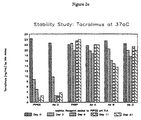
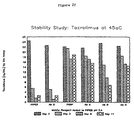
- the antibodies are derived from hybridomas prepared from splenocytes of mice immunized with tacrolimus-protein immunogen following published techniques. Three antibodies (designated AbA, AbB, and AbC) are added to P/B/T (pH 6.1 and 7.4) at a concentration of 5 ⁇ g/mL and the resulting solutions spiked with tacrolimus to a concentration of 20 ng/mL by dilution from the stock solution described in Example 1. As a control, a monoclonal antibody (AbD) that does not react with tacrolimus is spiked into P/B/T at 5 ⁇ g/mL.
- AbD monoclonal antibody
- P/B/T is also prepared with 1 ⁇ g/mL FKBP and spiked with 20 ng/mL tacrolimus.
- the solutions containing drug are incubated at 2-8, 37, and 45 degrees Celsius and assayed according to the commercial assay to determine the concentration of tacrolimus remaining after incubation at the time and temperature indicated.
- the results are shown in Figures 2a through 2f. At both pH 6.1 and 7.4 very little deterioration is seen at 2-8°C. At the elevated temperatures of 37 and 45°C, the decrease in the assayed tacrolimus concentration is dramatic in the unfortified and control (AbD) matrices.
- AbD unfortified and control
- FKBP FKBP
- AbA AbA
- AbC AbB
- the accelerated stability study outlined here is also useful in the evaluation of the stabilizing effect, or protective capacity, of antibodies.
- This example illustrates the preparation of an aqueous composition of the invention utilizing tacrolimus monoclonal antibodies and FKBP as additives to prolong the functional life of tacrolimus calibrators.
- Calibrators having concentrations of tacrolimus of 0, 10, 20, and 30 ng/mL are made up by dilution of a tacrolimus stock solution (Example 1) in P/B/T, pH 6.1.
- These calibrators are fortified with either 1 ⁇ g/mL FKBP or 5 ⁇ g/mL anti-tacrolimus antibody.
- the calibrators are filtered through a 0.2 ⁇ m filter.
- a similar series of calibrators (0, 10, 20, and 30 ng/mL tacrolimus) without FKBP or anti-tacrolimus are prepared in the Tacrolimus assay whole blood diluent (Abbott). All calibrators are stored at 2-8° or 37° C until use.
- a series of tacrolimus samples are prepared in the commercial tacrolimus diluent buffer (Abbott) at 12 (Sample A), 18 (Sample B), and 24 (Sample C) ng/mL and stored until use at -20° C. On the indicated day, a sample of A, B, and C are thawed and the concentration determined in the commercial assay using the fortified calibrators for each of the four diluents. For each set of calibrators at each temperature, a standard curve is generated and the concentration of tacrolimus in the sample computed using point to point data reduction. The results are shown in Figure 3.
- a critical feature determining the functional lifetime of a set of calibrators is that the concentration of the sample determined using the set of calibrators should not change. As shown in Figure 3, as the tacrolimus in a set of calibrators deteriorates under prolonged storage at 37° C, the apparent concentration of drug in samples determined using that set of calibrators will increase. As can be seen, both the FKBP and anti-tacrolimus antibody fortified calibrator compositions of the invention provide a longer functional lifetime in this accelerated stability study.
- This example illustrates the preparation of an aqueous composition of the invention utilizing a binding protein as an additive to prolong the functional life of rapamycin.
- P/B/T is fortified with FKBP at 3 ⁇ g/mL, anti-rapamycin monoclonal antibody at 5 ⁇ g/mL (AbA), or a control antibody at 5 ⁇ g/mL (AbB).
- the whole blood calibrator matrix from the commercial assay kit is used for comparison.
- the matrices are spiked with rapamycin to 40 ng/mL from a stock solution (10 ⁇ g/mL in methanol and stored at -20° C) and stored at 2-8°, 37° C, and ambient temperature.
- Calibrators for each days assay are made fresh by dilution from the methanol stock into P/B/T and kept on ice.
- the assay protocol is similar to that used for the commercial assay, except that the assay microparticles are prepared from an anti-rapamycin monoclonal antibody and the assay conjugate is a rapamycin-CMO-alkaline phosphatase conjugate.
- the extraction-reagent is 1% ZnSO 4 in 40% aqueous Methanol. Before assay, sample and calibrators are diluted with an equal volume of whole blood calibrator diluent or P/B/T to give a final concentration of 50% whole blood calibrator diluent and then extracted 1:1 with extraction reagent.
- the extract is centrifuged and the supernatant is added to the instrument sample well and assayed as previously described.
- the concentration of samples is read from a standard curve generated using point to point data reduction.
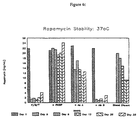
- the results are shown in Fig. 4a through 4c.
- the rapid deterioration of rapamycin in P/B/T and P/B/T & control Ab at ambient temperature and 37°C is evident.
- the protective effect of either FKBP-12 or the anti-rapamycin antibody is also evident and is similar to that of the tacrolimus whole blood diluent composition.
- This example also shows the effectiveness of the binding proteins at stabilizing rapamycin at 2-8°C at days 26 and 36 of this study.
- the following example demonstrates the preparation of an aqueous composition utilizing the binding protein FKBP-12 to stabilize rapamycin calibrators in an assay.
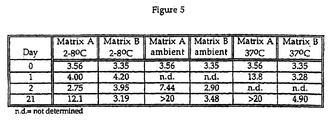
- P/B/T at pH 7.4 (matrix A) or P/B/T, pH 7.4 fortified with 1 ⁇ g/mL FKBP-12 (matrix B) is used to prepare a calibrator set consisting of 0,10 and 20 ng/mL rapamycin.
- a rapamycin control at 4 ng/mL is prepared in the whole blood calibrator diluent and stored at -20°C.
- the calibrator sets are stored at 2-8°C , ambient temperature, or 37°C.
- Concentrations of the control are determined from standard curves obtained from each calibrator set by point to point data reduction.
- Fig.5 The results shown in Fig.5 indicate the deterioration of the rapamycin calibrators at 2-8°C within 12 days, at ambient temperature within 2 days and at 37°C within 1 day.
- the addition of the FKBP-12 to the calibrator matrix significantly retards calibrator deterioration at all 3 temperatures, thus demonstrating the utility of the binding protein in the aqueous rapamycin calibrator matrix.
Landscapes
- Health & Medical Sciences (AREA)
- Life Sciences & Earth Sciences (AREA)
- Engineering & Computer Science (AREA)
- Molecular Biology (AREA)
- Hematology (AREA)
- Immunology (AREA)
- Biomedical Technology (AREA)
- Chemical & Material Sciences (AREA)
- Urology & Nephrology (AREA)
- Physics & Mathematics (AREA)
- Microbiology (AREA)
- Cell Biology (AREA)
- Food Science & Technology (AREA)
- Medicinal Chemistry (AREA)
- Biotechnology (AREA)
- Analytical Chemistry (AREA)
- Biochemistry (AREA)
- General Health & Medical Sciences (AREA)
- General Physics & Mathematics (AREA)
- Pathology (AREA)
- Bioinformatics & Cheminformatics (AREA)
- Pharmacology & Pharmacy (AREA)
- Pharmaceuticals Containing Other Organic And Inorganic Compounds (AREA)
- Medicinal Preparation (AREA)
- Nitrogen And Oxygen Or Sulfur-Condensed Heterocyclic Ring Systems (AREA)
- Peptides Or Proteins (AREA)
- Investigating Or Analysing Biological Materials (AREA)
- Diaphragms For Electromechanical Transducers (AREA)
- Polymerisation Methods In General (AREA)
- Medicines That Contain Protein Lipid Enzymes And Other Medicines (AREA)
Claims (7)
- Procédé de stabilisation d'une composition aqueuse contenant du tacrolimus ou de la rapamycine, qui comprend les étapes d'addition d'une protéine liant le tacrolimus ou la rapamycine, respectivement, à la solution aqueuse.
- Procédé selon la revendication 1, dans lequel la composition contient du tacrolimus et dans laquelle la protéine liante est choisie parmi le groupe consistant en les FKBP et les anticorps anti-tacrolimus.
- Procédé selon la revendication 1, dans lequel la composition contient de la rapamycine et dans laquelle la protéine liante est choisie parmi le groupe consistant en les FKBP et les anticorps anti-rapamycine.
- Procédé selon la revendication 2, dans laquelle le pH de la composition est de 7,4.
- Procédé selon la revendication 2 ou 3, dans lequel la protéine liante est le FKBP 12.
- Procédé pour créer une courbe d'étalonnage à utiliser comme étalon dans un immunodosage du tacrolimus dans un échantillon de patient, comprenant l'étape consistant à réaliser un immunodosage sur des compositions aqueuses d'étalonnage de tacrolimus stabilisées par l'addition d'une protéine liant le tacrolimus, de préférence des anticorps anti-tacrolimus ou un FKBP.
- Procédé pour créer une courbe d'étalonnage à utiliser comme étalon dans un immunodosage de la rapamycine dans un échantillon de patient, comprenant l'étape consistant à réaliser un immunodosage sur des compositions aqueuses d'étalonnage de rapamycine stabilisées par l'addition d'une protéine liant la rapamycine, de préférence des anticorps anti-rapamycine ou un FKBP.
Applications Claiming Priority (3)
| Application Number | Priority Date | Filing Date | Title |
|---|---|---|---|
| US474589 | 1995-06-07 | ||
| US08/474,589 US5635406A (en) | 1995-06-07 | 1995-06-07 | Stabilized standards and calibrators containing rapamycin and tacrolimus bound to anti-rapamycin and anti-tacrolimus antibodies |
| PCT/US1996/007617 WO1996041184A1 (fr) | 1995-06-07 | 1996-05-24 | Etalons et solutions d'etalonnage stabilises |
Publications (2)
| Publication Number | Publication Date |
|---|---|
| EP0832433A1 EP0832433A1 (fr) | 1998-04-01 |
| EP0832433B1 true EP0832433B1 (fr) | 2002-03-20 |
Family
ID=23884190
Family Applications (1)
| Application Number | Title | Priority Date | Filing Date |
|---|---|---|---|
| EP96916602A Expired - Lifetime EP0832433B1 (fr) | 1995-06-07 | 1996-05-24 | Etalons et solutions d'etalonnage stabilises |
Country Status (8)
| Country | Link |
|---|---|
| US (2) | US5635406A (fr) |
| EP (1) | EP0832433B1 (fr) |
| JP (1) | JP3863564B2 (fr) |
| AT (1) | ATE214803T1 (fr) |
| CA (1) | CA2219931C (fr) |
| DE (1) | DE69619982T2 (fr) |
| ES (1) | ES2176459T3 (fr) |
| WO (1) | WO1996041184A1 (fr) |
Families Citing this family (16)
| Publication number | Priority date | Publication date | Assignee | Title |
|---|---|---|---|---|
| US6709873B1 (en) | 1997-04-09 | 2004-03-23 | Isodiagnostika Inc. | Method for production of antibodies to specific sites of rapamycin |
| US7078495B1 (en) * | 1999-08-03 | 2006-07-18 | Dade Behring Inc. | Monoclonal antibodies to tacrolimus and immunoassay methods for tacrolimus |
| US6613083B2 (en) * | 2001-05-02 | 2003-09-02 | Eckhard Alt | Stent device and method |
| US20030054042A1 (en) * | 2001-09-14 | 2003-03-20 | Elaine Liversidge | Stabilization of chemical compounds using nanoparticulate formulations |
| US7186518B2 (en) * | 2003-11-21 | 2007-03-06 | Dade Behring Inc. | Method and composition useful for determining FK 506 |
| US8022188B2 (en) * | 2006-04-24 | 2011-09-20 | Abbott Laboratories | Immunosuppressant binding antibodies and methods of obtaining and using same |
| US7642338B2 (en) * | 2006-06-20 | 2010-01-05 | Siemens Healthcare Diagnostics Inc. | Tacrolimus standard and methods of using same |
| US8809003B2 (en) | 2010-06-25 | 2014-08-19 | Siemens Healthcare Diagnostics Inc. | Reduction in false results in assay measurements |
| US8329424B2 (en) | 2010-06-25 | 2012-12-11 | Siemens Healthcare Diagnostics | Reduction in false results in assay measurements |
| US8409807B2 (en) | 2010-10-22 | 2013-04-02 | T2 Biosystems, Inc. | NMR systems and methods for the rapid detection of analytes |
| US8563298B2 (en) | 2010-10-22 | 2013-10-22 | T2 Biosystems, Inc. | NMR systems and methods for the rapid detection of analytes |
| CA2815085C (fr) | 2010-10-22 | 2022-06-21 | T2 Biosystems, Inc. | Systemes de rmn et procedes de detection rapide d'analytes |
| EP2839038B1 (fr) | 2012-04-20 | 2019-01-16 | T2 Biosystems, Inc. | Compositions et procédés de détection d'espèces de candida |
| GB201309376D0 (en) * | 2013-05-24 | 2013-07-10 | Chronos Therapeutics Ltd | Medical methods and compounds for medical use |
| JP7523776B2 (ja) | 2016-01-21 | 2024-07-29 | ティー2 バイオシステムズ,インコーポレーテッド | 細菌を迅速に検出するnmr法及びシステム |
| CN110849694B (zh) * | 2019-12-02 | 2022-03-18 | 北京丹大生物技术有限公司 | 一种他克莫司全血样本前处理液及其使用方法和应用 |
Citations (1)
| Publication number | Priority date | Publication date | Assignee | Title |
|---|---|---|---|---|
| WO1992018527A1 (fr) * | 1991-04-09 | 1992-10-29 | Children's Research Institute | Analyse de detection de la rapamycine |
Family Cites Families (5)
| Publication number | Priority date | Publication date | Assignee | Title |
|---|---|---|---|---|
| DE3886265T2 (de) * | 1987-06-05 | 1994-04-28 | Fujisawa Pharmaceutical Co | Anti-FR-900506-Stoffe-Antikörper und höchstempfindliches Enzym-Immunoassay-Verfahren. |
| WO1994024568A1 (fr) * | 1993-04-20 | 1994-10-27 | Abbott Laboratories | Etalons de fk506 stables et aqueux |
| WO1993025533A1 (fr) * | 1992-06-05 | 1993-12-23 | Abbott Laboratories | Procedes et reactifs pour le dosage d'immnosuppresseurs |
| GB9307491D0 (en) * | 1993-04-08 | 1993-06-02 | Sandoz Ltd | Organic compounds |
| GB9313163D0 (en) * | 1993-06-25 | 1993-08-11 | Health Lab Service Board | Storage of antibodies |
-
1995
- 1995-06-07 US US08/474,589 patent/US5635406A/en not_active Expired - Lifetime
-
1996
- 1996-05-24 JP JP50070597A patent/JP3863564B2/ja not_active Expired - Lifetime
- 1996-05-24 CA CA2219931A patent/CA2219931C/fr not_active Expired - Lifetime
- 1996-05-24 EP EP96916602A patent/EP0832433B1/fr not_active Expired - Lifetime
- 1996-05-24 WO PCT/US1996/007617 patent/WO1996041184A1/fr not_active Ceased
- 1996-05-24 ES ES96916602T patent/ES2176459T3/es not_active Expired - Lifetime
- 1996-05-24 AT AT96916602T patent/ATE214803T1/de not_active IP Right Cessation
- 1996-05-24 DE DE69619982T patent/DE69619982T2/de not_active Expired - Lifetime
- 1996-09-27 US US08/723,203 patent/US5736401A/en not_active Expired - Lifetime
Patent Citations (1)
| Publication number | Priority date | Publication date | Assignee | Title |
|---|---|---|---|---|
| WO1992018527A1 (fr) * | 1991-04-09 | 1992-10-29 | Children's Research Institute | Analyse de detection de la rapamycine |
Also Published As
| Publication number | Publication date |
|---|---|
| US5635406A (en) | 1997-06-03 |
| DE69619982T2 (de) | 2002-11-21 |
| WO1996041184A1 (fr) | 1996-12-19 |
| ES2176459T3 (es) | 2002-12-01 |
| DE69619982D1 (de) | 2002-04-25 |
| CA2219931A1 (fr) | 1996-12-19 |
| ATE214803T1 (de) | 2002-04-15 |
| CA2219931C (fr) | 2012-05-15 |
| JP2001515581A (ja) | 2001-09-18 |
| EP0832433A1 (fr) | 1998-04-01 |
| US5736401A (en) | 1998-04-07 |
| JP3863564B2 (ja) | 2006-12-27 |
Similar Documents
| Publication | Publication Date | Title |
|---|---|---|
| EP0832433B1 (fr) | Etalons et solutions d'etalonnage stabilises | |
| JP5450092B2 (ja) | 全血中の分子または薬物の検出のための診断検査 | |
| EP0471295B1 (fr) | Réactif pour la précipitation des protéines | |
| Akingba et al. | Endothelial nitric oxide synthase protein expression, localization, and activity in the penis of the alloxan-induced diabetic rat | |
| US8129127B2 (en) | Assay for immunosuppressant drugs | |
| Johnson et al. | Deamidation of calmodulin at neutral and alkaline pH: quantitative relationships between ammonia loss and the susceptibility of calmodulin to modification by protein carboxyl methyltransferase | |
| JPH04233459A (ja) | 可溶化試薬 | |
| US8153594B2 (en) | Tacrolimus standard and methods of using same | |
| BRPI0722361A2 (pt) | Reagente de extração de fármaco imunossupressor para imunoensaios | |
| JP3103379B2 (ja) | レセプター:遊離リガンド(リランド)複合体ならびにそれに基づくアッセイおよびキット | |
| US4622293A (en) | Iodothyronine immunoassays employing HMS as TBP blocking agent | |
| US6066505A (en) | Fluorescence polarization immunoassay | |
| EP2098864A1 (fr) | Methode de dosage immunologique d'un composant urinaire et reactif a utiliser pour cette methode | |
| Westley et al. | Cloned enzyme donor immunoassay tacrolimus assay compared with high-performance liquid chromatography-tandem mass spectrometry and microparticle enzyme immunoassay in liver and renal transplant recipients | |
| Beresini et al. | Evaluation of EMIT cyclosporine assay for use with whole blood | |
| JP4540704B2 (ja) | エベロリムスの測定方法および測定キット | |
| ES2323553T3 (es) | Determinacion de diaminooxidasa. | |
| US4081525A (en) | Radioimmunoassay of plasma steroids | |
| EP0640145B1 (fr) | Mesure d'un marqueur enzymatique afin de faciliter le diagnostic | |
| JP3864261B2 (ja) | マイコフェノリック酸アッセイのための試薬 | |
| Doki et al. | Simultaneous determination of serum flecainide and its metabolites by using high performance liquid chromatography | |
| USRE35419E (en) | Measurement of an enzyme marker as an aid to diagnosis of liver transplant rejection | |
| JPH07289258A (ja) | 溶液中のペルオキシダーゼの安定化方法 | |
| JPH06121683A (ja) | 安定化ペルオキシダーゼ組成物 | |
| JPH0775574A (ja) | 安定なペルオキシダーゼ組成物及び安定な抗体組成物 |
Legal Events
| Date | Code | Title | Description |
|---|---|---|---|
| PUAI | Public reference made under article 153(3) epc to a published international application that has entered the european phase |
Free format text: ORIGINAL CODE: 0009012 |
|
| 17P | Request for examination filed |
Effective date: 19971201 |
|
| AK | Designated contracting states |
Kind code of ref document: A1 Designated state(s): AT BE CH DE ES FR GB IT LI NL |
|
| 17Q | First examination report despatched |
Effective date: 20000616 |
|
| GRAG | Despatch of communication of intention to grant |
Free format text: ORIGINAL CODE: EPIDOS AGRA |
|
| GRAG | Despatch of communication of intention to grant |
Free format text: ORIGINAL CODE: EPIDOS AGRA |
|
| GRAG | Despatch of communication of intention to grant |
Free format text: ORIGINAL CODE: EPIDOS AGRA |
|
| GRAH | Despatch of communication of intention to grant a patent |
Free format text: ORIGINAL CODE: EPIDOS IGRA |
|
| GRAH | Despatch of communication of intention to grant a patent |
Free format text: ORIGINAL CODE: EPIDOS IGRA |
|
| REG | Reference to a national code |
Ref country code: GB Ref legal event code: IF02 |
|
| GRAA | (expected) grant |
Free format text: ORIGINAL CODE: 0009210 |
|
| AK | Designated contracting states |
Kind code of ref document: B1 Designated state(s): AT BE CH DE ES FR GB IT LI NL |
|
| REF | Corresponds to: |
Ref document number: 214803 Country of ref document: AT Date of ref document: 20020415 Kind code of ref document: T |
|
| REG | Reference to a national code |
Ref country code: CH Ref legal event code: EP |
|
| REF | Corresponds to: |
Ref document number: 69619982 Country of ref document: DE Date of ref document: 20020425 |
|
| REG | Reference to a national code |
Ref country code: CH Ref legal event code: NV Representative=s name: A. BRAUN, BRAUN, HERITIER, ESCHMANN AG PATENTANWAE |
|
| ET | Fr: translation filed | ||
| REG | Reference to a national code |
Ref country code: ES Ref legal event code: FG2A Ref document number: 2176459 Country of ref document: ES Kind code of ref document: T3 |
|
| PLBE | No opposition filed within time limit |
Free format text: ORIGINAL CODE: 0009261 |
|
| STAA | Information on the status of an ep patent application or granted ep patent |
Free format text: STATUS: NO OPPOSITION FILED WITHIN TIME LIMIT |
|
| 26N | No opposition filed |
Effective date: 20021223 |
|
| PGFP | Annual fee paid to national office [announced via postgrant information from national office to epo] |
Ref country code: AT Payment date: 20040406 Year of fee payment: 9 |
|
| PGFP | Annual fee paid to national office [announced via postgrant information from national office to epo] |
Ref country code: BE Payment date: 20040603 Year of fee payment: 9 |
|
| PGFP | Annual fee paid to national office [announced via postgrant information from national office to epo] |
Ref country code: CH Payment date: 20040608 Year of fee payment: 9 |
|
| PG25 | Lapsed in a contracting state [announced via postgrant information from national office to epo] |
Ref country code: AT Free format text: LAPSE BECAUSE OF NON-PAYMENT OF DUE FEES Effective date: 20050524 |
|
| PG25 | Lapsed in a contracting state [announced via postgrant information from national office to epo] |
Ref country code: LI Free format text: LAPSE BECAUSE OF NON-PAYMENT OF DUE FEES Effective date: 20050531 Ref country code: CH Free format text: LAPSE BECAUSE OF NON-PAYMENT OF DUE FEES Effective date: 20050531 Ref country code: BE Free format text: LAPSE BECAUSE OF NON-PAYMENT OF DUE FEES Effective date: 20050531 |
|
| BERE | Be: lapsed |
Owner name: *ABBOTT LABORATORIES Effective date: 20050531 |
|
| REG | Reference to a national code |
Ref country code: CH Ref legal event code: PL |
|
| BERE | Be: lapsed |
Owner name: *ABBOTT LABORATORIES Effective date: 20050531 |
|
| PGFP | Annual fee paid to national office [announced via postgrant information from national office to epo] |
Ref country code: NL Payment date: 20110523 Year of fee payment: 16 |
|
| REG | Reference to a national code |
Ref country code: NL Ref legal event code: V1 Effective date: 20121201 |
|
| PG25 | Lapsed in a contracting state [announced via postgrant information from national office to epo] |
Ref country code: NL Free format text: LAPSE BECAUSE OF NON-PAYMENT OF DUE FEES Effective date: 20121201 |
|
| REG | Reference to a national code |
Ref country code: FR Ref legal event code: PLFP Year of fee payment: 20 |
|
| PGFP | Annual fee paid to national office [announced via postgrant information from national office to epo] |
Ref country code: ES Payment date: 20150507 Year of fee payment: 20 Ref country code: GB Payment date: 20150424 Year of fee payment: 20 Ref country code: DE Payment date: 20150601 Year of fee payment: 20 |
|
| PGFP | Annual fee paid to national office [announced via postgrant information from national office to epo] |
Ref country code: FR Payment date: 20150424 Year of fee payment: 20 Ref country code: IT Payment date: 20150513 Year of fee payment: 20 |
|
| REG | Reference to a national code |
Ref country code: DE Ref legal event code: R071 Ref document number: 69619982 Country of ref document: DE |
|
| REG | Reference to a national code |
Ref country code: GB Ref legal event code: PE20 Expiry date: 20160523 |
|
| PG25 | Lapsed in a contracting state [announced via postgrant information from national office to epo] |
Ref country code: GB Free format text: LAPSE BECAUSE OF EXPIRATION OF PROTECTION Effective date: 20160523 |
|
| REG | Reference to a national code |
Ref country code: ES Ref legal event code: FD2A Effective date: 20160831 |
|
| PG25 | Lapsed in a contracting state [announced via postgrant information from national office to epo] |
Ref country code: ES Free format text: LAPSE BECAUSE OF EXPIRATION OF PROTECTION Effective date: 20160525 |