EP0832847B1 - Nanotubes d'oxyde de titane cristallin et procécé pour leur préparation - Google Patents
Nanotubes d'oxyde de titane cristallin et procécé pour leur préparation Download PDFInfo
- Publication number
- EP0832847B1 EP0832847B1 EP97307700A EP97307700A EP0832847B1 EP 0832847 B1 EP0832847 B1 EP 0832847B1 EP 97307700 A EP97307700 A EP 97307700A EP 97307700 A EP97307700 A EP 97307700A EP 0832847 B1 EP0832847 B1 EP 0832847B1
- Authority
- EP
- European Patent Office
- Prior art keywords
- titania
- nanotube
- crystalline titania
- crystal
- temperature
- Prior art date
- Legal status (The legal status is an assumption and is not a legal conclusion. Google has not performed a legal analysis and makes no representation as to the accuracy of the status listed.)
- Expired - Lifetime
Links
Images

Classifications
-
- A—HUMAN NECESSITIES
- A61—MEDICAL OR VETERINARY SCIENCE; HYGIENE
- A61K—PREPARATIONS FOR MEDICAL, DENTAL OR TOILETRY PURPOSES
- A61K8/00—Cosmetics or similar toiletry preparations
- A61K8/02—Cosmetics or similar toiletry preparations characterised by special physical form
-
- A—HUMAN NECESSITIES
- A61—MEDICAL OR VETERINARY SCIENCE; HYGIENE
- A61K—PREPARATIONS FOR MEDICAL, DENTAL OR TOILETRY PURPOSES
- A61K8/00—Cosmetics or similar toiletry preparations
- A61K8/18—Cosmetics or similar toiletry preparations characterised by the composition
- A61K8/19—Cosmetics or similar toiletry preparations characterised by the composition containing inorganic ingredients
- A61K8/29—Titanium; Compounds thereof
-
- A—HUMAN NECESSITIES
- A61—MEDICAL OR VETERINARY SCIENCE; HYGIENE
- A61Q—SPECIFIC USE OF COSMETICS OR SIMILAR TOILETRY PREPARATIONS
- A61Q17/00—Barrier preparations; Preparations brought into direct contact with the skin for affording protection against external influences, e.g. sunlight, X-rays or other harmful rays, corrosive materials, bacteria or insect stings
- A61Q17/04—Topical preparations for affording protection against sunlight or other radiation; Topical sun tanning preparations
-
- B—PERFORMING OPERATIONS; TRANSPORTING
- B01—PHYSICAL OR CHEMICAL PROCESSES OR APPARATUS IN GENERAL
- B01J—CHEMICAL OR PHYSICAL PROCESSES, e.g. CATALYSIS OR COLLOID CHEMISTRY; THEIR RELEVANT APPARATUS
- B01J21/00—Catalysts comprising the elements, oxides, or hydroxides of magnesium, boron, aluminium, carbon, silicon, titanium, zirconium, or hafnium
- B01J21/06—Silicon, titanium, zirconium or hafnium; Oxides or hydroxides thereof
- B01J21/063—Titanium; Oxides or hydroxides thereof
-
- B—PERFORMING OPERATIONS; TRANSPORTING
- B01—PHYSICAL OR CHEMICAL PROCESSES OR APPARATUS IN GENERAL
- B01J—CHEMICAL OR PHYSICAL PROCESSES, e.g. CATALYSIS OR COLLOID CHEMISTRY; THEIR RELEVANT APPARATUS
- B01J35/00—Catalysts, in general, characterised by their form or physical properties
- B01J35/30—Catalysts, in general, characterised by their form or physical properties characterised by their physical properties
- B01J35/39—Photocatalytic properties
-
- B—PERFORMING OPERATIONS; TRANSPORTING
- B01—PHYSICAL OR CHEMICAL PROCESSES OR APPARATUS IN GENERAL
- B01J—CHEMICAL OR PHYSICAL PROCESSES, e.g. CATALYSIS OR COLLOID CHEMISTRY; THEIR RELEVANT APPARATUS
- B01J35/00—Catalysts, in general, characterised by their form or physical properties
- B01J35/70—Catalysts, in general, characterised by their form or physical properties characterised by their crystalline properties, e.g. semi-crystalline
-
- B—PERFORMING OPERATIONS; TRANSPORTING
- B82—NANOTECHNOLOGY
- B82Y—SPECIFIC USES OR APPLICATIONS OF NANOSTRUCTURES; MEASUREMENT OR ANALYSIS OF NANOSTRUCTURES; MANUFACTURE OR TREATMENT OF NANOSTRUCTURES
- B82Y30/00—Nanotechnology for materials or surface science, e.g. nanocomposites
-
- B—PERFORMING OPERATIONS; TRANSPORTING
- B82—NANOTECHNOLOGY
- B82Y—SPECIFIC USES OR APPLICATIONS OF NANOSTRUCTURES; MEASUREMENT OR ANALYSIS OF NANOSTRUCTURES; MANUFACTURE OR TREATMENT OF NANOSTRUCTURES
- B82Y5/00—Nanobiotechnology or nanomedicine, e.g. protein engineering or drug delivery
-
- C—CHEMISTRY; METALLURGY
- C01—INORGANIC CHEMISTRY
- C01G—COMPOUNDS CONTAINING METALS NOT COVERED BY SUBCLASSES C01D OR C01F
- C01G23/00—Compounds of titanium
- C01G23/04—Oxides; Hydroxides
- C01G23/047—Titanium dioxide
-
- A—HUMAN NECESSITIES
- A61—MEDICAL OR VETERINARY SCIENCE; HYGIENE
- A61K—PREPARATIONS FOR MEDICAL, DENTAL OR TOILETRY PURPOSES
- A61K2800/00—Properties of cosmetic compositions or active ingredients thereof or formulation aids used therein and process related aspects
- A61K2800/40—Chemical, physico-chemical or functional or structural properties of particular ingredients
- A61K2800/41—Particular ingredients further characterized by their size
- A61K2800/413—Nanosized, i.e. having sizes below 100 nm
-
- B—PERFORMING OPERATIONS; TRANSPORTING
- B01—PHYSICAL OR CHEMICAL PROCESSES OR APPARATUS IN GENERAL
- B01J—CHEMICAL OR PHYSICAL PROCESSES, e.g. CATALYSIS OR COLLOID CHEMISTRY; THEIR RELEVANT APPARATUS
- B01J2235/00—Indexing scheme associated with group B01J35/00, related to the analysis techniques used to determine the catalysts form or properties
- B01J2235/30—Scanning electron microscopy; Transmission electron microscopy
-
- C—CHEMISTRY; METALLURGY
- C01—INORGANIC CHEMISTRY
- C01P—INDEXING SCHEME RELATING TO STRUCTURAL AND PHYSICAL ASPECTS OF SOLID INORGANIC COMPOUNDS
- C01P2004/00—Particle morphology
- C01P2004/01—Particle morphology depicted by an image
- C01P2004/04—Particle morphology depicted by an image obtained by TEM, STEM, STM or AFM
-
- C—CHEMISTRY; METALLURGY
- C01—INORGANIC CHEMISTRY
- C01P—INDEXING SCHEME RELATING TO STRUCTURAL AND PHYSICAL ASPECTS OF SOLID INORGANIC COMPOUNDS
- C01P2004/00—Particle morphology
- C01P2004/10—Particle morphology extending in one dimension, e.g. needle-like
- C01P2004/13—Nanotubes
-
- C—CHEMISTRY; METALLURGY
- C01—INORGANIC CHEMISTRY
- C01P—INDEXING SCHEME RELATING TO STRUCTURAL AND PHYSICAL ASPECTS OF SOLID INORGANIC COMPOUNDS
- C01P2004/00—Particle morphology
- C01P2004/10—Particle morphology extending in one dimension, e.g. needle-like
- C01P2004/17—Nanostrips, nanoribbons or nanobelts, i.e. solid nanofibres with two significantly differing dimensions between 1-100 nanometer
-
- C—CHEMISTRY; METALLURGY
- C01—INORGANIC CHEMISTRY
- C01P—INDEXING SCHEME RELATING TO STRUCTURAL AND PHYSICAL ASPECTS OF SOLID INORGANIC COMPOUNDS
- C01P2004/00—Particle morphology
- C01P2004/60—Particles characterised by their size
- C01P2004/64—Nanometer sized, i.e. from 1-100 nanometer
-
- C—CHEMISTRY; METALLURGY
- C01—INORGANIC CHEMISTRY
- C01P—INDEXING SCHEME RELATING TO STRUCTURAL AND PHYSICAL ASPECTS OF SOLID INORGANIC COMPOUNDS
- C01P2006/00—Physical properties of inorganic compounds
- C01P2006/12—Surface area
-
- Y—GENERAL TAGGING OF NEW TECHNOLOGICAL DEVELOPMENTS; GENERAL TAGGING OF CROSS-SECTIONAL TECHNOLOGIES SPANNING OVER SEVERAL SECTIONS OF THE IPC; TECHNICAL SUBJECTS COVERED BY FORMER USPC CROSS-REFERENCE ART COLLECTIONS [XRACs] AND DIGESTS
- Y10—TECHNICAL SUBJECTS COVERED BY FORMER USPC
- Y10S—TECHNICAL SUBJECTS COVERED BY FORMER USPC CROSS-REFERENCE ART COLLECTIONS [XRACs] AND DIGESTS
- Y10S977/00—Nanotechnology
- Y10S977/70—Nanostructure
- Y10S977/734—Fullerenes, i.e. graphene-based structures, such as nanohorns, nanococoons, nanoscrolls or fullerene-like structures, e.g. WS2 or MoS2 chalcogenide nanotubes, planar C3N4, etc.
-
- Y—GENERAL TAGGING OF NEW TECHNOLOGICAL DEVELOPMENTS; GENERAL TAGGING OF CROSS-SECTIONAL TECHNOLOGIES SPANNING OVER SEVERAL SECTIONS OF THE IPC; TECHNICAL SUBJECTS COVERED BY FORMER USPC CROSS-REFERENCE ART COLLECTIONS [XRACs] AND DIGESTS
- Y10—TECHNICAL SUBJECTS COVERED BY FORMER USPC
- Y10S—TECHNICAL SUBJECTS COVERED BY FORMER USPC CROSS-REFERENCE ART COLLECTIONS [XRACs] AND DIGESTS
- Y10S977/00—Nanotechnology
- Y10S977/70—Nanostructure
- Y10S977/832—Nanostructure having specified property, e.g. lattice-constant, thermal expansion coefficient
- Y10S977/834—Optical properties of nanomaterial, e.g. specified transparency, opacity, or index of refraction
-
- Y—GENERAL TAGGING OF NEW TECHNOLOGICAL DEVELOPMENTS; GENERAL TAGGING OF CROSS-SECTIONAL TECHNOLOGIES SPANNING OVER SEVERAL SECTIONS OF THE IPC; TECHNICAL SUBJECTS COVERED BY FORMER USPC CROSS-REFERENCE ART COLLECTIONS [XRACs] AND DIGESTS
- Y10—TECHNICAL SUBJECTS COVERED BY FORMER USPC
- Y10S—TECHNICAL SUBJECTS COVERED BY FORMER USPC CROSS-REFERENCE ART COLLECTIONS [XRACs] AND DIGESTS
- Y10S977/00—Nanotechnology
- Y10S977/84—Manufacture, treatment, or detection of nanostructure
- Y10S977/842—Manufacture, treatment, or detection of nanostructure for carbon nanotubes or fullerenes
- Y10S977/843—Gas phase catalytic growth, i.e. chemical vapor deposition
-
- Y—GENERAL TAGGING OF NEW TECHNOLOGICAL DEVELOPMENTS; GENERAL TAGGING OF CROSS-SECTIONAL TECHNOLOGIES SPANNING OVER SEVERAL SECTIONS OF THE IPC; TECHNICAL SUBJECTS COVERED BY FORMER USPC CROSS-REFERENCE ART COLLECTIONS [XRACs] AND DIGESTS
- Y10—TECHNICAL SUBJECTS COVERED BY FORMER USPC
- Y10S—TECHNICAL SUBJECTS COVERED BY FORMER USPC CROSS-REFERENCE ART COLLECTIONS [XRACs] AND DIGESTS
- Y10S977/00—Nanotechnology
- Y10S977/84—Manufacture, treatment, or detection of nanostructure
- Y10S977/895—Manufacture, treatment, or detection of nanostructure having step or means utilizing chemical property
- Y10S977/896—Chemical synthesis, e.g. chemical bonding or breaking
-
- Y—GENERAL TAGGING OF NEW TECHNOLOGICAL DEVELOPMENTS; GENERAL TAGGING OF CROSS-SECTIONAL TECHNOLOGIES SPANNING OVER SEVERAL SECTIONS OF THE IPC; TECHNICAL SUBJECTS COVERED BY FORMER USPC CROSS-REFERENCE ART COLLECTIONS [XRACs] AND DIGESTS
- Y10—TECHNICAL SUBJECTS COVERED BY FORMER USPC
- Y10T—TECHNICAL SUBJECTS COVERED BY FORMER US CLASSIFICATION
- Y10T428/00—Stock material or miscellaneous articles
- Y10T428/13—Hollow or container type article [e.g., tube, vase, etc.]
-
- Y—GENERAL TAGGING OF NEW TECHNOLOGICAL DEVELOPMENTS; GENERAL TAGGING OF CROSS-SECTIONAL TECHNOLOGIES SPANNING OVER SEVERAL SECTIONS OF THE IPC; TECHNICAL SUBJECTS COVERED BY FORMER USPC CROSS-REFERENCE ART COLLECTIONS [XRACs] AND DIGESTS
- Y10—TECHNICAL SUBJECTS COVERED BY FORMER USPC
- Y10T—TECHNICAL SUBJECTS COVERED BY FORMER US CLASSIFICATION
- Y10T428/00—Stock material or miscellaneous articles
- Y10T428/13—Hollow or container type article [e.g., tube, vase, etc.]
- Y10T428/131—Glass, ceramic, or sintered, fused, fired, or calcined metal oxide or metal carbide containing [e.g., porcelain, brick, cement, etc.]
-
- Y—GENERAL TAGGING OF NEW TECHNOLOGICAL DEVELOPMENTS; GENERAL TAGGING OF CROSS-SECTIONAL TECHNOLOGIES SPANNING OVER SEVERAL SECTIONS OF THE IPC; TECHNICAL SUBJECTS COVERED BY FORMER USPC CROSS-REFERENCE ART COLLECTIONS [XRACs] AND DIGESTS
- Y10—TECHNICAL SUBJECTS COVERED BY FORMER USPC
- Y10T—TECHNICAL SUBJECTS COVERED BY FORMER US CLASSIFICATION
- Y10T428/00—Stock material or miscellaneous articles
- Y10T428/13—Hollow or container type article [e.g., tube, vase, etc.]
- Y10T428/131—Glass, ceramic, or sintered, fused, fired, or calcined metal oxide or metal carbide containing [e.g., porcelain, brick, cement, etc.]
- Y10T428/1314—Contains fabric, fiber particle, or filament made of glass, ceramic, or sintered, fused, fired, or calcined metal oxide, or metal carbide or other inorganic compound [e.g., fiber glass, mineral fiber, sand, etc.]
Definitions
- Titania (TiO 2 ) has excellent ultraviolet absorbability, absorbent properties and the like. Accordingly, it has been widely used as
- titania is of interest.
- the titania is applied to environmental cleanup or the like, for the decomposition of carbonaceous gas or nitrogen oxides whilst utilizing its superior oxidation and reduction properties.
- One of the conventional technologies for improving the properties of titania is by doping with SiO 2 , producing an increased specific surface area.
- Nanotubes of anastase titania having an outer diameter of between 140 and 180 nm are disclosed in P. Hoyer's "Formation of titanium dioxide nanotube array", Langmuir, vol. 12, 1996 p. 1411-1413. The document also discusses an electrodeposition process for producing the nanotubes which involves the addition of NaHCO 3 to the electrolyte solution
- the present invention is to provide crystalline titania in a nanotube which is a novel crystal shape.
- the diameter of the nanotube varies depending on the production conditions and the like. It is approximately between 5 and 80 nm in many cases.
- the crystal structure which is easy to obtain is an anatase type.
- This nanotube is formed by treating crystalline titania with an alkali.
- the alkali treatment can be conducted at a temperature of from 18 to 160°C using from 13 to 65 percent by weight of sodium hydroxide expressed as parts of sodium hydroxide per 100 parts of solvent (water).
- the nanotube is a hollow crystal, the specific surface area is increased as compared with a solid crystal such as a needle crystal, and the specific surface area in the volume occupied is increased. Accordingly, it is expected to markedly improve the properties of the crystalline titania. Furthermore the crystal is expected to find novel use in filters and the like by utilizing the nanotube shape.
- Fig.1 is a view showing a model shape of crystalline titania in the present invention.
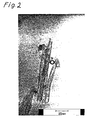
- Fig.2 is a transmission electron micrograph of Sample No.1-11 (40% x 110°C x 20 hours) in the Examples.
- the crystalline titania of the present invention is a nanotube as shown in Fig.1
- the diameter of this nanotube varies depending on the production conditions. It is usually between approximately 5 and 80 nm. The length thereof also varies depending on the production conditions. It is usually between 50 and 150 nm. The thickness thereof is usually between 2 and 10 nm.
- the anatase type is easily obtainable as shown in Tables 1 and 2.
- % by weight which refers to the alkali concentration means parts of alkali per 100 parts of solvent (water).
- the crystalline titania which has a nanotube shape in the present invention is produced by treating a titania powder with an alkali.
- the titania powder (crystalline titania) used herein has a particle diameter of, usually from 2 to 100 nm, preferably from 2 to 20 nm whether it is an anatase type or a rutile type.
- titania powders produced from a titanium ore such as anatase, rutile, brookite and the like by the following known liquid phase method, vapor deposition method or sol-gel method.
- Vapor deposition method here referred to is a method in which titania is produced by hydrolysing a titanium ore by heating a strong acid such as sulfuric acid or the like, and heating the resulting hydrous titanium oxide at from 800 to 850°C.
- Liquid phase method here referred to is a method in which titania is produced by contacting TiCl, with O 2 . and H 2 .
- Solid-gel method here referred to is a method in which titania is produced by hydrolysing titanium alkoxide including Ti(OR) 4 , in an alcohol aqueous solution to form a sol, adding a hydrolase to the sol, allowing the mixture to stand for gelation, and heating the gel.
- a titania powder is dipped in from 13 to 65% by weight of sodium hydroxide at a temperature of from 18 to 160°C for from 1 to 50 hours.
- it is dipped in from 18 to 55% by weight of sodium hydroxide at a temperature of from 18 to 120°C.
- it is dipped in from 30 to 50% by weight of sodium hydroxide at a temperature of from 50 to 120°C for from 2 to 20 hours.
- the temperature may be low (refer to Sample Nos. 1-9 and 2-4).
- the alkali concentration may be relatively low (refer to Sample Nos.1-8 and 2-3).
- the concentration of sodium hydroxide is less than 13% by weight, the reaction time may be too long to form a tube, and it is not efficient from the industrial viewpoint.
- it exceeds 65% by weight the tube is hardly formed (refer to Sample Nos.1-15, 1-16, 1-17, 2-10, 2-11 and 2-12).
- the temperature is less than 18°C, the reaction time for forming a tube is prolonged.
- the temperature exceeds 180°C, the tube is hardly formed.
- the nanotube crystal aggregate can hardly be produced without the above-mentioned ranges.
- Alkali treatment may be conducted in an open vessel, that is, under normal pressure (at atmospheric pressure). It is, however, advisable to conduct it in a sealed vessel. The evaporation of water is suppressed in the sealed vessel to stabilize the alkali concentration.
- the temperature is increased to 100°C or more in the sealed vessel, the pressure is increased and a nanotube having a small diameter is easily produced as compared with the alkali treatment in an open vessel.
- the alkali treatment is conducted in the sealed vessel under increased pressure of 1.5 atm (calculated), a nanotube having a small diameter of from 5 to 10 is obtained.
- the alkali treatment includes a step of water-washing as a final step. It is advisable to neutralise the resulting product with an inorganic acid such as dilute hydrochloric acid or the like.
- the above-obtained nanotube titania may further be heat-treated at from 200 to 1,200°C for from 10 to 400 minutes, preferably at from 300 to 800° for from 60 to 160 minutes.
- This heat treatment is expected to improve the crystallinity of TiO 2 and to increase the catalytic activity.
- the nanotube does not collapse through this heat treatment. Further, it does not collapse either upon using a pulverizer.
- the specific surface area of the above-obtained nanotube titania in the present invention is by far larger than that of the spherical or needle crystal.
- this titania when used as an ultraviolet absorber, a masking agent, an adsorbent or an optically active catalyst, the increase in the specific surface area can be expected, and especially the specific surface area per unit volume can be greatly improved.
- this titania When used as a catalyst, it may be ordinarily supported on a metal such as platinum, nickel, silver or the like.
- This nanotube titania can be used in such as (a) a filter; (b) a material with a new performance which is obtained by inserting an organic, inorganic, or metal material therein; and (c) a magnetic substance with new magnetic properties which is obtained by inserting a magnetic material therein.
- the present invention is illustrated by way of Example.
- the gel was heated with an electric oven at 600°C for 2 hours. Then, the heated product was pulverised using an agate mortar to obtain a fine powder.
- each of the titania powders was treated with alkali under conditions shown in Tables 1 and 2 (those other than Sample No.1-12 and 2-7 were treated in a sealed vessel). The treated powders were subsequently neutralized with 0.1N-HCl aqueous solution. In this manner, the test powders were prepared.
- test powders were dispersed in an ethanol aqueous solution.
- a droplet of the dispersion was dropped on a test stand using a pipet, and observed using a transmission electron microscope to estimate the shape of the crystalline titania.
Landscapes
- Chemical & Material Sciences (AREA)
- Engineering & Computer Science (AREA)
- Life Sciences & Earth Sciences (AREA)
- Health & Medical Sciences (AREA)
- Organic Chemistry (AREA)
- Materials Engineering (AREA)
- General Health & Medical Sciences (AREA)
- Nanotechnology (AREA)
- Chemical Kinetics & Catalysis (AREA)
- Animal Behavior & Ethology (AREA)
- Veterinary Medicine (AREA)
- Public Health (AREA)
- Inorganic Chemistry (AREA)
- Birds (AREA)
- Crystallography & Structural Chemistry (AREA)
- Epidemiology (AREA)
- Geology (AREA)
- Biotechnology (AREA)
- Composite Materials (AREA)
- Condensed Matter Physics & Semiconductors (AREA)
- General Physics & Mathematics (AREA)
- General Life Sciences & Earth Sciences (AREA)
- Environmental & Geological Engineering (AREA)
- Bioinformatics & Cheminformatics (AREA)
- Biophysics (AREA)
- Physics & Mathematics (AREA)
- General Engineering & Computer Science (AREA)
- Medical Informatics (AREA)
- Medicinal Chemistry (AREA)
- Molecular Biology (AREA)
- Pharmacology & Pharmacy (AREA)
- Dermatology (AREA)
- Catalysts (AREA)
- Inorganic Compounds Of Heavy Metals (AREA)
Claims (10)
- Titane cristallin caractérisé en ce que le cristal est en forme de nanotube présentant un diamètre situé entre 5 et 80 mm.
- Titane cristallin selon la revendication 1, caractérisé en ce que la structure cristalline est de type anatase.
- Procédé de fabrication de titane cristallin dont le cristal est en forme de nanotube, caractérisé en ce qu'il comprend une étape de traitement du titane cristallin par NaOH.
- Procédé de fabrication selon la revendication 3, caractérisé en ce que le nanotube présente un diamètre sensiblement compris entre 5 et 80 mm.
- Procédé de fabrication selon la revendication 3, caractérisé en ce que le traitement par NaOH est effectué à une température située entre 18 et 160°C en utilisant de 13 à 65 pourcents en poids d'hydroxyde de sodium.
- Procédé de fabrication selon la revendication 3, caractérisé en ce que le traitement par NaOH est effectué à une température située entre 18 et 120°C en utilisant de 18 à 55 pourcents en poids d'hydroxyde de sodium.
- Procédé de fabrication selon la revendication 6, caractérisé en ce que le traitement par NaOH est effectué à une température située entre 50 et 120°C en utilisant de 30 à 50 pourcents en poids d'hydroxyde de sodium.
- Procédé de fabrication selon la revendication 3, caractérisé en ce que le traitement par NaOH est effectué sous forte pression dans un récipient étanche.
- Procédé de fabrication selon la revendication 3, caractérisé en ce qu'après le traitement du titane cristallin avec NaOH, le produit est lavé à l'eau puis neutralisé.
- Procédé de fabrication selon la revendication 3, caractérisé en ce qu'après le traitement par NaOH, le produit est en outre traité par la chaleur à une température allant de 200 à 1.200°C pendant de 10 à 400 minutes.
Applications Claiming Priority (3)
| Application Number | Priority Date | Filing Date | Title |
|---|---|---|---|
| JP25918296 | 1996-09-30 | ||
| JP259182/96 | 1996-09-30 | ||
| JP25918296 | 1996-09-30 |
Publications (2)
| Publication Number | Publication Date |
|---|---|
| EP0832847A1 EP0832847A1 (fr) | 1998-04-01 |
| EP0832847B1 true EP0832847B1 (fr) | 2002-04-03 |
Family
ID=17330515
Family Applications (1)
| Application Number | Title | Priority Date | Filing Date |
|---|---|---|---|
| EP97307700A Expired - Lifetime EP0832847B1 (fr) | 1996-09-30 | 1997-09-30 | Nanotubes d'oxyde de titane cristallin et procécé pour leur préparation |
Country Status (3)
| Country | Link |
|---|---|
| US (2) | US6027775A (fr) |
| EP (1) | EP0832847B1 (fr) |
| DE (1) | DE69711526T2 (fr) |
Cited By (4)
| Publication number | Priority date | Publication date | Assignee | Title |
|---|---|---|---|---|
| AU2004203522B2 (en) * | 2003-08-01 | 2009-01-08 | Jgc Catalysts And Chemicals Ltd. | Fibrous titanium oxide particles, production method thereof and uses of particles |
| US7547490B2 (en) | 2001-07-31 | 2009-06-16 | Altairnano Inc. | High performance lithium titanium spinel Li4Ti5012 for electrode material |
| US8420264B2 (en) | 2007-03-30 | 2013-04-16 | Altairnano, Inc. | Method for preparing a lithium ion cell |
| EP3034565A1 (fr) | 2014-12-16 | 2016-06-22 | Technische Hochschule Nuernberg Georg-Simon-Ohm | Nanostructures conductrices d'électricité contenant du titane |
Families Citing this family (46)
| Publication number | Priority date | Publication date | Assignee | Title |
|---|---|---|---|---|
| EP1300374A4 (fr) * | 2000-07-12 | 2006-04-12 | Nippon Sheet Glass Co Ltd | Element photocatalytique |
| WO2002032574A2 (fr) * | 2000-10-17 | 2002-04-25 | Altair Nanomaterials Inc. | Procede de production de structures catalytiques |
| DE10110468B4 (de) * | 2001-03-05 | 2007-06-21 | Infineon Technologies Ag | Wellenlängenselektives Filterelement sowie Filtersystem mit einem solchen Filterelement |
| EP1426107A1 (fr) * | 2001-06-15 | 2004-06-09 | Andes Electric Co., Ltd. | Materiau de photocatalyseur et son procede de preparation |
| CA2454324C (fr) | 2001-07-20 | 2012-01-03 | Altair Nanomaterials Inc. | Procede destine a fabriquer du titanate de lithium |
| WO2003037798A1 (fr) * | 2001-10-30 | 2003-05-08 | Catalysts & Chemicals Industries Co., Ltd. | Particules d'oxyde de titane tubulaires, leur procede de preparation et leur utilisation |
| KR100455297B1 (ko) * | 2002-06-19 | 2004-11-06 | 삼성전자주식회사 | 무기물 나노튜브 제조방법 |
| WO2004057064A1 (fr) * | 2002-12-21 | 2004-07-08 | Juridical Foundation Osaka Industrial Promotion Organization | Nanostructure d'oxyde, son procede de production et son utilisation |
| WO2004092072A1 (fr) * | 2003-04-15 | 2004-10-28 | Sumitomo Chemical Company, Limited | Nanotube en oxyde de titane et procede de production d'un tel nanotube |
| JP2005008510A (ja) * | 2003-05-29 | 2005-01-13 | Institute Of Physical & Chemical Research | ナノチューブ材料の製造方法およびナノチューブ材料 |
| US7645439B2 (en) | 2003-10-10 | 2010-01-12 | Instituto Mexicano Del Petroleo | Nanostructured titanium oxide material and its synthesis procedure |
| US7416655B2 (en) * | 2003-10-10 | 2008-08-26 | Instituto Mexicano Del Petroleo | Selective adsorbent material and its use |
| MXPA04004265A (es) * | 2004-05-04 | 2005-11-09 | Mexicano Inst Petrol | Material de oxido de titanio nanoestructurado y procedimiento para su obtencion. |
| MXPA04008055A (es) * | 2004-08-19 | 2006-02-22 | Mexicano Inst Petrol | Material adsorbente selectivo de compuestos nitrogenados y/o azufrados en fracciones de hidrocarburos del petroleo y procedimiento de aplicacion. |
| US7482304B2 (en) | 2003-12-10 | 2009-01-27 | Altair Nanomaterials Inc. | Method for producing structures |
| JP4585212B2 (ja) * | 2004-03-19 | 2010-11-24 | Jx日鉱日石エネルギー株式会社 | ナノチューブ形状を有するチタニア及びその製造方法 |
| US7326399B2 (en) * | 2005-04-15 | 2008-02-05 | Headwaters Technology Innovation, Llc | Titanium dioxide nanoparticles and nanoparticle suspensions and methods of making the same |
| EP1943374A2 (fr) * | 2005-09-09 | 2008-07-16 | University of Nevada, Reno | Préparation d'un substrat en oxyde de titane nanotubulaire avec des lacunes d'oxygène et utilisation de ce dernier dans la photoélectrolyse de l'eau |
| KR100977349B1 (ko) * | 2005-09-30 | 2010-08-20 | 사까이가가꾸고오교가부시끼가이샤 | 루틸형 미립자 산화티탄의 제조 방법 |
| US8883115B2 (en) * | 2006-01-12 | 2014-11-11 | University Of Arkansas Technology Development Foundation | TiO2 nanostructures, membranes and films, and methods of making same |
| CN100427404C (zh) * | 2006-07-27 | 2008-10-22 | 北京先讯东泰科技有限公司 | 一种制备二氧化钛纳米线的方法及由此制得的二氧化钛纳米线的用途 |
| US8822030B2 (en) | 2006-08-11 | 2014-09-02 | Aqua Resources Corporation | Nanoplatelet metal hydroxides and methods of preparing same |
| US7736485B2 (en) * | 2006-08-11 | 2010-06-15 | Aqua Resources Corporation | Nanoplatelet magnesium hydroxides and methods of preparing same |
| KR100850027B1 (ko) | 2006-12-19 | 2008-08-04 | 나노케미칼 주식회사 | 티타네이트 나노튜브의 제조방법 |
| BRPI0700849B1 (pt) | 2007-03-21 | 2015-10-27 | Petroleo Brasileiro Sa | processo contínuo para preparar nanotubos de titanatos de sódio |
| EE05390B1 (et) | 2007-06-07 | 2011-04-15 | Tartu �likool | Meetod oksiidmaterjali valmistamiseks ja oksiidmaterjal |
| JP5511159B2 (ja) * | 2007-10-16 | 2014-06-04 | 宇部エクシモ株式会社 | 光触媒膜、光触媒膜の製造方法、物品および親水化方法 |
| US20090117384A1 (en) * | 2007-11-07 | 2009-05-07 | Brookhaven Science Associates, Llc | Titania Nanocavities and Method of Making |
| BRPI0705895B1 (pt) | 2007-12-13 | 2016-05-03 | Petroleo Brasileiro Sa | processo para a produção de biodiesel |
| US20090247391A1 (en) * | 2008-04-01 | 2009-10-01 | The Board Of Regents Of The Nevada System Of Higher Ed, On Behalf Of The Univ. Of Nevada, Reno | Nitrogen fixation by titanium dioxide |
| KR100987825B1 (ko) * | 2008-05-26 | 2010-10-18 | 한국화학연구원 | 로드형 티타니아 나노입자의 제조방법 |
| KR101332526B1 (ko) | 2008-06-20 | 2013-11-22 | 오사까 가스 가부시키가이샤 | 산화티탄 구조체 및 다공질 산화티탄 조성물 |
| MD4063C1 (ro) * | 2010-02-18 | 2011-03-31 | Технический университет Молдовы | Procedeu de obţinere a nanotuburilor din dioxid de titan pe suport de titan |
| CZ2010348A3 (cs) * | 2010-05-04 | 2011-02-09 | Ústav makromolekulární chemie AV CR, v.v.i. | Nanotrubky na bázi oxidu titanicitého a zpusob jejich prípravy |
| TWI424957B (zh) * | 2010-12-08 | 2014-02-01 | Taiwan Textile Res Inst | 石墨烯/奈米二氧化鈦複合物及其製備方法 |
| WO2012096346A1 (fr) | 2011-01-14 | 2012-07-19 | 独立行政法人物質・材料研究機構 | Nanostructure chargée avec un composé adsorbeur d'ion d'arsenic et procédé de récupération d'ion d'arsenic utilisant celle-ci |
| EP2885251B1 (fr) * | 2012-08-17 | 2016-08-03 | Council of Scientific & Industrial Research | Procédé pour la décomposition de colorants synthétiques organiques utilisant des nanotubes d'oxydes semi-conducteurs par catalyse dans le noir |
| US9908101B2 (en) | 2012-11-07 | 2018-03-06 | Council Of Scientific & Industrial Research | Catalyst for selective dehydrogenation / oxidative dehydrogenation reactions and process for the preparation thereof |
| US10130917B2 (en) | 2013-02-06 | 2018-11-20 | Northeastern University | Filtering article containing titania nanotubes |
| WO2014188448A1 (fr) | 2013-05-24 | 2014-11-27 | Council Of Scientific & Industrial Research | Particules composites à base de nanotubes de type semi-conducteurs-oxydes utiles pour l'élimination des colorants et procédé associé |
| US9873115B2 (en) * | 2013-07-01 | 2018-01-23 | The Regents Of The University Of Colorado, A Body Corporate | Nanostructured photocatalysts and doped wide-bandgap semiconductors |
| US10828400B2 (en) | 2014-06-10 | 2020-11-10 | The Research Foundation For The State University Of New York | Low temperature, nanostructured ceramic coatings |
| JP6167201B2 (ja) * | 2016-04-08 | 2017-07-19 | 日本パーミル株式会社 | 紫外線遮蔽素材及び紫外線遮蔽素材の製造方法 |
| WO2018118851A1 (fr) * | 2016-12-19 | 2018-06-28 | University Of Cincinnati | Filtre de carbone photocatalytique |
| BE1029032B1 (de) * | 2021-06-03 | 2022-08-16 | Univ Henan | Herstellungsverfahren und Anwendung von Li, C, N ternär co-dotierten Titandioxid-Nanomaterialien |
| KR102731240B1 (ko) * | 2021-12-22 | 2024-11-18 | 한국건설기술연구원 | 광촉매 입상체와 그 제조방법 |
Family Cites Families (4)
| Publication number | Priority date | Publication date | Assignee | Title |
|---|---|---|---|---|
| US5958358A (en) * | 1992-07-08 | 1999-09-28 | Yeda Research And Development Co., Ltd. | Oriented polycrystalline thin films of transition metal chalcogenides |
| JP3738371B2 (ja) * | 1995-03-27 | 2006-01-25 | 中部電力株式会社 | チタニア系触媒の製造方法 |
| JP4184451B2 (ja) * | 1995-09-06 | 2008-11-19 | 中部電力株式会社 | チタニア系触媒の製造方法 |
| US5897945A (en) * | 1996-02-26 | 1999-04-27 | President And Fellows Of Harvard College | Metal oxide nanorods |
-
1997
- 1997-09-25 US US08/937,885 patent/US6027775A/en not_active Expired - Lifetime
- 1997-09-30 DE DE69711526T patent/DE69711526T2/de not_active Expired - Fee Related
- 1997-09-30 EP EP97307700A patent/EP0832847B1/fr not_active Expired - Lifetime
-
1999
- 1999-08-24 US US09/382,125 patent/US6537517B1/en not_active Expired - Fee Related
Cited By (4)
| Publication number | Priority date | Publication date | Assignee | Title |
|---|---|---|---|---|
| US7547490B2 (en) | 2001-07-31 | 2009-06-16 | Altairnano Inc. | High performance lithium titanium spinel Li4Ti5012 for electrode material |
| AU2004203522B2 (en) * | 2003-08-01 | 2009-01-08 | Jgc Catalysts And Chemicals Ltd. | Fibrous titanium oxide particles, production method thereof and uses of particles |
| US8420264B2 (en) | 2007-03-30 | 2013-04-16 | Altairnano, Inc. | Method for preparing a lithium ion cell |
| EP3034565A1 (fr) | 2014-12-16 | 2016-06-22 | Technische Hochschule Nuernberg Georg-Simon-Ohm | Nanostructures conductrices d'électricité contenant du titane |
Also Published As
| Publication number | Publication date |
|---|---|
| US6027775A (en) | 2000-02-22 |
| EP0832847A1 (fr) | 1998-04-01 |
| DE69711526T2 (de) | 2002-09-26 |
| DE69711526D1 (de) | 2002-05-08 |
| US6537517B1 (en) | 2003-03-25 |
Similar Documents
| Publication | Publication Date | Title |
|---|---|---|
| EP0832847B1 (fr) | Nanotubes d'oxyde de titane cristallin et procécé pour leur préparation | |
| JP3513738B2 (ja) | ナノチューブ体のチタニアの製造方法 | |
| Wang et al. | Sol− gel synthesis and hydrothermal processing of anatase and rutile titania nanocrystals | |
| JP4093744B2 (ja) | 管状酸化チタン粒子の製造方法および管状酸化チタン粒子 | |
| EP1711259B1 (fr) | Particules nanostructurees a stabilite thermique elevee | |
| JP3609262B2 (ja) | 酸化チタンゾルおよびその製造方法 | |
| JP4698981B2 (ja) | 繊維状酸化チタン粒子とその製造方法ならびに該粒子の用途 | |
| JP3076844B1 (ja) | メソポーラス酸化チタン多孔体およびその製造方法 | |
| KR101233570B1 (ko) | 항균성 소취제 및 그 제조방법 | |
| CN101391811A (zh) | 一种高比表面积二氧化钛的制备方法 | |
| JP2009521392A5 (fr) | ||
| JP3983533B2 (ja) | 結晶チタニア | |
| JP3674009B2 (ja) | 無定形酸化チタンゾルの製造方法 | |
| JP2004035362A (ja) | 管状酸化チタン粒子および管状酸化チタン粒子の製造方法 | |
| JP2004331490A (ja) | チタニアナノチューブおよびその製造方法 | |
| CN1296274C (zh) | 单分散二氧化硅与二氧化钛复合微球及制备方法 | |
| JP2004161592A (ja) | アナターゼ型チタニア−シリカ複合体とその製造法 | |
| JP4521801B2 (ja) | 有機溶媒分散型酸化チタンゾル及びその製造方法 | |
| JP3970603B2 (ja) | 有機溶媒分散型酸化チタンゾルの製造方法 | |
| JP4521795B2 (ja) | 酸化チタンゾル組成物 | |
| KR100664751B1 (ko) | 티타니아 나노튜브의 제조방법 | |
| JP3374305B2 (ja) | チタニア系触媒の製造方法 | |
| KR100453446B1 (ko) | 광촉매분산액의 제조방법 | |
| JP4706053B2 (ja) | 酸化チタンナノチューブ構造体の簡易な製造方法及びその製法で得られた酸化チタンナノチューブ構造体 | |
| JPH08257399A (ja) | チタニア系触媒の製造方法 |
Legal Events
| Date | Code | Title | Description |
|---|---|---|---|
| PUAI | Public reference made under article 153(3) epc to a published international application that has entered the european phase |
Free format text: ORIGINAL CODE: 0009012 |
|
| AK | Designated contracting states |
Kind code of ref document: A1 Designated state(s): DE FR GB |
|
| 17P | Request for examination filed |
Effective date: 19980803 |
|
| AKX | Designation fees paid |
Free format text: DE FR GB |
|
| RBV | Designated contracting states (corrected) |
Designated state(s): DE FR GB |
|
| 17Q | First examination report despatched |
Effective date: 20000530 |
|
| GRAG | Despatch of communication of intention to grant |
Free format text: ORIGINAL CODE: EPIDOS AGRA |
|
| RTI1 | Title (correction) |
Free format text: NANOTUBES OF CRYSTALLINE TITANIA AND PROCESS FOR PRODUCING THE SAME |
|
| GRAG | Despatch of communication of intention to grant |
Free format text: ORIGINAL CODE: EPIDOS AGRA |
|
| GRAG | Despatch of communication of intention to grant |
Free format text: ORIGINAL CODE: EPIDOS AGRA |
|
| GRAH | Despatch of communication of intention to grant a patent |
Free format text: ORIGINAL CODE: EPIDOS IGRA |
|
| GRAH | Despatch of communication of intention to grant a patent |
Free format text: ORIGINAL CODE: EPIDOS IGRA |
|
| REG | Reference to a national code |
Ref country code: GB Ref legal event code: IF02 |
|
| GRAA | (expected) grant |
Free format text: ORIGINAL CODE: 0009210 |
|
| AK | Designated contracting states |
Kind code of ref document: B1 Designated state(s): DE FR GB |
|
| REF | Corresponds to: |
Ref document number: 69711526 Country of ref document: DE Date of ref document: 20020508 |
|
| ET | Fr: translation filed | ||
| PLBE | No opposition filed within time limit |
Free format text: ORIGINAL CODE: 0009261 |
|
| STAA | Information on the status of an ep patent application or granted ep patent |
Free format text: STATUS: NO OPPOSITION FILED WITHIN TIME LIMIT |
|
| 26N | No opposition filed |
Effective date: 20030106 |
|
| PGFP | Annual fee paid to national office [announced via postgrant information from national office to epo] |
Ref country code: DE Payment date: 20070921 Year of fee payment: 11 |
|
| PGFP | Annual fee paid to national office [announced via postgrant information from national office to epo] |
Ref country code: GB Payment date: 20070914 Year of fee payment: 11 |
|
| PGFP | Annual fee paid to national office [announced via postgrant information from national office to epo] |
Ref country code: FR Payment date: 20070831 Year of fee payment: 11 |
|
| GBPC | Gb: european patent ceased through non-payment of renewal fee |
Effective date: 20080930 |
|
| REG | Reference to a national code |
Ref country code: FR Ref legal event code: ST Effective date: 20090529 |
|
| PG25 | Lapsed in a contracting state [announced via postgrant information from national office to epo] |
Ref country code: DE Free format text: LAPSE BECAUSE OF NON-PAYMENT OF DUE FEES Effective date: 20090401 |
|
| PG25 | Lapsed in a contracting state [announced via postgrant information from national office to epo] |
Ref country code: FR Free format text: LAPSE BECAUSE OF NON-PAYMENT OF DUE FEES Effective date: 20080930 |
|
| PG25 | Lapsed in a contracting state [announced via postgrant information from national office to epo] |
Ref country code: GB Free format text: LAPSE BECAUSE OF NON-PAYMENT OF DUE FEES Effective date: 20080930 |