EP0833951B1 - Verfahren zur herstellung von wärmebehandeltem stahlguss und stahlgussstück - Google Patents
Verfahren zur herstellung von wärmebehandeltem stahlguss und stahlgussstück Download PDFInfo
- Publication number
- EP0833951B1 EP0833951B1 EP97916559A EP97916559A EP0833951B1 EP 0833951 B1 EP0833951 B1 EP 0833951B1 EP 97916559 A EP97916559 A EP 97916559A EP 97916559 A EP97916559 A EP 97916559A EP 0833951 B1 EP0833951 B1 EP 0833951B1
- Authority
- EP
- European Patent Office
- Prior art keywords
- casting
- range
- lying
- temperature
- heat treatment
- Prior art date
- Legal status (The legal status is an assumption and is not a legal conclusion. Google has not performed a legal analysis and makes no representation as to the accuracy of the status listed.)
- Expired - Lifetime
Links
- 238000005266 casting Methods 0.000 title claims abstract description 138
- 229910000831 Steel Inorganic materials 0.000 title claims abstract description 42
- 239000010959 steel Substances 0.000 title claims abstract description 42
- 238000004519 manufacturing process Methods 0.000 title claims abstract description 9
- 238000010438 heat treatment Methods 0.000 claims abstract description 57
- 229910052799 carbon Inorganic materials 0.000 claims abstract description 38
- OKTJSMMVPCPJKN-UHFFFAOYSA-N Carbon Chemical compound [C] OKTJSMMVPCPJKN-UHFFFAOYSA-N 0.000 claims abstract description 36
- 238000001816 cooling Methods 0.000 claims abstract description 21
- 238000010791 quenching Methods 0.000 claims abstract description 12
- 230000000171 quenching effect Effects 0.000 claims abstract description 12
- 229910045601 alloy Inorganic materials 0.000 claims abstract description 11
- 239000000956 alloy Substances 0.000 claims abstract description 11
- 229910000859 α-Fe Inorganic materials 0.000 claims description 28
- 229910001566 austenite Inorganic materials 0.000 claims description 17
- 229910052720 vanadium Inorganic materials 0.000 claims description 17
- 229910001563 bainite Inorganic materials 0.000 claims description 16
- 238000000034 method Methods 0.000 claims description 15
- 229910052782 aluminium Inorganic materials 0.000 claims description 14
- 229910052748 manganese Inorganic materials 0.000 claims description 14
- 229910052719 titanium Inorganic materials 0.000 claims description 14
- 229910052721 tungsten Inorganic materials 0.000 claims description 14
- 229910052804 chromium Inorganic materials 0.000 claims description 13
- 229910052710 silicon Inorganic materials 0.000 claims description 13
- 229910052802 copper Inorganic materials 0.000 claims description 12
- 150000001247 metal acetylides Chemical class 0.000 claims description 11
- 229910052759 nickel Inorganic materials 0.000 claims description 11
- 230000000717 retained effect Effects 0.000 claims description 11
- 229910000734 martensite Inorganic materials 0.000 claims description 10
- 229910052750 molybdenum Inorganic materials 0.000 claims description 10
- 229910052758 niobium Inorganic materials 0.000 claims description 10
- 229910052698 phosphorus Inorganic materials 0.000 claims description 9
- 229910052717 sulfur Inorganic materials 0.000 claims description 9
- XLYOFNOQVPJJNP-UHFFFAOYSA-N water Substances O XLYOFNOQVPJJNP-UHFFFAOYSA-N 0.000 claims description 9
- 229910052742 iron Inorganic materials 0.000 claims description 8
- 239000011572 manganese Substances 0.000 description 20
- 238000001000 micrograph Methods 0.000 description 20
- PXHVJJICTQNCMI-UHFFFAOYSA-N nickel Substances [Ni] PXHVJJICTQNCMI-UHFFFAOYSA-N 0.000 description 16
- 239000011651 chromium Substances 0.000 description 15
- 239000010949 copper Substances 0.000 description 15
- 239000000203 mixture Substances 0.000 description 15
- 239000010936 titanium Substances 0.000 description 13
- XEEYBQQBJWHFJM-UHFFFAOYSA-N iron Substances [Fe] XEEYBQQBJWHFJM-UHFFFAOYSA-N 0.000 description 9
- 239000010955 niobium Substances 0.000 description 8
- 238000012360 testing method Methods 0.000 description 7
- 230000000704 physical effect Effects 0.000 description 6
- LEONUFNNVUYDNQ-UHFFFAOYSA-N vanadium atom Chemical compound [V] LEONUFNNVUYDNQ-UHFFFAOYSA-N 0.000 description 6
- PWHULOQIROXLJO-UHFFFAOYSA-N Manganese Chemical compound [Mn] PWHULOQIROXLJO-UHFFFAOYSA-N 0.000 description 4
- XAGFODPZIPBFFR-UHFFFAOYSA-N aluminium Chemical compound [Al] XAGFODPZIPBFFR-UHFFFAOYSA-N 0.000 description 3
- 230000006698 induction Effects 0.000 description 3
- 230000009466 transformation Effects 0.000 description 3
- 229910000851 Alloy steel Inorganic materials 0.000 description 2
- IJGRMHOSHXDMSA-UHFFFAOYSA-N Atomic nitrogen Chemical compound N#N IJGRMHOSHXDMSA-UHFFFAOYSA-N 0.000 description 2
- RYGMFSIKBFXOCR-UHFFFAOYSA-N Copper Chemical compound [Cu] RYGMFSIKBFXOCR-UHFFFAOYSA-N 0.000 description 2
- 229910001021 Ferroalloy Inorganic materials 0.000 description 2
- NINIDFKCEFEMDL-UHFFFAOYSA-N Sulfur Chemical compound [S] NINIDFKCEFEMDL-UHFFFAOYSA-N 0.000 description 2
- 239000005864 Sulphur Substances 0.000 description 2
- RTAQQCXQSZGOHL-UHFFFAOYSA-N Titanium Chemical compound [Ti] RTAQQCXQSZGOHL-UHFFFAOYSA-N 0.000 description 2
- 238000007792 addition Methods 0.000 description 2
- 238000005275 alloying Methods 0.000 description 2
- 239000004411 aluminium Substances 0.000 description 2
- 229910052791 calcium Inorganic materials 0.000 description 2
- 239000011575 calcium Substances 0.000 description 2
- 238000009661 fatigue test Methods 0.000 description 2
- BHEPBYXIRTUNPN-UHFFFAOYSA-N hydridophosphorus(.) (triplet) Chemical compound [PH] BHEPBYXIRTUNPN-UHFFFAOYSA-N 0.000 description 2
- 239000004615 ingredient Substances 0.000 description 2
- 239000000463 material Substances 0.000 description 2
- 239000000155 melt Substances 0.000 description 2
- 229910001562 pearlite Inorganic materials 0.000 description 2
- 238000010583 slow cooling Methods 0.000 description 2
- 238000005496 tempering Methods 0.000 description 2
- WFKWXMTUELFFGS-UHFFFAOYSA-N tungsten Chemical compound [W] WFKWXMTUELFFGS-UHFFFAOYSA-N 0.000 description 2
- 239000010937 tungsten Substances 0.000 description 2
- OYPRJOBELJOOCE-UHFFFAOYSA-N Calcium Chemical compound [Ca] OYPRJOBELJOOCE-UHFFFAOYSA-N 0.000 description 1
- VYZAMTAEIAYCRO-UHFFFAOYSA-N Chromium Chemical compound [Cr] VYZAMTAEIAYCRO-UHFFFAOYSA-N 0.000 description 1
- 229910001208 Crucible steel Inorganic materials 0.000 description 1
- 241000251323 Matthiola oxyceras Species 0.000 description 1
- UCKMPCXJQFINFW-UHFFFAOYSA-N Sulphide Chemical compound [S-2] UCKMPCXJQFINFW-UHFFFAOYSA-N 0.000 description 1
- QVGXLLKOCUKJST-UHFFFAOYSA-N atomic oxygen Chemical compound [O] QVGXLLKOCUKJST-UHFFFAOYSA-N 0.000 description 1
- 229910001567 cementite Inorganic materials 0.000 description 1
- 230000000694 effects Effects 0.000 description 1
- 238000009863 impact test Methods 0.000 description 1
- PYLLWONICXJARP-UHFFFAOYSA-N manganese silicon Chemical compound [Si].[Mn] PYLLWONICXJARP-UHFFFAOYSA-N 0.000 description 1
- 238000002844 melting Methods 0.000 description 1
- 230000008018 melting Effects 0.000 description 1
- 229910052751 metal Inorganic materials 0.000 description 1
- 239000002184 metal Substances 0.000 description 1
- GUCVJGMIXFAOAE-UHFFFAOYSA-N niobium atom Chemical compound [Nb] GUCVJGMIXFAOAE-UHFFFAOYSA-N 0.000 description 1
- 229910052757 nitrogen Inorganic materials 0.000 description 1
- 229910052760 oxygen Inorganic materials 0.000 description 1
- 239000001301 oxygen Substances 0.000 description 1
- 238000003303 reheating Methods 0.000 description 1
- 239000010703 silicon Substances 0.000 description 1
- 230000003019 stabilising effect Effects 0.000 description 1
- 238000011282 treatment Methods 0.000 description 1
- 238000003466 welding Methods 0.000 description 1
Images




Classifications
-
- C—CHEMISTRY; METALLURGY
- C22—METALLURGY; FERROUS OR NON-FERROUS ALLOYS; TREATMENT OF ALLOYS OR NON-FERROUS METALS
- C22C—ALLOYS
- C22C38/00—Ferrous alloys, e.g. steel alloys
- C22C38/18—Ferrous alloys, e.g. steel alloys containing chromium
- C22C38/40—Ferrous alloys, e.g. steel alloys containing chromium with nickel
- C22C38/42—Ferrous alloys, e.g. steel alloys containing chromium with nickel with copper
-
- C—CHEMISTRY; METALLURGY
- C21—METALLURGY OF IRON
- C21D—MODIFYING THE PHYSICAL STRUCTURE OF FERROUS METALS; GENERAL DEVICES FOR HEAT TREATMENT OF FERROUS OR NON-FERROUS METALS OR ALLOYS; MAKING METAL MALLEABLE, e.g. BY DECARBURISATION OR TEMPERING
- C21D1/00—General methods or devices for heat treatment, e.g. annealing, hardening, quenching or tempering
- C21D1/18—Hardening; Quenching with or without subsequent tempering
- C21D1/185—Hardening; Quenching with or without subsequent tempering from an intercritical temperature
-
- C—CHEMISTRY; METALLURGY
- C21—METALLURGY OF IRON
- C21D—MODIFYING THE PHYSICAL STRUCTURE OF FERROUS METALS; GENERAL DEVICES FOR HEAT TREATMENT OF FERROUS OR NON-FERROUS METALS OR ALLOYS; MAKING METAL MALLEABLE, e.g. BY DECARBURISATION OR TEMPERING
- C21D1/00—General methods or devices for heat treatment, e.g. annealing, hardening, quenching or tempering
- C21D1/26—Methods of annealing
- C21D1/32—Soft annealing, e.g. spheroidising
-
- C—CHEMISTRY; METALLURGY
- C21—METALLURGY OF IRON
- C21D—MODIFYING THE PHYSICAL STRUCTURE OF FERROUS METALS; GENERAL DEVICES FOR HEAT TREATMENT OF FERROUS OR NON-FERROUS METALS OR ALLOYS; MAKING METAL MALLEABLE, e.g. BY DECARBURISATION OR TEMPERING
- C21D2211/00—Microstructure comprising significant phases
- C21D2211/001—Austenite
-
- C—CHEMISTRY; METALLURGY
- C21—METALLURGY OF IRON
- C21D—MODIFYING THE PHYSICAL STRUCTURE OF FERROUS METALS; GENERAL DEVICES FOR HEAT TREATMENT OF FERROUS OR NON-FERROUS METALS OR ALLOYS; MAKING METAL MALLEABLE, e.g. BY DECARBURISATION OR TEMPERING
- C21D2211/00—Microstructure comprising significant phases
- C21D2211/002—Bainite
-
- C—CHEMISTRY; METALLURGY
- C21—METALLURGY OF IRON
- C21D—MODIFYING THE PHYSICAL STRUCTURE OF FERROUS METALS; GENERAL DEVICES FOR HEAT TREATMENT OF FERROUS OR NON-FERROUS METALS OR ALLOYS; MAKING METAL MALLEABLE, e.g. BY DECARBURISATION OR TEMPERING
- C21D2211/00—Microstructure comprising significant phases
- C21D2211/005—Ferrite
-
- C—CHEMISTRY; METALLURGY
- C21—METALLURGY OF IRON
- C21D—MODIFYING THE PHYSICAL STRUCTURE OF FERROUS METALS; GENERAL DEVICES FOR HEAT TREATMENT OF FERROUS OR NON-FERROUS METALS OR ALLOYS; MAKING METAL MALLEABLE, e.g. BY DECARBURISATION OR TEMPERING
- C21D2211/00—Microstructure comprising significant phases
- C21D2211/008—Martensite
Definitions
- This invention relates to a method of making a heat treated steel casting and to a heat treated steel casting.
- Objects of the invention are to provide a method of making a heat treated steel casting and a heat treated steel casting which overcomes or reduces the above mentioned disadvantages.
- a method of making a heat treated steel casting comprising the steps of taking an "as-cast" steel casting comprising not more than 0.2% carbon, a total alloy content of less than about 4%, a carbon equivalent, lying in the range 0.45-0.7% and cooling the casting after performing the casting operation and then performing a heat treatment operation by re-heating the casting to a temperature above the AC 3 temperature to homogenise the casting, then cooling the casting to an inter-critical temperature lying between the AC 3 and AC 1 temperatures and then quenching to about room temperature wherein said carbon equivalent comprises C% + (Mn%) 6 + (Cr% + Mo% + V%) 5 + (Ni% + Cu%) 15 and the casting comprises a steel comprising:- C 0.1-0.2% Mn 1-1.5% S 0.002-0.015% P 0.002-0.015% Mo 0-0.2% Ni 0.3-0.6% Cr 0.3-0.6% Nb 0-0.1% Ti 0.02-0.10% Cu 0.5-1.0% V 0.10-0.19% Al 0.03-0.
- the method of making a heat treated steel casting may comprise the step of performing a casting operation to make said "as-cast" steel casting and then performing said heat treatment operation.
- the heat treatment operation is performed without any intervening step between said casting operation and said heat treatment operation other than said step of cooling subsequent to casting.
- the casting may be cooled after casting to a temperature lying in the range of room temperature to about 350°C and then reheated to perform the heat treatment operation.
- the casting may be heated to a temperature lying in the range 900°C to 1100°C and preferably about 1050°C to homogenise the casting.
- the thus homogenised casting may then be cooled to a temperature lying in the range 700°C to 800°C at a rate lying in the range 2°C per minute to 10°C per minute, or 2°C per minute to 6°C per minute or about 5°C per minute.
- the homogenised casting may be furnace cooled to said temperature lying in the range 700°C to 800°C.
- the casting may be quenched to about room temperature by quenching at a water quenching rate and preferably by quenching the casting to about room temperature in water
- the casting may comprise 0.10% - 0.20% carbon or 0.15% to 0.2% carbon.
- the casting may comprise a steel as set out above but in which at least one of the components listed below has the content specified below.
- the Mn content may lie in the range 1 - 1.5%.
- the steel of which the casting is made may be conventionally melted and cast, for example, in air
- a heat treated steel casting comprising not more than 0.2% carbon, a total alloy content of less than about 4%, a carbon equivalent, lying in the range 0.45% to 0.7% and which has been heat treated, after casting and then cooling, by re-heating the casting to a temperature above the AC 3 temperature to homogenise the casting, then cooling the casting to a inter-criticaltemperature lying between the AC 3 and AC 1 temperature and then quenching to about room temperature, wherein said carbon equivalent comprises:- C% + (Mn%) 6 + (Cr% + Mo% + V%) 5 + (Ni% + Cu%) 15 and the casting comprising a steel comprising:- C 0.1-0.2% Mn 1-1,5% S 0.002-0.015% P 0.002-0.015% Mo 0-0.2% Ni 0.3-0.6% Cr 0.3-0.6% Nb 0-0.1% Ti 002-0.10% Cu 0.5-1.0% V 0.10-0.19% Al 0.03-0.14% W 0.10-0.5% Si 0.30-0.65% N 2
- the casting, after said heat treatment, may comprise spheroidised carbides.
- the carbides may have a size of ⁇ 1 micron.
- the resultant casting has a hardness lying in the range 363-500 Hb, a strength lying in the range 1200-1600 Nmm -2 , an elongation lying in the range 6-12%, a Charpy impact strength lying in the range 30-60 Joules at room temperature and 20-40 Joules at -40°C, and a yield point of not less than 600Nmm -2 .
- the Mn content may lie in the range 1-1.5%.
- Si above 0.30% is provided because it is required in foundry alloys to ensure that the steel is protected from oxygen. That is to say to ensure that the steel is de-oxidised.
- nickel and manganese act against the de-stabilising effect of the silicon on the austenite and hence the austenite is stabilised so long as the Si content does not exceed about 0.65%.
- Carbon is present in the range 0.10% to 0.20% to form transformation carbides and to form spheroidised carbides in the acicular bainite and bainitic ferrite.
- Sulphur and phosphorous are present in amounts as low as possible since they help with toughness as measured by fracture toughness and also weldability. A practical minimum of both elements is 0.002%
- the AC 3 temperature is the temperature below which, on slow cooling, ferrite and austenite occur together on transformation from austenite
- the AC 1 temperature is the temperature below which, on slow cooling, ferrite and iron carbide occurs on transformation from a mixture of ferrite and austenite.
- Carbon equivalent is an empirical relationship used to determine the equivalent carbon content of the steel for weldability purposes.
- a typical carbon equivalent is: C% + (Mn%) 6 + (Cr% + Mo% + V%) 5 + (Ni% + Cu%) 15
- a low alloy steel to produce a casting having high strength and toughness was made by heating clean steel stock, i.e. stock low in phosphorous and sulphur, less than 0.015% for each element, and having a low alloy content by having less than 4% in total, and having a low carbon content, in the present example, below 0.1% and was heated in conventional manner in an induction furnace, in air, to a temperature of about 1560°C. Then about 0.1% aluminium was added to the steel bath followed by the addition of the desired micro-alloying ingredients to provide an "as-cast" analysis in accordance with the table set out below.
- micro alloy ingredients may be added in any desired conventional manner, for example, in the present example Ti, W and Cu were added as elements whilst the vanadium and Mn were added as ferro-alloys, and any necessary extra carbon was added to give the desired amount of carbon up to the maximum of 0.2%.
- Cr, Mo and Ni were not added, as adequate amounts were present in the stock material.
- the resultant melt was then superheated quickly, for example at 50°C per minute to a temperature of 1630°C by induction heating.
- the furnace was then tapped at 1630°C and at the same time 0.1% aluminium was added into the stream of metal as it was tapped into a ladle.
- the ladle there was added 0.1% of Ca, Si, Mn as a ferro alloy of calcium, silicon manganese.
- the resultant steel was cast from the ladle into a shaped mould to form a casting and the resultant casting was cooled to room temperature without any intervening step.
- the single step comprised re-heating the casting to 1050°C to homogenise the casting. This was done in a conventional air furnace. After homogenising the furnace was cooled to 750°C at a nominal rate of about 5°C per minute. Then the casting was water quenched to room temperature. A sample was cut from the casting at a position of mid-section and was prepared in conventional manner. If desired, the furnace may be cooled to a temperature in the range 780°C to 730°C. As the temperature is reduced in this range all the mechanical properties are retained except for the yield point. This is considered to be because the volume fraction of the ferrite increases at the expense of bainite.
- the micro-structure was a definite two-phase structure showing in the white phase, basically retained austenite or ferrite and showing in the other phase acicular bainite with some bainitic ferrite and martensite together with very fine carbides which were spheroidised because of the above mentioned heat treatment.
- the carbides have a size of less than 1 micron.
- carbide formers will form carbides with carbon in the melt in accordance with stoichiometric rules
- carbo-nitrides may also be formed such as titanium or vanadium carbo-nitrides, and hence the nitrogen content is kept as specified in the above mentioned table.
- the motivation of the alloying elements in the resultant casting have previously been explained and do not require re-explanation herein.
- the casting has a composition as follows: C 0.19% Mn 1.09% S 0.004% P 0.007% Mo 0.15% Ni 0.47% Cr 0.53% Nb 0.004% Ti 0.043% Cu 0.69% V 0.16% Al 0.082% W 0.25% Si 0.63% N 2 0.008-0.012% O 2 0.006-0.020% H 2 0.0003-0.0006% Fe and Usual Residuals Balance Carbon equivalent 0.62.
- a steel of the same composition as mentioned above was made into a casting similar to that described hereinbefore but the casting was subjected to a conventional heat treatment process in which the steel was originally treated 1050°C and then water quenched to room temperature and then subsequently tempered at 450°C.
- Example 3 steel castings having a composition as set out below and heat treated as described hereinafter were made as for Example 1.
- Example 3 Hardness 207 Hb 187 UTS 405 Nmm -2 506 Nmm -2 Elongation 2% 3% Reduction in Area 2% 2% Impact resistance (Charpy RT) 7J 6J Yield Point 400Nmm -2 394Nmm -2
- Example 3 failed to respond to the heat treatment in accordance with the invention.
- the composition contained 0.37% tungsten and 0.08% titanium and contained effectively no vanadium, copper or chromium.
- Example 5 had a composition in accordance with the following table: C 0.27% Mn 0.83% S 0.010% P 0.014% Mo 0.10% Ni 0.55% Cr 0.60% Nb 0.13% Ti 0.054% Cu 0.80% V 0.19% Al 0.085% W 0.31% Si 0.75% N 2 0.008-0.012% O 2 0.006-0.020% H 2 0.0003-0.0006% Fe and Usual Residuals Balance Carbon equivalent 0.67.
- this alloy had 0.31% tungsten, 0.085% aluminum, 0.19% vanadium and 0.80% copper. Accordingly the above mentioned elements lie within the range specified in accordance with the invention but the carbon content at 0.27% and the niobium content at 0.13% are too high and outside the specified range. It will be noted that whilst the hardness and UTS values are similar, the toughness is only 8 Joules.
- This sample like the sample of the first example, was also subjected to a fatigue test, and found to have a fatigue life of only 10 5 cycles compared with the invention's fatigue life of 10 6 cycles.
- a steel was again made as described in connection with the first embodiment and had a composition as set out in the following table: C 0.18% Mn 0.98% S 0.005% P 0.011% Mo 0.12% Ni 0.50% Cr 0.68% Nb 0.008% Ti 0.074% Cu 0.69% V 0.01% Al 0.11% W 0.257% Si 0.47% N 2 0.010% O 2 0.006-0.020% H 2 0.0003-0.0006% Fe and Usual Residuals Balance Carbon equivalent 0.58.
- this composition was similar to that of the composition in accordance with the invention as set out in the table of Example 1 except for the substantive absence of vanadium.
- a sample of a casting in accordance with the example was made using a heat treatment in accordance with the invention and was found to have the following physical properties: Hardness 415 Hb UTS 1340 Nmm -2 Elongation 9% Reduction in Area 22% Impact resistance (Charpy RT) 28 Joules Yield Point 725Nmm -2
- Example 1 a sample was taken from the casting of Example 1 and subjected to differing heat treatments.
- Figure 1 illustrates example 1 subsequent to the heat treatment described hereinbefore in accordance with the invention and accordingly it clearly shows a two phase structure comprising retained austenite or ferrite as the white structure and and showing in the other phase acicular bainite with a small amount of bainitic ferrite and martensite.
- the acicular bainitic structure gives the casting it relatively high hardness of around 500Hv with a 200gm load whilst the retained austenite or ferrite, at a hardness of around 200Hv, gives the casting its toughness whilst the microcarbides smooth out the lattice strength.
- Figure 2 illustrates the "as cast" structure of a sample of the example of Figure 1
- Figure 3 shows the Example of Figure 1 subject to a heat treatment in which the casting is homogenised at 1050°C, furnace cooled to 500°C and then water quenched.
- the micrograph illustrates in the "white” part of the microstructure a structure which is feathery upper bainite with a little lower bainite and martensite.
- the microstructure is not a true two phase structure since the "white" feathery upper bainite is not a truly white structure and is effectively a "dark phase” .
- the resultant microstructure is not so tough and not so hard.
- Figure 4 shows the Example of Figure 1 is subject to a heat treatment in which the casting is homogenised 1050°C, air cooled to 730°C and then water quenched.
- the micrograph illustrates a two phase structure where the white phase is again retained austenite or ferrite but in this example more martensite is obtained than in Figure 3 and hence the impact strength is reduced and the martensite is much darker than that of Figure 2 due to the faster cooling rate.
- the micrograph of Figure 4 shows that it is important to slow cool i.e. furnace cool at a rate lying in the range 2°C to 6°C/minute from a reheating temperature of 900°C to 1100°C.
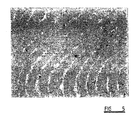
- Figure 5 shows the Example of Figure 1 when subjected to a heat treatment in which the casting is homogenised at 1050°C and then air cooled to 450°C and then water quenched.
- the micrograph shows a micro-structure comprising a single phase of lower bainite which is neither hard enough nor tough enough.
- the heat treatment in accordance with the invention is a combination of a heat treatment above the AC 3 temperature of 860-890°C by heating to about 1050°C and a inter-critical heat treatment below the AC 3 temperature but above AC 1 at around 750°C and at a minimum of around 700°C.
- This is to be contrasted with the previously known heat treatment where initially a casting is homogenised and then cooled to room temperature followed by heating by tempering up to a sub-critical heat treatment.
- the casting is heated to the above mentioned homogenising heat treatment at about 1050°C which is well above the AC 3 temperature and then is furnace cooled, i.e. cooled relatively slowly at a rate within the above mentioned range to provide a inter-critical heat treatment, i.e. between the AC 1 and the AC 3 temperatures.
- furnace cooled i.e. cooled relatively slowly at a rate within the above mentioned range to provide a inter-critical heat treatment, i.e. between the AC 1 and the AC 3 temperatures.
- conventionally castings are homogenised at the range 870°C to 1150°C and then quenched to room temperature followed by re-heating to a sub-critical temperature.
- the carbides formed in the melt are broken down and the grain structure is refined from the structure conventionally encountered and illustrated in Figure 2.
- the casting is then furnace cooled to the inter-critical zone, the object of which is to spheroidise the carbide and retain the austenite by cooling to about 750°C relatively slowly.
- the desired acicular bainite is obtained. It is believed that the desired hardness is obtained from the bainitic phase and the toughness is obtained from the retained austenite and ferrite and the spheroidised carbides.
- Example 1 provides a toughness of approximately 40 Joules.
- Example 7 Heat No BP137 C 0.20 Mn 0.93 S 0 007 P 0.012 Mo 0.14 Ni 0.45 Cr 0.50 Ti 0.060 Cu 0.66 V 0.13 Al 0.089 W 0.30 Si 0.56 N 2 0.011 O 2 0.021 Fe and usual Residuals Balance Carbon equivalent 0.58
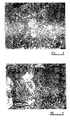
- Figures 6 and 7 are micrographs of samples of heat No. BP137 and they show a two phase structure with some retained austenite or ferrite and acicular bainite ferrite and martensite.
- Figures 8 and 9 are micrographs of samples taken from heat No. AR087 and they also show a two phase structure, in this case showing more ferrite and retained austenite and acicular bainite with bainitic ferrite and less acicular ferrite than in the case of heat No. BP137.
- Figures 10 and 12 are micrographs of samples taken from heat No. AR087 but in the "as-cast” condition ie. before heat treatment in accordance with the present invention and it shows equiaxed ferrite and Widmanstatten ferrite and pearlite.
- Castings in accordance with the invention have wide application but for example, they may be utilised to provide railway couplers where it is specifically desired to obtain high strength and toughness with a minimum weight
- Such couplers allow the achievement of up to 50% improvement in strength and wear resistance and in addition they suffer from lower frequency fatigue which is also considerably improved by steels embodying the invention.
- Castings embodying the invention are also useful in that they are weldable and a particular application of such steels is for the bogies of railway vehicles such as passenger trains where side frames have portions which are welded together. Again a steel embodying the invention enables the use of up to half the amount of material previously used, and hence half the weight previously required.
- castings embodying the invention have the above-mentioned weldability. If the carbon equivalent were less than 0.45% the castings would not require any pre-heat neither would they require any post-heat relative to the heat applied during welding. If the carbon equivalent were over 0.7% it would be necessary not only to pre-heat the casting, but also to post-heat the casting. By operating in the specified range the desired properties for weldability are achieved.
Landscapes
- Chemical & Material Sciences (AREA)
- Engineering & Computer Science (AREA)
- Materials Engineering (AREA)
- Mechanical Engineering (AREA)
- Metallurgy (AREA)
- Organic Chemistry (AREA)
- Thermal Sciences (AREA)
- Crystallography & Structural Chemistry (AREA)
- Physics & Mathematics (AREA)
- Heat Treatment Of Articles (AREA)
- Heat Treatment Of Steel (AREA)
- Paper (AREA)
- Treatment Of Steel In Its Molten State (AREA)
- Control Of Heat Treatment Processes (AREA)
- Heat Treatments In General, Especially Conveying And Cooling (AREA)
Claims (19)
- Verfahren zur Herstellung eines wärmebehandelten Stahlgußstückes, welches die Schritte umfaßt, daß ein Stahlgußstück im "Anlieferungszustand", das nicht mehr als 0,2 % Kohlenstoff, einen Gesamtlegierungsgehalt von weniger als 4 %, ein Kohlenstoffäquivalent, das im Bereich 0,45-0,7 % liegt, umfaßt, genommen und das Gußstück nach Durchführen des Gießvorganges abgekühlt, und anschließend ein Wärmebehandlungsvorgang durchgeführt, indem das Gußstück auf eine Temperatur oberhalb der AC3-Temperatur erneut erhitzt wird, um das Gußstück zu homogenisieren, anschließend das Gußstück auf eine interkritische Temperatur abgekühlt wird, die zwischen den AC3- und AC1-Temperaturen liegt, und anschließend auf etwa Raumtemperatur abgeschreckt wird, wobei besagtes Kohlenstoffäquivalent
C 0,1-0,2 % Mn 0,9-1,5 % S 0,002-0,015 % P 0,002-0,015 % Mo 0-0,2 % Ni 0,3-0,6 % Cr 0,3-0,6 % Nb 0-0,1 % Ti 0,02-0,10 % Cu 0,5-1,0 % V 0,10-0,19 % Al 0,03-0,14 % W 0,10-0,5 % Si 0,30-0,65 % N2 0,008-0,012 % - Verfahren nach Anspruch 1, dadurch gekennzeichnet, daß das Verfahren zur Herstellung eines wärmebehandelten Stahlgußstückes den Schritt umfaßt, daß ein Gießvorgang durchgeführt wird, um besagtes Stahlgußstück im "Anlieferungszustand" herzustellen, und anschließend besagter Wärmebehandlungsvorgang durchgeführt wird.
- Verfahren nach Anspruch 2, dadurch gekennzeichnet, daß der Wärmebehandlungsvorgang ohne irgendeinen anderen Zwischenschritt zwischen besagtem Gießvorgang und besagtem Wärmebehandlungsvorgang als besagten Schritt des Abkühlens im Anschluß an das Gießen durchgeführt wird.
- Verfahren nach einem der vorangehenden Ansprüche, dadurch gekennzeichnet, daß das Gußstück nach dem Gießen auf eine Temperatur abgekühlt wird, die im Bereich von Raumtemperatur bis etwa 350°C liegt, und anschließend erneut erhitzt wird, um den Wärmebehandlungsvorgang durchzuführen.
- Verfahren nach einem der vorangehenden Ansprüche, dadurch gekennzeichnet, daß das Gußstück auf eine Temperatur erhitzt wird, die im Bereich 900°C bis 1.100°C liegt, um das Gußstück zu homogenisieren.
- Verfahren nach einem der vorangehenden Ansprüche, dadurch gekennzeichnet, daß das homogenisierte Gußstück anschließend auf eine Temperatur, die im Bereich 700°C bis 800°C liegt, mit einer Rate abgekühlt wird, die im Bereich 2°C pro Minute bis 10°C pro Minute oder 2°C pro Minute bis 6°C pro Minute oder etwa 5°C pro Minute liegt.
- Verfahren nach Anspruch 6, dadurch gekennzeichnet, daß das homogenisierte Gußstück auf besagte Temperatur, die im Bereich 700°C bis 800°C liegt, ofengekühlt wird.
- Verfahren nach einem der vorangehenden Ansprüche, dadurch gekennzeichnet, daß das Gußstück durch Abschrecken mit einer Wasserabschreckrate auf etwa Raumtemperatur abgeschreckt wird.
- Verfahren nach Anspruch 8, dadurch gekennzeichnet, daß das Gußstück durch Abschrecken des Gußstückes auf etwa Raumtemperatur in Wasser abgeschreckt wird.
- Verfahren nach einem der vorangehenden Ansprüche, dadurch gekennzeichnet, daß das Gußstück 0,10 %-0,20 % Kohlenstoff umfaßt.
- Verfahren nach Anspruch 10, dadurch gekennzeichnet, daß das Gußstück 0,15 % bis 0,20 % Kohlenstoff umfaßt.
- Verfahren nach einem der vorangehenden Ansprüche, dadurch gekennzeichnet, daß das Gußstück einen Stahl umfaßt, in dem wenigstens eine der Komponenten umfaßt:
Ni 0,5 % Cr 0,5 % Ti 0,03-0,10 % V 0,10-0,15 % Al 0,030-0,12 % W 0,20-0,5 % Si 0,5 % O2 0,006-0,020 % - Verfahren nach einem der vorangehenden Ansprüche, dadurch gekennzeichnet, daß der Stahl, aus dem das Gußstück hergestellt ist, in herkömmlicher Weise geschmolzen und gegossen wird.
- Wärmebehandeltes Stahlgußstück, das nicht mehr als 0,2 % Kohlenstoff, einen Gesamtlegierungsgehalt von weniger als 4 %, ein Kohlenstoffäquivalent, das im Bereich 0,45 % bis 0,7 % liegt, umfaßt und das wärmebehandelt worden ist, nach dem Gießen und abschließenden Abkühlen, durch erneutes Erhitzen des Gußstückes auf eine Temperatur oberhalb der AC3-Temperatur, um das Gußstück zu homogenisieren, anschließendes Abkühlen des Gußstückes auf eine interkritische Temperatur, die zwischen den AC3- und AC1-Temperaturen liegt, und anschließendes Abschrecken auf ungefähr Raumtemperatur, ohne irgendeinen anderen Zwischenschritt zwischen besagtem Gießvorgang und besagter Wärmebehandlung als besagten Schritt des Abkühlens im Anschluß an das Gießen, und wobei besagtes Kohlenstoffäquivalent
C 0,1-0,2 % Mn 0,9-1,5 % S 0,002-0,015 % P 0,002-0,015 % Mo 0-0,2 % Ni 0,3-0,6 % Cr 0,3-0,6 % Nb 0-0,1 % Ti 0,02-0,10 % Cu 0,5-1,0 % V 0,10-0,19 % Al 0,03-0,14 % W 0,10-0,5 % Si 0,30-0,65 % N2 0,008-0,012 % O2 0,006-0,025 % H2 0,0003-0,0006 % Fe und üblicheRückstände Rest - Gußstück nach Anspruch 14, dadurch gekennzeichnet, daß das Gußstück, nach besagter Wärmebehandlung, weichgeglühte Carbide umfaßt.
- Gußstück nach Anspruch 15, dadurch gekennzeichnet, daß die Carbide eine Größe von < 1 Mikron aufweisen.
- Gußstück nach einem der Ansprüche 14 bis 16, dadurch gekennzeichnet, daß das resultierende Gußstück eine Härte, die im Bereich 363-500 Hb liegt, eine Festigkeit, die im Bereich 1.200-1.600 Nmm-2 liegt, eine Dehnung, die im Bereich 6-12 % liegt, eine Kerbschlagbiegefestigkeit nach Charpy, die im Bereich 30-60 Joule bei Raumtemperatur und 20-40 Joule bei -40°C liegt, und eine Streckgrenze von nicht weniger als 600 Nmm-2 aufweist.
- Verfahren nach einem der Ansprüche 1 bis 17, dadurch gekennzeichnet, daß der Mn-Gehalt im Bereich 1-1,5 % liegt.
- Gußstück nach einem der Ansprüche 14 bis 17, dadurch gekennzeichnet, daß der Mn-Gehalt im Bereich 1-1,5 % liegt.
Applications Claiming Priority (3)
| Application Number | Priority Date | Filing Date | Title |
|---|---|---|---|
| GB9608108 | 1996-04-19 | ||
| GBGB9608108.8A GB9608108D0 (en) | 1996-04-19 | 1996-04-19 | Steel Castings |
| PCT/GB1997/001024 WO1997040196A1 (en) | 1996-04-19 | 1997-04-15 | Method of making a heat treated steel casting and a heat treated steel casting |
Publications (2)
| Publication Number | Publication Date |
|---|---|
| EP0833951A1 EP0833951A1 (de) | 1998-04-08 |
| EP0833951B1 true EP0833951B1 (de) | 2002-02-27 |
Family
ID=10792324
Family Applications (1)
| Application Number | Title | Priority Date | Filing Date |
|---|---|---|---|
| EP97916559A Expired - Lifetime EP0833951B1 (de) | 1996-04-19 | 1997-04-15 | Verfahren zur herstellung von wärmebehandeltem stahlguss und stahlgussstück |
Country Status (11)
| Country | Link |
|---|---|
| US (1) | US5900082A (de) |
| EP (1) | EP0833951B1 (de) |
| JP (1) | JP4326592B2 (de) |
| AT (1) | ATE213784T1 (de) |
| AU (1) | AU720056B2 (de) |
| CA (1) | CA2225384A1 (de) |
| DE (1) | DE69710664T2 (de) |
| GB (1) | GB9608108D0 (de) |
| NO (1) | NO975842L (de) |
| TW (1) | TW385336B (de) |
| WO (1) | WO1997040196A1 (de) |
Families Citing this family (27)
| Publication number | Priority date | Publication date | Assignee | Title |
|---|---|---|---|---|
| US6537397B1 (en) * | 1998-08-18 | 2003-03-25 | Honda Giken Kogyo Kabushiki Kaisha | Process for producing Fe-based member having high young's modulus, and Fe-based member having high young's modulus and high toughness |
| BE1015018A3 (fr) * | 2002-07-02 | 2004-08-03 | Ct Rech Metallurgiques Asbl | Procede pour le traitement thermique d'une bande d'acier laminee a froid, procede de fabrication d'une bande d'acier adaptee au fromage et bande d'acier ainsi obtenue. |
| FR2847270B1 (fr) * | 2002-11-19 | 2004-12-24 | Usinor | Procede pour fabriquer une tole en acier resistant a l'abrasion et tole obtenue |
| FR2847271B1 (fr) * | 2002-11-19 | 2004-12-24 | Usinor | Procede pour fabriquer une tole en acier resistant a l'abrasion et tole obtenue |
| US20040177813A1 (en) * | 2003-03-12 | 2004-09-16 | Applied Materials, Inc. | Substrate support lift mechanism |
| DE10352182B4 (de) * | 2003-11-05 | 2008-10-02 | Dihag Deutsche Giesserei- Und Industrie-Holding Ag | Verfahren zur Herstellung eines dünnwandigen Stahlgußbauteils aus Edelstahl |
| JP2006051543A (ja) * | 2004-07-15 | 2006-02-23 | Nippon Steel Corp | 冷延、熱延鋼板もしくはAl系、Zn系めっき鋼板を使用した高強度自動車部材の熱間プレス方法および熱間プレス部品 |
| KR101136560B1 (ko) | 2004-09-15 | 2012-04-17 | 신닛뽄세이테쯔 카부시키카이샤 | 고강도 부품 제조 방법 |
| US20080026241A1 (en) * | 2006-07-25 | 2008-01-31 | Algoma Tubes, Inc. | Steel tubing with enhanced slot-ability characteristics for warm temperature service in casing liner applications and method of manufacturing the same |
| US7559999B2 (en) * | 2007-08-23 | 2009-07-14 | Transportation Technology Center, Inc. | Railroad wheel steels having improved resistance to rolling contact fatigue |
| US8590457B2 (en) | 2011-08-16 | 2013-11-26 | Pennsy Corporation | Lightweight rerailer |
| US9481380B2 (en) | 2012-11-15 | 2016-11-01 | Pennsy Corporation | Coupler knuckle |
| US9452764B2 (en) | 2012-11-15 | 2016-09-27 | Pennsy Corporation | Railway vehicle coupler |
| US11345372B1 (en) | 2012-11-15 | 2022-05-31 | Pennsy Corporation | Lightweight yoke for railway coupling |
| US10252733B1 (en) * | 2012-11-15 | 2019-04-09 | Pennsy Corporation | Lightweight fatigue resistant railcar truck, sideframe and bolster |
| US9199652B1 (en) | 2012-11-15 | 2015-12-01 | Pennsy Corporation | Lightweight, fatigue resistant knuckle |
| US9481381B2 (en) | 2012-11-15 | 2016-11-01 | Pennsy Corporation | Lightweight yoke for railway coupling |
| US11345374B1 (en) | 2012-11-15 | 2022-05-31 | Pennsy Corporation | Lightweight coupler |
| US9038836B1 (en) | 2012-11-15 | 2015-05-26 | Pennsy Corporation | Lightweight coupler |
| US9580089B2 (en) | 2012-11-15 | 2017-02-28 | Pennsy Corporation | Lightweight yoke for railway coupling |
| US9604276B2 (en) | 2014-02-03 | 2017-03-28 | Pennsy Corporation | Coupler and method for production of a coupler with selectable configuration options |
| CZ305587B6 (cs) * | 2014-06-12 | 2015-12-23 | Comtes Fht A.S. | Způsob tepelného zpracování ložiskové oceli |
| US10322732B1 (en) | 2015-11-11 | 2019-06-18 | Pennsy Corporation | Coupler knuckle, cores and method of production |
| EP3807428A4 (de) * | 2018-06-14 | 2022-03-09 | The Nanosteel Company, Inc. | Hochfeste stahllegierungen mit duktilitätseigenschaften |
| CN111321281B (zh) * | 2020-04-21 | 2021-12-07 | 山东钢铁集团日照有限公司 | 一种通过微观组织调控实现i&qp钢增强增塑的方法 |
| CN111850264A (zh) * | 2020-06-12 | 2020-10-30 | 宁波金汇精密铸造有限公司 | 一种35CrMo铸钢件的热处理方法 |
| CN115287552B (zh) * | 2022-08-17 | 2023-06-16 | 四川清贝科技技术开发有限公司 | 一种轻量化低合金钢铸件、制备方法及其应用 |
Family Cites Families (4)
| Publication number | Priority date | Publication date | Assignee | Title |
|---|---|---|---|---|
| FR2078143A5 (en) * | 1971-02-03 | 1971-11-05 | Suedwestfalen Ag Stahlwerke | Steel treatment - by faster controlled cooling, quenching and annealing schedules |
| US4398970A (en) * | 1981-10-05 | 1983-08-16 | Bethlehem Steel Corporation | Titanium and vanadium dual-phase steel and method of manufacture |
| JP2625572B2 (ja) * | 1990-10-24 | 1997-07-02 | 株式会社クボタ | 鋳鋼品の熱処理方法 |
| JPH07102316A (ja) * | 1993-10-04 | 1995-04-18 | Kubota Corp | 鋳鋼品の熱処理方法 |
-
1996
- 1996-04-19 GB GBGB9608108.8A patent/GB9608108D0/en active Pending
-
1997
- 1997-03-27 TW TW086103908A patent/TW385336B/zh not_active IP Right Cessation
- 1997-04-15 AU AU25174/97A patent/AU720056B2/en not_active Ceased
- 1997-04-15 JP JP53781397A patent/JP4326592B2/ja not_active Expired - Lifetime
- 1997-04-15 CA CA002225384A patent/CA2225384A1/en not_active Abandoned
- 1997-04-15 EP EP97916559A patent/EP0833951B1/de not_active Expired - Lifetime
- 1997-04-15 AT AT97916559T patent/ATE213784T1/de not_active IP Right Cessation
- 1997-04-15 DE DE69710664T patent/DE69710664T2/de not_active Expired - Fee Related
- 1997-04-15 US US08/973,740 patent/US5900082A/en not_active Expired - Fee Related
- 1997-04-15 WO PCT/GB1997/001024 patent/WO1997040196A1/en not_active Ceased
- 1997-12-11 NO NO975842A patent/NO975842L/no unknown
Also Published As
| Publication number | Publication date |
|---|---|
| CA2225384A1 (en) | 1997-10-30 |
| JP4326592B2 (ja) | 2009-09-09 |
| ATE213784T1 (de) | 2002-03-15 |
| NO975842D0 (no) | 1997-12-11 |
| EP0833951A1 (de) | 1998-04-08 |
| AU720056B2 (en) | 2000-05-25 |
| US5900082A (en) | 1999-05-04 |
| JPH11508966A (ja) | 1999-08-03 |
| TW385336B (en) | 2000-03-21 |
| DE69710664D1 (de) | 2002-04-04 |
| GB9608108D0 (en) | 1996-06-26 |
| DE69710664T2 (de) | 2002-09-05 |
| AU2517497A (en) | 1997-11-12 |
| WO1997040196A1 (en) | 1997-10-30 |
| NO975842L (no) | 1998-02-19 |
Similar Documents
| Publication | Publication Date | Title |
|---|---|---|
| US5900082A (en) | Method of making a heat treated steel casting and a heat treated steel casting | |
| EP2813596B1 (de) | Hochfeste stahlplatte mit hervorragender kältezähigkeit in den von schweisshitze beeinflussten zonen und herstellungsverfahren dafür | |
| KR100353300B1 (ko) | 고압 및 저압 통합형 터빈 회전자의 제조방법 | |
| EP0925379B1 (de) | Aushärtbare legierung mit einer kombination von hoher festigkeit und guter zähigkeit | |
| US6056833A (en) | Thermomechanically controlled processed high strength weathering steel with low yield/tensile ratio | |
| JP2009521600A (ja) | 耐遅れ破壊特性に優れた高強度ボルト及びその製造方法 | |
| US6743305B2 (en) | High-strength high-toughness precipitation-hardened steel | |
| JP2022548144A (ja) | 低温衝撃靭性に優れた高強度極厚物鋼材及びその製造方法 | |
| JPS5896856A (ja) | 鋼およびそれらより得られるチエ−ン | |
| JP2003213366A (ja) | 母材および大小入熱溶接熱影響部の靭性に優れた鋼材 | |
| JPH09249940A (ja) | 耐硫化物応力割れ性に優れる高強度鋼材およびその製造方法 | |
| EP0738784B1 (de) | Rostfreie martensitische Stahl mit hohem Chromgehalt für Rohre, die eine gute Beständigkeit gegen Lochfrasskorrosion haben, und Verfahren zu deren Herstellung | |
| JPH01159356A (ja) | 溶接熱影響部靭性の優れた高張力鋼 | |
| JPH06271975A (ja) | 耐水素脆化特性に優れた高強度鋼およびその製法 | |
| JPH11131177A (ja) | 溶接後熱処理の省略可能な中常温圧力容器用鋼板およびその製造方法 | |
| JP3536001B2 (ja) | 溶接構造用鋳鋼材 | |
| JPH06240406A (ja) | 高強度高靭性鋼板 | |
| JPS60128242A (ja) | 非磁性ドリルカラ−用高マンガン鋼 | |
| JPH1036940A (ja) | 耐遅れ破壊性に優れた高強度ボルト用鋼およびボルト | |
| JP3221309B2 (ja) | 機械構造用鋼およびその製造方法 | |
| RU2149207C1 (ru) | Легированная сталь | |
| US4634476A (en) | High-strength, low-alloy cast steel | |
| JPS63145711A (ja) | 低温靭性にすぐれる高張力鋼板の製造方法 | |
| JP3436823B2 (ja) | 高疲労強度溶接継手及びその熱処理方法 | |
| RU2196845C2 (ru) | Сталь |
Legal Events
| Date | Code | Title | Description |
|---|---|---|---|
| PUAI | Public reference made under article 153(3) epc to a published international application that has entered the european phase |
Free format text: ORIGINAL CODE: 0009012 |
|
| 17P | Request for examination filed |
Effective date: 19971205 |
|
| AK | Designated contracting states |
Kind code of ref document: A1 Designated state(s): AT BE CH DE DK ES FI FR GB GR IE IT LI NL PT SE |
|
| 17Q | First examination report despatched |
Effective date: 19990330 |
|
| GRAG | Despatch of communication of intention to grant |
Free format text: ORIGINAL CODE: EPIDOS AGRA |
|
| GRAG | Despatch of communication of intention to grant |
Free format text: ORIGINAL CODE: EPIDOS AGRA |
|
| GRAH | Despatch of communication of intention to grant a patent |
Free format text: ORIGINAL CODE: EPIDOS IGRA |
|
| GRAH | Despatch of communication of intention to grant a patent |
Free format text: ORIGINAL CODE: EPIDOS IGRA |
|
| REG | Reference to a national code |
Ref country code: GB Ref legal event code: IF02 |
|
| GRAA | (expected) grant |
Free format text: ORIGINAL CODE: 0009210 |
|
| AK | Designated contracting states |
Kind code of ref document: B1 Designated state(s): AT BE CH DE DK ES FI FR GR IE IT LI NL PT SE |
|
| PG25 | Lapsed in a contracting state [announced via postgrant information from national office to epo] |
Ref country code: NL Free format text: LAPSE BECAUSE OF FAILURE TO SUBMIT A TRANSLATION OF THE DESCRIPTION OR TO PAY THE FEE WITHIN THE PRESCRIBED TIME-LIMIT Effective date: 20020227 Ref country code: LI Free format text: LAPSE BECAUSE OF FAILURE TO SUBMIT A TRANSLATION OF THE DESCRIPTION OR TO PAY THE FEE WITHIN THE PRESCRIBED TIME-LIMIT Effective date: 20020227 Ref country code: IT Free format text: LAPSE BECAUSE OF FAILURE TO SUBMIT A TRANSLATION OF THE DESCRIPTION OR TO PAY THE FEE WITHIN THE PRESCRIBED TIME-LIMIT;WARNING: LAPSES OF ITALIAN PATENTS WITH EFFECTIVE DATE BEFORE 2007 MAY HAVE OCCURRED AT ANY TIME BEFORE 2007. THE CORRECT EFFECTIVE DATE MAY BE DIFFERENT FROM THE ONE RECORDED. Effective date: 20020227 Ref country code: GR Free format text: LAPSE BECAUSE OF FAILURE TO SUBMIT A TRANSLATION OF THE DESCRIPTION OR TO PAY THE FEE WITHIN THE PRESCRIBED TIME-LIMIT Effective date: 20020227 Ref country code: FR Free format text: LAPSE BECAUSE OF FAILURE TO SUBMIT A TRANSLATION OF THE DESCRIPTION OR TO PAY THE FEE WITHIN THE PRESCRIBED TIME-LIMIT Effective date: 20020227 Ref country code: FI Free format text: LAPSE BECAUSE OF FAILURE TO SUBMIT A TRANSLATION OF THE DESCRIPTION OR TO PAY THE FEE WITHIN THE PRESCRIBED TIME-LIMIT Effective date: 20020227 Ref country code: CH Free format text: LAPSE BECAUSE OF FAILURE TO SUBMIT A TRANSLATION OF THE DESCRIPTION OR TO PAY THE FEE WITHIN THE PRESCRIBED TIME-LIMIT Effective date: 20020227 Ref country code: BE Free format text: LAPSE BECAUSE OF FAILURE TO SUBMIT A TRANSLATION OF THE DESCRIPTION OR TO PAY THE FEE WITHIN THE PRESCRIBED TIME-LIMIT Effective date: 20020227 Ref country code: AT Free format text: LAPSE BECAUSE OF FAILURE TO SUBMIT A TRANSLATION OF THE DESCRIPTION OR TO PAY THE FEE WITHIN THE PRESCRIBED TIME-LIMIT Effective date: 20020227 |
|
| REF | Corresponds to: |
Ref document number: 213784 Country of ref document: AT Date of ref document: 20020315 Kind code of ref document: T |
|
| REG | Reference to a national code |
Ref country code: CH Ref legal event code: EP |
|
| RBV | Designated contracting states (corrected) |
Designated state(s): AT BE CH DE DK ES FI FR GR IE IT LI NL PT SE |
|
| REF | Corresponds to: |
Ref document number: 69710664 Country of ref document: DE Date of ref document: 20020404 |
|
| PG25 | Lapsed in a contracting state [announced via postgrant information from national office to epo] |
Ref country code: IE Free format text: LAPSE BECAUSE OF NON-PAYMENT OF DUE FEES Effective date: 20020415 |
|
| PG25 | Lapsed in a contracting state [announced via postgrant information from national office to epo] |
Ref country code: SE Free format text: LAPSE BECAUSE OF FAILURE TO SUBMIT A TRANSLATION OF THE DESCRIPTION OR TO PAY THE FEE WITHIN THE PRESCRIBED TIME-LIMIT Effective date: 20020527 Ref country code: PT Free format text: LAPSE BECAUSE OF FAILURE TO SUBMIT A TRANSLATION OF THE DESCRIPTION OR TO PAY THE FEE WITHIN THE PRESCRIBED TIME-LIMIT Effective date: 20020527 Ref country code: DK Free format text: LAPSE BECAUSE OF FAILURE TO SUBMIT A TRANSLATION OF THE DESCRIPTION OR TO PAY THE FEE WITHIN THE PRESCRIBED TIME-LIMIT Effective date: 20020527 |
|
| NLV1 | Nl: lapsed or annulled due to failure to fulfill the requirements of art. 29p and 29m of the patents act | ||
| PG25 | Lapsed in a contracting state [announced via postgrant information from national office to epo] |
Ref country code: ES Free format text: LAPSE BECAUSE OF FAILURE TO SUBMIT A TRANSLATION OF THE DESCRIPTION OR TO PAY THE FEE WITHIN THE PRESCRIBED TIME-LIMIT Effective date: 20020829 |
|
| REG | Reference to a national code |
Ref country code: CH Ref legal event code: PL |
|
| PGFP | Annual fee paid to national office [announced via postgrant information from national office to epo] |
Ref country code: DE Payment date: 20021031 Year of fee payment: 6 |
|
| RAP2 | Party data changed (patent owner data changed or rights of a patent transferred) |
Owner name: MERIDIAN RAIL INFORMATION SYSTEMS CORPORATION |
|
| EN | Fr: translation not filed | ||
| PLBE | No opposition filed within time limit |
Free format text: ORIGINAL CODE: 0009261 |
|
| STAA | Information on the status of an ep patent application or granted ep patent |
Free format text: STATUS: NO OPPOSITION FILED WITHIN TIME LIMIT |
|
| REG | Reference to a national code |
Ref country code: IE Ref legal event code: MM4A |
|
| 26N | No opposition filed |
Effective date: 20021128 |
|
| PG25 | Lapsed in a contracting state [announced via postgrant information from national office to epo] |
Ref country code: DE Free format text: LAPSE BECAUSE OF NON-PAYMENT OF DUE FEES Effective date: 20031101 |