EP0841310A1 - Dielektrische keramische Zusammensetzung - Google Patents
Dielektrische keramische Zusammensetzung Download PDFInfo
- Publication number
- EP0841310A1 EP0841310A1 EP97119561A EP97119561A EP0841310A1 EP 0841310 A1 EP0841310 A1 EP 0841310A1 EP 97119561 A EP97119561 A EP 97119561A EP 97119561 A EP97119561 A EP 97119561A EP 0841310 A1 EP0841310 A1 EP 0841310A1
- Authority
- EP
- European Patent Office
- Prior art keywords
- dielectric ceramic
- solid solution
- ceramic composition
- composition
- cuo
- Prior art date
- Legal status (The legal status is an assumption and is not a legal conclusion. Google has not performed a legal analysis and makes no representation as to the accuracy of the status listed.)
- Granted
Links
Images

Classifications
-
- H—ELECTRICITY
- H01—ELECTRIC ELEMENTS
- H01G—CAPACITORS; CAPACITORS, RECTIFIERS, DETECTORS, SWITCHING DEVICES, LIGHT-SENSITIVE OR TEMPERATURE-SENSITIVE DEVICES OF THE ELECTROLYTIC TYPE
- H01G4/00—Fixed capacitors; Processes of their manufacture
- H01G4/002—Details
- H01G4/018—Dielectrics
- H01G4/06—Solid dielectrics
- H01G4/08—Inorganic dielectrics
- H01G4/12—Ceramic dielectrics
-
- H—ELECTRICITY
- H01—ELECTRIC ELEMENTS
- H01G—CAPACITORS; CAPACITORS, RECTIFIERS, DETECTORS, SWITCHING DEVICES, LIGHT-SENSITIVE OR TEMPERATURE-SENSITIVE DEVICES OF THE ELECTROLYTIC TYPE
- H01G4/00—Fixed capacitors; Processes of their manufacture
- H01G4/002—Details
- H01G4/018—Dielectrics
- H01G4/06—Solid dielectrics
- H01G4/08—Inorganic dielectrics
- H01G4/12—Ceramic dielectrics
- H01G4/1209—Ceramic dielectrics characterised by the ceramic dielectric material
- H01G4/1254—Ceramic dielectrics characterised by the ceramic dielectric material based on niobium or tungsteen, tantalum oxides or niobates, tantalates
-
- C—CHEMISTRY; METALLURGY
- C04—CEMENTS; CONCRETE; ARTIFICIAL STONE; CERAMICS; REFRACTORIES
- C04B—LIME, MAGNESIA; SLAG; CEMENTS; COMPOSITIONS THEREOF, e.g. MORTARS, CONCRETE OR LIKE BUILDING MATERIALS; ARTIFICIAL STONE; CERAMICS; REFRACTORIES; TREATMENT OF NATURAL STONE
- C04B35/00—Shaped ceramic products characterised by their composition; Ceramics compositions; Processing powders of inorganic compounds preparatory to the manufacturing of ceramic products
- C04B35/01—Shaped ceramic products characterised by their composition; Ceramics compositions; Processing powders of inorganic compounds preparatory to the manufacturing of ceramic products based on oxide ceramics
- C04B35/495—Shaped ceramic products characterised by their composition; Ceramics compositions; Processing powders of inorganic compounds preparatory to the manufacturing of ceramic products based on oxide ceramics based on vanadium, niobium, tantalum, molybdenum or tungsten oxides or solid solutions thereof with other oxides, e.g. vanadates, niobates, tantalates, molybdates or tungstates
- C04B35/497—Shaped ceramic products characterised by their composition; Ceramics compositions; Processing powders of inorganic compounds preparatory to the manufacturing of ceramic products based on oxide ceramics based on vanadium, niobium, tantalum, molybdenum or tungsten oxides or solid solutions thereof with other oxides, e.g. vanadates, niobates, tantalates, molybdates or tungstates based on solid solutions with lead oxides
- C04B35/499—Shaped ceramic products characterised by their composition; Ceramics compositions; Processing powders of inorganic compounds preparatory to the manufacturing of ceramic products based on oxide ceramics based on vanadium, niobium, tantalum, molybdenum or tungsten oxides or solid solutions thereof with other oxides, e.g. vanadates, niobates, tantalates, molybdates or tungstates based on solid solutions with lead oxides containing also titanates
Definitions
- the present invention relates to a ceramic composition, in particular, to a dielectric ceramic composition capable of being fired at relatively low temperatures.
- Monolithic ceramic capacitors are produced by alternately laminating inner electrode layers and dielectric ceramic layers followed by firing the resulting laminate of those inner electrode layers and dielectric ceramic layers, for which are used highly dielectric, ceramic capacitor materials having a high dielectric constant.
- the monolithic ceramic capacitors thus produced shall have a large capacitance.
- barium titanate-type materials have been widely used as such highly dielectric, ceramic capacitor materials.
- those materials must be fired at high temperatures of not lower than 1300°C. Therefore, where they are used in producing monolithic ceramic capacitors, expensive noble metals such as platinum and palladium must be used to form the inner electrodes in the capacitors.
- the firing temperature for the conventional barium titanate-type materials is not lower than 1300°C and that for the conventional lead-containing composite perovskite compounds is about 1100°C. Therefore, all those conventional materials are problematic in that they could not be fired along with inexpensive silver and silver alloys.
- inexpensive silver or silver alloys could not be employed to form the inner electrodes for those capacitors, resulting in that it is impossible to produce monolithic ceramic capacitors at low production costs.
- the object of the present invention is to solve the problems mentioned above and to provide a dielectric ceramic composition having a high dielectric constant and capable of being fired at a temperature of 1000°C or lower along with silver and silver alloys.
- the present inventors After having studied the firing condition for the two-component composition comprising lead nickeloniobate Pb(Ni 1/3 Nb 2/3 )O 3 and lead titanate PbTiO 3 and also various additives thereto capable of promoting the sintering of the composition, the present inventors have found that manganese oxide (MnO), a group of compounds of Pb 3 O 4 , CuO and WO 3 capable of forming a composition of Pb(Cu 1/2 W 1/2 )O 3 can promote the sintering of the two-component composition while lowering the firing temperature for the composition, and have completed the present invention.
- MnO manganese oxide
- the invention provides a dielectric ceramic composition including a solid solution including lead nickeloniobate Pb(Ni 1/3 Nb 2/3 )O 3 and lead titanate PbTiO 3, and at least one additive selected from the group consisting of Pb 3 O 4 , CuO, WO 3 and MnO.
- the solid solution is represented by a formula, XPb(Ni 1/3 Nb 2/3 )O 3 -(1-X)PbTiO 3 , in which X indicates a molar fraction to fall within the scope of 0.57 ⁇ X ⁇ 0.87, in order to make the composition have a relatively high specific inductive capacity.
- the solid solution is represented by a formula, XPb(Ni 1/3 Nb 2/3 )O 3 -(1-X)PbTiO 3 , in which X indicates a molar fraction to fall within the scope of 0.65 ⁇ X ⁇ 0.75, in order to make the composition have a higher specific inductive capacity.
- the amount of manganese oxide (MnO) to be in the dielectric ceramic composition is not larger than 1 % by weight relative to the solid solution, in order not to lower the specific inductive capacity of the composition.
- the amount of the group of compounds of Pb 3 O 4 , CuO and WO 3 to be in the dielectric ceramic composition is not larger than 9 % by weight in terms of Pb(Cu 1/2 W 1/2 )O 3 and relative to the essential component of the composition, in order not to lower the specific inductive capacity of the composition.
- the dielectric ceramic composition of the invention contains both the group of compounds of Pb 3 O 4 , CuO and WO 3 capable of forming Pb(Cu 1/2 W 1/2 )O 3 , and manganese oxide, in order to further lower the firing temperature for the composition, in which the amount of manganese oxide (MnO) is not larger than 1 % by weight relative to the essential component of the composition and that of the group of compounds of Pb 3 O 4 , CuO and WO 3 is not larger than 9 % by weight in terms of Pb(Cu 1/2 W 1/2 )O 3 and relative to the solid solution, in order not to lower the specific inductive capacity of the composition.
- MnO manganese oxide
- Embodiment 1 of the invention is the dielectric ceramic composition which consists essentially of a solid solution of a formula XPb(Ni 1/3 Nb 2/3 )O 3 -(1 -X)PbTiO 3 , where X indicates a molar fraction, and which contains manganese oxide MnO that acts to lower the firing temperature for the solid solution.
- the amount of manganese oxide to be added to the composition is preferably not larger than 1 % by weight relative to the essential component, in order not to lower the high specific inductive capacity, ⁇ , of the essential component, solid solution.
- the dielectric ceramic composition of Embodiment 1 having the constitution mentioned above can be fired at low temperatures of 1000°C or lower, while having a relatively high specific inductive capacity, ⁇ .
- Embodiment 2 of the invention is the dielectric ceramic composition which consists essentially of a solid solution of a formula XPb(Ni 1/3 Nb 2/3 )O 3 -(1-X)PbTiO 3 , where X indicates a molar fraction, and which contains a group of compounds Pb 3 O 4 , CuO and WO 3 that acts to lower the firing temperature for the solid solution.
- the group of compounds Pb 3 O 4 , CuO and WO 3 can form a composition of a chemical formula Pb(Cu 1/2 W 1/2 )O 3 .
- the amount of the group of compounds Pb 3 O 4 , CuO and WO 3 to be added to the dielectric ceramic composition is preferably not larger than 9 % by weight in terms of Pb(Cu 1/2 W 1/2 )O 3 and relative to the essential component, in order not to lower the high specific inductive capacity, ⁇ , of the essential component, solid solution.
- the dielectric ceramic composition of Embodiment 2 having the constitution mentioned above can be fired at low temperatures of 1000°C or lower, while having a relatively high specific inductive capacity, ⁇ .
- Embodiment 3 of the invention is the dielectric ceramic composition which consists essentially of a solid solution of a formula XPb(Ni 1/3 Nb 2/3 )O 3 -(1-X)PbTiO 3 , where X indicates a molar fraction, and which contains both manganese oxide MnO and a group of compounds Pb 3 O 4 , CuO and WO 3 , both acting to lower the firing temperature for the solid solution.
- the group of compounds Pb 3 O 4 , CuO and WO 3 can form a composition of a chemical formula Pb(Cu 1/2 W 1/2 )O 3 .
- the amount of manganese oxide MnO to be added to the dielectric ceramic composition is preferably not larger than 1 % by weight relative to the essential component and that of the group of compounds Pb 3 O 4 , CuO and WO 3 to be added thereto is preferably not larger than 9 % by weight in terms of Pb(Cu 1/2 W 1/2 )O 3 and relative to the essential component, in order not to lower the high specific inductive capacity, ⁇ , of the essential component, solid solution.
- the dielectric ceramic composition of Embodiment 3 having the constitution mentioned above can be fired at lower temperatures than that of Embodiment 1 and Embodiment 2, while having a relatively high specific inductive capacity, ⁇ .
- the solid solution of the essential component of a formula XPb(Ni 1/3 Nb 2/3 )O 3 -(1-X)PbTiO 3 , where X indicates a molar fraction, is preferably so defined that X in that formula falls within the range of 0.57 ⁇ X ⁇ 0.87 in order to make the dielectric ceramic composition have a high specific inductive capacity, ⁇ , but is more preferably so defined that X therein falls within the range of 0.65 ⁇ X ⁇ 0.75 in order to make the composition have a higher specific inductive capacity, ⁇ .
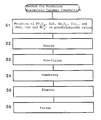
- Pb 3 O 4 , NiO, Nb 2 O 5 , TiO 2 , MnO, CuO and WO 3 are weighed to give the essential component and the additive in a predetermined ratio in the step S1.
- the thus-weighed materials are mixed in a wet or dry system.
- the resulting mixture is pre-fired at a predetermined temperature to give a solid solution of a dielectric ceramic composition material.
- this dielectric ceramic composition material is powdered to obtain a powder of the material.
- the powder is shaped to have a predetermined shape along with a resin binder or the like. Then, in the step S6, this is fired at a relatively low, predetermined temperature of not higher than 1000°C, whereby the powdery composition is sintered into a dielectric ceramic composition.
- a resin binder such as polyvinyl alcohol is added to the powdery dielectric ceramic composition and the resulting mixture is shaped into green sheets in the step S5. Then, those green sheets are alternately laminated with electrode layers made of silver 4 or a silver alloy, the resulting laminate is cut to have a predetermined shape, an electrode paste 6 is applied to the edges of the thus-shaped laminate to form edge electrodes 5 therearound, and finally the laminate thus composed of the green sheets and the electrodes is fired all at once to obtain a monolithic ceramic capacitor. If necessary, a first 6 and a second plating layers 7 may be applied on the electrodes 7.
- the composition can be fired at low temperatures of not higher than 1000°C. Therefore, any of inexpensive silver and silver alloys can be used to form the inner electrodes of those capacitors, in place of expensive noble metals such as platinum and palladium, and the capacitors can be produced at low costs.
- starting materials of Pb 3 O 4 , NiO, Nb 2 O 5 , TiO 2 , MnO, CuO and WO 3 were wet-milled in a ball mill to give final compositions as in Table 1, then vaporized and dried.
- the compositions in Table 1 are fired ones.
- each powdery mixture was pre-fired at 750°C for 2 hours to obtain a predetermined, powdery dielectric ceramic composition.
- the wet mixture was vaporized, dried and dressed, and the resulting powdery mixture was shaped under a pressure of 2.5 tons/cm 2 to give discs each having a diameter of 10 mm and a thickness of 1.2 mm. These discs were fired in an electric furnace having a Pb atmosphere, at different temperatures shown in Table 1.
- an Ag paste to be an electrode was applied to each disc, and fired at 800°C to prepare samples.
- the specific inductive capacity, ⁇ , and the dielectric loss ( tan ⁇ ) of each sample were measured at 1 KHz, 1 Vrms and 20°C. To measure its specific resistance, ⁇ , a voltage of 250 V was applied to each sample at 25°C for 120 seconds.
- the molar fraction X in the chemical formula XPb(Ni 1/3 Nb 2/3 )O 3 -(1-X)PbTiO 3 to represent the essential component constituting the composition was varied within the defined range, as in Table 1, while the amount, ⁇ % by weight relative to the essential component, of the additive of manganese oxide (MnO) added to the essential component as well as the amount, ⁇ % by weight in terms of Pb(Cu 1/2 W 1/2 )O 3 and relative to the essential component, of the additive of the group of Pb 3 O 4 , CuO and WO 3 added thereto was varied within the defined range, as in Table 1.
- the firing temperatures for those samples, and also the specific inductive capacity ⁇ , the dielectric loss tan ⁇ , and the specific resistivity ⁇ of each sample are shown in Table 1.
- the samples of Nos. 6 to 30 which are within the scope of the invention all had a high specific resistivity, p > 10 11 ⁇ . cm, or that is, those samples all had high insulation resistance, and that those samples were successively fired at temperatures lower than 1000°C.
- the dielectric ceramic composition of the invention can be fired at temperatures lower than 1000°C, while having a high specific inductive capacity ⁇ and high insulation resistance. Therefore, when the dielectric ceramic composition of the invention is used, it is possible to provide monolithic ceramic capacitors having large capacitance and high insulation resistance and, in addition, inexpensive silver and silver alloys can be used to form the inner electrodes in those monolithic ceramic capacitors. Accordingly, using the composition of the invention, good monolithic ceramic capacitors can be produced at low costs.
Landscapes
- Engineering & Computer Science (AREA)
- Chemical & Material Sciences (AREA)
- Ceramic Engineering (AREA)
- Power Engineering (AREA)
- Manufacturing & Machinery (AREA)
- Inorganic Chemistry (AREA)
- Microelectronics & Electronic Packaging (AREA)
- Materials Engineering (AREA)
- Structural Engineering (AREA)
- Organic Chemistry (AREA)
- Inorganic Insulating Materials (AREA)
- Compositions Of Oxide Ceramics (AREA)
Applications Claiming Priority (3)
| Application Number | Priority Date | Filing Date | Title |
|---|---|---|---|
| JP30013396 | 1996-11-12 | ||
| JP8300133A JPH10139536A (ja) | 1996-11-12 | 1996-11-12 | 誘電体磁器組成物 |
| JP300133/96 | 1996-11-12 |
Publications (2)
| Publication Number | Publication Date |
|---|---|
| EP0841310A1 true EP0841310A1 (de) | 1998-05-13 |
| EP0841310B1 EP0841310B1 (de) | 2003-10-01 |
Family
ID=17881142
Family Applications (1)
| Application Number | Title | Priority Date | Filing Date |
|---|---|---|---|
| EP97119561A Expired - Lifetime EP0841310B1 (de) | 1996-11-12 | 1997-11-07 | Dielektrische keramische Zusammensetzung |
Country Status (6)
| Country | Link |
|---|---|
| US (1) | US5905049A (de) |
| EP (1) | EP0841310B1 (de) |
| JP (1) | JPH10139536A (de) |
| KR (1) | KR100271100B1 (de) |
| CN (1) | CN1085638C (de) |
| DE (1) | DE69725260T2 (de) |
Families Citing this family (4)
| Publication number | Priority date | Publication date | Assignee | Title |
|---|---|---|---|---|
| WO1997044797A1 (de) * | 1996-05-21 | 1997-11-27 | Siemens Aktiengesellschaft | Dünnfilm mehrschichtkondensator |
| CN100361232C (zh) * | 2004-03-16 | 2008-01-09 | 天津大学 | 具有高介电常数的高频介质材料及其制备方法 |
| CN100422110C (zh) * | 2007-04-26 | 2008-10-01 | 浙江大学 | 一种渗流型Ag-PbTiO3复合陶瓷薄膜及其制备方法 |
| US12558678B2 (en) | 2021-12-01 | 2026-02-24 | Samsung Electronics Co., Ltd. | Dielectric material comprising lead compound and method of making the same |
Citations (2)
| Publication number | Priority date | Publication date | Assignee | Title |
|---|---|---|---|---|
| JPH0558645A (ja) * | 1991-09-03 | 1993-03-09 | Hitachi Metals Ltd | 圧電磁器組成物 |
| US5415945A (en) * | 1990-06-19 | 1995-05-16 | Murata Manufacturing Co., Ltd. | Dielectric ceramic composition for low temperature sintering |
Family Cites Families (3)
| Publication number | Priority date | Publication date | Assignee | Title |
|---|---|---|---|---|
| US4704373A (en) * | 1985-10-29 | 1987-11-03 | Ngk Spark Plug Co., Ltd. | Dielectric ceramic composition and process for producing the same |
| ES2008482A6 (es) * | 1987-05-12 | 1989-07-16 | Glaxo Inc | Dispositivo de inhalacion. |
| JP3087644B2 (ja) * | 1996-03-26 | 2000-09-11 | 株式会社村田製作所 | 誘電体磁器組成物 |
-
1996
- 1996-11-12 JP JP8300133A patent/JPH10139536A/ja active Pending
-
1997
- 1997-11-07 DE DE69725260T patent/DE69725260T2/de not_active Expired - Fee Related
- 1997-11-07 EP EP97119561A patent/EP0841310B1/de not_active Expired - Lifetime
- 1997-11-12 KR KR1019970059417A patent/KR100271100B1/ko not_active Expired - Fee Related
- 1997-11-12 US US08/968,993 patent/US5905049A/en not_active Expired - Lifetime
- 1997-11-12 CN CN97122277A patent/CN1085638C/zh not_active Expired - Fee Related
Patent Citations (2)
| Publication number | Priority date | Publication date | Assignee | Title |
|---|---|---|---|---|
| US5415945A (en) * | 1990-06-19 | 1995-05-16 | Murata Manufacturing Co., Ltd. | Dielectric ceramic composition for low temperature sintering |
| JPH0558645A (ja) * | 1991-09-03 | 1993-03-09 | Hitachi Metals Ltd | 圧電磁器組成物 |
Non-Patent Citations (1)
| Title |
|---|
| DATABASE WPI Week 9315, Derwent World Patents Index; AN 93-121074, XP002055896 * |
Also Published As
| Publication number | Publication date |
|---|---|
| CN1085638C (zh) | 2002-05-29 |
| US5905049A (en) | 1999-05-18 |
| DE69725260T2 (de) | 2004-05-06 |
| DE69725260D1 (de) | 2003-11-06 |
| EP0841310B1 (de) | 2003-10-01 |
| JPH10139536A (ja) | 1998-05-26 |
| KR19980042310A (ko) | 1998-08-17 |
| KR100271100B1 (ko) | 2000-11-01 |
| CN1182061A (zh) | 1998-05-20 |
Similar Documents
| Publication | Publication Date | Title |
|---|---|---|
| EP0534378B1 (de) | Nichtreduzierbare dielektrische keramische Zusammensetzung | |
| US4078938A (en) | Ceramic compositions having high dielectric constant | |
| US4753905A (en) | Dielectric ceramic composition | |
| US4985381A (en) | Dielectric ceramic composition | |
| EP0364639B1 (de) | Keramischer Mehrschichtkondensator | |
| US5905049A (en) | Dielectric ceramic composition | |
| JPS6234707B2 (de) | ||
| JP3793548B2 (ja) | 誘電体磁器および積層セラミックコンデンサ | |
| EP0631996A1 (de) | Dielektrische keramische Zusammensetzung | |
| KR0165557B1 (ko) | 자기 조성물 | |
| JP3389947B2 (ja) | 誘電体磁器組成物及びそれを用いた厚膜コンデンサ | |
| JP3134430B2 (ja) | 非還元性誘電体磁器組成物 | |
| JP2671422B2 (ja) | 非還元性誘電体磁器組成物 | |
| JP2895056B1 (ja) | 磁器組成物および積層セラミックコンデンサ | |
| JPH0610100B2 (ja) | 磁器組成物 | |
| JP3336194B2 (ja) | 誘電体磁器 | |
| JPS6234706B2 (de) | ||
| JPS6227025B2 (de) | ||
| JP3215003B2 (ja) | 誘電体磁器組成物 | |
| JP2000182881A (ja) | 誘電体磁器材料 | |
| JPH0794022A (ja) | 誘電体材料およびセラミック部品 | |
| JP3071452B2 (ja) | 誘電体磁器組成物 | |
| JP2924469B2 (ja) | 磁器組成物 | |
| JPS6234708B2 (de) | ||
| JPH0664933B2 (ja) | 誘電体磁器組成物 |
Legal Events
| Date | Code | Title | Description |
|---|---|---|---|
| PUAI | Public reference made under article 153(3) epc to a published international application that has entered the european phase |
Free format text: ORIGINAL CODE: 0009012 |
|
| 17P | Request for examination filed |
Effective date: 19971121 |
|
| AK | Designated contracting states |
Kind code of ref document: A1 Designated state(s): DE GB NL |
|
| AX | Request for extension of the european patent |
Free format text: AL;LT;LV;MK;RO;SI |
|
| AKX | Designation fees paid |
Free format text: DE GB NL |
|
| RBV | Designated contracting states (corrected) |
Designated state(s): DE GB NL |
|
| 17Q | First examination report despatched |
Effective date: 20000417 |
|
| GRAH | Despatch of communication of intention to grant a patent |
Free format text: ORIGINAL CODE: EPIDOS IGRA |
|
| GRAS | Grant fee paid |
Free format text: ORIGINAL CODE: EPIDOSNIGR3 |
|
| GRAA | (expected) grant |
Free format text: ORIGINAL CODE: 0009210 |
|
| AK | Designated contracting states |
Kind code of ref document: B1 Designated state(s): DE GB NL |
|
| PG25 | Lapsed in a contracting state [announced via postgrant information from national office to epo] |
Ref country code: NL Free format text: LAPSE BECAUSE OF FAILURE TO SUBMIT A TRANSLATION OF THE DESCRIPTION OR TO PAY THE FEE WITHIN THE PRESCRIBED TIME-LIMIT Effective date: 20031001 |
|
| REG | Reference to a national code |
Ref country code: GB Ref legal event code: FG4D |
|
| REF | Corresponds to: |
Ref document number: 69725260 Country of ref document: DE Date of ref document: 20031106 Kind code of ref document: P |
|
| PG25 | Lapsed in a contracting state [announced via postgrant information from national office to epo] |
Ref country code: GB Free format text: LAPSE BECAUSE OF NON-PAYMENT OF DUE FEES Effective date: 20040101 |
|
| NLV1 | Nl: lapsed or annulled due to failure to fulfill the requirements of art. 29p and 29m of the patents act | ||
| PLBE | No opposition filed within time limit |
Free format text: ORIGINAL CODE: 0009261 |
|
| STAA | Information on the status of an ep patent application or granted ep patent |
Free format text: STATUS: NO OPPOSITION FILED WITHIN TIME LIMIT |
|
| GBPC | Gb: european patent ceased through non-payment of renewal fee |
Effective date: 20040101 |
|
| 26N | No opposition filed |
Effective date: 20040702 |
|
| PGFP | Annual fee paid to national office [announced via postgrant information from national office to epo] |
Ref country code: DE Payment date: 20071101 Year of fee payment: 11 |
|
| PG25 | Lapsed in a contracting state [announced via postgrant information from national office to epo] |
Ref country code: DE Free format text: LAPSE BECAUSE OF NON-PAYMENT OF DUE FEES Effective date: 20090603 |