EP0841388B1 - Utilisation des tubes en acier à surface extérieure revêtue de résine organique pour un hydroreformage amélioré - Google Patents
Utilisation des tubes en acier à surface extérieure revêtue de résine organique pour un hydroreformage amélioré Download PDFInfo
- Publication number
- EP0841388B1 EP0841388B1 EP97308932A EP97308932A EP0841388B1 EP 0841388 B1 EP0841388 B1 EP 0841388B1 EP 97308932 A EP97308932 A EP 97308932A EP 97308932 A EP97308932 A EP 97308932A EP 0841388 B1 EP0841388 B1 EP 0841388B1
- Authority
- EP
- European Patent Office
- Prior art keywords
- steel pipe
- coating
- hydroforming
- tubular blank
- resin coating
- Prior art date
- Legal status (The legal status is an assumption and is not a legal conclusion. Google has not performed a legal analysis and makes no representation as to the accuracy of the status listed.)
- Expired - Lifetime
Links
Images

Classifications
-
- F—MECHANICAL ENGINEERING; LIGHTING; HEATING; WEAPONS; BLASTING
- F16—ENGINEERING ELEMENTS AND UNITS; GENERAL MEASURES FOR PRODUCING AND MAINTAINING EFFECTIVE FUNCTIONING OF MACHINES OR INSTALLATIONS; THERMAL INSULATION IN GENERAL
- F16L—PIPES; JOINTS OR FITTINGS FOR PIPES; SUPPORTS FOR PIPES, CABLES OR PROTECTIVE TUBING; MEANS FOR THERMAL INSULATION IN GENERAL
- F16L58/00—Protection of pipes or pipe fittings against corrosion or incrustation
- F16L58/02—Protection of pipes or pipe fittings against corrosion or incrustation by means of internal or external coatings
- F16L58/04—Coatings characterised by the materials used
- F16L58/10—Coatings characterised by the materials used by rubber or plastics
- F16L58/1054—Coatings characterised by the materials used by rubber or plastics the coating being placed outside the pipe
- F16L58/1072—Coatings characterised by the materials used by rubber or plastics the coating being placed outside the pipe the coating being a sprayed layer
-
- B—PERFORMING OPERATIONS; TRANSPORTING
- B05—SPRAYING OR ATOMISING IN GENERAL; APPLYING FLUENT MATERIALS TO SURFACES, IN GENERAL
- B05D—PROCESSES FOR APPLYING FLUENT MATERIALS TO SURFACES, IN GENERAL
- B05D7/00—Processes, other than flocking, specially adapted for applying liquids or other fluent materials to particular surfaces or for applying particular liquids or other fluent materials
- B05D7/14—Processes, other than flocking, specially adapted for applying liquids or other fluent materials to particular surfaces or for applying particular liquids or other fluent materials to metal, e.g. car bodies
- B05D7/146—Processes, other than flocking, specially adapted for applying liquids or other fluent materials to particular surfaces or for applying particular liquids or other fluent materials to metal, e.g. car bodies to metallic pipes or tubes
-
- C—CHEMISTRY; METALLURGY
- C10—PETROLEUM, GAS OR COKE INDUSTRIES; TECHNICAL GASES CONTAINING CARBON MONOXIDE; FUELS; LUBRICANTS; PEAT
- C10M—LUBRICATING COMPOSITIONS; USE OF CHEMICAL SUBSTANCES EITHER ALONE OR AS LUBRICATING INGREDIENTS IN A LUBRICATING COMPOSITION
- C10M107/00—Lubricating compositions characterised by the base-material being a macromolecular compound
- C10M107/20—Lubricating compositions characterised by the base-material being a macromolecular compound containing oxygen
- C10M107/22—Macromolecular compounds obtained by reactions only involving carbon-to-carbon unsaturated bonds
- C10M107/28—Macromolecular compounds obtained by reactions only involving carbon-to-carbon unsaturated bonds containing monomers having an unsaturated radical bound to a carboxyl radical, e.g. acrylate
-
- C—CHEMISTRY; METALLURGY
- C10—PETROLEUM, GAS OR COKE INDUSTRIES; TECHNICAL GASES CONTAINING CARBON MONOXIDE; FUELS; LUBRICANTS; PEAT
- C10M—LUBRICATING COMPOSITIONS; USE OF CHEMICAL SUBSTANCES EITHER ALONE OR AS LUBRICATING INGREDIENTS IN A LUBRICATING COMPOSITION
- C10M107/00—Lubricating compositions characterised by the base-material being a macromolecular compound
- C10M107/20—Lubricating compositions characterised by the base-material being a macromolecular compound containing oxygen
- C10M107/30—Macromolecular compounds obtained otherwise than by reactions only involving carbon-to-carbon unsaturated bonds
- C10M107/32—Condensation polymers of aldehydes or ketones; Polyesters; Polyethers
-
- C—CHEMISTRY; METALLURGY
- C10—PETROLEUM, GAS OR COKE INDUSTRIES; TECHNICAL GASES CONTAINING CARBON MONOXIDE; FUELS; LUBRICANTS; PEAT
- C10M—LUBRICATING COMPOSITIONS; USE OF CHEMICAL SUBSTANCES EITHER ALONE OR AS LUBRICATING INGREDIENTS IN A LUBRICATING COMPOSITION
- C10M107/00—Lubricating compositions characterised by the base-material being a macromolecular compound
- C10M107/40—Lubricating compositions characterised by the base-material being a macromolecular compound containing nitrogen
- C10M107/44—Macromolecular compounds obtained otherwise than by reactions only involving carbon-to-carbon unsaturated bonds
-
- C—CHEMISTRY; METALLURGY
- C10—PETROLEUM, GAS OR COKE INDUSTRIES; TECHNICAL GASES CONTAINING CARBON MONOXIDE; FUELS; LUBRICANTS; PEAT
- C10M—LUBRICATING COMPOSITIONS; USE OF CHEMICAL SUBSTANCES EITHER ALONE OR AS LUBRICATING INGREDIENTS IN A LUBRICATING COMPOSITION
- C10M111/00—Lubrication compositions characterised by the base-material being a mixture of two or more compounds covered by more than one of the main groups C10M101/00 - C10M109/00, each of these compounds being essential
- C10M111/04—Lubrication compositions characterised by the base-material being a mixture of two or more compounds covered by more than one of the main groups C10M101/00 - C10M109/00, each of these compounds being essential at least one of them being a macromolecular organic compound
-
- C—CHEMISTRY; METALLURGY
- C10—PETROLEUM, GAS OR COKE INDUSTRIES; TECHNICAL GASES CONTAINING CARBON MONOXIDE; FUELS; LUBRICANTS; PEAT
- C10M—LUBRICATING COMPOSITIONS; USE OF CHEMICAL SUBSTANCES EITHER ALONE OR AS LUBRICATING INGREDIENTS IN A LUBRICATING COMPOSITION
- C10M129/00—Lubricating compositions characterised by the additive being an organic non-macromolecular compound containing oxygen
- C10M129/02—Lubricating compositions characterised by the additive being an organic non-macromolecular compound containing oxygen having a carbon chain of less than 30 atoms
- C10M129/26—Carboxylic acids; Salts thereof
- C10M129/28—Carboxylic acids; Salts thereof having carboxyl groups bound to acyclic or cycloaliphatic carbon atoms
- C10M129/38—Carboxylic acids; Salts thereof having carboxyl groups bound to acyclic or cycloaliphatic carbon atoms having 8 or more carbon atoms
- C10M129/40—Carboxylic acids; Salts thereof having carboxyl groups bound to acyclic or cycloaliphatic carbon atoms having 8 or more carbon atoms monocarboxylic
-
- C—CHEMISTRY; METALLURGY
- C10—PETROLEUM, GAS OR COKE INDUSTRIES; TECHNICAL GASES CONTAINING CARBON MONOXIDE; FUELS; LUBRICANTS; PEAT
- C10M—LUBRICATING COMPOSITIONS; USE OF CHEMICAL SUBSTANCES EITHER ALONE OR AS LUBRICATING INGREDIENTS IN A LUBRICATING COMPOSITION
- C10M143/00—Lubricating compositions characterised by the additive being a macromolecular hydrocarbon or such hydrocarbon modified by oxidation
- C10M143/02—Polyethylene
-
- C—CHEMISTRY; METALLURGY
- C10—PETROLEUM, GAS OR COKE INDUSTRIES; TECHNICAL GASES CONTAINING CARBON MONOXIDE; FUELS; LUBRICANTS; PEAT
- C10M—LUBRICATING COMPOSITIONS; USE OF CHEMICAL SUBSTANCES EITHER ALONE OR AS LUBRICATING INGREDIENTS IN A LUBRICATING COMPOSITION
- C10M147/00—Lubricating compositions characterised by the additive being a macromolecular compound containing halogen
- C10M147/02—Monomer containing carbon, hydrogen and halogen only
-
- C—CHEMISTRY; METALLURGY
- C10—PETROLEUM, GAS OR COKE INDUSTRIES; TECHNICAL GASES CONTAINING CARBON MONOXIDE; FUELS; LUBRICANTS; PEAT
- C10M—LUBRICATING COMPOSITIONS; USE OF CHEMICAL SUBSTANCES EITHER ALONE OR AS LUBRICATING INGREDIENTS IN A LUBRICATING COMPOSITION
- C10M177/00—Special methods of preparation of lubricating compositions; Chemical modification by after-treatment of components or of the whole of a lubricating composition, not covered by other classes
-
- F—MECHANICAL ENGINEERING; LIGHTING; HEATING; WEAPONS; BLASTING
- F16—ENGINEERING ELEMENTS AND UNITS; GENERAL MEASURES FOR PRODUCING AND MAINTAINING EFFECTIVE FUNCTIONING OF MACHINES OR INSTALLATIONS; THERMAL INSULATION IN GENERAL
- F16L—PIPES; JOINTS OR FITTINGS FOR PIPES; SUPPORTS FOR PIPES, CABLES OR PROTECTIVE TUBING; MEANS FOR THERMAL INSULATION IN GENERAL
- F16L57/00—Protection of pipes or objects of similar shape against external or internal damage or wear
- F16L57/06—Protection of pipes or objects of similar shape against external or internal damage or wear against wear
-
- F—MECHANICAL ENGINEERING; LIGHTING; HEATING; WEAPONS; BLASTING
- F16—ENGINEERING ELEMENTS AND UNITS; GENERAL MEASURES FOR PRODUCING AND MAINTAINING EFFECTIVE FUNCTIONING OF MACHINES OR INSTALLATIONS; THERMAL INSULATION IN GENERAL
- F16L—PIPES; JOINTS OR FITTINGS FOR PIPES; SUPPORTS FOR PIPES, CABLES OR PROTECTIVE TUBING; MEANS FOR THERMAL INSULATION IN GENERAL
- F16L58/00—Protection of pipes or pipe fittings against corrosion or incrustation
- F16L58/02—Protection of pipes or pipe fittings against corrosion or incrustation by means of internal or external coatings
- F16L58/04—Coatings characterised by the materials used
- F16L58/10—Coatings characterised by the materials used by rubber or plastics
- F16L58/1054—Coatings characterised by the materials used by rubber or plastics the coating being placed outside the pipe
-
- C—CHEMISTRY; METALLURGY
- C10—PETROLEUM, GAS OR COKE INDUSTRIES; TECHNICAL GASES CONTAINING CARBON MONOXIDE; FUELS; LUBRICANTS; PEAT
- C10M—LUBRICATING COMPOSITIONS; USE OF CHEMICAL SUBSTANCES EITHER ALONE OR AS LUBRICATING INGREDIENTS IN A LUBRICATING COMPOSITION
- C10M2205/00—Organic macromolecular hydrocarbon compounds or fractions, whether or not modified by oxidation as ingredients in lubricant compositions
- C10M2205/02—Organic macromolecular hydrocarbon compounds or fractions, whether or not modified by oxidation as ingredients in lubricant compositions containing acyclic monomers
- C10M2205/022—Ethene
-
- C—CHEMISTRY; METALLURGY
- C10—PETROLEUM, GAS OR COKE INDUSTRIES; TECHNICAL GASES CONTAINING CARBON MONOXIDE; FUELS; LUBRICANTS; PEAT
- C10M—LUBRICATING COMPOSITIONS; USE OF CHEMICAL SUBSTANCES EITHER ALONE OR AS LUBRICATING INGREDIENTS IN A LUBRICATING COMPOSITION
- C10M2205/00—Organic macromolecular hydrocarbon compounds or fractions, whether or not modified by oxidation as ingredients in lubricant compositions
- C10M2205/14—Synthetic waxes, e.g. polythene waxes
-
- C—CHEMISTRY; METALLURGY
- C10—PETROLEUM, GAS OR COKE INDUSTRIES; TECHNICAL GASES CONTAINING CARBON MONOXIDE; FUELS; LUBRICANTS; PEAT
- C10M—LUBRICATING COMPOSITIONS; USE OF CHEMICAL SUBSTANCES EITHER ALONE OR AS LUBRICATING INGREDIENTS IN A LUBRICATING COMPOSITION
- C10M2207/00—Organic non-macromolecular hydrocarbon compounds containing hydrogen, carbon and oxygen as ingredients in lubricant compositions
- C10M2207/10—Carboxylix acids; Neutral salts thereof
- C10M2207/12—Carboxylix acids; Neutral salts thereof having carboxyl groups bound to acyclic or cycloaliphatic carbon atoms
- C10M2207/125—Carboxylix acids; Neutral salts thereof having carboxyl groups bound to acyclic or cycloaliphatic carbon atoms having hydrocarbon chains of eight up to twenty-nine carbon atoms, i.e. fatty acids
-
- C—CHEMISTRY; METALLURGY
- C10—PETROLEUM, GAS OR COKE INDUSTRIES; TECHNICAL GASES CONTAINING CARBON MONOXIDE; FUELS; LUBRICANTS; PEAT
- C10M—LUBRICATING COMPOSITIONS; USE OF CHEMICAL SUBSTANCES EITHER ALONE OR AS LUBRICATING INGREDIENTS IN A LUBRICATING COMPOSITION
- C10M2207/00—Organic non-macromolecular hydrocarbon compounds containing hydrogen, carbon and oxygen as ingredients in lubricant compositions
- C10M2207/10—Carboxylix acids; Neutral salts thereof
- C10M2207/12—Carboxylix acids; Neutral salts thereof having carboxyl groups bound to acyclic or cycloaliphatic carbon atoms
- C10M2207/125—Carboxylix acids; Neutral salts thereof having carboxyl groups bound to acyclic or cycloaliphatic carbon atoms having hydrocarbon chains of eight up to twenty-nine carbon atoms, i.e. fatty acids
- C10M2207/126—Carboxylix acids; Neutral salts thereof having carboxyl groups bound to acyclic or cycloaliphatic carbon atoms having hydrocarbon chains of eight up to twenty-nine carbon atoms, i.e. fatty acids monocarboxylic
-
- C—CHEMISTRY; METALLURGY
- C10—PETROLEUM, GAS OR COKE INDUSTRIES; TECHNICAL GASES CONTAINING CARBON MONOXIDE; FUELS; LUBRICANTS; PEAT
- C10M—LUBRICATING COMPOSITIONS; USE OF CHEMICAL SUBSTANCES EITHER ALONE OR AS LUBRICATING INGREDIENTS IN A LUBRICATING COMPOSITION
- C10M2207/00—Organic non-macromolecular hydrocarbon compounds containing hydrogen, carbon and oxygen as ingredients in lubricant compositions
- C10M2207/10—Carboxylix acids; Neutral salts thereof
- C10M2207/12—Carboxylix acids; Neutral salts thereof having carboxyl groups bound to acyclic or cycloaliphatic carbon atoms
- C10M2207/129—Carboxylix acids; Neutral salts thereof having carboxyl groups bound to acyclic or cycloaliphatic carbon atoms having hydrocarbon chains of thirty or more carbon atoms
-
- C—CHEMISTRY; METALLURGY
- C10—PETROLEUM, GAS OR COKE INDUSTRIES; TECHNICAL GASES CONTAINING CARBON MONOXIDE; FUELS; LUBRICANTS; PEAT
- C10M—LUBRICATING COMPOSITIONS; USE OF CHEMICAL SUBSTANCES EITHER ALONE OR AS LUBRICATING INGREDIENTS IN A LUBRICATING COMPOSITION
- C10M2209/00—Organic macromolecular compounds containing oxygen as ingredients in lubricant compositions
-
- C—CHEMISTRY; METALLURGY
- C10—PETROLEUM, GAS OR COKE INDUSTRIES; TECHNICAL GASES CONTAINING CARBON MONOXIDE; FUELS; LUBRICANTS; PEAT
- C10M—LUBRICATING COMPOSITIONS; USE OF CHEMICAL SUBSTANCES EITHER ALONE OR AS LUBRICATING INGREDIENTS IN A LUBRICATING COMPOSITION
- C10M2209/00—Organic macromolecular compounds containing oxygen as ingredients in lubricant compositions
- C10M2209/02—Macromolecular compounds obtained by reactions only involving carbon-to-carbon unsaturated bonds
-
- C—CHEMISTRY; METALLURGY
- C10—PETROLEUM, GAS OR COKE INDUSTRIES; TECHNICAL GASES CONTAINING CARBON MONOXIDE; FUELS; LUBRICANTS; PEAT
- C10M—LUBRICATING COMPOSITIONS; USE OF CHEMICAL SUBSTANCES EITHER ALONE OR AS LUBRICATING INGREDIENTS IN A LUBRICATING COMPOSITION
- C10M2209/00—Organic macromolecular compounds containing oxygen as ingredients in lubricant compositions
- C10M2209/02—Macromolecular compounds obtained by reactions only involving carbon-to-carbon unsaturated bonds
- C10M2209/08—Macromolecular compounds obtained by reactions only involving carbon-to-carbon unsaturated bonds containing monomers having an unsaturated radical bound to a carboxyl radical, e.g. acrylate type
-
- C—CHEMISTRY; METALLURGY
- C10—PETROLEUM, GAS OR COKE INDUSTRIES; TECHNICAL GASES CONTAINING CARBON MONOXIDE; FUELS; LUBRICANTS; PEAT
- C10M—LUBRICATING COMPOSITIONS; USE OF CHEMICAL SUBSTANCES EITHER ALONE OR AS LUBRICATING INGREDIENTS IN A LUBRICATING COMPOSITION
- C10M2209/00—Organic macromolecular compounds containing oxygen as ingredients in lubricant compositions
- C10M2209/02—Macromolecular compounds obtained by reactions only involving carbon-to-carbon unsaturated bonds
- C10M2209/08—Macromolecular compounds obtained by reactions only involving carbon-to-carbon unsaturated bonds containing monomers having an unsaturated radical bound to a carboxyl radical, e.g. acrylate type
- C10M2209/084—Acrylate; Methacrylate
-
- C—CHEMISTRY; METALLURGY
- C10—PETROLEUM, GAS OR COKE INDUSTRIES; TECHNICAL GASES CONTAINING CARBON MONOXIDE; FUELS; LUBRICANTS; PEAT
- C10M—LUBRICATING COMPOSITIONS; USE OF CHEMICAL SUBSTANCES EITHER ALONE OR AS LUBRICATING INGREDIENTS IN A LUBRICATING COMPOSITION
- C10M2209/00—Organic macromolecular compounds containing oxygen as ingredients in lubricant compositions
- C10M2209/02—Macromolecular compounds obtained by reactions only involving carbon-to-carbon unsaturated bonds
- C10M2209/08—Macromolecular compounds obtained by reactions only involving carbon-to-carbon unsaturated bonds containing monomers having an unsaturated radical bound to a carboxyl radical, e.g. acrylate type
- C10M2209/084—Acrylate; Methacrylate
- C10M2209/0845—Acrylate; Methacrylate used as base material
-
- C—CHEMISTRY; METALLURGY
- C10—PETROLEUM, GAS OR COKE INDUSTRIES; TECHNICAL GASES CONTAINING CARBON MONOXIDE; FUELS; LUBRICANTS; PEAT
- C10M—LUBRICATING COMPOSITIONS; USE OF CHEMICAL SUBSTANCES EITHER ALONE OR AS LUBRICATING INGREDIENTS IN A LUBRICATING COMPOSITION
- C10M2209/00—Organic macromolecular compounds containing oxygen as ingredients in lubricant compositions
- C10M2209/02—Macromolecular compounds obtained by reactions only involving carbon-to-carbon unsaturated bonds
- C10M2209/08—Macromolecular compounds obtained by reactions only involving carbon-to-carbon unsaturated bonds containing monomers having an unsaturated radical bound to a carboxyl radical, e.g. acrylate type
- C10M2209/086—Macromolecular compounds obtained by reactions only involving carbon-to-carbon unsaturated bonds containing monomers having an unsaturated radical bound to a carboxyl radical, e.g. acrylate type polycarboxylic, e.g. maleic acid
- C10M2209/0863—Macromolecular compounds obtained by reactions only involving carbon-to-carbon unsaturated bonds containing monomers having an unsaturated radical bound to a carboxyl radical, e.g. acrylate type polycarboxylic, e.g. maleic acid used as base material
-
- C—CHEMISTRY; METALLURGY
- C10—PETROLEUM, GAS OR COKE INDUSTRIES; TECHNICAL GASES CONTAINING CARBON MONOXIDE; FUELS; LUBRICANTS; PEAT
- C10M—LUBRICATING COMPOSITIONS; USE OF CHEMICAL SUBSTANCES EITHER ALONE OR AS LUBRICATING INGREDIENTS IN A LUBRICATING COMPOSITION
- C10M2209/00—Organic macromolecular compounds containing oxygen as ingredients in lubricant compositions
- C10M2209/10—Macromolecular compoundss obtained otherwise than by reactions only involving carbon-to-carbon unsaturated bonds
-
- C—CHEMISTRY; METALLURGY
- C10—PETROLEUM, GAS OR COKE INDUSTRIES; TECHNICAL GASES CONTAINING CARBON MONOXIDE; FUELS; LUBRICANTS; PEAT
- C10M—LUBRICATING COMPOSITIONS; USE OF CHEMICAL SUBSTANCES EITHER ALONE OR AS LUBRICATING INGREDIENTS IN A LUBRICATING COMPOSITION
- C10M2209/00—Organic macromolecular compounds containing oxygen as ingredients in lubricant compositions
- C10M2209/10—Macromolecular compoundss obtained otherwise than by reactions only involving carbon-to-carbon unsaturated bonds
- C10M2209/101—Condensation polymers of aldehydes or ketones and phenols, e.g. Also polyoxyalkylene ether derivatives thereof
-
- C—CHEMISTRY; METALLURGY
- C10—PETROLEUM, GAS OR COKE INDUSTRIES; TECHNICAL GASES CONTAINING CARBON MONOXIDE; FUELS; LUBRICANTS; PEAT
- C10M—LUBRICATING COMPOSITIONS; USE OF CHEMICAL SUBSTANCES EITHER ALONE OR AS LUBRICATING INGREDIENTS IN A LUBRICATING COMPOSITION
- C10M2209/00—Organic macromolecular compounds containing oxygen as ingredients in lubricant compositions
- C10M2209/10—Macromolecular compoundss obtained otherwise than by reactions only involving carbon-to-carbon unsaturated bonds
- C10M2209/101—Condensation polymers of aldehydes or ketones and phenols, e.g. Also polyoxyalkylene ether derivatives thereof
- C10M2209/1013—Condensation polymers of aldehydes or ketones and phenols, e.g. Also polyoxyalkylene ether derivatives thereof used as base material
-
- C—CHEMISTRY; METALLURGY
- C10—PETROLEUM, GAS OR COKE INDUSTRIES; TECHNICAL GASES CONTAINING CARBON MONOXIDE; FUELS; LUBRICANTS; PEAT
- C10M—LUBRICATING COMPOSITIONS; USE OF CHEMICAL SUBSTANCES EITHER ALONE OR AS LUBRICATING INGREDIENTS IN A LUBRICATING COMPOSITION
- C10M2209/00—Organic macromolecular compounds containing oxygen as ingredients in lubricant compositions
- C10M2209/10—Macromolecular compoundss obtained otherwise than by reactions only involving carbon-to-carbon unsaturated bonds
- C10M2209/102—Polyesters
- C10M2209/1023—Polyesters used as base material
-
- C—CHEMISTRY; METALLURGY
- C10—PETROLEUM, GAS OR COKE INDUSTRIES; TECHNICAL GASES CONTAINING CARBON MONOXIDE; FUELS; LUBRICANTS; PEAT
- C10M—LUBRICATING COMPOSITIONS; USE OF CHEMICAL SUBSTANCES EITHER ALONE OR AS LUBRICATING INGREDIENTS IN A LUBRICATING COMPOSITION
- C10M2211/00—Organic non-macromolecular compounds containing halogen as ingredients in lubricant compositions
- C10M2211/06—Perfluorinated compounds
-
- C—CHEMISTRY; METALLURGY
- C10—PETROLEUM, GAS OR COKE INDUSTRIES; TECHNICAL GASES CONTAINING CARBON MONOXIDE; FUELS; LUBRICANTS; PEAT
- C10M—LUBRICATING COMPOSITIONS; USE OF CHEMICAL SUBSTANCES EITHER ALONE OR AS LUBRICATING INGREDIENTS IN A LUBRICATING COMPOSITION
- C10M2213/00—Organic macromolecular compounds containing halogen as ingredients in lubricant compositions
- C10M2213/02—Organic macromolecular compounds containing halogen as ingredients in lubricant compositions obtained from monomers containing carbon, hydrogen and halogen only
-
- C—CHEMISTRY; METALLURGY
- C10—PETROLEUM, GAS OR COKE INDUSTRIES; TECHNICAL GASES CONTAINING CARBON MONOXIDE; FUELS; LUBRICANTS; PEAT
- C10M—LUBRICATING COMPOSITIONS; USE OF CHEMICAL SUBSTANCES EITHER ALONE OR AS LUBRICATING INGREDIENTS IN A LUBRICATING COMPOSITION
- C10M2213/00—Organic macromolecular compounds containing halogen as ingredients in lubricant compositions
- C10M2213/06—Perfluoro polymers
- C10M2213/062—Polytetrafluoroethylene [PTFE]
-
- C—CHEMISTRY; METALLURGY
- C10—PETROLEUM, GAS OR COKE INDUSTRIES; TECHNICAL GASES CONTAINING CARBON MONOXIDE; FUELS; LUBRICANTS; PEAT
- C10M—LUBRICATING COMPOSITIONS; USE OF CHEMICAL SUBSTANCES EITHER ALONE OR AS LUBRICATING INGREDIENTS IN A LUBRICATING COMPOSITION
- C10M2217/00—Organic macromolecular compounds containing nitrogen as ingredients in lubricant compositions
- C10M2217/04—Macromolecular compounds from nitrogen-containing monomers obtained otherwise than by reactions only involving carbon-to-carbon unsaturated bonds
- C10M2217/0403—Macromolecular compounds from nitrogen-containing monomers obtained otherwise than by reactions only involving carbon-to-carbon unsaturated bonds used as base material
-
- C—CHEMISTRY; METALLURGY
- C10—PETROLEUM, GAS OR COKE INDUSTRIES; TECHNICAL GASES CONTAINING CARBON MONOXIDE; FUELS; LUBRICANTS; PEAT
- C10M—LUBRICATING COMPOSITIONS; USE OF CHEMICAL SUBSTANCES EITHER ALONE OR AS LUBRICATING INGREDIENTS IN A LUBRICATING COMPOSITION
- C10M2217/00—Organic macromolecular compounds containing nitrogen as ingredients in lubricant compositions
- C10M2217/04—Macromolecular compounds from nitrogen-containing monomers obtained otherwise than by reactions only involving carbon-to-carbon unsaturated bonds
- C10M2217/041—Macromolecular compounds from nitrogen-containing monomers obtained otherwise than by reactions only involving carbon-to-carbon unsaturated bonds involving a condensation reaction
- C10M2217/0415—Macromolecular compounds from nitrogen-containing monomers obtained otherwise than by reactions only involving carbon-to-carbon unsaturated bonds involving a condensation reaction used as base material
-
- C—CHEMISTRY; METALLURGY
- C10—PETROLEUM, GAS OR COKE INDUSTRIES; TECHNICAL GASES CONTAINING CARBON MONOXIDE; FUELS; LUBRICANTS; PEAT
- C10M—LUBRICATING COMPOSITIONS; USE OF CHEMICAL SUBSTANCES EITHER ALONE OR AS LUBRICATING INGREDIENTS IN A LUBRICATING COMPOSITION
- C10M2217/00—Organic macromolecular compounds containing nitrogen as ingredients in lubricant compositions
- C10M2217/04—Macromolecular compounds from nitrogen-containing monomers obtained otherwise than by reactions only involving carbon-to-carbon unsaturated bonds
- C10M2217/042—Macromolecular compounds from nitrogen-containing monomers obtained otherwise than by reactions only involving carbon-to-carbon unsaturated bonds between the nitrogen-containing monomer and an aldehyde or ketone
- C10M2217/0425—Macromolecular compounds from nitrogen-containing monomers obtained otherwise than by reactions only involving carbon-to-carbon unsaturated bonds between the nitrogen-containing monomer and an aldehyde or ketone used as base material
-
- C—CHEMISTRY; METALLURGY
- C10—PETROLEUM, GAS OR COKE INDUSTRIES; TECHNICAL GASES CONTAINING CARBON MONOXIDE; FUELS; LUBRICANTS; PEAT
- C10M—LUBRICATING COMPOSITIONS; USE OF CHEMICAL SUBSTANCES EITHER ALONE OR AS LUBRICATING INGREDIENTS IN A LUBRICATING COMPOSITION
- C10M2217/00—Organic macromolecular compounds containing nitrogen as ingredients in lubricant compositions
- C10M2217/04—Macromolecular compounds from nitrogen-containing monomers obtained otherwise than by reactions only involving carbon-to-carbon unsaturated bonds
- C10M2217/043—Mannich bases
- C10M2217/0435—Mannich bases used as base material
-
- C—CHEMISTRY; METALLURGY
- C10—PETROLEUM, GAS OR COKE INDUSTRIES; TECHNICAL GASES CONTAINING CARBON MONOXIDE; FUELS; LUBRICANTS; PEAT
- C10M—LUBRICATING COMPOSITIONS; USE OF CHEMICAL SUBSTANCES EITHER ALONE OR AS LUBRICATING INGREDIENTS IN A LUBRICATING COMPOSITION
- C10M2217/00—Organic macromolecular compounds containing nitrogen as ingredients in lubricant compositions
- C10M2217/04—Macromolecular compounds from nitrogen-containing monomers obtained otherwise than by reactions only involving carbon-to-carbon unsaturated bonds
- C10M2217/044—Polyamides
-
- C—CHEMISTRY; METALLURGY
- C10—PETROLEUM, GAS OR COKE INDUSTRIES; TECHNICAL GASES CONTAINING CARBON MONOXIDE; FUELS; LUBRICANTS; PEAT
- C10M—LUBRICATING COMPOSITIONS; USE OF CHEMICAL SUBSTANCES EITHER ALONE OR AS LUBRICATING INGREDIENTS IN A LUBRICATING COMPOSITION
- C10M2217/00—Organic macromolecular compounds containing nitrogen as ingredients in lubricant compositions
- C10M2217/04—Macromolecular compounds from nitrogen-containing monomers obtained otherwise than by reactions only involving carbon-to-carbon unsaturated bonds
- C10M2217/044—Polyamides
- C10M2217/0443—Polyamides used as base material
-
- C—CHEMISTRY; METALLURGY
- C10—PETROLEUM, GAS OR COKE INDUSTRIES; TECHNICAL GASES CONTAINING CARBON MONOXIDE; FUELS; LUBRICANTS; PEAT
- C10M—LUBRICATING COMPOSITIONS; USE OF CHEMICAL SUBSTANCES EITHER ALONE OR AS LUBRICATING INGREDIENTS IN A LUBRICATING COMPOSITION
- C10M2217/00—Organic macromolecular compounds containing nitrogen as ingredients in lubricant compositions
- C10M2217/04—Macromolecular compounds from nitrogen-containing monomers obtained otherwise than by reactions only involving carbon-to-carbon unsaturated bonds
- C10M2217/045—Polyureas; Polyurethanes
-
- C—CHEMISTRY; METALLURGY
- C10—PETROLEUM, GAS OR COKE INDUSTRIES; TECHNICAL GASES CONTAINING CARBON MONOXIDE; FUELS; LUBRICANTS; PEAT
- C10M—LUBRICATING COMPOSITIONS; USE OF CHEMICAL SUBSTANCES EITHER ALONE OR AS LUBRICATING INGREDIENTS IN A LUBRICATING COMPOSITION
- C10M2217/00—Organic macromolecular compounds containing nitrogen as ingredients in lubricant compositions
- C10M2217/04—Macromolecular compounds from nitrogen-containing monomers obtained otherwise than by reactions only involving carbon-to-carbon unsaturated bonds
- C10M2217/045—Polyureas; Polyurethanes
- C10M2217/0453—Polyureas; Polyurethanes used as base material
-
- C—CHEMISTRY; METALLURGY
- C10—PETROLEUM, GAS OR COKE INDUSTRIES; TECHNICAL GASES CONTAINING CARBON MONOXIDE; FUELS; LUBRICANTS; PEAT
- C10M—LUBRICATING COMPOSITIONS; USE OF CHEMICAL SUBSTANCES EITHER ALONE OR AS LUBRICATING INGREDIENTS IN A LUBRICATING COMPOSITION
- C10M2217/00—Organic macromolecular compounds containing nitrogen as ingredients in lubricant compositions
- C10M2217/04—Macromolecular compounds from nitrogen-containing monomers obtained otherwise than by reactions only involving carbon-to-carbon unsaturated bonds
- C10M2217/046—Polyamines, i.e. macromoleculars obtained by condensation of more than eleven amine monomers
- C10M2217/0465—Polyamines, i.e. macromoleculars obtained by condensation of more than eleven amine monomers used as base material
-
- C—CHEMISTRY; METALLURGY
- C10—PETROLEUM, GAS OR COKE INDUSTRIES; TECHNICAL GASES CONTAINING CARBON MONOXIDE; FUELS; LUBRICANTS; PEAT
- C10N—INDEXING SCHEME ASSOCIATED WITH SUBCLASS C10M RELATING TO LUBRICATING COMPOSITIONS
- C10N2010/00—Metal present as such or in compounds
-
- C—CHEMISTRY; METALLURGY
- C10—PETROLEUM, GAS OR COKE INDUSTRIES; TECHNICAL GASES CONTAINING CARBON MONOXIDE; FUELS; LUBRICANTS; PEAT
- C10N—INDEXING SCHEME ASSOCIATED WITH SUBCLASS C10M RELATING TO LUBRICATING COMPOSITIONS
- C10N2010/00—Metal present as such or in compounds
- C10N2010/02—Groups 1 or 11
-
- C—CHEMISTRY; METALLURGY
- C10—PETROLEUM, GAS OR COKE INDUSTRIES; TECHNICAL GASES CONTAINING CARBON MONOXIDE; FUELS; LUBRICANTS; PEAT
- C10N—INDEXING SCHEME ASSOCIATED WITH SUBCLASS C10M RELATING TO LUBRICATING COMPOSITIONS
- C10N2010/00—Metal present as such or in compounds
- C10N2010/04—Groups 2 or 12
-
- C—CHEMISTRY; METALLURGY
- C10—PETROLEUM, GAS OR COKE INDUSTRIES; TECHNICAL GASES CONTAINING CARBON MONOXIDE; FUELS; LUBRICANTS; PEAT
- C10N—INDEXING SCHEME ASSOCIATED WITH SUBCLASS C10M RELATING TO LUBRICATING COMPOSITIONS
- C10N2040/00—Specified use or application for which the lubricating composition is intended
- C10N2040/20—Metal working
- C10N2040/22—Metal working with essential removal of material, e.g. cutting, grinding or drilling
-
- C—CHEMISTRY; METALLURGY
- C10—PETROLEUM, GAS OR COKE INDUSTRIES; TECHNICAL GASES CONTAINING CARBON MONOXIDE; FUELS; LUBRICANTS; PEAT
- C10N—INDEXING SCHEME ASSOCIATED WITH SUBCLASS C10M RELATING TO LUBRICATING COMPOSITIONS
- C10N2050/00—Form in which the lubricant is applied to the material being lubricated
- C10N2050/015—Dispersions of solid lubricants
- C10N2050/02—Dispersions of solid lubricants dissolved or suspended in a carrier which subsequently evaporates to leave a lubricant coating
Definitions
- the present invention relates to the use of a lubricant surface-treated pipe in hydroforming, which pipe has excellent lubrication for hydroforming.
- T pieces T-shaped pieces
- FIGs. 1A and 1B show a T piece, wherein Fig. 1A shows a side view and Fig. 1B shows a sectional view taken along line A-A of Fig. 1A.
- a T piece 1 includes a trunk 1a and a branch 1b, having a height H, which merge together through a crotch 1c, having a smooth curvature (radius R).
- Figs. 2A and 2B show dies used for hydroforming a T piece, wherein Fig. 2A shows a longitudinal sectional view and Fig. 2B shows a side view.
- Dies 2 include an upper die 2a and a lower die 2b which are vertically separable from each other.
- a semicircular groove 2a-1 is formed in the upper die 2a, whereas a semicircular groove 2b-1 and a hole 2b-2 are formed in the lower die 2b.
- the shape of the thus-formed die cavity is identical to the profile of the T piece 1.
- the dies 2 are generally of a tool steel. The surface of the die cavity is smoothly finished and is hardened through heat treatment or chromium-plating.
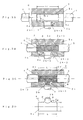
- Figs. 3A to 3D show the steps of hydroforming a T piece.
- a tubular blank 3 having a predetermined length L 0 is set in the dies 2 of a hydroforming machine (not shown).
- An outer diameter D1 and a wall thickness t a of the tubular blank 3 are identical to those of a product T piece.
- a tubular blank is a short piece of pipe obtained by cutting a long steel pipe into pieces, each having such a length as to be accommodated in the hydroforming dies.
- the tubular blank 3 is set in the groove 2b-1 of the lower die 2b, and then the upper die 2a attached to the vertically pressing apparatus of a hydroforming machine (not shown) is lowered, thereby setting the tubular blank 3 in the dies 2.
- the upper die 2a is pressed against the lower die 2b by a predetermined force.
- opposed pushing blocks 4 and 5 attached to the horizontally pressing apparatus of a hydroforming machine are advanced to press the end surfaces 4a and 5a thereof against the end surfaces 3a of the tubular blank 3.
- the tubular blank 3 is filled with a hydraulic fluid 8 injected through a hydraulic fluid path 6.
- the hydraulic fluid is usually of an emulsion prepared through combination of water with oil, which oil is intended primarily for rust prevention.
- the pushing blocks 4 and 5 are advanced.
- the tubular blank 3 begins to deform along the round (R) portion 2b-3 of the hole 2b-2 of the lower die 2b, so that part of the tubular blank 3 begins to project into the hole 2b-2.
- the tubular blank 3 is contracted to a length L' slightly longer than the length of the trunk of a product T piece, and a projected portion 9b is formed against the hole 2b-2 and a stopper 7 set in a predetermined position. Thereafter, the pressure of the hydraulic fluid 8 is reduced, the pushing blocks 4 and 5 are retreated, and the upper die 2a is raised. The stopper 7 is raised by a cylinder (not shown) to thereby eject a semifinished product 9 from the lower die 2b.
- Fig. 3D shows a side view of the semifinished product 9.
- the projected portion 9b is cut at a height H, and a trunk 9a is finished to a length L, followed by heat treatment, as needed, to thereby obtain a T piece.
- the hydraulic fluid 8 applies to the tubular blank 3 a pressure ranging from hundreds of atmospheres to one thousand and several hundreds of atmospheres.
- the pushing blocks 4 and 5 apply a compressive force to the tubular blank 3. Accordingly, a high pressure acts on the outer surface of the tubular blank 3 and the groove 2a-1 of the upper die 2a and the groove 2b-1 of the lower die 2b.
- scratches are formed in the outer surface of the semifinished product 9, and these must be removed by polishing with a grinder or the like.
- the cavity of the dies 2 is finished hard and smooth.
- hydroforming involves severe friction, repeated hydroforming results in the formation of scratches even in the dies 2.
- Correction of the die surface through polishing reduces production efficiency, and repeated correction results in a change of dimensions of a product. In such a case, the corrected portion of the die surface must be padded and finished, resulting in an increase in maintenance cost.
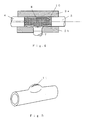
- tubular blank 3 is difficult to slide in an axial direction, the tubular blank 3 is likely to buckle in the vicinity of end portions thereof. Thus, hydroforming a thin-walled product is difficult.
- Fig. 4 shows a buckled tubular blank 3. As shown in Fig. 4, buckling 10 is likely to occur in the vicinity of end portions of the tubular blank 3.
- Fig. 5 shows the cracked projected portion 9b. As shown in Fig. 5, a crack 11 occurs in the top area of the projected portion 9b when the tubular blank 3 becomes difficult to project into the die hole 2b-2.
- the outer surface of a tubular blank is treated against galling to the die surface.
- a lubrication oil may be applied onto the outer surface of a tubular blank, but this method is relatively ineffective because the lubrication oil is rubbed off due to sliding under a high surface pressure between the tubular blank and the dies.
- a water-based hydraulic fluid used for applying an internal pressure to a tubular blank accommodated in dies may deteriorate the effect of a lubrication oil.
- anti-galling paint is commonly employed.
- a tubular blank obtained by cutting a pipe to a predetermined length is degreased and then paint is applied on the outer surface thereof by spraying or brushing. After the applied paint is sufficiently dried and solidified, hydroforming is performed.
- the degreasing and painting of a tubular blank require corresponding labor or man-hours. Since painting a long pipe it is difficult, the pipe is cut into tubular blanks, each having a predetermined length, and then each of the tubular blanks is painted. In this case, the step of cutting a pipe into tubular blanks cannot be continuously linked to a hydroforming step. Accordingly, material stagnates between steps, requiring an excess space for storing material and impairing the overall efficiency of a hydroforming system.
- JP-A-59 029 147 discloses a steel pipe whose outer surface is primed with anticorrosive powdered epoxy resin and coated with urethane resin.
- the urethane resin improves flexibility.
- US 4,510,007 discloses a method of jacketing pipes comprising applying a blend of an epoxy resin and a curing agent to the pipe.
- EP-A-0 357 508 discloses a water-dispersion-type hot-rolling lubricant for use in coating a mandrel bar which is used to produce seamless steel pipes.
- an objective of the present invention is to provide a lubricant surface-treated steel pipe for hydroforming use characterised in the following.
- the present invention provides:
- the present inventors have found that using a resin coating as a lubricant is an optimum way to cope with severe sliding conditions between dies and an object material in hydroforming.
- a resin coating is provided on at least the outer surface of a steel pipe. This coating functions as a spacer to prevent the direct metal-to-metal contact between dies and a steel pipe.
- the resin coating is left on the surface of the hydroformed product after hydroforming and is called a non-removal resin coating.
- the organic resin to be used for the non-removal resin coating may be of the thermosetting or radiation curing type.
- the organic resin is selected from acrylic, urethane, polyester, and epoxy resins. These resins may be cross-linked through use of an appropriate crosslinker. Examples of a crosslinker include amino resins and epoxy resins. Also, an acrylic resin prepared through polymerization primarily of acrylic acid and methacrylic acid may be thermoset through the use of methyl alcohol- or butyl alcohol-modified melamine.
- the organic resin coating used in the present invention may contain additives such as lubricants, pigments, and rust preventives in order to improve the physical properties thereof.
- a resin coating must have pressure resistance and adhesion.
- hydroforming the surface pressure between an object material and dies may reach thousands of atmospheres.
- the pressure resistance of a coating is evaluated in terms of hardness. It is desirable for a resin coating to have pencil hardness H or higher as specified in JIS K5400-6.14.
- working heat and frictional heat cause the surface temperature of an object material to rise.
- the surface temperature of a carbon steel pipe rises to approximately 40°C to 60°C, and that of a stainless steel pipe rises to approximately 70°C to 90°C.
- an emulsion is used as a hydraulic fluid, so that water is present between the dies and the object material. Accordingly, a coating must maintain adhesion in a heated moist state.
- a resin coating which is primarily formed from high polymers, decreases in modulus of elasticity and adhesion at high temperatures. Particularly, at a temperature not lower than a glass transition temperature, these properties deteriorate significantly. Accordingly, the glass transition temperature of the resin coating is 40°C or higher.
- the glass transition temperature of a resin coating is excessively high, the resin coating may crack during hydroforming.
- the glass transition temperature must be not higher than 120°C, preferably 50°C to 100°C, more preferably 60°C to 90°C.
- the surface of the steel pipe is preferably acid-cleaned or subjected to blast treatment.
- the resin coating is usually provided on the outer surface of a steel pipe so as to provide good lubrication between dies and the steel pipe in hydroforming, but may also be provided on the inner surface of the steel pipe.
- Application of the resin onto the inner surface of a steel pipe is primarily intended for rust prevention of the steel pipe before and after hydroforming.
- the organic resin coating remains on the hydroformed product. Since this coating has a rust-preventive function, the coating may be utilized as a rust-preventive coating. If the inner surface of the steel pipe to be hydroformed is also coated with the organic resin, the inner surface of the hydroformed product will also be prevented from rusting.
- the organic coating When the organic coating is not sufficiently lubricated due to severe hydroforming conditions, the organic coating will preferably contain an organic lubricant (e.g. polyethylene wax or fluoroplastic grains) in an amount of 0.5 wt.% to 20 wt.% in solid term. Also, adding pigments to an organic coating improves adhesion of the coating and increases the hardness of the coating.
- an organic lubricant e.g. polyethylene wax or fluoroplastic grains
- additives such as lubricants, pigments, and rust preventives may be added to a resin to control coating performance.
- solid lubricants such as wax and metallic soap
- metallic soap is particularly preferred because it is adsorbed into the surface of a tubular blank.
- inorganic solid lubricants having a large specific gravity are not preferred as they impair the stability of dispersion of a lubricant solution.
- Applicable metallic soap may include esters of fatty acid, phosphoric esters, and sulfuric esters. These kinds of metallic soap are preferably slightly soluble in water. Examples of such metallic soap include Ca salts and Zn salts. K salts and Na salts are not preferred, since they impair the water resistance and corrosion resistance of a coating.
- Metallic soap is added preferably in an amount of 1% to 20% inclusive. When metallic soap is added in an amount of less than 1%, sufficient lubrication is not obtained. When metallic soap is added in excess of 20%, the water resistance of a coating is impaired, and manufacturing performance is also impaired due to foaming at the time of application.
- Hydroforming does not require the inner surface of a tubular blank to be coated with a lubricating resin.
- a resin coating is also formed on the inner surface thereof; however, the inner coating has no effect on hydroforming.
- the inner resin coating will prevent the pipe surface from rusting.
- the thickness of the resin coating is 1 ⁇ m to 100 ⁇ m, preferably 30 ⁇ m to 90 ⁇ m, more preferably 30 ⁇ m to 50 ⁇ m.
- the resin coating must be relatively thick as described above.
- Such a thick resin coating may be formed by repeating the application of a resin and drying.
- the resin is either dissolved in a solvent or water and applied preferably by spraying, or a solid resin is applied preferably by electrostatic spraying a powder of the resin.
- forced drying is performed to evaporate the solvent or water.
- the coated steel pipe may be heated through use of hot air or induction heating.
- the drying time can for example be reduced through use of ultraviolet rays.
- a pre-treatment layer is provided as needed.
- a pre-treatment layer for the resin coating is preferably provided on the steel pipe in order to strengthen the adhesion between the resin coating and the steel pipe.
- a surface treatment layer is provided through phosphate treatment or chromate treatment which is usually applied before coating.
- zinc phosphate is applied in an amount of not greater than 1 g/m 2 ; iron phosphate is applied in an amount of not greater than 0.3 g/m 2 ; and chromate is applied in an amount of not greater than 500 mg/m 2 as metallic chromium.
- phosphating or reactive chromate treatment the steel pipe is immersed in a treatment solution for a predetermined time and is then washed with water and dried to thereby form a surface treatment layer on the steel pipe.
- a treatment solution is sprayed or brushed onto the surface of the steel pipe, followed by forced drying at a temperature of about 100°C.
- Examples of material for the steel pipe include, but are not limited to, carbon steel, austenitic stainless steel, and ferritic stainless steel.
- Surface-treated steel pipes of this invention are suitable for hydroforming various steel components used in automotive body such as lower arms,suspension members ,center pillars and so on.
- the glass transition temperature of coating was found to be 35°C to 110°C as a result of measurement of viscoelasticity.
- the pencil hardness of the coating was 3H.
- 3D are as follows: a trunk (9a) has an outer diameter (D1) of 89.1 mm and a length (L') of 180 mm; and a projected portion (9b) has an outer diameter (D2) of 89.1 mm and a height (H') of 65 mm. For each coating thickness, 10 tubular blanks were continuously hydroformed.
- Resins used, the thickness of a resin coating, and the amount of applied chromate are shown in Table 3.
- a trunk (9a) has an outer diameter (D1) of 89.1 mm and a length (L') of 180 mm; and a projected portion (9b) has an outer diameter (D2) of 89.1 mm and a height (H') of 65 mm.
Landscapes
- Chemical & Material Sciences (AREA)
- Engineering & Computer Science (AREA)
- Chemical Kinetics & Catalysis (AREA)
- General Chemical & Material Sciences (AREA)
- Oil, Petroleum & Natural Gas (AREA)
- Organic Chemistry (AREA)
- General Engineering & Computer Science (AREA)
- Mechanical Engineering (AREA)
- Emergency Medicine (AREA)
- Health & Medical Sciences (AREA)
- Wood Science & Technology (AREA)
- Life Sciences & Earth Sciences (AREA)
- Shaping Metal By Deep-Drawing, Or The Like (AREA)
Claims (8)
- Utilisation d'un tuyau en acier à surface traitée par un lubrifiant pour l'hydroformage, ce tuyau en acier comprenant un revêtement en résine organique lubrifiante disposé sur un moins une surface extérieure du tuyau en acier, la résine ayant une température de transition vitreuse comprise entre 40° C et 120° C et étant sélectionnée parmi des résines du type durcissant aux radiations ou thermodurcissable, et le revêtement ayant une épaisseur comprise entre 1 µm et 100 µm.
- Utilisation d'un tuyau en acier selon la revendication 1, dans lequel la résine est sélectionnée parmi les résines acryliques, uréthanes, polyesters et époxy.
- Utilisation d'un tuyau en acier selon la revendication 1 ou 2, dans lequel le revêtement en résine organique lubrifiant est disposé sur une couche de pré-traitement qui est disposée sur au moins une surface extérieure du tuyau en acier.
- Utilisation d'un tuyau en acier selon l'une quelconque des revendications 1 à 3, dans lequel l'épaisseur du revêtement en résine organique est comprise entre 30 µm et 90 µm.
- Utilisation d'un tuyau en acier selon l'une quelconque des revendications 1 à 4, dans lequel le revêtement en résine organique comprend une cire de polyéthylène ou des grains fluoroplastiques constituant un lubrifiant organique en une quantité comprise entre 0,5 % et 20 % en poids.
- Utilisation d'un tuyau en acier selon l'une quelconque des revendications 1 à 5, dans lequel la couche de pré-traitement est du phosphate de zinc appliqué en une quantité qui n'est pas supérieure à 1 g/m2.
- Utilisation d'un tuyau en acier selon l'une quelconque des revendications 3 à 5, dans lequel la couche de pré-traitement est du phosphate de fer appliqué en une quantité qui n'est pas supérieure à 0,3 g/m2.
- Utilisation d'un tuyau en acier selon l'une quelconque des revendications 3 à 5, dans lequel la couche de pré-traitement est un chromate appliqué en une quantité qui n'est pas supérieure à 500 mg/m2 de chrome métallique.
Priority Applications (1)
| Application Number | Priority Date | Filing Date | Title |
|---|---|---|---|
| EP01105671A EP1113066B1 (fr) | 1996-11-07 | 1997-11-06 | Utilisation de tubes en acier à surface extérieure revêtue de résine organique pour un hydroformage amélioré |
Applications Claiming Priority (6)
| Application Number | Priority Date | Filing Date | Title |
|---|---|---|---|
| JP295253/96 | 1996-11-07 | ||
| JP29516896 | 1996-11-07 | ||
| JP29525396A JP3424464B2 (ja) | 1996-11-07 | 1996-11-07 | 液圧バルジ加工用表面処理鋼管 |
| JP8295168A JPH10137863A (ja) | 1996-11-07 | 1996-11-07 | 液圧バルジ加工用表面処理鋼管 |
| JP29525396 | 1996-11-07 | ||
| JP295168/96 | 1996-11-07 |
Related Child Applications (1)
| Application Number | Title | Priority Date | Filing Date |
|---|---|---|---|
| EP01105671A Division EP1113066B1 (fr) | 1996-11-07 | 1997-11-06 | Utilisation de tubes en acier à surface extérieure revêtue de résine organique pour un hydroformage amélioré |
Publications (2)
| Publication Number | Publication Date |
|---|---|
| EP0841388A1 EP0841388A1 (fr) | 1998-05-13 |
| EP0841388B1 true EP0841388B1 (fr) | 2002-02-13 |
Family
ID=26560152
Family Applications (2)
| Application Number | Title | Priority Date | Filing Date |
|---|---|---|---|
| EP01105671A Expired - Lifetime EP1113066B1 (fr) | 1996-11-07 | 1997-11-06 | Utilisation de tubes en acier à surface extérieure revêtue de résine organique pour un hydroformage amélioré |
| EP97308932A Expired - Lifetime EP0841388B1 (fr) | 1996-11-07 | 1997-11-06 | Utilisation des tubes en acier à surface extérieure revêtue de résine organique pour un hydroreformage amélioré |
Family Applications Before (1)
| Application Number | Title | Priority Date | Filing Date |
|---|---|---|---|
| EP01105671A Expired - Lifetime EP1113066B1 (fr) | 1996-11-07 | 1997-11-06 | Utilisation de tubes en acier à surface extérieure revêtue de résine organique pour un hydroformage amélioré |
Country Status (6)
| Country | Link |
|---|---|
| US (1) | US6009913A (fr) |
| EP (2) | EP1113066B1 (fr) |
| KR (1) | KR100298796B1 (fr) |
| CA (1) | CA2220192A1 (fr) |
| DE (2) | DE69729592T2 (fr) |
| ID (1) | ID21208A (fr) |
Families Citing this family (16)
| Publication number | Priority date | Publication date | Assignee | Title |
|---|---|---|---|---|
| US6532784B1 (en) | 1998-09-04 | 2003-03-18 | Henkel Corporation | Mechanical hydroforming with improved lubrication |
| JP2000203588A (ja) * | 1998-10-19 | 2000-07-25 | Nisshin Steel Co Ltd | 燃料タンク用Al系めっき鋼板およびその鋼板による燃料タンクの製造方法 |
| US6668457B1 (en) * | 1999-12-10 | 2003-12-30 | L&L Products, Inc. | Heat-activated structural foam reinforced hydroform |
| CA2354665C (fr) | 2000-08-09 | 2006-10-31 | Nippon Steel Corporation | Feuille d'acier inoxydable soluble lubrifiant avec traitement de surface et ayant une faconnabilite excellente pour reservoir de carburant et methode de fabrication de reservoir de carburant |
| US20030181340A1 (en) * | 2000-09-22 | 2003-09-25 | Botz Frank K. | Lubricants suitable for hydroforming and other metal manipulating applications |
| DE10115696A1 (de) * | 2001-03-29 | 2002-10-10 | Henkel Kgaa | Schmierstoffmischung und ihre Verwendung |
| JP3504655B2 (ja) * | 2001-12-06 | 2004-03-08 | 新日本製鐵株式会社 | プレス成形性と作業性に優れたフェライト系ステンレス鋼板およびその製造方法 |
| US20050051932A1 (en) * | 2003-09-04 | 2005-03-10 | Danzik Dennis M. | Hydraulic composite molding and hydraulic molded products |
| ITGE20030110A1 (it) * | 2003-12-18 | 2005-06-19 | Socotherm S P A | Metodo di fabbricazione di condotte termoisolate a tubi |
| US8344905B2 (en) | 2005-03-31 | 2013-01-01 | Intelliserv, Llc | Method and conduit for transmitting signals |
| US7413021B2 (en) * | 2005-03-31 | 2008-08-19 | Schlumberger Technology Corporation | Method and conduit for transmitting signals |
| CA2551262A1 (fr) * | 2005-07-29 | 2007-01-29 | Salflex Polymers Ltd. | Methode de production de pieces composites en metal et matiere plastique |
| US8490278B2 (en) * | 2005-08-25 | 2013-07-23 | Toyo Kohan Co., Ltd. | Method for production of magnesium alloy molding-processed article, and magnesium alloy molding-processed article |
| US20090139799A1 (en) * | 2007-11-30 | 2009-06-04 | General Electric Company | Textured surfaces for gears |
| US9586248B1 (en) | 2016-04-08 | 2017-03-07 | King Saud University | System for forming a T-shaped tubular fitting |
| CN113513659B (zh) * | 2021-07-31 | 2021-12-28 | 江苏正泰不锈钢产业有限公司 | 一种不锈钢管防腐工艺 |
Family Cites Families (18)
| Publication number | Priority date | Publication date | Assignee | Title |
|---|---|---|---|---|
| US2646822A (en) * | 1949-12-31 | 1953-07-28 | Presstite Engineering Company | Plastic-coated pipe and pipe fitting |
| US3356108A (en) * | 1963-02-26 | 1967-12-05 | Texas Instruments Inc | Composite tubular articles and method of making same |
| US3422856A (en) * | 1967-04-11 | 1969-01-21 | John J Hunter | Plastic-lined pipe and method of producing |
| JPS495908B1 (fr) * | 1969-03-11 | 1974-02-09 | ||
| JPS5833903B2 (ja) * | 1979-02-28 | 1983-07-22 | 日東電工株式会社 | 金属板保護用塗料 |
| JPS58168420A (ja) * | 1982-03-31 | 1983-10-04 | Sumitomo Metal Ind Ltd | 難加工材の冷間抽伸法 |
| US4421569A (en) * | 1982-05-07 | 1983-12-20 | Sharon Tube Corp. | Corrosion protection of steel pipes |
| JPS58220737A (ja) * | 1982-06-18 | 1983-12-22 | 宇部興産株式会社 | 高防食性鋼管被覆シ−ト及びその製造法 |
| DE3247510C2 (de) * | 1982-07-06 | 1984-12-06 | Mannesmann AG, 4000 Düsseldorf | Verfahren zum Ummanteln eines Formkörpers und Anwendung des Verfahrens auf einen Formkörper mit einer wärmeempfindlichen Innenschicht |
| DE3229563A1 (de) * | 1982-08-07 | 1984-02-23 | Hoechst Ag, 6230 Frankfurt | Verfahren zur beschichtung von metallischen substraten und verwendung der nach diesem verfahren hergestellten erzeugnisse |
| JPS5929147A (ja) * | 1982-08-09 | 1984-02-16 | 新日本製鐵株式会社 | 複層プラスチツク被覆鋼管 |
| US5207248A (en) * | 1987-07-14 | 1993-05-04 | Hitachi Cable, Ltd. | Pipe coated with a resin layer on the inner surface thereof |
| JPH01280545A (ja) * | 1987-08-31 | 1989-11-10 | Nippon Steel Corp | 耐高温陰極剥離性の優れた有機樹脂系被覆鋼管の製造方法 |
| CA1329802C (fr) * | 1988-08-30 | 1994-05-24 | Nippon Kokan Kabushiki Kaisha | Lubrifiant pour l'obtention de tuyauterie sans couture, en acier |
| US5385655A (en) * | 1992-10-30 | 1995-01-31 | Man-Gill Chemical Company | Treatment of metal parts to provide rust-inhibiting coatings |
| JPH07195615A (ja) * | 1993-12-29 | 1995-08-01 | Kawasaki Steel Corp | プレス加工性、耐食性に優れた潤滑樹脂処理鋼板 |
| US5484541A (en) * | 1994-05-17 | 1996-01-16 | Century Chemical Corporation | Process and product for lubricating metal prior to cold forming |
| US5932306A (en) * | 1995-04-24 | 1999-08-03 | Usui Kokusai Sangyo Kaisha Limited | Corrosion-and-chipping-resistant resin coating structure for stainless steel pipes |
-
1997
- 1997-11-04 CA CA002220192A patent/CA2220192A1/fr not_active Abandoned
- 1997-11-04 ID IDP973596A patent/ID21208A/id unknown
- 1997-11-05 US US08/964,915 patent/US6009913A/en not_active Expired - Fee Related
- 1997-11-06 EP EP01105671A patent/EP1113066B1/fr not_active Expired - Lifetime
- 1997-11-06 KR KR1019970058620A patent/KR100298796B1/ko not_active Expired - Fee Related
- 1997-11-06 DE DE69729592T patent/DE69729592T2/de not_active Expired - Fee Related
- 1997-11-06 DE DE69710414T patent/DE69710414T2/de not_active Expired - Fee Related
- 1997-11-06 EP EP97308932A patent/EP0841388B1/fr not_active Expired - Lifetime
Also Published As
| Publication number | Publication date |
|---|---|
| ID21208A (id) | 1999-05-06 |
| KR100298796B1 (ko) | 2001-11-22 |
| EP1113066B1 (fr) | 2004-06-16 |
| DE69710414D1 (de) | 2002-03-21 |
| DE69729592D1 (de) | 2004-07-22 |
| CA2220192A1 (fr) | 1998-05-07 |
| EP0841388A1 (fr) | 1998-05-13 |
| EP1113066A1 (fr) | 2001-07-04 |
| DE69729592T2 (de) | 2005-06-09 |
| KR19980042178A (ko) | 1998-08-17 |
| DE69710414T2 (de) | 2002-11-07 |
| US6009913A (en) | 2000-01-04 |
Similar Documents
| Publication | Publication Date | Title |
|---|---|---|
| EP0841388B1 (fr) | Utilisation des tubes en acier à surface extérieure revêtue de résine organique pour un hydroreformage amélioré | |
| Cotell et al. | Surface engineering | |
| EP1548346B1 (fr) | Joint a vis destine a un tuyau en acier | |
| CA2958500C (fr) | Utilisation d'un sulfate et procede de fabrication d'une piece en acier par formage sur une machine de formage | |
| US5348425A (en) | Piston cylinder device with a protective coating and method of producing such a coating | |
| AU2003289934B2 (en) | Lubricant coated sheet metal with improved deformation properties | |
| US20030078170A1 (en) | Ballistics conditioning | |
| EP1099485A2 (fr) | Tôles ou tubes en acier inoxydable lubrifié et leur procédé de fabrication | |
| JPH0355204B2 (fr) | ||
| KR101523546B1 (ko) | 냉간압조용 소성가공 금속 재료의 비인피막 처리방법 | |
| JP2001105528A (ja) | リン酸亜鉛複合処理鋼板 | |
| JPH10137863A (ja) | 液圧バルジ加工用表面処理鋼管 | |
| CN1058553A (zh) | 活塞工作缸单元的制造方法及按该方法制造的活塞工作缸单元 | |
| JP3424464B2 (ja) | 液圧バルジ加工用表面処理鋼管 | |
| AU633411B2 (en) | Thermoplastic acrylic coated steel sheet | |
| JP2511497B2 (ja) | 成形性に優れた潤滑樹脂処理鋼板 | |
| CN113039026A (zh) | 冲压加工用模具及冲压加工方法 | |
| JP2001179873A (ja) | リン酸亜鉛複合処理鋼板 | |
| US20090048127A1 (en) | Body-in-white stamping lubricant with anti-weld spatter properties and related processes | |
| JPH01120447A (ja) | 熱収縮性樹脂管被覆金属コイルばね | |
| EP2732063B1 (fr) | Procédé fournissant un revêtement multifonctionnel sur un substrat métallique | |
| JP2001009530A (ja) | 良加工性内面高潤滑鋼管及びその製造方法 | |
| JP2005105337A (ja) | 塗装性に優れるハイドロフォーム用表面処理鋼管 | |
| JP3424463B2 (ja) | 液圧バルジ加工用表面処理鋼管 | |
| JP2002066626A (ja) | 電縫鋼管の製造装置 |
Legal Events
| Date | Code | Title | Description |
|---|---|---|---|
| PUAI | Public reference made under article 153(3) epc to a published international application that has entered the european phase |
Free format text: ORIGINAL CODE: 0009012 |
|
| AK | Designated contracting states |
Kind code of ref document: A1 Designated state(s): DE FR GB IT SE |
|
| AX | Request for extension of the european patent |
Free format text: AL;LT;LV;MK;RO;SI |
|
| 17P | Request for examination filed |
Effective date: 19980519 |
|
| 17Q | First examination report despatched |
Effective date: 19981102 |
|
| AKX | Designation fees paid |
Free format text: DE FR GB IT SE |
|
| RBV | Designated contracting states (corrected) |
Designated state(s): DE FR GB IT SE |
|
| RTI1 | Title (correction) |
Free format text: USE OF STEEL-PIPES HAVING AN ORGANIC RESIN OUTER SURFACE COATING FOR IMPROVED HYDROFORMING |
|
| GRAG | Despatch of communication of intention to grant |
Free format text: ORIGINAL CODE: EPIDOS AGRA |
|
| GRAG | Despatch of communication of intention to grant |
Free format text: ORIGINAL CODE: EPIDOS AGRA |
|
| GRAH | Despatch of communication of intention to grant a patent |
Free format text: ORIGINAL CODE: EPIDOS IGRA |
|
| GRAH | Despatch of communication of intention to grant a patent |
Free format text: ORIGINAL CODE: EPIDOS IGRA |
|
| GRAA | (expected) grant |
Free format text: ORIGINAL CODE: 0009210 |
|
| REG | Reference to a national code |
Ref country code: GB Ref legal event code: IF02 |
|
| AK | Designated contracting states |
Kind code of ref document: B1 Designated state(s): DE FR GB IT SE |
|
| REF | Corresponds to: |
Ref document number: 69710414 Country of ref document: DE Date of ref document: 20020321 |
|
| ET | Fr: translation filed |
Owner name: KONINKLIJKE PHILIPS ELECTRONICS N.V. |
|
| PLBE | No opposition filed within time limit |
Free format text: ORIGINAL CODE: 0009261 |
|
| STAA | Information on the status of an ep patent application or granted ep patent |
Free format text: STATUS: NO OPPOSITION FILED WITHIN TIME LIMIT |
|
| 26N | No opposition filed |
Effective date: 20021114 |
|
| PGFP | Annual fee paid to national office [announced via postgrant information from national office to epo] |
Ref country code: GB Payment date: 20041104 Year of fee payment: 8 Ref country code: DE Payment date: 20041104 Year of fee payment: 8 |
|
| PGFP | Annual fee paid to national office [announced via postgrant information from national office to epo] |
Ref country code: SE Payment date: 20041105 Year of fee payment: 8 |
|
| PGFP | Annual fee paid to national office [announced via postgrant information from national office to epo] |
Ref country code: FR Payment date: 20041109 Year of fee payment: 8 |
|
| PG25 | Lapsed in a contracting state [announced via postgrant information from national office to epo] |
Ref country code: IT Free format text: LAPSE BECAUSE OF NON-PAYMENT OF DUE FEES Effective date: 20051106 Ref country code: GB Free format text: LAPSE BECAUSE OF NON-PAYMENT OF DUE FEES Effective date: 20051106 |
|
| PG25 | Lapsed in a contracting state [announced via postgrant information from national office to epo] |
Ref country code: SE Free format text: LAPSE BECAUSE OF NON-PAYMENT OF DUE FEES Effective date: 20051107 |
|
| PG25 | Lapsed in a contracting state [announced via postgrant information from national office to epo] |
Ref country code: DE Free format text: LAPSE BECAUSE OF NON-PAYMENT OF DUE FEES Effective date: 20060601 |
|
| EUG | Se: european patent has lapsed | ||
| GBPC | Gb: european patent ceased through non-payment of renewal fee |
Effective date: 20051106 |
|
| PG25 | Lapsed in a contracting state [announced via postgrant information from national office to epo] |
Ref country code: FR Free format text: LAPSE BECAUSE OF NON-PAYMENT OF DUE FEES Effective date: 20060731 |
|
| REG | Reference to a national code |
Ref country code: FR Ref legal event code: ST Effective date: 20060731 |