EP0841393A1 - PROTEINE HUMAINE SEMBLABLE A GALECTINE-4 ET ADNc CODANT CETTE PROTEINE - Google Patents
PROTEINE HUMAINE SEMBLABLE A GALECTINE-4 ET ADNc CODANT CETTE PROTEINE Download PDFInfo
- Publication number
- EP0841393A1 EP0841393A1 EP96922267A EP96922267A EP0841393A1 EP 0841393 A1 EP0841393 A1 EP 0841393A1 EP 96922267 A EP96922267 A EP 96922267A EP 96922267 A EP96922267 A EP 96922267A EP 0841393 A1 EP0841393 A1 EP 0841393A1
- Authority
- EP
- European Patent Office
- Prior art keywords
- protein
- cdna
- sequence
- galectin
- lactose
- Prior art date
- Legal status (The legal status is an assumption and is not a legal conclusion. Google has not performed a legal analysis and makes no representation as to the accuracy of the status listed.)
- Withdrawn
Links
Images

Classifications
-
- C—CHEMISTRY; METALLURGY
- C07—ORGANIC CHEMISTRY
- C07K—PEPTIDES
- C07K14/00—Peptides having more than 20 amino acids; Gastrins; Somatostatins; Melanotropins; Derivatives thereof
- C07K14/435—Peptides having more than 20 amino acids; Gastrins; Somatostatins; Melanotropins; Derivatives thereof from animals; from humans
- C07K14/46—Peptides having more than 20 amino acids; Gastrins; Somatostatins; Melanotropins; Derivatives thereof from animals; from humans from vertebrates
- C07K14/47—Peptides having more than 20 amino acids; Gastrins; Somatostatins; Melanotropins; Derivatives thereof from animals; from humans from vertebrates from mammals
- C07K14/4701—Peptides having more than 20 amino acids; Gastrins; Somatostatins; Melanotropins; Derivatives thereof from animals; from humans from vertebrates from mammals not used
- C07K14/4726—Lectins
-
- A—HUMAN NECESSITIES
- A61—MEDICAL OR VETERINARY SCIENCE; HYGIENE
- A61K—PREPARATIONS FOR MEDICAL, DENTAL OR TOILETRY PURPOSES
- A61K38/00—Medicinal preparations containing peptides
Definitions
- the present invention relates to a novel cDNA originating from an mRNA expressed in human cells and a galectin-4-like protein encoded by this cDNA.
- the human cDNA of the present invention can be used as a probe for the gene diagnosis and a gene source for the gene therapy.
- the cDNA can be used as a gene source for large-scale production of the protein encoded by said cDNA.
- the protein of the present invention can be used as pharmaceuticals or reagents for glycogenic researches.
- Galectins are the general term for animal lectins binding to galactose. Animal lectins exist in many sites such as the cytoplasm, the nucleus, the cell membrane surface, etc., and considered to be related with the cell proliferation, the differentiation, the canceration, the metastasis, the immunity, and so on [Drickamer, K., Annu. Rev. Cell. Biol., 9: 237-264 (1993)]. Among them, galectin-4 has been found as a lectin contained abundantly in the rat intestinal extract. The galectin-4 is expressed specifically in the digestive tracts such as the stomach and intestines, and is abundant in the mucous membrane, thereby being a putative protein essential for maintaining the functions of these organs.
- the present inventors were successful in cloning of a human cDNA encoding a galectin-4-like protein, thereby completing the present invention. That is to say, the present invention provides a protein containing the amino acid sequence represented by Sequence No. 1 that is a human galectin-4-like protein.
- the present invention also, provides a DNA encoding said protein exemplified as a cDNA containing the base sequence represented by Sequence No. 2 or No. 3.
- the human cDNA of the present invention can be cloned from a cDNA library of the human cell origin.
- This cDNA library is constructed using as a template a poly(A) + RNA extracted from human cells.
- the human cells may be cells delivered from the human body, for example, by the operation or may be the culture cells.
- a poly(A) + RNA isolated from the stomach cancer tissue is used in Examples.
- the cDNA can be synthesized by using any method selected from the Okayama-Berg method [Okayama, H. and Berg, P., Mol. Cell. Biol., 2: 161-170 (1982)], the Gubler-Hoffman method [Gubler, U. and Hoffman, J.
- the identification of the cDNA is performed by the determination of the whole base sequence by the sequencing, the search of the amino acid sequence predicted from the base sequence and the known protein having a similar sequence, the protein expression by the in vitro translation, the expression by Escherichia coli , and the activity measurement of the expressed product.
- the activity measurement is carried out by identifying the binding with lactose.
- the cDNA of the present invention is characterized by containing the base sequence represented by Sequence No. 1, as exemplified by that represented by Sequence No. 2.
- Sequence No. 3 possesses a 1113-bp base sequence with a 972-bp open reading frame. This open reading frame codes for a protein consisting of 323 amino acid residues. This protein possesses such a high 76.3% similarity to the rat galectin-4 in the amino acid sequence level.
- the same clone as the cDNA of the present invention can be easily obtained by screening of the human cDNA library constructed from the gastrointestinal tissues or the gastrointestinal cell lines, by the use of an oligonucleotide probe synthesized on the basis of the cDNA base sequence depicted in Sequence No. 3.
- any cDNA that is subjected to insertion or deletion of one or plural nucleotides and/or substitution with other nucleotides in the base sequence encoding the amino acid sequence represented by Sequence No. 1 or in Sequence No. 3 shall come within the scope of the present invention.
- any protein that is produced by these modifications comprising insertion or deletion of one or plural nucleotides and/or substitution with other nucleotides shall come within the scope of the present invention.
- the cDNA of the present invention includes cDNA fragments (more than 10 bp) containing any partial base sequence of the base sequence represented by Sequence No. 2 or No. 3. Also, DNA fragments consisting of a sense chain and an anti-sense chain shall come within this scope. These DNA fragments can be used as the probes for the gene diagnosis.
- the protein of the present invention can be expressed in vitro by preparation of an RNA by the in vitro transcription from a vector having a cDNA of the present invention, followed by the in vitro translation using this RNA as a template. Also, the recombination of the translation domain to a suitable expression vector by the method known in the art leads to the expression of a large amount of the encoded protein by using Escherichia coli , Bacillus subtilis , yeasts, animal cells, and so on. Alternatively, the peptide can be prepared by the chemical synthesis on the basis of the amino acid sequence shown in the sequence table shown below.
- Any fusion protein with another optional protein is included in the scope of the present invention, as far as it possesses lactose-binding activity.
- Such examples include a fusion protein with the maltose-binding protein illustrated in Examples.
- Figure 1 is a figure depicting the structure of the plasmid pHP01049 of the present invention.
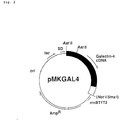
- Figure 2 is a figure depicting the structure of the Escherichia coli expression vector pMKGAL4 of the present invention.
- the present invention is embodied in more detail by the following examples, but this embodiment is not intended to restrict the present invention.
- the basic operations and the enzyme reactions with regard to the DNA recombination are carried out according to the literature [Molecular Cloning. A Laboratory Manual , Cold Spring Harbor Laboratory, 1989]. Unless otherwise stated, restrictive enzymes and a variety of modification enzymes to be used were those available from TAKARA SHUZO. The manufacturer s instructions were used for the buffer compositions as well as for the reaction conditions, in each of the enzyme reactions.
- the cDNA synthesis was carried out according to the literature [Kato, S. et al., Gene, 150: 243-250 (1994)].
- RNA was prepared according to the literature [Okayama, H. et al., "Methods in Enzymology” Vol. 164, Academic Press, 1987]. This was subjected to oligo(dT)-cellulose column chromatography washed with a 20 mM Tris-hydrochloric acid buffer solution (pH 7.6), 0.5 M NaCl, and 1 mM EDTA to obtain 10 ⁇ g of a poly(A) + RNA according to the literature mentioned above.
- the decapped poly(A) + RNA and 3 nmol of a chimeric DNA-RNA oligonucleotide (5'-dG-dG-dG-dG-dA-dA-dT-dT-dC-dG-dA-G-G-A-3') were dissolved in a solution containing 50 mM Tris-hydrochloric acid buffer (pH 7.5), 0.5 mM ATP, 5 mM MgCl 2 , 10 mM 2-mercaptoethanol, and 25% polyethylene glycol, whereto was added 50 units of T4RNA ligase and a total 30 ⁇ l volume of the resulting mixture was reacted at 20°C for 12 hours. After the reaction mixture was subjected to phenol extraction followed by ethanol precipitation, the pellet was dissolved in water to obtain a chimeric-oligo-capped poly(A) + RNA.
- the pellet was dissolved in a solution containing 50 mM Tris-hydrochloric acid buffer (pH 7.5), 100 mM NaCl, 10 mM MgCl 2 , and 1 mM dithiothreitol. Thereto were added 100 units of EcoRI and a total 20 ⁇ l volume of the resulting mixture was reacted at 37°C for one hour.
- the pellet was dissolved in a solution containing 20 mM Tris-hydrochloric acid buffer (pH 7.5), 100 mM KCl, 4 mM MgCl 2 , 10 mM (NH 4 ) 2 SO 4 , and 50 ⁇ g/ml of the bovine serum albumin. Thereto were added 60 units of an Escherichia coli DNA ligase and the resulting mixture was reacted at 16°C for 16 hours.
- the cDNA-synthesis reaction solution was used for transformation of an Escherichia coli DH12S (GIBCO-BRL).
- the transformation was carried out by an electroporation method. A portion of the transformant was sprayed on the 2xYT agar culture medium containing 100 ⁇ g/ml ampicillin and the mixture was incubated at 37°C overnight. A colony formed on the agar medium was picked up at random and inoculated on 2 ml of the 2xYT culture medium containing 100 ⁇ g/ml ampicillin. After incubation at 37°C for 2 hours, the mixture was infected with a helper phage MK13KO7 (Pharmacia) and incubated further at 37°C overnight.
- a helper phage MK13KO7 Pharmacia
- the culture solution was centrifuged to separate the mycelia and the supernatant, wherein a double-stranded DNA was isolated from the mycelia by the alkaline hydrolysis method and a single-stranded plasmid DNA from the supernatant according to the conventional method. After double digestion with EcoRI and NotI, the double-stranded plasmid DNA was subjected to 0.8% agarose gel electrophoresis to determine the size of the cDNA insert.
- Table 1 shows the comparison between the amino acid sequence of the human galectin-4-like protein of the present invention (HS) and that of the rat galectin-4 (RN). Therein, the marks of - (minus), * (asterisk) and. (dot) represent a gap, an amino acid residue identical with the protein of the present invention, and an amino acid residue similar to the protein of the present invention, respectively.
- the vector pHP01049 having the cDNA of the present invention was used for in vitro translation with a T N T rabbit reticulocyte lysate kit (Promega). In this case, [ 35 S]methionine was added to label the expression product with a radioisotope. Each of the reactions was carried out according to the protocols attached to the kit.
- Two micrograms of the plasmid pHP01049 was reacted at 30°C for 90 minutes in a total 100 ⁇ l volume of the reaction mixture containing 50 ⁇ l of the T N T rabbit reticulocyte lysate, 4 ⁇ l of a buffer solution (attached to the kit), 2 ⁇ l of an amino acid mixture (Met-free), 8 ⁇ l of [ 35 S]methionine (Amersham) (0.37 Mbq/ ⁇ l), 2 ⁇ l of T7RNA polymerase, and 80 U of RNasin.
- Plasmid pMALGAL4 was prepared from the transformant and the objective recombinant was identified by the restriction enzyme cleavage map.
- a suspension of 10 ml of an overnight-incubated liquid of pMALGAL4/JM109 in 500 ml of the Rich culture medium (contains 10 g of triptone, 5 g of yeast extract, 5 g of NaCl, and 2 g of glucose per one liter) was incubated in a shaker at 37°C and isopropylthiogalactoside was added so as to make 1 mM when A 600 reached about 0.5. After further incubation at 37°C for 3 hours, the mycelia collected by centrifugation were suspended in 25 ml of a column buffer for amylose column (10 mM Tris-hydrochloric acid, pH 7.4, 200 mM NaCl, and 1 mM EDTA).
- the above-prepared fusion protein was charged in the previously-prepared, lactosyl-Sepharose-4B column (head volume: 4.5 ml), which was washed with 20 ml of a column buffer for the lactose column and eluted with 20 ml of the column buffer containing 0.3 M lactose.
- the SDS-polyacrylamide electrophoresis of the eluted protein recognized a single band at a 81-kDa position, indicating that the maltose-binding protein/galectin-4 fusion protein obtained by the Escherichia coli expression possessed the lactose-binding activity.
- oligonucleotide primer PR1 (5'-GGGACGTCATGGCCTATGTCCCCGCACC-3') and PR2 (5'-GGCGACGTCTGAGCCCGGATCCTGCCC-3') were synthesized using a DNA synthesizer (Applied Biosystems) according to the attached protocol.
- the 5'-translation region was amplified by the PCR kit (TAKARA SHUZO) using 1 ng of plasmid pHP01049 as well as 100 pmole each of primers PR1 and PR2.
- reaction product was subjected to 1.5% agarose electrophoresis, cutting off of an about 190-bp DNA fragment, and purification.
- Plasmid pMALGAL4 was prepared from the transformant and the objective recombinant was identified by the restriction enzyme cleavage map.
- Figure 2 depicts the structure of the obtained plasmid.
- a suspension of 10 ml of an overnight-incubated liquid of pMALGAL4/JM109 in 100 ml of the LB culture medium containing 100 ⁇ g/ml of ampicillin was incubated in a shaker at 37°C and isopropylthiogalactoside was added so as to make 1 mM when A 600 reached about 0.5. After further incubation at 37°C for 3 hours, the mycelia collected by centrifugation were suspended in 25 ml of the column buffer for lactose column. After sonication, the suspension was centrifuged and the supernatant was charged into the previously prepared, lactosyl-Sepharose-4B column (a 4.5-ml head volume).
- the column was washed with 20 ml of the column buffer for lactose column and then eluted with 20 ml of the column buffer containing 0.3 M lactose.
- the SDS-polyacrylamide electrophoresis of this eluted protein indicated a single band at the position of 36 kDa.
- This molecular mass value is consistent with the molecular weight predicted for the human galectin-4-like protein. That is to say, the human galectin-4-like protein expressed by Escherichia coli was indicated to possess the lactose-binding activity.
- the present invention provides a human cDNA encoding a galectin-4-like protein and a protein encoded by this human cDNA.
- Said recombinant protein can be expressed in a large amount by using the cDNA of the present invention.
- Said recombinant protein can be used as pharmaceuticals, particularly for the treatment of the digestive tract diseases, or as research reagents, particulary as the reagents for the glycogenic research.
Landscapes
- Chemical & Material Sciences (AREA)
- Health & Medical Sciences (AREA)
- Life Sciences & Earth Sciences (AREA)
- Organic Chemistry (AREA)
- General Health & Medical Sciences (AREA)
- Gastroenterology & Hepatology (AREA)
- Biochemistry (AREA)
- Biophysics (AREA)
- Zoology (AREA)
- Genetics & Genomics (AREA)
- Medicinal Chemistry (AREA)
- Molecular Biology (AREA)
- Proteomics, Peptides & Aminoacids (AREA)
- Toxicology (AREA)
- Peptides Or Proteins (AREA)
- Micro-Organisms Or Cultivation Processes Thereof (AREA)
Applications Claiming Priority (3)
| Application Number | Priority Date | Filing Date | Title |
|---|---|---|---|
| JP174778/95 | 1995-07-11 | ||
| JP17477895 | 1995-07-11 | ||
| PCT/JP1996/001899 WO1997003190A1 (fr) | 1995-07-11 | 1996-07-09 | PROTEINE HUMAINE SEMBLABLE A GALECTINE-4 ET ADNc CODANT CETTE PROTEINE |
Publications (2)
| Publication Number | Publication Date |
|---|---|
| EP0841393A1 true EP0841393A1 (fr) | 1998-05-13 |
| EP0841393A4 EP0841393A4 (fr) | 1998-11-11 |
Family
ID=15984507
Family Applications (1)
| Application Number | Title | Priority Date | Filing Date |
|---|---|---|---|
| EP96922267A Withdrawn EP0841393A4 (fr) | 1995-07-11 | 1996-07-09 | PROTEINE HUMAINE SEMBLABLE A GALECTINE-4 ET ADNc CODANT CETTE PROTEINE |
Country Status (2)
| Country | Link |
|---|---|
| EP (1) | EP0841393A4 (fr) |
| WO (1) | WO1997003190A1 (fr) |
Cited By (3)
| Publication number | Priority date | Publication date | Assignee | Title |
|---|---|---|---|---|
| EP1148125A4 (fr) * | 1999-11-24 | 2002-06-12 | Japan Science & Tech Corp | Nucleoproteine humaine possedant un domaine www et polynucleotide codant cette nucleoproteine |
| US6468768B1 (en) | 1996-10-09 | 2002-10-22 | Human Genome Sciences, Inc. | Galectin 9 and 10SV polynucleotides |
| US6953658B2 (en) | 2000-03-09 | 2005-10-11 | Diadexus, Inc. | Method of diagnosing, monitoring, staging, imaging and treating gastrointestinal cancer |
Families Citing this family (3)
| Publication number | Priority date | Publication date | Assignee | Title |
|---|---|---|---|---|
| US6337195B1 (en) | 1995-06-06 | 2002-01-08 | Human Genome Sciences, Inc. | Colon specific genes and proteins |
| WO1998015624A1 (fr) * | 1996-10-09 | 1998-04-16 | Human Genome Sciences, Inc. | Galectine 8, 9, 10, et 10sv |
| CA2301708A1 (fr) * | 1997-08-22 | 1999-03-04 | Sagami Chemical Research Center | Proteines du type galectines 9 humaines et adnc codant ces proteines |
Family Cites Families (1)
| Publication number | Priority date | Publication date | Assignee | Title |
|---|---|---|---|---|
| WO1996039419A1 (fr) * | 1995-06-06 | 1996-12-12 | Human Genome Sciences, Inc. | Genes et proteines specifiques du colon |
-
1996
- 1996-07-09 EP EP96922267A patent/EP0841393A4/fr not_active Withdrawn
- 1996-07-09 WO PCT/JP1996/001899 patent/WO1997003190A1/fr not_active Ceased
Cited By (3)
| Publication number | Priority date | Publication date | Assignee | Title |
|---|---|---|---|---|
| US6468768B1 (en) | 1996-10-09 | 2002-10-22 | Human Genome Sciences, Inc. | Galectin 9 and 10SV polynucleotides |
| EP1148125A4 (fr) * | 1999-11-24 | 2002-06-12 | Japan Science & Tech Corp | Nucleoproteine humaine possedant un domaine www et polynucleotide codant cette nucleoproteine |
| US6953658B2 (en) | 2000-03-09 | 2005-10-11 | Diadexus, Inc. | Method of diagnosing, monitoring, staging, imaging and treating gastrointestinal cancer |
Also Published As
| Publication number | Publication date |
|---|---|
| EP0841393A4 (fr) | 1998-11-11 |
| WO1997003190A1 (fr) | 1997-01-30 |
Similar Documents
| Publication | Publication Date | Title |
|---|---|---|
| US20040259137A1 (en) | Alpha 1-6 fucosyltransferase | |
| JP2002530059A (ja) | 輸送ベクター | |
| CA2328132A1 (fr) | Precurseur de chaine lourde d'inhibiteur de protease associe a la croissance | |
| EP1088072A2 (fr) | Genes associes au cancer de la prostate | |
| JP2001029082A (ja) | カンナビジオール酸シンターゼをコードするdna | |
| JP2005501526A (ja) | 糖質結合タンパク質 | |
| EP1306435B1 (fr) | Genes codant des proteines capables de regenerer la luciferine, adn recombine et methode de production de proteines capables de regenerer la luciferine | |
| EP0857732A1 (fr) | Proteine humaine analogue a la pec-60 et adn qui la code | |
| CA2303483A1 (fr) | Sag: gene sensible a l'apoptose | |
| CA2367468C (fr) | Gene de la polyarthrite rhumatoide et procede permettant de diagnostiquer la polyarthrite rhumatoide | |
| US6703201B1 (en) | Human PEC-60-like protein and DNA encoding this protein | |
| JPH0937779A (ja) | ユビキチン結合酵素E2およびそれをコードするヒトcDNA | |
| WO1997003190A1 (fr) | PROTEINE HUMAINE SEMBLABLE A GALECTINE-4 ET ADNc CODANT CETTE PROTEINE | |
| JPH09262A (ja) | ヒトユビキチン結合酵素E2およびそれをコードするcDNA | |
| JPWO1997003190A1 (ja) | ヒトガレクチン−4様蛋白質およびそれをコードするcDNA | |
| HUT51328A (en) | Process for producing proteins | |
| AU715449B2 (en) | Human SMCY cDNA and related products | |
| JP4377987B2 (ja) | ガラクトース転移酵素及びそれをコードするdna | |
| EP0387861A2 (fr) | ADNc codant la lectine du champignon Aleuria aurantia et vecteur recombinant le contenant | |
| JPH10313876A (ja) | 抗腫瘍タンパク質およびその遺伝子 | |
| JP3002104B2 (ja) | 顆粒球コロニー刺激因子受容体のリガンド結合領域蛋白質bcをコードしているdna | |
| JPH0683670B2 (ja) | デオキシリボ核酸 | |
| JP2839837B2 (ja) | 顆粒球コロニー刺激因子受容体のリガンド結合領域蛋白質をコードしているdna | |
| JP2001500018A (ja) | 新規なヒト・ホスホリラーゼキナーゼγサブユニット | |
| JP2001046077A (ja) | N−アセチルグルコサミン転移酵素及びそれをコードするdna |
Legal Events
| Date | Code | Title | Description |
|---|---|---|---|
| PUAI | Public reference made under article 153(3) epc to a published international application that has entered the european phase |
Free format text: ORIGINAL CODE: 0009012 |
|
| 17P | Request for examination filed |
Effective date: 19980109 |
|
| AK | Designated contracting states |
Kind code of ref document: A1 Designated state(s): AT BE CH DE DK ES FI FR GB GR IE IT LI LU MC NL PT SE |
|
| AX | Request for extension of the european patent |
Free format text: LT PAYMENT 980109;LV PAYMENT 980109;SI PAYMENT 980109 |
|
| DAX | Request for extension of the european patent (deleted) | ||
| RIN1 | Information on inventor provided before grant (corrected) |
Inventor name: KAMATA, KOUJU Inventor name: SEKINE, SHINGO Inventor name: YAMAGUCHI, TOMOKO Inventor name: KATO, SEISHI |
|
| A4 | Supplementary search report drawn up and despatched |
Effective date: 19980924 |
|
| AK | Designated contracting states |
Kind code of ref document: A4 Designated state(s): AT BE CH DE DK ES FI FR GB GR IE IT LI LU MC NL PT SE |
|
| RIN1 | Information on inventor provided before grant (corrected) |
Inventor name: KAMATA, KOUJU Inventor name: SEKINE, SHINGO Inventor name: KIMURA, TOMOKO Inventor name: KATO, SEISHI |
|
| 17Q | First examination report despatched |
Effective date: 20020801 |
|
| STAA | Information on the status of an ep patent application or granted ep patent |
Free format text: STATUS: THE APPLICATION IS DEEMED TO BE WITHDRAWN |
|
| 18D | Application deemed to be withdrawn |
Effective date: 20030201 |