EP0848030A1 - Procede de production de granules de prepolymere de polycarbonate destine a la polymerisation a l'etat solide - Google Patents
Procede de production de granules de prepolymere de polycarbonate destine a la polymerisation a l'etat solide Download PDFInfo
- Publication number
- EP0848030A1 EP0848030A1 EP96924182A EP96924182A EP0848030A1 EP 0848030 A1 EP0848030 A1 EP 0848030A1 EP 96924182 A EP96924182 A EP 96924182A EP 96924182 A EP96924182 A EP 96924182A EP 0848030 A1 EP0848030 A1 EP 0848030A1
- Authority
- EP
- European Patent Office
- Prior art keywords
- prepolymer
- granular
- solid
- phase polymerization
- polycarbonate
- Prior art date
- Legal status (The legal status is an assumption and is not a legal conclusion. Google has not performed a legal analysis and makes no representation as to the accuracy of the status listed.)
- Withdrawn
Links
- 0 CCC1C*(C)CCC1 Chemical compound CCC1C*(C)CCC1 0.000 description 3
Images


Classifications
-
- C—CHEMISTRY; METALLURGY
- C08—ORGANIC MACROMOLECULAR COMPOUNDS; THEIR PREPARATION OR CHEMICAL WORKING-UP; COMPOSITIONS BASED THEREON
- C08J—WORKING-UP; GENERAL PROCESSES OF COMPOUNDING; AFTER-TREATMENT NOT COVERED BY SUBCLASSES C08B, C08C, C08F, C08G or C08H
- C08J3/00—Processes of treating or compounding macromolecular substances
- C08J3/12—Powdering or granulating
- C08J3/14—Powdering or granulating by precipitation from solutions
-
- B—PERFORMING OPERATIONS; TRANSPORTING
- B29—WORKING OF PLASTICS; WORKING OF SUBSTANCES IN A PLASTIC STATE IN GENERAL
- B29B—PREPARATION OR PRETREATMENT OF THE MATERIAL TO BE SHAPED; MAKING GRANULES OR PREFORMS; RECOVERY OF PLASTICS OR OTHER CONSTITUENTS OF WASTE MATERIAL CONTAINING PLASTICS
- B29B9/00—Making granules
- B29B9/12—Making granules characterised by structure or composition
-
- C—CHEMISTRY; METALLURGY
- C08—ORGANIC MACROMOLECULAR COMPOUNDS; THEIR PREPARATION OR CHEMICAL WORKING-UP; COMPOSITIONS BASED THEREON
- C08G—MACROMOLECULAR COMPOUNDS OBTAINED OTHERWISE THAN BY REACTIONS ONLY INVOLVING UNSATURATED CARBON-TO-CARBON BONDS
- C08G64/00—Macromolecular compounds obtained by reactions forming a carbonic ester link in the main chain of the macromolecule
- C08G64/20—General preparatory processes
-
- C—CHEMISTRY; METALLURGY
- C08—ORGANIC MACROMOLECULAR COMPOUNDS; THEIR PREPARATION OR CHEMICAL WORKING-UP; COMPOSITIONS BASED THEREON
- C08J—WORKING-UP; GENERAL PROCESSES OF COMPOUNDING; AFTER-TREATMENT NOT COVERED BY SUBCLASSES C08B, C08C, C08F, C08G or C08H
- C08J3/00—Processes of treating or compounding macromolecular substances
- C08J3/12—Powdering or granulating
-
- B—PERFORMING OPERATIONS; TRANSPORTING
- B29—WORKING OF PLASTICS; WORKING OF SUBSTANCES IN A PLASTIC STATE IN GENERAL
- B29K—INDEXING SCHEME ASSOCIATED WITH SUBCLASSES B29B, B29C OR B29D, RELATING TO MOULDING MATERIALS OR TO MATERIALS FOR MOULDS, REINFORCEMENTS, FILLERS OR PREFORMED PARTS, e.g. INSERTS
- B29K2069/00—Use of PC, i.e. polycarbonates or derivatives thereof, as moulding material
-
- C—CHEMISTRY; METALLURGY
- C08—ORGANIC MACROMOLECULAR COMPOUNDS; THEIR PREPARATION OR CHEMICAL WORKING-UP; COMPOSITIONS BASED THEREON
- C08J—WORKING-UP; GENERAL PROCESSES OF COMPOUNDING; AFTER-TREATMENT NOT COVERED BY SUBCLASSES C08B, C08C, C08F, C08G or C08H
- C08J2369/00—Characterised by the use of polycarbonates; Derivatives of polycarbonates
-
- Y—GENERAL TAGGING OF NEW TECHNOLOGICAL DEVELOPMENTS; GENERAL TAGGING OF CROSS-SECTIONAL TECHNOLOGIES SPANNING OVER SEVERAL SECTIONS OF THE IPC; TECHNICAL SUBJECTS COVERED BY FORMER USPC CROSS-REFERENCE ART COLLECTIONS [XRACs] AND DIGESTS
- Y10—TECHNICAL SUBJECTS COVERED BY FORMER USPC
- Y10T—TECHNICAL SUBJECTS COVERED BY FORMER US CLASSIFICATION
- Y10T428/00—Stock material or miscellaneous articles
- Y10T428/24—Structurally defined web or sheet [e.g., overall dimension, etc.]
- Y10T428/24355—Continuous and nonuniform or irregular surface on layer or component [e.g., roofing, etc.]
- Y10T428/24372—Particulate matter
-
- Y—GENERAL TAGGING OF NEW TECHNOLOGICAL DEVELOPMENTS; GENERAL TAGGING OF CROSS-SECTIONAL TECHNOLOGIES SPANNING OVER SEVERAL SECTIONS OF THE IPC; TECHNICAL SUBJECTS COVERED BY FORMER USPC CROSS-REFERENCE ART COLLECTIONS [XRACs] AND DIGESTS
- Y10—TECHNICAL SUBJECTS COVERED BY FORMER USPC
- Y10T—TECHNICAL SUBJECTS COVERED BY FORMER US CLASSIFICATION
- Y10T428/00—Stock material or miscellaneous articles
- Y10T428/24—Structurally defined web or sheet [e.g., overall dimension, etc.]
- Y10T428/24355—Continuous and nonuniform or irregular surface on layer or component [e.g., roofing, etc.]
- Y10T428/24372—Particulate matter
- Y10T428/24405—Polymer or resin [e.g., natural or synthetic rubber, etc.]
-
- Y—GENERAL TAGGING OF NEW TECHNOLOGICAL DEVELOPMENTS; GENERAL TAGGING OF CROSS-SECTIONAL TECHNOLOGIES SPANNING OVER SEVERAL SECTIONS OF THE IPC; TECHNICAL SUBJECTS COVERED BY FORMER USPC CROSS-REFERENCE ART COLLECTIONS [XRACs] AND DIGESTS
- Y10—TECHNICAL SUBJECTS COVERED BY FORMER USPC
- Y10T—TECHNICAL SUBJECTS COVERED BY FORMER US CLASSIFICATION
- Y10T428/00—Stock material or miscellaneous articles
- Y10T428/249921—Web or sheet containing structurally defined element or component
- Y10T428/249953—Composite having voids in a component [e.g., porous, cellular, etc.]
-
- Y—GENERAL TAGGING OF NEW TECHNOLOGICAL DEVELOPMENTS; GENERAL TAGGING OF CROSS-SECTIONAL TECHNOLOGIES SPANNING OVER SEVERAL SECTIONS OF THE IPC; TECHNICAL SUBJECTS COVERED BY FORMER USPC CROSS-REFERENCE ART COLLECTIONS [XRACs] AND DIGESTS
- Y10—TECHNICAL SUBJECTS COVERED BY FORMER USPC
- Y10T—TECHNICAL SUBJECTS COVERED BY FORMER US CLASSIFICATION
- Y10T428/00—Stock material or miscellaneous articles
- Y10T428/29—Coated or structually defined flake, particle, cell, strand, strand portion, rod, filament, macroscopic fiber or mass thereof
- Y10T428/2982—Particulate matter [e.g., sphere, flake, etc.]
Definitions
- the present invention relates to a method for producing a granular prepolymer that is suitable as a material to be put into a polymerization reactor to be polymerized therein into polycarbonate through solid-phase polymerization.
- solid-phase polymerization is specifically noted, as being effected at relatively low temperatures to give polycarbonate products of high quality.
- the starting polycarbonate prepolymer to be put into a polymerization reactor to be polymerized therein into polycarbonate through solid-phase polymerization is desirably a porous crystalline one having a number-average molecular weight of from 1,000 to 15,000, having a hydroxyl group and an arylcarbonate group at its terminals in a ratio of from 5/95 to 95/5, having a specific surface area of not smaller than 0.2 m 2 /g, and having a degree of crystallinity of not smaller than 5 (see Unexamined Published Japanese Patent Application No. Hei-3-223330).
- a method comprising introducing a solid or melt of a prepolymer as obtained through prepolymerization, into a crystallizing solvent, followed by grinding it therein under high shear into porous and crystalline prepolymer grains having an average grain size of not larger than 250 ⁇ .
- solid-phase polymerization using the granular prepolymer obtained in this method is problematic in that the granular prepolymer is partly fused thereby having some negative influences on the polymerization rate and making it difficult to take the polymer product out of the reactor.
- the present inventors have asciduously studied in order to solve the problems noted above, and, as a result, have found that the partial fusion of the granular prepolymer in its solid-phase polymerization would be caused by much fine powder existing in the granular prepolymer, that the solid-phase polymerization rate is often governed by the diffusion rate of phenol, and that the increase in the specific surface area of the prepolymer grains to be polymerized is effective in increasing the polymerization rate of the prepolymer.
- we have developed a method for producing a granular prepolymer having an increased specific surface area and containing a reduced amount of fine powder and have completed the present invention.
- Fig. 1 is a graphic view showing a process flow chart of one embodiment of the method of the invention, in which is used a prepolymer-shaping machine equipped with a tubular condenser.
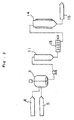
- Fig. 2 is a graphic view showing a process flow chart of another embodiment of the method of the invention, in which is used a prilling granulator.
- Fig. 3 is a graphic view showing the inside part of the tubular condenser to be in the prepolymer-shaping machine.
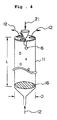
- Fig 4 is a graphic view showing the inside part of the prilling granulator.
- the method of the invention for producing the granular material for solid-phase polymerization comprises a plurality of steps, which are separately described below.
- the granular material for solid-phase polymerization is produced through (a) a step of producing a polycarbonate prepolymer, (b) a step of dissolving it in a solvent, (c) a step of crystallizing and shaping it, and (d) a step of drying it.
- the polycarbonate prepolymer to be processed in the invention preferably has a viscosity-average molecular weight of from 1,000 to 30,000, more preferably from 2,000 to 20,000. If the prepolymer has a viscosity-average molecular weight of smaller than 1,000, its pellets formed according to the invention have poor strength and are powdered into fine powder while they are handled. Regarding polycarbonate having a viscosity-average molecular weight of larger than 30,000, its molecular weight is satisfactory for its general use, and there is little necessity for further increasing its molecular weight through additional solid-phase polymerization.
- the prepolymer is terminated by a phenyl group and a hydroxyl group, in which the molar ratio of the former to the latter may be generally from 0.1 to 5, but preferably from 0.5 to 2, more preferably from 0.8 to 1.4.
- the ratio of the terminal groups noted above is desirably nearer to 1 for the efficiency of the polymerization.
- the prepolymer may be produced in any known method of, for example, interfacial polymerization or melt transesterification.
- interfacial polymerization however, a phenol-terminated prepolymer and a hydroxyl-terminated prepolymer, which are prepared separately, must be blended while controlling the ratio of the both terminal groups. Therefore, preferred is melt transesterification where the ratio of the both terminal groups is easily controlled.
- dihydroxy compound of the two preferred are aromatic ones, that is, aromatic dihydroxy compounds because of the physical properties of the polymer to be obtained and for other reasons.
- dihydroxybiphenyls such as bis(4-hydroxyphenyl)propane (generally referred to as bisphenol A, BPA).
- dicarbonate preferred are diaryl carbonates as being highly reactive.
- DPC diphenyl carbonate
- dihydroxy compound and dicarbonate are put into a polymerization reactor.
- a dihydroxy compound and a dicarbonate are together or separately melted and fed into the reactor; or a powdery dicarbonate is added to a melt of a dihydroxy compound and the resulting melt mixture is fed into the reactor.
- any known polymerization reactor is employable.
- Any of singe-stage reaction or multi-stage reaction is employable, for which one or more reactors as disposed singly, in series or in parallel are used.
- the temperature is defined to fall between 100 and 300°C, preferably between 150 and 280°C, and the pressure is to fall between 1 Torr and 5 kg/cm 2 G, preferably between 10 Torr and 2 kg/cm 2 G.
- Too low reaction temperature does not yield the intended transesterification; while too high reaction temperature is unfavorable, as the starting compound, diphenyl carbonate or the like diffuses out of the reaction system along with the side product, phenol. Too high pressure is unfavorable, as the side product, phenol hardly diffuses out of the system, thereby interfering with the condensation. On the contrary, too low pressure is also unfavorable, as the starting compound, diphenyl carbonate or the like diffuses out of the system, whereby the composition of the reactants in the reaction system varies.
- a polymerization catalyst is used for the reaction.
- an transesterification catalyst which includes, for example, alkali metal compounds (e.g., lithium hydroxide, sodium hydroxide, potassium hydroxide, etc.); alkaline earth metal compounds; nitrogen-containing basic compounds such as amines, quaternary ammonium salts, etc.; and boron compounds. If used, especially preferred are nitrogen-containing basic compounds of the catalysts noted above, as they are basic and remain little in the reaction system after the reaction.
- nitrogen-containing basic compounds for example, preferred are trihexylamine, tetramechylammonium hydroxide, tetrabutylammonium hydroxide, and dimethylpyridine.
- the boron compounds include, for example, boric acid, trimethyl borate, triethyl borate, tributyl borate, triheptyl borate, triphenyl borate, trinaphthyl borate, etc.
- the amount of the catalyst to be added may be generally from 10 -8 to 10 -1 mol/mol of the starting dihydroxy compound, but preferably from 10 -7 to 10 -2 mol/mol. If the amount of the catalyst is smaller than 10 - 8 mol/mol, the catalyst could not exhibit its catalytic activity. If, however, the amount is larger than 10 -1 mol/mol, such will result in worsening the physical properties, especially heat resistance and hydrolysis resistance of the final product, polycarbonate, and even in increasing the production costs. Therefore, addition of too much catalyst over the defined range is unnecessary.
- the prepolymer prepared as above is dissolved in a solvent under heat to prepare a prepolymer solution having a prepolymer concentration of generally from 20 to 90 % by weight.
- the solvent to be used herein shall have such a dissolution characteristic that it dissolves polycarbonate prepolymer under heat and precipitates crystals of the prepolymer when cooled to around room temperature.
- employable herein is any solvent capable of dissolving polycarbonate prepolymer and precipitating its crystals in heating-cooling operation.
- aromatic solvents including, for example, benzene, toluene, o-xylene, m-xylene, p-xylene, dioxane, ethylbenzene, anisole, cumene, propylbenzene, naphthalene, mecitylene, dibenzyl ether, diphenyl ether, tetrahydronaphthalene, phenanthrene, anthracene, cyclohexanone, tetrahydrofuran, etc.
- aromatic solvents including, for example, benzene, toluene, o-xylene, m-xylene, p-xylene, dioxane, ethylbenzene, anisole, cumene, propylbenzene, naphthalene, mecitylene, dibenzyl ether, diphenyl ether, tetrahydronaphthalene, phenanthrene, anthracene
- the solvent may be combined with a poor solvent for polycarbonate prepolymer within the range substantially not interfering with the dissolution of the prepolymer in the mixed solvent.
- the poor solvent includes, for example, aliphatic hydrocarbons such as pentane, hexane, heptane, nonane, decane, etc.; ketones such as acetone, ethyl methyl ketone, diethyl ketone, methyl vinyl ketone, mesityl oxide, cyclobutanone, etc.; ethers such as methyl ether, ethyl ether, propyl ether, methyl ethyl ether, methyl propyl ether, ethyl propyl ether, vinyl ether, allyl ether, methyl vinyl ether, etc.; and water.
- those poor solvents are usable either singly or as combined.
- alcohols are not good to add, as their terminal hydroxyl group reacts with prepolymer; and carboxylic acids are also not good, as their carboxyl group reacts with prepolymer.
- the concentration of prepolymer in its solution may be generally from 20 to 90 % by weight, but preferably from 25 to 85 % by weight. If its concentration is lower than 20 % by weight, the prepolymer will precipitates only a little, and its shaping is difficult. In addition, the granular prepolymer as obtained from the solution having such a low prepolymer concentration often gives much fine powder while it is handled, as its compression breaking strength is low. If, however, the prepolymer concentration in its solution is larger than 90 % by weight, the prepolymer could not be fully crystallized within a predetermined period of time but is often solidified, resulting in that the prepolymer precipitate formed shall have a low degree of crystallization and is often fused during solid-phase polymerization.
- the amount per unit volume of the prepolymer as crystallized from its solution having such a high prepolymer concentration increases, resulting in that the prepolymer crystals are dense and have a lowered specific surface area.
- Use of such dense prepolymer crystals in solid-phase polymerization is unfavorable, as lowering the polymerization rate.
- Reducing the concentration of prepolymer in its solution results in the increase in the specific surface area of the granular prepolymer to be formed from the solution, but it results in the increase in fine powder to be in the granular prepolymer. Considering this, therefore, the concentration of prepolymer in its solution is controlled to fall within a predetermined range in order to obtain the intended granular prepolymer of the invention.
- a prepolymer solution having a prepolymer concentration to fall between 20 and 90 % by weight gives the intended granular prepolymer having a specific surface area of not smaller than 1 m 2 /g and having a power content of not larger than 5 % by weight.
- employable is any of batch-wise or continuous system.
- any ordinary stirring tank for which preferably used are paddle-type stirrers, propeller-type stirrers, Folder (by Kobe Pantec), Max Blend (by Sumitomo Ship Building and Machinery), Sunmeler (by Mitsubishi Heavy Industries), Full Zone (by Kobe Pantec), etc.
- paddle-type stirrers for which preferably used are paddle-type stirrers, propeller-type stirrers, Folder (by Kobe Pantec), Max Blend (by Sumitomo Ship Building and Machinery), Sunmeler (by Mitsubishi Heavy Industries), Full Zone (by Kobe Pantec), etc.
- ultrasonication to dissolve prepolymer in a solvent.
- prepolymer and solvent may be put into the system in any order.
- any known stirring device such as line mixer or homogenizer.
- line mixer for the continuous system, generally used is any known stirring device such as line mixer or homogenizer.
- usable are Pipeline Homomixer (by Tokushu Kikai), Homomic Lineflow (by Tokushu Kikai), Multiline Mixer (by Satake Chemical Machinery), Komatsu Throughser Disintegrator (by Komatsu Zenoa), etc.
- the dissolution temperature may fall generally between 30 and 300°C, but preferably between 50 and 280°C. Even at a temperature lower than 30°C, some solvents may dissolve prepolymer. In general, however, dissolution at such low temperatures is disadvantageous, since it produces low solubility and requires cooling the system to around room temperature. On the other hand, dissolution at high temperatures above 300°C is unfavorable, as polymer is deteriorated.
- pressure may be applied to the dissolution system.
- the prepolymer solution prepared as above shall not be kept under heat for a long period of time, since the prepolymer, if heated long, wall be deteriorated to change the color of its solution.
- the dissolution of prepolymer is desirably effected in an inert gas atmosphere of, for example, nitrogen. It is further desired to bubble nitrogen or the like into the solvent being used, thereby removing dissolved oxygen from the solvent. This is because oxygen, if existing in the granular prepolymer, often deteriorates the prepolymer during polymerization.
- a polymerization catalyst such as sodium hydroxide, triethylamine or TMAH may be previously added to the solvent.
- the catalyst may thus exist in the prepolymer solution prepared, and the granular prepolymer formed from the solution shall contain the catalyst being uniformly dispersed therein, resulting in that the catalyst acts in the solid-phase polymerization of the prepolymer.
- monomers used in (a) may be added to the prepolymer solution prepared in this step (b).
- This step is to cool the prepolymer solution prepared in the previous step to crystallize and shape the prepolymer into a granular one.
- a crystallizing and shaping device 1 comprising tubular condensers 2.
- a prepolymer solution 6 comprising a polycarbonate prepolymer 4 and a solvent 5 is prepared in a dissolution tank 3, and is introduced under pressure into the condenser 2 in the direction 20.
- the prepolymer solution 6 is externally cooled, whereby its temperature is lowered from the inlet of the condenser 2 toward the outlet thereof to give a polycarbonate prepolymer precipitate 7.
- the amount of the precipitate 7 increases from the inlet toward the outlet, thereby forming a prepolymer precipitate distribution profile in which the precipitate concentration is rich near the outlet.
- the sherbet-like polycarbonate prepolymer thus formed near the outlet is extruded out through the outlet, and cut with a cutter 8 into pellets 9.
- the prepolymer solution introduced into the condenser 2 is crystallized therein in the absence of shear stress into prepolymer crystals having a grain size of from 0.1 to 50 ⁇ m, which are primary grains for the granular prepolymer 10.
- the inner diameter of the condenser 2 is defined, depending on the size of the prepolymer pellets to be formed, and may be generally from 0.1 to 10 mm, but preferably from 1 to 5 mm. If the inner diameter is smaller than 0.1 mm, the pellets formed may form fine powder while they are handled, and will be fused during solid-phase polymerization. If, however, it is larger than 10 mm, the polymerization rate of such large pellets of prepolymer will be low.
- the inner diameter of the condenser 2 is made constant throughout it from its inlet to outlet. The cross-sectional profile of the condenser 2 is not specifically defined.
- the condenser 2 is shorter than 1 cm, the prepolymer could not be cooled sufficiently due to heat transfer failure and will therefore precipitate insufficiently. If, however, the condenser 2 longer than 5 m, it will be clogged by the prepolymer, for which the pressure to be applied to the prepolymer solution must be increased.
- the inner surface of the condenser 2 is preferably coated with Teflon, as improving the releasability of the granular prepolymer formed.
- the granular prepolymer thus formed preferably has a degree of crystallinity of from 10 to 45 %.
- the granular prepolymer having a degree of crystallinity of smaller than 10 % has a low melting point, and this will fuse in high-rate solid-phase polymerization in which the prepolymer is heated at relatively high temperatures. Even if the granular prepolymer formed has a degree of crystallinity of larger than 45 %, there occur no problems in the polymerization of the prepolymer. For this, however, the time for cooling and precipitating the prepolymer with such high crystallinity shall be too long, which is disadvantageous in view of the equipment for the crystallization.
- FIG. 4 One embodiment of this method is illustrated in Fig. 4, in which is used a prilling granulator 11.
- the overall process using the granulator 11 is in Fig. 2.
- a polycarbonate prepolymer solution 6 is dropped into the granulator 11 in the direction 21, and is cooled and solidified therein.
- the cooled and solidified prepolymer is collected on the net 16, and taken out of the granulator 11 through a tubular collector (not shown).
- Cooling gas 12 is introduced into the granulator 11.
- the cooling gas 12 is not specifically defined and may be any of inert gases, such as nitrogen, argon and carbon dioxide; lower aliphatic saturated hydrocarbons such as methane, ethane, propane and butane: and lower aliphatic unsaturated hydrocarbons such as ethylene, propylene, butene and pentene.
- This method may apply to prepolymer solution of which the prepolymer concentration varies in a wide range.
- the amount of the coolant to be applied to the prilling granulator is varied and the drops of the prepolymer solution having introduced into the granulator can be crystallized.
- the granular prepolymer obtained in this method comprises spherical grains.
- the granular prepolymer obtained in the previous step is dried in a drier 13 to remove the solvent through vaporization.
- the drying temperature may fall generally between 30 and 230°C, but preferably between 50 and 200°C. If the drying temperature is too low, much time is taken for removing the solvent. If so, in addition, the granular prepolymer dissolves in the remaining solvent or fuses by itself to reduce its specific surface area when it is heated in the next polymerization step, and, as a result, the polymerization rate is reduced.
- the drying may be effected under heat, or in a nitrogen stream, or under reduced pressure, or even in their combination, either batch-wise and/or continuously.
- the thus-dried granular prepolymer preferably has a liquid content of not larger than 30 % by weight of the wet base, but preferably not larger than 20 % by weight of the wet base. If its liquid content is larger than 30 % by weight of the wet base, the prepolymer dissolves in the remaining solvent during polymerization to reduce its specific surface area, after all resulting in that the polymerization rate is reduced, or the prepolymer fuses into masses to lower the fluidity of the prepolymer in the polymerization reactor.
- the drying step may be omitted.
- the drier 13 is not specifically defined.
- employable is any of horizontal stirrers, vertical stirrers, fixed bed driers and fluidized bed driers.
- the granular prepolymer has a degree of crystallinity of from 10 to 45 %.
- the granular prepolymer having a degree of crystallinity of smaller than 10 % has a low melting point, and this fuses during high-rate polymerization that requires high temperatures. Even if the granular prepolymer formed has a degree of crystallinity of larger than 45 %, there occur no substantial problems in the polymerization of the prepolymer. For this, however, the time for cooling and precipitating the prepolymer with such high crystallinity shall be too long, which is disadvantageous.
- the degree of crystallinity of the prepolymer was calculated from the heat of fusion thereof, which was measured with a Perkin-Elmer's device, in accordance with the following equation.
- Degree of Crystallinity (%) [Heat of Fusion (J/g)]/[Heat of Fusion for Overall Crystallization (J/g)] x 100
- the granular prepolymer has a specific surface area of not smaller than 1 m 2 /g. If its specific surface area is smaller than 1 m 2 /g, the prepolymer could not be polymerized at a high rate.
- the specific surface area of the prepolymer was measured, using a Cantersorb (by Yuasa Batteries), according to the BET method using nitrogen gas.
- the granular prepolymer has a center grain size of from 0.1 to 10 mm, more preferably from 1 to 5 mm. Smaller grains than 0.1 mm are undesirable, as forming much fine powder during handling and often fusing during polymerization. Larger grains than 10 mm are also unfavorable, as being unable to polymerize at a high rate.
- the compression breaking strength of the granular prepolymer may be from 1 to 100 kgf/cm 2 , and it is larger when the prepolymer is produced from a prepolymer solution having a higher concentration.
- the compression breaking strength was obtained as follows. Pellets or spheres of the granular prepolymer obtained according to the method of the invention are dried, and stress was imparted thereto in the radial direction whereupon the stress intensity at which they were broken at a rate of 1 mm/min was measured. This indicates the compression breaking strength.
- the amount of fine powder to be in the granular prepolymer is desirably not larger than 5 % by weight, more preferably not larger than 1 % by weight. Existing too much fine powder in the granular prepolymer causes partial fusion of the prepolymer during solid-phase polymerization.
- the amount, % by weight, of fine powder of small grains not larger than 100 ⁇ m in size was measured through sieving of the granular prepolymer. The measurement was made just after drying the granular prepolymer or prior to putting it into polymerization reactor. Every time in handling it, the granular prepolymer produces new fine powder. However, since it is difficult to strictly determine the amount of fine powder to be in different granular prepolymers as prepared separately and handled differently, it is considered that repeated handling of the granular prepolymer as produced according to the method of the invention has no substantial influence on the formation of new fine powder having formed through the repeated handling of the prepolymer. Therefore, employed herein is the simple method of measuring the amount of fine powder as above.
- the granular polycarbonate prepolymer obtained herein may be polymerized through ordinary solid-phase polymerization into a polycarbonate 15 having a high molecular weight, using, for example, a solid-phase polymerizer 14.
- the solid-phase polymerization may be effected either batch-wise and/or continuously,
- the polymerization temperature may fall between 100 and 280°C, but preferably between 140 and 250°C.
- the polymerization may be effected at such a high temperature, provided that the prepolymer grains do not fuse together.
- the reaction time varies, depending on the molecular weight of the polymer to be obtained, but generally falls between 2 and 50 hours.
- a polycarbonate prepolymer 5.2 kg of diphenyl carbonate (DPC) and 5.0 kg of bisphenol A (BPA) were fed into a 20-liter stainless container equipped with a stirrer. This was fully purged with nitrogen, and TMAH (tetramethylammonium hydroxide) was added thereto in an amount of 1 x 10 -4 mol/mol of BPA. After having been mixed and melted at 180°C, these were reacted with further stepwise heating them and stepwise reducing the pressure.
- DPC diphenyl carbonate
- BPA bisphenol A
- the resulting solution was introduced under suction into a Teflon tube having an inner diameter of 2 ⁇ , and cooled therein, in which the prepolymer precipitated and solidified. Then, the resulting strand of the thus solidified prepolymer was extruded outside the tube and cut at a length of about 4 mm to obtain pellets of 2 ⁇ x 4 mm in size. 50 g of those pellets were put into a 200-ml autoclave equipped with a helical stirrer, and stirred therein at 15 rpm, while being heated in an oil bath at 100°C for 10 hours, with reducing the pressure in the autoclave to -600 mmHg, whereby the pellets were dried.
- the dried pellets were sieved, and the count of fine powder (of small grains having a grain size of not larger than 100 ⁇ m) in those pellets was measured to be 0.3 % by weight.
- the specific surface area of the pellets was measured to be 11.6 m 2 /g.
- Example 2 the resulting solution was processed in the same manner as in Example 1 to obtain pellets, which were then polymerized in solid phase.
- a strand prepolymer was prepared in the same manner as in Example 1, cut at a length of about 4 mm, and put into a 500-ml beaker containing therein 300ml of heptane. Thus were obtained prepolymer pellets of 2 ⁇ x 4 mm in size. These were dried and polymerized in solid phase in the same manner as in Example 1.
- the resulting prepolymer solution was processed in the same manner as in Example 1 to obtain pellets, which were polymerized in solid phase.
- TMAH tetramethylammonium hydroxide
- the p-xylene solution of prepolymer that had been prepared in Example 1 was dropped into a prilling granulator, such as that shown in Fig. 4, having an inner diameter, D, of 30 cm and a height, L, of 10 m, through its top.
- the solution was cooled and solidified by nitrogen having introduced thereinto through its bottom at a flow rate of 0.5 m/sec.
- prepolymer spheres were formed. These were dried under reduced pressure in the same manner as in Example 1.
- the dried spheres had a specific surface area of 8.5 m 2 /g and a mean grain size of 2.2 mm, and contained 2.1 % by weight of fine powder (of small grains having a grain size of not larger than 100 ⁇ m). These were polymerized in solid phase in the same manner as in Example 1.
- the prepolymer solution was dropped into the prilling granulator, and cooled and solidified therein, in the same manner as in Example 20 except that the resulting solid drops were put into one-liter beaker filled with heptane.
- spheres of the prepolymer had a specific surface area of 12.3 m 2 /g and a mean grain size of 2.5 mm.
- these were dried and polymerized in solid phase in the same manner as in Example 1.
- Example 2 50 g of wet prepolymer pellets as prepared in the same manner as in Example 1 were put into a 200-ml autoclave equipped with a helical stirrer, and stirred therein at 30 rpm, while being heated in an oil bath at 100°C for 10 hours, with reducing the pressure in the autoclave to -600 mmHg, whereby the pellets were dried.
- the dried pellets were sieved, and the amount of fine powder (of small grains having a grain size of not larger than 100 ⁇ m) in those pellets was measured to be 0.9 % by weight.
- the specific surface area of the pellets was measured to be 12.1 m 2 /g.
- these pellets were polymerized in solid phase in the same manner as in Example 1.
- the granular prepolymer prepared in Comparative Example 1 was polymerized in solid phase at 230°C.
- the degree of crystallinity of prepolymer was calculated from the heat of fusion thereof, which was measured with a Perkin-Elmer's device, in accordance with the following equation.
- Degree of Crystallinity (%) [Heat of Fusion (J/g)]/[Heat of Fusion for Overall Crystallization (J/g)] x 100
- the specific surface area of prepolymer was measured, using a Cantersorb (by Yuasa Batteries), according to the BET method using nitrogen gas.
- the amount, % by weight, of fine powder of small grains not larger than 100 ⁇ m in size was measured through sieving of granular prepolymer. The measurement was made just after drying granular prepolymer or prior to putting it into polymerization reactor.
- the present invention produced is good granular polycarbonate prepolymer which is favorably usable in solid-phase polymerization to give polycarbonate.
- the granular prepolymer obtained in the invention is polymerized in solid phase at a high rate, and the prepolymer grains do not fuse together during polymerization.
- the granular prepolymer is easy to handle.
Landscapes
- Chemical & Material Sciences (AREA)
- Health & Medical Sciences (AREA)
- Chemical Kinetics & Catalysis (AREA)
- Medicinal Chemistry (AREA)
- Polymers & Plastics (AREA)
- Organic Chemistry (AREA)
- Engineering & Computer Science (AREA)
- Mechanical Engineering (AREA)
- Polyesters Or Polycarbonates (AREA)
- Processes Of Treating Macromolecular Substances (AREA)
Applications Claiming Priority (3)
| Application Number | Priority Date | Filing Date | Title |
|---|---|---|---|
| JP22363095A JP3619579B2 (ja) | 1995-08-31 | 1995-08-31 | ポリカーボネート固相重合用オリゴマー粒状体の製造方法 |
| JP223630/95 | 1995-08-31 | ||
| PCT/JP1996/002046 WO1997008227A1 (fr) | 1995-08-31 | 1996-07-22 | Procede de production de granules de prepolymere de polycarbonate destine a la polymerisation a l'etat solide |
Publications (2)
| Publication Number | Publication Date |
|---|---|
| EP0848030A1 true EP0848030A1 (fr) | 1998-06-17 |
| EP0848030A4 EP0848030A4 (fr) | 2000-01-19 |
Family
ID=16801218
Family Applications (1)
| Application Number | Title | Priority Date | Filing Date |
|---|---|---|---|
| EP96924182A Withdrawn EP0848030A4 (fr) | 1995-08-31 | 1996-07-22 | Procede de production de granules de prepolymere de polycarbonate destine a la polymerisation a l'etat solide |
Country Status (4)
| Country | Link |
|---|---|
| US (1) | US5981051A (fr) |
| EP (1) | EP0848030A4 (fr) |
| JP (1) | JP3619579B2 (fr) |
| WO (1) | WO1997008227A1 (fr) |
Cited By (5)
| Publication number | Priority date | Publication date | Assignee | Title |
|---|---|---|---|---|
| WO1998045351A1 (fr) * | 1997-04-08 | 1998-10-15 | The Dow Chemical Company | Technique de production de prepolymere de polycarbonate et de polycarbonate de masse moleculaire elevee |
| WO2002089968A3 (fr) * | 2001-05-10 | 2003-02-06 | Romonta Ceralith Gmbh | Dispositif de fabrication de granulats a partir de biopolymeres et de matieres brutes minerales |
| US6534623B1 (en) | 2001-07-25 | 2003-03-18 | E.I. Du Pont De Nemours And Company | Process for the preparation of crystalline polycarbonate oligomers |
| US7084232B2 (en) | 2002-05-29 | 2006-08-01 | Lg Chem, Ltd. | Method for preparing high molecular weight polycarbonate |
| US7504472B2 (en) | 2005-06-02 | 2009-03-17 | E. I. Du Pont De Nemours + Company | Rapidly crystallizing polycarbonate composition |
Families Citing this family (21)
| Publication number | Priority date | Publication date | Assignee | Title |
|---|---|---|---|---|
| JP4592945B2 (ja) * | 2000-12-21 | 2010-12-08 | Dic株式会社 | 溶液調製方法 |
| US7837667B2 (en) * | 2004-09-09 | 2010-11-23 | Plc Medical Systems, Inc. | Patient hydration system with abnormal condition sensing |
| US7938817B2 (en) * | 2004-09-09 | 2011-05-10 | Plc Medical Systems, Inc. | Patient hydration system and method |
| US11213621B2 (en) | 2004-09-09 | 2022-01-04 | Reprieve Cardiovascular, Inc. | Fluid therapy method |
| US7758562B2 (en) | 2004-09-09 | 2010-07-20 | Plc Medical Systems, Inc. | Patient hydration system with a redundant monitoring of hydration fluid infusion |
| US7727222B2 (en) * | 2004-09-09 | 2010-06-01 | Plc Medical Systems, Inc. | Patient hydration system with taper down feature |
| US7758563B2 (en) | 2004-09-09 | 2010-07-20 | Plc Medical Systems, Inc. | Patient hydration monitoring and maintenance system and method for use with administration of a diuretic |
| US7736354B2 (en) * | 2004-09-09 | 2010-06-15 | Plc Medical Systems, Inc. | Patient hydration system with hydration state detection |
| US20070088333A1 (en) * | 2005-10-13 | 2007-04-19 | G&L Consulting, Llc | Method and system for infusing an osmotic solute into a patient and providing feedback control of the infusing rate |
| US8580914B2 (en) * | 2006-01-30 | 2013-11-12 | Kureha Corporation | Process for producing aliphatic polyester |
| US8075513B2 (en) * | 2006-10-13 | 2011-12-13 | Plc Medical Systems, Inc. | Patient connection system for a balance hydration unit |
| US10045734B2 (en) * | 2009-01-28 | 2018-08-14 | Plc Medical Systems, Inc. | Fluid replacement device |
| WO2015142617A1 (fr) | 2014-03-17 | 2015-09-24 | Plc Medical Systems, Inc. | Procédé de thérapie fluidique |
| WO2017159727A1 (fr) * | 2016-03-15 | 2017-09-21 | 出光興産株式会社 | Résine de polycarbonate, procédé de production d'une résine de polycarbonate, liquide de revêtement, photorécepteur électrophotographique et dispositif d'électrophotographie |
| US12239819B2 (en) | 2018-05-18 | 2025-03-04 | Reprieve Cardiovascular, Inc. | Method and system to treat acute decompensated heart failure |
| US12290380B1 (en) | 2018-08-20 | 2025-05-06 | Reprieve Cardiovascular, Inc. | Method and system to monitor urine output and manage fluid retention in a patient |
| US12459782B2 (en) | 2020-03-05 | 2025-11-04 | Otis Elevator Company | Receiver-less device positioning |
| WO2022221873A1 (fr) | 2021-04-15 | 2022-10-20 | Reprieve Cardiovascular, Inc. | Systèmes de collecte d'urine et procédés et dispositifs associés |
| US12605702B2 (en) | 2021-04-26 | 2026-04-21 | Reprieve Cardiovascular, Inc. | Measuring and/or detecting analytes in urine, and associated systems, devices, and methods |
| US12471842B2 (en) | 2023-09-12 | 2025-11-18 | Reprieve Cardiovascular, Inc. | Fluid therapy based on adjusted urine output rate, and associated systems, devices, and methods |
| WO2025175244A1 (fr) | 2024-02-16 | 2025-08-21 | Reprieve Cardiovascular, Inc. | Détection de sortie d'urine sans utilisation d'un cathéter à demeure, et systèmes, dispositifs et procédés associés |
Family Cites Families (3)
| Publication number | Priority date | Publication date | Assignee | Title |
|---|---|---|---|---|
| EP0338085B1 (fr) * | 1987-09-28 | 1994-06-22 | Asahi Kasei Kogyo Kabushiki Kaisha | Procede de preparation de polycarbonate aromatique cristallise et polycarbonate aromatique cristallise ainsi obtenu |
| WO1990007536A1 (fr) * | 1988-12-27 | 1990-07-12 | Asahi Kasei Kogyo Kabushiki Kaisha | Prepolymere de polycarbonate aromatique cristallise poreux, polycarbonate aromatique cristallise poreux, et procede de production |
| JP2546724B2 (ja) * | 1989-03-28 | 1996-10-23 | 旭化成工業株式会社 | ポリカーボネートプレポリマー多孔体とその製造方法、及びそれを用いる芳香族ポリカーボネートの製造方法 |
-
1995
- 1995-08-31 JP JP22363095A patent/JP3619579B2/ja not_active Expired - Fee Related
-
1996
- 1996-07-22 EP EP96924182A patent/EP0848030A4/fr not_active Withdrawn
- 1996-07-22 US US09/029,069 patent/US5981051A/en not_active Expired - Fee Related
- 1996-07-22 WO PCT/JP1996/002046 patent/WO1997008227A1/fr not_active Ceased
Cited By (6)
| Publication number | Priority date | Publication date | Assignee | Title |
|---|---|---|---|---|
| WO1998045351A1 (fr) * | 1997-04-08 | 1998-10-15 | The Dow Chemical Company | Technique de production de prepolymere de polycarbonate et de polycarbonate de masse moleculaire elevee |
| WO2002089968A3 (fr) * | 2001-05-10 | 2003-02-06 | Romonta Ceralith Gmbh | Dispositif de fabrication de granulats a partir de biopolymeres et de matieres brutes minerales |
| US6534623B1 (en) | 2001-07-25 | 2003-03-18 | E.I. Du Pont De Nemours And Company | Process for the preparation of crystalline polycarbonate oligomers |
| US7084232B2 (en) | 2002-05-29 | 2006-08-01 | Lg Chem, Ltd. | Method for preparing high molecular weight polycarbonate |
| CN100371366C (zh) * | 2002-05-29 | 2008-02-27 | Lg化学株式会社 | 制备高分子量聚碳酸酯的方法 |
| US7504472B2 (en) | 2005-06-02 | 2009-03-17 | E. I. Du Pont De Nemours + Company | Rapidly crystallizing polycarbonate composition |
Also Published As
| Publication number | Publication date |
|---|---|
| US5981051A (en) | 1999-11-09 |
| WO1997008227A1 (fr) | 1997-03-06 |
| EP0848030A4 (fr) | 2000-01-19 |
| JP3619579B2 (ja) | 2005-02-09 |
| JPH0967445A (ja) | 1997-03-11 |
Similar Documents
| Publication | Publication Date | Title |
|---|---|---|
| US5981051A (en) | Method for producing granular polycarbonate prepolymer for solid-state polymerization | |
| KR100191816B1 (ko) | 방향족 폴리카보네이트의 제조방법 | |
| KR100420017B1 (ko) | 방향족 폴리카르보네이트의 제조 방법 | |
| JPWO1999036457A1 (ja) | 芳香族ポリカーボネートを製造するための方法及び重合器 | |
| JPWO1999064492A1 (ja) | 芳香族ポリカーボネートの製造方法 | |
| MXPA04011430A (es) | Resina de tereftalato de politrimetileno. | |
| JP3966553B2 (ja) | 芳香族ポリカーボネートを製造するためのシステム | |
| JPWO2005121211A1 (ja) | 芳香族ポリカーボネートを効率的に製造する方法 | |
| JP3569064B2 (ja) | ガイドを用いた芳香族ポリカーボネートの製造法 | |
| JP3199644B2 (ja) | 芳香族ポリカーボネートの製造方法 | |
| JP3217853B2 (ja) | 芳香族ポリカーボネートプレポリマーの製法 | |
| JPH03223330A (ja) | ポリカーボネートプレポリマー多孔体とその製造方法、及びそれを用いる芳香族ポリカーボネートの製造方法 | |
| JP2004026916A (ja) | 複数のポリカーボネートの連続製法 | |
| EP0864597B1 (fr) | Procedes de production de polycarbonate | |
| JP3684282B2 (ja) | 芳香族ポリカーボネートの製造方法 | |
| JP3414505B2 (ja) | 芳香族ポリカ−ボネ−トの製造方法 | |
| JPH107785A (ja) | 光学材料用ポリカーボネート | |
| JPH08325372A (ja) | 芳香族ポリカーボネートの製造法 | |
| JPH10251396A (ja) | 芳香族ポリカーボネートの製造方法 | |
| JPH107783A (ja) | 芳香族ポリカーボネートの製法 | |
| JPH107784A (ja) | ポリカーボネートの製造方法 | |
| JPH08217871A (ja) | 芳香族ポリカーボネートの製造方法 | |
| JPH05170893A (ja) | 芳香族ポリカーボネートの製造法 | |
| JPH08231704A (ja) | ガイドを用いるポリカーボネート系樹脂の製造法 | |
| JPH08231703A (ja) | ポリカーボネート系樹脂の製造法 |
Legal Events
| Date | Code | Title | Description |
|---|---|---|---|
| PUAI | Public reference made under article 153(3) epc to a published international application that has entered the european phase |
Free format text: ORIGINAL CODE: 0009012 |
|
| 17P | Request for examination filed |
Effective date: 19980227 |
|
| AK | Designated contracting states |
Kind code of ref document: A1 Designated state(s): BE DE ES IT NL |
|
| A4 | Supplementary search report drawn up and despatched |
Effective date: 19991207 |
|
| AK | Designated contracting states |
Kind code of ref document: A4 Designated state(s): BE DE ES IT NL |
|
| RA4 | Supplementary search report drawn up and despatched (corrected) |
Effective date: 19991207 |
|
| 17Q | First examination report despatched |
Effective date: 20030320 |
|
| STAA | Information on the status of an ep patent application or granted ep patent |
Free format text: STATUS: THE APPLICATION IS DEEMED TO BE WITHDRAWN |
|
| 18D | Application deemed to be withdrawn |
Effective date: 20040116 |