EP0849938A2 - Appareil d'enregistrement et de reproduction équipé d'un capteur d'image - Google Patents
Appareil d'enregistrement et de reproduction équipé d'un capteur d'image Download PDFInfo
- Publication number
- EP0849938A2 EP0849938A2 EP97122050A EP97122050A EP0849938A2 EP 0849938 A2 EP0849938 A2 EP 0849938A2 EP 97122050 A EP97122050 A EP 97122050A EP 97122050 A EP97122050 A EP 97122050A EP 0849938 A2 EP0849938 A2 EP 0849938A2
- Authority
- EP
- European Patent Office
- Prior art keywords
- signal
- clock
- digital processor
- digital
- converter
- Prior art date
- Legal status (The legal status is an assumption and is not a legal conclusion. Google has not performed a legal analysis and makes no representation as to the accuracy of the status listed.)
- Withdrawn
Links
Images


Classifications
-
- H—ELECTRICITY
- H04—ELECTRIC COMMUNICATION TECHNIQUE
- H04N—PICTORIAL COMMUNICATION, e.g. TELEVISION
- H04N5/00—Details of television systems
- H04N5/76—Television signal recording
- H04N5/765—Interface circuits between an apparatus for recording and another apparatus
- H04N5/77—Interface circuits between an apparatus for recording and another apparatus between a recording apparatus and a television camera
- H04N5/772—Interface circuits between an apparatus for recording and another apparatus between a recording apparatus and a television camera the recording apparatus and the television camera being placed in the same enclosure
-
- H—ELECTRICITY
- H04—ELECTRIC COMMUNICATION TECHNIQUE
- H04N—PICTORIAL COMMUNICATION, e.g. TELEVISION
- H04N9/00—Details of colour television systems
- H04N9/79—Processing of colour television signals in connection with recording
- H04N9/80—Transformation of the television signal for recording, e.g. modulation, frequency changing; Inverse transformation for playback
- H04N9/82—Transformation of the television signal for recording, e.g. modulation, frequency changing; Inverse transformation for playback the individual colour picture signal components being recorded simultaneously only
- H04N9/83—Transformation of the television signal for recording, e.g. modulation, frequency changing; Inverse transformation for playback the individual colour picture signal components being recorded simultaneously only the recorded chrominance signal occupying a frequency band under the frequency band of the recorded brightness signal
-
- Y—GENERAL TAGGING OF NEW TECHNOLOGICAL DEVELOPMENTS; GENERAL TAGGING OF CROSS-SECTIONAL TECHNOLOGIES SPANNING OVER SEVERAL SECTIONS OF THE IPC; TECHNICAL SUBJECTS COVERED BY FORMER USPC CROSS-REFERENCE ART COLLECTIONS [XRACs] AND DIGESTS
- Y10—TECHNICAL SUBJECTS COVERED BY FORMER USPC
- Y10S—TECHNICAL SUBJECTS COVERED BY FORMER USPC CROSS-REFERENCE ART COLLECTIONS [XRACs] AND DIGESTS
- Y10S358/00—Facsimile and static presentation processing
- Y10S358/906—Hand-held camera with recorder in a single unit
Definitions
- the present invention relates to a magnetic recording/reproducing apparatus which is able to record and reproduce a signal from an image sensor such as a CCD, as well as a composite video signal, in particular, to the magnetic recording/reproducing apparatus equipped with such the image sensor formed or constructed as an unit, in which a camera portion and a video signal processing portion thereof are realized by digital signal processing circuits.
- a system in which an A/D converter is commonly used by sharing with a digital processor of the camera portion (hereinafter, "a camera DSP") and a digital processor of the VTR portion (hereinafter, "a video DSP") thereof, for example in Japanese Patent Laying Open No. 8-51565 (1996).
- a camera DSP digital processor of the camera portion
- a video DSP digital processor of the VTR portion
- three kinds of input signals i.e., a camera signal from the camera system, a video signal from a line input terminal, and a reproduced video signal from a VTR system
- a camera signal from the camera system i.e., a camera signal from the camera system
- a video signal from a line input terminal i.e., a video signal from a line input terminal
- a reproduced video signal from a VTR system are inputted to the A/D converter for common use after being selected through a change-over switch, and a digital signal outputted therefrom is distributed through another change-over switch.
- an interface circuit is provided for compensating level differences occurred during this period among those three kinds of signals.
- the reproduced signal inputted into the A/D converter is the video signal which has been treated with FM demodulation, therefore, an analogue processing circuitry is still necessary for the part of signals up to the demodulation. Namely, there are mixed the digital circuit and the analogue circuit in the circuitry for processing the video signal in the VTR portion, therefore being complex in the structure.
- the object of the present invention is to provide a low price magnetic recording/reproducing apparatus and the same equipped with an image sensor as an unit, with which the video signal can be processed more suitably when sharing the A/D converter in common with the camera DSP and the video DSP.
- the clock signal of 4 fsc is used for processing of the video signal after the FM demodulation, and as for dealing with this case, it is easy and common technique to set the clock at 8 fsc (28.6 MHz) two times higher than it with respect to the FM signal.
- the video DSP circuit can be simplified in the structure, on the contrary, it means that a very expensive A/D converter is used therein, therefore, it is not in conformity with an object of the present invention.
- operation modes i.e., a mode of camera recording, a mode of external input recording, and a mode of reproducing, and in particular in the reproducing mode
- a main function of the camera DSP is of receiving and outputting signals from and to the image sensor, then it is difficult to maintain synchronization with the video DSP.
- the signal in the operation of the video DSP, the signal is processed by using the clock of the camera DSP in the camera mode, while it is processed by using the system clock which is generated within the video DSP in the external inputting mode.
- the signal processing comes to be easy between those two DSPs which are in the synchronization, by exchanging or converting between the clock from the camera DSP and the system clock generated within the video DSP.
- the sampling rate of the camera DSP is exchanged depending on the number of the picture elements or pixels of various kinds of the image sensors.
- the sampling rate of the camera DSP differs greatly from that of the video DSP, it becomes more difficult to process the video signals therewith.
- a low price magnetic recording/reproducing apparatus with an image sensor, in which the clocks are unified as an original one clock signal for common use in both the camera DSP and the video DSP, so as to keep the two DSPs in synchronism basically, and then the sampling rate, which is variable depending on the number of the picture elements of the image pick-up element, is compensated at the side of the video DSP in the camera recording mode, thereby making the signal processing in common after the compensation, and simplifying the signal processing in the video DSP.
- Fig. 1 shows a circuit construction of a signal processing circuit of a camcorder.
- a signal from an image sensor 4 (recently, an solid state image sensor, such as a CCD (abbreviation of "Charge Coupled Device”) is generally used) is inputted through a switch circuit 5 to an A/D converter 6 to be converted into a digital signal.
- the A/D converter 6 performs sampling with a clock (CK1) which is generated in a camera DSP 7.
- CK1 clock
- the number of picture elements or pixels of 1H is 910, and this is same to the sampling number when the NTSC signal is sampled with the sampling frequency 4 fsc.
- the sampling frequency is the 4 fsc.
- An output of the A/D converter 6 is processed in the camera DSP 7.
- the signal processed by the camera DSP 7 is transferred to a video DSP 9 in a condition of the digital signal.
- a luminance signal is transferred through a switch circuit 15 to a luminance signal processing circuit 19 so as to be processed as the luminance signal and to be FM modulated.
- the FM modulated record signal is converted by a D/A converter 22 into an analogue signal and sent to the a recording/reproducing amplifier 2, and a monitor output signal which is outputted to a monitor TV is converted by a D/A converter 21 into an analogue signal to be outputted at a terminal 25.
- a color or chrominance signal is transferred through a switch circuit 16 to a chrominance signal processing circuit 20, and after it is processed as the chrominance signal and converted into a low band converted chrominance signal, it is further converted into an analogue signal by a D/A converter 24.
- the analogue signal is sent to the recording/reproducing amplifier 2 to be multiplexed with a FM signal therein, and is supplied to a magnetic head as a recording current.
- the monitor output signal to be displayed onto the monitor TV is converted by a D/A converter 23 into an analogue signal to be outputted at a terminal 26.
- a composite video signal coming from an input terminal 3 is inputted through the switch circuit 5 to the A/D converter 6 to be converted into a digital signal.
- the A/D converter 6 is sampling with a clock (CK2) which is generated by a clock generator 28 of the video DSP 9, and in general, the system clock (CK2) is set at 4 fsc in the same manner as the camera DSP, in almost of the cases for the NTSC signal.
- An output of the A/D converter 6 is divided into the luminance signal and the chrominance signal in a Y/C separating circuit 10 of the video DSP 9, and they are sent to the luminance signal processing circuit 19 and the chrominance signal processing circuit 20, respectively through switches 15 and 16.
- the processing thereafter is same as mentioned in the above.
- the A/D converter is performing the sampling operation with a clock (CK3) which is generated by a PLL circuit 27 of the video DSP 9.
- the output of the A/D converter 6 is divided and processed through a FM processing circuit 11 and a low pass color filter (C_LPF) 12, respectively.
- the FM luminance signal is demodulated into the video signal in the FM signal processing circuit 11.
- the output signals of the FM signal processing circuit 11 and the low pass color filter 12 are inputted to sampling rate converting circuits 13 and 14 to be converted to a desired sampling rate (in this embodiment, the CK2). After being converted, they are inputted through the switch circuits 15 and 16 to the luminance signal processing circuit 19 and the chrominance signal processing circuit 20, so as to be converted into the analogue signals by the D/A converters 21 and 23 and to be outputted as a reproduced luminance signal and a reproduced chrominance signal at the terminals 25 and 26, respectively.
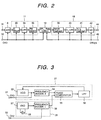
- the above explanation was given on the outline of the signal processing circuit of the camcorder with reference to Fig. 1, in the above, then, more detailed explanation will be given on the luminance signal processing circuit for the reproducing mode by reference to Fig. 2.
- the signal processing up to here is carried out by using the sampling clock (CK3) of the A/D converter 6 as the clock signal.
- An output of the FM demodulator 35 is converted in the rate into the clock frequency which is used in the video signal processing with the sampling rate converting circuit 13.
- the reproduced signal processing circuits are mostly designed in common in the circuitry for the recording signal processing circuits, the signal can be processed with the same clock frequency as in the recording mode by doing so, thereby it is possible to simplify the circuit designing, and in addition thereto, to achieve small-sizing in the circuit scale.
- the video signal which is converted in the sampling rate thereof is processed into a reproduced signal of superior S/N ratio with a main de-emphasis circuit 39, a main LPF 40 for the luminance signal, a non-linear de-emphasis circuit 41, and a noise canceller 42, and it is outputted at the terminal 44.
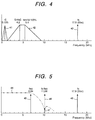
- Fig. 4 shows the relationship between the sampling frequency and the frequency allocations under the standard for 8 mm VTR of NTSC.
- the FM luminance signal 42 is distributed at the frequency of 4.2 MHz as an edge of the SYNC and at a frequency of 5.4 MHz as white (100%).
- the maximum carrier frequency fwc comes to be at 6.84 MHz.
- the low band converted chrominance signal 41 is about at 725 kHz, and it is multiplexed at the lower side frequency of the FM luminance signal. As shown in Fig. 4, an upper side-band of the FM luminance signal is lying until the vicinity of 10 MHz, therefore, the theorem for sampling cannot be satisfied at the sampling frequency of 4 fsc (14,3 MHz). Further, as the A/D converter, it is assumed that the converter of 20 MHz at the maximum sampling frequency is used from a view point of price thereof. Under such the restriction, as such the sampling clock 43, it is selected at the frequency 5 fsc (17.9 MHz).
- the FM audio signal is multiplexed at the frequency between the low band converted chrominance signal and the FM luminance signal, however, since it has no relationship with the processing in the video DSP, the explanation of this is omitted here.
- Fig. 5 shows a characteristic of the inter-modulation disturbance and a low pass filter (hereinafter, it is called as only a "LPF") for removing it when the sampling is conducted.
- LPF low pass filter
- the frequency difference (fs-fwc) comes to be 11.06 MHz (as indicated by an arrow of dotted line 46) which will cause problem when being demodulated with it. Therefore, with provision of a trap point on an amplitude characteristic at the frequency of 11.06 MHz with the LPF which is provided after the A/D conversion, as shown by an one-dotted chained line 44, the frequency difference (fs-fwc) is suppressed and the disturbance component of a broken-line arrow 46 is also fully suppressed as shown by a solid line arrow 47, thereby removing the disturbance during the demodulation.
- the clock (CK2) is used in the recording mode and in the process after the sampling rate conversion during the reproducing, and it is produced with high accuracy by an oscillator 57 by using a crystal oscillator 58 as a reference clock.
- the oscillation frequency of the oscillator 57 is 8 fsc.
- the clock of 4 fsc By producing the clock of 4 fsc from a frequency divider 59, it is outputted as the clock (CK2) at the terminal 52. Further, with respect to the clock (CK3), by oscillating a desired frequency clock by an oscillator 53, comparing it in the phase with the output of a frequency divider 59 by a phase comparator 55 after being divided by a frequency divider 54, and further feeding a phase error through LPF 56 back to a controlled oscillator 53 so as to construct a PLL loop, it is produced in synchronism with the clock (CK2) and outputted at a terminal 51.
- blocks 27 and 28 indicated by the frameworks of dotted line are those corresponding to the PLL circuit 27 and the clock generating circuit 28, which are shown in Fig. 1.
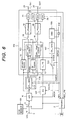
- Fig. 6 shows the signal processing circuit of the camcorder.
- the same elements shown in the embodiment in Fig. 1 are attached with the same reference numerals and the detailed explanation thereof will be omitted.
- the resolution power of the camcorder is determined by the number of the picture elements or pixels of the image sensor which is used. In a high grade or quality model is used an image sensor having a greater number of the picture elements or pixels, while in an ordinary model an image sensor having a relative low number of the pixels. Further, when performing the signal processing in the camera DSP, the sampling frequency must be different depending on the number of the pixels.
- an explanation will be given by taking the image sensor as an example which is applied to the camcorder of the NTSC.
- those 910 picture elements or pixels are provided for 1H in the image sensor of high pixel number, and it is the same to the sampling number when the NTSC signal is sampled with the sampling frequency 4 fsc.
- the sampling frequency comes to be 4 fsc.
- the number of pixels of the low pixel number image sensor is selected at 606 or the like for 1H for example, it is about 2/3 in the number of pixels of the high pixel image sensor, therefore the sampling frequency for the low pixel number image sensor is (8/3) fsc.
- the digital signal transferred from the camera DSP in the camera recording mode is converted in the sampling rate, so as to make it equal to the sampling frequency of the image sensor of high pixel number for a reference, thereby performing the same processing thereafter.
- an A/D converter 102 is so constructed that it is independently provided with respect to the processing of the FM signal.
- an oscillator 109 here, an oscillator of using a crystal oscillator 110
- a clock generator 107 Inside of the video DSP 104A, there is provided a clock generator 107, from which are produced a system clock (SYSCK) for use in the video DSP 104 and a clock (REFCK) used as a reference clock of the camera DSP 118.
- SYSCK system clock
- REFCK clock
- the camera DSP 118 is also so constructed that it produces a clock (omitted in Fig.
- the present embodiment is in accordance with the former method.
- two (2) clocks generated from the same clock are coincident with each other in the frequency, however, it is difficult to make them completely coincide with each other in the phase due to an effect of delay between those two (2) digital processors, etc. Consequently, when transferring them between those two (2) digital processors as they are, it is difficult to take in or fetch the data with stability.
- sampling rate converting circuits 105 and 106 for converting a data in synchronism with the clock (EXTCK) outputted from the camera DSP 118 into a data in synchronism with the system clock (SYSCK) inside of the video DSP 104.
- FIG. 7 shows a construction of the sampling rate converting circuit.
- a reference numeral 111 denotes a data input terminal, 112 an input terminal for the external clock (EXTCK), 113 a FIFO (abbreviation of First in First out), 115 a system clock input terminal, 114 a sample rate converting filter, 119 a switching circuit, 120 a control signal input terminal, and 116 an output terminal.
- EXTCK external clock
- FIFO abbreviation of First in First out
- 115 a system clock input terminal
- 114 a sample rate converting filter
- 119 a switching circuit
- 120 a control signal input terminal
- 116 an output terminal.
- the output of the FIFO 113 is transferred through the switching circuit 119 to the output terminal 116, on the while, in the camcorder using the low pixel number CCD, the output processed by the FIFO 113, after complementation of the data with the filter 114 for the sampling rate conversion, is outputted through the switch circuit 119 at the output terminal 116.
- the outputs of the sampling rate converting circuits 105 and 106 which are obtained in such manner are inputted to the luminance signal processing circuit 19 and the chrominance signal processing circuit 20, respectively, and then, they are converted into the analogue signals with the D/A converters 22 and 24 to be recorded onto a magnetic tape through the recording/reproducing amplifier 2.
- the sampling rate converting circuit in addition of operating those two (2) digital processors on the basis of the only one oscillator 109, stable signal transfer can be achieved, and further it can be converted easily if any one of sensors having various pixel number is used in the camera portion, thereby obtaining a merit that the processing thereafter can be unified.
- the A/D converter 102 is conditioned of being provided outside of the video DSP, but alternatively it can be provided inside thereof.
- the oscillator 109 and the switching circuit 103 are provided inside of the video DSP 104, but they also may be provided at the side of the camera DSP without trouble.
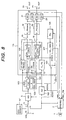
- Fig. 8 shows the signal processing circuit of the camcorder.
- the same elements shown in the embodiment in Fig. 6 are attached with the same reference numerals and the detailed explanation thereof will be omitted.
- the difference from that shown in Fig. 6 lies in a method for generating the clock which is used in the camera DSP 124 and video DSP 125.
- an oscillator 127 is provided at the side of the camera DSP 124, and from the output terminals thereof are outputted the clock (EXTCK) for use in signal transfer, the clock for use in the A/D converter 6, and a reference clock (CAMCK) for use as a reference in the video DSP to the video DSP 125.
- the above-mentioned reference clock (CAMCK) is inputted to the PLL circuit 126 to generate a clock in synchronism with the CAMCK in the phase, and it is sent to a clock generator 107 so as to produce the system clock (SYSCK) for use in the video DSP 125, etc.
- sample rate converting circuit 105 and 106 data transfer is performed by using the system clock (SYSCK) in synchronism with the external clock (EXTCK) inputted from the camera DSP. Operation other than this is the same to that of the embodiment shown in Fig. 6.
- SYSCK system clock
- EXTCK external clock
- the explanation was given basically on the assumption that those two (2) DSPs are brought in synchronism with each other by unifying or joining the reference clocks of the camera DSP and the video DSP as a one signal, however, if the camera DSP and the video DSP are constructed on the basis of the clocks which are completely different to each other, they can be measured by newly-devising the sampling rate conversion within the breadth of an idea of the present invention.
- the low pixel number sensor and the high pixel number (standard) sensor are mentioned as the image sensors.
- the signal can be processed in the same manner as in the process when using the low pixels number, i.e., by converting into the sampling mode for the high pixel (standard) mode by using the sampling rate converting circuit at the side of the video DSP, with respect to the sampling rate at the side of the camera DSP corresponding to the high resolution power sensor, within the breadth of an idea of the present invention.
- the switching circuit for exchanging among the camera input signal, the external input signal and the reproduced FM signal before the A/D converter, as well as selecting the sampling clock of the A/D converter at the most appropriate clock with respect to the above-mentioned three (3) signals, the digital signal processing for both the camera and the VTR portions can be achieved by only one A/D converter, thereby bringing great effect in reducing the cost thereof.
- the signal processing after the conversion can be treated in the same manner as the video signal processing during the recording operation, thereby achieving an effect of suppressing complication in the circuitry designing and of preventing from increase in the circuit scale, as well as of reducing the cost of the digital processor.
- performance can be sufficiently maintained for the FM signal processing with the relative low sampling frequency, such as around 2 times of the FM signal hand.
- the circuits after the sampling rate converting circuit can be used in common so as to be applied to camcorders of various specifications, advantageously. Namely, a merit can be obtained that unification of the circuit boards and parts can be achieved so as to accomplish reasonable or rational set designing.
Landscapes
- Engineering & Computer Science (AREA)
- Multimedia (AREA)
- Signal Processing (AREA)
- Television Signal Processing For Recording (AREA)
Applications Claiming Priority (2)
| Application Number | Priority Date | Filing Date | Title |
|---|---|---|---|
| JP341490/96 | 1996-12-20 | ||
| JP34149096 | 1996-12-20 |
Publications (2)
| Publication Number | Publication Date |
|---|---|
| EP0849938A2 true EP0849938A2 (fr) | 1998-06-24 |
| EP0849938A3 EP0849938A3 (fr) | 1999-02-24 |
Family
ID=18346464
Family Applications (1)
| Application Number | Title | Priority Date | Filing Date |
|---|---|---|---|
| EP97122050A Withdrawn EP0849938A3 (fr) | 1996-12-20 | 1997-12-15 | Appareil d'enregistrement et de reproduction équipé d'un capteur d'image |
Country Status (2)
| Country | Link |
|---|---|
| US (2) | US6215948B1 (fr) |
| EP (1) | EP0849938A3 (fr) |
Cited By (1)
| Publication number | Priority date | Publication date | Assignee | Title |
|---|---|---|---|---|
| MY138290A (en) * | 1999-03-09 | 2009-05-29 | Sony Corp | Reproducing apparatus and information distribution system |
Families Citing this family (11)
| Publication number | Priority date | Publication date | Assignee | Title |
|---|---|---|---|---|
| EP0849938A3 (fr) * | 1996-12-20 | 1999-02-24 | Hitachi, Ltd. | Appareil d'enregistrement et de reproduction équipé d'un capteur d'image |
| US8416468B2 (en) | 1999-09-17 | 2013-04-09 | Silverbrook Research Pty Ltd | Sensing device for subsampling imaged coded data |
| US7605940B2 (en) * | 1999-09-17 | 2009-10-20 | Silverbrook Research Pty Ltd | Sensing device for coded data |
| US20020110187A1 (en) * | 2001-02-13 | 2002-08-15 | Sigmatel, Inc. | Method and apparatus for providing domain conversions for multiple channels and applications thereof |
| JP3875043B2 (ja) * | 2001-05-31 | 2007-01-31 | Necエレクトロニクス株式会社 | タイミング信号の受け渡し回路 |
| KR100744050B1 (ko) * | 2003-11-28 | 2007-07-30 | 삼성전자주식회사 | 스캐닝 동작모드 별로 아날로그/디지털 변환하는 이미지스캐닝 장치 및 그의 이미지 스캐닝 방법 |
| US20060173829A1 (en) * | 2005-01-10 | 2006-08-03 | Neeman Yoni M | Embedded translation-enhanced search |
| TW201205180A (en) * | 2010-07-27 | 2012-02-01 | Hon Hai Prec Ind Co Ltd | Camera |
| US9136824B2 (en) * | 2014-01-10 | 2015-09-15 | Silicon Laboratories Inc. | Frequency management using sample rate conversion |
| EP3203384A1 (fr) * | 2016-02-02 | 2017-08-09 | Theo Hoffenberg | Procédé, dispositif et programme d'ordinateur pour fournir une définition ou une traduction d'un mot appartenant à une phrase en fonction des mots voisins et de bases de données |
| JP2018014630A (ja) * | 2016-07-21 | 2018-01-25 | ソニーセミコンダクタソリューションズ株式会社 | 固体撮像装置および電子機器 |
Family Cites Families (4)
| Publication number | Priority date | Publication date | Assignee | Title |
|---|---|---|---|---|
| US5142375A (en) * | 1988-09-27 | 1992-08-25 | Sony Corporation | Video camera integral with magnetic recording and reproducing device, and with color video signal processing apparatus |
| EP0868078B1 (fr) * | 1993-03-19 | 2001-08-29 | Canon Kabushiki Kaisha | Caméra vidéo numérique comportant un circuit de zoom électronique |
| JP3822920B2 (ja) * | 1994-08-09 | 2006-09-20 | ソニー株式会社 | ビデオ信号処理装置 |
| EP0849938A3 (fr) * | 1996-12-20 | 1999-02-24 | Hitachi, Ltd. | Appareil d'enregistrement et de reproduction équipé d'un capteur d'image |
-
1997
- 1997-12-15 EP EP97122050A patent/EP0849938A3/fr not_active Withdrawn
- 1997-12-22 US US08/996,207 patent/US6215948B1/en not_active Expired - Fee Related
-
2001
- 2001-02-01 US US09/774,662 patent/US6424787B2/en not_active Expired - Fee Related
Cited By (1)
| Publication number | Priority date | Publication date | Assignee | Title |
|---|---|---|---|---|
| MY138290A (en) * | 1999-03-09 | 2009-05-29 | Sony Corp | Reproducing apparatus and information distribution system |
Also Published As
| Publication number | Publication date |
|---|---|
| EP0849938A3 (fr) | 1999-02-24 |
| US20010002945A1 (en) | 2001-06-07 |
| US6215948B1 (en) | 2001-04-10 |
| US6424787B2 (en) | 2002-07-23 |
Similar Documents
| Publication | Publication Date | Title |
|---|---|---|
| US6215948B1 (en) | Magnetic recording/reproducing apparatus and the same equipped with an image sensor | |
| JP3053532B2 (ja) | 色信号の周波数帯域変換のための搬送波発生装置 | |
| US5825511A (en) | Image pickup apparatus | |
| JPH0937296A (ja) | 記録再生装置、記録装置及び再生装置 | |
| US6421496B1 (en) | Camcorder signal processor having superimposition capability and dual PLL | |
| JPH10233990A (ja) | 撮像素子付き磁気記録再生装置及び磁気記録再生装置 | |
| JP3406938B2 (ja) | カメラ一体型記録再生装置 | |
| JP2565253B2 (ja) | ビデオ再生装置 | |
| JP2677077B2 (ja) | 磁気記録再生装置 | |
| JP3216061B2 (ja) | 撮像記録装置 | |
| EP0716551A2 (fr) | Circuit de traitement d'un signal d'aide, pour un dispositif d'enrégistrement à cassette de vidéo pal plus | |
| EP0608935A2 (fr) | Appareil de reproduction et de traitement d'un signal vidéo et arrangement de circuit pour un tel appareil | |
| JPH05130644A (ja) | 画像処理用半導体集積回路装置 | |
| JPS6295092A (ja) | Vtrのクロマ信号処理回路 | |
| JPH0732490B2 (ja) | 磁気映像記録再生方式 | |
| JPS594276A (ja) | 映像信号記録再生システム | |
| JPH0213519B2 (fr) | ||
| JPS63122060A (ja) | デイスク再生装置 | |
| JPH05207511A (ja) | 映像信号処理回路 | |
| JPH0851565A (ja) | ビデオ信号処理装置 | |
| JPH0787440A (ja) | 映像信号のダビング・システム,再生装置および記録装置ならびにそれらの制御方法 | |
| JPS6184197A (ja) | ビデオ信号デイジタル処理方法 | |
| JPH06203481A (ja) | ビデオ信号記録装置及び再生装置 | |
| JPH0423593A (ja) | 磁気記録再生装置および信号処理回路 | |
| JPH04326688A (ja) | 画像処理装置 |
Legal Events
| Date | Code | Title | Description |
|---|---|---|---|
| PUAI | Public reference made under article 153(3) epc to a published international application that has entered the european phase |
Free format text: ORIGINAL CODE: 0009012 |
|
| 17P | Request for examination filed |
Effective date: 19971215 |
|
| AK | Designated contracting states |
Kind code of ref document: A2 Designated state(s): DE GB |
|
| AX | Request for extension of the european patent |
Free format text: AL;LT;LV;MK;RO;SI |
|
| PUAL | Search report despatched |
Free format text: ORIGINAL CODE: 0009013 |
|
| AK | Designated contracting states |
Kind code of ref document: A3 Designated state(s): AT BE CH DE DK ES FI FR GB GR IE IT LI LU MC NL PT SE |
|
| AX | Request for extension of the european patent |
Free format text: AL;LT;LV;MK;RO;SI |
|
| AKX | Designation fees paid |
Free format text: DE GB |
|
| 17Q | First examination report despatched |
Effective date: 20070514 |
|
| STAA | Information on the status of an ep patent application or granted ep patent |
Free format text: STATUS: THE APPLICATION IS DEEMED TO BE WITHDRAWN |
|
| 18D | Application deemed to be withdrawn |
Effective date: 20070915 |