EP0850931A2 - Verfahren zur Herstellung optisch aktiver (R oder S)-1-(4-Methoxy-benzyl)-1,2,3,4,5,6,7,8-Octahydro-isochinoline - Google Patents
Verfahren zur Herstellung optisch aktiver (R oder S)-1-(4-Methoxy-benzyl)-1,2,3,4,5,6,7,8-Octahydro-isochinoline Download PDFInfo
- Publication number
- EP0850931A2 EP0850931A2 EP97122627A EP97122627A EP0850931A2 EP 0850931 A2 EP0850931 A2 EP 0850931A2 EP 97122627 A EP97122627 A EP 97122627A EP 97122627 A EP97122627 A EP 97122627A EP 0850931 A2 EP0850931 A2 EP 0850931A2
- Authority
- EP
- European Patent Office
- Prior art keywords
- methoxy
- bis
- acid
- benzyl
- isoquinoline
- Prior art date
- Legal status (The legal status is an assumption and is not a legal conclusion. Google has not performed a legal analysis and makes no representation as to the accuracy of the status listed.)
- Granted
Links
- NPEVCJZMQGZNET-UHFFFAOYSA-N COc1ccc(CC2NCCC3=C2CCCC3)cc1 Chemical compound COc1ccc(CC2NCCC3=C2CCCC3)cc1 NPEVCJZMQGZNET-UHFFFAOYSA-N 0.000 description 1
Classifications
-
- C—CHEMISTRY; METALLURGY
- C07—ORGANIC CHEMISTRY
- C07D—HETEROCYCLIC COMPOUNDS
- C07D217/00—Heterocyclic compounds containing isoquinoline or hydrogenated isoquinoline ring systems
- C07D217/12—Heterocyclic compounds containing isoquinoline or hydrogenated isoquinoline ring systems with radicals, substituted by hetero atoms, attached to carbon atoms of the nitrogen-containing ring
- C07D217/18—Aralkyl radicals
-
- C—CHEMISTRY; METALLURGY
- C07—ORGANIC CHEMISTRY
- C07D—HETEROCYCLIC COMPOUNDS
- C07D217/00—Heterocyclic compounds containing isoquinoline or hydrogenated isoquinoline ring systems
- C07D217/12—Heterocyclic compounds containing isoquinoline or hydrogenated isoquinoline ring systems with radicals, substituted by hetero atoms, attached to carbon atoms of the nitrogen-containing ring
- C07D217/18—Aralkyl radicals
- C07D217/20—Aralkyl radicals with oxygen atoms directly attached to the aromatic ring of said aralkyl radical, e.g. papaverine
Definitions
- the compounds of formula I in the form of their free bases are on well-known and valuable intermediates for pharmacological usable end products such as Dextromethorphan.
- dextromethorphan has the disadvantage of resolving racemates, since the known hydrogenation of a compound of formula II in The presence of a heterogeneous catalyst leads to a racemate, that has to be split, since only the (S) -enantiomer of the formula I is used. Furthermore, the undesired R enantiomer of the Compound of formula I worked up over several reaction steps, racemized and recycled.
- the object of the present invention is to develop a new method for To provide that targeted asymmetric hydrogenation of en imines in the form of their salts without the above Disadvantages occur.
- a compound of the general formula in the HX has the above meaning hydrogenated in the presence of a complex of iridium with an optically active ligand and optionally in the presence of an additive asymmetrically to compounds of the formula I.
- optically active iridium complexes III-a to III-g can do for themselves synthesized or in situ in the absence or in the presence of the hydrogenating compounds of formula II from the components getting produced.
- neutral ligand means in the context of easily exchangeable ligands such as olefins, e.g. Ethylene, propylene, cyclooctene, 1,5-hexadiene, norbornadiene, 1,5-cyclooctadiene, Benzene, hexamethylbenzene, p-cymene and the like, nitriles such as Acetonitrile, benzonitrile, or also used solvents such as e.g. THF, Toluene, etc. If there is more than one such ligand, they can also be different from each other.
- olefins e.g. Ethylene, propylene, cyclooctene, 1,5-hexadiene, norbornadiene, 1,5-cyclooctadiene, Benzene, hexamethylbenzene, p-cymene and the like
- nitriles such as Acetonitrile,
- halides includes fluorine, chlorine, bromine and iodine Form of alkali, alkaline earth or tetrasubstituted ammonium compounds.
- anionic coordinating ligand includes e.g. Halogen, a carboxylic acid residue, a sulfonate residue such as e.g. Tosylate or Methanesulfonate, a 1,3-diketonate such as e.g. Acetylacetonate optionally substituted phenolate, hydroxy, nitrite, cyanate, rhodanide, Cyanide, allyl and 2-methylallyl.
- oxygen acid or complex acid means acids from the group consisting of H 2 SO 4 , HClO 4 , HBrO 4 , HIO 4 , HNO 3 , H 3 PO 4 , H 3 PO 3 , CF 3 SO 3 H, C 6 H 5 SO 3 H, as well as halogen complexes with the elements boron, phosphorus, arsenic antimony or bismuth.
- Preferred representatives are HClO 4 , CF 3 SO 3 H, HPF 6 , HBF 4 , HB (Ph) 4 , HB (3,5-C 6 H 3 ) 4 , HSbF 6 and HAsF 6 .
- C 1-8 alkyl means hydrocarbons having 1 to 8 carbon atoms, ie straight-chain or branched alkyl groups such as, for example, methyl, ethyl, propyl, isopropyl, butyl, isobutyl, tert-butyl, for all alkyl-containing systems , Pentyl, isoPentyl, Neopentyl, Hexyl, tert.Hexyl, Heptyl, isoHeptyl, Octyl, isoOctyl.
- C 1-8 alkoxy means an alkyl group as defined above which is attached via an oxygen atom. Examples include methoxy, ethoxy, propoxy, isopropoxy, butoxy and the like.
- C 3-8 -cycloalkyl in the context of the present invention means cyclopropyl, cyclobutyl, cyclopentyl, cyclohexyl, cycloheptyl, cyclooctyl.
- halogenated alkyl means in the context of present invention alkyl groups with a variable number of Halogen atoms, especially chlorine or fluorine, it being preferred at least one halogen atom or perfluorinated or perchlorinated Compounds such as trifluoromethyl, trichloromethyl, Pentafluoroethyl and the like.
- aryl means phenyl radicals which can be unsubstituted or substituted one or more times in the ortho, meta or para position. Suitable substituents are phenyl, C 1-8 alkyl or alkoxy groups, C 1 -C 8 halogenated alkyl, or also di-C 1 -C 8 alkylamino, diphenylamino, dibenzylamino, morpholino, pyperidino, pyrrolidino, halogen, trialkylsilyl eg trimethylsilyl and the like.
- the expression can also mean naphthyl.
- aralkyl means groups in which the aryl radical is the has previous meaning and the alkyl radical also the above has the above-mentioned meaning. Examples include benzyl and the like cited.
- heteroaryl means in the present invention five- or six-membered heteroaromatics which additionally condensed have aromatic groups with one or more heteroatoms from the group of nitrogen, oxygen or sulfur.
- five-membered heteroaromatics pyrrole, thiophene, furan. This is exemplary from the group of six-membered heteroaromatics Listed pyridine.
- the heteroaromatics can be like those listed above Aryls can be substituted, with nitrogen-containing heteroaromatics Nitrogen additionally with hydrogen, alkyl groups or alkoxy groups can be substituted.
- the ligands of the formulas IV and V are compounds known per se and can, for example, as described in SYNLETT 1992, 169, getting produced.
- the asymmetric hydrogenation of compounds according to the invention of the general formula II to compounds of the general Formula I is in suitable, inert under the reaction conditions organic solvents.
- organic solvents come especially considering lower alcohols, such as methanol, ethanol, iso-propanol; Esters; halogenated hydrocarbons, such as Methylene chloride, chloroform and the like; Hydrocarbons from the Group of toluene, xylene and the like; Ethers such as tert-butyl methyl ether, Diethyl ether, tetrahydrofuran, dioxane, furan or Amides such as dimethylformamide (DMF); Nitriles such as acetonitrile, carboxylic acids such as acetic acid, sulfoxides such as dimethyl sulfoxide (DMSO).
- DMF dimethylformamide
- Nitriles such as acetonitrile, carboxylic acids such as acetic acid, sulfoxides such as dimethyl sul
- solvents are hydrocarbons, Alcohols and water or mixtures thereof.
- a particularly preferred one Solvent mixture consists of alcohol and hydrocarbons such as toluene and methanol.
- a particularly preferred solvent mixture of three Solvents consist of toluene, methanol and water.
- the process according to the invention is preferably carried out in the presence an additive in the form of bases.
- the bases are compounds of the group of carboxylic acid salts such as e.g. Sodium acetate, sodium formate and the like, primary, secondary and tertiary amines such as diisopropylamine, triethylamine, Diisopropylethylamine, and diamines of the ethylenediamine type, Tetramethylethylenediamine, imides such as succinimide, phthalimide, Sodium alkylates such as sodium methylate, and Sodium hydroxide.
- carboxylic acid salts such as e.g. Sodium acetate, sodium formate and the like
- primary, secondary and tertiary amines such as diisopropylamine, triethylamine, Diisopropylethylamine, and diamines of the ethylenediamine type, Tetramethylethylenediamine
- imides such as succinimide,
- Another additive is also (R or S) -1- (4-methoxy-benzyl) -1,2,3,4,5,6,7,8-octahydro-isoquinoline to call. Particularly preferred become tertiary amines such as diisopropylamine and triethylamine. Likewise preferred additives are carbonates such as sodium hydrogen carbonate, Sodium carbonate, potassium hydrogen carbonate as well Disodium hydrogen phosphate and the like.
- the amounts of the additives used are in the range from 0.001 to 100 molar equivalents based on the compounds according to formulas II or III-a - III-g.
- a base from the group mentioned above is used as an additive, their amount is in the range of 0.001-100 mol equivalents, preferably in Range of 0.001-10 mole equivalents and particularly preferred in the range of 0.001-2 mol equivalents based on the compounds according to the formula II.
- the anionic coordinating ligands according to the above Definition can be added to the reaction mixture in quantities of 0.1-100 mole equivalents, preferably 0.5-50 mole equivalents and particularly preferably preferably 1-10 molar equivalents based on the compounds of Formula III-a - III-g can be used.
- a special embodiment of the method for asymmetrical Hydrogenation is the use of liquid or supercritical Carbon dioxide as a solvent or in combination with others of the above listed solvents. Already a small percentage of Carbon dioxide in the reaction mixture leads to an increase in yield of the product as Examples 1.6 to 1.8 and Example 1.5 as Comparative experiment can be seen.
- the salts of the compounds of the formula II can be known per se Manufactured in a manner e.g. starting from the well-known hydrochloride Formula II by salting or by acid exchange. It can on the Do not use water and / or chlorinated solvents will.
- the asymmetric hydrogenation is expediently carried out at temperatures in the range from approximately 10 ° C. to approximately 200 ° C., preferably 10 ° C. to 100 ° C., and particularly preferably in a range from 20 ° C. to 100 ° C., and a pressure of approximately 1 up to 250 bar, preferably 1 to 180 bar and particularly preferably 10 to 90 bar.
- the molar ratio (S / C) between the compounds to be hydrogenated of formula II and the metal complexes that act as catalysts are used according to formulas III-a to III-g, is appropriate between 20 to 80,000, preferably between 100 to 50,000 and especially preferably between 100 to 30,000.
- Example 2a.1 is described in detail for the examples in Table 2a. Examples 2a.2 to 2a.17 were carried out analogously.
- the Reaction mixture contained the dissolved crude Bischler-Napieralsky Reaction product 1- (4-methoxybenzyl) -3,4,5,6,7,8-hexahydro-isoquinoline Formula II in the form of a salt mixture consisting of HCl and various Phosphoric acids.
- the reaction mixture prepared in Example 7 was added in toluene at RT in an inert gas atmosphere in succession 160 ml of ethyl acetate and a solution of 10.98 g sodium fluoroborate (100 mmol) dissolved in 40 ml Given water. After stirring for 10 minutes, the water phase was separated and gently concentrated the organic phase in vacuo. The residue was dried azeotropically with 2x 100ml of ethyl acetate in vacuo and then dissolved in 50 ml of ethyl acetate in an inert gas atmosphere. After 8 h of crystallization at 0 ° C., the product was filtered off with suction and at 25 Washed ml of ethyl acetate.
- Example 10 Analogously to Example 10 was 1- (4-methoxybenzyl) -3,4,5,6,7,8-hexahydroisoquinoline picrate isolated, mp 131-134 ° C.
- a 2 l stirred autoclave was charged with 148.45 g of hexabase hydrogen sulfate (420 mol), 467 ml of methanol, 507 ml of toluene and 4.25 ml of triethylamine under argon conduction and sealed.
- a catalyst solution consisting of 14.1 mg [IrCl (COD)] 2 (0.021 mmol), 43.8 mg (R, R) -3,5-tBu-DIOP (0.0462 mmol), 62.1 mg Bu 4 N + I - (0.168 mmol) run in 40 ml of methanol from a catalyst addition vessel.
- the hydrogenation was carried out at 80 ° and under a hydrogen pressure of 30 bar for 15 h.
- the autoclave was then emptied and the hydrogenation solution was evaporated.
- the residue was dissolved in water, extracted with 200 ml of tert-butyl methyl ether and then mixed with an excess of a sodium hydroxide solution and with hexane.
- the hexane phase was separated, washed neutral and evaporated on a rotary evaporator.
- the residue (104.9 g) consisted of 93.0% (S) -Octabase with an ee of 78.1% according to HPLC and GC.
- the ee enrichment was achieved by crystallizing the 1: 1 salt of the (S) octabase with L - (+) - mandelic acid from water. This light beige crystalline material (138.2 g, 81% yield) was mixed with an excess of a sodium hydroxide solution and with hexane. The hexane phase was washed neutral and evaporated.
- the (S) octabase obtained (86.2 g, 80% yield) had a content of 98.0% and an ee of 98.6%.
Landscapes
- Chemical & Material Sciences (AREA)
- Organic Chemistry (AREA)
- Organic Low-Molecular-Weight Compounds And Preparation Thereof (AREA)
- Nitrogen Condensed Heterocyclic Rings (AREA)
- Catalysts (AREA)
- Low-Molecular Organic Synthesis Reactions Using Catalysts (AREA)
- Other In-Based Heterocyclic Compounds (AREA)
Abstract
Description
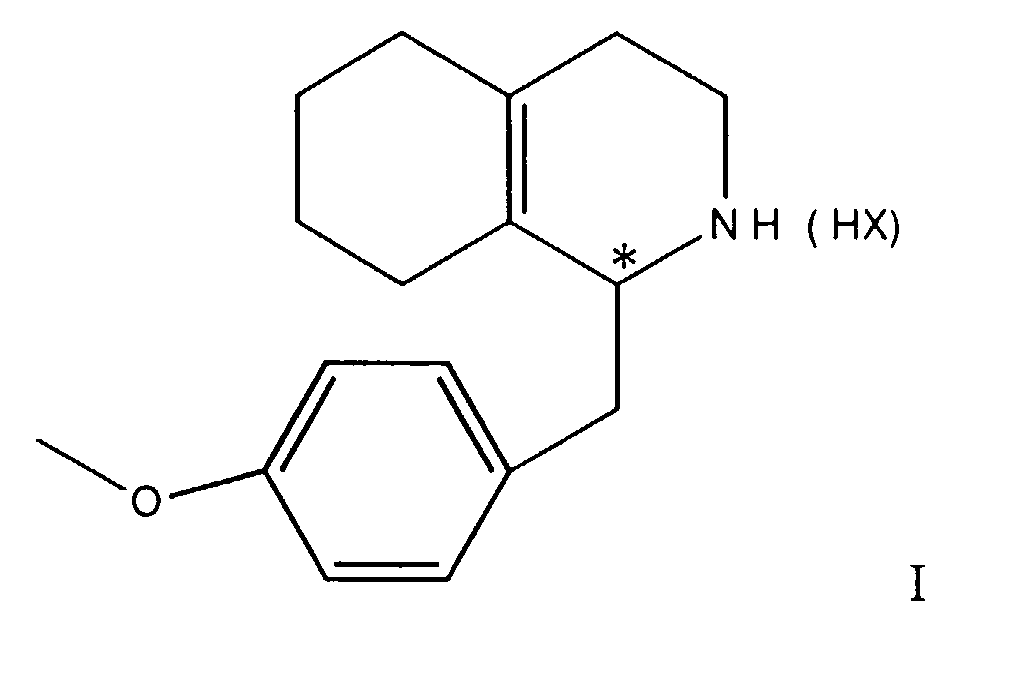

- worin HX obige Bedeutung hat.
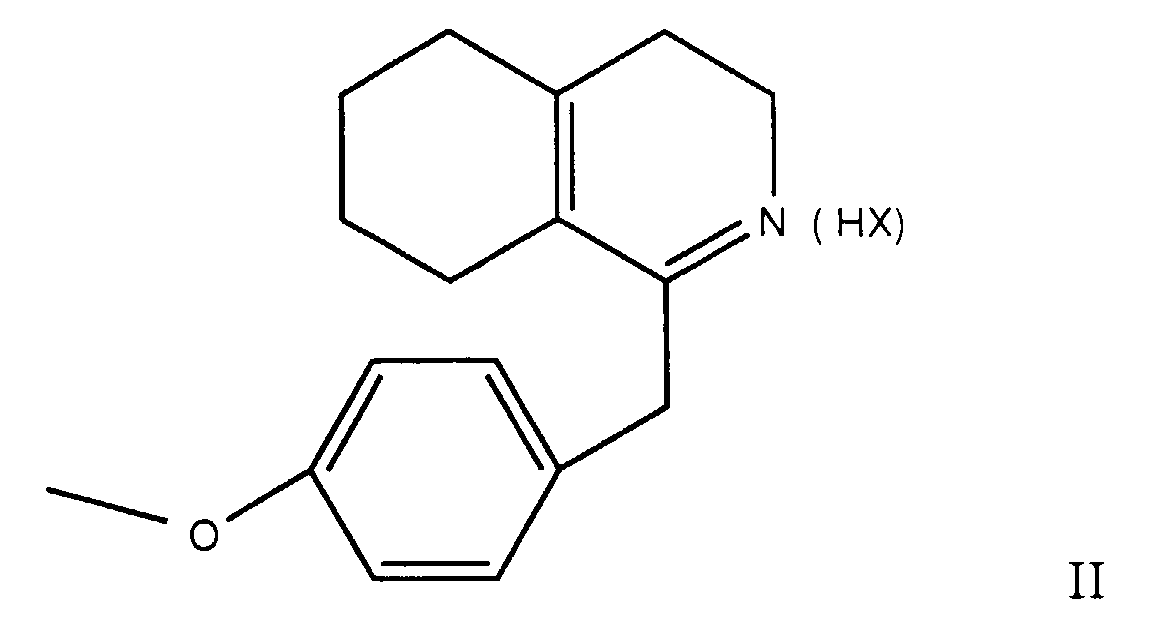
in Gegenwart eines Komplexes von Iridium mit einem optisch aktiven Liganden und gegebenenfalls in Gegenwart eines Additives asymmetrisch zu Verbindungen der Formel I hydriert.
- L
- neutraler Ligand;
- A
- Anion einer Sauerstoffsäure oder Komplexsäure;
- B
- anionisch koordinierender Ligand;
- n
- 0, 1, 2;
- o
- 1, 2;
- r
- 1, 2;
- M+
- Alkali, Erdalkali oder tetrasubstituiertes Ammonium;
- Y
- chiraler Diphosphinligand gemäss den Formeln

- R1, R1'
- C3-8-Cycloalkyl, Aryl , Heteroaryl oder zusammen mit dem Phosphoratom ein 9-Dibenzophospholyl, die Reste R1 und R1' können gleich oder verschieden sein;
- R9, R10, R11
- unabhängig voneinander Wasserstoff, C1-8-AIkyl, C1-8-halogeniertes Alkyl, C3-8-Cycloalkyl, Aryl, Aralkyl; und R10 und R11 können zusammen einen 5- bis 8-gliedrigen Ring bilden;
- R2
- C1-8-Alkyl oder C3-8-Cycloalkyl, Aryl oder Aralkyl, oder zwei R2 zusammen im gleichen Molekül einen 5- bis 8-gliederigen Ring bilden;
- R3
- C1-8-Alkyl, Heteroaryl, Aryl, C3-8-Cycloalkyl, Aralkyl und ;
- Z1
- Wasserstoff, C1-8-Alkyl, Aralkyl, -CO2R2, -CONR2 2, -SO2R10, -POR2 10, -COR3 bedeuten.
- HPLC
- Hochdruck-Flüssigchromatographie
- RT
- Raumtemperatur
- HV
- Hochvakuum
- GC
- Gaschromatographie
- e.e.
- Enantiomerer Ueberschuss
- (R,R)-MOD-DIOP:
- (4R,5R)-O-Isopropyliden-2,3-dihydroxy-1,4-bis-[bis-(4-methoxy-3,5-dimethyl-phenyl)phosphino]butan
- (S,S)-mTol-BPPM:
- tert-Butyl-(2S,4S)-4-(di-m-Tolylphosphino)-2-[(di-m-tolylphosphino)methyl]-1-pyrrolidincarboxylat
- (R,R)-3,5-tBu,4-Me-O-DIOP:
- (2R,3R)-O-Isopropyliden-2,3-dihydroxy-1,4-bis-[bis-(4-methoxy-3,5-ditert-butyl-phenyl)phosphino]butan
- (R,R)-3,5-MOR-DIOP:
- (2R,3R)-O-Isopropyliden-2,3-dihydroxy-1,4-bis-[bis-(3,5-di-N-morpholino-phenyl)phosphino]butan
- (R,R)-3,4,5-MeO-DIOP:
- (2R,3R)-O-Isopropyliden-2,3-dihydroxy-1,4-bis-[bis-(3,4,5-trimethoxy-phenyl)phosphino]butan
- (R,R)-2-Naphthyl-DIOP:
- (2R,3R)-O-Isopropyliden-2,3-dihydroxy-1,4-bis-[bis-(2-naphthyl)phosphino]butan
- (R,R)-(Cy)2(3,5-tBu,4-MeO)2-DIOP:
- (2R,3R)-O-Isopropyliden-2,3-dihydroxy-1-(dicyclohexylphospino)-4-[bis-(4-methoxy-3,5-ditert-butyl-phenyl)phosphino]butan
- (R,R)-(3,5-tBu,4-MeO)2-DIOP:
- (2R,3R)-O-Isopropyliden-2,3-dihydroxy-1-(diphenylphosphino)-4-[bis-(4-methoxy-3,5-ditert-butyl-phenyl)phosphino]butan
- (R,R)-(Cy)2(3,5-tBu)2-DIOP:
- (2R,3R)-O-Isopropyliden-2,3-dihydroxy-1-(dicyclohexylphosphino)-4-[bis-(3,5-ditert-butyl-phenyl)phosphino]butan
- (S,S)-MOD-BPPM:
- tert-Butyl-(2S,4S)-4-[bis-(4-methoxy-3,5-dimethyl-phenyl)phosphino]-2-[bis-(4-methoxy-3,5-dimethyl-phenylphosphino)methyl]-1-pyrrolidincarboxylat
- (S,S)-3,5-tBu-BPPM:
- tert-Butyl-(2S,4S)-4-[bis-(3,5-ditert-butyl-phenyl)phosphino]-2-[bis-(3,5-ditert-butyl-phenylphosphino)methyl]-1-pyrrolidincarboxylat
- (S,S)-(3,5-tBu)2(Ph)2-BPPM:
- tert-Butyl-(2S,4S)-4-[diphenyl)phosphino]-2-[bis-(3,5-ditert-butyl-phenylphosphino)methyl]-1-pyrrolidin-carboxylat
- (S,S)-3,5-tBu,4-MeO-BPPM:
- tert-Butyl-(2S,4S)-4-[bis-(4-methoxy-3,5-ditert-butyl-phenyl)phosphino]-2-[bis-(4-methoxy-3,5-ditert-butyl-phenylphosphino)methyl]-1-pyrrolidincarboxylat
- Hexabase:
- 1-(4-Methoxybenzyl)-3,4,5,6,7,8-hexahydro-isochinolin
- (S)-Octabase:
- (S)-1-[4-Methoxy-benzyl]-1,2,3,4,5,6,7,8-octahydro-isochinolin
| Beisp. | Chiraler Ligand | % Selekt. zu Octabase | % e.e. (Config.) |
| 1.1 | (R,R)-MOD-DIOP | 94 | 60 (S) |
| 1.2 | (R,R)-MOD-DIOP | 85 | 51 (S) |
| 1.3 | (R,R)-MOD-DIOP | 91 | 57 (S) |
| 1.4 | (R,R)-MOD-DIOP | 65 | 61 (S) |
| 1.5 | (R,R)-MOD-DIOP | 95 | 58 (S) |
| 1.6 | (R,R)-MOD-DIOP | 97 | 63(S) |
| 1.7 | (R,R)-MOD-DIOP | 53 | 32(S) |
| 1.8 | (R,R)-MOD-DIOP | 55 | 28(S) |
| 1.9 | (R,R)-3,5-tBu-DIOP | 75 | 84(S) |
| 1.10 | (R,R)-3,5-iProp-4-MeO-DIOP | 69 | 81(S) |
| Beisp. | Chiraler Ligand | Selekt. Zu Octabase | % e.e. (Config) |
| 2a.1 | (R,R)-3,5-tBu,4-MeO-DIOP | 95 | 80 (S) |
| 2a.2 | (R,R)-3,5-tBu-DIOP | 97 | 80 (S) |
| 2a.3 | (R,R)-3,5-Ipr,4-MeO-DIOP | 94 | 80 (S) |
| 2a.4 | (R,R)-MOD-DIOP | 95 | 52 (S) |
| 2a.5 | (R,R)-2-Naphtyl-DIOP | 98 | 24 (S) |
| 2a.6 | (R,R)-3,5-MOR-DIOP | 94 | 45 (S) |
| 2a.7 | (R,R)-3,4,5-MeO-DIOP | 90 | 39 (S) |
| 2a.8 | (R,R)-DIOP | 94 | 27 (S) |
| 2a.9 | (R,R)-(Cy)2(3,5-tBu,4-MeO)2-DIOP | 96 | 61 (S) |
| 2a.10 | (R,R)-(3,5-tBu,4-MeO)2-DIOP | 98 | 46 (S) |
| 2a.11 | (R,R)-(Cy)2(3,5-tBu)2-DIOP | 98 | 65 (S) |
| 2a.12 | (S,S)-3,5-Me,4MeO-BPPM | 95 | 46 (S) |
| 2a.13 | (S,S)-mTol-BPPM | 94 | 40 (S) |
| 2a.14 | (S,S)-BPPM | 95 | 30 (S) |
| 2a.15 | (S,S)-3,5-tBu-BPPM | 93 | 29 (S) |
| 2a.16 | (S,S)-(3,5-tBu,4-MeO)2(Ph)2-BPPM | 99 | 21 (S) |
| 2a.17 | (S,S)-3,5-tBu,4-MeO-BPPM | 98 | 26 (S) |
| Beisp. | Lsm1 | Lsm2 | Selekt. Zu Octabase | % e.e. (Konfig) |
| 2b.1 | Toluol (4ml) | MeOH (4ml) | 84 | 89 |
| 2b.2 | Toluol (4ml) | MeOH (4ml) | 72 | 86 |
| H2O (0.2ml) | ||||
| 2b.3 | MeOH (8ml) | 77 | 84 | |
| 2b.4 | MeOH (3ml) | CO2 (6g) | 80 | 78 |
| 2b.5 | 2-BuOH (8ml) | 86 | 67 | |
| 2b.6 | THF (8ml) | H2O (0.2ml) | 81 | 66 |
| 2b.7 | MeOH (4ml) | CH2Cl2 (4ml) | 91 | 65 |
| 2b.8 | THF (8ml) | 90 | 63 | |
| 2b.9 | THF (4ml) | CH2Cl2 (4ml) | 75 | 56 |
| 2b.10 | AcOEt (8ml) | 76 | 54 | |
| 2b.11 | IprOH (8ml) | 49 | 53 | |
| 2b.12 | Toluol (4ml) | IprOH (4ml) | 57 | 49 |
| 2b.13 | Toluol (8ml) | 56 | 47 |
| Beisp. | Katal. | Chiraler Ligand | % Selekt. zu Octabase | % e.e. (Config.) |
| 3.1 | [Ir] | (R,R)-MOD-DIOP | 90 | 60 (S) |
| 3.2 | " | (R,R)-MOD-DIOP | 81 | 48 (S) |
| 3.3 | " | (R,R)-MOD-DIOP | 62 | 62 (S) |
| Massenanalyse: | |||||
| C | H | N | S | ||
| Ber: | 57.77 | 6.56 | 3.96 | 9.07 | % |
| Gef: | 57.39 | 6.49 | 3.97 | 9.14 | % |
Claims (8)
- Verfahren zur Herstellung von optisch aktiven R oder S 1-(4-Methoxy-benzyl)-1,2,3,4,5,6,7,8-octahydro-isochinolin-Addukten der allgemeinen Formelworin
 dadurch gekennzeichnet, dass eine Verbindung der allgemeinen FormelHX eine Mineralsäure aus der Gruppe von HBF4, H2SO4, HPF6, HBr, HI, HCl, HSbF6, HClO4, starke organische Säuren aus der Gruppe von C1-8-AlkylSO3H, Pikrinsäure, Ameisensäure, eine Niederalkyl- oder Arylcarbonsäure oder eine Dicarbonsäure bedeutet,
 in Gegenwart eines Komplexes, bestehend aus optisch aktiven Diphosphin-Liganden mit Iridium asymmetrisch hydriert wird.worin HX die oben genannte Bedeutung hat
 - Verfahren nach Anspruch 1, dadurch gekennzeichnet, dass die asymmetrische Hydrierung von Verbindungen der allgemeinen Formel II in Gegenwart einer Base als Additiv durchgeführt wird.
- Verfahren gemäss Anspruch 1 oder 2, dadurch gekennzeichnet, dass die asymmetrische Hydrierung in Gegenwart eines optisch aktiven, kationischen, anionischen oder neutralen Metall-Diphosphin-Komplexes der folgenden Formeln durchgeführt wird
- L
- neutraler Ligand;
- A
- Anion einer Sauerstoffsäure oder Komplexsäure;
- B
- anionisch koordinierender Ligand;
- n
- 0, 1, 2;
- o
- 1, 2;
- r
- 1, 2;
- M+
- Alkali, Erdalkali oder tetrasubstituiertes Ammonium;
- Y
- chiraler Diphosphinligand gemäss den Formeln
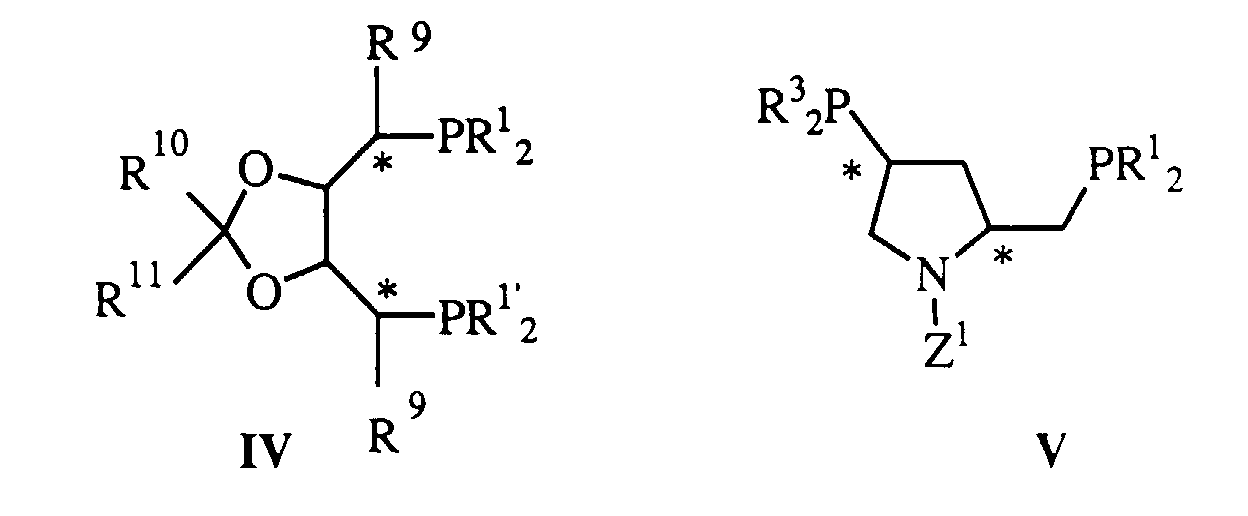
- R1, R1'
- C3-8-Cycloalkyl, Aryl , Heteroaryl oder zusammen mit dem Phosphoratom ein 9-Dibenzophospholyl, die Reste R1 und R1' können gleich oder verschieden sein;
- R9, R10, R11
- unabhängig voneinander Wasserstoff C1-8-Alkyl, C1-8-halogeniertes Alkyl, C3-8-Cycloalkyl, Aryl, Aralkyl; und R10 und R11 können zusammen einen 5- bis 8-gliedrigen Ring bilden;
- R2
- C1-8-Alkyl oder C3-8-Cycloalkyl, Aryl oder Aralkyl, oder zwei R2 zusammen im gleichen Molekül einen 5- bis 8-gliederigen Ring bilden;
- R3
- C1-8-Alkyl, Heteroaryl, Aryl, C3-8-Cycloalkyl, Aralkyl und ;
- Z1
- Wasserstoff, C1-8-Alkyl, Aralkyl, -CO2R2, -CONR2 2, -SO2R10, -POR2 10 , -COR3 bedeuten.
- Verfahren zur Herstellung einer Verbindung der Formel I gemäss einem der Ansprüche 1 bis 3, dadurch gekennzeichnet, dass die asymmetrische Hydrierung in einem Temperaturbereich von 10oC bis 200oC, einem Druck von 1 bis 250 bar und einem Substrat zu Katalysator-Verhältnis von 20 - 80 000 erfolgt.
- Verfahren nach einem der Ansprüche 1 oder 2, dadurch gekennzeichnet, dass als Additive Basen aus der Gruppe von Carbonsäuresalzen, Carbonate, primären, sekundären, tertiären Aminen, Imiden, Natriumalkylate und Natriumhydroxid verwendet werden.
- Verfahren nach einem der Ansprüche 2 oder 5, dadurch gekennzeichnet, dass als Basen sekundäre oder tertiäre Amine eingesetzt werden.
- Verfahren nach einem der Ansprüche 1 oder 2, dadurch gekennzeichnet, dass die Menge des Additivs aus der Gruppe der Carbonsäuresalze, primären, sekundären und tertiären Aminen in einem Bereich von 0,001-100 Molequivalente, bezogen auf die Verbindung gemäss der Formel II beträgt.
- Verbindungen gemäss Anspruch 11-(4-Methoxy-benzyl)-3,4,5,6,7,8-hexahydro-isochinolin- hydrogensulfat,1-(4-Methoxy-benzyl)-3,4,5,6,7,8-hexyhydro-isochinolin-hexafluorophosphat,1-(4-Methoxy-benzyl)-3,4,5,6,7,8-hexyhydro-isochinolin-tetrafluorborat,1-(4-Methoxy-benzyl)-3,4,5,6,7,8-hexahydro-isochinolin-phthalat,1-(4-Methoxy-benzyl)-3,4,5,6,7,8-hexahydro-isochinolin-perchlorat.
Priority Applications (1)
| Application Number | Priority Date | Filing Date | Title |
|---|---|---|---|
| EP97122627A EP0850931B1 (de) | 1996-12-23 | 1997-12-22 | Verfahren zur Herstellung optisch aktiver (R oder S)-1-(4-Methoxy-benzyl)-1,2,3,4,5,6,7,8-Octahydro-isochinoline |
Applications Claiming Priority (3)
| Application Number | Priority Date | Filing Date | Title |
|---|---|---|---|
| EP96120844 | 1996-12-23 | ||
| EP96120844 | 1996-12-23 | ||
| EP97122627A EP0850931B1 (de) | 1996-12-23 | 1997-12-22 | Verfahren zur Herstellung optisch aktiver (R oder S)-1-(4-Methoxy-benzyl)-1,2,3,4,5,6,7,8-Octahydro-isochinoline |
Publications (3)
| Publication Number | Publication Date |
|---|---|
| EP0850931A2 true EP0850931A2 (de) | 1998-07-01 |
| EP0850931A3 EP0850931A3 (de) | 2000-04-26 |
| EP0850931B1 EP0850931B1 (de) | 2003-05-02 |
Family
ID=8223556
Family Applications (1)
| Application Number | Title | Priority Date | Filing Date |
|---|---|---|---|
| EP97122627A Expired - Lifetime EP0850931B1 (de) | 1996-12-23 | 1997-12-22 | Verfahren zur Herstellung optisch aktiver (R oder S)-1-(4-Methoxy-benzyl)-1,2,3,4,5,6,7,8-Octahydro-isochinoline |
Country Status (9)
| Country | Link |
|---|---|
| US (1) | US5880285A (de) |
| EP (1) | EP0850931B1 (de) |
| JP (1) | JP3040366B2 (de) |
| KR (2) | KR19980064495A (de) |
| CN (1) | CN1139576C (de) |
| AT (1) | ATE238992T1 (de) |
| DE (1) | DE59709968D1 (de) |
| DK (1) | DK0850931T3 (de) |
| ES (1) | ES2196250T3 (de) |
Cited By (1)
| Publication number | Priority date | Publication date | Assignee | Title |
|---|---|---|---|---|
| WO2003078399A1 (en) * | 2002-03-19 | 2003-09-25 | Dsm Ip Assets B.V. | Process for asymmetric hydrogenation of hexahydroquinoline salts |
Families Citing this family (6)
| Publication number | Priority date | Publication date | Assignee | Title |
|---|---|---|---|---|
| EP1023269A4 (de) * | 1997-09-30 | 2001-06-27 | Molecular Design Int | Beta3-adrenoreceptor-agonisten, agonist-zubereitungen und verfahren zu ihrer verwendung |
| KR100382364B1 (ko) * | 2000-04-20 | 2003-05-01 | 학교법인 포항공과대학교 | 호모키랄 다공성 결정 물질 |
| US6593341B2 (en) | 2001-03-29 | 2003-07-15 | Molecular Design International, Inc. | β3-adrenoreceptor agonists, agonist compositions and methods of making and using the same |
| US6596734B1 (en) | 2002-10-11 | 2003-07-22 | Molecular Design International, Inc. | Tetrahydroisoquinoline compounds for use as β3-adrenoreceptor agonists |
| CN102241630A (zh) * | 2011-05-20 | 2011-11-16 | 杭州保灵集团有限公司 | 一种镇咳嗽药磷酸二甲啡烷的制备方法 |
| CN111333573B (zh) * | 2020-04-10 | 2021-09-28 | 浙江工业大学 | 一种右美沙芬中间体的制备工艺 |
Family Cites Families (5)
| Publication number | Priority date | Publication date | Assignee | Title |
|---|---|---|---|---|
| US4115389A (en) * | 1977-05-02 | 1978-09-19 | Bristol-Myers Company | Process of N-demethylating (-)-1-(p-methoxybenzyl)-2-methyl-1,2,3,4,5,6,7,8-octahydroisoquinoline |
| DE3436179A1 (de) * | 1984-10-03 | 1986-04-10 | Merck Patent Gmbh, 6100 Darmstadt | Verfahren zur herstellung optisch aktiver amine |
| JPH0667947B2 (ja) * | 1987-09-08 | 1994-08-31 | 高砂香料工業株式会社 | ルテニウム−ホスフイン錯体 |
| DK168069B1 (da) * | 1987-11-11 | 1994-01-31 | Hoffmann La Roche | Isoquinolinderivater og en fremgangsmaade til fremstilling af octahydroisoquinoliner ud fra derivaterne |
| EP0612758B1 (de) * | 1993-02-26 | 2003-04-09 | Syngenta Participations AG | Ferrocenyldiphosphine als Liganden für homogene Katalysatoren |
-
1997
- 1997-12-18 US US08/993,299 patent/US5880285A/en not_active Expired - Lifetime
- 1997-12-19 CN CNB971255504A patent/CN1139576C/zh not_active Expired - Fee Related
- 1997-12-22 DE DE59709968T patent/DE59709968D1/de not_active Expired - Lifetime
- 1997-12-22 JP JP9352502A patent/JP3040366B2/ja not_active Expired - Fee Related
- 1997-12-22 EP EP97122627A patent/EP0850931B1/de not_active Expired - Lifetime
- 1997-12-22 ES ES97122627T patent/ES2196250T3/es not_active Expired - Lifetime
- 1997-12-22 AT AT97122627T patent/ATE238992T1/de active
- 1997-12-22 DK DK97122627T patent/DK0850931T3/da active
- 1997-12-23 KR KR1019970072214A patent/KR19980064495A/ko active Granted
- 1997-12-23 KR KR1019970072214A patent/KR100248685B1/ko not_active Expired - Fee Related
Non-Patent Citations (7)
| Title |
|---|
| KITAMURA M ET AL: "GENERAL ASYMMETRIC SYNTHESIS OF BENZOMORPHANS AND MORPHINANS VIA ENANTIOSELECTIVE HYDROGENATION" TETRAHEDRON LETTERS,NL,ELSEVIER SCIENCE PUBLISHERS, AMSTERDAM, Bd. 28, Nr. 41, 1. Januar 1987 (1987-01-01), Seiten 4829-4832, XP002050843 ISSN: 0040-4039 * |
| KITAMURA M ET AL: "GENERAL ASYMMETRIC SYNTHESIS OF ISOQUINOLINE ALKALOIDS. ENANTIOSELECTIVE HYDROGENATION OF ENAMIDES CATALYZED BY BINAP-RUTHENIUM(II) COMPLEXES" JOURNAL OF ORGANIC CHEMISTRY,US,AMERICAN CHEMICAL SOCIETY. EASTON, Bd. 59, Nr. 2, 1. Januar 1994 (1994-01-01), Seiten 297-310, XP002050844 ISSN: 0022-3263 * |
| R. IMWINKELRIED: "Catalytic Asymmetric Hydrogenation in the Manufacture of d-Biotin and Dextromethorphan" CHIMIA, Bd. 51, Nr. 6, 1997, Seiten 300-302, XP000864390 * |
| W. OPPOLZER ET AL.: "Chiral toluene-2,alpha-sultam auxiliaries: Preparation and structure mof enantiomerically pure (R)- and (S)-ethyl-2,1'-sultam" TETRAHEDRON LETTERS, Bd. 31, Nr. 29, 1990, Seiten 4117-20, XP000864364 * |
| W. R. CULLEN ET AL.: "Asymmetric homogeneous hydrogenation of imines using rhodium-phosphine systems" JOURNAL OF MOLECULAR CATALYSIS, Bd. 62, 1990, Seiten 243-53, XP000864377 * |
| WILLOUGHBY C A ET AL: "CATALYTIC ASYMMETRIC HYDROGENATION OF IMINES WITH A CHIRAL TITANOCENE CATALYST: SCOPE AND LIMITATIONS" JOURNAL OF THE AMERICAN CHEMICAL SOCIETY,US,AMERICAN CHEMICAL SOCIETY, WASHINGTON, DC, Bd. 116, Nr. 20, 1. Januar 1994 (1994-01-01), Seiten 8952-8965, XP002046440 ISSN: 0002-7863 * |
| Y. NG CHEONG CHAN ET AL.: "Iridium (III) Hydride Complexes for the Catalytic Enantioselective Hydrogenation of Imines" JOURNAL OF THE AMERICAN CHEMICAL SOCIETY, Bd. 112, 1990, Seiten 9400-9401, XP000864363 * |
Cited By (1)
| Publication number | Priority date | Publication date | Assignee | Title |
|---|---|---|---|---|
| WO2003078399A1 (en) * | 2002-03-19 | 2003-09-25 | Dsm Ip Assets B.V. | Process for asymmetric hydrogenation of hexahydroquinoline salts |
Also Published As
| Publication number | Publication date |
|---|---|
| DK0850931T3 (da) | 2003-08-18 |
| CN1186073A (zh) | 1998-07-01 |
| EP0850931B1 (de) | 2003-05-02 |
| KR100248685B1 (ko) | 2000-04-01 |
| JPH10182612A (ja) | 1998-07-07 |
| EP0850931A3 (de) | 2000-04-26 |
| ES2196250T3 (es) | 2003-12-16 |
| DE59709968D1 (de) | 2003-06-05 |
| ATE238992T1 (de) | 2003-05-15 |
| KR19980064495A (ko) | 1998-10-07 |
| JP3040366B2 (ja) | 2000-05-15 |
| US5880285A (en) | 1999-03-09 |
| CN1139576C (zh) | 2004-02-25 |
Similar Documents
| Publication | Publication Date | Title |
|---|---|---|
| EP0301457B1 (de) | Verfahren zur Herstellung von optisch aktiven sekundären Aminen | |
| EP0272534A2 (de) | 8-Substituierte 2-Aminotetraline | |
| DE69906275T2 (de) | Intermediate und verfahren zur herstellung optisch aktiver oktansäure-derivate | |
| CH639662A5 (de) | Imidazoazine und imidazodiazine. | |
| EP0850931B1 (de) | Verfahren zur Herstellung optisch aktiver (R oder S)-1-(4-Methoxy-benzyl)-1,2,3,4,5,6,7,8-Octahydro-isochinoline | |
| CH555831A (de) | Verfahren zur herstellung von neuen benzazepinen. | |
| EP0380712B1 (de) | Verfahren zur Herstellung von 2,6-Dichlordiphenylaminessigsäurederivaten | |
| CH637373A5 (en) | Process for preparing novel 2-aminotetralins | |
| DD228249A5 (de) | Verfahren zur herstellung von substituierten imidazolen | |
| DE60104923T2 (de) | Piperidin- und Pirazinverbindungen zur Verwendung in der Behandlung von Alzheimer | |
| EP0570764B1 (de) | Asymmetrische Hydrierung | |
| DE69032595T2 (de) | Verfahren zur enantioselektiven Synthese alkylierter Oxindole zur Verwendung als Zwischenprodukte bei der Herstellung von Physostigminen | |
| DE60104704T2 (de) | Verfahren zur herstellung einer substituierten imidazopyridinverbindung | |
| DE3825368A1 (de) | Benzazepinderivate | |
| DE60029803T2 (de) | Verfahren für die herstellung von 4(5)-amino-5(4)-carboxamidoimidazolen und deren zwischenprodukte | |
| DD151408A5 (de) | Verfahren zur herstellung neuer pharmazeutisch aktiver phenylpiperazinderivate | |
| EP0302021A2 (de) | Verfahren zur Herstellung von optisch aktiven sekundären Arylaminen | |
| EP0744401B1 (de) | Verfahren zur Herstellung von optisch aktiven 2-Piperazincarbonsäurederivaten | |
| EP1375477B1 (de) | Verfahren zur Herstellung von mono-N-sulfonylierten Diaminen | |
| DE60106766T2 (de) | Verfahren zur herstellung von annelierten pyrrolen | |
| DE69521295T2 (de) | Triazolderivate | |
| EP0864576A1 (de) | Neue Amidophosphin-Phosphinit-Verbindungen | |
| DE2818290A1 (de) | Neue naphthyridine | |
| AT390791B (de) | Verfahren zur herstellung neuer kondensierter as-triazinium-derivate sowie von deren isomeren | |
| DE2263527B2 (de) | 2,2-Disubstituierte Phenylacetonitril-Derivate, Verfahren zu ihrer Herstellung und deren Verwendung |
Legal Events
| Date | Code | Title | Description |
|---|---|---|---|
| PUAI | Public reference made under article 153(3) epc to a published international application that has entered the european phase |
Free format text: ORIGINAL CODE: 0009012 |
|
| AK | Designated contracting states |
Kind code of ref document: A2 Designated state(s): AT BE CH DE DK ES FR GB IE IT LI NL |
|
| AX | Request for extension of the european patent |
Free format text: AL;LT;LV;MK;RO;SI |
|
| PUAL | Search report despatched |
Free format text: ORIGINAL CODE: 0009013 |
|
| AK | Designated contracting states |
Kind code of ref document: A3 Designated state(s): AT BE CH DE DK ES FI FR GB GR IE IT LI LU MC NL PT SE |
|
| AX | Request for extension of the european patent |
Free format text: AL;LT;LV;MK;RO;SI |
|
| 17P | Request for examination filed |
Effective date: 20001023 |
|
| AKX | Designation fees paid |
Free format text: AT BE CH DE DK ES FR GB IE IT LI NL |
|
| 17Q | First examination report despatched |
Effective date: 20011130 |
|
| GRAH | Despatch of communication of intention to grant a patent |
Free format text: ORIGINAL CODE: EPIDOS IGRA |
|
| GRAH | Despatch of communication of intention to grant a patent |
Free format text: ORIGINAL CODE: EPIDOS IGRA |
|
| GRAA | (expected) grant |
Free format text: ORIGINAL CODE: 0009210 |
|
| AK | Designated contracting states |
Designated state(s): AT BE CH DE DK ES FR GB IE IT LI NL |
|
| REG | Reference to a national code |
Ref country code: GB Ref legal event code: FG4D Free format text: NOT ENGLISH |
|
| REG | Reference to a national code |
Ref country code: CH Ref legal event code: EP |
|
| REF | Corresponds to: |
Ref document number: 59709968 Country of ref document: DE Date of ref document: 20030605 Kind code of ref document: P |
|
| REG | Reference to a national code |
Ref country code: IE Ref legal event code: FG4D Free format text: GERMAN |
|
| GBT | Gb: translation of ep patent filed (gb section 77(6)(a)/1977) | ||
| REG | Reference to a national code |
Ref country code: DK Ref legal event code: T3 |
|
| REG | Reference to a national code |
Ref country code: ES Ref legal event code: FG2A Ref document number: 2196250 Country of ref document: ES Kind code of ref document: T3 |
|
| REG | Reference to a national code |
Ref country code: CH Ref legal event code: PUE Owner name: DSM IP ASSETS B.V. Free format text: F. HOFFMANN-LA ROCHE AG##4070 BASEL (CH) -TRANSFER TO- DSM IP ASSETS B.V.#HET OVERLOON 1#6411 TE HEERLEN (NL) |
|
| ET | Fr: translation filed | ||
| PLBE | No opposition filed within time limit |
Free format text: ORIGINAL CODE: 0009261 |
|
| STAA | Information on the status of an ep patent application or granted ep patent |
Free format text: STATUS: NO OPPOSITION FILED WITHIN TIME LIMIT |
|
| 26N | No opposition filed |
Effective date: 20040203 |
|
| NLS | Nl: assignments of ep-patents |
Owner name: DSM IP ASSETS B.V. |
|
| REG | Reference to a national code |
Ref country code: GB Ref legal event code: 732E |
|
| REG | Reference to a national code |
Ref country code: CH Ref legal event code: NV Representative=s name: DSM NUTRITIONAL PRODUCTS |
|
| REG | Reference to a national code |
Ref country code: FR Ref legal event code: TP |
|
| PGFP | Annual fee paid to national office [announced via postgrant information from national office to epo] |
Ref country code: DE Payment date: 20141216 Year of fee payment: 18 Ref country code: GB Payment date: 20141217 Year of fee payment: 18 Ref country code: CH Payment date: 20141212 Year of fee payment: 18 |
|
| REG | Reference to a national code |
Ref country code: FR Ref legal event code: PLFP Year of fee payment: 19 |
|
| PGFP | Annual fee paid to national office [announced via postgrant information from national office to epo] |
Ref country code: DK Payment date: 20151210 Year of fee payment: 19 Ref country code: IE Payment date: 20151209 Year of fee payment: 19 |
|
| PGFP | Annual fee paid to national office [announced via postgrant information from national office to epo] |
Ref country code: ES Payment date: 20151112 Year of fee payment: 19 Ref country code: AT Payment date: 20151125 Year of fee payment: 19 Ref country code: NL Payment date: 20151210 Year of fee payment: 19 Ref country code: FR Payment date: 20151110 Year of fee payment: 19 Ref country code: BE Payment date: 20151204 Year of fee payment: 19 |
|
| PGFP | Annual fee paid to national office [announced via postgrant information from national office to epo] |
Ref country code: IT Payment date: 20151221 Year of fee payment: 19 |
|
| REG | Reference to a national code |
Ref country code: DE Ref legal event code: R119 Ref document number: 59709968 Country of ref document: DE |
|
| REG | Reference to a national code |
Ref country code: CH Ref legal event code: PL |
|
| GBPC | Gb: european patent ceased through non-payment of renewal fee |
Effective date: 20151222 |
|
| PG25 | Lapsed in a contracting state [announced via postgrant information from national office to epo] |
Ref country code: GB Free format text: LAPSE BECAUSE OF NON-PAYMENT OF DUE FEES Effective date: 20151222 Ref country code: LI Free format text: LAPSE BECAUSE OF NON-PAYMENT OF DUE FEES Effective date: 20151231 Ref country code: DE Free format text: LAPSE BECAUSE OF NON-PAYMENT OF DUE FEES Effective date: 20160701 Ref country code: CH Free format text: LAPSE BECAUSE OF NON-PAYMENT OF DUE FEES Effective date: 20151231 |
|
| PG25 | Lapsed in a contracting state [announced via postgrant information from national office to epo] |
Ref country code: BE Free format text: LAPSE BECAUSE OF NON-PAYMENT OF DUE FEES Effective date: 20161231 |
|
| REG | Reference to a national code |
Ref country code: DK Ref legal event code: EBP Effective date: 20161231 |
|
| REG | Reference to a national code |
Ref country code: NL Ref legal event code: MM Effective date: 20170101 |
|
| REG | Reference to a national code |
Ref country code: AT Ref legal event code: MM01 Ref document number: 238992 Country of ref document: AT Kind code of ref document: T Effective date: 20161222 |
|
| PG25 | Lapsed in a contracting state [announced via postgrant information from national office to epo] |
Ref country code: NL Free format text: LAPSE BECAUSE OF NON-PAYMENT OF DUE FEES Effective date: 20170101 |
|
| REG | Reference to a national code |
Ref country code: FR Ref legal event code: ST Effective date: 20170831 |
|
| REG | Reference to a national code |
Ref country code: IE Ref legal event code: MM4A |
|
| PG25 | Lapsed in a contracting state [announced via postgrant information from national office to epo] |
Ref country code: AT Free format text: LAPSE BECAUSE OF NON-PAYMENT OF DUE FEES Effective date: 20161222 Ref country code: FR Free format text: LAPSE BECAUSE OF NON-PAYMENT OF DUE FEES Effective date: 20170102 Ref country code: IT Free format text: LAPSE BECAUSE OF NON-PAYMENT OF DUE FEES Effective date: 20161222 |
|
| PG25 | Lapsed in a contracting state [announced via postgrant information from national office to epo] |
Ref country code: IE Free format text: LAPSE BECAUSE OF NON-PAYMENT OF DUE FEES Effective date: 20161222 |
|
| PG25 | Lapsed in a contracting state [announced via postgrant information from national office to epo] |
Ref country code: DK Free format text: LAPSE BECAUSE OF NON-PAYMENT OF DUE FEES Effective date: 20161231 |
|
| REG | Reference to a national code |
Ref country code: BE Ref legal event code: MM Effective date: 20161231 |
|
| REG | Reference to a national code |
Ref country code: ES Ref legal event code: FD2A Effective date: 20180507 |
|
| PG25 | Lapsed in a contracting state [announced via postgrant information from national office to epo] |
Ref country code: ES Free format text: LAPSE BECAUSE OF FAILURE TO SUBMIT A TRANSLATION OF THE DESCRIPTION OR TO PAY THE FEE WITHIN THE PRESCRIBED TIME-LIMIT Effective date: 20030502 |
|
| PG25 | Lapsed in a contracting state [announced via postgrant information from national office to epo] |
Ref country code: ES Free format text: LAPSE BECAUSE OF FAILURE TO SUBMIT A TRANSLATION OF THE DESCRIPTION OR TO PAY THE FEE WITHIN THE PRESCRIBED TIME-LIMIT Effective date: 20161223 |