EP0851216A2 - Débitmètre à impact - Google Patents
Débitmètre à impact Download PDFInfo
- Publication number
- EP0851216A2 EP0851216A2 EP97122667A EP97122667A EP0851216A2 EP 0851216 A2 EP0851216 A2 EP 0851216A2 EP 97122667 A EP97122667 A EP 97122667A EP 97122667 A EP97122667 A EP 97122667A EP 0851216 A2 EP0851216 A2 EP 0851216A2
- Authority
- EP
- European Patent Office
- Prior art keywords
- particulate material
- load
- detection plate
- flow meter
- supply device
- Prior art date
- Legal status (The legal status is an assumption and is not a legal conclusion. Google has not performed a legal analysis and makes no representation as to the accuracy of the status listed.)
- Withdrawn
Links
Images


Classifications
-
- G—PHYSICS
- G01—MEASURING; TESTING
- G01F—MEASURING VOLUME, VOLUME FLOW, MASS FLOW OR LIQUID LEVEL; METERING BY VOLUME
- G01F1/00—Measuring the volume flow or mass flow of fluid or fluent solid material wherein the fluid passes through a meter in a continuous flow
- G01F1/05—Measuring the volume flow or mass flow of fluid or fluent solid material wherein the fluid passes through a meter in a continuous flow by using mechanical effects
- G01F1/20—Measuring the volume flow or mass flow of fluid or fluent solid material wherein the fluid passes through a meter in a continuous flow by using mechanical effects by detection of dynamic effects of the flow
- G01F1/28—Measuring the volume flow or mass flow of fluid or fluent solid material wherein the fluid passes through a meter in a continuous flow by using mechanical effects by detection of dynamic effects of the flow by drag-force, e.g. vane type or impact flowmeter
- G01F1/30—Measuring the volume flow or mass flow of fluid or fluent solid material wherein the fluid passes through a meter in a continuous flow by using mechanical effects by detection of dynamic effects of the flow by drag-force, e.g. vane type or impact flowmeter for fluent solid material
-
- G—PHYSICS
- G01—MEASURING; TESTING
- G01D—MEASURING NOT SPECIALLY ADAPTED FOR A SPECIFIC VARIABLE; ARRANGEMENTS FOR MEASURING TWO OR MORE VARIABLES NOT COVERED IN A SINGLE OTHER SUBCLASS; TARIFF METERING APPARATUS; MEASURING OR TESTING NOT OTHERWISE PROVIDED FOR
- G01D5/00—Mechanical means for transferring the output of a sensing member; Means for converting the output of a sensing member to another variable where the form or nature of the sensing member does not constrain the means for converting; Transducers not specially adapted for a specific variable
- G01D5/12—Mechanical means for transferring the output of a sensing member; Means for converting the output of a sensing member to another variable where the form or nature of the sensing member does not constrain the means for converting; Transducers not specially adapted for a specific variable using electric or magnetic means
-
- G—PHYSICS
- G01—MEASURING; TESTING
- G01G—WEIGHING
- G01G11/00—Apparatus for weighing a continuous stream of material during flow; Conveyor belt weighers
- G01G11/003—Details; specially adapted accessories
Definitions
- the present invention relates to an impact type flow meter for measuring and controlling a flow rate of a particulate material such as cereal, and in particular to a flow meter utilizing a slanting or inclined detection plate.
- pill material used herein means not only a granular or particulate material but also a powdery or pulverulent material.
- a conventional impact type flow meter is so constructed as to cause particulate material to drop onto an impact plate or detection plate and to calculate a flow rate thereof from its impact force.
- the detection plate is mounted with an inclination or descent so that the particulate material impinging thereupon can slide down at once with no stagnation.
- Such a flow meter is seen in, for example, U.S. Patent No. 3,611,803, Japanese Patent Application Laid-Open Publication No. 60-122324, International Application Publication Nos. WO81/00312 and WO93/22652.
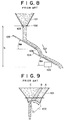
- Fig. 8 shows the arrangement proposed by Japanese Patent Publication No. H8-12091.
- the arrangement is such that one or more inclined buffer plates are provided between a discharge opening 103 in the lower portion of a particulate material supply device 102, which is below a hopper 101, and a detection plate 104.
- the particulate material dropping from the supply device 102 impinges upon the first one of the buffer plates, then slides down along the subsequent buffer plates, slides along the last buffer plate 105, and is finally dropped onto the detection plate 104.
- Fig. 8 illustrates only the final buffer plate 105 which is inclined in the same direction with the detection plate 104.
- the detection plate 104 is installed with its upper end located right below the lower end of the final buffer plate 105, and it has a detecting system or load cell 100 for detecting the vertical component of a force exerted to the detection plate 104.
- the flow meter thus constructed functions as follows.
- a cut-gate type particulate material supply device as shown in Fig. 9.
- the supply device is provided in its lower portion with a cut-gate 102 and opens and closes the discharge opening through rotary movement of the cut-gate. Therefore, there are caused a part A in which the material tends to stagnate, and a part C in which the material smoothly flows, depending on a degree of opening of the cut-gate 102.
- a boundary layer B is formed between the part A and the part C, and the thickness of the boundary layer B varies with the opening degree of the cut-gate 102. Change in the thickness of the boundary layer B causes the angle of repose of the stagnating part A to vary and provides a possibility that the stagnating part A will crumble at once.
- the opening degree of the cut-gate 102 does not always coincide with the flow rate of the material, and there are cases where the accuracy in measuring the flow rate of the material is subject to detrimental affection.
- the flow meter shown in Fig. 8 because of its construction in which the plurality of buffer plates are arranged in a stair-like manner and the load cell 100 is situated below the detection plate 104, is large in the height h of the apparatus, thereby becoming large in its overall size.
- the present invention has an object of, in view of the above-mentioned problems, providing an impact type flow meter which is small in height and compact and which is high in the accuracy of measurement of a flow rate.
- Another object of the invention is to provide an impact type flow meter which can always make the opening degree of a particulate material supply device coincident with the conveying flow rate of particulate material to improve the accuracy of flow rate measurement.
- the impact type flow meter for particulate material comprises a supply device having a supply opening for dropping the particulate material, which can change the flow rate of the particulate material flowing through the supply opening, an inclined load detection plate provided at a position for receiving a load of the particulate material dropping from the supply device, a load detector for detecting the load of the particulate material exerted on the load detection plate and for converting the load into an electrical signal, and a computing device for computing the flow rate of the particulate material from the electrical signal delivered from the load detector.
- the flow meter is characterized in that the supply device is in a trough-like shape defining a passage for the particulate material, and has a flat bottom surface of substantially the same inclination with the detection plate, and the supply opening is provided in the lower end of the bottom surface as viewed in the direction of inclination.
- the inclined bottom surface of the supply device guides the particulate material at substantially the same inclination with the load detection plate, and accordingly, serves as the conventional buffer plate which has been described above.
- the flow meter is of the construction that the particulate material supply device is integrally incorporated with the buffer plate, and it is possible to reduce the height and make the whole apparatus compact.
- the particulate material flowing into the supply device always impinges on the bottom surface, diverges in the widthwise direction of the bottom surface and reaches the supply opening. Accordingly, the direction and position of dropping of the particulate material onto the load detection plate come to be constant or fixed. Even though the speed of the particulate material flowing into the supply device is uneven, at the time when flowing down through the supply opening, the flow-down speed has been reduced, so that the flow meter is high in the measurement accuracy.
- the supply opening of the supply device is preferably rectangular and located close to the load detection plate so as to lessen the dropping impact of the particulate material. More specifically, it is preferable to set the space or distance between the supply opening and the load detection plate in such a manner that a quasi-static load on the inclined surface is detected to be larger than an impact load caused by dropping of the particulate material.
- the distance is, for example, about 40 mm for a flow meter which has the maximum measuring range of about 5 tons per hour.
- the flow meter can measure the particulate material in a manner like weighing measurement and is improved in the measurement accuracy.
- the flow meter is preferably provided with an opening and closing device for the supply opening of the supply device.
- the opening and closing device includes a plate member which is slidable in a direction parallel with the bottom surface so as to open and close the supply opening, and a drive source for moving the plate member. It is preferable for the plate member to be situated at a higher level than the supply opening with respect to the direction of inclination of the bottom surface, and to be moved downward for closing the supply opening. In this case, at whatever position the plate member lies, the particulate material by its all part slides down along the bottom surface and the plate member not to cause stagnation. Accordingly, the opening degree of the supply opening corresponds to the flow rate of the particulate material, and thereby the accuracy in measurement of a flow rate is further improved.
- the plate member is preferably formed with a cut-out portion in the lower end edge thereof as viewed in the direction of inclination of the bottom surface. In this case, the plate member, even when being near its close position, can control the particulate material to the region of a small flow rate and does not cause the material to stagnate.
- the load detector is preferably arranged at a height substantially equal to that of the supply device for particulate material to suspend the load detection plate.
- the flow meter 1 has a machine base 2, and a machine frame 4 provided on the machine base 2 supports a particulate material supply device 3 and a load detection plate 6.
- the supply device 3, which can change the flow rate of a particulate material, is in a trough-like or pipe-like shape for defining a particulate material passage, and is situated in an upper part of the machine frame 4.
- the supply device 3 is connected with a reservoir hopper above the supply device, not shown in the figures, via a pipe-like member 5.
- the load detection plate 6 is positioned below the supply device 3 to receive a load of the particulate material F dropping from the supply device 3.
- the load detection plate 6 is in a flat shape which is inclined with respect to the horizontal plane, so that the particulate material F slides along the inclined surface of the load detection plate 6 to exert a quasi-static load thereon.
- support members 7A,7B of a substantially triangular shape are attached to widthwise opposite sides of the load detection plate 6, respectively.
- the support members 7A,7B are formed in their upper portions with grip parts 8A,8B, respectively, between which a support member 9 is spanned or bridged.
- a load cell 10 serving as a load detecting means is attached at one end thereof to the support member 9.
- the load cell 10 is supported at its other end by the machine frame 4 through a support member 11.
- the load cell 10 is configured to suspend the load detection plate 6 therefrom.
- the particulate material supply device 3 has at its lower end a flat bottom surface 12, and the bottom surface 12 is inclined to a degree substantially equal to the load detection plate 6.
- the bottom surface 12 has, in its lower end as viewed in the direction inclination, a rectangular supply opening 13 of a constant width for dropping the particulate material F onto the load detection plate 6.
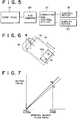
- the particulate material F having flown into the particulate material supply device 3 diverges widthwise, as indicated by reference letter M in Fig. 6, while sliding along the bottom surface 12, and comes to the supply opening 13.
- the supply opening 13 is arranged preferably close to the load detection plate 6 so as to reduce the dropping shock or impact of the particulate material thereon.
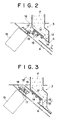
- the space or distance L between the supply opening 13 and the load detection plate 6 is set to 40 mm, see Fig. 2.
- the distance L is set in a manner that the quasi-static load of the particulate material F exerted on the inclined surface of the load detection plate 6, that is, a load close to that measured through weighing measurement, is larger than an impact load caused by dropping of the particulate material F.
- the size of the supply opening 13 is set so that it can feed the particulate material at a desired maximum flow rate.
- the particulate material supply device 3 is provided with an opening and closing device 16 for the supply opening 13.
- the opening and closing device 16 is composed of a plate member 14 which is adapted to slide in parallel with the bottom surface 12 to open and close the supply opening 13, and a drive device 15 for moving the plate member 14, which is a control motor in this embodiment.
- the drive device 15 may comprise an air cylinder or the like which can stop at desired positions.
- the plate member 14 is located in a position higher than the supply opening 13, as viewed in the direction of inclination of the bottom surface 12, and is moved downward to close the supply opening 13.
- the opening and closing device 16 moves the plate member 14 to a position S for closing the supply opening 13, see Fig. 2, to another position O for opening the supply opening 13, see Fig. 3, or to any position between these two positions to control the degree of opening of the particulate material supply device 3.
- the control motor 15 is adapted to stop at any rotating angle, and has a motor shaft 17 attached thereto with a rotary plate 18.
- the rotary plate 18 is coupled to the plate member 14 through a drive arm 19.
- the control motor 15 is rotated for a predetermined angle, the drive arm 19 is pulled up obliquely in the direction of inclination to open the supply opening 13, or to the contrary, the drive arm 19 is pulled down obliquely in the direction of inclination to close the supply opening 13.
- the flow meter 1 has a control section, and Fig. 5 shows the control section.
- the load cell 10 serving as the load detector outputs an analog signal in accordance with a load exerted to the load detection plate by the particulate material, and is connected to a computing and controlling device 21, such as a microprocessor, through an A/D converter 20.
- the computing and controlling device 21 computes a flow rate of the particulate material going along the detection plate, on the basis of the input signal from the load cell 10.
- Connected to the computing and controlling device 21 are the control motor 15 for the particulate material supply device 3, and a display device 22 for indicating a flow rate as a result of the computation.
- the particulate material supply device 3 closes its supply opening 13 as shown in Fig. 2, and is in a state of being filled with the particulate material F from the reservoir hopper.
- the computing and controlling device 21 outputs a drive signal to the control motor 15.
- the control motor 15 rotates the rotary plate 18 for a predetermined angle and moves the plate member 14 upward in the direction of inclination through the drive arm 19 to open the supply opening 13. See Fig. 3.
- the particulate material F therefore flows downward along the bottom surface 12 of the supply device 3, and then drops from the supply opening 13, which is on the lower side as viewed in the inclination, onto the load detection plate 6.
- the load cell 10 Upon dropping of the particulate material F onto the load detection plate 6, the load cell 10 detects the load of the particulate material F, and delivers an analog signal in accordance with the result of detection.
- the analog signal is A/D- converted by the A/D converter 20, and is then introduced into the computing and controlling device 21.
- the computing and controlling device 21 computes a quasi-static load from the detection signal, and further converts the same into a flow rate with the use of a predetermined arithmetic formula.
- the computing and controlling device 21 when judging necessary from the result of computation, drives the control motor 15 for the opening and closing device 16 to adjust the opening degree of the plate member 14. Further, the flow rate calculated by the computing and controlling device 21 is indicated on the display device 22.
- the primary feature of the invention resides in the provision of the bottom surface 12, which is inclined to a degree similar to the load detection plate 6, in the lower portion of the particulate material supply device 3, as shown in Fig. 1, differently from the conventional example shown in Fig. 8, wherein the plurality of buffer plates are provided separately from the particulate material supply device 102. More specifically, the particulate material supply device and the buffer plate are integrally formed to simplify the construction, thereby making the height of the apparatus lower and the whole apparatus compact. In this supply device, the particulate material F flowing down from the pipe-like member 5 always impinges upon the bottom surface 12, diverges widthwise and reaches the supply opening 13.
- the direction and position of dropping of the particulate material F onto the load detection plate 6 are substantially fixed, and therefor, even though the speed of the particulate material flowing into the supply opening 13 is uneven, the flow-down speed is lessened and the unevenness of speed is averaged or uniformed when it flows out from the supply opening 13.
- the particulate material supply device 3 has the supply opening 13 situated close to the load detection plate 6, the fall L between the supply opening 13 and the load detection plate 6, see Fig. 2, is small so as to be 40 mm. Accordingly, the dropping impact of the particulate material is less, and in the load exerted on the load detection plate 6, the quasi-static load caused when the particulate material F slides along the load detection plate 6 becomes larger in rate than the impact load upon dropping of the particulate material. It is thus possible to detect the flow rate of the particulate material F in a condition of almost weighing measurement.
- the particulate material supply device 3 has the supply opening 13 in the bottom surface 12 on the lower side thereof as viewed in the inclination, and performs opening and closing of the supply opening 13 by means of the plate member 14 which slides in parallel with the bottom surface 12.
- the particulate material F in the supply device 3 flows down in its entirety into the supply opening 13 along the bottom surface part 12, and there is no possibility that the plate member 14 causes a stagnating part of the material due to its position, which corresponds to the part A shown in Fig. 9. Accordingly, the opening degree of the supply device 3 or the plate member 14 is consistent with the flow rate of the material, so that the accuracy in measuring the flow rate of the material is improved and the control of opening and closing of the supply opening 13 can also be carried out precisely.
- the distance between the supply opening 13 and the load detection plate 6 is fixed, and the distance of dripping of the particulate material F is constant wherever the plate member 14 lies. That is, the magnitude of the impact load exerted by the particulate material F is proportional to the opening degree of the plate member 14, and thereby conversion to the flow rate can be made with high accuracy. This will be explained with reference to Fig. 7.
- Fig. 7 is a graph showing the relationship between opening degrees of the plate member 14 and detection values of the load cell 10, in which the abscissa denotes the opening degree and the ordinate denotes the detection value.
- the solid line M in Fig. 7 represents an actually detected value including the impact load which the load detection plate 6 receives due to the particulate material F dropping from the supply opening 13, and the quasi-static load of the particulate material F together. Since the impact load varies in proportion to the opening degree of the plate member 14, it is predicted that the quasi-static load will change as a broken line N with respect to the detection values of the solid line M. For instance, according to the graph of Fig.
- the impact load can be obtained from M-N, and it will be appreciated that the impact load M-N is proportional to the opening degree of the plate member 14. Therefore, by calculating an impact load from, for instance, the flow rate at the maximum opening degree of the supply opening 13, the ration of impact load over all the region of opening of the supply opening can be predicted. Accordingly, when knowing an opening degree of the plate member 14, a predicted value of impact load is known, and calculation of a quasistatic load and conversion to a flow rate can be carried out with high accuracy.
- the plate member 14 for opening and closing the supply opening 13 is preferably formed, as shown in Fig. 6, in its leading end edge, that is, in the lower end edge as viewed in the direction of inclination of the bottom surface 12, with a cut-out portion 14a.
- the cut-out portion 14a is generally in a chevron shape which become larger in opening as it comes near the widthwise center of the plate member 14.
- an opening width is about 100 mm and the maximum height or depth of the chevron shape at its center is about 10 mm for the plate member 14 of a 130 mm width.
- the cut-out portion 14a may take another shape than that described above and have other dimensions depending on the volume to be handled.
- the closing position of the plate member 14 is set to a position where the cut-out portion 14a passes over the supply opening 13.
- the load cell 10 as the load detector is situated at a height substantially equal to the particulate material supply device 3 and suspends the load detection plate 6. Accordingly, the height h of the flow meter 1 can be decreased to make the apparatus compact as compared with the conventional example of Fig. 8 wherein the load cell 100 is disposed below the detection plate 104.
Landscapes
- Physics & Mathematics (AREA)
- General Physics & Mathematics (AREA)
- Fluid Mechanics (AREA)
- Measuring Volume Flow (AREA)
- Weight Measurement For Supplying Or Discharging Of Specified Amounts Of Material (AREA)
Applications Claiming Priority (2)
| Application Number | Priority Date | Filing Date | Title |
|---|---|---|---|
| JP35799996A JP3750125B2 (ja) | 1996-12-26 | 1996-12-26 | 衝撃式流量検出装置 |
| JP357999/96 | 1996-12-26 |
Publications (2)
| Publication Number | Publication Date |
|---|---|
| EP0851216A2 true EP0851216A2 (fr) | 1998-07-01 |
| EP0851216A3 EP0851216A3 (fr) | 1998-11-11 |
Family
ID=18457028
Family Applications (1)
| Application Number | Title | Priority Date | Filing Date |
|---|---|---|---|
| EP97122667A Withdrawn EP0851216A3 (fr) | 1996-12-26 | 1997-12-22 | Débitmètre à impact |
Country Status (9)
| Country | Link |
|---|---|
| US (1) | US6094994A (fr) |
| EP (1) | EP0851216A3 (fr) |
| JP (1) | JP3750125B2 (fr) |
| KR (1) | KR100278223B1 (fr) |
| CN (1) | CN1131419C (fr) |
| AU (1) | AU695617B2 (fr) |
| CA (1) | CA2225606C (fr) |
| MY (1) | MY116596A (fr) |
| TW (1) | TW378270B (fr) |
Cited By (3)
| Publication number | Priority date | Publication date | Assignee | Title |
|---|---|---|---|---|
| EP1192425A4 (fr) * | 1999-03-24 | 2006-12-06 | Comalco Alu | Mesure et commande du debit de materiaux fluides |
| DE102008011564A1 (de) * | 2008-02-28 | 2009-09-03 | Rembe Gmbh Safety + Control | Vorrichtung zum Messen von Masseströmen |
| CN110745500A (zh) * | 2019-10-21 | 2020-02-04 | 马鞍山楚锐科技信息咨询有限公司 | 缓冲式落料输送装置 |
Families Citing this family (27)
| Publication number | Priority date | Publication date | Assignee | Title |
|---|---|---|---|---|
| US6257447B1 (en) * | 1999-06-29 | 2001-07-10 | Sandia Corporation | Precision powder feeder |
| US6417464B2 (en) * | 1999-08-23 | 2002-07-09 | Dynamic Air, Inc. | Extended range feeders |
| ATE381398T1 (de) | 2000-09-25 | 2008-01-15 | Voxeljet Technology Gmbh | Verfahren zum herstellen eines bauteils in ablagerungstechnik |
| DE10049043A1 (de) * | 2000-10-04 | 2002-05-02 | Generis Gmbh | Verfahren zum Entpacken von in ungebundenem Partikelmaterial eingebetteten Formkörpern |
| DE10117875C1 (de) * | 2001-04-10 | 2003-01-30 | Generis Gmbh | Verfahren, Vorrichtung zum Auftragen von Fluiden sowie Verwendung einer solchen Vorrichtung |
| DE10216013B4 (de) * | 2002-04-11 | 2006-12-28 | Generis Gmbh | Verfahren und Vorrichtung zum Auftragen von Fluiden |
| DE10222167A1 (de) * | 2002-05-20 | 2003-12-04 | Generis Gmbh | Vorrichtung zum Zuführen von Fluiden |
| DE10224981B4 (de) | 2002-06-05 | 2004-08-19 | Generis Gmbh | Verfahren zum schichtweisen Aufbau von Modellen |
| US6732597B1 (en) * | 2002-11-14 | 2004-05-11 | Robert O. Brandt, Jr. | Precision gravimetric feeder |
| US7807077B2 (en) * | 2003-06-16 | 2010-10-05 | Voxeljet Technology Gmbh | Methods and systems for the manufacture of layered three-dimensional forms |
| DE102004008168B4 (de) | 2004-02-19 | 2015-12-10 | Voxeljet Ag | Verfahren und Vorrichtung zum Auftragen von Fluiden und Verwendung der Vorrichtung |
| US20060245863A1 (en) * | 2005-04-19 | 2006-11-02 | Paul Wilcott | Solid state detection system for measuring high levels in grain bins |
| DE102006038858A1 (de) * | 2006-08-20 | 2008-02-21 | Voxeljet Technology Gmbh | Selbstaushärtendes Material und Verfahren zum schichtweisen Aufbau von Modellen |
| DE102007050679A1 (de) | 2007-10-21 | 2009-04-23 | Voxeljet Technology Gmbh | Verfahren und Vorrichtung zum Fördern von Partikelmaterial beim schichtweisen Aufbau von Modellen |
| DE102009030113A1 (de) | 2009-06-22 | 2010-12-23 | Voxeljet Technology Gmbh | Verfahren und Vorrichtung zum Zuführen von Fluiden beim schichtweisen Bauen von Modellen |
| US9533775B1 (en) | 2009-09-30 | 2017-01-03 | Matrix Packaging Machinery Llc | Particle packaging systems and associated methods |
| US8299374B2 (en) * | 2010-02-09 | 2012-10-30 | Brandt Robert O | Precision dynamic measurement apparatus |
| DE102010014969A1 (de) | 2010-04-14 | 2011-10-20 | Voxeljet Technology Gmbh | Vorrichtung zum Herstellen dreidimensionaler Modelle |
| DE102010027071A1 (de) | 2010-07-13 | 2012-01-19 | Voxeljet Technology Gmbh | Vorrichtung zum Herstellen dreidimensionaler Modelle mittels Schichtauftragstechnik |
| GB2482010B (en) * | 2010-07-14 | 2012-06-27 | Upcycle Holdings Ltd | Applicator device for plastic moulding machine |
| DE102010056346A1 (de) | 2010-12-29 | 2012-07-05 | Technische Universität München | Verfahren zum schichtweisen Aufbau von Modellen |
| DE102011007957A1 (de) | 2011-01-05 | 2012-07-05 | Voxeljet Technology Gmbh | Vorrichtung und Verfahren zum Aufbauen eines Schichtenkörpers mit wenigstens einem das Baufeld begrenzenden und hinsichtlich seiner Lage einstellbaren Körper |
| CN104748819B (zh) * | 2015-03-28 | 2017-03-01 | 长安大学 | 沥青混合料搅拌设备用冷料仓流量测定装置及测定方法 |
| JP6135874B2 (ja) | 2015-04-09 | 2017-05-31 | 三協パイオテク株式会社 | 衝撃式粉粒体流量計 |
| US10473496B2 (en) * | 2016-09-09 | 2019-11-12 | M&S Flomatics Incorporated | Devices, systems and methods for measuring flow |
| WO2021212110A1 (fr) | 2020-04-17 | 2021-10-21 | Eagle Engineered Solutions, Inc. | Appareil et système d'étalement de poudre |
| JP7500491B2 (ja) * | 2021-04-14 | 2024-06-17 | 株式会社クボタ | 洗米装置 |
Family Cites Families (12)
| Publication number | Priority date | Publication date | Assignee | Title |
|---|---|---|---|---|
| US1506936A (en) * | 1922-09-25 | 1924-09-02 | Lea James Edward | Apparatus for indicating and recording the rate of feed of granular materials |
| US3611803A (en) * | 1968-08-28 | 1971-10-12 | Hiroshi Kajiura | Impact flow meter for powdery and granular materials |
| CA1117622A (fr) * | 1977-08-11 | 1982-02-02 | Douglas A. Wood | Systeme regulateur d'ecoulement de matiere en particules |
| DE2953764C2 (de) * | 1979-07-12 | 1987-06-25 | Sankyo Dengyo Kk | Vorrichtung zur Lieferung einer konstanten Strömungsmenge |
| JPS60122324A (ja) * | 1983-12-06 | 1985-06-29 | Hokutou Koki Kogyo Kk | 衝撃式流量計 |
| JPH0812091B2 (ja) * | 1987-02-10 | 1996-02-07 | 三協電業株式会社 | 粉粒体流量計 |
| CA1312885C (fr) * | 1988-05-03 | 1993-01-19 | Josef Neumuller | Methode et appareil de pesage d'un courant continu de materiaux fluides |
| ES2121009T3 (es) * | 1992-02-12 | 1998-11-16 | Cimbria Unigrain Ltd | Dispositivo de medicion de caudal masico. |
| NZ242499A (en) * | 1992-04-24 | 1998-06-26 | Ind Res Ltd | Measuring or monitoring continuously a diameter of a flowing particulate material |
| CH683562A5 (de) * | 1992-05-05 | 1994-03-31 | K Tron Tech Inc | Schüttgutwaage. |
| DE19520264C2 (de) * | 1995-06-02 | 1997-08-07 | Claus Friedrich | Meßeinrichtung zur Erfassung der Förderstärke eines Schüttgutstromes |
| US5798466A (en) * | 1996-01-26 | 1998-08-25 | Satake Corporation | Flow meter and method of calibrating same |
-
1996
- 1996-12-26 JP JP35799996A patent/JP3750125B2/ja not_active Expired - Fee Related
-
1997
- 1997-12-19 US US08/995,250 patent/US6094994A/en not_active Expired - Fee Related
- 1997-12-22 TW TW086119525A patent/TW378270B/zh not_active IP Right Cessation
- 1997-12-22 EP EP97122667A patent/EP0851216A3/fr not_active Withdrawn
- 1997-12-23 KR KR1019970072496A patent/KR100278223B1/ko not_active Expired - Fee Related
- 1997-12-23 CA CA002225606A patent/CA2225606C/fr not_active Expired - Fee Related
- 1997-12-24 MY MYPI97006283A patent/MY116596A/en unknown
- 1997-12-24 AU AU49250/97A patent/AU695617B2/en not_active Ceased
- 1997-12-25 CN CN97125669A patent/CN1131419C/zh not_active Expired - Fee Related
Cited By (4)
| Publication number | Priority date | Publication date | Assignee | Title |
|---|---|---|---|---|
| EP1192425A4 (fr) * | 1999-03-24 | 2006-12-06 | Comalco Alu | Mesure et commande du debit de materiaux fluides |
| DE102008011564A1 (de) * | 2008-02-28 | 2009-09-03 | Rembe Gmbh Safety + Control | Vorrichtung zum Messen von Masseströmen |
| US7870794B2 (en) | 2008-02-28 | 2011-01-18 | Rembe Gmbh Safety + Control | Device for measuring a mass flow |
| CN110745500A (zh) * | 2019-10-21 | 2020-02-04 | 马鞍山楚锐科技信息咨询有限公司 | 缓冲式落料输送装置 |
Also Published As
| Publication number | Publication date |
|---|---|
| CN1131419C (zh) | 2003-12-17 |
| JPH10185638A (ja) | 1998-07-14 |
| JP3750125B2 (ja) | 2006-03-01 |
| US6094994A (en) | 2000-08-01 |
| KR19980064507A (ko) | 1998-10-07 |
| EP0851216A3 (fr) | 1998-11-11 |
| KR100278223B1 (ko) | 2001-03-02 |
| CA2225606A1 (fr) | 1998-06-26 |
| AU4925097A (en) | 1998-07-02 |
| AU695617B2 (en) | 1998-08-20 |
| TW378270B (en) | 2000-01-01 |
| MY116596A (en) | 2004-02-28 |
| CN1193732A (zh) | 1998-09-23 |
| CA2225606C (fr) | 2001-01-30 |
Similar Documents
| Publication | Publication Date | Title |
|---|---|---|
| US6094994A (en) | Impact type flow meter with trough-like material supply device having a built in supply opening | |
| JP4173805B2 (ja) | スケールの様態をしたチェーンコンベヤ | |
| US5834707A (en) | Bulk material scale and flowmeter | |
| CA1155879A (fr) | Dispositif permettant de peser les matieres fluides | |
| US7534970B2 (en) | Counterbalanced dispensing system | |
| US8299374B2 (en) | Precision dynamic measurement apparatus | |
| AU768576B2 (en) | Chain conveyor | |
| JPS61500134A (ja) | ばら材料の流れの流量記録方法及び装置 | |
| EP0878695A2 (fr) | Appareil pour pesée continue de matière pulvérulente, granulaire ou écailleuse pendant l'alimentation de celui-ci | |
| US7870794B2 (en) | Device for measuring a mass flow | |
| US20060032729A1 (en) | Transfer and dosing device of pulverulent or granular material contained in a hopper | |
| CN100486868C (zh) | 散状物料计量分装机 | |
| HU215040B (hu) | Berendezés tömegáram méréséhez | |
| JPH11108742A (ja) | エアースライド式コンベアスケール | |
| MX2025011974A (es) | Aparato de medicion y dosificacion de flujo para solidos granulares fluibles | |
| CN214871676U (zh) | 混凝土配料机流量控制系统 | |
| JPH11248522A (ja) | 大豆自動計量装置 | |
| CN204373755U (zh) | 物料流电子秤 | |
| JPH05139543A (ja) | 定量輸送装置 | |
| US20090301220A1 (en) | Device for measuring a mass flow | |
| JP2003192141A (ja) | 粉粒体サイロ装置 | |
| JP4611727B2 (ja) | 組合せ計量装置 | |
| CN108820278B (zh) | 一种打包秤及装置 | |
| SU1509596A1 (ru) | Устройство дл измерени расхода сыпучих материалов | |
| SU260843A1 (ru) | УСТРОЙСТВО дл ПОДАЧИ ФЕРРОСПЛАВОВ В СТАЛЕРАЗЛИВОЧНЫЙ КОВШ |
Legal Events
| Date | Code | Title | Description |
|---|---|---|---|
| PUAI | Public reference made under article 153(3) epc to a published international application that has entered the european phase |
Free format text: ORIGINAL CODE: 0009012 |
|
| 17P | Request for examination filed |
Effective date: 19971222 |
|
| AK | Designated contracting states |
Kind code of ref document: A2 Designated state(s): CH DE ES GB IT LI |
|
| AX | Request for extension of the european patent |
Free format text: AL;LT;LV;MK;RO;SI |
|
| PUAL | Search report despatched |
Free format text: ORIGINAL CODE: 0009013 |
|
| AK | Designated contracting states |
Kind code of ref document: A3 Designated state(s): AT BE CH DE DK ES FI FR GB GR IE IT LI LU MC NL PT SE |
|
| AX | Request for extension of the european patent |
Free format text: AL;LT;LV;MK;RO;SI |
|
| AKX | Designation fees paid |
Free format text: CH DE ES GB IT LI |
|
| 17Q | First examination report despatched |
Effective date: 20040813 |
|
| STAA | Information on the status of an ep patent application or granted ep patent |
Free format text: STATUS: THE APPLICATION IS DEEMED TO BE WITHDRAWN |
|
| 18D | Application deemed to be withdrawn |
Effective date: 20060701 |