EP0851273A2 - Dispositif de transmission de puissance pour un appareil photographique ou similaire et appareil l'utilisant - Google Patents
Dispositif de transmission de puissance pour un appareil photographique ou similaire et appareil l'utilisant Download PDFInfo
- Publication number
- EP0851273A2 EP0851273A2 EP97122911A EP97122911A EP0851273A2 EP 0851273 A2 EP0851273 A2 EP 0851273A2 EP 97122911 A EP97122911 A EP 97122911A EP 97122911 A EP97122911 A EP 97122911A EP 0851273 A2 EP0851273 A2 EP 0851273A2
- Authority
- EP
- European Patent Office
- Prior art keywords
- gear
- film
- spool
- driving force
- cartridge
- Prior art date
- Legal status (The legal status is an assumption and is not a legal conclusion. Google has not performed a legal analysis and makes no representation as to the accuracy of the status listed.)
- Granted
Links
Images





Classifications
-
- G—PHYSICS
- G03—PHOTOGRAPHY; CINEMATOGRAPHY; ANALOGOUS TECHNIQUES USING WAVES OTHER THAN OPTICAL WAVES; ELECTROGRAPHY; HOLOGRAPHY
- G03B—APPARATUS OR ARRANGEMENTS FOR TAKING PHOTOGRAPHS OR FOR PROJECTING OR VIEWING THEM; APPARATUS OR ARRANGEMENTS EMPLOYING ANALOGOUS TECHNIQUES USING WAVES OTHER THAN OPTICAL WAVES; ACCESSORIES THEREFOR
- G03B1/00—Film strip handling
-
- G—PHYSICS
- G03—PHOTOGRAPHY; CINEMATOGRAPHY; ANALOGOUS TECHNIQUES USING WAVES OTHER THAN OPTICAL WAVES; ELECTROGRAPHY; HOLOGRAPHY
- G03B—APPARATUS OR ARRANGEMENTS FOR TAKING PHOTOGRAPHS OR FOR PROJECTING OR VIEWING THEM; APPARATUS OR ARRANGEMENTS EMPLOYING ANALOGOUS TECHNIQUES USING WAVES OTHER THAN OPTICAL WAVES; ACCESSORIES THEREFOR
- G03B17/00—Details of cameras or camera bodies; Accessories therefor
- G03B17/42—Interlocking between shutter operation and advance of film or change of plate or cut-film
- G03B17/425—Interlocking between shutter operation and advance of film or change of plate or cut-film motor drive cameras
Definitions
- the present invention relates to a power transmission device for winding and rewinding a film in a camera or the like, and to an apparatus using the same.
- a film leader part is stowed in a cartridge until use thereof and, after the cartridge is loaded in the camera or the like, a film is thrust out from the cartridge with a spool disposed within the cartridge (hereinafter referred to as the cartridge spool) driven by a film transport mechanism disposed inside the camera or the like, as disclosed in U.S. Patents No. 4,832,275 and No. 4,834,306.
- the thrust type Such a type of film is hereinafter referred to as the thrust type.
- two transmission route channels are arranged to be selectively used to make smooth the change-over from a film thrusting-out operation by the driving of the cartridge spool to a film winding operation by the driving of the take-up spool, without using any one-way clutch.
- a sun gear is disposed at the last stage of a reduction gear train, and is provided with two planet gears.
- One of the two planet gears is arranged to be used for performing a film winding operation by the driving of the take-up spool, and the other is arranged to be used for performing a film thrusting-out operation by the driving of the cartridge spool, so that the change-over from the film thrusting-out operation to the film winding operation can be smoothly performed with a compact gear train arrangement.
- each of the above-mentioned kinds of technique has presented a problem in that there are required at least two channels of driving power transmission for driving the cartridge spool and for driving the take-up spool, thereby disadvantageously increasing the size of the device.
- a power transmission device for a camera or the like and an apparatus using the power transmission device comprising a spool gear disposed at a film take-up spool and an output gear that outputs a driving force transmitted to the spool gear, so that the spool gear is used as an intermediate gear in transmitting the driving force, thereby enabling reduction in size and cost of the device.
- Fig. 1 is a perspective view showing a film transport device according to a first embodiment of the invention.
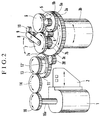
- Fig. 2 is a perspective view showing a film transport device according to a second embodiment of the invention.
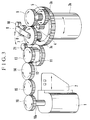
- Fig. 3 is a perspective view showing a film transport device according to a third embodiment of the invention.
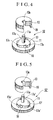
- Fig. 4 is an exploded perspective view showing a clutch part used in each of the film transport devices in the first and third embodiments.
- Fig. 5 is an exploded perspective view showing a clutch part used in the film transport device in the second embodiment.
- Fig. 6 is a perspective view showing a film transport device according to a fourth embodiment of the invention.
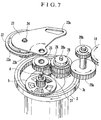
- Fig. 7 is an exploded perspective view showing a gear head part as viewed from the direction of an arrow A in Fig. 6.
- Fig. 8 is an exploded perspective view showing a clutch part in the film transport device shown in Fig. 6.
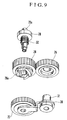
- Fig. 9 is an exploded perspective view showing also the clutch part in the film transport device shown in Fig. 6.
- Fig. 10 is a plan view showing the film transport device in Fig. 6 in the state where a film thrusting-out operation is started.
- Fig. 11 is a plan view showing the film transport device in Fig. 6 in the state where the change-over to a film rewinding operation is performed.
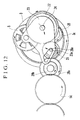
- Fig. 12 is a plan view showing the film transport device in Fig. 6 in the state where the film rewinding operation is in process.
- Fig. 1 shows in a perspective view a film transport device according to a first embodiment of the invention.
- the film transport device according to the first embodiment (also, according to other embodiments of the invention which will be described later) is used for various kinds of film using apparatuses, such as cameras, film viewers, etc.
- a film cartridge 1 is of a thrust type similar to that disclosed in U.S. Patent No. 4,832,275, U.S. Patent No. 4,834,306, etc. Specifically, as mentioned in the foregoing, the leader part of a film 2 is stowed in the cartridge 1 until use thereof, and, after the cartridge 1 is loaded into the film transport device, the film 2 is thrust out from the cartridge 1 with the cartridge spool driven to rotate.
- a take-up spool 3 is arranged to wind up thereon the film 2 thrust out from the cartridge 1.
- the take-up spool 3 is provided with a film winding part 3b the surface of which is covered with an elastic rubber material for facilitating generation of a frictional force on the film 2, and a spool gear 3a provided for obtaining a rotating force.
- a pinion gear 4 is disposed inside the take-up spool 3 and is connected directly to a motor (not shown).
- a first reduction gear 5 has a large gear part 5a which is in mesh with the pinion gear 4.
- An idler gear 6 is in mesh with a small gear part 5b of the first reduction gear 5.
- a second reduction gear 7 has a large gear part 7a which is in mesh with the idler gear 6 and a small gear part 7b which is in mesh with the spool gear 3a.
- the gears are always in mesh with one after the other, as shown in Fig. 1, and no driving change-over member such as a planet gear or the like is included. Therefore, for example, in a case where the motor is disposed inside the take-up spool 3 as shown in Fig. 1, a reduction gear train can be closely arranged only at an upper part of a spool chamber which houses the take-up spool 3 therein.
- a planetary arm 9 is mounted on the rotating shaft of the second reduction gear 7.
- a planet gear 8 which is rotatably mounted on the planetary arm 9 is in mesh with the large gear part 7a of the second reduction gear 7. Incidentally, a predetermined force of turning friction is imparted between the second reduction gear 7 and the planetary arm 9 by a spring (not shown).
- a thrust gear 11 is arranged to be always in mesh with the spool gear 3a.
- the thrust gear 11 is used as a member on the input side of a clutch part 12.
- a rewinding gear 13 is used as a member on the output side of the clutch part 12.
- a cam plate 17, which is formed integrally with the thrust gear 11, is provided with projection parts 17a formed at three positions in the peripheral part thereof.
- the rewinding gear 13, which is shown in a sectional view in Fig. 4, is integrally provided with a bowl-shaped clutch tube 19 which is arranged to rotatably house the cam plate 17 therein.
- a shaft hole part 13a of the rewinding gear 13 and the clutch tube 19 is fitted on a rotating shaft 11a which is formed integrally with the thrust gear 11 and the cam plate 17.
- Steel balls 18 are arranged between the inner wall of the clutch tube 19 and the cam plate 17.
- the thrust gear 11 and the rewinding gear 13 are connected to each other when the steel balls 18 are sandwiched in between the inner wall of the clutch tube 19 and the projection parts 17a of the cam plate 17, and are disconnected from each other when the steel balls 18 fall into recessed parts formed between the projection parts 17a, depending on a relation of rotation speed between the thrust gear 11 and the rewinding gear 13.
- an idler gear 14 is in mesh with the rewinding gear 13.
- An idler gear 15 is in mesh with the idler gear 14.
- a fork gear 16 is in mesh with the idler gear 15 and is integrally attached to a fork 16a, which engages the cartridge spool to drive the cartridge spool.
- arrows shown with full lines indicate driving directions in which the members mentioned above rotate for winding (thrusting out and taking up) the film 2.
- Arrows shown with broken lines indicate driving directions in which the members mentioned above rotate for rewinding the film 2.
- the thrust gear 11 which is in mesh with the spool gear 3a, is caused to rotate in the direction of a full-line arrow by the motor driving force received through the spool gear 3.
- the rotation of the thrust gear 11 in the full-line arrow direction causes the steel balls 18 to be pushed against the inner wall of the clutch tube 19 by the projection parts 17a of the cam plate 17, so that the clutch part 12 is brought into a connecting state to cause the thrust gear 11 and the rewinding gear 13 to rotate integrally.
- the rotation of the rewinding gear 13 is transmitted to the fork gear 16 through the idler gears 14 and 15.
- the cartridge spool which engages the fork 16a is thus driven to rotate. As a result, the film 2 is thrust out from the cartridge 1.
- the film 2 which is thrust out from the cartridge 1 reaches the film winding part 3b of the take-up spool 3, the film 2 is wound on the film winding part 3b without slackening under a pushing action of a pushing means (not shown).
- the reduction ratios of the gear trains of the film transport device are set such that a peripheral velocity of the film 2 on the surface of the take-up spool 3 is always faster than the speed at which the film 2 is being thrust out from the cartridge 1. Therefore, a portion of the film 2 wound on the take-up spool 3 causes the fork gear 16 to rotate at the faster speed in the direction of a full-line arrow.
- the fork gear 16, the idler gears 14 and 15 and the rewinding gear 13 are rotated at the faster speeds in the direction of full-line arrows.
- the friction between the inner wall of the clutch tube 19 and the steel balls 18 causes the steel balls 18 to be chased into the recessed parts formed between the projection parts 17a of the cam plate 17.
- the clutch part 12 is released from the connecting state, so that power is stopped from being transmitted from the thrust gear 11 to the rewinding gear 13. Accordingly, after that, the film 2 comes to be wound up solely by means of the tape-up spool 3.
- the thrust gear 11 and the spool gear 3a are arranged to form a last reduction stage, excluding the reduction stage of the idler gear 15 and the fork gear 16, for the film winding driving (the gears 13, 14 and 15 being arranged to make no reduction).
- the gears 13, 14 and 15 do not generate any large load when the fork gear 16 is driven by the film 2. Therefore, a load on the motor in canceling the connecting state of the clutch part 12 can be lessened.
- the change-over from the film thrusting-out driving to the film winding driving can be speedily and smoothly performed.
- the reduction gears 5, 6 and 7 and the spool gear 3a respectively rotate in the directions of broken-line arrows to cause the take-up spool 3 to rotate in the direction of a broken-line arrow.
- the rotation of the second reduction gear 7 causes the planetary arm 9 to turn away from the stopper 10, so that the planet gear 8 is brought to a position where the planet gear 8 meshes with the rewinding gear 13. Accordingly, the rotation of the second reduction gear 7 is transmitted to the rewinding gear 13 to cause the rewinding gear 13 to rotate in the direction of a broken-line arrow.
- the thrust gear 11 which is in mesh with the spool gear 3a, is caused by the driving force of the motor to rotate in the direction of a broken-line arrow.
- the rewinding gear 13 and the thrust gear 11 both receive the driving forces to be caused to rotate in the same direction across the clutch part 12.
- the reduction ratio of a part from the motor to the rewinding gear 13 (the reduction ratio of the gears 4, 5, 6, 7a, 8 and 13) is set larger than the reduction ratio of a part from the motor to the thrust gear 11 (the reduction ratio of the gears 4, 5, 6, 7, 3a and 11)
- the rewinding gear 13 always rotates slower than the thrust gear 11.
- the cam plate 17 is caused to rotate in such a direction as to bring the steel balls 18 into the recessed parts formed between the projection parts 17a of the cam plate 17. Accordingly, at the time of film rewinding driving, the clutch part 12 is always released from the connecting state. The driving force of the motor is thus transmitted to the fork gear 16 through the second reduction gear 7, the planet gear 8, the rewinding gear 13 and the idler gears 14 and 15.
- both the fork gear 16 and the take-up spool 3 are driven in the film rewinding direction.
- the rewinding speed of the film 2 on the surface of the take-up spool 3 is set always faster than the rewinding speed of the film 2 on the surface of the cartridge spool which is rotated by the fork gear 16, the film 2 is brought into a loosely coiled state within the spool chamber, so that the film 2 can be prevented from being stretched.
- the spool gear 3a is used not only as a gear to which the driving force of the motor for driving the take-up spool 3 is inputted, but also as an idle gear for transmitting the driving force of the motor to the thrust gear 11 which is arranged to input the driving force of the motor to a cartridge-spool driving system composed of gears from the rewinding gear 13 to the fork gear 16.
- This arrangement permits reduction in number of gears required in the film transport device, so that efficiency of driving force transmission to the cartridge-spool driving system can be enhanced.
- the spool gear 3a is disposed at the center of the spool chamber and is arranged to be relatively large in size. Therefore, the output of the spool gear 3a can be taken out from any direction. In other words, the setting position of the thrust gear 11 is selectable with a wide range of latitude.
- the driving action for winding the film is performed by causing the planet gear 8 to mesh with the rewinding gear 13 for power transmission. Therefore, even if the location of the rewinding gear 13 (determined by the location of the thrust gear 11) is relatively far from the second reduction gear 7 (a sun gear for the planet gear 8), the distance can be easily covered by changing the size of the planet gear 8.
- the above arrangement of the film transport device thus permits the relatively thick clutch gear train (11, 12 and 13), the planet gear train (8 and 9) and the reduction gear train (5, 6 and 7) to be closely arranged above the spool gear 3a.
- the gears 14, 15 and 16 which follow the clutch gear train (11, 12 and 13) can be arranged in a relatively thin space extending to the fork gear 16.
- the film transport device includes the clutch part 12, it can be arranged without setting any bulky gear part within a thin space available above a cartridge chamber in which the film cartridge 1 is to be placed and also within a thin space available between the cartridge chamber and the spool chamber. Therefore, wider spaces other than these thin spaces can be used for members other than the film transport device.
- the clutch gear train (11, 12 and 13), the planet gear train (8 and 9) and the reduction gear train (5, 6 and 7) can be closely arranged above the spool gear 3a, they can be formed into one unit. Such a unit can be also used in various kinds of apparatuses.
- the moving range of the planet gear 8 is limited to two positions, i.e., the position where the planet gear 8 is in mesh with the rewinding gear 13 and the position where the planet gear 8 is away from the rewinding gear 13. Therefore, compared with a case where the planet gear 8 is arranged, for example, to selectively mesh with two gears, the planet gear 8 can be arranged to have a smaller moving range.
- the first embodiment permits reduction in size of the film transport device in this respect.
- the planet gear 8 may be arranged to come to mesh, for example, with the idler gear 15 instead of with the rewinding gear 13 at the time of film rewinding.
- Such a modification can be made without difficulty as long as the clutch part 12 can be released from the connecting state for film rewinding.
- Fig. 2 shows in a perspective view a film transport device according to a second embodiment of the invention.
- the second embodiment differs from the first embodiment in that the spool gear 3a is provided with an internal gear part 3c, the small gear part 7b of the second reduction gear 7 is in mesh with the internal gear part 3c, and the thrust gear 11 is arranged to engage with the spool gear 3a (external gear part) through an idler gear 20.
- the spool gear 3a transmits the driving force of the motor to the thrust gear 11 through the idler gear 20 to cause the thrust gear 11 to rotate in the direction of a full-line arrow.
- the rotation of the second reduction gear 7 causes the planetary arm 9 to turn in such a direction as to abut on the stopper 10, so that the planet gear 8 is retracted to a position where the planet gear 8 does not mesh with any gear.
- a clutch part 12' disposed between the thrust gear 11 and the rewinding gear 13 differs from the clutch part 12 in the first embodiment (see Fig. 4), in the shape of projection parts 17a' of a cam plate 17', i.e., in the biting-in direction of the steel balls 18 into the projection parts 17a' and the clutch tube 19. More specifically, when the thrust gear 11 rotates in the direction of a full-line arrow in Fig. 2 in thrusting out the film from the cartridge, the cam plate 17', which is formed integrally with the thrust gear 11, pushes the steel balls 18 against the inner wall of the clutch tube 19.
- the clutch part 12' comes into a connecting state to cause the rewinding gear 13 to rotate at the same speed as the thrust gear 11.
- the inner wall of the clutch tube 19 chases the steel balls 18 into the recessed parts formed between the projection parts 17a' of the cam plate 17', so that the clutch part 12' is released from the connecting state.
- the winging driving of the film 2 is performed solely by means of the take-up spool 3.
- the driving force of the motor is transmitted to the spool gear 3a through the reduction gear train (5, 6 and 7) to cause the take-up spool 3 to rotate also in the direction of a broken-line arrow.
- the spool gear 3a transmits the driving force of the motor also to the thrust gear 11 through the idler gear 20 to cause the thrust gear 11 to rotate in the direction of a broken-line arrow.
- the rotation of the second reduction gear 7 causes the planetary arm 9 to turn away from the stopper 10.
- the planet gear 8 comes to mesh with the rewinding gear 13 to cause the rewinding gear 13 to rotate in the direction of a broken-line arrow.
- Both the rewinding gear 13 and the thrust gear 11 thus rotate in the same direction with the clutch part 12' interposed between them.
- the reduction ratio of a part from the motor to the rewinding gear 13 (the reduction ratio of the gears 4, 5, 6, 7a, 8 and 13) is set larger than the reduction ratio of a part from the motor to the thrust gear 11 (the reduction ratio of the gears 4, 5, 6, 7, 3a, 20 and 11). Therefore, in driving for film rewinding, the rewinding gear 13 rotates always slower than the thrust gear 11.
- the cam plate 17' then rotates in such a direction as to chase the steel balls 18 into the recessed parts formed between the projection parts 17a', thereby releasing the clutch part 12' from the connecting state at the time of driving for film rewinding.
- the driving force of the motor is transmitted to the fork gear 16 through the second reduction gear 7, the planet gear 8, the rewinding gear 13 and the idler gear 14.
- Fig. 3 shows in a perspective view a film transport device according to a third embodiment of the invention. All the component elements of the third embodiment that are in common with those of the second embodiment are indicated by the same reference numerals, and the details of them are omitted from the following description.
- the third embodiment differs from the second embodiment in that the spool gear 3a and the thrust gear 11 are arranged to intermesh directly with each other, and an idler gear 21 is interposed in between the planet gear 8 and the rewinding gear 13 which are arranged to engage with each other in driving for film rewinding.
- the spool gear 3a transmits the driving force of the motor also to the thrust gear 11 to cause the thrust gear 11 to rotate in the direction of a full-line arrow.
- the rotation of the second reduction gear 7 causes the planetary arm 9 to turn in such a direction as to abut on the stopper 10.
- the planet gear 8 is retracted to a position where the planet gear 8 does not mesh with any gear.
- the clutch part 12 disposed between the thrust gear 11 and the rewinding gear 13 is the same as the clutch part in the first embodiment (see Fig. 4).
- the thrust gear 11 rotates in the direction of a full-line arrow in Fig. 3 in thrusting out the film from the cartridge
- the cam plate 17, which is formed integrally with the thrust gear 11 pushes the steel balls against the inner wall of the clutch tube 19, so that the clutch part 12 is brought into a connecting state.
- the rewinding gear 13 thus rotates at the same speed as the thrust gear 11.
- the driving force of the motor is transmitted to the spool gear 3a through the reduction gear train (5, 6 and 7) to cause the take-up spool 3 to rotate also in the direction of a broken-line arrow.
- the spool gear 3a transmits the driving force of the motor also to the thrust gear 11 to cause the thrust gear 11 to rotate in the direction of a broken-line arrow.
- the rotation of the second reduction gear 7 causes the planetary arm 9 to turn away from the stopper 10.
- the planet gear 8 comes to engage with the rewinding gear 13 through the idler gear 21 to cause the rewinding gear 13 to rotate in the direction of a broken-line arrow.
- Both the rewinding gear 13 and the thrust gear 11 thus rotate in the same direction with the clutch part 12 interposed between them.
- the reduction ratio of a part from the motor to the rewinding gear 13 (the reduction ratio of the gears 4, 5, 6, 7a, 8, 21 and 13) is set larger than the reduction ratio of a part from the motor to the thrust gear 11 (the reduction ratio of the gears 4, 5, 6, 7, 3a and 11). Therefore, in driving for film rewinding, the rewinding gear 13 rotates always slower than the thrust gear 11.
- the cam plate 17 then rotates in such a direction as to chase the steel balls 18 into the recessed parts formed between the projection parts 17a, thereby releasing the clutch part 12 from the connecting state at the time of driving for film rewinding. In this instance, therefore, the driving force of the motor is transmitted to the fork gear 16 through the second reduction gear 7, the planet gear 8, the rewinding gear 13 and the idler gears 14 and 15.
- Fig. 6 shows in a perspective view a film transport device according to a fourth embodiment of the invention.
- Fig. 7 is an exploded perspective view showing a gear head part of the film transport device as viewed from the direction of an arrow A in Fig. 6.
- all component elements that are in common with the above-described embodiments are indicated by the same reference numerals, and the details of them are omitted from the following description.
- a pinion gear 4 is connected directly to a film transport motor (not shown).
- a reduction gear 5 has a large gear part 5a which is in mesh with the pinion gear 4.
- a planet gear 22 is arranged to have the reduction gear 5 as a sun gear and to revolve around the reduction gear 5.
- a large gear part 22a of the planet gear 22 is in mesh with a small gear part 5b of the reduction gear 5.
- a planetary plate 23 is arranged to cause a small gear part 22b of the planet gear 22 to be selectively come to mesh with the internal gear part 3c of the take-up spool 3 or with a sun gear 25.
- a planet shaft 24 is arranged to rotatably carry the planet gear 22 through a spring (not shown).
- the sun gear 25 is arranged to rotate in a fixed position where the sun gear 25 never meshes with the internal gear part 3c of the take-up spool 3.
- a planetary clutch gear 26 is arranged to be always in mesh with the sun gear 25 and a large gear part 29a of a transmission gear 29 and to turn around the sun gear 25.
- a planetary thrust gear 27 is arranged to turn around the sun gear 25 between a position where the planetary thrust gear 27 meshes with the internal gear part 3c of the take-up spool 3 and another position where the planetary thrust gear 27 does not mesh with the internal gear part 3c, while carrying out a clutching function between the planetary thrust gear 27 and the planetary clutch gear 26.
- a clutch shaft 28 acts as a rotating shaft for the planetary clutch gear 26 and the planetary thrust gear 27.
- the clutch shaft 28 has an end projection 28a which engages a cam part 23a of the planetary plate 23, so that the position of the clutch shaft 28, i.e., the revolving position of the planetary thrust gear 27, is controlled by the planetary plate 23.
- Figs. 8 and 9 are exploded perspective views showing a clutch part composed of the planetary clutch gear 26 and the planetary thrust gear 27 shown in Fig. 6.
- a sun-gear rotation sleeve 31 is caulked integrally with the planetary plate 30 and is fitted in the sun gear 25.
- the planetary clutch gear 26 is provided with slanting claw faces 26a on its lower side as shown in Fig. 9.
- the planetary thrust gear 27 is also provided with slanting claw faces 27a as shown in Fig. 8.
- the clutch shaft 28 is carried by the planetary plate 30 while compressing a coil spring 32 to push the planetary clutch gear 26 against the planetary thrust gear 27.
- Fig. 10 is a plan view showing the state of the film transport device at the time when the operation of thrusting out the film from the cartridge is started.
- the reduction gear 5 which is driven by the pinion gear 4 (not shown in Fig. 10) rotates in the direction of an arrow.
- the planet gear 22 is thus brought into a position where the planet gear 22 is held in a state of meshing with the internal gear part 3c of the take-up spool 3.
- the take-up spool 3 is caused by the planet gear 22 to rotate in the direction of an arrow, i.e., in the film winding direction.
- the internal gear part 3c of the take-up spool 3 has a large diameter, a sufficient amount of speed reduction is possible, despite the fact that there are only a few number of gear stages between the pinion gear 4 and the internal gear part 3c of the take-up spool 3.
- the end projection 28a of the clutch shaft 28 is restricted to be on the side of the internal gear part 3c of the take-up spool 3 by the action of the cam part 23a of the planetary plate 23.
- the planetary thrust gear 27 is kept in a state of meshing with the internal gear part 3c of the take-up spool 3. Since the planetary thrust gear 27 is rotated in such a direction that the slanting claw faces 27a of the planetary thrust gear 27 shown in Fig. 8 mesh with the slanting claw faces 26a of the planetary clutch gear 26, the planetary clutch gear 26 rotates integrally with the planetary thrust gear 27. The power of the planetary clutch gear 26 is thus transmitted to the large gear part 29a of the transmission gear 29.
- the planetary thrust gear 27 is arranged such that the power of the internal gear part 3c of the take-up spool 3 which is driven by the rotating force of the planet gear 22 is extracted from a different part of the internal gear part 3a and transmitted to the fork gear 16 by the planetary thrust gear 27.
- Fig. 11 shows in a plan view the state of the film transport device obtained immediately after the change-over from the film thrusting-out and winding-up operation to a film rewinding operation.
- the reduction gear 5 which receives power from the pinion gear 4 (not shown in Fig. 11), is driven in the direction of an arrow indicated by a broken line.
- the small gear part 22b of the planet gear 22 is then released from its state of meshing with the internal gear part 3c of the take-up spool 3 by the turning of the planetary plate 23 in the direction of an arrow indicated by a broken line, so that the planet gear 22 moves in such a direction as to mesh with the sun gear 25.
- Fig. 12 shows in a plan view the state of the film transport device where the film rewinding operation is in process.
- the small gear part 22b of the planet gear 22 is in mesh with the sun gear 25 to impart a turning force in the direction of a broken-line arrow.
- the planetary clutch gear 26, while receiving a force of revolving around the sun gear 25, is kept by the position restricting action of the cam part 23a of the planetary plate 23 in a position where the planetary thrust gear 27 never meshes with the internal gear part 3c of the take-up spool 3.
- a film rewinding driving force in the direction of a broken-line arrow is thus transmitted to the fork gear 16 through the sun gear 25, the planetary clutch gear 26, the transmission gear 29 and the idler gears 14 and 15. Therefore, the take-up spool 3 is allowed to rotate, free from the driving force of the motor, following a force of rewinding the film wound on the film winding part 3b. Then, the presence of the elastic member 33 (a leaf spring or the like) shown in Fig. 6 ensures that the film 2 can be transported without slackening its coiled state on the film winding part 3b of the take-up spool 3, even if the film winding operation and the film rewinding operation are repeatedly performed.
- the elastic member 33 a leaf spring or the like
- the spool gear disposed at the film take-up spool is used as an intermediate gear for transmission of a film transport driving force in each of the embodiments disclosed, the invention is not limited to the arrangement disclosed.
- the spool gear may be used as an intermediate gear for transmission of a driving force other than the film transport driving force, such as an optical system driving force.
- the invention may be carried out by combining as necessary the embodiments or their technological elements described in the foregoing.
- the invention is applicable to cameras of various kinds, such as a single-lens reflex camera and a lens-shutter type camera, and apparatuses other than cameras, such as a film viewing apparatus, a film using apparatus, a power transmission apparatus, etc.
- a power transmission device for a camera or the like or an apparatus using the power transmission device includes a spool gear disposed at a film take-up spool and an output gear that outputs a driving force transmitted to the spool gear.
Landscapes
- Physics & Mathematics (AREA)
- General Physics & Mathematics (AREA)
- Details Of Cameras Including Film Mechanisms (AREA)
- Gear Transmission (AREA)
Applications Claiming Priority (3)
| Application Number | Priority Date | Filing Date | Title |
|---|---|---|---|
| JP351529/96 | 1996-12-27 | ||
| JP35152996 | 1996-12-27 | ||
| JP35152996 | 1996-12-27 |
Publications (3)
| Publication Number | Publication Date |
|---|---|
| EP0851273A2 true EP0851273A2 (fr) | 1998-07-01 |
| EP0851273A3 EP0851273A3 (fr) | 2000-01-19 |
| EP0851273B1 EP0851273B1 (fr) | 2004-12-08 |
Family
ID=18417913
Family Applications (1)
| Application Number | Title | Priority Date | Filing Date |
|---|---|---|---|
| EP97122911A Expired - Lifetime EP0851273B1 (fr) | 1996-12-27 | 1997-12-24 | Appareil de transport de film |
Country Status (6)
| Country | Link |
|---|---|
| US (1) | US6170999B1 (fr) |
| EP (1) | EP0851273B1 (fr) |
| KR (1) | KR100261390B1 (fr) |
| CN (1) | CN1149441C (fr) |
| DE (1) | DE69731876T2 (fr) |
| TW (1) | TW367426B (fr) |
Families Citing this family (7)
| Publication number | Priority date | Publication date | Assignee | Title |
|---|---|---|---|---|
| JP2000081658A (ja) * | 1998-09-03 | 2000-03-21 | Canon Inc | フィルム給送装置およびこれを備えた光学機器 |
| JP2001099243A (ja) * | 1999-09-29 | 2001-04-10 | Canon Inc | 動力伝達装置、フィルム給送装置および光学機器 |
| KR100335500B1 (ko) * | 2000-05-16 | 2002-05-08 | 윤종용 | 직접사상 캐쉬와 완전연관 버퍼를 포함한 캐쉬 시스템의제어 방법 |
| JP5220284B2 (ja) * | 2006-05-15 | 2013-06-26 | 株式会社ハーモニック・ドライブ・システムズ | フィルム巻き取りロールの回転機構 |
| CN103718100B (zh) * | 2011-07-29 | 2018-02-16 | 罗伯特·博世有限公司 | 直线致动器和具有包括该直线致动器的机动后焦点模块的摄像机 |
| CN107477171A (zh) * | 2017-08-01 | 2017-12-15 | 梁文元 | 一种齿轮传动收放结构 |
| CN108761782A (zh) * | 2018-06-20 | 2018-11-06 | 东莞市维斗科技股份有限公司 | 一种监控镜头防尘机构 |
Family Cites Families (13)
| Publication number | Priority date | Publication date | Assignee | Title |
|---|---|---|---|---|
| JPS56132324A (en) * | 1980-03-22 | 1981-10-16 | Canon Inc | Film feeder for camera |
| US4688763A (en) | 1983-10-01 | 1987-08-25 | Nippon Kogaku K. K. | Film feeding device in a camera |
| US4832275A (en) | 1988-05-19 | 1989-05-23 | Eastman Kodak Company | Film cassette |
| JP2706489B2 (ja) | 1988-10-17 | 1998-01-28 | ウエスト電気 株式会社 | フィルム電動給送装置 |
| JP2890641B2 (ja) | 1989-10-26 | 1999-05-17 | 株式会社ニコン | 巻上げ・巻戻し装置 |
| JPH03287150A (ja) * | 1990-04-02 | 1991-12-17 | Nikon Corp | カメラのフイルム給送装置 |
| JP3110507B2 (ja) * | 1991-09-19 | 2000-11-20 | ウエスト電気株式会社 | フィルム電動巻上げ装置 |
| JP3208882B2 (ja) * | 1993-01-05 | 2001-09-17 | ミノルタ株式会社 | カメラおよび作動機構 |
| JPH07110518A (ja) * | 1993-10-14 | 1995-04-25 | Fuji Photo Optical Co Ltd | カメラ |
| JPH07175114A (ja) * | 1993-12-17 | 1995-07-14 | Olympus Optical Co Ltd | カメラのフィルム給送装置 |
| JPH0829841A (ja) * | 1994-07-15 | 1996-02-02 | Fuji Photo Optical Co Ltd | フイルム給送装置 |
| JPH08160511A (ja) * | 1994-12-02 | 1996-06-21 | Nikon Corp | フィルム給送装置 |
| US5555048A (en) * | 1995-01-20 | 1996-09-10 | Eastman Kodak Company | Dual floating gear system for a film transport mechanism |
-
1997
- 1997-12-19 US US08/994,425 patent/US6170999B1/en not_active Expired - Fee Related
- 1997-12-23 TW TW086119603A patent/TW367426B/zh not_active IP Right Cessation
- 1997-12-24 DE DE69731876T patent/DE69731876T2/de not_active Expired - Lifetime
- 1997-12-24 EP EP97122911A patent/EP0851273B1/fr not_active Expired - Lifetime
- 1997-12-26 CN CNB971232865A patent/CN1149441C/zh not_active Expired - Fee Related
- 1997-12-27 KR KR1019970074863A patent/KR100261390B1/ko not_active Expired - Fee Related
Also Published As
| Publication number | Publication date |
|---|---|
| EP0851273B1 (fr) | 2004-12-08 |
| US6170999B1 (en) | 2001-01-09 |
| DE69731876D1 (de) | 2005-01-13 |
| TW367426B (en) | 1999-08-21 |
| CN1149441C (zh) | 2004-05-12 |
| KR100261390B1 (ko) | 2000-07-01 |
| KR19980064730A (ko) | 1998-10-07 |
| CN1190749A (zh) | 1998-08-19 |
| EP0851273A3 (fr) | 2000-01-19 |
| DE69731876T2 (de) | 2005-11-24 |
Similar Documents
| Publication | Publication Date | Title |
|---|---|---|
| US5456419A (en) | Film feeder for cameras | |
| EP0851273B1 (fr) | Appareil de transport de film | |
| US5640637A (en) | Apparatus and method for moving film | |
| US6336751B1 (en) | Film feeding device, and optical apparatus including the same | |
| JPH0267535A (ja) | カメラ及びフィルム送り装置 | |
| US6361224B1 (en) | Film transport device and camera | |
| JPS6242489B2 (fr) | ||
| US5576784A (en) | Film transport device of camera | |
| US5138352A (en) | Camera | |
| JPH0267534A (ja) | カメラのフイルム給送装置 | |
| JPH09236854A (ja) | カメラの駆動切換機構 | |
| KR0184952B1 (ko) | 어드밴스트 포토 시스템 카메라의 필름 와인딩/리와인딩 메카니즘 | |
| JPH09281569A (ja) | カメラ | |
| JPH10239743A (ja) | カメラ等の動力伝達装置及びこれを用いた装置 | |
| US6276845B1 (en) | Power transmission mechanism | |
| JP3431345B2 (ja) | カメラ | |
| US6418816B1 (en) | Power transmission device | |
| JP3853870B2 (ja) | 駆動力伝達機構 | |
| JP2633350B2 (ja) | 切換クラッチ機構およびこの機構を使用したフィルム電動給送装置 | |
| JP2001066679A (ja) | フィルム給送装置およびこれを備えた光学機器 | |
| JPH0733221Y2 (ja) | カメラの画面間隔保持機構 | |
| US6125241A (en) | Camera | |
| JP2879752B2 (ja) | カメラ及びフィルム送り装置 | |
| JPH0289038A (ja) | カメラにおけるフィルムのオートローディング装置 | |
| JPH09230452A (ja) | カメラのフィルム給送機構 |
Legal Events
| Date | Code | Title | Description |
|---|---|---|---|
| PUAI | Public reference made under article 153(3) epc to a published international application that has entered the european phase |
Free format text: ORIGINAL CODE: 0009012 |
|
| AK | Designated contracting states |
Kind code of ref document: A2 Designated state(s): DE FR GB |
|
| AX | Request for extension of the european patent |
Free format text: AL;LT;LV;MK;RO;SI |
|
| PUAL | Search report despatched |
Free format text: ORIGINAL CODE: 0009013 |
|
| AK | Designated contracting states |
Kind code of ref document: A3 Designated state(s): AT BE CH DE DK ES FI FR GB GR IE IT LI LU MC NL PT SE |
|
| AX | Request for extension of the european patent |
Free format text: AL;LT;LV;MK;RO;SI |
|
| 17P | Request for examination filed |
Effective date: 20000531 |
|
| AKX | Designation fees paid |
Free format text: DE FR GB |
|
| 17Q | First examination report despatched |
Effective date: 20030821 |
|
| GRAP | Despatch of communication of intention to grant a patent |
Free format text: ORIGINAL CODE: EPIDOSNIGR1 |
|
| RTI1 | Title (correction) |
Free format text: FILM TRANSPORT APPARATUS |
|
| GRAS | Grant fee paid |
Free format text: ORIGINAL CODE: EPIDOSNIGR3 |
|
| GRAA | (expected) grant |
Free format text: ORIGINAL CODE: 0009210 |
|
| AK | Designated contracting states |
Kind code of ref document: B1 Designated state(s): DE FR GB |
|
| REG | Reference to a national code |
Ref country code: GB Ref legal event code: FG4D |
|
| REF | Corresponds to: |
Ref document number: 69731876 Country of ref document: DE Date of ref document: 20050113 Kind code of ref document: P |
|
| ET | Fr: translation filed | ||
| PLBE | No opposition filed within time limit |
Free format text: ORIGINAL CODE: 0009261 |
|
| STAA | Information on the status of an ep patent application or granted ep patent |
Free format text: STATUS: NO OPPOSITION FILED WITHIN TIME LIMIT |
|
| 26N | No opposition filed |
Effective date: 20050909 |
|
| PGFP | Annual fee paid to national office [announced via postgrant information from national office to epo] |
Ref country code: GB Payment date: 20101223 Year of fee payment: 14 |
|
| PGFP | Annual fee paid to national office [announced via postgrant information from national office to epo] |
Ref country code: DE Payment date: 20101231 Year of fee payment: 14 |
|
| PGFP | Annual fee paid to national office [announced via postgrant information from national office to epo] |
Ref country code: FR Payment date: 20120103 Year of fee payment: 15 |
|
| GBPC | Gb: european patent ceased through non-payment of renewal fee |
Effective date: 20121224 |
|
| REG | Reference to a national code |
Ref country code: FR Ref legal event code: ST Effective date: 20130830 |
|
| PG25 | Lapsed in a contracting state [announced via postgrant information from national office to epo] |
Ref country code: DE Free format text: LAPSE BECAUSE OF NON-PAYMENT OF DUE FEES Effective date: 20130702 |
|
| REG | Reference to a national code |
Ref country code: DE Ref legal event code: R119 Ref document number: 69731876 Country of ref document: DE Effective date: 20130702 |
|
| PG25 | Lapsed in a contracting state [announced via postgrant information from national office to epo] |
Ref country code: FR Free format text: LAPSE BECAUSE OF NON-PAYMENT OF DUE FEES Effective date: 20130102 Ref country code: GB Free format text: LAPSE BECAUSE OF NON-PAYMENT OF DUE FEES Effective date: 20121224 |