EP0854504A1 - Solutions de revêtement pour utilisation dans la formation de films minces ferroélectriques contenant du bismuth, et films minces ferroélectriques, condensateurs ferroélectrique et mémoires ferroélectriques formées avec ces solutions de revêtements ainsi que des procédés pour leur production - Google Patents
Solutions de revêtement pour utilisation dans la formation de films minces ferroélectriques contenant du bismuth, et films minces ferroélectriques, condensateurs ferroélectrique et mémoires ferroélectriques formées avec ces solutions de revêtements ainsi que des procédés pour leur production Download PDFInfo
- Publication number
- EP0854504A1 EP0854504A1 EP98100704A EP98100704A EP0854504A1 EP 0854504 A1 EP0854504 A1 EP 0854504A1 EP 98100704 A EP98100704 A EP 98100704A EP 98100704 A EP98100704 A EP 98100704A EP 0854504 A1 EP0854504 A1 EP 0854504A1
- Authority
- EP
- European Patent Office
- Prior art keywords
- coating solution
- metallic element
- ferroelectric thin
- forming
- thin films
- Prior art date
- Legal status (The legal status is an assumption and is not a legal conclusion. Google has not performed a legal analysis and makes no representation as to the accuracy of the status listed.)
- Ceased
Links
Images




Classifications
-
- H—ELECTRICITY
- H10—SEMICONDUCTOR DEVICES; ELECTRIC SOLID-STATE DEVICES NOT OTHERWISE PROVIDED FOR
- H10P—GENERIC PROCESSES OR APPARATUS FOR THE MANUFACTURE OR TREATMENT OF DEVICES COVERED BY CLASS H10
- H10P14/00—Formation of materials, e.g. in the shape of layers or pillars
- H10P14/60—Formation of materials, e.g. in the shape of layers or pillars of insulating materials
- H10P14/69—Inorganic materials
- H10P14/692—Inorganic materials composed of oxides, glassy oxides or oxide-based glasses
- H10P14/6938—Inorganic materials composed of oxides, glassy oxides or oxide-based glasses the material containing at least one metal element, e.g. metal oxides, metal oxynitrides or metal oxycarbides
- H10P14/69398—Inorganic materials composed of oxides, glassy oxides or oxide-based glasses the material containing at least one metal element, e.g. metal oxides, metal oxynitrides or metal oxycarbides the material having a perovskite structure, e.g. BaTiO3
-
- C—CHEMISTRY; METALLURGY
- C01—INORGANIC CHEMISTRY
- C01G—COMPOUNDS CONTAINING METALS NOT COVERED BY SUBCLASSES C01D OR C01F
- C01G33/00—Compounds of niobium
- C01G33/006—Compounds containing niobium, with or without oxygen or hydrogen, and containing two or more other elements
-
- C—CHEMISTRY; METALLURGY
- C01—INORGANIC CHEMISTRY
- C01G—COMPOUNDS CONTAINING METALS NOT COVERED BY SUBCLASSES C01D OR C01F
- C01G35/00—Compounds of tantalum
- C01G35/006—Compounds containing tantalum, with or without oxygen or hydrogen, and containing two or more other elements
-
- C—CHEMISTRY; METALLURGY
- C23—COATING METALLIC MATERIAL; COATING MATERIAL WITH METALLIC MATERIAL; CHEMICAL SURFACE TREATMENT; DIFFUSION TREATMENT OF METALLIC MATERIAL; COATING BY VACUUM EVAPORATION, BY SPUTTERING, BY ION IMPLANTATION OR BY CHEMICAL VAPOUR DEPOSITION, IN GENERAL; INHIBITING CORROSION OF METALLIC MATERIAL OR INCRUSTATION IN GENERAL
- C23C—COATING METALLIC MATERIAL; COATING MATERIAL WITH METALLIC MATERIAL; SURFACE TREATMENT OF METALLIC MATERIAL BY DIFFUSION INTO THE SURFACE, BY CHEMICAL CONVERSION OR SUBSTITUTION; COATING BY VACUUM EVAPORATION, BY SPUTTERING, BY ION IMPLANTATION OR BY CHEMICAL VAPOUR DEPOSITION, IN GENERAL
- C23C16/00—Chemical coating by decomposition of gaseous compounds, without leaving reaction products of surface material in the coating, i.e. chemical vapour deposition [CVD] processes
- C23C16/22—Chemical coating by decomposition of gaseous compounds, without leaving reaction products of surface material in the coating, i.e. chemical vapour deposition [CVD] processes characterised by the deposition of inorganic material, other than metallic material
- C23C16/30—Deposition of compounds, mixtures or solid solutions, e.g. borides, carbides, nitrides
- C23C16/40—Oxides
-
- C—CHEMISTRY; METALLURGY
- C23—COATING METALLIC MATERIAL; COATING MATERIAL WITH METALLIC MATERIAL; CHEMICAL SURFACE TREATMENT; DIFFUSION TREATMENT OF METALLIC MATERIAL; COATING BY VACUUM EVAPORATION, BY SPUTTERING, BY ION IMPLANTATION OR BY CHEMICAL VAPOUR DEPOSITION, IN GENERAL; INHIBITING CORROSION OF METALLIC MATERIAL OR INCRUSTATION IN GENERAL
- C23C—COATING METALLIC MATERIAL; COATING MATERIAL WITH METALLIC MATERIAL; SURFACE TREATMENT OF METALLIC MATERIAL BY DIFFUSION INTO THE SURFACE, BY CHEMICAL CONVERSION OR SUBSTITUTION; COATING BY VACUUM EVAPORATION, BY SPUTTERING, BY ION IMPLANTATION OR BY CHEMICAL VAPOUR DEPOSITION, IN GENERAL
- C23C16/00—Chemical coating by decomposition of gaseous compounds, without leaving reaction products of surface material in the coating, i.e. chemical vapour deposition [CVD] processes
- C23C16/44—Chemical coating by decomposition of gaseous compounds, without leaving reaction products of surface material in the coating, i.e. chemical vapour deposition [CVD] processes characterised by the method of coating
- C23C16/448—Chemical coating by decomposition of gaseous compounds, without leaving reaction products of surface material in the coating, i.e. chemical vapour deposition [CVD] processes characterised by the method of coating characterised by the method used for generating reactive gas streams, e.g. by evaporation or sublimation of precursor materials
-
- H—ELECTRICITY
- H10—SEMICONDUCTOR DEVICES; ELECTRIC SOLID-STATE DEVICES NOT OTHERWISE PROVIDED FOR
- H10D—INORGANIC ELECTRIC SEMICONDUCTOR DEVICES
- H10D1/00—Resistors, capacitors or inductors
- H10D1/60—Capacitors
- H10D1/68—Capacitors having no potential barriers
- H10D1/682—Capacitors having no potential barriers having dielectrics comprising perovskite structures
-
- C—CHEMISTRY; METALLURGY
- C01—INORGANIC CHEMISTRY
- C01P—INDEXING SCHEME RELATING TO STRUCTURAL AND PHYSICAL ASPECTS OF SOLID INORGANIC COMPOUNDS
- C01P2002/00—Crystal-structural characteristics
- C01P2002/70—Crystal-structural characteristics defined by measured X-ray, neutron or electron diffraction data
- C01P2002/72—Crystal-structural characteristics defined by measured X-ray, neutron or electron diffraction data by d-values or two theta-values, e.g. as X-ray diagram
-
- C—CHEMISTRY; METALLURGY
- C01—INORGANIC CHEMISTRY
- C01P—INDEXING SCHEME RELATING TO STRUCTURAL AND PHYSICAL ASPECTS OF SOLID INORGANIC COMPOUNDS
- C01P2002/00—Crystal-structural characteristics
- C01P2002/80—Crystal-structural characteristics defined by measured data other than those specified in group C01P2002/70
- C01P2002/85—Crystal-structural characteristics defined by measured data other than those specified in group C01P2002/70 by XPS, EDX or EDAX data
-
- C—CHEMISTRY; METALLURGY
- C01—INORGANIC CHEMISTRY
- C01P—INDEXING SCHEME RELATING TO STRUCTURAL AND PHYSICAL ASPECTS OF SOLID INORGANIC COMPOUNDS
- C01P2004/00—Particle morphology
- C01P2004/80—Particles consisting of a mixture of two or more inorganic phases
-
- C—CHEMISTRY; METALLURGY
- C01—INORGANIC CHEMISTRY
- C01P—INDEXING SCHEME RELATING TO STRUCTURAL AND PHYSICAL ASPECTS OF SOLID INORGANIC COMPOUNDS
- C01P2006/00—Physical properties of inorganic compounds
- C01P2006/40—Electric properties
-
- H—ELECTRICITY
- H10—SEMICONDUCTOR DEVICES; ELECTRIC SOLID-STATE DEVICES NOT OTHERWISE PROVIDED FOR
- H10P—GENERIC PROCESSES OR APPARATUS FOR THE MANUFACTURE OR TREATMENT OF DEVICES COVERED BY CLASS H10
- H10P14/00—Formation of materials, e.g. in the shape of layers or pillars
- H10P14/60—Formation of materials, e.g. in the shape of layers or pillars of insulating materials
- H10P14/63—Formation of materials, e.g. in the shape of layers or pillars of insulating materials characterised by the formation processes
- H10P14/6326—Deposition processes
- H10P14/6342—Liquid deposition, e.g. spin-coating, sol-gel techniques or spray coating
Definitions
- the present invention relates to coating solutions for use in forming Bi-based ferroelectric thin films, and ferroelectric thin films, ferroelectric capacitors and ferroelectric memories formed with said coating solutions, as well as processes for production thereof. More particularly, the invention relates to coating solutions that lead to only a small amount of separation (segregation, precipitation) of excessive metallic elements' particles, little leakage current, are excellent in hydrogen heat treatment resistance as well as voltage resistance, are capable of forming dense Bi-based ferroelectric thin films, and have good keeping quality. The invention also relates to ferroelectric thin films, ferroelectric capacitors and ferroelectric memories formed with such coating solutions, as well as processes for the production thereof.
- BLSF bismuth layer-structured ferroelectrics
- A is a mono-, di- or trivalent ion (as of Bi, Pb, Ba, Sr, Ca, Na, K or a rare earth element) or combinations of these ions
- B is a tetra-, penta- or hexavalent ion (as of a metallic element like Ti, Nb, Ta, W, Mo, Fe, Co or Cr) or combinations of these ions
- m is an integer of 1-5] have recently been found to feature good characteristics such as requiring small coercive field in remanent polarization P-E hysteresis curves and hence experiencing less fatigue as a result of repeated polarization switching.
- Such BLSF thin films can be formed by various methods including sputtering, CVD and coated film formation.
- sputtering and CVD techniques require costly apparatus and considerable difficulties are involved in controlling the composition of ferroelectric thin films at desired levels; hence, these techniques are not suitable for practical applications, particularly on large-diameter substrates.
- the coated film formation technique does not need expensive apparatus and can deposit films at relatively low cost; in addition, they provide ease in controlling the composition of ferroelectric thin films at desired levels. Therefore, the coated film process for the formation of BLSF thin films holds much promise for commercial use.
- the 2-ethylhexanate of the respective metal components has a long-chain (C 8 ) organic group, so a large portion of the coating solution is occupied by the organic content and there is much loss in the coating weight due to the burning out of the organic content in the process of film formation consisting of the application of the coating solution, baking of the applied coating and crystallization and a porous film will result.
- the surface morphology of the coating film is not satisfactory enough to provide for easy application to the fabrication of VLSI devices.
- the applied coating has to be annealed twice at an elevated temperature of 800oC to ensure appropriate electrical characteristics thereof, however, this is problematic from the viewpoint of semiconductor fabrication process.
- RTP Rapid Thermal Processing
- the prior art coating solutions have further problems.
- the long-chained metal carboxylates (metallic soaps) of monobasic acids which are commonly used in the coating solutions are generally slightly soluble in polar solvents and, hence, aromatic solvents such as xylene and toluene are used to prepare the coating solutions.
- aromatic solvents such as xylene and toluene
- the coating solutions using such aromatic solvents have to be stored in glass or metallic containers in order to ensure that the evaporating solvents will not be lost to the ambient atmosphere.
- glass and metallic containers have the disadvantage that metallic components will dissolve out into the coating solution and this is by no means desirable in the art of semiconductor fabrication which hates the contamination with metallic impurities.
- polyethylene or polypropylene containers which release only negligible amounts of contaminating metallic impurities, which can be protected against mechanical shocks by simple handling procedures and which are less costly and it is desired to use solvents that will leak out of the plastic containers in negligibly small amounts.
- ferroelectric memory It is the common practice to form a ferroelectric memory by providing a lower electrode/a ferroelectric thin film/an upper electrode on a substrate, and in the preceding or subsequent step of the following aluminum wiring step, form a protective film of SiO 2 or the like (passivation) on the upper electrode.
- PZT Pt/PZT/Pt using Pb(Zr, Ti)O 3
- This film breakage is caused by the presence of atomic-state hydrogen having a high reducibility and reduction of the PZT ferroelectric film, which is an oxide film, by the heat treatment.
- a ferroelectric film other than a PZT a similar film breakage is considered to occur particularly when using Pt for the upper electrode.
- hydrophilicity of a ferroelectric thin film means deterioration resistance of a ferroelectric thin film against hydrogen having a high reducibility, which occurs during formation of an SiO 2 passivation film or upon sintering treatment after formation of an aluminum wiring.
- An object of the present invention is therefore to provide a coating solution that contains an organometallic compound soluble in practical organic solvents, that leads to little leakage current, is excellent in hydrogen heat treatment resistance and voltage resistance and is capable of forming dense Bi-based ferroelectric thin films, that has good keeping quality and that ensures highly reproducible results in coating operations.
- Another object of the invention is to provide Bi-based ferroelectric thin films using the coating solution.
- Yet another object of the invention is to provide a ferroelectric capacitor and a ferroelectric memory using the coating solution, particularly to provide Bi-based ferroelectric thin films, a ferroelectric capacitor and a ferroelectric memory permitting inhibition of separation (segregation) of metallic elements such as Bi in the formation of a film by the RTP method.
- any of the conventional BLSF-based coating solutions is prepared by only mixing metal carboxylates, metal alkoxide compounds and the like in an organic solvent. This forms a factor causing occurrence of burnout of metallic elements and a burning loss of organic constituents in large quantities during the baking (annealing) step and causing segregation of some metallic elements such as Bi at grain boundaries, thereby causing a decrease in film forming density, an increase in leakage current and reduction of hydrogen heat treatment resistance and voltage resistance.
- the present invention relates to a coating solution for use in forming Bi-based ferroelectric thin film containing Bi, metallic element A (which is at least one metallic element selected from the group consisting of Bi, Pb, Ba, Sr, Ca, Na, K and rare earth elements) and metallic element B (which is at least one metallic element selected from the group consisting of Ti, Nb, Ta, W, Mo, Fe, Co and Cr), wherein it contains metal alkoxides of Bi, metallic element A (A as defined hereabove) and metallic element B (B as defined hereabove) respectively, and an organometallic compound obtainable by hydrolyzing composite metal alkoxides, formed by any two or more of said metal alkoxides, with water alone or in combination with a catalyst, and contains Bi in a molar amount 1-1.1 times as great as the stoichiometric amount.
- metallic element A which is at least one metallic element selected from the group consisting of Bi, Pb, Ba, Sr, Ca, Na, K and rare earth elements
- the invention relates to a ferroelectric thin film formed by applying the foregoing coating solution onto an electrode on a substrate, optionally exposing the applied coating to a humidified atmosphere and then baking(annealing) the coating.
- the invention further relates to a ferroelectric capacitor having an electrode formed on the above-mentioned ferroelectric thin film.
- the invention relates to a ferroelectric memory using the aforesaid capacitor.
- the invention relates to a process producing a ferroelectric thin film by the steps of:
- the invention relates to a process for producing a ferroelectric capacitor by the steps of:
- a saturated or unsaturated hydrocarbon group having 1-6 carbon atoms refers to a group with 1-6 carbon atoms that comprises carbon and hydrogen atoms in the presence of single or unsaturated carbon-carbon bonds.
- the "hydrocarbon group” to be used in the invention is either an aromatic or an aliphatic hydrocarbon group but aliphatic hydrocarbon groups are preferred, with alkyl group being particularly preferred.
- alkyl group having 1-6 carbon atoms may be either straight-chained or branched and is exemplified by methyl, ethyl, propyl, i-propyl, butyl, t-butyl, pentyl, neopentyl and hexyl groups.
- alkoxyl group having 1-6 carbon atoms may be either straight-chained or branched and is exemplified by methoxy, ethoxy, propoxy, i-propoxy, butoxy, t-butoxy and neopentoxy groups.
- the coating solution for use in forming Bi-based ferroelectric thin films of the invention contains Bi, metallic element A (which is at least one metallic element selected from the group consisting of Bi, Pb, Ba, Sr, Ca, Na, K and rare earth elements) and metallic element B (which is at least one metallic element selected from the group consisting of Ti, Nb, Ta, W, Mo, Fe, Co and Cr), which further contains metal alkoxides of Bi, metallic element A (A as defined hereabove) and metallic element B (B as defined hereabove), and an organometallic compound available by hydrolyzing a composite metal alkoxide formed by any two or more of said metal alkoxides, with water alone or in combination with a catalyst, and contains Bi in a molar amount 1 - 1.1 times as great as the stoichiometric amount.
- metallic element A which is at least one metallic element selected from the group consisting of Bi, Pb, Ba, Sr, Ca, Na, K and rare earth elements
- metallic element B which is at least one
- organometallic compounds are preferably contained therein, that are obtainable by (1) reacting the composite metal alkoxides with a stabilizer, followed by hydrolyzing them with water alone or in combination with a catalyst; or (2) hydrolyzing the composite metal alkoxides with water alone or in combination with the catalyst, followed by reacting them with the stabilizer.
- organometallic compounds especially the compounds obtained by (1) above, may further be reacted with the stabilizer.
- the stabilizer mentioned above should preferably be at least one selected from the group consisting of carboxylic anhydrides, dicarboxylic acid monoesters, ⁇ -diketones and glycols.
- the composite metal alkoxides in the present invention include composite metal alkoxides comprising at least two different metal alkoxides selected from the group consisting of metallic element A, metallic element B and Bi.
- composite metal alkoxides comprising at least two different metal alkoxides selected from the group consisting of metallic element A, metallic element B and Bi.
- a composite metal alkoxide as used in the invention is a compound obtainable by refluxing different metal alkoxides in a solvent at a temperature within a range of from 30 to 100oC for about 2 to 15 hours. Toward the end of reaction, the liquid is gradually discolored to finally become a brown liquid. The time point when the liquid has completely been discolored as described above may be regarded as the end point of reaction.
- the composite metal alkoxide thus obtained is considered to be one defined in the "Manufacturing Method of Glass Ceramics by Sol-Gel Process and Applications" (Applied Tech. Pub. Co., June 4, 1989), pp.
- ABi(OR 1 ) m (OR 2 ) 3 , BBi(OR 3 ) n (OR 2 ) 3 , or ABBi(OR 1 ) m (OR 3 ) n (OR 2 ) 3 are composite compounds of Bi are preferably used in order to inhibit separation (segregation) of Bi that is believed to have a particularly high sublimation.
- the metal alkoxides and the composite metal alkoxides are formed from alcohols which are preferably represented by the general formula (VI): R 8 OH where R 8 is a saturated or unsaturated hydrocarbon group having 1-6 carbon atoms.
- R 8 is a saturated or unsaturated hydrocarbon group having 1-6 carbon atoms.
- Specific examples of such alcohols include methanol, ethanol, propanol, butanol, amyl alcohol and cyclohexanol.
- alcohols in which hydrogen atoms in R 8 are substituted by alkoxyl groups of 1-6 carbon atoms may also be used and specific examples include methoxymethanol, methoxyethanol, ethoxymethanol and ethoxyethanol.
- the coating solution of the invention contains organometallic compounds obtainable by hydrolyzing the foregoing composite metal alkoxides with water alone or in combination with a catalyst.
- part of the alkoxyl groups may be substituted with carboxylic anhydride, dicarboxylic acid monoester, ⁇ -diketone or glycol described later.
- any catalysts such as metal alkoxides that are known in the art of hydrolysis may be employed and exemplary catalysts include acid catalysts such as inorganic acids including, for example, hydrochloric acid, sulfuric acid and nitric acid; and organic acids such as acetic acid, propionic acid and butyric acid; and inorganic or organic alkali catalysts such as sodium hydroxide, potassium hydroxide, ammonia, monoethanolamine, diethanolamine and tetramethylammonium hydroxide.
- an acid catalyst because, for inorganic alkali catalysts such as sodium hydroxide and potassium hydroxide, metallic ions of sodium and potassium may remain in the coating solution and therefore may exert an adverse effect on the electric properties of the film, and for nitrogen-containing alkali catalysts such as ammonia and amine, a high-boiling-point nitride compound may be formed after hydrolysis and may exert an adverse effect on densification of the film during baking (annealing).
- Hydrolysis may also be performed by exposing the surface of the as-applied coating on an electrode to a humidified atmosphere at a temperature of about 50-120oC for about 10-60 minutes at a humidity of about 50-100%.
- the conditions of hydrolytic reaction are in no way limited to those set forth above and they may be selected as appropriate for the specific use of the coating.
- the hydrolytic treatment is effective in not only reducing the organic content of the dried coating but also forming metaloxane bonds of metallic elements, and hence, the separation (segregation) of Bi and other metallic elements, as well as the loss of the organic content due to burning, can be suppressed.
- the reason would be as follows:
- Each of the organometallic compounds has respective organic groups in its structure.
- Hydrolytic treatment causes elimination of organic groups such as alkoxyl groups and thereby metalloxane bonds can be made of a higher inorganic property.
- the eliminated organic groups are to be low-boiling-point alcohols and glycols. Those alcohols and glycohols remain in the coating solution or the film, however, are evaporated together with the solvent in the drying step.
- inorganic property of the film becomes higher before submitted to annealing process, thereby a dense film may be formed.
- the composite metal compounds and the metalloxane bonds are attributed to strengthen binding of the metallic elements, and therefore separation (segregation) and burning off of metallic elements such as Bi, and increase of a leakage current can be suppressed. This makes it possible to form a film having little leakage current and is excellent in hydrogen heat treatment resistance and voltage resistance.
- Organometallic compounds which are preferably contained in the solution for forming Bi-based ferroelectric thin films of the invention, are optionally obtainable by (1) reacting the composite metal alkoxides with a stabilizer, and then hydrolyzing them with water alone or in combination with a catalyst, or (2) hydrolyzing the composite metal alkoxides with water alone or in combination with the catalyst, and then reacting them with a stabilizer.
- the above-mentioned stabilizer is for improving the keeping stability of the coating solution, and in the invention, at least one selected from the group consisting of carboxylic anhydrides, dicarboxylic acid monoesters, ⁇ -diketones, and glycols is preferably employed.
- carboxylic anhydrides at least one compound is preferably used as selected from among the carboxylic anhydrides represented by the general formula (II): R 1 (CO) 2 O where R 1 is a divalent saturated or unsaturated hydrocarbon group having 1-6 carbon atoms.
- R 1 is a divalent saturated or unsaturated hydrocarbon group having 1-6 carbon atoms.
- Specific example of the carboxylic anhydrides that can be used in the invention include maleic anhydride, citraconic anhydride, itaconic anhydride, succinic anhydride, methylsuccinic anhydride, glutaric anhydride, ⁇ -methylglutaric anhydride, ⁇ , ⁇ -dimethylglutaric anhydride and trimethylsuccinic anhydride.
- At least one compound is preferably used as dicarboxylic acid monoesters as selected from among the dicarboxylic acid monoesters represented by the general formula (III): R 2 OCOR 3 COOH where R 2 is a saturated or unsaturated hydrocarbon group having 1-6 carbon atoms; R 3 is a divalent saturated or unsaturated hydrocarbon group having 1-6 carbon atoms.
- Such dicarboxylic acid monoesters may be half esters prepared by reacting dibasic carboxylic acids with alcohols.
- dibasic carboxylic acids are oxalic acid, malonic acid, succinic acid, glutaric acid, adipic acid, pimelic acid, suberic acid, azelaic acid, sebacic acid, maleic acid, citraconic acid, itaconic acid, methylsuccinic acid, ⁇ -methylglutaric acid, ⁇ , ⁇ -dimethylglutaric acid and trimethylglutaric acid; at least one of these dibasic acids may be esterified with at least one alcohol as selected from among methyl alcohol, ethyl alcohol, propyl alcohol, butyl alcohol, amyl alcohol, hexyl alcohol, ethylene glycol monomethyl ether, propylene glycol monomethyl ether, etc., by known methods.
- At least one compound is preferably used as ⁇ -diketones as selected from among the ⁇ -diketones including the ⁇ -ketoesters represented by the general formula (IV): R 4 COCR 5 HCOR 6 where R 4 is a saturated or unsaturated hydrocarbon group having 1-6 carbon atoms; R 5 is H or CH 3 ; and R 6 is an alkyl or alkoxy group having 1-6 carbon atoms.
- ⁇ -diketones to be used in the invention include acetylacetone, 3-methyl-2,4-pentanedione and benzoylacetone.
- exemplary ⁇ -ketoesters include ethyl acetoacetate and diethyl malonate.
- complex formers may of course be employed; however, dipivaloylmethane and THF adducts thereof, as well as complex formers such as hexafluoroacetylacetone that form metal halides after annealing are not suitable for use in the production of the coating solution of the invention since they form highly sublimable or volatile metal complexes.
- At least one compound is preferably used as glycols as selected from among the glycols represented by the general formula (V): HOR 7 OH where R 7 is a divalent saturated or unsaturated hydrocarbon group having 1-6 carbon atoms.
- the stabilisers mentioned above are preferably be short-chained ones having 1-6 carbon atoms in order to enhance the polarity of the metal compounds and inorganic property of the film after the drying step.
- the BLSF-based coating solution of the invention contains in advance Bi in a molar amount in excess of the stoichiometric amount, i.e., in a molar amount 1 - 1.1 times as great as the stoichiometric amount, taking account of the burnout loss of Bi during formation of the BLSF thin film.
- the term "stoichiometric amount” as used herein means the number of moles of each metallic element of the BLSF thin film as expressed by a theoretical formula (Bi 2 O 2 ) 2+ (A m-1 B m O 3m+1 ) 2- [where A represents any of mono-, di- and trivalent ions (e.g., Bi, Pb, Ba, Sr, Ca, Na, K and rare earth elements) and combinations thereof; B is any of tetra-, penta- and hexavalent ions (e.g., metallic elements such as Ti, Nb, Ta, W, Mo, Fe, Co and Cr) and combinations thereof; and m is an integer of 1-5].
- A represents any of mono-, di- and trivalent ions (e.g., Bi, Pb, Ba, Sr, Ca, Na, K and rare earth elements) and combinations thereof
- B is any of tetra-, penta- and hexavalent ions (e.g., metallic elements such as Ti,
- Composite metal alkoxide and the hydrolytic treatment make it possible to form a BLSF thin film whose percentage composition is closest to that of metallic elements in the coating solution.
- the coating solution of the invention is produced by dissolving one of those reaction products (organometallic compounds) in organic solvents having oxygen atoms in the molecules thereof.
- organic solvents include alcohols, polyhydric alcohols, ethers, ketones, esters and lower carboxylic acids.
- Exemplary alcoholic solvents include methanol, ethanol, propanol, butanol, amyl alcohol, cyclohexanol and methyl cyclohexanol.
- Exemplary polyhydric alcohol-based solvents include ethylene glycol monomethyl ether, ethylene glycol monoacetate, diethylene glycol monomethyl ether, diethylene glycol monoacetate, propylene glycol monoethyl ether, propylene glycol monoacetate, dipropylene glycol monoethyl ether and methoxybutanol.
- Exemplary ether-based solvents include methylal, diethyl ether, dipropyl ether, dibutyl ether, diamyl ether, diethyl acetal, dihexyl ether, trioxane and dioxane.
- Exemplary ketone-based solvents include acetone, methyl ethyl ketone, methyl propyl ketone, methyl isobutyl ketone, methyl amyl ketone, methyl cyclohexyl ketone, diethyl ketone, ethyl butyl ketone, trimethyl nonanone, acetonitrile acetone, dimethyl oxide, phorone, cyclohexanone and diacetone alcohol.
- ester based solvents include ethyl formate, methyl acetate, ethyl acetate, butyl acetate, cyclohexyl acetate, methyl propionate, ethyl butyrate, ethyl oxoisobutyrate, ethyl acetoacetate, ethyl lactate, methoxybutyl acetate, diethyl oxalate and diethyl malonate.
- Exemplary lower carboxylic acid-based solvents include acetic acid, propionic acid, butyric acid, and valeric acid.
- reaction of these solvents, particularly alcoholic solvents, may partially be done with the metallic compounds.
- the solvents listed above may be used either singly or in admixture.
- organometallic compounds of the invention are also highly soluble in aromatic hydrocarbon-based solvents; however, as already mentioned, these solvents are not preferred since they are subject to increasingly rigorous regulations on the methods of their use and management.
- the selection of the most preferred solvent depends on specific coating conditions such as those of open spin coating, closed spin coating, liquid source misted chemical vapor deposition (LSM-CVD) and dip coating.
- specific coating conditions such as those of open spin coating, closed spin coating, liquid source misted chemical vapor deposition (LSM-CVD) and dip coating.
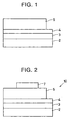
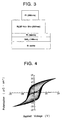
- a substrate 2 such as an Si wafer is first oxidized to form an Si oxide layer 3 which is overlaid with a lower electrode 4 that is formed from a metal such as Pt, Ir, Ru, Re or Os or a conductive metal oxide thereof by a known technique such as sputtering or vapor deposition.
- the lower electrode 4 is then coated with the coating solution of the invention by a known technique such as spin coating or dip coating and the applied coating is dried at a temperature of 50-200°C, followed by prebaking at a temperature of 200-700°C.
- the process from the application of the coating solution to the prebaking of the dried coating is repeated several times until a desired film thickness is attained.
- the hydrolytic reaction When the hydrolytic reaction is caused in a humidified atmosphere, it may be done, prior to the aforesaid prebaking, at a humidity of 50-100%, or preferably, 70-100%, and at a temperature of 50-120°C for 10-60 minutes.
- annealing is performed at a temperature of about 700-900°C in an oxygen atmosphere to form a crystalline ferroelectric thin film 5.
- the annealing step may be performed by any suitable method such as furnace process in which the temperature is raised from room temperature to the annealing temperature at a rate of about 5-20°C/min, followed by annealing at that temperature for about 30-80 minutes, or a rapid thermal processing(RTP) method in which the temperature is raised from room temperature to the annealing temperature at a rate of about 50-150°C/sec, followed by annealing at that temperature for about 0.5-3 minutes.
- RTP rapid thermal processing
- the thus prepared ferroelectric thin film 5 is overlaid with an electrode (upper electrode) 7, which may be formed of the metals or conductive metal oxides that have been listed in connection with the formation of the lower electrode 4; these materials are deposited on the ferroelectric thin film 5 by any known technique such as sputtering or vapor deposition and annealing (secondary annealing), as required, in an oxygen atmosphere to fabricate a ferroelectric capacitor 10.
- an electrode upper electrode
- annealing secondary annealing
- the secondary annealing which is usually performed at a temperature of about 800-900°C, may be carried out at a lower temperature of about 700°C in the present invention, and even in this case, a satisfactory hysteresis curve is available.
- the upper electrode 7 may be formed of a material different from that of the lower electrode 4; for instance, Ir may be used to make the lower electrode 4 whereas Ru may be used to make the upper electrode 7.
- leakage current could be inhibited and properties as a ferroelectric capacitor such as crystallinity, hydrogen heat treatment resistance and voltage resistance could be improved by the inhibition of separation (segregation) and burnout of metallic elements through enhancement of bonds between metallic elements as a result of achievement of the inorganicity by the formation of composite compounds and hydrolysis.
- properties as a ferroelectric capacitor such as crystallinity, hydrogen heat treatment resistance and voltage resistance could be improved by the inhibition of separation (segregation) and burnout of metallic elements through enhancement of bonds between metallic elements as a result of achievement of the inorganicity by the formation of composite compounds and hydrolysis.
- a satisfactory hysteresis curve is available even when raising the applied voltage by about 18 V.
- a protective film of SiO 2 or the like is formed (passivation) and an aluminum wiring is formed.
- passivation a protective film of SiO 2 or the like is formed (passivation) and an aluminum wiring is formed.
- the excellent hydrogen heat treatment resistance it is not necessary to worry about the risk of deterioration of ferroelectric properties upon forming the passivation film and upon sintering the aluminum wiring, and it became possible to apply the ferroelectric capacitor using the BLSF film to practical uses.
- the as-applied coating on the substrate may be exposed to a humidified atmosphere for a certain period preceding the annealing step in forming a coating film as described above and by so doing, hydrolytic polycondensation will proceed to render the coating sufficiently inorganic to form a dense film.
- An excessive hydrolytic treatment in the coating solution may potentially increase the viscosity of the coating solution gel or change its properties with time.
- the above-mentioned hydrolytic treatment of the as-applied coating prior to annealing in a forming a coating film is effective in order to avoid these possibilities.
- Bi, and metallic elements A and B in the coating solution for use in forming a Bi-based ferroelectric thin film are variable with the site and conditions of the application of the coating solution.
- appropriate formulations can be selected depending upon various conditions such as the type of the device to which the invention is to be applied (e.g., FRAM, DRAM, MFS, MFIS or MFMIS), the type of upper and lower electrodes to be used, their thickness, combinations of the two electrodes, the type of barrier layer, its thickness, and the presence or absence of a seed layer (orientation layer).
- the contents of individual organometallic compounds, the type and amount of residual alkoxy group, the proportion of the carbonyl group to be incorporated, the degree of complex formation, the degree of hydrolysis, the degree of polycondensation and the degree of composite alkoxylation can be selected in many ways depending upon various factors such as the use of the coating solution of the invention and the conditions under which it is to be employed (e.g., temperature, time, atmosphere and the method of temperature elevation which are to be adopted in the drying and annealing steps). Therefore, the following examples of the invention are intended to describe just a few embodiments among the many fields of application of the invention and should in no way be taken as limiting.
- a “ 1Tr - 1C " DRAM having a memory cell which comprises a transistor and a capacitor is now most commonly used. In the following examples, therefore, experiments were carried out by means of a ferroelectric capacitor used in such a DRAM to evaluate properties of a ferroelectric memory.
- a 12 wt% solution was prepared by diluting a part of the foregoing composite metal alkoxide solution a with MC.
- An MC solution containing H 2 O in a molar amount two times as great as a mole of the composite alkoxide contained in the solution was dropped and the resultant solution was stirred at 25°C for two hours to synthesize a coating solution 1 for forming a Bi-based ferroelectric thin film, having a concentration of 10 wt%.
- the resultant solution was left to cool until the temperature decreased to 25°C, thereby giving a solution of a concentration of 15 wt%.
- an MC solution containing propylene glycol in an amount in moles equal to that of the composite metal alkoxide contained in the solution was added.
- the mixture was stirred at 25°C for an hour into a solution having a concentration of 12 wt%.
- an MC solution containing H 2 O in a molar amount two times as great as mole of the composite metal alkoxide contained in the solution was dropped, and the resultant mixed solution was stirred at 25°C for two hours, thereby synthesizing a coating solution 2 for forming a Bi-based ferroelectric thin film, having a concentration of 10 wt%.
- a coating solution 3 for forming a Bi-based ferroelectric thin film having a concentration of 10 wt% was synthesized in the same manner as in Synthesis Example 2 except that maleic anhydride was used in place of ethyl acetoacetate and propylene glycol was not employed.
- a coating solution 4 for forming a Bi-based ferroelectric thin film having a concentration of 10 wt% was synthesized in the same manner as in Synthesis Example 2 except that the amount of H 2 O using for hydrolysis was changed in a molar amount from two times to four times as great as mole of the composite metal alkoxide.
- an MC solution containing propylene glycol in a molar amount equal to a mole of the composite metal alkoxide contained in that solution was added.
- the resultant mixed solution was stirred at 25°C for an hour, giving a solution having a concentration of 12 wt%.
- an MC solution containing H 2 O in a molar amount two times as great as a mole of the composite metal alkoxide contained in that solution was dropped, and the resultant solution was stirred at 25°C for two hours, thereby synthesizing a coating solution 5 for forming a Bi-based ferroelectric thin film, having a concentration of 10 wt%.
- the molar ratio was adjusted by dropping the second solution into the first solution to achieve Sr:Bi:Ta of 0.9 : 2.1 : 2.0.
- an MC solution containing propylene glycol in a molar amount equal to a mole of the composite metal alkoxide contained in the above solution was added, and the resultant solution was stirred at 25°C for an hour, thereby giving a solution having a concentration of 12 wt%.
- an MC solution containing H 2 O in a molar amount two times as great as a mole of the composite metal alkoxide contained in that solution was dropped, and the solution was stirred at 25°C for two hours, thereby synthesizing a coating solution 6 for forming a Bi-based ferroelectric thin film, having a concentration of 10 wt%.
- an MC solution containing propylene glycol in a molar amount equal to a mole of the composite metal alkoxide contained in the solution was added, and the resultant solution was stirred at 25°C for an hour, thereby giving a solution having a concentration of 12 wt%.
- an MC solution containing H 2 O in a molar amount two times as great as a mole of the composite metal alkoxide contained in that solution was dropped, and the solution was stirred at 25°C for two hours, thereby synthesizing a coating solution 7 for forming a Bi-based ferroelectric thin film, having a concentration of 10 wt%.
- a coating solution 11 for forming a Bi-based ferroelectric thin film, having a concentration of 10 wt% was synthesized in the same manner as in Synthesis Example 2 except that Sr(OC 2 H 4 OCH 3 ) 2 was changed to Sr(O-isoC 3 H 7 ) 2 .
- a Pt lower electrode having a thickness of 60 nm was formed by sputtering on a silicon wafer having a diameter of 6 inches and having a 100 nm-thick thermo-oxidized Si0 2 film formed thereon.
- coating solutions 1 to 10 obtained in the foregoing Synthesis Examples and comparative coating solutions 1 and 2 obtained in Comparative Synthesis Examples were coated onto the aforesaid Pt lower electrode by means of a spin coater at 500 rpm for five seconds and then at 2,000 rpm for 30 seconds. After drying at 150°C for 30 minutes, prebaking was conducted at 650°C for 30 minutes. The foregoing operations from coating to prebaking were repeated ten times. After that, a temperature was elevated in an oxygen atmosphere from 25°C to 800°C at a heating rate of 10°C/minute. Subsequently, annealing (primary annealing) was applied in the oxygen atmosphere at 800°C for 60 minutes, thereby forming ferroelectric thin films having a thickness of 300 nm.
- annealing primary annealing
- Example 11 a 300 nm-thick ferroelectric thin film was formed in the same manner as above except that, using the coating solution 11, the prebaking temperature was changed from 650°C to 450°C and the primary annealing temperature, from 800°C to 700°C.
- the Bi content in crystallized particles present in a thin film and the Bi content between crystallized particles (grain boundaries) in the foregoing ferroelectric thin films were analyzed by the energy dispersive X-ray spectroscopy (EDX).
- EDX energy dispersive X-ray spectroscopy
- a Pt upper electrode having a diameter of 0.2 mm and a thickness of 200 nm was then formed on the aforesaid ferroelectric thin film via a metal mask by sputtering, and annealing (secondary annealing) was applied in an oxygen atmosphere at 800°C for 30 minutes, thereby preparing a ferroelectric capacitor.
- the secondary annealing was carried out at 700°C in place of 800°C.
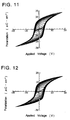
- a configuration is shown in Fig. 3.
- the ferroelectric capacitors formed with the coating solutions 1 to 11 exhibited satisfactory hysteresis curves with a high square ratio at an applied voltage within a range of from 2 to 18 V. Even at an applied voltage of 18 V, these capacitors showed a good hysteresis characteristic with a satisfactory voltage resistance. Particularly in Example 11, a satisfactory hysteresis curve was obtained although both the primary annealing and the secondary annealing were carried out at a low temperature of 700°C. The results are shown in Figs. 4 to 14. Figs. 4 to 13 respectively correspond to Examples using the coating solutions 1 to 10 (Examples 1 to 10). Fig. 14 illustrates hysteresis curves at an applied voltage of 10 V in the ferroelectric capacitors prepared in Examples 2 and 11.
- the mark o ⁇ represents a value of density under 10 -7 ; ⁇ , from 10 -7 to under 10 -6 ; ⁇ , from 10 -6 to under 10 -5 ; and X, 10 -5 and over.
- the results are shown in Table 1.
- a ferroelectric capacitor formed with the coating solution 4 was subjected to a heat treatment in an atmosphere comprising 10% hydrogen and 90% nitrogen at 400°C for 15 minutes.
- a hysteresis curve at an applied voltage of 2 to 18 V is shown in Fig. 19.
- the ferroelectric capacitor formed by the use of the coating solution 4 containing Bi in a molar amount 1.05 times as great as the stoichiometric amount and subjected to a hydrolysis is resistant to the reducing action exerted by the heat treatment in a hydrogen atmosphere, and the film is almost completely free from deterioration.
- the coating solution 2 and the comparative coating solution 2 were evaluated for the above Examples and Comparative Examples in the same manner as above except that the heating rate of the primary annealing was changed from 10°C/min to 125°C/sec, and the annealing time from 60 minutes to a minute.
- the ferroelectric capacitor formed with the use of the coating solution 2 showed a satisfactory hysteresis curve with a high square ratio at an applied voltage of 2 to 18 V. Even at an applied voltage of 18 V, it exhibited a hysteresis property, suggesting a good voltage resistance.
- the results are shown in Fig. 17.
- a coating solution for forming a Bi-based ferroelectric thin film which is capable of forming a dense film hardly suffering separation of excessive particles of metallic elements, giving little leakage current, and excellent in hydrogen heat treatment resistance and voltage resistance, with a high keeping stability.
- this coating solution it is possible to form a ferroelectric thin film, a ferroelectric capacitor and a ferroelectric memory at a low cost, with improved film density and surface morphology.
Landscapes
- Chemical & Material Sciences (AREA)
- Organic Chemistry (AREA)
- Inorganic Chemistry (AREA)
- Materials Engineering (AREA)
- Chemical Kinetics & Catalysis (AREA)
- Engineering & Computer Science (AREA)
- General Chemical & Material Sciences (AREA)
- Mechanical Engineering (AREA)
- Metallurgy (AREA)
- Semiconductor Memories (AREA)
- Inorganic Compounds Of Heavy Metals (AREA)
- Formation Of Insulating Films (AREA)
- Oxygen, Ozone, And Oxides In General (AREA)
- Inorganic Insulating Materials (AREA)
Applications Claiming Priority (4)
| Application Number | Priority Date | Filing Date | Title |
|---|---|---|---|
| JP19834/97 | 1997-01-18 | ||
| JP1983497 | 1997-01-18 | ||
| JP185872/97 | 1997-06-26 | ||
| JP09185872A JP3108039B2 (ja) | 1997-01-18 | 1997-06-26 | Bi系強誘電体薄膜形成用塗布液およびこれを用いて形成した強誘電体薄膜、強誘電体メモリ |
Publications (1)
| Publication Number | Publication Date |
|---|---|
| EP0854504A1 true EP0854504A1 (fr) | 1998-07-22 |
Family
ID=26356695
Family Applications (1)
| Application Number | Title | Priority Date | Filing Date |
|---|---|---|---|
| EP98100704A Ceased EP0854504A1 (fr) | 1997-01-18 | 1998-01-16 | Solutions de revêtement pour utilisation dans la formation de films minces ferroélectriques contenant du bismuth, et films minces ferroélectriques, condensateurs ferroélectrique et mémoires ferroélectriques formées avec ces solutions de revêtements ainsi que des procédés pour leur production |
Country Status (5)
| Country | Link |
|---|---|
| US (2) | US6197102B1 (fr) |
| EP (1) | EP0854504A1 (fr) |
| JP (1) | JP3108039B2 (fr) |
| KR (1) | KR100327291B1 (fr) |
| TW (1) | TW381273B (fr) |
Cited By (2)
| Publication number | Priority date | Publication date | Assignee | Title |
|---|---|---|---|---|
| WO2000077832A3 (fr) * | 1999-06-10 | 2001-09-07 | Symetrix Corp | Fines couches d'oxydes metalliques pour applications a constante dielectrique elevee |
| US6495878B1 (en) | 1999-08-02 | 2002-12-17 | Symetrix Corporation | Interlayer oxide containing thin films for high dielectric constant application |
Families Citing this family (13)
| Publication number | Priority date | Publication date | Assignee | Title |
|---|---|---|---|---|
| KR100393486B1 (ko) * | 2000-09-08 | 2003-08-06 | 학교법인 포항공과대학교 | 솔 코팅법에 의한 란탄함유 티탄산 비스무스 박막의 경제적인 제조방법 |
| KR100416760B1 (ko) * | 2001-03-12 | 2004-01-31 | 삼성전자주식회사 | 졸겔공정을 이용한 지르콘산-티탄산 납 후막의 제조방법 |
| US6437380B1 (en) * | 2001-03-28 | 2002-08-20 | Symetrix Corporation | Ferroelectric device with bismuth tantalate capping layer and method of making same |
| US7205056B2 (en) * | 2001-06-13 | 2007-04-17 | Seiko Epson Corporation | Ceramic film and method of manufacturing the same, ferroelectric capacitor, semiconductor device, and other element |
| KR20030042482A (ko) * | 2001-11-22 | 2003-06-02 | (주) 디엔에프솔루션 | 비스무스 란타늄 티타네이트 강유전체막 형성용 용액 |
| KR20030042483A (ko) * | 2001-11-22 | 2003-06-02 | (주) 디엔에프솔루션 | 납 마그네슘 니오베이트/납 티타네이트 강유전체막 형성용용액 |
| JP4828451B2 (ja) * | 2006-03-27 | 2011-11-30 | 東京エレクトロン株式会社 | 基板処理方法、半導体装置の製造方法および基板処理装置 |
| JP5080816B2 (ja) * | 2007-01-09 | 2012-11-21 | 株式会社Adeka | 塗布液組成物および該塗布液組成物を用いる金属酸化物膜の製造方法 |
| US8007989B1 (en) | 2008-04-11 | 2011-08-30 | The United States Of America As Represented By The Secretary Of The Navy | Method and solution for forming a patterned ferroelectric layer on a substrate |
| JP5845866B2 (ja) * | 2011-12-07 | 2016-01-20 | 富士通セミコンダクター株式会社 | 半導体装置の製造方法 |
| CN104160456B (zh) * | 2012-03-02 | 2016-10-26 | 独立行政法人科学技术振兴机构 | 导电性膜的形成方法 |
| US9871044B2 (en) * | 2015-11-06 | 2018-01-16 | Micron Technology, Inc. | Enhanced charge storage materials, related semiconductor memory cells and semiconductor devices, and related systems and methods |
| CN117304714A (zh) * | 2022-06-29 | 2023-12-29 | 佳能株式会社 | 溶胶液,混合液,涂覆膜,制备溶胶液的方法和制备涂覆膜的方法 |
Citations (8)
| Publication number | Priority date | Publication date | Assignee | Title |
|---|---|---|---|---|
| JPS6186423A (ja) * | 1984-10-04 | 1986-05-01 | Mitsubishi Mining & Cement Co Ltd | ビスマス複酸化物の製造方法 |
| US5196388A (en) * | 1991-06-10 | 1993-03-23 | Akzo N.V. | Process for the preparation of double metal oxide powders containing a Group IIIA and a Group IVB element and a novel double metal hydroxyl carboxylate useful in preparing same |
| JPH05136471A (ja) * | 1991-11-14 | 1993-06-01 | Rohm Co Ltd | 強誘電体薄膜微細パターン形成方法 |
| US5271797A (en) * | 1991-10-28 | 1993-12-21 | Rohm Co., Ltd. | Method for patterning metal oxide thin film |
| WO1994010084A1 (fr) * | 1992-10-23 | 1994-05-11 | Symetrix Corporation | Precurseurs et procedes de fabrication d'oxydes de metaux |
| WO1996030938A2 (fr) * | 1995-03-17 | 1996-10-03 | Symetrix Corporation | Procede de fabrication de materiaux a structure heterarchique en couches et de realisation de dispositifs electroniques comprenant de tels materiaux |
| WO1996041375A1 (fr) * | 1995-06-07 | 1996-12-19 | Symetrix Corporation | Circuit integre comportant un substrat et une couche de cablage separes par une couche intermediaire |
| US5627013A (en) * | 1991-11-14 | 1997-05-06 | Rohm Co., Ltd. | Method of forming a fine pattern of ferroelectric film |
Family Cites Families (8)
| Publication number | Priority date | Publication date | Assignee | Title |
|---|---|---|---|---|
| CA1217927A (fr) | 1983-04-15 | 1987-02-17 | Tsutomu Nanao | Materiau composite inorganique, et sa preparation |
| JPH05298920A (ja) | 1992-04-23 | 1993-11-12 | Mitsubishi Electric Corp | 高誘電体薄膜 |
| JP2783158B2 (ja) | 1994-05-26 | 1998-08-06 | 富士ゼロックス株式会社 | 酸化物薄膜の製造方法 |
| JP3007795B2 (ja) * | 1994-06-16 | 2000-02-07 | シャープ株式会社 | 複合金属酸化物誘電体薄膜の製造方法 |
| JPH0891841A (ja) | 1994-09-27 | 1996-04-09 | Sharp Corp | 強誘電体膜の製造方法 |
| JP3120701B2 (ja) | 1995-02-15 | 2000-12-25 | 三菱マテリアル株式会社 | 金属酸化物薄膜パターン形成用組成物及びその製造方法、金属酸化物薄膜パターンの形成方法並びに電子部品及び光学部品の製造方法 |
| JPH0977592A (ja) | 1995-09-14 | 1997-03-25 | Kojundo Chem Lab Co Ltd | ビスマス層状強誘電体薄膜の製造方法 |
| JP3195265B2 (ja) * | 1997-01-18 | 2001-08-06 | 東京応化工業株式会社 | Bi系強誘電体薄膜形成用塗布液およびこれを用いて形成した強誘電体薄膜、強誘電体メモリ |
-
1997
- 1997-06-26 JP JP09185872A patent/JP3108039B2/ja not_active Expired - Fee Related
- 1997-12-17 TW TW086119097A patent/TW381273B/zh not_active IP Right Cessation
- 1997-12-29 KR KR1019970076814A patent/KR100327291B1/ko not_active Expired - Fee Related
-
1998
- 1998-01-15 US US09/008,245 patent/US6197102B1/en not_active Expired - Fee Related
- 1998-01-16 EP EP98100704A patent/EP0854504A1/fr not_active Ceased
-
2000
- 2000-12-27 US US09/748,160 patent/US6528172B2/en not_active Expired - Fee Related
Patent Citations (8)
| Publication number | Priority date | Publication date | Assignee | Title |
|---|---|---|---|---|
| JPS6186423A (ja) * | 1984-10-04 | 1986-05-01 | Mitsubishi Mining & Cement Co Ltd | ビスマス複酸化物の製造方法 |
| US5196388A (en) * | 1991-06-10 | 1993-03-23 | Akzo N.V. | Process for the preparation of double metal oxide powders containing a Group IIIA and a Group IVB element and a novel double metal hydroxyl carboxylate useful in preparing same |
| US5271797A (en) * | 1991-10-28 | 1993-12-21 | Rohm Co., Ltd. | Method for patterning metal oxide thin film |
| JPH05136471A (ja) * | 1991-11-14 | 1993-06-01 | Rohm Co Ltd | 強誘電体薄膜微細パターン形成方法 |
| US5627013A (en) * | 1991-11-14 | 1997-05-06 | Rohm Co., Ltd. | Method of forming a fine pattern of ferroelectric film |
| WO1994010084A1 (fr) * | 1992-10-23 | 1994-05-11 | Symetrix Corporation | Precurseurs et procedes de fabrication d'oxydes de metaux |
| WO1996030938A2 (fr) * | 1995-03-17 | 1996-10-03 | Symetrix Corporation | Procede de fabrication de materiaux a structure heterarchique en couches et de realisation de dispositifs electroniques comprenant de tels materiaux |
| WO1996041375A1 (fr) * | 1995-06-07 | 1996-12-19 | Symetrix Corporation | Circuit integre comportant un substrat et une couche de cablage separes par une couche intermediaire |
Non-Patent Citations (1)
| Title |
|---|
| PATENT ABSTRACTS OF JAPAN vol. 017, no. 518 (E - 1434) 17 September 1993 (1993-09-17) * |
Cited By (4)
| Publication number | Priority date | Publication date | Assignee | Title |
|---|---|---|---|---|
| WO2000077832A3 (fr) * | 1999-06-10 | 2001-09-07 | Symetrix Corp | Fines couches d'oxydes metalliques pour applications a constante dielectrique elevee |
| US6495878B1 (en) | 1999-08-02 | 2002-12-17 | Symetrix Corporation | Interlayer oxide containing thin films for high dielectric constant application |
| US6541279B2 (en) | 1999-08-02 | 2003-04-01 | Symetrix Corporation | Method for forming an integrated circuit |
| US6867452B2 (en) | 1999-08-02 | 2005-03-15 | Symetrix Corporation | Interlayer oxide containing thin films for high dielectric constant application of the formula AB2O6 or AB2O7 |
Also Published As
| Publication number | Publication date |
|---|---|
| KR100327291B1 (ko) | 2002-04-17 |
| US6197102B1 (en) | 2001-03-06 |
| JP3108039B2 (ja) | 2000-11-13 |
| TW381273B (en) | 2000-02-01 |
| JPH10259007A (ja) | 1998-09-29 |
| US6528172B2 (en) | 2003-03-04 |
| KR19980070256A (ko) | 1998-10-26 |
| US20010010867A1 (en) | 2001-08-02 |
Similar Documents
| Publication | Publication Date | Title |
|---|---|---|
| US6120912A (en) | Coating solutions for use in forming bismuth-based ferroelectric thin films, and ferroelectric thin films, ferroelectric capacitors and ferroelectric memories formed with said coating solutions, as well as processes for production thereof | |
| US6197102B1 (en) | Coating solutions for use in forming bismuth-based ferroelectric thin films, and ferroelectric thin films, ferroelectric capacitors and ferroelectric memories formed with said coating solutions, as well as processes for production thereof | |
| JP3113281B2 (ja) | 金属酸化物の前駆体と製造方法 | |
| CN1179232A (zh) | 具有混合层状超点阵材料的集成电路及用于制备该电路的前体溶液 | |
| US5811153A (en) | Coating solutions for use in forming bismuth-based dielectric thin films, and dielectric thin films and memories formed with said coating solutions, as well as processes for production thereof | |
| EP1434259A1 (fr) | Couche mince ferro-électrique et méthode pour sa production | |
| US6582972B1 (en) | Low temperature oxidizing method of making a layered superlattice material | |
| US20040055509A1 (en) | Coating solutions for use in forming bismuth-based ferroelectric thin films and a method of forming bismuth-based ferroelectric thin films using the coating solutions | |
| JP2000332209A (ja) | Bi系強誘電体素子の製造方法 | |
| US5788757A (en) | Composition and process using ester solvents for fabricating metal oxide films and electronic devices including the same | |
| JP2005255468A (ja) | 常誘電性あるいは強誘電性のBi系誘電体薄膜形成用塗布液、およびBi系誘電体薄膜 | |
| JP4329288B2 (ja) | Blt又はbt強誘電体薄膜、その形成用組成物及び形成方法 | |
| US20070062414A1 (en) | Coating solutions for use in forming bismuth-based ferroelectric thin films and a method of forming bismuth-based ferroelectric thin films using the coating solutions | |
| JP2002211929A (ja) | Bi系強誘電体薄膜の形成方法 | |
| JP2001110237A (ja) | 強誘電体薄膜形成用塗布液、その製造方法及び強誘電体薄膜 | |
| JP2005285847A (ja) | Bi系強誘電体薄膜の形成方法、およびBi系強誘電体薄膜形成用塗布液の調製方法 | |
| JP2002193616A (ja) | 強誘電体薄膜形成用塗布液、その製造方法および強誘電体薄膜 | |
| JP2001089146A (ja) | c軸方向への結晶の成長が抑制されたBi系強誘電体薄膜の形成方法およびBi系強誘電体薄膜 | |
| JP2002100626A (ja) | 強誘電体薄膜形成用塗布液及びそれを用いて作製した強誘電体薄膜 | |
| JP2003063825A (ja) | 強誘電体薄膜形成用塗布液、その製造方法および強誘電体薄膜 | |
| JP2001316117A (ja) | Bi系強誘電体薄膜形成用塗布液およびこれを用いたBi系強誘電体薄膜の形成方法 |
Legal Events
| Date | Code | Title | Description |
|---|---|---|---|
| PUAI | Public reference made under article 153(3) epc to a published international application that has entered the european phase |
Free format text: ORIGINAL CODE: 0009012 |
|
| AK | Designated contracting states |
Kind code of ref document: A1 Designated state(s): DE FR GB IT NL |
|
| AX | Request for extension of the european patent |
Free format text: AL;LT;LV;MK;RO;SI |
|
| 17P | Request for examination filed |
Effective date: 19981020 |
|
| AKX | Designation fees paid |
Free format text: DE FR GB IT NL |
|
| RBV | Designated contracting states (corrected) |
Designated state(s): DE FR GB IT NL |
|
| 17Q | First examination report despatched |
Effective date: 20031217 |
|
| STAA | Information on the status of an ep patent application or granted ep patent |
Free format text: STATUS: THE APPLICATION HAS BEEN REFUSED |
|
| 18R | Application refused |
Effective date: 20140420 |