EP0857199B1 - Procede de cristallisation de matieres grasses et installation pour la mise en oeuvre de ce procede - Google Patents
Procede de cristallisation de matieres grasses et installation pour la mise en oeuvre de ce procede Download PDFInfo
- Publication number
- EP0857199B1 EP0857199B1 EP96932397A EP96932397A EP0857199B1 EP 0857199 B1 EP0857199 B1 EP 0857199B1 EP 96932397 A EP96932397 A EP 96932397A EP 96932397 A EP96932397 A EP 96932397A EP 0857199 B1 EP0857199 B1 EP 0857199B1
- Authority
- EP
- European Patent Office
- Prior art keywords
- beads
- aqueous solution
- fatty substance
- process according
- mixture
- Prior art date
- Legal status (The legal status is an assumption and is not a legal conclusion. Google has not performed a legal analysis and makes no representation as to the accuracy of the status listed.)
- Expired - Lifetime
Links
- 238000000034 method Methods 0.000 title claims abstract description 55
- 238000002425 crystallisation Methods 0.000 title claims abstract description 23
- 239000011324 bead Substances 0.000 claims abstract description 78
- 239000007864 aqueous solution Substances 0.000 claims abstract description 74
- 239000000203 mixture Substances 0.000 claims abstract description 54
- 239000000243 solution Substances 0.000 claims abstract description 36
- 238000001914 filtration Methods 0.000 claims abstract description 13
- 239000007788 liquid Substances 0.000 claims abstract description 10
- 238000002844 melting Methods 0.000 claims abstract description 10
- 230000008018 melting Effects 0.000 claims abstract description 10
- 238000005194 fractionation Methods 0.000 claims abstract description 6
- 239000000126 substance Substances 0.000 claims abstract 47
- 239000003925 fat Substances 0.000 claims description 78
- 235000019197 fats Nutrition 0.000 claims description 78
- 239000012528 membrane Substances 0.000 claims description 10
- 239000000725 suspension Substances 0.000 claims description 10
- 235000014113 dietary fatty acids Nutrition 0.000 claims description 9
- 229930195729 fatty acid Natural products 0.000 claims description 9
- 239000000194 fatty acid Substances 0.000 claims description 9
- 150000004665 fatty acids Chemical class 0.000 claims description 9
- 239000002253 acid Substances 0.000 claims description 7
- XLYOFNOQVPJJNP-UHFFFAOYSA-N water Substances O XLYOFNOQVPJJNP-UHFFFAOYSA-N 0.000 claims description 7
- KRKNYBCHXYNGOX-UHFFFAOYSA-N citric acid Chemical compound OC(=O)CC(O)(C(O)=O)CC(O)=O KRKNYBCHXYNGOX-UHFFFAOYSA-N 0.000 claims description 6
- 239000004094 surface-active agent Substances 0.000 claims description 6
- 238000005192 partition Methods 0.000 claims description 4
- 238000007711 solidification Methods 0.000 claims description 4
- 230000008023 solidification Effects 0.000 claims description 4
- 235000019860 lauric fat Nutrition 0.000 claims description 3
- 238000007127 saponification reaction Methods 0.000 claims description 3
- 238000005054 agglomeration Methods 0.000 claims description 2
- 230000002776 aggregation Effects 0.000 claims description 2
- 125000000129 anionic group Chemical group 0.000 claims description 2
- 125000002091 cationic group Chemical group 0.000 claims description 2
- 239000003995 emulsifying agent Substances 0.000 claims description 2
- 235000021588 free fatty acids Nutrition 0.000 claims description 2
- 230000003064 anti-oxidating effect Effects 0.000 claims 1
- 239000012809 cooling fluid Substances 0.000 claims 1
- 210000003414 extremity Anatomy 0.000 claims 1
- 230000004907 flux Effects 0.000 claims 1
- 210000001364 upper extremity Anatomy 0.000 claims 1
- 230000008025 crystallization Effects 0.000 abstract description 17
- 239000004519 grease Substances 0.000 description 26
- 241000209504 Poaceae Species 0.000 description 9
- 230000006641 stabilisation Effects 0.000 description 9
- 239000000047 product Substances 0.000 description 7
- 238000011105 stabilization Methods 0.000 description 7
- 238000009434 installation Methods 0.000 description 6
- 229940110456 cocoa butter Drugs 0.000 description 4
- 235000019868 cocoa butter Nutrition 0.000 description 4
- 238000005086 pumping Methods 0.000 description 4
- 239000007787 solid Substances 0.000 description 4
- 239000002904 solvent Substances 0.000 description 4
- ZCYVEMRRCGMTRW-UHFFFAOYSA-N 7553-56-2 Chemical compound [I] ZCYVEMRRCGMTRW-UHFFFAOYSA-N 0.000 description 3
- CSCPPACGZOOCGX-UHFFFAOYSA-N Acetone Chemical compound CC(C)=O CSCPPACGZOOCGX-UHFFFAOYSA-N 0.000 description 3
- 235000017858 Laurus nobilis Nutrition 0.000 description 3
- DNIAPMSPPWPWGF-UHFFFAOYSA-N Propylene glycol Chemical compound CC(O)CO DNIAPMSPPWPWGF-UHFFFAOYSA-N 0.000 description 3
- 235000005212 Terminalia tomentosa Nutrition 0.000 description 3
- 238000005056 compaction Methods 0.000 description 3
- 239000012530 fluid Substances 0.000 description 3
- 229910052740 iodine Inorganic materials 0.000 description 3
- 239000011630 iodine Substances 0.000 description 3
- 239000003921 oil Substances 0.000 description 3
- 235000019198 oils Nutrition 0.000 description 3
- 244000147568 Laurus nobilis Species 0.000 description 2
- 244000299461 Theobroma cacao Species 0.000 description 2
- 235000010724 Wisteria floribunda Nutrition 0.000 description 2
- 150000007513 acids Chemical class 0.000 description 2
- 238000007664 blowing Methods 0.000 description 2
- 238000005119 centrifugation Methods 0.000 description 2
- 239000002826 coolant Substances 0.000 description 2
- 238000001816 cooling Methods 0.000 description 2
- 239000013078 crystal Substances 0.000 description 2
- 230000035784 germination Effects 0.000 description 2
- 238000004519 manufacturing process Methods 0.000 description 2
- 238000011085 pressure filtration Methods 0.000 description 2
- 238000011084 recovery Methods 0.000 description 2
- 239000003507 refrigerant Substances 0.000 description 2
- 238000000926 separation method Methods 0.000 description 2
- 238000006467 substitution reaction Methods 0.000 description 2
- 244000144725 Amygdalus communis Species 0.000 description 1
- 235000004936 Bromus mango Nutrition 0.000 description 1
- 241000219992 Cuphea Species 0.000 description 1
- 241000218195 Lauraceae Species 0.000 description 1
- 240000007228 Mangifera indica Species 0.000 description 1
- 235000014826 Mangifera indica Nutrition 0.000 description 1
- 235000014643 Orbignya martiana Nutrition 0.000 description 1
- 244000021150 Orbignya martiana Species 0.000 description 1
- 235000015076 Shorea robusta Nutrition 0.000 description 1
- 235000009184 Spondias indica Nutrition 0.000 description 1
- 235000009470 Theobroma cacao Nutrition 0.000 description 1
- 235000018936 Vitellaria paradoxa Nutrition 0.000 description 1
- 238000013019 agitation Methods 0.000 description 1
- 235000020224 almond Nutrition 0.000 description 1
- 230000003078 antioxidant effect Effects 0.000 description 1
- 230000001174 ascending effect Effects 0.000 description 1
- 230000015572 biosynthetic process Effects 0.000 description 1
- 235000014121 butter Nutrition 0.000 description 1
- 239000003795 chemical substances by application Substances 0.000 description 1
- 235000019219 chocolate Nutrition 0.000 description 1
- 235000019864 coconut oil Nutrition 0.000 description 1
- 239000003240 coconut oil Substances 0.000 description 1
- 230000006835 compression Effects 0.000 description 1
- 238000007906 compression Methods 0.000 description 1
- 235000009508 confectionery Nutrition 0.000 description 1
- 238000010908 decantation Methods 0.000 description 1
- 238000001704 evaporation Methods 0.000 description 1
- 230000008020 evaporation Effects 0.000 description 1
- 235000013861 fat-free Nutrition 0.000 description 1
- 239000000706 filtrate Substances 0.000 description 1
- 235000013305 food Nutrition 0.000 description 1
- 230000004927 fusion Effects 0.000 description 1
- 238000002156 mixing Methods 0.000 description 1
- 238000012986 modification Methods 0.000 description 1
- 230000004048 modification Effects 0.000 description 1
- 235000014571 nuts Nutrition 0.000 description 1
- 239000000546 pharmaceutical excipient Substances 0.000 description 1
- 238000004064 recycling Methods 0.000 description 1
- 238000005057 refrigeration Methods 0.000 description 1
- 239000011343 solid material Substances 0.000 description 1
- 238000004781 supercooling Methods 0.000 description 1
- 238000005496 tempering Methods 0.000 description 1
- 238000005406 washing Methods 0.000 description 1
Images


Classifications
-
- B—PERFORMING OPERATIONS; TRANSPORTING
- B01—PHYSICAL OR CHEMICAL PROCESSES OR APPARATUS IN GENERAL
- B01D—SEPARATION
- B01D9/00—Crystallisation
- B01D9/0004—Crystallisation cooling by heat exchange
- B01D9/0009—Crystallisation cooling by heat exchange by direct heat exchange with added cooling fluid
-
- C—CHEMISTRY; METALLURGY
- C11—ANIMAL OR VEGETABLE OILS, FATS, FATTY SUBSTANCES OR WAXES; FATTY ACIDS THEREFROM; DETERGENTS; CANDLES
- C11B—PRODUCING, e.g. BY PRESSING RAW MATERIALS OR BY EXTRACTION FROM WASTE MATERIALS, REFINING OR PRESERVING FATS, FATTY SUBSTANCES, e.g. LANOLIN, FATTY OILS OR WAXES; ESSENTIAL OILS; PERFUMES
- C11B15/00—Solidifying fatty oils, fats, or waxes by physical processes
-
- C—CHEMISTRY; METALLURGY
- C11—ANIMAL OR VEGETABLE OILS, FATS, FATTY SUBSTANCES OR WAXES; FATTY ACIDS THEREFROM; DETERGENTS; CANDLES
- C11B—PRODUCING, e.g. BY PRESSING RAW MATERIALS OR BY EXTRACTION FROM WASTE MATERIALS, REFINING OR PRESERVING FATS, FATTY SUBSTANCES, e.g. LANOLIN, FATTY OILS OR WAXES; ESSENTIAL OILS; PERFUMES
- C11B7/00—Separation of mixtures of fats or fatty oils into their constituents, e.g. saturated oils from unsaturated oils
- C11B7/0091—Separation of mixtures of fats or fatty oils into their constituents, e.g. saturated oils from unsaturated oils non-solvents, e.g. water wherein the fat or oil is dispersed account a more washing out of fractions is not taken into
Definitions
- the subject of the present invention is a fat crystallization process, in particular of lauric fats and fatty acids lauric or not for their subsequent fractionation in particular by pressure filtration.
- cocoa butter In the area of food fats, the part which concerns the total substitution or partial cocoa butter is the subject of many research, this being mainly due to the high price cocoa butter, the main feature of which lies in its total melting capacity at temperature of the human body while there is enough solid and easy to handle below it.
- Use main cocoa butter is confectionery and the chocolate factory, but the excipient market in pharmacology is not negligible.
- Butter substitute products cocoa are classified into two main categories, following whether they are of lauric type or not, that is to say according to whether or not they are produced from rich fats in lauric fatty acids.
- the invention relates in particular to Lauric type substitution products and in particular to fats, rather than oils, since the physical characteristics of the products in question these generally fall into the category of fat.
- the invention also relates to the production of lauric-type fractionated fatty acids or no which can replace acids at a lower cost distilled fat.
- the most used grease for manufacturing of a laurel type surrogate is unquestionably palm kernel fat, which is extracted from the kernel of palm nuts.
- Other exotic fats like coconut oil, shea fat, fats from almonds of cuphea, babassu, mango or sal can also be used.
- palm kernel fat to obtain a similar product therefrom cocoa butter, palm kernel fat is split to remove a solid part. From a palm kernel fat with an iodine value of approximately 17 to 19, the aim of the fractionation is to obtain a solid part whose iodine value does not exceed 7. In this area, the use of the iodine index, i.e. measuring the degree of unsaturation of the fat, is quite widespread because it is done quickly and gives a good approximation of the quality of the products. Other analyzes relating to the composition of products and their physical behavior are used for a more precise definition.
- the invention aims to provide a simple and effective solution to the aforementioned difficulties that arise during the implementation of the fourth above process.
- the method according to the invention is to melt the fat, divide the mass as homogeneous as possible in the form of balls and as regular dimensions as possible, to be entered these beads in an aqueous solution beforehand refrigerated at a temperature below that of the point fat melting, to adjust the concentration fat compared to the aqueous solution depending on its capacity to absorb the amount of heat needed to solidify fat balls, to adjust the introduction rate said beads in the above solution so that each ball of fat is submitted instantly to a heat exchange of beads / aqueous solution which quickly solidifies the surface balls and progressively all of their mass, to keep the fat balls in suspension in said aqueous solution, to adjust the temperature of the mixture of beads / solution to allow stabilization of the crystallization of each ball, to maintain said temperature of the mixture until stabilization complete with the above crystallization, to be transferred then the mixture of beads / solution at the place of filtering whose surfaces in contact with said mixture are kept at a temperature close to that of this last, to separate under low pressure the balls of fatty matter
- the subject of the invention is also a installation for implementing the above process.
- this installation includes an enclosure to be crystallized connected to a source of melted fat, source of solution aqueous so that the temperature of the solution is adjustable and to a filter press, equipped with trays whose walls are arranged to be brought to a determined temperature, means arranged in the enclosure, near the place where the melted fat is introduced into it, and arranged to divide this fat into balls, means arranged to regulate the rate of introduction of the melted fat in the enclosure and the concentration fat balls in the solution aqueous, means arranged in the enclosure to maintain the fat balls suspended in the aqueous solution, means provided in the enclosure, connected to an external source of refrigerant, which are arranged to maintain the temperature of the mixture of fat balls / aqueous solution at a determined value and means arranged to allow transfer of the above mixture from the enclosure or filter.
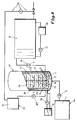
- Figure 1 is a very schematic view which illustrates the process and shows the following installation the invention.
- Figure 2 is a schematic view, in elevation and with partial breaks, of the enclosure crystallization of the above installation.
- FIGs 3, 4 and 5 are views of detail, in perspective and with partial breaks, showing variants of the crystallization enclosure shown in Figure 2.
- Figures 6, 7, 8 and 9 are views schematic, in elevation and in section, of an element of filter of the installation according to the invention, the figure 6 showing this empty element and awaiting its supply in mixture of grease balls / aqueous solution above, Figure 7 showing this feeding while that Figures 8 and 9 respectively show the compaction of said mixture and discharge of cakes from solid matter.
- fat has as broad a meaning as possible and will include therefore both fats containing fatty acids as fatty acids as such, that these fats and fatty acids are lauric in nature or no.
- process of the invention as well as said earlier, particularly suitable to the treatment of lauric fats and fatty acids laurels or not.
- the process according to the invention and illustrated to the drawings is more particularly intended for the crystallization of lauric-type fats, in a aqueous solution, for subsequent fractionation by pressure filtration, with recovery of this aqueous solution during filtering.
- This process first consists in 1, melting the fats and divide, in 2, the mass of melted fat 3 into balls 4 as regular as possible that we introduce in an aqueous solution 5 previously chilled to a temperature below that of the melting point of the fat.
- the concentration of the beads is adjusted grease compared to the aqueous solution, depending of its ability to absorb the amount of heat necessary for the solidification of the balls of grease and we regulate, in 6, the rate of introduction of balls 4 in solution 5 so that each ball of grease be instantly subjected to heat exchange beads / aqueous solution which quickly causes solidification of the surface of the balls and gradually with all their mass.
- the mixture is then transferred beads / solution, for example by pumping 9, at the place filter 10 whose surfaces in contact with said mixture are maintained at a temperature close to that of the latter.
- the crystallization of the grease balls 4 takes place in discontinuous by introducing, at 7 and to form the mixture of beads / aqueous solution, a given volume of grease balls in a given volume of solution aqueous, which is prepared in 11 and where it is recycled after filtering said mixture. After formation of said mixture, this is maintained, as explained above, in 7 until complete crystallization of the beads fat. It is only when this crystallization is stabilized as the mixture is transferred to the place of filtering.
- An advantageous way to do this would be to introduce the melted fat to the bottom of a vertical column, through a device dividing the grease into balls as illustrated by one of figures 2, 3, 4 or 5.
- the vertical column is then traversed by a flow of the aqueous solution, going from the top to the bottom of the column, so continuous or pulsed.
- the beads formed and gradually solidified are then animated by a movement ascending due to their specific weight less than that of the solution.
- the mixture of beads / solution flows then by overflow at the top of the column in a stabilization enclosure.
- the mixture of beads / solution is directed aqueous to a filter bank where the filters are filled and activated one by one so that the aqueous solution is separated, by pressure, from the beads grease, the latter then being put under pressure so that their liquid part is exuded.
- aqueous solution which is determined by the desired concentration of the mixture formed by this solution and the grease balls 4 which will be introduced therein, the temperature of the aqueous solution being, prior to this introduction, adjusted to a temperature below that of the melting point of the fat.
- the temperature of the aqueous solution will be between 5 ° and 27 ° C and preferably between 8 ° and 20 ° C.
- Fat is introduced in this aqueous solution in the form of beads homogeneous whose diameter is between 0.1 and 5 mm, but which is preferably between 1 and 3 mm.
- the aforementioned concentration of grease balls by ratio to the aqueous solution will be 10 to 70%, and preference included, for palm kernel fat, between 20 and 50%.
- the mixture of beads and solution constituted aqueous its temperature is then maintained between 10 ° and 23 ° C, and preferably between 17 ° and 20 ° C, so as to stabilize the crystallization of each bead of the mixture. Maintaining the mixture at temperature takes place by precisely controlling the temperature of said mixture via that of a coolant 12 and lasts between 2 and 24 hours, and preferably for palm kernel fat, 4 to 10 hours.
- the mixture of beads / aqueous solution When the mixture of beads / aqueous solution was maintained for the time desired at temperature, it can easily be transferred either by pumping, as shown in Figure 1, or by pressure difference, in filter 10, which will be described below, previously brought to a temperature close to that of the mixture; filter in which the aqueous solution will first be separated from the mixture to a pressure between 100 to 400 KPa to be recycled in 11, the liquid part of the grease balls then being exuded at a pressure between 1500 to 7000 KPa and preferably, for palm kernel fat, from 2000 to 4000 KPa.
- aqueous solution it is possible to use simply water, but to avoid, on the one hand, the untimely saponification of free fatty acids contained in the fat and, on the other hand, the agglomeration grease balls between them, aqueous solution containing an acid and a surfactant.
- citric acid although there have no downside to using other acids more economic.
- the surfactant will advantageously choose, for palm kernel fat, an emulsifier of the anionic, cationic or zwitterionic or nonionic.
- the installation for the implementation of the aforementioned process comprises an enclosure to be crystallized 13 connected to a source 14 of rendered fats, to a 15 'source of aqueous solution arranged so that the solution temperature is adjustable and at a filter press 10 equipped with trays whose walls are arranged to be able to be brought to a temperature determined.
- Means 15 are arranged in the enclosure 13, near the place 16 where the melted fat is introduced therein, and are arranged to divide this grease into balls 4.
- Means 6 are arranged to regulate, on the one hand, the rate of introduction of the melted fat in the enclosure 13 and, on the other hand, the concentration of grease balls in the solution aqueous.
- Means 17 are arranged in the enclosure 13 to keep the fat balls suspended in the aqueous solution, while means 18 are provided in the enclosure and connected to an external source 12 coolant to maintain the temperature of the grease ball / aqueous solution mixture to a determined value, means 19 being arranged for ensuring the transfer of said mixture from enclosure 13 into the filter 10 whose walls are tempered by a refrigerant contained in a tank 20 and put circulating by a pump 21.
- Means 60 are in additionally provided for recycling the separated aqueous solution grease balls in the filter, towards the source 15 ' aqueous solution.
- an enclosure to be crystallized 13 represented in FIGS. 1 and 2 and which is of the cylindrical tank type, of vertical axis and with insulated wall 22, in which the introduction of the melted fat takes place, in 16, at the base, this tank comprising, on a large part from its height, on the one hand, a heat exchanger 23 coaxial with the tank which constitutes the abovementioned means 18 to maintain the temperature of the ball mixture grease / aqueous solution at a determined value and, on the other hand, an agitator 24 formed by a mounted shaft on the tank so that its axis of its shaft 25 is coincident with the axis of the tank.
- Blades 26, preferably orientable, are regularly distributed according to the direction of the length of the tree and according to plans passing through the axis of this shaft, said agitator constituting the aforementioned means 17 for holding the balls fat suspended in the aqueous solution.
- the aforementioned means 15, arranged for dividing fat melted into balls, are formed, in enclosure 13, shown in Figures 1 and 2, by a plate regularly perforated 27 which is fixed, by its periphery, in the lower part of the tank to the inner wall of this last, this plate 27 which is plane and perpendicular to the axis of the tank could also, depending on the invention, to be curved, either convex or concave, the dimensions of the perforations 28 being chosen as a function of the desired volume for the balls 4.
- the liquid of cooling, which circulates in the heat exchanger 23 is constantly controlled in temperature, as in flow through pump 29. This liquid will most often water or, when the temperature requires it, a mixture water and propylene glycol.
- the means 15 above, arranged to divide the melted fat into balls can also be bell, circular or longitudinal, arranged on a fixed plate 30 inside the tank perpendicular to its axis and provided with a central opening 31.
- these means 15 could also consist of a flat plate 30 fixed inside of the tank perpendicular to its axis and having parallel elongated openings 36.
- Each of these openings 36 is capped by a box 37 of U-shaped section including the heights of the wings 38 and 39 are uneven, this box being attached to the upper face of the plate 30 by the free edge 40 of its wing 38 of greater length while the free edge 41 of its wing 39 of lesser length has notches 42 regularly distributed over its entire length.
- This box 37 includes, between the two wings 38 and 39 from the U and parallel to these, a vertical partition plane 43 fixed to the aforementioned plate and arranged between the elongated opening 36 above and the wing of the U 39 of lower height, the height of this partition 43 being such that a space 44 remains between its edge upper 45 and the soul 46 of the U.
- the filter 10 one element of which is shown diagrammatically in Figures 6 to 9 is a plate filter press chambered known per se, each chamber 47 of an element of the filter being provided with a flexible membrane 48, behind which in 49, it is possible to introduce a fluid under pressure.
- any other fat that a laurel fat could be treated the same way or substantially similar to the process illustrated. This is how the use of the solution aqueous composed of water and acid to avoid saponification fat free fatty acids do not obviously understands that in the case of the treatment of a fat.
Landscapes
- Chemical & Material Sciences (AREA)
- Chemical Kinetics & Catalysis (AREA)
- Wood Science & Technology (AREA)
- Thermal Sciences (AREA)
- Life Sciences & Earth Sciences (AREA)
- Engineering & Computer Science (AREA)
- Oil, Petroleum & Natural Gas (AREA)
- Physics & Mathematics (AREA)
- Organic Chemistry (AREA)
- Crystallography & Structural Chemistry (AREA)
- Dispersion Chemistry (AREA)
- Fats And Perfumes (AREA)
- Organic Low-Molecular-Weight Compounds And Preparation Thereof (AREA)
- Preparation Of Compounds By Using Micro-Organisms (AREA)
Description
- Procédé suivant lequel la matière grasse est additionnée d'un solvant, en général de l'acétone. Ensuite, le miscella est réfrigéré par convection ou évaporation jusqu'à germination et croissance de cristaux au sein du miscella. Après stabilisation de ces cristaux par tempérage, ceux-ci sont séparés de la partie fluide par filtration, décantation ou autre procédé de séparation.
- Procédé suivant lequel la matière grasse est cristallisée sans solvant par refroidissement pour être ensuite additionnée d'un agent tensioactif qui permet la séparation par centrifugation de la partie cristallisée, ce procédé étant connu sous le nom de procédé Lanza.
- Procédé suivant lequel la matière grasse est cristallisée et solidifiée dans des plateaux placés en chambre froide ou véhiculés dans des tunnels de réfrigération, les plaques de matière grasse solidifiée étant alors introduites dans des sacs filtrants qui sont ensuite empilés dans la cage d'une presse hydraulique. Grâce à la haute pression disponible, la partie molle de la matière grasse est exsudée jusqu'à ce que la qualité de sa partie dure restant dans la presse est celle voulue. L'empilement des sacs filtrants est alors défait et les gâteaux constitués par la partie dure susdite sont alors débâtis.
- Procédé utilisé par FUJI OIL suivant lequel la matière grasse est partiellement solidifiée dans une cuve de cristallisation jusqu'au point où la matière grasse se trouve à la limite des possibilités du pompage, en état de surfusion. Elle est alors introduite par pompage dans les chambres d'un filtre-presse équipé de plateaux à parois réfrigérées, munis de membranes. Après introduction de la matière grasse dans le filtre, celle-ci y est laissée le temps nécessaire à sa solidification et à la stabilisation de la phase cristalline. Ensuite, une pression importante, de 2500 à 7000 KPa suivant les cas, est appliquée sur la face arrière de chaque membrane afin d'exsuder la partie fluide de la matière grasse. La pression est ensuite relâchée et le filtre est ouvert pour débâtir les gâteaux de matière solide.
- Alimentation du filtre en mélange billes de graisse/solution aqueuse, en 50 (Figure 7), filtration de la masse des billes de graisse en suspension, puis montée à une pression de 1 à 4 bars pour extraire la solution aqueuse qui est immédiatement récupérée, en 51, pour être réutilisée en 11.
- Compaction de chaque chambre 47 en portant l'arrière de chaque membrane 48 à une pression comprise entre 15 à 70 bars, pendant laquelle la partie liquide de la graisse est exsudée, en 52, et laisse dans chaque chambre 47 un gâteau de produit 56 à point de fusion élevé (Figure 8).
- Soufflage des conduits 53 d'alimentation en mélange billes/solution aqueuse.
- Soufflage des conduits 54 de sortie du filtrat.
- Evacuation du circuit 55 de mise sous pression des membranes 48.
- Débâtissage des gâteaux 56 (Figure 9).
- Fermeture du filtre et préparation de celui-ci au transfert d'une nouvelle quantité du mélange susdit, après un éventuel cycle de lavage.
Claims (31)
- Procédé de cristallisation de matières grasses, en particulier de graisses lauriques et d'acides gras lauriques ou non pour leur fractionnement ultérieur notamment par filtrage sous pression, caractérisé en ce qu'il consiste à fondre les matières grasses, à diviser la masse fondue en billes les plus homogènes possibles et de dimensions les plus régulières possibles, à introduire ces billes dans une solution aqueuse préalablement réfrigérée à une température inférieure à celle du point de fusion de la matière grasse, à ajuster la concentration de matière grasse par rapport à la solution aqueuse en fonction de la capacité de celle-ci à absorber la quantité de chaleur nécessaire à la solidification des billes de matière grasse, à régler le débit d'introduction desdites billes dans la solution précitée pour que chaque bille de matière grasse soit soumise instantanément à un échange thermique billes/solution aqueuse qui provoque rapidement la solidification de la surface des billes et progressivement de toute leur masse, à maintenir les billes de matière grasse en suspension dans ladite solution aqueuse, à ajuster la température du mélange billes/solution pour permettre la stabilisation de la cristallisation de chaque bille, à maintenir ladite température du mélange jusqu'à la stabilisation complète de la cristallisation susdite, à transférer ensuite le mélange billes/solution à l'endroit de filtrage dont les surfaces en contact avec ledit mélange sont maintenues à une température proche de celle de ce dernier, à séparer sous faible pression les billes de matière grasse de la solution aqueuse et à extraire enfin desdites billes de matière grasse, sous forte pression, la partie liquide de la matière grasse.
- Procédé suivant la revendication 1, caractérisé en ce qu'on effectue la cristallisation des matières grasses en discontinu en introduisant un volume donné de billes de matière grasse dans un volume donné de solution aqueuse.
- Procédé suivant la revendication 1, caractérisé en ce qu'on effectue la cristallisation des matières grasses en continu en faisant circuler la solution aqueuse précitée à contre-courant par rapport au flux de billes de matière grasse.
- Procédé suivant l'une quelconque des revendications 1 à 3, caractérisé en ce qu'on divise la masse de matière grasse fondue en billes dont le diamètre est compris entre 0,1 et 5 mm.
- Procédé suivant la revendication 4, caractérisé en ce que le diamètre des billes est compris entre 1 et 3 mm.
- Procédé suivant l'une quelconque des revendications 1 à 5, caractérisé en ce que l'on introduit les billes de matière grasse, telle que graisse de palmiste, dans une solution aqueuse dont la température est comprise entre 5 et 27°C.
- Procédé suivant la revendication 6, caractérisé en ce que la température de la solution aqueuse est comprise entre 8 et 20°C.
- Procédé suivant l'une quelconque des revendications 1 à 7, caractérisé en ce que la solution aqueuse susdite est constituée d'eau.
- Procédé suivant la revendication 6, caractérisé en ce que, pour éviter la saponification des acides gras libres contenus dans les billes de graisse, la solution aqueuse susdite est composée d'eau et d'acide.
- Procédé suivant la revendication 9, caractérisé en ce que l'on dose l'acide dans l'eau, avant l'introduction des billes de graisse dans la solution aqueuse, pour que le pH de cette solution soit compris entre 6,8 et 7,0.
- Procédé suivant l'une ou l'autre des revendications 9 et 10, caractérisé en ce que l'on utilise, pour son effet antioxydant, de l'acide citrique.
- Procédé suivant l'une quelconque des revendications 1 à 11, caractérisé en ce que, pour maintenir dans la solution aqueuse l'homogénéité de chaque bille de matière grasse et éviter l'agglomération de ces billes entre elles, ladite solution aqueuse comprend un agent tensioactif.
- Procédé suivant la revendication 12, caractérisé en ce que l'on choisit, comme agent tensioactif, un émulsifiant du type anionique, cationique ou zwitterionique ou non ionique.
- Procédé suivant l'une quelconque des revendications 1 à 13, caractérisé en ce qu'on maintient les billes de matière grasse en suspension dans la solution aqueuse en provoquant dans le mélange billes/solution un mouvement d'agitation.
- Procédé suivant la revendication 6, caractérisé en ce que, pendant la cristallisation des billes de graisse, on maintient la température du mélange billes de graisse/solution aqueuse entre 10° et 23°C.
- Procédé suivant la revendication 15, caractérisé en ce que la température du mélange billes de graisse/solution aqueuse est maintenue entre 17° et 20°C.
- Procédé suivant l'une quelconque des revendications 1 à 16, caractérisé en ce qu'on introduit une quantité de billes de matière grasse dans la solution aqueuse pour obtenir une concentration de 10 à 70 % de matière grasse par rapport à ladite solution aqueuse.
- Procédé suivant la revendication 17, caractérisé en ce que la quantité de billes de matière grasse introduite dans la solution aqueuse est telle que la concentration précitée est comprise entre 20 et 50 %.
- Procédé suivant l'une quelconque des revendications 1 à 18, caractérisé en ce qu'on maintient la température du mélange billes de matière grasse/solution aqueuse, afin d'assurer la solidification totale desdites billes, pendant une durée comprise entre 2 et 24 heures.
- Procédé suivant la revendication 19, caractérisé en ce que la durée de maintien de la température du mélange est comprise entre 4 et 10 heures.
- Procédé suivant l'une quelconque des revendications 1 à 20, caractérisé en ce que l'on sépare, par filtrage, la solution aqueuse des billes de matière grasse à une pression comprise entre 100 à 400 KPa.
- Procédé suivant l'une quelconque des revendications 1 à 21, caractérisé en ce que, après séparation des billes de matière grasse de la solution précitée, on soumet les billes de matière grasse à une pression comprise entre 1500 et 7000 KPa pour que la partie liquide de la matière grasse soit exsudée et filtrée, avec comme résidu un gâteau de produit à point de fusion élevé.
- Procédé suivant la revendication 22, caractérisé en ce que la pression à laquelle sont soumises les billes de matière grasse est comprise entre 2000 et 4000 KPa.
- Procédé suivant l'une quelconque des revendications 1 à 23, caractérisé en ce qu'on recycle la solution aqueuse après séparation de celle-ci du mélange susdit billes de matière grasse/solution aqueuse.
- Installation pour la mise en oeuvre du procédé suivant l'une quelconque des revendications 1 à 24, caractérisée en ce qu'elle comprend une enceinte à cristalliser (13) raccordée à une source (14) de matières grasses fondues, à une source (15') de solution aqueuse agencée pour que la température de la solution soit réglable et à un filtre-presse (10), équipé de plateaux dont les parois sont agencées pour pouvoir être portées à une température déterminée, des moyens (15) disposés dans l'enceinte (13), à proximité de l'endroit (16) où la matière grasse fondue est introduite dans celle-ci, et agencés pour diviser cette matière grasse en billes, des moyens (6) agencés pour régler le débit d'introduction de la matière grasse fondue dans l'enceinte (13) et la concentration des billes de matière grasse dans la solution aqueuse, des moyens (17) agencés dans l'enceinte (13) pour maintenir les billes de matière grasse (4) en suspension dans la solution aqueuse, des moyens (18) prévus dans l'enceinte, connectés à une source externe (12) de fluide réfrigérant, qui sont agencés pour maintenir la température du mélange billes de matière grasse/solution aqueuse à une valeur déterminée et des moyens (19) agencés pour permettre le transfert du mélange susdit de l'enceinte au filtre.
- Installation suivant la revendication 25, caractérisée en ce que le filtre et la source de solution aqueuse comprennent des moyens (60) agencés pour permettre le recyclage de la solution aqueuse filtrée.
- Installation suivant l'une ou l'autre des revendications 25 et 26, caractérisée en ce que l'enceinte à cristalliser (13) susdite est du type cuve cylindrique, d'axe vertical et à paroi isolée (22), dans laquelle l'introduction de la matière grasse fondue s'effectue à la base, cette cuve comprenant, sur une partie importante de sa hauteur, d'une part, un échangeur de chaleur (23) coaxial à la cuve qui constitue les moyens (18) susdits pour maintenir la température du mélange billes de matière grasse/solution aqueuse à une valeur déterminée et, d'autre part, un agitateur (24) formé par un arbre (25) monté sur la cuve pour que son axe soit confondu avec l'axe de la cuve, des pales (16), de préférence orientables, étant régulièrement réparties suivant le sens de la longueur de l'arbre (25) et suivant des plans passant par l'axe de cet arbre, ledit agitateur constituant les moyens (17) précités pour maintenir les billes de matière grasse en suspension dans la solution aqueuse.
- Installation suivant la revendication 27, caractérisée en ce que les moyens (15) précités agencés pour diviser la matière grasse fondue en billes sont constitués par une plaque régulièrement perforée (27) qui est fixée, par son pourtour, dans la partie inférieure de la cuve à la paroi interne de cette dernière, cette plaque (27) étant soit plane et perpendiculaire à l'axe de la cuve, soit bombée - convexe ou concave, les dimensions des perforations (28) étant choisies en fonction du volume désiré pour les billes.
- Installation suivant la revendication 27, caractérisée en ce que les moyens précités (15) agencés pour diviser la matière grasse fondue en billes (4) sont du type cloche, circulaire ou longitudinale, disposés sur une plaque (30) fixée à l'intérieur de la cuve perpendiculairement à son axe et pourvue d'une ouverture centrale (31), un conduit (32), ouvert à ses deux extrémités, étant fixé à cette ouverture (31) de manière à s'étendre au-dessus de ladite plaque (30), une cloche (33), fixée également à cette plaque, coiffant le conduit (32) de manière à ce qu'un espace (34) subsiste entre l'extrémité supérieure (35) dudit conduit et la cloche (34), cette dernière étant régulièrement perforée, (en 36), sur tout son pourtour dans sa zone comprise entre le niveau de la plaque (30) et celui de la partie supérieure (35) du conduit (32).
- Installation suivant la revendication 27, caractérisée en ce que les moyens précités agencés pour diviser la matière grasse fondue en billes comprennent une plaque plane fixée à l'intérieur de la cuve perpendiculairement à son axe et présentant des ouvertures allongées (36) parallèles, chacune de ces ouvertures étant coiffée par une boíte (37) de section en U dont les hauteurs des ailes (38, 39) sont inégales, cette boíte étant fixée à la face supérieure de la plaque (30) par le bord libre (40) de son aile (38) de plus grande longueur tandis que le bord libre (41) de son aile (39) de longueur moindre présente des échancrures (42) régulièrement réparties sur toute sa longueur, ladite boíte (37) comprenant, entre les deux ailes du U et parallèlement à celles-ci, une cloison plane (43) fixée à la plaque précitée et disposée entre l'ouverture allongée (36) susdite et l'aile (39) du U de plus faible hauteur, la hauteur de cette cloison (43) étant telle qu'un espace (44) subsiste entre son bord supérieur (45) et l'âme (46) du U.
- Installation suivant l'une quelconque des revendications 25 à 30, caractérisée en ce que le filtre (10) est du type filtre-presse équipé de plateaux à membranes connu en soi.
Applications Claiming Priority (3)
| Application Number | Priority Date | Filing Date | Title |
|---|---|---|---|
| BE9500871A BE1009693A3 (fr) | 1995-10-19 | 1995-10-19 | Procede de cristallisation de matieres grasses de type laurique et installation pour la mise en oeuvre de ce procede. |
| BE9500871 | 1995-10-19 | ||
| PCT/BE1996/000106 WO1997014777A1 (fr) | 1995-10-19 | 1996-10-04 | Procede de cristallisation de matieres grasses et installation pour la mise en oeuvre de ce procede |
Publications (2)
| Publication Number | Publication Date |
|---|---|
| EP0857199A1 EP0857199A1 (fr) | 1998-08-12 |
| EP0857199B1 true EP0857199B1 (fr) | 2002-08-14 |
Family
ID=3889249
Family Applications (1)
| Application Number | Title | Priority Date | Filing Date |
|---|---|---|---|
| EP96932397A Expired - Lifetime EP0857199B1 (fr) | 1995-10-19 | 1996-10-04 | Procede de cristallisation de matieres grasses et installation pour la mise en oeuvre de ce procede |
Country Status (12)
| Country | Link |
|---|---|
| US (1) | US6072066A (fr) |
| EP (1) | EP0857199B1 (fr) |
| JP (1) | JP3556229B2 (fr) |
| AT (1) | ATE222283T1 (fr) |
| AU (1) | AU7122496A (fr) |
| BE (1) | BE1009693A3 (fr) |
| CA (1) | CA2235319C (fr) |
| DE (1) | DE69623031T2 (fr) |
| DK (1) | DK0857199T3 (fr) |
| ES (1) | ES2179950T3 (fr) |
| MY (1) | MY118749A (fr) |
| WO (1) | WO1997014777A1 (fr) |
Families Citing this family (4)
| Publication number | Priority date | Publication date | Assignee | Title |
|---|---|---|---|---|
| WO1999042545A1 (fr) * | 1998-02-19 | 1999-08-26 | Crystallisation & Degumming Sprl | Procede de production de micro-cristaux de graisses vegetales et animales |
| DE60140185D1 (de) * | 2001-07-31 | 2009-11-26 | Smet Engineering N V De | Verfahren und Vorrichtung zur Trockenfraktionierung |
| AR076109A1 (es) * | 2009-03-13 | 2011-05-18 | Gen Mills Marketing Inc | Procesos para la produccion de particulas lipidas |
| CN109970840A (zh) * | 2019-02-26 | 2019-07-05 | 浙江海洋大学 | 新型超声波提取反应罐 |
Family Cites Families (8)
| Publication number | Priority date | Publication date | Assignee | Title |
|---|---|---|---|---|
| US2800493A (en) * | 1955-12-20 | 1957-07-23 | Henkel & Cie Gmbh | Separation of high molecular organic compound mixtures |
| US3633883A (en) * | 1968-11-04 | 1972-01-11 | Raymond D Mcglothlin | Supporting and sealing means for treating trays in fluid-treating apparatus |
| JPS58152097A (ja) * | 1982-03-08 | 1983-09-09 | 雪印乳業株式会社 | 微粒子状油脂の製造方法 |
| EP0198538A1 (fr) * | 1985-04-12 | 1986-10-22 | The Procter & Gamble Company | Procédé de préparation de graisse de cuisson solide versable |
| SU1558970A1 (ru) * | 1987-12-15 | 1990-04-23 | Научно-производственное объединение "Автоматика" | Кристаллизатор жира |
| DE3926974A1 (de) * | 1989-08-16 | 1991-02-21 | Wiederaufarbeitung Von Kernbre | Stoffaustauschkolonne |
| JPH03146595A (ja) * | 1989-11-02 | 1991-06-21 | Noboru Yamada | 粒子状固形油脂製品の製造方法 |
| JPH0463896A (ja) * | 1990-04-09 | 1992-02-28 | Noboru Yamada | 油脂を主体とする粒子状製品の製造装置 |
-
1995
- 1995-10-19 BE BE9500871A patent/BE1009693A3/fr not_active IP Right Cessation
-
1996
- 1996-10-04 DK DK96932397T patent/DK0857199T3/da active
- 1996-10-04 CA CA002235319A patent/CA2235319C/fr not_active Expired - Fee Related
- 1996-10-04 AT AT96932397T patent/ATE222283T1/de not_active IP Right Cessation
- 1996-10-04 WO PCT/BE1996/000106 patent/WO1997014777A1/fr not_active Ceased
- 1996-10-04 DE DE69623031T patent/DE69623031T2/de not_active Expired - Fee Related
- 1996-10-04 ES ES96932397T patent/ES2179950T3/es not_active Expired - Lifetime
- 1996-10-04 EP EP96932397A patent/EP0857199B1/fr not_active Expired - Lifetime
- 1996-10-04 AU AU71224/96A patent/AU7122496A/en not_active Abandoned
- 1996-10-04 JP JP51536197A patent/JP3556229B2/ja not_active Expired - Fee Related
- 1996-10-04 US US09/051,598 patent/US6072066A/en not_active Expired - Fee Related
- 1996-10-17 MY MYPI96004319A patent/MY118749A/en unknown
Also Published As
| Publication number | Publication date |
|---|---|
| DK0857199T3 (da) | 2002-12-09 |
| MY118749A (en) | 2005-01-31 |
| BE1009693A3 (fr) | 1997-07-01 |
| CA2235319A1 (fr) | 1997-04-24 |
| CA2235319C (fr) | 2003-04-29 |
| AU7122496A (en) | 1997-05-07 |
| ATE222283T1 (de) | 2002-08-15 |
| US6072066A (en) | 2000-06-06 |
| DE69623031T2 (de) | 2003-05-08 |
| EP0857199A1 (fr) | 1998-08-12 |
| WO1997014777A1 (fr) | 1997-04-24 |
| ES2179950T3 (es) | 2003-02-01 |
| JP3556229B2 (ja) | 2004-08-18 |
| DE69623031D1 (de) | 2002-09-19 |
| JPH11513714A (ja) | 1999-11-24 |
Similar Documents
| Publication | Publication Date | Title |
|---|---|---|
| EP2055197B1 (fr) | Procédé d'évapocristallisation du maltitol | |
| Timms | Fractional crystallisation–the fat modification process for the 21st century | |
| Timms | Fractionation | |
| EP0535013B1 (fr) | Procede et installation pour la cristallisation d'une substance minerale | |
| EP0139177B1 (fr) | Procédé de production de fractions comestibles de matières grasses et leur utilisation | |
| US20170216802A1 (en) | Process for the Production of Solid Cooling Agents | |
| EP0352847B1 (fr) | Procédé et installation pour la cristallisation d'une substance minérale | |
| BE897634A (fr) | Bombon dur au sorbitol et son procede de fabrication | |
| CA2235319C (fr) | Procede de cristallisation de matieres grasses et installation pour la mise en oeuvre de ce procede | |
| BE1007448A3 (fr) | Procede de fractionnement d'une composition de matiere grasse et produit ainsi obtenu. | |
| FR2549385A1 (fr) | Appareil pour purifier des cristaux, notamment du naphtalene ou derives, ou analogues | |
| EP0262113A2 (fr) | Procédé et installation de fractionnement par cristallisation de matières grasses | |
| EP0202999B1 (fr) | Procédé et installation de préparation de dextrose cristallisé anhydre | |
| JP4522064B2 (ja) | 油脂のドライ分別方法 | |
| FR2597115A1 (fr) | Procede et installation pour la production en continu de cristaux de sucre a partir de sirops | |
| CA1205803A (fr) | Procede et dispositif de cristallisation en continu d'une masse cuite | |
| EP1056820A1 (fr) | Procede de production de micro-cristaux de graisses vegetales et animales | |
| EP1092459B1 (fr) | Procédé et dispositif de purification de produits organiques par cristallisation fractionnée à vitesse de circulation variable | |
| EP2166072B1 (fr) | Procédé de cristallisation continu avec ensemencement pour corps gras | |
| EP0356301B1 (fr) | Procédé pour la fabrication de confiseries à base de polyols | |
| BE549989A (fr) | ||
| EP0606030A2 (fr) | Procédé et appareil pour la refonte de sucre | |
| FR2887399A1 (fr) | Procede et dispositif de traitement post fabrication d'un beurre de frigo-tartinable | |
| BE541544A (fr) | ||
| BE532817A (fr) |
Legal Events
| Date | Code | Title | Description |
|---|---|---|---|
| PUAI | Public reference made under article 153(3) epc to a published international application that has entered the european phase |
Free format text: ORIGINAL CODE: 0009012 |
|
| 17P | Request for examination filed |
Effective date: 19980504 |
|
| AK | Designated contracting states |
Kind code of ref document: A1 Designated state(s): AT BE CH DE DK ES FI FR GB GR IE IT LI LU MC NL PT SE |
|
| AX | Request for extension of the european patent |
Free format text: SI PAYMENT 980504 |
|
| 17Q | First examination report despatched |
Effective date: 20001020 |
|
| GRAG | Despatch of communication of intention to grant |
Free format text: ORIGINAL CODE: EPIDOS AGRA |
|
| GRAG | Despatch of communication of intention to grant |
Free format text: ORIGINAL CODE: EPIDOS AGRA |
|
| GRAH | Despatch of communication of intention to grant a patent |
Free format text: ORIGINAL CODE: EPIDOS IGRA |
|
| GRAH | Despatch of communication of intention to grant a patent |
Free format text: ORIGINAL CODE: EPIDOS IGRA |
|
| GRAA | (expected) grant |
Free format text: ORIGINAL CODE: 0009210 |
|
| AK | Designated contracting states |
Kind code of ref document: B1 Designated state(s): AT BE CH DE DK ES FI FR GB GR IE IT LI LU MC NL PT SE |
|
| AX | Request for extension of the european patent |
Free format text: SI PAYMENT 19980504 |
|
| PG25 | Lapsed in a contracting state [announced via postgrant information from national office to epo] |
Ref country code: IE Free format text: LAPSE BECAUSE OF FAILURE TO SUBMIT A TRANSLATION OF THE DESCRIPTION OR TO PAY THE FEE WITHIN THE PRESCRIBED TIME-LIMIT Effective date: 20020814 Ref country code: GR Free format text: LAPSE BECAUSE OF FAILURE TO SUBMIT A TRANSLATION OF THE DESCRIPTION OR TO PAY THE FEE WITHIN THE PRESCRIBED TIME-LIMIT Effective date: 20020814 Ref country code: FI Free format text: LAPSE BECAUSE OF FAILURE TO SUBMIT A TRANSLATION OF THE DESCRIPTION OR TO PAY THE FEE WITHIN THE PRESCRIBED TIME-LIMIT Effective date: 20020814 Ref country code: AT Free format text: LAPSE BECAUSE OF FAILURE TO SUBMIT A TRANSLATION OF THE DESCRIPTION OR TO PAY THE FEE WITHIN THE PRESCRIBED TIME-LIMIT Effective date: 20020814 |
|
| REF | Corresponds to: |
Ref document number: 222283 Country of ref document: AT Date of ref document: 20020815 Kind code of ref document: T |
|
| REG | Reference to a national code |
Ref country code: GB Ref legal event code: FG4D Free format text: NOT ENGLISH |
|
| REG | Reference to a national code |
Ref country code: CH Ref legal event code: EP |
|
| REG | Reference to a national code |
Ref country code: IE Ref legal event code: FG4D Free format text: FRENCH |
|
| REF | Corresponds to: |
Ref document number: 69623031 Country of ref document: DE Date of ref document: 20020919 |
|
| REG | Reference to a national code |
Ref country code: CH Ref legal event code: NV Representative=s name: PATENTANWAELTE FELDMANN & PARTNER AG |
|
| PG25 | Lapsed in a contracting state [announced via postgrant information from national office to epo] |
Ref country code: LU Free format text: LAPSE BECAUSE OF NON-PAYMENT OF DUE FEES Effective date: 20021004 |
|
| GBT | Gb: translation of ep patent filed (gb section 77(6)(a)/1977) |
Effective date: 20020919 |
|
| PG25 | Lapsed in a contracting state [announced via postgrant information from national office to epo] |
Ref country code: PT Free format text: LAPSE BECAUSE OF FAILURE TO SUBMIT A TRANSLATION OF THE DESCRIPTION OR TO PAY THE FEE WITHIN THE PRESCRIBED TIME-LIMIT Effective date: 20021129 |
|
| REG | Reference to a national code |
Ref country code: DK Ref legal event code: T3 |
|
| REG | Reference to a national code |
Ref country code: ES Ref legal event code: FG2A Ref document number: 2179950 Country of ref document: ES Kind code of ref document: T3 |
|
| PG25 | Lapsed in a contracting state [announced via postgrant information from national office to epo] |
Ref country code: MC Free format text: LAPSE BECAUSE OF NON-PAYMENT OF DUE FEES Effective date: 20030501 |
|
| REG | Reference to a national code |
Ref country code: IE Ref legal event code: FD4D Ref document number: 0857199E Country of ref document: IE |
|
| PLBE | No opposition filed within time limit |
Free format text: ORIGINAL CODE: 0009261 |
|
| STAA | Information on the status of an ep patent application or granted ep patent |
Free format text: STATUS: NO OPPOSITION FILED WITHIN TIME LIMIT |
|
| 26N | No opposition filed |
Effective date: 20030515 |
|
| PGFP | Annual fee paid to national office [announced via postgrant information from national office to epo] |
Ref country code: GB Payment date: 20030829 Year of fee payment: 8 |
|
| PGFP | Annual fee paid to national office [announced via postgrant information from national office to epo] |
Ref country code: BE Payment date: 20030910 Year of fee payment: 8 |
|
| PGFP | Annual fee paid to national office [announced via postgrant information from national office to epo] |
Ref country code: FR Payment date: 20030915 Year of fee payment: 8 Ref country code: ES Payment date: 20030915 Year of fee payment: 8 |
|
| PGFP | Annual fee paid to national office [announced via postgrant information from national office to epo] |
Ref country code: NL Payment date: 20030923 Year of fee payment: 8 |
|
| PGFP | Annual fee paid to national office [announced via postgrant information from national office to epo] |
Ref country code: DK Payment date: 20031020 Year of fee payment: 8 |
|
| PGFP | Annual fee paid to national office [announced via postgrant information from national office to epo] |
Ref country code: DE Payment date: 20031029 Year of fee payment: 8 |
|
| PGFP | Annual fee paid to national office [announced via postgrant information from national office to epo] |
Ref country code: SE Payment date: 20031105 Year of fee payment: 8 |
|
| PGFP | Annual fee paid to national office [announced via postgrant information from national office to epo] |
Ref country code: CH Payment date: 20040128 Year of fee payment: 8 |
|
| PG25 | Lapsed in a contracting state [announced via postgrant information from national office to epo] |
Ref country code: GB Free format text: LAPSE BECAUSE OF NON-PAYMENT OF DUE FEES Effective date: 20041004 |
|
| PG25 | Lapsed in a contracting state [announced via postgrant information from national office to epo] |
Ref country code: SE Free format text: LAPSE BECAUSE OF NON-PAYMENT OF DUE FEES Effective date: 20041005 Ref country code: ES Free format text: LAPSE BECAUSE OF NON-PAYMENT OF DUE FEES Effective date: 20041005 |
|
| PG25 | Lapsed in a contracting state [announced via postgrant information from national office to epo] |
Ref country code: LI Free format text: LAPSE BECAUSE OF NON-PAYMENT OF DUE FEES Effective date: 20041031 Ref country code: CH Free format text: LAPSE BECAUSE OF NON-PAYMENT OF DUE FEES Effective date: 20041031 Ref country code: BE Free format text: LAPSE BECAUSE OF NON-PAYMENT OF DUE FEES Effective date: 20041031 |
|
| PG25 | Lapsed in a contracting state [announced via postgrant information from national office to epo] |
Ref country code: DK Free format text: LAPSE BECAUSE OF NON-PAYMENT OF DUE FEES Effective date: 20041101 |
|
| BERE | Be: lapsed |
Owner name: *TAN CHEE HONG Effective date: 20041031 Owner name: *TIRTIAUX ALAIN Effective date: 20041031 |
|
| PG25 | Lapsed in a contracting state [announced via postgrant information from national office to epo] |
Ref country code: NL Free format text: LAPSE BECAUSE OF NON-PAYMENT OF DUE FEES Effective date: 20050501 |
|
| PG25 | Lapsed in a contracting state [announced via postgrant information from national office to epo] |
Ref country code: DE Free format text: LAPSE BECAUSE OF NON-PAYMENT OF DUE FEES Effective date: 20050503 |
|
| GBPC | Gb: european patent ceased through non-payment of renewal fee |
Effective date: 20041004 |
|
| EUG | Se: european patent has lapsed | ||
| REG | Reference to a national code |
Ref country code: DK Ref legal event code: EBP |
|
| REG | Reference to a national code |
Ref country code: CH Ref legal event code: PL |
|
| PG25 | Lapsed in a contracting state [announced via postgrant information from national office to epo] |
Ref country code: FR Free format text: LAPSE BECAUSE OF NON-PAYMENT OF DUE FEES Effective date: 20050630 |
|
| NLV4 | Nl: lapsed or anulled due to non-payment of the annual fee |
Effective date: 20050501 |
|
| REG | Reference to a national code |
Ref country code: FR Ref legal event code: ST |
|
| PG25 | Lapsed in a contracting state [announced via postgrant information from national office to epo] |
Ref country code: IT Free format text: LAPSE BECAUSE OF NON-PAYMENT OF DUE FEES;WARNING: LAPSES OF ITALIAN PATENTS WITH EFFECTIVE DATE BEFORE 2007 MAY HAVE OCCURRED AT ANY TIME BEFORE 2007. THE CORRECT EFFECTIVE DATE MAY BE DIFFERENT FROM THE ONE RECORDED. Effective date: 20051004 |
|
| REG | Reference to a national code |
Ref country code: ES Ref legal event code: FD2A Effective date: 20041005 |
|
| BERE | Be: lapsed |
Owner name: *TAN CHEE HONG Effective date: 20041031 Owner name: *TIRTIAUX ALAIN Effective date: 20041031 |