EP0858112A2 - Festkörperbildsensor und Herstellungsverfahren - Google Patents
Festkörperbildsensor und Herstellungsverfahren Download PDFInfo
- Publication number
- EP0858112A2 EP0858112A2 EP98101889A EP98101889A EP0858112A2 EP 0858112 A2 EP0858112 A2 EP 0858112A2 EP 98101889 A EP98101889 A EP 98101889A EP 98101889 A EP98101889 A EP 98101889A EP 0858112 A2 EP0858112 A2 EP 0858112A2
- Authority
- EP
- European Patent Office
- Prior art keywords
- titanium dioxide
- image sensor
- film
- solid
- state image
- Prior art date
- Legal status (The legal status is an assumption and is not a legal conclusion. Google has not performed a legal analysis and makes no representation as to the accuracy of the status listed.)
- Withdrawn
Links
Images



Classifications
-
- H—ELECTRICITY
- H10—SEMICONDUCTOR DEVICES; ELECTRIC SOLID-STATE DEVICES NOT OTHERWISE PROVIDED FOR
- H10F—INORGANIC SEMICONDUCTOR DEVICES SENSITIVE TO INFRARED RADIATION, LIGHT, ELECTROMAGNETIC RADIATION OF SHORTER WAVELENGTH OR CORPUSCULAR RADIATION
- H10F39/00—Integrated devices, or assemblies of multiple devices, comprising at least one element covered by group H10F30/00, e.g. radiation detectors comprising photodiode arrays
- H10F39/10—Integrated devices
- H10F39/12—Image sensors
- H10F39/15—Charge-coupled device [CCD] image sensors
- H10F39/151—Geometry or disposition of pixel elements, address lines or gate electrodes
-
- H—ELECTRICITY
- H10—SEMICONDUCTOR DEVICES; ELECTRIC SOLID-STATE DEVICES NOT OTHERWISE PROVIDED FOR
- H10F—INORGANIC SEMICONDUCTOR DEVICES SENSITIVE TO INFRARED RADIATION, LIGHT, ELECTROMAGNETIC RADIATION OF SHORTER WAVELENGTH OR CORPUSCULAR RADIATION
- H10F39/00—Integrated devices, or assemblies of multiple devices, comprising at least one element covered by group H10F30/00, e.g. radiation detectors comprising photodiode arrays
- H10F39/10—Integrated devices
- H10F39/12—Image sensors
- H10F39/15—Charge-coupled device [CCD] image sensors
- H10F39/153—Two-dimensional or three-dimensional array CCD image sensors
Definitions
- the invention relates to a solid-state image sensor to be employed in a visible radiation region, and a method of fabricating the same.
- CCD charge coupled device
- TDI time delay and integration
- CID image sensor photoelectric conversion is carried out at a portion below a gate electrode of MOS capacitor.
- CCD image sensor In a one-dimensional CCD, TDI operation CCD image sensor, a frame transfer type CCD image sensor, and a full-frame type CCD image sensor, CCD having a function of electronic scanning is employed also as a photodetector.
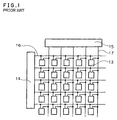
- Fig. 1 illustrates a basic structure of CID image sensor
- Figs. 2A to 2C illustrate an operation of a unit pixel of CID image sensor
- a unit pixel 13 illustrated in Fig. 1 is constituted of two charge-coupled MOS capacitors, as illustrated in Figs. 2A to 2C.
- CID image sensor a plurality of the unit pixels 13 is two-dimensionally arranged.
- Each one of the unit pixels 13 is electrically connected with one of horizontal selection lines 16 and further with one of vertical selection lines 17. All the horizontal selection lines 16 are connected to a vertical shift register 14, and all the vertical selection lines 17 are connected to a horizontal shift register 15.
- a certain unit pixel among a plurality of the unit pixels 13 is accessible by means of a horizontal selection pulse applied to one of the horizontal selection fines 16 and a vertical selection pulse applied to one of the vertical selection lines 17.
- a horizontal selection pulse applied to one of the horizontal selection fines 16 and a vertical selection pulse applied to one of the vertical selection lines 17.
- an operation for selecting one of the unit pixels 13 is explained with reference to Figs. 2A to 2C.
- the unit pixel 13 is comprised of a p-type Si substrate 18 which is grounded, an oxide film 21 formed on the substrate 18, a first gate electrode 19 formed on the oxide film 21 and electrically connected to the horizontal selection line 16, and a second gate electrode 20 formed partially on the oxide film 21 and partially on the first gate electrode 19 with the oxide film 21 sandwiched therebetween, and electrically connected to the vertical selection fine 17.
- Fig. 2A illustrates a condition where high level is applied to the horizontal selection line 16 and low level is applied to the vertical selection line 17.
- a potential well W in the p-type silicon substrate 18 below the first gate electrode 19 electrically connected to the horizontal selection line 16.
- Signal charges generated in the p-type Si substrate 18 by means of a light h ⁇ passing through the first and/or second gate electrodes 19 and 20 and incident on the substrate 18 are accumulated in the potential well W.
- Fig. 2B illustrates a condition where low level is applied to the horizontal selection line 16 and high level is applied to the vertical selection line 17.
- a potential well W is formed in the p-type silicon substrate 18 below the second gate electrode 20 electrically connected to the vertical selection line 17. Signal charges generated by an incident light h ⁇ are accumulated in the potential well W.
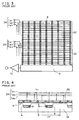
- Fig. 3 is a plan view of a frame transfer type CCD image sensor
- Fig. 4 is a cross-sectional view of an image section of the frame transfer type CCD image sensor illustrated in Fig. 3.
- a vertical CCD is of three-phase drive type.
- Channel stop regions 8 vertically divide a charge transfer channel into pixel rows in the same number as the number of horizontal pixels.
- Vertical CCDs are arranged perpendicularly to the channel stop regions 8.
- the vertical CCDs are grouped into upper and lower groups.
- the upper group of the vertical CCDs forms an image section 22 for receiving a light therein
- the lower group of the vertical CCDs forms a storage section 23 for temporarily storing signal charges therein.
- the storage section 23 is connected at a termination end thereof with a horizontal CCD 9.
- the horizontal CCD 9 receives signal charges of a line at a time from the storage section 23, and carries them to an output section 10.
- the output section 10 carries out detecting of signal charges and converting the thus detected charges into voltage, and then emits the signal voltage as an output.
- a thin insulating film (not illustrated) is formed over the image sensor, and a metal film (not illustrated) is formed on the insulating film in order to prevent a light from entering the storage section 23 and the horizontal CCD 9.
- the image section of the frame transfer type CCD image sensor includes a p-type Si substrate 18, a gate oxide film 4 formed on the p-type Si substrate 18, and a plurality of vertical CCD electrodes 26 arranged on the gate oxide film 4.
- One of drive signals I ⁇ 1 to I ⁇ 3 is applied to every three vertical CCD electrodes 26.
- a single pixel 27 corresponds to three vertical CCD electrodes 26.
- a single pixel means a region surrounded by the vertical CCD electrodes 26 in the number associated with the number of phases of drive signals 24 constituting one stage of CCD and the channel stop regions 8.
- potential wells W below the vertical CCD electrodes 26 to which the drive signals I ⁇ 1 is applied that is, positive charges [+] are applied.
- excited signal charges are collected in the potential well W below one of the three vertical CCD electrodes 26 corresponding to a single pixel 27.
- drive signals 24 for driving the vertical CCDs in the image section 22 and drive signals 25 for driving the vertical CCDs in the storage section 23 become high-speed transfer pulses, and thus charges in all pixels in the image section 22 are immediately transferred to and stored in the storage section 23.
- the image section 22 starts again accumulating light signal charges in each of the pixels. While the image section 22 is accumulating light signal charges, the signal charges having been stored in the storage section 23 are downwardly transferred line by line, and then is transferred to the output section 10 through the horizontal CCD 9. First, signal charges stored in the bottom line are all transmitted to the horizontal CCD 9, and then transferred horizontally to the output section 10 at a high clock frequency. The thus transferred signal charges are read out of the output section 10 as time sequential signals. Since the next signal charges have already been transferred down to the bottom fine at this time, the next signal charges are transferred into the horizontal CCD 9 by next transfer operation of the storage section 23, and then read out of the output section 10.
- TDI operation CCD image sensor and a full-frame type CCD image sensor basically have the same structure as that of the above-mentioned frame transfer type CCD image sensor from which the storage section 23 is eliminated.
- TDI operation CCD image sensor scans images incident thereon at a constant rate, and synchronizes a transfer rate of signal charges with a motion of the images to thereby concurrently carry out accumulation and transfer of signals, and provide high sensitivity.
- a full-frame type CCD image sensor includes a mechanical shutter in front of CCD image sensor in order to shield the CCD image sensor from lights when signal charges are read out of the CCD image sensor. When a charge accumulation period has been expired, the mechanical shutter is closed. Then, signal charges are read out of the CCD image sensor for frame transfer in the same manner as signal charges are read out of the storage section of the above-mentioned frame transfer type CCD image sensor.
- the conventional solid-state image sensors including an electrode in a photoelectric conversion region, and a photodetector for detecting a light passing through the electrode, such as a one-dimensional CCD, CID image sensor, TDI operation CCD image sensor, a frame transfer type CCD image sensor, and a full-frame type CCD image sensor, a gate electrode formed in a photoelectric conversion region and CCD transfer electrode are composed of polysilicon.
- the conventional solid-state image sensors are accompanied with a problem that a photodetector has a low quantum efficiency because of intensive absorption of a fight into a polysilicon electrode. In particular, a quantum efficiency is just a few percents in the blue region.
- a device suggested by D. M. Brown et al. is CID image sensor.
- a structure of a unit pixel in the suggested CID image sensor is illustrated in Fig. 5.
- a thick field oxide film 30 is formed on an n-type silicon substrate 1.
- a portion of the field oxide film 30 in a region which will make an active region namely, a recessed region inside a boundary 31 between a gate oxide film and the field oxide film 30
- a thin gate oxide film is formed in the region.
- a polysilicon low line (a horizontal selection line) 28 is first horizontally formed, and then a transparent electrode column line (a vertical selection line) 29 is formed on the polysilicon low line 28.
- the transparent electrode is composed of ITO (Indium-Tin Oxide: In 2 O 3 -SnO 2 ), that is, indium oxide containing tin oxide at 5 to 10%.
- a portion of the polysilicon low line (horizontal selection line) 28 covering the gate oxide film therewith constitutes a first gate electrode, and a portion of the transparent electrode column line (vertical selection line) 29 covering the gate oxide film therewith constitutes a second gate electrode.
- the polysilicon low line (horizontal selection line) 28 absorbs a light to much degree, optical loss in the transparent electrode column fine (vertical selection line) 29 is small. Thus, a quantum efficiency is enhanced by a light incident on the device through the transparent electrode column line 29.
- Devices suggested by D. H. McCann et al. are a one-dimensional CCD, TDI operation CCD image sensor, and a frame transfer type CCD image sensor.
- Fig. 6 illustrates a cross-sectional structure of a light-receiving region of those devices.
- a p-type buried channel 32 is formed in the vicinity of a surface of an n-type silicon substrate 1, and a two-layered gate insulating film comprising a thermal oxide film 33 and a silicon nitride film 34 is formed on the silicon substrate 1.
- a plurality of first tin dioxide electrodes 35 is formed on the silicon nitride film 34 in such a way that the adjacent electrodes 35 are spaced away from each other.
- a plurality of second tin dioxide electrodes 37 is formed on the first layer SILOX 36 so that each of the second tin dioxide electrodes 37 is disposed above a space formed between the adjacent first tin dioxide electrodes 35.
- the second tin dioxide electrodes 37 and exposed portions of the first layer SILOX 36 are covered with a second layer SILOX 38, on which an internal wiring composed of aluminum is formed in a non-illustrated region.
- On the second layer SILOX 38 are deposited a third layer SILOX 39 and a fourth layer SILOX 40.
- a light shield composed of aluminum for defining a light receiving region is formed on the fourth layer SILOX 40 in a non-illustrated region.
- a device suggested by W. F. Keenan is a kind of a full-frame type CCD image sensor, but has a unique structure. This is CCD operable by a single drive signal, and is called virtual-phase (VP) CCD.
- Fig. 7 illustrates a cross-sectional structure of the suggested device.
- the device includes a silicon substrate 40, a gate oxide film 46 formed on the substrate 40, a plurality of tin oxide electrodes 42 formed on the gate oxide film 46 and spaced away from each other, and an oxide film 43 covering the tin oxide electrodes 42 and exposed portions of the gate oxide film 46 therewith.
- boron virtual electrodes 41 are formed in the substrate 40 for keeping a surface potential in the substrate 40.
- a region where the boron virtual electrode 41 exists is a virtual-phase region 44, and a region where the tin oxide electrode 42 exists is a clock-phase region 45.
- n-type buried channels are formed below the boron virtual electrodes 41 and the tin oxide electrodes 42.
- impurities profiles which generate a difference in potential for forming both a barrier region and a storage region.
- a virtual-phase CCD is inferior in charge transfer capacity to an ordinary CCD which forms a barrier region and a storage section in CCD channel by drive signals to be applied to vertical CCD electrodes, a virtual-phase CCD provides an advantage of a high quantum efficiency, because no vertical CCD electrode exists above the virtual-phase region 44.
- Indium (In) which is a major constituent of ITO and tin (Sn) which is a major constituent of tin dioxide are materials both forming all-rate solid solution along with silicon, and hence do not form a stable phase.
- oxides of indium and tin do not have sufficiently high thermal resistance.
- indium and tin tend to become contaminant, and thus pose a problem that a limitation is given to fabrication process, and designability, performance limits, and productivity thereof are reduced in order to avoid deterioration of performances in a device.
- an allowable temperature to be applied to a device is about 600°C in maximum, if ITO or tin oxide were employed for forming an electrode. It would be difficult to implant and activate impurities, if an electrode were composed of ITO or tin oxide, and accordingly, it is not possible to employ self-align technique useful for fabricating a device in a finer size and further for enabling a device to have higher performances.
- an insulating film between electrodes has to be a film which is capable of being formed at low temperature process which would provide only low insulation. For instance, if an insulating film were to be formed of SILOX, it had to be formed at 400°C to 450°C.
- Japanese Unexamined Patent Publication No. 62-277878 has suggested a solid-state image sensor comprising CCD type solid-state image sensor, and a micro color film disposed on the solid-state image sensor.
- the suggested CCD type solid-state image sensor is used for a camera, in particular, an electronic still camera, and is characterized by means for preventing a fight from entering the image sensor.
- Japanese Unexamined Patent Publication No. 63-500412 which is based on the international application numbered PCT/US86/01507 or assigned U.S. patent application number 762,172, has suggested a frame transfer type CCD area image sensor having an improved horizontal resolution.
- a solid-state image sensor including a photodetector array in which a plurality of photodetectors are one- or two-dimensionally arranged, each one of the photodetctors including an electrode in a photoelectric conversion region, and transmitting signals when detecting a light passing through the electrode, the solid-state image sensor converting the signals into time sequence electric signals, characterized by that the electrode is composed of titanium dioxide (TiO 2 ).
- the titanium dioxide contains oxygen vacancies and/or at least one of tungsten (W), phosphorus (P), antimony (Sb), tantalum (Ta), niobium (Nb), indium (In) and oxides thereof (WO 3 , P 2 O 5 , Sb 2 O 5 , Ta 2 O 5 , Nb 2 O 5 , In 2 O 3 ).
- a doping concentration is preferably in the range of 1 ⁇ 10 19 cm -3 to 1 ⁇ 10 21 cm -3 .
- the titanium dioxide contains an anatase phase.
- the titanium dioxide may be in the form of a film having a thickness in the range of 0.1 to 2 ⁇ m both inclusive.
- the solid-state image sensor further includes an insulating film composed of PSG or BPSG and covering the titanium dioxide therewith.
- the titanium dioxide makes electrical contact through a titanium nitride or titanium boride film with wiring metal contained in a contact hole formed throughout an insulating layer formed on the titanium dioxide, thus a contact structure of (wiring metal)/TiN/TiO 2 or (wiring metal)/TiB 2 /TiO 2 being established.
- the titanium dioxide may be in the form of a single layer, which is formed with a plurality of spaces to thereby define electrodes therebetween.
- a channel below the spaces are preferably doped with impurities having a conductivity type opposite to that of the channel.
- the titanium dioxide may be in the form of upper and lower layers, the lower layer being formed with a plurality of spaces to thereby define first electrodes therebetween, the first electrodes being covered with an insulating film, the upper layer being formed on the spaces of the lower layer.
- the insulating film may be composed of silicon dioxide or silicon nitride.
- a method of fabricating a solid-state image sensor including the steps of (a) forming a titanium dioxide (TiO 2 ) film as an electrode in a photoelectric conversion region, and (b) annealing the titanium dioxide film in vacuum at a pressure of 1 ⁇ 10 -5 Torr or smaller at 300°C to 1200°C both inclusive.
- the method may further include the steps of (c) forming an insulating film over the titanium dioxide film, (d) forming a contact hole throughout the insulating film, and (e) annealing the product of the step (d) at 800°C to 1100°C in nitrogen or boron atmosphere for altering a portion of the titanium dioxide film exposed to the contact hole into titanium nitride (TiN) or titanium boride (TiB 2 ).
- a method of fabricating a solid-state image sensor including the steps of (a) forming a titanium dioxide (TiO 2 ) film as an electrode in a photoelectric conversion region, and (b) annealing the titanium dioxide film at 300°C to 1000°C both inclusive in an atmosphere containing hydrogen at 10 % to 100 % both inclusive.
- a method of fabricating a solid-state image sensor including the step of forming a titanium dioxide (TiO 2 ) film as an electrode in a photoelectric conversion region by sputtering, employing titanium or titanium dioxide as a target containing at least one of tungsten (W), phosphorus (P), antimony (Sb), tantalum (Ta), niobium (Nb), indium (In) and oxides thereof (WO 3 , P 2 O 5 , Sb 2 O 5 , Ta 2 O 5 , Nb 2 O 5 , In 2 O 3 ).
- the titanium or titanium dioxide as a target contains at least one of tungsten (W), phosphorus (P), antimony (Sb), tantalum (Ta), niobium (Nb), indium (In) and oxides thereof (WO 3 , P 2 O 5 , Sb 2 O 5 , Ta 2 O 5 , Nb 2 O 5 , In 2 O 3 ) at a concentration in the range of 10 19 to 10 21 cm -3 .
- a gate electrode or CCD transfer electrode in a photoelectric conversion region is composed of titanium dioxide (TiO 2 ).
- titanium dioxide (TiO 2 ) is insulating material, and that though it would be possible to cause titanium dioxide (TiO 2 ) to have electrical conductivity by some methods, it is impossible to have sufficiently low resistivity.
- rutile crystal has a characteristic of varying electrical conductivity by reduction or impurities doping. According to the report, titanium dioxide is surely given electrical conductivity, however, has resistivity in the figure of about 10 0 to 10 -1 ⁇ cm in minimum, which is higher than resistivity of polysilicon, ITO (In 2 O 3 -SnO 2 ) or tin dioxide (SnO 2 ) which is in the figure of 10 -4 ⁇ cm.
- TiO 2 titanium dioxide
- a thin TiO 2 film in particular, one mainly containing an anatase phase, can have resistivity lower than that of the above-mentioned rutile crystal. Even so, the resistivity is in the figure of 10 -2 ⁇ cm, which is higher by two figures than resistivity of polysilicon, ITO (In 2 O 3 -SnO 2 ) or tin dioxide (SnO 2 ).
- titanium dioxide TiO 2
- electrical conductivity however, with high resistivity.
- a gate electrode or CCD transfer electrode in a photoelectric conversion region is composed of titanium dioxide (TiO 2 ).
- titanium which is a main constituent of titanium dioxide (TiO 2 ) cooperates with silicon to form TiSi 2 which is a stable phase, and has been employed as barrier metal for suppressing abnormal reaction at a contact of a semiconductor device.
- titanium dioxide (TiO 2 ) an oxide of titanium, has high heat resistance, high adhesion, and high processability.
- titanium dioxide (TiO 2 ) is unlikely to become contaminant unlike ITO (In 2 O 3 -SnO 2 ) and tin dioxide (SnO 2 ).
- the inventor conducted an experiment in which a method of forming a thin film, usually employed in semiconductor process, was applied to titanium dioxide (TiO 2 ), and analyzed the obtained thin titanium dioxide (TiO 2 ) film.
- the result was that resistivity of about 10 0 to 10 -2 ⁇ cm was obtained in the obtained thin titanium dioxide (TiO 2 ) film by annealing in vacuum or in hydrogen atmosphere, or doping at least one of WO 3 , P 2 O 5 , Sb 2 O 5 , Ta 2 O 5 , Nb 2 O 5 , In 2 O 3 , and materials obtained before they are oxidized.
- the materials obtained before they are oxidized are equivalent to oxide doping, since W, P, Sb, Ta, Nb and In enters titanium dioxide (TiO 2 ) and combines with O in titanium dioxide (TiO 2 ).
- titanium dioxide TiO 2
- an absorption loss to visible lights is quite small, and it is possible to have the same fight-permeability as that of ITO (In 2 O 3 -SnO 2 ) and tin dioxide (SnO 2 ).
- a first problem which would arise when an electrically conductive electrode in an integrated circuit such as a solid-state image sensor is composed of material having high resistivity is that it would be difficult to cause the electrode to have a low resistance.
- a more serious problem than the above-mentioned first problem is that it would be quite difficult or almost impossible to have a desired contact characteristic between the electrode and wiring metal.
- a resistance of an electrode may be reduced, for instance, by forming the electrode thicker, or changing a metal wiring structure.
- a contact area is reduced, which in turn increases a contact resistance.
- an electrical barrier tends to be formed at a contact between wiring metal and an electrode, if the electrode is composed of high resistivity material. Thus, it is quite difficult to have the desired contact characteristic.
- an electrode is formed in a photoelectric conversion region by patterning the above-mentioned thin titanium dioxide (TiO 2 ) film. It is preferable that after a contact hole leading to an electrode composed of titanium dioxide (TiO 2 ) is formed, a contact structure of (wiring metal)/TiN/TiO 2 or (wiring metal)/ TiB 2 /TiO 2 is established by altering a portion of the titanium dioxide (TiO 2 ) open to the contact hole into titanium nitride (TiN) or titanium boride (TiB 2 ).
- titanium dioxide (TiO 2 ) for composing an electrode thereof in a photoelectric conversion region preferably contains oxygen vacancies, at least one of tungsten (W), phosphorus (P), antimony (Sb), tantalum (Ta), niobium (Nb), indium (In) and oxides thereof (WO 3 , P 2 O 5 , Sb 2 O 5 , Ta 2 O 5 , Nb 2 O 5 , In 2 O 3 ), or both oxygen vacancies and at least one of tungsten (W), phosphorus (P), antimony (Sb), tantalum (Ta), niobium (Nb), indium (In) and oxides thereof (WO 3 , P 2 O 5 , Sb 2 O 5 , Ta 2 O 5 , Nb 2 O 5 , In 2 O 3 ).
- the titanium dioxide (TiO 2 ) in the present invention has electrical conductivity, though it has also high resistivity.
- titanium nitride (TiN) and titanium boride (TiB 2 ) altered from titanium dioxide (TiO 2 ) are metals having low resistivity, specifically, resistivity of 10 -4 to 10 -5 ⁇ cm and 10 -5 to 10 -6 ⁇ cm, respectively, they readily form an ohmic contact with wiring metal.
- titanium nitride (TiN) and titanium boride (TiB 2 ) are altered directly from titanium dioxide (TiO 2 ), an electrical barrier is not formed between titanium dioxide (TiO 2 ) and them.
- titanium nitride (TiN) and titanium boride (TiB 2 ) are quite stable phases, they double as a barrier metal for suppressing abnormal reaction.
- the contact structure of (wiring metal)/TiN/TiO 2 and (wiring metal)/TiB 2 /TiO 2 provide preferred contact characteristic. Accordingly, it is possible to use an electrode composed of titanium dioxide (TiO 2 ) as a gate electrode or CCD transfer electrode in a photoelectric conversion region.
- an electrode in a photoelectric conversion region is composed of titanium dioxide (TiO 2 ), there is almost no possibility that contaminant is generated unlike a conventional electrode composed of ITO (In 2 O 3 -SnO 2 ) and tin dioxide (SnO 2 ).
- ITO In 2 O 3 -SnO 2
- SnO 2 tin dioxide
- titanium dioxide has high light-permeability, it is also possible to have a high quantum efficiency similarly to a case where an electrode is composed of transparent, electrically conductive material such as ITO (In 2 O 3 -SnO 2 ) and tin dioxide (SnO 2 ).
- Fig. 1 is a plan view illustrating a basic structure of CID image sensor.
- Figs. 2A to 2C are cross-sectional views of a unit pixel in CID image sensor, illustrating an operation of the same.
- Fig. 3 is a plan view illustrating a frame transfer type CCD image sensor.
- Fig. 4 is a cross-sectional view of an image section of the frame transfer type CCD image sensor illustrated in Fig. 3.
- Fig. 5 is a perspective view illustrating a unit pixel of CID image sensor reported by D. M. Brown et al..
- Fig. 6 is a cross-sectional view of a fight-receiving region of a one-dimensional CCD, TDI operation CCD image sensor and a frame transfer type CCD image sensor reported by D. H. McCann.
- Fig. 7 is a cross-sectional view of a light-receiving region of a full-frame type CCD (virtual-phase CCD) image sensor reported by W. F. Keenan.
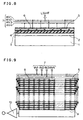
- Fig. 8 is a cross-sectional view of a solid-state image sensor in accordance with a preferred embodiment of the present invention.
- Fig. 9 is a plan view of a full-frame type CCD image sensor in accordance with a preferred embodiment of the present invention.
- Fig. 10 is a plan view of a full-frame type CCD image sensor in accordance with a preferred embodiment of the present invention.
- Fig. 11 is a cross-sectional view illustrating a structure of a contact between a metal wiring layer and an electrode.
- Fig. 8 is a cross-sectional view of a solid-state image sensor in accordance with the first embodiment.
- the illustrated solid-state image sensor is designed to include an n-type silicon substrate 1, a p-type well 2 formed in the n-type silicon substrate 1, and an n-type CCD channel 3 in the vicinity of a surface of the silicon substrate 1 and over the p-type well 2.
- the n-type silicon substrate 1 contains phosphorus at about 10 13 to about 10 15 cm -3
- the p-type well 2 has a depth in the range of 2 ⁇ m to 4 ⁇ m and contains boron at about 10 15 to about 10 16 cm -3
- the n-type CCD channel 3 has a depth in the range of 0.5 ⁇ m to 1 ⁇ m and contains phosphorus or arsenic at about 10 16 to about 10 17 cm -3 .
- a gate dioxide film 4 is formed over the n-type CCD channel 3 by thermal oxidation.
- the gate dioxide film 4 has a thickness in the range of about 20 nm to about 200 nm.
- a plurality of vertical CCD electrodes 5 composed of titanium dioxide (TiO 2 ) is formed on the gate dioxide film 4. The adjacent vertical CCD electrodes 5 are spaced away from each other. As mentioned later, the vertical CCD electrodes 5 are entirely covered with a cover film 6.
- a titanium dioxide (TiO 2 ) film is formed by reactive sputtering in which there are used titanium as a target and sputter gas including a partial pressure of oxygen at 5 to 50%, sputtering in which titanium dioxide (TiO 2 ) is a target, or plasma-enhanced chemical vapor deposition (PCVD) employing titanium tetrachloride (TiCl 4 ) and oxygen.
- the titanium dioxide (TiO 2 ) film has a thickness in the range of 0.1 to 2 ⁇ m.
- a product is annealed at a pressure of 1 ⁇ 10 -5 Torr or smaller, namely, in degree of vacuum in the order of 10 -6 Torr or greater at 300°C to 1200°C, or annealed at 300°C to 1000°C in hydrogen atmosphere, after the titanium dioxide (TiO 2 ) film has been formed.
- hydrogen atmosphere covers from an atmosphere established by a mixture gas of hydrogen at 10 % or greater and a rare gas such as helium and argon to an atmosphere established by 100% of hydrogen. Annealing time is a few minutes to a few hours.
- At least one of tungsten (W), phosphorus (P), antimony (Sb), tantalum (Ta), niobium (Nb), indium (In) and oxides thereof may be doped into a titanium dioxide (TiO 2 ) film for reducing resistivity.
- tungsten, phosphorus, antimony and indium they may be distributed in the vicinity of a surface of the titanium dioxide (TiO 2 ) film by ion-implantation, after the titanium dioxide (TiO 2 ) film has been formed, and doped wholly into the titanium dioxide (TiO 2 ) film by annealing.
- titanium sputtering target or a titanium dioxide (TiO 2 ) sputtering target containing any one of the above listed impurities at 10 19 to 10 21 cm -3 it would be easier to prepare a titanium sputtering target or a titanium dioxide (TiO 2 ) sputtering target containing any one of the above listed impurities at 10 19 to 10 21 cm -3 , and dope the impurities into the titanium dioxide (TiO 2 ) film by sputtering at the same time when the titanium dioxide (TiO 2 ) film is formed.
- the reduction of resistivity may be insufficient by either one of the above-mentioned methods, if a diameter of crystal grain was small, since a surface condition and/or surface morphology before formation of the titanium dioxide (TiO 2 ) film exerts an influence on a diameter of crystal grain.
- an increase in carriers may be facilitated by carrying out both the annealing in vacuum or in hydrogen atmosphere and the impurity doping, to thereby reduce resistivity.
- the titanium dioxide (TiO 2 ) film is patterned into a vertical CCD electrode shape by dry etching.
- impurities are doped into the titanium dioxide (TiO 2 ) film by ion-implantation
- the above-mentioned dry etching has to be carried out after the ion-implantation.
- resistivity is to be reduced by other methods than impurities doping by ion-implantation
- the above-mentioned dry etching may be carried out immediately after the formation of the thin titanium dioxide (TiO 2 ) film.
- An electrode may be a single layer electrode formed by etching a single, thin titanium dioxide (TiO 2 ) film to form spaces between vertical CCD electrodes, as illustrated in Fig. 8.
- an electrode may be a dual layer electrode comprising two thin titanium dioxide (TiO 2 ) films patterned into vertical CCD electrodes, and an interlayer insulating film sandwiched between the two thin titanium dioxide (TiO 2 ) films like a solid-state image sensor reported by D. H. McCann et al..
- titanium dioxide (TiO 2 ) into the vertical CCD electrodes 5 After patterning the titanium dioxide (TiO 2 ) into the vertical CCD electrodes 5, boron ions are implanted into the n-type channel 13 below the spaces between the vertical CCD electrodes 5 at about 10 keV to about 100 keV in dependence on a thickness of the gate dioxide film 4 with doses of 1 ⁇ 10 10 - 1 ⁇ 10 13 cm -2 by using the vertical CCD electrodes 5 as a mask, followed by annealing over the temperature range of about 700°C to about 1000°C for a few minutes to a few hours in vacuum or in hydrogen atmosphere.
- the characteristics of the titanium dioxide (TiO 2 ) vertical CCD electrodes 5 are kept not varied, even when the vertical CCD electrodes 5 are exposed to the atmosphere, if the TiO 2 vertical CCD electrodes 5 have an electrical conductivity by impurities doped thereinto.
- the TiO 2 vertical CCD electrodes 5 have an electrical conductivity by being thermally treated in vacuum or in hydrogen atmosphere, if the impurities are annealed at a higher temperature or in different atmospheres, it is preferable to form an insulating film such as a silicon oxide film or a silicon nitride film before annealing.
- an insulating film can be solidified by being burnt after the formation of the titanium dioxide (TiO 2 ) film, even if a silicon oxide film or a silicon nitride film may be formed by low temperature process as an insulating film, it would be possible to have desired characteristics by burning for solidification. If a silicon oxide film or a silicon nitride film may be formed by high temperature thermal CVD in which film formation temperature is about 800°C, desired characteristics of an insulating film may be obtained without burning the film for solidification.
- an electrode When an electrode is to be formed as a dual layer electrode, a lower layer is first patterned into a vertical CCD electrode shape, and then an interlayer insulating film is formed on the patterned lower layer.
- the above-mentioned silicon dioxide film or silicon nitride film formed by high temperature thermal CVD may be used as the interlayer insulating film. Since the silicon dioxide film or silicon nitride film formed by high temperature thermal CVD has insulating breakdown voltage of about 1 ⁇ 10 7 V/cm, the interlayer insulating film may be reduced in a thickness down to 20 nm, even if an insulating breakdown voltage of 20V is required between lower and upper layer vertical CCD electrodes, for instance.
- the interlayer insulating film doubles as a gate insulating film disposed below the upper layer vertical CCD electrodes. Since CCD would have an enhanced charge transfer ability by reducing a gate insulating film in a thickness, a greater amount of transfer charges might be transferred by reducing a thickness of the interlayer insulating film.
- the upper layer composed of titanium dioxide (TiO 2 ) is patterned into vertical CCD electrodes in the same manner as that of the lower layer vertical CCD electrodes. Thereafter, an insulating film is deposited over the upper layer vertical CCD electrodes in the same manner as that of the single-layered electrode.
- the planarizing film may be composed of PSG or BPSG having a high film-quality and high reliability, which needs a planarizing temperature in the range of about 800°C to about 1000°C.
- contact holes are formed throughout the insulating film, followed by annealing at about 800°C to about 1100°C in nitrogen atmosphere, to thereby smooth a shape of the contact holes and alter a portion of the titanium dioxide (TiO 2 ) vertical CCD electrodes 5 open to the contact hole into titanium nitride (TiN).
- annealing is carried out at about 800°C to about 1100°C in the same atmosphere as a conventional atmosphere in which boron is diffused into silicon employing argon gas as a carrier gas, to thereby smooth a shape of the contact holes and alter a portion of the titanium dioxide (TiO 2 ) vertical CCD electrodes 5 open to the contact hole into titanium boride (TiB 2 ).
- an internal metal wiring layer 50 is formed over the insulating film 51 so that the internal metal wiring layer 50 is contained in the contact hole.
- the internal metal wiring layer 50 is composed of a metal such as aluminum, copper, gold, molybdenum, and tungsten.
- a contact between the internal metal wiring layer 50 and the vertical CCD electrodes 5 has a structure of wiring metal 50/TiN 52/TiO 2 5 or wiring metal 50/TiB 2 53/TiO 2 5.
- titanium nitride (TiN) and titanium boride (TiB 2 ) have resistivity lower by figures than that of the titanium dioxide (TiO 2 ) vertical CCD electrodes 5, specifically, resistivity in the range of 10 -4 ⁇ cm to 10 -5 ⁇ cm and in the range of 10 -5 ⁇ cm to 10 -6 ⁇ cm, respectively, they make a buffer layer forming a preferred ohmic contact with wiring metal, and in addition, they act as barrier metal for preventing abnormal reaction, ensuring desired contact characteristic.
- the contact holes and the internal metal wiring layer are formed in a region not illustrated in Fig. 8.
- Fig. 8 illustrates a relation between the vertical CCDs electrodes 5 and signals 7 for driving them in the case that the vertical CCDs are of four-phase drive.
- a metal light-shield is formed on the insulating film composed of silicon dioxide or silicon nitride in a region not illustrated in Fig. 8 for defining a light-receiving region therewith.
- the metal light-shield is composed of aluminum, copper, gold, molybdenum or tungsten.
- a protection film composed of silicon dioxide, silicon nitride or other materials is formed over the device.
- the cover film 6 covering the vertical CCD electrodes 5 is comprised of the insulating film formed immediately on the titanium dioxide (TiO 2 ) vertical CCD electrodes 5, the film for planarization, the insulating formed on the internal metal wiring layer, and the protection film formed over the device.
- the cover film 6 over the lower layer vertical CCD electrodes includes an interlayer insulating film formed on the lower layer vertical CCD electrodes.
- the cover film 6 is composed entirely of a silicon dioxide film (a PSG film and a BPSG film are one of silicon dioxide films), reflection at a surface of the cover film 6 can be reduced to thereby have high sensitivity by, since an index of refraction of a silicon dioxide film is about 1.45, arranging the cover film 6 to have a total thickness equal to ⁇ /5.8 multiplied by an odd number, wherein ⁇ /5.8 is obtained by introducing the index of refraction, 1.45, into the equation ⁇ /4n.
- ⁇ indicates a wavelength of a light
- n indicates an index of refraction of a film in question.
- an insulating film to be formed on the vertical CCD electrodes 5 composed of titanium dioxide (TiO 2 ) is made of a silicon nitride film, and the film (PSG or BPSG) for planaraization formed in the light-receiving region is removed by etching with the insulating film made of a silicon nitride film used as an etching stopper, it would be possible to compose the entire cover film 6 in the fight-receiving region of a silicon nitride film, in which case, high sensitivity can be obtained by arranging the cover film 6 to have a total thickness equal to ⁇ /8 multiplied by an odd number, wherein ⁇ /8 is obtained by introducing the index of refraction of a silicon nitride film, 2, into the equation ⁇ /4n.
- indexes of refraction of first, second and third layers in the multi-layered structure are represented with N 1 , N 2 and N 3 , respectively.
- the second layer is arranged to have a thickness equal to ⁇ /4N 2 multiplied by an odd number.
- a relation among N 1 , N 2 and N 3 is N 1 ⁇ N 2 , N 2 >N 3 or N 1 >N 2 , N 2 ⁇ N 3
- the second layer is arranged to have a thickness equal to ⁇ /4N 2 multiplied by an even number.
- the titanium dioxide (TiO 2 ) vertical CCD electrodes 5 it would be preferable for the titanium dioxide (TiO 2 ) vertical CCD electrodes 5 to have a thickness equal to ⁇ /4N multiplied by an even number, since titanium dioxide (TiO 2 ) has a greater index of refraction than that of the gate insulating film composed of a silicon dioxide film or a silicon nitride film. It is also preferable for the gate insulating film to have a thickness equal to ⁇ /4N multiplied by an even number. However, if the gate insulating film became thicker to do so, a transfer ability of the vertical CCD would be degraded. Hence, it would be better in some cases to arrange the gate insulating film to have a thickness smaller than ⁇ /4N, considering the reduction in a transfer ability of the vertical CCD, to thereby significantly reduce optical interference effect in the gate insulating film.
- Fig. 9 illustrates a full-frame type CCD image sensor in accordance with the second embodiment.
- a plurality of p + type channel stop regions 8 divides a charge transfer channel into vertical sections to thereby define pixel rows in the number corresponding to the number of horizontal pixels.
- Each one of the channel stop 8 has a depth in the range of 1 ⁇ m to 4 ⁇ m, and has a boron concentration in the range of 10 17 to 10 19 cm -3 .
- a group of vertical CCDs 5 composed of titanium dioxide (TiO 2 ) is arranged perpendicularly to the channel stops 8. Signals 7 for driving the vertical CCDs 5 are transmitted to the CCD transfer electrodes 5 through left and right ends thereof.
- the illustrated full-frame type CCD image sensor does not have a storage section unlike a frame transfer type CCD image sensor, and includes a horizontal CCD 9 connected directly to a light-receiving region composed of the vertical CCDs 5, at a termination end thereof.
- the horizontal CCD 9 receives signal charges at a line at a time from the light-receiving region, and transmits the thus received signal charges to an output section 10 in the form of time sequence signals.
- the output section 10 carries out detection of signal charges and conversion of the detected charges into voltage, and emits the signal voltage as an output.
- the horizontal CCD transfer electrodes and the gate electrodes in a region other than the light-receiving region may be composed of titanium dioxide (TiO 2 ) or polysilicon.
- the signal charges are read out by closing a mechanical shutter when optical signal charges in an image have been finished to accumulate, and then by the same steps as steps for reading out charges out of a storage section in the above-mentioned conventional frame transfer type CCD image sensor.
- Fig. 10 illustrates another full-frame type CCD image sensor in accordance with the third embodiment of the present invention.
- signals 7 for driving the vertical CCDs 5 are transmitted to the vertical CCDs 5 through left and right ends thereof.
- Metal wirings 11 are formed on the channel stops 8.
- Contacts 12 for ensuring electrical connection between the metal wirings and the electrodes 5 are offset by a distance corresponding to one stage of the vertical CCDs 5.
- the vertical CCDs 5 are of four-phase drive, and hence, the contacts 12 are offset every four rows of the electrodes 5.
- the driving signals 7 are also supplied to the vertical CCDs 5 through the metal wirings 11 and the contacts 12.
- a load caused by wiring resistance and vertical CCD resistance is significantly decreased when the driving signals 7 are supplied to the vertical CCDs 5.
- delay and decay of the driving signals 7 are prevented to thereby ensure that the full-frame type CCD image sensor in accordance with the third embodiment has a higher charge transfer ability than the second embodiment illustrated in Fig. 9.
- an electrical conductivity type in each of the regions may be replaced with an opposite electrical conductivity type. Namely, a p-type conductivity may be replaced with an n-type conductivity, and vice versa.
- a dual-layered titanium dioxide CCD electrode is to be applied to CID image sensor, lower and upper layers are arranged perpendicularly to each other.
- the inventor fabricated a four-phase drive, vertical CCD type full-frame CCD image sensor having a structure as illustrated in Fig. 10 and also having effective pixels of 640 (H) ⁇ 480(V).
- an epitaxial silicon substrate comprising an n-type (100) silicon substrate containing phosphorus at about 2 ⁇ 10 14 cm -3 , and a 20 ⁇ m-thick epitaxial silicon layer formed on the n-type (100) silicon substrate and containing phosphorus at the same concentration.
- a p-type well containing boron at about 5 ⁇ 10 15 cm -3 and having a depth of about 3 ⁇ m was formed in the epitaxial silicon substrate.
- n-type CCD channel containing phosphorus at about 5 ⁇ 10 16 cm -3 and having a depth of about 1 ⁇ m was formed in the p-type well.
- the n-type CCD channel was perpendicularly divided into sections by channel stops arranged at a pitch of 10 ⁇ m.
- the channel stops had a depth of about 2 ⁇ m and contained boron at about 8 ⁇ 10 17 cm -3 .
- a gate oxide film was formed over a surface of the n-type CCD channel by a thickness of 50 nm by thermal oxidation.
- the reason why the gate oxide film was designed to have a thickness of 50 nm is as follows. Introduction of 550 nm, which is almost main wavelength in a wavelength band of visible radiation, to the equation 2 ⁇ /4n makes 190 nm, which is relatively thick as a film thickness of a gate oxide film. Hence, the thickness 190 nm may be adopted. However, if a gate oxide film was designed to have a thickness smaller than 95 nm corresponding to ⁇ /4n, it would be possible to enhance an ability of vertical CCD, and reduce interference effect with the result of smaller optical loss.
- TiO 2 titanium dioxide
- the titanium dioxide (TiO 2 ) vertical CCD electrodes were fabricated as follows. First, a titanium dioxide (TiO 2 ) layer was formed by reactive sputtering in which titanium was used as a target and there was employed an argon gas including oxygen at a partial pressure of 30%. The thus formed titanium dioxide (TiO 2 ) layer was annealed at 500°C for three hours in a vacuum kept in the order of 10 -7 Torr, and then dry-etched to thereby form 0.3 ⁇ m-spaces.
- titanium dioxide (TiO 2 ) vertical CCD electrodes were completed as a single layer electrode structure including electrodes having a width of 2.2 ⁇ m.
- a pixel had a dimension of 10 ⁇ m ⁇ in the four-phase drive type vertical CCD.
- the resistivity of the titanium dioxide (TiO 2 ) vertical CCD electrodes was 1 ⁇ 10 -2 to 2 ⁇ 10 -2 ⁇ cm. Resistivity almost the same as the above-mentioned one was obtained also by reactive sputtering in which titanium containing impurities such as phosphorus at about 1 ⁇ 10 20 cm -3 was uses as a target, or by sputtering in which titanium dioxide (TiO 2 ) containing impurities at the same concentration was uses as a target.
- the vertical CCD electrodes were designed to have a thickness of 550 nm, since it had been known by measurement that an index of refraction thereof was 2.5.
- the n-type channel was perpendicularly implanted at 50 keV with doses of 6 ⁇ 10 11 cm -2 boron at the spaces formed between the adjacent vertical CCD electrodes (it should be noted that ion-implantation is usually carried out at an angle of about 7 degrees from a normal line of a substrate).
- a silicon dioxide film was formed by a thickness of 50 nm by high temperature thermal CVD, and BPSG film was further formed on the silicon dioxide film by a thickness of 400 nm, followed by annealing for planarization at 950°C for 30 minutes in steam atmosphere.
- the product was annealed at 950°C for 30 minutes in nitrogen atmosphere to thereby smooth a shape of the contact holes, and further a surface portion of the titanium dioxide vertical CCD electrodes exposed to the contact holes was altered into titanium nitride (TiN).
- an internal metal wiring layer composed of aluminum was formed above the channel stops and around the light-receiving region.
- a silicon dioxide film was formed over the internal metal wiring layer for insulation by a thickness of 400 nm by plasma-enhanced CVD.
- a metal light-shield composed of aluminum was formed for defining the light-receiving region, and an outermost portion of the device was covered with a 200 nm-thick silicon dioxide film by plasma-enhanced CVD.
- the cover film formed on the titanium dioxide (TiO 2 ) vertical CCD electrodes was comprised of a silicon dioxide film having a thickness of 1050 nm which corresponds to about 11 ⁇ /4n wherein a wavelength ⁇ is 550 nm.
- a two-phase drive type horizontal CCD and a transistor of an output section were already formed by ordinary two-layer polysilicon process before the titanium dioxide vertical CCD electrodes had been formed.
- the vertical CCD and the horizontal CCD were connected with each other through dummy pixels below the metal light-shield. Then, a through-hole was formed throughout a silicon dioxide film formed on bonding pads.
- the thus fabricated full-frame type CCD image sensor was operated at 30 frames per second in order to test the performance thereof.
- the image sensor was exposed to a light for about 16.7 milliseconds to thereby accumulate image signals, and then the mechanical shutter was closed for about 16.7 milliseconds to thereby transfer charges and output the image signals. The above-mentioned operation was repeated.
- a frequency of the vertical CCD driving signals was about 30 kHz. The result was that no transfer fault was found. Since the titanium dioxide vertical CCD electrodes between the contacts arranged at a pitch of 40 ⁇ m had a significantly low resistance, specifically, in the range of about 3.3 to about 6.6 k ⁇ , a driving frequency is not limited by a resistance of the titanium dioxide vertical CCD electrodes and electrostatic capacity of a tiny area of the electrodes, but rather limited by a resistance of the internal metal wiring layer composed of aluminum and electrostatic capacity of the light-receiving region having a larger area and connected to the internal metal wiring layer. It was estimated that charge transfer could be carried out at a frequency up to about 20 MHz without any fault. This driving frequency is sufficiently used for high-speed transfer in a frame transfer type CCD image sensor. A quantum efficiency was equal to or greater than 60% over a visible radiation band, and was over 70% at maximum at a frequency of about 550 nm to about 600 nm.
- the solid-state image sensor in accordance with the present invention provides a high quantum efficiency which would be obtained when transparent, electrically conductive material such as ITO (In 2 O 3 -SnO 2 ) and tin oxide (SnO 2 ) is used.
- transparent, electrically conductive material such as ITO (In 2 O 3 -SnO 2 ) and tin oxide (SnO 2 ) is used.
- the solid-state image sensor enhances designability, performance limits and productivity, since it has no limitation in fabrication which would exist when the above-mentioned transparent, electrically conductive material is used.
Landscapes
- Solid State Image Pick-Up Elements (AREA)
- Light Receiving Elements (AREA)
- Electrodes Of Semiconductors (AREA)
Applications Claiming Priority (2)
| Application Number | Priority Date | Filing Date | Title |
|---|---|---|---|
| JP9024956A JP3019797B2 (ja) | 1997-02-07 | 1997-02-07 | 固体撮像素子とその製造方法 |
| JP24956/97 | 1997-02-07 |
Publications (2)
| Publication Number | Publication Date |
|---|---|
| EP0858112A2 true EP0858112A2 (de) | 1998-08-12 |
| EP0858112A3 EP0858112A3 (de) | 1999-01-20 |
Family
ID=12152448
Family Applications (1)
| Application Number | Title | Priority Date | Filing Date |
|---|---|---|---|
| EP98101889A Withdrawn EP0858112A3 (de) | 1997-02-07 | 1998-02-04 | Festkörperbildsensor und Herstellungsverfahren |
Country Status (3)
| Country | Link |
|---|---|
| US (1) | US6018169A (de) |
| EP (1) | EP0858112A3 (de) |
| JP (1) | JP3019797B2 (de) |
Cited By (5)
| Publication number | Priority date | Publication date | Assignee | Title |
|---|---|---|---|---|
| WO2000026967A1 (en) * | 1998-11-02 | 2000-05-11 | Hamamatsu Photonics K.K. | Semiconductor energy sensor |
| EP1796107A4 (de) * | 2004-08-13 | 2011-10-26 | Kanagawa Kagaku Gijutsu Akad | Transparenter leiter, transparente elektrode, solarzelle, lumineszentes bauelement und display-tafel |
| WO2012015632A1 (en) * | 2010-07-29 | 2012-02-02 | Image Sensor Technologies Acquisition Corporation | Ccd sensors with multiple contact patterns |
| WO2012015627A1 (en) * | 2010-07-29 | 2012-02-02 | Eastman Kodak Company | Ccd sensors with multiple contact patterns |
| US8293663B2 (en) | 2010-07-29 | 2012-10-23 | Truesense Imaging, Inc. | CCD sensors with multiple contact patterns |
Families Citing this family (18)
| Publication number | Priority date | Publication date | Assignee | Title |
|---|---|---|---|---|
| JP3988239B2 (ja) * | 1998-03-19 | 2007-10-10 | ソニー株式会社 | 固体撮像素子及びその製造方法 |
| JP4493124B2 (ja) * | 1999-08-04 | 2010-06-30 | 日本テキサス・インスツルメンツ株式会社 | 固体撮像装置 |
| DE10140514A1 (de) | 2001-08-17 | 2003-02-27 | Heraeus Gmbh W C | Sputtertarget auf Basis von Titandioxid |
| FR2838561B1 (fr) * | 2002-04-12 | 2004-09-17 | Commissariat Energie Atomique | Matrice de photodectecteurs, a pixels isoles par des murs, hybridee sur un circuit de lecture |
| US7430897B2 (en) * | 2002-09-19 | 2008-10-07 | National Research Council Of Canada | Method and apparatus for detecting and locating gas leaks |
| JP2004140258A (ja) * | 2002-10-18 | 2004-05-13 | Sanyo Electric Co Ltd | 固体撮像素子及びその製造方法 |
| ATE474071T1 (de) * | 2003-08-11 | 2010-07-15 | Honeywell Int Inc | Target/trägerplatte-konstruktionen und herstellungsverfahren dafür |
| JP4496751B2 (ja) * | 2003-10-09 | 2010-07-07 | 日本電気株式会社 | 熱型赤外線固体撮像素子及びその製造方法 |
| JP2006049451A (ja) * | 2004-08-03 | 2006-02-16 | Sony Corp | 固体撮像素子及び固体撮像素子の駆動方法 |
| WO2006073189A1 (ja) * | 2005-01-08 | 2006-07-13 | Kanagawa Academy Of Science And Technology | 機能素子及び酸化物材料形成方法 |
| JP2007053183A (ja) * | 2005-08-17 | 2007-03-01 | Fujifilm Corp | 固体撮像素子 |
| EP1943374A2 (de) * | 2005-09-09 | 2008-07-16 | University of Nevada, Reno | Herstellung eines nanoröhrchen-titansubstrats mit sauerstofflücken und deren verwendung bei der photoelektrolyse von wasser |
| US7524690B2 (en) * | 2006-08-10 | 2009-04-28 | United Microelectronics Corp. | Image sensor with a waveguide tube and a related fabrication method |
| CN100413084C (zh) * | 2006-09-18 | 2008-08-20 | 西安理工大学 | 绕行转移面阵电荷耦合器件ccd |
| US20110073982A1 (en) * | 2007-05-25 | 2011-03-31 | Armstrong J Joseph | Inspection system using back side illuminated linear sensor |
| JP2011009502A (ja) * | 2009-06-26 | 2011-01-13 | Showa Denko Kk | 発光素子、その製造方法、ランプ、電子機器及び機械装置 |
| FR2971084B1 (fr) * | 2011-01-28 | 2013-08-23 | E2V Semiconductors | Capteur d'image multilineaire a integration de charges |
| US8987788B2 (en) | 2011-09-26 | 2015-03-24 | Semiconductor Components Industries, Llc | Metal-strapped CCD image sensors |
Family Cites Families (7)
| Publication number | Priority date | Publication date | Assignee | Title |
|---|---|---|---|---|
| US4012767A (en) * | 1976-02-25 | 1977-03-15 | General Electric Company | Electrical interconnections for semi-conductor devices |
| JPS5941351B2 (ja) * | 1976-09-13 | 1984-10-06 | 株式会社日立製作所 | カラ−用固体撮像素子 |
| US4720746A (en) * | 1985-08-05 | 1988-01-19 | Eastman Kodak Company | Frame transfer CCD area image sensor with improved horizontal resolution |
| JPH0685583B2 (ja) * | 1986-05-27 | 1994-10-26 | 富士写真フイルム株式会社 | カラ−用固体撮像素子 |
| JPH02229473A (ja) * | 1989-03-01 | 1990-09-12 | Ricoh Co Ltd | パターン化光導電体素子の製造方法 |
| US4994405A (en) * | 1989-11-21 | 1991-02-19 | Eastman Kodak Company | Area image sensor with transparent electrodes |
| JP2797941B2 (ja) * | 1993-12-27 | 1998-09-17 | 日本電気株式会社 | 光電変換素子とその駆動方法 |
-
1997
- 1997-02-07 JP JP9024956A patent/JP3019797B2/ja not_active Expired - Fee Related
-
1998
- 1998-02-04 EP EP98101889A patent/EP0858112A3/de not_active Withdrawn
- 1998-02-05 US US09/019,470 patent/US6018169A/en not_active Expired - Lifetime
Cited By (8)
| Publication number | Priority date | Publication date | Assignee | Title |
|---|---|---|---|---|
| WO2000026967A1 (en) * | 1998-11-02 | 2000-05-11 | Hamamatsu Photonics K.K. | Semiconductor energy sensor |
| US6541753B2 (en) | 1998-11-02 | 2003-04-01 | Hammatsu Photonics K.K. | Semiconductor energy detector having reinforcement |
| EP1796107A4 (de) * | 2004-08-13 | 2011-10-26 | Kanagawa Kagaku Gijutsu Akad | Transparenter leiter, transparente elektrode, solarzelle, lumineszentes bauelement und display-tafel |
| TWI382004B (zh) * | 2004-08-13 | 2013-01-11 | Kanagawa Kagaku Gijutsu Akad | 透明導體、透明電極、太陽電池、發光元件以及顯示面板 |
| WO2012015632A1 (en) * | 2010-07-29 | 2012-02-02 | Image Sensor Technologies Acquisition Corporation | Ccd sensors with multiple contact patterns |
| WO2012015627A1 (en) * | 2010-07-29 | 2012-02-02 | Eastman Kodak Company | Ccd sensors with multiple contact patterns |
| US8274100B2 (en) | 2010-07-29 | 2012-09-25 | Truesense Imaging, Inc. | CCD sensors with multiple contact patterns |
| US8293663B2 (en) | 2010-07-29 | 2012-10-23 | Truesense Imaging, Inc. | CCD sensors with multiple contact patterns |
Also Published As
| Publication number | Publication date |
|---|---|
| US6018169A (en) | 2000-01-25 |
| JP3019797B2 (ja) | 2000-03-13 |
| EP0858112A3 (de) | 1999-01-20 |
| JPH10223877A (ja) | 1998-08-21 |
Similar Documents
| Publication | Publication Date | Title |
|---|---|---|
| US6018169A (en) | Solid-state image sensor and method of fabricating the same | |
| US5235198A (en) | Non-interlaced interline transfer CCD image sensing device with simplified electrode structure for each pixel | |
| US6501065B1 (en) | Image sensor using a thin film photodiode above active CMOS circuitry | |
| KR0175175B1 (ko) | 고체 화상 소자 | |
| EP0409970B1 (de) | Zwischenzeilige übertragende ccd-bildsensorvorrichtung mit einer elektrodenstruktur für jeden bildpunkt | |
| US20220238575A1 (en) | Dummy vertical transistor structure to reduce cross talk in pixel sensor | |
| US20090209060A1 (en) | Photoelectric converting film stack type solid-state image pickup device, and method of producing the same | |
| US6525356B1 (en) | Solid imaging device | |
| US7105867B2 (en) | Solid-state imaging device and manufacturing method thereof | |
| US7102185B2 (en) | Lightshield architecture for interline transfer image sensors | |
| US5895944A (en) | Charge coupled device image sensor and method of driving the same | |
| JPH0846169A (ja) | Ccd映像素子及びその製造方法 | |
| US20050263676A1 (en) | Complementary metal oxide semiconductor image sensor and method for fabricating the same | |
| US20110031573A1 (en) | Solid-state imaging device, imaging apparatus, and manufacturing method of solid-state imaging device | |
| EP0428050B1 (de) | Photosensor mit einer amorphen photoabsorbierenden Schicht aus Silizium | |
| JP3394308B2 (ja) | 固体撮像装置 | |
| US5142346A (en) | Floating gate JFET image sensor | |
| US20240145514A1 (en) | Image sensor | |
| JPH04373174A (ja) | 固体撮像装置 | |
| US6441853B1 (en) | Solid-state image sensor having vertical transfer electrodes protected from short circuiting | |
| JPH0888344A (ja) | 固体撮像装置 | |
| JP3239934B2 (ja) | 固体撮像素子及びその製造方法 | |
| JP3890381B2 (ja) | 固体撮像装置 | |
| JP2002110959A (ja) | 固体撮像装置およびその製造方法 | |
| WO1991008590A1 (en) | Non-interlaced interline transfer ccd image sensing device with simplified electrode structure for each pixel |
Legal Events
| Date | Code | Title | Description |
|---|---|---|---|
| PUAI | Public reference made under article 153(3) epc to a published international application that has entered the european phase |
Free format text: ORIGINAL CODE: 0009012 |
|
| AK | Designated contracting states |
Kind code of ref document: A2 Designated state(s): DE FR GB NL |
|
| AX | Request for extension of the european patent |
Free format text: AL;LT;LV;MK;RO;SI |
|
| PUAL | Search report despatched |
Free format text: ORIGINAL CODE: 0009013 |
|
| AK | Designated contracting states |
Kind code of ref document: A3 Designated state(s): AT BE CH DE DK ES FI FR GB GR IE IT LI LU MC NL PT SE |
|
| AX | Request for extension of the european patent |
Free format text: AL;LT;LV;MK;RO;SI |
|
| 17P | Request for examination filed |
Effective date: 19990301 |
|
| AKX | Designation fees paid |
Free format text: DE FR GB NL |
|
| 17Q | First examination report despatched |
Effective date: 20021002 |
|
| GRAP | Despatch of communication of intention to grant a patent |
Free format text: ORIGINAL CODE: EPIDOSNIGR1 |
|
| STAA | Information on the status of an ep patent application or granted ep patent |
Free format text: STATUS: THE APPLICATION IS DEEMED TO BE WITHDRAWN |
|
| 18D | Application deemed to be withdrawn |
Effective date: 20050920 |