EP0859020A2 - Verfahren zur Herstellung von Polypropylenterephthalat - Google Patents
Verfahren zur Herstellung von Polypropylenterephthalat Download PDFInfo
- Publication number
- EP0859020A2 EP0859020A2 EP98101696A EP98101696A EP0859020A2 EP 0859020 A2 EP0859020 A2 EP 0859020A2 EP 98101696 A EP98101696 A EP 98101696A EP 98101696 A EP98101696 A EP 98101696A EP 0859020 A2 EP0859020 A2 EP 0859020A2
- Authority
- EP
- European Patent Office
- Prior art keywords
- ppm
- esterification
- polycondensation
- catalyst
- polypropylene terephthalate
- Prior art date
- Legal status (The legal status is an assumption and is not a legal conclusion. Google has not performed a legal analysis and makes no representation as to the accuracy of the status listed.)
- Granted
Links
Classifications
-
- C—CHEMISTRY; METALLURGY
- C08—ORGANIC MACROMOLECULAR COMPOUNDS; THEIR PREPARATION OR CHEMICAL WORKING-UP; COMPOSITIONS BASED THEREON
- C08G—MACROMOLECULAR COMPOUNDS OBTAINED OTHERWISE THAN BY REACTIONS ONLY INVOLVING UNSATURATED CARBON-TO-CARBON BONDS
- C08G63/00—Macromolecular compounds obtained by reactions forming a carboxylic ester link in the main chain of the macromolecule
- C08G63/78—Preparation processes
- C08G63/82—Preparation processes characterised by the catalyst used
-
- C—CHEMISTRY; METALLURGY
- C08—ORGANIC MACROMOLECULAR COMPOUNDS; THEIR PREPARATION OR CHEMICAL WORKING-UP; COMPOSITIONS BASED THEREON
- C08G—MACROMOLECULAR COMPOUNDS OBTAINED OTHERWISE THAN BY REACTIONS ONLY INVOLVING UNSATURATED CARBON-TO-CARBON BONDS
- C08G63/00—Macromolecular compounds obtained by reactions forming a carboxylic ester link in the main chain of the macromolecule
- C08G63/02—Polyesters derived from hydroxycarboxylic acids or from polycarboxylic acids and polyhydroxy compounds
- C08G63/12—Polyesters derived from hydroxycarboxylic acids or from polycarboxylic acids and polyhydroxy compounds derived from polycarboxylic acids and polyhydroxy compounds
- C08G63/16—Dicarboxylic acids and dihydroxy compounds
- C08G63/18—Dicarboxylic acids and dihydroxy compounds the acids or hydroxy compounds containing carbocyclic rings
- C08G63/181—Acids containing aromatic rings
- C08G63/183—Terephthalic acids
-
- C—CHEMISTRY; METALLURGY
- C08—ORGANIC MACROMOLECULAR COMPOUNDS; THEIR PREPARATION OR CHEMICAL WORKING-UP; COMPOSITIONS BASED THEREON
- C08G—MACROMOLECULAR COMPOUNDS OBTAINED OTHERWISE THAN BY REACTIONS ONLY INVOLVING UNSATURATED CARBON-TO-CARBON BONDS
- C08G63/00—Macromolecular compounds obtained by reactions forming a carboxylic ester link in the main chain of the macromolecule
- C08G63/78—Preparation processes
- C08G63/82—Preparation processes characterised by the catalyst used
- C08G63/85—Germanium, tin, lead, arsenic, antimony, bismuth, titanium, zirconium, hafnium, vanadium, niobium, tantalum, or compounds thereof
Definitions
- the present invention relates to the production of polypropylene terephthalate from terephthalic acid and 1,3-propanediol.
- Polypropylene terephthalate is now growing after 1,3-propanediol affordable prices is available on a large industrial scale, a trend-setting Plastic with a long chain zigzag molecule structure and properties, mostly between those of polyethylene terephthalate and polybutylene terephthalate. Areas of application are preferred the entire fiber area and molded body.
- the object of the present invention is therefore to minimize the Acrolein and allyl alcohol content of polypropylene terephthalate.
- polypropylene terephthalate with a neutral, bluish-white color can be produced.
- the polypropylene terephthalate contains no more than 5 ppm acrolein and no more than 3 ppm allyl alcohol and by direct esterification in the presence of 30 to 200 ppm titanium in the form of an inorganic containing at least 50 mol% TiO 2 precipitate
- Esterification catalyst blocking the esterification catalyst after the esterification by adding 10 to 100 ppm phosphorus in the form of a phosphorus-oxygen compound and subsequent precondensation and polycondensation in the presence of 100 to 300 ppm antimony in the form of a conventional antimony polycondensation catalyst and optionally customary color toners .
- the starting products are terephthalic acid and 1,3-propanediol in the for Polyester usual quality.
- Terephthalic acid and 1,3-propanediol can up to a total of 15 mol% through other dicarboxylic acids and / or others Diole to be replaced. Examples include 2,6-naphthalenedicarboxylic acid, 1,4-cyclohexanedicarboxylic acid, p-hydroxybenzoic acid, 4,4'-biphenyldicarboxylic acid, ethylene glycol, 1,2-propanediol, 1,4-butanediol, diethylene glycol, dipropylene glycol and / or 1,4-cyclohexanedimethanol into consideration.
- the esterification of the terephthalic acid with the 1,3-propanediol takes place in the presence of 30 to 200 ppm, preferably 50 to 100 ppm, of titanium in the form of an inorganic esterification catalyst containing at least 50 mol% of TiO 2 precipitate.
- the esterification catalyst may only contain titanium in the form of TiO 2 , but not in the form of, for example, organic titanium esters.
- Hydrated titanium dioxide obtained by thermal hydrolysis of titanyl sulfate is suitable, as described in EP patent application 96 103 659.7.
- a titanium dioxide / silicon dioxide coprecipitate with 50 to 99 mol% TiO 2 is particularly suitable.
- Such coprecipitates are described in patent applications WO 95/18839 and EP 0 716 112 A, but are used exclusively as polycondensation catalysts.
- the allyl alcohol content of the polypropylene terephthalate is the Inactivation or blocking of the esterification catalyst after Completion of the esterification and before the start of the polycondensation, preferably at the beginning of the precondensation, by adding 10 to 100 ppm, preferably 20 to 60 ppm phosphorus in the form of a phosphorus-oxygen compound, such as phosphorous acid, phosphoric acid, Phosphonic acid, carboxyphosphonic acid and their compounds.
- a phosphorus-oxygen compound such as phosphorous acid, phosphoric acid, Phosphonic acid, carboxyphosphonic acid and their compounds.
- the precondensation and polycondensation take place in the presence of 100 to 300 ppm, preferably 200 to 250 ppm, of antimony in the form of a usual polyester-soluble antimony polycondensation catalyst, for example antimony triacetate.
- the addition of the polycondensation catalyst can simultaneously add the phosphorus compound be carried out, but is preferably carried out only immediately after Completion of this, especially when polymers with particularly good Transparency is desired.
- the polypropylene terephthalate should be a have a neutral, bluish-white color, corresponding to a CIELAB color value b * in the range of -4.0 to +4.0.
- a color tone preferably 20 to 60 ppm, in particular 30 to 50 ppm cobalt in the form of a polyester-soluble cobalt compound such as cobalt acetate.
- the temperature and pressure conditions of esterification, precondensation and polycondensation correspond to those from the prior art known. If necessary, subsequent to the melt polycondensation and granulation another solid phase polycondensation respectively.
- additives such as dyes, Matting agents, lubricants, crosslinking agents, etc. are possible.
- the intrinsic viscosities were determined on a solution of 0.5 g Polyester in 100 ml of a mixture of phenol and 1,2-dichlorobenzene (3: 2 parts by weight) at 25 ° C.
- the COOH end group concentration was determined by photometric titration with 0.05 N ethanolic potassium hydroxide solution against bromothymol blue a solution of the polyester in a mixture of o-cresol and chloroform (70:30 Parts by weight) determined.
- the CIELAB color values were measured on polyester granules crystallized in a drying cabinet at 150 ⁇ 5 ° C. for 1 h.
- the color values were determined by measuring the hue of the polyester sample with three photocells, each with a red, green or blue filter, in a three-range colorimeter (X, Y and Z values).
- the content of free acrolein, which is physically dissolved in the polyester Allyl alcohol was determined as follows: The polyester to be analyzed was cooled with liquid nitrogen after cooling and the Sieve fraction smaller than 0.4 mm used for the analysis. 2.0 g of the to The determining polyester sample was placed in a 20 ml bottle with a septum given, the bottle closed and for 60 min at 170 ° C. held. The gas space of the bottle became a sample through the septum removed and the acrolein and allyl alcohol content by gas chromatography certainly.
- terephthalic acid 1 part by weight of terephthalic acid was mixed with that specified in the table Parts by weight of 1,3-propanediol (1,3-PD) mixed into a paste and together with the esterification catalyst and optionally Cobalt acetate tetrahydrate as a color tone in the presented Esterification product from a previous similar batch fed.
- the Polycondensation catalyst added. The mixture was used until significant decrease in the water of reaction (degree of esterification at least 98.8%) esterified.
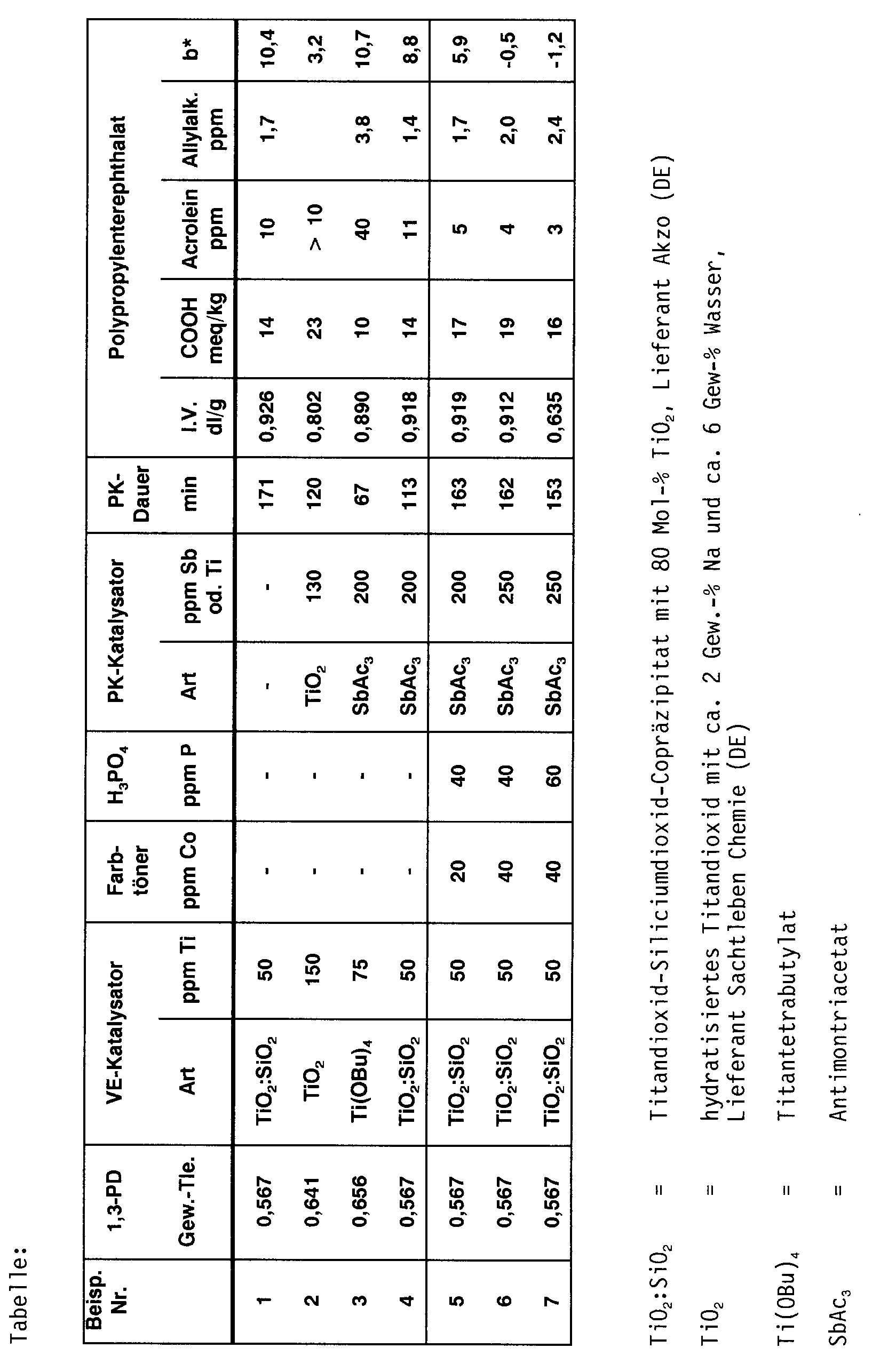
- titanium tetrabutylate (comparative example 3) to yellowish products with high acrolein and Allyl alcohol content.
- esterification is slower than when using the titanium dioxide precipitate catalysts according to the invention.
- this shows Titanium dioxide / silica coprecipitate a higher catalytic Activity, but leads to one (without adding a tint) stronger polymer discoloration than the pure titanium dioxide precipitate (Comparative Example 2).
- By adding an appropriate amount of Color tone can correct the discoloration, so that polyester with b * color values of less than +0.5 can be produced without problems can (Examples 6 and 7).
- the allyl alcohol content that can be achieved with the esterification catalysts according to the invention without inactivating the catalyst before the polycondensation is satisfactory, regardless of the type of polycondensation catalyst, while the acrolein content is lower than when using titanium tetrabutylate, but with at least 10 ppm Acrolein still quite high (Comparative Examples 1, 2 and 4).
- the esterification catalyst based on TiO 2 according to the invention must be completely blocked before the polycondensation by adding a phosphorus-oxygen compound (Example 5 compared to Comparative Example 4) and the polycondensation catalyst free of titanium be.
Landscapes
- Chemical & Material Sciences (AREA)
- Health & Medical Sciences (AREA)
- Chemical Kinetics & Catalysis (AREA)
- Medicinal Chemistry (AREA)
- Polymers & Plastics (AREA)
- Organic Chemistry (AREA)
- Polyesters Or Polycarbonates (AREA)
- Organic Low-Molecular-Weight Compounds And Preparation Thereof (AREA)
- Peptides Or Proteins (AREA)
Abstract
Description
Claims (7)
- Verfahren zur Herstellung von Polypropylenterephthalat durch Direkt-Veresterung von Terephthalsäure mit 1,3-Propandiol und nachfolgende Vorkondensation und Polykondensation, dadurch gekennzeichnet, daß das Polypropylenterephthalat nicht mehr als 5 ppm Acrolein und nicht mehr als 3 ppm Allylalkohol enthält und durch Veresterung in Gegenwart von 30 bis 200 ppm Titan in Form eines mindestens 50 Mol-% TiO2-Präzipitat enthaltenden anorganischen Veresterungskatalysators, Blockierung des Veresterungskatalysators nach der Veresterung durch Zusatz von 10 bis 100 ppm Phosphor in Form einer Phosphor-Sauerstoff-Verbindung und nachfolgende Vorkondensation und Polykondensation in Gegenwart von 100 bis 300 ppm Antimon in Form eines üblichen Antimon-Polykondensationskatalysators, und wahlweise Zusatz zu einem beliebigen Zeitpunkt von üblichen Farbtönern, erhalten wird.
- Verfahren gemäß Anspruch 1, dadurch gekennzeichnet, daß der Farbtöner aus 20 bis 60 ppm Cobalt in Form einer polyesterlöslichen Cobaltverbindung besteht.
- Verfahren gemäß Anspruch 1 oder 2, dadurch gekennzeichnet, daß der Polykondensationskatalysator nach Abschluß der Zugabe der Phosphorverbindung zugesetzt wird.
- Verfahren gemäß einem der Ansprüche 1 bis 3, dadurch gekennzeichnet, daß der Veresterungskatalysator ein durch thermische Hydrolyse von Titanylsulfat erhaltenes, hydratisiertes Titandioxid ist.
- Verfahren gemäß einem der Ansprüche 1 bis 3, dadurch gekennzeichnet, daß der Veresterungskatalysator ein Titandioxid/Siliciumdioxid-Copräzipitat mit 50 bis 99 Mol-% TiO2 ist.
- Verfahren gemäß einem der Ansprüche 1 bis 5, dadurch gekennzeichnet, daß das Polypropylenterephthalat ein Copolyester mit insgesamt bis zu 15 Mol-% anderer Dicarbonsäuren und/oder anderer Diole ist.
- Polypropylenterephthalat, welches nach dem Verfahren gemäß einem der Ansprüche 1 bis 6 herstellbar ist, dadurch gekennzeichnet, daß es nicht mehr als 5 ppm Acrolein und nicht mehr als 3 ppm Allylalkohol enthält.
Applications Claiming Priority (2)
| Application Number | Priority Date | Filing Date | Title |
|---|---|---|---|
| DE19705249A DE19705249A1 (de) | 1997-02-12 | 1997-02-12 | Verfahren zur Herstellung von Polypropylenterphthalat |
| DE19705249 | 1997-02-12 |
Publications (3)
| Publication Number | Publication Date |
|---|---|
| EP0859020A2 true EP0859020A2 (de) | 1998-08-19 |
| EP0859020A3 EP0859020A3 (de) | 2002-01-02 |
| EP0859020B1 EP0859020B1 (de) | 2006-06-07 |
Family
ID=7819961
Family Applications (1)
| Application Number | Title | Priority Date | Filing Date |
|---|---|---|---|
| EP98101696A Expired - Lifetime EP0859020B1 (de) | 1997-02-12 | 1998-02-02 | Verfahren zur Herstellung von Polypropylenterephthalat |
Country Status (8)
| Country | Link |
|---|---|
| US (1) | US5798433A (de) |
| EP (1) | EP0859020B1 (de) |
| KR (1) | KR100496260B1 (de) |
| CN (1) | CN1094133C (de) |
| AT (1) | ATE328933T1 (de) |
| DE (2) | DE19705249A1 (de) |
| ES (1) | ES2268741T3 (de) |
| PT (1) | PT859020E (de) |
Cited By (1)
| Publication number | Priority date | Publication date | Assignee | Title |
|---|---|---|---|---|
| WO2000061657A1 (en) * | 1999-04-08 | 2000-10-19 | E.I. Du Pont De Nemours And Company | Catalysis with titanium oxides |
Families Citing this family (52)
| Publication number | Priority date | Publication date | Assignee | Title |
|---|---|---|---|---|
| US6428767B1 (en) | 1995-05-12 | 2002-08-06 | E. I. Du Pont De Nemours And Company | Method for identifying the source of carbon in 1,3-propanediol |
| US5686276A (en) | 1995-05-12 | 1997-11-11 | E. I. Du Pont De Nemours And Company | Bioconversion of a fermentable carbon source to 1,3-propanediol by a single microorganism |
| ATE287979T1 (de) | 1997-09-03 | 2005-02-15 | Asahi Chemical Ind | Polyesterfaser und gewebe daraus |
| US6245844B1 (en) * | 1998-09-18 | 2001-06-12 | E. I. Du Pont De Nemours And Company | Nucleating agent for polyesters |
| MXPA01003740A (es) * | 1998-10-15 | 2004-09-10 | Asahi Chemical Ind | Fibra politrimetilentereftalato. |
| WO2000026301A1 (en) | 1998-10-30 | 2000-05-11 | Asahi Kasei Kabushiki Kaisha | Polyester resin composition and fiber |
| US5989665A (en) * | 1999-03-15 | 1999-11-23 | Eastman Chemical Company | Copolyesters of 1,3-propanediol having improved gas barrier properties |
| US6350895B1 (en) | 1999-03-26 | 2002-02-26 | E. I. Du Pont De Nemours And Company | Transesterification process using yttrium and samarium compound catalystis |
| US6331264B1 (en) | 1999-03-31 | 2001-12-18 | E. I. Du Pont De Nemours And Company | Low emission polymer compositions |
| US6277947B1 (en) * | 2000-04-21 | 2001-08-21 | Shell Oil Company | Process of producing polytrimethylene terephthalate (PTT) |
| DE69905856T2 (de) * | 1999-04-22 | 2003-12-18 | Shell Internationale Research Maatschappij B.V., Den Haag | Verfahren zur Herstellung von Polytrimethylenterephthalat (PTT) |
| US6512080B2 (en) | 1999-04-22 | 2003-01-28 | Shell Oil Company | Process of producing polytrimethylene terephthalate (PTT) |
| US6277289B1 (en) | 1999-07-01 | 2001-08-21 | E. I. Du Pont De Nemours And Company | Treatment of aqueous aldehyde waste streams |
| AU6218100A (en) | 1999-07-20 | 2001-02-05 | Procter & Gamble Company, The | Improved encapsulated oil particles |
| JP5283298B2 (ja) | 1999-08-25 | 2013-09-04 | イー・アイ・デュポン・ドウ・ヌムール・アンド・カンパニー | ジ(1,3−プロピレングリコール)低レベル含有ポリ(トリメチレンテレフタレート)の調製 |
| US6410619B2 (en) | 1999-11-22 | 2002-06-25 | Bayer Corporation | Method for conditioning organic pigments |
| MXPA02007740A (es) * | 2000-02-11 | 2002-10-23 | Du Pont | Proceso continuo para la produccion de poli(trimetilen tereftalato). |
| US6353062B1 (en) | 2000-02-11 | 2002-03-05 | E. I. Du Pont De Nemours And Company | Continuous process for producing poly(trimethylene terephthalate) |
| MY127766A (en) * | 2000-04-21 | 2006-12-29 | Shell Int Research | Optimum dipropylene glycol content polytrimethylene terephthalate compositions |
| US6576774B2 (en) | 2000-07-20 | 2003-06-10 | Shell Oil Company | Process for recycling polytrimethylene terephthalate cyclic dimer |
| US6914107B2 (en) | 2001-01-24 | 2005-07-05 | E. I. Du Pont De Nemours And Company | Catalyst composition and process therewith |
| MXPA03006900A (es) * | 2001-02-07 | 2003-11-18 | Asahi Chemical Ind | Poli (tereftalato de trimetileno) y proceso para obtenerlo. |
| US6740400B2 (en) | 2001-02-07 | 2004-05-25 | Asahi Kasei Kabushiki Kaisha | Poly (trimethylene terephthalate) and a process for producing the same |
| US6489433B2 (en) | 2001-02-23 | 2002-12-03 | E. I. Du Pont De Nemours And Company | Metal-containing composition and process therewith |
| US6506853B2 (en) | 2001-02-28 | 2003-01-14 | E. I. Du Pont De Nemours And Company | Copolymer comprising isophthalic acid |
| DE10112493A1 (de) * | 2001-03-15 | 2002-09-19 | Mitsubishi Polyester Film Gmbh | Weiße, biaxial orientierte Folie aus einem kristallisierbaren Thermoplasten mit hohem Weißgrad und mit zusätzlicher Funktionalität |
| KR100459654B1 (ko) * | 2001-10-12 | 2004-12-03 | 에스케이케미칼주식회사 | 1,4-사이클로헥산디메탄올이 공중합된 폴리에스테르수지의 제조방법 |
| EP1347005A1 (de) * | 2002-03-23 | 2003-09-24 | Zimmer AG | Polytrimethylenterephthalatharze mit verbesserten Eigenschaften |
| US6887953B2 (en) * | 2002-10-11 | 2005-05-03 | E.I. Du Pont De Nemours And Company | Esterification process |
| US6641916B1 (en) | 2002-11-05 | 2003-11-04 | E. I. Du Pont De Nemours And Company | Poly(trimethylene terephthalate) bicomponent fibers |
| MXPA04012278A (es) * | 2002-12-23 | 2005-02-25 | Du Pont | Proceso de fibra bicomponente de poli(tereftalato de trimetileno). |
| US7005093B2 (en) * | 2003-02-05 | 2006-02-28 | E. I. Du Pont De Nemours And Company | Spin annealed poly(trimethylene terephthalate) yarn |
| US20060173155A1 (en) * | 2003-03-05 | 2006-08-03 | Katsuhiro Fujimoto | Polytrimethylene terephthalate composition and process for producing the same |
| US7303795B2 (en) * | 2003-03-13 | 2007-12-04 | Invista North America S.A. R.L. | Molding of polypropylene with enhanced reheat characteristics |
| US20040222154A1 (en) * | 2003-05-08 | 2004-11-11 | E.I.Du Pont De Nemours & Company | Treatment of non-aqueous aldehyde waste streams |
| US20070035057A1 (en) * | 2003-06-26 | 2007-02-15 | Chang Jing C | Poly(trimethylene terephthalate) bicomponent fiber process |
| US20050147784A1 (en) * | 2004-01-06 | 2005-07-07 | Chang Jing C. | Process for preparing poly(trimethylene terephthalate) fiber |
| US20060041039A1 (en) * | 2004-08-20 | 2006-02-23 | Gyorgyi Fenyvesi | Fluorescent poly(alkylene terephthalate) compositions |
| TWI376390B (en) * | 2004-09-16 | 2012-11-11 | Lurgi Zimmer Gmbh | Polytrimethylene terephthalate having a low level of acrolein and a process for producing the same |
| KR101159844B1 (ko) | 2004-12-29 | 2012-06-25 | 에스케이케미칼주식회사 | 티탄 화합물을 촉매로 사용하는 결정성 폴리에스테르의 제조방법 |
| US7357985B2 (en) * | 2005-09-19 | 2008-04-15 | E.I. Du Pont De Nemours And Company | High crimp bicomponent fibers |
| US7666501B2 (en) * | 2005-12-07 | 2010-02-23 | E. I. Du Pont De Nemours And Company | Poly(trimethylene terephthalate)/poly(alpha-hydroxy acid) bi-constituent filaments |
| US20070128459A1 (en) * | 2005-12-07 | 2007-06-07 | Kurian Joseph V | Poly(trimethylene terephthalate)/poly(alpha-hydroxy acid) films |
| US20070129503A1 (en) * | 2005-12-07 | 2007-06-07 | Kurian Joseph V | Poly(trimethylene terephthalate)/poly(alpha-hydroxy acid) molded, shaped articles |
| WO2010079500A2 (en) | 2008-02-28 | 2010-07-15 | Reliance Life Sciences Pvt. Ltd | Aerobic production of 1,3-propanediol from crude glycerol from biodiesel process. |
| CN102050942A (zh) * | 2009-11-02 | 2011-05-11 | 远东新世纪股份有限公司 | 含钛组合物及以含钛组合物催化聚酯化反应的方法 |
| KR20130090640A (ko) * | 2012-02-06 | 2013-08-14 | 삼성정밀화학 주식회사 | 폴리에스테르 수지 합성용 촉매 및 이를 이용한 폴리에스테르 수지의 제조방법 |
| EP3907312A1 (de) | 2012-03-30 | 2021-11-10 | DuPont Industrial Biosciences USA, LLC | Polyester und daraus hergestellte fasern |
| WO2013149157A1 (en) | 2012-03-30 | 2013-10-03 | E. I. Du Pont De Nemours And Company | Polyesters and fibers made therefrom |
| KR20160047218A (ko) * | 2014-10-22 | 2016-05-02 | 에스케이케미칼주식회사 | 부산물의 함량이 낮은 폴리(트리메틸렌 테레프탈레이트)의 연속 제조 방법 |
| KR101676939B1 (ko) * | 2015-01-07 | 2016-11-16 | 남택욱 | 인조 스웨이드의 제조방법 및 이에 의해 제조된 인조 스웨이드 |
| CN110437429A (zh) * | 2018-05-02 | 2019-11-12 | 中国石油化工股份有限公司 | 一种改性聚酯及其制备方法及其膜的制备方法 |
Family Cites Families (8)
| Publication number | Priority date | Publication date | Assignee | Title |
|---|---|---|---|---|
| US3696171A (en) * | 1970-10-14 | 1972-10-03 | Celanese Corp | Polybutylene terephthalate-oxymethylene polymer compositions |
| US4611049A (en) * | 1984-06-07 | 1986-09-09 | Teijin Limited | Process for producing aromatic polyester |
| US4713414A (en) * | 1986-07-16 | 1987-12-15 | Celanese Corporation | Polyoxymethylene molding compositions exhibiting improved toughness |
| US5340909A (en) * | 1991-12-18 | 1994-08-23 | Hoechst Celanese Corporation | Poly(1,3-propylene terephthalate) |
| DE4430634A1 (de) * | 1994-08-29 | 1996-03-07 | Hoechst Ag | Verfahren zur Herstellung thermostabiler, farbneutraler, antimonfreier Polyester und die danach herstellbaren Produkte |
| US5459229A (en) * | 1995-02-27 | 1995-10-17 | Shell Oil Company | By product stream purification in the preparation of 1,3-propanediol-based polyesters |
| DE19513056B4 (de) * | 1995-04-07 | 2005-12-15 | Zimmer Ag | Titanhaltige Katalysatoren und Verfahren zur Herstellung von Polyester |
| ZA9710542B (en) * | 1996-11-27 | 1999-07-23 | Shell Int Research | Modified 1,3-propanediol-based polyesters. |
-
1997
- 1997-02-12 DE DE19705249A patent/DE19705249A1/de not_active Withdrawn
- 1997-10-01 US US08/941,997 patent/US5798433A/en not_active Expired - Fee Related
- 1997-11-12 CN CN97122535A patent/CN1094133C/zh not_active Expired - Fee Related
-
1998
- 1998-01-22 KR KR10-1998-0001845A patent/KR100496260B1/ko not_active Expired - Fee Related
- 1998-02-02 AT AT98101696T patent/ATE328933T1/de not_active IP Right Cessation
- 1998-02-02 DE DE59813576T patent/DE59813576D1/de not_active Expired - Fee Related
- 1998-02-02 PT PT98101696T patent/PT859020E/pt unknown
- 1998-02-02 EP EP98101696A patent/EP0859020B1/de not_active Expired - Lifetime
- 1998-02-02 ES ES98101696T patent/ES2268741T3/es not_active Expired - Lifetime
Cited By (1)
| Publication number | Priority date | Publication date | Assignee | Title |
|---|---|---|---|---|
| WO2000061657A1 (en) * | 1999-04-08 | 2000-10-19 | E.I. Du Pont De Nemours And Company | Catalysis with titanium oxides |
Also Published As
| Publication number | Publication date |
|---|---|
| US5798433A (en) | 1998-08-25 |
| ATE328933T1 (de) | 2006-06-15 |
| CN1094133C (zh) | 2002-11-13 |
| EP0859020B1 (de) | 2006-06-07 |
| ES2268741T3 (es) | 2007-03-16 |
| DE19705249A1 (de) | 1998-08-13 |
| CN1190661A (zh) | 1998-08-19 |
| KR100496260B1 (ko) | 2005-09-02 |
| DE59813576D1 (de) | 2006-07-20 |
| PT859020E (pt) | 2006-10-31 |
| KR19980070695A (ko) | 1998-10-26 |
| EP0859020A3 (de) | 2002-01-02 |
Similar Documents
| Publication | Publication Date | Title |
|---|---|---|
| EP0859020B1 (de) | Verfahren zur Herstellung von Polypropylenterephthalat | |
| DE19537930B4 (de) | Verfahren zur Herstellung von klarsichtigem Polyester | |
| DE69633064T2 (de) | Mit 1,4-cyclohexandimethanol modifizierte polyester mit hoher transparenz, die unter verwendung eines antimon enthaltenden katalysator-stabilisator systems hergestellt worden sind | |
| DE4205093C2 (de) | Verfahren zur Herstellung eines Polymers auf Polybutylenterephthalat-Basis | |
| DE60203355T2 (de) | Verfahren zur Herstellung von Copolyestern unter Verwendung von titandioxyd/Siliciumdioxyd co-präzipitierten Katalisatoren, die in Form einer Suspension in Glycol vorliegen | |
| EP0736560B1 (de) | Titanhaltiger Katalysator und Verfahren zur Herstellung von Polyester | |
| DE60102079T2 (de) | Katalysatoren für die herstellung von polyester, verfahren zur herstellung von polyester, und polyester | |
| EP0525463B1 (de) | Verfahren zur Herstellung eines Modifizierten Co-Polyethylenterephthalates | |
| EP0921145B1 (de) | Verfahren zur Herstellung von Polyestern mit Mischkatalysatoren | |
| DE60012149T2 (de) | Verfahren zur Herstellung von mit 1,4-Cyclohexandimethanol copolymersierten Polyestern | |
| DE2147835A1 (de) | Verfahren zur Herstellung linearer Polyester | |
| DE2242002A1 (de) | Flammwidrige synthetische lineare polyester sowie geformte gebilde daraus | |
| DE19631068A1 (de) | Verfahren zur Beschleunigung der Polykondensation von Polyester | |
| EP1397412B1 (de) | Verfahren zur herstellung von polybutylenterephthalat | |
| DE602004010887T2 (de) | Verfahren zur Herstellung von Copolyestern aus Polyethylenterephthalat | |
| DE69923420T2 (de) | Verfahren zur Herstellung von Polyesterharzen | |
| DE60124599T2 (de) | Polyester-Polykondensation mit Titanyloxalat-Katalysator und einer den katalytischen Effekt verstärkenden Verbindung | |
| DE2802485A1 (de) | Koordinationskomplexe von metallhalogeniden mit siliciumhaltigen verbindungen und deren verwendung | |
| DE2637813A1 (de) | Verfahren zur herstellung hochmolekularer polyester | |
| DE60223343T2 (de) | Polytrimethylenterephthalat und verfahren zu seiner herstellung | |
| DE3887555T2 (de) | Verfahren zur Herstellung von Polyestern unter Anwendung einer Niob-Verbindung als Katalysator. | |
| DE2654923A1 (de) | Verfahren zur gewinnung aromatischer copolyester auf der basis von 2,2-bis- (4'-hydroxyphenyl)-propan und einem gemisch von terephthalsaeure und isophthalsaeure in einheitlich feinpulveriger form | |
| EP1177233A1 (de) | Fadenbildende polyester und copolyester und verfahren zu deren herstellung | |
| WO1992013022A1 (de) | Verfahren zur herstellung eines polyesters, einen polyester sowie dessen verwendung | |
| WO1994001484A1 (de) | Verfahren zur reduktion des gelbwertes von nachkondensiertem polyestergranulat |
Legal Events
| Date | Code | Title | Description |
|---|---|---|---|
| PUAI | Public reference made under article 153(3) epc to a published international application that has entered the european phase |
Free format text: ORIGINAL CODE: 0009012 |
|
| AK | Designated contracting states |
Kind code of ref document: A2 Designated state(s): AT BE CH DE DK ES FI FR GB GR IE IT LI LU MC NL PT SE Kind code of ref document: A2 Designated state(s): AT BE DE ES FI FR GB IE IT NL PT |
|
| AX | Request for extension of the european patent |
Free format text: AL;LT;LV;MK;RO;SI |
|
| RAP1 | Party data changed (applicant data changed or rights of an application transferred) |
Owner name: DEGUSSA AKTIENGESELLSCHAFT Owner name: LURGI ZIMMER AKTIENGESELLSCHAFT |
|
| RAP1 | Party data changed (applicant data changed or rights of an application transferred) |
Owner name: DEGUSSA-HUELS AKTIENGESELLSCHAFT Owner name: LURGI ZIMMER AKTIENGESELLSCHAFT |
|
| RAP3 | Party data changed (applicant data changed or rights of an application transferred) |
Owner name: DEGUSSA-HUELS AKTIENGESELLSCHAFT Owner name: LURGI ZIMMER AKTIENGESELLSCHAFT |
|
| RAP1 | Party data changed (applicant data changed or rights of an application transferred) |
Owner name: DEGUSSA-HUELS AKTIENGESELLSCHAFT Owner name: ZIMMER AKTIENGESELLSCHAFT |
|
| RAP1 | Party data changed (applicant data changed or rights of an application transferred) |
Owner name: DEGUSSA AG Owner name: ZIMMER AKTIENGESELLSCHAFT |
|
| PUAL | Search report despatched |
Free format text: ORIGINAL CODE: 0009013 |
|
| AK | Designated contracting states |
Kind code of ref document: A3 Designated state(s): AT BE CH DE DK ES FI FR GB GR IE IT LI LU MC NL PT SE |
|
| AX | Request for extension of the european patent |
Free format text: AL;LT;LV;MK;RO;SI |
|
| RIC1 | Information provided on ipc code assigned before grant |
Free format text: 7C 08G 63/85 A, 7C 08G 63/78 B, 7C 08G 63/183 B, 7C 08L 67/02 B |
|
| AKX | Designation fees paid | ||
| REG | Reference to a national code |
Ref country code: DE Ref legal event code: 8566 |
|
| 17P | Request for examination filed |
Effective date: 20020904 |
|
| RBV | Designated contracting states (corrected) |
Designated state(s): AT BE DE ES FI FR GB IE IT NL PT |
|
| GRAP | Despatch of communication of intention to grant a patent |
Free format text: ORIGINAL CODE: EPIDOSNIGR1 |
|
| GRAS | Grant fee paid |
Free format text: ORIGINAL CODE: EPIDOSNIGR3 |
|
| GRAA | (expected) grant |
Free format text: ORIGINAL CODE: 0009210 |
|
| AK | Designated contracting states |
Kind code of ref document: B1 Designated state(s): AT BE DE ES FI FR GB IE IT NL PT |
|
| PG25 | Lapsed in a contracting state [announced via postgrant information from national office to epo] |
Ref country code: IT Free format text: LAPSE BECAUSE OF FAILURE TO SUBMIT A TRANSLATION OF THE DESCRIPTION OR TO PAY THE FEE WITHIN THE PRE;WARNING: LAPSES OF ITALIAN PATENTS WITH EFFECTIVE DATE BEFORE 2007 MAY HAVE OCCURRED AT ANY TIME BEFORE 2007. THE CORRECT EFFECTIVE DATE MAY BE DIFFERENT FROM THE ONE RECORDED.SCRIBED TIME-LIMIT Effective date: 20060607 Ref country code: IE Free format text: LAPSE BECAUSE OF FAILURE TO SUBMIT A TRANSLATION OF THE DESCRIPTION OR TO PAY THE FEE WITHIN THE PRESCRIBED TIME-LIMIT Effective date: 20060607 Ref country code: FI Free format text: LAPSE BECAUSE OF FAILURE TO SUBMIT A TRANSLATION OF THE DESCRIPTION OR TO PAY THE FEE WITHIN THE PRESCRIBED TIME-LIMIT Effective date: 20060607 |
|
| REG | Reference to a national code |
Ref country code: GB Ref legal event code: FG4D Free format text: NOT ENGLISH |
|
| REG | Reference to a national code |
Ref country code: IE Ref legal event code: FG4D Free format text: LANGUAGE OF EP DOCUMENT: GERMAN |
|
| REF | Corresponds to: |
Ref document number: 59813576 Country of ref document: DE Date of ref document: 20060720 Kind code of ref document: P |
|
| RAP2 | Party data changed (patent owner data changed or rights of a patent transferred) |
Owner name: DEGUSSA AG |
|
| REG | Reference to a national code |
Ref country code: PT Ref legal event code: SC4A Effective date: 20060906 |
|
| REG | Reference to a national code |
Ref country code: PT Ref legal event code: PC4A Owner name: DEGUSSA AG, DE Effective date: 20061010 |
|
| NLT2 | Nl: modifications (of names), taken from the european patent patent bulletin |
Owner name: DEGUSSA AG Effective date: 20060927 |
|
| GBT | Gb: translation of ep patent filed (gb section 77(6)(a)/1977) |
Effective date: 20061113 |
|
| NLS | Nl: assignments of ep-patents |
Owner name: DEGUSSA AG Effective date: 20061023 |
|
| REG | Reference to a national code |
Ref country code: IE Ref legal event code: FD4D |
|
| ET | Fr: translation filed | ||
| PGFP | Annual fee paid to national office [announced via postgrant information from national office to epo] |
Ref country code: PT Payment date: 20070126 Year of fee payment: 10 |
|
| REG | Reference to a national code |
Ref country code: GB Ref legal event code: 732E |
|
| PGFP | Annual fee paid to national office [announced via postgrant information from national office to epo] |
Ref country code: AT Payment date: 20070213 Year of fee payment: 10 Ref country code: NL Payment date: 20070213 Year of fee payment: 10 |
|
| PGFP | Annual fee paid to national office [announced via postgrant information from national office to epo] |
Ref country code: DE Payment date: 20070216 Year of fee payment: 10 Ref country code: GB Payment date: 20070216 Year of fee payment: 10 |
|
| RAP2 | Party data changed (patent owner data changed or rights of a patent transferred) |
Owner name: DEGUSSA GMBH |
|
| PGFP | Annual fee paid to national office [announced via postgrant information from national office to epo] |
Ref country code: ES Payment date: 20070227 Year of fee payment: 10 |
|
| PGFP | Annual fee paid to national office [announced via postgrant information from national office to epo] |
Ref country code: BE Payment date: 20070316 Year of fee payment: 10 |
|
| REG | Reference to a national code |
Ref country code: ES Ref legal event code: FG2A Ref document number: 2268741 Country of ref document: ES Kind code of ref document: T3 |
|
| PLBE | No opposition filed within time limit |
Free format text: ORIGINAL CODE: 0009261 |
|
| STAA | Information on the status of an ep patent application or granted ep patent |
Free format text: STATUS: NO OPPOSITION FILED WITHIN TIME LIMIT |
|
| NLT2 | Nl: modifications (of names), taken from the european patent patent bulletin |
Owner name: DEGUSSA GMBH Effective date: 20070221 |
|
| 26N | No opposition filed |
Effective date: 20070308 |
|
| REG | Reference to a national code |
Ref country code: FR Ref legal event code: TP |
|
| BECA | Be: change of holder's address |
Owner name: *DEGUSSA A.G.BENNIGSENPLATZ 1, D-40474 DUESSELDORF Effective date: 20060607 |
|
| BECH | Be: change of holder |
Owner name: *DEGUSSA A.G. Effective date: 20060607 |
|
| PGFP | Annual fee paid to national office [announced via postgrant information from national office to epo] |
Ref country code: IT Payment date: 20070625 Year of fee payment: 10 |
|
| PGFP | Annual fee paid to national office [announced via postgrant information from national office to epo] |
Ref country code: FR Payment date: 20070212 Year of fee payment: 10 |
|
| REG | Reference to a national code |
Ref country code: PT Ref legal event code: MM4A Free format text: LAPSE DUE TO NON-PAYMENT OF FEES Effective date: 20080804 |
|
| BERE | Be: lapsed |
Owner name: DEGUSSA A.G. Effective date: 20080228 |
|
| GBPC | Gb: european patent ceased through non-payment of renewal fee |
Effective date: 20080202 |
|
| PG25 | Lapsed in a contracting state [announced via postgrant information from national office to epo] |
Ref country code: PT Free format text: LAPSE BECAUSE OF NON-PAYMENT OF DUE FEES Effective date: 20080804 |
|
| NLV4 | Nl: lapsed or anulled due to non-payment of the annual fee |
Effective date: 20080901 |
|
| PG25 | Lapsed in a contracting state [announced via postgrant information from national office to epo] |
Ref country code: NL Free format text: LAPSE BECAUSE OF NON-PAYMENT OF DUE FEES Effective date: 20080901 Ref country code: AT Free format text: LAPSE BECAUSE OF NON-PAYMENT OF DUE FEES Effective date: 20080202 |
|
| REG | Reference to a national code |
Ref country code: FR Ref legal event code: ST Effective date: 20081031 |
|
| PG25 | Lapsed in a contracting state [announced via postgrant information from national office to epo] |
Ref country code: DE Free format text: LAPSE BECAUSE OF NON-PAYMENT OF DUE FEES Effective date: 20080902 |
|
| PG25 | Lapsed in a contracting state [announced via postgrant information from national office to epo] |
Ref country code: BE Free format text: LAPSE BECAUSE OF NON-PAYMENT OF DUE FEES Effective date: 20080228 |
|
| PG25 | Lapsed in a contracting state [announced via postgrant information from national office to epo] |
Ref country code: FR Free format text: LAPSE BECAUSE OF NON-PAYMENT OF DUE FEES Effective date: 20080229 |
|
| REG | Reference to a national code |
Ref country code: ES Ref legal event code: FD2A Effective date: 20080204 |
|
| PG25 | Lapsed in a contracting state [announced via postgrant information from national office to epo] |
Ref country code: GB Free format text: LAPSE BECAUSE OF NON-PAYMENT OF DUE FEES Effective date: 20080202 |
|
| PG25 | Lapsed in a contracting state [announced via postgrant information from national office to epo] |
Ref country code: ES Free format text: LAPSE BECAUSE OF NON-PAYMENT OF DUE FEES Effective date: 20080204 |
|
| PG25 | Lapsed in a contracting state [announced via postgrant information from national office to epo] |
Ref country code: IT Free format text: LAPSE BECAUSE OF NON-PAYMENT OF DUE FEES Effective date: 20080202 |