EP0859367B1 - Mustergenerator mit erweiterter Registerprogrammierung - Google Patents
Mustergenerator mit erweiterter Registerprogrammierung Download PDFInfo
- Publication number
- EP0859367B1 EP0859367B1 EP98400378A EP98400378A EP0859367B1 EP 0859367 B1 EP0859367 B1 EP 0859367B1 EP 98400378 A EP98400378 A EP 98400378A EP 98400378 A EP98400378 A EP 98400378A EP 0859367 B1 EP0859367 B1 EP 0859367B1
- Authority
- EP
- European Patent Office
- Prior art keywords
- register
- address
- counter
- loop
- operating
- Prior art date
- Legal status (The legal status is an assumption and is not a legal conclusion. Google has not performed a legal analysis and makes no representation as to the accuracy of the status listed.)
- Expired - Lifetime
Links
- 230000015654 memory Effects 0.000 claims description 72
- 238000012360 testing method Methods 0.000 claims description 43
- 239000013598 vector Substances 0.000 claims description 28
- 230000004044 response Effects 0.000 claims description 22
- 230000003111 delayed effect Effects 0.000 claims description 13
- 208000037516 chromosome inversion disease Diseases 0.000 description 13
- 238000010586 diagram Methods 0.000 description 7
- 238000003491 array Methods 0.000 description 5
- 239000004065 semiconductor Substances 0.000 description 3
- 230000001360 synchronised effect Effects 0.000 description 3
- 230000006870 function Effects 0.000 description 2
- 230000000295 complement effect Effects 0.000 description 1
- 230000002708 enhancing effect Effects 0.000 description 1
- 230000007274 generation of a signal involved in cell-cell signaling Effects 0.000 description 1
- 238000003780 insertion Methods 0.000 description 1
- 230000037431 insertion Effects 0.000 description 1
- 238000004519 manufacturing process Methods 0.000 description 1
- 238000005259 measurement Methods 0.000 description 1
- 238000012163 sequencing technique Methods 0.000 description 1
Images


Classifications
-
- G—PHYSICS
- G01—MEASURING; TESTING
- G01R—MEASURING ELECTRIC VARIABLES; MEASURING MAGNETIC VARIABLES
- G01R31/00—Arrangements for testing electric properties; Arrangements for locating electric faults; Arrangements for electrical testing characterised by what is being tested not provided for elsewhere
- G01R31/28—Testing of electronic circuits, e.g. by signal tracer
- G01R31/317—Testing of digital circuits
- G01R31/3181—Functional testing
- G01R31/31813—Test pattern generators
-
- G—PHYSICS
- G01—MEASURING; TESTING
- G01R—MEASURING ELECTRIC VARIABLES; MEASURING MAGNETIC VARIABLES
- G01R31/00—Arrangements for testing electric properties; Arrangements for locating electric faults; Arrangements for electrical testing characterised by what is being tested not provided for elsewhere
- G01R31/28—Testing of electronic circuits, e.g. by signal tracer
- G01R31/317—Testing of digital circuits
- G01R31/3181—Functional testing
- G01R31/319—Tester hardware, i.e. output processing circuits
- G01R31/31917—Stimuli generation or application of test patterns to the device under test [DUT]
- G01R31/31926—Routing signals to or from the device under test [DUT], e.g. switch matrix, pin multiplexing
Definitions
- the present invention relates to algorithmic pattern generators in automatic test equipment for testing circuits, and more particularly to algorithmic pattern generators useful for testing semiconductor random access memory arrays embedded in logic and semiconductor random access memory devices, and more particularly for testing synchronous DRAM devices.
- Algorithmic pattern generators are well-known components of automatic test equipment (ATE) for electronic circuits.
- APGs exist to create patterns of test vectors on-the-fly for testing integrated circuits.
- the testing of memory arrays (embedded in logic or microprocessor devices, for example) and memory devices (such as synchronous dynamic random access memory devices) is an important application of APGs.
- New memory devices are faster and larger than previous generation devices. They also pose new challenges to the algorithmic generation of test vectors -- multi-cycle latency, pipelining, non-linear address sequencing, and synchronous operation.
- US-A-4 293 950 discloses a test pattern generating apparatus comprising the features of the preamble of claim 1.
- This apparatus is adapted to generate test pattern for testing a semiconductor memory. It comprises a program control section, which controls an address pattern generation section, a data pattern generation section, a memory signal generation section and a buffer memory section.
- the program control section applies pattern generate instructions to the various sections; the outputs of the various sections are multiplexed to provide the test patterns.
- the invention features an algorithmic pattern generator (APG) in a circuit tester for testing circuits, the circuit tester being of a kind having a main vector memory and a subroutine vector memory for storing test vectors.
- the APG includes a programmable sequencer operating to select instructions for execution by the APG, the sequencer including: a program counter storing a program counter address and sequence control logic coupled to the program counter to receive the program counter address.
- the sequence control logic operates in response to sequence control instructions to select a next address and to cause the next address to be stored in the program counter.
- the APG also includes an instruction memory coupled to receive the program counter addresses from the program counter and coupled to the sequence control logic, with the instruction memory storing sequence control instructions and operating to provide sequence control instructions to the sequence control logic in response to the program counter address.
- the instruction memory further stores pattern instructions and operates to provide pattern instructions to the APG in response to the program counter address.
- the APG further includes an address generator and a data generator.
- the address generator is coupled to receive pattern instructions from the instruction memory and operates to generate X address signals and Y address signals in response to received pattern instructions.
- the data generator is coupled to receive signals from the address generator and pattern instructions from the instruction memory, and operates to generate data signals in response to received array signals and pattern instructions.
- the program counter is coupled to drive a subroutine vector memory control circuit in the circuit tester and operates to provide the program counter address to control operation of the subroutine vector memory.
- the invention features, in an algorithmic pattern generator, a programmable sequencer which includes a pair of linked loop counters including a first loop counter and second loop counter; a program counter storing a program counter address; and sequence control logic coupled to the program counter to receive the program counter address.
- the sequence control logic operates in response to sequence control instructions and includes logic to: execute a sequence control instruction to program a first initial value for the first loop counter; execute a sequence control instruction to program a second initial value for the second loop counter; and execute a sequence control instruction to loop to a target program counter address until the pair of linked loop counters is exhausted, wherein the pair counts as a cascaded counter pair with each loop counter running from the counter's programmable initial value to a final value.
- the invention features in an algorithmic pattern generator an address generator including registers operating to store Y-related values that include a Y register and a YI register with the YI register operating as an index register to the Y register.
- the address generator also includes a YREF register and a YRI register with the YRI register operating as an index register to the YREF register, a YMAX register; and a YOFF register.
- the address generator further includes Y address circuitry coupled to the Y, YI, YREF, YRI, YMAX and YOFF registers which operates to perform arithmetic and logical operations on the Y, YI, YREF, YRI registers, the result of each operation being masked by the YMAX value from the YMAX register before being stored in the Y, YI, YREF, or YRI registers.
- the address generator further includes a YOFF adder coupled to the YOFF register and the Y register which operates to compute the Y address as the sum of the YOFF value and the Y value.
- the invention features in an algorithmic pattern generator, a programmable sequencer which includes a program counter for storing a program counter address and sequence control logic coupled to the program counter to receive the program counter addresses.
- the sequence control logic operates in response to sequence control instructions to select a next address and to cause the next address to be stored in the program counter.
- the sequencer also includes instruction memory coupled to receive the program counter addresses from the program counter and coupled to the sequence control logic.
- the instruction memory stores sequence control instructions and operates to provide sequence control instructions to the sequence control logic in response to the program counter address.
- the sequencer further includes a refresh circuit coupled to the sequence control logic which operates to generate a refresh interrupt signal at a timed interval and to provide the refresh interrupt signal to the sequence control logic.
- the sequence control logic operates to call a refresh subroutine in the instruction memory in response to the refresh interrupt signal.
- the invention features, in an algorithmic pattern generator, a data generator which includes a first stage circuit connected to receive as input address signals and operates to produce an invert value.
- the data generator also includes a crosspoint multiplexer circuit connected to receive as input address signals a number M of address signals and operates to produce as outputs output address signals being a selection of a smaller number m of the input address signals.
- the address generator further includes a topology memory connected to be addressed by the selection of m signals produced as output by the crosspoint multiplexer circuit and produces a topology invert bit as output, and includes a sequence of stages through which the invert value passes serially.
- An input to the sequence is the output of the first stage circuit, and the sequence includes as one stage a data inversion gate connected to the topology memory to receive the topology invert bit and operates to invert the invert value according to the state of the topology invert bit.
- It can generate complex memory array test patterns from small pattern programs.
- Small pattern programs can replace massive test vector files, saving disk storage, load time for loading tester programs, and tester vector memory, and enhancing the quality of testing through ease of test pattern generation.
- an algorithmic test pattern generator (APG) 100 is programmed and run to generate pattern signals X, Y, Z, D, and UD. Because APGs are typically and advantageously used in the testing of memory arrays, these signals conventionally are thought of, and used as, an X and Y device address for a memory location, a Z device address or segment, a delayed data value for the location, and an un-delayed data value for the location, respectively.
- the X and Y device addresses to a memory array are conventionally the row and column addresses, respectively.
- the widths of these signals in an embodiment useful for present memory devices are 16 bits for X and Y, 4 bits for Z, and 22 bits for D and UD combined.
- APG 100 functions generally as an alternative source of test vector data for use in a circuit tester.
- the bits of a test vector are ultimately routed to pin electronics 111, where they may be used to define signals applied to pins of a DUT (device under test) 112, and/or to define a comparison for signals received from pins of a DUT and/or to provide control signals to the pin electronics 111.
- selectors 106 and 108 the control circuitry of a tester will cause the test vector bit or bits for a particular pin of a DUT to be taken from a main test vector memory 110, a subroutine test vector memory 104, or an APG 100.
- the APG is coupled to the tester through a crosspoint multiplexer 102 that is programmable to cross connect any of the crosspoint inputs to any of its outputs. This allows full flexibility of programming to connect cell row and column device address bits, for example, to any pins on a DUT.
- the APG 100 also provides a PC (program counter) address signal, which may be used to drive the subroutine vector memory 104, as will be described below.
- the APG 100 includes a programmable sequencer 120 that selects instructions for execution by the APG; an address generator including X, Y, and Z address generators, namely arithmetic logic units (ALUs) X ALU 160, Y ALU 140, and Z ALU 180; an address scrambler 200; and a data generator 220.
- ALUs arithmetic logic units
- the sequencer 120 sends an ALU op code and operand (denoted "n") to the ALUs 140, 160, and 180 through signal lines.
- the sequencer 120 also sends a data generator (DGEN) op code and operand to the data generator 220 through signal lines.
- DGEN data generator
- the X, Y, and Z ALUs 160, 140, and 180 provide X address, Y address and Z address output signals through signal lines 162, 141, and 182, respectively, to the address scrambler 200, which may rearrange the signals and subject them to Boolean operations to produce the X, Y, and Z device address signal outputs of the APG.
- the ALUs and sequences also provide signals to the data generator 220, which generates the D and UD output signals.
- the X and Y ALUs also receive signals from others of the X, Y, and Z ALUs to support the ALU instructions described below. Parenthetically, it will be noted that the figures here are simplified and conceptual so as to present a clear picture of the features of the invention.
- the figures do not show the pipeline structure of the APG used to achieve high speed in a production implementation.
- the width of signal buses is generally not indicated, it being understood that a drawn signal line indicates a bus of sufficient capacity to carry the required signals to the next stage for processing or use.
- the APG when the APG is executing a pattern (a program in the APG's pattern language instruction set), it performs, at each instruction cycle, the instruction pointed to (directly or indirectly) by PC 122 (the PC address).
- the PC address addresses the sequence instruction memory 128.
- the sequence instruction memory 128 provides a sequence control instruction such as JUMP or LOOP and other data to the control logic 124, provides the n operand and provides a pattern instruction memory address to address the pattern instruction memory 130.
- the control logic 124 Based on the sequence control instruction and other data it receives, the control logic 124 calculates (selects) the PC address for the next APG instruction cycle and stores it in the PC 122.
- the signals to the pattern instruction memory 130 result in output of an ALU op code to the ALUs (140, 160, and 180) and a DGEN op code to the data generator 220, respectively.
- the sequence and pattern instruction memories are loaded at APG setup time, before execution of an APG program begins.
- a block 126 of at least eight loop counters A-H supports conditional branch (loop) instructions. At least two pairs of counters, EF and GH, can operate in a linked way, as will be described.
- Sequence instructions supported by the APG include those in the following table.
- ADVANCE Advance to next instruction JUMP Jump to specified location CALL Jump to specified location, push (PC address)+1 HALT End of APG program RET Return from a call (i.e., pop stack and load PC)
- CNT_c n Set initial value of counter c to n; c is one of A, B, C, D, E, F, G, or H LOOP_c Test counter: branch and decrement if not zero, reset counter to initial value if zero. Loop when counter c not zero; c is one of A, B, C, D, E, F, G, H, EF, or GH There is a loop instruction for each counter A-H and for each of the linked pairs EF and GH.
- Instructions to loop to a target address until a loop counter is exhausted operate to test the loop counter and (i) if the loop counter is not zero, jump to the target address and decrement the loop counter, and (ii) if the loop counter is zero, reset the loop counter to its initial value and advance to the next instruction.
- the E and G counters are the low order counters.
- the sequencer 120 has refresh timer and interrupt logic 132 coupled to the sequence control logic 124 that can be used to invoke an interrupt subroutine.
- the timer and interrupt logic 132 have a refresh count hold register and a refresh branch address register, which are initialized at setup time.
- the branch address register contains the address of an interrupt subroutine to which the sequencer passes control when an interrupt occurs.
- the refresh counter has a terminal for receiving a clocking signal and operates to count from an initial value to a final value in response to the clocking signal and to generate the refresh interrupt signal when a final value, for example, zero, is reached.
- the refresh counter starts as soon as the APG starts.
- the interrupt signal is provided to the sequence control logic 124, and, if the current APG instruction cycle does not have a refresh-holdoff bit set (providing inhibit refresh signal 134), the sequencer calls the interrupt subroutine. When a return instruction is reached, control will return and the refresh counter will reload and start counting down again.
- the refresh logic 132 forcing a subroutine call can be used for many unique test types other than refresh.
- a "disturb" pattern can be programmed where, after a length of time, the array under test is read in a unique way, is subject to a power surge, or has a series of measurements taken in a somewhat asynchronous mode.
- the Y ALU 140 includes registers YOFF 143, YRI 144, YREF 145, Y 146, YI 147, and YMAX 148, which are used in address calculation operations.
- YMAX is a bounding register whose value masks values before they are stored in registers Y, YI, YREF, and YREF.
- YOFF is an offset register that will be described below.
- YRI and YREF act as a pair and Y and YI act as a pair.
- YRI contains index values for reference values in the YREF register.
- YI contains index values for the Y address values in the Y register.
- the YRI 144, YREF 145, Y 146, and YI 147 registers have corresponding instruction processors 154, 155, 156, and 157, which functionally relate the members of the above register pairs.
- the instruction processors perform arithmetic and logical operations on the corresponding registers, including the operations listed in the following table in response to instruction control bits received from pattern instructions.
- the Y ALU 140 receives from the Z ALU 180 a signal ZCARRY and from the X ALU 160 a signal XCARRY and supports instructions incrementing and decrementing the Y register 146 if ZCARRY and XCARRY are true, respectively.
- the selection of Y address values to be the output (on lines 141 and 142) of the Y address generator 140 is performed by a Y source selector circuit 151, which operates under control of pattern instructions.
- the Y source selector is connected to the registers by signal lines and provides one of the values of Y, Y-inverted, or YREF as an input signal to an address side adder 152.
- the Y source selector provides Y values that may have one or more bits from the Z register (received by signal line connection from Z ALU 180) substituted for low order bits of Y. (Operation of the Z ALU and use of the Z register in Y address programming is further described in the above-referenced U.S.
- the DUT side Y, Y-inverted, or YREF are similarly provided as input to a DUT side adder 153.
- the other input to the two adders 152 and 153 is YOFF from the YOFF register 143.
- the resulting values are always between YOFF and YOFF+YMAX.
- the sum from the address side adder 152 is provided on signal lines 141 to the address scrambler 200.
- the sum from the DUT side adder 153 is provided on signal lines 142 to the data generator 220.
- the X ALU 160 (X address generator) has an architecture and functions analogous to the Y ALU 140, except there is no use of the Z register ALU 180 input to replace X bits and only one output as described below.
- the X ALU 160 includes registers XOFF 163, XRI 164, XREF 165, X 166, XI 167, and XMAX 168, and corresponding instruction processors 174, 175, 176, and 177, each of which are analogous to their Y ALU 140 counterparts.
- the data generator 220 receives a data generator (DGEN) instruction from the pattern instruction memory 130; X, Y, and Z addresses from the X, Y, and Z ALUs; and an operand n.
- a first stage 221 receives X and Y address by way of signal lines 162 and 142. The first stage operates to produce an invert value (or bit) according to the pattern instruction and the inputs the first stage receives. This invert bit is the passed through (inverted or not) a sequence of inversion (exclusive or) stages, which include a latched inversion stage at gate 223 and a topology inversion stage at gate 226.
- DGEN data generator
- Latched inversion register 222 responds to pattern instructions to set and to clear the register and retains its state until a pattern instruction changes it.
- Gate 223 inverts the invert value or not according to the state of the latched inversion register 222. This allows for easy programming of a pattern and its inverse with the insertion of a single pattern instruction to change the state of the latch inversion register 222 between two calls to a pattern subroutine.
- Topology inversion facilitates programming for devices that have a topology based inversion of physically stored data.
- a selector 224 receives as input a number M of address signals from the address generator and produces as output a selection of a smaller number m of these address signals. Thirty-six bits of X, Y, and Z address signals may be reduced to a six-bit topology address, for example, by selector 224.
- the m address signals output are used to address a topology memory 225 (a 2 m x 1 random access memory) to produce a topology inversion bit. Larger or smaller values of M and m can also be used.
- the data generator 220 includes two shift registers 228 and 229 that are loaded by a single pattern instruction.
- a signal path provides the invert bit from the last of the inversion stages to control a set of inversion gates 230-231 and 232-233.
- the signals for shift register 229 and gates 230-231 pass through a delayed access pipeline (DAP) 227 and produce a delayed output (D) as will be described.
- DAP delayed access pipeline
- Those routed to shift register 228 and gates 232-233 bypass the DAP.
- the shift registers 229 and 229 may be of any desired length, such as 16 or 18 bits, and may be programmed to rotate over fewer bits than their physical length.
- the DAP 227 responds to pattern instructions to set a delay length, receives input data including the final invert value, and produces as output its input data delayed by a number of APG cycles equal to the delay length, which may range from zero to the number of stages in the pipeline.
- the input to the DAP includes a shift register control bit and the output of the DAP includes the shift register control bit delayed by the delay length.
- the invert value is programmed to zero.
- the invert bit is set to zero, one of the bits in the shift register is set to 1, and the shift control bit is set in the pattern instruction.
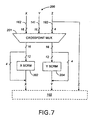
- the address scrambler 200 combines a crosspoint multiplexer 201 and a pair of scramble memories (XSCRM and YSCRM) 202 and 204. All three are initialized (programmed) at APG setup time.
- the multiplexer 201 receives X, Y, and Z addresses from the X, Y, and Z ALUs --as illustrated, 36 bits in all -- and connects any 32 of them, one-to-one, to any of its 32 outputs, 16 of which become X address values and 16 of which become Y address values.
- the low-order 12 bits of the X and Y values are provided as addresses to XSCRM and YSCRM 202 and 204, respectively, which are 4Kx12 random access memories.
- the scramble memories can be pre-programmed to implement any Boolean operation on their 12 bits of input. The remaining four bits pass directly to output.
- the scramble memories may be bypassed altogether by use of bypass multiplexers (not shown).
Landscapes
- Engineering & Computer Science (AREA)
- General Engineering & Computer Science (AREA)
- Physics & Mathematics (AREA)
- General Physics & Mathematics (AREA)
- For Increasing The Reliability Of Semiconductor Memories (AREA)
- Tests Of Electronic Circuits (AREA)
- Techniques For Improving Reliability Of Storages (AREA)
- Test And Diagnosis Of Digital Computers (AREA)
Claims (21)
- Schaltungstester beinhaltend einen algorithmischen Mustergenerator (APG) zum Testen von Schaltungen, umfassend:dadurch gekennzeichnet, daß der Schaltungstester von dem Typ ist, daß er einen Hauptvektorspeicher (110) und einen Unterprogrammvektorspeicher (104) zum Speichern von Testvektoren enthält, wobei der Programmzähler (122) gekoppelt ist, um eine Steuerschaltung des Unterprogrammvektorspeichers in dem Schaltungstester zu betreiben, und arbeitet, um die Programmzähleradresse bereitzustellen, um den Betrieb des Unterprogrammvektorspeichers (104) zu steuern.einen programmierbaren Sequencer zum Auswählen von durch den APG auszuführenden Befehlen (120), wobei der Sequencer beinhaltet:einen Programmzähler (122) zum Speichern einer Programmzähleradresse,eine mit dem Programmzähler gekoppelte Ablaufsteuerungslogik (124), um die Programmzähleradressen zu empfangen, wobei die Ablaufsteuerungslogik in Rückmeldung auf Ablaufsteuerungsanweisungen arbeitet, um eine nächste Adresse auszuwählen und zu bewirken, daß die nächste Adresse in dem Programmzähler gespeichert wird,einen Befehlsspeicher (128, 130) gekoppelt, um die Programmzähleradressen vom Programmzähler (122) zu empfangen, und gekoppelt mit der Ablaufsteuerungslogik (124), wobei der Befehlsspeicher Ablaufsteuerungsanweisungen speichert und arbeitet, um Ablaufsteuerungsanweisungen für die Ablaufsteuerungslogik als Rückmeldung auf die Programmzähleradresse bereitzustellen, wobei der Befehlsspeicher ferner Musteranweisungen speichert und arbeitet, um Musteranweisungen für den APG als Rückmeldung auf die Programmzähleradresse bereitzustellen;einen Adreßgenerator (140, 160, 180) gekoppelt, um Musteranweisungen von dem Befehlsspeicher (128, 130) zu empfangen, wobei der Adreßgenerator arbeitet, um X-Adreßsignale und Y-Adreßsignale als Rückmeldung auf empfangene Musteranweisungen zu generieren; undeinen Datengenerator (220) gekoppelt, um Signale von dem Adreßgenerator (140, 160, 180) und Musteranweisungen von dem Befehlsspeicher (128, 130) zu empfangen, wobei der Datengenerator arbeitet, um Datensignale als Rückmeldung auf empfangene Adreßsignale und Musteranweisungen zu generieren;
- Schaltungstester nach Anspruch 1, wobei der Befehlsspeicher (128, 130) ferner beinhaltet:wobei der Ablaufsteuerungsspeicher (128) gekoppelt ist, um Programmzähleradressen von dem Programmzähler (122) zu empfangen, und mit der Ablaufsteuerungslogik (124) gekoppelt ist, wobei der Ablaufsteuerungsspeicher arbeitet, um Ablaufsteuerungsanweisungen und Musteranweisungsspeicheradressen zu speichern, und um Ablaufsteuerungsanweisungen als Rückmeldung auf Programmzähleradressen für die Ablaufsteuerungslogik (124) bereitzustellen und um Musteranweisungsspeicheradressen für den Musteranweisungsspeicher (130) bereitzustellen; undeinen Ablaufsteuerungsspeicher (128) und einen Musterbefehlsspeicher (130);
der Musteranweisungsspeicher (130) mit dem Ablaufsteuerungsspeicher (128) gekoppelt ist, um Musteranweisungsspeicheradressen von dem Ablaufsteuerungsspeicher (128) zum empfangen und Musteranweisungen zu speichern und in Rückmeldung auf Musteranweisungsspeicheradressen Musteranweisungen für das APG (100) bereitzustellen. - Schaltungstester nach Anspruch 1 oder 2, wobei der programmierbare Sequencer (120) ferner beinhaltet:und wobei die Ablaufsteuerungslogik (124) beinhaltet Logik zum:ein Paar von verbundenen Schleifenzählern (126), umfassend einen ersten und einen zweiten Schleifenzähler;Ausführen einer Ablaufsteuerungsanweisung, um einen ersten Anfangswert für den ersten Schleifenzähler zu programmieren,Ausführen einer Ablaufsteuerungsanweisung, um einen zweiten Anfangswert für den zweiten Schleifenzähler zu programmieren, undAusführen einer Ablaufsteuerungsanweisung, um zu einer Zielprogrammzähleradresse zu schleifen und um einen Schleifenzähler zu dekrementieren, bis das Paar der verbundenen Schleifenzähler verbraucht ist, wobei das Paar als ein Kaskadenzählerpaar zählt, wobei jeder Schleifenzähler vom programmierbaren Anfangswert des Zählers zu einem Endwert läuft.
- Schaltungstester nach Anspruch 3, wobei die Ablaufsteuerungslogik (124) ferner beinhaltet Logik zum:undAusführen einer Ablaufstreuerungsanweisung, um zu einer Zielprogrammzähleradresse zu schleifen und um den ersten Schleifenzähler zu dekrementieren, bis der erste Schleifenzähler verbraucht ist, und Zurücksetzen des ersten Schleifenzählers auf den ersten Anfangswert, nachdem der erste Schleifenzähler verbraucht ist;Ausführen einer Ablaufsteuerungsanweisung, um zu einer Zielprogrammzähleradresse zu schleifen und um den zweiten Schleifenzähler zu dekrementieren, bis der zweite Schleifenzähler verbraucht ist, und um den zweiten Schleifenzähler auf den zweiten Anfangswert zurückzusetzen, nachdem der zweite Schleifenzähler verbraucht ist.
- Schaltungstester nach Anspruch 4 mit:einer Anweisung zum Schleifen zu einer Zieladresse bis ein Schleifenzähler erschöpft ist, welche durchführt, den Schleifenzähler (126) zu testen und, (i) wenn der Schleifenzähler nicht gleich Null ist, zur Zieladresse zu springen und den Schleifenzähler zu dekrementieren und, (ii) wenn der Schleifenzähler gleich Null ist, den Schleifenzähler auf seinen Anfangswert zurückzusetzen und zu einer nächsten Anweisung in Abfolge fortzuschreiten; undeine Anweisung zum Schleifen zu einer Zieladresse auf ein Paar von verbundenen Schleifenzählem bis das Paar erschöpft ist, welche durchführt, den zweiten Schleifenzähler des Paares zu testen und, (i) wenn der zweite Schleifenzähler nicht gleich Null ist, zur Zieladresse zu springen und den zweiten Schleifenzähler zu dekrementieren, und, (ii) wenn der zweite Schleifenzähler Null ist, den zweiten Schleifenzähler auf seinen Anfangswert zurückzusetzen und den ersten Schleifenzähler zu dekrementieren und zu der Zieladresse zu schleifen, bis der erste Schleifenzähler erschöpft ist.
- Schaltungstester nach Anspruch 4, wobei der Sequencer (120) wenigstens acht Schleifenzähler (126) beinhaltet, die wenigstens zwei Paare von verbundenen Schleifenzählern umfassen.
- Schaltungstester nach einem der Ansprüche 1 bis 6, wobei der Adreßgenerator Register beinhaltet, die arbeiten, um Y-bezogene Werte zu speichern, umfassend:ein Y-Register (146) und ein YI-Register (147), wobei das YI-Register als ein Indexregister des Y-Registers arbeitet,ein YREF-Register (145) und ein YRI-Register (144), wobei das YRI-Register als ein Indexregister des YREF-Registers arbeitet,ein YMAX-Register (148), undein YOFF-Register (143);Y-Adreßschaltungsanordnung (154-157), verbunden mit den Y-, YI-, YREF-, YRI-YMAX- und YOFF-Registern (143-148), wobei die Schaltungsanordnung arbeitet, um arithmetische und logische Operationen an den Y-, YI-, YREF-, YRI-Registern vorzunehmen, wobei das Ergebnis jeder Operation durch den YMAX-Wert des YMAX-Registers (148) maskiert wird, bevor es in dem Y-, YI-, YREF- bzw. YRI-Register (143-147) gespeichert wird; undein YOFF-Addierer (152-153), der mit dem YOFF-Register (143) und dem Y-Register gekoppelt ist und arbeitet, um die Y-Adresse als Summe des YOFF-Wertes und des Y-Wertes zu berechnen.
- Schaltungstester nach Anspruch 7, ferner beinhaltend Register, die arbeiten, um X-bezogene Werte zu speichern, umfassend:ein X-Register (166) und ein XI-Register (167), wobei das XI-Register als ein Indexregister des X-Registers arbeitet,ein XREF-Register (165) und ein XRI-Register (164), wobei das XRI-Register als ein Indexregister des XREF-Registers arbeitet,ein XMAX-Register (168), undein XOFF (163)-Register;X-Adreßschaltungsanordnung (174-177), die mit den X-, XI-, XREF-, XRI-, XMAX- und XOFF-Registern (164-167) gekoppelt ist, wobei die Schaltungsanordnung arbeitet, um arithmetische und logische Operationen an den X-, XI-, XREF- und XRI-Registern (164-167) durchzuführen, wobei das Ergebnis jeder Operation durch den XMAX-Wert des XMAX-Registers (168) maskiert wird, bevor es in dem X-, XI-, XREF- bzw. XRI-Register gespeichert wird; undein XOFF-Addierer (173), der mit dem XOFF-Register (163) und dem X-Register gekoppelt ist, und arbeitet, um die X-Adresse als Summe des XOFF-Wertes und des X-Wertes zu berechnen.
- Schaltungsanordnung nach einem der Ansprüche 1 bis 8, wobei der programmierbare Sequencer ferner beinhaltet:eine Auffrischschaltung (132), die mit der Ablaufsteuerungslogik (124) gekoppelt ist, wobei die Auffrischschaltung arbeitet, um ein Auffrisch-Interruptsignal an einem zeitlichen Intervall zu generieren, und um das Auffrisch-Interruptsignal für die Ablaufsteuerungslogik bereitzustellen, wobei die Ablaufsteuerungslogik arbeitet, um ein Auffrisch-Unterprogramm im Befehlsspeicher in Rückmeldung auf das Auffrisch-Interruptsignal aufzurufen.
- Schaltungstester nach Anspruch 9, wobei die Auffrischschaltung (132) beinhaltet:eine Zählerschaltung mit einer Klemme zum Empfangen eines Taktsignals und Ansprechen zum Zählen von einem Anfangswert zu einem Endwert in Rückmeldung auf das Taktsignal und zum Generieren des Auffrisch-Interruptsignals, wenn der Endwert erreicht ist.
- Schaltungstester nach Anspruch 9 oder 10, wobei die Auffrischschaltung (132) eine Klemme zum Empfangen eines Sperrsignals (134) aufweist, das durch eine Anweisung in Rückmeldung auf den Sequencerprogrammzähler (122) erzeugt wird, wobei das Sperrsignal verursacht, daß der Aufruf des Auffrischunterprogramms solange verzögert wird, wie das Sperrsignal vorliegt.
- Schaltungstester nach einem der Ansprüche 1 bis 11, wobei der Datengenerator (220) beinhaltet:eine erste Stufenschaltung (221) gekoppelt, um Adreßsignale (142, 162) als Eingabe zu empfangen, und arbeitet, um einen invertierten Wert zu erzeugen;eine Kreuzungspunkt-Multiplexerschaltung (102) gekoppelt, um eine Anzahl M von Adreßsignalen als Eingabeadreßsignale zu empfangen, und arbeitet, um Ausgabeadreßsignale als Ausgabe zu erzeugen, die eine Auswahl einer geringeren Anzahl m von Eingabeadreßsignalen sind;ein Topologiespeicher (225) gekoppelt, um durch die Auswahl von m Signalen adressierbar zu sein, die als Ausgabe durch die Kreuzungspunkt-Multiplexerschaltung (102) erzeugt werden, wobei der Topologiespeicher ein Invertier-Bit als Ausgabe erzeugt; undeine Folge von Stufen (223, 226), durch die der invertierte Wert seriell durchläuft, wobei eine Eingabe für die Folge die Ausgabe der ersten Stufenschaltung (221) ist, wobei die Folge als eine Stufe ein Dateninversionsgate (226) beinhaltet, das mit dem Topologiespeicher (225) gekoppelt ist, um das Topologie-Invertier-Bit zu empfangen und um den invertierten Wert gemäß dem Zustand des Topologie-Invertier-Bits zu invertieren.
- Schaltungstester nach Anspruch 12, wobei der Topologiespeicher ein 2m x 1-Schreib-/Lesespeicher ist.
- Schaltungstester nach Anspruch 12 oder 13, wobei die Anzahl M mindestens 36 und die Anzahl m mindestens 6 ist.
- Schaltungstester nach einem der Ansprüche 12 bis 14, ferner beinhaltend:wobei die Folge von Stufen ferner eine Stufe (223) beinhaltet, die ein Dateninversionsgate aufweist, das mit dem Verriegelungsinversionsregister (222) gekoppelt ist, um das Verriegelungsinversionsbit zu empfangen und den invertierten Wert gemäß dem Zustand des Verriegelungsinversionsbits zu invertieren.ein Verriegelungsinversionsregister (222) gekoppelt, um das Register als Rückmeldung auf Musteranweisungen zu setzen und zu löschen, wobei das Register als Ausgabe ein Verriegelungsinversionsbit bereitstellt;
- Schaltungstester nach einem der Ansprüche 12 bis 15, wobei die Folge von Stufen ferner beinhaltet:wobei die verzögerte Zugriffsleitung Eingabedaten empfängt, die einen invertierten Wert umfassen, und als Ausgabe die Eingangsdaten, um eine Anzahl von APG-Zyklen, die gleich der Verzögerungslänge ist, verzögert, erzeugt;eine verzögerte Zugriffsleitungsstufe (227) gekoppelt, um auf Datengeneratoranweisungen zu antworten, um eine Verzögerungslänge zu setzen,wobei die beiden Ausgänge der verzögerten Zugriffsleitung und des Verzögerungsbypassdatenpfads einer Ausgabestufe des Datengenerators bereitgestellt werden.einen Verzögerungsbypassdatenpfad zum Umgehen der verzögerten Zugriffsleitung; und
- Schaltungstester nach Anspruch 16, wobei die Verzögerungslänge wählbar in einem Bereich ist, der Werte von null bis sieben Leitungsstufen beinhaltet.
- Schaltungstester nach Anspruch 16, wobei die Eingabe für die verzögerte Zugriffsleitung auch ein Schieberegistersteuerungsbit beinhaltet und die Ausgabe der verzögerten Zugriffsleitung ein um die Verzögerungslänge verzögertes Schieberegistersteuerungsbit beinhaltet.
- Schaltungstester zum Testen von Schaltungen, mit einem APG gemäß einem der Ansprüche 1 bis 18, einem Unterprogrammvektorspeicher (104) zum Speichern von Testvektoren, wobei der Unterprogrammvektorspeicher (104) mit dem Programmzähler (122) des APG gekoppelt ist, um die Programmzähleradresse zu empfangen.
- Tester nach Anspruch 19, ferner beinhaltend einen Haupttestvektorspeicher (110).
- Tester nach Anspruch 19, ferner beinhaltend Pinelektronik (111) zum Empfangen einer zu testenden Vorrichtung (112), wobei die Pinelektronik ein Testvektorbit oder Testvektorbits für einen speziellen Pin von dem Haupttestvektorspeicher (110) von dem Unterprogrammvektorspeicher (104) oder von dem APG empfängt.
Applications Claiming Priority (2)
| Application Number | Priority Date | Filing Date | Title |
|---|---|---|---|
| US08/801,687 US5883905A (en) | 1997-02-18 | 1997-02-18 | Pattern generator with extended register programming |
| US801687 | 1997-02-18 |
Publications (3)
| Publication Number | Publication Date |
|---|---|
| EP0859367A2 EP0859367A2 (de) | 1998-08-19 |
| EP0859367A3 EP0859367A3 (de) | 1998-11-18 |
| EP0859367B1 true EP0859367B1 (de) | 2004-10-06 |
Family
ID=25181798
Family Applications (1)
| Application Number | Title | Priority Date | Filing Date |
|---|---|---|---|
| EP98400378A Expired - Lifetime EP0859367B1 (de) | 1997-02-18 | 1998-02-17 | Mustergenerator mit erweiterter Registerprogrammierung |
Country Status (6)
| Country | Link |
|---|---|
| US (1) | US5883905A (de) |
| EP (1) | EP0859367B1 (de) |
| JP (1) | JPH10275091A (de) |
| KR (1) | KR19980071411A (de) |
| DE (1) | DE69826744T8 (de) |
| TW (1) | TW371324B (de) |
Families Citing this family (31)
| Publication number | Priority date | Publication date | Assignee | Title |
|---|---|---|---|---|
| JP3233068B2 (ja) * | 1997-05-23 | 2001-11-26 | 安藤電気株式会社 | パターン発生装置 |
| US6073263A (en) * | 1997-10-29 | 2000-06-06 | Credence Systems Corporation | Parallel processing pattern generation system for an integrated circuit tester |
| US6161206A (en) * | 1998-04-30 | 2000-12-12 | Credence Systems Corporation | Pattern generator for a semiconductor integrated circuit tester |
| DE69901534T2 (de) * | 1999-02-23 | 2003-01-09 | Taiwan Semiconductor Mfg. Co., Ltd. | Integrierte Selbsttestschaltung für eine Speichereinrichtung |
| DE69902221T2 (de) | 1999-02-23 | 2003-03-06 | Taiwan Semiconductor Mfg. Co., Ltd. | Speicherschaltungen mit eingebautem Selbsttest |
| US6321356B1 (en) * | 1999-05-18 | 2001-11-20 | Micron Technology, Inc. | Programmable pattern generator |
| US6425103B1 (en) * | 1999-09-29 | 2002-07-23 | Lsi Logic Corporation | Programmable moving inversion sequencer for memory bist address generation |
| US6671845B1 (en) * | 1999-10-19 | 2003-12-30 | Schlumberger Technologies, Inc. | Packet-based device test system |
| US6415408B1 (en) * | 1999-11-03 | 2002-07-02 | Unisys Corporation | Multi-stage algorithmic pattern generator for testing IC chips |
| US6571365B1 (en) * | 1999-11-03 | 2003-05-27 | Unisys Corporation | Initial stage of a multi-stage algorithmic pattern generator for testing IC chips |
| US6314034B1 (en) * | 2000-04-14 | 2001-11-06 | Advantest Corp. | Application specific event based semiconductor memory test system |
| JP4146986B2 (ja) * | 2000-05-19 | 2008-09-10 | 株式会社アドバンテスト | 半導体試験装置 |
| JP2002123562A (ja) * | 2000-07-31 | 2002-04-26 | Hitachi Ltd | テスタ構築データの生成方法およびテスタの構築方法並びにテスト回路 |
| JP2002071766A (ja) * | 2000-08-28 | 2002-03-12 | Advantest Corp | 半導体試験装置 |
| US6598112B1 (en) * | 2000-09-11 | 2003-07-22 | Agilent Technologies, Inc. | Method and apparatus for executing a program using primary, secondary and tertiary memories |
| DE10111440C2 (de) * | 2001-03-09 | 2003-02-20 | Infineon Technologies Ag | Adressengenerator zur Erzeugung von Adressen zum Testen einer Schaltung |
| TWI234001B (en) * | 2001-03-20 | 2005-06-11 | Schlumberger Techonogies Inc | Low-jitter clock for test system |
| KR100379721B1 (ko) * | 2001-05-23 | 2003-04-10 | 송동섭 | 경계주사 테스트용 테스트벡터의 생성방법 |
| US20030099139A1 (en) * | 2001-08-24 | 2003-05-29 | Abrosimov Igor Anatolievich | Memory test apparatus and method of testing |
| US7472326B2 (en) * | 2002-05-06 | 2008-12-30 | Nextest Systems Corporation | Semiconductor test system having multitasking algorithmic pattern generator |
| DE10231176A1 (de) * | 2002-07-09 | 2003-10-30 | Infineon Technologies Ag | Testmustergeneratorschaltung |
| EP1554653B1 (de) * | 2002-10-15 | 2011-08-24 | STMicroelectronics S.A. | Übertragung von wiederholungsdigitalnachrichten zwischen einer überwachungsschaltung eines mikroprozessors und eines analysewerkzeugs |
| US20060174155A1 (en) * | 2005-02-03 | 2006-08-03 | Arm Limited | System, method and computer program product for testing software |
| US20090307468A1 (en) * | 2008-06-06 | 2009-12-10 | International Business Machines Corporation | Generating a Test Case Micro Generator During Processor Design Verification and Validation |
| US8516305B2 (en) * | 2010-09-01 | 2013-08-20 | Advanced Micro Devices, Inc. | Power dissipation test method and device therefor |
| FR2971872B1 (fr) * | 2011-02-18 | 2014-06-20 | Bull Sas | Circuit integre programmable de cryptographie |
| US9195261B2 (en) | 2013-09-03 | 2015-11-24 | Teradyne, Inc. | Synchronizing data from different clock domains by bridges one of the clock signals to appear to run an integer of cycles more than the other clock signal |
| US20170045981A1 (en) | 2015-08-10 | 2017-02-16 | Apple Inc. | Devices and Methods for Processing Touch Inputs Based on Their Intensities |
| KR102314419B1 (ko) * | 2021-07-27 | 2021-10-19 | (주) 에이블리 | 반도체 테스트 패턴 발생 장치 및 방법 |
| CN118782128B (zh) * | 2023-03-31 | 2025-09-26 | 长鑫存储技术有限公司 | 信号生成电路、测试电路及存储器 |
| CN117037893A (zh) * | 2023-10-08 | 2023-11-10 | 悦芯科技股份有限公司 | 一种用于存储芯片测试机向量产生器的微处理器系统 |
Family Cites Families (9)
| Publication number | Priority date | Publication date | Assignee | Title |
|---|---|---|---|---|
| US4293950A (en) * | 1978-04-03 | 1981-10-06 | Nippon Telegraph And Telephone Public Corporation | Test pattern generating apparatus |
| US4313200A (en) * | 1978-08-28 | 1982-01-26 | Takeda Riken Kogyo Kabushikikaisha | Logic test system permitting test pattern changes without dummy cycles |
| JPH0750159B2 (ja) * | 1985-10-11 | 1995-05-31 | 株式会社日立製作所 | テストパタ−ン発生装置 |
| US4682330A (en) * | 1985-10-11 | 1987-07-21 | International Business Machines Corporation | Hierarchical test system architecture |
| US4931723A (en) * | 1985-12-18 | 1990-06-05 | Schlumberger Technologies, Inc. | Automatic test system having a "true tester-per-pin" architecture |
| JPH0255331U (de) * | 1988-10-11 | 1990-04-20 | ||
| US5151903A (en) * | 1989-09-28 | 1992-09-29 | Texas Instruments Incorporated | High efficiency pattern sequence controller for automatic test equipment |
| DE4305442C2 (de) * | 1993-02-23 | 1999-08-05 | Hewlett Packard Gmbh | Verfahren und Vorrichtung zum Erzeugen eines Testvektors |
| JPH0862302A (ja) * | 1994-08-19 | 1996-03-08 | Advantest Corp | サイクル遅延用パターン発生器 |
-
1997
- 1997-02-18 US US08/801,687 patent/US5883905A/en not_active Expired - Fee Related
-
1998
- 1998-02-05 TW TW087101513A patent/TW371324B/zh active
- 1998-02-17 KR KR1019980004724A patent/KR19980071411A/ko not_active Ceased
- 1998-02-17 EP EP98400378A patent/EP0859367B1/de not_active Expired - Lifetime
- 1998-02-17 DE DE69826744T patent/DE69826744T8/de not_active Expired - Fee Related
- 1998-02-18 JP JP10036225A patent/JPH10275091A/ja active Pending
Also Published As
| Publication number | Publication date |
|---|---|
| US5883905A (en) | 1999-03-16 |
| TW371324B (en) | 1999-10-01 |
| EP0859367A2 (de) | 1998-08-19 |
| KR19980071411A (ko) | 1998-10-26 |
| JPH10275091A (ja) | 1998-10-13 |
| EP0859367A3 (de) | 1998-11-18 |
| DE69826744T2 (de) | 2006-02-16 |
| DE69826744T8 (de) | 2006-04-27 |
| DE69826744D1 (de) | 2004-11-11 |
Similar Documents
| Publication | Publication Date | Title |
|---|---|---|
| EP0859367B1 (de) | Mustergenerator mit erweiterter Registerprogrammierung | |
| US4639919A (en) | Distributed pattern generator | |
| KR100538404B1 (ko) | 테스팅의 병렬 및 스캔 모드용으로 단일 메모리를사용하는 집적회로용 테스트 시스템 | |
| US6288566B1 (en) | Configuration state memory for functional blocks on a reconfigurable chip | |
| JP4315552B2 (ja) | 半導体集積回路装置 | |
| US3751649A (en) | Memory system exerciser | |
| US20200241844A1 (en) | Matrix normal/transpose read and a reconfigurable data processor including same | |
| US5357523A (en) | Memory testing system with algorithmic test data generation | |
| US4672610A (en) | Built in self test input generator for programmable logic arrays | |
| US5299320A (en) | Program control type vector processor for executing a vector pipeline operation for a series of vector data which is in accordance with a vector pipeline | |
| WO2001020455A1 (en) | Microcomputer with test instruction memory | |
| JPH0750159B2 (ja) | テストパタ−ン発生装置 | |
| US4670879A (en) | Pattern generator | |
| EP0070863A1 (de) | Steuergerät mit gespeichertem programm. | |
| US5485466A (en) | Method and apparatus for performing dual scan path testing of an array in a data processing system | |
| US6061815A (en) | Programming utility register to generate addresses in algorithmic pattern generator | |
| US6014752A (en) | Method and apparatus for fully controllable integrated circuit internal clock | |
| US5872797A (en) | Burn-in signal pattern generator | |
| US6757844B1 (en) | Architecture and logic to control a device without a JTAG port through a device with a JTAG port | |
| JPH04302341A (ja) | アドレス発生装置 | |
| US6567942B1 (en) | Method and apparatus to reduce the size of programmable array built-in self-test engines | |
| US5636225A (en) | Memory test circuit | |
| US6983407B2 (en) | Random pattern weight control by pseudo random bit pattern generator initialization | |
| Roncken et al. | CA-BIST for asynchronous circuits: A case study on the RAPPID asynchronous instruction length decoder | |
| US5629946A (en) | High speed test pattern generator |
Legal Events
| Date | Code | Title | Description |
|---|---|---|---|
| PUAI | Public reference made under article 153(3) epc to a published international application that has entered the european phase |
Free format text: ORIGINAL CODE: 0009012 |
|
| AK | Designated contracting states |
Kind code of ref document: A2 Designated state(s): DE FR GB |
|
| AX | Request for extension of the european patent |
Free format text: AL;LT;LV;MK;RO;SI |
|
| PUAL | Search report despatched |
Free format text: ORIGINAL CODE: 0009013 |
|
| AK | Designated contracting states |
Kind code of ref document: A3 Designated state(s): AT BE CH DE DK ES FI FR GB GR IE IT LI LU MC NL PT SE |
|
| AX | Request for extension of the european patent |
Free format text: AL;LT;LV;MK;RO;SI |
|
| 17P | Request for examination filed |
Effective date: 19990407 |
|
| AKX | Designation fees paid |
Free format text: DE FR GB |
|
| 17Q | First examination report despatched |
Effective date: 20020422 |
|
| GRAP | Despatch of communication of intention to grant a patent |
Free format text: ORIGINAL CODE: EPIDOSNIGR1 |
|
| GRAS | Grant fee paid |
Free format text: ORIGINAL CODE: EPIDOSNIGR3 |
|
| GRAA | (expected) grant |
Free format text: ORIGINAL CODE: 0009210 |
|
| AK | Designated contracting states |
Kind code of ref document: B1 Designated state(s): DE FR GB |
|
| REG | Reference to a national code |
Ref country code: GB Ref legal event code: FG4D |
|
| REF | Corresponds to: |
Ref document number: 69826744 Country of ref document: DE Date of ref document: 20041111 Kind code of ref document: P |
|
| PLBE | No opposition filed within time limit |
Free format text: ORIGINAL CODE: 0009261 |
|
| STAA | Information on the status of an ep patent application or granted ep patent |
Free format text: STATUS: NO OPPOSITION FILED WITHIN TIME LIMIT |
|
| ET | Fr: translation filed | ||
| 26N | No opposition filed |
Effective date: 20050707 |
|
| PGFP | Annual fee paid to national office [announced via postgrant information from national office to epo] |
Ref country code: FR Payment date: 20060202 Year of fee payment: 9 |
|
| PGFP | Annual fee paid to national office [announced via postgrant information from national office to epo] |
Ref country code: DE Payment date: 20070228 Year of fee payment: 10 |
|
| GBPC | Gb: european patent ceased through non-payment of renewal fee |
Effective date: 20070217 |
|
| REG | Reference to a national code |
Ref country code: FR Ref legal event code: ST Effective date: 20071030 |
|
| PG25 | Lapsed in a contracting state [announced via postgrant information from national office to epo] |
Ref country code: GB Free format text: LAPSE BECAUSE OF NON-PAYMENT OF DUE FEES Effective date: 20070217 Ref country code: FR Free format text: LAPSE BECAUSE OF NON-PAYMENT OF DUE FEES Effective date: 20070228 |
|
| PGFP | Annual fee paid to national office [announced via postgrant information from national office to epo] |
Ref country code: GB Payment date: 20060109 Year of fee payment: 9 |
|
| PG25 | Lapsed in a contracting state [announced via postgrant information from national office to epo] |
Ref country code: DE Free format text: LAPSE BECAUSE OF NON-PAYMENT OF DUE FEES Effective date: 20080902 |