EP0860459A2 - Polymerisation de cyclosiloxanes en présence de charges - Google Patents
Polymerisation de cyclosiloxanes en présence de charges Download PDFInfo
- Publication number
- EP0860459A2 EP0860459A2 EP98301263A EP98301263A EP0860459A2 EP 0860459 A2 EP0860459 A2 EP 0860459A2 EP 98301263 A EP98301263 A EP 98301263A EP 98301263 A EP98301263 A EP 98301263A EP 0860459 A2 EP0860459 A2 EP 0860459A2
- Authority
- EP
- European Patent Office
- Prior art keywords
- polymerisation
- filler
- process according
- further characterised
- phosphazene base
- Prior art date
- Legal status (The legal status is an assumption and is not a legal conclusion. Google has not performed a legal analysis and makes no representation as to the accuracy of the status listed.)
- Granted
Links
Images
Classifications
-
- C—CHEMISTRY; METALLURGY
- C08—ORGANIC MACROMOLECULAR COMPOUNDS; THEIR PREPARATION OR CHEMICAL WORKING-UP; COMPOSITIONS BASED THEREON
- C08K—Use of inorganic or non-macromolecular organic substances as compounding ingredients
- C08K3/00—Use of inorganic substances as compounding ingredients
- C08K3/18—Oxygen-containing compounds, e.g. metal carbonyls
- C08K3/24—Acids; Salts thereof
- C08K3/26—Carbonates; Bicarbonates
-
- C—CHEMISTRY; METALLURGY
- C04—CEMENTS; CONCRETE; ARTIFICIAL STONE; CERAMICS; REFRACTORIES
- C04B—LIME, MAGNESIA; SLAG; CEMENTS; COMPOSITIONS THEREOF, e.g. MORTARS, CONCRETE OR LIKE BUILDING MATERIALS; ARTIFICIAL STONE; CERAMICS; REFRACTORIES; TREATMENT OF NATURAL STONE
- C04B38/00—Porous mortars, concrete, artificial stone or ceramic ware; Preparation thereof
-
- C—CHEMISTRY; METALLURGY
- C08—ORGANIC MACROMOLECULAR COMPOUNDS; THEIR PREPARATION OR CHEMICAL WORKING-UP; COMPOSITIONS BASED THEREON
- C08G—MACROMOLECULAR COMPOUNDS OBTAINED OTHERWISE THAN BY REACTIONS ONLY INVOLVING UNSATURATED CARBON-TO-CARBON BONDS
- C08G77/00—Macromolecular compounds obtained by reactions forming a linkage containing silicon with or without sulfur, nitrogen, oxygen or carbon in the main chain of the macromolecule
- C08G77/04—Polysiloxanes
- C08G77/06—Preparatory processes
- C08G77/08—Preparatory processes characterised by the catalysts used
-
- C—CHEMISTRY; METALLURGY
- C08—ORGANIC MACROMOLECULAR COMPOUNDS; THEIR PREPARATION OR CHEMICAL WORKING-UP; COMPOSITIONS BASED THEREON
- C08K—Use of inorganic or non-macromolecular organic substances as compounding ingredients
- C08K3/00—Use of inorganic substances as compounding ingredients
- C08K3/01—Use of inorganic substances as compounding ingredients characterized by their specific function
-
- C—CHEMISTRY; METALLURGY
- C08—ORGANIC MACROMOLECULAR COMPOUNDS; THEIR PREPARATION OR CHEMICAL WORKING-UP; COMPOSITIONS BASED THEREON
- C08K—Use of inorganic or non-macromolecular organic substances as compounding ingredients
- C08K3/00—Use of inorganic substances as compounding ingredients
- C08K3/02—Elements
- C08K3/04—Carbon
-
- C—CHEMISTRY; METALLURGY
- C08—ORGANIC MACROMOLECULAR COMPOUNDS; THEIR PREPARATION OR CHEMICAL WORKING-UP; COMPOSITIONS BASED THEREON
- C08K—Use of inorganic or non-macromolecular organic substances as compounding ingredients
- C08K3/00—Use of inorganic substances as compounding ingredients
- C08K3/18—Oxygen-containing compounds, e.g. metal carbonyls
- C08K3/20—Oxides; Hydroxides
- C08K3/22—Oxides; Hydroxides of metals
-
- C—CHEMISTRY; METALLURGY
- C08—ORGANIC MACROMOLECULAR COMPOUNDS; THEIR PREPARATION OR CHEMICAL WORKING-UP; COMPOSITIONS BASED THEREON
- C08K—Use of inorganic or non-macromolecular organic substances as compounding ingredients
- C08K3/00—Use of inorganic substances as compounding ingredients
- C08K3/34—Silicon-containing compounds
- C08K3/36—Silica
-
- C—CHEMISTRY; METALLURGY
- C08—ORGANIC MACROMOLECULAR COMPOUNDS; THEIR PREPARATION OR CHEMICAL WORKING-UP; COMPOSITIONS BASED THEREON
- C08K—Use of inorganic or non-macromolecular organic substances as compounding ingredients
- C08K9/00—Use of pretreated ingredients
- C08K9/04—Ingredients treated with organic substances
- C08K9/06—Ingredients treated with organic substances with silicon-containing compounds
Definitions
- This invention relates to the ring-opening polymerisation of cyclosiloxanes in the presence of fillers and catalysed by phosphazene bases.
- Cyclosiloxanes are critical intermediates in the silicone industry, primarily as starting monomers for polymerisation.
- Several general routes are known for the preparation of cyclosiloxanes. Together with hydroxy-endblocked linear polydiorganosiloxanes, they are formed as a product of hydrolysis of the corresponding diorganodihalosilanes.
- Mixtures of cyclic and/or linear polydiorganosiloxanes can also be equilibrated or "cracked" by reaction in the presence of a catalyst such as a base to form an equilibrium mixture of more desired cyclics and linears.
- catalysts are known for the polymerisation of cyclosiloxanes.
- Examples are alkali metal hydroxides, alkali metal alkoxides or complexes of alkali metal hydroxides and an alcohol, alkali metal silanolates, and phosphonitrile halides (sometimes referred to as acidic phosphazenes).
- Such polymerisations can be carried out in bulk, in solvents (such as non-polar or polar organic solvents) or in emulsion.
- An endblocking agent may be used to regulate the molecular weight of the polymer and/or to add functionality.
- Polymerisation may be terminated by using a neutralizing agent which reacts with the catalyst to render it non-active. In most cases catalyst residues remain in the polymer product and are desirably removed, such as by filtration.
- Silicone polymer-filler mixtures are used as a base for various silicone rubber compositions, silicone compounds and greases, etc. These mixtures are generally produced by first polymerising silicone oligomer into a silicone polymer with the desired viscosity and then mechanically mixing the resulting silicone polymer with the selected filler.
- Such methods involve two different types of processes, necessitating a separate polymerisation step and mixing step.
- US-A-4 448 927 discloses a method of polymerising a hydroxy-endblocked polydiorganosiloxane and/or a polydiorganocyclosiloxane in the presence of an acidic or neutral reinforcing filler and catalysed by trifluoromethane sulfonic acid.
- EP-A-0 019 816 discloses a method of bulk polymerisation of a hydroxy-endblocked polydiorganosiloxane and/or a polydiorganocyclosiloxane in the presence of an acidic or neutral reinforcing filler and catalysed by sulfuric acid or a sulfonic acid.
- EP-A-0 019 093 discloses a method of polymerising a hydroxy-endblocked polydiorganosiloxane in the presence of an inorganic reinforcing or extending filler and a basic diorganosilanolate catalyst.
- US-A-4 431 771 discloses the polymerisation of a hydroxy-endblocked polydiorganosiloxane in the presence of an acidic or neutral reinforcing filler and a catalyst selected from sulfuric acid, sulfonic acids, perfluorinated alkane sulfonic acid, and a combination of quaternary ammonium carboxylate and carboxylic acid. While these processes have been successful with linear starting materials, they have been less successful with cyclosiloxanes, as the rates of polymerisation have generally been regarded as too slow.
- Phosphazene bases are known to be extremely strong bases. Numerous phosphazene bases and routes for their synthesis have been described in the literature, for example in Schwesinger et al, Liebigs Ann. 1996, 1055-1081.
- phosphazene base catalysts are well suited for polymerisation of cyclosiloxanes in the presence of fillers.
- the hexane/methanol activated catalyst can give erratic polymerisation behaviour.
- the present invention thus provides a process for producing a silicone polymer-filler mixture, which comprises effecting the ring-opening polymerisation of a cyclosiloxane with a phosphazene base in the presence of a filler and of water.
- the invention yields a silicone polymer-filler mixture suitable for use as an electrical insulation grease, sealants or as a reinforced polymer mixture useful in producing silicone elastomers.
- the phosphazene base reacts with trace quantities of water present to form highly active hydroxide ions which initiate the polymerisation.
- the phosphazene base will also react with certain other chemical groups which may be present, e.g. silanol or alcohol, to form similarly active polymerisation-initiating species.
- the phosphazene base may be in ionic form, with a strong anion such as fluoride or hydroxide, which is active in initiating polymerisation.
- the phosphazene base is a very powerful catalyst for the polymerisation, it can be present in a relatively low proportion, for example from 1 - 750ppm by weight, based on the weight of cyclosiloxane.
- a preferred range is 10 - 500ppm, more preferably 10 - 100ppm.
- the proportion of catalyst actually used will be selected depending on the polymerisation product that is sought.
- the proportion of water present in the reaction is preferably at least 0.5 mol, more preferably from 0.5-10 mols per mol of phosphazene base, most preferably from 1 mol-10 mols per mol of phosphazene base. It is possible to employ higher proportions of water, and this can have the benefit of enabling greater control over the polymerisation reaction, as described in more detail below.
- any phosphazene base is suitable for use in the present invention.
- a wide range of suitable phosphazene bases has been described in Schwesinger et al (see above).
- Some phosphazene bases are commercially available from Fluka Chemie AG, Switzerland.
- the phosphazene bases preferably have at least 3 P-atoms.
- R 1 is methyl
- R 2 is tert. butyl or tert. octyl
- x is 3
- y is 4
- A is fluoride or hydroxide.
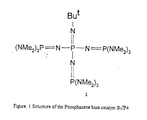
- a preferred compound is the phosphazene base I shown in Figure 1.
- the polymerisation can be carried out in bulk, or in the presence of a solvent or in emulsion.
- Suitable solvents are liquid hydrocarbons or silicone fluids.
- the phosphazene base catalyst can be diluted in a hydrocarbon solvent, such as hexane or heptane, or dispersed in a silicone fluid such as polydiorganosiloxane. Where the phosphazene base catalyst is initially in a solvent such as hexane, the hexane can be removed by evaporation under vacuum, and the catalyst dispersed in a silicone fluid to give a stable clear solution. When this silicone dissolved catalyst is used for polymerisation reactions, the catalyst disperses evenly and gives reproducible results.
- the catalyst can also be dissolved in water, and this has the advantage of moderating and enabling greater control over the polymerisation reaction, as described below.
- the polymerisation reaction can be carried out at ambient temperature or under heating. Heating, for example to 100°C or higher, is appropriate when the catalyst activity has been moderated as described below. A preferred temperature range is 40°C to 200°C, more preferably 50°C to 150°C.
- the time taken for polymerisation will depend on the activity of the catalyst in the chosen system, and on the desired polymer product. In the absence of moderation, the phosphazene base catalysts are sufficiently active to convert cyclosiloxanes such as D4 to high molecular weight polymers within a few seconds.
- the starting material is a cyclosiloxane (also known as a cyclic siloxane).
- Cyclic siloxanes which are useful are well known and commercially available materials. They have the general formula (R 2 SiO) n , wherein R denotes hydrogen or an optionally substituted alkyl, alkenyl, aryl, alkaryl or aralkyl group having up to 8 carbon atoms, n denotes an integer with a value of from 3 to 12. R can be substituted, e.g. by halogen such as fluorine or chlorine.
- the alkyl group can be, for example, methyl, ethyl, n-propyl, trifluoropropyl, n-butyl, sec-butyl, and tert-butyl.
- the alkenyl group can be, for example, vinyl, allyl, propenyl, and butenyl.
- the aryl and aralkyl groups can be, for example, phenyl, tolyl, and benzoyl.
- the preferred groups are methyl, ethyl, phenyl, vinyl, and trifluoropropyl.
- Preferably at least 80% of all R groups are methyl or phenyl groups, most preferably methyl. It is most preferred that substantially all R groups are methyl groups.
- n is from 3 to 6, most preferably 4 or 5.
- suitable cyclic siloxanes are octamethyl cyclotetrasiloxane, decamethyl pentacyclosiloxane, cyclopenta (methylvinyl) siloxane, tetramethyltetravinylcyclotetrasiloxane, cyclotetra (phenylmethyl) siloxane and cyclopenta methylhydrosiloxane.
- One particularly suitable commercially available material is a mixture of octamethylcyclotetrasiloxane and decamethylcyclopentasiloxane.
- R is methyl
- the reaction mixture is generally purged with inert gas, preferably nitrogen, prior to addition of the catalyst so as to remove any dissolved CO 2 . Because of the extremely rapid reaction, the reaction mixture is vigorously mixed to ensure homogenous dispersion of the catalyst. Inadequate mixing can result in the catalyst being encapsulated in beads of gum as it is added to the reaction, and the catalyst then takes some time to diffuse out of the gum particles, giving a slower reaction.
- inert gas preferably nitrogen
- the process according to the invention can be used to make polymers of high molecular weight, for example from 1x10 4 to 10x10 6 .
- the molecular weight which is given as number average, unless otherwise indicated, of silicone polymers is limited by the concentration of end groups and in the absence of added endgroups is determined by the catalyst concentration.
- the catalyst used in the present invention has sufficient activity to give polymers in a reasonable time at a low concentration even in the presence of fillers. Uses of these high molecular weight polymers with fillers include high consistency rubber, and sealants.
- phosphazene base catalysts when used at very low concentrations (10-500ppm) produce polymers with very high molecular weights (10,000-10,000,000) very quickly (10s-8h) at moderate to low temperatures (20-150°C). Molecular weight changes during polymerisation can be monitored by sampling the reaction during polymerisation, and analysing each sample by GPC (gel permeation chromatography) to determine the molecular weight. Polymers of very high molecular weights can be obtained almost immediately. The process can be used to produce ultra high molecular weight materials. This is by virtue of the very low catalyst concentrations needed for the polymerisation, with the result that the molecular weight of the polymer produced is dependent on the end group concentration which is equal to the catalyst concentration. We have found that at very low catalyst concentrations, such as 20ppm, the molecular weight increases with reaction time. The process may be limited by diffusion of the catalyst, which is very slow in these high molecular weight polymers.
- An endblocker may be added in a proportion calculated to produce the desired molecular weight of polymer.
- Suitable endblockers are, for example, polysiloxanes in the viscosity range at 25°C of from 0.5 to 150,000mm 2 /s, in particular hexamethyldisiloxane or polydimethylsiloxanes of the general formula MD x M where M is trimethylsilyl, D is -Si(CH 3 ) 2 O- and x has a value of from 0 to 20.
- the endblocker may have one or more functional groups such as hydroxy, vinyl or hydrogen. Water also acts as a endblocker, with the introduction of hydroxy functional groups.
- Suitable neutralising agents are acids such as acetic acid, silyl phosphate, polyacrylic acid, chlorine substituted silanes, silyl phosphonate or carbon dioxide.
- the reaction with water and CO 2 needs to be taken into account to control the reaction and to obtain reproducible results.
- the catalyst activity becomes much more controllable and the polymers produced are of lower molecular weight. This is caused by the water acting as a catalyst inhibitor and also as an endblocker.
- the inhibiting effect of the water can be reduced by reducing the amount of water present, e.g. by heating. At temperatures below 100°C the rate of polymerisation in the presence of water or CO 2 is relatively slow, for example taking up to more than 24 hours to reach high viscosity.
- polymerisation becomes much faster, for example taking up to 5 - 60 minutes to reach high viscosity.
- control of the reaction can also be achieved if the water is mixed with, or replaced by alcohol, (e.g. C 1 -C 6 alcohols such as methanol or ethanol).
- polymerisation can be prevented by exposing a mixture of cyclosiloxane and phosphazene base catalyst to air and/or CO 2 .
- the polymerisation can then be initiated ("command polymerisation") simply by removing the air and/or CO 2 , e.g. by heating the mixture (e.g. to 100°C - 140°C for a few minutes).
- command polymerisation simply by removing the air and/or CO 2 , e.g. by heating the mixture (e.g. to 100°C - 140°C for a few minutes).
- a D4 catalyst mixture (2 - 50ppm of catalyst) is stable in air at 20°C for extended periods (up to 7 days).
- Prior methods for the synthesis of siloxane polymers by ring-opening equilibration polymerisation produced products which may typically consist of small cyclics (5 - 10% D4-D10), macrocyclics (5-10% D11-D50) and polymer (80-90%).
- the present invention makes it possible to produce polymers by ring-opening polymerisation which have low levels of macrocyclics.
- the phosphazene base catalysts in the ring opening polymerisation of e.g. D4 according to the present invention, it is possible to produce polymers that contain less than 1% total by weight of macrocyclics.
- Thermogravimetric analysis (TGA) of the polymers produced according to the invention shows that they have enhanced thermal stability.
- High molecular weight gums have been produced with decomposition onset temperatures of more than 450°C.
- the enhanced thermal stability is attributed to the very low levels of catalyst residues remaining in the product.
- the low catalyst residues also mean that a filtration step is usually not necessary, which is a very significant process advantage.
- the filler used in the invention plays the role of rheological control additive, reinforcer, extender or agent for imparting conductivity, etc.
- the filler may be a reinforcing filler such as fumed silica, precipitated silica, gel-formation silica, fumed titanium dioxide or carbon black; or an extending filler such as quartz powder, alumino silicate, aluminium oxide, zirconium silicate, magnesium oxide, zinc oxide, talc, diatomaceous earth, iron oxide, calcium carbonate, clay, titanium dioxide, mica, glass powder or graphite.
- Preferred fillers are finely divided reinforcing fillers for silicone elastomers.
- examples of such fillers include carbon black; amorphous silica such as fumed silica, precipitated silica, gel-formation silica, diatomaceous earth, and fumed titanium dioxide.
- the reinforcing fillers have particle sizes in the colloidal range and specific surface areas greater than 50 m 2 /g, usually above 150m 2 /g.
- the most useful reinforcing filler is fumed silica with a specific surface area of at least 150m 2 /g.
- Silica fillers are preferably surface-treated by hydrophobising agents.
- Suitable hydrophobising agents include short polydimethyl siloxanes, hexamethyldisiloxane, silanes, silanol-endblocked dimethyl siloxanes or fatty acids.
- hydrophobising agents are used which result in di- or triorgano silyl groups being present on the surface of the fillers.
- the quantity of filler used depends on the type of filler and on the application of the silicone polymer-filler mixture.
- a strongly reinforcing filler such as fumed silica or precipitated silica will generally be employed at from 1 to 70 weight parts per 100 weight parts total cyclosiloxane. The highest reinforcing performance is obtained for this range of addition.
- Other fillers may be used at from 1 to 200 weight parts per 100 weight parts total cyclosiloxane, but the optimal quantity is appropriately determined by experiment.
- the filler may be a single filler or two or more fillers may be used simultaneously, whether they be all reinforcing, all extending or a mixture of both types of fillers.
- the silicone polymer-filler mixtures produced by the method of this invention are useful in producing curable compositions which yield cured silicone elastomer. They can be used in a manner similar to conventional mixtures of high viscosity polydiorganosiloxanes and fillers.
- a common method is the addition of an organic peroxide vulcanising agent to a filled polydiorganosiloxane mixture.
- the organic peroxide vulcanising agents suitable for use in silicone elastomers are well known. If the polydiorganosiloxane does not contain any vinyl radicals, it preferably is vulcanised with organic peroxides that are efficient in causing reactions in such polydiorganosiloxanes.
- non-vinyl specific Such organic peroxides are labelled "non-vinyl specific” and are represented by such organic peroxides as benzoylperoxide and 2,4-dichlorobenzoylperoxide.
- the polydiorganosiloxane contains vinyl radicals, it can be vulcanised with either "non-vinyl specific” or "vinyl specific” organic peroxides.
- vinyl specific organic peroxides are ditertiary-butyl peroxide and 2,5-bis-(tertbutylperoxy)-2,5-dimethylhexane.
- the properties of the cured silicone elastomer can be altered by the type and amount of vulcanising agent used to cure the composition.
- the organic peroxide vulcanising agent can be present in amounts from 0.1 to 5 parts by weight per 100 parts by weight of the filled polydiorganosiloxane, preferably from 0.5 to 2.0 parts by weight.
- the embodiments of the method of this invention which give a polymer having hydroxyl groups on the ends can be further mixed with curing agents to yield curable compositions.
- a number of methods are known for combining hydroxyl-containing polydiorganosiloxane in an essentially anhydrous mixture with a curing agent to yield a one part curable composition.
- the compositions cure to silicone elastomers upon exposure to the atmosphere.
- Methods are available based upon tri-functional and tetra-functional silanes as crosslinking agents as well as short polymeric crosslinkers.
- the functional groups used are acetoxy radicals, alkoxy radicals, amino radicals and amido radicals.
- Common catalysts for these systems include metal carboxylates, alkyl metal carboxylates, alkyl metal alkoxides and titanates.
- Preferred catalysts are stannous octoate, dibutyltindiacetate, dibutyltindilaurate, tetrabutyltitanate, dibutyl-tindimethoxide and tetraisopropyltitanate.
- Silicone polymer-filler mixture containing two or more unsaturated monovalent aliphatic radicals per polymer molecule such as vinyl and allyl radicals can be combined with a curing agent comprising an organohydrogensiloxane having an average of more than two silicon-bonded hydrogen atoms per molecule, and a hydrosilylation catalyst, e.g. a platinum-containing catalyst in an amount sufficient to provide at least one part by weight platinum per million parts by weight polydiorganosiloxane.
- the organohydrogensiloxane is present in sufficient quantity to provide from at least one silicon-bonded hydrogen atom per unsaturated monovalent aliphatic radical int he polydiorganosiloxane.
- the polydiorganosiloxane in the mixture preferably contains from 0.01 to 2.0 mol percent unsaturated monovalent aliphatic radical.
- silicone polymer-filler mixture of this invention can also be combined with the additives normally used with silicone polymer-filler mixtures such as thickeners, pigments, heat stability additives, oil resistance additives and flame retarding additives.
- the solution was cooled to 60°C and 1 ml of the phosphazene base solution added with rapid stirring of the mixture (in this case the ratio of end-blocking functionality to cyclics was controlled so as to obtain a theoretical number average molecular weight of 50,000).
- Polymerisation began immediately after catalyst addition and a very viscous gum was obtained in within 5 minutes.
- the gum was then heated to 150°C with a nitrogen purge and cooled to room temperature. A portion of the gum was isolated and extracted with toluene. The extract was analyzed by GPC (gel permeation chromatography) and found to contain polydimethylsiloxane with a number average molecular weight of 25,000 relative to polystyrene standards.
Landscapes
- Chemical & Material Sciences (AREA)
- Organic Chemistry (AREA)
- Health & Medical Sciences (AREA)
- Chemical Kinetics & Catalysis (AREA)
- Medicinal Chemistry (AREA)
- Polymers & Plastics (AREA)
- Engineering & Computer Science (AREA)
- Ceramic Engineering (AREA)
- Materials Engineering (AREA)
- Structural Engineering (AREA)
- Silicon Polymers (AREA)
- Compositions Of Macromolecular Compounds (AREA)
- Processes Of Treating Macromolecular Substances (AREA)
Applications Claiming Priority (2)
| Application Number | Priority Date | Filing Date | Title |
|---|---|---|---|
| GBGB9703552.1A GB9703552D0 (en) | 1997-02-20 | 1997-02-20 | Polymerisation of cyclosiloxanes in the presence of fillers |
| GB9703552 | 1997-02-20 |
Publications (3)
| Publication Number | Publication Date |
|---|---|
| EP0860459A2 true EP0860459A2 (fr) | 1998-08-26 |
| EP0860459A3 EP0860459A3 (fr) | 1999-01-20 |
| EP0860459B1 EP0860459B1 (fr) | 2004-04-14 |
Family
ID=10808024
Family Applications (1)
| Application Number | Title | Priority Date | Filing Date |
|---|---|---|---|
| EP98301263A Expired - Lifetime EP0860459B1 (fr) | 1997-02-20 | 1998-02-20 | Polymerisation de cyclosiloxanes en présence de charges |
Country Status (10)
| Country | Link |
|---|---|
| US (1) | US6001928A (fr) |
| EP (1) | EP0860459B1 (fr) |
| JP (1) | JPH10279686A (fr) |
| KR (1) | KR100504411B1 (fr) |
| AU (1) | AU732624B2 (fr) |
| BR (1) | BR9800704A (fr) |
| DE (1) | DE69823080T2 (fr) |
| GB (1) | GB9703552D0 (fr) |
| SG (1) | SG66434A1 (fr) |
| TW (1) | TW460526B (fr) |
Cited By (8)
| Publication number | Priority date | Publication date | Assignee | Title |
|---|---|---|---|---|
| EP0879838A3 (fr) * | 1997-05-22 | 2000-08-30 | Mitsui Chemicals, Inc. | Procédé de préparation de polymères en présence de sel de phosphazénium |
| EP1138715A1 (fr) * | 2000-03-28 | 2001-10-04 | Dow Corning Corporation | Compositions organosiliciés de cyclosiloxanes |
| EP1369449A1 (fr) * | 2002-06-06 | 2003-12-10 | Wacker-Chemie GmbH | Procédé de préparation des polydiorganosiloxanes |
| WO2005005544A1 (fr) * | 2003-07-10 | 2005-01-20 | Dow Corning Corporation | Compositions antiadhesives de silicone |
| US7754800B2 (en) | 2005-04-06 | 2010-07-13 | Dow Corning Europe Sa | Organosiloxane compositions |
| US7906605B2 (en) | 2005-07-28 | 2011-03-15 | Dow Corning Corporation | Release coating compositions having improved release force profiles |
| US8487037B2 (en) | 2009-03-26 | 2013-07-16 | Dow Corning Corporation | Preparation of organosiloxane polymers |
| US8735493B2 (en) | 2009-03-26 | 2014-05-27 | Dow Corning Corporation | Preparation of organosiloxane polymers |
Families Citing this family (37)
| Publication number | Priority date | Publication date | Assignee | Title |
|---|---|---|---|---|
| GB9818543D0 (en) * | 1998-08-26 | 1998-10-21 | Dow Corning | Continuous process for producing a silicone polymer |
| GB9818541D0 (en) * | 1998-08-26 | 1998-10-21 | Dow Corning | Continuous process for producing a silicone polymer |
| GB9827085D0 (en) * | 1998-12-09 | 1999-02-03 | Dow Corning | Polymerisation of siloxanes |
| US8236352B2 (en) | 1998-10-01 | 2012-08-07 | Alkermes Pharma Ireland Limited | Glipizide compositions |
| US20040013613A1 (en) * | 2001-05-18 | 2004-01-22 | Jain Rajeev A | Rapidly disintegrating solid oral dosage form |
| AU6283299A (en) * | 1998-10-01 | 2000-04-17 | Elan Pharma International Limited | Controlled release nanoparticulate compositions |
| US8293277B2 (en) * | 1998-10-01 | 2012-10-23 | Alkermes Pharma Ireland Limited | Controlled-release nanoparticulate compositions |
| US6428814B1 (en) * | 1999-10-08 | 2002-08-06 | Elan Pharma International Ltd. | Bioadhesive nanoparticulate compositions having cationic surface stabilizers |
| GB9827069D0 (en) * | 1998-12-09 | 1999-02-03 | Dow Corning | Polymerisation catalyst |
| GB9827036D0 (en) * | 1998-12-09 | 1999-02-03 | Dow Corning | Polymerisation of siloxanes |
| US20040156872A1 (en) * | 2000-05-18 | 2004-08-12 | Elan Pharma International Ltd. | Novel nimesulide compositions |
| US7198795B2 (en) | 2000-09-21 | 2007-04-03 | Elan Pharma International Ltd. | In vitro methods for evaluating the in vivo effectiveness of dosage forms of microparticulate of nanoparticulate active agent compositions |
| DK1471887T3 (da) | 2002-02-04 | 2010-06-07 | Elan Pharma Int Ltd | Nanopartikelkompositioner der har lysozym som overfladestabiliseringsmiddel |
| US6777512B1 (en) * | 2003-02-28 | 2004-08-17 | Dow Global Technologies Inc. | Amine organoborane complex initiated polymerizable compositions containing siloxane polymerizable components |
| WO2006001787A1 (fr) * | 2003-06-09 | 2006-01-05 | Dow Global Technologies Inc. | Initiateurs de polymerisation d'organoborane stabilise et compositions polymerisables |
| WO2005063480A1 (fr) * | 2003-12-22 | 2005-07-14 | Dow Global Technologies Inc. | Compositions a polymerisation acceleree initiee par un complexe organoborane amine |
| US8501886B2 (en) | 2003-12-22 | 2013-08-06 | Dow Global Technologies Llc | Accelerated organoborane amine complex initiated polymerizable compositions |
| KR101208460B1 (ko) * | 2005-03-07 | 2012-12-05 | 하이브리드 플라스틱스 인코포레이티드 | Poss 단량체의 어셈블리 방법 |
| BRPI0617591A2 (pt) | 2005-10-07 | 2011-08-02 | Dow Global Technologies Inc | sistemas para iniciar polimerização via radical livre, composição polimerizável de duas partes, método de polimerização, método para ligar dois ou mais substratos entre si, método para modificar a superfìcie de um polìmero de baixa energia superficial, método para revestir um substrato, composição de revestimento e laminado |
| RU2009117593A (ru) * | 2006-10-10 | 2010-11-20 | Дау Корнинг Корпорейшн (Us) | Силиконовый агент, регулирующий пенообразование |
| WO2008045547A2 (fr) * | 2006-10-12 | 2008-04-17 | The Government Of The Usa, As Represented By The Secretary Of The Navy | Agents de traitement de surface à base de silane générant du fluoroalkyle carbinol |
| US7524907B2 (en) | 2006-10-12 | 2009-04-28 | Dow Global Technologies, Inc. | Accelerated organoborane initiated polymerizable compositions |
| RU2461584C2 (ru) * | 2007-03-12 | 2012-09-20 | Байер Ой | Применение токоферола |
| KR101677123B1 (ko) * | 2008-04-16 | 2016-11-18 | 다우 코닝 코포레이션 | 실리콘 마이크로에멀젼의 제조 |
| CN102348765B (zh) | 2009-03-10 | 2015-09-09 | 道康宁东丽株式会社 | 水包油硅氧烷乳液组合物 |
| GB0905507D0 (en) | 2009-03-31 | 2009-05-13 | Dow Corning | Organopol Ysiloxane Compositions Containing An Active Material |
| GB0905502D0 (en) | 2009-03-31 | 2009-05-13 | Dow Corning | Organopolysiloxane emulsions and their production |
| GB0905488D0 (en) | 2009-03-31 | 2009-05-13 | Dow Corning | Organopolysiloxane compositions and their production |
| EP3118242B1 (fr) | 2009-03-31 | 2018-10-17 | Dow Silicones Corporation | Organopolysiloxanes ramifiés |
| KR101833966B1 (ko) | 2010-07-02 | 2018-03-02 | 다우 코닝 도레이 캄파니 리미티드 | 수중유 실리콘 에멀젼 조성물 |
| JP6893338B2 (ja) * | 2016-09-14 | 2021-06-23 | 国立研究開発法人産業技術総合研究所 | ポリシロキサン構造含有化合物の製造方法及び高分子組成物 |
| EP3323844A1 (fr) * | 2016-11-17 | 2018-05-23 | Henkel AG & Co. KGaA | Compositions durcissables à base de polymères contenant du silicium utilisant des phosphazènes comme catalyseurs |
| CN106582814B (zh) * | 2016-12-20 | 2019-02-22 | 福州大学 | 一种环氧开环反应催化剂及其制备方法 |
| JP7623678B2 (ja) * | 2020-12-15 | 2025-01-29 | 日東化成株式会社 | 重合体の硬化に用いる硬化触媒を含む湿気硬化型組成物、硬化物の製造方法 |
| CN112724685B (zh) * | 2020-12-28 | 2023-01-17 | 深圳市安品有机硅材料有限公司 | 有机硅导热片材及其制备方法 |
| CN115785447B (zh) * | 2021-09-10 | 2024-02-20 | 山东大学 | 一种超低粘度液体硅橡胶及其交联剂与制备方法 |
| CN115651200A (zh) * | 2022-10-26 | 2023-01-31 | 青岛科技大学 | 一种连续生产硅橡胶生胶的方法 |
Family Cites Families (8)
| Publication number | Priority date | Publication date | Assignee | Title |
|---|---|---|---|---|
| US4431771A (en) * | 1983-03-14 | 1984-02-14 | Dow Corning Corporation | Polymerization of silicone polymer-filler mixtures as powders |
| US4486567A (en) * | 1983-03-14 | 1984-12-04 | Dow Corning Corporation | Method of polymerizing hydroxyl endblocked polydiorganosiloxane using quaternary ammonium carboxylate-carboxylic acid catalyst |
| US4433096A (en) * | 1983-03-14 | 1984-02-21 | Dow Corning Corporation | Polymerization of polydiorganosiloxane in the presence of filler |
| US4448927A (en) * | 1983-03-14 | 1984-05-15 | Dow Corning Corporation | Method of polymerizing oligomers of polydiorganosiloxane in the presence of filler |
| US4482670A (en) * | 1983-03-14 | 1984-11-13 | Dow Corning Corporation | Method of polymerizing polydiorganosiloxane fluid-filler mixture using sulfuric or sulfonic acids |
| US5138008A (en) * | 1990-06-05 | 1992-08-11 | Carnegie Mellon University | Process for the production of linear polyphosphazenes |
| GB9105372D0 (en) * | 1991-03-14 | 1991-05-01 | Dow Corning Sa | Method of making siloxane compositions |
| US5334688A (en) * | 1993-04-19 | 1994-08-02 | Hercules Incorporated | Fully substituted cyclopolysiloxanes and their use for making organosilicon polymers |
-
1997
- 1997-02-20 GB GBGB9703552.1A patent/GB9703552D0/en active Pending
-
1998
- 1998-02-18 TW TW087102271A patent/TW460526B/zh not_active IP Right Cessation
- 1998-02-19 BR BR9800704A patent/BR9800704A/pt not_active Application Discontinuation
- 1998-02-20 EP EP98301263A patent/EP0860459B1/fr not_active Expired - Lifetime
- 1998-02-20 SG SG1998000366A patent/SG66434A1/en unknown
- 1998-02-20 KR KR10-1998-0005249A patent/KR100504411B1/ko not_active Expired - Fee Related
- 1998-02-20 DE DE69823080T patent/DE69823080T2/de not_active Expired - Fee Related
- 1998-02-20 JP JP10039193A patent/JPH10279686A/ja not_active Ceased
- 1998-02-20 AU AU55406/98A patent/AU732624B2/en not_active Ceased
- 1998-02-20 US US09/027,157 patent/US6001928A/en not_active Expired - Fee Related
Cited By (17)
| Publication number | Priority date | Publication date | Assignee | Title |
|---|---|---|---|---|
| EP0879838A3 (fr) * | 1997-05-22 | 2000-08-30 | Mitsui Chemicals, Inc. | Procédé de préparation de polymères en présence de sel de phosphazénium |
| EP1138715A1 (fr) * | 2000-03-28 | 2001-10-04 | Dow Corning Corporation | Compositions organosiliciés de cyclosiloxanes |
| EP1369449A1 (fr) * | 2002-06-06 | 2003-12-10 | Wacker-Chemie GmbH | Procédé de préparation des polydiorganosiloxanes |
| US6998437B2 (en) | 2002-06-06 | 2006-02-14 | Wacker-Chemie Gmbh | Preparation of polydiorganosiloxanes |
| WO2005005544A1 (fr) * | 2003-07-10 | 2005-01-20 | Dow Corning Corporation | Compositions antiadhesives de silicone |
| US7592412B2 (en) | 2003-07-10 | 2009-09-22 | Dow Corning Corporation | Silicone release coating compositions |
| US8022162B2 (en) | 2005-04-06 | 2011-09-20 | Dow Corning Corporation | Organosiloxane compositions |
| US7754800B2 (en) | 2005-04-06 | 2010-07-13 | Dow Corning Europe Sa | Organosiloxane compositions |
| US8067519B2 (en) | 2005-04-06 | 2011-11-29 | Dow Corning Corporation | Organosiloxane compositions |
| US8076411B2 (en) | 2005-04-06 | 2011-12-13 | Dow Corning Corporation | Organosiloxane compositions |
| US8084535B2 (en) | 2005-04-06 | 2011-12-27 | Dow Corning Corporation | Organosiloxane compositions |
| US8088857B2 (en) | 2005-04-06 | 2012-01-03 | Dow Corning Corporation | Organosiloxane compositions |
| US8153724B2 (en) | 2005-04-06 | 2012-04-10 | Dow Corning Corporation | Organosiloxane compositions |
| US8344087B2 (en) | 2005-04-06 | 2013-01-01 | Dow Corning Corporation | Hydrosilylation cured organosiloxanes having diluent therein |
| US7906605B2 (en) | 2005-07-28 | 2011-03-15 | Dow Corning Corporation | Release coating compositions having improved release force profiles |
| US8487037B2 (en) | 2009-03-26 | 2013-07-16 | Dow Corning Corporation | Preparation of organosiloxane polymers |
| US8735493B2 (en) | 2009-03-26 | 2014-05-27 | Dow Corning Corporation | Preparation of organosiloxane polymers |
Also Published As
| Publication number | Publication date |
|---|---|
| JPH10279686A (ja) | 1998-10-20 |
| DE69823080T2 (de) | 2005-03-24 |
| TW460526B (en) | 2001-10-21 |
| AU5540698A (en) | 1998-08-27 |
| EP0860459B1 (fr) | 2004-04-14 |
| KR19980071527A (ko) | 1998-10-26 |
| AU732624B2 (en) | 2001-04-26 |
| US6001928A (en) | 1999-12-14 |
| BR9800704A (pt) | 1999-07-06 |
| DE69823080D1 (de) | 2004-05-19 |
| EP0860459A3 (fr) | 1999-01-20 |
| SG66434A1 (en) | 1999-07-20 |
| KR100504411B1 (ko) | 2005-11-21 |
| GB9703552D0 (en) | 1997-04-09 |
Similar Documents
| Publication | Publication Date | Title |
|---|---|---|
| EP0860459B1 (fr) | Polymerisation de cyclosiloxanes en présence de charges | |
| US6054548A (en) | Process for producing a silicone polymer | |
| US6184330B1 (en) | Continuous process for producing a silicone polymer | |
| AU732626B2 (en) | Polymerisation of cyclosiloxanes | |
| EP0982346B1 (fr) | Procédé de préparation d'un polymère silicone | |
| EP3118242B1 (fr) | Organopolysiloxanes ramifiés | |
| EP0119093B1 (fr) | Polymérisation de polydiorganosiloxane en présence de charge | |
| EP0120645B1 (fr) | Méthode de polymérisation d'oligomères de polydiorganosiloxanes en présence de charge | |
| US6221993B1 (en) | Continuous process for producing a silicone polymer | |
| US4990555A (en) | Preparation of hydroxy terminated polysiloxanes | |
| US6353075B1 (en) | Polymerization of siloxanes | |
| US6555662B1 (en) | Process for making siloxane compositions | |
| WO1981001562A1 (fr) | Compositions de mercaptoorganosiloxane polymerisables a l'oxygene contenant des composes de redox et de carbonyles de fer et procede de fabrication de produits de poids moleculaire plus eleve a partir de celles-ci |
Legal Events
| Date | Code | Title | Description |
|---|---|---|---|
| PUAI | Public reference made under article 153(3) epc to a published international application that has entered the european phase |
Free format text: ORIGINAL CODE: 0009012 |
|
| AK | Designated contracting states |
Kind code of ref document: A2 Designated state(s): BE DE FR GB IT NL |
|
| AX | Request for extension of the european patent |
Free format text: AL;LT;LV;MK;RO;SI |
|
| PUAL | Search report despatched |
Free format text: ORIGINAL CODE: 0009013 |
|
| AK | Designated contracting states |
Kind code of ref document: A3 Designated state(s): AT BE CH DE DK ES FI FR GB GR IE IT LI LU MC NL PT SE |
|
| AX | Request for extension of the european patent |
Free format text: AL;LT;LV;MK;RO;SI |
|
| 17P | Request for examination filed |
Effective date: 19990625 |
|
| AKX | Designation fees paid |
Free format text: BE DE FR GB IT NL |
|
| GRAP | Despatch of communication of intention to grant a patent |
Free format text: ORIGINAL CODE: EPIDOSNIGR1 |
|
| GRAS | Grant fee paid |
Free format text: ORIGINAL CODE: EPIDOSNIGR3 |
|
| GRAA | (expected) grant |
Free format text: ORIGINAL CODE: 0009210 |
|
| AK | Designated contracting states |
Kind code of ref document: B1 Designated state(s): BE DE FR GB IT NL |
|
| PG25 | Lapsed in a contracting state [announced via postgrant information from national office to epo] |
Ref country code: NL Free format text: LAPSE BECAUSE OF FAILURE TO SUBMIT A TRANSLATION OF THE DESCRIPTION OR TO PAY THE FEE WITHIN THE PRESCRIBED TIME-LIMIT Effective date: 20040414 Ref country code: BE Free format text: LAPSE BECAUSE OF FAILURE TO SUBMIT A TRANSLATION OF THE DESCRIPTION OR TO PAY THE FEE WITHIN THE PRESCRIBED TIME-LIMIT Effective date: 20040414 |
|
| REG | Reference to a national code |
Ref country code: GB Ref legal event code: FG4D |
|
| REF | Corresponds to: |
Ref document number: 69823080 Country of ref document: DE Date of ref document: 20040519 Kind code of ref document: P |
|
| NLV1 | Nl: lapsed or annulled due to failure to fulfill the requirements of art. 29p and 29m of the patents act | ||
| ET | Fr: translation filed | ||
| PLBE | No opposition filed within time limit |
Free format text: ORIGINAL CODE: 0009261 |
|
| STAA | Information on the status of an ep patent application or granted ep patent |
Free format text: STATUS: NO OPPOSITION FILED WITHIN TIME LIMIT |
|
| 26N | No opposition filed |
Effective date: 20050117 |
|
| PGFP | Annual fee paid to national office [announced via postgrant information from national office to epo] |
Ref country code: GB Payment date: 20070214 Year of fee payment: 10 |
|
| PGFP | Annual fee paid to national office [announced via postgrant information from national office to epo] |
Ref country code: DE Payment date: 20070215 Year of fee payment: 10 |
|
| PGFP | Annual fee paid to national office [announced via postgrant information from national office to epo] |
Ref country code: IT Payment date: 20070524 Year of fee payment: 10 |
|
| PGFP | Annual fee paid to national office [announced via postgrant information from national office to epo] |
Ref country code: FR Payment date: 20070208 Year of fee payment: 10 |
|
| GBPC | Gb: european patent ceased through non-payment of renewal fee |
Effective date: 20080220 |
|
| REG | Reference to a national code |
Ref country code: FR Ref legal event code: ST Effective date: 20081031 |
|
| PG25 | Lapsed in a contracting state [announced via postgrant information from national office to epo] |
Ref country code: DE Free format text: LAPSE BECAUSE OF NON-PAYMENT OF DUE FEES Effective date: 20080902 |
|
| PG25 | Lapsed in a contracting state [announced via postgrant information from national office to epo] |
Ref country code: FR Free format text: LAPSE BECAUSE OF NON-PAYMENT OF DUE FEES Effective date: 20080229 |
|
| PG25 | Lapsed in a contracting state [announced via postgrant information from national office to epo] |
Ref country code: GB Free format text: LAPSE BECAUSE OF NON-PAYMENT OF DUE FEES Effective date: 20080220 |
|
| PG25 | Lapsed in a contracting state [announced via postgrant information from national office to epo] |
Ref country code: IT Free format text: LAPSE BECAUSE OF NON-PAYMENT OF DUE FEES Effective date: 20080220 |