EP0860743A2 - Behandlungsmethode für Halbleiter und Verfahren zur Erzeugung von Mustern - Google Patents
Behandlungsmethode für Halbleiter und Verfahren zur Erzeugung von Mustern Download PDFInfo
- Publication number
- EP0860743A2 EP0860743A2 EP98103054A EP98103054A EP0860743A2 EP 0860743 A2 EP0860743 A2 EP 0860743A2 EP 98103054 A EP98103054 A EP 98103054A EP 98103054 A EP98103054 A EP 98103054A EP 0860743 A2 EP0860743 A2 EP 0860743A2
- Authority
- EP
- European Patent Office
- Prior art keywords
- film
- resist film
- inorganic compound
- ion
- resist
- Prior art date
- Legal status (The legal status is an assumption and is not a legal conclusion. Google has not performed a legal analysis and makes no representation as to the accuracy of the status listed.)
- Withdrawn
Links
Images






Classifications
-
- G—PHYSICS
- G03—PHOTOGRAPHY; CINEMATOGRAPHY; ANALOGOUS TECHNIQUES USING WAVES OTHER THAN OPTICAL WAVES; ELECTROGRAPHY; HOLOGRAPHY
- G03F—PHOTOMECHANICAL PRODUCTION OF TEXTURED OR PATTERNED SURFACES, e.g. FOR PRINTING, FOR PROCESSING OF SEMICONDUCTOR DEVICES; MATERIALS THEREFOR; ORIGINALS THEREFOR; APPARATUS SPECIALLY ADAPTED THEREFOR
- G03F7/00—Photomechanical, e.g. photolithographic, production of textured or patterned surfaces, e.g. printing surfaces; Materials therefor, e.g. comprising photoresists; Apparatus specially adapted therefor
- G03F7/26—Processing photosensitive materials; Apparatus therefor
- G03F7/265—Selective reaction with inorganic or organometallic reagents after image-wise exposure, e.g. silylation
Definitions
- the present invention relates to a pattern forming method and a semiconductor processing method adaptable in a manufacturing process for a semiconductor IC and the like.
- a pattern is conventionally formed through photolithography using UV, in which a light source with a shorter wavelength has become mainly used in accordance with miniaturization of a semiconductor device.
- a surface imaging process using dry development has been developed in order to improve the resolution and increase the depth of focus in using a light source with a shorter wavelength.
- U.S. Patent No. 5,278,029 discloses a method wherein a polysiloxane film is selectively formed on the surface of a resist film which can generate an acid through exposure, after which the resist film is dry etched by using the polysiloxane film as a mask to form a resist pattern.
- this conventional method will be described with reference to FIGS. 12(a) through 12(c).
- a copolymer of 1,2,3,4-tetrahydronaphthyridinenimino-p-styrene sulfonate (NISS) and methyl methacrylate (MMA) is used as the resist material for generating an acid through exposure.
- a resist film 11, which generates an acid through exposure, coated on a silicon substrate 10 is irradiated with a KrF excimer laser 13 by using a mask 12, resulting in the generation of an acid 14 to be a catalyst in the exposed area of the resist film 11. Owing to the acid 14, the exposed area of the resist film 11 is changed to be hydrophilic, and hence water in air is adsorbed on the surface of the exposed area.
- the acid which has been selectively generated on the exposed area of the resist film 11 works as a catalyst, so that alkoxysilane, which is a raw material, is hydrolyzed and condensed to produce polysiloxane. Accordingly, as is shown in FIG. 13, polysiloxane is linearly formed with respect to the CVD processing time (alkoxysilane gas introducing time). The reason for this is that alkoxysilane polymerizes with the nucleus of polysiloxane during the CVD process, which allows the growth of polysiloxane to proceed.
- FIG. 14 shows the relationship between the CVD processing time and the actual values of a pattern width with 0.5- ⁇ m design rules. If the tolerance on the pattern width is assumed to be 0.5 ⁇ m ⁇ 10%, the process margin for the CVD processing time becomes 3 minutes ⁇ 30 seconds. As described above, the amount of alkoxysilane to undergo polymerization reaction depends on the CVD processing time, and hence the process margin for the CVD processing time is very narrow as is evident from FIG. 14. If the process margin for the CVD processing time is narrow, there occurs a disadvantage in that variations in pattern width in a wafer plane, between wafers, and between batches increase, thereby reducing the yield of semiconductor devices to be obtained.
- the present invention has been achieved in view of the foregoing. It is therefore an object of the present invention to process a thin film such as resist film deposited on a semiconductor substrate or an object film formed on the semiconductor substrate, thereby reducing the processing time dependence of the thin film width in forming a compound film made of the thin film for a mask.
- the present invention provides a method of selectively imparting a positive or negative electric charge to the surface of a thin film such as resist film to be a mask, and supplying a compound having a negative or positive electric charge onto the entire surface of the thin film to cause the electrostatic adsorption of the positive or negative electric charge of the thin film with the negative or positive electric charge of the compound, thereby forming a compound film only in the region where a positive or negative electric charge has been imparted on the surface of the thin film.
- a pattern forming method comprises: a resist film depositing step of depositing a resist film on an object film formed on a semiconductor substrate; a charging step of selectively imparting a positive or negative electric charge to the surface of the resist film; an inorganic compound film forming step of supplying an inorganic compound having an opposite charge to the charge which has been imparted in the charging step onto the entire surface of the resist film to cause the electrostatic adsorption of the inorganic compound on the surface of the resist film charged in the charging step, thereby selectively forming an inorganic compound film made of the inorganic compound on the surface of the resist film; and an etching step of subjecting the resist film to dry etching by using the inorganic compound film as a mask to form a resist pattern made of the resist film.
- the pattern forming method when the entire surface of the resist film is supplied with an inorganic compound having an opposite charge to the charge which has been imparted to the resist film, on the selectively charged region in the surface of the resist film, the inorganic compound having an opposite charge is electrostatically adsorbed. Accordingly, an inorganic compound film made of the inorganic compound can be selectively formed on the surface of the resist film, and hence a resist pattern with high resolution can be formed. In this case, the electrostatic adsorption instantaneously occurs, and is instantaneously saturated, and hence the amount of the inorganic compound formed on the surface of the resist film is also saturated.
- the width of the inorganic compound film selectively formed on the surface of the resist film coincides with the width of the charged region in the resist film. Since the width of the inorganic compound film will not be influenced by the processing temperature and processing time for forming the inorganic compound film, it will not be also influenced by variations in processing temperature and processing time, thereby improving the controllability of the width of the resist pattern.
- the resist film in the resist depositing step comprises a resist material which generates a negative ion through irradiation with an energy beam;
- the charging step includes a step of selectively irradiating the surface of the resist film with an energy beam to selectively generate a negative ion on the surface of the resist film;
- the inorganic compound film forming step includes a step of supplying an inorganic compound for generating a positive ion onto the entire surface of the resist film to cause the electrostatic adsorption of the inorganic compound in which a positive ion has been generated on the surface of the resist film in which a negative ion has been generated.
- the resist film can be selectively charged through irradiation with an energy beam, and hence the width of the inorganic compound film selectively formed on the surface of the resist film can be controlled with ease and reliability.
- the resist film comprises a polymer having a negative ion generating group which generates a negative ion through irradiation with an energy beam.
- the polymer having the negative ion generating group generates a sulfonic acid ion or a carboxylic acid ion through irradiation with an energy beam.
- the negative ion is generated with reliability, and hence the electrostatic adsorption can be performed with reliability. In other words, the electrostatically adsorbing force can be enhanced.
- the inorganic compound is a compound having an amino group.
- an ammonium ion is generated from the inorganic compound, and hence the electrostatic adsorption can be performed with reliability. In other words, the electrostatically adsorbing force can be enhanced.
- the resist film in the resist film depositing step comprises a resist material which generates a positive ion through irradiation with an energy beam;
- the charging step includes a step of selectively irradiating the surface of the resist film with an energy beam to selectively generate a positive ion on the surface of the resist film;
- the inorganic compound film forming step includes a step of supplying an inorganic compound for generating a negative ion on the entire surface of the resist film to cause the electrostatic adsorption of the inorganic compound in which a negative ion has been generated on the surface of the resist film in which a positive ion has been generated.
- the resist film can be selectively charged through irradiation with an energy beam, and hence the width of the inorganic compound film selectively formed on the surface of the resist film can be controlled with ease and reliability.
- the resist film comprises a polymer having a positive ion generating group which generates a positive ion through irradiation with an energy beam.
- the polymer having the positive ion generating group generates an ammonium ion through irradiation with an energy beam
- the positive ion is generated with reliability, and hence the electrostatic adsorption can be performed with reliability. In other words, the electrostatically adsorbing force can be enhanced.
- the inorganic compound is a compound having a sulfonic group or a carboxylic group.
- an ammonium ion is generated from the inorganic compound, and hence the electrostatic adsorption can be performed with reliability. In other words, the electrostatically adsorbing force can be enhanced.
- the inorganic film forming step includes a step of supplying a solution of the inorganic compound onto the entire surface of the resist film.
- the inorganic compound can be supplied onto the entire surface thereof with ease and reliability.
- the inorganic film forming step includes a step of supplying the vapor of the inorganic compound onto the entire surface of the resist film.
- the amount of the inorganic compound to be used in processing can be reduced, resulting in a reduction in cost required for the processing.
- the charging step includes a step of selectively implanting a positive or negative ion into the surface of the resist film to selectively impart a positive or negative electric charge to the surface of the resist film.
- the resist film can be selectively charged by ion implantation, and hence the width of the inorganic compound film selectively formed on the surface of the resist film can be controlled with ease and reliability.
- a semiconductor processing method comprises: a thin film depositing step of depositing a thin film on a semiconductor substrate, or an object film formed on the semiconductor substrate; a charging step of selectively imparting a positive or negative electric charge to the surface of the thin film; a compound film forming step of supplying a compound having an opposite charge to the charge which has been imparted in the charging step onto the entire surface of the thin film to cause the electrostatic adsorption of the compound having the opposite charge on the surface of the thin film charged in the charging step, thereby selectively forming a compound film made of the compound on the surface of the thin film; and a processing step of processing the semiconductor substrate or the object film by using the compound film as a mask.
- the semiconductor processing method when the entire surface of the thin film is supplied with a compound having an opposite charge to the charge which has been imparted to the thin film, on the selectively charged region in the surface of the thin film, the compound having an opposite charge is electrostatically adsorbed, and hence a compound film made of the compound can be selectively formed on the surface of the thin film. Therefore, the semiconductor substrate or the object film can be subjected to processing with high precision. In this case, the electrostatic adsorption instantaneously occurs and is instantaneously saturated, and hence the amount of the compound adsorbed on the surface of the thin film is saturated. Accordingly, the width of the compound film selectively formed on the surface of the thin film coincides with the width of the charged region in the thin film. Since the width of the compound film will not be influenced by the processing temperature and processing time for forming the compound film, it will not be also influenced by variations in processing temperature and processing time, thereby improving the controllability of the width in the processed region.
- the charging step includes a step of selectively implanting a positive or negative ion into the surface of the thin film to selectively impart a positive or negative electric charge to the surface of the thin film.
- the thin film can be selectively charged by ion implantation, and hence the width of the compound film selectively formed on the surface of the thin film can be controlled with ease and reliability.
- FIGS. 1(a) and 1(b), and FIGS. 2(a) and 2(b) are sectional views for showing procedures of a pattern forming method according to a first embodiment of the present invention.
- a copolymer of 1,2,3,4-tetrahydronaphthyridinenimino-p-styrene sulfonate (NISS) and methyl methacrylate (MMA) dissolved in ECA is used.
- NISS 1,2,3,4-tetrahydronaphthyridinenimino-p-styrene sulfonate
- MMA methyl methacrylate
- polysiloxane obtained by polymerizing 3-aminopropyltriethoxysilane by the use of hydrochloric acid serving as a catalyst is used.
- the resist material is spin-coated on a semiconductor substrate 100 of silicon, and the resultant semiconductor substrate 100 is annealed at a temperature of 90°C for 90 seconds, thereby forming a resist film 101 with a thickness of 1 ⁇ m.
- the resist film 101 is irradiated with a KrF excimer laser 103, i.e., an energy beam, thereby transcribing a pattern of the mask 102 on the resist film 101.
- a KrF excimer laser 103 i.e., an energy beam
- the semiconductor substrate 100 is immersed in a 0.1N solution of TPAH (HON(CH 2 CH 2 CH 3 ) 4 ) for 5 minutes, and then washed with water, after which the semiconductor substrate 100 is immersed in a polysiloxane solution 106 obtained by diluting polysiloxane 105 having an amino group with water as is shown in FIG. 1(b). Thereafter, the semiconductor substrate 100 is washed with water, and then dried.
- TPAH HON(CH 2 CH 2 CH 3 ) 4
- Conducting such processing causes the polysiloxane 105 having an ammonium ion 107, i.e., a positive ion, to be electrostatically adsorbed on the surface of the exposed area of the resist film 101 where a sulfonic acid ion 104, i.e., a negative ion is present, resulting in the formation of a polysiloxane film 108, as is shown in FIG. 2(a).
- the resist film 101 is subjected to RIE (reactive ion etching) using O 2 plasma 109, thereby forming a resist pattern 110.
- RIE reactive ion etching
- the RIE using O 2 plasma 109 is effected by using a parallel plate reactive ion etching system under conditions of a power of 900 W, a pressure of 0.7 Pa and a flow rate of 40 SCCM.
- the polysiloxane 105 having an amino group occurs with having an ammonium ion (NH 3 + ) 107, i.e., a positive ion in the polysiloxane solution 106.
- one polysiloxane 105 having an ammonium ion (positive ion) 107 is electrostatically adsorbed on one sulfonic acid ion 104 (negative ion) existing on the surface of the exposed area of the resist film 101,.
- each polysiloxane 105 is electrostatically adsorbed on every sulfonic acid ion 104 existing on the surface of the exposed area of the resist film 101, respectively,. Accordingly, when the electrostatic adsorption proceeds, resulting in no presence of the sulfonic acid ion 104 on the surface of the exposed area of the resist film 101, the electrostatic adsorption will no more occur. Consequently, even after an elapse of the processing time, the polysiloxane film 108 will no more expand.
- the amount of the polysiloxane film 108 formed through electrostatic adsorption caused by the aforementioned method is evaluated by measuring the absorbing peak of the siloxane bond by FTIR (Fourier transform infrared spectroscopy).
- FIG. 4 shows the relationship between the processing time with the polysiloxane solution 106 and the amount of the formed polysiloxane film 108 in the exposed area and unexposed area of the resist film 101.
- the unexposed area where the sulfonic acid ion 104 is not generated there is no formation of the polysiloxane film 108 even after the processing time has appreciably elapsed.
- the polysiloxane film 108 is formed instantaneously (within 30 seconds), and no change is observed in amount of the formed polysiloxane film 108 even after the processing time has exceeded 30 seconds. It is also indicated that the selectivity between the exposed area and unexposed area in the resist film 101 is very high.
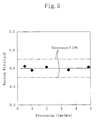
- FIG. 5 shows the relationship between the processing time with the polysiloxane solution 106 and the pattern width(0.5- ⁇ m design rules) of the resist pattern 110 when etching has been conducted after causing the electrostatic adsorption of the polysiloxane 105.
- the amount of the formed polysiloxane 107 is completely saturated with respect to the processing time, and hence, it is indicated that variations in pattern width are very small as is shown in FIG. 5.
- the variations in pattern width satisfy the tolerance on the pattern width (within ⁇ 10%) to a sufficient degree.
- the sulfonic acid ion 104 i.e., a negative ion
- the polysiloxane 105 having an ammonium ion 107 i.e., a positive ion
- the width of the selectively formed polysiloxane film (inorganic compound film) 108 is uniquely determined by the amount of the generated negative ions. Therefore, it is difficult for the resist film 101 to be influenced by the variations in processing temperature and processing time of the electrostatic adsorption, resulting in an improvement in controllability of the pattern width.
- a copolymer of NISS and MMA is used, but a group which can generate an acid through exposure can be used in place of NISS appropriately.
- a group which can generate an acid through exposure can be used in place of NISS appropriately.
- an acid generating group 9-fluorenilideneimino-p-styrene sulfonate (FISS), or propylideneimino-p-styrene sulfonate (PISS) may be used.
- FISS 9-fluorenilideneimino-p-styrene sulfonate
- PISS propylideneimino-p-styrene sulfonate
- the substances to produce a copolymer with NISS such as styrene can be used appropriately.
- the polysiloxane having an amino group is used in this embodiment, but inorganic compounds having other groups to be positive ions may be used instead.
- inorganic compounds having other groups to be positive ions may be used instead.
- a high molecular compound having an amino group, and including Ti, Al, Ge, or Zr may be used.
- the processing is performed by the use of a solution of inorganic compound in this embodiment, but the processing may be performed by using vapor of inorganic compound instead.
- the dry development is effected by the RIE using O 2 plasma in this embodiment, but ECR (electron cyclotron resonance etching) using O 2 plasma or the like is adoptable instead.
- a light source for the exposure is the KrF excimer laser in this embodiment, but , an ArF excimer laser, an electron beam, or X-rays can be used instead.
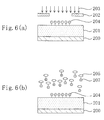
- FIGS. 6(a) and 6(b), and FIGS. 7(a) and 7(b) are sectional views for showing procedures of a pattern forming method according to a second embodiment of the present invention.
- a copolymer of NISS and styrene dissolved in diglyme is used as a resist material.
- the NISS content is 55 mol%.
- polysiloxane obtained by polymerizing 3-aminopropyltriethoxysilane by the use of hydrochloric acid serving as a catalyst is used.
- the resist material is spin-coated on a semiconductor substrate 200 of silicon, and the resultant semiconductor substrate 200 is annealed at a temperature of 90°C for 90 seconds, thereby forming a resist film 201 with a thickness of 1 ⁇ m.
- the resist film 201 is irradiated with an ArF excimer laser 203, i.e., an energy beam, thereby exposing a pattern of the mask 202 on the resist film 201.
- NISS is dissolved to generate a sulfonic acid ion 204, i.e., a negative ion on the surface of an exposed area of the resist film 201.
- the vapor of polysiloxane 205 having an amino group is sprayed on the surface of the resist film 201 as is shown in FIG. 6(b).
- the amino group becomes an ammonium ion 207, i.e., a positive ion due to the moisture in an atmosphere, resulting in that the polysiloxane 205 has a positive ion.
- Conducting such a processing causes the polysiloxane 205 in the vapor form having an ammonium ion 207, i.e., a positive ion, to be electrostatically adsorbed on the surface of the exposed area of the resist film 201 where a negative ion is present, resulting in the formation of a polysiloxane film 208, as is shown in FIG. 7(a).
- an ammonium ion 207 i.e., a positive ion
- the resist film 201 is subjected to RIE using O 2 plasma 209, thereby forming a resist pattern 210.
- the RIE using O 2 plasma 209 is effected by using a parallel plate reactive ion etching system under conditions of a power of 900 W, a pressure of 0.7 Pa and a flow rate of 40 SCCM.
- the sulfonic acid ion 204 i.e., a negative ion
- the polysiloxane 205 having an ammonium ion 207 i.e., a positive ion is caused to be electrostatically adsorbed on the sulfonic acid ion 204.
- the width of the selectively formed polysiloxane film (inorganic compound film) 208 is uniquely determined by the amount of the generated negative ions. Therefore, it is difficult for the resist film 201 to be influenced by the variations in processing temperature and processing time of the electrostatic adsorption, resulting in an improvement in controllability of the pattern width.
- a copolymer of NISS and styrene is used, but a group which can generate an acid through exposure can be used in place of NISS appropriately.
- a group which can generate an acid through exposure can be used in place of NISS appropriately.
- an acid generating group 9-fluorenilideneimino-p-styrene sulfonate (FISS), or propylideneimino-p-styrene sulfonate (PISS) may be used.
- the polysiloxane having an amino group is used in this embodiment, but inorganic compounds having other groups to be positive ions may be used instead.
- inorganic compounds having other groups to be positive ions may be used instead.
- a high molecular compound having an amino group, and including Ti, Al, Ge, or Zr may be used.
- the processing is performed by the use of the vapor of inorganic compound in this embodiment, but processing may be performed by using a solution of inorganic compound instead.
- the dry development is effected by the RIE using O 2 plasma in this embodiment, but ECR (electron cyclotron resonance etching) using O 2 plasma or the like is adoptable instead.
- a light source for the exposure is the ArF excimer laser in this embodiment, but, a KrF excimer laser, an electron beam, or X-rays can be used instead.
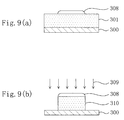
- FIGS. 8(a) and 8(b), and FIGS. 9(a) and 9(b) are sectional views for showing procedures of a pattern forming method according to a third embodiment of the present invention.
- a copolymer of O-acryloyl-acetophenone-oxime (AAPO) and MMA dissolved in diglyme is used as a resist material.
- AAPO content is 34 mol%.
- polysiloxane having a sulfonic group is used as an inorganic compound.
- the resist material is spin-coated on a semiconductor substrate 300 of silicon, and the resultant semiconductor substrate 300 is annealed at a temperature of 90°C for 90 seconds, thereby forming a resist film 301 with a thickness of 1 ⁇ m.
- the resist film 301 is irradiated with a KrF excimer laser 303, i.e., an energy beam, thereby exposing a pattern of the mask 302 on the resist film 301.
- AAPO is dissolved, and the dissolved AAPO is influenced by water to generate an ammonium ion 304, i.e., a positive ion on the surface of an exposed area of the resist film 301.
- the semiconductor substrate 300 is immersed in a polysiloxane solution 306 obtained by diluting polysiloxane 305 having a sulfonic group with water as is shown in FIG. 8(b). Thereafter, the semiconductor substrate 300 is washed with water, and then dried. Conducting such a processing causes the polysiloxane 305 having a sulfonic acid ion 307, i.e., a negative ion, to be electrostatically adsorbed on the surface of the exposed area of the resist film 301 where an ammonium ion 304, i.e., a positive ion is present, resulting in the formation of a polysiloxane film 308, as is shown in FIG. 9(a).
- a sulfonic acid ion 307 i.e., a negative ion
- the resist film 301 is subjected to RIE using O 2 plasma 309, thereby forming a resist pattern 310.
- the RIE using O 2 plasma 309 is effected by using a parallel plate reactive ion etching system under conditions of a power of 900 W, a pressure of 0.7 Pa and a flow rate of 40 SCCM.
- the ammonium ion 304 i.e., a positive ion
- the polysiloxane 305 having a sulfonic acid ion 307, i.e., a negative ion is caused to be electrostatically adsorbed on the ammonium ion 304.
- the width of the selectively formed polysiloxane film (inorganic compound film ) 308 is uniquely determined by the amount of the generated positive ions. Therefore, it is difficult for the resist film 301 to be influenced by the variations in processing temperature and processing time of the electrostatic adsorption, resulting in an improvement in controllability of the pattern width.
- a copolymer of AAPO and MMA is used, but a group which can generate a base through exposure can be used in place of AAPO appropriately.
- a base generating group O-phenylacetyl-acetophenone-oxime (PaApO), or O-phenylacetyl-acetonaphthone-oxime (PaANO) may be used.
- the polysiloxane having a sulfonic group is used in this embodiment, but inorganic compounds having other groups to be negative ions such as carboxylic group may be used instead.
- inorganic compounds having other groups to be negative ions such as carboxylic group may be used instead.
- a high molecular compound having a sulfonic group or carboxylic group, and including Ti, Al, Ge, or Zr may be used.
- the processing is performed by the use of a solution of inorganic compound in this embodiment, but the processing may be performed by using the vapor of inorganic compound instead.
- the dry development is effected by the RIE using O 2 plasma in this embodiment, but ECR (electron cyclotron resonance etching) using O 2 plasma or the like is adoptable instead.
- a light source for the exposure is the KrF excimer laser in this embodiment, but , an ArF excimer laser, an electron beam, or X-rays can be used instead.
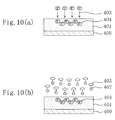
- FIGS. 10(a) and 10(b), and FIGS. 11(a) and 11(b) are sectional views for showing procedures of a pattern forming method according to a fourth embodiment of the present invention.
- novolak type resin dissolved in diglyme is used as a resist material.
- polysiloxane having a sulfonic group is used as an inorganic compound.
- the resist material is spin-coated on a semiconductor substrate 400 of silicon, and the resultant semiconductor substrate 400 is annealed at a temperature of 200°C for 90 seconds, thereby forming a resist film 401 with a thickness of 1 ⁇ m.
- a desired pattern is exposed by means of a hydrogen ion beam 403, thereby selectively implanting hydrogen ions (H + ) 404 into the vicinity of the surface of the resist film 401.
- the resist film 401 is an insulating film, and hence the implanted hydrogen ion 404 remains as a positive electric charge.
- the vapor of polysiloxane 405 having a sulfonic group is sprayed on the surface of the resist film 401 as is shown in FIG. 10(b).
- the sulfonic group becomes a sulfonic acid ion 407, i.e., a negative ion due to the moisture in an atmosphere, resulting in that the polysiloxane 405 has a negative ion.
- Conducting such a processing causes the polysiloxane 405 in the vapor form having a sulfonic acid ion 407, i.e., a negative ion, to be electrostatically adsorbed on the surface of the exposed area of the resist film 401 where the hydrogen ion 404, i.e., a positive ion is present, resulting in the formation of a polysiloxane film 408, as is shown in FIG.11(a).
- a sulfonic acid ion 407 i.e., a negative ion
- the resist film 401 is subjected to RIE using O 2 plasma 409, thereby forming a resist pattern 410.
- the RIE using O 2 plasma 409 is effected by using a parallel plate reactive ion etching system under conditions of a power of 900 W, a pressure of 0.7 Pa and a flow rate of 40 SCCM.
- the hydrogen ion 404 i.e., a positive ion
- the polysiloxane 405 having a sulfonic acid ion 407, i.e., a negative ion is caused to be electrostatically adsorbed on the hydrogen ion 404.
- the width of the selectively formed polysiloxane film (inorganic compound film) 408 is uniquely determined by the amount of ions of the implanted hydrogen ions 404. Therefore, it is difficult for the resist film 401 to be influenced by the variations in processing temperature and processing time of the electrostatic adsorption, resulting in an improvement in controllability of the pattern width.
- the polysiloxane having a sulfonic group is used in this embodiment, but inorganic compounds for generating a negative ion opposite to the positive ion for ion implantation may be used instead.
- inorganic compounds for generating a negative ion opposite to the positive ion for ion implantation may be used instead.
- a high molecular compound having a carboxylic group, and including Ti, Al, Ge, or Zr may be used.
- a hydrogen ion is used as an ion to be selectively implanted into the resist film 401 in this embodiment, but a He ion having a positive electric charge, C ion having a positive or negative electric charge, or the like may be used instead.
- a negative ion is implanted, in place of polysiloxane having a sulfonic group which generates a negative ion, for example, polysiloxane having an amino group, or a high molecular compound having an amino group, and including Ti, Al, Ge, or Zr may be used.
- the processing is performed by the use of the vapor of inorganic compound in this embodiment, but processing may be performed by using a solution of inorganic compound instead.
- the dry development is effected by the RIE using O 2 plasma in this embodiment, but ECR (electron cyclotron resonance etching) using O 2 plasma or the like is adoptable instead.
- the present invention is not limited thereto.
- the present invention is widely adoptable in the cases where impurity is selectively implanted into a semiconductor substrate, or an object film formed on the semiconductor substrate; a mask for selectively depositing a thin film on a semiconductor substrate, or an object film formed on the semiconductor substrate is formed; and the like.
- an organic polymer film or insulating film may be used in place of a resist film.
- a polymer film for example, a polyvinyl phenol film, polyimide film, or the like may be used, while as an insulating film, for example, a silicon dioxide film, silicon nitride film, or the like may be used.
Landscapes
- Chemical & Material Sciences (AREA)
- Chemical Kinetics & Catalysis (AREA)
- Inorganic Chemistry (AREA)
- Organic Chemistry (AREA)
- Physics & Mathematics (AREA)
- General Physics & Mathematics (AREA)
- Photosensitive Polymer And Photoresist Processing (AREA)
- Exposure Of Semiconductors, Excluding Electron Or Ion Beam Exposure (AREA)
- Materials For Photolithography (AREA)
- Drying Of Semiconductors (AREA)
Applications Claiming Priority (3)
| Application Number | Priority Date | Filing Date | Title |
|---|---|---|---|
| JP04021097A JP3467372B2 (ja) | 1997-02-25 | 1997-02-25 | パターン形成方法及び半導体処理方法 |
| JP4021097 | 1997-02-25 | ||
| JP40210/97 | 1997-02-25 |
Publications (2)
| Publication Number | Publication Date |
|---|---|
| EP0860743A2 true EP0860743A2 (de) | 1998-08-26 |
| EP0860743A3 EP0860743A3 (de) | 1999-11-10 |
Family
ID=12574425
Family Applications (1)
| Application Number | Title | Priority Date | Filing Date |
|---|---|---|---|
| EP98103054A Withdrawn EP0860743A3 (de) | 1997-02-25 | 1998-02-20 | Behandlungsmethode für Halbleiter und Verfahren zur Erzeugung von Mustern |
Country Status (2)
| Country | Link |
|---|---|
| EP (1) | EP0860743A3 (de) |
| JP (1) | JP3467372B2 (de) |
Families Citing this family (2)
| Publication number | Priority date | Publication date | Assignee | Title |
|---|---|---|---|---|
| US7220680B1 (en) * | 2005-10-31 | 2007-05-22 | Taiwan Semiconductor Manufacturing Company, Ltd. | Method for photolithography in semiconductor manufacturing |
| CN102236253B (zh) * | 2011-05-20 | 2012-11-07 | 潍坊星泰克微电子材料有限公司 | 用于微光刻工艺的多相高硅光刻胶成像方法、多相高硅光刻胶及应用 |
Family Cites Families (5)
| Publication number | Priority date | Publication date | Assignee | Title |
|---|---|---|---|---|
| JPH0249416A (ja) * | 1988-08-10 | 1990-02-19 | Sanyo Electric Co Ltd | 微細パターンの形成方法 |
| DE3913434A1 (de) * | 1989-04-24 | 1990-10-25 | Siemens Ag | Trockenwickelbares resistsystem |
| DE59010396D1 (de) * | 1990-04-27 | 1996-08-01 | Siemens Ag | Verfahren zur Erzeugung einer Resiststruktur |
| KR950004976B1 (ko) * | 1992-10-26 | 1995-05-16 | 현대전자산업주식회사 | 포지티브 레지스트 형성방법 |
| KR0174316B1 (ko) * | 1994-07-05 | 1999-04-01 | 모리시다 요이치 | 미세패턴 형성방법 |
-
1997
- 1997-02-25 JP JP04021097A patent/JP3467372B2/ja not_active Expired - Fee Related
-
1998
- 1998-02-20 EP EP98103054A patent/EP0860743A3/de not_active Withdrawn
Also Published As
| Publication number | Publication date |
|---|---|
| JP3467372B2 (ja) | 2003-11-17 |
| JPH10242022A (ja) | 1998-09-11 |
| EP0860743A3 (de) | 1999-11-10 |
Similar Documents
| Publication | Publication Date | Title |
|---|---|---|
| US8158335B2 (en) | High etch resistant material for double patterning | |
| EP0791856B1 (de) | Bilderzeugungsmaterial und Verfahren | |
| US5658711A (en) | Method of forming micropatterns | |
| EP0599539B1 (de) | Verfahren zur Herstellung eines Musters durch Silylierung | |
| EP0860740B1 (de) | Material zur Herstellung von Feinstrukturen | |
| US20090011374A1 (en) | Method and material for forming high etch resistant double exposure patterns | |
| EP0877295A2 (de) | Mustermaterial und Musterverfahren | |
| US4596761A (en) | Graft polymerized SiO2 lithographic masks | |
| US5229258A (en) | Method for producing a resist structure | |
| JP3467372B2 (ja) | パターン形成方法及び半導体処理方法 | |
| JPH09189998A (ja) | パターン形成材料及びパターン形成方法 | |
| JPH0883786A (ja) | 半導体装置の製造方法 | |
| JP3342856B2 (ja) | 微細パターンの形成方法および半導体装置の製造方法 | |
| US6190837B1 (en) | Method for forming photoresist film pattern | |
| JPH11258803A (ja) | パターン形成材料及びパターン形成方法 | |
| JP4836363B2 (ja) | レジストパターンの形成方法 | |
| JP3293803B2 (ja) | 微細パターンの形成方法および半導体装置の製造方法 | |
| JP3387740B2 (ja) | パターン形成方法 | |
| JP3257126B2 (ja) | パターン形成方法 | |
| EP0354536B1 (de) | Bilderzeugungsverfahren | |
| JP2643879B2 (ja) | 微細パターン形成方法 | |
| JP4017231B2 (ja) | 化学増幅レジストの感度促進方法およびパターン形成方法 | |
| JP2000347406A (ja) | レジストパターン形成方法及び半導体装置の製造方法 | |
| JP3570107B2 (ja) | レジストパターンの形成方法及び半導体装置の製造方法 | |
| JPH08328265A (ja) | 微細パターン形成方法 |
Legal Events
| Date | Code | Title | Description |
|---|---|---|---|
| PUAI | Public reference made under article 153(3) epc to a published international application that has entered the european phase |
Free format text: ORIGINAL CODE: 0009012 |
|
| AK | Designated contracting states |
Kind code of ref document: A2 Designated state(s): AT BE CH DE DK ES FI FR GB GR IE IT LI LU MC NL PT SE |
|
| AX | Request for extension of the european patent |
Free format text: AL;LT;LV;MK;RO;SI |
|
| PUAL | Search report despatched |
Free format text: ORIGINAL CODE: 0009013 |
|
| RIC1 | Information provided on ipc code assigned before grant |
Free format text: 6G 03F 7/26 A, 6G 03F 7/20 B |
|
| AK | Designated contracting states |
Kind code of ref document: A3 Designated state(s): AT BE CH DE DK ES FI FR GB GR IE IT LI LU MC NL PT SE |
|
| AX | Request for extension of the european patent |
Free format text: AL;LT;LV;MK;RO;SI |
|
| AKX | Designation fees paid | ||
| REG | Reference to a national code |
Ref country code: DE Ref legal event code: 8566 |
|
| STAA | Information on the status of an ep patent application or granted ep patent |
Free format text: STATUS: THE APPLICATION IS DEEMED TO BE WITHDRAWN |
|
| 18D | Application deemed to be withdrawn |
Effective date: 20000611 |