EP0861830B1 - Verwendung von 1,4-Naphthochinon- und 1,4-dihydroxynaphthalin-Pyrrolderivaten zum Färben von Keratinsubstanzen, Verbindungen und diese enthaltende Zusammensetzungen - Google Patents
Verwendung von 1,4-Naphthochinon- und 1,4-dihydroxynaphthalin-Pyrrolderivaten zum Färben von Keratinsubstanzen, Verbindungen und diese enthaltende Zusammensetzungen Download PDFInfo
- Publication number
- EP0861830B1 EP0861830B1 EP98400298A EP98400298A EP0861830B1 EP 0861830 B1 EP0861830 B1 EP 0861830B1 EP 98400298 A EP98400298 A EP 98400298A EP 98400298 A EP98400298 A EP 98400298A EP 0861830 B1 EP0861830 B1 EP 0861830B1
- Authority
- EP
- European Patent Office
- Prior art keywords
- pyrrol
- naphthoquinone
- pyrrole
- methyl
- dioxo
- Prior art date
- Legal status (The legal status is an assumption and is not a legal conclusion. Google has not performed a legal analysis and makes no representation as to the accuracy of the status listed.)
- Expired - Lifetime
Links
- 0 *c(c(*)c1C(C(*)=C2*)=O)c(*)c(*)c1C2=O Chemical compound *c(c(*)c1C(C(*)=C2*)=O)c(*)c(*)c1C2=O 0.000 description 4
- WCMRPMAUSODOIJ-UHFFFAOYSA-N CCCCCC[n]1c(C(C(c2ccccc22)=O)=CC2=O)ccc1 Chemical compound CCCCCC[n]1c(C(C(c2ccccc22)=O)=CC2=O)ccc1 WCMRPMAUSODOIJ-UHFFFAOYSA-N 0.000 description 1
- UTAPZHXYLBPVHG-UHFFFAOYSA-N CCc1c(C)[nH]c(C(C(c2ccccc22)=O)=CC2=O)c1C Chemical compound CCc1c(C)[nH]c(C(C(c2ccccc22)=O)=CC2=O)c1C UTAPZHXYLBPVHG-UHFFFAOYSA-N 0.000 description 1
- MQEQCBMDKZYTPO-UHFFFAOYSA-N CCc1c[nH]c(C(C(c2ccccc22)=O)=CC2=O)c1C Chemical compound CCc1c[nH]c(C(C(c2ccccc22)=O)=CC2=O)c1C MQEQCBMDKZYTPO-UHFFFAOYSA-N 0.000 description 1
- SRCQSGIBVKOWIP-UHFFFAOYSA-N Cc1c(C(C(c2ccccc22)=O)=CC2=O)[nH]c(C)c1 Chemical compound Cc1c(C(C(c2ccccc22)=O)=CC2=O)[nH]c(C)c1 SRCQSGIBVKOWIP-UHFFFAOYSA-N 0.000 description 1
- MTTHFEPVGDFOIG-UHFFFAOYSA-N Cc1c(C)[nH]c(C(C(c2ccccc22)=O)=CC2=O)c1C Chemical compound Cc1c(C)[nH]c(C(C(c2ccccc22)=O)=CC2=O)c1C MTTHFEPVGDFOIG-UHFFFAOYSA-N 0.000 description 1
Classifications
-
- A—HUMAN NECESSITIES
- A61—MEDICAL OR VETERINARY SCIENCE; HYGIENE
- A61K—PREPARATIONS FOR MEDICAL, DENTAL OR TOILETRY PURPOSES
- A61K8/00—Cosmetics or similar toiletry preparations
- A61K8/18—Cosmetics or similar toiletry preparations characterised by the composition
- A61K8/30—Cosmetics or similar toiletry preparations characterised by the composition containing organic compounds
- A61K8/49—Cosmetics or similar toiletry preparations characterised by the composition containing organic compounds containing heterocyclic compounds
- A61K8/4906—Cosmetics or similar toiletry preparations characterised by the composition containing organic compounds containing heterocyclic compounds with one nitrogen as the only hetero atom
- A61K8/4913—Cosmetics or similar toiletry preparations characterised by the composition containing organic compounds containing heterocyclic compounds with one nitrogen as the only hetero atom having five membered rings, e.g. pyrrolidone carboxylic acid
-
- A—HUMAN NECESSITIES
- A61—MEDICAL OR VETERINARY SCIENCE; HYGIENE
- A61Q—SPECIFIC USE OF COSMETICS OR SIMILAR TOILETRY PREPARATIONS
- A61Q5/00—Preparations for care of the hair
- A61Q5/06—Preparations for styling the hair, e.g. by temporary shaping or colouring
- A61Q5/065—Preparations for temporary colouring the hair, e.g. direct dyes
-
- C—CHEMISTRY; METALLURGY
- C07—ORGANIC CHEMISTRY
- C07D—HETEROCYCLIC COMPOUNDS
- C07D207/00—Heterocyclic compounds containing five-membered rings not condensed with other rings, with one nitrogen atom as the only ring hetero atom
- C07D207/02—Heterocyclic compounds containing five-membered rings not condensed with other rings, with one nitrogen atom as the only ring hetero atom with only hydrogen or carbon atoms directly attached to the ring nitrogen atom
- C07D207/30—Heterocyclic compounds containing five-membered rings not condensed with other rings, with one nitrogen atom as the only ring hetero atom with only hydrogen or carbon atoms directly attached to the ring nitrogen atom having two double bonds between ring members or between ring members and non-ring members
- C07D207/32—Heterocyclic compounds containing five-membered rings not condensed with other rings, with one nitrogen atom as the only ring hetero atom with only hydrogen or carbon atoms directly attached to the ring nitrogen atom having two double bonds between ring members or between ring members and non-ring members with only hydrogen atoms, hydrocarbon or substituted hydrocarbon radicals, directly attached to ring carbon atoms
- C07D207/33—Heterocyclic compounds containing five-membered rings not condensed with other rings, with one nitrogen atom as the only ring hetero atom with only hydrogen or carbon atoms directly attached to the ring nitrogen atom having two double bonds between ring members or between ring members and non-ring members with only hydrogen atoms, hydrocarbon or substituted hydrocarbon radicals, directly attached to ring carbon atoms with substituted hydrocarbon radicals, directly attached to ring carbon atoms
- C07D207/333—Radicals substituted by oxygen or sulfur atoms
-
- C—CHEMISTRY; METALLURGY
- C07—ORGANIC CHEMISTRY
- C07D—HETEROCYCLIC COMPOUNDS
- C07D207/00—Heterocyclic compounds containing five-membered rings not condensed with other rings, with one nitrogen atom as the only ring hetero atom
- C07D207/02—Heterocyclic compounds containing five-membered rings not condensed with other rings, with one nitrogen atom as the only ring hetero atom with only hydrogen or carbon atoms directly attached to the ring nitrogen atom
- C07D207/30—Heterocyclic compounds containing five-membered rings not condensed with other rings, with one nitrogen atom as the only ring hetero atom with only hydrogen or carbon atoms directly attached to the ring nitrogen atom having two double bonds between ring members or between ring members and non-ring members
- C07D207/34—Heterocyclic compounds containing five-membered rings not condensed with other rings, with one nitrogen atom as the only ring hetero atom with only hydrogen or carbon atoms directly attached to the ring nitrogen atom having two double bonds between ring members or between ring members and non-ring members with hetero atoms or with carbon atoms having three bonds to hetero atoms with at the most one bond to halogen, e.g. ester or nitrile radicals, directly attached to ring carbon atoms
-
- C—CHEMISTRY; METALLURGY
- C07—ORGANIC CHEMISTRY
- C07D—HETEROCYCLIC COMPOUNDS
- C07D207/00—Heterocyclic compounds containing five-membered rings not condensed with other rings, with one nitrogen atom as the only ring hetero atom
- C07D207/46—Heterocyclic compounds containing five-membered rings not condensed with other rings, with one nitrogen atom as the only ring hetero atom with hetero atoms directly attached to the ring nitrogen atom
- C07D207/48—Sulfur atoms
Definitions
- the invention relates to the use of pyrrolic derivatives of 1,4-naphthoquinone and 1,4-dihydroxynaphthalene, as direct dyes in a composition dye intended for dyeing keratinous materials, in particular in a cosmetic composition intended for dyeing keratin materials human, and in particular human keratin fibers such as hair; it also relates to some of these pyrrolic derivatives of 1,4-naphthoquinone and 1,4-dihydroxynaphthalene as new compounds.
- naphthoquinone dyes such as 2-hydroxynaphtoquinone (commonly known as lawsone), 5-hydroxynaphtoquinone (commonly called juglone), 2-hydroxynaphtoquinones and 5-hydroxynaphtoquinones substituted by other hydroxy radicals, chlorine atoms, radicals alkoxy or alkyl, as described in patents FR-2,517,199 and FR-2,537 433.
- the alkyl radicals (C 1 -C 4 ) or the alkyls (C 1 -C 4 ) of the alkoxy radicals or of the acyl radicals can be linear or branched, saturated or unsaturated, and can be chosen in particular from methyl, ethyl, n -propyl, isopropyl, n-butyl, isobutyl, ter.-butyl, and more particularly methyl.
- the alkyl radicals can be linear or branched, saturated or unsaturated; they may be substituted by one or more halogen atoms, one or more hydroxyl radicals, free, or protected by an ether function chosen from aliphatic ethers such as methoxymethyl ether, methyl ether or ethyl ether, aromatic ethers such as benzyl ether, alkylsilyl ethers such as trimethylsilylether or tert-butyldimethylsilylether, alkylarylsilyl ethers such as tert-butyldiphenylsilylether or also among aliphatic esters such as acetates and aromatic esters such as benzoates.
- aliphatic ethers such as methoxymethyl ether, methyl ether or ethyl ether
- aromatic ethers such as benzyl ether
- alkylsilyl ethers such as trimethylsilylether or tert-butyl
- the alkyl radicals (C 1 -C 18 ) are especially chosen, for example, from the methyl, ethyl, n-propyl, isopropyl, n-butyl, isobutyl, ter.-butyl, n-pentyl, isopentenyl, n- radicals. octyl, n-hexadecyl, and more particularly methyl, ter.-butyl, n-pentyl, isopentenyl, n-octyl, n-hexadecyl.
- substitution radicals of the alkyl radicals (C 1 -C 18 ) which denote COOH, as well as the COOH radicals of R 7 to R 11 can also be salified with non-toxic cations chosen from alkali metals, alkaline earth metals and ammonium.
- halogen atoms are chosen in particular from chlorine and bromine.
- a more particularly preferred novel compound of formula (II) is the methyl ester of [5- (1,4-dihydroxy-naphthalen-2-yl) -1-methyl-1-H-pyrrol-2-yl acid. ]-acetic.
- the subject of the invention is also a dye composition for materials keratin, comprising in a medium suitable for dyeing, 0.01 to 10% by weight relative to the total weight of the composition, of at least one compound of formula (I) or (II) defined above.
- composition intended for the dyeing of human keratin materials, and more particularly still, in the dyeing of human keratin fibers such as the hair, comprising in a medium cosmetically acceptable, 0.01 to 10% by weight relative to the total weight of the composition of at least one compound of formula (I) or (II) defined above.
- keratin materials mainly means natural textile fibers such as wool, animal fur, by material human keratin, skin and nails, and by human keratin fibers, hair, body hair, eyelashes and eyebrows.
- the invention is more particularly on human keratin materials, and more particularly still on the hair.
- the compounds of formula (I) or (II) are generally present in proportions of between approximately 0.01 and 10%, preferably between approximately 0.05 and 5% by weight, relative to the total weight of the dye composition.
- the compounds of formula (I) or (II) can also be incorporated into dye compositions for oxidation coloring which contain bases oxidation and possibly couplers, to enrich the nuances with reflections obtained with oxidation dyes.
- the cosmetically acceptable medium is preferably a medium consisting of water and / or cosmetically acceptable organic solvents if the composition is cosmetic, and more particularly, alcohols (ethyl alcohol, isopropyl alcohol, l benzyl alcohol, and phenylethyl alcohol), glycols or glycol ethers (propylene glycol or its ethers such as, for example, propylene glycol monomethyl ether, butylene glycol, dipropylene glycol as well as diethylene glycol alkyl ethers such as, for example, monoethyl ether or the monobutyl ether of diethylene glycol, the monomethyl, monoethyl and monobutyl ethers of ethylene glycol), in concentrations of between approximately 0.5 and 25% and, preferably, between approximately 2 and 15% by weight relative to the total weight of the composition.
- alcohols ethyl alcohol, isopropyl alcohol, l benzyl alcohol, and phenylethyl alcohol
- fatty substances such as oils and waxes. It is also possible to add to the composition according to the invention fatty amides such as mono- and di-ethanolamides of acids derived from coconut, lauric acid or oleic acid, at concentrations of between approximately 0.05 and 10% by weight.
- the dye composition according to the invention may also contain, in order to obtain various shades, in addition to the dyes of formula (I) or (II), other direct dye (s) conventionally used, and in particular, nitrobenzene dyes, such as nitrophenylenediamines, nitrodiphenylamines, nitroanilines, nitrated phenol ethers or nitrophenols, nitropyridines, anthraquinone dyes, mono- or di-azo, triarylmethanics, azinics, acridinics and xanthines Ore.
- the proportion of all these other direct addition dyes can vary between approximately 0.05 and 10% by weight relative to the total weight of the dye composition.
- Said dye composition may also contain any other adjuvant usually used in dyeing keratin materials and for example, surfactants well known in the art and of anionic, cationic, nonionic, amphoteric, zwitterionic or their mixtures, thickening agents, antioxidants, perfumes, sequestering agents, dispersing agents, conditioning agents, preserving agents, opacifying agents, etc.
- surfactants well known in the art and of anionic, cationic, nonionic, amphoteric, zwitterionic or their mixtures, thickening agents, antioxidants, perfumes, sequestering agents, dispersing agents, conditioning agents, preserving agents, opacifying agents, etc.
- surfactants well known in the art and of anionic, cationic, nonionic, amphoteric, zwitterionic or their mixtures, thickening agents, antioxidants, perfumes, sequestering agents, dispersing agents, conditioning agents, preserving agents, opacifying agents, etc.
- the dye composition according to the invention can be formulated at acidic, neutral or alkaline pH, the pH possibly varying for example from 2 to 11 and preferably from 2.5 to 10, and being able to be adjusted by means of alkalinization or acidification agents previously well known.
- the basifying agents there may be mentioned, by way of example, ammonia, alkali carbonates, alkanolamines such as mono-, di- and triethanolamines as well as their derivatives, sodium or potassium hydroxides and compounds of following formula: in which R is a propylene residue optionally substituted by a hydroxyl group or a C 1 -C 4 alkyl radical; R 16, R 17, R 18 and R 19, identical or different, represent a hydrogen atom, an alkyl radical in C 1 -C 4 hydroxyalkyl or C 1 -C 4.
- the acidifying agents are conventionally, for example, mineral or organic acids such as hydrochloric acid, orthophosphoric acid, carboxylic acids such as tartaric acid, citric acid, lactic acid, or
- compositions for the nails and the skin are in particular nail varnishes, makeup products for the lips or the face, such as lipstick sticks, eye shadows, blushes, foundations, the liners also called "eyeliner", or mascaras.
- Another subject of the invention relates to a process for dyeing fibers human keratin, and more particularly of the hair, by coloring direct, consisting in letting a dye composition containing at least a compound of formula (I) or (II), on dry or wet keratin fibers.
- the composition according to the invention can be used as a non-composition rinsed, that is to say that after application of the composition to the fibers, it is dried without intermediate rinsing.
- the composition on the fibers during an exposure time varying between 3 and 60 minutes approximately, preferably between 5 and 45 minutes approximately, one rinses, optionally washing and rinsing again, then drying.
- Example 7 The same protocol was followed as in Example 7, shaking 10 millimoles of 1,4-naphthoquinone with 2.5 millimoles of N-pentyl-pyrrole in 40ml of acid acetic at 50 ° C for 5 hours.
- Example 7 The same protocol was followed as in Example 7, with 10 millimoles of 1,4-naphthoquinone being stirred with 2.5 millimoles of N-octyl-pyrrole in 40 ml of acetic acid at 50 ° C. for 5 hours. There was thus obtained 1-octyl-2,5-bis- (1,4-naphthoquinone-2-yl) -pyrrole with a yield of 49% after chromatography on a silica column. Melting Point: 75-76 ° C.
- Example 7 The same protocol was followed as in Example 7, shaking 10 millimoles of 1,4-naphthoquinone with 2.5 millimoles of N-hexadecyl-pyrrole in 40ml of acid acetic at 50 ° C for 5 hours.
- Example 7 The same protocol was followed as in Example 7, with 10 millimoles of 1,4-naphthoquinone being stirred with 2.5 millimoles of N-benzyl-pyrrole in 40 ml of acetic acid at 50 ° C. for 5 hours. There was thus obtained 1-benzyl-2,5-bis- (1,4-naphthoquinone-2-yl) -pyrrole with a yield of 9% after chromatography on a silica column. Melting Point : 149-150 ° C.
- Example 14 The same protocol was followed as in Example 14, with stirring in a flask 40 millimoles of 1,4-naphthoquinone and 10 millimoles of 2,5-dimethyl-1H-pyrrole in 50 ml of glacial acetic acid for 2 hours at room temperature.
- the product 2- (2,5-dimethyl-1-H-pyrrol-3-yl) -8-hydroxy- [1,4] -naphthoquinone was thus isolated, with a yield of 37% after purification by column chromatography. silica.
- Example 14 The same protocol was followed as in Example 14, with stirring in a flask 40 millimoles of 1,4-naphthoquinone and 10 millimoles of the methyl ester of 3- (1,2,5-trimethyl-1 acid).
- -H-pyrrole) -carboxylic in 50 ml of glacial acetic acid for 2 hours at room temperature.
- the methyl ester product of 4- (8-hydroxy-1,4-dioxo-1,4-dihydro-naphthalen-2-yl) -1,2,5-trimethyl-1-H- was thus isolated.
- pyrrole-3-carboxylic with a yield of 26% after purification by chromatography on a silica column.
- Example 14 The same protocol was followed as in Example 14, with stirring in a flask 40 millimoles of 1,4-naphthoquinone and 10 millimoles of the methyl ester of 3- (2,5-dimethyl-1-H acid).
- -pyrrole) -carboxylic in 50 ml of glacial acetic acid for 2 hours at room temperature.
- the methyl ester product of 4- (8-hydroxy-1,4-dioxo-1,4-dihydro-naphthalen-2-yl) -2,5-dimethyl-1-H-pyrrole- was thus isolated.
- 3-carboxylic with a yield of 31% after purification by chromatography on a silica column.
- the following dye composition was prepared: Colorant prepared in Example 1 0,531g Benzyl alcohol 10.0 g Ethyl alcohol 21.0 g Glycerin 5.0 g Hydroxyethylcellulose sold under the name Cellosize QP4400H by Union Carbide 2.3 g Citric acid 1.4 g Demineralized water qs 100g
- this dye composition was applied to locks of gray hair permed with 90% white hairs, at a rate of 3 grams per gram of hair. It was left to stand for 30 minutes at room temperature; the locks were then rinsed under running water and then dried. The locks of hair were dyed a purple color.
- the following dye composition was prepared: Colorant prepared in Example 5 0,702g Benzyl alcohol 10.0 g Ethyl alcohol 21.0 g Glycerin 5.0 g Hydroxyethylcellulose sold under the name Cellosize QP4400H by Union Carbide 2.3 g Citric acid 1.4 g Demineralized water qs 100g
- this dye composition was applied to locks of gray hair containing 90% white and bleached, at a rate of 3 grams per gram of hair. It was left to stand for 30 minutes at room temperature; the locks were then rinsed under running water and then dried. The locks of hair were dyed in a beige-pink color.
- the following dye composition was prepared: Colorant prepared in Example 7 0,881g Benzyl alcohol 10.0 g Ethyl alcohol 21.0 g Glycerin 5.0 g Hydroxyethylcellulose sold under the name Cellosize QP4400H by Union Carbide 2.3 g Citric acid 1.4 g Demineralized water qs 100g
- this dye composition was applied to locks of natural gray hair containing 90% white hairs, at a rate of 3 grams per gram of hair. It was left to stand for 30 minutes at room temperature; the locks were then rinsed under running water and then dried. The locks of hair were dyed in an intense copper color.
- the following dye composition was prepared: Colorant prepared in Example 1 0,500g Nonylphenol oxyethylenated with 9 moles of ethylene oxide 8.0 g Coconut acid diethanolamide 2.0 g Propylene glycol monomethyl ether 10.0 g 2-amino-2-methyl-1-propanol qs pH 9 Demineralized water qs 100g
- this dye composition was applied to locks of gray hair containing 90% white and bleached, at a rate of 3 grams per gram of hair. It was left to stand for 30 minutes at room temperature; the locks were then rinsed under running water and then dried. The locks of hair were dyed in a light salmon color.
- this dye composition was applied to locks of gray hair permed with 90% white hairs, at a rate of 3 grams per gram of hair. It was left to stand for 30 minutes at room temperature; the locks were then rinsed under running water and then dried. The locks of hair were dyed in a very light copper color.
- the following dye composition was prepared: Colorant prepared in Example 8 1,007g Nonylphenol oxyethylenated with 9 moles of ethylene oxide 8.0 g Coconut acid diethanolamide 2.0 g Propylene glycol monomethyl ether 10.0 g 2-amino-2-methyl-1-propanol qs pH 9 Demineralized water qs 100g
- this dye composition was applied to locks of gray hair containing 90% white and bleached, at a rate of 3 grams per gram of hair. It was left to stand for 30 minutes at room temperature; the locks were then rinsed under running water and then dried. The locks of hair were dyed in a golden blond color.
- this dye composition was applied to locks of gray hair containing 90% white and bleached, at a rate of 3 grams per gram of hair. It was left to stand for 30 minutes at room temperature; the locks were then rinsed under running water and then dried. The locks of hair were dyed in a straw color.
- the following dye composition was prepared: Colorant prepared in Example 11 1,052g Nonylphenol oxyethylenated with 9 moles of ethylene oxide 8.0 g Coconut acid diethanolamide 2.0 g Propylene glycol monomethyl ether 10.0 g 2-amino-2-methyl-1-propanol qs pH 9 Demineralized water qs 100g
- this dye composition was applied to locks of gray hair containing 90% white and bleached, at a rate of 3 grams per gram of hair. It was left to stand for 30 minutes at room temperature; the locks were then rinsed under running water and then dried. The locks of hair were dyed in a golden blond color.
- the following dye composition was prepared: Colorant prepared in Example 12 0,934g Benzyl alcohol 10.0 g Ethyl alcohol 21.0 g Glycerin 5.0 g Hydroxyethylcellulose sold under the name Cellosize QP4400H by Union Carbide 2.3 g Citric acid 1.4 g Demineralized water qs 100g
- this dye composition was applied to locks of gray hair containing 90% white and bleached, at a rate of 3 grams per gram of hair. It was left to stand for 30 minutes at room temperature; the locks were then rinsed under running water and then dried. The locks of hair were dyed in a pink color.
- the following dye composition was prepared: Colorant prepared in Example 13 0,928g Benzyl alcohol 10.0 g Ethyl alcohol 21.0 g Glycerin 5.0 g Hydroxyethylcellulose sold under the name Cellosize QP4400H by Union Carbide 2.3 g Citric acid 1.4 g Demineralized water qs 100g
- this dye composition was applied to locks of gray hair containing 90% white and bleached, at a rate of 3 grams per gram of hair. It was left to stand for 30 minutes at room temperature; the locks were then rinsed under running water and then dried. The locks of hair were dyed in a light purple color.
- the following dye composition was prepared: Dye prepared in Example 14 0,928g Benzyl alcohol 10.0 g Ethyl alcohol 21.0 g Glycerin 5.0 g QP4400H by Union Carbide Hydroxyethylcellulose sold under the name Cellosize 2.3 g Citric acid 1.4 g Demineralized water qs 100g
- this dye composition was applied to locks of gray hair permed with 90% white hairs, at a rate of 3 grams per gram of hair. It was left to stand for 30 minutes at room temperature; the locks were then rinsed under running water and then dried. The locks of hair were dyed in an intense beige-pink coloration.
- the following dye composition was prepared: Dye prepared in Example 15 0,827g Benzyl alcohol 10.0 g Ethyl alcohol 21.0 g Glycerin 5.0 g Hydroxyethylcellulose sold under the name Cellosize QP4400H by Union Carbide 2.3 g Citric acid 1.4 g Demineralized water qs 100g
- this dye composition was applied to locks of gray hair containing 90% white and bleached, at a rate of 3 grams per gram of hair. It was left to stand for 30 minutes at room temperature; the locks were then rinsed under running water and then dried. The locks of hair were dyed in a gray-golden-pearly color.
- the following dye composition was prepared: Colorant prepared in Example 16 1,018g Benzyl alcohol 10.0 g Ethyl alcohol 21.0 g Glycerin 5.0 g Hydroxyethylcellulose sold under the name Cellosize QP4400H by Union Carbide 2.3 g Citric acid 1.4 g Demineralized water qs 100g
- this dye composition was applied to locks of gray hair permed with 90% white hairs, at a rate of 3 grams per gram of hair. It was left to stand for 30 minutes at room temperature; the locks were then rinsed under running water and then dried. The locks of hair were dyed in a golden-blonde color.
- the following dye composition was prepared: Colorant prepared in Example 17 0,976g Benzyl alcohol 10.0 g Ethyl alcohol 21.0 g Glycerin 5.0 g Hydroxyethylcellulose sold under the name Cellosize QP4400H by Union Carbide 2.3 g Citric acid 1.4 g Demineralized water qs 100g
- this dye composition was applied to locks of gray hair containing 90% white and bleached, at a rate of 3 grams per gram of hair. It was left to stand for 30 minutes at room temperature; the locks were then rinsed under running water and then dried. The locks of hair were dyed in a light copper color.
- the following dye composition was prepared: Colorant prepared in Example 18 0.5 g Nonylphenol oxyethylenated with 9 moles of ethylene oxide 8.0 g Coconut acid diethanolamide 2.0 g Propylene glycol monomethyl ether 10.0 g 2-amino-2-methyl-1-propanol qs pH 9 Demineralized water qs 100g
- this dye composition was applied to locks of gray hair containing 90% white and bleached, at a rate of 3 grams per gram of hair. It was left to stand for 30 minutes at room temperature; the locks were then rinsed under running water and then dried. The locks of hair were dyed in a beige-pink color.
- the following dye composition was prepared: Colorant prepared in Example 19 0,838g Benzyl alcohol 10.0 g Ethyl alcohol 21.0 g Glycerin 5.0 g Hydroxyethylcellulose sold under the name Cellosize QP4400H by Union Carbide 2.3 g Citric acid 1.4 g Demineralized water qs 100g
- this dye composition was applied to locks of gray hair containing 90% white and bleached, at a rate of 3 grams per gram of hair. It was left to stand for 30 minutes at room temperature; the locks were then rinsed under running water and then dried. The locks of hair were dyed in a silver lavender blue color.
Landscapes
- Chemical & Material Sciences (AREA)
- Organic Chemistry (AREA)
- Health & Medical Sciences (AREA)
- Life Sciences & Earth Sciences (AREA)
- Public Health (AREA)
- General Health & Medical Sciences (AREA)
- Animal Behavior & Ethology (AREA)
- Veterinary Medicine (AREA)
- Birds (AREA)
- Epidemiology (AREA)
- Cosmetics (AREA)
- Pyrrole Compounds (AREA)
- Coloring (AREA)
- Plural Heterocyclic Compounds (AREA)
Claims (10)
- Verwendung von Verbindungen der Formeln I oder II als Direktfarbstoffe in kosmetischen Zusammensetzungen zum Färben der Haare oder zur Herstellung dieser Zusammensetzungen:wobei in den Formeln I oder II bedeuten:
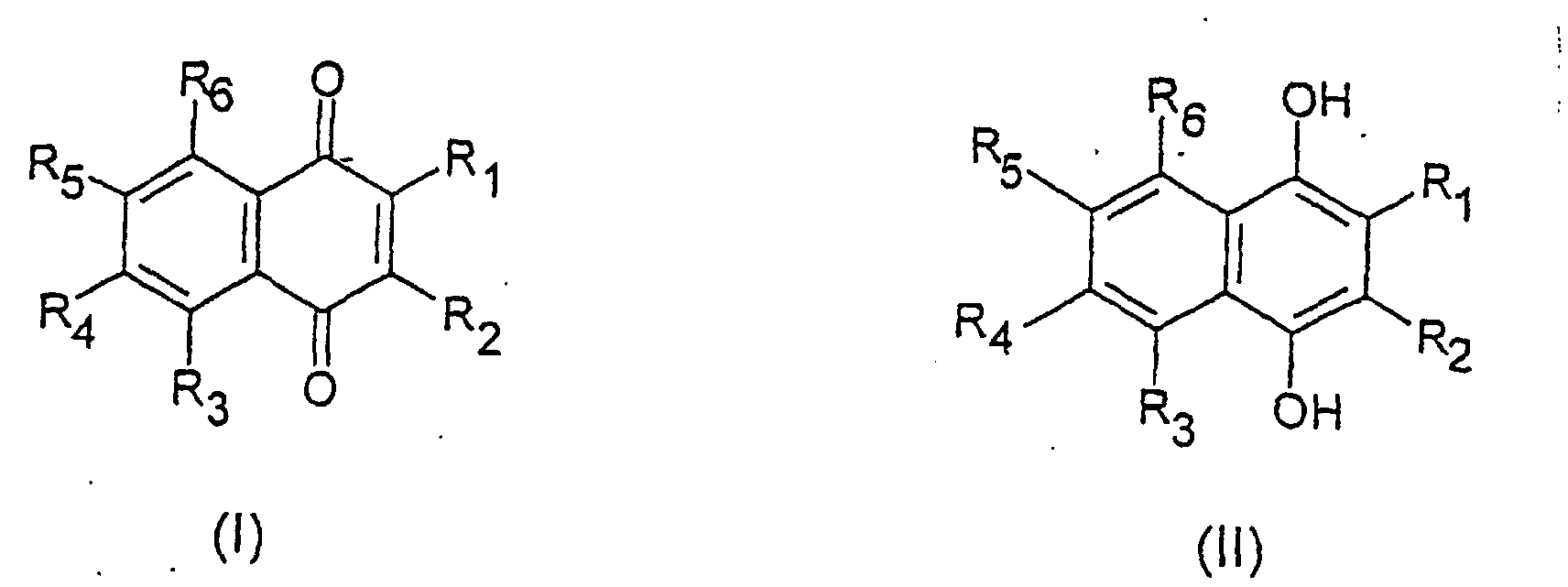 worin bedeuten:die Gruppen R1 und R2, die identisch oder voneinander verschieden sind, ein Wasserstoffatom, ein Halogenatom, die OH-Gruppe, eine C1-4-Alkylgruppe, eine C1-4-Alkoxygruppe oder eine Gruppe Z der nachstehend definierten Formel III,die Gruppen R3 bis R6, die identisch oder voneinander verschieden sind, ein Wasserstoffatom, ein Halogenatom, die OH-Gruppe, eine C1-4-Alkylgruppe, eine C1-4-Alkoxygruppe oder eine Gruppe Z der folgenden Formel III
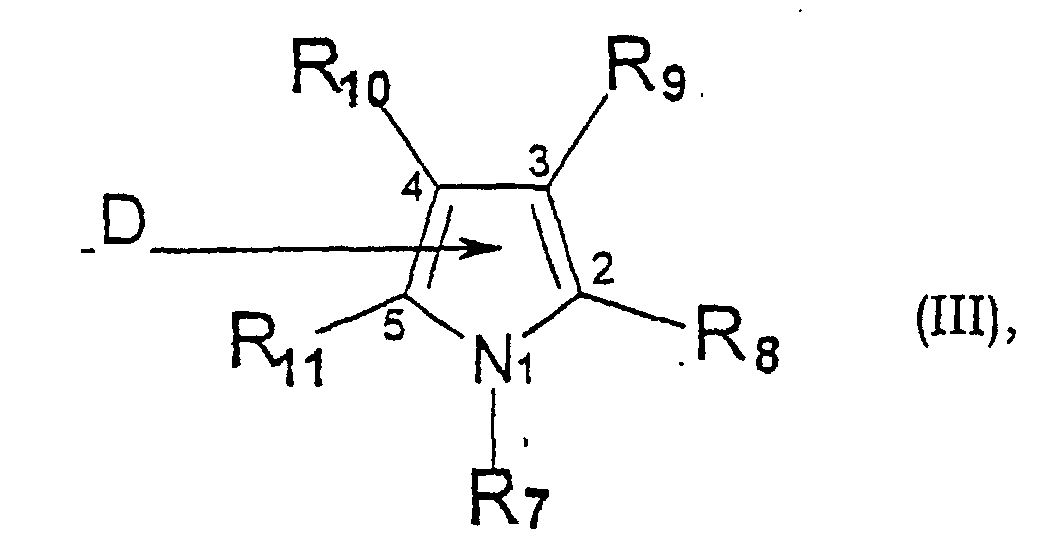 D eine kovalente Bindung zwischen dem Pyrrolring (III) und den Ringen der Struktur (I) oder (II),die Gruppen R7 bis R11, die identisch oder voneinander verschieden sind, Wasserstoff oder eine geradkettige oder verzweigte C1-18-Alkylgruppe, gesättigt oder ungesättigt die ggf. mit einem oder mehreren Halogenatomen, mit einer oder mehreren freien oder in Form von Ether- oder Estergruppen geschützten Hydroxygruppen oder mit einer oder mehreren der folgenden Gruppen substituiert ist: -CN, -COOR, -NR'R" und deren Additionssalzen mit einer Säure, -N(R')COR" und -CONR'R", wobei die Gruppen R, R' und R" H oder C1-4-Alkyl bedeuten,
die Gruppen R7 bis R11, die identisch oder voneinander verschieden sind, können auch bedeuten: CH2-C6H5, SO2-C6H5, eine Gruppe CO-C1-4-alkyl, die Gruppe COOH und ihre Salze, COO-C1-4-alkyl, CONR'R", wobei die Gruppen R' und R", die identisch oder voneinander verschieden sind, H oder C1-4-Alkyl bedeuten, eine Gruppe C6H5, die mit einem oder mehreren Halogenatomen oder einer oder mehreren Hydroxygruppen, C1-4-Alkyl oder C1-4-Alkoxy substituiert sein kann, unddie Gruppen R8 bis R11 mindestens eine Bindung D, mit der Maßgabe, dass(i) mindestens eine der Gruppen R1 oder R2 Z bedeutet,(ii) die Bindung der Gruppe Z an die Ringe der Formel (I) oder (II) an einer beliebigen Stellung 2 bis 5 des Pyrrolrings erfolgt, und(üi) die Gruppen R8 und R10 oder die Gruppen R9 und R11 nicht gleichzeitig eine Verbindung der Formel (I) bedeuten. - Verwendung nach Anspruch 1, dadurch gekennzeichnet, daß in der Formel I bedeuten:R1 eine Gruppe Z der Formel (III), wobei R7 Wasserstoff, Methyl, n-Pentyl, Isopentenyl, n-Octyl, n-Hexadecyl, CH2-C6H5, (CH2)2-CN, (CH2)2-OH, (CH2)2-NH-COCH3 und C(CH3)(CH2OH)2 bedeutet, R8 Wasserstoff, CH3, COOC2H5, CH2-COOH, CH2-COOCH3, 2-(1,4-Naphthochinonyl) und 2-(8-Hydroxy-1,4-naphthochinonyl) bedeutet, R9 Wasserstoff, CH3, C2H5, COCH3, COOH oder COOCH3 ist, R10 Wasserstoff, CH3, 2-(1,4-Naphthochinonyl) oder 2-(8-Hydroxy-1,4-naphthochinonyl) bedeutet und R11 CH3 oder 2-(1,4- Naphthochinonyl) oder 2-(8-Hydroxy-1,4-naphthochinonyl) ist,R2 Wasserstoff,R3 bis R5 Wasserstoff, undR6 Wasserstoff oder OH.
- Verwendung nach Anspruch 2, dadurch gekennzeichnet, daß es sich bei den Verbindungen der Formel I um die folgenden Verbindungen handelt:2-(1-H-Pyrrol-2-yl)-[1,4]-naphthochinon,2-(1-Methyl-1H-pyrrol-2-yl)-[1,4]-naphthochinon,2-(1-Pentyl-1H-pyrrol-2-yl)-[1,4]-naphthochinon,2-(1-Octyl-1H-pyrrol-2-yl)-[1,4]-naphthochinon,2-(1-Hexadecyl-1H-pyrrol-2-yl)-[1,4]-naphthochinon,2-(1-Benzyl-1H-pyrrol-2-yl)-[1,4]-naphthochinon,2-(4-Ethyl-3,5-dimethyl-1H-pyrrol-2-yl)-[1,4]-naphthochinon,3-[2-(1,4-Dioxo-1,4-dihydronaphthalin-2-yl)-pyrrol-1-yl]-propionitril,1-Methyl-2,5-bis(1,4-naphthochinon-2-yl)-pyrrol,1-Pentyl-2,5-bis(1,4-naphthochinon-2-yl)-pyrrol,1-Octyl-2,5-bis(1,4-naphthochinon-2-yl)-pyrrol,1-Hexadecyl-2,5-bis(1,4-naphthochinon-2-yl)-pyrrol,1-Benzyl-2,5-bis(1,4-naphthochinon-2-yl)-pyrrol,[5-(1,4-Dioxo-1,4-dihydronaphthalin-2-yl)-1-methyl-1-H-pyrrol-2-yl]-essigsäuremethylester,4-(1,4-Dioxo-1,4-dihydronaphthalin-2-yl)-2,5-dimethyl-1-Hpyrrol-3-carbonsäuremethylester,4-(1,4-Dioxo-1,4-dihydronaphthalin-2-yl)-1,2,5-trimethyl-1-Hpyrrol-3-carbonsäuremethylester,2-(2,5-Dimethyl-1-H-pyrrol-3-yl)-8-hydroxy-[1,4]-naphthochinon,4-(8-Hydroxy-1,4-dioxo-1,4-dihydronaphthalin-2-yl)-1,2,5-trimethyl-1-H-pyrrol-3-carbonsäuremethylester,4-(8-Hydroxy-1,4-dioxo-1,4-dihydronaphthalin-2-yl)-2, 5-dimethyl-1-H-pyrrol-3-carbonsäuremethylester,N-{2-[2-( 1,4-Dioxo-1,4-dihydronaphthalin-2-yl)-pyrrol-1-yl]-ethyl}-acetamid,2-{N- [(2-Hydroxy-1-hydroxymethyl-1-methyl)-ethyl]-1-H-pyrrol-2-yl}-[1,4]-naphthochinon,2-[N-(β-Hydroxyethyl)-1-H-pyrrol-2-yl]-[1,4]-naphthochinon,2-Carboxymethyl-5-(1,4-dioxo-1,4-dihydronaphthalin-2-yl)-1,4-dimethyl-1-H-pyrrol-3-carbonsäure,4-(1,4-Dioxo-1,4-dihydronaphthalin-2-yl)-2,5-dimethyl-1-Hpyrrol-3-carbonsäure,4-(1,4-Dioxo-1,4-dihydronaphthalin-2-yl)-3,5-dimethyl-1-Hpyrrol-2-carbonsäureethylester und2-(4-Acetyl-3,5-dimethyl-1-H-pyrrol-2-yl)-[1,4]-naphthochinon.
- Verwendung nach einem der Ansprüche 1 bis 2, dadurch gekennzeichnet, daß die Verbindung der Formel II unter 2-(1-Methyl-1-H-pyrrol-2-yl)-[1,4]-dihydroxynaphthalin und dem Methylester von [5-(1,4-Dihydroxynaphthalin-2-yl)-1-methyl-1-Hpyrrol-2-yl]-essigsäure ausgewählt ist.
- Verbindungen der Formel I nach Anspruch 1, mit Ausnahme der folgenden Verbindungen:sowie Verbindungen der folgenden Formel (IV):2-(1-Methyl-1H-pyrrol-2-yl)-[1,4]-naphthochinon,2-(1-Benzyl-1-H-pyrrol-2-yl)-3-methoxy-[1,4]-naphthochinon,2-(1-Ethyl-1-H-pyrrol-2-yl)-3-methoxy-[1,4]-naphthochinon,2-(1-H-Pyrrol-2-yl)-3-methoxy-[1,4]-naphthochinon,2-(1-Methyl-1-H-pyrrol-2-yl)-3-brom-[1,4]-naphthochinon,2-(1-Methyl-1-H-pyrrol-2-yl)-3-methyl-[1,4]-naphthochinon,2-(1-Methyl-1-H-pyrrol-2-yl)-3-methoxy-[1,4]-naphthochinon,2-(1,2,5-Trimethyl-1-H-pyrrol-4-yl)-3-chlor-[1,4]-naphthochinon,2-(2,5-Diethyl-1-methyl-1-H-pyrrol-3-yl)-[1,4]-naphthochinon,1-Methyl-2,5-bis(1,4-naphthochinon-2-yl)-pyrrol,wobei in der Formel R12 H, Alkyl, Aryl oder Aralkyl bedeutet und die Gruppen R13, R14 und R15, die identisch oder voneinander verschieden sind, H, Alkyl, Phenyl oder mit Phenyl substituiertes Sulfonyl bedeuten.
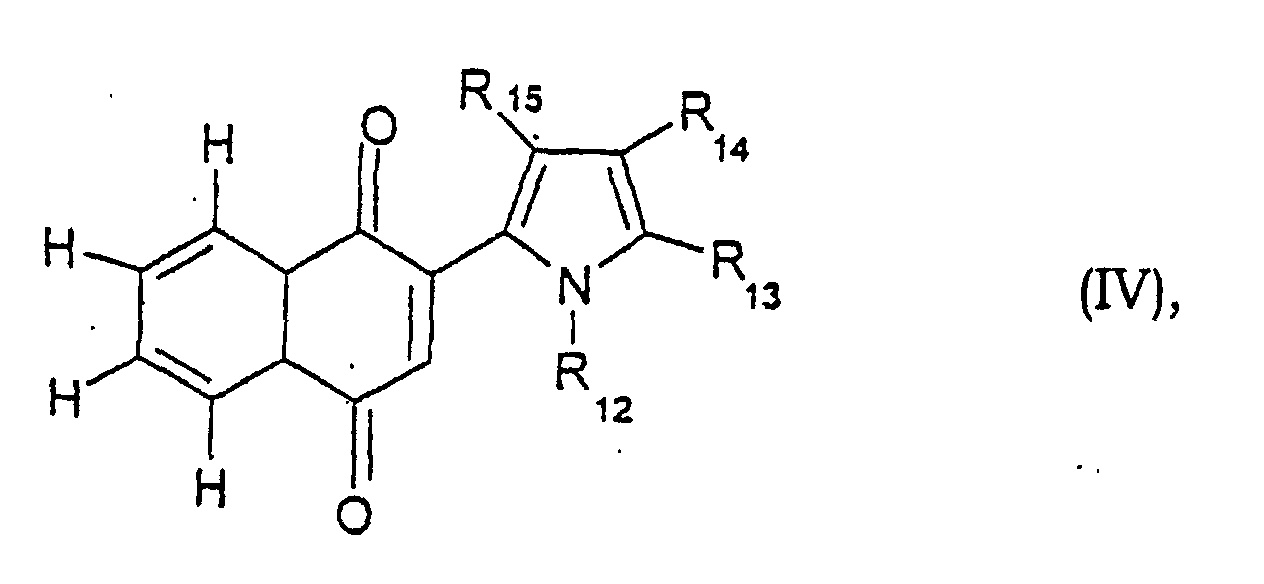
- Verbindungen der Formel II nach Anspruch 1, wobei das 2-(1-Methyl-1-H-pyrrol-2-yl)-[1,4]-dihydroxynaphthalin ausgenommen ist.
- Kosmetische Zusammensetzung zum Färben der Haare, dadurch gekennzeichnet, daß sie in einem kosmetisch akzeptablen Medium 0,01 bis 10 Gew.-% mindestens einer Verbindung der Formel I oder II nach einem der Ansprüche 1 bis 6, bezogen auf das Gesamtgewicht der Zusammensetzung, enthält.
- Zusammensetzung nach Anspruch 7, dadurch gekennzeichnet, daß sie einen pH-Wert im Bereich von 2 bis 11 aufweist.
- Zusammensetzung nach den Ansprüchen 7 bis 8, dadurch gekennzeichnet, daß das kosmetisch akzeptable Medium aus Wasser und/oder organischen Lösungsmitteln, wie Alkoholen, Glykolen oder Glykolethern, in Mengenanteilen von 0,5 bis 25 Gew.-%, bezogen auf das Gesamtgewicht der Zusammensetzung, besteht.
- Verfahren zum Färben von Haaren durch direkte Färbung, dadurch gekennzeichnet, daß eine Farbmittelzusammensetzung, die mindestens eine Verbindung der Formel I oder II nach einem der Ansprüche 1 bis 6 enthält, auf die trockenen oder feuchten Keratinfasern aufgetragen wird, die Zusammensetzung ggf. während einer Einwirkzeit von 3 bis 60 min auf die Fasern einwirken gelassen wird und die Fasern nach einem fakultativen Spülschritt getrocknet werden.
Applications Claiming Priority (2)
| Application Number | Priority Date | Filing Date | Title |
|---|---|---|---|
| FR9702370 | 1997-02-27 | ||
| FR9702370A FR2760010B1 (fr) | 1997-02-27 | 1997-02-27 | Utilisation de derives pyrroliques de la 1,4-naphtoquinone et du 1,4-dihydroxynaphtalene en teinture des matieres keratiniques, nouveaux composes et compositions les contenant |
Publications (2)
| Publication Number | Publication Date |
|---|---|
| EP0861830A1 EP0861830A1 (de) | 1998-09-02 |
| EP0861830B1 true EP0861830B1 (de) | 2002-12-18 |
Family
ID=9504260
Family Applications (1)
| Application Number | Title | Priority Date | Filing Date |
|---|---|---|---|
| EP98400298A Expired - Lifetime EP0861830B1 (de) | 1997-02-27 | 1998-02-10 | Verwendung von 1,4-Naphthochinon- und 1,4-dihydroxynaphthalin-Pyrrolderivaten zum Färben von Keratinsubstanzen, Verbindungen und diese enthaltende Zusammensetzungen |
Country Status (6)
| Country | Link |
|---|---|
| US (1) | US6022379A (de) |
| EP (1) | EP0861830B1 (de) |
| JP (1) | JP3040369B2 (de) |
| DE (1) | DE69810171T2 (de) |
| ES (1) | ES2189101T3 (de) |
| FR (1) | FR2760010B1 (de) |
Families Citing this family (29)
| Publication number | Priority date | Publication date | Assignee | Title |
|---|---|---|---|---|
| KR19990069877A (ko) * | 1998-02-13 | 1999-09-06 | 성재갑 | 나프토퀴논 구조를 갖는 사이클린-의존 키나아제 저해제 화합물 |
| FR2782720B1 (fr) * | 1998-09-01 | 2001-10-12 | Oreal | Utilisation en teinture capillaire de condensats de quinoline-5,8-diones ou de quinoxaline-5,8-diones et de pyrroles, anilines ou indoles substitues |
| FR2806408B1 (fr) * | 2000-03-17 | 2002-10-11 | Oreal | Composition cosmetique comprenant un derive de furane- naphtoquinone, leur utilisation comme agent colorant et derives |
| US20080092306A1 (en) * | 2002-07-30 | 2008-04-24 | Glenn Robert W Jr | Keratin Dyeing Compounds, Keratin Dyeing Compositions Containing Them, And Use Thereof |
| US7297168B2 (en) * | 2004-02-02 | 2007-11-20 | The Procter & Gamble Company | Keratin dyeing compounds, keratin dyeing compositions containing them, and use thereof |
| US7303590B2 (en) * | 2004-02-10 | 2007-12-04 | The Procter & Gamble Company | Keratin dyeing compounds, keratin dyeing compositions containing them, and use thereof |
| US7229480B2 (en) * | 2004-02-13 | 2007-06-12 | The Procter & Gamble Company | Keratin dyeing compounds, keratin dyeing compositions containing them, and use thereof |
| JP2007526338A (ja) * | 2004-03-04 | 2007-09-13 | ザ プロクター アンド ギャンブル カンパニー | ケラチン染色化合物、それらを含有するケラチン染色組成物、及びそれらの使用 |
| US7306631B2 (en) * | 2004-03-30 | 2007-12-11 | The Procter & Gamble Company | Keratin dyeing compounds, keratin dyeing compositions containing them, and use thereof |
| CN1937994A (zh) * | 2004-04-06 | 2007-03-28 | 宝洁公司 | 角蛋白染色化合物、包含它们的角蛋白染色组合物以及它们的应用 |
| US7276089B2 (en) * | 2004-08-26 | 2007-10-02 | The Procter & Gamble Company | Keratin dyeing compounds, keratin dyeing compositions containing them, and use thereof |
| US7288123B2 (en) * | 2004-08-26 | 2007-10-30 | The Procter & Gamble Company | Keratin dyeing compounds, keratin dyeing compositions containing them, and use thereof |
| US7399317B2 (en) | 2004-08-26 | 2008-07-15 | The Procter & Gamble Company | Keratin dyeing compounds, keratin dyeing compositions containing them, and use thereof |
| US7371264B2 (en) * | 2004-08-26 | 2008-05-13 | The Procter & Gamble Company | Keratin dyeing compounds, keratin dyeing compositions containing them, and use thereof |
| US20060156482A1 (en) * | 2005-01-14 | 2006-07-20 | The Procter & Gamble Company | Keratin dyeing compounds, keratin dyeing compositions containing them, and use thereof |
| US20060156480A1 (en) * | 2005-01-14 | 2006-07-20 | The Procter & Gamble Company | Keratin dyeing compounds, keratin dyeing compositions containing them, and use thereof |
| US20060156485A1 (en) * | 2005-01-14 | 2006-07-20 | The Procter & Gamble Company | Keratin dyeing compounds, keratin dyeing compositions containing them, and use thereof |
| US20060156484A1 (en) * | 2005-01-14 | 2006-07-20 | The Procter & Gamble Company | Keratin dyeing compounds, keratin dyeing compositions containing them, and use thereof |
| US20060156483A1 (en) * | 2005-01-14 | 2006-07-20 | The Procter & Gamble Company | Keratin dyeing compounds, keratin dyeing compositions containing them, and use thereof |
| US20060156486A1 (en) * | 2005-01-14 | 2006-07-20 | The Procter & Gamble Company | Keratin dyeing compounds, keratin dyeing compositions containing them, and use thereof |
| AU2006206504A1 (en) * | 2005-01-21 | 2006-07-27 | The Procter & Gamble Company | Keratin dyeing compositions containing benzothiazole-4-, 7-diamines, and use thereof |
| US20060286049A1 (en) * | 2005-02-28 | 2006-12-21 | Chrystel Grethen-Pourille | Cosmetic composition comprising a tribochromic compound, process using this composition and uses |
| US20060156481A1 (en) * | 2005-03-22 | 2006-07-20 | The Procter & Gamble Company | Keratin dyeing compounds, keratin dyeing compositions containing them, and use thereof |
| US7485156B2 (en) | 2005-05-31 | 2009-02-03 | L'oreal S.A. | Composition for dyeing keratin fibers, comprising at least one diamino-N,N-dihydropyrazolone derivative, at least one coupler and at least one associative polyurethane polymer |
| US7488355B2 (en) | 2005-05-31 | 2009-02-10 | L'oreal S.A. | Composition for dyeing keratin fibers, comprising a diamino-N,N-dihydropyrazolone compound, a coupler, and a polyol |
| US7582121B2 (en) | 2005-05-31 | 2009-09-01 | L'oreal S.A. | Composition for dyeing keratin fibers, comprising at least one diamino-N,N-dihydropyrazolone derivative, at least one coupler, and at least one heterocyclic direct dye |
| FR2886132B1 (fr) | 2005-05-31 | 2007-07-20 | Oreal | Composition pour la teinture des fibres keratiniques comprenant un derive de diamino-n,n-dihydro-pyrazolone, un coupleur et un colorant direct heterocyclique |
| US7488356B2 (en) | 2005-05-31 | 2009-02-10 | L'oreal S.A. | Composition for dyeing keratin fibers, comprising at least one diamino-N,N-dihydropyrazolone derivative, at least one coupler, and at least one surfactant |
| US7341606B2 (en) * | 2005-08-23 | 2008-03-11 | The Procter & Gamble Company | Keratin dyeing compounds, keratin dyeing compositions containing them, and use thereof |
Citations (1)
| Publication number | Priority date | Publication date | Assignee | Title |
|---|---|---|---|---|
| FR2537433A1 (fr) * | 1982-12-08 | 1984-06-15 | Oreal | Utilisation de 5-hydroxynaphtoquinones pour la teinture des fibres keratiniques humaines, procede de teinture les mettant en oeuvre et composition tinctoriale utilisee |
Family Cites Families (2)
| Publication number | Priority date | Publication date | Assignee | Title |
|---|---|---|---|---|
| US4684599A (en) * | 1986-07-14 | 1987-08-04 | Eastman Kodak Company | Photoresist compositions containing quinone sensitizer |
| JP3463775B2 (ja) * | 1995-06-20 | 2003-11-05 | 京セラミタ株式会社 | 電子写真感光体 |
-
1997
- 1997-02-27 FR FR9702370A patent/FR2760010B1/fr not_active Expired - Fee Related
-
1998
- 1998-02-10 ES ES98400298T patent/ES2189101T3/es not_active Expired - Lifetime
- 1998-02-10 EP EP98400298A patent/EP0861830B1/de not_active Expired - Lifetime
- 1998-02-10 DE DE69810171T patent/DE69810171T2/de not_active Expired - Fee Related
- 1998-02-26 JP JP10045879A patent/JP3040369B2/ja not_active Expired - Fee Related
- 1998-02-27 US US09/031,777 patent/US6022379A/en not_active Expired - Fee Related
Patent Citations (1)
| Publication number | Priority date | Publication date | Assignee | Title |
|---|---|---|---|---|
| FR2537433A1 (fr) * | 1982-12-08 | 1984-06-15 | Oreal | Utilisation de 5-hydroxynaphtoquinones pour la teinture des fibres keratiniques humaines, procede de teinture les mettant en oeuvre et composition tinctoriale utilisee |
Also Published As
| Publication number | Publication date |
|---|---|
| FR2760010B1 (fr) | 2000-09-15 |
| EP0861830A1 (de) | 1998-09-02 |
| JPH10236932A (ja) | 1998-09-08 |
| JP3040369B2 (ja) | 2000-05-15 |
| US6022379A (en) | 2000-02-08 |
| DE69810171T2 (de) | 2003-07-24 |
| DE69810171D1 (de) | 2003-01-30 |
| FR2760010A1 (fr) | 1998-08-28 |
| ES2189101T3 (es) | 2003-07-01 |
Similar Documents
| Publication | Publication Date | Title |
|---|---|---|
| EP0861830A1 (de) | Verwendung von 1,4-Naphthochinon- und 1,4-dihydroxynaphthalin-Pyrrolderivaten zum Färben von Keratinsubstanzen, Verbindungen und diese enthaltende Zusammensetzungen | |
| EP0984010B1 (de) | Verwendung in Haarfarbstoffen von Chinolin-5,8-dionen oder Chinoxalin-5,8-dionen kondensiert mit substituierten Pyrrolen, Anilinen oder Indolen | |
| EP0918053B1 (de) | Azoverbindungen, ihre Verwendung zum Färben, diese enthaltende Zusammensetzungen und Farbverfahren | |
| EP0796850B1 (de) | 4,5-Diiminopyrazoline, Verfahren zu ihrer Herstellung und diese enthaltende Färbemittel | |
| EP1006153A1 (de) | Kationische Aminodianthrachinone, deren Verwendung, diese enthaltende Färbemittel sowie Färbeverfahren | |
| EP0754681B1 (de) | N-substituierte 4-Hydroxyindolderivate und Zusammensetzungen zur Färbung keratinischer Fasern die sie enthalten | |
| CH657607A5 (fr) | Derives nitres de la serie benzenique, leur procede de preparation et leur utilisation en teinture des fibres keratiniques. | |
| EP0839815B1 (de) | Verwendung von siliciumhaltigen Verbindungen zum Färben von Menschlichen Keratinfasern; neue Verbindungen und Zusammensetzungen, die diese enthalten. | |
| EP0780118B1 (de) | Zusammensetzungen zum Färben von Keratinfasern, die N-substituierte 4-Hydroxyindolinderivate enthalten, und verschiedene dieser Derivate | |
| EP0294669B1 (de) | Metaphenylendiamine, Verfahren zu deren Herstellung, Zwischenprodukte und Verwendung dieser Metaphenylendiamine als Kuppler für die oxidative Färbung von Keratinfasern insbesondere von menschlichem Haar | |
| EP1073407B1 (de) | Verfahren zur haarfärbung unter verwendung von einem kationischen aliphatischen amin und einem aldehyd oder einem keton , einer chinonverbindung oder derivaten von diimino-isoindolin oder 3-amino-isoindolon | |
| FR2568772A1 (fr) | Composition tinctoriale pour fibres keratiniques renfermant au moins une nitro-2 paraphenylenediamine n-substituee cosolubilisee et procede de teinture de fibres keratiniques correspondant | |
| EP0295474B1 (de) | Clorometaphenylendiamine, deren Verwendung als Kuppler für die oxidative Färbung von Keratinfasern, Haarfärbezusammensetzungen, die diese Verbindungen enthalten und Färbeverfahren mit diesen Zusammensetzungen | |
| EP0366542B1 (de) | 5-Substituierte Ortho-Aminophenole, Verfahren zu ihrer Herstellung und ihre Verwendung als Oxydationsfärbemittel von keratinischen Fasern | |
| LU85421A1 (fr) | Composition tinctoriale pour fibres keratiniques renfermant au moins une nitro-2 paraphenylene n-substituee cosolubilisee et procedes de teinture de fibres keratiniques correspondants | |
| FR2571364A1 (fr) | Nouveau procede de preparation de nitroparaphenylenediamines n,n'-disubstituees, nouvelles oxazolidones utilisees dans ce procede, nouvelles nitroparaphenylenediamines n,n'-disubstituees obtenues selon ce procede et compositions tinctoriales contenant les nitroparaphenylenediamines n,n'-disubstituees obtenues selon ledit procede | |
| FR2570600A1 (fr) | Composition tinctoriale pour fibres keratiniques renfermant au moins une nitro-2 paraphenylenediamine n-substituee cosolubilisee et procede de teinture de fibres keratiniques correspondant | |
| FR2580279A1 (fr) | Nouveaux nitroaminophenols, leur procede de preparation et leur utilisation en teinture des fibres keratiniques, nouveaux nitroaminobenzenes intermediaires et leur utilisation en teinture des fibres keratiniques | |
| FR2798931A1 (fr) | Nouveaux composes indoliques, leur utilisation pour la teinture et le maquillage des matieres keratiniques, compositions les contenant et procedes de teinture | |
| EP0560682B1 (de) | Färbemittel für keratinische Fasern, die 4-Monoindolyl 1,2-naphthochinone enthalten, 4-Monoindolyl 1,2-naphthochinone | |
| EP0560684A1 (de) | 1,4-Naphthochnon oder 1,4-Naphthalendiolverbindungen di- oder tri-Indolyl substituiert, Verfahren zu ihren Herstellung und ihre Verwendung zum Färben von Keratinmaterial | |
| CA2250334A1 (fr) | Procede de synthese de 2-hydroxyalkyl paraphenylenediamines, nouvelles 2-hydroxyalkyl paraphenylenediamines, leur utilisation pour la teinture d'oxydation, compositions tinctoriales et procedes de teinture | |
| CA1257611A (fr) | Dinitro-2,4, hydroxyalkyl-6 anilines, leur procede de preparation et leur utilisation en teinture des fibres keratiniques, et en particulier des cheveux humains | |
| EP0560683A1 (de) | Haarfärbezusammensetzung mit Monoindolyl-1,4-naphthochinonenrader, ihre Leukoderivativen, neue Monoindolyl-1,4-Naphthochinone und ihre Leukoderivate | |
| EP0826669A1 (de) | Mittel zum Färben von Keratinfasern |
Legal Events
| Date | Code | Title | Description |
|---|---|---|---|
| PUAI | Public reference made under article 153(3) epc to a published international application that has entered the european phase |
Free format text: ORIGINAL CODE: 0009012 |
|
| AK | Designated contracting states |
Kind code of ref document: A1 Designated state(s): DE ES FR GB IT |
|
| AX | Request for extension of the european patent |
Free format text: AL;LT;LV;MK;RO;SI |
|
| 17P | Request for examination filed |
Effective date: 19990302 |
|
| AKX | Designation fees paid |
Free format text: DE ES FR GB IT |
|
| RBV | Designated contracting states (corrected) |
Designated state(s): DE ES FR GB IT |
|
| 17Q | First examination report despatched |
Effective date: 20000519 |
|
| GRAG | Despatch of communication of intention to grant |
Free format text: ORIGINAL CODE: EPIDOS AGRA |
|
| GRAG | Despatch of communication of intention to grant |
Free format text: ORIGINAL CODE: EPIDOS AGRA |
|
| GRAG | Despatch of communication of intention to grant |
Free format text: ORIGINAL CODE: EPIDOS AGRA |
|
| GRAH | Despatch of communication of intention to grant a patent |
Free format text: ORIGINAL CODE: EPIDOS IGRA |
|
| GRAH | Despatch of communication of intention to grant a patent |
Free format text: ORIGINAL CODE: EPIDOS IGRA |
|
| GRAA | (expected) grant |
Free format text: ORIGINAL CODE: 0009210 |
|
| AK | Designated contracting states |
Kind code of ref document: B1 Designated state(s): DE ES FR GB IT |
|
| REG | Reference to a national code |
Ref country code: GB Ref legal event code: FG4D Free format text: NOT ENGLISH |
|
| REF | Corresponds to: |
Ref document number: 69810171 Country of ref document: DE Date of ref document: 20030130 Kind code of ref document: P Ref document number: 69810171 Country of ref document: DE Date of ref document: 20030130 |
|
| GBT | Gb: translation of ep patent filed (gb section 77(6)(a)/1977) |
Effective date: 20030401 |
|
| REG | Reference to a national code |
Ref country code: ES Ref legal event code: FG2A Ref document number: 2189101 Country of ref document: ES Kind code of ref document: T3 |
|
| PLBE | No opposition filed within time limit |
Free format text: ORIGINAL CODE: 0009261 |
|
| STAA | Information on the status of an ep patent application or granted ep patent |
Free format text: STATUS: NO OPPOSITION FILED WITHIN TIME LIMIT |
|
| 26N | No opposition filed |
Effective date: 20030919 |
|
| PGFP | Annual fee paid to national office [announced via postgrant information from national office to epo] |
Ref country code: GB Payment date: 20040204 Year of fee payment: 7 |
|
| PGFP | Annual fee paid to national office [announced via postgrant information from national office to epo] |
Ref country code: FR Payment date: 20040210 Year of fee payment: 7 |
|
| PGFP | Annual fee paid to national office [announced via postgrant information from national office to epo] |
Ref country code: DE Payment date: 20040219 Year of fee payment: 7 |
|
| PGFP | Annual fee paid to national office [announced via postgrant information from national office to epo] |
Ref country code: ES Payment date: 20040227 Year of fee payment: 7 |
|
| PG25 | Lapsed in a contracting state [announced via postgrant information from national office to epo] |
Ref country code: IT Free format text: LAPSE BECAUSE OF NON-PAYMENT OF DUE FEES Effective date: 20050210 Ref country code: GB Free format text: LAPSE BECAUSE OF NON-PAYMENT OF DUE FEES Effective date: 20050210 |
|
| PG25 | Lapsed in a contracting state [announced via postgrant information from national office to epo] |
Ref country code: ES Free format text: LAPSE BECAUSE OF NON-PAYMENT OF DUE FEES Effective date: 20050211 |
|
| PG25 | Lapsed in a contracting state [announced via postgrant information from national office to epo] |
Ref country code: DE Free format text: LAPSE BECAUSE OF NON-PAYMENT OF DUE FEES Effective date: 20050901 |
|
| GBPC | Gb: european patent ceased through non-payment of renewal fee |
Effective date: 20050211 |
|
| PG25 | Lapsed in a contracting state [announced via postgrant information from national office to epo] |
Ref country code: FR Free format text: LAPSE BECAUSE OF NON-PAYMENT OF DUE FEES Effective date: 20051031 |
|
| REG | Reference to a national code |
Ref country code: FR Ref legal event code: ST Effective date: 20051031 |
|
| REG | Reference to a national code |
Ref country code: ES Ref legal event code: FD2A Effective date: 20050211 |