EP0862086A1 - Glimmentladungsbehandlung der Oberfläche einer Trägerbahn in einer Bahnbeschichtungsanlage - Google Patents
Glimmentladungsbehandlung der Oberfläche einer Trägerbahn in einer Bahnbeschichtungsanlage Download PDFInfo
- Publication number
- EP0862086A1 EP0862086A1 EP98200471A EP98200471A EP0862086A1 EP 0862086 A1 EP0862086 A1 EP 0862086A1 EP 98200471 A EP98200471 A EP 98200471A EP 98200471 A EP98200471 A EP 98200471A EP 0862086 A1 EP0862086 A1 EP 0862086A1
- Authority
- EP
- European Patent Office
- Prior art keywords
- web
- glow discharge
- coating
- substrate
- electrodes
- Prior art date
- Legal status (The legal status is an assumption and is not a legal conclusion. Google has not performed a legal analysis and makes no representation as to the accuracy of the status listed.)
- Withdrawn
Links
- 238000000576 coating method Methods 0.000 title claims abstract description 79
- 239000011248 coating agent Substances 0.000 title claims abstract description 70
- 208000028659 discharge Diseases 0.000 title claims abstract description 68
- 238000011282 treatment Methods 0.000 title claims abstract description 42
- 239000000758 substrate Substances 0.000 title claims description 38
- 238000000034 method Methods 0.000 claims description 24
- 239000001307 helium Substances 0.000 claims description 19
- 229910052734 helium Inorganic materials 0.000 claims description 19
- SWQJXJOGLNCZEY-UHFFFAOYSA-N helium atom Chemical compound [He] SWQJXJOGLNCZEY-UHFFFAOYSA-N 0.000 claims description 19
- 239000007789 gas Substances 0.000 claims description 18
- IJGRMHOSHXDMSA-UHFFFAOYSA-N Atomic nitrogen Chemical compound N#N IJGRMHOSHXDMSA-UHFFFAOYSA-N 0.000 claims description 16
- 239000000203 mixture Substances 0.000 claims description 13
- QVGXLLKOCUKJST-UHFFFAOYSA-N atomic oxygen Chemical compound [O] QVGXLLKOCUKJST-UHFFFAOYSA-N 0.000 claims description 8
- 229910052757 nitrogen Inorganic materials 0.000 claims description 8
- 239000001301 oxygen Substances 0.000 claims description 8
- 229910052760 oxygen Inorganic materials 0.000 claims description 8
- 239000000463 material Substances 0.000 claims description 5
- YCKRFDGAMUMZLT-UHFFFAOYSA-N Fluorine atom Chemical compound [F] YCKRFDGAMUMZLT-UHFFFAOYSA-N 0.000 claims description 2
- 150000001875 compounds Chemical class 0.000 claims description 2
- 229910052731 fluorine Inorganic materials 0.000 claims description 2
- 239000011737 fluorine Substances 0.000 claims description 2
- 238000009998 heat setting Methods 0.000 claims description 2
- 230000009477 glass transition Effects 0.000 claims 1
- 238000010438 heat treatment Methods 0.000 claims 1
- 239000000155 melt Substances 0.000 claims 1
- 230000000694 effects Effects 0.000 abstract description 7
- 230000008030 elimination Effects 0.000 abstract description 2
- 238000003379 elimination reaction Methods 0.000 abstract 1
- 230000002459 sustained effect Effects 0.000 abstract 1
- 239000013011 aqueous formulation Substances 0.000 description 9
- -1 polyethylene Polymers 0.000 description 9
- 238000004519 manufacturing process Methods 0.000 description 7
- 230000008569 process Effects 0.000 description 5
- 238000010586 diagram Methods 0.000 description 4
- 239000000839 emulsion Substances 0.000 description 4
- 238000001125 extrusion Methods 0.000 description 4
- 239000004816 latex Substances 0.000 description 4
- 229920000126 latex Polymers 0.000 description 4
- 229920003207 poly(ethylene-2,6-naphthalate) Polymers 0.000 description 4
- 239000011112 polyethylene naphthalate Substances 0.000 description 4
- 229920000098 polyolefin Polymers 0.000 description 4
- 239000004033 plastic Substances 0.000 description 3
- 229920003023 plastic Polymers 0.000 description 3
- 229920000728 polyester Polymers 0.000 description 3
- 229920000139 polyethylene terephthalate Polymers 0.000 description 3
- 239000005020 polyethylene terephthalate Substances 0.000 description 3
- 229920000642 polymer Polymers 0.000 description 3
- 108010010803 Gelatin Proteins 0.000 description 2
- 239000004698 Polyethylene Substances 0.000 description 2
- 229910052782 aluminium Inorganic materials 0.000 description 2
- XAGFODPZIPBFFR-UHFFFAOYSA-N aluminium Chemical compound [Al] XAGFODPZIPBFFR-UHFFFAOYSA-N 0.000 description 2
- 230000015572 biosynthetic process Effects 0.000 description 2
- 229920002678 cellulose Polymers 0.000 description 2
- 239000001913 cellulose Substances 0.000 description 2
- 238000004891 communication Methods 0.000 description 2
- 230000003292 diminished effect Effects 0.000 description 2
- 239000008273 gelatin Substances 0.000 description 2
- 229920000159 gelatin Polymers 0.000 description 2
- 235000019322 gelatine Nutrition 0.000 description 2
- 235000011852 gelatine desserts Nutrition 0.000 description 2
- 229910052751 metal Inorganic materials 0.000 description 2
- 239000002184 metal Substances 0.000 description 2
- 229920000573 polyethylene Polymers 0.000 description 2
- 229920005989 resin Polymers 0.000 description 2
- 239000011347 resin Substances 0.000 description 2
- 238000003860 storage Methods 0.000 description 2
- 238000004381 surface treatment Methods 0.000 description 2
- 229920005992 thermoplastic resin Polymers 0.000 description 2
- VEXZGXHMUGYJMC-UHFFFAOYSA-M Chloride anion Chemical compound [Cl-] VEXZGXHMUGYJMC-UHFFFAOYSA-M 0.000 description 1
- 239000004743 Polypropylene Substances 0.000 description 1
- 238000000137 annealing Methods 0.000 description 1
- 230000008859 change Effects 0.000 description 1
- 238000007766 curtain coating Methods 0.000 description 1
- 230000008021 deposition Effects 0.000 description 1
- 238000011161 development Methods 0.000 description 1
- 238000005530 etching Methods 0.000 description 1
- 239000000499 gel Substances 0.000 description 1
- 230000006872 improvement Effects 0.000 description 1
- 238000009413 insulation Methods 0.000 description 1
- 150000002500 ions Chemical class 0.000 description 1
- 230000001788 irregular Effects 0.000 description 1
- 239000007788 liquid Substances 0.000 description 1
- 229910052756 noble gas Inorganic materials 0.000 description 1
- 150000002835 noble gases Chemical class 0.000 description 1
- 229920002120 photoresistant polymer Polymers 0.000 description 1
- 229920000307 polymer substrate Polymers 0.000 description 1
- 229920001155 polypropylene Polymers 0.000 description 1
- 238000002360 preparation method Methods 0.000 description 1
- 238000012545 processing Methods 0.000 description 1
- 230000004044 response Effects 0.000 description 1
- 239000000243 solution Substances 0.000 description 1
- 239000000126 substance Substances 0.000 description 1
- 238000012360 testing method Methods 0.000 description 1
- TXEYQDLBPFQVAA-UHFFFAOYSA-N tetrafluoromethane Chemical compound FC(F)(F)F TXEYQDLBPFQVAA-UHFFFAOYSA-N 0.000 description 1
- 229920001169 thermoplastic Polymers 0.000 description 1
- 239000004416 thermosoftening plastic Substances 0.000 description 1
- 238000009489 vacuum treatment Methods 0.000 description 1
- 239000002699 waste material Substances 0.000 description 1
- XLYOFNOQVPJJNP-UHFFFAOYSA-N water Substances O XLYOFNOQVPJJNP-UHFFFAOYSA-N 0.000 description 1
- 238000009736 wetting Methods 0.000 description 1
Images



Classifications
-
- G—PHYSICS
- G03—PHOTOGRAPHY; CINEMATOGRAPHY; ANALOGOUS TECHNIQUES USING WAVES OTHER THAN OPTICAL WAVES; ELECTROGRAPHY; HOLOGRAPHY
- G03C—PHOTOSENSITIVE MATERIALS FOR PHOTOGRAPHIC PURPOSES; PHOTOGRAPHIC PROCESSES, e.g. CINE, X-RAY, COLOUR, STEREO-PHOTOGRAPHIC PROCESSES; AUXILIARY PROCESSES IN PHOTOGRAPHY
- G03C1/00—Photosensitive materials
- G03C1/76—Photosensitive materials characterised by the base or auxiliary layers
- G03C1/91—Photosensitive materials characterised by the base or auxiliary layers characterised by subbing layers or subbing means
- G03C1/915—Photosensitive materials characterised by the base or auxiliary layers characterised by subbing layers or subbing means using mechanical or physical means therefor, e.g. corona
-
- B—PERFORMING OPERATIONS; TRANSPORTING
- B05—SPRAYING OR ATOMISING IN GENERAL; APPLYING FLUENT MATERIALS TO SURFACES, IN GENERAL
- B05D—PROCESSES FOR APPLYING FLUENT MATERIALS TO SURFACES, IN GENERAL
- B05D3/00—Pretreatment of surfaces to which liquids or other fluent materials are to be applied; After-treatment of applied coatings, e.g. intermediate treating of an applied coating preparatory to subsequent applications of liquids or other fluent materials
- B05D3/14—Pretreatment of surfaces to which liquids or other fluent materials are to be applied; After-treatment of applied coatings, e.g. intermediate treating of an applied coating preparatory to subsequent applications of liquids or other fluent materials by electrical means
- B05D3/141—Plasma treatment
- B05D3/142—Pretreatment
- B05D3/144—Pretreatment of polymeric substrates
-
- B—PERFORMING OPERATIONS; TRANSPORTING
- B29—WORKING OF PLASTICS; WORKING OF SUBSTANCES IN A PLASTIC STATE IN GENERAL
- B29C—SHAPING OR JOINING OF PLASTICS; SHAPING OF MATERIAL IN A PLASTIC STATE, NOT OTHERWISE PROVIDED FOR; AFTER-TREATMENT OF THE SHAPED PRODUCTS, e.g. REPAIRING
- B29C59/00—Surface shaping of articles, e.g. embossing; Apparatus therefor
- B29C59/10—Surface shaping of articles, e.g. embossing; Apparatus therefor by electric discharge treatment
- B29C59/12—Surface shaping of articles, e.g. embossing; Apparatus therefor by electric discharge treatment in an environment other than air
Definitions
- the invention relates to apparatus and methods for treating surfaces of plastic polymeric web substrates with electrical discharges at ambient atmospheric pressures to alter the wettability and adhesion of those surfaces to aqueous formulations coated subsequently to the treated surfaces, and particularly to apparatus and methods for such treatment in a coating line shortly before the coating application point.
- thermoplastic polymeric materials such as polyethylene and polyesters such as polyethylene terephthalate, and polyethylene naphthalate.
- Glow discharge treating of webs in vacuum is most conveniently performed in a separate manufacturing step in a vacuum treatment machine. While operationally convenient, this method of treatment is very capital intensive and also adds substantially to the overall manufacturing cost of, for example, a photographic product using a thermoplastic resin web as the photographic film or paper base.
- US Patent No. 5,558,843 issued September 24, 1996 discloses method and apparatus for treating polyester web with glow discharge at atmospheric pressure, using gas mixtures including helium.
- the discovery is important because it permits treatment of conveyed rolls of web in an off-line machine at atmospheric pressure. Treatment is typically carried out on an apparatus wherein the web substrate is unwound from a stock roll, conveyed through a glow discharge region for treatment, and then wound into a treated stock roll. The roll may be placed in storage until needed for coating or it may be sent directly to a coating machine for application of layers to the treated surface.
- the time period between treatment and coating is defined as the "latency" of the treatment. Since some treated rolls may be sent to storage while others are sent directly for coating, different rolls may have differing post-treatment histories and therefore differing latencies, which may result in roll-to-roll product variability for adhesion. Where the treatment effect decays rapidly, even the head and tail portions of an individual stock roll may exhibit substantially different adhesions.
- the as-cast polymer ribbon typically is coated with a chloride-containing latex subbing layer, or primer, before lengthwise and widthwise stretching to achieve end use sheet dimensions.
- a chloride-containing latex subbing layer, or primer typically is applied to the latex sub before photographic layers can be coated. Omission of either the latex sub or the gel sub can result in adhesion failure of subsequently-coated photographic layers.
- the web In the known manufacture of photographic paper including a cellulose-based web, the web typically is made water-proof, to minimize the uptake of processing chemicals during photographic development and fixing, by being impregnated on one or both sides with a bonded layer of a polyolefin, typically polyethylene.
- So-called "resin-coated” or “RC” paper as cast has unsatisfactory coatability and adhesion of aqueous formulations.
- Current practice is to treat the polyolefin surface with a corona discharge prior to the application of aqueous formulations.
- the apparatus and method of the invention are useful in providing polymeric web substrates having high wettability and high adhesion to aqueous coatings.
- the invention provides apparatus and method for treating and coating webs to have high coatability and adhesion to aqueous formulations by glow discharge surface treatment of a web substrate being conveyed along a web path in a coating line, also known as a coating machine, at substantially atmospheric pressure before application of a coating to the treated surface along a later portion of the same web path.
- a gas mixture comprising helium and nitrogen and/or oxygen permits formation of a stable glow discharge over a wide range of voltages and frequencies at ambient atmospheric pressure. This enables the glow discharge apparatus and process to be incorporated into a coating machine ahead of the coating application point, allowing minimization or virtual elimination of treatment decay through latency loss.
- the glow discharge apparatus comprises a first electrode having a first surface adjacent the web conveyance path in a coating machine shortly before the coating point, a second electrode having a second surface opposite the first surface and also adjacent the web path, means for introducing gas between the first and second electrodes, and a power supply coupled between the first and second electrodes for sustaining a glow discharge therebetween, at least one of the first and second surfaces being insulated.
- the power supply is operable at a potential of between 0.5 kV and 20 kV and at a frequency of between 60 Hz and 40 MHz (megaHertz).
- the first and second electrodes may be adjacent opposite sides of the web substrate, the web path extending therebetween, or they may be both adjacent one side of the web substrate.
- the gas may be pure helium; a mixture of helium and nitrogen; a mixture of helium, nitrogen, and oxygen; a mixture of helium and oxygen; or a mixture of helium, oxygen, and a fluorine-containing compound, for example, carbon tetrafluoride.
- one of the electrodes is a conveyance roller for the web substrate in the web path of the coating machine.
- the electrode roller is also a backing roller for supporting the web substrate for application of the coating to the treated surface immediately after treatment.
- a plurality of glow discharge devices may be used in series as needed to increase the treatment of low-response substrates or to permit increases in the line speed of the coating machine.
- the present invention provides apparatus and method for treating and coating webs to have high coatability and adhesion to aqueous formulations by the glow discharge treatment of web substrates at atmospheric pressure in a coating machine shortly before the coating of one or more of the aqueous layers to the substrate surface, and for providing uniform latency of glow discharge treatment over all areas of web to be coated.
- the web may be prepared by stretching a ribbon of material lengthwise and widthwise prior to heat setting and annealing.
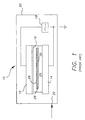
- a prior art glow discharge device 10 which illustrates the basic principles of atmospheric glow discharge treatment in accordance with the invention.
- Device 10 has first and second spaced apart electrodes 12 and 14, respectively, at least one of which has an insulating layer 16.
- the electrodes are electrically connected by a grounded power source 18 and are surrounded by an enclosure 20.
- a gas mixture including helium and, preferably, nitrogen and/or oxygen is metered into the enclosure through an entry port 22 and occupies the region between the electrodes.
- the power source preferably at a voltage between about 0.5 kV and 20 kV and at a frequency between about 60 Hz and 40 MHz, the gas sustains a glow discharge 24 in this region.
- a polymeric web substrate 26, seen in cross-section on end in Figure 1, is passed through the glow discharge 24 between the electrodes, and the first and second surfaces thereof 28 and 30, respectively, become altered.
- Either surface can be curved to be substantially conformable with the substrate surface at a substantially uniform distance therefrom.
- the altering treatment can change both the wettability of the surfaces to subsequent aqueous coatings and the adhesion of the surfaces to those coatings after they have been dried to form layers.
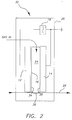
- a second embodiment 32 of glow discharge apparatus is shown in Figure 2.
- the gas is introduced directly and continuously into the region between electrodes 12 and 14 and preferably parallel to the electrode surfaces 34 and 36.
- the momentum of the flowing gas displaces the glow discharge 24 from between the electrodes, carrying a mixture of ions, radicals, and other reactive species, and resulting in an active region 38 beyond the electrodes through which substrate 26 can be conveyed for surface treatment.
- the apparatus can also comprise third and fourth electrodes spaced apart and disposed along said web path ahead of said first and second electrodes, at least one of said third and fourth electrodes being insulated, and further comprising means for providing a gas comprising helium between said third and fourth electrodes, and further comprising a power supply coupled between said third and fourth electrodes for sustaining a second glow discharge therebetween.
- a preferred embodiment 40 of glow discharge apparatus is substantially as disclosed in the above-referenced U.S Patent No. 5,558,843.
- a grounded metal roller 42 defines a first electrode which can be anodized aluminum and conveys web substrate 26 through an arc of rotation.
- a conformal shoe electrode 44 spaced from roller 42 by preferably about 0.2 mm to 10 mm, includes a manifold chamber 46 supplied with gas through a supply conduit 48 and in communication with the substrate first surface 28 through apertures 50. At least one of electrodes 42 and 44 is insulated.
- shoe electrode 44 is formed of aluminum and is insulated by being anodized on surface 34.
- roller 42 can equally well be the high voltage electrode and shoe 44 the grounded electrode, but operationally working with the roller at ground is preferable.
- a glow discharge apparatus as disclosed in our pending application, Serial No. 08/685,353 filed July 23, 1996, would also be useful in treating web in accordance with the present invention.
- the time between treatment and coating can be from 5 minutes or less and preferably 2 minutes or less. In some preferred embodiments the time can be 30 seconds or less.
- the effect of the short time period is shown in the following example:
- a web of polyethylene naphthalate was treated on the shoe electrode treater shown in Figure 3 under the following conditions: 2.25 mm spacing between electrodes; 450 kHz frequency; power level 600-650 watts; gas flow of 8 liters/min of helium and 0.15 liters/min of nitrogen; web speed 3 m/min. Different portions of the treated web were subsequently coated with a photographic emulsion at various periods of time after treatment.
- wetting contact angle indicative of wettability of the support by aqueous formulations
- contact angle is a useful correlate and predictor of adhesion.
- atmospheric glow discharge treatment the correlation is not maintained.
- a coating machine 52 conveys a web substrate 26 over rollers 54, which may be either idle rollers or drive rollers, and around a coating backing roller 56 which supports the web for the application of a liquid coating via slot die hopper 58.
- Application can also be made by any of various other known coating applicators, for example, a cascade hopper 60 ( Figure 7), curtain coating hopper, extrusion/slide hopper, air knife metered applicator, kiss coater, fountain applicator, gravure roller, and offset roller.
- Web 26 may be supplied to the coating machine as a stock roll to be unwound (not shown), or coating machine 52 may be integral with a known web manufacturing machine (not shown) wherein molten polymer is extruded from an extrusion die as a relatively thick ribbon which is then oriented by stretching lengthwise and widthwise to obtain the desired sheet dimensions of the web.
- a glow discharge apparatus 40 like that shown in Figure 3.
- apparatus 40 is currently preferred because it includes a roller and can participate positively in conveying the web through the machine.
- First web surface 28 is glow discharge treated by device 40 and the web wettability and adhesion characteristics are substantially enhanced or diminished thereby.
- enhancement is desired, but in other applications, for example, in manufacturing stripping films or interleaving, it is desirable to diminish the adhesion of the coated layer to the substrate. Diminished adhesion can be achieved through addition of small amounts of, for example, specific fluorocarbons to the active gas stream, as described in the cited Kokai references.
- grounded roller 42 of a glow discharge apparatus 40 is also the backing roller 56 for the coating applicator 58.
- the distance along the web path between the glow discharge and the coating point is in the order of centimeters; and at typical coating speeds of several hundreds of meters per minute, latency is virtually zero, resulting in maximum adhesion of the coated layer. Since the effect of glow discharge treatment here is not reduced by time and hence is higher than in any other possible configuration, higher coating machine speeds or reduced treatment power levels may be enabled.
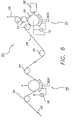
- a plurality of glow discharge apparatus may be employed in series along the web path, as shown in Figure 6, combining the configurations shown in Figures 4 and 5.
- Multiple-slide cascade hoppers having suction troughs are well known in the coating of photographic films and papers on melt-extruded polymer substrates such as polyethylene terephthalate, polyethylene naphthalate, polypropylene and cellulose and polyolefin coatings bonded to paper stock.
- one glow discharge device 40 is shown residing within the suction trough 62 of cascade hopper 60. This preferred location may present challenges in baffling the electrode to prevent fouling with waste emulsion during preparation of the hopper for coating, but the engineering solutions are straightforward.
- the glow discharge may fog light-sensitive emulsions, and it may be necessary in some applications either to visually baffle the glow discharge from the coating nip or to rotate the shoe electrode to the back side of the backing roller to break line of sight communication of the glow discharge and the coating nip.
Landscapes
- Engineering & Computer Science (AREA)
- Physics & Mathematics (AREA)
- Chemical & Material Sciences (AREA)
- Materials Engineering (AREA)
- General Physics & Mathematics (AREA)
- Plasma & Fusion (AREA)
- Health & Medical Sciences (AREA)
- Toxicology (AREA)
- Application Of Or Painting With Fluid Materials (AREA)
- Treatments Of Macromolecular Shaped Articles (AREA)
- Coating Apparatus (AREA)
Applications Claiming Priority (2)
| Application Number | Priority Date | Filing Date | Title |
|---|---|---|---|
| US08/810,497 US5954926A (en) | 1997-02-28 | 1997-02-28 | Glow discharge treatment of a web substrate surface in a web coating line |
| US810497 | 1997-02-28 |
Publications (1)
| Publication Number | Publication Date |
|---|---|
| EP0862086A1 true EP0862086A1 (de) | 1998-09-02 |
Family
ID=25203993
Family Applications (1)
| Application Number | Title | Priority Date | Filing Date |
|---|---|---|---|
| EP98200471A Withdrawn EP0862086A1 (de) | 1997-02-28 | 1998-02-14 | Glimmentladungsbehandlung der Oberfläche einer Trägerbahn in einer Bahnbeschichtungsanlage |
Country Status (4)
| Country | Link |
|---|---|
| US (1) | US5954926A (de) |
| EP (1) | EP0862086A1 (de) |
| JP (1) | JPH10244212A (de) |
| CN (1) | CN1199749A (de) |
Cited By (2)
| Publication number | Priority date | Publication date | Assignee | Title |
|---|---|---|---|---|
| NL1010287C2 (nl) * | 1998-10-09 | 2000-04-11 | Fuji Photo Film Bv | Werkwijze voor de behandeling van een fotografische drager met een atmosferische druk gloeiontlading. |
| WO2009029058A1 (en) * | 2007-08-28 | 2009-03-05 | Super Film Ambalaj Ve Sanayi Ve Ticaret A.S. | In-line coated biaxially orientated polypropylene based antistatic mono or multilayer films |
Families Citing this family (2)
| Publication number | Priority date | Publication date | Assignee | Title |
|---|---|---|---|---|
| US6190741B1 (en) * | 1998-12-02 | 2001-02-20 | Tetra Laval Holdings & Finance, Sa | Double corona treatment |
| CN101200798A (zh) * | 2006-12-15 | 2008-06-18 | 鸿富锦精密工业(深圳)有限公司 | 表面处理方法和电子装置 |
Citations (3)
| Publication number | Priority date | Publication date | Assignee | Title |
|---|---|---|---|---|
| EP0699954A2 (de) * | 1994-09-01 | 1996-03-06 | Eastman Kodak Company | Nahezu-Atmosphärendruck Polymerensverarbeitung die Heliumsentladungen verwendet |
| EP0790525A2 (de) * | 1996-02-13 | 1997-08-20 | Eastman Kodak Company | Plasmabehandlung von Polymerträgern mittels einer Glimmentladung bei atmosphärem Druck zur Steigerung der Adhäsion für photographische Anwendungen |
| EP0821273A1 (de) * | 1996-07-23 | 1998-01-28 | Eastman Kodak Company | Plasmabehandlung von Polymerträgern mittels einer Glimmentladung bei atmosphärem Druck zur Steigerung der Adhäsion für photographische Anwendungen |
Family Cites Families (10)
| Publication number | Priority date | Publication date | Assignee | Title |
|---|---|---|---|---|
| JPS495251B1 (de) * | 1969-11-27 | 1974-02-06 | ||
| DE2308711C2 (de) * | 1973-02-22 | 1983-08-04 | Felix Schoeller jr. GmbH & Co KG, 4500 Osnabrück | Verfahren zur Herstellung eines polyolefinbeschichteten fotografischen Schriftträgers mit einer kristallinen Schicht |
| JPS579058B2 (de) * | 1974-05-23 | 1982-02-19 | ||
| DE2519233A1 (de) * | 1975-04-30 | 1976-11-18 | Agfa Gevaert Ag | Verfahren zur verbesserung der haftung photographischer schichten auf folienbahnen mittels einer corona-behandlung |
| JPS6230246A (ja) * | 1985-07-31 | 1987-02-09 | Konishiroku Photo Ind Co Ltd | ハロゲン化銀写真感光材料 |
| JPS6230245A (ja) * | 1985-07-31 | 1987-02-09 | Konishiroku Photo Ind Co Ltd | ハロゲン化銀写真感光材料 |
| JP3082120B2 (ja) * | 1992-08-20 | 2000-08-28 | 富士写真フイルム株式会社 | ハロゲン化銀写真感光材料 |
| US5403453A (en) * | 1993-05-28 | 1995-04-04 | The University Of Tennessee Research Corporation | Method and apparatus for glow discharge plasma treatment of polymer materials at atmospheric pressure |
| JPH07166355A (ja) * | 1993-12-13 | 1995-06-27 | Sekisui Chem Co Ltd | 基板の表面処理方法 |
| JPH07166356A (ja) * | 1993-12-13 | 1995-06-27 | Sekisui Chem Co Ltd | 基板の表面処理方法 |
-
1997
- 1997-02-28 US US08/810,497 patent/US5954926A/en not_active Expired - Fee Related
-
1998
- 1998-02-14 EP EP98200471A patent/EP0862086A1/de not_active Withdrawn
- 1998-02-28 CN CN98107730.7A patent/CN1199749A/zh active Pending
- 1998-03-02 JP JP10049184A patent/JPH10244212A/ja active Pending
Patent Citations (4)
| Publication number | Priority date | Publication date | Assignee | Title |
|---|---|---|---|---|
| EP0699954A2 (de) * | 1994-09-01 | 1996-03-06 | Eastman Kodak Company | Nahezu-Atmosphärendruck Polymerensverarbeitung die Heliumsentladungen verwendet |
| US5558843A (en) * | 1994-09-01 | 1996-09-24 | Eastman Kodak Company | Near atmospheric pressure treatment of polymers using helium discharges |
| EP0790525A2 (de) * | 1996-02-13 | 1997-08-20 | Eastman Kodak Company | Plasmabehandlung von Polymerträgern mittels einer Glimmentladung bei atmosphärem Druck zur Steigerung der Adhäsion für photographische Anwendungen |
| EP0821273A1 (de) * | 1996-07-23 | 1998-01-28 | Eastman Kodak Company | Plasmabehandlung von Polymerträgern mittels einer Glimmentladung bei atmosphärem Druck zur Steigerung der Adhäsion für photographische Anwendungen |
Cited By (3)
| Publication number | Priority date | Publication date | Assignee | Title |
|---|---|---|---|---|
| NL1010287C2 (nl) * | 1998-10-09 | 2000-04-11 | Fuji Photo Film Bv | Werkwijze voor de behandeling van een fotografische drager met een atmosferische druk gloeiontlading. |
| EP0992844A1 (de) * | 1998-10-09 | 2000-04-12 | Fuji Photo Film B.V. | Verfahren zur Behandlung eines photographischen Trägers mittels einer Glimmentladung bei atmosphärischem Druck |
| WO2009029058A1 (en) * | 2007-08-28 | 2009-03-05 | Super Film Ambalaj Ve Sanayi Ve Ticaret A.S. | In-line coated biaxially orientated polypropylene based antistatic mono or multilayer films |
Also Published As
| Publication number | Publication date |
|---|---|
| US5954926A (en) | 1999-09-21 |
| JPH10244212A (ja) | 1998-09-14 |
| CN1199749A (zh) | 1998-11-25 |
Similar Documents
| Publication | Publication Date | Title |
|---|---|---|
| US5314539A (en) | Apparatus for plasma treatment of continuous material | |
| US4940521A (en) | Process and apparatus for pretreating the surface of a single-layer or multilayer molded material by means of an electrical corona discharge | |
| EP0821273B1 (de) | Plasmabehandlung von Polymerträgern mittels einer Glimmentladung bei atmosphärem Druck zur Steigerung der Adhäsion für photographische Anwendungen | |
| US3888753A (en) | Coruscate electrical discharge treatment of polymeric film to improve adherability thereof to gelatinous and other coatings | |
| US3755683A (en) | Apparatus for improving adhesion of gelatinous and other coatings to oriented and unoriented polymeric film | |
| US5954926A (en) | Glow discharge treatment of a web substrate surface in a web coating line | |
| JP2835659B2 (ja) | 塗布方法 | |
| US20110223357A1 (en) | Surface treatment method | |
| EP0790525A2 (de) | Plasmabehandlung von Polymerträgern mittels einer Glimmentladung bei atmosphärem Druck zur Steigerung der Adhäsion für photographische Anwendungen | |
| US6177141B1 (en) | Method for coating a liquid composition to a web using a backing roller with a relieved surface | |
| US5895744A (en) | Method and apparatus for making polyester web having high adhesion to coated layers | |
| JP4082061B2 (ja) | コロナ放電処理方法、プラスチックフィルムの製造方法および装置 | |
| US7095600B2 (en) | Electrostatic charge neutralization using grooved roller surface patterns | |
| EP0992844B1 (de) | Verfahren zur Behandlung eines photographischen Trägers mittels einer Glimmentladung bei atmosphärischem Druck | |
| JP3870605B2 (ja) | 支持体の表面処理方法及びその装置 | |
| JPS6138012B2 (de) | ||
| US6242051B1 (en) | Coating method using electrostatic assist | |
| JP3675189B2 (ja) | 支持体の表面処理装置、及び支持体の表面処理方法 | |
| AU644177B2 (en) | Apparatus for-plasma treatment of continuous material | |
| JPH09108614A (ja) | 塗布方法 | |
| JP2000246091A (ja) | 基体の表面処理方法及びその装置並びに表面処理した基体 | |
| JPH11293011A (ja) | 表面処理方法 | |
| GB1561767A (en) | Corona discharge apparatus | |
| JPH08117682A (ja) | 塗布方法 | |
| JPH01223440A (ja) | コロナ放電処理装置 |
Legal Events
| Date | Code | Title | Description |
|---|---|---|---|
| PUAI | Public reference made under article 153(3) epc to a published international application that has entered the european phase |
Free format text: ORIGINAL CODE: 0009012 |
|
| AK | Designated contracting states |
Kind code of ref document: A1 Designated state(s): DE FR GB IT |
|
| AX | Request for extension of the european patent |
Free format text: AL;LT;LV;MK;RO;SI |
|
| 17P | Request for examination filed |
Effective date: 19990204 |
|
| AKX | Designation fees paid | ||
| RBV | Designated contracting states (corrected) | ||
| RBV | Designated contracting states (corrected) |
Designated state(s): DE FR GB IT |
|
| 17Q | First examination report despatched |
Effective date: 20030905 |
|
| STAA | Information on the status of an ep patent application or granted ep patent |
Free format text: STATUS: THE APPLICATION IS DEEMED TO BE WITHDRAWN |
|
| 18D | Application deemed to be withdrawn |
Effective date: 20040116 |