EP0863887B1 - Zwischerprodukte für die hemisynthese von taxanen und deren verfahren zu herstellung - Google Patents
Zwischerprodukte für die hemisynthese von taxanen und deren verfahren zu herstellung Download PDFInfo
- Publication number
- EP0863887B1 EP0863887B1 EP96934977A EP96934977A EP0863887B1 EP 0863887 B1 EP0863887 B1 EP 0863887B1 EP 96934977 A EP96934977 A EP 96934977A EP 96934977 A EP96934977 A EP 96934977A EP 0863887 B1 EP0863887 B1 EP 0863887B1
- Authority
- EP
- European Patent Office
- Prior art keywords
- radical
- general formula
- radicals
- iii
- process according
- Prior art date
- Legal status (The legal status is an assumption and is not a legal conclusion. Google has not performed a legal analysis and makes no representation as to the accuracy of the status listed.)
- Expired - Lifetime
Links
- 229940123237 Taxane Drugs 0.000 title claims abstract description 55
- 150000001875 compounds Chemical class 0.000 title claims abstract description 27
- 238000002360 preparation method Methods 0.000 title claims description 12
- DKPFODGZWDEEBT-QFIAKTPHSA-N taxane Chemical class C([C@]1(C)CCC[C@@H](C)[C@H]1C1)C[C@H]2[C@H](C)CC[C@@H]1C2(C)C DKPFODGZWDEEBT-QFIAKTPHSA-N 0.000 claims abstract description 22
- 239000002243 precursor Substances 0.000 claims abstract description 21
- -1 hydrocarbon radical Chemical group 0.000 claims description 91
- 238000000034 method Methods 0.000 claims description 51
- 150000003254 radicals Chemical class 0.000 claims description 49
- XLYOFNOQVPJJNP-UHFFFAOYSA-N water Substances O XLYOFNOQVPJJNP-UHFFFAOYSA-N 0.000 claims description 36
- 230000008569 process Effects 0.000 claims description 32
- 239000002253 acid Substances 0.000 claims description 26
- 230000015572 biosynthetic process Effects 0.000 claims description 24
- 238000003786 synthesis reaction Methods 0.000 claims description 21
- RTZKZFJDLAIYFH-UHFFFAOYSA-N ether Substances CCOCC RTZKZFJDLAIYFH-UHFFFAOYSA-N 0.000 claims description 20
- 125000002887 hydroxy group Chemical group [H]O* 0.000 claims description 20
- 125000000217 alkyl group Chemical group 0.000 claims description 18
- 239000000203 mixture Substances 0.000 claims description 18
- 125000006239 protecting group Chemical group 0.000 claims description 15
- IMSODMZESSGVBE-UHFFFAOYSA-N 2-Oxazoline Chemical compound C1CN=CO1 IMSODMZESSGVBE-UHFFFAOYSA-N 0.000 claims description 13
- 238000006434 Ritter amidation reaction Methods 0.000 claims description 13
- 125000001997 phenyl group Chemical group [H]C1=C([H])C([H])=C(*)C([H])=C1[H] 0.000 claims description 13
- 229910052736 halogen Inorganic materials 0.000 claims description 12
- 150000002367 halogens Chemical class 0.000 claims description 12
- 125000004435 hydrogen atom Chemical group [H]* 0.000 claims description 12
- 125000001424 substituent group Chemical group 0.000 claims description 12
- 239000004215 Carbon black (E152) Substances 0.000 claims description 11
- 229930195733 hydrocarbon Natural products 0.000 claims description 11
- 238000007127 saponification reaction Methods 0.000 claims description 11
- TUCNEACPLKLKNU-UHFFFAOYSA-N acetyl Chemical compound C[C]=O TUCNEACPLKLKNU-UHFFFAOYSA-N 0.000 claims description 10
- 150000005840 aryl radicals Chemical class 0.000 claims description 10
- 125000004122 cyclic group Chemical group 0.000 claims description 10
- HBAQYPYDRFILMT-UHFFFAOYSA-N 8-[3-(1-cyclopropylpyrazol-4-yl)-1H-pyrazolo[4,3-d]pyrimidin-5-yl]-3-methyl-3,8-diazabicyclo[3.2.1]octan-2-one Chemical class C1(CC1)N1N=CC(=C1)C1=NNC2=C1N=C(N=C2)N1C2C(N(CC1CC2)C)=O HBAQYPYDRFILMT-UHFFFAOYSA-N 0.000 claims description 9
- 229910052799 carbon Inorganic materials 0.000 claims description 9
- 125000000753 cycloalkyl group Chemical group 0.000 claims description 9
- OKTJSMMVPCPJKN-UHFFFAOYSA-N Carbon Chemical compound [C] OKTJSMMVPCPJKN-UHFFFAOYSA-N 0.000 claims description 8
- 238000005886 esterification reaction Methods 0.000 claims description 8
- 150000002825 nitriles Chemical class 0.000 claims description 8
- 230000032050 esterification Effects 0.000 claims description 7
- 239000000543 intermediate Substances 0.000 claims description 7
- 125000002915 carbonyl group Chemical group [*:2]C([*:1])=O 0.000 claims description 6
- 125000004430 oxygen atom Chemical group O* 0.000 claims description 6
- 125000004665 trialkylsilyl group Chemical group 0.000 claims description 6
- LJCZNYWLQZZIOS-UHFFFAOYSA-N 2,2,2-trichlorethoxycarbonyl chloride Chemical compound ClC(=O)OCC(Cl)(Cl)Cl LJCZNYWLQZZIOS-UHFFFAOYSA-N 0.000 claims description 5
- WADSJYLPJPTMLN-UHFFFAOYSA-N 3-(cycloundecen-1-yl)-1,2-diazacycloundec-2-ene Chemical compound C1CCCCCCCCC=C1C1=NNCCCCCCCC1 WADSJYLPJPTMLN-UHFFFAOYSA-N 0.000 claims description 4
- KZMGYPLQYOPHEL-UHFFFAOYSA-N Boron trifluoride etherate Chemical compound FB(F)F.CCOCC KZMGYPLQYOPHEL-UHFFFAOYSA-N 0.000 claims description 4
- WKBOTKDWSSQWDR-UHFFFAOYSA-N Bromine atom Chemical compound [Br] WKBOTKDWSSQWDR-UHFFFAOYSA-N 0.000 claims description 4
- ZAMOUSCENKQFHK-UHFFFAOYSA-N Chlorine atom Chemical compound [Cl] ZAMOUSCENKQFHK-UHFFFAOYSA-N 0.000 claims description 4
- CIUQDSCDWFSTQR-UHFFFAOYSA-N [C]1=CC=CC=C1 Chemical compound [C]1=CC=CC=C1 CIUQDSCDWFSTQR-UHFFFAOYSA-N 0.000 claims description 4
- 150000001408 amides Chemical class 0.000 claims description 4
- 150000004200 baccatin III derivatives Chemical class 0.000 claims description 4
- 239000000460 chlorine Substances 0.000 claims description 4
- 125000000113 cyclohexyl group Chemical group [H]C1([H])C([H])([H])C([H])([H])C([H])(*)C([H])([H])C1([H])[H] 0.000 claims description 4
- 125000005843 halogen group Chemical group 0.000 claims description 4
- 125000005913 (C3-C6) cycloalkyl group Chemical group 0.000 claims description 3
- 239000002841 Lewis acid Substances 0.000 claims description 3
- 230000002378 acidificating effect Effects 0.000 claims description 3
- 125000005428 anthryl group Chemical group [H]C1=C([H])C([H])=C2C([H])=C3C(*)=C([H])C([H])=C([H])C3=C([H])C2=C1[H] 0.000 claims description 3
- GDTBXPJZTBHREO-UHFFFAOYSA-N bromine Substances BrBr GDTBXPJZTBHREO-UHFFFAOYSA-N 0.000 claims description 3
- 229910052794 bromium Inorganic materials 0.000 claims description 3
- 229910052801 chlorine Inorganic materials 0.000 claims description 3
- 150000007517 lewis acids Chemical class 0.000 claims description 3
- WCYWZMWISLQXQU-UHFFFAOYSA-N methyl Chemical compound [CH3] WCYWZMWISLQXQU-UHFFFAOYSA-N 0.000 claims description 3
- 125000001624 naphthyl group Chemical group 0.000 claims description 3
- 238000007363 ring formation reaction Methods 0.000 claims description 3
- 125000003866 trichloromethyl group Chemical group ClC(Cl)(Cl)* 0.000 claims description 3
- HNUALPPJLMYHDK-UHFFFAOYSA-N C[CH]C Chemical compound C[CH]C HNUALPPJLMYHDK-UHFFFAOYSA-N 0.000 claims description 2
- 229910021627 Tin(IV) chloride Inorganic materials 0.000 claims description 2
- YUDRVAHLXDBKSR-UHFFFAOYSA-N [CH]1CCCCC1 Chemical group [CH]1CCCCC1 YUDRVAHLXDBKSR-UHFFFAOYSA-N 0.000 claims description 2
- LVZGQWKTUCVPBQ-UHFFFAOYSA-N acetic acid;trifluoroborane Chemical compound CC(O)=O.FB(F)F LVZGQWKTUCVPBQ-UHFFFAOYSA-N 0.000 claims description 2
- 125000004653 anthracenylene group Chemical group 0.000 claims description 2
- VMPVEPPRYRXYNP-UHFFFAOYSA-I antimony(5+);pentachloride Chemical compound Cl[Sb](Cl)(Cl)(Cl)Cl VMPVEPPRYRXYNP-UHFFFAOYSA-I 0.000 claims description 2
- 125000005179 haloacetyl group Chemical group 0.000 claims description 2
- 125000004184 methoxymethyl group Chemical group [H]C([H])([H])OC([H])([H])* 0.000 claims description 2
- 125000004957 naphthylene group Chemical group 0.000 claims description 2
- 150000007530 organic bases Chemical class 0.000 claims description 2
- 125000000843 phenylene group Chemical group C1(=C(C=CC=C1)*)* 0.000 claims description 2
- LEVJVKGPFAQPOI-UHFFFAOYSA-N phenylmethanone Chemical compound O=[C]C1=CC=CC=C1 LEVJVKGPFAQPOI-UHFFFAOYSA-N 0.000 claims description 2
- 125000001412 tetrahydropyranyl group Chemical group 0.000 claims description 2
- HPGGPRDJHPYFRM-UHFFFAOYSA-J tin(iv) chloride Chemical compound Cl[Sn](Cl)(Cl)Cl HPGGPRDJHPYFRM-UHFFFAOYSA-J 0.000 claims description 2
- XJDNKRIXUMDJCW-UHFFFAOYSA-J titanium tetrachloride Chemical compound Cl[Ti](Cl)(Cl)Cl XJDNKRIXUMDJCW-UHFFFAOYSA-J 0.000 claims description 2
- 125000004191 (C1-C6) alkoxy group Chemical group 0.000 claims 4
- 125000004169 (C1-C6) alkyl group Chemical group 0.000 claims 4
- VLTRZXGMWDSKGL-UHFFFAOYSA-N perchloric acid Chemical compound OCl(=O)(=O)=O VLTRZXGMWDSKGL-UHFFFAOYSA-N 0.000 claims 2
- 125000003504 2-oxazolinyl group Chemical group O1C(=NCC1)* 0.000 claims 1
- SLRMQYXOBQWXCR-UHFFFAOYSA-N 2154-56-5 Chemical compound [CH2]C1=CC=CC=C1 SLRMQYXOBQWXCR-UHFFFAOYSA-N 0.000 claims 1
- QAOWNCQODCNURD-UHFFFAOYSA-N Sulfuric acid Chemical compound OS(O)(=O)=O QAOWNCQODCNURD-UHFFFAOYSA-N 0.000 claims 1
- 229910052796 boron Inorganic materials 0.000 claims 1
- 125000002485 formyl group Chemical class [H]C(*)=O 0.000 claims 1
- 239000001117 sulphuric acid Substances 0.000 claims 1
- 235000011149 sulphuric acid Nutrition 0.000 claims 1
- 229930190007 Baccatin Chemical class 0.000 abstract description 8
- 238000004519 manufacturing process Methods 0.000 abstract 1
- YMWUJEATGCHHMB-UHFFFAOYSA-N Dichloromethane Chemical compound ClCCl YMWUJEATGCHHMB-UHFFFAOYSA-N 0.000 description 83
- 239000000243 solution Substances 0.000 description 62
- OKKJLVBELUTLKV-UHFFFAOYSA-N Methanol Chemical compound OC OKKJLVBELUTLKV-UHFFFAOYSA-N 0.000 description 52
- HEDRZPFGACZZDS-MICDWDOJSA-N Trichloro(2H)methane Chemical compound [2H]C(Cl)(Cl)Cl HEDRZPFGACZZDS-MICDWDOJSA-N 0.000 description 52
- XEKOWRVHYACXOJ-UHFFFAOYSA-N Ethyl acetate Chemical compound CCOC(C)=O XEKOWRVHYACXOJ-UHFFFAOYSA-N 0.000 description 36
- 230000002829 reductive effect Effects 0.000 description 35
- 238000003756 stirring Methods 0.000 description 29
- VYPSYNLAJGMNEJ-UHFFFAOYSA-N Silicium dioxide Chemical compound O=[Si]=O VYPSYNLAJGMNEJ-UHFFFAOYSA-N 0.000 description 25
- FAPWRFPIFSIZLT-UHFFFAOYSA-M Sodium chloride Chemical compound [Na+].[Cl-] FAPWRFPIFSIZLT-UHFFFAOYSA-M 0.000 description 24
- YXFVVABEGXRONW-UHFFFAOYSA-N Toluene Chemical compound CC1=CC=CC=C1 YXFVVABEGXRONW-UHFFFAOYSA-N 0.000 description 24
- 238000006243 chemical reaction Methods 0.000 description 24
- 239000003480 eluent Substances 0.000 description 24
- 239000012074 organic phase Substances 0.000 description 24
- NOTFZGFABLVTIG-UHFFFAOYSA-N Cyclohexylethyl acetate Chemical compound CC(=O)OCCC1CCCCC1 NOTFZGFABLVTIG-UHFFFAOYSA-N 0.000 description 23
- 238000004587 chromatography analysis Methods 0.000 description 23
- 239000000741 silica gel Substances 0.000 description 23
- 229910002027 silica gel Inorganic materials 0.000 description 23
- 239000012429 reaction media Substances 0.000 description 21
- VHYFNPMBLIVWCW-UHFFFAOYSA-N 4-Dimethylaminopyridine Chemical compound CN(C)C1=CC=NC=C1 VHYFNPMBLIVWCW-UHFFFAOYSA-N 0.000 description 20
- 229960001592 paclitaxel Drugs 0.000 description 20
- 229930012538 Paclitaxel Natural products 0.000 description 18
- RCINICONZNJXQF-MZXODVADSA-N taxol Chemical compound O([C@@H]1[C@@]2(C[C@@H](C(C)=C(C2(C)C)[C@H](C([C@]2(C)[C@@H](O)C[C@H]3OC[C@]3([C@H]21)OC(C)=O)=O)OC(=O)C)OC(=O)[C@H](O)[C@@H](NC(=O)C=1C=CC=CC=1)C=1C=CC=CC=1)O)C(=O)C1=CC=CC=C1 RCINICONZNJXQF-MZXODVADSA-N 0.000 description 18
- 239000012043 crude product Substances 0.000 description 17
- YWLXLRUDGLRYDR-ZHPRIASZSA-N 5beta,20-epoxy-1,7beta,10beta,13alpha-tetrahydroxy-9-oxotax-11-ene-2alpha,4alpha-diyl 4-acetate 2-benzoate Chemical compound O([C@H]1[C@H]2[C@@](C([C@H](O)C3=C(C)[C@@H](O)C[C@]1(O)C3(C)C)=O)(C)[C@@H](O)C[C@H]1OC[C@]12OC(=O)C)C(=O)C1=CC=CC=C1 YWLXLRUDGLRYDR-ZHPRIASZSA-N 0.000 description 16
- UIIMBOGNXHQVGW-UHFFFAOYSA-M Sodium bicarbonate Chemical compound [Na+].OC([O-])=O UIIMBOGNXHQVGW-UHFFFAOYSA-M 0.000 description 16
- WYURNTSHIVDZCO-UHFFFAOYSA-N Tetrahydrofuran Chemical compound C1CCOC1 WYURNTSHIVDZCO-UHFFFAOYSA-N 0.000 description 16
- 239000000047 product Substances 0.000 description 16
- OVMSOCFBDVBLFW-VHLOTGQHSA-N 5beta,20-epoxy-1,7beta,13alpha-trihydroxy-9-oxotax-11-ene-2alpha,4alpha,10beta-triyl 4,10-diacetate 2-benzoate Chemical compound O([C@@H]1[C@@]2(C[C@H](O)C(C)=C(C2(C)C)[C@H](C([C@]2(C)[C@@H](O)C[C@H]3OC[C@]3([C@H]21)OC(C)=O)=O)OC(=O)C)O)C(=O)C1=CC=CC=C1 OVMSOCFBDVBLFW-VHLOTGQHSA-N 0.000 description 14
- 239000008346 aqueous phase Substances 0.000 description 13
- 238000000746 purification Methods 0.000 description 13
- 229920006395 saturated elastomer Polymers 0.000 description 11
- BPBOFBFRBITMMR-UONOGXRCSA-N (4s,5r)-2,4-diphenyl-4,5-dihydro-1,3-oxazole-5-carboxylic acid Chemical compound C1([C@@H]2N=C(O[C@H]2C(=O)O)C=2C=CC=CC=2)=CC=CC=C1 BPBOFBFRBITMMR-UONOGXRCSA-N 0.000 description 10
- 239000007864 aqueous solution Substances 0.000 description 10
- 238000010511 deprotection reaction Methods 0.000 description 10
- 239000011780 sodium chloride Substances 0.000 description 10
- 239000006188 syrup Substances 0.000 description 10
- 235000020357 syrup Nutrition 0.000 description 10
- JFDZBHWFFUWGJE-UHFFFAOYSA-N benzonitrile Chemical compound N#CC1=CC=CC=C1 JFDZBHWFFUWGJE-UHFFFAOYSA-N 0.000 description 9
- RZARFIRJROUVLM-GVHYBUMESA-N (3r)-3-amino-2-hydroxy-3-phenylpropanoic acid Chemical compound OC(=O)C(O)[C@H](N)C1=CC=CC=C1 RZARFIRJROUVLM-GVHYBUMESA-N 0.000 description 8
- ZDZOTLJHXYCWBA-VCVYQWHSSA-N N-debenzoyl-N-(tert-butoxycarbonyl)-10-deacetyltaxol Chemical compound O([C@H]1[C@H]2[C@@](C([C@H](O)C3=C(C)[C@@H](OC(=O)[C@H](O)[C@@H](NC(=O)OC(C)(C)C)C=4C=CC=CC=4)C[C@]1(O)C3(C)C)=O)(C)[C@@H](O)C[C@H]1OC[C@]12OC(=O)C)C(=O)C1=CC=CC=C1 ZDZOTLJHXYCWBA-VCVYQWHSSA-N 0.000 description 8
- 125000003118 aryl group Chemical group 0.000 description 8
- 229960003668 docetaxel Drugs 0.000 description 8
- 239000012047 saturated solution Substances 0.000 description 8
- 229910000030 sodium bicarbonate Inorganic materials 0.000 description 8
- 235000017557 sodium bicarbonate Nutrition 0.000 description 8
- 239000002904 solvent Substances 0.000 description 8
- YLQBMQCUIZJEEH-UHFFFAOYSA-N tetrahydrofuran Natural products C=1C=COC=1 YLQBMQCUIZJEEH-UHFFFAOYSA-N 0.000 description 8
- LFQSCWFLJHTTHZ-UHFFFAOYSA-N Ethanol Chemical compound CCO LFQSCWFLJHTTHZ-UHFFFAOYSA-N 0.000 description 7
- 239000000843 powder Substances 0.000 description 7
- TYLVGQKNNUHXIP-MHHARFCSSA-N 10-deacetyltaxol Chemical compound O([C@H]1[C@H]2[C@@](C([C@H](O)C3=C(C)[C@@H](OC(=O)[C@H](O)[C@@H](NC(=O)C=4C=CC=CC=4)C=4C=CC=CC=4)C[C@]1(O)C3(C)C)=O)(C)[C@@H](O)C[C@H]1OC[C@]12OC(=O)C)C(=O)C1=CC=CC=C1 TYLVGQKNNUHXIP-MHHARFCSSA-N 0.000 description 6
- QTBSBXVTEAMEQO-UHFFFAOYSA-N Acetic acid Chemical compound CC(O)=O QTBSBXVTEAMEQO-UHFFFAOYSA-N 0.000 description 6
- IAZDPXIOMUYVGZ-WFGJKAKNSA-N Dimethyl sulfoxide Chemical compound [2H]C([2H])([2H])S(=O)C([2H])([2H])[2H] IAZDPXIOMUYVGZ-WFGJKAKNSA-N 0.000 description 6
- IAZDPXIOMUYVGZ-UHFFFAOYSA-N Dimethylsulphoxide Chemical compound CS(C)=O IAZDPXIOMUYVGZ-UHFFFAOYSA-N 0.000 description 6
- JUJWROOIHBZHMG-UHFFFAOYSA-N Pyridine Chemical compound C1=CC=NC=C1 JUJWROOIHBZHMG-UHFFFAOYSA-N 0.000 description 6
- 229930014667 baccatin III Natural products 0.000 description 6
- 150000001576 beta-amino acids Chemical group 0.000 description 6
- 238000009833 condensation Methods 0.000 description 6
- 230000005494 condensation Effects 0.000 description 6
- VLKZOEOYAKHREP-UHFFFAOYSA-N n-Hexane Chemical compound CCCCCC VLKZOEOYAKHREP-UHFFFAOYSA-N 0.000 description 6
- 239000011541 reaction mixture Substances 0.000 description 6
- 0 C(C1)[C@@]2CC*[C@]1C2 Chemical compound C(C1)[C@@]2CC*[C@]1C2 0.000 description 5
- QOSSAOTZNIDXMA-UHFFFAOYSA-N Dicylcohexylcarbodiimide Chemical compound C1CCCCC1N=C=NC1CCCCC1 QOSSAOTZNIDXMA-UHFFFAOYSA-N 0.000 description 5
- 230000008878 coupling Effects 0.000 description 5
- 238000010168 coupling process Methods 0.000 description 5
- 238000005859 coupling reaction Methods 0.000 description 5
- 230000008030 elimination Effects 0.000 description 5
- 238000003379 elimination reaction Methods 0.000 description 5
- 235000019441 ethanol Nutrition 0.000 description 5
- 238000001914 filtration Methods 0.000 description 5
- 230000007062 hydrolysis Effects 0.000 description 5
- 238000006460 hydrolysis reaction Methods 0.000 description 5
- 238000001223 reverse osmosis Methods 0.000 description 5
- PZAQBHDGXLMLRH-VQTJNVASSA-N (2R,3S)-3-[benzoyloxy(triethylsilyl)amino]-2-hydroxy-3-phenylpropanoic acid Chemical compound C(C1=CC=CC=C1)(=O)ON([C@H]([C@@H](O)C(=O)O)C1=CC=CC=C1)[Si](CC)(CC)CC PZAQBHDGXLMLRH-VQTJNVASSA-N 0.000 description 4
- HYJVYOWKYPNSTK-UONOGXRCSA-N (2r,3s)-3-benzamido-2-hydroxy-3-phenylpropanoic acid Chemical compound N([C@H]([C@@H](O)C(O)=O)C=1C=CC=CC=1)C(=O)C1=CC=CC=C1 HYJVYOWKYPNSTK-UONOGXRCSA-N 0.000 description 4
- XVMSFILGAMDHEY-UHFFFAOYSA-N 6-(4-aminophenyl)sulfonylpyridin-3-amine Chemical compound C1=CC(N)=CC=C1S(=O)(=O)C1=CC=C(N)C=N1 XVMSFILGAMDHEY-UHFFFAOYSA-N 0.000 description 4
- QGZKDVFQNNGYKY-UHFFFAOYSA-N Ammonia Chemical compound N QGZKDVFQNNGYKY-UHFFFAOYSA-N 0.000 description 4
- 238000003476 Darzens condensation reaction Methods 0.000 description 4
- DCFKHNIGBAHNSS-UHFFFAOYSA-N chloro(triethyl)silane Chemical compound CC[Si](Cl)(CC)CC DCFKHNIGBAHNSS-UHFFFAOYSA-N 0.000 description 4
- BWHMMNNQKKPAPP-UHFFFAOYSA-L potassium carbonate Chemical compound [K+].[K+].[O-]C([O-])=O BWHMMNNQKKPAPP-UHFFFAOYSA-L 0.000 description 4
- 239000007787 solid Substances 0.000 description 4
- 238000011282 treatment Methods 0.000 description 4
- 229930182986 10-Deacetyltaxol Natural products 0.000 description 3
- IZXIZTKNFFYFOF-UHFFFAOYSA-N 2-Oxazolidone Chemical compound O=C1NCCO1 IZXIZTKNFFYFOF-UHFFFAOYSA-N 0.000 description 3
- HOJZAHQWDXAPDJ-UHFFFAOYSA-N 3-anilino-2-hydroxypropanoic acid Chemical compound OC(=O)C(O)CNC1=CC=CC=C1 HOJZAHQWDXAPDJ-UHFFFAOYSA-N 0.000 description 3
- RZARFIRJROUVLM-UHFFFAOYSA-N 3-azaniumyl-2-hydroxy-3-phenylpropanoate Chemical compound OC(=O)C(O)C(N)C1=CC=CC=C1 RZARFIRJROUVLM-UHFFFAOYSA-N 0.000 description 3
- HEDRZPFGACZZDS-UHFFFAOYSA-N Chloroform Chemical compound ClC(Cl)Cl HEDRZPFGACZZDS-UHFFFAOYSA-N 0.000 description 3
- NOOLISFMXDJSKH-UHFFFAOYSA-N DL-menthol Natural products CC(C)C1CCC(C)CC1O NOOLISFMXDJSKH-UHFFFAOYSA-N 0.000 description 3
- IAYPIBMASNFSPL-UHFFFAOYSA-N Ethylene oxide Chemical compound C1CO1 IAYPIBMASNFSPL-UHFFFAOYSA-N 0.000 description 3
- HEMHJVSKTPXQMS-UHFFFAOYSA-M Sodium hydroxide Chemical compound [OH-].[Na+] HEMHJVSKTPXQMS-UHFFFAOYSA-M 0.000 description 3
- HCHKCACWOHOZIP-UHFFFAOYSA-N Zinc Chemical compound [Zn] HCHKCACWOHOZIP-UHFFFAOYSA-N 0.000 description 3
- WETWJCDKMRHUPV-UHFFFAOYSA-N acetyl chloride Chemical compound CC(Cl)=O WETWJCDKMRHUPV-UHFFFAOYSA-N 0.000 description 3
- 239000012346 acetyl chloride Substances 0.000 description 3
- 150000007513 acids Chemical class 0.000 description 3
- 230000009471 action Effects 0.000 description 3
- 125000003545 alkoxy group Chemical group 0.000 description 3
- 125000004106 butoxy group Chemical group [*]OC([H])([H])C([H])([H])C(C([H])([H])[H])([H])[H] 0.000 description 3
- 239000013078 crystal Substances 0.000 description 3
- 238000010790 dilution Methods 0.000 description 3
- 239000012895 dilution Substances 0.000 description 3
- 150000002918 oxazolines Chemical class 0.000 description 3
- 239000012071 phase Substances 0.000 description 3
- UMJSCPRVCHMLSP-UHFFFAOYSA-N pyridine Natural products COC1=CC=CN=C1 UMJSCPRVCHMLSP-UHFFFAOYSA-N 0.000 description 3
- 238000000926 separation method Methods 0.000 description 3
- 230000009466 transformation Effects 0.000 description 3
- 150000003952 β-lactams Chemical class 0.000 description 3
- NOOLISFMXDJSKH-UTLUCORTSA-N (+)-Neomenthol Chemical compound CC(C)[C@@H]1CC[C@@H](C)C[C@@H]1O NOOLISFMXDJSKH-UTLUCORTSA-N 0.000 description 2
- NOOLISFMXDJSKH-AEJSXWLSSA-N (+)-menthol Chemical compound CC(C)[C@H]1CC[C@H](C)C[C@@H]1O NOOLISFMXDJSKH-AEJSXWLSSA-N 0.000 description 2
- WEIGDWIZZXHFRS-JGVFFNPUSA-N (4s,5r)-2-oxo-4-phenyl-1,3-oxazolidine-5-carboxylic acid Chemical compound OC(=O)[C@@H]1OC(=O)N[C@H]1C1=CC=CC=C1 WEIGDWIZZXHFRS-JGVFFNPUSA-N 0.000 description 2
- PKUPAJQAJXVUEK-UHFFFAOYSA-N 2-phenoxyacetyl chloride Chemical compound ClC(=O)COC1=CC=CC=C1 PKUPAJQAJXVUEK-UHFFFAOYSA-N 0.000 description 2
- RGUKYNXWOWSRET-UHFFFAOYSA-N 4-pyrrolidin-1-ylpyridine Chemical compound C1CCCN1C1=CC=NC=C1 RGUKYNXWOWSRET-UHFFFAOYSA-N 0.000 description 2
- BMYNFMYTOJXKLE-UHFFFAOYSA-N DL-isoserine Natural products NCC(O)C(O)=O BMYNFMYTOJXKLE-UHFFFAOYSA-N 0.000 description 2
- MZRVEZGGRBJDDB-UHFFFAOYSA-N N-Butyllithium Chemical compound [Li]CCCC MZRVEZGGRBJDDB-UHFFFAOYSA-N 0.000 description 2
- CDBYLPFSWZWCQE-UHFFFAOYSA-L Sodium Carbonate Chemical compound [Na+].[Na+].[O-]C([O-])=O CDBYLPFSWZWCQE-UHFFFAOYSA-L 0.000 description 2
- WQDUMFSSJAZKTM-UHFFFAOYSA-N Sodium methoxide Chemical compound [Na+].[O-]C WQDUMFSSJAZKTM-UHFFFAOYSA-N 0.000 description 2
- 241001116498 Taxus baccata Species 0.000 description 2
- XSQUKJJJFZCRTK-UHFFFAOYSA-N Urea Chemical compound NC(N)=O XSQUKJJJFZCRTK-UHFFFAOYSA-N 0.000 description 2
- 150000001241 acetals Chemical class 0.000 description 2
- 125000002252 acyl group Chemical group 0.000 description 2
- 229910021529 ammonia Inorganic materials 0.000 description 2
- 150000008064 anhydrides Chemical group 0.000 description 2
- 239000002246 antineoplastic agent Substances 0.000 description 2
- HUMNYLRZRPPJDN-UHFFFAOYSA-N benzaldehyde Chemical compound O=CC1=CC=CC=C1 HUMNYLRZRPPJDN-UHFFFAOYSA-N 0.000 description 2
- 125000004432 carbon atom Chemical group C* 0.000 description 2
- 239000003054 catalyst Substances 0.000 description 2
- 238000012937 correction Methods 0.000 description 2
- 238000002425 crystallisation Methods 0.000 description 2
- 230000008025 crystallization Effects 0.000 description 2
- 238000013480 data collection Methods 0.000 description 2
- 238000010586 diagram Methods 0.000 description 2
- WGLUMOCWFMKWIL-UHFFFAOYSA-N dichloromethane;methanol Chemical compound OC.ClCCl WGLUMOCWFMKWIL-UHFFFAOYSA-N 0.000 description 2
- 238000000605 extraction Methods 0.000 description 2
- 238000001640 fractional crystallisation Methods 0.000 description 2
- 230000008570 general process Effects 0.000 description 2
- 238000004128 high performance liquid chromatography Methods 0.000 description 2
- 150000002430 hydrocarbons Chemical class 0.000 description 2
- 239000007788 liquid Substances 0.000 description 2
- 230000014759 maintenance of location Effects 0.000 description 2
- 229940041616 menthol Drugs 0.000 description 2
- 150000002917 oxazolidines Chemical class 0.000 description 2
- 230000020477 pH reduction Effects 0.000 description 2
- 125000005561 phenanthryl group Chemical group 0.000 description 2
- 229910000027 potassium carbonate Inorganic materials 0.000 description 2
- 238000010992 reflux Methods 0.000 description 2
- 238000010956 selective crystallization Methods 0.000 description 2
- 230000000707 stereoselective effect Effects 0.000 description 2
- 239000000725 suspension Substances 0.000 description 2
- 230000002194 synthesizing effect Effects 0.000 description 2
- 230000001131 transforming effect Effects 0.000 description 2
- 229910052725 zinc Inorganic materials 0.000 description 2
- 239000011701 zinc Substances 0.000 description 2
- 229940075966 (+)- menthol Drugs 0.000 description 1
- FOYWCEUVVIHJKD-UHFFFAOYSA-N 2-methyl-5-(1h-pyrazol-5-yl)pyridine Chemical compound C1=NC(C)=CC=C1C1=CC=NN1 FOYWCEUVVIHJKD-UHFFFAOYSA-N 0.000 description 1
- SHKMRXZBTKFNGP-UHFFFAOYSA-N 3-butoxycarbonyl-2-oxo-4-phenyl-1,3-oxazolidine-5-carboxylic acid Chemical compound CCCCOC(=O)N1C(C(OC1=O)C(=O)O)C2=CC=CC=C2 SHKMRXZBTKFNGP-UHFFFAOYSA-N 0.000 description 1
- FBXGQDUVJBKEAJ-UHFFFAOYSA-N 4h-oxazin-3-one Chemical class O=C1CC=CON1 FBXGQDUVJBKEAJ-UHFFFAOYSA-N 0.000 description 1
- ZCYVEMRRCGMTRW-UHFFFAOYSA-N 7553-56-2 Chemical compound [I] ZCYVEMRRCGMTRW-UHFFFAOYSA-N 0.000 description 1
- 101100438156 Arabidopsis thaliana CAD7 gene Proteins 0.000 description 1
- IVRMZWNICZWHMI-UHFFFAOYSA-N Azide Chemical compound [N-]=[N+]=[N-] IVRMZWNICZWHMI-UHFFFAOYSA-N 0.000 description 1
- BMTAFVWTTFSTOG-UHFFFAOYSA-N Butylate Chemical group CCSC(=O)N(CC(C)C)CC(C)C BMTAFVWTTFSTOG-UHFFFAOYSA-N 0.000 description 1
- 101150071647 CAD4 gene Proteins 0.000 description 1
- 101100322652 Catharanthus roseus ADH13 gene Proteins 0.000 description 1
- 101100087088 Catharanthus roseus Redox1 gene Proteins 0.000 description 1
- VGCXGMAHQTYDJK-UHFFFAOYSA-N Chloroacetyl chloride Chemical compound ClCC(Cl)=O VGCXGMAHQTYDJK-UHFFFAOYSA-N 0.000 description 1
- RYGMFSIKBFXOCR-UHFFFAOYSA-N Copper Chemical compound [Cu] RYGMFSIKBFXOCR-UHFFFAOYSA-N 0.000 description 1
- ZOKXTWBITQBERF-UHFFFAOYSA-N Molybdenum Chemical compound [Mo] ZOKXTWBITQBERF-UHFFFAOYSA-N 0.000 description 1
- SECPQTAVSFQZNI-LSDHHAIUSA-N O[C@H]([C@H](C1=CC=CC=C1)N(C(OCC(Cl)(Cl)Cl)=O)OC(C1=CC=CC=C1)=O)C(O)=O Chemical compound O[C@H]([C@H](C1=CC=CC=C1)N(C(OCC(Cl)(Cl)Cl)=O)OC(C1=CC=CC=C1)=O)C(O)=O SECPQTAVSFQZNI-LSDHHAIUSA-N 0.000 description 1
- ZLMJMSJWJFRBEC-UHFFFAOYSA-N Potassium Chemical compound [K] ZLMJMSJWJFRBEC-UHFFFAOYSA-N 0.000 description 1
- 229920000297 Rayon Polymers 0.000 description 1
- 241001116495 Taxaceae Species 0.000 description 1
- 241001116500 Taxus Species 0.000 description 1
- 241000202349 Taxus brevifolia Species 0.000 description 1
- 241001080024 Telles Species 0.000 description 1
- 238000002441 X-ray diffraction Methods 0.000 description 1
- DHKHKXVYLBGOIT-UHFFFAOYSA-N acetaldehyde Diethyl Acetal Natural products CCOC(C)OCC DHKHKXVYLBGOIT-UHFFFAOYSA-N 0.000 description 1
- 150000001242 acetic acid derivatives Chemical class 0.000 description 1
- ZOIORXHNWRGPMV-UHFFFAOYSA-N acetic acid;zinc Chemical compound [Zn].CC(O)=O.CC(O)=O ZOIORXHNWRGPMV-UHFFFAOYSA-N 0.000 description 1
- 125000002777 acetyl group Chemical group [H]C([H])([H])C(*)=O 0.000 description 1
- 150000001266 acyl halides Chemical class 0.000 description 1
- 230000010933 acylation Effects 0.000 description 1
- 238000005917 acylation reaction Methods 0.000 description 1
- 150000001298 alcohols Chemical class 0.000 description 1
- 150000001299 aldehydes Chemical class 0.000 description 1
- 229910000288 alkali metal carbonate Inorganic materials 0.000 description 1
- 150000008041 alkali metal carbonates Chemical class 0.000 description 1
- 238000004458 analytical method Methods 0.000 description 1
- 125000003710 aryl alkyl group Chemical group 0.000 description 1
- 125000003968 arylidene group Chemical group [H]C(c)=* 0.000 description 1
- 238000011914 asymmetric synthesis Methods 0.000 description 1
- 125000004429 atom Chemical group 0.000 description 1
- 150000001540 azides Chemical class 0.000 description 1
- 239000002585 base Substances 0.000 description 1
- PASDCCFISLVPSO-UHFFFAOYSA-N benzoyl chloride Chemical compound ClC(=O)C1=CC=CC=C1 PASDCCFISLVPSO-UHFFFAOYSA-N 0.000 description 1
- 230000004071 biological effect Effects 0.000 description 1
- 239000004202 carbamide Substances 0.000 description 1
- 239000003153 chemical reaction reagent Substances 0.000 description 1
- 239000003795 chemical substances by application Substances 0.000 description 1
- CZKMPDNXOGQMFW-UHFFFAOYSA-N chloro(triethyl)germane Chemical compound CC[Ge](Cl)(CC)CC CZKMPDNXOGQMFW-UHFFFAOYSA-N 0.000 description 1
- FOCAUTSVDIKZOP-UHFFFAOYSA-N chloroacetic acid Chemical compound OC(=O)CCl FOCAUTSVDIKZOP-UHFFFAOYSA-N 0.000 description 1
- 238000001816 cooling Methods 0.000 description 1
- 229910052802 copper Inorganic materials 0.000 description 1
- 239000010949 copper Substances 0.000 description 1
- 125000001995 cyclobutyl group Chemical group [H]C1([H])C([H])([H])C([H])(*)C1([H])[H] 0.000 description 1
- 125000001511 cyclopentyl group Chemical group [H]C1([H])C([H])([H])C([H])([H])C([H])(*)C1([H])[H] 0.000 description 1
- 125000001559 cyclopropyl group Chemical group [H]C1([H])C([H])([H])C1([H])* 0.000 description 1
- 238000002050 diffraction method Methods 0.000 description 1
- 238000009792 diffusion process Methods 0.000 description 1
- 238000007865 diluting Methods 0.000 description 1
- 150000004141 diterpene derivatives Chemical group 0.000 description 1
- 238000006345 epimerization reaction Methods 0.000 description 1
- 150000002148 esters Chemical class 0.000 description 1
- 125000001495 ethyl group Chemical group [H]C([H])([H])C([H])([H])* 0.000 description 1
- 230000001747 exhibiting effect Effects 0.000 description 1
- 239000000284 extract Substances 0.000 description 1
- OTGHWLKHGCENJV-UHFFFAOYSA-N glycidic acid Chemical compound OC(=O)C1CO1 OTGHWLKHGCENJV-UHFFFAOYSA-N 0.000 description 1
- 229910002804 graphite Inorganic materials 0.000 description 1
- 239000010439 graphite Substances 0.000 description 1
- 125000004993 haloalkoxycarbonyl group Chemical group 0.000 description 1
- 229910001385 heavy metal Inorganic materials 0.000 description 1
- 125000001072 heteroaryl group Chemical group 0.000 description 1
- 125000004051 hexyl group Chemical group [H]C([H])([H])C([H])([H])C([H])([H])C([H])([H])C([H])([H])C([H])([H])* 0.000 description 1
- 239000012456 homogeneous solution Substances 0.000 description 1
- 229910052739 hydrogen Inorganic materials 0.000 description 1
- 230000002452 interceptive effect Effects 0.000 description 1
- 239000011630 iodine Substances 0.000 description 1
- 229910052740 iodine Inorganic materials 0.000 description 1
- 238000006317 isomerization reaction Methods 0.000 description 1
- 125000001449 isopropyl group Chemical group [H]C([H])([H])C([H])(*)C([H])([H])[H] 0.000 description 1
- 230000000670 limiting effect Effects 0.000 description 1
- YNESATAKKCNGOF-UHFFFAOYSA-N lithium bis(trimethylsilyl)amide Chemical compound [Li+].C[Si](C)(C)[N-][Si](C)(C)C YNESATAKKCNGOF-UHFFFAOYSA-N 0.000 description 1
- BITPAXWTJXOWKL-UHFFFAOYSA-N lithium;oxolane Chemical compound [Li].C1CCOC1 BITPAXWTJXOWKL-UHFFFAOYSA-N 0.000 description 1
- 239000011159 matrix material Substances 0.000 description 1
- GBMDVOWEEQVZKZ-UHFFFAOYSA-N methanol;hydrate Chemical compound O.OC GBMDVOWEEQVZKZ-UHFFFAOYSA-N 0.000 description 1
- HAFFKTJSQPQAPC-UHFFFAOYSA-N methyl 3-phenyloxirane-2-carboxylate Chemical compound COC(=O)C1OC1C1=CC=CC=C1 HAFFKTJSQPQAPC-UHFFFAOYSA-N 0.000 description 1
- 150000004702 methyl esters Chemical class 0.000 description 1
- 125000002496 methyl group Chemical group [H]C([H])([H])* 0.000 description 1
- 229910052750 molybdenum Inorganic materials 0.000 description 1
- 239000011733 molybdenum Substances 0.000 description 1
- 239000005445 natural material Substances 0.000 description 1
- 230000007935 neutral effect Effects 0.000 description 1
- 239000012038 nucleophile Substances 0.000 description 1
- 230000000269 nucleophilic effect Effects 0.000 description 1
- 239000003960 organic solvent Substances 0.000 description 1
- AHHWIHXENZJRFG-UHFFFAOYSA-N oxetane Chemical compound C1COC1 AHHWIHXENZJRFG-UHFFFAOYSA-N 0.000 description 1
- 229910052760 oxygen Inorganic materials 0.000 description 1
- QNGNSVIICDLXHT-UHFFFAOYSA-N para-ethylbenzaldehyde Natural products CCC1=CC=C(C=O)C=C1 QNGNSVIICDLXHT-UHFFFAOYSA-N 0.000 description 1
- 230000037361 pathway Effects 0.000 description 1
- 125000001147 pentyl group Chemical group C(CCCC)* 0.000 description 1
- 230000002085 persistent effect Effects 0.000 description 1
- 230000010287 polarization Effects 0.000 description 1
- 229910052700 potassium Inorganic materials 0.000 description 1
- 239000011591 potassium Substances 0.000 description 1
- LPNYRYFBWFDTMA-UHFFFAOYSA-N potassium tert-butoxide Chemical compound [K+].CC(C)(C)[O-] LPNYRYFBWFDTMA-UHFFFAOYSA-N 0.000 description 1
- 125000001436 propyl group Chemical group [H]C([*])([H])C([H])([H])C([H])([H])[H] 0.000 description 1
- 108090000623 proteins and genes Proteins 0.000 description 1
- 102000004169 proteins and genes Human genes 0.000 description 1
- 230000005855 radiation Effects 0.000 description 1
- 239000002964 rayon Substances 0.000 description 1
- 239000000376 reactant Substances 0.000 description 1
- 238000007670 refining Methods 0.000 description 1
- 229930195734 saturated hydrocarbon Natural products 0.000 description 1
- 238000007086 side reaction Methods 0.000 description 1
- 239000000377 silicon dioxide Substances 0.000 description 1
- 238000010583 slow cooling Methods 0.000 description 1
- 229910000029 sodium carbonate Inorganic materials 0.000 description 1
- RCINICONZNJXQF-XAZOAEDWSA-N taxol® Chemical compound O([C@@H]1[C@@]2(CC(C(C)=C(C2(C)C)[C@H](C([C@]2(C)[C@@H](O)C[C@H]3OC[C@]3(C21)OC(C)=O)=O)OC(=O)C)OC(=O)[C@H](O)[C@@H](NC(=O)C=1C=CC=CC=1)C=1C=CC=CC=1)O)C(=O)C1=CC=CC=C1 RCINICONZNJXQF-XAZOAEDWSA-N 0.000 description 1
- 125000000999 tert-butyl group Chemical group [H]C([H])([H])C(*)(C([H])([H])[H])C([H])([H])[H] 0.000 description 1
- 238000000844 transformation Methods 0.000 description 1
- OHSJPLSEQNCRLW-UHFFFAOYSA-N triphenylmethyl radical Chemical compound C1=CC=CC=C1[C](C=1C=CC=CC=1)C1=CC=CC=C1 OHSJPLSEQNCRLW-UHFFFAOYSA-N 0.000 description 1
- JABYJIQOLGWMQW-UHFFFAOYSA-N undec-4-ene Chemical compound CCCCCCC=CCCC JABYJIQOLGWMQW-UHFFFAOYSA-N 0.000 description 1
- 229930195735 unsaturated hydrocarbon Natural products 0.000 description 1
- 238000005406 washing Methods 0.000 description 1
- 239000004246 zinc acetate Substances 0.000 description 1
Classifications
-
- C—CHEMISTRY; METALLURGY
- C07—ORGANIC CHEMISTRY
- C07D—HETEROCYCLIC COMPOUNDS
- C07D263/00—Heterocyclic compounds containing 1,3-oxazole or hydrogenated 1,3-oxazole rings
- C07D263/02—Heterocyclic compounds containing 1,3-oxazole or hydrogenated 1,3-oxazole rings not condensed with other rings
- C07D263/08—Heterocyclic compounds containing 1,3-oxazole or hydrogenated 1,3-oxazole rings not condensed with other rings having one double bond between ring members or between a ring member and a non-ring member
- C07D263/16—Heterocyclic compounds containing 1,3-oxazole or hydrogenated 1,3-oxazole rings not condensed with other rings having one double bond between ring members or between a ring member and a non-ring member with hetero atoms or with carbon atoms having three bonds to hetero atoms with at the most one bond to halogen, e.g. ester or nitrile radicals, directly attached to ring carbon atoms
-
- C—CHEMISTRY; METALLURGY
- C07—ORGANIC CHEMISTRY
- C07C—ACYCLIC OR CARBOCYCLIC COMPOUNDS
- C07C229/00—Compounds containing amino and carboxyl groups bound to the same carbon skeleton
- C07C229/02—Compounds containing amino and carboxyl groups bound to the same carbon skeleton having amino and carboxyl groups bound to acyclic carbon atoms of the same carbon skeleton
- C07C229/34—Compounds containing amino and carboxyl groups bound to the same carbon skeleton having amino and carboxyl groups bound to acyclic carbon atoms of the same carbon skeleton the carbon skeleton containing six-membered aromatic rings
-
- C—CHEMISTRY; METALLURGY
- C07—ORGANIC CHEMISTRY
- C07C—ACYCLIC OR CARBOCYCLIC COMPOUNDS
- C07C233/00—Carboxylic acid amides
- C07C233/64—Carboxylic acid amides having carbon atoms of carboxamide groups bound to carbon atoms of six-membered aromatic rings
- C07C233/81—Carboxylic acid amides having carbon atoms of carboxamide groups bound to carbon atoms of six-membered aromatic rings having the nitrogen atom of at least one of the carboxamide groups bound to a carbon atom of a hydrocarbon radical substituted by carboxyl groups
- C07C233/82—Carboxylic acid amides having carbon atoms of carboxamide groups bound to carbon atoms of six-membered aromatic rings having the nitrogen atom of at least one of the carboxamide groups bound to a carbon atom of a hydrocarbon radical substituted by carboxyl groups with the substituted hydrocarbon radical bound to the nitrogen atom of the carboxamide group by an acyclic carbon atom
- C07C233/87—Carboxylic acid amides having carbon atoms of carboxamide groups bound to carbon atoms of six-membered aromatic rings having the nitrogen atom of at least one of the carboxamide groups bound to a carbon atom of a hydrocarbon radical substituted by carboxyl groups with the substituted hydrocarbon radical bound to the nitrogen atom of the carboxamide group by an acyclic carbon atom of a carbon skeleton containing six-membered aromatic rings
-
- C—CHEMISTRY; METALLURGY
- C07—ORGANIC CHEMISTRY
- C07D—HETEROCYCLIC COMPOUNDS
- C07D263/00—Heterocyclic compounds containing 1,3-oxazole or hydrogenated 1,3-oxazole rings
- C07D263/02—Heterocyclic compounds containing 1,3-oxazole or hydrogenated 1,3-oxazole rings not condensed with other rings
- C07D263/08—Heterocyclic compounds containing 1,3-oxazole or hydrogenated 1,3-oxazole rings not condensed with other rings having one double bond between ring members or between a ring member and a non-ring member
- C07D263/16—Heterocyclic compounds containing 1,3-oxazole or hydrogenated 1,3-oxazole rings not condensed with other rings having one double bond between ring members or between a ring member and a non-ring member with hetero atoms or with carbon atoms having three bonds to hetero atoms with at the most one bond to halogen, e.g. ester or nitrile radicals, directly attached to ring carbon atoms
- C07D263/18—Oxygen atoms
- C07D263/20—Oxygen atoms attached in position 2
-
- C—CHEMISTRY; METALLURGY
- C07—ORGANIC CHEMISTRY
- C07D—HETEROCYCLIC COMPOUNDS
- C07D263/00—Heterocyclic compounds containing 1,3-oxazole or hydrogenated 1,3-oxazole rings
- C07D263/02—Heterocyclic compounds containing 1,3-oxazole or hydrogenated 1,3-oxazole rings not condensed with other rings
- C07D263/08—Heterocyclic compounds containing 1,3-oxazole or hydrogenated 1,3-oxazole rings not condensed with other rings having one double bond between ring members or between a ring member and a non-ring member
- C07D263/16—Heterocyclic compounds containing 1,3-oxazole or hydrogenated 1,3-oxazole rings not condensed with other rings having one double bond between ring members or between a ring member and a non-ring member with hetero atoms or with carbon atoms having three bonds to hetero atoms with at the most one bond to halogen, e.g. ester or nitrile radicals, directly attached to ring carbon atoms
- C07D263/18—Oxygen atoms
- C07D263/20—Oxygen atoms attached in position 2
- C07D263/26—Oxygen atoms attached in position 2 with hetero atoms or acyl radicals directly attached to the ring nitrogen atom
-
- C—CHEMISTRY; METALLURGY
- C07—ORGANIC CHEMISTRY
- C07D—HETEROCYCLIC COMPOUNDS
- C07D303/00—Compounds containing three-membered rings having one oxygen atom as the only ring hetero atom
- C07D303/02—Compounds containing oxirane rings
- C07D303/48—Compounds containing oxirane rings with hetero atoms or with carbon atoms having three bonds to hetero atoms with at the most one bond to halogen, directly attached to ring carbon atoms, e.g. ester or nitrile radicals
-
- C—CHEMISTRY; METALLURGY
- C07—ORGANIC CHEMISTRY
- C07D—HETEROCYCLIC COMPOUNDS
- C07D305/00—Heterocyclic compounds containing four-membered rings having one oxygen atom as the only ring hetero atoms
- C07D305/14—Heterocyclic compounds containing four-membered rings having one oxygen atom as the only ring hetero atoms condensed with carbocyclic rings or ring systems
-
- C—CHEMISTRY; METALLURGY
- C07—ORGANIC CHEMISTRY
- C07D—HETEROCYCLIC COMPOUNDS
- C07D413/00—Heterocyclic compounds containing two or more hetero rings, at least one ring having nitrogen and oxygen atoms as the only ring hetero atoms
- C07D413/02—Heterocyclic compounds containing two or more hetero rings, at least one ring having nitrogen and oxygen atoms as the only ring hetero atoms containing two hetero rings
- C07D413/12—Heterocyclic compounds containing two or more hetero rings, at least one ring having nitrogen and oxygen atoms as the only ring hetero atoms containing two hetero rings linked by a chain containing hetero atoms as chain links
-
- C—CHEMISTRY; METALLURGY
- C07—ORGANIC CHEMISTRY
- C07F—ACYCLIC, CARBOCYCLIC OR HETEROCYCLIC COMPOUNDS CONTAINING ELEMENTS OTHER THAN CARBON, HYDROGEN, HALOGEN, OXYGEN, NITROGEN, SULFUR, SELENIUM OR TELLURIUM
- C07F7/00—Compounds containing elements of Groups 4 or 14 of the Periodic Table
- C07F7/02—Silicon compounds
- C07F7/08—Compounds having one or more C—Si linkages
- C07F7/0834—Compounds having one or more O-Si linkage
- C07F7/0838—Compounds with one or more Si-O-Si sequences
-
- C—CHEMISTRY; METALLURGY
- C07—ORGANIC CHEMISTRY
- C07F—ACYCLIC, CARBOCYCLIC OR HETEROCYCLIC COMPOUNDS CONTAINING ELEMENTS OTHER THAN CARBON, HYDROGEN, HALOGEN, OXYGEN, NITROGEN, SULFUR, SELENIUM OR TELLURIUM
- C07F7/00—Compounds containing elements of Groups 4 or 14 of the Periodic Table
- C07F7/02—Silicon compounds
- C07F7/08—Compounds having one or more C—Si linkages
- C07F7/18—Compounds having one or more C—Si linkages as well as one or more C—O—Si linkages
- C07F7/1804—Compounds having Si-O-C linkages
-
- C—CHEMISTRY; METALLURGY
- C07—ORGANIC CHEMISTRY
- C07F—ACYCLIC, CARBOCYCLIC OR HETEROCYCLIC COMPOUNDS CONTAINING ELEMENTS OTHER THAN CARBON, HYDROGEN, HALOGEN, OXYGEN, NITROGEN, SULFUR, SELENIUM OR TELLURIUM
- C07F7/00—Compounds containing elements of Groups 4 or 14 of the Periodic Table
- C07F7/02—Silicon compounds
- C07F7/08—Compounds having one or more C—Si linkages
- C07F7/18—Compounds having one or more C—Si linkages as well as one or more C—O—Si linkages
- C07F7/1804—Compounds having Si-O-C linkages
- C07F7/1872—Preparation; Treatments not provided for in C07F7/20
- C07F7/1892—Preparation; Treatments not provided for in C07F7/20 by reactions not provided for in C07F7/1876 - C07F7/1888
Definitions
- the present invention relates to new intermediates for the hemisynthesis of taxanes and their preparation processes.
- Taxanes natural substances whose diterpene skeleton is generally esterified by a ⁇ -amino acid side chain derived from N-alkyl- or N-aroyl-phenyl-isoserine, are known as anticancer agents.
- Taxus brevifolia French researchers sought to isolate PACLITAXEL from renewable parts (the leaves) of T. baccata , the European yew. They thus highlighted the probable biogenetic precursor of taxanes, 10-deacetylbaccatin III, springboard of choice for hemisynthesis, because of its relative abundance in leaf extracts.
- the ⁇ -amino acid side chains derived from N-alkyl- or N-aroylphenylisoserine from PACLITAXEL or DOCETAXEL are configuration (2R, 3S), and one of the main difficulties in hemisynthesis taxanes resides in obtaining an enantiomerically pure product.
- the first problem is to obtain a pure enantiomer of the derivatives of the phenylisoserine used in the hemisynthesis of taxanes.
- the second problem is to maintain this enantiomeric purity during the esterification of the baccatin derivative and subsequent treatments of products obtained (deprotection of hydroxyls, etc.).
- cyclic precursors are prepared from the corresponding derivative of ⁇ -phenyl-isoserine.
- the proposed methods involve a large number of steps, and a necessary resolution of racemic to obtain the desired side chain precursor of taxanes. It was therefore important to develop a new and improved synthesis pathway for precursor side chain intermediates of taxanes, in particular enantiomers of cis- ⁇ -phenyl-glycidic acid, ⁇ -phenyl-isoserine and their derivatives. cyclical.
- the present invention firstly relates to an improved method of preparation of taxane side chain precursors.
- the direct synthesis of the linear chain by the Ritter reaction consists in reacting a cis- ⁇ -aryl-glycidate derivative of general formula I defined above, with a nitrile of formula R 2 -CN in which R 2 represents an aryl radical, preferably a phenyl, in the presence of a protonic acid such as sulfuric, perchloric, tetrafluoroboric acids, etc. and water.
- a ⁇ -aryl-isoserine derivative of general formula IIa is then obtained, in which Ar, R and R 2 are defined above.
- the Ritter reaction is carried out in an appropriate solvent at a temperature between -75 and + 25 ° C.
- the suitable solvent can be the nitrile itself when it is liquid at reaction temperature, or the acid itself (ac. sulfuric, perchloric or tetrafluoroboric), or a solvent such as example methylene chloride or ethyl ether. Acids conventionally used protonics can contain the water necessary to hydrolysis.
- a Ritter reaction is also carried out, with a nitrile of formula R ' 2 -CN in which R ′ 2 represents R 2 defined above, or a lower alkyl or lower perhaloalkyl radical, such as trichloromethyl, in the presence of a Lewis acid, in particular the acetic acid boron trifluoride complex, boron trifluoride etherate, antimony pentachloride, tin tetrachloride, titanium tetrachloride, etc., or a protonic acid such as for example tetrafluoroboric acid, the reaction being carried out in an anhydrous medium.
- a Lewis acid in particular the acetic acid boron trifluoride complex, boron trifluoride etherate, antimony pentachloride, tin tetrachloride, titanium tetrachloride, etc., or a protonic acid such as for example tetrafluoroboric acid, the reaction being carried out in an
- the solvent can be the nitrile itself when it is liquid at the reaction temperature, or well a suitable solvent tcl as for example methylene chloride or ethyl ether.
- the reaction temperature is also included between - 75 and + 25 ° C.
- reagents for both Ritter reactions, to avoid the formation of a free carbocation, cause of many potential side reactions, preferably add the reagents in the following order: i) first forms the complex between the nitrile and the acid, then ii) the catalyst acid is added to the mixture consisting of oxirane and nitrile.
- the derivatives of general formula IIa or llb obtained previously can eventually be transformed into new intermediaries side chain precursors in the hemisynthesis of taxanes. These transformations are done with retention of the configuration of C-2 and C-3.
- the new intermediaries obtained will therefore have the same stereochemistry as the derivatives of formula IIa or IIb from which they are derived.
- the products obtained in this second step are then converted to acid by saponification before coupling to a protected derivative of the baccatin for the hemisynthesis of taxane, in particular ACLITAXEL or DOCETAXEL.
- ⁇ -aryl-isoserine derivatives of general formula IIa can also be transformed into new cyclic intermediates, oxazolidinone of general formula III'a in which Ar and R are defined above, and R " 2 represents R ' 2 defined above, an alkoxy radical, preferably t.butoxy, or a linear or branched alkyl radical comprising at least one unsaturation, for example a 1-methyl radical -1-propylene, and the corresponding dialkyl acetals.
- the oxazolidinones of general formula III'a are obtained first of all by reacting a ⁇ -aryl-isoserine derivative of general formula IIa with a haloalkoxycarbonyl ester, in particular 2,2,2-trichloroethoxycarbonyl (TrOC), then by cyclization in the presence of a strong organic base, such as diazabicyclo-undecene (DBU).
- a strong organic base such as diazabicyclo-undecene (DBU).
- the derivatives of general formula IIIa can also be obtained by direct synthesis, by reacting the derivatives of ⁇ -aryl-glycidate of formula II'a with urea.
- acylated derivatives of general formula III'a are obtained by introducing the radical R “ 2 -CO- according to the usual acylation techniques, in the presence of an appropriate acylating agent, for example an acyl halide of formula R" 2 -CO-X, in which R " 2 is defined above, and X represents a halogen, or an anhydride of the corresponding acid.
- an appropriate acylating agent for example an acyl halide of formula R" 2 -CO-X, in which R " 2 is defined above, and X represents a halogen, or an anhydride of the corresponding acid.
- dialkylacetals are obtained according to the usual techniques of acetal formation.
- R ' 2 represents a lower perhaloalkyl, such as trichloromethyl
- R' 2 - CO - constitutes a protective group for the hydroxy function
- the optically pure enantiomer of a chiral hydrocarbon radical with a large steric hindrance is a cycloalkyl substituted by one or more alkyl groups, in particular a cyclohexyl.
- the hydrocarbon radical will be chosen chiral of strong steric hindrance so that it allows the physical separation of the two diastereoisomers from the reaction medium, by example by selective crystallization, without requiring stereospecific separation of the enantiomer sought at the end of the reaction by the methods usual crystallization or chromatography on a chiral column.
- R-OH represents menthol, one of the rare chiral alcohols with a large steric, economic and commercially available in its two enantiomeric forms.
- the asymmetric Darzens reaction is carried out in the presence of a base, particularly an alkaline alcoholate such as tertiary butylate potassium, or an amide, such as lithium bis-trimethylsilylamide in a suitable solvent, in particular an ether, such as ethyl ether, at a temperature between - 78 ° C and 25 ° C.
- a base particularly an alkaline alcoholate such as tertiary butylate potassium, or an amide, such as lithium bis-trimethylsilylamide
- a suitable solvent in particular an ether, such as ethyl ether
- This last point is particularly important because it conditions the isomeric purity of the final taxane, the undesirable diastereoisomers exhibiting their own biological activity, different from that of taxane research.
- the present invention also relates to these derivatives, which are useful as intermediaries in the synthesis of the side chains of taxanes.
- the protective groups GP1 and GP2 are independently one on the other, the usual groups used in the hemisynthesis of taxanes, such as trialkylsilyls (EP-0 336 840), or TrOC (EP-0 336 841).
- GP1 and GP2 also represent, independently of one another, hindered, linear or branched haloalkoxycarbonyl radicals comprising at least one halogen atom.
- these are radicals the alkyl residue of which comprises between 1 and 4 carbon atoms and 3 or 4 halogen atoms, preferably chosen from the 2,2,2-tribromoethoxycarbonyl, 2,2, 2,1-tétrachloroéthoxycarbonyle, 2,2,2-trichloro-t-butoxycarbonyl and trichlorométhoxycarbonyle, radicals all more hindered than the haloalkoxycarbonyl (TrOC) used until now to protect taxanes in the 7 position.
- TrOC haloalkoxycarbonyl
- GP1 and GP2 also independently represent one of the other, acyl radicals including the carbon at ⁇ of the carbonyl function carries at least one oxygen atom.
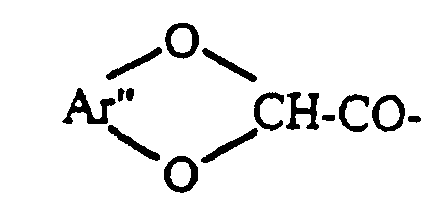
- acyl radicals are described in particular in patent application EP-0 445 021. They are advantageously alkoxy- or aryloxyacetyl radicals of formula R 6 -O-CH 2 -CO- in which R 6 represents a sterically hindered alkyl radical, a cycloalkyl radical or an aryl radical, or the arylidenedioxyacetyl radicals of formula in which Ar "represents an arylidene radical.
- sterically hindered alkyl is preferably meant a linear or branched C 1 -C 6 alkyl radical substituted by one or more bulky substituents chosen from halogens, linear or branched C 1 -C 6 alkyl radicals, linear or branched alkoxy C 1 -C 6 or C 3 -C 6 cycloalkyl or aryl. It will, for example, be a tert-butyl or triphenylmethyl radical.
- Cycloalkyl is preferably understood to mean a cycloalkyl radical in C 3 -C 6 optionally substituted by one or more bulky substituents chosen from halogens or linear or branched alkyl radicals C 1 -C 6 alkoxy linear or branched C 1 - C 6 or aryl.
- it is a cyclohexyl radical, substituted by one or more linear or branched C 1 -C 6 alkyl radicals, such as, for example, menthyl, its racemic or its enantiomers and their mixtures in all proportions. .
- Aryl preferably means phenyl, naphthyl, anthryl or phenanthryl, optionally substituted by one or more bulky substituents chosen from halogens or linear or branched alkyl radicals C 1 -C 6 alkoxy linear or branched C 1 -C 6 or aryl, in particular phenyl.
- it is a phenyl radical, optionally substituted by one or two bulky substituents above, ortho- and ortho'- of the ether bond.
- arylidene is preferably meant a phenylene, naphthylene, anthrylene or phenanthrylene radical, optionally substituted by one or more bulky substituents chosen from halogens, linear or branched C 1 -C 6 alkyl radicals, linear or branched alkoxy C 1 -C 6 or aryl, in particular phenyl.
- GP1 and GP2 also independently represent a trialkylgermanyl radical or together form a divalent radical of formula -SiR 7 -O-SiR 8 - in which R 7 and R 8 , independently of one another, represent a sterically hindered alkyl radical as defined above, in particular R 7 and R 8 each represent an isopropyl radical.
- radicals IIb, IIIa and III'a are generally opened by hydrolysis in acidic or basic medium.
- this opening can be carried out according to the methods described in the state of the technique (in particular WO 94/14787) by hydrolysis in an acid medium, followed a treatment in basic medium to obtain the derivative of general formula VI.
- GP1 and / or GP2 are haloalkoxycarbonyl radicals congested
- deprotection is carried out according to the usual techniques described for TrOC, by the action of zinc or zinc doped with heavy metals such that copper, in an organic solvent, in particular, in acid acetic acid, tetrahydrofuran or ethyl alcohol, with or without water.
- GP1 and / or GP2 are acyl radicals including carbon has a carbonyl function carries at least one oxygen atom
- the deprotection takes place in a basic medium by saponification in the methanol at low temperature, advantageously with ammonia in the methanol at a temperature below 10 ° C, preferably close to 0 ° C.
- the opening of the oxazoline is carried out simultaneously with deprotection in basic medium to lead in one step to the corresponding taxane derivative of general formula VI, for which R 4 represents a acetyl radical or a hydrogen atom, and R 5 represents a hydrogen atom, unlike the opening in an acid medium described in the state of the art which requires a second step in basic medium.
- the known protective groups are removed using known methods and the oxazolinic chain, when it was present, deployed by hydrolysis, giving taxanes identical in every respect to reference taxanes.
- PACLITAXEL, 10-deacetyltaxol, cephalomanin and DOCETAXEL it is possible to obtain PACLITAXEL, 10-deacetyltaxol, cephalomanin and DOCETAXEL to from the corresponding protected derivatives.
- the present invention finally relates to the intermediates of synthesis of general formulas IV, V and VI described above, useful in the general synthesis of the taxanes which are the subject of the present invention.
- hydroxycarbon radical preferably according to the invention a saturated or unsaturated hydrocarbon radical, may include one or more unsaturations, such as alkyl linear or branched, optionally unsaturated, optionally a cycloalkyl unsaturated, aralkyl or aryl, each of which may optionally be substituted by one or more substituents, in particular alkyl.
- linear or branched alkyl is preferably meant according to the invention a C 1 -C 6 alkyl, in particular chosen from the methyl, ethyl, propyl, isopropyl, butyl radicals and its various branched isomers such as for example terbutyl, pentyl and hexyl and their various branched isomers.
- This definition also applies to the alkyl residues of the alkoxy or aralkoxy radicals.
- cycloalkyl is preferably meant according to the invention a C 3 -C 6 cycloalkyl, in particular chosen from the cyclopropyl, cyclobutyl, cyclopentyl or cyclohexyl radicals.
- aryl is preferably meant according to the invention a radical aromatic or heteroaromatic, in particular chosen from radicals phenyl, naphthyl, anthryl, phenanthryl, pyridyle, pyrimidyle, etc.
- halogen is preferably meant chlorine, bromine or iodine.
- haloalkoxycarbonyl radicals it is preferably radicals in which the alkyl residue contains between 1 and 4 carbon atoms, and 3 or 4 halogen atoms.
- FIG. 2 summarizes a synthesis of PACLITAXEL from derivatives of formula IV defined more above, for which C represents a radical of formulas IIb or III'a.
- FIG. 3 summarizes the synthesis of 10-deacetyltaxol from a derivative of formula IV for which C represents a radical of formula IIb.
- the monocrystal was obtained from a suspension crystalline resulting from the hot addition of the non-solvent (water) to a hemisaturated solution of glycidate in methanol. Through slow cooling, the solution allowed to deposit fine needles purity 99.95% (HPLC), which were kept moist until final selection.
- the selected sample (fine needle of dimensions 0.12 * 0.12 * 0.40 mm) was studied on an automatic CAD4 ENRAF-NONIUS diffractometer (molybdenum radiation with graphite monochromator).
- the parameters of the mesh were obtained by refining a set of 25 reflections at high theta angle.
- reaction is allowed to continue at -65 ° C for 1 h and, after checking by TLC, 300 ml of a saturated aqueous solution of sodium hydrogencarbonate are added and the mixture is allowed to return to ambient temperature with stirring. After extraction of the aqueous phase with dichloromethane (2 x 200 mL), the combined organic phases are washed with a saturated sodium chloride solution (200 mL), with water (50 mL) and dried over MgSO 4 .
- the crude product obtained is purified by chromatography on silica gel (15-40 ⁇ m) (eluent: cyclohexane-ethyl acetate, 20/1) .
- the aqueous phase thus obtained is washed with dichloromethane (3 x 100 mL), acidified to pH 2 by slow addition of 20 mL of a 1M aqueous HCl solution, and extracted with ethyl acetate (3 x 100 mL).
- the combined organic extraction phases are dried (MgSO 4 ) and concentrated under reduced pressure.
- the aqueous phase obtained after concentration under reduced pressure is extracted with dichloromethane (100 ml).
- the aqueous phase is washed with a saturated sodium chloride solution (2 x 50 mL), dried over MgSO 4 , concentrated under reduced pressure, and the residue obtained is chromatographed on silica gel (15-40 ⁇ m) (eluent: dichloromethane -methanol, 95/05).
- the reaction medium is concentrated under reduced pressure, and the residual aqueous phase is washed with dichloromethane (3 x 50 mL) then acidified to pH 2 by slow addition of an aqueous solution of '1M HCl (10 mL).
- the aqueous phase is extracted with ethyl acetate (3 x 50 mL) and the combined organic phases are dried over MgSO 4 and concentrated under reduced pressure.
Landscapes
- Chemical & Material Sciences (AREA)
- Organic Chemistry (AREA)
- Chemical Kinetics & Catalysis (AREA)
- Epoxy Compounds (AREA)
- Pharmaceuticals Containing Other Organic And Inorganic Compounds (AREA)
- Plural Heterocyclic Compounds (AREA)
- Heterocyclic Carbon Compounds Containing A Hetero Ring Having Nitrogen And Oxygen As The Only Ring Hetero Atoms (AREA)
- Heterocyclic Carbon Compounds Containing A Hetero Ring Having Oxygen Or Sulfur (AREA)
- Organic Low-Molecular-Weight Compounds And Preparation Thereof (AREA)
- Medicines Containing Plant Substances (AREA)
- Preparation Of Compounds By Using Micro-Organisms (AREA)
Claims (26)
- Verfahren zur Herstellung von Vorstufen der Seitenkette von Taxanen, bei dem man ein cis-β-Aryl-glycidatderivat der allgemeinen Formel Iin der
 umwandelt, um die β-N-Alkylamidgruppe und die α-Hydroxygruppe oder ihre cyclischen Vorstufen regio- und stereospezifisch in einem einzigen Schritt durch eine Ritter-Reaktion einzuführen, die entweder besteht:Ar einen Arylrest darstellt undR einen Kohlenwasserstoffrest darstellt, vorzugsweise einen linearen oder verzweigten Alkylrest oder einen Cycloalkylrest, der gegebenenfalls mit einer oder mehreren Alkylgruppen substituiert ist,a aus der direkten Synthese einer linearen Kette, indem man ein cis-β-Aryl-glycidatderivat der oben definierten allgemeinen Formel I mit einem Nitril der Formel
R2 einen Arylrest darstellt,
in Gegenwart einer Protonensäure und Wasser umsetzt, um ein β-Aryl-isoserinderivat der allgemeinen Formel IIa,in der Ar, R und R2 wie zuvor definiert sind, zu erhalten; oder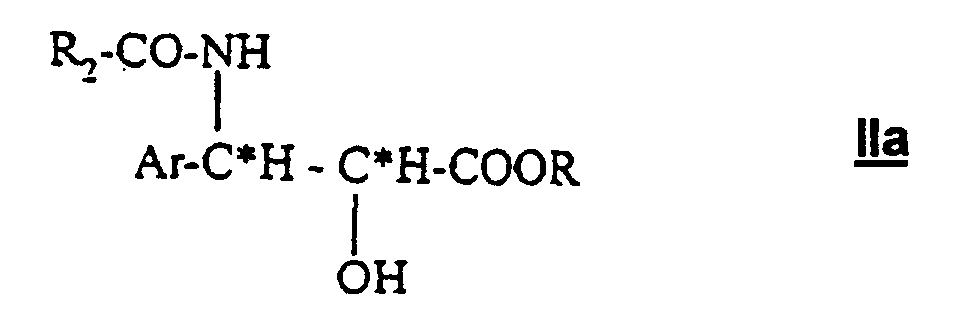 b aus der direkten Synthese einer cyclischen Kette, indem man ein cis-β-Aryl-glycidatderivat der oben definierten allgemeinen Formel I mit einem Nitril der Formel
R'2 den zuvor definierten Rest R2 oder einen niedrigen Alkyl- oder niedrigen Perhalogenalkylrest, wie Trichlormethyl, darstellt,
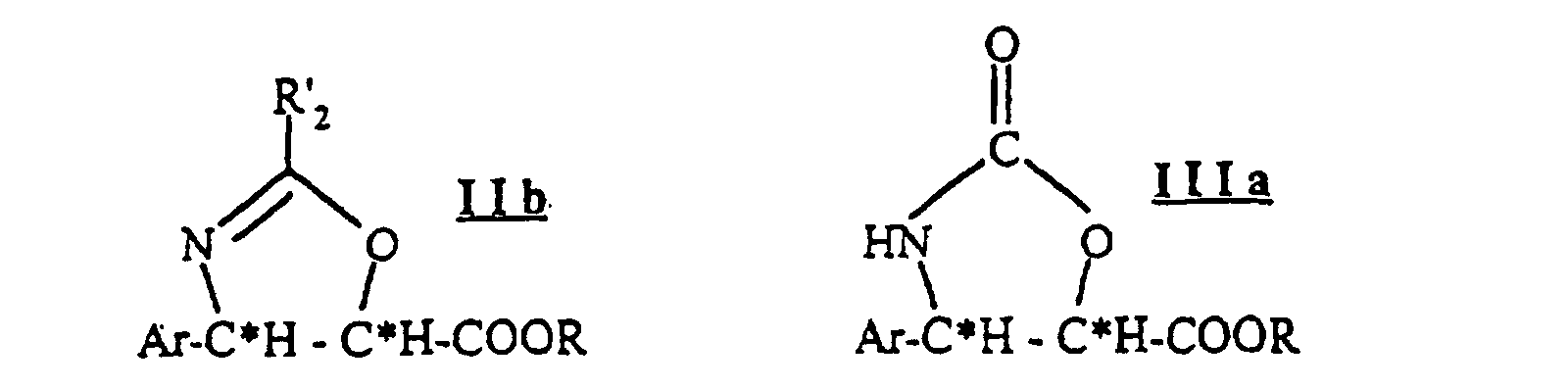
in Gegenwart einer Lewis-Säure oder einer Protonensäure in wasserfreiem Medium umsetzt, um das Oxazolin der allgemeinen Formel IIbin der Ar, R und R'2 wie zuvor definiert sind, zu erhalten.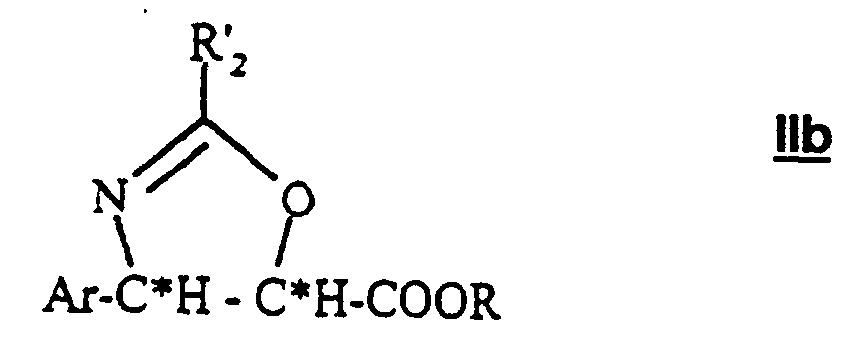
- Verfahren gemäß Anspruch 1, dadurch gekennzeichnet, dass R ein optisch reines Enantiomer eines chiralen Kohlenwasserstoffrests mit großem sterischen Raumbedarf, vorteilhafterweise einen mit einer oder mehreren Alkylgruppen substituierten Cycloalkylrest, insbesondere einen Cyclohexylrest, darstellt.
- Verfahren gemäß Anspruch 2, dadurch gekennzeichnet, dass R eines der Enantiomere des Menthylrests, insbesondere (+)-Menthyl, ist.
- Verfahren gemäß einem der Ansprüche 1 bis 3, dadurch gekennzeichnet, dass das cis-β-Phenyl-glycidatderivat der allgemeinen Formel I die (2R,3R)-Konfiguration hat und die erhaltenen Derivate der allgemeinen Formeln lla und IIb die (2R,3S)-Konfiguration haben.
- Verfahren gemäß einem der Ansprüche 1 bis 4, dadurch gekennzeichnet, dass Ar und R2 einen Phenylrest darstellen.
- Verfahren gemäß einem der Ansprüche 1 bis 5, dadurch gekennzeichnet, dass die Protonensäure in der Stufe a unter Schwefelsäure, Perchlorsäure oder Tetrafluorborsäure ausgewählt ist, die Lewis-Säure in der Stufe b unter dem Bortrifluorid-Essigsäure-Komplex, Bortrifluorid-etherat, Antimonpentachlorid, Zinntetrachlorid oder Titantetrachlorid ausgewählt ist und die Protonensäure in der Stufe b Tetrafluorborsäure ist.
- Verfahren gemäß einem der Ansprüche 1 bis 6, dadurch gekennzeichnet, dass das β-Aryl-isoserinderivat der allgemeinen Formel IIa durch Schützen der Hydroxyfunktion durch eine geeignete Schutzgruppe (GP) umgewandelt wird, um ein Derivat der allgemeinen Formel II'azu erhalten, in der
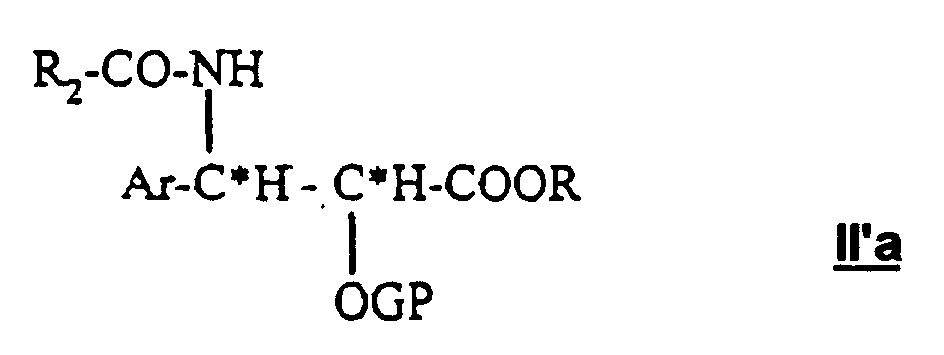 Ar, R und R2 wie in Anspruch 1 definiert sind undGP eine Schutzgruppe für die Hydroxyfunktion darstellt, die für die Synthese der Taxane geeignet und insbesondere ausgewählt ist unter den Resten Alkoxyether, Aralkoxyether, Aryloxyether oder Halogenalkoxycarbonyl, wie beispielsweise die Gruppen Methoxymethyl, 1-Ethoxyethyl, Benzyloxy-methyl, (β-Trimethylsilyl-ethoxy)-methyl, den Resten Tetrahydro-pyranyl, β-Alkoxycarbonyl, den β-Halogenalkylsilylethem oder den Resten Alkoxyacetyl, Aryloxyacetyl, Halogenacetyl oder Formyl.
 - Verfahren gemäß einem der Ansprüche 1 bis 6, dadurch gekennzeichnet, dass das β-Aryl-isoserinderivat der allgemeinen Formel IIa in neue cyclische Oxazolidinonzwischenstufen der allgemeinen Formel IIIain der Ar und R wie in Anspruch 1 definiert sind,

umgewandelt wird, indem man ein β-Aryl-isoserinderivat der allgemeinen Formel IIa gemäß einem der Ansprüche 1 bis 5 mit einem Halogenalkoxycarbonylester, insbesondere 2,2,2-Trichlorethoxycarbonyl (TrOC), umsetzt, dann in Gegenwart einer starken organischen Base, wie Diazabicyclo-undecen (DBU), cyclisiert, wonach gegebenenfalls eine Umwandlung in das entsprechende Amid der allgemeinen Formel III'aerfolgt, in der Ar und R wie in Anspruch 1 definiert sind und R"2 R'2, wie in Anspruch 1 definiert, einen Alkoxyrest oder einen Alkylrest darstellt, der linear oder verzweigt ist und wenigstens eine ungesättigte Bindung umfasst.
- Verfahren gemäß einem der Ansprüche 1 bis 6, dadurch gekennzeichnet, dass man das Oxazolin der allgemeinen Formel IIb in saurem Medium hydrolysiert, um das β-Aryl-isoserinderivat der allgemeinen Formel IIIbin der Ar, R und R'2 wie in Anspruch 1 definiert sind,
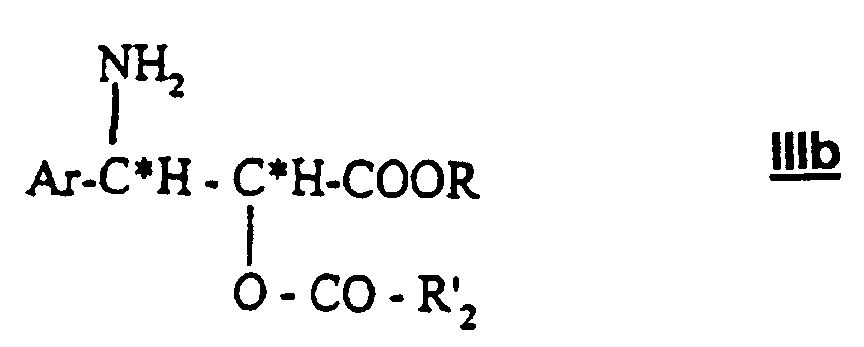
zu erhalten, das dann gegebenenfalls in das entsprechende Amid der allgemeinen Formel III'bin der Ar, R, R'2 und R"2 wie in Anspruch 1 definiert sind, umgewandelt wird.
- Verfahren gemäß einem der Ansprüche 1 bis 9, dadurch gekennzeichnet, dass das cis-β-Aryl-glycidatderivat der allgemeinen Formel Iin der
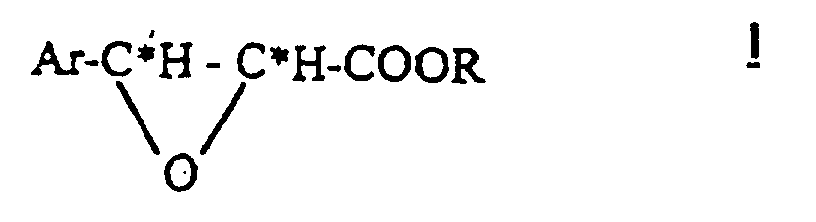 hergestellt wird, indem man den Aldehyd der FormelAr wie in Anspruch 1 definiert ist undR ein optisch reines Enantiomer eines chiralen Kohlenwasserstoffrests mit großem sterischen Raumbedarf darstellt,Ar, R wie in Anspruch 1 definiert sind undX ein Halogenatom, insbesondere ein Chlor- oder ein Bromatom, darstellt.
 - Verfahren gemäß einem der Ansprüche 1 bis 10, dadurch gekennzeichnet, dass man durch schonende Verseifung die Derivate der Formeln IIa, II'a, IIb, IIIa, III'a, IIIb und III'b, definiert wie in den Ansprüchen 1, 7, 8 und 9, für die R ein Wasserstoffatom darstellt, erhält.
- Vorstufen von Seitenketten von Taxanen, dadurch gekennzeichnet, dass sie unter den Derivaten der folgenden allgemeinen Formeln I, IIa, IIb, II'a, IIIb und III'b ausgewählt sind:
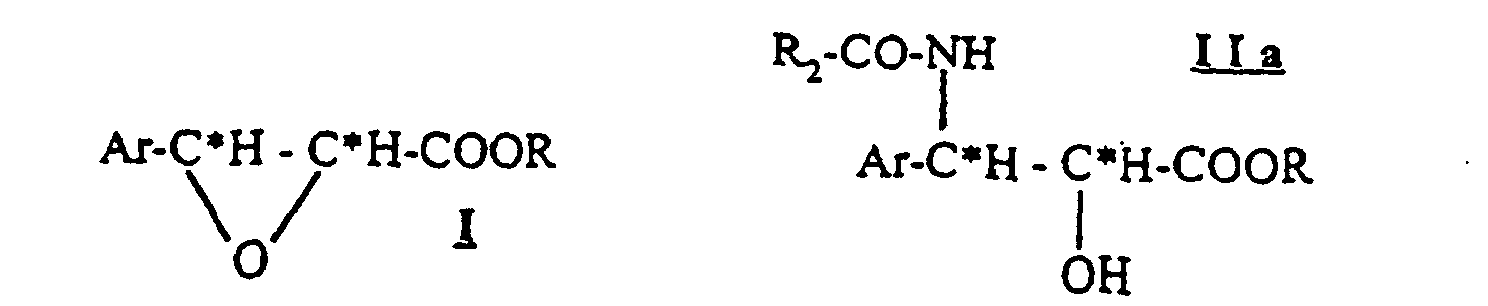
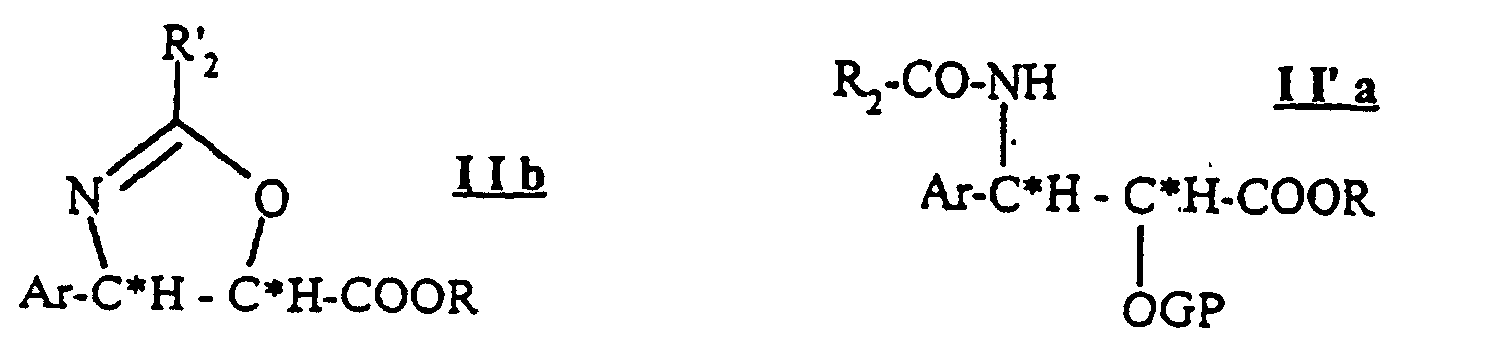 in denen
 Ar, R2, R'2, R"2 und GP wie in einem der Ansprüche 1 bis 3 und 5 definiert sind undR ein optisch reines Enantiomer eines chiralen Kohlenwasserstoffrests mit großem sterischen Raumbedarf darstellt.
 - Verbindungen gemäß Anspruch 12, dadurch gekennzeichnet, dass R eines der Enantiomere des Menthylrests, insbesondere (+)-Menthyl, ist.
- Verbindungen gemäß einem der Ansprüche 12 oder 13, dadurch gekennzeichnet, dass das cis-β-Phenyl-glycidatderivat der allgemeinen Formel I die (2R,3R)-Konfiguration hat und die Derivate der allgemeinen Formeln IIa, IIb, IIIb und III'b die (2R,3S)-Konfiguration haben.
- Vorstufen von Seitenketten von Taxanen, dadurch gekennzeichnet, dass sie unter den Derivaten der folgenden allgemeinen Formeln IIIa und III'a ausgewählt sind:in denen
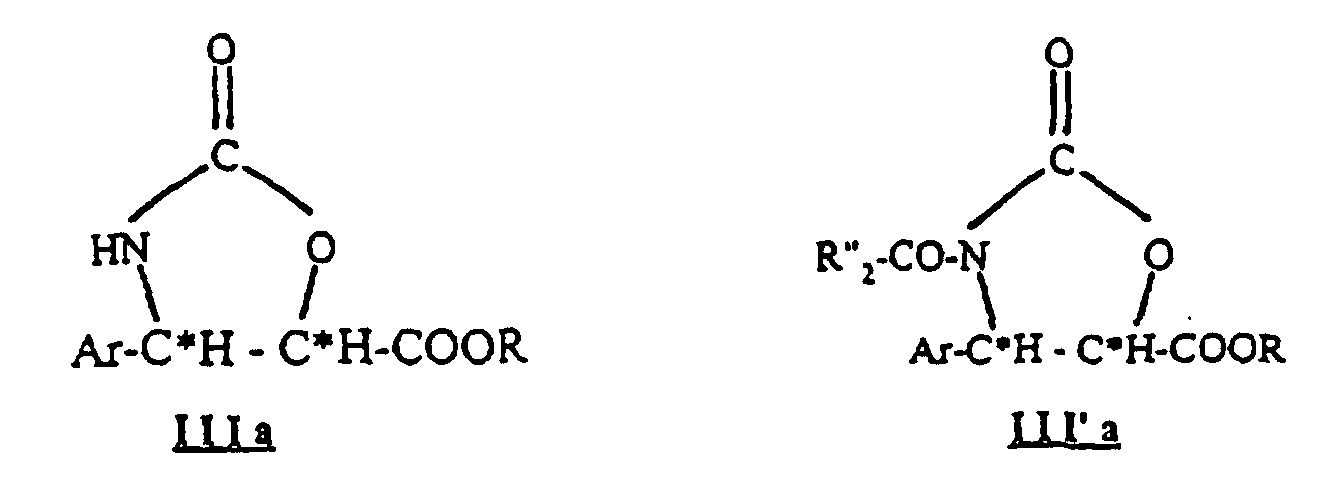
Ar, R und R"2 wie in den Ansprüchen 1 und 8 definiert sind oder R ein Wasserstoffatom darstellt. - Verbindungen gemäß Anspruch 15, dadurch gekennzeichnet, dass sie die (2R,3S)-Konfiguration haben.
- Verfahren zur Herstellung von Taxanen der allgemeinen Formel IV,
B einen Rest der allgemeinen Formel Vdarstellt, in der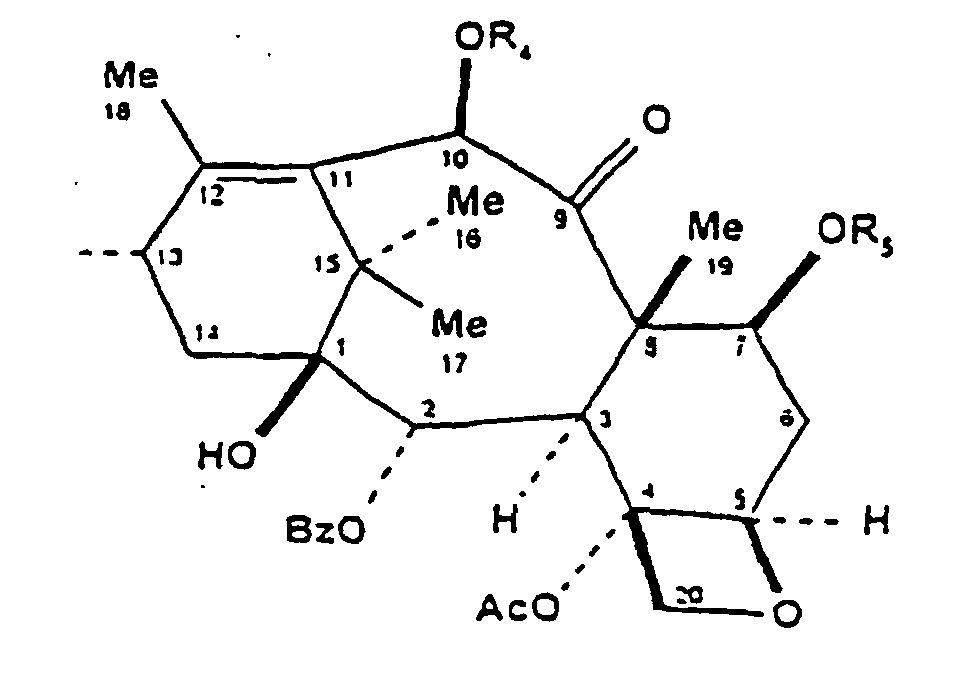 in denen Ar, R2, R'2, R"2 und GP wie in den Ansprüchen 1, 7 und 8 definiert sind, durch Veresterung eines geeigneten Baccatin III-Derivats der allgemeinen Formel V, das eine Hydrowfunktion in Position C 13 trägt, mit einem der Derivate der Formeln IIa, II'a, IIb, IIIa, III'a, IIIb und III'b, für die R ein Wasserstoffatom darstellt, die durch das Verfahren gemäß Anspruch 11 erhalten werden.Ac den Acetylrest darstellt,Bz den Benzylrest darstellt,Me den Methylrest darstellt,R4 einen Acetylrest oder eine Schutzgruppe für die Hydroxyfunktion GP1 darstellt undR5 eine Schutzgruppe für die Hydroxyfunktion GP2 darstellt undC eine Seitenkette darstellt, die unter den Resten der folgenden Formeln IIa, II'a, IIb, IIIa, III'a, IIIb und III'b ausgewählt ist:


- Verfahren gemäß Anspruch 17, dadurch gekennzeichnet, dass die Schutzgruppen GP1 und GP2 unabhängig voneinander übliche Schutzgruppen sind, die bei der Hemisynthese der Taxane verwendet werden, wie die Trialkylsilylgruppen oder TROC, oder sperrige, lineare oder verzweigte Halogenalkoxycarbonylreste mit wenigstens einem Halogenatom, Acylreste, deren Kohlenstoffatom in Position a zur Carbonylfunktion wenigstens ein Sauerstoffatom trägt, ein Trialkylgermanylrest, oder GP1 und GP2 zusammen einen zweiwertigen Rest der Formel
R7 und R8 unabhängig voneinander einen sterisch sperrigen Alkylrest darstellen,
bilden. - Verfahren gemäß einem der Ansprüche 17 oder 18, dadurch gekennzeichnet, dass die Acylreste, deren Kohlenstoffatom in Position a zur Carbonylfunktion wenigstens ein Sauerstoffatom trägt, unter denausgewählt sind.Alkoxy- oder Aryloxyacetylresten der Formeloder den Arylidendioxyacetylresten der Formel/ in der Ar" einen Arylidenrest darstellt,
- Verfahren gemäß Anspruch 19, dadurch gekennzeichnet, dass:der sterisch sperrige Alkylrest ein linearer oder verzweigter C1-C6-Alkylrest ist, der mit einem oder mehreren sperrigen Substituenten substituiert ist, die unter den Halogenen, den linearen oder verzweigten C1-C6-Alkylresten, linearen oder verzweigten C1-C6-Alkoxyresten oder C3-C6-Cycloalkylresten oder Arylresten ausgewählt sind,der Cycloalkylrest ein C3-C6-Cycloalkylrest ist, der gegebenenfalls mit einem oder mehreren sperrigen Substituenten substituiert ist, die unter den Halogenen, den linearen oder verzweigten C1-C6-Alkylresten, linearen oder verzweigten C1-C6-Alkoxyresten oder Arylresten ausgewählt sind, vorzugsweise ein Cyclohexylrest, der mit einem oder mehreren, linearen oder verzweigten C1-C6-Alkylresten substituiert ist, beispielsweise der Menthylrest, dessen Racemat oder dessen Enantiomere und deren Gemische in allen Verhältnissen,der Arylrest ein Phenyl-, Naphthyl-, Anthryl- oder Phenanthrylrest ist, der gegebenenfalls mit einem oder mehreren sperrigen Substituenten substituiert ist, die unter den Halogenen, den linearen oder verzweigten C1-C6-Alkylresten, linearen oder verzweigten C1-C6-Alkoxyresten oder Arylresten, insbesondere Phenyl, ausgewählt sind, vorzugsweise ein Phenylrest, der gegebenenfalls mit einem oder zwei der obigen sperrigen Substituenten in ortho- und ortho'-Stellung zur Etherbindung substituiert ist, undder Arylidenrest ein Phenylen-, Naphthylen-, Anthrylen- oder Phenanthrylenrest ist, der gegebenenfalls mit einem oder mehreren sperrigen Substituenten substituiert ist, die unter den Halogenen, den linearen oder verzweigten C1-C6-Alkylresten, linearen oder verzweigten C1-C6-Alkoxyresten oder Arylresten, insbesondere Phenyl, ausgewählt sind.
- Verfahren gemäß einem der Ansprüche 17 oder 18, dadurch gekennzeichnet, dass R4 einen Acetylrest darstellt und GP2 einen Trialkylsilyl-, 2,2,2-Trichlorethoxycarbonyl-, 2,2,2-Tribromethoxycarbonyl-, 2,2,2,1-Tetrachlorethoxycarbonyl-, 2,2,2-Trichlor-tert.-butoxycarbonyl-, Trichlormethoxycarbonyl-, Phenoxyacetyl- oder Trialkyl-germanylrest darstellt.
- Verfahren gemäß einem der Ansprüche 17 oder 18, dadurch gekennzeichnet, dass R4 eine Gruppe GP1 darstellt und GP1 und GP2 einen 2,2,2-Trichlorethoxycarbonyl- oder Phenoxyacetylrest darstellen oder zusammen einen zweiwertigen Rest der Formel
- Verfahren gemäß einem der Ansprüche 17 bis 21, dadurch gekennzeichnet, dass C einen Rest der Formel IIa darstellt, wobei Ar und R2 einen Phenylrest darstellen, und R4 einen Acetylrest darstellt.
- Verfahren gemäß einem der Ansprüche 17 bis 23, dadurch gekennzeichnet, dass man dann die Schutzgruppen für die Hydroxyfunktionen der Derivate der allgemeinen Formel IV entfernt und gegebenenfalls, gleichzeitig oder getrennt, den Oxazolinring der Reste der Formel IIb oder IIIa öffnet, um ein Taxanderivat der allgemeinen Formel VIin der
 zu erhalten.Ac, Bz, Me und R'2 wie in einem der vorigen Ansprüche definiert sind,R4 ein Wasserstoffatom oder einen Acetylrest darstellt undR5 ein Wasserstoffatom darstellt,
 - Taxanderivate der allgemeinen Formel IV
- Baccatin III-Derivate, die für die Hemisynthese von Taxanen nützlich sind, dadurch gekennzeichnet, dass sie unter den Derivaten der allgemeinen Formel V,ausgewählt sind, in der
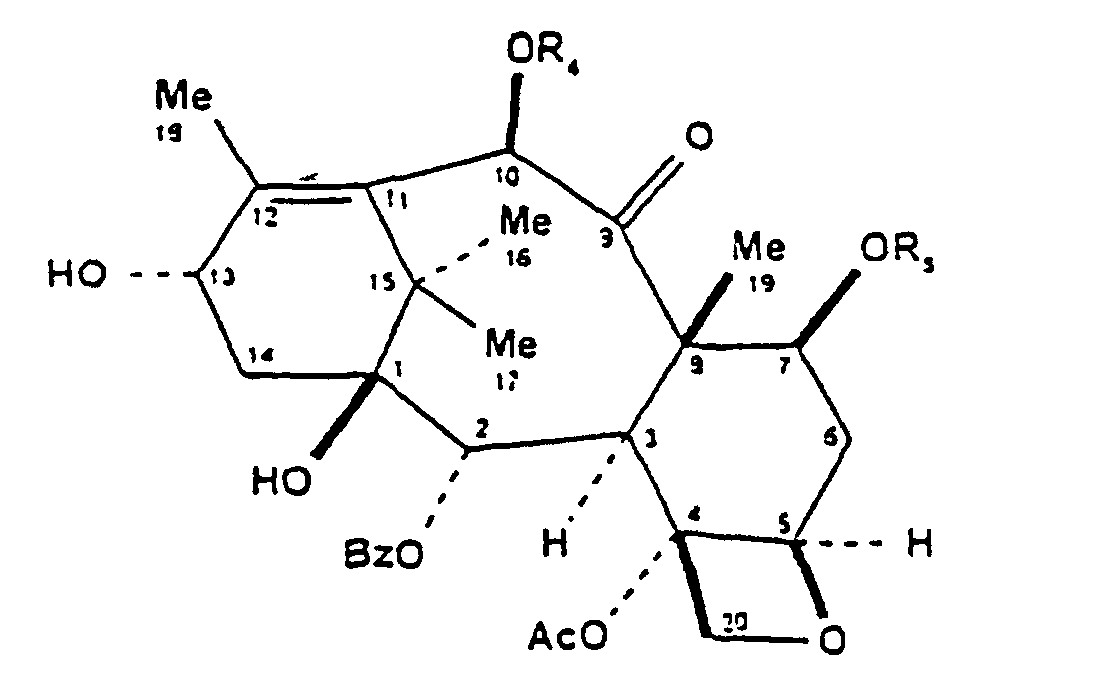 in derAc den Acetylrest darstellt,Bz den Benzoylrest darstellt,Me den Methylrest darstellt,R4 einen Acetylrest oder eine Schutzgruppe für die Hydroxyfunktion GP1 darstellt,R5 eine Schutzgruppe für die Hydroxyfunktion GP2 darstellt undGP1 und GP2 unabhängig voneinander sperrige Halogenalkoxycarbonylreste mit Ausnahme von TrOC, Acylreste, deren Kohlenstoffatom in Position a zur Carbonylfunktion wenigstens ein Sauerstoffatom trägt, Trialkylgermanylreste sind oder GP1 und GP2 zusammen einen zweiwertigen Rest der Formel
R7 und R8 unabhängig voneinander einen sterisch sperrigen Alkylrest darstellen, bilden.
Applications Claiming Priority (3)
| Application Number | Priority Date | Filing Date | Title |
|---|---|---|---|
| FR9512739A FR2740451B1 (fr) | 1995-10-27 | 1995-10-27 | Nouveaux intermediaires pour l'hemisynthese de taxanes, leurs procedes de preparation et leur utilisation dans la synthese generale des taxanes |
| FR9512739 | 1995-10-27 | ||
| PCT/FR1996/001676 WO1997015562A1 (fr) | 1995-10-27 | 1996-10-25 | Intermediaires pour l'hemisynthese de taxanes et leurs procedes de preparation |
Publications (2)
| Publication Number | Publication Date |
|---|---|
| EP0863887A1 EP0863887A1 (de) | 1998-09-16 |
| EP0863887B1 true EP0863887B1 (de) | 2002-01-23 |
Family
ID=9484016
Family Applications (1)
| Application Number | Title | Priority Date | Filing Date |
|---|---|---|---|
| EP96934977A Expired - Lifetime EP0863887B1 (de) | 1995-10-27 | 1996-10-25 | Zwischerprodukte für die hemisynthese von taxanen und deren verfahren zu herstellung |
Country Status (25)
| Country | Link |
|---|---|
| US (5) | US6265587B1 (de) |
| EP (1) | EP0863887B1 (de) |
| JP (1) | JP2000500437A (de) |
| KR (1) | KR100489865B1 (de) |
| CN (1) | CN100374428C (de) |
| AT (1) | ATE212342T1 (de) |
| AU (1) | AU710314B2 (de) |
| BR (1) | BR9610908A (de) |
| CZ (1) | CZ125598A3 (de) |
| DE (1) | DE69618812T2 (de) |
| DK (1) | DK0863887T3 (de) |
| EE (1) | EE03610B1 (de) |
| ES (1) | ES2170876T3 (de) |
| FR (1) | FR2740451B1 (de) |
| GE (1) | GEP20001938B (de) |
| HU (1) | HU225507B1 (de) |
| IL (1) | IL155876A (de) |
| NO (1) | NO981823D0 (de) |
| NZ (1) | NZ320356A (de) |
| PL (1) | PL327458A1 (de) |
| PT (1) | PT863887E (de) |
| RU (1) | RU2159237C2 (de) |
| SK (1) | SK52398A3 (de) |
| TR (1) | TR199800713T2 (de) |
| WO (1) | WO1997015562A1 (de) |
Families Citing this family (27)
| Publication number | Priority date | Publication date | Assignee | Title |
|---|---|---|---|---|
| FR2740451B1 (fr) * | 1995-10-27 | 1998-01-16 | Seripharm | Nouveaux intermediaires pour l'hemisynthese de taxanes, leurs procedes de preparation et leur utilisation dans la synthese generale des taxanes |
| KR100225535B1 (ko) * | 1996-08-27 | 1999-10-15 | 정지석 | 파클리탁셀의 제조방법 |
| US6150537A (en) * | 1997-12-12 | 2000-11-21 | Emory University | Methods for the esterification of alcohols and compounds useful therefor as potential anticancer agents |
| KR100267596B1 (ko) * | 1998-04-17 | 2000-10-16 | 강재헌 | 베타-아미노-알파-하이드록시산과 균등한 옥사졸린 유도체의 입체선택적 합성방법 |
| WO2001030770A1 (en) * | 1999-10-26 | 2001-05-03 | Dong Kook Pharmaceutical Co., Ltd. | Stereoselective synthesis of oxazoline derivative |
| ES2178539B1 (es) * | 2000-03-14 | 2004-08-01 | Dong Kook Pharmaceutical Co., Ltd. | Procedimiento para la preparacion de un compuesto de oxazolina. |
| WO2002066448A1 (en) * | 2001-02-20 | 2002-08-29 | Dabur India Limited | Method of preparation of paclitaxel (taxol) using 3-(alk-2-ynyloxy) carbonyl-5-oxazolidine carboxylic acid |
| FR2846327B1 (fr) * | 2002-10-25 | 2006-03-24 | Merck Sante Sas | Derives de n-benzodioxolyl, n-benzodioxanyl et n-benzodioxepinyl arylcarboxamides utilisables dans le traitement de dyslipidemies et compositions pharmaceutiques les contenant. |
| BRPI0611954A2 (pt) * | 2005-06-10 | 2009-04-28 | Univ Florida State Res Found | processos para a produÇço de compostos de anel fundido policÍclico |
| AU2006258012B2 (en) * | 2005-06-10 | 2011-04-07 | Florida State University Research Foundation, Inc. | Processes for the preparation of docetaxel |
| GB0701523D0 (en) * | 2007-01-26 | 2007-03-07 | Chatham Biotec Ltd | Semi-synthetic process for the preparation of taxane derivatives |
| CN101468974B (zh) * | 2007-12-28 | 2011-02-09 | 上海百灵医药科技有限公司 | 多烯紫杉醇的半合成方法 |
| CA2873141C (en) | 2009-12-30 | 2018-05-29 | Adam Kelliher | Simulated moving bed chromatographic separation process |
| GB201111601D0 (en) | 2011-07-06 | 2011-08-24 | Equateq Ltd | New process |
| GB201111591D0 (en) | 2011-07-06 | 2011-08-24 | Equateq Ltd | Further new process |
| GB201111589D0 (en) | 2011-07-06 | 2011-08-24 | Equateq Ltd | New modified process |
| GB201111594D0 (en) | 2011-07-06 | 2011-08-24 | Equateq Ltd | New improved process |
| GB201111595D0 (en) | 2011-07-06 | 2011-08-24 | Equateq Ltd | Improved process |
| CN103508918B (zh) * | 2012-06-18 | 2015-09-09 | 上海医药工业研究院 | 带有环丁基的α-羟基β-氨基酯类化合物及其制备方法 |
| GB201300354D0 (en) | 2013-01-09 | 2013-02-20 | Basf Pharma Callanish Ltd | Multi-step separation process |
| US9428711B2 (en) | 2013-05-07 | 2016-08-30 | Groupe Novasep | Chromatographic process for the production of highly purified polyunsaturated fatty acids |
| US8802880B1 (en) | 2013-05-07 | 2014-08-12 | Group Novasep | Chromatographic process for the production of highly purified polyunsaturated fatty acids |
| EP2883860B1 (de) | 2013-12-11 | 2016-08-24 | Novasep Process | Chromatografisches Verfahren zur Herstellung von mehrfach ungesättigten Fettsäuren |
| JP6303017B2 (ja) | 2014-01-07 | 2018-03-28 | ノヴァセプ プロセスNovasep Process | 芳香族アミノ酸を精製する方法 |
| CN107848990B (zh) * | 2015-07-07 | 2021-06-11 | 万代忠胜 | 紫杉醇和多烯紫杉醇的侧链前体的制造方法 |
| CN112876503B (zh) * | 2021-03-18 | 2022-04-29 | 中国科学院兰州化学物理研究所 | 用于癌症硼中子俘获治疗药物的硼酸盐化合物及其制备 |
| CN114195820B (zh) * | 2021-12-17 | 2023-11-10 | 中山大学 | 异丝氨酸衍生物及其制备与在紫杉醇合成中的应用 |
Family Cites Families (14)
| Publication number | Priority date | Publication date | Assignee | Title |
|---|---|---|---|---|
| US4876399A (en) * | 1987-11-02 | 1989-10-24 | Research Corporation Technologies, Inc. | Taxols, their preparation and intermediates thereof |
| US5008411A (en) * | 1988-05-24 | 1991-04-16 | Hoffmann-La Roche Inc. | Glycidic acid ester and process of preparation |
| US5274300A (en) * | 1988-10-26 | 1993-12-28 | Sepracor, Inc. | Enzymatic hydrolysis of glycidate esters in the presence of bisulfite anion |
| US5304670A (en) | 1989-08-23 | 1994-04-19 | Centre National De La Recherche Scientifique | Process for the enantioselective preparation of phenylisoserine derivatives |
| IL95436A (en) * | 1989-08-23 | 1996-07-23 | Centre Nat Rech Scient | Method for the preparation of phenzlisoserine derivatives |
| JPH088879B2 (ja) * | 1989-09-13 | 1996-01-31 | 田辺製薬株式会社 | 光学活性3―フェニルグリシッド酸エステル類化合物の製法 |
| FR2658513B1 (fr) * | 1990-02-21 | 1994-02-04 | Rhone Poulenc Sante | Procede de preparation de l'acide cis-beta-phenylglycidique-(2r,3r). |
| RU2017724C1 (ru) * | 1990-07-12 | 1994-08-15 | Дзе Юниверсити оф Канзас | Способ получения производных таксола |
| FR2678930B1 (fr) * | 1991-07-10 | 1995-01-13 | Rhone Poulenc Rorer Sa | Procede de preparation de derives de la baccatine iii et de la desacetyl-10 baccatine iii. |
| AU3140093A (en) * | 1991-11-22 | 1993-06-15 | University Of Mississippi, The | Synthesis and optical resolution of the taxol side chain and related compounds |
| FR2687150B1 (fr) * | 1992-02-07 | 1995-04-28 | Rhone Poulenc Rorer Sa | Procede de preparation de derives du taxane. |
| ATE309229T1 (de) * | 1992-12-23 | 2005-11-15 | Bristol Myers Squibb Co | Seitenkette tragende taxanen und deren zwischenprodukten |
| FR2740451B1 (fr) * | 1995-10-27 | 1998-01-16 | Seripharm | Nouveaux intermediaires pour l'hemisynthese de taxanes, leurs procedes de preparation et leur utilisation dans la synthese generale des taxanes |
| US6228955B1 (en) * | 1996-04-19 | 2001-05-08 | Chirotech Technology, Ltd. | Asymmetric epoxides, their synthesis and use |
-
1995
- 1995-10-27 FR FR9512739A patent/FR2740451B1/fr not_active Expired - Fee Related
-
1996
- 1996-10-25 KR KR1019980703067A patent/KR100489865B1/ko not_active Expired - Fee Related
- 1996-10-25 DE DE69618812T patent/DE69618812T2/de not_active Expired - Lifetime
- 1996-10-25 BR BR9610908A patent/BR9610908A/pt unknown
- 1996-10-25 PT PT96934977T patent/PT863887E/pt unknown
- 1996-10-25 SK SK523-98A patent/SK52398A3/sk unknown
- 1996-10-25 AT AT96934977T patent/ATE212342T1/de not_active IP Right Cessation
- 1996-10-25 CZ CZ981255A patent/CZ125598A3/cs unknown
- 1996-10-25 NZ NZ320356A patent/NZ320356A/xx unknown
- 1996-10-25 GE GEAP19964253A patent/GEP20001938B/en unknown
- 1996-10-25 TR TR1998/00713T patent/TR199800713T2/xx unknown
- 1996-10-25 AU AU73086/96A patent/AU710314B2/en not_active Ceased
- 1996-10-25 RU RU98110071/04A patent/RU2159237C2/ru not_active IP Right Cessation
- 1996-10-25 EP EP96934977A patent/EP0863887B1/de not_active Expired - Lifetime
- 1996-10-25 DK DK96934977T patent/DK0863887T3/da active
- 1996-10-25 CN CNB961978538A patent/CN100374428C/zh not_active Expired - Fee Related
- 1996-10-25 ES ES96934977T patent/ES2170876T3/es not_active Expired - Lifetime
- 1996-10-25 HU HU9802487A patent/HU225507B1/hu not_active IP Right Cessation
- 1996-10-25 EE EE9800149A patent/EE03610B1/xx not_active IP Right Cessation
- 1996-10-25 PL PL96327458A patent/PL327458A1/xx unknown
- 1996-10-25 JP JP9516372A patent/JP2000500437A/ja not_active Ceased
- 1996-10-25 WO PCT/FR1996/001676 patent/WO1997015562A1/fr not_active Ceased
- 1996-10-25 US US09/065,041 patent/US6265587B1/en not_active Expired - Fee Related
-
1998
- 1998-04-23 NO NO981823A patent/NO981823D0/no not_active Application Discontinuation
-
2001
- 2001-04-18 US US09/836,326 patent/US6825365B2/en not_active Expired - Fee Related
-
2003
- 2003-05-12 IL IL155876A patent/IL155876A/en not_active IP Right Cessation
-
2004
- 2004-06-04 US US10/859,953 patent/US7279586B2/en not_active Expired - Fee Related
-
2005
- 2005-03-11 US US11/076,856 patent/US7220871B2/en not_active Expired - Fee Related
-
2007
- 2007-03-07 US US11/714,817 patent/US7432383B2/en not_active Expired - Fee Related
Also Published As
Similar Documents
| Publication | Publication Date | Title |
|---|---|---|
| US7432383B2 (en) | Intermediates for the hemisynthesis of taxanes and preparation processes therefor | |
| CA2146372C (fr) | Nouveau procede d'esterification de la baccatine iii et de la desacetyl-10 baccatine iii | |
| EP0336840B1 (de) | Verfahren zur Herstellung von Taxol | |
| CA2146155C (fr) | Procede de preparation de derives du taxane | |
| EP0595370B1 (de) | Verfahren zur Herstellung von Taxanderivaten und deren Zwischenprodukte | |
| EP0666857B1 (de) | Verfahren zur herstellung von taxanderivaten | |
| EP0414610A1 (de) | Verfahren zur enantioselektiven Herstellung von Phenylisoserin-Derivaten | |
| CN101035778A (zh) | 紫杉烷中间体的半合成及其向太平洋紫杉醇和多烯紫杉醇的转化 | |
| JP3889047B2 (ja) | タキソールおよびその誘導体の製造方法 | |
| EP0703907B1 (de) | Verfahren zur herstellung einer oxazolidincarbon säure nützlich für die herstellung von therapeutischen taxoiden | |
| EP0663901B1 (de) | Stereoselektives verfahren zur herstellung eines beta-phenylisoserin-derivates sowie seine verwendung zur herstellung von taxan-derivaten | |
| CA2236293C (fr) | Intermediaires pour l'hemisynthese de taxanes et leurs procedes de preparation | |
| EP1856081B1 (de) | Verfahren zur herstellung von paclitaxel | |
| CA2576943A1 (fr) | Intermediaires pour l'hemisynthese de taxanes et leurs procedes de preparation | |
| EP1856080B1 (de) | Verfahren zur herstellung von docetaxel | |
| IL150093A (en) | Baccatin derivatives, intermediary compounds for the hemisynthesis of taxanes and preparation processes therefor | |
| MXPA98002923A (en) | Intermediary compounds for the detaxanism semisintesis and the preparation procedures of the mis |
Legal Events
| Date | Code | Title | Description |
|---|---|---|---|
| PUAI | Public reference made under article 153(3) epc to a published international application that has entered the european phase |
Free format text: ORIGINAL CODE: 0009012 |
|
| 17P | Request for examination filed |
Effective date: 19980429 |
|
| AK | Designated contracting states |
Kind code of ref document: A1 Designated state(s): AT BE CH DE DK ES FI FR GB GR IE IT LI LU NL PT SE |
|
| 17Q | First examination report despatched |
Effective date: 20000915 |
|
| GRAG | Despatch of communication of intention to grant |
Free format text: ORIGINAL CODE: EPIDOS AGRA |
|
| GRAG | Despatch of communication of intention to grant |
Free format text: ORIGINAL CODE: EPIDOS AGRA |
|
| GRAH | Despatch of communication of intention to grant a patent |
Free format text: ORIGINAL CODE: EPIDOS IGRA |
|
| GRAH | Despatch of communication of intention to grant a patent |
Free format text: ORIGINAL CODE: EPIDOS IGRA |
|
| GRAA | (expected) grant |
Free format text: ORIGINAL CODE: 0009210 |
|
| REG | Reference to a national code |
Ref country code: GB Ref legal event code: IF02 |
|
| AK | Designated contracting states |
Kind code of ref document: B1 Designated state(s): AT BE CH DE DK ES FI FR GB GR IE IT LI LU NL PT SE |
|
| PG25 | Lapsed in a contracting state [announced via postgrant information from national office to epo] |
Ref country code: GR Free format text: LAPSE BECAUSE OF FAILURE TO SUBMIT A TRANSLATION OF THE DESCRIPTION OR TO PAY THE FEE WITHIN THE PRESCRIBED TIME-LIMIT Effective date: 20020123 |
|
| REF | Corresponds to: |
Ref document number: 212342 Country of ref document: AT Date of ref document: 20020215 Kind code of ref document: T |
|
| REG | Reference to a national code |
Ref country code: CH Ref legal event code: EP |
|
| REG | Reference to a national code |
Ref country code: CH Ref legal event code: NV Representative=s name: KIRKER & CIE SA |
|
| REG | Reference to a national code |
Ref country code: IE Ref legal event code: FG4D Free format text: FRENCH |
|
| REF | Corresponds to: |
Ref document number: 69618812 Country of ref document: DE Date of ref document: 20020314 |
|
| REG | Reference to a national code |
Ref country code: DK Ref legal event code: T3 |
|
| GBT | Gb: translation of ep patent filed (gb section 77(6)(a)/1977) |
Effective date: 20020407 |
|
| REG | Reference to a national code |
Ref country code: GR Ref legal event code: EP Ref document number: 20010400968 Country of ref document: GR |
|
| REG | Reference to a national code |
Ref country code: PT Ref legal event code: SC4A Free format text: AVAILABILITY OF NATIONAL TRANSLATION Effective date: 20020418 |
|
| PGFP | Annual fee paid to national office [announced via postgrant information from national office to epo] |
Ref country code: PT Payment date: 20020816 Year of fee payment: 7 |
|
| REG | Reference to a national code |
Ref country code: ES Ref legal event code: FG2A Ref document number: 2170876 Country of ref document: ES Kind code of ref document: T3 |
|
| PGFP | Annual fee paid to national office [announced via postgrant information from national office to epo] |
Ref country code: BE Payment date: 20020903 Year of fee payment: 7 |
|
| PGFP | Annual fee paid to national office [announced via postgrant information from national office to epo] |
Ref country code: FI Payment date: 20020906 Year of fee payment: 7 |
|
| PGFP | Annual fee paid to national office [announced via postgrant information from national office to epo] |
Ref country code: AT Payment date: 20020912 Year of fee payment: 7 |
|
| PGFP | Annual fee paid to national office [announced via postgrant information from national office to epo] |
Ref country code: SE Payment date: 20020927 Year of fee payment: 7 |
|
| PGFP | Annual fee paid to national office [announced via postgrant information from national office to epo] |
Ref country code: LU Payment date: 20020930 Year of fee payment: 7 |
|
| PGFP | Annual fee paid to national office [announced via postgrant information from national office to epo] |
Ref country code: ES Payment date: 20021003 Year of fee payment: 7 |
|
| PGFP | Annual fee paid to national office [announced via postgrant information from national office to epo] |
Ref country code: GR Payment date: 20021016 Year of fee payment: 7 |
|
| PGFP | Annual fee paid to national office [announced via postgrant information from national office to epo] |
Ref country code: DK Payment date: 20021022 Year of fee payment: 7 |
|
| PGFP | Annual fee paid to national office [announced via postgrant information from national office to epo] |
Ref country code: IE Payment date: 20021029 Year of fee payment: 7 |
|
| PGFP | Annual fee paid to national office [announced via postgrant information from national office to epo] |
Ref country code: NL Payment date: 20021031 Year of fee payment: 7 |
|
| PLBE | No opposition filed within time limit |
Free format text: ORIGINAL CODE: 0009261 |
|
| STAA | Information on the status of an ep patent application or granted ep patent |
Free format text: STATUS: NO OPPOSITION FILED WITHIN TIME LIMIT |
|
| 26N | No opposition filed | ||
| PG25 | Lapsed in a contracting state [announced via postgrant information from national office to epo] |
Ref country code: LU Free format text: LAPSE BECAUSE OF NON-PAYMENT OF DUE FEES Effective date: 20031025 Ref country code: FI Free format text: LAPSE BECAUSE OF NON-PAYMENT OF DUE FEES Effective date: 20031025 Ref country code: AT Free format text: LAPSE BECAUSE OF NON-PAYMENT OF DUE FEES Effective date: 20031025 |
|
| PG25 | Lapsed in a contracting state [announced via postgrant information from national office to epo] |
Ref country code: SE Free format text: LAPSE BECAUSE OF NON-PAYMENT OF DUE FEES Effective date: 20031026 |
|
| PG25 | Lapsed in a contracting state [announced via postgrant information from national office to epo] |
Ref country code: IE Free format text: LAPSE BECAUSE OF NON-PAYMENT OF DUE FEES Effective date: 20031027 Ref country code: ES Free format text: LAPSE BECAUSE OF NON-PAYMENT OF DUE FEES Effective date: 20031027 |
|
| PG25 | Lapsed in a contracting state [announced via postgrant information from national office to epo] |
Ref country code: DK Free format text: LAPSE BECAUSE OF NON-PAYMENT OF DUE FEES Effective date: 20031031 Ref country code: BE Free format text: LAPSE BECAUSE OF NON-PAYMENT OF DUE FEES Effective date: 20031031 |
|
| BERE | Be: lapsed |
Owner name: SOC. D'ETUDE ET DE RECHERCHE EN INGENIERIE PHARMAC Effective date: 20031031 |
|
| PG25 | Lapsed in a contracting state [announced via postgrant information from national office to epo] |
Ref country code: PT Free format text: LAPSE BECAUSE OF NON-PAYMENT OF DUE FEES Effective date: 20040430 |
|
| PG25 | Lapsed in a contracting state [announced via postgrant information from national office to epo] |
Ref country code: NL Free format text: LAPSE BECAUSE OF NON-PAYMENT OF DUE FEES Effective date: 20040501 |
|
| EUG | Se: european patent has lapsed | ||
| NLV4 | Nl: lapsed or anulled due to non-payment of the annual fee |
Effective date: 20040501 |
|
| REG | Reference to a national code |
Ref country code: IE Ref legal event code: MM4A |
|
| REG | Reference to a national code |
Ref country code: PT Ref legal event code: MM4A Free format text: LAPSE DUE TO NON-PAYMENT OF FEES Effective date: 20040430 |
|
| REG | Reference to a national code |
Ref country code: DK Ref legal event code: EBP |
|
| REG | Reference to a national code |
Ref country code: ES Ref legal event code: FD2A Effective date: 20031027 |
|
| PGFP | Annual fee paid to national office [announced via postgrant information from national office to epo] |
Ref country code: IT Payment date: 20081028 Year of fee payment: 13 |
|
| PGFP | Annual fee paid to national office [announced via postgrant information from national office to epo] |
Ref country code: GB Payment date: 20100928 Year of fee payment: 15 |
|
| PGFP | Annual fee paid to national office [announced via postgrant information from national office to epo] |
Ref country code: FR Payment date: 20101020 Year of fee payment: 15 |
|
| PGFP | Annual fee paid to national office [announced via postgrant information from national office to epo] |
Ref country code: DE Payment date: 20100930 Year of fee payment: 15 Ref country code: CH Payment date: 20101008 Year of fee payment: 15 |
|
| PG25 | Lapsed in a contracting state [announced via postgrant information from national office to epo] |
Ref country code: IT Free format text: LAPSE BECAUSE OF NON-PAYMENT OF DUE FEES Effective date: 20091025 |
|
| REG | Reference to a national code |
Ref country code: CH Ref legal event code: PL |
|
| GBPC | Gb: european patent ceased through non-payment of renewal fee |
Effective date: 20111025 |
|
| REG | Reference to a national code |
Ref country code: FR Ref legal event code: ST Effective date: 20120629 |
|
| PG25 | Lapsed in a contracting state [announced via postgrant information from national office to epo] |
Ref country code: LI Free format text: LAPSE BECAUSE OF NON-PAYMENT OF DUE FEES Effective date: 20111031 Ref country code: CH Free format text: LAPSE BECAUSE OF NON-PAYMENT OF DUE FEES Effective date: 20111031 Ref country code: DE Free format text: LAPSE BECAUSE OF NON-PAYMENT OF DUE FEES Effective date: 20120501 |
|
| REG | Reference to a national code |
Ref country code: DE Ref legal event code: R119 Ref document number: 69618812 Country of ref document: DE Effective date: 20120501 |
|
| PG25 | Lapsed in a contracting state [announced via postgrant information from national office to epo] |
Ref country code: GB Free format text: LAPSE BECAUSE OF NON-PAYMENT OF DUE FEES Effective date: 20111025 Ref country code: FR Free format text: LAPSE BECAUSE OF NON-PAYMENT OF DUE FEES Effective date: 20111102 |