EP0864561B1 - Nouveaux dérivés de benzènesulfonylamine, leur procédé de préparation et les compositions pharmaceutiques qui les contiennent - Google Patents
Nouveaux dérivés de benzènesulfonylamine, leur procédé de préparation et les compositions pharmaceutiques qui les contiennent Download PDFInfo
- Publication number
- EP0864561B1 EP0864561B1 EP98400468A EP98400468A EP0864561B1 EP 0864561 B1 EP0864561 B1 EP 0864561B1 EP 98400468 A EP98400468 A EP 98400468A EP 98400468 A EP98400468 A EP 98400468A EP 0864561 B1 EP0864561 B1 EP 0864561B1
- Authority
- EP
- European Patent Office
- Prior art keywords
- group
- formula
- compound
- branched
- linear
- Prior art date
- Legal status (The legal status is an assumption and is not a legal conclusion. Google has not performed a legal analysis and makes no representation as to the accuracy of the status listed.)
- Expired - Lifetime
Links
- 0 CC(C1)C2C1CCC(C*C1C3(CC3)C1)C2 Chemical compound CC(C1)C2C1CCC(C*C1C3(CC3)C1)C2 0.000 description 2
Classifications
-
- C—CHEMISTRY; METALLURGY
- C07—ORGANIC CHEMISTRY
- C07C—ACYCLIC OR CARBOCYCLIC COMPOUNDS
- C07C311/00—Amides of sulfonic acids, i.e. compounds having singly-bound oxygen atoms of sulfo groups replaced by nitrogen atoms, not being part of nitro or nitroso groups
- C07C311/15—Sulfonamides having sulfur atoms of sulfonamide groups bound to carbon atoms of six-membered aromatic rings
- C07C311/16—Sulfonamides having sulfur atoms of sulfonamide groups bound to carbon atoms of six-membered aromatic rings having the nitrogen atom of at least one of the sulfonamide groups bound to hydrogen atoms or to an acyclic carbon atom
- C07C311/19—Sulfonamides having sulfur atoms of sulfonamide groups bound to carbon atoms of six-membered aromatic rings having the nitrogen atom of at least one of the sulfonamide groups bound to hydrogen atoms or to an acyclic carbon atom to an acyclic carbon atom of a hydrocarbon radical substituted by carboxyl groups
-
- A—HUMAN NECESSITIES
- A61—MEDICAL OR VETERINARY SCIENCE; HYGIENE
- A61P—SPECIFIC THERAPEUTIC ACTIVITY OF CHEMICAL COMPOUNDS OR MEDICINAL PREPARATIONS
- A61P7/00—Drugs for disorders of the blood or the extracellular fluid
- A61P7/02—Antithrombotic agents; Anticoagulants; Platelet aggregation inhibitors
-
- A—HUMAN NECESSITIES
- A61—MEDICAL OR VETERINARY SCIENCE; HYGIENE
- A61P—SPECIFIC THERAPEUTIC ACTIVITY OF CHEMICAL COMPOUNDS OR MEDICINAL PREPARATIONS
- A61P9/00—Drugs for disorders of the cardiovascular system
- A61P9/08—Vasodilators for multiple indications
-
- A—HUMAN NECESSITIES
- A61—MEDICAL OR VETERINARY SCIENCE; HYGIENE
- A61P—SPECIFIC THERAPEUTIC ACTIVITY OF CHEMICAL COMPOUNDS OR MEDICINAL PREPARATIONS
- A61P9/00—Drugs for disorders of the cardiovascular system
- A61P9/10—Drugs for disorders of the cardiovascular system for treating ischaemic or atherosclerotic diseases, e.g. antianginal drugs, coronary vasodilators, drugs for myocardial infarction, retinopathy, cerebrovascula insufficiency, renal arteriosclerosis
-
- C—CHEMISTRY; METALLURGY
- C07—ORGANIC CHEMISTRY
- C07C—ACYCLIC OR CARBOCYCLIC COMPOUNDS
- C07C311/00—Amides of sulfonic acids, i.e. compounds having singly-bound oxygen atoms of sulfo groups replaced by nitrogen atoms, not being part of nitro or nitroso groups
- C07C311/15—Sulfonamides having sulfur atoms of sulfonamide groups bound to carbon atoms of six-membered aromatic rings
- C07C311/21—Sulfonamides having sulfur atoms of sulfonamide groups bound to carbon atoms of six-membered aromatic rings having the nitrogen atom of at least one of the sulfonamide groups bound to a carbon atom of a six-membered aromatic ring
-
- C—CHEMISTRY; METALLURGY
- C07—ORGANIC CHEMISTRY
- C07C—ACYCLIC OR CARBOCYCLIC COMPOUNDS
- C07C381/00—Compounds containing carbon and sulfur and having functional groups not covered by groups C07C301/00 - C07C337/00
-
- C—CHEMISTRY; METALLURGY
- C07—ORGANIC CHEMISTRY
- C07C—ACYCLIC OR CARBOCYCLIC COMPOUNDS
- C07C2602/00—Systems containing two condensed rings
- C07C2602/02—Systems containing two condensed rings the rings having only two atoms in common
- C07C2602/04—One of the condensed rings being a six-membered aromatic ring
- C07C2602/10—One of the condensed rings being a six-membered aromatic ring the other ring being six-membered, e.g. tetraline
Definitions
- the present invention relates to new derivatives of benzenesulfonylamine, their process preparation and pharmaceutical compositions which contain them.
- TXA 2 is a metabolite of arachidonic acid produced by blood platelets and certain other cells in the body, which causes severe constriction of blood vessels, induces platelet aggregation and has proliferative properties.
- the production of TXA 2 is among other things increased in coronary heart diseases (eg angina pectoris, myocardial infarction) and in cerebrovascular accidents and TXA 2 plays a capital role in all the processes leading to thrombotic diseases.
- this mediator is involved in many other human pathologies such as diabetes, hypertension and atherosclerosis (JC Ansquer; STV; 4; 161-167, 1992).
- TP-receptors specific membrane receptors
- NO Nitric oxide
- a vasodilator produced by cells endothelial, an antiplatelet agent produced by platelets, a neurotransmitter present in nitridergic neurons and a substance whose production (by NO-synthases) is induced in the body as a result of inflammatory stimuli.
- the NO also has antiproliferative properties (Moncada and Higgs, N. Engl. J. Med., 329, 2002-2012, 1993).
- Nitro derivatives such as nitroglycerin have been used in the therapy of diseases coronary artery disease for several decades. The action of its derivatives is based on the fact that these products are NO donors whose production and / or release is compromised in diseases.
- the NO donor substances are vasodilators and also antiaggregants platelets (J.S. Stamler, JACC, 1529-1536, 1991; I. Salvemini et al., Biochem. Pharmacol., 44, 17-24, 1992).
- NO-donating substances are therefore useful for cardiovascular disease involving vasospasm and / or platelet aggregation and / or proliferation.
- the products are therefore useful as antagonists of TP-receptors and NO donors in the treatment and / or prevention of diseases in which TXA 2 is involved and the levels and / or activity of NO are decreased as eg cardio and cerebrovascular diseases, thrombotic diseases as well as vascular complications which accompany pathological conditions linked to an exaggerated production or activity of TXA 2 and / or a reduced production or activity of NO (eg restenosis, vascular complications in the diabetes, hypertension, atherosclerosis, Raynaud's disease, kidney disease, lung disease).
- these products also have gastric wall protective properties (ML Ogletree et al., J. Pharm. Exp.
- TP-receptor antagonists can also be used in asthma (E. Samara, Cardiovasc. Drug. Rev. 14: 272-282, 1996). Thanks to the inhibitory properties of platelet aggregation, the compounds of the invention can also be proposed in the treatment of migraine (P. Puig-Parellada et al., Prostagland. Leukotr. Essentail Fatty acids: 49: 537-547, 1993).
- the invention relates to the compounds of formula (I) for which R 1 represents a group -O-NO 2 while p is equal to 0, R a and R b each represent a hydrogen atom while m is equal at 1, R 4 represents a hydrogen atom, R 5 and R 6 together form a chain - (CH 2 ) t with t equal to 2 while q is equal to 1, and r is equal to 0, Rd represents a halogen atom while Re represents hydrogen, and Rc represents a hydroxyl group or a linear or branched (C 1 -C 6) alkoxy group.
- optionally substituted phenyl is meant optionally substituted by one or more, identical or different, halogen atoms or linear or branched (C 1 -C 6 ) alkyl, linear or branched (C 1 -C 6) alkoxy, hydroxy or linear or branched trihaloalkyl (C 1 -C 6).
- the invention also extends to the process for preparing the compounds of formula (I).
- the invention also extends to pharmaceutical compositions containing as active principle at least one compound of formula (I) with one or more inert, non-toxic excipients and appropriate.
- pharmaceutical compositions according to the invention there may be mentioned more particularly those suitable for oral, parenteral (intravenous or subcutaneous), nasal, plain or sugar-coated tablets, sublingual tablets, capsules, tablets, suppositories, creams, ointments, skin gels, injectable preparations, drinkable suspensions, etc ...
- the useful dosage is adaptable according to the nature and the severity of the affection, the route administration as well as the age and weight of the patient. This dosage varies from 10 to 1000 mg per day in one or more doses.
- the starting products used are starting products known or prepared according to methods known operations.
- Stage A ethyl 6- (4-Chlorophenylsulfonyl) amino-2-trimethylsilyl-5,6,7,8-tetrahydronapht-1-ylcarboxylate
- Stage B 6- (4-Chlorophenylsulfonyl) amino-2-trimethylsilyl-1-hydroxymethyl-5,6,7,8-tetrahydronaphthalene
- Stage C 6- (4-Chlorophenylsulfonyl) amino-2-trimethylsylyl-5,6,7,8-tetrahydronapht-1-yl-carboxaldehyde
- Stage D 6- (4-Chlorophenylsulfonyl) amino-2-iodo-5,6,7,8-tetrahydronapht-1-yl-carboxaldehyde
- Stage E 6- (4-Chlorophenysulfonyl) amino-2-vinyl-5,6,7,8-tetrahydronaphth-1-yl-carboxaldehyde
- Stage F Methyl 3- [6- (4-Chlorophenylsulfonyl) amino-2-vinyl-5,6,7,8-tetrahydronaphth-1-yl] prop-2-enoate
- Stage G methyl 3- [6- (4-Chlorophenylsulfonyl) amino-2-vinyl-5,6,7,8-tetrahydronaphth-1-yl] propanoate
- Stage A ethyl 3-Bromo-6- (4-chlorophenylsulfonyl) amino-2-trimethylsilyl-5,6,7,8-tetrahydronapht-1-yl-carboxylate
- the expected product is obtained according to the process described in Stage A of Preparation A using 3-bromo-6- (4-chlorophenylsulfonyl) amino-2-oxo-5,6,7,8-tetrahydro-2H benzo [e ] pyrane as the starting material. Melting point : 134 ° C
- Stage B ethyl 3-Bromo-6- (4 -chlorophenylsulfonyl) amino-5,6,7,8-tetrahydronaphth-1-yl-carboxylate
- the expected product is obtained according to the process described in Stage B of Preparation A from compound obtained in the previous stage.
- the expected product is obtained according to the process described in Stage C of Preparation A from the compound described in the preceding stage. Melting point : 145 ° C
- Stage F methyl 3- [3-Bromo-6- (4-chlorophenylsulfonyl) amino-5,6,7,8-tetrahydronaphyl-1-yl] propanoate
- Stage G methyl 3- [6- (4-Chlorophenylsulfonyl) amino-3-vinyl-5,6,7,8-tetrahydronaphth-1-yl] propanoate
- the expected product is obtained according to the process described in Stage E of Preparation A from compound described in the previous stage.
- the expected product is obtained according to the process described in Preparation B, replacing with stage E (carbomethoxymethylidene) triphenylphosphorane with (carbo-tert-butoxymethylidene) triphenylphosphorane.
- PREPARATION D 3- ⁇ 6 - [(4-Chlorophenylsulfonyl) amino] -2- (2-hydroxyethyl) -5,6,7,8-tetrahydronapht-1-yl ⁇ prop-2-enoate
- Stage E in 35 ml of THF are added 20 ml of a 1M solution of borane-tetrahydrofuran complex in THF. After 2 hours of stirring at room temperature, the solution is cooled to 0 ° C and 8.5 ml of water then 7.6 g of sodium perborate tetrahydrate are added.
- Stage B 3- ⁇ 6 - [(4-Chlorophenylsulfonyl) amino] -2- (2-hydroxyethyl) -5,6,7,8-tetrahydronapht-1-yl ⁇ prop-2-enoate
- the expected product is obtained according to the process described in Preparation A, Stage F, from compound described in the previous stage.
- the expected product is obtained according to the process described in Preparation A, Stage E, from compound described in preparation B, stage D.
- Stage B ⁇ 6 - [(4-Chlorophenylsulfonyl) amino] -3- (2-hydroxyethyl) -5,6,7,8-tetrahydronapht-1-yl ⁇ carboxaldehyde
- the expected product is obtained according to the process described in Preparation D, Stage A, from of the compound described in the previous stage.
- the expected product is obtained according to the process described in Preparation A, Stage F, from compound described in the previous stage.
- PREPARATION F 3- ⁇ 3-Allyl-6 - [(4-chlorophenylsulfonyl) amino] -5,6,7,8-tetrahydronaphth-1-yl ⁇ propanoate of methyl
- the expected product is obtained according to the process described in Preparation B, replacing, at stage G vinyltributyltin by allyltributyltin.
- PREPARATION G ethyl 3- ⁇ 6 - [(4-Chlorophenylsulfonyl) amino] -3-vinyl-5,6,7,8-tetrahydronapht-1-yl ⁇ carboxylate
- the expected product is obtained according to the process described in Preparation A, Stage E, from compound described in preparation B, stage B.
- PREPARATION H 3- ⁇ 6 - [(4-Chlorophenylsulfonyl) amino] -2- (2-hydroxyethoxy) -5,6,7,8-tetrahydronapht-1-yl ⁇ propanoate
- the expected product is obtained according to the process described by Vollhart (Angew Chem. Int. Eng., 1984, p.539) from the compound described in Preparation A, stage C.
- Stage B ⁇ 6 - [(4-Chlorophenylsulfonyl) amino] -2- (2-hydroxyethoxy) -5,6,7,8-tetrahydronapht-1-yl ⁇ carboxaldehyde
- the expected product is obtained according to the process described in Preparation A, stages F and G, to starting from the compound described in the previous stage.
- Stage A ethyl 3- ⁇ 3-Bromo-6 - [(4-chlorophenylsulfonyl) amino] -2-iodo-5,6,7,8-tetrahydronapht-1-yl ⁇ carboxylate
- the expected product is obtained according to the process described in Preparation A, Stage D from compound described in preparation B, stage A.
- Stage B ⁇ 3-Bromo-6 [(4-chlorophenylsulfonyl) amino] -2-iodo-5,6,7,8-tetrahydronapt-1-yl ⁇ carboxaldehyde
- the expected product is obtained according to the process described in Preparation A, stages B and C, to starting from the compound described in the previous stage.
- the expected product is obtained according to the process described in Preparation A, stages F and G, to starting from the compound described in the previous stage.
- Stage D methyl 3- ⁇ 6 - [(4-Chlorophenylsulfonyl) amino] -2,3, -bisvinyl-5,6,7,8-tetrahydronaphth-1-yl ⁇ propanoate
- the expected product is obtained according to the process described in Preparation A, Stage E, from compound described in the previous stage, respecting the stoichiometry.
- the expected product is obtained by a transesterification reaction using vinyl alcohol (prepared in situ by the method described by Rodler et al. J. Am. Chem. Soc., 1984, 106 , 4029) of the compound described. in preparation B.
- PREPARATION K 3- ⁇ 6 - [(4-Chlorophenylsulfonyl) aminoethyl] -2-vinyl-5,6,7,8-tetrahydronaphth-1-yl ⁇ propanoate of methyl
- the expected product is obtained according to the process described in Preparation A from 6- (4-chlorophenylsulfonyl) aminoethyl-2-oxo-5,6,7,8-tetrahydro-2H-benzo [ e ] pyran.
- the expected product is obtained according to the process described in Preparation A from 6- (4-fluorophenylsulfonyl) amino-2-oxo-5,6,7,8-tetrahydro-2H-benzo [ e ] pyran.
- the expected product is obtained according to the process described in Preparation A from 6-toluylsulfonylamino-2-oxo-5,6,7,8-tetrahydro-2H-benzo [ e ] pyran.
- Stage B methyl 3- [6- (4-Chlorophenylsulfonyl) amino-2-bromomethyl-5,6,7,8-tetrahydronaphth-1-yl] propanoate
- the expected product is obtained according to the process described in Example 2, from the compound obtained in example 3.
- the expected product is obtained according to the process described in Stage A of Example 1 from compound described in preparation B.
- Stage B 3- ⁇ 6 - [(4-Chlorophenylsulfonyl) amino] -3- (2-tosyloxyethyl) -5,6,7,8-tetrahydronapht-1-yl ⁇ propanoate
- the expected product is obtained according to the process described in Stage B of Example 1 from compound obtained in the previous stage.
- the expected product is obtained according to the process described in Stage C of Example 1 from compound obtained in the previous stage.
- the expected product is obtained according to the process described in Example 2 from the compound obtained in Example 5.
- Stage B 6- (4-Chlorophenylsulfonyl) amino-1- (2-methoxycarbonyl-ethyl) -5,6,7,8-tetrahydronaphthalene-2-carboxylic acid
- a solution of 6.88 mmoles of the product obtained in the preceding stage in 30 ml of acetone is added at room temperature a solution of 2.7 g of potassium permanganate in 50 ml of an acetone / water mixture (50/50).
- the solution is stirred for 2 hours at temperature ambient. After filtration, 100 ml of methanol is added and the solution is brought to reflux. 2 hours. After filtration, evaporation of the solvent, 100 ml of water is added.
- the expected product is obtained according to the process described in J. Org. Chem., 59, 7019-7026, (1994).
- To a solution of 4.97 mmoles of the product described in the previous stage in 50 ml of benzene is added 5 ml of thionyl chloride. After 1 hour of reflux, the solution is evaporated to dryness to give the corresponding acid chloride.
- Has a solution of 0.75 g of 1-amino-2-methyl-2-propanethiol chloride in 50 ml of acetonitrile are added to room temperature 3 ml of N-N-diisopropylethylamine, then a solution of the chloride of the previous acid in 50 ml of acetonitrile.
- the expected product is obtained according to the process described in Example 2 from the compound described in Example 7.
- the expected product is obtained according to the process described in Example 3 from the compound described in Preparation B.
- the expected product is obtained according to the process described in Example 7, Stage A, from compound described in preparation C.
- the expected product is obtained according to the process described in Example 3, Stage B, from compound described in the previous stage.
- the expected product is obtained according to the process described in Example 3, Stage C, from compound described in the previous stage.
- the expected product is obtained according to the process described in Example 2, Stage A, from compound described in Example 9.
- the expected product is obtained according to the process described in Example 1, Stage B, from compound described in preparation D.
- Stage B 3- ⁇ 6 - [(4-Chlorophenylsulfonyl) amino] -2- (2-nitroxyethyl) -5,6,7,8-tetrahydronapht-1-yl ⁇ prop-2-enoate
- the expected product is obtained according to the process described in Example 1, Stage C, from compound described in the previous stage.
- the expected product is obtained according to the process described in Example 2, Stage B, from compound described in Example 12.
- the expected product is obtained according to the process described in Example 1, Stage C, using as starting product the compound described in Example 1, Stage A, and replacing the tetrabutylammonium nitrate by tert-butyl nitrite.
- the expected product is obtained according to the process described in Example 2 from the compound described in Example 14.
- the expected product is obtained according to the process described in Example 12 from the compound described in preparation E.
- the expected product is obtained according to the process described in Example 2 from the compound described in Example 16.
- the expected product is obtained according to the process described in Example 5 from the compound described in preparation F.
- the expected product is obtained according to the process described in Example 2 from the compound described in Example 18.
- EXAMPLE 20 Ethyl 3- ⁇ 6 - [(4-Chlorophenylsulfonyl) amino] -3- (2-nitroxyethyl) -5,6,7,8-tetrahydronapht-1-yl ⁇ carboxylate
- the expected product is obtained according to the process described in Example 1 from the compound described in preparation G.
- the expected product is obtained according to the process described in Example 2 from the compound described in Example 20.
- the expected product is obtained according to the process described in Example 1 from the compound described in preparation H.
- the expected product is obtained according to the process described in Example 2 from the compound described in Example 22.
- the expected product is obtained according to the process described in Example 1 from the compound described in Preparation I, respecting the stoichiometry.
- the expected product is obtained according to the process described in Example 2 from the compound described in Example 24.
- the expected product is obtained according to the process described in Example 1 from the compound described in Preparation J, respecting the stoichiometry.
- the expected product is obtained according to the process described in Example 1 from the compound described in preparation K.
- the expected product is obtained according to the process described in Example 2 from the compound described in Example 27.
- the expected product is obtained according to the process described in Example 1 from the compound described in preparation L.
- the expected product is obtained according to the process described in Example 2 from the compound described in Example 29.
- the expected product is obtained according to the process described in Example 1 from the compound described in the preparation M.
- the expected product is obtained according to the process described in Example 2 from the compound described in Example 31.
- the expected product is obtained according to the process described in Example 1 from the compound described in preparation N.
- the expected product is obtained according to the process described in Example 2 from the compound described in Example 33.
- the expected product is obtained according to the process described in Example 3 from the compound described in preparation O.
- the expected product is obtained according to the process described in Example 2 from the compound described in Example 35.
- EXAMPLE 37 Platelet aggregation in humans
- Venous blood is obtained from human volunteers who have not taken aspirin for at least 14 days prior to the experiment. The blood is taken on sodium citrate (0.109 M) (1 vol. Of citrate out of 9 vol. Of blood). Platelet rich plasma (PRP) is obtained after centrifugation (20 ° C) at 200 g for 10 minutes. The number of platelets is on average 250,000 PL / mm 3 . PRP is stored at room temperature until time of testing and is used within 2 hours of collection. The antagonists are tested according to the procedure described in Example 19 using U 46619 at a concentration of 0.3 ⁇ M. The compounds of the invention inhibit platelet aggregation induced by the TXA 2 agonist, U 46619. The IC 50 of the compounds of Examples 2 and 4 are equal to 140 nM. This value indicates that the compounds of the invention are powerful antiplatelet agents acting on the TXA 2 pathway.
- EXAMPLE 38 Determination of the pA 2 Values of the Antagonists to TXA 2 in the Rabbit Saphenous Vein
- New Zealand rabbits (2.5 kg) were exsanguinated under anesthesia (pentobarbital, 30 mg.kg) and the saphenous veins quickly removed and cut into three mm rings. These rings are mounted between two hooks in tanks thermostatically controlled at 37 ° C containing physiological liquid (composition in mM: NaCl 118; NaHCO 3 25; Glucose 10; KCl 4.7; CaCl 2 1.25; MgSO 4 1.19; KHPO 4 1.14).
- the physiological solution is bubbled with a mixture of 95% O 2 - 5% CO 2 .
- the lower hook is the fixed point while the upper hook is connected to an isometric force transducer.
- the tissues are put under 1 gram base tension.
- the pharmacological substances studied are prepared immediately before use.
- the drugs are soluble in water or in dimethyl sulfoxide.
- This EC 50 is routinely calculated as follows: the voltage values are first converted into percentages with respect to the maximum effect, these percentages are then plotted on a graph with the percentages on the ordinate and the log (concentration) on the x-axis. A linear regression is then carried out on the points between 10% and 90% (which corresponds to the linear part of the sigmoid curve). The concentration corresponding to the half maximum effect (50%) can be easily calculated using the parameters on the right. After washing and returning to the baseline, the organ is contacted with the antagonist (8 different concentrations for each organ) for 20 minutes. A second effect / concentration curve is then produced in the presence of the antagonist and the “treated” EC 50 can then be calculated. We thus have all the elements allowing the calculation of pA 2 (competitive antagonism) or pD 2 (non-competitive antagonism).
- Preparation formula for 1000 tablets of 100 mg Compound of Example 2 10 g Hydroxypropylcellulose 2 g Wheat starch 10 g Lactose 100 g Magnesium stearate 3 g Talc 3 g
Landscapes
- Chemical & Material Sciences (AREA)
- Organic Chemistry (AREA)
- Health & Medical Sciences (AREA)
- Engineering & Computer Science (AREA)
- Bioinformatics & Cheminformatics (AREA)
- Life Sciences & Earth Sciences (AREA)
- Public Health (AREA)
- General Chemical & Material Sciences (AREA)
- Medicinal Chemistry (AREA)
- Nuclear Medicine, Radiotherapy & Molecular Imaging (AREA)
- Chemical Kinetics & Catalysis (AREA)
- Pharmacology & Pharmacy (AREA)
- Veterinary Medicine (AREA)
- Animal Behavior & Ethology (AREA)
- General Health & Medical Sciences (AREA)
- Heart & Thoracic Surgery (AREA)
- Cardiology (AREA)
- Urology & Nephrology (AREA)
- Vascular Medicine (AREA)
- Diabetes (AREA)
- Hematology (AREA)
- Acyclic And Carbocyclic Compounds In Medicinal Compositions (AREA)
- Organic Low-Molecular-Weight Compounds And Preparation Thereof (AREA)
- Pharmaceuticals Containing Other Organic And Inorganic Compounds (AREA)
- Nitrogen- Or Sulfur-Containing Heterocyclic Ring Compounds With Rings Of Six Or More Members (AREA)
Description
Les produits sont donc utiles en tant qu'antagonistes des TP-récepteurs et donneurs de NO dans le traitement et/ou la prévention des maladies dans lesquelles le TXA2 est impliqué et les taux et/ou l'activité du NO sont diminués comme p.e. les maladies cardio et cérébrovasculaires, les maladies thrombotiques ainsi que les complications vasculaires qui accompagnent les conditions pathologiques liés à une production ou une activité exagérée de TXA2 et/ou une production ou activité diminuée du NO (e.g. la resténose, les complications vasculaires dans le diabète, l'hypertension, l'athérosclérose, la maladie de Raynaud, la maladie rénale, la maladie pulmonaire). En tant qu'antagoniste des TP-récepteurs et donneurs de NO, ces produits possèdent également des propriétés protectrices de la paroi gastrique (M.L. Ogletree et coll., J. Pharm. Exp. Ther. : 263 : 374-380, 1992 ; S.J. Konturek et al.. Scand. J. Gastroenterol. : 30 : suppl. 220 : 22-27, 1995) et peuvent être bénéfiques dans l'impuissance (Moncada and Higgs : N. Engl. J. Med : 329 : 2002-2012, 1993).
Les antagonistes des TP-récepteurs peuvent également être utilisés dans l'asthme (E. Samara, Cardiovasc. Drug. Rev. 14 : 272-282, 1996). Grâce aux propriétés inhibitrices de l'agrégation plaquettaire, les composés de l'invention peuvent également être proposés dans le traitement de la migraine (P. Puig-Parellada et al., Prostagland. Leukotr. Essentail Fatty acids : 49 : 537-547, 1993).

- Ra, Rb,
- identiques ou différents, représentent un atome d'hydrogène ou un groupement alkyle
(C1-C6) linéaire ou ramifié,
ou bien Ra, Rb forment ensemble une liaison, - Rc
- représente un groupement hydroxy, alkoxy (C1-C6) linéaire ou ramifié (substitué éventuellement par un groupement -O-NO2, -O-NO ou -S-NO), un groupement amino (substitué éventuellement par un ou deux groupements, identiques ou différents, alkyle (C1-C6) linéaire ou ramifié, phényle éventuellement substitué),
- R1
- représente un atome d'hydrogène ou un groupement -O-NO2, -O-NO ou -S-NO,
- R2, R3,
- identiques ou différents, représentent un atome d'hydrogène ou un groupement alkyle (C1-C6) linéaire ou ramifié, ou phényle éventuellement substitué.
- X
- représente un atome d'oxygène ou un groupement -NH-CO-,
- m
- représente 0 ou 1,
- n
- représente un nombre entier tel que 0 ≤ n ≤ 6,
- p
- représente 0 ou 1,
- R4
- représente un atome d'hydrogène, un groupement alkyle (C1-C6) linéaire ou ramifié,
(éventuellement substitué par un groupement hydroxy), phényle éventuellement substitué
ou un groupement :
dans lequel :

- R'1
- représente un atome d'hydrogène ou un groupement : -O-NO2, -O-NO ou -S-NO,
- R'2, R'3,
- identiques ou différents, représentent un atome d'hydrogène ou un groupement alkyle (C1-C6) linéaire ou ramifié, ou phényle éventuellement substitué,
- X'
- représente un atome d'oxygène ou un groupement -NH-CO-,
- n'
- représente un nombre entier tel que 0 ≤ n ≤ 6,
- p'
- représente 0 ou 1,
- R5
- représente un atome d'hydrogène ou un groupement alkyle (C1-C6), linéaire ou ramifié,
- R6
- représente un atome d'hydrogène ou un groupement alkyle (C1-C6) linéaire ou ramifié, ou bien R5 et R6 forment ensemble une chaíne -(CH2)t- dans laquelle t représente 1 ou 2,
- q
- représente 0, 1 ou 2,
- r
- représente un nombre entier tel que 0 ≤ r ≤ 6,
- Rd, Re,
- identiques ou différents, représentent un atome d'hydrogène, un atome d'halogène, un groupement alkyle (C1-C6) linéaire ou ramifié, un groupement alkoxy (C1-C6) linéaire ou ramifié, un groupement hydroxy ou un groupement trihalogénoalkyle (C1-C6) linéaire ou ramifié,
et leurs sels d'addition à un acide ou à une base pharmaceutiquement acceptable.
- Ra et Rb représentent chacun un atome d'hydrogène et m est égal à 1,
- R1 représente un groupement -O-NO2, -O-NO, ou -S-NO,
- R4 représente un atome d'hydrogène,
- R5 et R6 forment ensemble une chaíne -(CH2)t,
- Rc représente un groupement hydroxy ou un groupement alkoxy (C1-C6) linéaire ou ramifié,
- Rd représente un atome d'halogène,
- p est égal à 0,
- r est égal à 0,

pour conduire au composé de formule (III):

- R, Rd, Re, R2, R3, R5, R6, n, q et r ont la même définition que précédemment,
- R4b représente un atome d'hydrogène, un groupement alkyle (C1-C6) linéaire ou ramifié
(éventuellement substitué par un groupement hydroxy), phényle éventuellement substitué
ou un groupement
(dans lequel R'2, R'3 et n' ont la même signification que précédemment),

composé de formule (III) :
- soit dont on transforme le ou les groupements hydroxy en un groupement OTs (dans lequel Ts
représente le groupement Tosyle) ou en un atome de brome et qui subit l'action du nitrate de
tétrabutylammonium ou du nitrate d'argent,
pour conduire au composé de formule (I/a), cas particulier des composés de formule (I) :dans laquelle :
- R2, R3, R5, R6, Ra, Rb, Rd, Re, m, n, q et r ont la même signification que dans la formule (I), et
R4c représente un atome d'hydrogène, un groupement alkyle (C1-C6) linéaire ou ramifié,
phényle éventuellement substitué ou un groupement
(dans lequel

- R'2, R'3 et n' ont la même signification que précédemment et,
R'c1 représente un groupement alkyle (C1-C6) linéaire ou ramifié (éventuellement substitué par un groupement -O-NO2)),


- qui peut être, le cas échéant, purifié selon une technique classique de purification,
- dont on sépare, le cas échéant, les isomères selon une technique classique de séparation,
- que l'on transforme, si on le souhaite, en ses sels d'addition à un acide ou une base pharmaceutiquement acceptable.

que l'on fait réagir avec une amine de formule (V):

- R2, R3 et n ont la même signification que dans la formule (I)
et Y représente un atome de soufre ou d'oxygène,
pour conduire au composé de formule (VI) :dans laquelle :
- R, Rd, Re, R5, R2, R3, R6, Y, n, q et r ont la même signification que précédemment,
- R'4b représente un atome d'hydrogène ou un groupement alkyle (C1-C6) linéaire ou ramifié
(éventuellement substitué par un groupement hydroxy), phényle éventuellement substitué
ou un groupement

composé de formule (VI) :
- soit dont on transforme le ou les groupements hydroxy en un groupement OTs (dans lequel Ts
représente le groupement Tosyle) ou en atome de brome et qui subit l'action du nitrate de
tétrabutylammonium ou du nitrate d'argent,
pour conduire au composé de formule (I/c), cas particulier des composés de formule (I) :dans laquelle :
- R2, R3, R5, R6, Ra, Rb, Rd, Re, m, n, q et r ont la même signification que dans la formule (I), et
- R'4c représente un atome d'hydrogène, un groupement alkyle (C1-C6) linéaire ou ramifié
(éventuellement substitué par un groupement -O-NO2), phényle éventuellement substitué
ou un groupement
(dans lequel R2, R3 et n ont la même signification que précédemment et

- R'c1 représente un groupement alkyle (C1-C6) linéaire ou ramifié (éventuellement substitué par un groupement -O-NO2)),


- qui peut être, le cas échéant, purifié selon une technique classique de purification,
- dont on sépare, le cas échéant, les isomères selon une technique classique de séparation,
- que l'on transforme, si on le souhaite, en ses sels d'addition à un acide ou une base pharmaceutiquement acceptable.


- soit dont on transforme le ou les groupements hydroxy en un groupement OTs (dans lequel Ts
représente un groupement Tosyle) ou en un atome de brome, et qui subit l'action du nitrate de
tétrabutylammonium ou du nitrate d'argent,
pour conduire à un composé de formule (I/e), cas particulier des composés de formule (I)dans laquelle: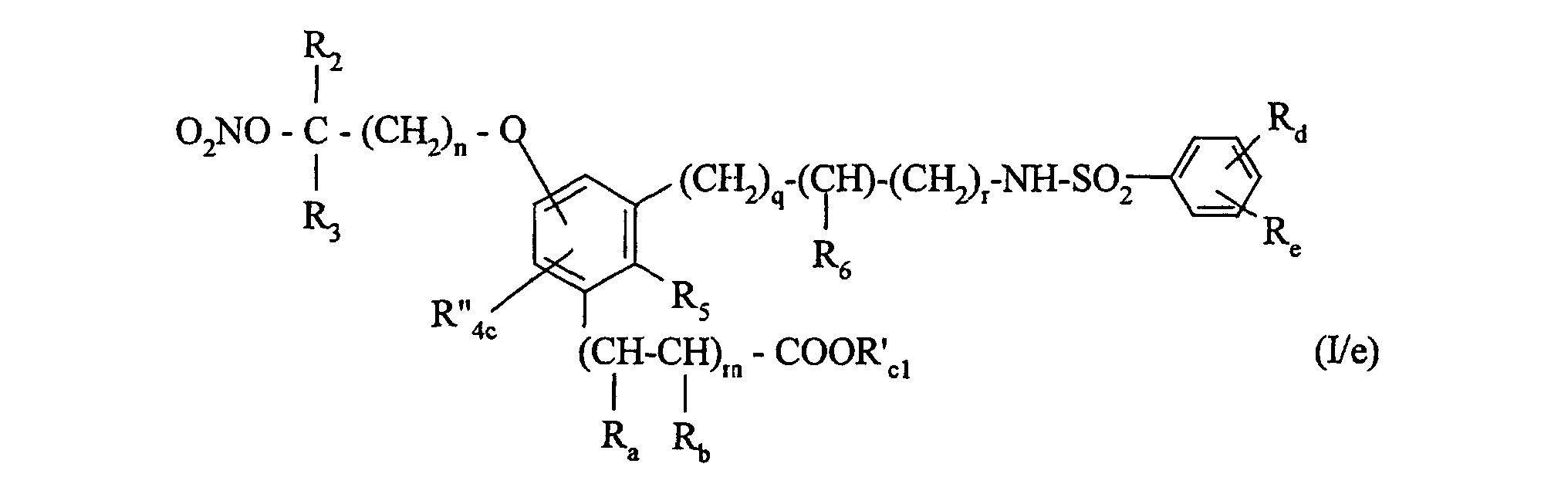
- R2, R3, R5, R6, Ra, Rb, Rd, Re, m, n, q et r ont la même signification que dans la formule (I), et
- R"4c représente un atome d'hydrogène, un groupement alkyle (C1-C6) linéaire ou ramifié,
phényle
éventuellement
substitué ou un groupement
dans lequel R'2, R'3, et

- et n' ont la même que précédemment) et R'C1 représente un groupement alkyle (C1-C6) linéaire ou ramifié éventuellement substitué par un groupement -ONO2,


- qui peut être, le cas échéant, purifié selon une technique classique de purification,
- dont on sépare, le cas échéant, les isomères selon une technique classique de séparation,
- que l'on transforme, si on le souhaite, en ses sels d'addition à un acide ou une base pharmaceutiquement acceptable.
Point de fusion : 104°C
Point de fosion : 138°C
Point de fusion : 134°C
Point de fusion : 145°C
Point de fusion : 110°C
Point de fusion : 132°C
Point de fusion : 175°C (dec)
Point de fusion : 110°C
Pour les substances de l'invention, des IC50 suivantes ont été obtenues :
| Formule de préparation pour 1000 comprimés dosés à 100 mg : | |
| Composé de l'exemple 2 | 10 g |
| Hydroxypropylcellulose | 2 g |
| Amidon de blé | 10 g |
| Lactose | 100 g |
| Stéarate de magnésium | 3 g |
| Talc | 3 g |
Claims (17)
- Composé de formule (I)dans laquelle :

- Ra, Rb,
- identiques ou différents, représentent un atome d'hydrogène ou un groupement alkyle
(C1-C6) linéaire ou ramifié,
ou bien Ra, Rb forment ensemble une liaison, - Rc
- représente un groupement hydroxy, alkoxy (C1-C6) linéaire ou ramifié (substitué éventuellement par un groupement -O-NO2, -O-NO ou -S-NO), un groupement amino (substitué éventuellement par un ou deux groupements, identiques ou différents, alkyle (C1-C6) linéaire ou ramifié, phényle éventuellement substitué),
- R1
- représente un atome d'hydrogène ou un groupement -O-NO2, -O-NO ou -S-NO,
- R2, R3,
- identiques ou différents, représentent un atome d'hydrogène ou un groupement alkyle (C1-C6) linéaire ou ramifié, ou phényle éventuellement substitué,
- X
- représente un atome d'oxygène ou un groupement -NH-CO-,
- m
- représente 0 ou 1,
- n
- représente un nombre entier tel que 0 ≤ n ≤ 6,
- p
- représente 0 ou 1,
- R4
- représente un atome d'hydrogène, un groupement alkyle (C1-C6) linéaire ou ramifié,
(éventuellement substitué par un groupement hydroxy), phényle éventuellement substitué
ou un groupement :
dans lequel :

- R'1
- représente un atome d'hydrogène ou un groupement : -O-NO2, -O-NO ou -S-NO,
- R'2, R'3,
- identiques ou différents, représentent un atome d'hydrogène ou un groupement alkyle (C1-C6) linéaire ou ramifié, ou phényle éventuellement substitué,
- X'
- représente un atome d'oxygène ou un groupement -NH-CO-,
- n'
- représente un nombre entier tel que 0 ≤ n ≤ 6,
- p'
- représente 0 ou 1,
- R5
- représente un atome d'hydrogène ou un groupement alkyle (C1-C6), linéaire ou ramifié,
- R6
- représente un atome d'hydrogène ou un groupement alkyle (C1-C6) linéaire ou ramifié, ou bien R5 et R6 forment ensemble une chaíne -(CH2)t- dans laquelle t représente 1 ou 2,
- q
- représente 0,1 ou 2,
- r
- représente un nombre entier tel que 0≤r≤6,
- Rd, Re,
- identiques ou différents, représentent un atome d'hydrogène, un atome d'halogène, un groupement alkyle (C1-C6) linéaire ou ramifié, un groupement alkoxy (C1-C6) linéaire ou ramifié, un groupement hydroxy ou un groupement trihalogénoalkyle (C1-C6) linéaire ramifié,
et que par phényle éventuellement substitué, on entend éventuellement substitué par un ou plusieurs, identiques ou différents, atomes d'halogène ou groupements alkyle (C1-C6) linéaire ou ramifié, alkoxy (C1-C6) linéaire ou ramifié, hydroxy ou trihalogénoalkyle (C1-C6) linéaire ou ramifié,
et leurs sels d'addition à un acide ou à une base pharmaceutiquement acceptable. - Composé de formule (I) selon la revendication 1 tels que R1 représente -O-NO2, -O-NO ou -S-NO.
- Composé de formule (I) selon la revendication 1 tels que Ra et Rb représentent simultanément un atome d'hydrogène et m est égal à 1.
- Composé de formule (I) selon la revendication 1 tels que R5 et R6 forment ensemble une chaíne -(CH2)t-.
- Composé de formule (I) selon la revendication 1 tels que R4 représente un atome d'hydrogène.
- Composé de formule (I) selon la revendication 1 tels que p est égal à 0.
- Composé de formule (I) selon la revendication 1 tels que Rc représente un groupement hydroxy ou un groupement alkoxy (C1-C6) linéaire ou ramifié.
- Composé de formule (I) selon la revendication 1 tels que Rd représente un atome d'halogène tandis que Re représente un atome d'hydrogène.
- Composé de formule (I) selon la revendication 1 tels que R1 représente un groupement -O-NO2 tandis que p est égal à 0, Ra et Rb représentent chacun un atome d'hydrogène tandis que m est égal à 1, R4 représente un atome d'hydrogène, R5 et R6 forment ensemble une chaíne -(CH2)t avec t égal à 2 tandis que q est égal à 1, et r est égal à 0, Rd représente un atome d'halogène tandis que Re représente un atome d'hydrogène et Rc représente un groupement hydroxy ou un groupement alkoxy (C1-C6) linéaire ou ramifié.
- Composé de formule (I) selon la revendication 1 qui est l'acide 3-{6-[(4-chlorophénylsulfonyl)amino]-2-(2-nitroxyéthyl)-5,6,7,8-tétrahydronapht-1-yl} propionique, ainsi que ses sels d'addition à une base pharmaceutiquement acceptable.
- Composé de formule (I) selon la revendication 1 qui est l'acide 3-{6-[(4-chlorophénylsulfonyl)amino-3-(2-nitroxyéthyl)-5,6,7,8-tétrahydronapht-1-yl}propionique, ainsi que ses sels d'addition à une base pharmaceutiquement acceptable.
- Composé de formule (I) selon la revendication 1 qui est l'acide 3-{6-[(4-chlorophénylsulfonyl)amino]-3-nitroxyméthyl-5,6,7,8-tétrahydronapht-1-yl}propionique, ainsi que ses sels d'addition à une base pharmaceutiquement acceptable.
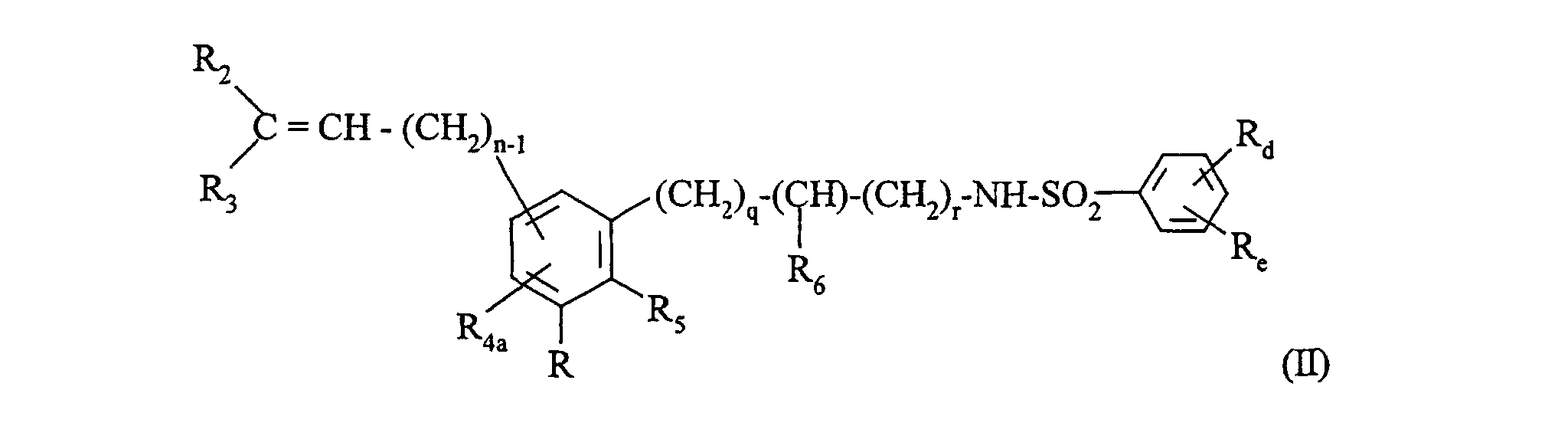
- Procédé de préparation des dérivés de formule (I) selon la revendication 1 tels que p=p'=0, caractérisé en ce que l'on utilise comme produit de départ un composé de formule (II):dans laquelle :
 que l'on soumet à un traitement oxydant approprié de la double liaison en alcool correspondant,Rd, Re, R2, R3, R5, R6, n, q, r ont la même signification que dans la formule (I),R4a représente un atome d'hydrogène, un groupement alkyle (C1-C6) linéaire ou ramifié (éventuellement substitué par un groupement hydroxy), phényle éventuellement substitué ou un groupement(dans lequel R'2, R'3 et n' ont la même signification que dans la formule (I)),
 et R représente -CH2-CH2-CO2R'c ou -CO2R'c (dans lesquels R'c représente un groupement alkyle (C1-C6) linéaire ou ramifié éventuellement substitué par un groupement hydroxy),
pour conduire au composé de formule (III) :dans laquelle :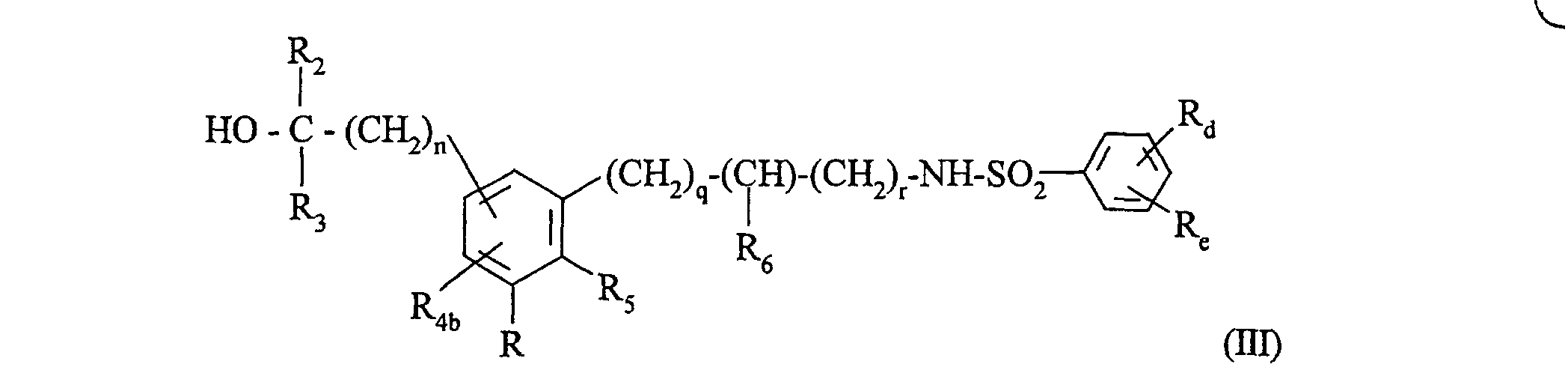 composé de formule (III) qui est éventuellement transformé lorsque R représente un groupement -CO2Alk (Alk étant un groupement alkyle (C1-C6) linéaire ou ramifié) en aldéhyde correspondant puis qui subit une réaction de Wittig, pour conduire à un composé de formule (III) dans laquelle le groupement R est remplacé par le groupement -CH=CH-CO2R'c, R'c étant tel que défini précédemment,R, Rd, Re, R2, R3, R5, R6, n, q et r ont la même définition que précédemment,R4b représente un atome d'hydrogène, un groupement alkyle (C1-C6) linéaire ou ramifié (éventuellement substitué par un groupement hydroxy), phényle éventuellement substitué ou un groupement(dans lequel R'2, R'3 et n' ont la même signification que précédemment),
composé de formule (III):soit dont on transforme le ou les groupements hydroxy en un groupement OTs (dans lequel Ts représente le groupement Tosyle) ou en un atome de brome et qui subit l'action du nitrate de tétrabutylammonium ou du nitrate d'argent,
pour conduire au composé de formule (I/a), cas particulier des composés de formule (I):dans laquelle : R2, R3, R5, R6, Ra, Rb, Rd, Re, m, n, q et r ont la même signification que dans la formule (I), etR4c représente un atome d'hydrogène, un groupement alkyle (C1-C6) linéaire ou ramifié, phényle éventuellement substitué ou un groupement(dans lequel R'2, R'3 et n' ont la même signification que précédemment et,
 R'c1 représente un groupement alkyle (C1-C6) linéaire ou ramifié (éventuellement substitué par un groupement -O-NO2)),soit que l'on fait réagir avec du nitrite de terbutyle, pour conduire au composé de formule (I/b), cas particulier des composés de formule (I) :dans laquelle :
 composé de formules (I/a) ou (I/b), dont on transforme, si on le désire, la fonction ester en fonction acide ou amide correspondante,R2, R3, R5, R6, Ra, Rb, Rd, m, n, q et r ont la même signification que précédemment, etR4d représente un atome d'hydrogène, un groupement alkyle (C1-C6) linéaire ou ramifié, phényle éventuellement substitué ou un groupement(dans lequel R'2, R'3 et n' ont la même signification que précédemment et,
 R'c2 représente un groupement alkyle (C1-C6) linéaire ou ramifié (éventuellement substitué par un groupement -O-NO)),qui peut être, le cas échéant, purifié selon une technique classique de purification,dont on sépare, le cas échéant, les isomères selon une technique classique de séparation,que l'on transforme, si on le souhaite, en ses sels d'addition à un acide ou une base pharmaceutiquement acceptable.
 - Procédé de préparation des composés de formule (I) selon la revendication 1 tels que p ou p' est égal à 1 et X et X' représentent -NH-CO-, caractérisé en ce que l'on utilise comme produit de départ un composé de formule (IV):dans laquelle :
 que l'on fait réagir avec une amine de formule (V):R, Rd, Re, R5, R6, q, r ont la même signification que dans la formule (I),R'4a représente un atome d'hydrogène ou un groupement alkyle (C1-C6) linéaire ou ramifié (éventuellement substitué par un groupement hydroxy), phényle éventuellement substitué ou un groupement vinyle,
dont on transforme le ou les groupements vinyliques en groupements formyles par coupure oxydative puis en groupements carboxy correspondants,dans laquelle : pour conduire au composé de formule (VI) :R2, R3 et n ont la même signification que dans la formule (I)et Y représente un atome de soufre ou d'oxygène,dans laquelle :
 composé de formule (VI) :R, Rd, Re, R5, R2, R3, R6, Y, n, q et r ont la même signification que précédemment,R'4b représente un atome d'hydrogène ou un groupement alkyle (C1-C6) linéaire ou ramifié (éventuellement substitué par un groupement hydroxy), phényle éventuellement substitué ou un groupementcomposé de formule (VI) qui est éventuellement transformé lorsque R représente un groupement -CO2Alk (Alk étant un groupement alkyle (C1-C6) linéaire ou ramifié) en aldéhyde correspondant puis qui subit une réaction de Wittig, pour conduire à un composé de formule (VI) dans laquelle le groupement R est remplacé par le groupement -CH=CH-CO2R'c, R'c représentant un groupement alkyle (C1-C6) linéaire ou ramifié éventuellement substitué par un groupement hydroxy,
 composé de formule (I/c) ou (I/d), dont on transforme, si on le désire, la fonction ester en fonction acide ou amide correspondante,soit dont on transforme le ou les groupements hydroxy en un groupement OTs (dans lequel Ts représente le groupement Tosyle) ou en un atome de brome et qui subit l'action du nitrate de tétrabutylammonium ou du nitrate d'argent,
pour conduire au composé de formule (I/c), cas particulier des composés de formule (I) :dans laquelle :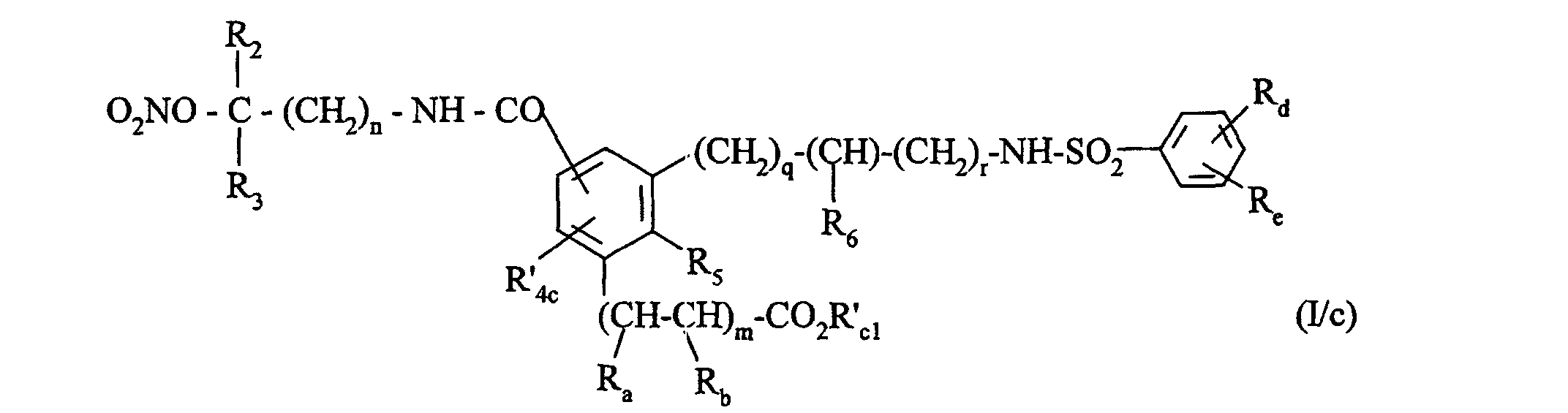 R2, R3, R5, R6, Ra, Rb, Rd, Re, m, n, q et r ont la même signification que dans la formule (I), etR'4c représente un atome d'hydrogène, un groupement alkyle (C1-C6) linéaire ou ramifié (éventuellement substitué par un groupement -ONO2), phényle éventuellement substitué ou un groupement(dans lequel R2, R3 et n ont la même signification que précédemment et
 R'c1 représente un groupement alkyle (C1-C6) linéaire ou ramifié (éventuellement substitué par un groupement -O-NO2)),soit que l'on fait réagir avec du nitrite de terbutyle, pour conduire au composé de formule (I/d), cas particulier des composés de formule (I):dans laquelle :
 Y, R2, R3, R5, R6, Ra, Rb, Rd, Re, m, n, q et r ont la même signification que précédemment, etR'4d représente un atome d'hydrogène, un groupement alkyle (C1-C6) linéaire ou ramifié (éventuellement substitué par un groupement -O-NO), phényle éventuellement substitué ou un groupement(dans lequel Y, R2, R3 et n ont la même signification que précédemment et
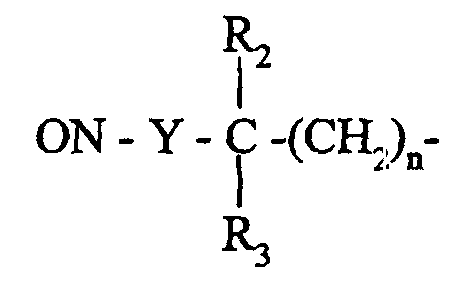 R'c2 représente un groupement alkyle (C1-C6) linéaire ou ramifié (éventuellement substitué par un groupement -O-NO)),qui peut être, le cas échéant, purifié selon une technique classique de purification,dont on sépare, le cas échéant, les isomères selon une technique classique de séparation,que l'on transforme, si on le souhaite, en ses sels d'addition à un acide ou une base pharmaceutiquement acceptable.
 - Procédé de préparation des composés de formule (I) tels que X représente un atome d'oxygène, caractérisé en ce que l'on utilise comme produit de départ un composé de formule (VII):dans laquelle:
 composé de formule (VII):R2, R3, R5, R6, Rd, Re, r, q et n sont tels définis dans la formule (I), R représente un groupementou COOR'c (dans lesquels R'c représente un groupement alkyle (C1-C6)linéaire ou ramifié éventuellement substitué par un groupement hydroxy et Ra et Rb sont tels que définis dans la formule (1)),
 et R'4b représente un atome d'hydrogène, un groupement alkyle (C1-C6) linéaire ou ramifié, phényle éventuellement substitué ou un groupementdans lequel n', R'2 et R'3 sont tels que définis dans la formule (I)),
 soit dont on transforme le ou les groupements hydroxy en un groupement OTs (dans lequel Ts représente un groupement Tosyle) ou en un atome de brome, et qui subit l'action du nitrate de tétrabutylammonium ou du nitrate d'argent,
pour conduire à un composé de formule (I/e), cas particulier des composés de formule (I)dans laquelle : R2, R3, R5, R6, Ra, Rb, Rd, Re, m, n, q et r ont la même signification que dans la formule (I), etR"4c représente un atome d'hydrogène, un groupement alkyle (C1-C6) linéaire ou ramifié, phényle éventuellement substitué ou un groupementdans lequel R'2, R'3 et n' ont la même signification que précédemment) et R'C1 représente un groupement alkyle (C1-C6) linéaire on ramifié éventuellement substitué par un groupement -ONO2,
 soit que l'on fait réagir avec du nitrite de tertbutyle pour conduire au composé de formule (I/f), cas particulier des composés de formule (I):dans laquelle :
 composé de formules (I/e) ou (I/f), dont on transforme, si on le désire, la fonction ester en fonction acide ou amide correspondante,R2, R3, R5, R6, Ra, Rb, Rd, Re, n, m, q et r ont la même signification que dans la formule (I),R"4d représente un atome d'hydrogène, un groupement alkyle (C1-C6) linéaire ou ramifié, phényle éventuellement substitué ou un groupementdans lequel R'2, R'3 et n' ont la même signification que précédemment et R'C2 représente un groupement alkyle (C1-C6) linéaire ou ramifié éventuellement substitué par un groupement -O-NO,
 qui peut être, le cas échéant, purifié selon une technique classique de purification,dont on sépare, le cas échéant, les isomères selon une technique classique de séparation,que l'on transforme, si on le souhaite, en ses sels d'addition à un acide ou une base pharmaceutiquement acceptable.
 - Compositions pharmaceutiques contenant comme principe actif au moins un composé selon l'une quelconque des revendications 1 à 12, seul ou en combinaison avec un ou plusieurs excipients ou véhicules inertes, non toxiques, pharmaceutiquement acceptables.
- Compositions pharmaceutiques selon la revendication 16 contenant au moins un principe actif selon l'une quelconque des revendications 1 à 12 utiles comme antagonistes des récepteurs TXA2 et comme donneurs de NO.
Applications Claiming Priority (2)
| Application Number | Priority Date | Filing Date | Title |
|---|---|---|---|
| FR9702445 | 1997-02-28 | ||
| FR9702445A FR2760235B1 (fr) | 1997-02-28 | 1997-02-28 | Nouveaux derives de benzenesulfonylamine, leur procede de preparation et les compositions pharmaceutiques qui les contiennent |
Publications (2)
| Publication Number | Publication Date |
|---|---|
| EP0864561A1 EP0864561A1 (fr) | 1998-09-16 |
| EP0864561B1 true EP0864561B1 (fr) | 2001-09-05 |
Family
ID=9504314
Family Applications (1)
| Application Number | Title | Priority Date | Filing Date |
|---|---|---|---|
| EP98400468A Expired - Lifetime EP0864561B1 (fr) | 1997-02-28 | 1998-02-27 | Nouveaux dérivés de benzènesulfonylamine, leur procédé de préparation et les compositions pharmaceutiques qui les contiennent |
Country Status (19)
| Country | Link |
|---|---|
| US (1) | US6013667A (fr) |
| EP (1) | EP0864561B1 (fr) |
| JP (1) | JP3917287B2 (fr) |
| CN (1) | CN1160323C (fr) |
| AT (1) | ATE205189T1 (fr) |
| AU (1) | AU736532B2 (fr) |
| BR (1) | BR9800773A (fr) |
| CA (1) | CA2231026C (fr) |
| DE (1) | DE69801535T2 (fr) |
| DK (1) | DK0864561T3 (fr) |
| ES (1) | ES2163844T3 (fr) |
| FR (1) | FR2760235B1 (fr) |
| GR (1) | GR3037048T3 (fr) |
| HU (1) | HU224960B1 (fr) |
| NO (1) | NO310068B1 (fr) |
| NZ (1) | NZ329868A (fr) |
| PL (1) | PL193930B1 (fr) |
| PT (1) | PT864561E (fr) |
| ZA (1) | ZA981681B (fr) |
Families Citing this family (3)
| Publication number | Priority date | Publication date | Assignee | Title |
|---|---|---|---|---|
| FR2803848B1 (fr) * | 2000-01-19 | 2002-02-15 | Adir | Nouveaux derives de benzenesulfonamide, leur procede de preparation et les compositions pharmaceutiques qui les contiennent |
| FR2827280B1 (fr) * | 2001-07-13 | 2003-10-31 | Servier Lab | Nouveaux derives de benzene sulfonamide, leur procede de preparation et les compositions pharmaceutiques qui les contiennent |
| US8152693B2 (en) | 2006-05-08 | 2012-04-10 | Nokia Corporation | Exercise data device, server, system and method |
Family Cites Families (4)
| Publication number | Priority date | Publication date | Assignee | Title |
|---|---|---|---|---|
| DE3000377A1 (de) * | 1980-01-07 | 1981-07-09 | Boehringer Mannheim Gmbh, 6800 Mannheim | Neue sulfonamide, verfahren zu deren herstellung sowie diese verbindungen enthaltende arzneimittel |
| WO1992015558A1 (fr) * | 1991-03-01 | 1992-09-17 | Zeria Pharmaceutical Co., Ltd. | Derive d'indane et antagoniste de thromboxane le contenant |
| JPH08503484A (ja) * | 1992-11-27 | 1996-04-16 | ビイク ネダーラント ベスローテン フェンノートシャップ | 調剤学的特性を有するニトロキシ化合物 |
| FR2711139B1 (fr) * | 1993-10-15 | 1995-12-01 | Adir | Nouveaux dérivés de 1,2,3,4-tétrahydronaphtalène, leur procédé de préparation et les compositions pharmaceutiques qui les contiennent. |
-
1997
- 1997-02-28 FR FR9702445A patent/FR2760235B1/fr not_active Expired - Fee Related
-
1998
- 1998-02-26 CA CA002231026A patent/CA2231026C/fr not_active Expired - Fee Related
- 1998-02-26 JP JP04479498A patent/JP3917287B2/ja not_active Expired - Fee Related
- 1998-02-26 BR BR9800773-4A patent/BR9800773A/pt active Search and Examination
- 1998-02-27 AT AT98400468T patent/ATE205189T1/de active
- 1998-02-27 EP EP98400468A patent/EP0864561B1/fr not_active Expired - Lifetime
- 1998-02-27 US US09/032,587 patent/US6013667A/en not_active Expired - Lifetime
- 1998-02-27 DK DK98400468T patent/DK0864561T3/da active
- 1998-02-27 CN CNB981080707A patent/CN1160323C/zh not_active Expired - Fee Related
- 1998-02-27 ES ES98400468T patent/ES2163844T3/es not_active Expired - Lifetime
- 1998-02-27 HU HU9800430A patent/HU224960B1/hu not_active IP Right Cessation
- 1998-02-27 DE DE69801535T patent/DE69801535T2/de not_active Expired - Lifetime
- 1998-02-27 ZA ZA981681A patent/ZA981681B/xx unknown
- 1998-02-27 AU AU56360/98A patent/AU736532B2/en not_active Ceased
- 1998-02-27 PL PL325082A patent/PL193930B1/pl not_active IP Right Cessation
- 1998-02-27 PT PT98400468T patent/PT864561E/pt unknown
- 1998-02-27 NO NO980842A patent/NO310068B1/no not_active IP Right Cessation
- 1998-02-27 NZ NZ329868A patent/NZ329868A/xx not_active IP Right Cessation
-
2001
- 2001-10-30 GR GR20010401920T patent/GR3037048T3/el unknown
Also Published As
| Publication number | Publication date |
|---|---|
| ES2163844T3 (es) | 2002-02-01 |
| JPH10251217A (ja) | 1998-09-22 |
| HUP9800430A2 (hu) | 1999-06-28 |
| NO980842D0 (no) | 1998-02-27 |
| DE69801535D1 (de) | 2001-10-11 |
| ATE205189T1 (de) | 2001-09-15 |
| PL325082A1 (en) | 1998-08-31 |
| HUP9800430A3 (en) | 2000-09-28 |
| PL193930B1 (pl) | 2007-04-30 |
| ZA981681B (en) | 1998-09-04 |
| AU5636098A (en) | 1998-09-03 |
| NZ329868A (en) | 1999-01-28 |
| BR9800773A (pt) | 1999-12-07 |
| DE69801535T2 (de) | 2002-05-08 |
| HU9800430D0 (en) | 1998-04-28 |
| NO980842L (no) | 1998-08-31 |
| PT864561E (pt) | 2001-12-28 |
| DK0864561T3 (da) | 2001-11-19 |
| NO310068B1 (no) | 2001-05-14 |
| CA2231026A1 (fr) | 1998-08-28 |
| US6013667A (en) | 2000-01-11 |
| FR2760235A1 (fr) | 1998-09-04 |
| EP0864561A1 (fr) | 1998-09-16 |
| FR2760235B1 (fr) | 1999-04-09 |
| HK1014932A1 (en) | 1999-10-08 |
| CA2231026C (fr) | 2004-02-10 |
| CN1195662A (zh) | 1998-10-14 |
| CN1160323C (zh) | 2004-08-04 |
| GR3037048T3 (en) | 2002-01-31 |
| JP3917287B2 (ja) | 2007-05-23 |
| AU736532B2 (en) | 2001-08-02 |
| HU224960B1 (en) | 2006-04-28 |
Similar Documents
| Publication | Publication Date | Title |
|---|---|---|
| CA1207324A (fr) | Derives d'arene et d'heteroarenecarboxamides et leur utilisation comme medicaments | |
| LU82087A1 (fr) | N-benzylimidazoles inhibiteurs selectifs de thromboxannesynthetase,leur procede de production et compositions pharmaceutiques les contenant | |
| FR2665440A1 (fr) | Nouveaux cycloalkylsulfonamides substitues, procedes de preparation et medicaments les contenant. | |
| EP0648741B1 (fr) | Dérivés de 1,2,3,4-tétrahydronaphtalène, de chromanne et de thiochromanne comme agents antithromotiques | |
| CA2085570C (fr) | Nouveaux derives de pyrrolidine , leur procede de preparation et les compositions pharmaceutiques qui les contiennent | |
| CA2089349C (fr) | Nouveaux derives de pyrrolidine, leur procede de preparation et les compositions pharmaceutiques qui les contiennent | |
| EP1118610B1 (fr) | Nouveaux dérivés de benzènesulfonamide, leur procédé de préparation et les compositions pharmaceutiques qui les contiennent | |
| FR2521992A1 (fr) | Nouveaux composes de pyridine utiles comme medicaments | |
| EP0864561A1 (fr) | Nouveaux dérivés de benzènsesulfonylamine, leur procédé de préparation et les compositions pharmaceutiques qui les contiennent | |
| CA2394037C (fr) | Nouveaux derives de benzene sulfonamide, leur procede de preparation et les compositions pharmaceutiques qui les contiennent | |
| FR2528846A1 (fr) | Nouveau derive de la pyrazolo (1,5-a) pyridine, sa preparation et les compositions pharmaceutiques qui le contiennent | |
| WO1998025913A1 (fr) | Nouveaux derives [3h]-benzoxazole-2-thiones et [3h]-benzothiazole-2-thiones substitues, leur procede de preparation et les compositions pharmaceutiques qui les contiennent | |
| EP0412898A1 (fr) | Nouveaux dérivés d'oxazolo pyridines, leur procédé de préparation et les compositions pharmaceutiques qui les contiennent | |
| FR2673629A1 (fr) | Nouveaux derives du benzopyrane leur procede de preparation et les compositions pharmaceutiques qui les contiennent. | |
| EP0570263B1 (fr) | Nouveaux derivés d'acides alcenecarboxyliques, leur procédé de préparation et les compositions pharmaceutiques qui les contiennent | |
| EP0027412A1 (fr) | Dérivés de la pyridine, procédé pour leur préparation et médicaments les contenant | |
| FR2645149A1 (fr) | ||
| FR2722193A1 (fr) | Derives n-oxydes de 1-(7-chloro-4-quinoleinyl)pyrazole-3-carboxamides substitues, procede pour leur preparation et les compositions pharmaceitiques les contenant | |
| FR2543954A1 (fr) | Acylamino-4 aza-1 adamantanes, procede pour leur preparation et application en therapeutique | |
| BE878185A (fr) | Derives de 1-phtalazone, leur procede de preparation et leur utilisation | |
| JPS626714B2 (fr) | ||
| JPH0515706B2 (fr) | ||
| BE897816A (fr) | Picolyl-amides substitues de l'acide 4-hydroxy-isophtalique, procede de preparation et utilisation pharmaceutique | |
| CA2022594A1 (fr) | Derives d'oxazolo pyridines, leur procede de preparation et les compositions pharmaceutiques qui les contiennent | |
| BE884978A (fr) | Nouveaux esters de l'acide benzoique substitue |
Legal Events
| Date | Code | Title | Description |
|---|---|---|---|
| PUAI | Public reference made under article 153(3) epc to a published international application that has entered the european phase |
Free format text: ORIGINAL CODE: 0009012 |
|
| 17P | Request for examination filed |
Effective date: 19980312 |
|
| AK | Designated contracting states |
Kind code of ref document: A1 Designated state(s): AT BE CH DE DK ES FI FR GB GR IE IT LI LU NL PT SE |
|
| AX | Request for extension of the european patent |
Free format text: AL;LT;LV;MK;RO;SI |
|
| AKX | Designation fees paid |
Free format text: AT BE CH DE DK ES FI FR GB GR IE IT LI LU NL PT SE |
|
| RBV | Designated contracting states (corrected) |
Designated state(s): AT BE CH DE DK ES FI FR GB GR IE IT LI LU NL PT SE |
|
| 17Q | First examination report despatched |
Effective date: 20000322 |
|
| GRAG | Despatch of communication of intention to grant |
Free format text: ORIGINAL CODE: EPIDOS AGRA |
|
| GRAG | Despatch of communication of intention to grant |
Free format text: ORIGINAL CODE: EPIDOS AGRA |
|
| GRAH | Despatch of communication of intention to grant a patent |
Free format text: ORIGINAL CODE: EPIDOS IGRA |
|
| GRAH | Despatch of communication of intention to grant a patent |
Free format text: ORIGINAL CODE: EPIDOS IGRA |
|
| GRAA | (expected) grant |
Free format text: ORIGINAL CODE: 0009210 |
|
| AK | Designated contracting states |
Kind code of ref document: B1 Designated state(s): AT BE CH DE DK ES FI FR GB GR IE IT LI LU NL PT SE |
|
| REF | Corresponds to: |
Ref document number: 205189 Country of ref document: AT Date of ref document: 20010915 Kind code of ref document: T |
|
| REG | Reference to a national code |
Ref country code: CH Ref legal event code: NV Representative=s name: A. BRAUN, BRAUN, HERITIER, ESCHMANN AG PATENTANWAE Ref country code: CH Ref legal event code: EP |
|
| REF | Corresponds to: |
Ref document number: 69801535 Country of ref document: DE Date of ref document: 20011011 |
|
| REG | Reference to a national code |
Ref country code: IE Ref legal event code: FG4D Free format text: FRENCH |
|
| REG | Reference to a national code |
Ref country code: CH Ref legal event code: PFA Free format text: ADIR ET COMPAGNIE TRANSFER- LES LABORATOIRES SERVIER |
|
| REG | Reference to a national code |
Ref country code: DK Ref legal event code: T3 |
|
| REG | Reference to a national code |
Ref country code: FR Ref legal event code: TP |
|
| REG | Reference to a national code |
Ref country code: GB Ref legal event code: 732E |
|
| REG | Reference to a national code |
Ref country code: PT Ref legal event code: SC4A Free format text: AVAILABILITY OF NATIONAL TRANSLATION Effective date: 20010906 |
|
| BECA | Be: change of holder's address |
Free format text: 20010905 LES LABORATOIRES *SERVIER:1 RUE CARLE HEBERT, 92415 COURBEVOIE CEDEX |
|
| BECH | Be: change of holder |
Free format text: 20010905 LES LABORATOIRES *SERVIER |
|
| REG | Reference to a national code |
Ref country code: GB Ref legal event code: IF02 |
|
| GBT | Gb: translation of ep patent filed (gb section 77(6)(a)/1977) |
Effective date: 20011201 |
|
| NLS | Nl: assignments of ep-patents |
Owner name: LES LABORATOIRES SERVIER |
|
| REG | Reference to a national code |
Ref country code: GR Ref legal event code: EP Ref document number: 20010401920 Country of ref document: GR |
|
| REG | Reference to a national code |
Ref country code: ES Ref legal event code: FG2A Ref document number: 2163844 Country of ref document: ES Kind code of ref document: T3 |
|
| REG | Reference to a national code |
Ref country code: PT Ref legal event code: PC4A Free format text: LES LABORATOIRES SERVIER FR Effective date: 20011105 |
|
| PLBE | No opposition filed within time limit |
Free format text: ORIGINAL CODE: 0009261 |
|
| STAA | Information on the status of an ep patent application or granted ep patent |
Free format text: STATUS: NO OPPOSITION FILED WITHIN TIME LIMIT |
|
| 26N | No opposition filed | ||
| REG | Reference to a national code |
Ref country code: CH Ref legal event code: PFA Owner name: LES LABORATOIRES SERVIER Free format text: LES LABORATOIRES SERVIER#22, RUE GARNIER#92200 NEUILLY-SUR-SEINE (FR) -TRANSFER TO- LES LABORATOIRES SERVIER#22, RUE GARNIER#92200 NEUILLY-SUR-SEINE (FR) |
|
| PGFP | Annual fee paid to national office [announced via postgrant information from national office to epo] |
Ref country code: LU Payment date: 20101223 Year of fee payment: 14 |
|
| PGFP | Annual fee paid to national office [announced via postgrant information from national office to epo] |
Ref country code: IE Payment date: 20110223 Year of fee payment: 14 Ref country code: DK Payment date: 20110223 Year of fee payment: 14 |
|
| PGFP | Annual fee paid to national office [announced via postgrant information from national office to epo] |
Ref country code: FR Payment date: 20110311 Year of fee payment: 14 Ref country code: IT Payment date: 20110223 Year of fee payment: 14 Ref country code: FI Payment date: 20110214 Year of fee payment: 14 Ref country code: NL Payment date: 20110301 Year of fee payment: 14 Ref country code: SE Payment date: 20110223 Year of fee payment: 14 Ref country code: DE Payment date: 20110225 Year of fee payment: 14 Ref country code: AT Payment date: 20110111 Year of fee payment: 14 Ref country code: CH Payment date: 20110225 Year of fee payment: 14 |
|
| PGFP | Annual fee paid to national office [announced via postgrant information from national office to epo] |
Ref country code: GR Payment date: 20110107 Year of fee payment: 14 Ref country code: BE Payment date: 20110117 Year of fee payment: 14 |
|
| PGFP | Annual fee paid to national office [announced via postgrant information from national office to epo] |
Ref country code: ES Payment date: 20110328 Year of fee payment: 14 Ref country code: GB Payment date: 20110223 Year of fee payment: 14 |
|
| PGFP | Annual fee paid to national office [announced via postgrant information from national office to epo] |
Ref country code: PT Payment date: 20111130 Year of fee payment: 15 |
|
| BERE | Be: lapsed |
Owner name: LES LABORATOIRES *SERVIER Effective date: 20120228 |
|
| REG | Reference to a national code |
Ref country code: NL Ref legal event code: V1 Effective date: 20120901 |
|
| REG | Reference to a national code |
Ref country code: CH Ref legal event code: PL |
|
| GBPC | Gb: european patent ceased through non-payment of renewal fee |
Effective date: 20120227 |
|
| REG | Reference to a national code |
Ref country code: GR Ref legal event code: ML Ref document number: 20010401920 Country of ref document: GR Effective date: 20120905 |
|
| PG25 | Lapsed in a contracting state [announced via postgrant information from national office to epo] |
Ref country code: LI Free format text: LAPSE BECAUSE OF NON-PAYMENT OF DUE FEES Effective date: 20120229 Ref country code: SE Free format text: LAPSE BECAUSE OF NON-PAYMENT OF DUE FEES Effective date: 20120228 Ref country code: CH Free format text: LAPSE BECAUSE OF NON-PAYMENT OF DUE FEES Effective date: 20120229 Ref country code: FI Free format text: LAPSE BECAUSE OF NON-PAYMENT OF DUE FEES Effective date: 20120227 |
|
| REG | Reference to a national code |
Ref country code: DK Ref legal event code: EBP |
|
| REG | Reference to a national code |
Ref country code: IE Ref legal event code: MM4A |
|
| REG | Reference to a national code |
Ref country code: FR Ref legal event code: ST Effective date: 20121031 |
|
| PG25 | Lapsed in a contracting state [announced via postgrant information from national office to epo] |
Ref country code: GR Free format text: LAPSE BECAUSE OF NON-PAYMENT OF DUE FEES Effective date: 20120905 Ref country code: IT Free format text: LAPSE BECAUSE OF NON-PAYMENT OF DUE FEES Effective date: 20120227 |
|
| REG | Reference to a national code |
Ref country code: DE Ref legal event code: R119 Ref document number: 69801535 Country of ref document: DE Effective date: 20120901 |
|
| REG | Reference to a national code |
Ref country code: AT Ref legal event code: MM01 Ref document number: 205189 Country of ref document: AT Kind code of ref document: T Effective date: 20120227 |
|
| PG25 | Lapsed in a contracting state [announced via postgrant information from national office to epo] |
Ref country code: BE Free format text: LAPSE BECAUSE OF NON-PAYMENT OF DUE FEES Effective date: 20120228 |
|
| PG25 | Lapsed in a contracting state [announced via postgrant information from national office to epo] |
Ref country code: GB Free format text: LAPSE BECAUSE OF NON-PAYMENT OF DUE FEES Effective date: 20120227 Ref country code: NL Free format text: LAPSE BECAUSE OF NON-PAYMENT OF DUE FEES Effective date: 20120901 Ref country code: FR Free format text: LAPSE BECAUSE OF NON-PAYMENT OF DUE FEES Effective date: 20120229 Ref country code: AT Free format text: LAPSE BECAUSE OF NON-PAYMENT OF DUE FEES Effective date: 20120227 Ref country code: IE Free format text: LAPSE BECAUSE OF NON-PAYMENT OF DUE FEES Effective date: 20120227 |
|
| PG25 | Lapsed in a contracting state [announced via postgrant information from national office to epo] |
Ref country code: DE Free format text: LAPSE BECAUSE OF NON-PAYMENT OF DUE FEES Effective date: 20120901 |
|
| REG | Reference to a national code |
Ref country code: ES Ref legal event code: FD2A Effective date: 20130709 |
|
| PG25 | Lapsed in a contracting state [announced via postgrant information from national office to epo] |
Ref country code: ES Free format text: LAPSE BECAUSE OF NON-PAYMENT OF DUE FEES Effective date: 20120228 |
|
| REG | Reference to a national code |
Ref country code: PT Ref legal event code: MM4A Free format text: LAPSE DUE TO NON-PAYMENT OF FEES Effective date: 20130827 |
|
| PG25 | Lapsed in a contracting state [announced via postgrant information from national office to epo] |
Ref country code: PT Free format text: LAPSE BECAUSE OF NON-PAYMENT OF DUE FEES Effective date: 20130827 Ref country code: DK Free format text: LAPSE BECAUSE OF NON-PAYMENT OF DUE FEES Effective date: 20120229 |
|
| PG25 | Lapsed in a contracting state [announced via postgrant information from national office to epo] |
Ref country code: LU Free format text: LAPSE BECAUSE OF NON-PAYMENT OF DUE FEES Effective date: 20120227 |