EP0865152B1 - Unité de commande pour machine frigorifique - Google Patents
Unité de commande pour machine frigorifique Download PDFInfo
- Publication number
- EP0865152B1 EP0865152B1 EP97309222A EP97309222A EP0865152B1 EP 0865152 B1 EP0865152 B1 EP 0865152B1 EP 97309222 A EP97309222 A EP 97309222A EP 97309222 A EP97309222 A EP 97309222A EP 0865152 B1 EP0865152 B1 EP 0865152B1
- Authority
- EP
- European Patent Office
- Prior art keywords
- compressor
- motor
- temperature
- current
- inverter
- Prior art date
- Legal status (The legal status is an assumption and is not a legal conclusion. Google has not performed a legal analysis and makes no representation as to the accuracy of the status listed.)
- Expired - Lifetime
Links
Images







Classifications
-
- H—ELECTRICITY
- H02—GENERATION; CONVERSION OR DISTRIBUTION OF ELECTRIC POWER
- H02H—EMERGENCY PROTECTIVE CIRCUIT ARRANGEMENTS
- H02H7/00—Emergency protective circuit arrangements specially adapted for specific types of electric machines or apparatus or for sectionalised protection of cable or line systems, and effecting automatic switching in the event of an undesired change from normal working conditions
- H02H7/08—Emergency protective circuit arrangements specially adapted for specific types of electric machines or apparatus or for sectionalised protection of cable or line systems, and effecting automatic switching in the event of an undesired change from normal working conditions for dynamo-electric motors
-
- H—ELECTRICITY
- H02—GENERATION; CONVERSION OR DISTRIBUTION OF ELECTRIC POWER
- H02P—CONTROL OR REGULATION OF ELECTRIC MOTORS, ELECTRIC GENERATORS OR DYNAMO-ELECTRIC CONVERTERS; CONTROLLING TRANSFORMERS, REACTORS OR CHOKE COILS
- H02P1/00—Arrangements for starting electric motors or dynamo-electric converters
- H02P1/16—Arrangements for starting electric motors or dynamo-electric converters for starting dynamo-electric motors or dynamo-electric converters
- H02P1/26—Arrangements for starting electric motors or dynamo-electric converters for starting dynamo-electric motors or dynamo-electric converters for starting an individual polyphase induction motor
- H02P1/28—Arrangements for starting electric motors or dynamo-electric converters for starting dynamo-electric motors or dynamo-electric converters for starting an individual polyphase induction motor by progressive increase of voltage applied to primary circuit of motor
-
- F—MECHANICAL ENGINEERING; LIGHTING; HEATING; WEAPONS; BLASTING
- F25—REFRIGERATION OR COOLING; COMBINED HEATING AND REFRIGERATION SYSTEMS; HEAT PUMP SYSTEMS; MANUFACTURE OR STORAGE OF ICE; LIQUEFACTION SOLIDIFICATION OF GASES
- F25B—REFRIGERATION MACHINES, PLANTS OR SYSTEMS; COMBINED HEATING AND REFRIGERATION SYSTEMS; HEAT PUMP SYSTEMS
- F25B2600/00—Control issues
- F25B2600/02—Compressor control
- F25B2600/021—Inverters therefor
-
- F—MECHANICAL ENGINEERING; LIGHTING; HEATING; WEAPONS; BLASTING
- F25—REFRIGERATION OR COOLING; COMBINED HEATING AND REFRIGERATION SYSTEMS; HEAT PUMP SYSTEMS; MANUFACTURE OR STORAGE OF ICE; LIQUEFACTION SOLIDIFICATION OF GASES
- F25B—REFRIGERATION MACHINES, PLANTS OR SYSTEMS; COMBINED HEATING AND REFRIGERATION SYSTEMS; HEAT PUMP SYSTEMS
- F25B49/00—Arrangement or mounting of control or safety devices
- F25B49/02—Arrangement or mounting of control or safety devices for compression type machines, plants or systems
- F25B49/025—Motor control arrangements
-
- Y—GENERAL TAGGING OF NEW TECHNOLOGICAL DEVELOPMENTS; GENERAL TAGGING OF CROSS-SECTIONAL TECHNOLOGIES SPANNING OVER SEVERAL SECTIONS OF THE IPC; TECHNICAL SUBJECTS COVERED BY FORMER USPC CROSS-REFERENCE ART COLLECTIONS [XRACs] AND DIGESTS
- Y02—TECHNOLOGIES OR APPLICATIONS FOR MITIGATION OR ADAPTATION AGAINST CLIMATE CHANGE
- Y02B—CLIMATE CHANGE MITIGATION TECHNOLOGIES RELATED TO BUILDINGS, e.g. HOUSING, HOUSE APPLIANCES OR RELATED END-USER APPLICATIONS
- Y02B30/00—Energy efficient heating, ventilation or air conditioning [HVAC]
- Y02B30/70—Efficient control or regulation technologies, e.g. for control of refrigerant flow, motor or heating
Definitions
- the invention relates to a control unit of a compressor controlling the start-up operation for refrigerating machines such as air-conditioners and refrigerators.
- Fig. 18 has taken into consideration such situations, aiming to provide a start-up control unit of refrigerating cycle machines that has a heat-up function for some period of time before re-starting the machine when the failing occurs.
- compressor 81 compressor 81; pre-heating unit 82; exterior unit 83; central control unit 84; main inverter circuit 85; converter 86; inverter 87; excess current sensor 88 that detects excess current of the compressor 81; excess current detection circuit 90; and interior unit 91.
- the refrigerant is carbureted to be used by the compressor 81 during the refrigerating cycle.
- the carbureted refrigerant is liquified, then become mixed with the lubricant.
- the liquified refrigerant inside the compressor is termed "resting refrigerant”.
- An amount of liquified resting refrigerant is called “amount of resting refrigerant”.
- the refrigerant that is carbureted due to rise in compressor temperature is used in the refrigerating cycle.
- the reason for pre-heating the compressor is to carburete the resting refrigerant.
- the central processing unit 84 re-activates the compressor 81.
- a temperature sensor 92 can be attached to the pre-heating unit 82, and the temperature reading can be transmitted to the central processing unit 84 for control.
- heater was attached to a sealed container of the compressor as shown in Figure 18; then the compressor was heated to prevent a melting of the refrigerant into the lubricant.
- Such configuration needs a power supply for the heater.
- the disadvantages were wasting of power, and an addition of extra parts as heater and cables for the heater.
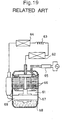
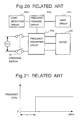
- Figs. 19 and 20 show a configuration of conventional air-conditioner and a block chart of the control unit.
- the parts are: compressor 61 containing motor 66 and compressor unit 69 which are designed to be contained inside a sealed container 67.
- Other parts are: condenser 62; decompressor 63; and evaporator 64.
- the compressor 61 is connected with the other parts to form a loop to comprise a well-known refrigerating cycle. When the compressor is not rotating, the lubricant 68 resides at an inner bottom of the compressor 61, and most part of the refrigerant are melted to the lubricant.
- Control unit 65 controls the operation of the compressor 61 and is equipped with the followings: frequency conversion circuit 65a; frequency command circuit 65b; timer circuit 65c which controls the frequency command circuit 65b; and load detection circuit 65d which detects loads on the air-conditioner. 70 is operating switch.
- the timer circuit 65c is activated after a fixed time t has lapsed, and the frequency command circuit 65b will be controlled by the load detection circuit 65d.
- Fig. 21 shows, when the output from the frequency command circuit 65b changes, the frequency output from the frequency conversion circuit 65a will change from 0 c/s to a certain frequency (e.g. frequency in which the motor 66 starts), then the motor 66 will starts rotation and outputs high pressure gas from the compressor 61.
- a certain frequency e.g. frequency in which the motor 66 starts
- the motor 66 will starts rotation and outputs high pressure gas from the compressor 61.
- the refrigerant that are melted into the lubricant 68 should be small, therefore, foaming of the lubricant 68 will not occur, and only the refrigerant gas is output from the compressor 61.
- the frequency output is set to 0 c/s, however, it is also possible to apply a low frequency to cause zero or small number of rotations of the motor 66.
- a frequency command circuit 65b by the load detection circuit 65d is determined using a timer, but it can also be done by temperature reading of the compressor 61.
- frequency is set to either zero or to a lower frequency so that the rotation of compressor is stopped or reduced.
- the compressor is heated up to evaporate the refrigerant melted into the lubricant.
- the compressor is designed to rotate after the evaporation that it possesses a number of advantages as: prevention of burning of each abrasive part caused by the shortage of lubricant; and no extra parts are needed such as heater and cables for the heater.
- EP 0 537512 A2 relates to a device for controlling a three-phase asynchronous motor powered by a DC source via an inverter.
- the voltage value of the DC supply is detected by a voltage sensor and a microprocessor unit decreases or increases the frequency of the inverter output in accordance with that voltage value.
- US 4 724 680 discloses a device according to the preamble of claim 1.
- the invention provides a control unit of a refrigerating machine as set out in Claim 1.
- Fig. 1 shows configuration of the compressor for embodiment 1, illustrating the following parts: AC (alternate current) power 1; converter 2 having rectifier diode; smoothing condenser 3; inverter 4 having inverter element; compressor 5 having a motor; driving circuit 7 that drives the inverter element of the inverter 4; current detection circuit 10 which detects current of the compressor; and microprocessor (start-up control unit) 9.
- AC alternate current
- converter 2 having rectifier diode
- smoothing condenser 3 smoothing condenser 3
- inverter 4 having inverter element
- compressor 5 having a motor
- driving circuit 7 that drives the inverter element of the inverter 4
- current detection circuit 10 which detects current of the compressor
- microprocessor start-up control unit
- the microporcessor 9 converts current of the compressor detected by the current detection circuit 10, from analog into digital signal. Based on a result of the conversion, the microprocessor controls the driving circuit of inverter element.
- the microprocessor 9 is a microcomputer (start-up control circuit) having a function of software to control the start-up.
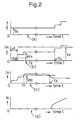
- Fig. 2 shows time charts on the start-up of compressor according to the embodiment 1.
- the horizontal axis of a, b, c and d on the charts indicate time lapsed; and the vertical axis of a, b, c and d correspond to frequency output of inverter, voltage output of inverter, input current of compressor, and rotation of the motor respectively.
- a setup current level IMO is the value of current regarded sufficient to start the motor rotation.
- fs an initial setup value of frequency as frequency output of inverter
- VS1 an initial setup values of voltage VS1 as voltage output of inverter
- the current detection circuit 10 detects input current IM in locked compressor for every ⁇ t.
- the detected input current IM exceeds setup current level of IMO at time t1, which is a current level required to start the motor.
- the control unit increases the voltage output VS1 by ⁇ VS.
- the reason for the level-up of voltage output VS1 by ⁇ VS is to obtain a minimum possible input current IM that exceeds the setup current level IMO. This is an attempt to start the motor in minimum possible electricity to conserve energy, also prevents excess current flow.
- the voltage output of the inverter should stop increasing, and should maintain the voltage at that level. For example, after the value of the input current IM has exceeded the setup current level IMO which is a sufficient level to start the motor, at time t2 after ⁇ t has lapsed from time t1, stop increasing the voltage output of inverter to maintain it unchanged.
- the motor of compressor heats up, and the viscosity of lubricant decreases by the increased temperature.
- the compressor starts to rotate, and the input current IM, which is detected by the current detection circuit 10, reduces to below setup current level IMO at time t3.
- the frequency output and voltage output of inverter are increased to control the rotation (frequency) of the compressor depending on loads.
- the current detection circuit 10 valuates the completion time of heating to pour out the resting refrigerant, and it is geared to conserve energy.
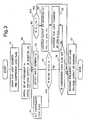
- Fig. 3 shows a control flow chart at start-up.
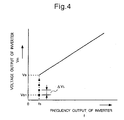
- Fig. 4 is a graph on the start-up characteristic of voltage output of inverter, showing the relation of: voltage output of inverter/frequency output of inverter (V/f).
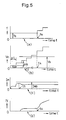
- Fig. 5 is time charts at normal start-up.
- the start-up control circuit 9 clears the counter and the lock flag based on starting signal from the compressor.
- “lock” of the compressor is, it is a situation when the motor of the compressor is not rotating.
- the lock flag is a flag that indicates that the compressor is not rotating even if there's sufficient electricity running to start the compressor.
- step 2 the compressor is started at the initial setup value, that is, as explained previously, the compressor starts at VS1/fs (voltage output of inverter/frequency output of inverter).
- step 3 the frequency output fs is maintained, and detect the input current IM after ⁇ t.
- step 4 valuate whether or not if the detected input current IM had exceeded the setup current level IMO.
- the setup current level IMO is a level of the current required to switch the compressor from the locking to the rotating mode. That is, it is the level of current required to start a rotation of the motor of compressor.
- the setup current level IMO can be used to indicate abnormality in a motor, if the motor does not rotate even after the current has reached the excess level.
- step 5 which sets the lock flag to maintain the situation
- step 6 which is a step to valuate whether lock flag is being set or not.
- step 6 the lock flag is checked.
- n is a counter number.
- step 9 for every increase in the loop counter by 1, the voltage output of inverter VS1 is raised by ⁇ VS only. That is, the voltage output of inverter Vn is VS1+(n) ⁇ VS.
- Step 10 valuates VS1+(n) ⁇ VS whether it has reached previously set driving voltage Vs shown in Fig. 4. If it has, it is functioning normally and will go to step 7. After that, operation of compressor is controlled by the voltage output and the frequency output of inverter depending on loads. If VS1+(n) ⁇ VS has not reached the previously set driving voltage Vs, it will go to step 3. After that it is a repetition from step 3 to step 10.
- step 4 when the detected input current IM has been valuated to exceed the value of setup current level IMO (time t3 of c in Fig. 2), go to step 5.
- the detected input current IM exceeding the value of setup current level IMO is, the motor is unable to rotate due to low temperature and abundant amount of resting refrigerant.
- step 3 to step 10 When the motor begins to rotate during the repetition of step 3 to step 10, this means that the motor has started normally without the input current IM having to exceed the setup current level IMO.
- Fig. 5 shows, when the motor starts to rotate at time t5, the input current IM remains low.
- step 3 to step 10 continues to repeat in this situation, Vn>Vs occurs at time t6 as shown in Fig. 5.
- the voltage output of inverter Vn equals the previously set driving voltage Vs as described previously, it will go from step 10 to step 7, and the operation of compressor is controlled by the voltage output of inverter and the frequency output of inverter depending on loads. Therefore, if went from step 10 to step 7, it is the case of normal function without the input current IM having to exceed the setup current level IMO.
- step 5 If the motor failed to rotate as normal the lock flag is set at step 5. Then returns to step 3 as done so in Fig. 2, without increasing the voltage output.
- the current input IM is detected in step 3 and again in step 4 repeats the step of valuation whether or not if the detected input current IM exceeded the setup current level IMO.
- the detected input current IM is below the setup current level IMO (time t4 of c in Fig. 2), that means the motor in locking mode is heated up by running of electricity and the temperature of lubricant is increased which decreases the viscosity causing the decline in fricitional resistance of each abrasive part to begin the rotation of compressor, and eventually decreasing the input current IM.
- step 6 When the input current IM is valuated to be below the setup current level IMO, go to step 6, and in this step, the lock flag is checked. As the lock flag has been set, it goes to step 7 where compressor operation for the voltage output of inverter and the frequency output of inverter are controlled depending on loads. As such, heating completes when the current has been detected and the motor starts to rotate. In other words, the heating can be done in the exact time needed. This is quite different from the conventional method where heating time was exactly for 3 minutes or for a fixed time period t.
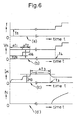
- the voltage VS1 of the initial frequency fs is increased for every ⁇ t, however, it can also be for a predetermined time. For example, as Fig. 6 shows, if set the time to be longer to start with and then shorter next ( ⁇ t1> ⁇ t2), time ⁇ t3 can be made shorter, which is the time period of excess current flow at above the setup current level IMO to raise the coil temperature. Therefore, the resting refrigerant will be poured out under the most safe condition and the credibility of refrigerating machine increases.
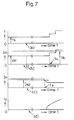
- Fig. 7 shows, when the voltage VS1 for the initial frequency fs is below the driving voltage Vs, there's no problem for the initial input current IM being in excess to the setup current level IMO. In such a case, as with the flow chart shown in Fig. 3, the steps from 8 to 10 are skipped, and the start-up is controlled within step 1 to step 7.
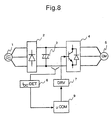
- Fig. 8 shows a configuration for the embodiment 2.
- 6 is DC-line current detection circuit that protects excess current of DC-line inverter element.
- the detailed explanation of all other parts are as explained in the embodiment 1.
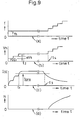
- Fig. 9 is time charts for the start-up of compressor for the embodiment 2.
- the horizontal axis of a, b, c and d on the charts indicate time lapsed; and the vertical axis of a, b, c and d correspond to frequency output of inverter, voltage output of inverter, DC-line current and rotation of compressor respectively.
- outputs are made to the compressor.
- the initial setup value of frequency fs as frequency output of inverter, and the initial setup value for voltage VS1 as voltage output of inverter.
- the DC-line current detection circuit 6 detects DC-line current IDC from the compressor in locking mode for every ⁇ t. For every ⁇ t the voltage output VS1 is raised by ⁇ VS until time t1. The detected DC-line current IDC exceeds a setup level value of DC-line current IDCO at time t1. The level value of DC-line current IDCO is a required level to move from the locking mode to the rotating mode.
- the motor of compressor heats up which can increase the temperature of lubricant, causing decline in viscosity to cause decrease in the frictional resistance of abrasive parts. Then the compressor begins to rotate and the DC-line current IDC decreases to below the setup level value of DC-line current IDCO at time t3. At time t4 after time ⁇ t has lapsed, as a and b of Fig. 9 shows, the frequency output of inverter and the voltage output of inverter are increased which will control a number of rotations (frequency) of the compressor depending on loads.
- DC-line current detection circuit 6 valuates driving based on detection from DC-line current of inverter. A measure of valuation had simply been substituted from the input current for compressor IM to the DC-line current for inverter IDC. All other mechanisms are as explained in the embodiment 1, therefore, the explanation on operational flow is omitted.
- Fig. 10 shows a configuration of the embodiment 3.
- 8 is a power-supplied input current detection circuit that detects power-supplied input current.
- Other parts of the configuration are as explained in the embodiment 1, therefore, the detailed explanation is omitted.
- Fig. 11 is time charts on the start-up of compressor for the embodiment 3.
- the horizontal axis of a, b, c and d on the charts indicate time and the vertical axis of a, b, c and d correspond to frequency output of inverter, voltage output of inverter, power-supplied input current and a number of rotations of compressor respectively.
- the power-supplied input current detection circuit 8 valuates driving of the compressor based on power-supplied input current IAC. A measure of valuation had simply been substituted from the input current for compressor IM to the power-supplied input current IAC.
- Fig. 11 shows, on start-up, outputs are made to the compressor.
- the frequency output of inverter the initial setup value of frequency fs
- voltage output of inverter the initial setup value of voltage VS1.
- the frequency output fs and the initial setup value for voltage VS1 are maintained until the compressor starts to rotate. Maintaining the situation, detect power-supplied input current IAC, and when the detected power-supplied current IAC is exceeding the previously set level value of power-supplied input setup current IACO, maintain this situation.
- the compressor rotates and the power-supplied current IAC decreases to below the power-supplied input setup current IACO at time t1.
- time t2 after time ⁇ t has lasped the frequency output of inverter and the voltage output of inverter are increased.
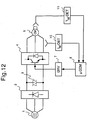
- Fig. 12 shows a configuration of the control unit for embodiment 4.
- 11 is a temperature sensor which measures the motor temperature in the compressor. All other parts in this configuration are as described in the embodiment 1, therefore, the detailed explanation is omitted.
- Fig. 13 is time charts on the start-up of compressor for the embodiment 4.
- the horizontal axis of a, b, c and d on the charts indicate time and the vertical axis of a, b, c and d correspond to the frequency output of inverter, and the motor temperature of compressor respectively.
- Fig. 13 shows a case when the motor temperature TM, which is detected by the temperature sensor 11, had become greater than the highest setup temperature TMO before the compressor rotation.
- Fig. 2 shows, on start-up, outputs are made to the compressor. As the frequency output of inverter the initial setup value of frequency fs, and as voltage output of inverter the initial setup value of voltage VS1. On starting, the frequency output fs and the initial setup value for voltage VS1 are maintained until the compressor starts to rotate.
- the current detection circuit 10 detects the input current of compressor IM in the locking mode for every ⁇ t, and until the detected input current for compressor IM exceeds the previously set value of setup current level IMO at time t1, the voltage output VS1 at the control unit is increased by ⁇ VS for every ⁇ t.
- the motor inside the compressor heats up which causes the temperature of lubricant to increase, leading to a decrease in its viscosity, which in turn will causes decline in the frictional resistance of abrasive parts and the compressor begins to rotate.
- the detected input current of compressor IM decreases to below the setup current level IMO after time ⁇ t at time t3
- the voltage output of inverter and the frequency output of inverter are increased at time t4 as shown in a and b of Fig. 2, this can control a number of rotations (frequency) of the compressor depending on loads.
- a control method one is to block inverter output as shown in time t1 of Fig. 13.
- a control method three is, when the motor temperature measured by the temperature sensor 11 is greater than the highest set temperature, the compressor is assumed that it has an adequate heat.
- the voltage output and frequency output of inverter are increased to control the rotation (frequency) of compressor, depending on loads.
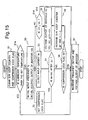
- Fig. 14 is an operational flow chart on controlled start-up for the embodiment 4.
- Fig. 14 shows in step 11 the start-up control unit 9 clears the lock flag and the counter based on the starting signal of compressor in order to set initial values of the software (S/W) loop counter and the compressor lock flag.
- step 12 the compressor starts at the initial setup value, that is, as described previously, the compressor starts at; VS1/fs (voltage output of inverter/frequency output of inverter).
- step 13 under the maintained frequency output fs, the input current for compressor IM is detected after time A t.
- Step 14 valuates whether the detected input current of compressor IM had exceeded or not the setup current level IMO.
- step 15 From the initial valuation result where lock flag is unset and if IM>IMO, go to step 15, and if IM ⁇ IMO, then go to step 17 to determine if lock flag is set or unset.
- the initial voltage output VS1 is set so the initial input current for compressor IM is always below the setup current level IMO, therefore, goes to step 17.
- step 17 the lock flag is unset so proceed to step 18 and see if the motor temperature of the compressor is greater or smaller than the highest set temperature. If the temperature is greater than the highest set temperature, the lubricant is sufficiently warm inside the compressor, so proceed to step 22, and the voltage output and frequency output of inverter are increased to control the rotation (frequency) depending on loads.
- step 19 to increase the loop counter by one, then proceed to step 20.
- step 20 for every increase in the loop counter by one, increase the voltage output of inverter VS1 by ⁇ VS. That is, voltage output of inverter Vn is VS1+(n) ⁇ VS.
- n is the counter number.
- step 21 VS1+(n) ⁇ VS valuates whether or not if it has reached the previously set driving voltage Vs. If it has, go to step 22 to control the operation for the voltage output of inverter and frequency output of inverter of compressor depending on loads.
- step 13 If VS1+(n) ⁇ VS has not reached previously set driving voltage Vs, go to step 13 to repeat steps 13 to step 20.
- step 22 When the voltage output of inverter Vn became the same value as the previously set driving voltage Vs during the repetition, as described before, go to step 22 to control the operation of the voltage output of inverter and frequency output of inverter of compressor depending on loads.
- step 14 While repeating the steps 13 to 20, if the input current of compressor IM detected in step 14 exceeded the setup current level IMO, go to step 15.
- the motor temperature of compressor is measured to see if the temperature is over or under the highest set temperature. From a result of the measurement, if it is over the highest set temperature, the lubricant inside the compressor is sufficiently warm meaning there's no resting refrigerant, so proceed to step 22 to increase the frequency output of inverter and the output voltage of inverter, and control a number of rotations (frequency) of compressor depending on loads.
- step 16 when the motor temperature is below the highest set temperature, the voltage output remains intact and go to step 16 to set the lock flag to maintain the situation then returns to step 13 to re-detect the input current of compressor IM after time ⁇ t.
- step 14 repeat the valuation if the input current IM has exceeded the setup current level IMO.
- the voltage VS1 of the initial frequency fs was increased for every ⁇ t but it can also be for a fixed time. For instance, if set the time so that it is longer in duration to start with, followed by shorter duration, so that time period between excess current flow can be made shorter when raising coil temperature that this is much a safer way to pour out the resting refrigerant.
- the temperature sensor 11 measures the motor temperature of compressor to valuate whether or not if the measured temperature is over the highest set temperature.
- the temperature sensor 11 can be set to measure the temperature of lubricant that is appropriate as the motor temperature of compressor, or as a shell temperature of compressor, and either one of these can be the basis of valuation to valuate if the motor temperature had become over the highest set temperature.
- step 15 or 18 can use a software program for counting a period of time between power off to power on mode of the compressor. That is, for step 15 or 18, if the period of time between the power off to power on of the compressor is below the pre-setted time, the compressor is still warm, and can proceed to step 22.
- step 1a is inserted between step 1 and 2.
- the temperature characteristic value that corresponds to the motor temperature of the compressor e.g. temperature of lubricant in the compressor
- step 2 If the temperature characteristic value is under the highest set temperature, go to step 2, so that if the temperature of lubricant is low, that is, a temperature when the amount of resting refrigerant is large inside the compressor, the refrigerant must be heated.
- the temperature of refrigerant is high, that is, a temperature when the amount of resting refrigernat is low, the unnecessary heating will not take place. By doing so it helps to prevent the deteoriation of lubricant to provide the control unit of refrigerating machine that are economically sound and high in credibility.
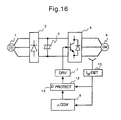
- Fig. 16 shows a configuration of the embodiment 5.
- Fig. 17 is time charts of the start-up control unit for the embodiment 5.
- excess current protection circuit 12 is set in place. The excess current protection circuit 12 hold the protection level value of excess current IMC.
- the excess current protection circuit 12 blocks the voltage output of inverter, and the result of the blockage is indicated at display unit 13.
- the excess current protection circuit 12 can also be installed to embodiments 2 to 4 (not illustrated). Instead of the excess current protection circuit 12, can design something else that achieves similar function as the excess current protection circuit 12 at the start-up control circuit 9.
Landscapes
- Engineering & Computer Science (AREA)
- Power Engineering (AREA)
- Air Conditioning Control Device (AREA)
- Compressor (AREA)
- Control Of Positive-Displacement Pumps (AREA)
- Control Of Ac Motors In General (AREA)
Claims (8)
- Unité de commande d'une machine de réfrigération munie d'un compresseur couplé thermiquement et entraíné par un moteur entraíné par inverseur, l'unité de commande comprenant:dans laquelle le circuit de commande est adapté pour faire en sorte que l'inverseur applique une fréquence initiale et une tension initiale sur le moteur lors du démarrage; pour déterminer un mode de fonctionnement du moteur sur la base d'un résultat de détection en provenance du circuit de détection de courant; et pour déterminer lorsqu'il convient d'augmenter la fréquence de fonctionnement de l'inverseur sur la base du résultat du circuit de détection de courant; caractérisée en ce que le circuit de commande est adapté pour augmenter la tension d'une valeur fixe pour des périodes fixes successives lorsque le moteur n'est pas actionné et ensuite pour évaluer le mode de fonctionnement du moteur sur la base du résultat de détection en provenance du circuit de détection de courant.un circuit de détection de courant pour détecter un courant qui est appliqué pour entraíner le moteur; etun circuit de commande pour commander le moteur sur la base d'un résultat détecté en provenance du circuit de détection de courant,
- Unité de commande d'une machine de réfrigération selon la revendication 1, dans laquelle le circuit de commande est adapté pour augmenter la fréquence d'inverseur lorsque la tension atteint une tension de pilotage établie de façon préalable.
- Unité de commande d'une machine de réfrigération selon l'une quelconque des revendications précédentes, comprenant en outre un circuit de capteur de température pour détecter une valeur caractéristique de température qui est équivalente à la température du moteur et dans laquelle le circuit de commande est adapté pour évaluer si oui ou non il convient d'appliquer la fréquence initiale et la tension initiale sur le compresseur sur la base d'un résultat de détection du circuit de détection de température avant de démarrer le moteur.
- Unité de commande d'une machine de réfrigération selon la revendication 3, dans laquelle le circuit de commande est adapté pour évaluer si oui ou non la valeur caractéristique de température a excédé une température pré-établie sur la base d'un résultat de détection en provenance du circuit de détection de température, après application de la fréquence initiale et de la tension initiale sur le moteur et pour commander la fréquence de l'inverseur lorsque le moteur n'est pas actionné.
- Unité de commande d'une machine de réfrigération selon la revendication 3, dans laquelle le circuit de commande est adapté pour augmenter la tension initiale d'une valeur fixe à chaque période fixe lorsque le moteur n'est pas actionné puis pour évaluer si oui ou non la valeur caractéristique de température a excédé la température pré-établie sur la base d'un résultat de détection en provenance du circuit de détection de température.
- Unité de commande d'une machine de réfrigération selon la revendication 3, dans laquelle le circuit de commande est adapté pour augmenter la tension initiale d'une valeur fixe à chaque période fixe lorsque le compresseur n'est pas actionné puis pour évaluer si oui ou non la valeur caractéristique de température a excédé la température pré-établie et, lorsque la valeur caractéristique de température n'a pas excédé la température pré-établie, pour réévaluer le mode de fonctionnement du moteur sur la base d'un résultat de détection en provenance du circuit de détection de température.
- Unité de commande d'une machine de réfrigération selon l'une quelconque des revendications précédentes, comprenant en outre un circuit de protection vis-à-vis d'un courant en excès pour bloquer un courant qui est appliqué sur le moteur lorsque le résultat de détection en provenance du circuit de détection de courant excède une valeur de courant en excès.
- Unité de commande d'une machine de réfrigération selon la revendication 7, comprenant en outre une unité d'affichage pour indiquer la survenue d'un blocage au moyen du circuit de protection vis-à-vis d'un courant en excès.
Applications Claiming Priority (3)
| Application Number | Priority Date | Filing Date | Title |
|---|---|---|---|
| JP5436797 | 1997-03-10 | ||
| JP54367/97 | 1997-03-10 | ||
| JP5436797 | 1997-03-10 |
Publications (2)
| Publication Number | Publication Date |
|---|---|
| EP0865152A1 EP0865152A1 (fr) | 1998-09-16 |
| EP0865152B1 true EP0865152B1 (fr) | 2004-09-01 |
Family
ID=12968695
Family Applications (1)
| Application Number | Title | Priority Date | Filing Date |
|---|---|---|---|
| EP97309222A Expired - Lifetime EP0865152B1 (fr) | 1997-03-10 | 1997-11-17 | Unité de commande pour machine frigorifique |
Country Status (4)
| Country | Link |
|---|---|
| US (1) | US5959428A (fr) |
| EP (1) | EP0865152B1 (fr) |
| CN (1) | CN1089426C (fr) |
| ES (1) | ES2231847T3 (fr) |
Cited By (1)
| Publication number | Priority date | Publication date | Assignee | Title |
|---|---|---|---|---|
| US10985608B2 (en) | 2016-12-13 | 2021-04-20 | General Electric Company | Back-up power system for a component and method of assembling same |
Families Citing this family (22)
| Publication number | Priority date | Publication date | Assignee | Title |
|---|---|---|---|---|
| ES2245102T3 (es) * | 1998-06-19 | 2005-12-16 | Matsushita Electric Industrial Co., Ltd. | Acondicionador de aire. |
| JP3671850B2 (ja) * | 2001-03-16 | 2005-07-13 | 三菱電機株式会社 | 冷凍サイクル |
| JP3896472B2 (ja) * | 2002-09-04 | 2007-03-22 | 株式会社日立製作所 | 冷凍装置 |
| KR100517935B1 (ko) * | 2003-05-26 | 2005-09-30 | 엘지전자 주식회사 | 왕복동식 압축기의 운전제어장치 및 방법 |
| KR100517934B1 (ko) * | 2003-05-26 | 2005-09-30 | 엘지전자 주식회사 | 왕복동식 압축기의 운전제어장치 및 방법 |
| JP4311983B2 (ja) * | 2003-05-30 | 2009-08-12 | 三洋電機株式会社 | 冷却装置 |
| JP4124205B2 (ja) * | 2004-04-26 | 2008-07-23 | ダイキン工業株式会社 | インバータ駆動圧縮機の予熱運転方法およびその装置 |
| JP4899549B2 (ja) * | 2005-10-31 | 2012-03-21 | ダイキン工業株式会社 | 冷凍装置の圧縮機運転方法、および冷凍装置 |
| WO2008032225A2 (fr) * | 2006-03-21 | 2008-03-20 | Ranco Incorporated Of Delaware | Unité de contrôle de réfrigération |
| JP2008231987A (ja) * | 2007-03-19 | 2008-10-02 | Mitsubishi Heavy Ind Ltd | 電動圧縮機 |
| US8038412B2 (en) * | 2007-06-06 | 2011-10-18 | Hamilton Sundstrand Corporation | Temperature management for electric motor driven pump |
| KR101395890B1 (ko) * | 2007-10-18 | 2014-05-15 | 엘지전자 주식회사 | 공기조화기의 전동기 제어장치 및 그 제어 방법 |
| JP5119025B2 (ja) * | 2008-03-31 | 2013-01-16 | 株式会社日立産機システム | モータ制御装置、空気圧縮機、空気調和機、乗客コンベアの制御装置及びコンベアの制御装置 |
| DE102009021098A1 (de) * | 2009-05-13 | 2010-11-18 | Siemens Aktiengesellschaft | Elektrisches Antriebssystem |
| EP2515049A4 (fr) * | 2009-12-17 | 2018-01-03 | Mitsubishi Electric Corporation | Climatiseur |
| JP2013096670A (ja) * | 2011-11-04 | 2013-05-20 | Panasonic Corp | 冷凍サイクル装置及び温水生成装置 |
| DE102014219474B4 (de) * | 2014-09-25 | 2022-06-09 | Valeo Siemens Eautomotive Germany Gmbh | Verfahren zum Betrieb von Leistungshalbleitern |
| KR101795405B1 (ko) * | 2016-03-31 | 2017-11-10 | 현대자동차 주식회사 | 차량용 컴프레서 제어 장치 및 방법 |
| CN105871266A (zh) * | 2016-05-19 | 2016-08-17 | 上海电机学院 | 无刷直流电机无位置传感器的定频升压启动方法及系统 |
| AU2017420948B2 (en) * | 2017-06-30 | 2021-02-25 | Mitsubishi Electric Corporation | Refrigeration cycle device and drive device |
| CN112856774B (zh) * | 2021-02-01 | 2022-10-28 | 青岛海尔空调器有限总公司 | 用于空调导板控制的方法、装置及空调器 |
| CN113028674B (zh) * | 2021-03-31 | 2022-06-21 | 四川长虹空调有限公司 | 制冷系统的控制保护方法 |
Citations (1)
| Publication number | Priority date | Publication date | Assignee | Title |
|---|---|---|---|---|
| US4724680A (en) * | 1985-11-28 | 1988-02-16 | Kabushiki Kaisha Toshiba | Air conditioning apparatus and control method thereof |
Family Cites Families (12)
| Publication number | Priority date | Publication date | Assignee | Title |
|---|---|---|---|---|
| US4259845A (en) * | 1979-02-08 | 1981-04-07 | Borg-Warner Corporation | Logic control system for inverter-driven motor |
| JPS56134561U (fr) * | 1980-03-11 | 1981-10-13 | ||
| JPS57129198A (en) * | 1981-01-30 | 1982-08-11 | Hitachi Ltd | Controlling method and device for ac motor |
| JPS62178832A (ja) * | 1986-02-03 | 1987-08-05 | Hitachi Ltd | インバ−タ付空気調和機の制御回路 |
| JPS63310385A (ja) * | 1987-06-10 | 1988-12-19 | Mitsubishi Electric Corp | インバ−タエアコンの起動方法 |
| JP2752125B2 (ja) * | 1989-02-10 | 1998-05-18 | 株式会社東芝 | 空気調和機の制御装置 |
| US5087923A (en) * | 1990-05-25 | 1992-02-11 | Hewlett-Packard Company | Method of adjusting a strobe pulse for a thermal line array printer |
| JPH04268164A (ja) * | 1991-02-22 | 1992-09-24 | Sharp Corp | 空気調和機 |
| US5506487A (en) * | 1991-03-28 | 1996-04-09 | General Electric Company | Systems and methods for driving a compressor with a motor |
| IT1253287B (it) * | 1991-10-16 | 1995-07-14 | Indel B Srl | Dispositivo circuitale per controllare un motore asincrono trifase alimentato in corrente continua |
| JPH06165584A (ja) * | 1992-11-13 | 1994-06-10 | Fujitsu General Ltd | 誘導電動機の制御方法 |
| JP2989490B2 (ja) * | 1994-09-19 | 1999-12-13 | 三洋電機株式会社 | 空気調和機 |
-
1997
- 1997-09-30 CN CN97119813A patent/CN1089426C/zh not_active Expired - Fee Related
- 1997-10-24 US US08/956,099 patent/US5959428A/en not_active Expired - Fee Related
- 1997-11-17 ES ES97309222T patent/ES2231847T3/es not_active Expired - Lifetime
- 1997-11-17 EP EP97309222A patent/EP0865152B1/fr not_active Expired - Lifetime
Patent Citations (1)
| Publication number | Priority date | Publication date | Assignee | Title |
|---|---|---|---|---|
| US4724680A (en) * | 1985-11-28 | 1988-02-16 | Kabushiki Kaisha Toshiba | Air conditioning apparatus and control method thereof |
Cited By (1)
| Publication number | Priority date | Publication date | Assignee | Title |
|---|---|---|---|---|
| US10985608B2 (en) | 2016-12-13 | 2021-04-20 | General Electric Company | Back-up power system for a component and method of assembling same |
Also Published As
| Publication number | Publication date |
|---|---|
| ES2231847T3 (es) | 2005-05-16 |
| CN1193095A (zh) | 1998-09-16 |
| EP0865152A1 (fr) | 1998-09-16 |
| CN1089426C (zh) | 2002-08-21 |
| HK1010947A1 (en) | 1999-07-02 |
| US5959428A (en) | 1999-09-28 |
Similar Documents
| Publication | Publication Date | Title |
|---|---|---|
| US5959428A (en) | Starting control unit for a refrigeration machine | |
| CA2751098C (fr) | Commande de chauffe-eau pompe a chaleur | |
| JPH08226714A (ja) | 空気調和機 | |
| JP3731214B2 (ja) | 圧縮機の液冷媒排出装置 | |
| JP3840573B2 (ja) | ヒートポンプ式給湯装置 | |
| JP2001263767A (ja) | 空気調和機の制御方法 | |
| JP4327936B2 (ja) | ヒートポンプ式冷凍装置 | |
| EP1748265B1 (fr) | Procédé et appareil de préchauffage d'un compresseur commandé par un onduleur | |
| JPH08261571A (ja) | 圧縮式冷凍装置の起動方法 | |
| EP0407633A1 (fr) | Appareil de commande de chauffage pour vitre de voiture | |
| HK1010947B (en) | Control unit for refrigerating machine | |
| JP4120038B2 (ja) | 冷凍機の制御装置及び冷凍機の制御方法 | |
| JPH1030563A (ja) | 圧縮機用ヒータの制御装置 | |
| JP3293316B2 (ja) | 自動車用電動圧縮機の制御駆動装置 | |
| JP2000097479A (ja) | 空気調和機 | |
| JP2661608B2 (ja) | 空気調和機のファン制御装置 | |
| JP4322996B2 (ja) | 空気調和機用圧縮機の駆動制御装置および空気調和機用圧縮機の冷媒寝込み防止制御方法 | |
| KR890010517A (ko) | 냉동시스템과 그의 제어방법 | |
| JP3719162B2 (ja) | ヒートポンプ給湯機 | |
| KR100298410B1 (ko) | 압축기의구동제어장치 | |
| JP2009180390A (ja) | 製氷機 | |
| JP2004198044A (ja) | 給湯装置 | |
| JP3330437B2 (ja) | 貯湯式電気温水器の制御装置 | |
| JPH0719598A (ja) | 熱媒ボイラの起動制御方法 | |
| JP2004088924A (ja) | モータ制御回路の異常判定装置及びその異常判定装置を備えた送風ファン用モータ |
Legal Events
| Date | Code | Title | Description |
|---|---|---|---|
| PUAI | Public reference made under article 153(3) epc to a published international application that has entered the european phase |
Free format text: ORIGINAL CODE: 0009012 |
|
| AK | Designated contracting states |
Kind code of ref document: A1 Designated state(s): ES GB IT |
|
| AX | Request for extension of the european patent |
Free format text: AL;LT;LV;MK;RO;SI |
|
| 17P | Request for examination filed |
Effective date: 19980814 |
|
| AKX | Designation fees paid |
Free format text: AT BE CH LI |
|
| RBV | Designated contracting states (corrected) |
Designated state(s): AT BE CH LI |
|
| REG | Reference to a national code |
Ref country code: DE Ref legal event code: 8566 |
|
| RBV | Designated contracting states (corrected) |
Designated state(s): ES GB IT |
|
| 17Q | First examination report despatched |
Effective date: 20000628 |
|
| GRAP | Despatch of communication of intention to grant a patent |
Free format text: ORIGINAL CODE: EPIDOSNIGR1 |
|
| GRAS | Grant fee paid |
Free format text: ORIGINAL CODE: EPIDOSNIGR3 |
|
| GRAA | (expected) grant |
Free format text: ORIGINAL CODE: 0009210 |
|
| AK | Designated contracting states |
Kind code of ref document: B1 Designated state(s): ES GB IT |
|
| REG | Reference to a national code |
Ref country code: GB Ref legal event code: FG4D |
|
| REG | Reference to a national code |
Ref country code: HK Ref legal event code: GR Ref document number: 1010947 Country of ref document: HK |
|
| REG | Reference to a national code |
Ref country code: GB Ref legal event code: 727 |
|
| REG | Reference to a national code |
Ref country code: ES Ref legal event code: FG2A Ref document number: 2231847 Country of ref document: ES Kind code of ref document: T3 |
|
| REG | Reference to a national code |
Ref country code: GB Ref legal event code: 727A |
|
| PLBE | No opposition filed within time limit |
Free format text: ORIGINAL CODE: 0009261 |
|
| STAA | Information on the status of an ep patent application or granted ep patent |
Free format text: STATUS: NO OPPOSITION FILED WITHIN TIME LIMIT |
|
| 26N | No opposition filed |
Effective date: 20050602 |
|
| REG | Reference to a national code |
Ref country code: GB Ref legal event code: 727H |
|
| PGFP | Annual fee paid to national office [announced via postgrant information from national office to epo] |
Ref country code: GB Payment date: 20051116 Year of fee payment: 9 |
|
| PGFP | Annual fee paid to national office [announced via postgrant information from national office to epo] |
Ref country code: ES Payment date: 20051219 Year of fee payment: 9 |
|
| PGFP | Annual fee paid to national office [announced via postgrant information from national office to epo] |
Ref country code: IT Payment date: 20061130 Year of fee payment: 10 |
|
| GBPC | Gb: european patent ceased through non-payment of renewal fee |
Effective date: 20061117 |
|
| PG25 | Lapsed in a contracting state [announced via postgrant information from national office to epo] |
Ref country code: GB Free format text: LAPSE BECAUSE OF NON-PAYMENT OF DUE FEES Effective date: 20061117 |
|
| REG | Reference to a national code |
Ref country code: ES Ref legal event code: FD2A Effective date: 20061118 |
|
| PG25 | Lapsed in a contracting state [announced via postgrant information from national office to epo] |
Ref country code: ES Free format text: LAPSE BECAUSE OF NON-PAYMENT OF DUE FEES Effective date: 20061118 |
|
| PG25 | Lapsed in a contracting state [announced via postgrant information from national office to epo] |
Ref country code: IT Free format text: LAPSE BECAUSE OF NON-PAYMENT OF DUE FEES Effective date: 20071117 |