EP0867751A2 - Panneau d'affichage à cristaux liquides - Google Patents
Panneau d'affichage à cristaux liquides Download PDFInfo
- Publication number
- EP0867751A2 EP0867751A2 EP98105330A EP98105330A EP0867751A2 EP 0867751 A2 EP0867751 A2 EP 0867751A2 EP 98105330 A EP98105330 A EP 98105330A EP 98105330 A EP98105330 A EP 98105330A EP 0867751 A2 EP0867751 A2 EP 0867751A2
- Authority
- EP
- European Patent Office
- Prior art keywords
- lines
- substrate
- display panel
- signal lines
- scanning lines
- Prior art date
- Legal status (The legal status is an assumption and is not a legal conclusion. Google has not performed a legal analysis and makes no representation as to the accuracy of the status listed.)
- Withdrawn
Links
Images


Classifications
-
- G—PHYSICS
- G02—OPTICS
- G02F—OPTICAL DEVICES OR ARRANGEMENTS FOR THE CONTROL OF LIGHT BY MODIFICATION OF THE OPTICAL PROPERTIES OF THE MEDIA OF THE ELEMENTS INVOLVED THEREIN; NON-LINEAR OPTICS; FREQUENCY-CHANGING OF LIGHT; OPTICAL LOGIC ELEMENTS; OPTICAL ANALOGUE/DIGITAL CONVERTERS
- G02F1/00—Devices or arrangements for the control of the intensity, colour, phase, polarisation or direction of light arriving from an independent light source, e.g. switching, gating or modulating; Non-linear optics
- G02F1/01—Devices or arrangements for the control of the intensity, colour, phase, polarisation or direction of light arriving from an independent light source, e.g. switching, gating or modulating; Non-linear optics for the control of the intensity, phase, polarisation or colour
- G02F1/13—Devices or arrangements for the control of the intensity, colour, phase, polarisation or direction of light arriving from an independent light source, e.g. switching, gating or modulating; Non-linear optics for the control of the intensity, phase, polarisation or colour based on liquid crystals, e.g. single liquid crystal display cells
- G02F1/133—Constructional arrangements; Operation of liquid crystal cells; Circuit arrangements
-
- G—PHYSICS
- G02—OPTICS
- G02F—OPTICAL DEVICES OR ARRANGEMENTS FOR THE CONTROL OF LIGHT BY MODIFICATION OF THE OPTICAL PROPERTIES OF THE MEDIA OF THE ELEMENTS INVOLVED THEREIN; NON-LINEAR OPTICS; FREQUENCY-CHANGING OF LIGHT; OPTICAL LOGIC ELEMENTS; OPTICAL ANALOGUE/DIGITAL CONVERTERS
- G02F1/00—Devices or arrangements for the control of the intensity, colour, phase, polarisation or direction of light arriving from an independent light source, e.g. switching, gating or modulating; Non-linear optics
- G02F1/01—Devices or arrangements for the control of the intensity, colour, phase, polarisation or direction of light arriving from an independent light source, e.g. switching, gating or modulating; Non-linear optics for the control of the intensity, phase, polarisation or colour
- G02F1/13—Devices or arrangements for the control of the intensity, colour, phase, polarisation or direction of light arriving from an independent light source, e.g. switching, gating or modulating; Non-linear optics for the control of the intensity, phase, polarisation or colour based on liquid crystals, e.g. single liquid crystal display cells
- G02F1/133—Constructional arrangements; Operation of liquid crystal cells; Circuit arrangements
- G02F1/136—Liquid crystal cells structurally associated with a semi-conducting layer or substrate, e.g. cells forming part of an integrated circuit
- G02F1/1362—Active matrix addressed cells
- G02F1/136204—Arrangements to prevent high voltage or static electricity failures
Definitions
- the present invention relates to a display panel such as a liquid crystal display panel used in television sets, personal computers, word processors, OA (Office Automation) apparatuses, or the like.
- a display panel such as a liquid crystal display panel used in television sets, personal computers, word processors, OA (Office Automation) apparatuses, or the like.
- Such a liquid crystal display panel has a structure where a pair of substrates are provided so as to oppose each other with a liquid crystal layer being interposed therebetween as a display medium.
- One of the pair of substrates is an active matrix substrate, in which a plurality of signal lines and a plurality of scanning lines are provided so as to cross each other via an insulation film.
- a pixel electrode is provided in the vicinity of an intersection between the signal line and the scanning line and is connected to the signal lines and the scanning lines via a TFT (Thin Film Transistor) as a switching element.
- TFT Thin Film Transistor
- Each of the pixel electrodes is provided with a signal from the corresponding signal line via the TFT, which is switched by a signal from the corresponding scanning line.
- a voltage is applied to the liquid crystal layer between the pixel electrode and an opposing counter electrode, thereby changing the optical characteristics of the corresponding portion of the liquid crystal layer between the electrodes. This change in the optical characteristics is visually perceived as a display pattern.
- FIG. 7 shows an equivalent circuit of such a conventional active matrix substrate 101 .
- the active matrix substrate 101 includes a transmissive substrate 1 made of a glass plate, or the like, as well as a plurality of signal lines 2 and a plurality of scanning lines 3 provided to cross each other via an insulation film.
- the active matrix substrate 101 further includes TFTs 4 in the vicinity of the intersection between the signal lines 2 and the scanning lines 3 as switching elements, and pixel electrodes 5 .
- a display region is defined by the plurality of pixel electrodes 5 arranged in a matrix. Each of the pixel electrodes 5 is connected to a corresponding TFT 4 .
- the signal lines 2 and the scanning lines 3 extend beyond the display region.
- a signal input terminal 6 is provided at one end of each signal line 2 while a signal input terminal 7 is provided at one end of each scanning line 3 . Furthermore, a short-circuiting line 8 is formed around the display region. Until a certain point in the production process, the short-circuiting line 8 is connected to both ends of the signal lines 2 and the scanning lines 3 .
- Figure 8 is a plan view illustrating another conventional active matrix substrate 111 . Elements in Figure 8 which are functionally the same as those in Figure 7 are denoted by the same reference numerals and will not be further described. In Figure 8 , for simplicity, elements provided inside a display region 20 and some of the lines and terminals provided around the display region 20 are not shown. In this active matrix substrate, the short-circuiting line 8 is connected to one end of each signal line 2 at which the signal input terminal 6 is not provided and to one end of each scanning line 3 at which the signal input terminal 7 is not provided.
- Such an active matrix substrate is attached to a counter substrate having a transmissive substrate and counter electrodes provided thereon. Then, a liquid crystal material is injected between the substrates, thereby completing the liquid crystal display panel.
- the panel cannot be driven with the signal lines 2 and the scanning lines 3 being short-circuited by the short-circuiting line 8 . Therefore, the short circuit is removed before the liquid crystal panel is completed by severing the substrate 111 along a severance line 10 .
- the short-circuiting line 8 is provided to connect the signal lines 2 and the scanning lines 3 to one another, whereby the signal lines 2 and the scanning lines 3 are always kept at the same potential.
- the signal lines 2 and the scanning lines 3 are always kept at the same potential.
- the signal lines 2 and the scanning lines 3 are electrically isolated from one another after the active matrix substrate is severed.
- the TFT whose characteristics can deteriorate even by an applied voltage of about 100 V, is always subject to an influence of an electrostatic charge until it is incorporated in a shield case.
- the TFT is subject to the influence of an electrostatic charge during steps of connecting drivers to the panel, attaching a polarizer thereto, and incorporating the panel into a shield case.
- each edge of the substrate 101 includes severed sections of the signal lines 2 or the scanning lines 3 .
- two edges of the counter substrate e.g., the upper and left edges, as in Figure 8
- An electrostatic charge entering the panel through these severed sections often causes a problem, thereby significantly lowering the product yield.
- Figure 9 shows an equivalent circuit of such a conventional active matrix substrate 121 .
- Elements in Figure 9 which are functionally the same as those in Figure 7 are denoted by the same reference numerals and will not be further described.
- the inner short-circuiting line 13 is separately provided inside the short-circuiting line 8 , where the signal lines 2 and the scanning lines 3 are connected to the inner short-circuiting line 13 via the elements 12 .
- the element 12 a high resistance element made of a semiconductor thin film, or the like, or a non-linear element which exhibits non-linear resistance values for different applied voltages may be used.
- connection resistance between the signal lines 2 and the inner short-circuiting line 13 , and between the scanning lines 3 and the inner short-circuiting line 13 is set to a value which is sufficiently high to eliminate problems in conducting a test for detecting a short circuit between the signal lines 2 and the scanning lines 3 , for detecting a disconnection of the lines during the production process of the liquid crystal display panel, or in actually driving the completed liquid crystal display panel.
- each of the signal lines 2 and the scanning lines 3 is electrically isolated from one another. Therefore, when an electrostatic charge is applied after the substrate is severed, it is not possible to prevent the deterioration of the switching element characteristics and the insulation breakdown between the signal lines 2 and the scanning lines 3 . Moreover, as the substrate edges have severed sections of the signal lines 2 or the scanning lines 3 , an electrostatic charge entering the panel through these severed sections often causes a problem.
- the elements 12 may be broken or the characteristics thereof may deteriorate due to an applied electrostatic charge, so that leakage might occur between the signal lines 2 and the scanning lines 3 , or non-uniformity may occur in the connection resistance between the lines and the inner short-circuiting line 13 , thus lowering the display quality.
- the resistance of the elements 12 is set to a value which is sufficiently high to eliminate problems in actually driving the display panel. Normally, the resistance value of the elements 12 is set to be higher than the resistance value of the signal lines 2 and the scanning lines 3 by an order of magnitude or more.
- a display panel includes: a first substrate and a second substrate opposing each other with a display medium interposed therebetween; a plurality of signal lines and a plurality of scanning lines provided on the first substrate to cross each other and be insulated from each other; and a plurality of pixel electrodes each provided in a vicinity of an intersection between one of the plurality of signal lines and one of the plurality of scanning lines so as to be connected to the one of the plurality of signal lines and the one of the plurality of scanning lines via a switching element, while the plurality of pixel electrodes define a display region of the display panel.
- At least one of each of the plurality of signal lines and each of the plurality of scanning lines has a high resistance portion proximate an end thereof outside the display region. The high resistance portion is interposed at least partially between the first substrate and the second substrate.
- the high resistance portion is formed of a material including semiconductor, a metal, and a metal oxide.
- the high resistance portion is formed of a film having a specific resistance higher than a specific resistance of a film which forms portions of the plurality of signal lines and the plurality of the scanning lines in the display region.
- a display panel includes: a first substrate and a second substrate opposing each other with a display medium interposed therebetween; a plurality of signal lines and a plurality of scanning lines provided on the first substrate to cross each other and be insulated from each other; and a plurality of pixel electrodes each provided in a vicinity of an intersection between one of the plurality of signal lines and one of the plurality of scanning lines so as to be connected to the one of the plurality of signal lines and the one of the plurality of scanning lines via a switching element, while the pixel electrodes define a display region of the display panel.
- a first electrode for inducing an electrostatic charge applied to the display panel to the first electrode, is provided outside the display region in a vicinity of an end of at least one of each of the plurality of signal lines and each of the plurality of scanning lines, the first electrode being insulated from the plurality of signal lines and the plurality of scanning lines.
- the first electrode is electrically connected to a counter electrode on the second substrate.
- the first electrode is superimposed on, and insulated from, the plurality of signal lines and the plurality of scanning lines.
- the first electrode is interposed between, and insulated from, two adjacent ones of the plurality of signal lines and the plurality of scanning lines.
- the first electrode is wider or larger in area than the portion of the plurality of signal lines and the plurality of scanning lines near an edge of the first substrate.
- the signal line and/or the scanning line has a high resistance portion proximate the end thereof outside the display region. Since the signal lines and the scanning lines are connected to the short-circuiting line via the high resistance portions, even if an electrostatic charge is applied before the substrate is severed, the electrostatic charge can be dispersed to the other lines via the high resistance portion and the short-circuiting line, whereby the deterioration of the switching element characteristics and the insulation breakdown between the lines will not occur due to an electrostatic charge.
- the resistance value of the high resistance portion is sufficiently higher than the resistance value of the signal line or the scanning line, it is possible to conduct a test for detecting a disconnection of the signal lines and the scanning lines or for detecting a leakage between these lines, with the connection of these lines to the short-circuiting line still intact.
- the high resistance portion is protruding from, or interior to, an edge of the counter substrate, whereby when the substrate is severed, part or all of the high resistance portion remains between the severed edge of the substrate and the display region.
- the high resistance portion since the high resistance portion is located closer to the substrate edge than the signal input terminals, the high resistance portion does not influence a signal applied to the signal input terminals for actually driving the display panel, even with the high resistance portion remaining on the substrate after the display panel is completed.
- the high resistance portion is made of a film having a specific resistance higher than a specific resistance of a film which forms portions of the signal lines and the scanning lines excluding the high resistance portion. Any film such as a semiconductor film, a metal film or a metal oxide film may be used for this purpose. Particularly, it is preferable that the high resistance portion is formed of a material which forms the active matrix substrate, whereby no additional production step is required.
- a discharge-inducing electrode is provided outside the display region in the vicinity of the end of either or both of the signal line and the scanning line so as to be insulated from these lines. Therefore, even when an electrostatic charge is generated around the display panel during a step of producing the display panel or after the display panel is completed, the electrostatic charge is discharged to the discharge-inducing electrode, whereby the application of the electrostatic charge to the signal lines and the scanning lines is suppressed. Thus, the deterioration of the switching element characteristics and the insulation breakdown between the lines will not occur.
- the discharge-inducing electrode When the discharge-inducing electrode is connected to the counter electrode, the applied electrostatic charge is dispersed to the entire display panel, whereby it is possible to avoid the influence of the electrostatic charge.
- the discharge-inducing electrode may be superimposed on, and insulated from, the scanning lines and the signal lines, or it may be interposed between, and insulated from, two adjacent signal lines or two adjacent scanning lines.
- the discharge-inducing electrode may further be provided outside the outermost lines so as to be insulated from the outermost lines. In any case, since the discharge-inducing electrode is electrically insulated from the lines, the electrostatic charge applied to the discharge-inducing electrode will not be applied to the scanning lines or the signal lines.
- the discharge-inducing electrode is preferably wider or larger in area than the scanning lines or the signal lines at the edge of the substrate, so that the electrostatic charge applied around the display panel is more easily induced to the discharge-inducing electrode.
- the invention described herein has the advantage of providing a display panel in which it is possible to prevent the deterioration of the switching element characteristics and the insulation breakdown between the lines due to an electrostatic charge even after the substrate is severed.
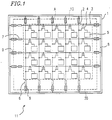
- Figure 1 is a diagram illustrating an equivalent circuit of an active matrix substrate in a display panel according to Example 1 of the present invention.
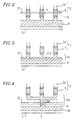
- Figure 2 is a partial enlarged view illustrating a display panel according to Example 1 of the present invention.
- Figure 3 is a partial enlarged view illustrating a display panel according to Example 2 of the present invention.
- Figure 4 is a partial enlarged view illustrating a display panel according to Example 3 of the present invention.
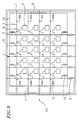
- Figure 5 is a plan view illustrating an active matrix substrate in a display panel according to Example 4 of the present invention.
- Figure 6 is a plan view illustrating an active matrix substrate in a display panel according to Example 5 of the present invention.
- Figure 7 is a diagram illustrating an equivalent circuit of a conventional active matrix substrate.
- Figure 8 is a diagram illustrating an equivalent circuit of another conventional active matrix substrate.
- Figure 9 is a diagram illustrating an equivalent circuit of still another conventional active matrix substrate.
- Figure 1 shows an equivalent circuit of an active matrix substrate 11 in a display panel according to Example 1 of the present invention.
- the active matrix substrate 11 includes a transmissive substrate 1 made of a glass plate, or the like, as well as a plurality of signal lines 2 and a plurality of scanning lines 3 provided to cross each other via an insulation film (not shown).
- the active matrix substrate 11 further includes TFTs 4 in the vicinity of the intersection between the signal lines 2 and the scanning lines 3 as switching elements, and pixel electrodes 5 .
- a display region 20 is defined by the plurality of pixel electrodes 5 provided in a matrix arrangement. Each of the pixel electrodes 5 is connected to a corresponding TFT 4 .
- the signal lines 2 and the scanning lines 3 extend beyond the display region 20 .
- a signal input terminal 6 is provided at one end of the signal line 2 while a signal input terminal 7 is provided at one end of the scanning line 3 .
- Each of the pixel electrodes 5 is provided with a signal from the corresponding signal line 2 via the TFT 4 , which is switched by a signal from the corresponding scanning line 3 .
- a short-circuiting line 8 is formed around the display region 20 .
- the short-circuiting line 8 is connected to high resistance portions 9 provided at both ends of the signal lines 2 and the scanning lines 3 .
- the high resistance portions 9 can be formed simultaneously with the TFTs 4 using, for example, an n + a-Si semiconductor film, which forms the TFTs 4 .
- the specific resistance of n + a-Si is usually about several tens ⁇ cm, and the thickness thereof is about several hundred angstroms.
- the connection resistance between the signal lines 2 or the scanning lines 3 and the short-circuiting line 8 is about 10 M ⁇ .
- the active matrix substrate 11 is attached to a counter substrate (not shown) having a transmissive substrate and planar counter electrodes provided thereon.
- Figure 2 is an enlarged view showing a portion of the display panel corresponding to the upper portion of the active matrix substrate 11 of Figure 2 , before the active matrix substrate is severed.
- the substrate 11 is severed along a severance line 10 , as shown in Figures 1 and 2 , so as to remove the portion on which the short-circuiting line 8 is provided.
- a part of the high resistance portion 9 remains at both ends of the signal lines 2 (and the scanning lines 3 ).
- reference numeral 31 denotes an edge of the substrate 11 before it is severed
- reference numeral 32 denotes an edge of the counter substrate.
- the edge 32 of the counter substrate is preferably positioned so that the counter substrate completely covers the signal line portions 2a (and the scanning line portions), while it does not completely cover the high resistance portions 9 . Then, the gap between the active matrix substrate and the counter substrate is filled with a liquid crystal material, thereby completing the liquid crystal display panel.
- the line resistance value of the signal line portion 2a (and the scanning line portion) is normally about 1 to several tens k ⁇ , and sufficiently lower than the resistance value of the high resistance portion 9 . Therefore, it is possible to conduct a substrate test for detecting a disconnection of the lines or for detecting a leakage between the lines.
- the surface of the active matrix substrate 11 is covered with the counter substrate except for the portion where the signal input terminals 6 and 7 are formed. Therefore, a generated electrostatic charge mostly enters the signal lines 2 and the scanning lines 3 through the severed substrate edges (such as A in Figures 1 and 2 ). However, since the high resistance portion 9 exists between the signal line 2 and the severed edge and between the scanning line 3 and the severed edge, the voltage of the applied electrostatic charge is lowered by the high resistance portion 9 before it reaches the display region 20 , whereby the deterioration of the switching element characteristics and the insulation breakdown between the lines will not occur.
- the high resistance portions 9 are located closer to the substrate edge than the signal input terminals 6 and 7 , the high resistance portions 9 do not influence signals applied to the signal input terminals 6 and 7 for actually driving the display panel. Furthermore, since the signal lines 2 and the scanning lines 3 are not connected to each other, unlike the conventional example illustrated in Figure 9 , leakage between lines due to an electrostatic charge applied to the elements 12 (see Figure 9 ) which connects the lines to each other will not occur, and accordingly a display non-uniformity due to a slight leakage will not occur.
- the severance line 10 of the active matrix substrate 11 is positioned so as to remove the portion of the substrate 11 on which the high resistance portions 9 are provided.
- the severance line 10 may be at any other position so long as part or all of each of the high resistance portions 9 remains between the severed edge of the substrate 11 and the display region 20 .
- the high resistance portions 9 may be completely interposed between the active matrix substrate 11 and the counter substrate, or interposed only partially between the active matrix substrate 11 and the counter substrate.
- Figure 3 is a partial enlarged view illustrating a display panel according to Example 2 of the present invention.
- the view of Figure 3 corresponds to that of Figure 2 .
- the severance line 210 is positioned so as to cut off a portion of the short-circuiting line 8 which is connected to the high resistance portions 9 of the signal lines 2 and the scanning lines (not shown). After the substrate is severed, a portion 8a of the short-circuiting line 8 is left in the peripheral region of the active matrix substrate.
- the applied electrostatic charge is dispersed to the signal lines 2 and the scanning lines 3 via the portion of the short-circuiting line 8 remaining in the peripheral region of the active matrix substrate. Therefore, the voltage of the applied electrostatic charge is lowered by the high resistance portions 9 before it reaches the display region.
- the present example is further effective in preventing the deterioration of the switching element characteristics and the insulation breakdown between the lines due to an electrostatic charge.
- the lines will be still connected together via the high resistance portions 9 and the portion 8a of the short-circuiting line 8 after the display panel is completed. Therefore, it is necessary to set the connection resistance between the adjacent signal lines (and the adjacent scanning lines) to a predetermined value so as not to influence a driving signal for actually driving the display panel.
- Figure 4 is a partial enlarged view illustrating a display panel according to Example 3 of the present invention.
- the view of Figure 4 corresponds to that of Figure 2 .
- a portion 38a of the short-circuiting line 38 is left in the peripheral region of the active matrix substrate.
- the portion 38a of the short-circuiting line 38 is connected to the end portions 2a of the signal lines 2 (or the end portions of the scanning lines 3 ) via the high resistance portions 9 .
- a neck 38b is provided in the short-circuiting line 38 , and the severance line 10 is positioned so that the active matrix substrate is severed in the neck 38b of the short-circuiting line 38 .
- a portion of the neck 38b of the short-circuiting line 38 is left in the peripheral region of the active matrix substrate.
- the remaining portion of the neck 38b is electrically connected to a plurality of end portions 2a (three end portions 2a , in Figure 4 ) of the signal lines 2 (and the end portions of the scanning lines 3 ) via the high resistance portions 9 .
- the edge 32 of the counter substrate is preferably positioned to cover at least a portion of the neck 38b of the short-circuiting line 38 .
- the counter substrate covers at least a portion of the neck 38b of the short-circuiting line 38 , whereby an electrostatic charge is applied only to the neck 38b (indicated at B in Figure 4 ) after the substrate is severed. Therefore, it is possible to considerably reduce the problem caused by an electrostatic charge, as compared to Examples 1 and 2. In Examples 2 and 3, the influence of an electrostatic charge can be further reduced by connecting the portion 38a of the short-circuiting line 38 that is left on the panel after the severance to the counter electrode (not shown).
- a semiconductor film is used as the high resistance portions 9 .
- any film such as a metal film or a metal oxide film, can be used for this purpose as long as the film has a specific resistance higher than that of the signal line portion 2a or the scanning lines 3 in the display region 20 (see Figure 1 ).
- a metal film is used as the high resistance portions 9 , it is preferable, for example, to reduce the thickness of the film or to increase the length to width ratio of the metal film so as to increase the resistance value of the high resistance portions 9 .
- a metal oxide film may be used as the high resistance portions 9 .
- a semiconductor film, a metal film or a metal oxide film which forms the active matrix substrate is used for the high resistance portions 9 , no additional production step is required, thereby reducing the production cost.
- the short-circuiting line 8 and 38 is formed around the display region so as to connect to the high resistance portions 9 (provided at both ends of the signal lines 2 and the scanning lines 3 ).
- the short-circuiting lines 8 and 38 in an L shape so as to connect to the high resistance portions 9 (provided at one end of the signal lines 2 and one end of the scanning lines 3 ).
- the edge 32 of the counter substrate is preferably positioned so that the counter substrate completely covers the ends of the lines which are not connected to the short-circuiting lines 8 and 38 , so that no electrostatic charge is applied to the signal lines 2 and the scanning lines 3 by physical contact, or the like, after the substrate is severed.
- Figure 5 is a plan view illustrating an active matrix substrate 41 in a display panel according to Example 4 of the present invention.
- elements provided inside a display region 20 and some of the lines and terminals provided around the display region 20 are not shown.
- the short-circuiting line 8 is connected to one end of each signal line 2 at which the signal input terminal 6 is not provided, and to one end of each scanning line 3 at which the signal input terminal 7 is not provided.
- a discharge-inducing electrode 15 is superimposed on the signal lines 2 and the scanning lines 3 via an insulation film (not shown) along two sides (e.g., the upper and the left sides, as in Figure 5 ) of the substrate 41 along which the signal input terminals 6 or 7 are not provided.
- the active matrix substrate 41 is attached to a counter substrate (not shown) having counter electrodes provided thereon, the gap between the substrates is filled with a liquid crystal material, thereby completing the display panel.
- the substrate 41 is severed along the severance line 10 so as to remove the portion on which the short-circuiting line 8 is provided.
- the ends of the signal lines 2 and the scanning lines 3 are covered with the discharge-inducing electrode 15 along the two sides of the substrate along which the signal input terminals 6 or 7 are not provided.
- the discharge-inducing electrode 15 covers the ends of the signal lines 2 and the scanning lines 3 , as described above, most of the electrostatic charge discharged around the display panel is induced to the discharge-inducing electrode 15 .
- the discharge-inducing electrode 15 is electrically insulated from the signal lines 2 and the scanning lines 3 . Therefore, no voltage is applied to the TFT 4 formed at a location where the signal line 2 and the scanning line 3 cross each other, whereby the deterioration of the TFT characteristics and the insulation breakdown between the lines due to an electrostatic charge will not occur.
- Figure 6 is a plan view illustrating an active matrix substrate 51 in a display panel according to Example 5 of the present invention.
- elements provided inside a display region 20 and some of the lines and terminals provided around the display region 20 are not shown.
- the short-circuiting line 8 is connected to one end of each signal line 2 at which the signal input terminal 6 is not provided and to one end of each scanning line 3 at which the signal input terminal 7 is not provided.
- discharge-inducing electrodes 55 are provided on both sides of, and spaced apart (thus insulated) from, each of the signal lines 2 and the scanning lines 3 , along two sides (e.g., the upper and the left sides, as in Figure 6 ) of the substrate 51 along which the signal input terminals 6 or 7 are not provided.
- the active matrix substrate 51 is attached to a counter substrate (not shown) having counter electrodes provided thereon, the gap between the substrates is filled with a liquid crystal material, thereby completing the display panel.
- the substrate 51 is severed along the severance line 10 so as to cut off the short-circuiting line 8 .
- the ends of the signal lines 2 and the scanning lines 3 are each interposed by the discharge-inducing electrodes 55 along the two sides of the substrate 51 along which the signal input terminals 6 or 7 are not provided.
- the discharge-inducing electrodes 55 may be omitted on the outer side of the outermost signal lines 2 and scanning lines 3 .
- the discharge-inducing electrodes 55 interpose the ends of the signal lines 2 and the scanning lines 3 while the width of the discharge-inducing electrode 55 is wider than the width of the signal line 2 or the width of the scanning line 3 , as described above, most of the electrostatic charge discharged around the display panel is induced to the discharge-inducing electrodes 55 .
- the discharge-inducing electrodes 55 are electrically insulated from the signal lines 2 and the scanning lines 3 . Therefore, no voltage is applied to the TFT 4 formed at a location where the signal line 2 and the scanning line 3 cross each other, whereby the deterioration of the TFT characteristics and the insulation breakdown between the lines due to an electrostatic charge will not occur.
- the discharge-inducing electrodes 55 are connected to counter electrodes (not shown) via a common line 25 , whereby a static electric charge can be dispersed to the entire liquid crystal display panel through the counter electrodes.
- a static electric charge can be dispersed to the entire liquid crystal display panel through the counter electrodes.
- the shape of the discharge-inducing electrode 15 and 55 is not limited to those illustrated in Examples 4 and 5. As long as the discharge-inducing electrode 15 and 55 is formed in the vicinity of the signal lines 2 and the scanning lines 3 using a conductive material, the discharge-inducing electrodes 15 and 55 may have any shape corresponding to the connection pattern between the signal lines 2 and the short-circuiting line 8 or the connection pattern between the scanning lines 3 and the short-circuiting line 8 . Particularly, when the width or area of the discharge-inducing electrode 15 and 55 at the substrate edge is larger than the width or area of the lines 2 and 3 at the substrate edge, an electrostatic charge can be effectively induced to the discharge-inducing electrode 15 and 55 . Moreover, when the discharge-inducing electrode 15 and 55 is formed by using the same material as the signal lines 2 , the scanning lines 3 or the common line 25 (in the case of Example 5), no additional production step is required, thereby reducing the production cost.
- the scanning line and/or the signal line has a high resistance portion proximate an end thereof outside the display region.
- the active matrix substrate is severed so that the high resistance portions may be completely interposed between the active matrix substrate and the counter substrate, or interposed only partially between the active matrix substrate and the counter substrate. Therefore, it is possible to prevent the deterioration of the switching element characteristics and the breakdown of the insulation film between the lines. As a result, it is possible to improve the production yield in all of the production steps before and after the substrate is severed, and to produce a reliable display panel.
- the resistance value of the high resistance portions is sufficiently higher than that of the signal lines and the scanning lines in the display region. Therefore, it is possible to conduct a test for detecting a disconnection of the lines, or for detecting a leakage between the lines, with the short-circuiting line still being connected to the signal lines and the scanning lines before the substrate is severed, thereby further improving the production yield.
- the high resistance portions are located closer to the substrate edge than the signal input terminals.
- the high resistance portions do not influence a signal applied to the signal input terminals for actually driving the display panel, even with the high resistance portions remaining on the substrate after the display panel is completed. As a result, an image with a high display quality is obtained.
- the high resistance portions can be formed by using the same material as that forming the active matrix substrate (e.g., a semiconductor film, a metal film or an oxide film), no additional production step is required, thereby reducing the production cost.
- the active matrix substrate e.g., a semiconductor film, a metal film or an oxide film
- a discharge-inducing electrode is provided outside the display region in the vicinity of the end of either or both of the signal line and the scanning line. Therefore, even when an electrostatic charge is generated around the display panel after the display panel is completed, the electrostatic charge can be induced to the discharge-inducing electrode, whereby it is possible to prevent the electrostatic charge from being applied to the signal lines or the scanning lines. Thus, it is possible to prevent the deterioration of the switching element characteristics and the insulation breakdown between the lines due to the electrostatic charge.
- the discharge-inducing electrode can be formed during the step of forming the signal line or the scanning line, no additional production step is required, thereby reducing the production cost.
Landscapes
- Physics & Mathematics (AREA)
- Nonlinear Science (AREA)
- Mathematical Physics (AREA)
- Chemical & Material Sciences (AREA)
- Crystallography & Structural Chemistry (AREA)
- General Physics & Mathematics (AREA)
- Optics & Photonics (AREA)
- Engineering & Computer Science (AREA)
- Microelectronics & Electronic Packaging (AREA)
- Liquid Crystal (AREA)
- Devices For Indicating Variable Information By Combining Individual Elements (AREA)
- Thin Film Transistor (AREA)
Applications Claiming Priority (3)
| Application Number | Priority Date | Filing Date | Title |
|---|---|---|---|
| JP73963/97 | 1997-03-26 | ||
| JP9073963A JPH10268794A (ja) | 1997-03-26 | 1997-03-26 | 表示パネル |
| JP7396397 | 1997-03-26 |
Publications (2)
| Publication Number | Publication Date |
|---|---|
| EP0867751A2 true EP0867751A2 (fr) | 1998-09-30 |
| EP0867751A3 EP0867751A3 (fr) | 1999-10-20 |
Family
ID=13533250
Family Applications (1)
| Application Number | Title | Priority Date | Filing Date |
|---|---|---|---|
| EP98105330A Withdrawn EP0867751A3 (fr) | 1997-03-26 | 1998-03-24 | Panneau d'affichage à cristaux liquides |
Country Status (6)
| Country | Link |
|---|---|
| US (3) | US6570630B2 (fr) |
| EP (1) | EP0867751A3 (fr) |
| JP (1) | JPH10268794A (fr) |
| KR (2) | KR100358660B1 (fr) |
| CN (2) | CN1150421C (fr) |
| TW (1) | TWI223731B (fr) |
Cited By (3)
| Publication number | Priority date | Publication date | Assignee | Title |
|---|---|---|---|---|
| DE102006056404B4 (de) * | 2006-06-29 | 2009-11-26 | Lg Display Co., Ltd. | Gate-In-Panel-LCD |
| CN101726952B (zh) * | 2009-12-30 | 2011-11-16 | 昆山龙腾光电有限公司 | 液晶显示面板及液晶显示装置 |
| CN113674621A (zh) * | 2021-08-03 | 2021-11-19 | Tcl华星光电技术有限公司 | 基板及显示面板 |
Families Citing this family (36)
| Publication number | Priority date | Publication date | Assignee | Title |
|---|---|---|---|---|
| JP2000155329A (ja) * | 1998-11-19 | 2000-06-06 | Hitachi Ltd | 液晶表示装置 |
| TW457690B (en) | 1999-08-31 | 2001-10-01 | Fujitsu Ltd | Liquid crystal display |
| JP3868687B2 (ja) * | 1999-12-10 | 2007-01-17 | 株式会社アドバンスト・ディスプレイ | 表示装置用基板の製造方法 |
| KR100487808B1 (ko) * | 2002-12-10 | 2005-05-06 | 엘지.필립스 엘시디 주식회사 | 그라인딩 공정 전의 액정표시패널 및 액정표시패널의 제조 방법 |
| TWI229440B (en) * | 2003-10-09 | 2005-03-11 | Au Optronics Corp | Electrostatic discharge protection structure |
| US7297979B2 (en) * | 2003-12-18 | 2007-11-20 | Samsung Electronics Co., Ltd. | Thin film transistor array panel for a display |
| KR101100878B1 (ko) * | 2004-07-07 | 2012-01-02 | 삼성전자주식회사 | 다중 도메인 액정 표시 장치 및 그에 사용되는 표시판 |
| TWI379113B (en) | 2004-07-07 | 2012-12-11 | Samsung Display Co Ltd | Array substrate, manufacturing method thereof and display device having the same |
| US20060028464A1 (en) * | 2004-08-06 | 2006-02-09 | Arima Computer Corporation | Method for reducing static charges on a panel and the structure thereof |
| KR101051009B1 (ko) * | 2004-09-07 | 2011-07-21 | 삼성전자주식회사 | 표시기판 및 이의 제조 방법 |
| TWI260094B (en) * | 2005-06-13 | 2006-08-11 | Au Optronics Corp | Active device matrix substrate |
| US7477333B2 (en) * | 2005-08-30 | 2009-01-13 | Chunghwa Picture Tubes, Ltd. | Liquid crystal display panel with electrostatic discharge protection |
| US7522248B2 (en) * | 2005-11-01 | 2009-04-21 | Chunghwa Picture Tubes, Ltd. | Liquid crystal display and thin film transistor array substrate thereof |
| CN1916710B (zh) * | 2006-09-07 | 2010-05-12 | 友达光电股份有限公司 | 液晶显示母板及其液晶显示面板 |
| JP4305486B2 (ja) * | 2006-09-28 | 2009-07-29 | エプソンイメージングデバイス株式会社 | 液晶表示パネル |
| TWI356960B (en) * | 2007-01-09 | 2012-01-21 | Chunghwa Picture Tubes Ltd | Active device array substrate |
| CN100428007C (zh) * | 2007-05-22 | 2008-10-22 | 友达光电股份有限公司 | 液晶显示面板及其驱动方法 |
| JP5286782B2 (ja) * | 2007-12-28 | 2013-09-11 | セイコーエプソン株式会社 | 電気光学装置用基板及び電気光学装置、並びに電子機器 |
| CN101661698B (zh) * | 2008-08-26 | 2014-07-16 | 群创光电股份有限公司 | 显示影像系统 |
| JP4911169B2 (ja) * | 2008-12-25 | 2012-04-04 | 三菱電機株式会社 | アレイ基板及び表示装置 |
| JP5504866B2 (ja) * | 2009-12-10 | 2014-05-28 | セイコーエプソン株式会社 | 電気泳動表示装置、電子機器および電気光学装置の製造方法 |
| KR101290709B1 (ko) * | 2009-12-28 | 2013-07-29 | 엘지디스플레이 주식회사 | 터치센서 인셀 타입 액정표시장치용 어레이 기판 및 이의 제조방법 |
| KR101586522B1 (ko) * | 2010-01-06 | 2016-01-18 | 가부시키가이샤 제이올레드 | 액티브 매트릭스 기판, 표시 패널 및 이들의 검사 방법 |
| JP5556881B2 (ja) * | 2010-03-17 | 2014-07-23 | 富士通株式会社 | 映像表示システム、情報処理装置、および映像表示装置 |
| CN102289115B (zh) | 2010-06-21 | 2014-08-20 | 北京京东方光电科技有限公司 | 母板及tft阵列基板的制造方法 |
| CN102298239A (zh) * | 2011-08-25 | 2011-12-28 | 南京中电熊猫液晶显示科技有限公司 | 一种位于薄膜晶体管液晶显示器阵列基板上的金属层电极 |
| TWI470332B (zh) | 2012-06-29 | 2015-01-21 | 友達光電股份有限公司 | 顯示面板及其檢測方法 |
| KR102145390B1 (ko) * | 2013-10-25 | 2020-08-19 | 삼성디스플레이 주식회사 | 정전기 방전 회로를 포함하는 표시 장치 |
| CN104716146B (zh) * | 2015-03-30 | 2018-06-15 | 京东方科技集团股份有限公司 | 一种阵列基板及其制备方法、显示装置 |
| TWI544272B (zh) * | 2015-04-17 | 2016-08-01 | 元太科技工業股份有限公司 | 顯示裝置 |
| CN105093761B (zh) * | 2015-09-21 | 2019-05-14 | 京东方科技集团股份有限公司 | 阵列基板、显示装置及可穿戴设备 |
| CN107844009B (zh) * | 2017-11-22 | 2021-01-29 | Tcl华星光电技术有限公司 | 显示装置及其显示面板 |
| US10685988B2 (en) | 2017-12-28 | 2020-06-16 | Wuhan China Star Optoelectronics Technology Co., Ltd. | Display panel having connection line connected to end portions of scan lines and manufacturing method thereof, and display device |
| CN108196407A (zh) * | 2017-12-28 | 2018-06-22 | 武汉华星光电技术有限公司 | 显示面板及其制作方法、显示装置 |
| CN109377874B (zh) * | 2018-12-21 | 2021-07-09 | 上海中航光电子有限公司 | 显示面板和显示装置 |
| US12191217B2 (en) | 2020-02-27 | 2025-01-07 | Hefei Boe Joint Technology Co., Ltd. | Motherboard and manufacturing method for motherboard |
Family Cites Families (39)
| Publication number | Priority date | Publication date | Assignee | Title |
|---|---|---|---|---|
| JPS59126663A (ja) | 1983-01-11 | 1984-07-21 | Seiko Epson Corp | 半導体装置 |
| JPS62147432A (ja) * | 1985-12-20 | 1987-07-01 | Matsushita Electric Ind Co Ltd | 液晶表示パネル線欠陥救済方法 |
| JPH0830823B2 (ja) | 1986-07-02 | 1996-03-27 | 株式会社日立製作所 | 液晶表示装置 |
| US4803536A (en) * | 1986-10-24 | 1989-02-07 | Xerox Corporation | Electrostatic discharge protection network for large area transducer arrays |
| JPS63220289A (ja) | 1987-03-10 | 1988-09-13 | 日本電気株式会社 | 薄膜トランジスタアレイ |
| JPH032838A (ja) * | 1989-05-31 | 1991-01-09 | Matsushita Electron Corp | 液晶表示装置の製造方法 |
| JP2764139B2 (ja) * | 1989-10-20 | 1998-06-11 | ホシデン・フィリップス・ディスプレイ株式会社 | アクティブマトリックス液晶表示素子 |
| JP2712764B2 (ja) * | 1990-06-08 | 1998-02-16 | 三菱電機株式会社 | マトリクス型液晶表示装置 |
| JP2687967B2 (ja) | 1990-09-21 | 1997-12-08 | 松下電器産業株式会社 | 液晶表示装置 |
| JP2901028B2 (ja) * | 1991-12-03 | 1999-06-02 | シャープ株式会社 | 誘電性表示素子およびその製造方法 |
| DE69318434T2 (de) * | 1992-01-30 | 1998-10-01 | Canon Kk | Flüssigkristallanzeige |
| US5497146A (en) * | 1992-06-03 | 1996-03-05 | Frontec, Incorporated | Matrix wiring substrates |
| US5313319A (en) * | 1992-06-17 | 1994-05-17 | General Electric Company | Active array static protection devices |
| NL194873C (nl) * | 1992-08-13 | 2003-05-06 | Oki Electric Ind Co Ltd | Dunnefilmtransistorenreeks en daarvan gebruikmakende vloeibare kristalweergeefinrichting. |
| JPH06186590A (ja) * | 1992-12-21 | 1994-07-08 | Sharp Corp | アクティブマトリクス型液晶表示パネル |
| EP0619676A3 (fr) * | 1993-04-09 | 1995-05-24 | Kanegafuchi Chemical Ind | Procédé et dispositif pour la lecture d'images. |
| JPH06310558A (ja) | 1993-04-20 | 1994-11-04 | Sanyo Electric Co Ltd | Icチップ |
| JPH07146481A (ja) * | 1993-11-25 | 1995-06-06 | Hitachi Ltd | 液晶表示基板 |
| JPH07225393A (ja) | 1994-02-10 | 1995-08-22 | Matsushita Electric Ind Co Ltd | アクティブマトリクス方式液晶表示装置 |
| US5852480A (en) * | 1994-03-30 | 1998-12-22 | Nec Corporation | LCD panel having a plurality of shunt buses |
| JP2715936B2 (ja) * | 1994-09-30 | 1998-02-18 | 日本電気株式会社 | 薄膜トランジスタ型液晶表示装置とその製造方法 |
| US5677745A (en) * | 1994-12-21 | 1997-10-14 | Kabushiki Kaisha Toshiba | LCD with electrostatic discharge projections |
| JPH08179366A (ja) | 1994-12-22 | 1996-07-12 | Casio Comput Co Ltd | 薄膜トランジスタアレイ |
| KR0145902B1 (ko) * | 1995-01-27 | 1998-09-15 | 김광호 | 박막트랜지스터 액정디스플레이 소자의 저항부 및 그 제조방법 |
| US5748179A (en) * | 1995-05-15 | 1998-05-05 | Hitachi, Ltd. | LCD device having driving circuits with multilayer external terminals |
| EP0842536B1 (fr) * | 1995-07-31 | 2002-09-25 | iFire Technology Inc. | Serie de commutateurs a semi-conducteurs avec protection contre les decharges electrostatiques et technique de fabrication |
| EP0845697B1 (fr) * | 1995-08-07 | 2004-03-17 | Hitachi, Ltd. | Dispositif d'affichage a cristaux liquides et de type matrice active resistant a l'electricite statique |
| JP3007025B2 (ja) * | 1995-08-25 | 2000-02-07 | シャープ株式会社 | アクティブマトリクス型液晶表示装置及びその製造方法 |
| US5767929A (en) * | 1995-09-21 | 1998-06-16 | Advanced Display Inc. | Liquid crystal display apparatus with shorting ring |
| US5835177A (en) * | 1995-10-05 | 1998-11-10 | Kabushiki Kaisha Toshiba | Array substrate with bus lines takeout/terminal sections having multiple conductive layers |
| JP3072707B2 (ja) * | 1995-10-31 | 2000-08-07 | インターナショナル・ビジネス・マシーンズ・コーポレ−ション | 液晶表示装置及びその製造方法 |
| KR0182016B1 (ko) * | 1995-12-05 | 1999-05-01 | 김광호 | 액정 표시 장치용 박막 트랜지스터 기판 |
| JPH09171190A (ja) * | 1995-12-19 | 1997-06-30 | Semiconductor Energy Lab Co Ltd | 液晶表示装置 |
| US5731216A (en) * | 1996-03-27 | 1998-03-24 | Image Quest Technologies, Inc. | Method of making an active matrix display incorporating an improved TFT |
| JP3747336B2 (ja) * | 1996-05-08 | 2006-02-22 | 株式会社半導体エネルギー研究所 | 液晶表示装置の製造方法および液晶パネル |
| JPH1020336A (ja) * | 1996-07-02 | 1998-01-23 | Sharp Corp | アクティブマトリクス基板およびその製造方法 |
| KR100232177B1 (ko) * | 1996-07-22 | 1999-12-01 | 구본준 | 액정 표시 장치의 쇼팅바 및 그의 제조방법 |
| KR100252308B1 (ko) | 1997-01-10 | 2000-04-15 | 구본준, 론 위라하디락사 | 박막트랜지스터 어레이 |
| US5946057A (en) * | 1997-05-28 | 1999-08-31 | Nec Corporation | Liquid crystal display having electrostatic discharge damage prevention |
-
1997
- 1997-03-26 JP JP9073963A patent/JPH10268794A/ja active Pending
-
1998
- 1998-03-18 TW TW087104022A patent/TWI223731B/zh not_active IP Right Cessation
- 1998-03-24 EP EP98105330A patent/EP0867751A3/fr not_active Withdrawn
- 1998-03-25 US US09/047,509 patent/US6570630B2/en not_active Expired - Fee Related
- 1998-03-26 KR KR1019980010492A patent/KR100358660B1/ko not_active Expired - Fee Related
- 1998-03-26 CN CNB981051871A patent/CN1150421C/zh not_active Expired - Fee Related
- 1998-03-26 CN CNB031249566A patent/CN1332246C/zh not_active Expired - Fee Related
-
2001
- 2001-09-19 KR KR1020010057950A patent/KR100355966B1/ko not_active Expired - Fee Related
-
2003
- 2003-01-27 US US10/351,388 patent/US20030117537A1/en not_active Abandoned
- 2003-01-27 US US10/351,362 patent/US6765630B2/en not_active Expired - Lifetime
Cited By (4)
| Publication number | Priority date | Publication date | Assignee | Title |
|---|---|---|---|---|
| DE102006056404B4 (de) * | 2006-06-29 | 2009-11-26 | Lg Display Co., Ltd. | Gate-In-Panel-LCD |
| CN101726952B (zh) * | 2009-12-30 | 2011-11-16 | 昆山龙腾光电有限公司 | 液晶显示面板及液晶显示装置 |
| CN113674621A (zh) * | 2021-08-03 | 2021-11-19 | Tcl华星光电技术有限公司 | 基板及显示面板 |
| CN113674621B (zh) * | 2021-08-03 | 2023-06-30 | Tcl华星光电技术有限公司 | 基板及显示面板 |
Also Published As
| Publication number | Publication date |
|---|---|
| US20030117537A1 (en) | 2003-06-26 |
| CN1332246C (zh) | 2007-08-15 |
| CN1495473A (zh) | 2004-05-12 |
| US6765630B2 (en) | 2004-07-20 |
| CN1195117A (zh) | 1998-10-07 |
| KR19980080705A (ko) | 1998-11-25 |
| US20020021375A1 (en) | 2002-02-21 |
| US20030112402A1 (en) | 2003-06-19 |
| CN1150421C (zh) | 2004-05-19 |
| KR100355966B1 (ko) | 2002-10-12 |
| EP0867751A3 (fr) | 1999-10-20 |
| TWI223731B (en) | 2004-11-11 |
| US6570630B2 (en) | 2003-05-27 |
| KR100358660B1 (ko) | 2002-12-18 |
| JPH10268794A (ja) | 1998-10-09 |
Similar Documents
| Publication | Publication Date | Title |
|---|---|---|
| US6570630B2 (en) | Display panel | |
| US6175393B1 (en) | Active-matrix type liquid crystal display device and method of compensating for defective pixel | |
| US6100948A (en) | Matrix-type display capable of being repaired by pixel unit and a repair method therefor | |
| US6268895B1 (en) | Liquid crystal display device having light shield in periphery of display | |
| US9921447B2 (en) | Liquid crystal display and panel therefor | |
| US6787829B2 (en) | LCD panel | |
| KR0160062B1 (ko) | 플랫패널 표시장치용 어레이기판 | |
| KR101098084B1 (ko) | 액정 표시 장치 | |
| US20010045998A1 (en) | Active-matrix substrate and inspecting method thereof | |
| US6326641B1 (en) | Liquid crystal display device having a high aperture ratio | |
| US20010033354A1 (en) | Liquid-crystal display | |
| JPH10213816A (ja) | アクティブマトリクス型液晶表示装置 | |
| JP4089886B2 (ja) | 表示パネル | |
| JPH11282386A (ja) | アクティブマトリクス基板装置の製造方法及び該アクティブマトリクス基板装置並びにこれを備えた電気光学パネル | |
| JPH08152652A (ja) | フラットパネル表示装置用アレイ基板 | |
| KR100529572B1 (ko) | 박막 트랜지스터 액정 표시 장치 | |
| JP3418684B2 (ja) | アクティブマトリクス型液晶表示装置 | |
| JP3350486B2 (ja) | アクティブマトリクス型液晶表示装置 | |
| CN114578624B (zh) | 阵列基板及显示面板 | |
| JP3418683B2 (ja) | アクティブマトリクス型液晶表示装置 | |
| JP3350485B2 (ja) | アクティブマトリクス型液晶表示装置 | |
| JP3416718B2 (ja) | 液晶表示装置の製造方法 | |
| JPH04278928A (ja) | アクティブマトリクス基板 | |
| JP3165194B2 (ja) | アクティブマトリクス型液晶表示装置の製造方法 | |
| JPH0713192A (ja) | 薄膜トランジスタ駆動液晶表示素子 |
Legal Events
| Date | Code | Title | Description |
|---|---|---|---|
| PUAI | Public reference made under article 153(3) epc to a published international application that has entered the european phase |
Free format text: ORIGINAL CODE: 0009012 |
|
| AK | Designated contracting states |
Kind code of ref document: A2 Designated state(s): DE FR NL |
|
| AX | Request for extension of the european patent |
Free format text: AL;LT;LV;MK;RO;SI |
|
| PUAL | Search report despatched |
Free format text: ORIGINAL CODE: 0009013 |
|
| AK | Designated contracting states |
Kind code of ref document: A3 Designated state(s): AT BE CH DE DK ES FI FR GB GR IE IT LI LU MC NL PT SE |
|
| AX | Request for extension of the european patent |
Free format text: AL;LT;LV;MK;RO;SI |
|
| RIC1 | Information provided on ipc code assigned before grant |
Free format text: 6G 02F 1/1343 A, 6G 02F 1/136 B |
|
| 17P | Request for examination filed |
Effective date: 20000222 |
|
| AKX | Designation fees paid |
Free format text: DE FR NL |
|
| 17Q | First examination report despatched |
Effective date: 20040312 |
|
| STAA | Information on the status of an ep patent application or granted ep patent |
Free format text: STATUS: THE APPLICATION IS DEEMED TO BE WITHDRAWN |
|
| 18D | Application deemed to be withdrawn |
Effective date: 20131001 |