EP0867954A1 - Générateur électrochimique à boítier isolé protégé contre la corrosion - Google Patents
Générateur électrochimique à boítier isolé protégé contre la corrosion Download PDFInfo
- Publication number
- EP0867954A1 EP0867954A1 EP98400668A EP98400668A EP0867954A1 EP 0867954 A1 EP0867954 A1 EP 0867954A1 EP 98400668 A EP98400668 A EP 98400668A EP 98400668 A EP98400668 A EP 98400668A EP 0867954 A1 EP0867954 A1 EP 0867954A1
- Authority
- EP
- European Patent Office
- Prior art keywords
- housing
- electrode
- electrochemical
- electrolyte
- potential
- Prior art date
- Legal status (The legal status is an assumption and is not a legal conclusion. Google has not performed a legal analysis and makes no representation as to the accuracy of the status listed.)
- Granted
Links
Images

Classifications
-
- H—ELECTRICITY
- H01—ELECTRIC ELEMENTS
- H01M—PROCESSES OR MEANS, e.g. BATTERIES, FOR THE DIRECT CONVERSION OF CHEMICAL ENERGY INTO ELECTRICAL ENERGY
- H01M6/00—Primary cells; Manufacture thereof
- H01M6/50—Methods or arrangements for servicing or maintenance, e.g. for maintaining operating temperature
- H01M6/5005—Auxiliary electrodes
-
- H—ELECTRICITY
- H01—ELECTRIC ELEMENTS
- H01M—PROCESSES OR MEANS, e.g. BATTERIES, FOR THE DIRECT CONVERSION OF CHEMICAL ENERGY INTO ELECTRICAL ENERGY
- H01M50/00—Constructional details or processes of manufacture of the non-active parts of electrochemical cells other than fuel cells, e.g. hybrid cells
- H01M50/10—Primary casings; Jackets or wrappings
- H01M50/116—Primary casings; Jackets or wrappings characterised by the material
- H01M50/117—Inorganic material
- H01M50/119—Metals
-
- H—ELECTRICITY
- H01—ELECTRIC ELEMENTS
- H01M—PROCESSES OR MEANS, e.g. BATTERIES, FOR THE DIRECT CONVERSION OF CHEMICAL ENERGY INTO ELECTRICAL ENERGY
- H01M50/00—Constructional details or processes of manufacture of the non-active parts of electrochemical cells other than fuel cells, e.g. hybrid cells
- H01M50/50—Current conducting connections for cells or batteries
- H01M50/571—Methods or arrangements for affording protection against corrosion; Selection of materials therefor
-
- H—ELECTRICITY
- H01—ELECTRIC ELEMENTS
- H01M—PROCESSES OR MEANS, e.g. BATTERIES, FOR THE DIRECT CONVERSION OF CHEMICAL ENERGY INTO ELECTRICAL ENERGY
- H01M10/00—Secondary cells; Manufacture thereof
- H01M10/05—Accumulators with non-aqueous electrolyte
-
- Y—GENERAL TAGGING OF NEW TECHNOLOGICAL DEVELOPMENTS; GENERAL TAGGING OF CROSS-SECTIONAL TECHNOLOGIES SPANNING OVER SEVERAL SECTIONS OF THE IPC; TECHNICAL SUBJECTS COVERED BY FORMER USPC CROSS-REFERENCE ART COLLECTIONS [XRACs] AND DIGESTS
- Y02—TECHNOLOGIES OR APPLICATIONS FOR MITIGATION OR ADAPTATION AGAINST CLIMATE CHANGE
- Y02E—REDUCTION OF GREENHOUSE GAS [GHG] EMISSIONS, RELATED TO ENERGY GENERATION, TRANSMISSION OR DISTRIBUTION
- Y02E60/00—Enabling technologies; Technologies with a potential or indirect contribution to GHG emissions mitigation
- Y02E60/10—Energy storage using batteries
-
- Y—GENERAL TAGGING OF NEW TECHNOLOGICAL DEVELOPMENTS; GENERAL TAGGING OF CROSS-SECTIONAL TECHNOLOGIES SPANNING OVER SEVERAL SECTIONS OF THE IPC; TECHNICAL SUBJECTS COVERED BY FORMER USPC CROSS-REFERENCE ART COLLECTIONS [XRACs] AND DIGESTS
- Y02—TECHNOLOGIES OR APPLICATIONS FOR MITIGATION OR ADAPTATION AGAINST CLIMATE CHANGE
- Y02P—CLIMATE CHANGE MITIGATION TECHNOLOGIES IN THE PRODUCTION OR PROCESSING OF GOODS
- Y02P70/00—Climate change mitigation technologies in the production process for final industrial or consumer products
- Y02P70/50—Manufacturing or production processes characterised by the final manufactured product
Definitions
- the present invention relates to an electrochemical generator comprising in a metal case at least one electrochemical couple consisting of a separator, a positive electrode of a separator and a negative electrode, the assembly being impregnated with electrolyte, the electrodes of same nature being joined by connections ensuring the paralleling and the connection with two respective current output terminals.
- the generator case when it is metallic, is used to constitute one of the polarities.
- metal constituting said housing must be chemically and electrochemically stable vis-à-vis the electrolytic solution at the potential imposed on it by the generator electrode, to which it is connected.
- the positive electrode materials can be very oxidizing.
- lithiated manganese oxide of spinel form LiMn 2 O 4 must be brought to a potential of at least 4.3 V relative to a lithium electrode to be sufficiently charged.
- Lithium cobalt or nickel oxides must be brought to 4.2 or 4.1 V, respectively, to be charged.
- a non-aqueous electrolyte consisting of solvents such as alkyl carbonates and a lithium salt such as LiPF 6 , LiBF 4 , LiClO 4 , LiCF 3 SO 3 or any other type of lithium salt
- Ni, Fe, Cu ions go into solution and will have a very negative on the stability and the self-discharge of the accumulator. Ultimately, the housing will be pierced, because corrosion is generally in the form of pitting. he therefore, stable metals should be selected.
- the only known to currently aluminum is also used to make the current collectors for electrodes of this type of generator.
- this layer may be more or less passivating, that is to say auto-inhibiting with respect to the reaction. If the passivation is insufficient, the electrolyte reduction reaction by the negative active material (Li or lithium insertion compound) will continue, resulting in self-discharge of the element. This phenomenon is accentuated if the temperature is increased.
- the object of the invention is to propose an electrochemical generator with metal housing whose positive and negative terminals are isolated from the case, presenting no risk of corrosion and the like aforementioned drawbacks.
- the invention consists in introducing into electrical contact with inside the housing on the one hand and impregnated with electrolyte on the other hand, a additional electrode containing electrochemically active material chosen so that its electrochemical potential vis-à-vis the electrolyte either in the field of passivation and metal stability constituting the housing.
- the interface potential of the latter with the electrolyte is thus fixed in a range where no harmful reaction is to be feared.
- the additional electrode advantageously consists of a aluminum support partially covered with active material, and welded by ultrasound on a free part of the case by its uncovered surface.
- the electrolyte is chosen from the electrolytes to non-aqueous solvent.
- the electrode additional is advantageously arranged on the bottom of the housing and separated by an appropriate separator from the electrochemical couple. So is even for a cylindrical accumulator, the electrochemical couple being wound in a spiral.
- the potential window in which the material of the additional electrode must be located in order to ward off the risks of corrosion So in the case of an aluminum case, we know that it can form a lithium alloy if it is brought to a potential lower than about 0.5 V compared to lithium in the electrolyte solution of an accumulator with a lithium-carbon anode, and that it can be corroded in certain electrolytes if it is brought to a potential greater than 4.3 V.
- the choice for the additional electrode of a material whose potential is intermediate between these values is particularly suitable, for example a LiV 2 O 5 electrode (potential of approximately 2.5 volts).
- the material intended for the additional electrode may advantageously be a metal oxide or a sulfide, lithiated or not, whose potential with respect to lithium is between 2 and 3.5 V, such as for example V 2 O 5 , Li x V 2 O 5 , MnO 2 , Li x MnO 2 , MoS 2 , Li x MoS 2 .
- the positive electrode contains at least one oxide lithiated with a transition metal
- the negative electrode is chosen from graphite and graphitic or non-graphiteable disordered carbons, and their mixtures.
- the potential of the additional electrode can be checked periodically and readjusted by a simple recharge with the cathode in temporarily connecting a resistor between the box and the positive pole.
- the active materials of the electrodes 5, 6 consist of lithiated nickel oxide (LiNiO 2 ) for the positive, and lithium for the negative electrode.
- the positive electrodes 6 are produced by applying a mixture of LiNiO 2 90%, 6% of polyvinylidene fluoride as binder dissolved in N methyl pyrrolidone, 2% of carbon black and 2% of graphite as conductive agents, successively on the two sides of an aluminum strip. 1.85 g of this mixture (dry weight) is used to make an electrode 6 of 0.20 mm thick and of dimensions 45 mm x 80 mm.
- the negative electrodes 5 consist of a sheet of 0.20 mm thick lithium, fitted with nickel connections to connect the electrodes together and to the negative terminal 4.
- a stack of a separator 2, a positive electrode 6, a separator 2 and a negative electrode 5 constitutes an electrochemical couple.
- the separator 2 is a microporous polypropylene sheet.
- a stack of 28 of these couples constitute the active part of the accumulator described in figure 1.
- the electrodes 5, 6 of the same kind are joined by connections, ensuring parallel connection and connection with each terminal 4, 3 current output.
- These terminals 4, 3 are isolated from the housing 1 with a part Polypropylene insulation also ensuring sealing.
- the prismatic housing 1 is made of aluminum.
- the device according to the invention consists of an electrode 10 of weak dimensions connected to the bottom of the housing 1, and covered with a separator 2 '.
- the housing 1 After introduction of the electrode harness 5, 6, the housing 1 is closed by its cover 7, comprising the output terminals 3, 4, a safety device consisting of a safety valve 8 and a hole 9 for filling the 'electrolyte.
- the electrolyte consisting of a molar solution of LiPF 6 , in a mixture of solvents produced with dimethyl carbonate, propylene carbonate and ethylene carbonate in the respective volume proportions of 60%, 20%, 20%.
- the generator thus formed is subjected to a load, at a current of 0.5 A up to a voltage of 4.1 V during which the positive material undergoes the following transformation: LiNiO 2 ⁇ Li (1-x) NiO 2 + xLi + + xe -
- the negative electrode is enriched with the following lithium: xLi + + xe - ⁇ xLi
- the amount of electricity involved compared to the mass of positive active ingredient introduced, used to calculate the composition of material in the loaded state.
- the potential of the housing is located at a value 3.45 V relative to the lithium electrode (socket equal to 0V as reference). In this area, the stability of the aluminum is very good and no corrosion is to be feared. This potential is that determined by the vanadium oxide electrode V 2 O 5 .
- the decrease in the electromotive force of the accumulator (+/-) is therefore due to a decrease in the potential of the positive electrode itself due to a very partial reduction of the active material by the electrolyte.
- Li (1-x) NiO 2 electrode is a function of its state of charge. It varies almost continuously from about 4.06 in the charged state (Li 0.35 NiO 2 ) to about 3.60 V in the discharged state (Li 0.85 NiO 2 ).
- the positive electrode is the same as in Example 1.
- the negative electrode is produced according to a process identical to that of the positive electrode.
- a mixture of 90% graphite and 10% of polyvinylidene fluoride binder is applied to both sides of a copper strip. 1.15 g of this mixture are used to constitute a electrode with dimensions 48 mm x 82 mm, and thickness 0.23 mm.
- a stack of a separator, a positive electrode, a separator and a negative electrode constitutes an electrochemical couple.
- the separator is a sheet of microporous polypropylene.
- a stack of 26 of these couples constitutes the active part of the accumulator.
- the prismatic housing is made of aluminum.
- the auxiliary vanadium oxide electrode, device according to the invention is identical to that described in the previous example, and placed in the same way into the accumulator.
- the battery is finished and then filled with the same electrolyte than that described in Example 1.
- the generator thus formed is subjected to a first charge at a constant current of 0.5 A, until the potential difference between the two terminals is equal to 4.0 V.
- the positive x 0.65, that is Li 0.35 NiO 2 .
- the amount of lithium inserted per carbon atom in the negative electrode is variable depending on the amount of graphite used y, and depends on the consumption of lithium to form a passivating layer on the carbon, which is a function of the carbon used. It is less than or equal to 1 lithium atom for 6 carbon atoms, i.e. LiC 6 .
- the potential compared to the negative is 0.1 V lower compared to example n ° 1, as is the potential difference between the two terminals. This indicates, which is in line with theory, that the potential of the Li C 6 lithiated graphite electrode has a potential of 0.1 V with respect to a lithium electrode.
- Example 1 there is a decrease due to a slight reduction in the positive active ingredient.
- the potential of the case by compared to the negative did not change, indicating that, as in example 1, the potential of the housing has not changed, as has that of the negative electrode, the potential of which does not vary with the state of charge in a small estate.
- a generator is produced in all respects identical to Example 2, except with regard to the nature of the compound used to form the protective electrode coupled to the housing.
- This comprises manganese dioxide MnO 2 , obtained by heating MnO 2 EMD (electrolytic manganese dioxide), for 5 hours at 350 ° C., to obtain the conventional material used in lithium batteries, replacing the vanadium oxide V 2 O 5 .
- the electrode consists of 70 mg of a mixture of 80% MnO 2 , 8% binder, 5% carbon black and 5% graphite, to form an electrode 35 mm x 10 mm thick. 0.17 mm.
- the accumulator is manufactured and charged under the same conditions as those described in Example No. 2. After one hour of rest, the potential differences of the electrodes are measured, and described in Table No. 5. +/- 3.96 V + / case 0.71 V housing/- 3.25 V
- the potential difference between the terminals is identical to that of Example 2, which is normal since the electrodes are the same.
- the potential of the case, fixed by the electrode according to the invention in this case is slightly lower, by 0.1 V with respect to the negative electrode. Knowing the potential of the negative electrode which is 0.1 V compared to lithium, we can deduce that the potential of the case is 3.35 V compared to lithium, which is an area or none corrosion is not to be feared for the housing.
- the potential of the housing relative to the negative electrode has decreased by about 0.05 volts, which indicates that the potential of the electrode according to the invention has decreased by this value, to reach 3.3 V by compared to lithium. This is not in any way annoying for the desired effect, since the risk of corrosion is only increased with an increase in the potential.
- the cause is that the zero current potential of a manganese dioxide electrode depends on its state of discharge, at the start of the discharge, as shown by the discharge curves of the known Li / MnO 2 batteries. This, like Li 0.35 NiO 2 , is slightly reduced by the electrolyte during storage.
Landscapes
- Chemical & Material Sciences (AREA)
- Chemical Kinetics & Catalysis (AREA)
- Electrochemistry (AREA)
- General Chemical & Material Sciences (AREA)
- Inorganic Chemistry (AREA)
- Engineering & Computer Science (AREA)
- Manufacturing & Machinery (AREA)
- Battery Electrode And Active Subsutance (AREA)
- Secondary Cells (AREA)
- Battery Mounting, Suspending (AREA)
- Sealing Battery Cases Or Jackets (AREA)
Abstract
Description
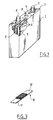
- la figure 1 est une vue en perspective avec arrachement partiel d'un accumulateur prismatique auquel s'applique l'invention,
- la figure 2 est une vue en coupe verticale de l'accumulateur de la figure 1,
- la figure 3 montre en perspective l'électrode supplémentaire conforme à l'invention.
- un mélange d'oxyde de vanadium V2O5 (86 %), de fluorure de polyvinylidène (10 %), de graphite (2 %) et de noir d'acétylène (2 %) est déposé sur une face d'un feuillard d'aluminium 11. 70 mg de ce mélange sont utilisés pour réaliser une électrode 10 de dimensions 35 x 10 mm, laissant ainsi une partie 12 de sa surface non recouverte de matière active. Cette partie est utilisée pour souder par ultra-sons cette électrode 10 dans le fond du boítier 1 d'aluminium, avant l'introduction du faisceau d'électrodes 5, 6.
| +/- | 4,060 V |
| + /BOITIER | 0,610 V |
| BOITIER/- | 3,450 V |
| +/- | 4,030 V |
| +/BOITIER | 0,580 V |
| BOITIER/- | 3,450 V |
| +/- | 3,96 V |
| +/boítier | 0,61 V |
| boítier/- | 3,35 V |
| +/- | 3,93 V |
| +/boítier | 0,58 V |
| boítier/- | 3,35 V |
| +/- | 3,96 V |
| +/boítier | 0,71 V |
| boítier/- | 3,25 V |
| +/- | 3,93 V |
| +/boítier | 0,73 V |
| boítier/- | 3,20 V |
Claims (9)
- Générateur électrochimique comprenant dans un boítier métallique (1) au moins un couple électrochimique constitué d'un séparateur (2), d'une électrode positive (6), d'un séparateur (2) et d'une électrode négative (5), l'ensemble étant imprégné d'électrolyte, les électrodes de même polarité étant réunies par des connexions assurant la mise en parallèle et la liaison avec deux bornes (3, 4) de sortie de courant respectivement positive et négative, isolées du boítier (1), caractérisé en ce qu'il comporte une électrode supplémentaire (10) en contact électrique avec le boítier (1) et imprégnée d'électrolyte, contenant une matière électrochimiquement active choisie de telle sorte que son potentiel électrochimique vis-à-vis de l'électrolyte soit dans le domaine de passivation et de stabilité du métal constituant le boítier (1).
- Générateur selon la revendication 1, caractérisé en ce que le boítier (1) est en aluminium.
- Générateur selon l'une des revendications 1 et 2, caractérisé en ce que l'électrode supplémentaire (10) est constituée par un support d'aluminium (11) recouvert partiellement de matière active, et soudé par ultra-sons sur une partie libre du boítier (1) par sa surface non recouverte (12).
- Générateur selon l'une des revendications précédentes caractérisé en ce que ledit électrolyte est choisi parmi les électrolytes à solvant non aqueux.
- Générateur selon la revendication 4, caractérisé en ce que l'électrode supplémentaire (10) est dans une matière choisie parmi un oxyde ou un sulfure métallique lithié ou non, dont le potentiel par rapport au lithium se situe entre 2 et 3,5 V, comme par exemple V2O5, LixV2O5, MnO2, LixMnO2, MoS2, LixMoS2.
- Générateur selon l'une des revendications 4 et 5, caractérisé en ce que l'électrode positive (6) contient au moins un oxyde lithié d'un métal de transition et l'électrode négative (5) est choisie parmi les graphites et les carbones désordonnés graphitables ou non graphitables, et leurs mélanges.
- Générateur selon l'une des revendications précédentes, caractérisé en ce que ladite électrode supplémentaire (10) est disposée sur le fond du boítier (1) et séparée par un séparateur (2') dudit couple électrochimique.
- Générateur selon l'une des revendications précédentes, caractérisé en ce qu'il s'agit d'un générateur électrochimique de forme prismatique.
- Générateur selon l'une des revendications là 6, caractérisé en ce qu'il s'agit d'un générateur électrochimique de forme cylindrique dans lequel un couple électrochimique, constitué d'une électrode positive, d'une électrode négative et de deux séparateurs, est enroulé en spirale.
Applications Claiming Priority (2)
| Application Number | Priority Date | Filing Date | Title |
|---|---|---|---|
| FR9703543 | 1997-03-24 | ||
| FR9703543A FR2761201B1 (fr) | 1997-03-24 | 1997-03-24 | Generateur a boitier isole protege contre la corrosion |
Publications (2)
| Publication Number | Publication Date |
|---|---|
| EP0867954A1 true EP0867954A1 (fr) | 1998-09-30 |
| EP0867954B1 EP0867954B1 (fr) | 2001-05-02 |
Family
ID=9505102
Family Applications (1)
| Application Number | Title | Priority Date | Filing Date |
|---|---|---|---|
| EP98400668A Expired - Lifetime EP0867954B1 (fr) | 1997-03-24 | 1998-03-23 | Générateur électrochimique à boítier isolé protégé contre la corrosion |
Country Status (6)
| Country | Link |
|---|---|
| US (1) | US6060186A (fr) |
| EP (1) | EP0867954B1 (fr) |
| JP (1) | JPH1167284A (fr) |
| CA (1) | CA2230939A1 (fr) |
| DE (1) | DE69800740T2 (fr) |
| FR (1) | FR2761201B1 (fr) |
Cited By (5)
| Publication number | Priority date | Publication date | Assignee | Title |
|---|---|---|---|---|
| EP0993061A3 (fr) * | 1998-10-05 | 2002-02-13 | NBT GmbH | Pile rechargeable à ions lithium |
| WO2008152482A1 (fr) * | 2007-06-13 | 2008-12-18 | Toyota Jidosha Kabushiki Kaisha | Élément de batterie et alimentation |
| CN101127389B (zh) * | 2006-08-16 | 2011-12-07 | 深圳市比克电池有限公司 | 一种圆柱形锂离子电芯、电池及其制作方法 |
| US20170012323A1 (en) * | 2014-01-31 | 2017-01-12 | Commissariat à l'Energie Atomique et aux Energies Alternatives | Method for regenerating the capacity of an electrochemical lithium battery, and associated battery housing and battery |
| CN108428954A (zh) * | 2018-03-31 | 2018-08-21 | 重庆市紫建电子有限公司 | 一种能快速研究锂离子电池电化学行为的装置及其方法 |
Families Citing this family (21)
| Publication number | Priority date | Publication date | Assignee | Title |
|---|---|---|---|---|
| USD437287S1 (en) | 1999-10-08 | 2001-02-06 | Matsushita Electric Industrial Co., Ltd. | Storage battery |
| US9065145B2 (en) | 2004-10-29 | 2015-06-23 | Medtronic, Inc. | Lithium-ion battery |
| US9077022B2 (en) | 2004-10-29 | 2015-07-07 | Medtronic, Inc. | Lithium-ion battery |
| US7563541B2 (en) * | 2004-10-29 | 2009-07-21 | Medtronic, Inc. | Lithium-ion battery |
| US8105714B2 (en) * | 2004-10-29 | 2012-01-31 | Medtronic, Inc. | Lithium-ion battery |
| US7641992B2 (en) * | 2004-10-29 | 2010-01-05 | Medtronic, Inc. | Medical device having lithium-ion battery |
| US7582387B2 (en) | 2004-10-29 | 2009-09-01 | Medtronic, Inc. | Lithium-ion battery |
| US7337010B2 (en) * | 2004-10-29 | 2008-02-26 | Medtronic, Inc. | Medical device having lithium-ion battery |
| KR101326118B1 (ko) * | 2004-10-29 | 2013-11-06 | 메드트로닉 인코포레이티드 | 리튬 이온 전지의 충전방법 |
| US8980453B2 (en) | 2008-04-30 | 2015-03-17 | Medtronic, Inc. | Formation process for lithium-ion batteries |
| US7662509B2 (en) * | 2004-10-29 | 2010-02-16 | Medtronic, Inc. | Lithium-ion battery |
| US7682745B2 (en) * | 2004-10-29 | 2010-03-23 | Medtronic, Inc. | Medical device having lithium-ion battery |
| US7927742B2 (en) | 2004-10-29 | 2011-04-19 | Medtronic, Inc. | Negative-limited lithium-ion battery |
| CN101048898B (zh) | 2004-10-29 | 2012-02-01 | 麦德托尼克公司 | 锂离子电池及医疗装置 |
| JP2007250413A (ja) * | 2006-03-17 | 2007-09-27 | Gs Yuasa Corporation:Kk | 非水電解液二次電池 |
| JP4384213B2 (ja) * | 2007-09-18 | 2009-12-16 | トヨタ自動車株式会社 | 二次電池の状態検出装置 |
| US9287580B2 (en) | 2011-07-27 | 2016-03-15 | Medtronic, Inc. | Battery with auxiliary electrode |
| US20130149560A1 (en) | 2011-12-09 | 2013-06-13 | Medtronic, Inc. | Auxiliary electrode for lithium-ion battery |
| EP2919299B1 (fr) * | 2014-03-13 | 2017-10-11 | Robert Bosch Gmbh | Conception de cathode à air/lithium améliorée |
| JP7028685B2 (ja) | 2018-03-22 | 2022-03-02 | 本田技研工業株式会社 | 電池構造体 |
| DE102019217296A1 (de) * | 2019-11-08 | 2021-05-12 | Robert Bosch Gmbh | Batteriesystem |
Citations (3)
| Publication number | Priority date | Publication date | Assignee | Title |
|---|---|---|---|---|
| US5260146A (en) * | 1991-11-18 | 1993-11-09 | Motorola, Inc. | Cathodically protected battery having sacrificial anode |
| US5328780A (en) * | 1991-12-16 | 1994-07-12 | Motorola, Inc. | Method for controlling corrosion on a battery with fractionally sized terminals |
| WO1995013629A1 (fr) * | 1993-11-10 | 1995-05-18 | Valence Technology, Inc. | Conteneur de protection pour dispositif electrochimique |
Family Cites Families (5)
| Publication number | Priority date | Publication date | Assignee | Title |
|---|---|---|---|---|
| US3945847A (en) * | 1971-12-28 | 1976-03-23 | Union Carbide Corporation | Coherent manganese dioxide electrodes, process for their production, and electrochemical cells utilizing them |
| DE2826780C2 (de) * | 1978-06-19 | 1986-12-11 | Varta Batterie Ag, 3000 Hannover | Galvanisches Element |
| US4621034A (en) * | 1984-07-31 | 1986-11-04 | Kabushiki Kaisha Toshiba | Sealed metal oxide-hydrogen storage cell |
| US5162169A (en) * | 1987-10-27 | 1992-11-10 | Battery Technologies Inc. | Catalytic recombination of hydrogen in alkaline cells |
| US5601951A (en) * | 1995-09-19 | 1997-02-11 | Battery Engineering, Inc. | Rechargeable lithium ion cell |
-
1997
- 1997-03-24 FR FR9703543A patent/FR2761201B1/fr not_active Expired - Fee Related
-
1998
- 1998-03-23 CA CA002230939A patent/CA2230939A1/fr not_active Abandoned
- 1998-03-23 US US09/045,850 patent/US6060186A/en not_active Expired - Fee Related
- 1998-03-23 EP EP98400668A patent/EP0867954B1/fr not_active Expired - Lifetime
- 1998-03-23 DE DE69800740T patent/DE69800740T2/de not_active Expired - Fee Related
- 1998-03-24 JP JP10075434A patent/JPH1167284A/ja active Pending
Patent Citations (3)
| Publication number | Priority date | Publication date | Assignee | Title |
|---|---|---|---|---|
| US5260146A (en) * | 1991-11-18 | 1993-11-09 | Motorola, Inc. | Cathodically protected battery having sacrificial anode |
| US5328780A (en) * | 1991-12-16 | 1994-07-12 | Motorola, Inc. | Method for controlling corrosion on a battery with fractionally sized terminals |
| WO1995013629A1 (fr) * | 1993-11-10 | 1995-05-18 | Valence Technology, Inc. | Conteneur de protection pour dispositif electrochimique |
Cited By (7)
| Publication number | Priority date | Publication date | Assignee | Title |
|---|---|---|---|---|
| EP0993061A3 (fr) * | 1998-10-05 | 2002-02-13 | NBT GmbH | Pile rechargeable à ions lithium |
| CN101127389B (zh) * | 2006-08-16 | 2011-12-07 | 深圳市比克电池有限公司 | 一种圆柱形锂离子电芯、电池及其制作方法 |
| WO2008152482A1 (fr) * | 2007-06-13 | 2008-12-18 | Toyota Jidosha Kabushiki Kaisha | Élément de batterie et alimentation |
| US8252457B2 (en) | 2007-06-13 | 2012-08-28 | Toyota Jidosha Kabushiki Kaisha | Battery cell and power supply |
| US20170012323A1 (en) * | 2014-01-31 | 2017-01-12 | Commissariat à l'Energie Atomique et aux Energies Alternatives | Method for regenerating the capacity of an electrochemical lithium battery, and associated battery housing and battery |
| CN108428954A (zh) * | 2018-03-31 | 2018-08-21 | 重庆市紫建电子有限公司 | 一种能快速研究锂离子电池电化学行为的装置及其方法 |
| CN108428954B (zh) * | 2018-03-31 | 2020-07-24 | 重庆市紫建电子股份有限公司 | 一种能快速研究锂离子电池电化学行为的装置 |
Also Published As
| Publication number | Publication date |
|---|---|
| DE69800740T2 (de) | 2002-03-07 |
| FR2761201A1 (fr) | 1998-09-25 |
| DE69800740D1 (de) | 2001-06-07 |
| US6060186A (en) | 2000-05-09 |
| FR2761201B1 (fr) | 1999-05-07 |
| CA2230939A1 (fr) | 1998-09-24 |
| JPH1167284A (ja) | 1999-03-09 |
| EP0867954B1 (fr) | 2001-05-02 |
Similar Documents
| Publication | Publication Date | Title |
|---|---|---|
| EP0867954B1 (fr) | Générateur électrochimique à boítier isolé protégé contre la corrosion | |
| EP1493202B1 (fr) | Generateur electrochimique au lithium comprenant au moins une electrode bipolaire avec substrats conducteurs en aluminium ou alliage d'aluminium | |
| EP2269954B1 (fr) | Materiau d'electrode positive pour accumulateur lithium-ion | |
| EP3128598B1 (fr) | Utilisation d'un accumulateur electrochimique au lithium a haute temperature | |
| US20070111099A1 (en) | Primary lithium ion electrochemical cells | |
| WO2015136199A1 (fr) | Batteries lithium-ion a longue duree de vie | |
| EP1544930A2 (fr) | Accumulateur au lithium présentant à la fois un potentiel électrique et une capacité d'insertion du lithium élevés | |
| FR2935544A1 (fr) | Collecteur de courant pour anode de generateur electrochimique primaire au lithium | |
| EP2583333B1 (fr) | Accumulateur electrochimique au lithium a architecture bipolaire specifique | |
| EP2583347B1 (fr) | Accumulateur electrochimique au lithium a architecture bipolaire fonctionnant sur la base d'un couple d'electrodes lithium-soufre | |
| WO2014114864A1 (fr) | Batterie au lithium | |
| Zhao et al. | Electrochemical Stability of Graphite‐Coated Copper in Lithium‐Ion Battery Electrolytes | |
| EP3384550B1 (fr) | Procédé de régénération de capacité d'un accumulateur électrochimique métal-ion, accumulateur associé | |
| EP3297070B1 (fr) | Batterie de type lithium comportant une electrode negative a duree de vie amelioree | |
| FR3095552A1 (fr) | Procédé de formation d’une cellule de batterie Li-ion | |
| EP3898522B1 (fr) | Matériau actif d'électrode négative à base d'hydroxysulfure de fer et de lithium | |
| FR3063389A1 (fr) | Accumulateur electrochimique a architecture bipolaire, a forte tension par cellule electrochimique | |
| WO2014068216A1 (fr) | Procede pour la preparation d'une batterie au lithium | |
| WO2014064361A1 (fr) | Électrode négative pour cellule électrochimique de stockage d'énergie, cellule électrochimique et batterie correspondantes et leur utilisation dans un véhicule électrique | |
| CA3027117A1 (fr) | Procede de preparation d'un supercondensateur hybride de forme cylindrique comportant un metal alcalin ionique | |
| FR3091623A1 (fr) | Cellule electrochimique pour accumulateur au lithium comprenant une electrode negative specifique en lithium metallique et une electrode positive sur collecteur en aluminium | |
| JP2021190222A (ja) | リチウムイオン二次電池の接続構造 | |
| FR3013150A1 (fr) | Cellule electrochimique comprenant deux electrolytes et accumulateur au lithium comprenant une telle cellule electrochimique |
Legal Events
| Date | Code | Title | Description |
|---|---|---|---|
| PUAI | Public reference made under article 153(3) epc to a published international application that has entered the european phase |
Free format text: ORIGINAL CODE: 0009012 |
|
| AK | Designated contracting states |
Kind code of ref document: A1 Designated state(s): DE ES FI FR GB IE IT NL SE |
|
| AX | Request for extension of the european patent |
Free format text: AL;LT;LV;MK;RO;SI |
|
| RAP3 | Party data changed (applicant data changed or rights of an application transferred) |
Owner name: ALCATEL |
|
| RAP3 | Party data changed (applicant data changed or rights of an application transferred) |
Owner name: ALCATEL |
|
| 17P | Request for examination filed |
Effective date: 19990330 |
|
| AKX | Designation fees paid |
Free format text: DE ES FI FR GB IE IT NL SE |
|
| GRAG | Despatch of communication of intention to grant |
Free format text: ORIGINAL CODE: EPIDOS AGRA |
|
| 17Q | First examination report despatched |
Effective date: 20000804 |
|
| GRAG | Despatch of communication of intention to grant |
Free format text: ORIGINAL CODE: EPIDOS AGRA |
|
| GRAH | Despatch of communication of intention to grant a patent |
Free format text: ORIGINAL CODE: EPIDOS IGRA |
|
| GRAH | Despatch of communication of intention to grant a patent |
Free format text: ORIGINAL CODE: EPIDOS IGRA |
|
| GRAA | (expected) grant |
Free format text: ORIGINAL CODE: 0009210 |
|
| AK | Designated contracting states |
Kind code of ref document: B1 Designated state(s): DE ES FI FR GB IE IT NL SE |
|
| PG25 | Lapsed in a contracting state [announced via postgrant information from national office to epo] |
Ref country code: NL Free format text: LAPSE BECAUSE OF FAILURE TO SUBMIT A TRANSLATION OF THE DESCRIPTION OR TO PAY THE FEE WITHIN THE PRESCRIBED TIME-LIMIT Effective date: 20010502 Ref country code: IT Free format text: LAPSE BECAUSE OF FAILURE TO SUBMIT A TRANSLATION OF THE DESCRIPTION OR TO PAY THE FEE WITHIN THE PRESCRIBED TIME-LIMIT;WARNING: LAPSES OF ITALIAN PATENTS WITH EFFECTIVE DATE BEFORE 2007 MAY HAVE OCCURRED AT ANY TIME BEFORE 2007. THE CORRECT EFFECTIVE DATE MAY BE DIFFERENT FROM THE ONE RECORDED. Effective date: 20010502 Ref country code: IE Free format text: LAPSE BECAUSE OF FAILURE TO SUBMIT A TRANSLATION OF THE DESCRIPTION OR TO PAY THE FEE WITHIN THE PRESCRIBED TIME-LIMIT Effective date: 20010502 Ref country code: FI Free format text: LAPSE BECAUSE OF FAILURE TO SUBMIT A TRANSLATION OF THE DESCRIPTION OR TO PAY THE FEE WITHIN THE PRESCRIBED TIME-LIMIT Effective date: 20010502 |
|
| GBT | Gb: translation of ep patent filed (gb section 77(6)(a)/1977) |
Effective date: 20010502 |
|
| REF | Corresponds to: |
Ref document number: 69800740 Country of ref document: DE Date of ref document: 20010607 |
|
| REG | Reference to a national code |
Ref country code: IE Ref legal event code: FG4D Free format text: FRENCH |
|
| PG25 | Lapsed in a contracting state [announced via postgrant information from national office to epo] |
Ref country code: SE Free format text: LAPSE BECAUSE OF FAILURE TO SUBMIT A TRANSLATION OF THE DESCRIPTION OR TO PAY THE FEE WITHIN THE PRESCRIBED TIME-LIMIT Effective date: 20010802 |
|
| NLV1 | Nl: lapsed or annulled due to failure to fulfill the requirements of art. 29p and 29m of the patents act | ||
| PG25 | Lapsed in a contracting state [announced via postgrant information from national office to epo] |
Ref country code: ES Free format text: LAPSE BECAUSE OF FAILURE TO SUBMIT A TRANSLATION OF THE DESCRIPTION OR TO PAY THE FEE WITHIN THE PRESCRIBED TIME-LIMIT Effective date: 20011130 |
|
| REG | Reference to a national code |
Ref country code: GB Ref legal event code: IF02 |
|
| REG | Reference to a national code |
Ref country code: IE Ref legal event code: FD4D |
|
| PLBE | No opposition filed within time limit |
Free format text: ORIGINAL CODE: 0009261 |
|
| STAA | Information on the status of an ep patent application or granted ep patent |
Free format text: STATUS: NO OPPOSITION FILED WITHIN TIME LIMIT |
|
| 26N | No opposition filed | ||
| PGFP | Annual fee paid to national office [announced via postgrant information from national office to epo] |
Ref country code: GB Payment date: 20040318 Year of fee payment: 7 Ref country code: DE Payment date: 20040318 Year of fee payment: 7 |
|
| PGFP | Annual fee paid to national office [announced via postgrant information from national office to epo] |
Ref country code: FR Payment date: 20040323 Year of fee payment: 7 |
|
| REG | Reference to a national code |
Ref country code: GB Ref legal event code: 732E |
|
| PG25 | Lapsed in a contracting state [announced via postgrant information from national office to epo] |
Ref country code: GB Free format text: LAPSE BECAUSE OF NON-PAYMENT OF DUE FEES Effective date: 20050323 |
|
| PG25 | Lapsed in a contracting state [announced via postgrant information from national office to epo] |
Ref country code: DE Free format text: LAPSE BECAUSE OF NON-PAYMENT OF DUE FEES Effective date: 20051001 |
|
| GBPC | Gb: european patent ceased through non-payment of renewal fee |
Effective date: 20050323 |
|
| PG25 | Lapsed in a contracting state [announced via postgrant information from national office to epo] |
Ref country code: FR Free format text: LAPSE BECAUSE OF NON-PAYMENT OF DUE FEES Effective date: 20051130 |
|
| REG | Reference to a national code |
Ref country code: FR Ref legal event code: ST Effective date: 20051130 |