EP0868079A2 - Leistungssteuerungsschemata für Gerät mit konvergierenden Funktionalitäten - Google Patents
Leistungssteuerungsschemata für Gerät mit konvergierenden Funktionalitäten Download PDFInfo
- Publication number
- EP0868079A2 EP0868079A2 EP98302385A EP98302385A EP0868079A2 EP 0868079 A2 EP0868079 A2 EP 0868079A2 EP 98302385 A EP98302385 A EP 98302385A EP 98302385 A EP98302385 A EP 98302385A EP 0868079 A2 EP0868079 A2 EP 0868079A2
- Authority
- EP
- European Patent Office
- Prior art keywords
- components
- functional mode
- state
- power
- mode
- Prior art date
- Legal status (The legal status is an assumption and is not a legal conclusion. Google has not performed a legal analysis and makes no representation as to the accuracy of the status listed.)
- Withdrawn
Links
Images



Classifications
-
- G—PHYSICS
- G06—COMPUTING OR CALCULATING; COUNTING
- G06F—ELECTRIC DIGITAL DATA PROCESSING
- G06F1/00—Details not covered by groups G06F3/00 - G06F13/00 and G06F21/00
- G06F1/26—Power supply means, e.g. regulation thereof
- G06F1/32—Means for saving power
- G06F1/3203—Power management, i.e. event-based initiation of a power-saving mode
-
- G—PHYSICS
- G06—COMPUTING OR CALCULATING; COUNTING
- G06F—ELECTRIC DIGITAL DATA PROCESSING
- G06F1/00—Details not covered by groups G06F3/00 - G06F13/00 and G06F21/00
- G06F1/26—Power supply means, e.g. regulation thereof
- G06F1/32—Means for saving power
- G06F1/3203—Power management, i.e. event-based initiation of a power-saving mode
- G06F1/3234—Power saving characterised by the action undertaken
- G06F1/3287—Power saving characterised by the action undertaken by switching off individual functional units in the computer system
-
- H—ELECTRICITY
- H04—ELECTRIC COMMUNICATION TECHNIQUE
- H04N—PICTORIAL COMMUNICATION, e.g. TELEVISION
- H04N21/00—Selective content distribution, e.g. interactive television or video on demand [VOD]
- H04N21/40—Client devices specifically adapted for the reception of or interaction with content, e.g. set-top-box [STB]; Operations thereof
- H04N21/41—Structure of client; Structure of client peripherals
- H04N21/4104—Peripherals receiving signals from specially adapted client devices
- H04N21/4113—PC
-
- H—ELECTRICITY
- H04—ELECTRIC COMMUNICATION TECHNIQUE
- H04N—PICTORIAL COMMUNICATION, e.g. TELEVISION
- H04N5/00—Details of television systems
- H04N5/63—Generation or supply of power specially adapted for television receivers
-
- H—ELECTRICITY
- H04—ELECTRIC COMMUNICATION TECHNIQUE
- H04N—PICTORIAL COMMUNICATION, e.g. TELEVISION
- H04N21/00—Selective content distribution, e.g. interactive television or video on demand [VOD]
- H04N21/40—Client devices specifically adapted for the reception of or interaction with content, e.g. set-top-box [STB]; Operations thereof
- H04N21/41—Structure of client; Structure of client peripherals
- H04N21/426—Internal components of the client ; Characteristics thereof
-
- Y—GENERAL TAGGING OF NEW TECHNOLOGICAL DEVELOPMENTS; GENERAL TAGGING OF CROSS-SECTIONAL TECHNOLOGIES SPANNING OVER SEVERAL SECTIONS OF THE IPC; TECHNICAL SUBJECTS COVERED BY FORMER USPC CROSS-REFERENCE ART COLLECTIONS [XRACs] AND DIGESTS
- Y02—TECHNOLOGIES OR APPLICATIONS FOR MITIGATION OR ADAPTATION AGAINST CLIMATE CHANGE
- Y02D—CLIMATE CHANGE MITIGATION TECHNOLOGIES IN INFORMATION AND COMMUNICATION TECHNOLOGIES [ICT], I.E. INFORMATION AND COMMUNICATION TECHNOLOGIES AIMING AT THE REDUCTION OF THEIR OWN ENERGY USE
- Y02D10/00—Energy efficient computing, e.g. low power processors, power management or thermal management
Definitions
- the present invention relates generally to consumer electronics devices with converged functionalities. More particularly, the present invention relates to a power management system for personal computer/television ("PC/TV's"), which power management system causes a PC/TV in which it is incorporated to operate in a "user friendly” manner.
- PC/TV's personal computer/television
- PC/TV personal computers and televisions, which are combined (i.e., whose functionalities are converged) in "PC/TV's," have a number of common attributes.
- PC/TV developers are generally eager to exploit components underlying these attributes twice, rather than duplicate them. For example, it makes sense to use commonly required screen display elements for both the PC and TV sides of PC/TV, rather than to build a PC/TV with two screen displays. Notwithstanding the above-mentioned "eagerness" on the part of PC/TV developers, PC's and TV's behave differently in a number of respects, which makes "double exploitation” difficult.
- Still yet another complicating factor resides in the inherent difficulty of designing a remote control for both a PC/TV that is effective but foolproof (i.e., not capable of triggering or attempting to trigger a nonsensical or improper action).
- a system for managing power in an electronic apparatus which electronic apparatus can operate in at least two different modes and, further, which electronic apparatus can exist in at least two different states; said system comprising:
- an electronic system capable of operating in a first functional mode and in a second functional mode, said system comprising first functional mode components; second functional mode components a power distribution subsystem (134,150) for selectively empowering said first functional mode components and said second functional mode components; and a power distribution control subsystem (185), which power distribution control subsystem comprises an actuating mechanism for empowering said first functional mode components and for empowering said second functional mode components.
- an electronic system capable of operating in a first functional mode and in a second functional mode, said system comprising first functional mode components operable to provide personal computer mode functionality; second functional mode components operable to provide television receiver mode functionality a common display operably coupled to both said first and said second functional mode components a power distribution subsystem for selectively empowering said first functional mode components and said second functional mode components; and a power distribution control subsystem, which comprises a manually operable actuator for enabling and disabling empowering of said first functional mode components and for enabling and disabling empowering of said second functional mode components, and a power management subsystem to selectively transition operating states of said functional mode components between predetermined power consumption levels based on activity of said components during operation to provide personal computer mode functionality, said power management subsystem being disabled during operation of said second functional mode components to provide television receiver mode functionality.
- the present invention overcomes the shortcoming and deficiency mentioned above by providing a converged electronics device such as a PC/TV including a power distribution control subsystem, which power distribution control subsystem relies on an actuating mechanism for user controlled empowering (of, e.g., the PC and TV sides of the PC/TV).
- the provided power management control subsystem can accomplish some or all of the following:
- FIG. 1 there is shown a block diagram of a PC/TV system, designated generally by reference numeral 100, utilizing the teachings of the present invention.
- the purpose of the block diagram set forth in FIG. 1 is to illustrate an exemplary environment in which an embodiment of the present invention may be practised.
- the block diagram in FIG. 1 is not necessarily intended to schematically represent specific modules of hardware or any particular data or control paths therebetween.
- the PC/TV system 100 includes a display monitor 110 operable to receive and display thereon television signals received by a receiver 105.
- the receiver 105 is capable of receiving conventional television signals in any standard form (e.g., VHF or UHF).
- the PC/TV system 100 is provided with a sub-system 115 having a processor unit 120 coupled to a storage unit 125.
- the sub-system 115 may preferably contain a data communication port 140 for enabling data communication between the PC/TV system 100 and a network 135, and an access control unit 145 for controlling viewer/user access to the sub-system 115 or possibly even to the entire PC/TV system 100 itself.
- PC/TV system 100 provides both TV (via monitor 110 and receiver 105 interaction) and PC (via monitor and subsystem 115 interaction) functionalities.
- the network 135 can be understood to be any network, for example, a Local Area Network, a Metropolitan Area Network, a Wide Area Network, or the Internet.
- the access control unit 145 may be of the type that accepts an alphanumeric code associated with an authorized viewer/user.
- the display system 100 may preferably contain such hardware modules as a TV tuner board for converting signals received by the receiver 105 to a scan VGA (or higher resolution) signal for display on the display monitor 100, CD-ROM players, floppy drives, printer ports, wired or wireless keyboards, or the like.
- the PC/TV system 100 may preferably be operable using a remote control unit (“RCU") 130 that is provided with a power on/off button 132 and a PC/TV mode change button.
- RCU remote control unit
- the PC/TV system 100 is also preferably powered by a power unit 134 conventionally connected to components (e.g., elements 105 and 110) to be empowered via conventional power lines (not shown).
- System 150 comprises at least one layer - and more often, multiple layers - of software that support power management in computers with power manageable hardware.
- System 150 effectively defines a hardware independent software interface between hardware-specific power management software and an operating system power management policy driver. System 150 also effectively masks the details of the hardware, allowing higher-level software to manage power without necessarily having any knowledge of the hardware interface.
- the major software components of system 150 are the power management BIOS itself 175, the power management interface 180, the power management driver module 185, power management aware applications 190, and power management-aware device driver modules 165.
- the BIOS 175 is the software interface to the motherboard and its power managed devices and components.
- the interface 180 is the interaction between the driver module 185 and the BIOS 175.
- the module 185 is the primary controller of power management policy; module 185 communicates directly to power management-aware applications 190.
- the applications 190 interface with the module 185 to monitor and/or control power management.
- the device drivers 165 provide a power management software interface for add-in devices, i.e., any device that is not on the motherboard (such as an add-in or PCMCIA card).
- the power management BIOS 175 (which is generally supplied by OEM's and is specific to the hardware platform) manages power in the background based on device activity.
- the power management device 185 participates in managing power levels via function calls to the power management software interface 180. Both methods cause transitions from one power management-defined state to another, the states themselves being defined by the power level of the controlled devices and the CPU.
- a primary function of the present invention is to provide systems and methods whereby a PC/TV power management subsystem contributes to causing a PC/TV to look and act (that is, "feel") like a consumer electronic television when in TV mode. Likewise, the PC/TV should "feel” like a normal desktop computer when in PC mode. Towards this end, when in PC mode the PC/TV should enter “standby” and “suspend” modes, as discussed above, as most PC computer systems in the market today do.
- This functionality can be provided by software resident in either the BIOS 175 or driver module 185, both of which are depicted in FIG. 2. Alternatively, an independent block of software can be incorporated into the scheme depicted in FIG.
- PC/TV operation in TV mode there are a number of aspects to PC/TV operation in TV mode that contribute to the proper "feel" mentioned above.
- one possible aspect of an embodiment of a PC/TV according to the teachings of the present invention is the placing of the monitor (element 110 in FIG. 1) into a special overscan mode where the video picture takes up the entire screen and the PC desktop is hidden.
- the monitor (element 110 in FIG. 1)
- TV mode power management is disabled in embodiments of the present invention, ensuring the PC/TV does not enter a "standby" or “suspend” state because of a time-out.
- TV mode may be made the default mode in embodiments of the present invention, so that the PC/TV goes directly into TV mode upon start up.
- the common control for a PC/TV is a remote control unit (element 130 in FIG. 1).
- a remote control unit (element 130 in FIG. 1).
- Certain aspects of embodiments of the present invention are embodied in the structure and operation of this unit.
- the PC/TV when a user hits the power button (element 132 in FIG. 1) on the remote control 130 to turn off the TV, the PC/TV is put into a "soft-off state," which is effectively the "suspend state" described above with reference to FIG. 2. That is, the PC/TV is not completely powered off. This is done so that when the user presses the power button 132 again to turn the unit on, response is nearly instantaneous, because the PC/TV does not need to completely reboot.
- Embodiments of the present invention are designed to disable components selectively and to boot into the last power state.
- a power outage when the PC/TV reboots it will be placed back into "soft-off” after Windows (or whatever operating system is in use) starts, if that was the state it was in before being powered off.
- Another situation is one in which the PC/TV is in "soft-off,” and some event (such as a programmed VCR recording or TV program guide download) occurs that inclines to drive the PC/TV to return to full power.
- such events are allowed to occur, but the monitor remains in a low power state, and the system video remains muted. This ensures that a PC/TV does not turn on, "full blast,” in the middle of the night when a VCR activates recording of a program.
- This aspect is possible because such "events” are timed events, registered with the software that monitors power on the system (see FIG. 2).
- this software sets a flag before going into “ soft-off state, " notifying the power management BIOS not to power up the monitor (or audio or whatever) when coming out of a suspend (or “soft-off”) state.
- the above-mentioned power management software is responsible to bring the monitor (e.g., element 110 in FIG. 1) or other elements back to full power when the user presses the power button (e.g., element 132 in FIG. 1).
- a flag is not saved through a reboot, however.
- video is not lost.
- a PC/TV according to the teachings of the present invention is put into the last power state when entering its operating system, e.g., Windows, after a reboot, the system has video until it has booted into Windows, when it will be placed back into "soft-off. " Therefore, the system has video before Windows starts, and the user may intervene before Windows is started if he or she wants to work under, e.g., DOS.
- FIGs. 3-5 provide some additional insight into software logic in embodiments of the present invention.
- FIG. 3 depicts, in flow chart form, a power management initialization procedure according to the teachings of the present invention.
- This procedure begins with a power on self test (step 200), followed by a loading of the operating system (e.g. Windows) and television control (e.g., Navigator) software (step 210), and further followed by an installation of power management software (step 220).
- the software determines whether a sleeping bit is set in a registry to determine the system state (i.e., the system refers to means to determine whether it should power up into a soft-off state, as discussed above, whether those means involve bits, flags, or whatever indicating signals) at step 230. If yes, the PC/TV enters suspend mode (step 240). If not, the PC/TV boots normally (step 250).
- the registry mentioned above with respect to step 230 in FIG. 3 can, in embodiments of the present invention, effectively be a register for button press messages. This is possible because most important user-controlled state changes in embodiments of the present invention occur as a result of a actuator switch (e.g., power button press). Being so limited, control is facilitated.
- a actuator switch e.g., power button press
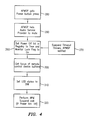
- FIG. 4 there is depicted, in flow chart form, a power management power-off procedure according to the teachings of the present invention.
- This procedure involves setting an off bit in a "registry" (discussed above) and indicating locking of the monitor (step 260).
- This step is effected either if a suspend time out occurs (when the PC/TV is in a PC mode only) (step 270), or when the power button is pressed when the PC/TV is on (step 280).
- the power management software also causes audio muting (step 290). In either event, in fact, muting occurs.
- the power management software gains focus of the power device buttons from remote control software (step 300), visually indicates the power-off state (step 310), and advises all other software, e.g., the PC power management software depicted in FIG. 2, of the state change (step 320).
- FIG. 5 there is shown a block diagram chart of a return from suspend mode procedure according to the teachings of the present invention.
- the BIOS wakes up the system and sends a wake-up signal to the PC (step 360). It is important to note that the BIOS does not here turn on the monitor if locked off.
- different events occur depending upon the source of the "wake up” call. If the "wake up" call comes from the remote control 130 (in the form of a power button press) (step 370), the power up is immediately recognized as valid by setting a valid power up flag or like validating and indicating means (step 380).
- the PC/TV power management software checks to see whether the system has been validated to power up (step 400). If yes, the system is powered up (step 410). If not, the PC/TV power management software looks to remote control software to see if the power button was pressed (step 420). If yes, the system wakes up (step 410). If not, the system remains in suspended mode. The reason for this is so that one can virtually ensure that a PC/TV does not inadvertently power up.
- a PC/TV can be made user friendly because a single power button press can switch a computer between an "on” and “suspended” (v. "off") state. This causes the computer, if desired, to appear to power up instantaneously. That same power button defaults to power up the TV, which makes the overall PC/TV system seem like an especially empowered TV, which is the primary piece of electronics equipment it is replacing.
- the system when the system powers down totally (e.g., because power failed), it checks to see what state it was in before losing power (which is especially important if the system was in the suspend mode) and it returns to that state. This ensures that if power is lost in the middle of the night, the system does not power up with the TV blaring.
- Embodiments of the present invention also detect and distinguish between modes; when in TV mode the system is not allowed to time out power down. When the system is powered up to do a VCR record or the like, the monitor and audio components are kept “off,” unless the user instructs otherwise, to ensure the system is not empowered to a higher level than is desired or is desirable. Also, since power management is limited to a single button, e.g., button 132 (which can be recessed or otherwise protected), the chances of inadvertent tripping the system on are reduced.
- buttons 132 While the embodiment described in detail above includes a button 132, embodiments of the present invention could just as easily employ a switch, knob, dial, or other such "actuating" subsystem. Accordingly, the term "button” as used herein should be understood to encompass all such means for switching between two, or more, states.
Landscapes
- Engineering & Computer Science (AREA)
- Theoretical Computer Science (AREA)
- General Engineering & Computer Science (AREA)
- Signal Processing (AREA)
- General Physics & Mathematics (AREA)
- Multimedia (AREA)
- Physics & Mathematics (AREA)
- Computer Hardware Design (AREA)
- Computing Systems (AREA)
- Television Receiver Circuits (AREA)
- Power Sources (AREA)
- Supply And Distribution Of Alternating Current (AREA)
- Remote Monitoring And Control Of Power-Distribution Networks (AREA)
- Calculators And Similar Devices (AREA)
Applications Claiming Priority (2)
| Application Number | Priority Date | Filing Date | Title |
|---|---|---|---|
| US08/829,437 US6285406B1 (en) | 1997-03-28 | 1997-03-28 | Power management schemes for apparatus with converged functionalities |
| US829437 | 1997-03-28 |
Publications (2)
| Publication Number | Publication Date |
|---|---|
| EP0868079A2 true EP0868079A2 (de) | 1998-09-30 |
| EP0868079A3 EP0868079A3 (de) | 1999-07-28 |
Family
ID=25254544
Family Applications (1)
| Application Number | Title | Priority Date | Filing Date |
|---|---|---|---|
| EP98302385A Withdrawn EP0868079A3 (de) | 1997-03-28 | 1998-03-27 | Leistungssteuerungsschemata für Gerät mit konvergierenden Funktionalitäten |
Country Status (4)
| Country | Link |
|---|---|
| US (1) | US6285406B1 (de) |
| EP (1) | EP0868079A3 (de) |
| JP (1) | JPH10293629A (de) |
| TW (1) | TW502151B (de) |
Cited By (2)
| Publication number | Priority date | Publication date | Assignee | Title |
|---|---|---|---|---|
| WO2001095616A3 (en) * | 2000-06-07 | 2002-03-28 | Gemstar Dev Ltd | An enhanced television system |
| EP2549360A1 (de) * | 2011-07-21 | 2013-01-23 | Samsung Electronics Co., Ltd. | Anzeigevorrichtung, Host-Vorrichtung, Anzeigesystem, Verfahren zur Steuerung der Anzeigevorrichtung, und das Anzeigesystem |
Families Citing this family (40)
| Publication number | Priority date | Publication date | Assignee | Title |
|---|---|---|---|---|
| JP3929553B2 (ja) * | 1997-06-11 | 2007-06-13 | 株式会社フィリップスエレクトロニクスジャパン | データ放送受信機の受信制御方法 |
| KR100910125B1 (ko) * | 1998-06-17 | 2009-08-03 | 코닌클리케 필립스 일렉트로닉스 엔.브이. | 장치 및 주변장치들의 시스템 |
| EP1046211A1 (de) * | 1998-09-25 | 2000-10-25 | Koninklijke Philips Electronics N.V. | Signalverarbeitungsvorrichtung mit mitteln zur reduzierung des energieverbrauchs |
| US6831704B1 (en) * | 1999-07-30 | 2004-12-14 | Grass Valley (U.S.) Inc. | Linking external devices to switcher transitions |
| KR100753089B1 (ko) * | 1999-12-20 | 2007-08-31 | 삼성전자주식회사 | 다중신호원을 갖는 영상표시기기의 제어방법 |
| JP4712934B2 (ja) * | 2000-03-06 | 2011-06-29 | ソニー株式会社 | 情報信号再生装置 |
| JP2001325206A (ja) * | 2000-05-12 | 2001-11-22 | Canon Inc | 表示装置、表示システム及びコンピュータ読み取り可能な記憶媒体 |
| US7411631B1 (en) * | 2000-05-31 | 2008-08-12 | Intel Corporation | Power management for processor-based appliances |
| US6760852B1 (en) | 2000-08-31 | 2004-07-06 | Advanced Micro Devices, Inc. | System and method for monitoring and controlling a power-manageable resource based upon activities of a plurality of devices |
| JP3568470B2 (ja) * | 2000-09-21 | 2004-09-22 | 三洋電機株式会社 | シェル型データ端末装置 |
| US7865922B2 (en) * | 2000-10-03 | 2011-01-04 | Sony Corporation | Low-power broadcast receiver |
| KR100399143B1 (ko) * | 2000-10-19 | 2003-09-26 | 삼성전자주식회사 | 컴퓨터 및 그 컴퓨터의 tv신호 저장방법 |
| US7196737B1 (en) * | 2002-01-25 | 2007-03-27 | Sige Semiconductor Inc. | Method of using control loops in a broadband cable tuner |
| US7139017B2 (en) * | 2002-01-29 | 2006-11-21 | Koninklijke Philips Electronics N.V. | Method and system for obtaining the best picture quality in a scarce-power device |
| US7346017B2 (en) * | 2002-03-05 | 2008-03-18 | Intel Corporation | Partially integrating wireless components of processor-based systems |
| US7538826B2 (en) * | 2002-12-06 | 2009-05-26 | Thomson Licensing | Tuner power dissipation reduction in a standby mode |
| TW200416521A (en) * | 2003-02-17 | 2004-09-01 | Elitegroup Computer Systems Co Ltd | TV image converter switching on and off computer through multimedia remote control |
| JP2004282876A (ja) * | 2003-03-14 | 2004-10-07 | Orion Denki Kk | 複合電子機器の電源制御装置 |
| US7137023B2 (en) * | 2003-06-04 | 2006-11-14 | 02 Micro, Inc. | Auxiliary alarm clock system for a personal computer |
| US20040257332A1 (en) * | 2003-06-23 | 2004-12-23 | Shlomo Turgeman | Personal computer and television display system |
| TWI353784B (en) * | 2004-02-06 | 2011-12-01 | Hon Hai Prec Ind Co Ltd | A circuit and method for implementing the function |
| US20050182978A1 (en) * | 2004-02-17 | 2005-08-18 | Anderson Jason M. | Always ready computing device |
| JP4833560B2 (ja) * | 2004-02-17 | 2011-12-07 | マイクロソフト コーポレーション | 常時動作可能なコンピューティングデバイス |
| JP4303634B2 (ja) * | 2004-04-15 | 2009-07-29 | 富士通株式会社 | 画像出力装置および情報処理装置 |
| JP2005316176A (ja) * | 2004-04-28 | 2005-11-10 | Toshiba Corp | 電子機器及び表示制御方法 |
| JP4153462B2 (ja) * | 2004-05-31 | 2008-09-24 | インターナショナル・ビジネス・マシーンズ・コーポレーション | 表示方式切替装置、表示方式切替方法、表示方式切替プログラム、及びそのプログラムを記憶したコンピュータ読み取り可能な記憶媒体 |
| EP1734759A3 (de) * | 2005-06-13 | 2009-04-22 | LG Electronics Inc. | Vorrichtung und Verfahren zur Leistungsverwaltung einer Anzeigevorrichtung |
| US20070011715A1 (en) * | 2005-07-07 | 2007-01-11 | Wei-Yi Hsuan | Instant switching method for a computer-television system |
| JP4805633B2 (ja) * | 2005-08-22 | 2011-11-02 | 任天堂株式会社 | ゲーム用操作装置 |
| JP4461084B2 (ja) * | 2005-08-24 | 2010-05-12 | シャープ株式会社 | 複数の待機電力モードを有するテレビジョン受信機 |
| JP4247221B2 (ja) * | 2005-08-31 | 2009-04-02 | 富士通株式会社 | 信号分離回路および信号送信回路 |
| KR100667842B1 (ko) * | 2005-12-05 | 2007-01-11 | 삼성전자주식회사 | 디지털tv의 전원을 효율적으로 제어하는 방법 및 이를위한 디지털 tv |
| US7669063B2 (en) * | 2006-06-15 | 2010-02-23 | Top Victory Electronics (Taiwan) Co., Ltd. | Method of power down control for a display device, and power down controller for implementing the method |
| JP2008005168A (ja) * | 2006-06-21 | 2008-01-10 | Toshiba Corp | 情報処理装置および表示制御方法 |
| JP2009088701A (ja) * | 2007-09-27 | 2009-04-23 | Fuji Xerox Co Ltd | 情報処理装置、プログラム、及び保安システム |
| CN102447962B (zh) | 2010-09-30 | 2016-03-30 | 联想(北京)有限公司 | 一种具有电视功能的终端及显示方法 |
| US20120137147A1 (en) * | 2010-11-30 | 2012-05-31 | Stewart Myers | Method of powering down a computer system from a remote power button event |
| JP2013140516A (ja) * | 2012-01-05 | 2013-07-18 | Sony Corp | 情報処理装置および表示制御方法 |
| JP2014216785A (ja) * | 2013-04-24 | 2014-11-17 | 株式会社東芝 | 電子機器、表示方法及びプログラム |
| US20160299557A1 (en) * | 2015-04-07 | 2016-10-13 | Control Module, Inc. | Automatic Activating System for Computer Manual Power Control Switch |
Family Cites Families (42)
| Publication number | Priority date | Publication date | Assignee | Title |
|---|---|---|---|---|
| US4628541A (en) | 1983-08-10 | 1986-12-09 | International Business Machines Corporation | Infra-red data communications system for coupling a battery powered data entry device to a microcomputer |
| US4658247A (en) | 1984-07-30 | 1987-04-14 | Cornell Research Foundation, Inc. | Pipelined, line buffered real-time color graphics display system |
| US4775928A (en) | 1985-10-30 | 1988-10-04 | Westinghouse Electric Corp. | Hand-held wireless computer controller system |
| US4954819A (en) | 1987-06-29 | 1990-09-04 | Evans & Sutherland Computer Corp. | Computer graphics windowing system for the display of multiple dynamic images |
| JPH03204224A (ja) * | 1990-01-05 | 1991-09-05 | Pioneer Electron Corp | オーディオ装置のスリープタイマー |
| US5291275A (en) | 1990-06-20 | 1994-03-01 | International Business Machines Incorporated | Triple field buffer for television image storage and visualization on raster graphics display |
| US5249164A (en) * | 1990-06-27 | 1993-09-28 | Koz Mark C | Digital color tv for personal computers |
| GB2250668B (en) | 1990-11-21 | 1994-07-20 | Apple Computer | Tear-free updates of computer graphical output displays |
| US5283819A (en) * | 1991-04-25 | 1994-02-01 | Compuadd Corporation | Computing and multimedia entertainment system |
| US5291187A (en) | 1991-05-06 | 1994-03-01 | Compaq Computer Corporation | High-speed video display system |
| US5355490A (en) * | 1991-06-14 | 1994-10-11 | Toshiba America Information Systems, Inc. | System and method for saving the state for advanced microprocessor operating modes |
| JP3316592B2 (ja) | 1991-06-17 | 2002-08-19 | サン・マイクロシステムズ・インコーポレーテッド | 二重バッファ・出力ディスプレー・システム、および、第1のフレーム・バッファおよび第2のフレーム・バッファ相互間の切り換えを行う方法 |
| US5392023A (en) * | 1991-09-06 | 1995-02-21 | Motorola, Inc. | Data communication system with automatic power control |
| US5410713A (en) * | 1992-01-02 | 1995-04-25 | Smith Corona/Acer | Power-management system for a computer |
| JPH06110590A (ja) | 1992-07-07 | 1994-04-22 | Fujitsu General Ltd | パーソナルコンピュータ |
| US5623533A (en) * | 1992-08-18 | 1997-04-22 | Hitachi, Ltd. | Mobile communication end device with low power operation mode |
| US5821924A (en) * | 1992-09-04 | 1998-10-13 | Elonex I.P. Holdings, Ltd. | Computer peripherals low-power-consumption standby system |
| US5745105A (en) * | 1993-03-31 | 1998-04-28 | Samsung Electronics Co., Ltd. | Power saving apparatus and method of a monitor |
| CN1124531A (zh) * | 1993-04-16 | 1996-06-12 | 数据翻译公司 | 在计算机显示器上显示二次抽样视频图象 |
| US5502462A (en) | 1993-11-01 | 1996-03-26 | The 3Do Company | Display list management mechanism for real-time control of by-the-line modifiable video display system |
| US5625882A (en) * | 1994-03-01 | 1997-04-29 | Motorola, Inc. | Power management technique for determining a device mode of operation |
| US5572698A (en) | 1994-04-18 | 1996-11-05 | Rolm Company | System and method for allocating memory resources where the category of a memory resource determines where on a circular stack a pointer to the memory resource is placed |
| US5555032A (en) | 1994-05-09 | 1996-09-10 | Weltrend Semiconductor, Inc. | Integrated circuit for economizing power consumption of a monitor by using two reference values for discrminating the input signal |
| KR970003439B1 (ko) * | 1994-05-19 | 1997-03-18 | 삼성전자 주식회사 | 모니터의 전원 제어회로 |
| US5530879A (en) | 1994-09-07 | 1996-06-25 | International Business Machines Corporation | Computer system having power management processor for switching power supply from one state to another responsive to a closure of a switch, a detected ring or an expiration of a timer |
| US5539391A (en) | 1994-09-22 | 1996-07-23 | Gemstar Development Corporation | Remote controller for controlling turning appliances on and off |
| DE69635409T2 (de) * | 1995-03-06 | 2006-07-27 | Intel Corp., Santa Clara | Ein rechnersystem mit unbewachter auf-anfrage-verfügbarkeit |
| US5675364A (en) * | 1995-04-28 | 1997-10-07 | Dell Usa, L.P. | Display wakeup control |
| JPH08340500A (ja) | 1995-06-13 | 1996-12-24 | Matsushita Electric Ind Co Ltd | コンピュータ内蔵テレビ受像機 |
| KR0141751B1 (ko) * | 1995-06-13 | 1998-06-15 | 구자홍 | 영상신호 처리기의 취침예약 확인방법 |
| JP3045948B2 (ja) * | 1995-07-05 | 2000-05-29 | インターナショナル・ビジネス・マシーンズ・コーポレイション | 情報処理装置及びその制御方法 |
| US5650831A (en) * | 1995-07-17 | 1997-07-22 | Gateway 2000, Inc. | Adjustable power remote control drive |
| US5745391A (en) * | 1995-09-13 | 1998-04-28 | Topor; Yakov | Apparatus for and method of turning on and shutting off a computing device |
| JPH09135399A (ja) * | 1995-11-09 | 1997-05-20 | Sony Corp | 画像表示装置及びパワーセーブモード表示方法 |
| US5610663A (en) | 1996-01-17 | 1997-03-11 | Acer Peripherals, Inc. | Multi-frequency displaying device for displaying both television and personal computer video signals |
| US5838720A (en) * | 1996-02-23 | 1998-11-17 | Teletransactions, Inc. | Transceiver control with sleep mode operation |
| FI102701B1 (fi) * | 1996-05-06 | 1999-01-29 | Nokia Display Products Oy | Näytön tehonsäästömenetelmä |
| US5790201A (en) * | 1996-08-08 | 1998-08-04 | Antos; Jeffrey David | Television and computer capability integration |
| US5819156A (en) * | 1997-01-14 | 1998-10-06 | Compaq Computer Corp. | PC/TV usage tracking and reporting device |
| US5844552A (en) * | 1997-01-23 | 1998-12-01 | Zenith Electronics Corporation | Communication of character data in a web television |
| US6011592A (en) * | 1997-03-31 | 2000-01-04 | Compaq Computer Corporation | Computer convergence device controller for managing various display characteristics |
| JP3112862B2 (ja) * | 1997-06-17 | 2000-11-27 | 日本電気アイシーマイコンシステム株式会社 | 情報処理装置 |
-
1997
- 1997-03-28 US US08/829,437 patent/US6285406B1/en not_active Expired - Lifetime
-
1998
- 1998-03-12 TW TW087103658A patent/TW502151B/zh not_active IP Right Cessation
- 1998-03-27 JP JP10081354A patent/JPH10293629A/ja active Pending
- 1998-03-27 EP EP98302385A patent/EP0868079A3/de not_active Withdrawn
Cited By (2)
| Publication number | Priority date | Publication date | Assignee | Title |
|---|---|---|---|---|
| WO2001095616A3 (en) * | 2000-06-07 | 2002-03-28 | Gemstar Dev Ltd | An enhanced television system |
| EP2549360A1 (de) * | 2011-07-21 | 2013-01-23 | Samsung Electronics Co., Ltd. | Anzeigevorrichtung, Host-Vorrichtung, Anzeigesystem, Verfahren zur Steuerung der Anzeigevorrichtung, und das Anzeigesystem |
Also Published As
| Publication number | Publication date |
|---|---|
| JPH10293629A (ja) | 1998-11-04 |
| US6285406B1 (en) | 2001-09-04 |
| EP0868079A3 (de) | 1999-07-28 |
| TW502151B (en) | 2002-09-11 |
Similar Documents
| Publication | Publication Date | Title |
|---|---|---|
| US6285406B1 (en) | Power management schemes for apparatus with converged functionalities | |
| US5978923A (en) | Method and apparatus for a computer power management function including selective sleep states | |
| US6711004B2 (en) | Portable electronic apparatus for selectively operating in normal mode and tablet mode | |
| WO2005020052A2 (en) | Computer system power policy adjustment in response to a user request | |
| US7020785B2 (en) | Method for automatically verifying security code of computer system operated by remote controller | |
| JP5284504B1 (ja) | 電子機器、電子機器の制御方法、制御プログラム及び記録媒体 | |
| US6038670A (en) | Computer display switching circuit and method thereof | |
| EP3477425B1 (de) | Computersystem, client-vorrichtung und anzeigevorrichtung | |
| US20060022992A1 (en) | Information processing apparatus and method for controlling display luminance | |
| US20080298528A1 (en) | Information processing apparatus and method of controlling the same | |
| JP2014102789A (ja) | 電子機器、電源制御方法、及びプログラム | |
| US7779283B2 (en) | Computer and method for realizing household appliance application with low power consumption | |
| EP2079230A2 (de) | Verfahren zum Betrieb einer TV-Empfängerkarte | |
| US6851065B2 (en) | System and method for executing resume tasks during a suspend routine | |
| JP2007516631A5 (de) | ||
| US6272630B1 (en) | Method and device for reserving wake-up functions of computer system after power loss | |
| EP1338947A1 (de) | Leistungszustanduntersystem und Verfahren zur Leistungszustandänderung eines ausgewählten Rechnersystems | |
| EP1946215A1 (de) | Direkt-berechnungs-erlebnis | |
| US7631205B2 (en) | Information processing apparatus and control method | |
| US8539219B2 (en) | Information access apparatus, program storage medium and method | |
| KR101441684B1 (ko) | 동영상 플레이 모드를 구비한 컴퓨터 및 이의 동영상플레이시 시스템의 모드 설정방법 | |
| JP2001125556A (ja) | 電子機器 | |
| KR100672931B1 (ko) | 모니터 전원 버튼 조작에 의해 전원 상태 변환이 가능한컴퓨터 시스템 및 그것의 전원관리 방법 | |
| US20070083777A1 (en) | Information processing apparatus and power on control method | |
| US7137023B2 (en) | Auxiliary alarm clock system for a personal computer |
Legal Events
| Date | Code | Title | Description |
|---|---|---|---|
| PUAI | Public reference made under article 153(3) epc to a published international application that has entered the european phase |
Free format text: ORIGINAL CODE: 0009012 |
|
| AK | Designated contracting states |
Kind code of ref document: A2 Designated state(s): AT BE CH DE DK ES FI FR GB GR IE IT LI LU MC NL PT SE |
|
| AX | Request for extension of the european patent |
Free format text: AL;LT;LV;MK;RO;SI |
|
| PUAL | Search report despatched |
Free format text: ORIGINAL CODE: 0009013 |
|
| AK | Designated contracting states |
Kind code of ref document: A3 Designated state(s): AT BE CH DE DK ES FI FR GB GR IE IT LI LU MC NL PT SE |
|
| AX | Request for extension of the european patent |
Free format text: AL;LT;LV;MK;RO;SI |
|
| AKX | Designation fees paid | ||
| REG | Reference to a national code |
Ref country code: DE Ref legal event code: 8566 |
|
| STAA | Information on the status of an ep patent application or granted ep patent |
Free format text: STATUS: THE APPLICATION IS DEEMED TO BE WITHDRAWN |
|
| 18D | Application deemed to be withdrawn |
Effective date: 20000129 |