EP0871545B1 - Dispositifs de type manchon a base de silicium pour reactions chimiques - Google Patents
Dispositifs de type manchon a base de silicium pour reactions chimiques Download PDFInfo
- Publication number
- EP0871545B1 EP0871545B1 EP96921649A EP96921649A EP0871545B1 EP 0871545 B1 EP0871545 B1 EP 0871545B1 EP 96921649 A EP96921649 A EP 96921649A EP 96921649 A EP96921649 A EP 96921649A EP 0871545 B1 EP0871545 B1 EP 0871545B1
- Authority
- EP
- European Patent Office
- Prior art keywords
- silicon
- reaction
- reaction chamber
- chemical reactor
- window
- Prior art date
- Legal status (The legal status is an assumption and is not a legal conclusion. Google has not performed a legal analysis and makes no representation as to the accuracy of the status listed.)
- Expired - Lifetime
Links
Images




Classifications
-
- G—PHYSICS
- G01—MEASURING; TESTING
- G01N—INVESTIGATING OR ANALYSING MATERIALS BY DETERMINING THEIR CHEMICAL OR PHYSICAL PROPERTIES
- G01N21/00—Investigating or analysing materials by the use of optical means, i.e. using sub-millimetre waves, infrared, visible or ultraviolet light
- G01N21/62—Systems in which the material investigated is excited whereby it emits light or causes a change in wavelength of the incident light
- G01N21/66—Systems in which the material investigated is excited whereby it emits light or causes a change in wavelength of the incident light electrically excited, e.g. electroluminescence
- G01N21/69—Systems in which the material investigated is excited whereby it emits light or causes a change in wavelength of the incident light electrically excited, e.g. electroluminescence specially adapted for fluids, e.g. molten metal
-
- B—PERFORMING OPERATIONS; TRANSPORTING
- B01—PHYSICAL OR CHEMICAL PROCESSES OR APPARATUS IN GENERAL
- B01J—CHEMICAL OR PHYSICAL PROCESSES, e.g. CATALYSIS OR COLLOID CHEMISTRY; THEIR RELEVANT APPARATUS
- B01J19/00—Chemical, physical or physico-chemical processes in general; Their relevant apparatus
- B01J19/0046—Sequential or parallel reactions, e.g. for the synthesis of polypeptides or polynucleotides; Apparatus and devices for combinatorial chemistry or for making molecular arrays
-
- B—PERFORMING OPERATIONS; TRANSPORTING
- B01—PHYSICAL OR CHEMICAL PROCESSES OR APPARATUS IN GENERAL
- B01J—CHEMICAL OR PHYSICAL PROCESSES, e.g. CATALYSIS OR COLLOID CHEMISTRY; THEIR RELEVANT APPARATUS
- B01J19/00—Chemical, physical or physico-chemical processes in general; Their relevant apparatus
- B01J19/0093—Microreactors, e.g. miniaturised or microfabricated reactors
-
- B—PERFORMING OPERATIONS; TRANSPORTING
- B01—PHYSICAL OR CHEMICAL PROCESSES OR APPARATUS IN GENERAL
- B01L—CHEMICAL OR PHYSICAL LABORATORY APPARATUS FOR GENERAL USE
- B01L7/00—Heating or cooling apparatus; Heat insulating devices
- B01L7/52—Heating or cooling apparatus; Heat insulating devices with provision for submitting samples to a predetermined sequence of different temperatures, e.g. for treating nucleic acid samples
-
- G—PHYSICS
- G01—MEASURING; TESTING
- G01N—INVESTIGATING OR ANALYSING MATERIALS BY DETERMINING THEIR CHEMICAL OR PHYSICAL PROPERTIES
- G01N21/00—Investigating or analysing materials by the use of optical means, i.e. using sub-millimetre waves, infrared, visible or ultraviolet light
- G01N21/01—Arrangements or apparatus for facilitating the optical investigation
- G01N21/03—Cuvette constructions
- G01N21/0332—Cuvette constructions with temperature control
-
- G—PHYSICS
- G01—MEASURING; TESTING
- G01N—INVESTIGATING OR ANALYSING MATERIALS BY DETERMINING THEIR CHEMICAL OR PHYSICAL PROPERTIES
- G01N21/00—Investigating or analysing materials by the use of optical means, i.e. using sub-millimetre waves, infrared, visible or ultraviolet light
- G01N21/75—Systems in which material is subjected to a chemical reaction, the progress or the result of the reaction being investigated
- G01N21/76—Chemiluminescence; Bioluminescence
-
- B—PERFORMING OPERATIONS; TRANSPORTING
- B01—PHYSICAL OR CHEMICAL PROCESSES OR APPARATUS IN GENERAL
- B01J—CHEMICAL OR PHYSICAL PROCESSES, e.g. CATALYSIS OR COLLOID CHEMISTRY; THEIR RELEVANT APPARATUS
- B01J2219/00—Chemical, physical or physico-chemical processes in general; Their relevant apparatus
- B01J2219/00781—Aspects relating to microreactors
- B01J2219/00819—Materials of construction
- B01J2219/00824—Ceramic
- B01J2219/00828—Silicon wafers or plates
-
- B—PERFORMING OPERATIONS; TRANSPORTING
- B01—PHYSICAL OR CHEMICAL PROCESSES OR APPARATUS IN GENERAL
- B01J—CHEMICAL OR PHYSICAL PROCESSES, e.g. CATALYSIS OR COLLOID CHEMISTRY; THEIR RELEVANT APPARATUS
- B01J2219/00—Chemical, physical or physico-chemical processes in general; Their relevant apparatus
- B01J2219/00781—Aspects relating to microreactors
- B01J2219/00851—Additional features
- B01J2219/00853—Employing electrode arrangements
-
- B—PERFORMING OPERATIONS; TRANSPORTING
- B01—PHYSICAL OR CHEMICAL PROCESSES OR APPARATUS IN GENERAL
- B01J—CHEMICAL OR PHYSICAL PROCESSES, e.g. CATALYSIS OR COLLOID CHEMISTRY; THEIR RELEVANT APPARATUS
- B01J2219/00—Chemical, physical or physico-chemical processes in general; Their relevant apparatus
- B01J2219/00781—Aspects relating to microreactors
- B01J2219/00873—Heat exchange
-
- B—PERFORMING OPERATIONS; TRANSPORTING
- B01—PHYSICAL OR CHEMICAL PROCESSES OR APPARATUS IN GENERAL
- B01J—CHEMICAL OR PHYSICAL PROCESSES, e.g. CATALYSIS OR COLLOID CHEMISTRY; THEIR RELEVANT APPARATUS
- B01J2219/00—Chemical, physical or physico-chemical processes in general; Their relevant apparatus
- B01J2219/00781—Aspects relating to microreactors
- B01J2219/00889—Mixing
-
- B—PERFORMING OPERATIONS; TRANSPORTING
- B01—PHYSICAL OR CHEMICAL PROCESSES OR APPARATUS IN GENERAL
- B01J—CHEMICAL OR PHYSICAL PROCESSES, e.g. CATALYSIS OR COLLOID CHEMISTRY; THEIR RELEVANT APPARATUS
- B01J2219/00—Chemical, physical or physico-chemical processes in general; Their relevant apparatus
- B01J2219/00781—Aspects relating to microreactors
- B01J2219/00891—Feeding or evacuation
-
- B—PERFORMING OPERATIONS; TRANSPORTING
- B01—PHYSICAL OR CHEMICAL PROCESSES OR APPARATUS IN GENERAL
- B01J—CHEMICAL OR PHYSICAL PROCESSES, e.g. CATALYSIS OR COLLOID CHEMISTRY; THEIR RELEVANT APPARATUS
- B01J2219/00—Chemical, physical or physico-chemical processes in general; Their relevant apparatus
- B01J2219/00781—Aspects relating to microreactors
- B01J2219/00905—Separation
- B01J2219/00912—Separation by electrophoresis
-
- B—PERFORMING OPERATIONS; TRANSPORTING
- B01—PHYSICAL OR CHEMICAL PROCESSES OR APPARATUS IN GENERAL
- B01J—CHEMICAL OR PHYSICAL PROCESSES, e.g. CATALYSIS OR COLLOID CHEMISTRY; THEIR RELEVANT APPARATUS
- B01J2219/00—Chemical, physical or physico-chemical processes in general; Their relevant apparatus
- B01J2219/00781—Aspects relating to microreactors
- B01J2219/00925—Irradiation
- B01J2219/00934—Electromagnetic waves
- B01J2219/00936—UV-radiations
-
- B—PERFORMING OPERATIONS; TRANSPORTING
- B01—PHYSICAL OR CHEMICAL PROCESSES OR APPARATUS IN GENERAL
- B01J—CHEMICAL OR PHYSICAL PROCESSES, e.g. CATALYSIS OR COLLOID CHEMISTRY; THEIR RELEVANT APPARATUS
- B01J2219/00—Chemical, physical or physico-chemical processes in general; Their relevant apparatus
- B01J2219/00781—Aspects relating to microreactors
- B01J2219/00925—Irradiation
- B01J2219/00934—Electromagnetic waves
- B01J2219/00945—Infrared light
-
- B—PERFORMING OPERATIONS; TRANSPORTING
- B01—PHYSICAL OR CHEMICAL PROCESSES OR APPARATUS IN GENERAL
- B01J—CHEMICAL OR PHYSICAL PROCESSES, e.g. CATALYSIS OR COLLOID CHEMISTRY; THEIR RELEVANT APPARATUS
- B01J2219/00—Chemical, physical or physico-chemical processes in general; Their relevant apparatus
- B01J2219/00781—Aspects relating to microreactors
- B01J2219/0095—Control aspects
- B01J2219/00952—Sensing operations
-
- B—PERFORMING OPERATIONS; TRANSPORTING
- B81—MICROSTRUCTURAL TECHNOLOGY
- B81C—PROCESSES OR APPARATUS SPECIALLY ADAPTED FOR THE MANUFACTURE OR TREATMENT OF MICROSTRUCTURAL DEVICES OR SYSTEMS
- B81C3/00—Assembling of devices or systems from individually processed components
-
- G—PHYSICS
- G01—MEASURING; TESTING
- G01N—INVESTIGATING OR ANALYSING MATERIALS BY DETERMINING THEIR CHEMICAL OR PHYSICAL PROPERTIES
- G01N21/00—Investigating or analysing materials by the use of optical means, i.e. using sub-millimetre waves, infrared, visible or ultraviolet light
- G01N21/01—Arrangements or apparatus for facilitating the optical investigation
- G01N21/03—Cuvette constructions
- G01N2021/0346—Capillary cells; Microcells
-
- G—PHYSICS
- G01—MEASURING; TESTING
- G01N—INVESTIGATING OR ANALYSING MATERIALS BY DETERMINING THEIR CHEMICAL OR PHYSICAL PROPERTIES
- G01N21/00—Investigating or analysing materials by the use of optical means, i.e. using sub-millimetre waves, infrared, visible or ultraviolet light
- G01N21/01—Arrangements or apparatus for facilitating the optical investigation
- G01N21/03—Cuvette constructions
- G01N21/05—Flow-through cuvettes
Definitions
- the present invention relates to instruments for chemical reaction control and detection of participating reactants and resultant products, particularly to integrated microfabricated instruments for performing microscale chemical reactions involving precise control of parameters of the reactions, and more particularly to silicon-based sleeve devices as reaction chambers for chemical reactions and which can be utilized in large arrays of individual chambers for a high-throughput microreaction unit.
- Microfabrication technologies are now well known and include sputtering, electrodeposition, low-pressure vapor deposition, photolithography, and etching.
- Microfabricated devices are usually formed on crystalline substrates, such as silicon and gallium arsenide, but may be formed on non-crystalline materials, such as glass or certain polymers.
- the shapes of crystalline devices can be precisely controlled since etched surfaces are generally crystal planes, and crystalline materials may be bonded by processes such as fusion at elevated temperatures, anodic bonding, or field-assisted methods.
- Monolithic microfabrication technology now enables the production of electrical, mechanical, electromechanical, optical, chemical and thermal devices, including pumps, valves, heaters, mixers, and detectors for microliter to nanoliter quantities of gases, liquids, and solids.
- optical waveguide probes and ultrasonic flexural-wave sensors can now be produced on a microscale.
- integrated microinstruments may be applied to biochemical, inorganic, or organic chemical reactions to perform biomedical and environmental diagnostics, as well as biotechnological processing and detection.
- the small volumes and high surface-area to volume ratios of microfabricated reaction instruments provide a high level of control of the parameters of a reaction.
- Heaters may produce temperature cycling or ramping; while sonochemical and sonophysical changes in conformational structures may be produced by ultrasound transducers; and polymerizations may be generated by incident optical radiation.
- Synthesis reactions and especially synthesis chain reactions such as the polymerase chain reaction (PCR), are particularly well-suited for microfabrication reaction instruments.
- PCR can selectively amplify a single molecule of DNA (or RNA) of an organism by a factor of 10 6 to 10 9 .
- This well-established procedure requires the repetition of heating (denaturing) and cooling (annealing) cycles in the presence of an original DNA target molecule, specific DNA primers, deoxynucleotide triphosphates, and DNA polymerase enzymes and cofactors. Each cycle produces a doubling of the target DNA sequence, leading to an exponential accumulation of the target sequence.
- the PCR procedure involves: 1) processing of the sample to release target DNA molecules into a crude extract; 2) addition of an aqueous solution containing enzymes, buffers deoxyribonucleotide triphosphates (dNTPS), and oligonucleotide primers; 3) thermal cycling of the reaction mixture between two or three temperatures (e.g., 90-96, 72, and 37-55°C); and 4) detection of amplified DNA.
- dNTPS deoxyribonucleotide triphosphates
- oligonucleotide primers e.g., oligonucleotide primers
- a problem with standard PCR laboratory techniques is that the PCR reactions may be contaminated or inhibited by the introduction of a single contaminant molecule of extraneous DNA, such as those from previous experiments, or other contaminants, during transfers of reagents from one vessel to another.
- PCR reaction volumes used in standard laboratory techniques are typically on the order of 50 microliters.
- a thermal cycle typically consists of four stages: heating a sample to a first temperature, maintaining the sample at the first temperature, cooling the sample to a second lower temperature, and maintaining the temperature at that lower temperature.
- each of these four stages of a thermal cycle requires about one minute, and thus to complete forty cycles, for example, is about three hours.
- the present invention is directed to a particular geometry of silicon-based micro-reactors that have shown to be very efficient in terms of power and temperature uniformity.
- the micro-reactor of this invention which is broadly considered as a silicon-based sleeve device for chemical reactions, can be effectively utilized in either of the reactor systems of the above-referenced copending applications.
- the present invention utilizes doped polysilicon for heating and bulk silicon for convective cooling.
- the present invention allows the multi-parameter, simultaneous changing of detection window size, in situ detection, reaction volumes, thermal uniformity, and heating and cooling rates. In addition, it enables the use of large arrays of the individual reaction chambers for a high-throughput microreaction unit.
- a further object of the invention is to provide a silicon-based sleeve device for chemical reactors.
- a further object of the invention is to provide a chemical reaction chamber that combines to use of doped polysilicon and bulk silicon.
- a further object of the invention is to provide chemical reaction chambers that combines the use of doped polysilicon and bulk silicon to provide flexibility in thermal and optical properties allowing the implementation into small and large instruments.
- Another object of the invention is to provide a silicon-based reaction sleeve that combines a critidal ratio of silicon and silicon nitride to the volume of material to be heated (e.g., liquid) in order to provide uniform heating, yet low power requirement.
- Another object of the invention is to provide a silicon-based reaction sleeve that will allow the introduction of a secondary tube (e.g., plastic) into the reaction sleeve that contains the reaction mixture, thereby deviating any potential materials incompatiblity issues.
- a secondary tube e.g., plastic
- Another object of the invention is to provide an array of individual reaction chambers for a high-throughput microreaction unit.
- Another object of the invention is to provide a hand-held instrument that uses silicon-based sleeve-type reaction chambers with integrated heaters.
- Another object of the invention is to provide a reaction chamber with automated detection and feedback control.
- Another object of the invention is to provide for artificial intelligence control of reactions in a reaction chamber.
- Another object of the invention is to provide pulse-width modulation as a feedback control for reaction chamber.
- the invention is a silicon-based sleeve for chemical reactions.
- the invention encompasses a chemical reaction chamber that combines the use of polysilicon for heating and bulk silicon for convective cooling.
- the reaction sleeve combines a critical ratio of silicon and silicon nitride to the volume of material to be heated in order to provide uniform heating, yet low power requirements.
- the reaction sleeve also allows for the introduction therein of a secondary tube that contains the reaction mixture thereby alleviating any potential material incompatibility.
- the present invention is an extension of the above-referenced integrated micofabricated reactor of above-referenced U.S Patent No. 5,639,423.
- the silicon-based sleeve reaction chamber can be utilized in chemical reaction systems for synthesis or processing of organic, inorganic, or biochemical reactions, such as the polymerase chain reaction (PCR) and/or other DNA reactions (such as the ligose chain reaction), or other synthetic, thermal-cycling-based reactions.
- PCR polymerase chain reaction
- DNA reactions such as the ligose chain reaction
- the present invention is a micro-fabricated silicon-based sleeve chemical reaction chamber as claimed in claim 1, herein, that combines heaters, such as doped polysilicon for heating and bulk silicon for conventive cooling.
- the microreaction chambers can be used in an array for a high-throughput microreaction unit, or in a hand-held unit. It combines a critical ratio of silicon and silicon nitride to the volume of material to be heated (e.g., liquid) in order to provide uniform heating, yet low power requirements. It also will allow the introduction of a secondary tube (e.g., plastic) into the reaction sleeve that contains the reaction mixture thereby alleviating any potential materials incompatibility issues.
- a secondary tube e.g., plastic
- the present invention utilizes a particular geometry of silicon-based micro-reactors that have been shown to be very efficient in terms of power and temperature uniformity.
- the particular embodiment of the microfabricated reactor described has been experimentally used as a thermal cycling instrument for use in the polymerase chain reaction (PCR) and other chemical reactions, and has shown to be superior to present commercial instruments on thermally-driven chemical reactors.
- the silicon-based sleeve reaction chamber of this invention can be utilized in place of the reaction chamber of the microfabricated system of above-referenced copending Application Serial No. 07/938,106; and can be utilized with the integrated heater and detection arrangement of above-referenced copending Application Serial No. 08/(IL-9121), and thus constitutes an extension of the microfabricated chemical reaction systems in these copending applications.
- Figure 1 illustrates an embodiment of a microfabricated chemical reaction instrument generally indicated at 10, shown above a recessed section thereof, indicated generally at 11, in a power source/control system of the microfabricated reaction instrument, generally indicated at 12.
- a hypodermic needle 13 is shown inserting a sample through a silicone rubber window 14 into the reaction instrument 10.
- the reaction is controlled and powered by: induction coupling, such as that between coil L CL in the instrument 10 and a magnetic coil 15; by capacitive coupling, such as that between the plates of capacitor C 3 and plates 16 and 17; and by electromagnetic coupling between a resonant circuit, see Figure 2, in instrument 10 and a radio frequency antenna 18.
- FIG. 2 A schematic of the instrument 10 of Figure 1 is illustrated in Figure 2, and comprises three reagent chambers 19, 20 and 21, which, for example, may contain the DNA primers, the polymerase, and the nucleotides and any detection-tag molecules, such as magnetic beads.
- the target DNA molecule is placed in reagent chamber 19 by insertion of a hypodermic needle 13 ( Figure 1) or the like through a silicone rubber or other type material window 14.
- the reactants chambers 19, 20 and 21 are respectively connected by channels 22, 23, and 24, having narrow midsections, not shown, to a reaction chamber 25.
- the chambers 19-21 and 25 have a volume ranging from microliter to nanoliters.
- the channels 22-24 are equipped with Lamb-wave pumps LW 1 , LW 2 and LW 3 , respectively, for pumping reactants in chambers 19-21 through channels 22-24 in the direction of the arrows into reaction chamber 25.
- the Lamb-wave pumps may be located on any wall, or on multiple walls, of the channels 22-24.
- the Lamb-wave pumps LW 1 , LW 2 , and LW 3 are connected respectively to capacitors C 1 , C 2 , and C 3 .
- the surface tension across the narrow midsections of the channels 22-24 prevents the reactants in chambers 19-21 from flowing into reaction chamber 25 until pumping is initiated.
- the inner surfaces of the channels 22-24 may be treated to raise the surface tension thereby further inhibiting flow of the reagents when the Lamb-wave pumps are not activated.
- the reaction chamber 25 may be equipped with a Lamb-wave transducer LW C and a heater H C .
- the Lamb-wave transducer LW C is connected to inductor L CL (also shown in Figure 1).
- the heater H C is connected to a resonant circuit consisting of an inductor L CH and a capacitor C CH .
- the Lamb-wave transducer LW C acts as an agitator, mixer, or sonochemical inducer, as indicated by the connected arrows 26 in chamber 25.
- a channel 27 connects the reaction chamber 25 to a detection chamber 28.
- the channel 27 is equipped with a Lamb-wave pump LW DP , which is connected to a resonant circuit consisting of an inductor L DP and a capacitor C DP .
- the detection chamber 28 is equipped with a Lamb-wave sensor LW D , which is connected to a capacitor C D .
- Lamb-wave transducers have high mechanical Q values and can therefore be powered by only a narrow range of alternating voltage frequencies.
- the Lamb-wave pumps (LW 1 , LW 2 , LW 3 ) and Lamb-wave sensor (LW D ) are powered capacitively by generating an electric field between the plates (such as plates 16 and 17 of Figure 1 for example) at the resonant frequencies of the Lamb-wave transducers (LW 1 , LW 2 , LW 3 , and LW D ).
- the transducers have high Q values; only when the frequency of the imposed field is near the resonant frequency of a transducer do the transducer vibrate with any substantial magnitude.
- the Lamb-wave mixing chamber transducer LW C is provided by an alternating frequency magnetic field generated by the coil (15 in Figure 1) at the mechanical resonant frequency of the transducer LW C .
- the heater H C and the Lamb-wave pump LW DP are activated by directing an electromagnetic wave from the antenna (18 in Figure 1) to the resonant circuit C CH and L CH , and resonant circuit C DP and L DP , respectively.
- the frequency of the incident electromagnetic radiation must correspond to the mechanical resonant frequency of the transducer LW DP , to activate the pump LW DP .
- the frequency of the incident electromagnetic radiation must correspond to the resonant frequency of the electrical elements CH, L CH and H C to activate the heater H C .
- a PCR reaction for example, is initiated by pumping the reagents in the chamber 19, 20 and 21 along the directions of the arrows through respective channels 22, 23 and 24 to the reaction chamber 25 by activating pump LW 1 , LW 2 , and LW 3 .
- a series of about twenty to forty thermal cycles, for example, are then initiated, and during each cycle the temperature of the reactants in the reaction chamber 25 goes from 55°C to 96°C, and back to 55°C, for example.
- the temperature of the reaction chamber 25 is determined by the power of the incident electromagnetic signal at the frequency corresponding to the resonant frequency of the circuit composed of the capacitor C CH , and the inductor L CH , together with the heater H C .
- the Lamb-wave device LW C of the reaction chamber 25 acts as an agitator or mixer, as indicated by arrows 26, to mix the reagents and promote the reaction.
- the contents of the reaction chamber 25 are pumped by the Lamb-wave perm LW DP through channel 27 in the direction of the arrow to the detection chamber 38, which utilizes a Lamb-wave sensor LW D .
- the detection chamber 28 may be provided with an optical window and testing may be performed by fluorescence-based or absorption-based optical spectroscopy.
- Figure 3 illustrates a heating/detection arrangement that can be incorporated into the microfabricated reactor of Figures 1 and 2.
- a chemical reaction chamber such as a PCR chamber, of a miniaturized, microfabricated instrument, generally indicated 30, is illustrated in cross-section, with chamber 31 being formed in a housing 32, constructed of Pyrex for example, and having silicon inserts 33 and 34 therein, with an inlet 35 and an outlet 36.
- Energy from two different energy (light) sources is directed onto the housing 32, one source 37 being infrared (IR) source, and the second source 38 being an ultra-violet (UV) source.
- the IR source 17 applies heat more uniformly through the bulk of the solution in chamber 31.
- the UV source 18 induces fluorescence of the reaction products in the visible (Vis) spectrum, which can be detected by a visible (Vis) detector 39 located external of the housing 32 defining reaction chamber 31.
- Housing 32 must be constructed of a material transparent to UV and/or the visible spectrum.
- the present invention involves a microfabricated reactor generally indicated at 40 which includes a silicon-based sleeve as a chemical reaction chamber, generally indicated at 41, constructed of two bonded silicon parts, and which utilizes doped polysilicon for heating and bulk silicon for convective cooling, as described in greater detail hereinafter.
- the sleeve 41 includes a slot or opening 42 into which reaction fluid, indicated at 43, from a hypodermic needle 44 is inserted into the reaction chamber, or into which a secondary tube 45 containing a reaction mixture 46 may be inserted.
- the tube 45 is constructed of plastic, for example, or other material which is inert with respect to the reaction mixture, thereby alleviating any potential material incompatibility issues.
- the sleeve is also provided with an opening 47 in which is located an optical window 48, made, for example, of silicon nitride, silicon dioxide, or polymers.
- the silicon sleeve reaction chamber 41 includes doped polysilicon for heating and bulk silicon for convective cooling, and combines a critical ratio of silicon and silicon nitride to the volume of material to be heated (e.g., liquid) in order to provide uniform heating, yet low power requirements.
- Figure 6 is an enlarged view of microreaction chamber, similar to the Figure 4 embodiment, but utilizing two windows.
- the reaction chamber of Figure 6, generally indicated at 50 is composed of two silicon wafers or substrates 51 and 52 bonded together as indicated at 53, and configured to define a slot or opening 54 therein.
- Each of wafers 51 and 52 include a layer of silicon nitride 51' and 52' which define a window, indicated generally at 55 and 56, respectively.
- Window 55 in wafer 51, constructed of silicon nitride is provided with a heater 57 having electrical leads 58 and contacts 59 which extend along the edges of heater 57 to provide uniform heating.
- Window 56 in wafer 52 has a heater not shown in Figure 6 but which is secured by metal contacts 60 and 61 as illustrated in either of Figures 7 and 8.
- the silicon nitride layers 51' and 52' are very thin (about 1 ⁇ m) and vapor-deposited onto the bulk silicon wafers 51 and 52.
- the silicon nitride only becomes a window, as indicated at 55 and 56, when the bulk silicon wafers 51 and 52 are etched away to form the opening or slot 54.
- Heater 57 is transparent to energy passing through window 55, for example.
- Figure 7 is a greatly enlarged view of an embodiment of a section of silicon wafer 52 and window 56, as indicated by the circle 62 in Figure 6.
- the section of the silicon wafer 52 indicated at 63, is composed of bulk or single crystal silicon and is in contact with a low (100 to 500 MPa) stress silicon nitride membrane or window 64 (52' in Figure 6) which in turn is in contact with a doped polysilicon heater 65 and metal contact 60 and 61.
- the Figure 7 embodiment comprises an isolated heater version fixed window.
- Figure 8 is a greatly enlarged view of another embodiment of a section of silicon wafer 52 and window 56, as indicated by the circle 62.
- the sections of the silicon substate 52, indicated at 66 are composed of bulk or single crystal silicon.
- a low (100 to 500 MPa) stress silicon nitride member or window 69 (52' in Figure 6) is in contact with silicon section 66, a doped polysilicon heater 70 is in contact with window membrane 69 and metal contacts 71 are mounted to heater 70.
- the Figure 8 embodiment comprises a non-isolated heater version.
- the window size relative to the chamber can be varied to ensure thermal uniformity and optical access to the reaction chamber.
- the silicon wafers or substrates 51 and 52 may have a length of 5 to 50mm, width of 2 to 10mm, thickness of 0.1 to 1.0mm, with the slot 54 having a cross-sectional area of 5 to 500mm 2 .
- Slot 54 which shown to be of a six-sided configuration, may be a round, oblong, square, rectangular, or other configuration.
- Windows 55 and 56 may have a length of 0.1 to 1mm, width of 0.1 to 50mm, thickness of 0.1 to 10 ⁇ m, and in addition to silicon nitride, may be composed of silicon dioxide, silicon, or polymers.
- the doped polysilicon heater 65 of Figure 7 may have a thickness of 0.05 to 5 ⁇ m, with the heater 70 of Figure 8 having a thickness of 0.05 to 5 ⁇ m.
- the metal contacts 60-61 and 61' of Figures 6 and 7 may be composed of gold or aluminum, with a thickness of 0.01 to 5 ⁇ m, with the metal contact 71 of Figure having a thickness of 0.01 to 5 ⁇ m and composed of gold or aluminum.
- the heater 57 in silicon wafer or substrate 51 is composed of doped polysilicon having a thickness of 0.05 to 5 ⁇ m, with the electrical leads and contacts 58 and 59 being composed of gold or aluminum.
- Figure 9 is an embodiment of a miniature thermal cycling, battery operated, hand-held low-power, feedback-controlled instrument for PCR that uses microfabricated, silicon-based reaction chambers, such as those of Figures 4 and 6, the development of which addressed thermal uniformity and temperature precision of the reaction chambers, temperature ramp rates of the chambers, and biocompatibility of the materials in contact with the reagents.
- the hand-held, battery-operated instrument coined "PCR man", generally indicated at 75, comprises a pressure-fit electrical contact controller holder, or housing 76, which for example may be 3 x 5 inches having a control-face-plate 77 with various indicators thereon, including a "status" window 78.
- the holder 76 is provided with a thermocouple-based temperature feedback control circuitry, heater electronics, computer interface, and power source connector, as described in greater detail hereinafter.
- the holder 76 is provided with batteries, indicated at 79, such as four nine-volt batteries, and at the upper end is provided with slots 80 for insertion of reaction chambers inside the holder (three slots shown), and into which silicon-based reaction chambers 81, 82, 83 and 84, with integrated heaters (as shown in Figure 6) are inserted as indicated by the arrow 85.
- the reaction chambers 81-84 may when constructed contain different reagents or chemicals, and can be selectively inserted into the hand-held instrument 75 via slots 80 in holder or controller 76.
- This instrument can be used to rapidly and repetitively provide controlled thermal cycles to the reaction mixture.
- the thermal conductivity properties of the silicon or similar semiconducting substrate help speed up the thermal rise and fall times, and allow low power operation.
- silicon is unique in its thermal properties, i.e., high thermal conductivity, a combination of silicon, silicon nitride, silicon dioxide, polymers and other materials would provide a combination of thermal conductivity and insulation that would allow thermal uniformity and low power operation.
- FIG. 6 The particular embodiment, such as Figure 6, of a microfabricated reactor described can be used as a thermal cycling instrumentation for use inthe PCR and other chemical reactions, biochemical processes, microbiological processes, and incubators. As shown hereinafter the reaction chamber of this invention is superior to present commercial instruments used in thermally-driven chemical reactions.
- Photolithographic patterns for reaction chamber and subsequent processing steps were taken in the following order: 1) the silicon nitride was reactive ion etched (RIE) over the reaction chamber area, 2) the SCS was etched to the silicon nitride backside defining the chamber volume, 3) the wafer was patterned and the silicon nitride is chemically etched away everywhere except over the nitride membrane or left over the entire surface, depending upon the reaction chamber design, 4) the remaining silicon nitride membrane (side opposite the chamber) was LPCVD deposited with polycrystalline silicon (polysilicon) to a thickness of 3000 ⁇ , 5) the polysilicon was then high temperature doped with boron to a resistivity of 50-200 ohms per square, and 6) either aluminum or gold thin-film metal contacts were deposited defining the heater geometry.
- RIE reactive ion etched
- Each wafer potentially contains many reaction chambers, depending upon geometry and volume desired.
- the etched depression in each wafer constitutes one-half of a dual-heater reaction chamber. Processed wafers are subsequently bound together forming an enclosed chamber with heaters on both sides.
- reaction chambers can be bonded together by depositing a thin film of low-temperature-curing polyimide between the two wafers directly or other bonding techniques such as eutectic metal bonding.
- a high precision computer-controlled silicon saw was used in each design to cut out each dual-heater chamber. The chambers were then rinsed repeatedly with de-ionized water and dried prior to treatment with silane.
- the reaction chambers were inserted into a pressure-fit electrical contact holder that was part of the plexiglas backboard of the electronics components making up the controller.
- the controller electronics could be either/or anologue or digital and could use processes such as pulse-width modulation as a feedback control mechanism.
- the backboard was 3 inches by 5 inches and consisted of the thermocouple-based temperature feedback control circuitry, heater electronics, computer interface, and power source connector. The circuitry was designed to work from 8 to 32 volts. Thermal calibration was accomplished by correlating the temperature of the fluid with that of the silicon-measuring Type K thermocouple. Once calibrated, the instrument was capable of automated, feedback-controlled, thermal cycling operation without direct measurement of the reaction fluid.
- the thermal cycler output is to an Apple Centris 650 computer which displays the thermal cycle real-time along with storing the accumulated profiles. Four nine-volt batteries were able to run the entire instrument continuously for over 2.5 hours.
- Typical PCRs were set up as scaled-up master mixes, to assure uniformity between aliquotes thermocycled under different conditions. Reagent amounts were based on those ideal for 50 ul reactions.
- master mixes contained: 50 mM KC1, 10 mM Tris-HCl pH 8.3, 1.5-3.0 mM MgCl 2 , 200 uM each deoxynucleotide, or 800 uM dNTP total, 0.5 uM each of two oligonucleotide primers, 25 units/ml AmpliTaq® DNA polymerase, and target template at a specified copy number per 50 ul reaction.
- CF template was human genomic, double stranded, DNA derived from a cultured cell lines, HL60, GM07460, or GM08345.
- Each reaction mixture was aliquoted from the same master mix and thermocycled in the instrument of the present invention and a Perkin-Elmer GeneAmp® 9600 Thermal Cycler. Thermocycled reactions from both thermal cyders were fractionated on 3% NuSeive, 1% Seakem agarose (FMC Corp.) using tris-borate buffer. The gels were stained with ethidium bromide and photographed under illumination with 302 nm UV light.
- the (MEMS) based thermal cycling instrument of this invention has been tested with a variety of PCR systems, including viral, bacterial, and human genomic templates. As well, various changes in both the reaction chamber design and controller instrumentationhave been implemented and evaluated.
- a controller output real-time display of a thermal cycle from microfabricated thermal cycler has been prepared and it has been shown that with 15 volts input (average 1.2 Watts) that heating rates of over 5°C/sec are attained. Cooling is slightly slower (2.5°C/sec.) mostly due to the fact that the reaction chamber is held inside a plexiglass instrument board. Precision of +/- 0.5°C is maintained at the target temperatures. Higher heating and cooling rates have been achieved.
- Multiplex PCR is considered to one of the most recent and analytically-powerful DNA amplification techniques. It requires precise and uniform temperature control within the reaction chamber. We have achieved this with the instrument of this invention.
- Post-PCR-detectionof the specific mutations associated with the cystic fibrosis (CF) disease can be identified with simple nylon-based test strips, using reverse-dot-blot technology.
- the test strip has specific, immobilized DNA probes containing the mutation sequence of interest.
- the multiplex PCR amplification products are put into a simple reagent trough along with the assay. If binding occurs and the DNA is retained after a wash step, the DNA-biotin-streptavidin-enzyme complex will turn color upon treatment with the substrate.
- the commercial and the Figure 9 instrument-amplified results of PCR followed by reverse-dot-plot assay for CF prepared.
- silicon-based reaction chambers of various sizes and configurations are capable of carrying out chemical reactions, such as PCR, with low power requirements.
- Figures 10A-10B and 11 illustrate a system approach, combining the high-throughput, high efficiency thermal cycler instrument, sample handling, and electrophoresis module.
- the electrophoresis module could also be micromachined in glass or silicon.
- the instrument could be hybrid in nature; i.e., a silicon based reaction chamber and a mini glass electrophoresis module taking advantage of both substrates or members, as in the Figure 5 embodiment.
- the advantage to having real-time detection of DNA production is that it allows the operator to know about the PCR efficiency during the reaction, rathern than waiting to see the results on a gel. This will significantly help DNA sequencing productivity by eliminating time wasted running electrophoresis gels on samples that haven't amplified.
- FIGS 10A and 10B illustrate a thermal cycling instrument, generally indicated at 90, having a housing 91 with a face plate 92 with various indicators thereon, including a "status" window 93, similar to the faceplate of the Figure 9 hand-held instrument.
- the housing includes a hinged top 94, under which is located an array 95 (see Figure 10B) of individually controlled silicon-based microreaction chambers 96, which may, for example, be of the type illustrated in Figures 4 and 6.
- the instrument 90 is designed for 384 microreaction chambers 95, although the array 95 as shown in Figure 10B only includes 100 chambers for simplicity of illustration.
- FIG 11 is a schematic representationof high-throughput DNA application, sample-handling, and electrosystem utilizing the instrument of Figures 10A-10B, and corresponding reference numeral indicate corresponding components.
- An array 95' of 384 individual-controlled PCR reaction chambers 96' (only five shown, is operatively connected to an automated sample input/output assembly, generally indicated at 97 using two sets of microinjectors, generally indicated at 98 and 99.
- the sample input/output function between microinjector set 98 of assembly 97 and array 95 is indicated by double arrow 100, while the function between the sets 98 and 99 of microinjectors is indicated by double arrow 101.
- the microinjector set 99 is operatively to an array 102 of individual microelectrophoresis channels 103.
- This injector input/output system will load reagent samples from the reaction chambers 96 with vacuum or electrokinetic power; automatically or robotically move to electrophoresis channels 103; and unload reagents via pressure or reversed field electrokinetic injection into those channels for electrophoretic separation.
- the electrophoresis module could be micromachined as well. Silicon is good for reaction chambers, glass for electrophoresis.
- the electrophoresis channels 103, formed in a glass substrate are each directly connected to a silicon reaction chamber of the type shown in Figure 4, so as to produce an array 95 of reaction chambers 96' connected directly to the array 102 of electrophoresis channels 103, as shown in Figure 5.
- Removable/permanent lines/inserts for the reaction chambers of a material kown to be compatible with the appropriate reactions, such as shown in Figure 12 will in some applications reduce the overall cost, as these liners/inserts may be disposable. Also, considered are derivatizing agents for the surfaces of the silicon-based reaction chamber to enhance covalent and/or other bonding to the liners. Examples being the organic/reactive silanes, polyimides, teflons, polytheylene, other polymers.
- Figure 12 illustrates an embodiment of an insert/liner, generally indicated at 105, for a reaction chamber with an optical window 106 therein.
- the insert/liner 105 includes a six-sided housing 107 and a top/cover 108.
- the six-sided housing 107 is configured, for example, to be inserted into opening 54 of the reaction chamber 50 of the Figure 6 embodiment, such that window 106 aligns with one of windows 55 or 56 of Figure 6.
- the housing 107 may be constructed of plastic or other compatible material set forth above.
- Window 106 of insert/liner 105 includes a test strip 109, described hereinafter with respect to Figure 14.
- Figure 13 illustrates external filling of the reaction chamber insert/liner 105 of Figure 12 via an external interfludic connection, generally indicated at 110.
- fluidic connections includes: syringe needles, pipette tips, and fused silica capillaries or glass or polymer tubing.
- FIG 14 is an enlarged view of the test strip 109 of Figure 12.
- a test strip can be included in the windows of the Figures 4 or 6 reaction chambers.
- Immobilized reagents/probes for detection of specific products directly on the window, such as 106 of Figure 12, or within the reaction fluid in reaction chamber insert/liner 105 of Figure 12 can be detected optically inthe PCR man hand-held instrument of Figure 9, by the use of the test strip 109.
- the actual inner surface of the window could be used as an immobilization surface for specific-target or product detecting probes, or the window could be used to view an immobilization/detection surface within the chamber.
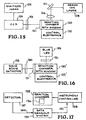
- Figures 15 and 16 schematically illustrate two setups for optical detection.
- the Figure 15 setup is a laser/ccd version, while the Figure 16 setup will allow low-power operation for implementation into the PCR man (hand-held instrument) of Figure 9.
- this optical detection arrangement for a reaction chamber 120 with a window 121 and control electronics 122 includes an optical filter 123, such as an interference filter or band pass filter for passing the detection wavelength of interest, CCD 124, digitized image generally indicated at 125, focusing optics 126, reflector/splitter 127 and an Argon ion laser 128.
- the operation is as follows: The laser excites the fluorescent indicator dye associated with product detection. The fluorescent signal is monitored by the CCD 124. Absorption spectroscopy could similarly be used.
- Figure 16 is a miniaturized optical detector system for reaction chamber 120' having a window 121' and control electronics 122' is composed of two filters 130 and 131, a solid state detector 132 and a Blue LED 133.
- the filters 130 and 131 are either band pass or long pass for selecting emission (i.e., 600nm long pass) and band pass for selecting the excitation wavelength of interest, such as 488nm ⁇ 10nm.
- the excitation band pass can be used to select from the typically broad emission of an LED, for example.
- the operation of the Figure 16 detection system is as follows: The LED is filtered to 488 ⁇ 10nm as an excitation source (or absorption) for the fluorescent indicating dye.
- the solid state detector is also filtered to receive only the wavelengths of detection (>600nm) or as an absorption detector.
- Artificial intelligence is one way to produce DNA and determine how many cycles to go, when it is complete, if it worked, adjustment of parameters to improve production, etc.
- a real-time detection systems such as illustrated schematically in Figure 17, an artificial intelligent feedback system using integrated detection can be provided.
- the system of Figure 17 comprises a reaction chamber 135 having a window 136, a detector 137 for in situ detection of DNA production, an instrument control 138 for reaction chamber 135, and a data readout system 139, which receives data from detector 137; as indicated by arrow 140, and supplies control data to controller 138, as indicated by arrow 141.
- the data readout system 139 provides information such as how much DNA is being made, starting copy number, reaction complete, etc.
- the system could adjust its cycling time and cycle number to produce the minimal number of cycles required for detection, thus speeding up the process. Also by determining the cycle number required to detect a given fluorescent signal, or product concentration, the system would be able to calculate all starting copy number or concentration of the unknown starting sample. This would allow automated concentration calculations. Real-time quantitative information can allow the system to adjust the reaction parameters such as target temperatures, hold times, and ramp rates.
- a microfabricated, electrochemiluminesence cell for the detection of amplified DNA is described hereinafter with respect to Figures 18-31, and which sets forth the design, fabrication, and testing thereof.
- the microcell is designed to be the detection unit in a PCR micro-instrument, such as described above and illustrated in Figure 9.
- the cell is a vertical assembly of micromachined silicon and glass and contains thin film electrodes, as shown in the Figures.
- TBR tris (2,2' bipyridyl) ruthenium (II)
- II ruthenium
- ECL electrochemiluminescence
- TBR requires a relatively low oxidation potential (a few volts) and has a high ECL efficiency in the visible (620nm). This makes it attractive for microsensor applications, since visible emission is readily detected with silicon photodiodes, which could be integrated into a silicon micromachined cell.
- the reduction can occur electrochemically or chemically; in either case, light is emitted.
- oxidized tripropylamine TPA
- TBR oxidized tripropylamine
- Both oxidations can occur at the same electrode, relatively large concentrations of both species can be produced in close proximity, which results in higher light intensity for a given TBR concentration, than if TBR alone is present in solution.
- the electrochemical oxidation and chemical reduction reactions for TBR which occurs at the anode are schematically diagrammed in Figure 18.
- Electrochemical reduction of TBR also occurs at the cathode. In order to oxidize only the TBR labeled DNA and not the free TBR, a separation of the two is required. One way to achieve this is by using the highly specific binding of immunoproteins (antibody-antigen).
- FIG. 19 An example is shown in Figure 19, where a biotin primer is made on a 5' end of one strand of target DNA and the TBR is tagged to the 5' end of the complementary strand.
- a biotin primer is made on a 5' end of one strand of target DNA and the TBR is tagged to the 5' end of the complementary strand.
- DNA double strands are produced with biotin and TBR labeled on either end.
- the biotin labeled DNA can then be introduced into an electrochemical cell with an anode whose surface is coated with avidin, the antibody for bitoin.
- TBR bound to the DNA, which in turn is attached to the anode via the antibody-antigen bond, can be oxidized along with added TPA, and the subsequent luminescence intensity will depend on the amount of DNA that is present.
- the ECL microcell is a multilayer assembly of micromachined silicon and glass.
- Cells with solution capacity ranging from 35 ⁇ L to 85 ⁇ L have been designed and fabricated in silicon.
- An e-beam deposited, gold, thin film forms the cell cathode.
- the anode is also a thin film.
- ITO indium tin oxide
- platinum have been carried out. ITO is transparent to visible light, so that when deposited onto glass, it can form the top layer of the assembly, through which the emitted light can be picked up by a photodetector (see Figure 21).
- the assembly also contains micromachined fluid fill ports (see Figure 22).
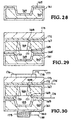
- the layers were assembled and bonded together (see Figures 29-30) using a low temperature curing polyimide, such as Epotek 400.
- ECL experiments have been performed in the microcell with free TBR, i.e., no DNA.
- the cells were filled with TPA + TBR solution and a photomultiplier tube (PMT) was placed in close proximity to the top glass layer of the cell to detect emission.
- PMT photomultiplier tube
- the chemiluminescence produced by the reaction of oxidized TPA and TBR depends on the concentration of both chemicals. In these experiments, the concentration of TPA was kept constant (50mM) and TBR was varied.
- the solutions were prepared as follows: 1g of TBR hexahydrate chloride was dissolved in 50mM TPA to make 5mM of TBR, which was then diluted with additional 50mM TPA to produce a set of test solutions, whose TBR concentrations range from 0.1nM to 5mM.
- FIG. 1 An EG&G potentiostat, model PARC 273, was used to produce voltammograms of the TBR + TPA solution, both in the microcell with ITO and gold thin film electrodes, and in a more conventional, electrochemical cell with platinum wire electrodes. From the voltammogram, the oxidation potential, which is where ECL occurs, was determined and then applied as a dc bias between the thin film cathode and anode. The emitted light was measured with a Hamamatsu MT, model R928, biased at 600 volt.
- Figure 20 shows the relationship between measured light intensity and electrode voltage for a TBR concentration of /mM, where cell voltage and ECL intensity versus time.
- the voltage as indicated by the dot-dash-dot line, is increased, then decreased. In both directions, the voltage passes through the oxidation potential of TBR, where intensity of ECL is a maximum.
- the lowest concentration of TBR that has been measured using the microcell with an ITO film as the anode material was 1 ⁇ M. With a platinum anode, the measured TBP concentrations were as low as 1nM.
- the relatively high resistance of the ITO film is believed to be limiting the oxidation current for TPA, and therefore reducing the sensitivity. It has been determined that sensitivity can be improved by depositing a thin film of material, such as aluminum on the ITO film, as described hereinafter with respect to Figure 31. Also, efforts are being carried out to integrate the silicon photodiode into the microcell, rather than being separated therefrom as in the Figure 21 embodiment.
- FIG 21 illustrates an embodiment of a micromachined ECL cell with thin film anode, generally indicated at 140, and a silicon (Si) photodiode 141 positioned adjacent the ECL cell 140.
- the ECL cell 140 is shown in enlarged cross-section in Figure 22.
- the cell 140 comprises a pair of silicon members 142 and 143, between which is positioned an electrode 144, which may be constructed of gold (Au), platinum (Pt) or silver (Ag), an ITO layer 145, and a glass layer or slide 146.
- Silicon member 142 includes a reaction chamber 147, and member 143 includes a pair of filling ports 148 (see Figure 22) via which an analyte, as indicated by legend is directed into chamber 147 and withdrawn therefrom via tubes or lines 149 and 150, as indicated by arrows 151 and 152.
- a center section 153 of silicon member 143 located between fill ports 148, along with ITO layer 145 and glass slide 146 define a window by which reactions within chamber 147 can be detected, as indicated by photons 154 passing therethrough onto photodiode 141.
- Electrical leads 155 and 156 are connected from a power source to electrode 144 and ITO layer 145, respectively, while photodiode 141 is electrically connected to a power source via leads 157 and 158.
- FIGS 23-30 illustrate the fabrication of an embodiment of an ECL cell similar to that of Figures 21 and 22.
- the fabrication process is carried out as follows:
- a thin film of aluminum 182 can be deposited on the ITO layer or electrode 172 prior to same being bonded to the silicon nitride coated silicon block 166.
- the present invention provides a silicon-based microreaction chamber which can be used in a hand-held instrument or a large high-throughput instrument.
Landscapes
- Chemical & Material Sciences (AREA)
- Health & Medical Sciences (AREA)
- Chemical Kinetics & Catalysis (AREA)
- Physics & Mathematics (AREA)
- Life Sciences & Earth Sciences (AREA)
- Biochemistry (AREA)
- General Health & Medical Sciences (AREA)
- Immunology (AREA)
- Organic Chemistry (AREA)
- Pathology (AREA)
- Analytical Chemistry (AREA)
- General Physics & Mathematics (AREA)
- Plasma & Fusion (AREA)
- Engineering & Computer Science (AREA)
- Nuclear Medicine, Radiotherapy & Molecular Imaging (AREA)
- Molecular Biology (AREA)
- Clinical Laboratory Science (AREA)
- Apparatus Associated With Microorganisms And Enzymes (AREA)
- Measuring Or Testing Involving Enzymes Or Micro-Organisms (AREA)
- Physical Or Chemical Processes And Apparatus (AREA)
Abstract
Claims (14)
- Un réacteur chimique microfabriqué comprenant une chambre de réaction (41) à base de silicium, caractérisé par le fait que ladite chambre de réaction présente la forme d'un manchon comprenant une fente (42), où ladite fente est utilisée pour insertion de fluide de réaction directement ou par l'intermédiaire d'un tube.
- Le réacteur chimique de la revendication 1, dans lequel ladite chambre de réaction en forme de manchon (41) présente au moins une fenêtre optique (48).
- Le réacteur chimique de l'une quelconque des revendications précédentes, dans lequel ladite chambre de réaction en forme de manchon (41) est composée d'une pluralité d'éléments de silicium liés (51, 52), lesdits éléments de silicium liés (51, 52) étant réalisés en polysilicium et silicium en vrac, dans lequel le polysilicium dopé est utilisé pour chauffage et le silicium en vrac est utilisé pour refroidissement par convection.
- Le réacteur chimique de l'une quelconque des revendications précédentes, dans lequel ladite chambre de réaction en forme de manchon (41) comprend une paire de fenêtres (55, 56) et des moyens de chauffage (57, 65) situés de manière adjacente à chacune desdites fenêtres (55, 56).
- Le réacteur chimique de la revendication 4, dans lequel lesdites fenêtres (55, 56) sont réalisées en nitrure de silicium et dans lequel lesdits moyens de chauffage (57, 65) comprennent un organe de chauffage en polysilicium dopé.
- Le réacteur chimique de l'une quelconque des revendications 1 - 5, dans lequel ladite fente (42) prévue dans ladite chambre de réaction (41) est d'une configuration à plusieurs côtés.
- Le réacteur chimique de la revendication 2, comprenant en outre un insert (105) adapté pour être inséré dans ladite fente (42), ledit insert (105) comprenant au moins une fenêtre (106).
- Le réacteur chimique de la revendication 7, dans lequel cette au moins une fenêtre (106) dudit insert (105) est munie d'une bande d'essai (109).
- Le réacteur chimique de l'une quelconque des revendications précédentes, dans lequel ladite chambre de réaction en forme de manchon (41) à base de silicium est réalisée pour être insérée dans un instrument tenu à la main et actionné par batterie (75) et/ou dans un instrument réalisé pour contenir un réseau (95) de telle chambre de réaction (96), ledit réseau (95) de chambres de réaction (96) étant relié de manière opérationnelle par l'intermédiaire d'un réseau de microinjecteurs (98, 99) à un réseau de microélectrophorèse (102), ou étant relié directement au réseau de microélectrophorèse (102).
- Le réacteur chimique de la revendication 9, dans lequel ledit réseau (95) de chambres de réaction (96) est réalisé en silicium et dans lequel ledit réseau de microélectrophorèse est réalisé en verre.
- Le réacteur chimique de la revendication 2, comprenant en outre un détecteur optique mis en place de manière adjacente à ladite fenêtre optique (106).
- Le réacteur chimique de la revendication 11, comprenant en outre un système de lecture de données (139) relié de manière opérationnelle audit détecteur optique, et un organe de commande d'instrument (138) relié de manière opérationnelle audit système de lecture de données (139) et à ladite chambre de réaction (135).
- Le réacteur chimique de la revendication 1, comprenant en outre un boítier (105) adapté pour être inséré dans ladite fente (42) et dans lequel ladite chambre de réaction (41) à base de silicium présente au moins une fenêtre (55, 56) contiguë à ladite fente (42) et un organe de chauffage (57, 65) mis en place de manière adjacente à ladite fenêtre.
- Le réacteur chimique de la revendication 1, dans lequel ledit tube est disposé de manière coulissante dans ladite fente pour insertion de fluide de réaction.
Applications Claiming Priority (3)
| Application Number | Priority Date | Filing Date | Title |
|---|---|---|---|
| US492678 | 1995-06-20 | ||
| US08/492,678 US5589136A (en) | 1995-06-20 | 1995-06-20 | Silicon-based sleeve devices for chemical reactions |
| PCT/US1996/010453 WO1997000726A1 (fr) | 1995-06-20 | 1996-06-17 | Dispositifs de type manchon a base de silicium pour reactions chimiques |
Publications (3)
| Publication Number | Publication Date |
|---|---|
| EP0871545A1 EP0871545A1 (fr) | 1998-10-21 |
| EP0871545A4 EP0871545A4 (fr) | 1999-09-08 |
| EP0871545B1 true EP0871545B1 (fr) | 2005-01-12 |
Family
ID=23957196
Family Applications (1)
| Application Number | Title | Priority Date | Filing Date |
|---|---|---|---|
| EP96921649A Expired - Lifetime EP0871545B1 (fr) | 1995-06-20 | 1996-06-17 | Dispositifs de type manchon a base de silicium pour reactions chimiques |
Country Status (7)
| Country | Link |
|---|---|
| US (1) | US5589136A (fr) |
| EP (1) | EP0871545B1 (fr) |
| JP (1) | JP4091656B2 (fr) |
| CA (1) | CA2225390C (fr) |
| DE (1) | DE69634175T2 (fr) |
| ES (1) | ES2236739T3 (fr) |
| WO (1) | WO1997000726A1 (fr) |
Cited By (4)
| Publication number | Priority date | Publication date | Assignee | Title |
|---|---|---|---|---|
| US7833709B2 (en) | 2004-05-28 | 2010-11-16 | Wafergen, Inc. | Thermo-controllable chips for multiplex analyses |
| US8252581B2 (en) | 2007-01-22 | 2012-08-28 | Wafergen, Inc. | Apparatus for high throughput chemical reactions |
| US10641772B2 (en) | 2015-02-20 | 2020-05-05 | Takara Bio Usa, Inc. | Method for rapid accurate dispensing, visualization and analysis of single cells |
| US11460405B2 (en) | 2016-07-21 | 2022-10-04 | Takara Bio Usa, Inc. | Multi-Z imaging and dispensing with multi-well devices |
Families Citing this family (310)
| Publication number | Priority date | Publication date | Assignee | Title |
|---|---|---|---|---|
| US5605798A (en) | 1993-01-07 | 1997-02-25 | Sequenom, Inc. | DNA diagnostic based on mass spectrometry |
| US20030017081A1 (en) * | 1994-02-10 | 2003-01-23 | Affymetrix, Inc. | Method and apparatus for imaging a sample on a device |
| US6287850B1 (en) * | 1995-06-07 | 2001-09-11 | Affymetrix, Inc. | Bioarray chip reaction apparatus and its manufacture |
| US5814565A (en) * | 1995-02-23 | 1998-09-29 | University Of Utah Research Foundation | Integrated optic waveguide immunosensor |
| US6207369B1 (en) * | 1995-03-10 | 2001-03-27 | Meso Scale Technologies, Llc | Multi-array, multi-specific electrochemiluminescence testing |
| US6428955B1 (en) | 1995-03-17 | 2002-08-06 | Sequenom, Inc. | DNA diagnostics based on mass spectrometry |
| US5830655A (en) | 1995-05-22 | 1998-11-03 | Sri International | Oligonucleotide sizing using cleavable primers |
| US6524532B1 (en) | 1995-06-20 | 2003-02-25 | The Regents Of The University Of California | Microfabricated sleeve devices for chemical reactions |
| US5849208A (en) | 1995-09-07 | 1998-12-15 | Microfab Technoologies, Inc. | Making apparatus for conducting biochemical analyses |
| US6048734A (en) | 1995-09-15 | 2000-04-11 | The Regents Of The University Of Michigan | Thermal microvalves in a fluid flow method |
| AU2069597A (en) | 1996-03-04 | 1997-09-22 | Genetrace Systems, Inc. | Methods of screening nucleic acids using mass spectrometry |
| US5885470A (en) | 1997-04-14 | 1999-03-23 | Caliper Technologies Corporation | Controlled fluid transport in microfabricated polymeric substrates |
| US6054277A (en) * | 1996-05-08 | 2000-04-25 | Regents Of The University Of Minnesota | Integrated microchip genetic testing system |
| US5919364A (en) * | 1996-06-24 | 1999-07-06 | Regents Of The University Of California | Microfabricated filter and shell constructed with a permeable membrane |
| GB9616540D0 (en) * | 1996-08-06 | 1996-09-25 | Cavendish Kinetics Ltd | Integrated circuit device manufacture |
| GB9618595D0 (en) * | 1996-09-06 | 1996-10-16 | Central Research Lab Ltd | Reaction cell |
| US5965363A (en) | 1996-09-19 | 1999-10-12 | Genetrace Systems Inc. | Methods of preparing nucleic acids for mass spectrometric analysis |
| US6221654B1 (en) | 1996-09-25 | 2001-04-24 | California Institute Of Technology | Method and apparatus for analysis and sorting of polynucleotides based on size |
| JPH10132749A (ja) * | 1996-10-01 | 1998-05-22 | Texas Instr Inc <Ti> | 集積蛍光生化学センサ |
| US6024925A (en) | 1997-01-23 | 2000-02-15 | Sequenom, Inc. | Systems and methods for preparing low volume analyte array elements |
| US7285422B1 (en) * | 1997-01-23 | 2007-10-23 | Sequenom, Inc. | Systems and methods for preparing and analyzing low volume analyte array elements |
| EP1164203B1 (fr) | 1996-11-06 | 2007-10-10 | Sequenom, Inc. | Diagnostics de l'ADN fondés sur la spectrométrie de masse |
| DE69735112T2 (de) | 1996-11-06 | 2006-09-07 | Sequenom, Inc., San Diego | Verfahren zur Analyse und Vorrichtung |
| CA2276251A1 (fr) | 1996-11-20 | 1998-05-28 | The Regents Of The University Of Michigan | Dispositifs microfabriques et procedes d'amplification isotherme d'acides nucleiques |
| US5804384A (en) * | 1996-12-06 | 1998-09-08 | Vysis, Inc. | Devices and methods for detecting multiple analytes in samples |
| EP0963443B1 (fr) | 1996-12-10 | 2006-03-08 | Sequenom, Inc. | Molecules d'etiquetage massique, non volatiles et liberables |
| US8293064B2 (en) * | 1998-03-02 | 2012-10-23 | Cepheid | Method for fabricating a reaction vessel |
| US5958349A (en) * | 1997-02-28 | 1999-09-28 | Cepheid | Reaction vessel for heat-exchanging chemical processes |
| EP0963545B1 (fr) | 1997-02-28 | 2011-05-11 | Cepheid | Ensemble pour reaction chimique avec echange thermique et detection optique, et cuvette de reaction |
| US6143496A (en) | 1997-04-17 | 2000-11-07 | Cytonix Corporation | Method of sampling, amplifying and quantifying segment of nucleic acid, polymerase chain reaction assembly having nanoliter-sized sample chambers, and method of filling assembly |
| WO1998050773A2 (fr) * | 1997-05-08 | 1998-11-12 | University Of Minnesota | Biocapteur en porte-a-faux |
| JP3654481B2 (ja) * | 1997-06-05 | 2005-06-02 | 独立行政法人理化学研究所 | 生化学反応用マイクロリアクタ |
| US6097025A (en) * | 1997-10-31 | 2000-08-01 | Ljl Biosystems, Inc. | Light detection device having an optical-path switching mechanism |
| US6071748A (en) * | 1997-07-16 | 2000-06-06 | Ljl Biosystems, Inc. | Light detection device |
| US6258326B1 (en) | 1997-09-20 | 2001-07-10 | Ljl Biosystems, Inc. | Sample holders with reference fiducials |
| US6469311B1 (en) | 1997-07-16 | 2002-10-22 | Molecular Devices Corporation | Detection device for light transmitted from a sensed volume |
| US5965410A (en) | 1997-09-02 | 1999-10-12 | Caliper Technologies Corp. | Electrical current for controlling fluid parameters in microchannels |
| US6413783B1 (en) | 1997-09-18 | 2002-07-02 | Meso Scale Technologies, Llc | Assay sonication apparatus and methodology |
| US6825921B1 (en) | 1999-11-10 | 2004-11-30 | Molecular Devices Corporation | Multi-mode light detection system |
| US6297018B1 (en) | 1998-04-17 | 2001-10-02 | Ljl Biosystems, Inc. | Methods and apparatus for detecting nucleic acid polymorphisms |
| WO2000050877A1 (fr) | 1999-02-23 | 2000-08-31 | Ljl Biosystems, Inc. | Dispositif de detection de lumiere a domaine de frequence |
| US6326605B1 (en) | 1998-02-20 | 2001-12-04 | Ljl Biosystems, Inc. | Broad range light detection system |
| US6992761B2 (en) | 1997-09-20 | 2006-01-31 | Molecular Devices Corporation | Broad range light detection system |
| US6982431B2 (en) | 1998-08-31 | 2006-01-03 | Molecular Devices Corporation | Sample analysis systems |
| US6576476B1 (en) | 1998-09-02 | 2003-06-10 | Ljl Biosystems, Inc. | Chemiluminescence detection method and device |
| US6540895B1 (en) | 1997-09-23 | 2003-04-01 | California Institute Of Technology | Microfabricated cell sorter for chemical and biological materials |
| US7214298B2 (en) | 1997-09-23 | 2007-05-08 | California Institute Of Technology | Microfabricated cell sorter |
| US6251660B1 (en) | 1997-11-25 | 2001-06-26 | Mosaic Technologies, Inc. | Devices and methods for detecting target molecules in biological samples |
| US6174675B1 (en) | 1997-11-25 | 2001-01-16 | Caliper Technologies Corp. | Electrical current for controlling fluid parameters in microchannels |
| US6268131B1 (en) | 1997-12-15 | 2001-07-31 | Sequenom, Inc. | Mass spectrometric methods for sequencing nucleic acids |
| EP1179585B1 (fr) * | 1997-12-24 | 2008-07-09 | Cepheid | Dispositif et procédé de Lyse |
| US6210882B1 (en) | 1998-01-29 | 2001-04-03 | Mayo Foundation For Medical Education And Reseach | Rapid thermocycling for sample analysis |
| US6369893B1 (en) | 1998-05-19 | 2002-04-09 | Cepheid | Multi-channel optical detection system |
| US6660228B1 (en) | 1998-03-02 | 2003-12-09 | Cepheid | Apparatus for performing heat-exchanging, chemical reactions |
| AU764319B2 (en) * | 1998-03-17 | 2003-08-14 | Cepheid | Chemical processing device |
| US6979424B2 (en) | 1998-03-17 | 2005-12-27 | Cepheid | Integrated sample analysis device |
| US7188001B2 (en) * | 1998-03-23 | 2007-03-06 | Cepheid | System and method for temperature control |
| WO1999048608A2 (fr) * | 1998-03-23 | 1999-09-30 | Cepheid | Systeme de reacteur multi-site a commande dynamique independante de sites de reaction individuels |
| US6537751B1 (en) * | 1998-04-21 | 2003-03-25 | Genset S.A. | Biallelic markers for use in constructing a high density disequilibrium map of the human genome |
| US6723564B2 (en) | 1998-05-07 | 2004-04-20 | Sequenom, Inc. | IR MALDI mass spectrometry of nucleic acids using liquid matrices |
| US6200531B1 (en) * | 1998-05-11 | 2001-03-13 | Igen International, Inc. | Apparatus for carrying out electrochemiluminescence test measurements |
| DE69904043T2 (de) * | 1998-05-19 | 2003-07-31 | Cepheid, Sunnyvale | Mehrkanaliges optisches detektionssystem |
| AU5667599A (en) | 1998-07-27 | 2000-02-21 | Ljl Biosystems, Inc. | Apparatus and methods for time-resolved spectroscopic measurements |
| AU5223899A (en) | 1998-07-27 | 2000-02-21 | Ljl Biosystems, Inc. | Apparatus and methods for spectroscopic measurements |
| CA2339163C (fr) * | 1998-08-10 | 2010-01-12 | Genomic Solutions, Inc. | Dispositif thermique pour fluide pour l'hybridation d'acides nucleiques |
| US6638716B2 (en) | 1998-08-24 | 2003-10-28 | Therasense, Inc. | Rapid amperometric verification of PCR amplification of DNA |
| US6281006B1 (en) | 1998-08-24 | 2001-08-28 | Therasense, Inc. | Electrochemical affinity assay |
| CN100385232C (zh) | 1998-08-26 | 2008-04-30 | 医药及科学传感器公司 | 基于光学的感测装置 |
| AU6151699A (en) * | 1998-09-21 | 2000-04-10 | Ramot University Authority For Applied Research And Industrial Development Ltd. | Method, chip, device and system for effecting and monitoring nucleic acid accumulation |
| US6572830B1 (en) | 1998-10-09 | 2003-06-03 | Motorola, Inc. | Integrated multilayered microfludic devices and methods for making the same |
| US6413780B1 (en) * | 1998-10-14 | 2002-07-02 | Abbott Laboratories | Structure and method for performing a determination of an item of interest in a sample |
| US6680193B1 (en) | 1998-10-16 | 2004-01-20 | Commissariat A L'energie Atomique | Device for chemical and/or biological analysis with analysis support |
| US6503750B1 (en) * | 1998-11-25 | 2003-01-07 | The Regents Of The University Of California | PCR thermocycler |
| US7150994B2 (en) * | 1999-03-03 | 2006-12-19 | Symyx Technologies, Inc. | Parallel flow process optimization reactor |
| US20040053290A1 (en) * | 2000-01-11 | 2004-03-18 | Terbrueggen Robert Henry | Devices and methods for biochip multiplexing |
| FR2795426A1 (fr) * | 1999-06-22 | 2000-12-29 | Commissariat Energie Atomique | Support d'analyse biologique a amplification |
| EP1203096B1 (fr) | 1999-07-28 | 2008-12-31 | Merck Serono Biodevelopment | Dispositif microfluidique dans lequel un changement de température locale agit sur un echantillon en flux continu |
| US6932951B1 (en) | 1999-10-29 | 2005-08-23 | Massachusetts Institute Of Technology | Microfabricated chemical reactor |
| US6642046B1 (en) | 1999-12-09 | 2003-11-04 | Motorola, Inc. | Method and apparatus for performing biological reactions on a substrate surface |
| AU2082701A (en) * | 1999-12-09 | 2001-06-18 | Motorola, Inc. | Multilayered microfluidic devices for analyte reactions |
| AU2277001A (en) * | 1999-12-20 | 2001-07-03 | Penn State Research Foundation, The | Deposited thin films and their use in detection, attachment, and bio-medical applications |
| US6699713B2 (en) | 2000-01-04 | 2004-03-02 | The Regents Of The University Of California | Polymerase chain reaction system |
| EP1738829A1 (fr) * | 2000-01-04 | 2007-01-03 | The Regents of the University of California | Systeme d'amplification en chaine par polymerase |
| US6403037B1 (en) | 2000-02-04 | 2002-06-11 | Cepheid | Reaction vessel and temperature control system |
| DE10006214A1 (de) | 2000-02-11 | 2001-08-16 | Roche Diagnostics Gmbh | System zur einfachen Nukleinsäureanalytik |
| US6824669B1 (en) | 2000-02-17 | 2004-11-30 | Motorola, Inc. | Protein and peptide sensors using electrical detection methods |
| WO2001067369A2 (fr) * | 2000-03-03 | 2001-09-13 | California Institute Of Technology | Jeux ordonnes d'echantillons combinatoires pour analyse d'acides nucleiques |
| DE60108482T2 (de) | 2000-03-07 | 2006-02-16 | Symyx Technologies, Inc., Santa Clara | Prozessoptimierungsreaktor mit parallelem durchfluss |
| US6927851B2 (en) | 2000-03-31 | 2005-08-09 | Neogen Corporation | Methods and apparatus to improve the sensitivity and reproducibility of bioluminescent analytical methods |
| US6653147B2 (en) | 2000-03-31 | 2003-11-25 | Neogen Corporation | Apparatus and method for chemiluminescent assays |
| US7351376B1 (en) | 2000-06-05 | 2008-04-01 | California Institute Of Technology | Integrated active flux microfluidic devices and methods |
| DE60137722D1 (de) | 2000-06-13 | 2009-04-02 | Univ Boston | Verwendung von mass-matched nukleotide in der analyse von oligonukleotidmischungen sowie in der hoch-multiplexen nukleinsäuresequenzierung |
| US7062418B2 (en) | 2000-06-27 | 2006-06-13 | Fluidigm Corporation | Computer aided design method and system for developing a microfluidic system |
| US6563581B1 (en) * | 2000-07-14 | 2003-05-13 | Applera Corporation | Scanning system and method for scanning a plurality of samples |
| US6600558B2 (en) * | 2000-08-22 | 2003-07-29 | Nippon Telegraph And Telephone Corporation | Micro-fluidic cell for optical detection of gases and method for producing same |
| EP1336097A4 (fr) | 2000-10-13 | 2006-02-01 | Fluidigm Corp | Systeme d'injection d'echantillons utilisant un dispositif microfluidique, pour dispositifs d'analyse |
| US20020142483A1 (en) | 2000-10-30 | 2002-10-03 | Sequenom, Inc. | Method and apparatus for delivery of submicroliter volumes onto a substrate |
| US20020132360A1 (en) | 2000-11-17 | 2002-09-19 | Flir Systems Boston, Inc. | Apparatus and methods for infrared calorimetric measurements |
| US6821787B2 (en) | 2000-11-17 | 2004-11-23 | Thermogenic Imaging, Inc. | Apparatus and methods for infrared calorimetric measurements |
| US20020114739A1 (en) * | 2000-12-26 | 2002-08-22 | Weigl Bernard H. | Microfluidic cartridge with integrated electronics |
| US6692700B2 (en) | 2001-02-14 | 2004-02-17 | Handylab, Inc. | Heat-reduction methods and systems related to microfluidic devices |
| US6509186B1 (en) | 2001-02-16 | 2003-01-21 | Institute Of Microelectronics | Miniaturized thermal cycler |
| US6432695B1 (en) | 2001-02-16 | 2002-08-13 | Institute Of Microelectronics | Miniaturized thermal cycler |
| US20050196785A1 (en) * | 2001-03-05 | 2005-09-08 | California Institute Of Technology | Combinational array for nucleic acid analysis |
| US7118917B2 (en) | 2001-03-07 | 2006-10-10 | Symyx Technologies, Inc. | Parallel flow reactor having improved thermal control |
| US6586233B2 (en) | 2001-03-09 | 2003-07-01 | The Regents Of The University Of California | Convectively driven PCR thermal-cycling |
| US7323140B2 (en) | 2001-03-28 | 2008-01-29 | Handylab, Inc. | Moving microdroplets in a microfluidic device |
| US6852287B2 (en) | 2001-09-12 | 2005-02-08 | Handylab, Inc. | Microfluidic devices having a reduced number of input and output connections |
| US7192557B2 (en) | 2001-03-28 | 2007-03-20 | Handylab, Inc. | Methods and systems for releasing intracellular material from cells within microfluidic samples of fluids |
| US8895311B1 (en) | 2001-03-28 | 2014-11-25 | Handylab, Inc. | Methods and systems for control of general purpose microfluidic devices |
| US7270786B2 (en) | 2001-03-28 | 2007-09-18 | Handylab, Inc. | Methods and systems for processing microfluidic samples of particle containing fluids |
| US7010391B2 (en) | 2001-03-28 | 2006-03-07 | Handylab, Inc. | Methods and systems for control of microfluidic devices |
| US7829025B2 (en) | 2001-03-28 | 2010-11-09 | Venture Lending & Leasing Iv, Inc. | Systems and methods for thermal actuation of microfluidic devices |
| US6575188B2 (en) | 2001-07-26 | 2003-06-10 | Handylab, Inc. | Methods and systems for fluid control in microfluidic devices |
| EP1384022A4 (fr) | 2001-04-06 | 2004-08-04 | California Inst Of Techn | Amplification d'acide nucleique au moyen de dispositifs microfluidiques |
| DK1412725T3 (en) | 2001-06-29 | 2019-03-25 | Meso Scale Technologies Llc | Multi-well plates for LUMINESCENSE TEST MEASUREMENTS |
| US6923939B1 (en) * | 2001-07-05 | 2005-08-02 | Uop Llc | Heat activated membrane introduction apparatus and method for screening materials |
| US20030032172A1 (en) * | 2001-07-06 | 2003-02-13 | The Regents Of The University Of California | Automated nucleic acid assay system |
| EP1412487B1 (fr) | 2001-07-30 | 2010-06-16 | Meso Scale Technologies LLC | Electrodes de test comportant des couches de lipide/proteine immobilises et procedes de fabrication et d'utilisation associes |
| US6939632B2 (en) * | 2001-08-06 | 2005-09-06 | Massachusetts Institute Of Technology | Thermally efficient micromachined device |
| CA2495021A1 (fr) * | 2001-08-06 | 2003-07-03 | Vanderbilt University | Systeme et procedes de mesure d'au moins un taux metabolique de plusieurs cellules |
| AU2002333497A1 (en) * | 2001-08-21 | 2003-03-10 | Bestmann, Lukas | Thermo-optical analysis system for biochemical reactions |
| AU2002341621A1 (en) | 2001-09-10 | 2003-03-24 | Meso Scale Technologies, Llc | Methods, reagents, kits and apparatus for protein function analysis |
| KR100488281B1 (ko) * | 2001-09-15 | 2005-05-10 | 아람 바이오시스템 주식회사 | 열 대류를 이용한 염기서열 증폭 방법 및 장치 |
| US8440093B1 (en) | 2001-10-26 | 2013-05-14 | Fuidigm Corporation | Methods and devices for electronic and magnetic sensing of the contents of microfluidic flow channels |
| WO2003038127A1 (fr) | 2001-10-30 | 2003-05-08 | Ahram Biosystems Inc. | Procede et appareil permettant d'amplifier des sequences d'acides nucleiques a l'aide d'une adn polymerase immobilisee |
| WO2003048295A1 (fr) | 2001-11-30 | 2003-06-12 | Fluidigm Corporation | Dispositif microfluidique et procedes d'utilisation de ce dernier |
| US7691333B2 (en) | 2001-11-30 | 2010-04-06 | Fluidigm Corporation | Microfluidic device and methods of using same |
| AU2003224817B2 (en) | 2002-04-01 | 2008-11-06 | Fluidigm Corporation | Microfluidic particle-analysis systems |
| US7312085B2 (en) | 2002-04-01 | 2007-12-25 | Fluidigm Corporation | Microfluidic particle-analysis systems |
| US20050221326A1 (en) * | 2002-06-12 | 2005-10-06 | Avi Orr-Urtreger | Oligonucleotides antibodies and kits including same for treating prostate cancer and determining predisposition thereto |
| KR20050013592A (ko) * | 2002-06-20 | 2005-02-04 | 아이젠인터내셔널인코포레이티드 | 전기화학발광 유동 셀 및 유동 셀 성분 |
| US20040096368A1 (en) * | 2002-06-28 | 2004-05-20 | Igen International, Inc. | Assay systems and components |
| CA2492056A1 (fr) * | 2002-07-23 | 2004-01-29 | Richard M. Crooks | Rapport a signaux photoniques d'evenements electrochimiques |
| WO2004011145A1 (fr) * | 2002-07-26 | 2004-02-05 | Arizona Board Regents, A Body Corporate Of The State Of Arizona, Acting For And On Behalf Of Arizona State University | Microreacteur avec pression et temperature commandable destine aux analyses de materiau sur site |
| US20070166725A1 (en) * | 2006-01-18 | 2007-07-19 | The Regents Of The University Of California | Multiplexed diagnostic platform for point-of care pathogen detection |
| US20040038385A1 (en) * | 2002-08-26 | 2004-02-26 | Langlois Richard G. | System for autonomous monitoring of bioagents |
| JP2006501056A (ja) | 2002-09-25 | 2006-01-12 | カリフォルニア インスティテュート オブ テクノロジー | ミクロ流体大規模集積 |
| WO2004040001A2 (fr) | 2002-10-02 | 2004-05-13 | California Institute Of Technology | Analyse microfluidique d'acides nucleiques |
| US20090209030A1 (en) * | 2002-10-15 | 2009-08-20 | Benett William J | Thermal Cycler |
| US20040072334A1 (en) * | 2002-10-15 | 2004-04-15 | The Regents Of The University Of California | Thermal cycler |
| TW200409821A (en) * | 2002-12-03 | 2004-06-16 | Ind Tech Res Inst | Microarray biochip reactor |
| AU2003302264A1 (en) | 2002-12-20 | 2004-09-09 | Biotrove, Inc. | Assay apparatus and method using microfluidic arrays |
| WO2004058052A2 (fr) | 2002-12-20 | 2004-07-15 | Applera Corporation | Polymorphismes genetiques associes a l'infarctus du myocarde, techniques de detection et utilisations de ceux-ci |
| GB2399776A (en) * | 2003-03-24 | 2004-09-29 | Pa Knowledge Ltd | Cyclical heating and cooling device and associated methods |
| US7476363B2 (en) | 2003-04-03 | 2009-01-13 | Fluidigm Corporation | Microfluidic devices and methods of using same |
| US8828663B2 (en) | 2005-03-18 | 2014-09-09 | Fluidigm Corporation | Thermal reaction device and method for using the same |
| US7604965B2 (en) | 2003-04-03 | 2009-10-20 | Fluidigm Corporation | Thermal reaction device and method for using the same |
| CA2521171C (fr) | 2003-04-03 | 2013-05-28 | Fluidigm Corp. | Dispositifs microfluidiques et leurs procedes d'utilisation |
| US20050145496A1 (en) | 2003-04-03 | 2005-07-07 | Federico Goodsaid | Thermal reaction device and method for using the same |
| US7435391B2 (en) * | 2003-05-23 | 2008-10-14 | Lucent Technologies Inc. | Light-mediated micro-chemical reactors |
| JP4705035B2 (ja) * | 2003-05-23 | 2011-06-22 | バイオ−ラッド ラボラトリーズ,インコーポレイティド | 反応培地の空間配列に対し局部化した温度制御 |
| US7170594B2 (en) | 2003-05-28 | 2007-01-30 | Smiths Detection, Inc. | Device for polymerase chain reactions |
| ES2220227B1 (es) * | 2003-05-30 | 2006-02-16 | INSTITUTO NACIONAL DE TECNICA AEROESPACIAL "ESTEBAN TERRADAS" | Metodo y aparato para la deteccion de sustancias o analitos a partir del analisis de una o varias muestras. |
| WO2005011867A2 (fr) | 2003-07-31 | 2005-02-10 | Handylab, Inc. | Traitement d'echantillons contenant des particules |
| US7413712B2 (en) | 2003-08-11 | 2008-08-19 | California Institute Of Technology | Microfluidic rotary flow reactor matrix |
| US7981362B2 (en) | 2003-11-04 | 2011-07-19 | Meso Scale Technologies, Llc | Modular assay plates, reader systems and methods for test measurements |
| WO2005056837A2 (fr) | 2003-11-26 | 2005-06-23 | Applera Corporation | Polymorphismes genetiques associes a des troubles cardiovasculaires et a une reponse au medicament, leurs procedes de detection et d'utilisation |
| US8697433B2 (en) * | 2003-12-10 | 2014-04-15 | Samsung Electronics Co., Ltd. | Polymerase chain reaction (PCR) module and multiple PCR system using the same |
| US7767439B2 (en) * | 2003-12-10 | 2010-08-03 | Samsung Electronics Co., Ltd. | Real-time PCR monitoring apparatus and method |
| DE10359160A1 (de) * | 2003-12-16 | 2005-07-21 | Roche Diagnostics Gmbh | Testelement zur Untersuchung von Probenmaterial |
| US20050170401A1 (en) * | 2004-01-29 | 2005-08-04 | Canon Kabushiki Kaisha | Hybridization apparatus and method |
| US8852862B2 (en) | 2004-05-03 | 2014-10-07 | Handylab, Inc. | Method for processing polynucleotide-containing samples |
| ES2572382T3 (es) | 2004-05-03 | 2016-05-31 | Handylab Inc | Un dispositivo microfluídico para el procesamiento de muestras que contienen polinucleótidos |
| US7820380B2 (en) | 2004-05-07 | 2010-10-26 | Celera Corporation | Genetic polymorphisms associated with liver fibrosis |
| DE102004035080A1 (de) * | 2004-05-27 | 2005-12-29 | Infineon Technologies Ag | Anordnung zur Verringerung des elektrischen Übersprechens auf einem Chip |
| DE102004033317A1 (de) * | 2004-07-09 | 2006-02-09 | Roche Diagnostics Gmbh | Analytisches Testelement |
| US8185653B2 (en) * | 2004-08-09 | 2012-05-22 | Johnny Yau | Method and apparatus for ad hoc mesh routing |
| US7968287B2 (en) | 2004-10-08 | 2011-06-28 | Medical Research Council Harvard University | In vitro evolution in microfluidic systems |
| US7391936B2 (en) * | 2005-01-21 | 2008-06-24 | Lucent Technologies, Inc. | Microfluidic sensors and methods for making the same |
| WO2006099365A2 (fr) | 2005-03-11 | 2006-09-21 | Applera Corporation | Polymorphismes genetiques associes a des maladies cardiaques coronariennes, methodes de detection et d'utilisation desdits polymorphismes |
| JP2006255522A (ja) * | 2005-03-15 | 2006-09-28 | Hitachi Ltd | 物質の製造装置および製造方法 |
| JP5590796B2 (ja) | 2005-06-03 | 2014-09-17 | ボード・オブ・リージェンツ・オブ・ザ・ユニバーシティ・オブ・テキサス・システム | 電気化学および単一ファラデー電極による電気化学発光 |
| US7780813B2 (en) * | 2005-06-09 | 2010-08-24 | Alcatel-Lucent Usa Inc. | Electric field mediated chemical reactors |
| US7630849B2 (en) | 2005-09-01 | 2009-12-08 | Applied Biosystems, Llc | Method of automated calibration and diagnosis of laboratory instruments |
| US9604219B2 (en) * | 2005-09-06 | 2017-03-28 | Thermo Fisher Scientific Oy | Thermal cycler with optimized sample holder geometry |
| US7799530B2 (en) | 2005-09-23 | 2010-09-21 | Celera Corporation | Genetic polymorphisms associated with cardiovascular disorders and drug response, methods of detection and uses thereof |
| US7727473B2 (en) | 2005-10-19 | 2010-06-01 | Progentech Limited | Cassette for sample preparation |
| US7754148B2 (en) | 2006-12-27 | 2010-07-13 | Progentech Limited | Instrument for cassette for sample preparation |
| KR100768089B1 (ko) * | 2005-11-30 | 2007-10-18 | 한국전자통신연구원 | 친화 크로마토그래피 미세장치, 이의 제조방법. |
| WO2007081385A2 (fr) | 2006-01-11 | 2007-07-19 | Raindance Technologies, Inc. | Dispositifs microfluidiques et leurs procédés d'utilisation dans la formation et le contrôle de nanoréacteurs |
| EP1979079A4 (fr) | 2006-02-03 | 2012-11-28 | Integenx Inc | Dispositifs microfluidiques |
| US10900066B2 (en) | 2006-03-24 | 2021-01-26 | Handylab, Inc. | Microfluidic system for amplifying and detecting polynucleotides in parallel |
| DK3088083T3 (en) | 2006-03-24 | 2018-11-26 | Handylab Inc | Method of carrying out PCR down a multi-track cartridge |
| US7998708B2 (en) | 2006-03-24 | 2011-08-16 | Handylab, Inc. | Microfluidic system for amplifying and detecting polynucleotides in parallel |
| US8088616B2 (en) | 2006-03-24 | 2012-01-03 | Handylab, Inc. | Heater unit for microfluidic diagnostic system |
| US11806718B2 (en) | 2006-03-24 | 2023-11-07 | Handylab, Inc. | Fluorescence detector for microfluidic diagnostic system |
| US7705339B2 (en) * | 2006-04-25 | 2010-04-27 | University Of South Florida | Portable reactor for real-time nucleic acid amplification and detection comprising a reaction chamber formed from a flexible printed circuit board |
| US8900828B2 (en) | 2006-05-01 | 2014-12-02 | Cepheid | Methods and apparatus for sequential amplification reactions |
| US9562837B2 (en) | 2006-05-11 | 2017-02-07 | Raindance Technologies, Inc. | Systems for handling microfludic droplets |
| EP2530167A1 (fr) | 2006-05-11 | 2012-12-05 | Raindance Technologies, Inc. | Dispositifs microfluidiques |
| US8119352B2 (en) * | 2006-06-20 | 2012-02-21 | Cepheld | Multi-stage amplification reactions by control of sequence replication times |
| EP2639317B1 (fr) | 2006-09-11 | 2015-03-04 | Celera Corporation | Polymorphismes génétiques associés au psoriasis, procédés de détection et utilisations associées |
| KR100758273B1 (ko) * | 2006-09-13 | 2007-09-12 | 한국전자통신연구원 | 플라스틱 기반 미소 가열기 및 그 제조방법, 이를 이용한dna 증폭칩 및 그 제조방법 |
| US7910303B2 (en) | 2006-10-20 | 2011-03-22 | Celera Corporation | Genetic polymorphisms associated with venous thrombosis, methods of detection and uses thereof |
| EP2104755A4 (fr) * | 2006-10-26 | 2011-01-12 | Symyx Solutions Inc | Réacteur à lit fixe parallèle à haute pression et son procédé |
| US8709787B2 (en) | 2006-11-14 | 2014-04-29 | Handylab, Inc. | Microfluidic cartridge and method of using same |
| WO2008060604A2 (fr) | 2006-11-14 | 2008-05-22 | Handylab, Inc. | Système microfluidique utilisé pour amplifier et détecter des polynucléotides en parallèle |
| WO2008061771A1 (fr) * | 2006-11-23 | 2008-05-29 | Nanoident Technologies Ag | Dispositif de caractérisation optoélectronique d'échantillons |
| US20110039303A1 (en) * | 2007-02-05 | 2011-02-17 | Stevan Bogdan Jovanovich | Microfluidic and nanofluidic devices, systems, and applications |
| WO2008097559A2 (fr) | 2007-02-06 | 2008-08-14 | Brandeis University | Manipulation de fluides et de réactions dans des systèmes microfluidiques |
| US20080206877A1 (en) * | 2007-02-22 | 2008-08-28 | The State Of Oregon Acting By And Through The State Board Of Higher Education On Behalf Of | Reactors for selective enhancement reactions and methods of using such reactors |
| US8298763B2 (en) * | 2007-03-02 | 2012-10-30 | Lawrence Livermore National Security, Llc | Automated high-throughput flow-through real-time diagnostic system |
| DE102007017450A1 (de) * | 2007-04-02 | 2008-10-09 | Niro-Plan Ag | Verfahren und Vorrichtung zur Herstellung von Caffe Latte Macchiato |
| US8592221B2 (en) | 2007-04-19 | 2013-11-26 | Brandeis University | Manipulation of fluids, fluid components and reactions in microfluidic systems |
| US20120115131A1 (en) | 2007-05-31 | 2012-05-10 | Yale University | Genetic lesion associated with cancer |
| EP2162554A4 (fr) | 2007-05-31 | 2010-07-28 | Univ Queensland | Marqueurs de diagnostic pour une spondylarthrite ankylosante et leurs utilisations |
| US8133671B2 (en) | 2007-07-13 | 2012-03-13 | Handylab, Inc. | Integrated apparatus for performing nucleic acid extraction and diagnostic testing on multiple biological samples |
| US8105783B2 (en) | 2007-07-13 | 2012-01-31 | Handylab, Inc. | Microfluidic cartridge |
| USD621060S1 (en) | 2008-07-14 | 2010-08-03 | Handylab, Inc. | Microfluidic cartridge |
| US9618139B2 (en) | 2007-07-13 | 2017-04-11 | Handylab, Inc. | Integrated heater and magnetic separator |
| US9186677B2 (en) | 2007-07-13 | 2015-11-17 | Handylab, Inc. | Integrated apparatus for performing nucleic acid extraction and diagnostic testing on multiple biological samples |
| US8287820B2 (en) | 2007-07-13 | 2012-10-16 | Handylab, Inc. | Automated pipetting apparatus having a combined liquid pump and pipette head system |
| US20090136385A1 (en) | 2007-07-13 | 2009-05-28 | Handylab, Inc. | Reagent Tube |
| US8182763B2 (en) | 2007-07-13 | 2012-05-22 | Handylab, Inc. | Rack for sample tubes and reagent holders |
| AU2008276211B2 (en) | 2007-07-13 | 2015-01-22 | Handylab, Inc. | Polynucleotide capture materials, and methods of using same |
| US7955840B2 (en) | 2007-08-23 | 2011-06-07 | Akonni Biosystems | Thermal cycler for PCR including temperature control bladder |
| WO2009039122A2 (fr) | 2007-09-17 | 2009-03-26 | Sequenom, Inc. | Dispositif de transfert d'échantillon robotique intégré |
| US8778663B2 (en) * | 2007-09-18 | 2014-07-15 | Lawrence Livermore National Security, Llc. | Thermal cycler |
| US8039212B2 (en) | 2007-11-05 | 2011-10-18 | Celera Corporation | Genetic polymorphisms associated with liver fibrosis, methods of detection and uses thereof |
| DE102007062441A1 (de) | 2007-12-20 | 2009-06-25 | Aj Innuscreen Gmbh | Mobiles Schnelltestsystem für die Nukleinsäureanalytik |
| DE102008009920A1 (de) * | 2008-02-15 | 2009-08-20 | Aj Innuscreen Gmbh | Mobiles Gerät für die Nukleinsäureisolierung |
| US20090221620A1 (en) | 2008-02-20 | 2009-09-03 | Celera Corporation | Gentic polymorphisms associated with stroke, methods of detection and uses thereof |
| EP3093351B1 (fr) | 2008-07-09 | 2018-04-18 | Celera Corporation | Polymorphismes génétiques associés à des maladies cardiovasculaires, procédés de détection et utilisations associées |
| USD618820S1 (en) | 2008-07-11 | 2010-06-29 | Handylab, Inc. | Reagent holder |
| USD787087S1 (en) | 2008-07-14 | 2017-05-16 | Handylab, Inc. | Housing |
| US12038438B2 (en) | 2008-07-18 | 2024-07-16 | Bio-Rad Laboratories, Inc. | Enzyme quantification |
| EP4047367A1 (fr) | 2008-07-18 | 2022-08-24 | Bio-Rad Laboratories, Inc. | Procedé de détection d'analytes cibles au moyens des bibliothèques de gouttelettes |
| CA2638458A1 (fr) * | 2008-07-31 | 2010-01-31 | Spartan Bioscience Inc. | Recyclage thermique au moyen du positionnement d'une source de temperature allant de relative a fixe |
| US20100081577A1 (en) * | 2008-09-30 | 2010-04-01 | Symyx Technologies, Inc. | Reactor systems and methods |
| US20110229892A1 (en) | 2008-11-17 | 2011-09-22 | Yehuda G Assaraf | Method for predicting a patient's responsiveness to anti-folate therapy |
| WO2010111231A1 (fr) | 2009-03-23 | 2010-09-30 | Raindance Technologies, Inc. | Manipulation de gouttelettes microfluidiques |
| US20100261292A1 (en) | 2009-04-10 | 2010-10-14 | Meso Scale Technologies, Llc | Methods for Conducting Assays |
| BRPI1014469A2 (pt) | 2009-04-14 | 2017-06-27 | Biocartis Sa | cavitação induzida hifu com limiar de energia reduzido |
| KR20120030361A (ko) | 2009-04-15 | 2012-03-28 | 비오까르띠 에스아 | 바이오분석 샘플 챔버의 보호 |
| EP2419743B1 (fr) | 2009-04-15 | 2020-08-05 | Biocartis NV | Système de détection optique pour une réaction d'amplification en chaîne par polymérase (acp) en temps réel |
| WO2010127464A1 (fr) | 2009-05-06 | 2010-11-11 | Biocartis Sa | Dispositif de coupe d'un porte-échantillon |
| EP3586945A3 (fr) | 2009-06-05 | 2020-03-04 | IntegenX Inc. | Système universel de préparation d'échantillons et utilisation dans un système d'analyse intégré |
| ES2623633T3 (es) | 2009-06-09 | 2017-07-11 | Gendiag.Exe, S.L. | Marcadores de riesgo para enfermedad cardiovascular |
| CA2766210A1 (fr) | 2009-06-25 | 2010-12-29 | Yale University | Polymorphismes de nucleotide unique du brca1 et risque de cancer |
| EP2470914B1 (fr) | 2009-07-27 | 2020-05-13 | Meso Scale Technologies, LLC | Appareils et procédés d'essai |
| CN104630056B (zh) | 2010-01-12 | 2017-11-07 | 阿赫姆生物系统公司 | 两阶段热对流装置及其用途 |
| EP2524026A4 (fr) | 2010-01-12 | 2017-10-18 | Ahram Biosystems, Inc. | Appareil de convection thermique à trois étages et ses utilisations |
| US9399797B2 (en) | 2010-02-12 | 2016-07-26 | Raindance Technologies, Inc. | Digital analyte analysis |
| EP4484577A3 (fr) | 2010-02-12 | 2025-03-26 | Bio-Rad Laboratories, Inc. | Analyse numérique d'analyte |
| US9366632B2 (en) | 2010-02-12 | 2016-06-14 | Raindance Technologies, Inc. | Digital analyte analysis |
| US10351905B2 (en) | 2010-02-12 | 2019-07-16 | Bio-Rad Laboratories, Inc. | Digital analyte analysis |
| AU2011220873B2 (en) | 2010-02-23 | 2014-07-10 | Luminex Corporation | Apparatus and methods for integrated sample preparation, reaction and detection |
| WO2011128096A1 (fr) | 2010-04-16 | 2011-10-20 | Roche Diagnostics Gmbh | Marqueurs de polymorphisme destinés à prédire la réponse à un traitement par un médicament anticorps monoclonal inhibant les récepteurs de l'interleukine-6 |
| US20110269735A1 (en) | 2010-04-19 | 2011-11-03 | Celera Corporation | Genetic polymorphisms associated with statin response and cardiovascular diseases, methods of detection and uses thereof |
| EP2593468B1 (fr) | 2010-07-12 | 2020-06-10 | The State of Israel, Ministry of Agriculture and Rural Development, Agricultural Research Organization, (A.R.O.), Volcani Center | Polynucléotides isolés et procédés et plantes les utilisant pour la régulation de l'acidité des plantes |
| EP2606154B1 (fr) | 2010-08-20 | 2019-09-25 | Integenx Inc. | Système d'analyse intégrée |
| WO2012024657A1 (fr) | 2010-08-20 | 2012-02-23 | IntegenX, Inc. | Dispositifs microfluidiques pourvus de soupapes à diaphragme mécaniquement scellées |
| US9562897B2 (en) | 2010-09-30 | 2017-02-07 | Raindance Technologies, Inc. | Sandwich assays in droplets |
| JP5943927B2 (ja) | 2010-10-14 | 2016-07-05 | メソ スケール テクノロジーズ エルエルシー | アッセイデバイスにおける試薬貯蔵 |
| US20120108651A1 (en) | 2010-11-02 | 2012-05-03 | Leiden University Medical Center (LUMC) Acting on Behalf of Academic Hospital Leiden (AZL) | Genetic polymorphisms associated with venous thrombosis and statin response, methods of detection and uses thereof |
| CA2824404C (fr) | 2011-01-06 | 2023-01-03 | Meso Scale Technologies, Llc | Cartouches d'essai destinees a l'analyse pcr et methodes d'utilisation associees |
| EP3412778A1 (fr) | 2011-02-11 | 2018-12-12 | Raindance Technologies, Inc. | Procédés permettant de former des gouttelettes mélangées |
| WO2012112804A1 (fr) | 2011-02-18 | 2012-08-23 | Raindance Technoligies, Inc. | Compositions et méthodes de marquage moléculaire |
| ES2769028T3 (es) * | 2011-04-15 | 2020-06-24 | Becton Dickinson Co | Termociclador microfluídico de barrido en tiempo real |
| CN104023834B (zh) | 2011-05-04 | 2016-09-28 | 卢米耐克斯公司 | 用于集成的样品制备、反应和检测的设备与方法 |
| EP3216872B1 (fr) | 2011-06-02 | 2020-04-01 | Bio-Rad Laboratories, Inc. | Quantification d'enzyme |
| US8658430B2 (en) | 2011-07-20 | 2014-02-25 | Raindance Technologies, Inc. | Manipulating droplet size |
| USD692162S1 (en) | 2011-09-30 | 2013-10-22 | Becton, Dickinson And Company | Single piece reagent holder |
| ES2645966T3 (es) | 2011-09-30 | 2017-12-11 | Becton, Dickinson And Company | Tira reactiva unificada |
| US10865440B2 (en) | 2011-10-21 | 2020-12-15 | IntegenX, Inc. | Sample preparation, processing and analysis systems |
| US20150136604A1 (en) | 2011-10-21 | 2015-05-21 | Integenx Inc. | Sample preparation, processing and analysis systems |
| CN104040238B (zh) | 2011-11-04 | 2017-06-27 | 汉迪拉布公司 | 多核苷酸样品制备装置 |
| EP2776833B1 (fr) | 2011-11-11 | 2018-09-05 | Eli N. Glezer | Procédés de dosage assistés par co-liant |
| AU2013214849B2 (en) | 2012-02-03 | 2016-09-01 | Becton, Dickinson And Company | External files for distribution of molecular diagnostic tests and determination of compatibility between tests |
| CA3235305A1 (fr) | 2013-01-04 | 2014-07-10 | Meso Scale Technologies, Llc. | Appareils, procedes et reactifs de dosage |
| DK2972353T3 (da) | 2013-03-11 | 2023-03-27 | Meso Scale Technologies Llc | Forbedrede fremgangsmåder til udførelse af multipleksanalyser |
| CA2904181A1 (fr) | 2013-03-13 | 2014-10-09 | Anahit Aghvanyan | Dosage immunologique sandwich comprenant un reactif d'ancrage |
| US10114015B2 (en) | 2013-03-13 | 2018-10-30 | Meso Scale Technologies, Llc. | Assay methods |
| US10202500B2 (en) | 2013-03-15 | 2019-02-12 | Lubrizol Advanced Materials, Inc. | Heavy metal free CPVC compounds |
| US11901041B2 (en) | 2013-10-04 | 2024-02-13 | Bio-Rad Laboratories, Inc. | Digital analysis of nucleic acid modification |
| CN114471756B (zh) | 2013-11-18 | 2024-04-16 | 尹特根埃克斯有限公司 | 用于样本分析的卡盒和仪器 |
| US9944977B2 (en) | 2013-12-12 | 2018-04-17 | Raindance Technologies, Inc. | Distinguishing rare variations in a nucleic acid sequence from a sample |
| CA3229509A1 (fr) | 2014-05-09 | 2015-11-12 | Meso Scale Technologies, Llc. | Electrodes modifiees par graphene |
| EP3143401A4 (fr) | 2014-05-15 | 2017-10-11 | Meso Scale Technologies, LLC | Méthodes de dosage améliorées |
| WO2015179098A1 (fr) | 2014-05-21 | 2015-11-26 | Integenx Inc. | Cartouche fluidique comprenant un mécanisme de soupape |
| US10627358B2 (en) | 2014-10-06 | 2020-04-21 | Alveo Technologies, Inc. | Method for detection of analytes |
| US9921182B2 (en) | 2014-10-06 | 2018-03-20 | ALVEO Technologies Inc. | System and method for detection of mercury |
| US10352899B2 (en) | 2014-10-06 | 2019-07-16 | ALVEO Technologies Inc. | System and method for detection of silver |
| US9506908B2 (en) | 2014-10-06 | 2016-11-29 | Alveo Technologies, Inc. | System for detection of analytes |
| US10196678B2 (en) | 2014-10-06 | 2019-02-05 | ALVEO Technologies Inc. | System and method for detection of nucleic acids |
| CN107106983B (zh) | 2014-10-22 | 2021-04-16 | 尹特根埃克斯有限公司 | 用于样品制备、处理和分析的系统和方法 |
| US9943819B2 (en) | 2014-11-03 | 2018-04-17 | Singh Instrument LLC | Small-scale reactor having improved mixing |
| WO2016116935A1 (fr) | 2015-01-21 | 2016-07-28 | Yeda Research And Development Co. Ltd. | Utilisation de la rasa2 en tant que marqueur pronostique et thérapeutique pour un mélanome |
| US10647981B1 (en) | 2015-09-08 | 2020-05-12 | Bio-Rad Laboratories, Inc. | Nucleic acid library generation methods and compositions |
| JP6578188B2 (ja) * | 2015-11-05 | 2019-09-18 | ウシオ電機株式会社 | 光学測定器 |
| CN108350407B (zh) | 2015-12-11 | 2022-07-08 | 杰诺玛迪克斯公司 | 用于核酸扩增的管密封系统和方法 |
| EP3472342A1 (fr) | 2016-06-19 | 2019-04-24 | Yissum Research Development Company of the Hebrew University of Jerusalem Ltd. | Criblage de la résistance à la chimiothérapie dans des cellules haploïdes humaines |
| CN109996888A (zh) | 2016-09-23 | 2019-07-09 | 阿尔韦奥科技公司 | 用于检测分析物的方法和组合物 |
| JP7377544B2 (ja) | 2017-05-17 | 2023-11-10 | マイクロバイオ・プロプライエタリー・リミテッド | バイオマーカーおよびその使用 |
| EP4310184A3 (fr) | 2018-02-23 | 2024-05-01 | Meso Scale Technologies, LLC. | Procédés de criblage de molécules de liaison à l'antigène par normalisation de la concentration de molécule de liaison à l'antigène |
| IL262658A (en) | 2018-10-28 | 2020-04-30 | Memorial Sloan Kettering Cancer Center | Prevention of age related clonal hematopoiesis and diseases associated therewith |
| EP3899022A4 (fr) | 2018-12-20 | 2023-03-01 | Alveo Technologies Inc. | Système de test de diagnostic basé sur l'impédance portatif pour la détection d'analytes |
| AU2019418498A1 (en) | 2019-01-03 | 2021-07-15 | Meso Scale Technologies, Llc | Compositions and methods for carrying out assay measurements |
| DE102019200109A1 (de) * | 2019-01-08 | 2020-07-09 | Robert Bosch Gmbh | Mikrofluidische Vorrichtung und Analysegerät für eine mikrofluidische Vorrichtung |
| CN120098057A (zh) | 2019-03-01 | 2025-06-06 | 中尺度技术有限责任公司 | 用于免疫方法的被电化学发光标记的探针、使用这类探针的方法和包含这类探针的试剂盒 |
| CN120665985A (zh) | 2019-06-07 | 2025-09-19 | 豪夫迈·罗氏有限公司 | 杂交全lna寡核苷酸 |
| IL325928A (en) | 2019-07-16 | 2026-03-01 | Meso Scale Technologies Llc | Testing instruments, methods and reagents |
| US20240018571A1 (en) | 2020-05-19 | 2024-01-18 | Meso Scale Technologies, Llc. | Methods, compositions, and kits for nucleic acid detection |
| EP4176263A1 (fr) | 2020-07-01 | 2023-05-10 | Meso Scale Technologies, LLC | Compositions et procédés pour mesures de dosage |
| US12472492B2 (en) | 2020-08-14 | 2025-11-18 | Alveo Technologies, Inc. | Systems and methods of sample depositing and testing |
| JP2023554517A (ja) | 2020-12-22 | 2023-12-27 | エフ. ホフマン-ラ ロシュ アーゲー | 試料中の目的の分析物を検出するための方法 |
| CN118922555A (zh) | 2021-12-30 | 2024-11-08 | 中尺度技术有限责任公司 | 用于电化学发光检测的方法 |
| JP2025506652A (ja) | 2022-02-18 | 2025-03-13 | エフ. ホフマン-ラ ロシュ アーゲー | 試料中の目的の分析物を検出するための方法 |
| WO2023194369A1 (fr) | 2022-04-08 | 2023-10-12 | Fundació Institut Mar D'investigacions Mèdiques (Imim) | Marqueurs génétiques des formes graves de la covid-19 |
Family Cites Families (7)
| Publication number | Priority date | Publication date | Assignee | Title |
|---|---|---|---|---|
| US4315890A (en) * | 1980-05-01 | 1982-02-16 | Intersci Corporation | Device for the identification of volatile fluids |
| US5252294A (en) * | 1988-06-01 | 1993-10-12 | Messerschmitt-Bolkow-Blohm Gmbh | Micromechanical structure |
| US4908112A (en) * | 1988-06-16 | 1990-03-13 | E. I. Du Pont De Nemours & Co. | Silicon semiconductor wafer for analyzing micronic biological samples |
| US5262127A (en) * | 1992-02-12 | 1993-11-16 | The Regents Of The University Of Michigan | Solid state chemical micro-reservoirs |
| US5304487A (en) * | 1992-05-01 | 1994-04-19 | Trustees Of The University Of Pennsylvania | Fluid handling in mesoscale analytical devices |
| CA2134474C (fr) * | 1992-05-01 | 1999-07-06 | The Trustees Of The University Of Pennsylvania | Dispositif microfabrique de manutention d'echantillons de sperme |
| US5639423A (en) * | 1992-08-31 | 1997-06-17 | The Regents Of The University Of Calfornia | Microfabricated reactor |
-
1995
- 1995-06-20 US US08/492,678 patent/US5589136A/en not_active Expired - Lifetime
-
1996
- 1996-06-17 EP EP96921649A patent/EP0871545B1/fr not_active Expired - Lifetime
- 1996-06-17 DE DE69634175T patent/DE69634175T2/de not_active Expired - Lifetime
- 1996-06-17 WO PCT/US1996/010453 patent/WO1997000726A1/fr not_active Ceased
- 1996-06-17 CA CA002225390A patent/CA2225390C/fr not_active Expired - Lifetime
- 1996-06-17 ES ES96921649T patent/ES2236739T3/es not_active Expired - Lifetime
- 1996-06-17 JP JP50388697A patent/JP4091656B2/ja not_active Expired - Lifetime
Cited By (11)
| Publication number | Priority date | Publication date | Assignee | Title |
|---|---|---|---|---|
| US7833709B2 (en) | 2004-05-28 | 2010-11-16 | Wafergen, Inc. | Thermo-controllable chips for multiplex analyses |
| US9228933B2 (en) | 2004-05-28 | 2016-01-05 | Wafergen, Inc. | Apparatus and method for multiplex analysis |
| US10718014B2 (en) | 2004-05-28 | 2020-07-21 | Takara Bio Usa, Inc. | Thermo-controllable high-density chips for multiplex analyses |
| US8252581B2 (en) | 2007-01-22 | 2012-08-28 | Wafergen, Inc. | Apparatus for high throughput chemical reactions |
| US9132427B2 (en) | 2007-01-22 | 2015-09-15 | Wafergen, Inc. | Apparatus for high throughput chemical reactions |
| US9951381B2 (en) | 2007-01-22 | 2018-04-24 | Takara Bio Usa, Inc. | Apparatus for high throughput chemical reactions |
| US11643681B2 (en) | 2007-01-22 | 2023-05-09 | Takara Bio Usa, Inc. | Apparatus for high throughput chemical reactions |
| US10641772B2 (en) | 2015-02-20 | 2020-05-05 | Takara Bio Usa, Inc. | Method for rapid accurate dispensing, visualization and analysis of single cells |
| US11125752B2 (en) | 2015-02-20 | 2021-09-21 | Takara Bio Usa, Inc. | Method for rapid accurate dispensing, visualization and analysis of single cells |
| US12613244B2 (en) | 2015-02-20 | 2026-04-28 | Takara Bio Usa, Inc. | Method for rapid accurate dispensing, visualization and analysis of single cells |
| US11460405B2 (en) | 2016-07-21 | 2022-10-04 | Takara Bio Usa, Inc. | Multi-Z imaging and dispensing with multi-well devices |
Also Published As
| Publication number | Publication date |
|---|---|
| JP4091656B2 (ja) | 2008-05-28 |
| CA2225390C (fr) | 2008-09-30 |
| EP0871545A4 (fr) | 1999-09-08 |
| CA2225390A1 (fr) | 1997-01-09 |
| JPH11509136A (ja) | 1999-08-17 |
| WO1997000726A1 (fr) | 1997-01-09 |
| DE69634175T2 (de) | 2006-01-05 |
| ES2236739T3 (es) | 2005-07-16 |
| US5589136A (en) | 1996-12-31 |
| DE69634175D1 (de) | 2005-02-17 |
| EP0871545A1 (fr) | 1998-10-21 |
Similar Documents
| Publication | Publication Date | Title |
|---|---|---|
| EP0871545B1 (fr) | Dispositifs de type manchon a base de silicium pour reactions chimiques | |
| US6521181B1 (en) | Microfabricated electrochemiluminescence cell for chemical reaction detection | |
| US6602473B1 (en) | Temperature control apparatus | |
| JP3002541B2 (ja) | 化学反応制御用装置およびその製造方法ならびに化学反応制御方法 | |
| US7297313B1 (en) | Microfabricated reactor, process for manufacturing the reactor, and method of amplification | |
| Burns et al. | An integrated nanoliter DNA analysis device | |
| Northrup et al. | A MEMS-based miniature DNA analysis system | |
| US9228933B2 (en) | Apparatus and method for multiplex analysis | |
| JP3654481B2 (ja) | 生化学反応用マイクロリアクタ | |
| WO2008091626A1 (fr) | Appareil permettant la mise en oeuvre de réactions chimiques à haut rendement | |
| CN1157639A (zh) | 中型多核苷酸扩增装置 | |
| Lagally et al. | Monolithic integrated PCR reactor-CE system for DNA amplification and analysis to the single molecule limit | |
| Muthukumar | Shalini Prasad, Yamini Yadav, Vindhya Kunduru, Manish Bothara, and |
Legal Events
| Date | Code | Title | Description |
|---|---|---|---|
| PUAI | Public reference made under article 153(3) epc to a published international application that has entered the european phase |
Free format text: ORIGINAL CODE: 0009012 |
|
| 17P | Request for examination filed |
Effective date: 19980115 |
|
| AK | Designated contracting states |
Kind code of ref document: A1 Designated state(s): BE CH DE ES FR GB IT LI NL |
|
| A4 | Supplementary search report drawn up and despatched |
Effective date: 19990726 |
|
| AK | Designated contracting states |
Kind code of ref document: A4 Designated state(s): BE CH DE ES FR GB IT LI NL |
|
| RIC1 | Information provided on ipc code assigned before grant |
Free format text: 6B 01L 3/00 A, 6B 01J 19/00 B, 6G 01N 21/03 B, 6B 01L 7/00 B |
|
| 17Q | First examination report despatched |
Effective date: 20020322 |
|
| GRAP | Despatch of communication of intention to grant a patent |
Free format text: ORIGINAL CODE: EPIDOSNIGR1 |
|
| GRAS | Grant fee paid |
Free format text: ORIGINAL CODE: EPIDOSNIGR3 |
|
| GRAA | (expected) grant |
Free format text: ORIGINAL CODE: 0009210 |
|
| AK | Designated contracting states |
Kind code of ref document: B1 Designated state(s): BE CH DE ES FR GB IT LI NL |
|
| PG25 | Lapsed in a contracting state [announced via postgrant information from national office to epo] |
Ref country code: NL Free format text: LAPSE BECAUSE OF FAILURE TO SUBMIT A TRANSLATION OF THE DESCRIPTION OR TO PAY THE FEE WITHIN THE PRESCRIBED TIME-LIMIT Effective date: 20050112 Ref country code: LI Free format text: LAPSE BECAUSE OF FAILURE TO SUBMIT A TRANSLATION OF THE DESCRIPTION OR TO PAY THE FEE WITHIN THE PRESCRIBED TIME-LIMIT Effective date: 20050112 Ref country code: CH Free format text: LAPSE BECAUSE OF FAILURE TO SUBMIT A TRANSLATION OF THE DESCRIPTION OR TO PAY THE FEE WITHIN THE PRESCRIBED TIME-LIMIT Effective date: 20050112 Ref country code: BE Free format text: LAPSE BECAUSE OF FAILURE TO SUBMIT A TRANSLATION OF THE DESCRIPTION OR TO PAY THE FEE WITHIN THE PRESCRIBED TIME-LIMIT Effective date: 20050112 |
|
| REG | Reference to a national code |
Ref country code: GB Ref legal event code: FG4D |
|
| REG | Reference to a national code |
Ref country code: CH Ref legal event code: EP |
|
| REF | Corresponds to: |
Ref document number: 69634175 Country of ref document: DE Date of ref document: 20050217 Kind code of ref document: P |
|
| NLV1 | Nl: lapsed or annulled due to failure to fulfill the requirements of art. 29p and 29m of the patents act | ||
| REG | Reference to a national code |
Ref country code: ES Ref legal event code: FG2A Ref document number: 2236739 Country of ref document: ES Kind code of ref document: T3 |
|
| REG | Reference to a national code |
Ref country code: CH Ref legal event code: PL |
|
| PLBE | No opposition filed within time limit |
Free format text: ORIGINAL CODE: 0009261 |
|
| STAA | Information on the status of an ep patent application or granted ep patent |
Free format text: STATUS: NO OPPOSITION FILED WITHIN TIME LIMIT |
|
| ET | Fr: translation filed | ||
| 26N | No opposition filed |
Effective date: 20051013 |
|
| REG | Reference to a national code |
Ref country code: FR Ref legal event code: PLFP Year of fee payment: 20 |
|
| PGFP | Annual fee paid to national office [announced via postgrant information from national office to epo] |
Ref country code: GB Payment date: 20150629 Year of fee payment: 20 Ref country code: ES Payment date: 20150626 Year of fee payment: 20 Ref country code: DE Payment date: 20150629 Year of fee payment: 20 |
|
| PGFP | Annual fee paid to national office [announced via postgrant information from national office to epo] |
Ref country code: FR Payment date: 20150617 Year of fee payment: 20 |
|
| PGFP | Annual fee paid to national office [announced via postgrant information from national office to epo] |
Ref country code: IT Payment date: 20150625 Year of fee payment: 20 |
|
| REG | Reference to a national code |
Ref country code: DE Ref legal event code: R071 Ref document number: 69634175 Country of ref document: DE |
|
| REG | Reference to a national code |
Ref country code: GB Ref legal event code: PE20 Expiry date: 20160616 |
|
| PG25 | Lapsed in a contracting state [announced via postgrant information from national office to epo] |
Ref country code: GB Free format text: LAPSE BECAUSE OF EXPIRATION OF PROTECTION Effective date: 20160616 |
|
| REG | Reference to a national code |
Ref country code: ES Ref legal event code: FD2A Effective date: 20160926 |
|
| PG25 | Lapsed in a contracting state [announced via postgrant information from national office to epo] |
Ref country code: ES Free format text: LAPSE BECAUSE OF EXPIRATION OF PROTECTION Effective date: 20160618 |