EP0873340B1 - Heterocyclisch substituierte cyclopentanderivate. - Google Patents
Heterocyclisch substituierte cyclopentanderivate. Download PDFInfo
- Publication number
- EP0873340B1 EP0873340B1 EP96918151A EP96918151A EP0873340B1 EP 0873340 B1 EP0873340 B1 EP 0873340B1 EP 96918151 A EP96918151 A EP 96918151A EP 96918151 A EP96918151 A EP 96918151A EP 0873340 B1 EP0873340 B1 EP 0873340B1
- Authority
- EP
- European Patent Office
- Prior art keywords
- pyrrolopyrimidine
- amino
- chloro
- iodo
- cyclopentyl
- Prior art date
- Legal status (The legal status is an assumption and is not a legal conclusion. Google has not performed a legal analysis and makes no representation as to the accuracy of the status listed.)
- Expired - Lifetime
Links
Classifications
-
- C—CHEMISTRY; METALLURGY
- C07—ORGANIC CHEMISTRY
- C07D—HETEROCYCLIC COMPOUNDS
- C07D473/00—Heterocyclic compounds containing purine ring systems
-
- A—HUMAN NECESSITIES
- A61—MEDICAL OR VETERINARY SCIENCE; HYGIENE
- A61P—SPECIFIC THERAPEUTIC ACTIVITY OF CHEMICAL COMPOUNDS OR MEDICINAL PREPARATIONS
- A61P25/00—Drugs for disorders of the nervous system
- A61P25/08—Antiepileptics; Anticonvulsants
-
- A—HUMAN NECESSITIES
- A61—MEDICAL OR VETERINARY SCIENCE; HYGIENE
- A61P—SPECIFIC THERAPEUTIC ACTIVITY OF CHEMICAL COMPOUNDS OR MEDICINAL PREPARATIONS
- A61P29/00—Non-central analgesic, antipyretic or antiinflammatory agents, e.g. antirheumatic agents; Non-steroidal antiinflammatory drugs [NSAID]
-
- A—HUMAN NECESSITIES
- A61—MEDICAL OR VETERINARY SCIENCE; HYGIENE
- A61P—SPECIFIC THERAPEUTIC ACTIVITY OF CHEMICAL COMPOUNDS OR MEDICINAL PREPARATIONS
- A61P31/00—Antiinfectives, i.e. antibiotics, antiseptics, chemotherapeutics
-
- A—HUMAN NECESSITIES
- A61—MEDICAL OR VETERINARY SCIENCE; HYGIENE
- A61P—SPECIFIC THERAPEUTIC ACTIVITY OF CHEMICAL COMPOUNDS OR MEDICINAL PREPARATIONS
- A61P43/00—Drugs for specific purposes, not provided for in groups A61P1/00-A61P41/00
-
- A—HUMAN NECESSITIES
- A61—MEDICAL OR VETERINARY SCIENCE; HYGIENE
- A61P—SPECIFIC THERAPEUTIC ACTIVITY OF CHEMICAL COMPOUNDS OR MEDICINAL PREPARATIONS
- A61P9/00—Drugs for disorders of the cardiovascular system
-
- A—HUMAN NECESSITIES
- A61—MEDICAL OR VETERINARY SCIENCE; HYGIENE
- A61P—SPECIFIC THERAPEUTIC ACTIVITY OF CHEMICAL COMPOUNDS OR MEDICINAL PREPARATIONS
- A61P9/00—Drugs for disorders of the cardiovascular system
- A61P9/10—Drugs for disorders of the cardiovascular system for treating ischaemic or atherosclerotic diseases, e.g. antianginal drugs, coronary vasodilators, drugs for myocardial infarction, retinopathy, cerebrovascula insufficiency, renal arteriosclerosis
-
- C—CHEMISTRY; METALLURGY
- C07—ORGANIC CHEMISTRY
- C07D—HETEROCYCLIC COMPOUNDS
- C07D471/00—Heterocyclic compounds containing nitrogen atoms as the only ring hetero atoms in the condensed system, at least one ring being a six-membered ring with one nitrogen atom, not provided for by groups C07D451/00 - C07D463/00
- C07D471/02—Heterocyclic compounds containing nitrogen atoms as the only ring hetero atoms in the condensed system, at least one ring being a six-membered ring with one nitrogen atom, not provided for by groups C07D451/00 - C07D463/00 in which the condensed system contains two hetero rings
- C07D471/04—Ortho-condensed systems
-
- C—CHEMISTRY; METALLURGY
- C07—ORGANIC CHEMISTRY
- C07F—ACYCLIC, CARBOCYCLIC OR HETEROCYCLIC COMPOUNDS CONTAINING ELEMENTS OTHER THAN CARBON, HYDROGEN, HALOGEN, OXYGEN, NITROGEN, SULFUR, SELENIUM OR TELLURIUM
- C07F9/00—Compounds containing elements of Groups 5 or 15 of the Periodic Table
- C07F9/02—Phosphorus compounds
- C07F9/547—Heterocyclic compounds, e.g. containing phosphorus as a ring hetero atom
- C07F9/6561—Heterocyclic compounds, e.g. containing phosphorus as a ring hetero atom containing systems of two or more relevant hetero rings condensed among themselves or condensed with a common carbocyclic ring or ring system, with or without other non-condensed hetero rings
-
- Y—GENERAL TAGGING OF NEW TECHNOLOGICAL DEVELOPMENTS; GENERAL TAGGING OF CROSS-SECTIONAL TECHNOLOGIES SPANNING OVER SEVERAL SECTIONS OF THE IPC; TECHNICAL SUBJECTS COVERED BY FORMER USPC CROSS-REFERENCE ART COLLECTIONS [XRACs] AND DIGESTS
- Y02—TECHNOLOGIES OR APPLICATIONS FOR MITIGATION OR ADAPTATION AGAINST CLIMATE CHANGE
- Y02P—CLIMATE CHANGE MITIGATION TECHNOLOGIES IN THE PRODUCTION OR PROCESSING OF GOODS
- Y02P20/00—Technologies relating to chemical industry
- Y02P20/50—Improvements relating to the production of bulk chemicals
- Y02P20/55—Design of synthesis routes, e.g. reducing the use of auxiliary or protecting groups
Definitions
- the present invention relates to new heterocyclic substituted cyclopentane compounds, which are useful in inhibiting adenosine kinase, to pharmaceutical compositions containing such compounds and to a method of using such compounds for inhibiting adenosine kinase.
- Adenosine kinase (ATP:adenosine 5'-phosphotransferase, EC 2.7.1.20) is a ubiquitous enzyme which catalyzes the phosphorylation of adenosine to AMP, using ATP, preferentially, as the phosphate source. Magnesium is also required for the reaction, and the true cosubstrate is probably the MgATP 2- complex (Palella, et al ., J . Biol . Chem. 1980, 255 : 5264-5269).
- Adenosine kinase has broad tissue and species distribution, and has been isolated from yeast (Leibach, et al ., Hoppe-Seyler's Z . Physiol .
- Adenosine kinase is a key enzyme in the control of the cellular concentrations of adenosine (Arch and Newsholme, Essays Biochem . 1978, 14 : 82-123).
- Adenosine is a purine nucleoside that is an intermediate in the pathways of purine nucleotide degradation and salvage.
- adenosine has many important physiologic effects, many of which are mediated through the activation of specific ectocellular receptors, termed P 1 receptors (Burnstock, in Cell Membrane Receptors for Drugs and Hormones, 1978, (Bolis and Straub, eds) Raven, New York, pp.
- adenosine inhibits the release of certain neurotransmitters (Corradetti, et al., Eur. J. Pharmacol. 1984, 104: 19-26), stabilizes membrane potential (Rudolphi, et al., Cerebrovasc. Brain Metab. Rev. 1992, 4: 346-360), functions as an endogenous anticonvulsant (Dragunow, Trends Pharmacol. Sci. 1986, 7: 128-130) and may have a role as an endogenous neuroprotective agent (Rudolphi, et al., Trends Pharmacol. Sci. 1992, 13: 439-445).
- Adenosine has also been implicated in modulating transmission in pain pathways in the spinal cord (Sawynok, et al., Br. J. Pharmacol. 1986, 88: 923-930), and in mediating the analgesic effects of morphine (Sweeney, et al., J. Pharmacol. Exp. Ther. 1987, 243: 657-665). In the immune system, adenosine inhibits certain neutrophil functions and exhibits anti-inflammatory effects (Cronstein, J . Appl. Physiol. 1994, 76: 5-13).
- Adenosine also exerts a variety of effects on the cardiovascular system, including vasodilation, impairment of atrioventricular conduction and endogenous cardioprotection in myocardial ischemia and reperfusion (Mullane and Williams, in Adenosine and Adenosine Receptors, 1990 (Williams, ed) Humana Press, New Jersey, pp. 289-334).
- the widespread actions of adenosine also include effects on the renal, respiratory, gastrointestinal and reproductive systems, as well as on blood cells and adipocytes.
- adenosine release appears to have a role as a natural defense mechanism in various pathophysiologic conditions, including cerebral and myocardial ischemia, seizures, pain, inflammation and sepsis. While adenosine is normally present at low levels in the extracellular space, its release is locally enhanced at the site(s) of excessive cellular activity, trauma or metabolic stress. Once in the extracellular space, adenosine activates specific extracellular receptors to elicit a variety of responses which tend to restore cellular function towards normal (Bruns, Nucleosides Nucleotides, 1991, 10: 931-943; Miller and Hsu, J . Neurotrauma, 1992, 9: S563-S577).
- Adenosine has a half-life measured in seconds in extracellular fluids (Moser, et al., Am. J. Physiol. 1989, 25 : C799-C806), and its endogenous actions are therefore highly localized.
- adenosine kinase inhibition can result in augmentation of the local adenosine concentrations at foci of tissue injury, further enhancing cytoprotection. This effect is likely to be most pronounced at tissue sites where trauma results in increased adenosine production, thereby minimizing systemic toxicities.
- Pharmacologic compounds directed towards adenosine kinase inhibition provide potentially effective new therapies for disorders benefited by the site- and event-specific potentiation of adenosine.
- Adenosine kinase is also responsible for the activation of many pharmacologically active nucleosides (Miller, et al., J. Biol. Chem. 1979, 254: 2339-2345), including tubercidin, formycin, ribavirin, pyrazofurin and 6-(methylmercapto)purine riboside.
- These purine nucleoside analogs represent an important group of antimetabolites which possess cytotoxic, anticancer and antiviral properties. They serve as substrates for adenosine kinase and are phosphorylated by the enzyme to generate the active form.
- adenosine kinase activity has been implicated as a mechanism of cellular resistance to the pharmacological effects of these nucleoside analogs ( e . g . Bennett, et al ., Mol . Pharmacol ., 1966, 2: 432-443; Caldwell, et al ., Can . J . Biochem ., 1967, 45: 735-744; Suttle, et al ., Europ . J . Cancer, 1981, 17: 43-51). Decreased cellular levels of adenosine kinase have also been associated with resistance to the toxic effects of 2'-deoxyadenosine (Hershfield and Kredich, Proc . Natl .
- dATP deoxyadenosine triphosphate
- the present invention provides a heterocyclic substituted cyclopentane compound that acts as an adenosine kinase inhibitor.
- a compound of the present invention is a compound of the Formula I, below: wherein R 4 is hydroxyl,-NHR 10 or -NR 12 R 13 where R 10 , R 12 and R 13 are as defined in claim 1, R 5 is amino, arylalkyl, arylalkynyl, arylamino or halogen and R6 is aryl, arylalkyl, arylalkenyl, arylalkynyl, or halogen.
- R4 is amino, methylamino, dimethylamino, acylamino or heteroarylcarbonylamino
- R 5 is chloro, amino, phenylamino or 2-phenylethynyl
- R 6 is chloro, iodo, phenyl, 2-phenylethyl or 2-phenylethynyl.
- An especially preferred compound of the present invention has the Formula III or V below: where R 4 , R 5 and R 6 are as defined above. Preferred values of R 4 , R 5 and R 6 are the same as set forth above. Exemplary and preferred compounds having the Formula I, or III are:
- the present invention provides a pharmaceutical composition
- a pharmaceutical composition comprising a compound of the present invention in combination with a pharmaceutically acceptable carrier.
- Preferred compounds are those set forth above that have the Formula I, III, or V.
- a compound is present in a therapeutically effective amount.
- the present invention provides a method of inhibiting adenosine kinase comprising exposing an adenosine kinase to an effective inhibiting amount of a compound of the present invention. Where the adenosine kinase is located in vivo , the compound is administered to the organism.
- Preferred compounds are the same as set forth above.
- the present invention provides a method of treating cerebral ischemia, epilepsy, nociperception, inflammation and sepsis in a patient in need of such treatment, comprising administering to the patient a therapeutically effective amount of a compound of the present invention.
- the present invention relates to new heterocyclic substituted cyclopentane compounds which are useful in inhibiting adenosine kinase, to pharmaceutical compositions containing such compounds and to a method of using such compounds for inhibiting adenosine kinase.
- the compounds of the invention comprise asymmetrically substituted carbon atoms.
- all stereoisomers of the compounds of the invention are meant to be included in the invention, including racemic mixtures, mixtures of diastereomers, as well as single diastereomers of the compounds of the invention.
- the terms "S" and "R” configuration, as used herein, are as defined by the IUPAC 1974 Recommendations for Section E, Fundamental Stereochemistry, Pure Appl. Chem. (1976) 45, 13-30.
- the present invention provides heterocyclic substitute cyclopentane compounds that are adenosine kinase inhibitors.
- An adenosine kinase inhibitor of the present invention is a compound of the Formula I, shown above.
- an adenosine kinase inhibitor of the present invention is a compound of Formula III or V, shown above.
- R 4 groups are acetylamino, t-butoxycarbonylamino, methoxycarbonylamino, nicotinoylamino, dimethylamino, trifluoroacetylamino, and dimethyl-amino, pyridinylamino, methylimidazole-sulfonylamino.
- R 5 groups are halogen, amino, phenylamino, phenylacetylenyl.
- R 6 groups are halogen, phenyl, 2-phenylethyl, phenylacetylenyl.
- Preferred compounds of the invention are compounds of Formula I, III or V wherein R 4 is amino, methylamino, dimethylamino, acylamino or heteroarylcarbonylamino, R 5 is chloro, amino, phenylamino or 2-phenylethynyl; and R 6 is chloro, iodo, phenyl, 2-phenylethynyl or 2-phenylethyl.
- Exemplary and preferred compounds having the Formula III or V are those wherein R 4 is hydroxyl and the values of R 5 and R 6 are: a) R 5 is Cl and R 6 is Cl, I, phenyl, or 2-phenylethynyl; b) R 5 is NH 2 and R 6 is I, phenyl, 2-phenylethyl or 2-phenylethynyl; c) R 5 is phenylamino and R 6 is I or phenyl; or d) R 5 is 2-phenylethynyl and R 6 is 2-phenylethynyl.
- R 4 is NH 2 , R 5 is Cl or NH 2 and R 6 is I; c) R 4 is NHBoc, R 5 is NH 2 and R 6 is I; d) R 4 is CH 3 NH, R 5 is Cl and R 6 is CH 3 ; e) R 4 is (CH 3 ) 2 N, R 5 is Cl and R 6 is I; f) R 4 is nicotinamido, R 5 is Cl and R 6 is I; g) R 4 is (3"-chloro-pyridazin-6"-yl)amino, R 5 is NH2, and R 6 is I; h) R4 is (2"-pyrimidinyl)amino, R 5 is NH2, and R 6 is I; i) R 4 is (3"-pyridinylacetyl)amino, R 5 is Cl and R 6 is I; j) R 4 is (N-t-butoxycarbonylamino
- the present invention also contemplates salts amides and esters of compounds having Formula I to V.
- acyl refers to R 17 CO-where R 17 is loweralkyl, heteroaryl or heterocyclyl.
- acyloxy refers to R 18 COO-where R 18 is loweralkyl, heteroaryl or heterocyclyl.
- alkanoylaminoalkyl refers to -NHC(O)R 19 wherein R 19 is loweralkyl.
- alkanoyloxyalkyl refers to -OC(O)R 20 wherein R 20 is loweralkyl.
- alkenyl refers to branched or straight chain alkyl groups comprising 2 to 10 carbon atoms that has one or more carbon-carbon double bonds, including vinyl, propenyl, butenyl and the like.
- alkoxy refers to R 21 O where R 21 is a loweralkyl or benzyl group.
- Representative alkoxy groups include methoxy, ethoxy, t-butoxy, benzyloxy and the like.
- alkoxycarbonyl refers -C(O)OR 22 wherein R 22 is loweralkyl or cycloalkyl.
- alkoxycarbonyloxyalkyl refers to -OC(O)OR 23 wherein R 23 is loweralkyl or cycloalkyl.
- alkoxycarbonylaminoalkyl refers to -NHC(O)OR 24 wherein R24 is loweralkyl.
- alkylamino refers to NHR 25 where R 25 is a loweralkyl group.
- alkylmercapto refers to SHR 26 where R 26 is a loweralkyl group.
- alkylsulfonyl refers to SO 2 R 27 where R 27 is a loweralkyl group.
- alkylaminocarbonylaminoalkyl refers to -NHC(O)NHR 28 wherein R28 is loweralkyl.
- alkynyl refers to branched or straight chain alkyl groups comprising 2 to 10 carbon atoms that has one or more carbon-carbon triple bonds, including ethynyl, propynyl, butynyl and the like.
- aroyloxyalkyl refers to a loweralkyl radical -OC(O)R 29 wherein R29 is loweralkyl.
- aryl refers to a phenyl or a C 9 or C 10 bicyclic carbocyclic ring system having one or more aromatic rings, including naphthyl, tetrahydronaphthyl, indanyl, indenyl and the like.
- aryl includes aryl groups that are unsubstitued or substituted with one or more substituents independently selected from loweralkyl, alkoxy, halo-substituted loweralkyl, cyano, thioalkoxy, alkoxycarbonyl, hydroxy, halo, mercapto, nitro, amino, alkylamino, dialkylamino, carboxaldehyde, carboxy and carboxamide.
- arylalkyl, arylalkenyl and arylalkynyl refer to an aryl group appended to an alkyl, alkenyl or alkynyl group, respectively
- arylamino refers to an aryl group appended to an amino group.
- arylmercapto refers to an aryl group appended to a mercapto (SH) group.
- dialkylamino refers to -NR 30 R 31 wherein R 30 and R 31 are independently selected from loweralkyl.
- halogen or "halo" as used herein refers to Cl, Br, I and F.
- heteroaryl refers to aryl in which one or more of the ring carbon atoms is replaced by a heterocyclic atom such as N, S, O or P.
- heteroarylalkyl refers to a heteroaryl group appended to an alkyl group.
- heteroarylcarbonylamino refers to heteroarylC(O)NH-.
- heterocyclic group refers to any 3- or 4-membered ring containing a heteroatom selected from oxygen, nitrogen and sulfur, or a 5-, 6-, or 7-membered ring containing one, two or three nitrogen atoms; one nitrogen and one sulfur atom; or one nitrogen and one oxygen atom; wherein the 5-membered ring has 0-2 double bonds and the 6- or 7-membered ring has 0-3 double bonds; wherein the nitrogen and sulfur heteroatoms can optionally be oxidized; wherein the nitrogen heteroatom can optionally be quaternized; and, including any cyclic group in which any of the above heterocyclic rings is fused to a benzene ring or another 5-, 6- or 7-membered heterocyclic ring independently as defined above.
- heterocyclyls include indolyl, quinolyl, isoquinolyl, tetrahydroquinolyl, benzofuryl, benzothienylazetidinyl, pyrrolyl, pyrrolinyl, pyrazolyl, pyrazolinyl, pyrazolidinyl, imidazolyl, imidazolinyl, imidazolidinyl, pyridyl, piperidinyl, pyrazinyl, piperazinyl, pyrimidinyl, pyridazinyl, oxazolyl, oxazolidinyl, isoxazolyl, isoxazolidinyl, morpholinyl, thiomorpholinyl, thiazolyl, thiazolidinyl, isothiazolyl, isothiazolidinyl, benzimidazolyl, benzothiazolyl, benzoxazolyl, furyl, thi
- loweralkyl refers to branched or straight chain, substituted or unsubstituted, alkyl groups comprising 1 to 10 carbon atoms including methyl, ethyl, propyl, isopropyl, butyl n-butyl, n-butyl, neopentyl and the like.
- thioalkoxy or “mercaptoalkoxy” as used herein refers to -SR 16 wherein R 16 is a loweralkyl or benzyl group.
- Haldroxy-protecting group refers to a substituent which protects hydroxyl groups against undesirable reactions during synthetic procedures and includes, but is not limited to, substituted methyl ethers, for example, methoxymethyl, benzyloxymethyl, 2-methoxyethoxymethyl, 2-(trimethylsiyll)-ethoxymethyl, benzyl, and triphenylmethyl; tetrahydropyranyl ethers; substituted ethyl ethers, for example, 2,2,2-trichloroethyl and t-butyl; silyl ethers, for example, trimethylsilyl, t-butyldimethylsilyl and t-butyldiphenylsilyl; cyclic acetals and ketals, for example, methylene acetal, acetonide and benzylidene acetal; cyclic ortho esters, for example, methoxymethylene; cyclic carbonates
- N-protecting group or “N-protected” as used herein refers to those groups intended to protect an amino group against undesirable reactions during synthetic procedures. Commonly used N-protecting groups are disclosed in Greene, “Protective Groups In Organic Synthesis,” (John Wiley & Sons, New York (1981), which is hereby incorporated by reference. N-protecting groups comprise carbamates, amides including those containing hetero arylgroups, N-alkyl derivatives, amino acetal derivatives, N-benzyl derivatives, imine derivatives, enamine derivatives and N-heteroatom derivatives.
- N-protecting groups are formyl, acetyl, benzoyl, pivaloyl, phenylsulfonyl, benzyl, triphenylmethyl (trityl), t-butyloxycarbonyl (Boc), benzyloxycarbonyl (Cbz), nicotinoyl and the like.
- compositions which comprise a compound of the present invention in combination with a pharmaceutically acceptable carrier.
- the present invention includes one or more compounds, as set forth above, formulated into compositions together with one or more non-toxic physiologically tolerable or acceptable diluents, carriers, adjuvants or vehicles that are collectively referred to herein as diluents, for parenteral injection, for oral administration in solid or liquid form, for rectal or topical administration, or the like.
- diluents for parenteral injection, for oral administration in solid or liquid form, for rectal or topical administration, or the like.
- a compound of the present invention can exist in a variety of forms including pharmaceutically-acceptable salts, esters, amides and the like.
- “Pharmaceutically-acceptable amide” refers to the pharmaceutically-acceptable, nontoxic amides of the compounds of the present invention which include amides formed with suitable organic acids or with amino adds, including short peptides consisting of from 1-to-6 amino adds joined by amide linkages which may be branched or linear, wherein the amino acids are selected independently from naturally-occurring amino acids, such as for example, glycine, alanine, leucine, valine, phenylalanine, proline, methionine, tryptophan, asparagine, aspartic acid, glutamic acid, glutamine, serine, threonine, lysine, arginine, tyrosine, histidine, ornithine, and the like.
- “Pharmaceutically-acceptable ester” refers to the pharmaceutically-acceptable, nontoxic esters of the compounds of the present invention which include loweralkyl esters, wherein loweralkyl is as defined above, and C5-C7-cycloalkyl esters, wherein cycloalkyl refers to cyclic saturated hydrocarbon radicals, such as cyclopentyl, cyclohexyl, and the like. Also included are arylalkyl esters, wherein aryl and alkyl are as defined above. Representative examples include benzyl, phenethyl, and the like.
- “Pharmaceutically-acceptable salts” refers to the pharmaceutically-acceptable, nontoxic, inorganic or organic acid addition salts of the compounds of the present invention, as described in greater detail below.
- the compounds of the present invention can be used in the form of pharmaceutically-acceptable salts derived from inorganic or organic acids.
- These salts include, but are not limited to, the following: acetate, adipate, alginate, aspartate, benzoate, benzenesulfonate, bisulfate, butyrate, camphorate, camphorsulfonate, citrate, cyclopentanepropionate, digluconate, dodecylsulfate, ethanesulfonate, flavianate, fumarate, glucoheptonate, glycerophosphate, hemisulfate, heptonate, hexonoate, hydrochloride, hydrobromide, hydroiodide, 2-hydroxy-ethanesulfonate, lactate, maleate, methanesulfonate, nicotinate, 2-naphthalenesulfonate, oxalate, palmoate, pectinate
- Appropriate cationic salts are also readily prepared by conventional procedures such as treating an acid of Formula I with an appropriate amount of base, such as an alkali or alkaline earth metal hydroxide, e . g ., sodium, potassium, lithium, calcium, or magnesium, or an organic base such as an amine, e . g ., dibenzylethylenediamine, cyclohexylamine, dicyclohexylamine, triethylamine, piperidine, pyrrolidine, benzylamine, and the like, or a quanternary ammonium hydroxide such as tetramethylammonium hydroxide and the like.
- base such as an alkali or alkaline earth metal hydroxide, e . g ., sodium, potassium, lithium, calcium, or magnesium
- an organic base such as an amine, e . g ., dibenzylethylenediamine, cyclohexylamine, dicyclohexylamine,
- the basic nitrogen-containing groups can be quaternized with such agents as loweralkyl halides, such as methyl, ethyl, propyl, and butyl chlorides, bromides, and iodides; dialkyl sulfates; long chain halides such as decyl, lauryl, myristyl, and stearyl chlorides, bromides and iodides; arylalkyl halides like benzyl and phenethyl bromides, and others. Water or oil-soluble or dispersible products are thereby obtained.
- loweralkyl halides such as methyl, ethyl, propyl, and butyl chlorides, bromides, and iodides
- dialkyl sulfates long chain halides such as decyl, lauryl, myristyl, and stearyl chlorides, bromides and iodides
- arylalkyl halides like benzy
- the salts of the present invention can be synthesized from the compounds of Formula I which contain a basic or acidic moiety by conventional methods, such as by reacting the free base or add with stoichiometric amounts or with an excess of the desired salt forming inorganic acid or base in a suitable solvent or various combinations of solvents.
- compositions can be administered to humans and animals either orally, rectally, parenterally, intracisternally, intravaginally, intraperitoneally, locally, or as a buccal or nasal spray.
- compositions suitable for parenteral administration can comprise physiologically acceptable sterile aqueous or non-aqueous solutions, dispersions, suspensions or emulsions and sterile powders for reconstitution into such sterile solutions or dispersions.
- suitable diluents include water, ethanol, polyols, suitable mixtures thereof, vegetable oils and injectable organic esters such as ethyl oleate.
- Proper fluidity can be maintained, for example, by the use of a coating such as lecithin, by the maintenance of the required particle size in the case of dispersions and by the use of surfactants.
- Compositions can also contain adjuvants such as preserving, wetting, emulsifying, and dispensing agents. Prevention of the action of microorganisms can be insured by various antibacterial and antifungal agents, for example, parabens, chlorobutanol, phenol, sorbic acid, and the like. It may also be desirable to include isotonic agents, for example, sugars, sodium chloride and the like. Prolonged absorption of the injectable pharmaceutical form can be brought about by the use of agents delaying absorption, for example, aluminum monostearate and gelatin.
- the composition can also include sweetening, flavoring and perfuming agents.
- Suspensions in addition to the active compounds, may contain suspending agents, as for example, ethoxylated isostearyl alcohols, polyoxyethylene sorbitol and sorbitan esters, microcrystalline cellulose, aluminum metahydroxide, bentonite, agar-agar and tragacanth, or mixtures of these substances, and the like.
- the present invention also relates to processes for preparing the compounds of Formula I-V and to the synthetic intermediates useful in such processes.
- Compounds of the present invention are prepared using standard synthetic procedures well known in the art.
- the compounds of the present invention may be synthesized by methods illustrated in Schemes 1 - 10.
- certain heterocyclic bases and analogs are useful starting materials.
- the pyrrole nitrogen in the aforementioned heterocyclic bases 1 may be protected as for example the methoxymethyl ether 6 shown in Scheme 2 with methoxymethyl chloride and sodium hydride.
- the protecting group in 6 may be removed after synthetic transformation of the heterocyclic moiety by treatment with aqueous acid to give 1.
- DAST diethyl azodicarboxylate
- the allylic alcohols may also be treated with nucleophiles containing acidic nitrogens (e.g., bis-t-butoxycarbonylamine, phthalimide), acidic oxygens (e.g., phenols), acidic sulfurs (e.g., mercaptans, heteroaryl mercaptans), or phosphorus (e.g., dialkylphosphine oxides) in the presence of triphenylphosphine and diethylazodicarboxylate to give 13 , using the Mitsunobu reaction.
- acidic nitrogens e.g., bis-t-butoxycarbonylamine, phthalimide
- acidic oxygens e.g., phenols
- acidic sulfurs e.g., mercaptans, heteroaryl mercaptans
- phosphorus e.g., dialkylphosphine oxides
- the acetate 11 may be converted to 15 by treatment with nucleophiles containing acidic nitrogens (e.g., bis-t-butoxycarbonylamine, phthalimide), or acidic oxygens (e . g ., phenols), in the presence of base and tetra-kis(triphenylphosphine)palladium, or with free base amines in the presence of tetra-kis(triphenylphosphine)-palladium (Deardorff, J. Org. Chem. (1989) 54 , 2759-2762; Genet, Tet. Lett. (1983) 24 , 2745-2748). These in turn can be treated with osmium tetroxide to give 16 .
- nucleophiles containing acidic nitrogens e.g., bis-t-butoxycarbonylamine, phthalimide
- acidic oxygens e. g ., phenols
- free base amines etra-
- a catalytic amount of a palladium complex like Pd(PPh 3 ) 4 or PdCl 2 (PPh 3 ) 2 .
- the products of the invention can be produced by treating an allylic acetate 10 (or 10 protected with a TBS)(Greene & Wuts, in Protective Groups in Organic Synthesis, John Wiley and Sons, 199), with a heterocyclic base ( 1 ) and with a deprotonating agent such as lithium hydride, in the presence of tetrakis(triphenylphosphine)palladium (Benneche, Acta. Chem. Scan. (1992) 46, 761-771; Benneche, Tet. Lett. (1992) 33, 1085-1088).
- the resulting cyclopentenes 18 can be cis-hydroxylated with osmium tetroxide to provide 19 , then treated with a fluoride source or acid to produce the trihydroxycyclopentanes 20.
- the hydroxyls can be protected as for example, the acetonide 21 , produced by reaction with acetone in the presence of an acid catalyst.
- alchohols can then be treated with nucleophiles containing acidic nitrogens (bis-t-butoxycarbonylamine, phthalamide), or acidic oxygens (phenols) in the presence of triphenylphosphine and diethylazodicarboxylate to give 25 using the Mitsunobu reaction as described above, then deprotected to provide compounds of the invention 25.
- nucleophiles containing acidic nitrogens bis-t-butoxycarbonylamine, phthalamide
- phenols acidic oxygens
- the alcohols 24 can be converted to the methanesulfonates 26, which can be displaced with nucleophiles containing acidic nitrogens (bis-t-butoxycarbonylamine, phthalamide), or acidic oxygens (phenols) in the presence of a base like potassium carbonate, or with compounds containing nucleophilic heteroatoms (for example, hydrazine) to provide 25 (after treatment with aqueous acid).
- the methanesulfonates 26 can also be displaced with amines in the free base form (methylamine, aniline) to provide 25 (after treatment with aqueous acid).
- mineral acid for example hydrobromic acid
- copper(I) salt of the halide for example (copper(I)iodide)
- the halogenated compound is treated with a appropriately substituted organostannane or sodium carbonate and an organoboronic acid reagent, in the presence of a catalytic amount of a palladium complex, like Pd(PPh 3 ) 4 or PdCl 2 (PPh 3 ) 2 .
- the compounds 32 where R 4 is NH2 (prepared as described above), can be reductively alkylated with aldehydes (for example, formaldehyde) in the presence of sodium cyanoborohydride (Borcht reduction), or in the presence of formic acid (Eschweiler-Clark reaction).
- aldehydes for example, formaldehyde
- formic acid formic acid
- compounds where R 4 is NH 2 can be reacted with electrophilic halogenated heterocycles (like 3,6-dichloropyridazine), with electrophilic haloaromatics (like 2-fluoronitrobenzene), or with substituted alkyl halides (like benzyl chloride).
- R 4 NH 2
- R 4 is desired to be an amide
- the present invention also provides synthetic intermediates useful in making the inhibitor compound of the present invention. Certain intermediates in the production of compounds of the present invention likely have use as prodrugs.
- prodrug refers to compounds that are rapidly transformed in vivo to yield the parent compounds of Formula (I), as for example, by hydrolysis in blood.
- T. Higuchi and V. Stella provide a thorough discussion of the prodrug concept in Prodrugs as Novel Delivery Systems , Vol. 14 of the A.C.S. Symposium Series, American Chemical Society (1975).
- esters useful as prodrugs for compounds containing carboxyl groups can be found on pages 14-21 of Bioreversible Carriers in Drug Design: Theory and Application , edited by E.B. Roche, Pergamon Press (1987).
- prodrug ester group refers to any of several ester-forming groups that are hydrolyzed under physiological conditions.
- Examples of prodrug ester groups include pivoyloxymethyl, acetoxymethyl, phthalidyl, indanyl and methoxymethyl, as well as other such groups known in the art.
- a process of inhibiting adenosine kinase is disclosed.
- an adenosine kinase enzyme is exposed to an effective inhibiting amount of an adenosine kinase inhibitor compound of the present invention.
- Preferred such compounds for use in the process are the same as set forth above.
- Means for determining an effective inhibiting amount are well known in the art.
- the adenosine kinase to be inhibited can be located in vitro, in situ or in vivo. Where the adenosine kinase is located in vitro, adenosine kinase is contacted with the inhibitor compound, typically by adding the compound to an aqueous solution containing the enzyme, radiolabeled substrate adenosine, magnesium chloride and ATP.
- the enzyme can exist in intact cells or in isolated subcellular fractions containing the enzyme. The enzyme is then maintained in the presence of the inhibitor for a perod of time and under suitable physiological conditions. Means for determining maintainence times are well known in the art and depend inter alia on the concentrations of enzyme and the physiological conditions.
- Suitable physiological conditions are those necessary to maintain adenosine kinase viability and include temperature, acidity, tonicity and the like. Inhibition of adenosine kinase can be performed, by example, according to standard procedures well known in the art (Yamada, et al., Comp. Biochem. Physiol. 1982, 71B: 367-372).
- adenosine kinase is located in situ or in vivo, is typically administered to a fluid perfusing the tissue containing the enzyme.
- That fluid can be a naturally occuring fluid such as blood or plasma or an artificial fluid such as saline, Ringer's solution and the like.
- a process of inhibiting adenosine kinase in vivo is particularly useful in mammals such as humans.
- Administering an inhibitor compound is typically accomplished by the parenteral (e . g ., intravenous injection or oral) administration of the compound.
- the amount administered is an effective inhibiting or therapeutic amount.
- adenosine kinase activity can be measured using any of the standard procedures well known in the art.
- cells containing adenosine kinase such as IMR-32 human neuroblastoma cells, are cultured in the presence and absence of an inhibitor.
- Inhibition is measured as the ability to inhibit phosphorylation of endogenous or externally applied 14 C-adenosine by these cells.
- the cells can be intact or broken.
- adenosine kinase inhibitory activity is determined by studying the effects of inhibitors on adenosine A1 and A2a receptor bindng, adenosine deaminase activity and adenosine transport.
- a “therapeutically-effective amount” of the compound of the invention is meant a sufficient amount of the compound to treat disorders, at a reasonable benefit/risk ratio applicable to any medical treatment. It will be understood, however, that the total daily usage of the compounds and compositions of the present invention is to be decided by the attending physician within the scope of sound medical judgment.
- the specific therapeutically-effective dose level for any particular patient will depend upon a variety of factors including the disorder being treated and the severity of the disorder; activity of the specific compound employed; the specific composition employed; the age, body weight, general health, gender and diet of the patient; the time of administration, route of administration, and rate of excretion of the specific compound employed; the duration of the treatment; drugs used in combination or coincidental with specific compound employed; and the like factors well known in the medical arts and well within the capabilities of attending physicians.
- adenosine kinase inhibitors have been reported to protect rodents (e . g ., mice and rats) from seizures induced by the subcutaneous administration of pentylenetetrazol (PTZ).
- rodents e . g ., mice and rats
- PTZ pentylenetetrazol
- the rodents are injected with various doses of a given inhibitor followed at various times by the subcutaneous administration of from about 10 to about 500 milligrams per kilogram of PTZ. The injected animals are then observed for the onset of seizures.
- a method of treating cerebral ischemia, epilepsy, nociperception or nociception, inflammation including conditions such as septic shock due to sepsis infection in a human or lower mammal comprising administering to the patient a therapeutically effective amount of a compound.
- Adenosine kinase activity was found to be decreased, relative to normal liver, in a variety of rat hepatomas: activity of the enzyme giving a negative correlation with tumor growth rate (Jackson, et al., Br. J. Cancer, 1978, 37: 701-713). Adenosine kinase activity was also diminished in regenerating liver after partial hepatectomy in experimental animals (Jackson, et al., Br. J. Cancer, 1978, 37: 701-713).
- Erythrocyte Adenosine kinase activity was found to be diminished in patients with gout (Nishizawa, et al., Clin. Chim. Acta 1976, 67: 15-20). Lymphocyte adenosine kinase activity was decreased in patients infected with the human immunodeficiency virus (HIV) exhibiting symptoms of AIDS, and increased in asymptomatic HIV-seropositive and HIV-seronegative high-risk subjects, compared to normal healthy controls (Renouf, et al., Clin. Chem. 1989, 35: 1478-1481).
- HIV human immunodeficiency virus
- adenosine kinase activity may prove useful in monitoring the clinical progress of patients with HIV infection (Renouf, et al., Clin. Chem. 1989, 35: 1478-1481).
- Sepsis infection may lead to a systemic inflammatory syndrome (SIRS), characterized by an increase in cytokine production, neutrophil accumulation, hemodynamic effects, and tissue damage or death.
- SIRS systemic inflammatory syndrome
- the ability of adenosine kinase inhibitor to elevate adenosine levels in tissues has been demonstrated to ameliorate syndrome symptoms, due to the know anti-inflammatory effects of adenosine. (Firestein, et al., J . of Immunology, 1994, pp. 5853-5859).
- adenosine kinase inhibitors to elevate adenosine levels is expected to alleviate pain states, since it has been demonstrated that administration of adneosine or its analogs results in antinociception or antinociperception. (Swaynok, et al., Neuroscience, 1989, 32 : No. 3, pp. 557-569).
- EXAMPLE 1 Synthesis of (1R,4S ) -cis-4-(t-butyldimethylsilyloxy)-1-acetoxy-2-cyclopentene: A mixture of 710 mg of (1R,4S)-cis-4-hydroxy-2-cyclopentenyl acetate, 1.21 g of t-butyldimethylsilylchloride, and 1.09 g of imidazole in 1.7 mL of dimethylformamide was stirred at 25 °C for six hours, then poured into a mixture of ethyl acetate/hexane and washed with sodium phosphate buffer (pH 7).
- EXAMPLE 2 Synthesis of N7-((1'R,4'S)-cis-4'-(t-butyldime-thylsilyloxy)-2'-cyclopentenyl)-4-chloro-pyrrolopyrimidine: A mixture of 216 mg of 4-chloropyrrolopyrimdine (L. B.
- EXAMPLE 3 Synthesis of N7-((1'R,2'S,3'R,4'S)-2',3',4'-trihydroxycyclopentyl ) -4-chloro-5-iodo-pyrrolopyrimidine: A mixture of 250 mg of N7-((1'R,2'S,3'R,4'S)-2',3',4'-triacetoxycyclopentyl)-4-chloro-5-iodo-pyrrolopyrimidine in methanol was saturated with ammonia and stirred under nitrogen at 25 °C for 60 hours.
- EXAMPLE 5 Synthesis of N7-((1'R,2'S,3'R,4'S)-2',3',4'-triacetoxycyclopentyl )-4 -chloro-pyrrolopyrimidine: A mixture of 947 mg of N7-((1'R,2'S,3'S,4'S)-2',3'-dihydroxy-4'-(t-butyldimethylsilyloxy)-cyclopentyl)-4-chloro-pyrrolopyrimidine, 3 mL of a 1-M solution of tetra-(n-butyl)ammonium fluoride (TBAF) in THF, was stirred under nitrogen at 25 °C for 18 hours, then another 1 mL of 1-M TBAF solution was added.
- TBAF tetra-(n-butyl)ammonium fluoride
- EXAMPLE 6 Synthesis of N7-((1'R,2'S,3'R,4'S)-2',3',4'-triaceto-xycyclopentyl)-4-chloro-5-iodo-pyrrolopyrimidine: A mixture of 749 mg of N7-((1'R,2'S,3'R,4'S)-2',3',4'-triacetoxycyclopentyl)-4-chloro-pyrrolopyrimidine, 483 mg of sodium carbonate, 2.09 mL of a 1-M solution of ICl in CH 2 Cl 2 , and 4 mL CH 2 Cl 2 was stirred under nitrogen at 25 °C for 18 hours.
- EXAMPLE 7 Synthesis of N7-((1'R,2'S,3'R,4'S)-2',3',4'-triacetoxycyclopentyl)-4-chloro-5-phenyl-pyrrolopyrimidine: A mixture of 280 mg of N7-((1'R,2'S,3'R,4'S)-2',3',4'-triacetoxycyclopentyl)-4-chloro-5-iodo-pyrrolopyrimidine, 33 mg of triphenylarsine, 25 mg of tris(dibenzylidineacetone)dipalladium (0), and 154 mg of phenyltrimethylstannane in 3.5 mL of DMF was stirred under nitrogen at 65 °C for 19 hours.
- EXAMPLE 8 Synthesis of N7-((1'R,2'S,3'R,4'S)-2',3',4'-trihydroxycyclopentyl)-4-amino-5-iodo-pyrrolopyrimidine: A solution of 67 mg of N7-((1'R,2'S,3'R,4'S)-2',3',4'-trihydroxycyclopentyl)-4-chloro-5-iodo-pyrrolopyrimidine in methanol at 0 °C was saturated with ammonia, then heated in a sealed tube at 112 °C for 60 hours.
- EXAMPLE 9 Synthesis of N7-((1'R,2'S,3'R,4'S)-2',3',4'-trihydroxycyclopentyl)-4-chloro-5-phenyl-pyrrolopyrimidine: A solution of 85 mg of N7-((1'R,2'S,3'R,4'S)-2',3',4'-triacetoxycyclopentyl)-4-chloro-5-phenylpyrrolopyrimidine in methanol at 0 °C was saturated with ammonia, then stirred at 25 °C for 24 hours in a sealed flask.
- EXAMPLE 10 Synthesis of N7-((1'R,2'S,3'R,4'S)-2',3',4'-trihydroxycyclopentyl)-4-(phenyl)amino-5-phenyl-pyrrolopyrimidine: A solution of 102 mg of N7-((1'R,2'S,3'R,4'S)-2',3',4'-triacetoxycyclopentyl)-4-chloro-5-phenyl-pyrrolopyrimidine, 122 mg of triethylamine, and 179 mg of aniline in ethanol was stirred at 135 °C for 20 hours in a sealed tube.
- EXAMPLE 11 Synthesis of N7- ( (1'R,2'S,3'R,4'S)-2',3',4'-trihydroxycyclopentyl)-4-amino-5-phenyl-pyrrolopyrimidine: A solution of 102 mg of N7-((1'R,2'S,3'R,4'S)-2',3',4'-triacetoxycyclopentyl)-4-chloro-5-phenylpyrrolopyrimidine in methanol was saturated with ammonia at 0°C, then heated in a sealed vessel at 140 °C for 20 hours.
- EXAMPLE 12 Synthesis of N7-((1'R,2'S,3'R,4'S)-2',3'-dihydroxy-4'-aminocyclopentyl)-4-chloro-5-iodo-pyrrolopyrimidine: Dry hydrogen chloride gas was bubbled through a suspension of 108 mg of N7-((1'R,2'S,3'R,4'S)-2',3'-diydroxy-4'-(bis-t-butoxycarbonylamino)-cyclopentyl)-4-chloro-5-iodo-pyrrolo- pyrimidine in diethyl ether at 25 °C until saturated.
- EXAMPLE 13 Synthesis of N7-((1'R,2'S,3'R,4'S)-2',3',4'-triacetoxycyclopentyl)-4,5-bis-phenylacetylenyl-pyrrolopyrimidine and N7-((1'R,2'S,3'R,4'S)-2',3',4'-triacetoxycyclopentyl)-4-chlor-5-phenyl-acetylenylpyrrolopyrimidine: A solution of 207 mg of N7-((1'R,2'S,3'R,4'S)-2',3',4'-triacetoxycyclopentyl)-4-chloro-5-iodo-pyrrolo-pyrimidine, 28 mg of bis(triphenylphosphine)palladium(II)dichloride, 7.6 mg of copper(I) iodide, 121 mg of phenylacetylene, and
- EXAMPLE 14 Synthesis of N7-((1'R,2'S,3'R,4'S)-2',3',4'-triacetoxycyclopentyl)-4,5-dichloro-pyrrolopyrimidine: A mixture of 135 mg of N7-((1'R,2'S,3'R,4'S)-2',3',4'-triacetoxycyclopentyl)-4-chloropyrrolopyrimidine and 46 mg of N-chlorosuccinimide in CH 2 Cl 2 was stirred under nitrogen at 25 °C for 72 hours, then another 300 mg of N-chlorosuccinimide was added.
- EXAMPLE 15 Synthesis of N7-((1'R,2'S,3'R,4'S)-2',3',4'-trihydroxycyclopentyl)-4-chloro-5-phenylacetylenyl-pyrrolopyrimidine: A solution of 38 mg of N7-((1'R,2'S,3'R,4'S)-2',3',4'-triacetoxycyclopentyl)-4-chloro-5-phenylacetylenyl-pyrrolopyrimidine in methanol was cooled to 0 °C and saturated with ammonia.
- EXAMPLE 16 Synthesis of N7-((1'R,2'S,3'R,4'S ) -2',3',4'-trihydroxycyclopentyl)-4,5-dichloro-pyrrolopyrimidine: A solution of 90 mg of N7-((1'R,2'S,3'R,4'S)-2',3',4'-triacetoxycyclopentyl)-4,5-dichloropyrrolopyrimidine in methanol was saturated with ammonia.
- EXAMPLE 17 Synthesis of N7-((1'R,2'S,3'R,4'S)-2',3',4'-trihydroxycydopentyl)-4,5-bis-phenylacetylenyl-pyrrolopyrimidine: A solution of 121 mg of N7-((1'R,2'S,3'R,4'S)-2',3',4'-triacetoxycyclopentyl)-4,5-bis-phenylacetylenyl-pyrrolopyrimidine in methanol was saturated with ammonia.
- EXAMPLE 18 Synthesis of N7-((1'R,2'S,3'R,4'S)-2',3',4'-trihydroxycyclopentyl)-4-amino-5-phenylacetylenyl-pyrrolopyrimidine: A solution of 169 mg of N7-((1'R,2'S,3'R,4'S)-2',3',4'-trihydroxycyclopentyl)-4-chloro-5-iodo-pyrrolopyrimidine, 32 mg of bis(triphenylphosphine)-palladium(II)dichloride, 8.7 mg of copper(I) iodide, 145 mg of phenylacetylene, and 4.5 mL of triethylamine in 5 mL of DMF was heated at 69 °C for six hours.
- EXAMPLE 19 Synthesis of N7-((1'R,4'R)-trans-4'-acetoxy-2'-cyclopentenyl)-4-chloro-5-iodo-pyrrolopyrimidine: A mixture of 2.08 g of 4-chloro-5-iodopyrrolopyrimdine 882 mg of (1R,4S)-cis-4-(hydroxy)-1-acetoxy-2-cyclopentene, 1.95 g of triphenylphosphine, and 1.2 g of diethylazodicarboxylate in 20 mL of tetrahydrofuran was stirred under nitrogen at 25 °C for 22 hours, then concentrated in vacuo to a white paste.
- EXAMPLE 20 Synthesis of N7-((1'R,4'R)-trans-4'-hydroxy-2'-cyclopentenyl)-4-chloro-5-iodo-pyrrolopyrimidine: A suspension of 4.68 g of N7-((1'R,4'R)-trans-4'-acetoxy-2'-cyclopentenyl)-4-chloro-pyrrolopyrimidine in methanol was cooled to 0 °C in an ice water bath and saturated with NH 3 and stirred under nitrogen at 25 °C for 40 hours, then concentrated in vacuo to a white solid.
- EXAMPLE 21 Synthesis of N7-((1'R,4'S)-cis-4'-(bis-t-butoxy-carbonylamino)-2'-cyclopentenyl)-4-chloro-5-iodo-pyrrolopyrimidine: To a mixture of 400 mg of N7-((1'R,4'R)-trans-4'-hydroxy-2'-cyclopentenyl)-4-chloro-5-iodo-pyrrolopyrimidine, 337 mg of di-t-butyl-imino dicarboxylate, 319 mg of di-t-butyl azodicarboxylate, and 363 mg of triphenylphosphine in a dry flask under nitrogen was added tetrahydrofuran.
- EXAMPLE 22 Synthesis of N7-((1'R,2'S,3'R,4'S)-2',3'-dihydroxy-4'-(bis-t-butoxycarbonylamino)-cyclopentyl)-4-chloro-5-iodo-pyrrolo-pyrimidine: To a mixture of 400 mg of N7-((1'R,4'S)-cis-4'-(bis-t-butoxy-carbonylamino)-2'-cyclopentenyl)-4-chloro-5-iodo-pyrrolopyrimidine, and 250 mg of N-morpholine-N-oxide in 1.5 mL of tetrahydrofuran at 0 °C was added 1.5 mL of a 2.5% solution of osmium tetroxide in t-butanol under nitrogen.
- EXAMPLE 23 Synthesis of N7-((1'R,2'S,3'R,4'S)-2',3'-dihydroxy-4'-aminocyclopentyl)-4-amino-5-iodo-pyrrolopyrimidine: Dry hydrogen chloride gas was bubbled through a suspension of 108 mg of N7-((1'R,2'S,3'R,4'S)-2',3'-dihydroxy-4'-(t-butoxycarbonylamino)-cyclopentyl)-4-amino-5-iodo-pyrrolopyrimidine in diethyl ether at 25 °C until saturated. The mixture was stirred at 25 °C for 4 hours, then concentrated in vacuo.
- the reaction was stirred for 24 hours, after which 10 mL of water was added, and the mixture lyophilized.
- the resulting yellow powder was dissolved in methanol, and 0.28 mL of ethyl trifluoroacetate and 0.32 mL of triethylamine was added.
- the reaction was poured into sodium phosphate buffer (pH 7) and extracted with ethyl acetate. The organic layer was washed with water, and saturated sodium chloride, dried over Na 2 SO 4 , and concentrated in vacuo .
- EXAMPLE 25 Synthesis of N7-((1'R,2'S,3'R,4'S)-2',3'-dihydroxy-4'-(t-butoxycarbonylamino)-cyclopentyl)-4-amino-5-iodo-pyrrolo-pyrimidine: A suspension of 1.2 g of N7-((1'R,2'S,3'R,4'S)-2',3'-dihydroxy-4'-(bis-t-butoxycarbonylamino)-cydopentyl)-4-chloro-5-iodo-pyrrolopyrimidine in 20 mL of methanol was cooled to -50 °C and ammonia was bubbled through the solution until about 20 mL of ammonia had been condensed.
- EXAMPLE 26 Synthesis of N7-((1'R,2'S,3'R,4'S)-2',3'-O-(2"-oxo-1",3"-dioxalyl)-4'-amino-cyclopentyl)-4-chloro-5-iodo-pyrrolo-pyrimidine: To a solution of 208 mg N7-((1'R,2'S,3'R,4'S)-2',3'-dihydroxy-4'-(bis-t-butoxycarbonylamino)-cyclopentyl)-4-chloro-5-iodo-pyrrolopyrimidine in 5 mL of DMF was added 57 mg of carbonyl diimidazole.
- EXAMPLE 27 Synthesis of N7-((1'R,2'S,3'R,4'S)-2',3'-dihydroxy-4'-(acetyl)amino-cyclopentyl)-4-chloro-5-iodo-pyrrolopyrimidine: To a solution of 154 mg of N7-((1'R,2'S,3'R,4'S)-2',3'-diacetoxy-4'-acetamido-2'-cyclopentyl)-4-chloro-5-iodo-pyrrolopyrimidine in methanol was saturated with ammonia.
- EXAMPLE 28 Synthesis of N7-((1'R,2'S,3'R,4'S)-2',3'-diacetoxy-4'-(acetyl)amino-cyclopentyl)-4-chloro-5-iodo-pyrrolopyrimidine: To a solution of 114 mg of N7-((1'R,2'S,3'R,4'S)-2',3'-dihydroxy-4'-amino-cyclopentyl)-4-chloro-5-iodo-pyrrolopyrimidine in pyridine at 25 °C was added 147 mg of acetic anhydride.
- EXAMPLE 29 Synthesis of N7-((1'R,2'S,3'R,4'S)-2',3'-dihydroxy-4'-(acetyl)amino-cyclopentyl)-4-amino-5-iodo-pyrrolopyrimidine: Ammonia was bubbled through a solution of 30 mg of N7-((1'R,2'S,3'R,4'S)-2',3'-diacetoxy-4'-(acetyl)amino-cyclopentyl)-4-amino-5-iodo-pyrrolopyrimidine in 4 mL of methanol for 20 seconds.
- EXAMPLE 30 Synthesis of N7-((1'R,2'S,3'R,4'S)-2',3'-O-(2"-oxo-1",3"-dioxalyl)-4'-(acetyl)amino-cyclopentyl)-4-chloro-5-iodo-pyrrolopyrimidine and N7-((1'R,2'S,3'R,4'S)-2',3'-O-(2"-oxo-1",3"-dioxalyl)-4'-(acetyl)-aminocydopentyl)-4-hydroxy-5-iodo-pyrrolopyrimidine: To a solution of 72 mg of N7-((1'R,2'S,3'R,4'S)-2',3'-O-(2"-oxo-1",3"-dioxalyl)-4'-amino-cyclopentyl)-4-chlor
- EXAMPLE 31 Synthesis of N7-((1'R,2'S,3'R,4'S)-2',3',4'-trihydroxycydopentyl)-4-amino-5-((2-phenyl)ethyl)-pyrrolopyrimidine: A solution of 22 mg of N7-((1'R,2'S,3'R,4'S)-2',3',4'-trihydroxycyclopentyl)-4-amino-5-phenylacetylenyl-pyrrolopyrimidine and 20 mg of 10% palladium on carbon in methanol was stirred under an atmosphere of hydrogen for two weeks.
- EXAMPLE 33 Synthesis of N7-((1'R,2'S,3'R,4'S)-2',3'-dihydroxy-4'-(methoxycarbonyl)amino-cyclopentyl)-4-chloro-5-iodo-pyrrolo-pyrimidine: To a solution of 78 mg of N7-((1'R,2'S,3'R,4'S)-2',3'-dihydroxy-4'-aminocyclopentyl)-4-chloro-5-iodo-pyrrolopyrimidine in pyridine was added 25 ⁇ L of triethylamine.
- EXAMPLE 34 Synthesis of N7-((1'R,2'S,3'R,4'S)-2',3'-dihydroxy-4'-(3"-nicotinyl)amino-cyclopentyl)-4-chloro-5-iodo-pyrrolopyrimidine: To a solution of 78 mg of N7-((1'R,2'S,3'R,4'S)-2',3'-dihydroxy-4'-aminocyclopentyl)-4-chloro-5-iodo-pyrrolopyrimidine and 50 ⁇ L of triethylamine in 2 mL of pyridine at 0 °C was added 32 mg of nicotinyl chloride hydrochloride.
- EXAMPLE 35 Synthesis of N7-(((1'R,2'S,3'R,4'S)-2',3'-diacetoxy-4'-(acetyl)amino-cyclopentyl)-4-amino-5-iodo-pyrrolopyrimidine: To a solution of 75 mg of N7-((1'R,2'S,3'R,4'S)-2',3'-dihydroxy-4'-amino-cyclopentyl)-4-amino-5-iodo-pyrrolopyrimidine in 4 mL of pyridine was added 28 ⁇ L of triethylamine at 0 °C.
- Acetic anhydride (75 ⁇ L) was added dropwise, and after one hour, the reaction was concentrated in vacuo and redissolved in 4 mL of pyridine, and 21 ⁇ L of acetic anhydride was added. After 24 hours, 28 ⁇ L of triethylamine was added, and after 24 hours, another 21 ⁇ L of acetic anhydride was added. The solution was concentrated in vacuo and residual solvent removed by azeotropic evaporation with toluene. Recrystallization from ethanol/ethyl acetate gave a white solid. Mass spectrum: [M+H] m/z 502.
- EXAMPLE 36 Synthesis of N7-((1'R,2'S,3'R,4'S)-2',3'-dihydroxy-4'-(dimethyl)amino-cydopentyl)-4-chloro-5-iodo-pyrrolopyrimidine: To a solution of 72 mg of N7-((1'R,2'S,3'R,4'S)-2',3'-dihydroxy-4'-aminocyclopentyl)-4-chloro-5-iodo-pyrrolopyrimidine in 0.9 mL of 50 mM sodium phosphate buffer at pH 4.6 was added 0.12 mL of 37% formaldehyde and 30 mg of sodium cyanoborohydride.
- EXAMPLE 42 Synthesis of N7-((1'R,2'S,3'R,4'S)-2',3'-dihydroxy-4'-(3"-chloropyridazin-6"-yl)amino-cyclopentyl)-4-amino-5-iodo-pyrrolo-pyrimidine: A suspension of 174 mg of N7-((1'R,2'S,3'R,4'S)-2',3'-dihydroxy-4'-aminocyclopentyl)-4-amino-5-iodo-pyrrolopyrimidine, 170 mg of 3,6-dichloropyridazine, and 385 mg of di-isopropylethylamine in 3.5 mL of DMSO was heated at 90 °C for 33 hours, then was cooled, and the reaction mixture poured into water and extracted with chloroform/ethyl acetate.
- EXAMPLE 43 Synthesis of N7-((1'R,2'S,3'R,4'S)-2',3'-dihydroxy-4'-(3"-dimethylamino-pyridazin-6"-yl)amino-cyclopentyl)-4-amino-5-iodo-pyrrolopyrimidine: A suspension of 1 mMole of N7-((1'R,2'S,3'R,4'S)-2',3'-dihydroxy-4'-(3"-chloro-pyridazinyl-6"-yl))amino-cyclopentyl)-4-amino-5-iodo-pyrrolo-pyrimidine in dimethylamine/ethanol is heated in a sealed tube at 130 °C for six hours, then cooled, and the reaction concentrated in vacuo. The residue is purified by flash chromatography to give the product.
- EXAMPLE 44 Synthesis of N7-((1'R,2'S,3'R,4'S)-2',3'-dihydroxy-4'-(pyridin-2"-yl)amino-cyclopentyl)-4-amino-5-iodo-pyrrolopyrimidine: A suspension of 1 mMole of N7-((1'R,2'S,3'R,4'S)-2',3'-dihydroxy-4'-amino-cyclopentyl)-4-amino-5-iodo-pyrrolopyrimidine and 20 mMole of 2-fluoropyridine in triethylamine/ethanol is heated in a sealed tube at 130 °C for six hours, then cooled, and the reaction concentrated in vacuo . The residue is purified by flash chromatography to give the product.
- EXAMPLE 45 Synthesis of N7-((1'R,2'S,3'R,4'S)-2',3'-dihydroxy-4'-aminocydopentyl)-4-amino-5-phenyl-pyrrolopyrimidine: A mixture of 1 mMole of N7-((1'R,2'S,3'R,4'S)-2',3'-dihydroxy-4'-(t-butoxycarbonyl)amino-cyclopentyl)-4-amino-5-iodo-pyrrolopyrimidine, 1.2 mMole of phenyl-trimethylstannane, and 0.05 mMole of tetrakis-triphenylphosphine palladium (0) in DMF is heated at 70 °C for 12 hours, then cooled, and concentrated in vacuo to a syrup.
- EXAMPLE 48 Synthesis of N7-((1'R,2'S,3'R,4'S)-2',3'-dihydroxy-4'-(1"-methylimidazole-4"-sulfonyl)amino-cyclopentyl)-4-amino-5-iodo-pyrrolopyrimidine: To a suspension of 1 mMole of N7-((1'R,2'S,3'R,4'S)-2',3'-dihydroxy-4'-amino-cyclopentyl)-4-amino-5-iodo-pyrrolopyrimidine in triethylamine/pyridine at 0 °C is added 1 mMole of 1-methylimidazole-4-sulphonyl chloride (Maybridge Chemical Co.). The reaction is allowed to warm to 25 °C, and stirred for 2 hours, concentrated in vacuo. The residue is purified by flash chromatography to give the product.
- EXAMPLE 61 Synthesis of N7-((1'R,4'R)-trans-4'-hydroxy-2'-cyclopentenyl)- 4-chloro-5-iodo-pyrrolopyrimidine.
- EXAMPLE 67 Synthesis of N7-((1'R,2'S,3'R,4'S)-2',3'-dihydroxy-4'-aminocyclopentyl)-4,5-bis-phenylacetylenyl-pyrrolopyrimidine: A solution of 119 mg of N7-((1'R,2'S,3'R,4'S)-2',3'-dihydroxy-4'-(bis-t-butoxycarbonylamino)-cyclopentyl)-4-chloro-5-iodo-pyrrolopyrimidine, 14 mg of bis(triphenylphosphine) palladium(II)dichloride, 7 mg of copper(I) iodide, 0.11 mL of phenylacetylene, and 4 mL of triethylamine in acetonitrile was heated at 70 °C for 17 hours.
- EXAMPLE 68 Synthesis of N7-(((1'R,2'S,3'R,4'S)-2',3'-dihydroxy)-4'-aminocyclopentyl)-4,5-bis-((2-phenyl)-ethyl))-pyrrolopyrimidine: A suspension of 1 mMole of N7-(((1'R,2'S,3'R,4'S)-2',3'-dihydroxy)-4'-amino-cyclopentyl)-4,5-bis-phenylacetylenyl-pyrrolopyrimidine and 20 mg of 10% palladium on carbon in methanol is stirred under an atmosphere of hydrogen for two weeks. The mixture is filtered, concentrated in vacuo , and purified by flash chromatography to give the title product.
- EXAMPLE 71 Synthesis of N7-((1'R,2'S,3'S,4'S)-2',3'-O-(1-methylethylidene)-4'-(t-butyldimethylsilyloxy)-cyclopentyl)-4-chloro-pyrrolopyrimidine: A mixture of 1 mMole of N7-((1'R,2'S,3'S,4'S)-2',3'-dihydroxy-4'-(t-butyldimethylsilyloxy)-cyclopentyl)-4-chloro-pyrrolopyrimidine, 3 mMole of 2,2-dimethoxypropane, and 0.02 mMole of 4-toluenesulfonic acid, in DMF is stirred at 25 °C for 24 hours. The reaction is then poured into ethyl acetate and washed with saturated sodium bicarbonate, dried over MgSO 4 , and concentrated in va
- EXAMPLE 72 Synthesis of N7-((1'R,2'S,3'R,4'S)-2',3'-O-(1-methylethylidene)-4'-(t-butyldimethylsilyloxy)-cyclopentyl)-4-chloro-5-bromopyrrolopyrimidine: A mixture of 1 mMole of N7-((1'R,2'S,3'S,4'S)-2',3'-O-(1-methylethylidene)-4'-(t-butyldimethylsilyloxy)-cyclopentyl)-4-chloropyrrolopyrimidine, and 1 mMole of N-bromosuccinimide in dichloromethane is stirred at 25 °C for 72 hours.
- reaction is then poured into ethyl acetate and washed with a mixture of 10% sodium thiosulfate and saturated sodium bicarbonate, dried over MgSO 4 , and concentrated in vacuo. The residue is purified by flash chromatography.
- EXAMPLE 73 Synthesis of N7-((1'R,2'S,3'S,4'S)-2',3'-O-(1-methylethylidene)-4'-hydroxy-cydopentyl)-4-chloro-5-bromo-pyrrolo-pyrimidine: A mixture of 1 mMole of N7-((1'R,2'S,3'S,4'S)-2',3'-O-(1-methylethylidene)-4'-(t-butyldimethylsilyloxy)-cyclopentyl)-4-chloro-5-bromo-pyrrolopyrimidine, and 2 mMole of tetra-(n-butyl)ammonium fluoride in tetrahydrofuran is stirred at 25 °C for 2 hours. The reaction is then concentrated in vacuo and the residue is purified by flash chromatography.
- EXAMPLE 74 Synthesis of N7-((1'R,2'S,3'S)-2',3'-O-(1-methylethylidene)-4'-oxo-cyclopentyl)-4-chloro-5-bromo-pyrrolo-pyrimidine: To a mixture of 2 mMole of oxalyl chloride in dichloromethane at -60 °C is added 4 mMole of dimethylsulfoxide over 2 minutes.
- reaction is stirred at -60 °C for 20 minutes, then warmed to room temperature and poured into ethyl acetate/hexane and washed with saturated sodium bicarbonate solution, dried over MgSO 4 , concentrated in vacuo , and purified by flash chromatography.
- EXAMPLE 75 Synthesis of N7-((1'R,2'S,3'R,4'S)-2',3'-O-(1-methylethylidene)-4'-(4"-dimethylaminobenzyl)amino-cyclopentyl)-4-chloro-5-bromo-pyrrolopyrimidine: To a solution of 1 mMole of N7-((1'R,2'S,3'S)-2',3'-O-(1-methylethylidene)-4'-oxo-cyclopentyl)-4-chloro-5-bromo-pyrrolopyrimidine and 1 mMole of 4-(dimethylamino)benenzyl amine in dimethylformamide and toluene is added 4 ⁇ molecular sieves.
- the mixture is heated at 40 °C until imine formation is complete.
- the solution is cooled to 0 °C, and 5 mMole of a 0.25 M solution of sodium borohydride solution in ethanol is added with stirring.
- the reaction is maintained at 0 °C for one hour, quenched with water, then concentrated to a paste. This is diluted with dichloromethane, poured into dichloromethane and washed with sodium phosphate buffer (pH 7), dried over Na 2 SO 4 , and concentrated in vacuo .
- the residue is purified by flash chromatography to give the tide product.
- EXAMPLE 78 Synthesis of N7-((1'R,2'S,3'R,4'S)-2',3'-O-(1-methylethylidene)-4'-(t-butyldimethylsilyloxy)-cyclopentyl)-5-phenyl-pyrrolopyrimidine: A mixture of 1 mMole of N7-((1'R,2'S,3'S,4'S)-2',3'-O-(1-methylethylidene)-4'-(t-butyldimethylsilyloxy)-cyclopentyl)-4-chloro-5-phenyl-pyrrolo-pyrimidine and 25 mg of 10% palladium on carbon in ethanol was hydrogenated under 3 atmospheres of hydrogen at 25 °C for one hour.
- EXAMPLE 79 Synthesis of N7-((1'R,2'S,3'S)-2',3'-O-(1-methylethylidene)-4'-oxo-cydopentyl)-5-phenyl-pyrrolopyrimidine: To a mixture of 2 mMole of oxalyl chloride in dichloromethane at -60 °C is added 4 mMole of dimethylsulfoxide over 2 minutes.
- reaction is stirred at -60 °C for 20 minutes, then warmed to room temperature and poured into ethyl acetate/hexane and washed with saturated sodium bicarbonate solution, dried over MgSO 4 , concentrated in vacuo , and purified by flash chromatography.
- EXAMPLE 80 Synthesis of N7-((1'R,2'S,3'R,4'R)-2',3'-O-(1-methylethylidene)-4'-(4"-dimethylaminobenzyl)amino-cyclopentyl)-5-phenyl-pyrrolopyrimidine: To a solution of 1 mMole of N7-((1'R,2'S,3'S)-2',3'-O-(1-methylethylidene)-4'-oxo-cyclopentyl)-5-phenyl-pyrrolopyrimidine and 1 mMole of 4-(dimethylamino)benzyl amine in tetrahydrofuran and toluene is added 4 ⁇ molecular sieves.
- the mixture is heated at 40 °C until imine formation is complete.
- the solution is cooled to 0 °C, and 5 mMole of a 1 M solution of methyl magnesium bromide in ether is added with stirring.
- the reaction is maintained at 0 °C for two hours, then quenched with water and concentrated to a paste. This is diluted with dichloromethane, then poured into dichloromethane and washed with sodium phosphate buffer (pH 7), dried over Na 2 SO 4 , and concentrated in vacuo. The residue is purified by flash chromatography to give the title product.
- EXAMPLE 82 Synthesis of N7-((1'R,2'S,3'S)-2',3'-dihydroxy-4'-oxo-cyclopentyl)-5-phenyl-pyrrolopyrimidine: A solution of 1 mMole of N7-((1'R,2'S,3'S)-2',3'-O-(1-methylethylidene)-4'-oxo-cyclopentyl)-5-phenylpyrrolo-pyrimidine in 1 N aqueous hydrochloric acid in tetrahydrofuran is stirred at 25 °C for two hours, then poured into dichloromethane and washed with sodium phosphate buffer (pH 7), dried over Na 2 SO 4 , and concentrated in vacuo . The residue is purified by flash chromatography to give the title product.
- EXAMPLE 83 Synthesis of N7-((1'R,2'S,3'S)-2',3'-dihydroxy-4'-oxo-cyclopentyl)-4-chloro-5-bromo-pyrrolopyrimidine: A solution of 1 mMole of N7-((1'R,2'S,3'S)-2',3'-O-(1-methylethylidene)-4'-oxo-cyclopentyl)-4-chloro-5-bromo-pyrrolopyrimidine in 1 N aqueous hydrochloric acid in tetrahydrofuran is stirred at 25 °C for two hours, then poured into dichloromethane and washed with sodium phosphate buffer (pH 7), dried over Na 2 SO 4 , and concentrated in vacuo . The residue is purified by flash chromatography to give the title product.
- EXAMPLE 84 Synthesis of N7-((1'R,4'S)-cis-4'-amino-2'-cyclo-pentenyl)-4-chloro-5-iodo-pyrrolopyrimidine: A solution of 1 mMole of N7-((1'R,4'S)-cis-4'-(bis-t-butoxycarbonylamino)-2'-cyclopentenyl)-4-chloro-5-iodo-pyrrolopyrimidine in 5 mL of trifluoroacetic acid is stirred at 25 °C under nitrogen for 6 hours. The reaction is concentrated in vacuo , and the residue is then purified by flash chromatography, to give the title product.
- EXAMPLE 92 N7-((1'R,2'S,3'R,4'S)-2',3'-dihydroxy-4'-(2"-pyrimidinyl)-amino-cyclopentyl)-4-amino-5-iodo-pyrrolopyrimidine: In accordance with the method for Example 42, a suspension of 94 mg of N7-((1'R,2'S,3'R,4'S)-2',3'-dihydroxy-4'-amino-cyclopentyl)-4-amino-5-iodo-pyrrolopyrimidine, 172 mg of 2-chloropyrimidine, and 96 mg of diisopropylethylamine in 3 mL of N-methylpyrrolidinone was heated at 80 °C for 20 hours, then cooled.
- EXAMPLE 93 Synthesis of N7-((1'R,2'S,3'R,4'S)-2',3'-dihydroxy-4'-(2"-pyridinylacetyl)amino-cyclopentyl)-4-chloro-5-iodo-pyrrolopyrimidine: A solution of 38 mg of 2-pyridinyl acetic add and 35 mg of carbonyl diimidazole was stirred in 2 mL of DMF for 40 minutes to prepare a solution of N-(2-pyridinylacetyl) imidazole.
- EXAMPLE 94 Synthesis of N7-((1'R,2'S,3'R,4'S)-2',3'-dihydroxy-4'-(dimethylaminoacetyl)amino-cyclopentyl)-4-chloro-5-iodo-pyrrolopyrimidine: A solution of 90 mg of N7-((1'R,2'S,3'R,4'S)-2',3'-dihydroxy-4'-(aminoacetyl)amino-cyclopentyl)-4-chlolo-5-iodo-pyrrolopyrimidine, 0.045 mL of 37% formaldehyde, and 28 mg of sodium cyanoborohydride in 1.5 mL of 0.1 M aqueous sodium dihydrogen phosphate and methanol was stirred for 24 hours, then poured into water and extracted with ethyl acetate.
- EXAMPLE 96 Synthesis of N7-((1'R,2'S,3'R,4'S)-2',3'-dihydroxy-4'-(N-t-butoxycarbonylaminoacetyl)amino-cyclopentyl)-4-chloro-5-iodo-pyrrolopyrimidine: A solution of 165 mg of N7-((1'R, 2'S, 3'R, 4'S)-2',3'-bis-(t-butyldimethylsilyloxy)-4'-(bis-t-butoxycarbonylamino)cyclopentyl)-4-chloro-5-iodo-pyrrolopyrimidine was dissolved in 2 mL of trifluoroacetic acid.
- EXAMPLE 98 Synthesis of N7-((1'R,2'S,3'R,4'S)-2',3'-dihydroxy-4'-(4"-bromo phenyl)amino-cyclopentyl)-4-chloro-5-iodo-pyrrolopyrimidine: A solution of 0.69 g of 4-bromoaniline and 0.88 g of di-t-butyl dicarbonate in dichloromethane was stirred for two days, then purified by flash chromatography to give 4-bromo-N-butoxycarbonylaniline.
- EXAMPLE 100 Synthesis of N7-((1'R,2'S,3'R,4'S)-2',3'-dihydroxy-4'-(bis-t-butoxycarbonylamino)-cyclopentyl)-4-chloro-5-phenyl-pyrrolopyrimidine: A mixture of 250 mg of N7-((1'R,2'S,3'R,4'S)-2',3'-dihydroxy-4'-(bis-t-butoxycarbonylamino)-cyclopentyl)-4-chloro-5-iodo-pyrrolopyrimidine, 132 mg of phenyltrimethylstannane, and 20 mg of dibenzylidineacetone palladium (0), and 26 mg of triphenylarsine in DMF was heated at 70 °C for 16 hours, then cooled, poured into water and extracted with dichloromethane.
- EXAMPLE 101 Synthesis of N7-((1'R,2'S,3'R,4'S)-2',3'-dihydroxy-4'-aminocyclopentyl)-4-chloro-5-phenyl-pyrrolopyrimidine: A mixture of 165 mg of N7-((1'R,2'S,3'R,4'S)-2',3'-dihydroxy-4'-(bis-t-butoxycarbonylamino)-cyclopentyl)-4-chloro-5-phenyl-pyrrolopyrimidine, 0.75 mL of aniline, and dioxane was heated in a sealed tube at 135 °C for 24 hours, then cooled and poured into ethyl acetate/dichloromethane, then washed with aqueous potassium carbonate.
- EXAMPLE 102 Synthesis of N7-((1'R,2'S,3'R,4'S)-2',3'-dihydroxy-4'-(t-butoxycarbonyl-methyl)amino-cyclopentyl)-4-chloro-5-iodo-pyrrolopyrimidine: A solution of 550 mg of N7-((1'R, 2'S, 3'R, 4'S)-2',3'-bis-(t-butyldimethylsilyloxy)-4'-(bis-t-butoxycarbonylamino)cyclopentyl)-4-chloro-5-iodo-pyrrolopyrimidine was dissolved in 4 mL of trifluoroacetic acid.
- EXAMPLE 103 Synthesis of N7-((1'R,2'S'3'R,4'S)-2',3'-dihydroxy-4'-(carboxymethyl)amino-cyclopentyl)-4-chloro-5-iodo-pyrrolopyrimidine: A solution of 164 mg of N7-((1'R,2'S,3'R,4'S)-2',3'-dihydroxy-4'-(t-butoxycarbonyl-methyl)amino-cyclopentyl)-4-chloro-5-iodo-pyrrolopyrimidine was dissolved in 5 mL of trifluoroacetic acid. After 150 minutes, the solvent was removed under vacuum to give a glassy residue.
- EXAMPLE 104 Synthesis of N7-((1'R,4'S)-4'-((N-(2",4"-dinitrophenylsulfonyl)-(O-t-butyl)-L-asparaginyl)cyclopentenyl)-4-chloro-5-iodo-pyrrolopyrimidine: A mixture of 0.95 g of t-butyl-L-asparagine hydrochloride, 1.26 g of 2,4-dinitrophenylsulfonyl chloride, and 0.9 g of 2,6-lutidine in dichloromethane was stirred for eight hours, then purified by chromatography, eluting with ethyl acetate to give N 1 -2',4'-dinitrophenylsulfonyl-L-asparagine t-butyl ester.
- EXAMPLE 105 Synthesis of N7-((1'R,2'S,3'R,4'S)-2',3'-dihydroxy-4'-(N-(2",4"-dinitrophenylsulfonyl)-O-t-butyl-L-asparaginyl)cyclopentyl)-4-chloro-5-iodo-pyrrolopyrimidine: A mixture of 439 mg of N7-((1'R,4'S)-4'-((N-(2",4"-dinitrophenylsulfonyl)-(O-t-butyl)-L-asparaginyl)cyclopentenyl)-4-chloro-5-iodo-pyrrolopyrimidine, 270 mg N-methyl-morpholine-N-oxide, and 1 mL of 2.5% of osmium tetroxide in t-butanol in THF was stirred for two days, then treated with
- EXAMPLE 106 Synthesis of N7-((1'R,2'S,3'R,4'S)-2',3'-dihydroxy-4'-(N-(O-t-butyl)-L-asparaginyl)cyclopentyl)-4-chloro-5-iodo-pyrrolopyrimidine: A mixture of 230 mg of N7-((1'R,2'S,3'R,4'S)-2',3'-dihydroxy-4'-(N-(2",4"-dinitrophenylsulfonyl)-(O-t-butyl)-L-asparaginyl)cyclopentyl)-4-chloro-5-iodo-pyrrolopyrimidine and 0.5 mL of propylamine in acetonitrile was stirred for 90 minutes, then concentrated in vacuo , and purified by chromatography, eluting with ethanol/dichloromethane to give the
- EXAMPLE 107 Synthesis of N7-((1'R,2'S,3'R,4'S)-2',3'-dihydroxy-4'-(N-asparaginyl)cydopentyl)-4-chloro-5-iodo-pyrrolopyrimidine: A mixture of 53 mg of N7-((1'R,2'S,3'R,4'S)-2',3'-dihydroxy-4'-(N-(O-t-butyl)-L-asparaginyl)-cyclopentyl)-4-chloro-5-iodo-pyrrolopyrimidine in 8 mL of trifluoroacetic acid was stirred for two hours, concentrated in vacuo , coevaporated with acetonitrile/acetic acid/water, then lyophilized from water to give a white foam.
Landscapes
- Chemical & Material Sciences (AREA)
- Organic Chemistry (AREA)
- Health & Medical Sciences (AREA)
- General Health & Medical Sciences (AREA)
- Life Sciences & Earth Sciences (AREA)
- Public Health (AREA)
- Chemical Kinetics & Catalysis (AREA)
- Animal Behavior & Ethology (AREA)
- Veterinary Medicine (AREA)
- Pharmacology & Pharmacy (AREA)
- Nuclear Medicine, Radiotherapy & Molecular Imaging (AREA)
- Medicinal Chemistry (AREA)
- General Chemical & Material Sciences (AREA)
- Engineering & Computer Science (AREA)
- Bioinformatics & Cheminformatics (AREA)
- Biochemistry (AREA)
- Heart & Thoracic Surgery (AREA)
- Cardiology (AREA)
- Pain & Pain Management (AREA)
- Molecular Biology (AREA)
- Communicable Diseases (AREA)
- Rheumatology (AREA)
- Neurosurgery (AREA)
- Oncology (AREA)
- Biomedical Technology (AREA)
- Neurology (AREA)
- Urology & Nephrology (AREA)
- Vascular Medicine (AREA)
- Pharmaceuticals Containing Other Organic And Inorganic Compounds (AREA)
- Organic Low-Molecular-Weight Compounds And Preparation Thereof (AREA)
- Nitrogen Condensed Heterocyclic Rings (AREA)
- Heterocyclic Carbon Compounds Containing A Hetero Ring Having Nitrogen And Oxygen As The Only Ring Hetero Atoms (AREA)
Claims (7)
- Eine Verbindung gemäß Formel I:worin
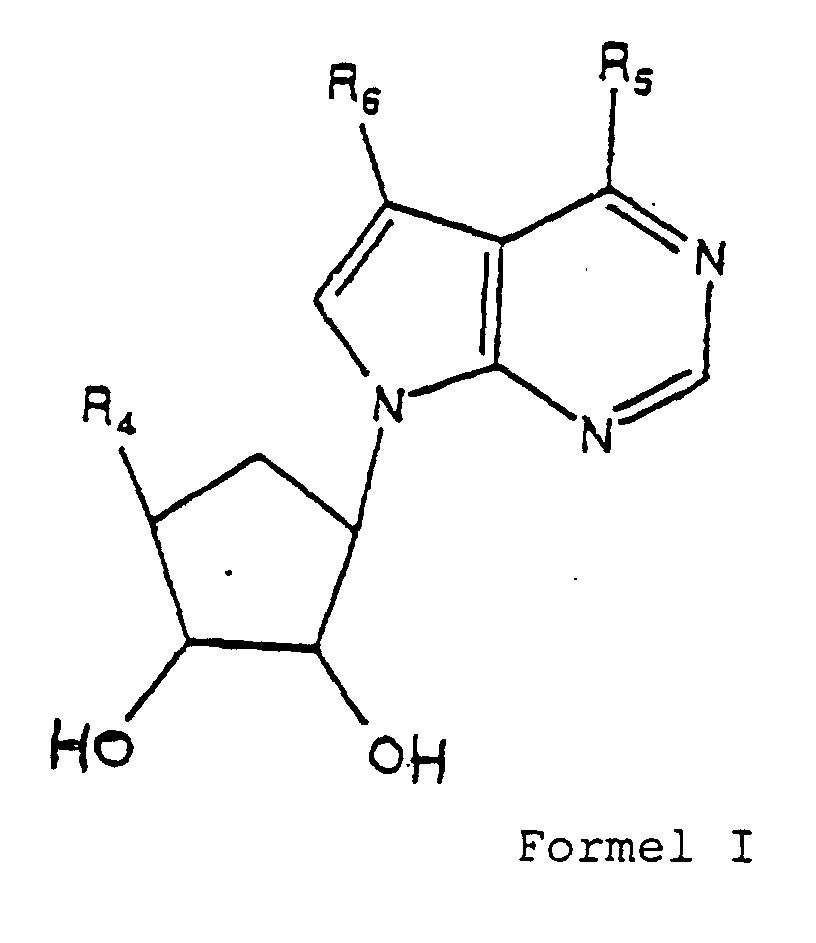 R4 Hydroxyl, -NHR10, -NR12R13 ist, worinR10 eine Aminoschutzgruppe ist;R12 ist Wasserstoff, Alkyl von 1 bis 10 Kohlenstoffatomen, Alkylsulfonyl, Acyl, Alkoxycarbonyl, Aryl, Arylalkyl, Heteroaryl, Arylsulfonyl, Haloalkyl, Heteroarylalkyl, Heteroarylsulfonyl, Aminoalkyl oder Heterozyklyl;R13 ist Wasserstoff, Alkyl von 1 bis 10 Kohlenstoffatomen,R5 ist Amino, Arylalkyl, Arylalkinyl, Arylamino, oder Halogen,R6 ist Aryl, Arylalkyl, Arylalkenyl, Arylalkinyl, oder Halogen.
 - Eine Verbindung gemäß Anspruch 1, worinR4 Amino, Methylamino, Dimethylamino, Acylamino, oder Heteroarylcarbonylamino ist;R5 ist Chlor, Amino, Phenylamino, oder 2-Phenylethinyl;R6 ist Chlor, Iod, Phenyl, 2-Phenylethyl oder Phenylethinyl.
- Eine Verbindung gemäß Anspruch 1, mit der Formel III oder V:worin R4, R5 und R6 wie in Anspruch 1 definiert sind.

- Eine Verbindung gemäß Anspruch 3, worinR4 Amino, Methylamino, Dimethylamino, Acylamino oder Heteroarylcarbonylamino ist;R5 ist Chlor, Amino, Phenylamino, oder 2-Phenylethinyl;R6 ist Chlor, Jod, Phenyl, 2-Phenylethyl oder Phenylethinyl.
- Eine pharmazeutische Zusammensetzung, die eine therapeutisch wirksame Menge einer Verbindung gemäß irgendeinem der Ansprüch 1-4 in Kombination mit einem pharmazeutisch verträglichen Träger umfaßt.
- Verwendung einer Verbindung gemäß irgendeinem der Ansprüche 1-4 zur Herstellung eines Medikamentes zur Hemmung der Adenosinkinase.
- Verwendung einer Verbindung gemäß irgendeinem der Ansprüche 1-4 zur Herstellung eines Medikamentes zur Behandlung von zerebraler Ischämie, Epilepsie, Nozizeption, Entzündung, Sepsis.
Applications Claiming Priority (5)
| Application Number | Priority Date | Filing Date | Title |
|---|---|---|---|
| US47248695A | 1995-06-07 | 1995-06-07 | |
| US472486 | 1995-06-07 | ||
| US651882 | 1996-06-04 | ||
| US08/651,882 US6143749A (en) | 1995-06-07 | 1996-06-04 | Heterocyclic substituted cyclopentane compounds |
| PCT/US1996/009042 WO1996040686A1 (en) | 1995-06-07 | 1996-06-06 | Heterocyclic substituted cyclopentane compounds |
Publications (2)
| Publication Number | Publication Date |
|---|---|
| EP0873340A1 EP0873340A1 (de) | 1998-10-28 |
| EP0873340B1 true EP0873340B1 (de) | 2001-11-21 |
Family
ID=27043790
Family Applications (1)
| Application Number | Title | Priority Date | Filing Date |
|---|---|---|---|
| EP96918151A Expired - Lifetime EP0873340B1 (de) | 1995-06-07 | 1996-06-06 | Heterocyclisch substituierte cyclopentanderivate. |
Country Status (11)
| Country | Link |
|---|---|
| US (1) | US6143749A (de) |
| EP (1) | EP0873340B1 (de) |
| JP (1) | JP2000501694A (de) |
| AT (1) | ATE209206T1 (de) |
| CA (1) | CA2220006A1 (de) |
| DE (1) | DE69617273T2 (de) |
| DK (1) | DK0873340T3 (de) |
| ES (1) | ES2168479T3 (de) |
| MX (1) | MX9709718A (de) |
| PT (1) | PT873340E (de) |
| WO (1) | WO1996040686A1 (de) |
Families Citing this family (45)
| Publication number | Priority date | Publication date | Assignee | Title |
|---|---|---|---|---|
| US5674998A (en) * | 1989-09-15 | 1997-10-07 | Gensia Inc. | C-4' modified adenosine kinase inhibitors |
| US5721356A (en) * | 1989-09-15 | 1998-02-24 | Gensia, Inc. | Orally active adenosine kinase inhibitors |
| CH690773A5 (de) * | 1996-02-01 | 2001-01-15 | Novartis Ag | Pyrrolo(2,3-d)pyrimide und ihre Verwendung. |
| GB9704948D0 (en) | 1997-03-11 | 1997-04-30 | Knoll Ag | Therapeutic agents |
| TR199902301T2 (xx) * | 1997-03-19 | 1999-12-21 | Basf Aktiengesellschaft | Pirilo $2,3D]pirimidinler ve onlar�n kullan�m�. |
| US7863444B2 (en) | 1997-03-19 | 2011-01-04 | Abbott Laboratories | 4-aminopyrrolopyrimidines as kinase inhibitors |
| CA2286909A1 (en) * | 1997-04-16 | 1998-10-22 | Abbott Laboratories | 5,7-disubstituted 4-aminopyrido¬2,3-d|pyrimidine compounds and their use as adenosine kinase inhibitors |
| HK1039326A1 (zh) * | 1998-09-18 | 2002-04-19 | Abbott Gmbh & Co. Kg | 4氨基吡咯并嘧啶作为激酶抑制剂 |
| US6713474B2 (en) | 1998-09-18 | 2004-03-30 | Abbott Gmbh & Co. Kg | Pyrrolopyrimidines as therapeutic agents |
| TWI229674B (en) | 1998-12-04 | 2005-03-21 | Astra Pharma Prod | Novel triazolo[4,5-d]pyrimidine compounds, pharmaceutical composition containing the same, their process for preparation and uses |
| US7071199B1 (en) | 1999-09-17 | 2006-07-04 | Abbott Gmbh & Cco. Kg | Kinase inhibitors as therapeutic agents |
| AU2000240570A1 (en) * | 2000-03-29 | 2001-10-08 | Knoll Gesellschaft Mit Beschraenkter Haftung | Pyrrolopyrimidines as tyrosine kinase inhibitors |
| GB0128885D0 (en) * | 2001-12-03 | 2002-01-23 | Merck Sharp & Dohme | Therapeutic agents |
| WO2005044835A1 (en) * | 2003-10-27 | 2005-05-19 | Genelabs Technologies, Inc. | METHODS FOR PREPARING 7-(2'-SUBSTITUTED-ß-D-RIBOFURANOSYL)-4-(NR2R3)-5-(SUBSTITUTED ETHYN-1-YL)-PYRROLO[2,3-D]PYRIMIDINE DERIVATIVES |
| US7345034B2 (en) * | 2004-04-07 | 2008-03-18 | Abbott Laboratories | Azacyclosteroid histamine-3 receptor ligands |
| GT200500281A (es) * | 2004-10-22 | 2006-04-24 | Novartis Ag | Compuestos organicos. |
| US7659274B2 (en) * | 2006-01-25 | 2010-02-09 | Osi Pharmaceuticals, Inc. | Unsaturated mTOR inhibitors |
| ATE549337T1 (de) * | 2006-04-21 | 2012-03-15 | Novartis Ag | Purinderivate zur verwendung als adenosin-a2a- rezeptoragonisten |
| WO2009065406A2 (en) * | 2007-11-23 | 2009-05-28 | Leo Pharma A/S | Novel cyclic hydrocarbon compounds for the treatment of diseases |
| GB201004311D0 (en) | 2010-03-15 | 2010-04-28 | Proximagen Ltd | New enzyme inhibitor compounds |
| US9150574B2 (en) | 2011-09-14 | 2015-10-06 | Proximagen Limited | Enzyme inhibitor compounds |
| GB201115853D0 (en) * | 2011-09-14 | 2011-10-26 | Proximagen Ltd | New enzyme inhibitor compounds |
| US9682083B2 (en) | 2013-05-14 | 2017-06-20 | Nerviano Medical Sciences S.R.L. | Pyrrolo[2,3-D]pyrimidine derivatives, process for their preparation and their use as kinase inhibitors |
| TWI791251B (zh) | 2015-08-26 | 2023-02-01 | 比利時商健生藥品公司 | 使用作為prmt5抑制劑之新穎經6-6雙環芳香環取代之核苷類似物 |
| MA41559A (fr) | 2015-09-08 | 2017-12-26 | Taiho Pharmaceutical Co Ltd | Composé de pyrimidine condensé ou un sel de celui-ci |
| IL261107B2 (en) | 2016-02-23 | 2023-11-01 | Taiho Pharmaceutical Co Ltd | A novel compressed pyrimidine compound or a salt thereof |
| ES2891320T3 (es) | 2016-03-10 | 2022-01-27 | Janssen Pharmaceutica Nv | Análogos de nucleósidos sustituidos para su uso como inhibidores de PRMT5 |
| CA2969295A1 (en) * | 2016-06-06 | 2017-12-06 | Pfizer Inc. | Substituted carbonucleoside derivatives, and use thereof as a prmt5 inhibitor |
| EP3512858B1 (de) | 2016-09-14 | 2023-11-08 | Janssen Pharmaceutica NV | Kondensierte bicyclische inhibitoren der menin-mll-interaktion |
| US12084462B2 (en) | 2016-09-14 | 2024-09-10 | Janssen Pharmaceutica Nv | Spiro bicyclic inhibitors of menin-MLL interaction |
| ES2872003T3 (es) | 2016-09-14 | 2021-11-02 | Janssen Pharmaceutica Nv | Inhibidores espirobicíclicos de la interacción de menina-MLL |
| KR102531344B1 (ko) * | 2016-10-03 | 2023-05-10 | 얀센 파마슈티카 엔.브이. | Prmt5 억제제로서 사용하기 위한 신규의 모노사이클릭 및 바이사이클릭 고리 시스템 치환된 카르바뉴클레오시드 유사체 |
| KR102513564B1 (ko) | 2016-12-15 | 2023-03-22 | 얀센 파마슈티카 엔.브이. | 메닌-mll 상호작용의 아제판 억제제 |
| EA201990851A1 (ru) | 2017-02-24 | 2019-09-30 | Янссен Фармацевтика Нв | Новые аналоги карбануклеозида, замещенные моноциклической и бициклической кольцевой системой, для применения в качестве ингибиторов prmt5 |
| CA3049739A1 (en) | 2017-02-27 | 2018-08-30 | Janssen Pharmaceutica Nv | Use of biomarkers in identifying cancer patients that will be responsive to treatment with a prmt5 inhibitor |
| WO2018160824A1 (en) * | 2017-03-01 | 2018-09-07 | Prelude Therapeutics, Incorporated | Selective inhibitors of protein arginine methyltransferase 5 (prmt5) |
| SG11202001212SA (en) | 2017-08-21 | 2020-03-30 | Taiho Pharmaceutical Co Ltd | Fusion protein of dctn1 protein with ret protein |
| JP7352544B2 (ja) | 2017-12-08 | 2023-09-28 | ヤンセン ファーマシューティカ エヌ.ベー. | 新規なスピロ二環式類似体 |
| US11396517B1 (en) | 2017-12-20 | 2022-07-26 | Janssen Pharmaceutica Nv | Exo-aza spiro inhibitors of menin-MLL interaction |
| SG11202110272SA (en) | 2019-03-25 | 2021-10-28 | California Inst Of Techn | Prmt5 inhibitors and uses thereof |
| TW202112375A (zh) | 2019-06-06 | 2021-04-01 | 比利時商健生藥品公司 | 使用prmt5抑制劑治療癌症之方法 |
| IL288741B2 (en) | 2019-06-12 | 2025-03-01 | Janssen Pharmaceutica Nv | Novel spirobicyclic intermediates |
| TWI878414B (zh) | 2019-12-19 | 2025-04-01 | 比利時商健生藥品公司 | 經取代之直鏈螺環接衍生物 |
| CN111320634A (zh) * | 2020-04-14 | 2020-06-23 | 浙江工业大学 | 一种乙酰氧取代的吡咯并[2,3-d]嘧啶衍生物的制备方法 |
| US12084453B2 (en) | 2021-12-10 | 2024-09-10 | Incyte Corporation | Bicyclic amines as CDK12 inhibitors |
Family Cites Families (11)
| Publication number | Priority date | Publication date | Assignee | Title |
|---|---|---|---|---|
| US3551428A (en) * | 1956-02-10 | 1970-12-29 | Ciba Geigy Corp | New 1- (or 2-) substituted 4-mercapto-pyrazolo(3,4-d)pyrimidines |
| US3296261A (en) * | 1965-03-09 | 1967-01-03 | Bristol Myers Co | 6-hydroxy-pyrimidine-5-acetamides |
| US3311628A (en) * | 1965-03-09 | 1967-03-28 | Bristol Myers Co | Derivatives of pyrrolo [2, 3-d] pyrimidine |
| US5223618A (en) * | 1990-08-13 | 1993-06-29 | Isis Pharmaceuticals, Inc. | 4'-desmethyl nucleoside analog compounds |
| US5378825A (en) * | 1990-07-27 | 1995-01-03 | Isis Pharmaceuticals, Inc. | Backbone modified oligonucleotide analogs |
| FI933303L (fi) * | 1991-01-23 | 1993-08-31 | Gensia Inc | Adenosinkinasinhibitorer |
| EP0521463A3 (en) * | 1991-07-04 | 1993-04-14 | Hoechst Aktiengesellschaft | Substituted cyclic cycloalkyltriols, process, intermediates for their preparation and their use as antiviral and antiparasitic agents |
| AU4845193A (en) * | 1992-09-11 | 1994-04-12 | Regents Of The University Of California, The | Adenosine analogues and method of increasing adenosine release |
| ES2128544T3 (es) * | 1992-12-17 | 1999-05-16 | Pfizer | Pirrolopirimidinas como antagonistas del crf. |
| AU673055B2 (en) * | 1993-02-03 | 1996-10-24 | Gensia, Inc. | Adenosine kinase inhibitors comprising lyxofuranosyl derivatives |
| IL108523A0 (en) * | 1993-02-03 | 1994-05-30 | Gensia Inc | Pharmaceutical compositions containing adenosine kinase inhibitors for preventing or treating conditions involving inflammatory responses and pain |
-
1996
- 1996-06-04 US US08/651,882 patent/US6143749A/en not_active Expired - Fee Related
- 1996-06-06 PT PT96918151T patent/PT873340E/pt unknown
- 1996-06-06 JP JP9501456A patent/JP2000501694A/ja active Pending
- 1996-06-06 DE DE69617273T patent/DE69617273T2/de not_active Expired - Fee Related
- 1996-06-06 WO PCT/US1996/009042 patent/WO1996040686A1/en not_active Ceased
- 1996-06-06 EP EP96918151A patent/EP0873340B1/de not_active Expired - Lifetime
- 1996-06-06 CA CA002220006A patent/CA2220006A1/en not_active Abandoned
- 1996-06-06 DK DK96918151T patent/DK0873340T3/da active
- 1996-06-06 ES ES96918151T patent/ES2168479T3/es not_active Expired - Lifetime
- 1996-06-06 AT AT96918151T patent/ATE209206T1/de not_active IP Right Cessation
-
1997
- 1997-12-05 MX MX9709718A patent/MX9709718A/es unknown
Also Published As
| Publication number | Publication date |
|---|---|
| DE69617273D1 (de) | 2002-01-03 |
| CA2220006A1 (en) | 1996-12-19 |
| PT873340E (pt) | 2002-05-31 |
| MX9709718A (es) | 1998-07-31 |
| ES2168479T3 (es) | 2002-06-16 |
| EP0873340A1 (de) | 1998-10-28 |
| ATE209206T1 (de) | 2001-12-15 |
| DK0873340T3 (da) | 2002-05-21 |
| US6143749A (en) | 2000-11-07 |
| DE69617273T2 (de) | 2002-07-25 |
| JP2000501694A (ja) | 2000-02-15 |
| WO1996040686A1 (en) | 1996-12-19 |
Similar Documents
| Publication | Publication Date | Title |
|---|---|---|
| US5665721A (en) | Heterocyclic substituted cyclopentane compounds | |
| US6143749A (en) | Heterocyclic substituted cyclopentane compounds | |
| EP3345907B1 (de) | Pyrazolo[3,4-d]pyrimidin-verbindungen oder salze davon | |
| US5763597A (en) | Orally active adenosine kinase inhibitors | |
| CA2247984A1 (en) | Orally active adenosine kinase inhibitors | |
| CA2247983A1 (en) | Water-soluble adenosine kinase inhibitors | |
| KR20170023156A (ko) | 단백질 키나제 저해제로서의 아미노피리다지논 화합물 | |
| CA3135740A1 (en) | Cancer treatments targeting cancer stem cells | |
| CN112047943A (zh) | 一种选择性抑制激酶化合物及其用途 | |
| WO2023003610A1 (en) | Novel spiropyrrolidine derived antiviral agents | |
| CN111057021A (zh) | 均三嗪类化合物及其制备方法和用途 | |
| AU744528B2 (en) | 6,7-disubstituted-4-aminopyrido(2,3-d)pyrimidine compounds | |
| KR102776475B1 (ko) | 아민, 아미드 및 페놀 전달에 유용한 프로드러그 플랫폼 | |
| KR100429117B1 (ko) | 선택된용해성히드록실함유인돌로카르바졸의에스테르 | |
| CN117402183A (zh) | 含硼化合物及其医药用途 | |
| RU2768451C1 (ru) | Селективный антагонист рецепторов типа A2A | |
| EP0975633A1 (de) | 5,6,7-trisubstituierte-4-aminopyrido(2,3-d)pyrimidin verbindungen | |
| CN115536696B (zh) | Enpp1抑制剂 | |
| JP2003506376A (ja) | 1,2−ジヒドロ−1−オキソ−ピラジノ[1,2−a]インドール誘導体 | |
| EP4703354A1 (de) | Verbindung als ccr6-antagonisten sowie pharmazeutische zusammensetzung und verwendung davon | |
| KR101569341B1 (ko) | 베타-세크리테아제 활성을 억제하는 4-(아릴유레이도)피롤리딘 유도체 및 이를 유효성분으로 함유하는 약제학적 조성물 | |
| CN120230147A (zh) | 信号传导及转录激活蛋白抑制剂化合物及其应用 | |
| CN117247374A (zh) | 一种bcl-xl抑制剂及其制药用途 | |
| JPS615082A (ja) | 3−アミノピラゾロ〔3,4−d〕ピリミジン誘導体 | |
| JPH0834788A (ja) | ピロロベンゾカルバゾール誘導体及びその製造方法 |
Legal Events
| Date | Code | Title | Description |
|---|---|---|---|
| PUAI | Public reference made under article 153(3) epc to a published international application that has entered the european phase |
Free format text: ORIGINAL CODE: 0009012 |
|
| 17P | Request for examination filed |
Effective date: 19971208 |
|
| AK | Designated contracting states |
Kind code of ref document: A1 Designated state(s): AT BE CH DE DK ES FI FR GB GR IE IT LI LU NL PT SE |
|
| 17Q | First examination report despatched |
Effective date: 20000303 |
|
| GRAG | Despatch of communication of intention to grant |
Free format text: ORIGINAL CODE: EPIDOS AGRA |
|
| GRAG | Despatch of communication of intention to grant |
Free format text: ORIGINAL CODE: EPIDOS AGRA |
|
| GRAH | Despatch of communication of intention to grant a patent |
Free format text: ORIGINAL CODE: EPIDOS IGRA |
|
| GRAH | Despatch of communication of intention to grant a patent |
Free format text: ORIGINAL CODE: EPIDOS IGRA |
|
| GRAA | (expected) grant |
Free format text: ORIGINAL CODE: 0009210 |
|
| AK | Designated contracting states |
Kind code of ref document: B1 Designated state(s): AT BE CH DE DK ES FI FR GB GR IE IT LI LU NL PT SE |
|
| REF | Corresponds to: |
Ref document number: 209206 Country of ref document: AT Date of ref document: 20011215 Kind code of ref document: T |
|
| REG | Reference to a national code |
Ref country code: CH Ref legal event code: EP |
|
| REG | Reference to a national code |
Ref country code: IE Ref legal event code: FG4D |
|
| REG | Reference to a national code |
Ref country code: GB Ref legal event code: IF02 |
|
| REF | Corresponds to: |
Ref document number: 69617273 Country of ref document: DE Date of ref document: 20020103 |
|
| REG | Reference to a national code |
Ref country code: CH Ref legal event code: NV Representative=s name: A. BRAUN, BRAUN, HERITIER, ESCHMANN AG PATENTANWAE |
|
| ET | Fr: translation filed | ||
| REG | Reference to a national code |
Ref country code: DK Ref legal event code: T3 |
|
| REG | Reference to a national code |
Ref country code: PT Ref legal event code: SC4A Free format text: AVAILABILITY OF NATIONAL TRANSLATION Effective date: 20020221 |
|
| PG25 | Lapsed in a contracting state [announced via postgrant information from national office to epo] |
Ref country code: LU Free format text: LAPSE BECAUSE OF NON-PAYMENT OF DUE FEES Effective date: 20020606 Ref country code: IE Free format text: LAPSE BECAUSE OF NON-PAYMENT OF DUE FEES Effective date: 20020606 Ref country code: GB Free format text: LAPSE BECAUSE OF NON-PAYMENT OF DUE FEES Effective date: 20020606 Ref country code: FI Free format text: LAPSE BECAUSE OF NON-PAYMENT OF DUE FEES Effective date: 20020606 Ref country code: AT Free format text: LAPSE BECAUSE OF NON-PAYMENT OF DUE FEES Effective date: 20020606 |
|
| PG25 | Lapsed in a contracting state [announced via postgrant information from national office to epo] |
Ref country code: SE Free format text: LAPSE BECAUSE OF NON-PAYMENT OF DUE FEES Effective date: 20020607 Ref country code: ES Free format text: LAPSE BECAUSE OF NON-PAYMENT OF DUE FEES Effective date: 20020607 |
|
| REG | Reference to a national code |
Ref country code: ES Ref legal event code: FG2A Ref document number: 2168479 Country of ref document: ES Kind code of ref document: T3 |
|
| PG25 | Lapsed in a contracting state [announced via postgrant information from national office to epo] |
Ref country code: LI Free format text: LAPSE BECAUSE OF NON-PAYMENT OF DUE FEES Effective date: 20020630 Ref country code: CH Free format text: LAPSE BECAUSE OF NON-PAYMENT OF DUE FEES Effective date: 20020630 Ref country code: BE Free format text: LAPSE BECAUSE OF NON-PAYMENT OF DUE FEES Effective date: 20020630 |
|
| PG25 | Lapsed in a contracting state [announced via postgrant information from national office to epo] |
Ref country code: DK Free format text: LAPSE BECAUSE OF NON-PAYMENT OF DUE FEES Effective date: 20020731 |
|
| REG | Reference to a national code |
Ref country code: GR Ref legal event code: EP Ref document number: 20020400680 Country of ref document: GR |
|
| PLBE | No opposition filed within time limit |
Free format text: ORIGINAL CODE: 0009261 |
|
| STAA | Information on the status of an ep patent application or granted ep patent |
Free format text: STATUS: NO OPPOSITION FILED WITHIN TIME LIMIT |
|
| 26N | No opposition filed | ||
| BERE | Be: lapsed |
Owner name: *ABBOTT LABORATORIES Effective date: 20020630 |
|
| PG25 | Lapsed in a contracting state [announced via postgrant information from national office to epo] |
Ref country code: NL Free format text: LAPSE BECAUSE OF NON-PAYMENT OF DUE FEES Effective date: 20030101 Ref country code: DE Free format text: LAPSE BECAUSE OF NON-PAYMENT OF DUE FEES Effective date: 20030101 |
|
| PG25 | Lapsed in a contracting state [announced via postgrant information from national office to epo] |
Ref country code: GR Free format text: LAPSE BECAUSE OF NON-PAYMENT OF DUE FEES Effective date: 20030108 |
|
| GBPC | Gb: european patent ceased through non-payment of renewal fee |
Effective date: 20020606 |
|
| EUG | Se: european patent has lapsed | ||
| REG | Reference to a national code |
Ref country code: CH Ref legal event code: PL |
|
| REG | Reference to a national code |
Ref country code: DK Ref legal event code: EBP |
|
| PG25 | Lapsed in a contracting state [announced via postgrant information from national office to epo] |
Ref country code: FR Free format text: LAPSE BECAUSE OF NON-PAYMENT OF DUE FEES Effective date: 20030228 |
|
| NLV4 | Nl: lapsed or anulled due to non-payment of the annual fee |
Effective date: 20030101 |
|
| REG | Reference to a national code |
Ref country code: IE Ref legal event code: MM4A |
|
| REG | Reference to a national code |
Ref country code: FR Ref legal event code: ST |
|
| PG25 | Lapsed in a contracting state [announced via postgrant information from national office to epo] |
Ref country code: PT Free format text: LAPSE BECAUSE OF NON-PAYMENT OF DUE FEES Effective date: 20031231 |
|
| REG | Reference to a national code |
Ref country code: PT Ref legal event code: MM4A Free format text: LAPSE DUE TO NON-PAYMENT OF FEES Effective date: 20031231 |
|
| REG | Reference to a national code |
Ref country code: ES Ref legal event code: FD2A Effective date: 20030711 |
|
| PG25 | Lapsed in a contracting state [announced via postgrant information from national office to epo] |
Ref country code: IT Free format text: LAPSE BECAUSE OF NON-PAYMENT OF DUE FEES Effective date: 20050606 |
|
| PG25 | Lapsed in a contracting state [announced via postgrant information from national office to epo] |
Ref country code: PT Free format text: LAPSE BECAUSE OF NON-PAYMENT OF DUE FEES Effective date: 20020606 |