EP0873681A2 - Dispositif de traitement de la vigne - Google Patents
Dispositif de traitement de la vigne Download PDFInfo
- Publication number
- EP0873681A2 EP0873681A2 EP98107199A EP98107199A EP0873681A2 EP 0873681 A2 EP0873681 A2 EP 0873681A2 EP 98107199 A EP98107199 A EP 98107199A EP 98107199 A EP98107199 A EP 98107199A EP 0873681 A2 EP0873681 A2 EP 0873681A2
- Authority
- EP
- European Patent Office
- Prior art keywords
- drive
- vine
- cords
- receiving
- erecting
- Prior art date
- Legal status (The legal status is an assumption and is not a legal conclusion. Google has not performed a legal analysis and makes no representation as to the accuracy of the status listed.)
- Granted
Links
Images


Classifications
-
- A—HUMAN NECESSITIES
- A01—AGRICULTURE; FORESTRY; ANIMAL HUSBANDRY; HUNTING; TRAPPING; FISHING
- A01G—HORTICULTURE; CULTIVATION OF VEGETABLES, FLOWERS, RICE, FRUIT, VINES, HOPS OR SEAWEED; FORESTRY; WATERING
- A01G17/00—Cultivation of hops, vines, fruit trees, or like trees
- A01G17/02—Cultivation of hops or vines
Definitions
- the invention relates to a vine processing device which can be attached as an attachment to a carrier vehicle by means of a gallows-shaped boom and has a carrier frame which can be connected to the carrier vehicle and which runs with its frame plane transversely to the direction of travel of the carrier vehicle and has side legs which at least in some areas have the vine row to be processed overlap, the support frame and the boom being designed as a basic device for the detachable attachment of removal devices with different processing functions.
- Vine processing devices are already known in different embodiments.
- DE 35 46 445.3-23 discloses a device for pre-cutting vine with knives which engage in the row of vines and cut approximately in the horizontal direction. With this device intended for cordon cutting, the vine can be cut and shredded.
- a foliage cutting device is known with which the outside of the vine row can be trimmed.
- This cutting device works with a hedge trimmer, which has a cutter bar with a length approximately corresponding to the height of the leaf wall to be processed.
- cutting devices have been developed which work with several cutter disks.
- Such a device is known for example from DE-OS 20 37 293.
- From FR 22 30 285 an attachment for lateral pruning and for decapping is known which can be attached to a carrier vehicle by means of a gallows-shaped boom and a carrier frame suspended thereon.
- Another vine processing device is known from DE-PS 2 426 612. It is a device for erecting and fixing vine shoots. This allows the vine shoots, which grow crisscross over time, to be lifted upwards and fixed in this upright position by means of threads stretched on both sides next to the row of vines, which are stitched together at certain intervals. In such processing devices, it is also known to use screw conveyors to erect the vine shoots.
- the object of the present invention is a vine processing device to create that is inexpensive and needed for different types of vines or with different requirements is adaptable and with which in particular an even erection the vine shoots may be possible.
- a receiving and erecting device with powered conveying means for erecting the vine drives is provided as an extension device, which has a drive that is approximately proportional to the driving speed of the carrier vehicle and that the proportionality factor can be set manually.
- the conveying speed of the conveying means and the driving speed are matched to one another in such a way that the vine drives are picked up by the conveying means during the detection time and brought into an approximately vertical position in which the conveying means then come out of engagement again. Due to the speed-proportional drive of the conveying means, the driving speed of the carrier vehicle can be varied without adversely affecting the work result.
- soil cultivation is also carried out simultaneously with the cultivation of the vine row, for example with an additional mulching device attached to the tractor.
- An embodiment of the invention provides that as an additional Removal devices a stapler for stapling parallel cords laid side by side and an unwinding device for unwinding cords spaced approximately parallel to each other is provided and that as a drive for the receiving and erecting device that when sewing on both sides along the row of vines Laying cords or similar pulling elements that serve are attached at one end to one end of the row of vines.
- the vine shoots erected by the receiving and erecting device are held by the cords running on both sides.
- the cords are stapled together at certain intervals. This can be done manually or with the stapler that can be attached to the base unit as an extension unit.
- the drive for the conveying means by means of the cords or similar pulling elements laid on both sides along the row of rows when pinning results in a particularly simple way of driving the conveying means synchronously with the driving speed. Separate drives for the conveying means with a corresponding control device for adaptation to the driving speed are therefore not necessary.
- motor drives in particular electric motors or hydraulic motors, can also be provided as drives for the receiving and erecting device, which are connected to a control for a conveying speed of the receiving and raising device approximately proportional to the travel speed.
- motor drives for example hydraulic motors or electric motors for the conveying means to use.
- An embodiment of the invention provides that the receiving and erecting device opposite on the two side legs of the support frame releasably attachable and rotatably mounted ring gears with teeth located on the outer circumference or the like driver, the plate levels obliquely with respect to each other in the direction of travel of the carrier vehicle and upwards Plate level spacing are arranged.
- This pick-up and erection device with, for example, two ring gears is simple in construction and also comparatively light. It can therefore also be used on smaller carrier vehicles.
- the serrations or drivers on the outer circumferences of the ring gears are designed so that driver chambers are formed which are dimensioned to receive a vine shoot and grasp it and raise the vine shoots by the rotation of the ring gears and their inclination.
- the special position and inclination of the crown wheels also means that they come out of engagement with these vine shoots in the case of approximately vertically erected vine shoots and thus release the shoots again in the intended vertical alignment position.
- the ring gears for a drive speed-synchronous drive have cord grooves set back inwards for their teeth or the like, which are at least partially wrapped around by the cords to be laid during stitching. A driving speed-synchronous drive of the ring gears is thus easily available.
- the receiving and erecting device can optionally also be arranged opposite one another on the two side legs of the support frame, can be detachably attached, runs diagonally upward and transports in this direction, the screw turns of which are spaced such that, taking into account the inclined position of the screw between the screw turns, in an approximately vertical direction there is a clear passage for shoots to be erected and that the pitch of the turns is preferably more than 125 mm, for example 180 mm with an inclined position of the screw conveyors of approximately 50 ° to approximately 60 °.
- Such a pick-up and uprighting device is also suitable for very vigorous vines or also for vines in an advanced stage of growth. The distances provided between the screw turns ensure that the individual shoots are gripped securely and then erected into an approximately vertical position.
- An advantageous embodiment of the aforementioned embodiment of a receiving and erecting device provides that coupling points are provided at the upper end of the screw conveyors for screw conveyor extensions that can be coupled there, which extend to behind the carrier frame and that the screw conveyor extensions are preferably arranged at a flatter angle than the rest of the screw conveyor and that in particular universal joints are provided for the drive transmission at the coupling point.
- the screw conveyors can be adjusted in height on the side legs of the support frame so that they can be adapted to the position of the vine shoots to be erected, but in some cases it is necessary to have a particularly long conveyor track available.
- the screw conveyors can be extended at their upper ends with the provided extensions, so that the shoots are securely gripped on the one hand at the lower end, but on the other hand also erected up to an actual vertical position.
- the conveying path in the upper area of the screw conveyor is dimensioned such that the vine shoots are guided beyond the stitching point to ensure that the vine shoots are fed to the decipherer in a vertical cutting position.
- the screw auger extension can operate at a higher drive speed than the screw conveyor conveying it, wherein preferably the drive transmission between the screw conveyor and screw auger extension has a translation. This measure ensures that the supplied drives are aligned in a vertical position on a short conveying path. This also favors the fact that the vine shoots are brought into a vertical position and stapled in this position and only then released in order to be cut off by the subsequent summit device.
- a receiving and erecting device provides that the receiving and erecting device on the opposite side on the two side legs of the support frame has detachably attachable, obliquely upward and transporting in this direction, preferably formed by V-belts, which are guided over pulley pulleys are and that the conveyor belts have driver projections on the outside, for example in the form of knobs, rods and the like.
- V-belts which are guided over pulley pulleys are and that the conveyor belts have driver projections on the outside, for example in the form of knobs, rods and the like.
- the deflection pulleys of a conveyor belt can be adjusted from a position in alignment with one another, in particular the upper, laterally adjacent deflection pulleys being adjustable with respect to one another in their inclined position. This makes it possible to set a "twisting" of the conveyor belts within the transport path and thus to be able to adapt them to the prevailing conditions in order to achieve optimal conveying conditions.
- an advantageous embodiment provides that the space delimited on the inside by the conveyor belt and the deflection pulleys is preferably essentially filled by a guide plate, which is designed on its side facing the inner belt drum as a support guide for the conveyor belt and the other on the opposite side Straps around the belt drum. This prevents drives that may have slipped on the conveyor belt of the conveyor belt between the conveyor belt and the deflection pulley.
- the baffle thus serves on the one hand as a deflector for the vine drives to be erected and also forms a side system by which transverse loads on the conveyor belts are avoided.
- a vine processing device which has a stapling device for stapling cords or the like laid in parallel next to one another, releasably attachable staple legs are provided on the two side legs of the support frame, with a reloading opening for staples accessible from the front end of the staple leg being provided for the stapling head and for this Reload opening a locking slide is arranged, which forms a stop in the closed position for under tension, clamped in one of the side legs brackets.
- the stapler thus also forms a removal device that can be attached to the basic device as required.
- the unwinding device for unwinding cords, threads or the like which are spaced approximately parallel to one another, has a control device for monitoring the line or thread reels and if viewing windows are preferably provided for this purpose in a receiving box for the line or thread reels.
- the viewing windows are in the driver's field of vision, for whom it is continuously recognizable to what extent the spools of thread have been processed.
- a vine cultivating device 1 shown in FIG. 1 is designed as an attachment for a carrier vehicle 2 and has a base unit 3, which essentially consists of a gallows-shaped boom, a carrier frame 5 and a knife 6 (decoder) arranged at the upper region of the carrier frame 5.
- the boom 4 is connected to the carrier vehicle 2 by means of a holder and there has a lifting device 7 and a pivot bearing 8, about which the boom 4 can be swiveled to the right and left by about 30 ° and can be fixed in the desired position.
- This pivotability is indicated by the arrow Pf1, the height adjustment by the arrow Pf2 and finally the adjustability of the boom width by the arrow Pf3.
- the support frame 5 is suspended via a swivel joint 40.
- the carrier frame 5 is located laterally next to the carrier vehicle 2, the frame plane extending transversely to the direction of travel of the vehicle.
- the support frame 5 is pivoted laterally at the swivel joint 8 and a vibration damper 26 is provided for damping in this swivel direction.
- the head-end knife 6 for decapping is pivoted against the direction of travel and can thus move backwards with a correspondingly greater resistance. A collision safety device is thereby formed.
- the support frame 5 is essentially U-shaped and extends over a row of vines 9. In FIG.
- the vine processing device 1 is realized by conveyor belts 43 which run obliquely upwards and transport in this direction, preferably formed by V-belts, which are guided over deflection pulleys 44.
- the conveyor belts 43 have driver projections 41, for example in the form of knobbed bars or the like.
- the driver 41 which is in the form of a rod in the exemplary embodiment, can be connected on the outside at any distance, depending on the requirements, to the V-belt, and this can be done by welding or gluing when using a plastic V-belt.
- the rod-shaped drivers preferably have a rounded cross section in order to avoid damage to the drives.
- the deflection pulleys preferably have axially offset cord grooves, not shown here, via which the conveyor belts can be driven with the aid of a tack cord to be laid.
- the distance between the deflection pulleys for one conveyor belt and thus the conveyor section can be adapted to the respective requirements. Since these funds are light in weight, there is in particular the possibility of spacing the deflection pulleys so far apart that, on the one hand, the shoots to be erected are reliably detected in the lower area and, on the other hand, the recorded vine shoots can also be taken beyond a stitching point .
- a guide plate 45 which is only indicated by a dashed line on the right-hand side, which prevents vine drives from getting between the belts and one of the deflection pulleys, and in addition, the guide plate forms a lateral contact for the vine drives, so that transverse forces acting on the conveyor belts are avoided.
- the guide plate In the case of the inner belt drum, which is loaded by the vine shoots, the guide plate has a support guide, through which the pressurization of the conveyor belt is absorbed.
- the opposite side of the baffle is provided with an offset, which encompasses the other, returning belt drum.
- clamp legs 29, 30 of a stapler 28 pass through the plane spanned by the deflection pulleys 44, 44a and corresponding cutouts 46 are provided in the guide plates 45.
- the gallows-shaped boom can be pivoted about a vertical axis 27 by about 180 ° to the other side of the carrier vehicle. This makes it possible, with a given direction of travel of the carrier vehicle, to be able to process either the vine row located to the right or left. If cutters are used for trimming the leaves laterally, the vertically oriented rotary knives arranged one above the other on the inside of the side legs 10 and 11 of the support frame are provided with cutters on their front and rear edges in the circumferential plane, so that in both pivoting end positions of the boom 4 on the one or on the other side of the carrier vehicle equally good cutting results can be achieved.
- the side legs 10 and 11 have fastening points 14, at which processing devices 12 can be detachably attached.
- the processing devices can be removed.
- other extension devices with different machining functions can also be attached to the then existing base unit 3, in particular also the receiving and erecting device 15 shown in FIG. 1.
- the basic device 3 of the vine processing device 1 is equipped with a receiving and erecting device 15 as a removal device. This enables inclined vine shoots to be picked up and aligned in an approximately vertical position.
- the receiving and erecting device 15 shown in FIG. 2 has two obliquely arranged crown wheels 16 with teeth 17 located on the outer circumference.
- the two ring gears 16 are arranged on the two outer legs of the support frame 5 opposite one another.
- an unwinding device (not shown in more detail) is provided for unwinding cords 19, threads or similar pulling elements which are to be laid approximately parallel to one another on both sides of the vine row and which are stapled together at certain intervals. This keeps the upright vine shoots in this position.
- the unwinding device for unwinding the cords 19, which are spaced apart approximately parallel to one another, has a control device for monitoring the cord or thread reels, which are located in a receiving box 20.
- the latter has viewing windows 42 which are in the driver's field of vision, so that the driver can recognize in good time when a next line roller must be attached.
- the unwinding device can at the same time also be used to drive the ring gears 16 or else the conveying means of the other receiving and erecting device shown in FIG. 1.
- the ring gears have cord grooves 18 over which the cords 19 fastened at one end to the end of a row of vines are guided.
- the cord is then preferably guided along the carrier frame parts to a cord supply located in a receiving box 20, from which the cord is unwound. This takes place when the carrier vehicle 2 moves away from the outer fastening points of the cord at the end of a row of vines. Since the cords are guided over the ring gears 16, they move synchronously with the driving speed.
- the ring gears have a carrier part 24 which forms the hub and has the rotary bearing 23 and to which an exchangeable outer ring part 25 is connected.
- This outer ring part with the teeth 17 is preferably made of plastic and can be easily replaced as a wearing part.
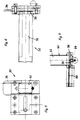
- a stapler 28 which is schematically indicated in FIG. For the sake of clarity, only the stapler 28 is shown in FIG. 3.
- the stapler works in each case in connection with one of the receiving and erecting devices, which are shown in FIGS. 1, 2 and 4.
- the receiving and erecting device is located in front of the stapler 28 in the direction of travel.
- the stapler 28 has two clamp legs 29, 30 which are pivotable in an approximately horizontal plane and driven by lifting cylinders and which form a stapling head 31 at their free ends, in which, when the ends of the staple legs 29 and 30 meet, the cords stapling staples are output and be bent.
- the stapling device 28 also forms a removal device which, if necessary, can be used in conjunction with the basic device 3 and a receiving and erecting device 15 and an unwinding device for the cords.
- a special feature of the stapling device 28 is shown in FIGS. 5 to 6.
- the staple leg 30, in which a staple magazine 32 is accommodated, has a reloading opening 33 which is accessible from the front end of the staple leg 30 and which can be closed by a slide 34. In the closed position, the slide 34 forms a stop for prestressed magazine clamps which can be ejected in succession at a delivery opening 36 with the aid of a push plate 35.
- a compression spring is usually arranged within the clip magazine 2, which is compressed with clips during magazine loading.
- the free end of the spring or a slider located there can be connected to a preferably manually operated pulling or pushing element, by means of which the spring is first retracted or pushed back into the maximum tensioned end position can.
- a pull element one end of which is connected to the spring, can preferably be guided via a deflection, which is located at the end of the clip magazine 32 facing away from the stitching head, and a pull handle can be connected to the other end, which is located next to the reload opening 33 or at the head end of the clamp leg 30.
- the pull handle can be pulled at the same time, thus compensating the spring preload more or less.
- a lifting cylinder which is preferably arranged approximately parallel to the magazine chamber and is connected to the magazine slide, can also be provided.
- Lifting cylinders in particular hydraulic cylinders, can also be provided for the pivoting movement of the two clamp legs, which are likewise arranged approximately parallel next to the respective clamp leg. This results in compact and practically closed units on which moving parts are shielded from the outside. This makes it possible to safely position the stapler in the driver's access area. After the stapling process, the two staple legs 29 and 30 are brought back into their open starting position by spring force. In order to avoid hard stops in the open position, preferably hydraulic end position dampers are preferably provided in the lifting cylinders for actuating the clamp legs.
- FIG. 4 shows yet another embodiment of a receiving and erecting device 15, conveyor screws 37 running obliquely upward and transporting in this direction being provided on the two side legs 10 and 11 of the carrier frame 5.
- conveyor screws 37 running obliquely upward and transporting in this direction being provided on the two side legs 10 and 11 of the carrier frame 5.
- motor drives 38 which are preferably formed by hydraulic motors.
- the drives 38 are connected to a controller that controls the drives 38 as a function of the driving speed of the carrier vehicle 2.
- There is also an adjustment option on the control unit in order to be able to set or change the conveying speed which is proportional to the driving speed.
- Extensions can also be coupled to the upper ends of the screw conveyors, which extend in particular up to behind the support frame 5 or, when a stapler is used, up to or beyond a stitching point. This brings the vine shoots up to a vertical position, staples them and then releases them, in order to be finally cut off at their ends by the subsequent summit device.
- the screw auger extensions can also be designed as an additional device so that they are only installed if necessary.
- a universal joint can be provided as the drive connection, since the upper conveyor sections formed by the extensions run somewhat flatter than the other screw conveyors.
- the drives 38 can be arranged slightly offset to the outside.
- a front mounting bracket or in the middle of the Longitudinal extension of the vehicle in front of the driver area on one be designed as a bridge-shaped bracket.
- the device described above can be adapted to different work using various expansion devices that can be attached to the basic device - for example pre-cutting, leaf cutting, stitching, etc. Even a basic device with all the expansion devices that can be connected to it is cheaper than a corresponding number of complete devices.
- a cost-effective, step-by-step construction of the vine processing device is initially possible by purchasing the basic device and a first removal device, and further removal devices can be purchased gradually at later times.
- the user of the vine processing device according to the invention can purchase a suitable assortment or suitable extension equipment for his specific needs and his way of working. Additional costs due to devices that are useless for him are thus avoided.
Landscapes
- Life Sciences & Earth Sciences (AREA)
- Botany (AREA)
- Environmental Sciences (AREA)
- Harvesting Machines For Root Crops (AREA)
- Harvesting Machines For Specific Crops (AREA)
- Agricultural Machines (AREA)
- Electrotherapy Devices (AREA)
- Paper (AREA)
- Organic Low-Molecular-Weight Compounds And Preparation Thereof (AREA)
- Supports For Plants (AREA)
Applications Claiming Priority (2)
| Application Number | Priority Date | Filing Date | Title |
|---|---|---|---|
| DE19717198A DE19717198A1 (de) | 1997-04-24 | 1997-04-24 | Rebenbearbeitungseinrichtung |
| DE19717198 | 1997-04-24 |
Publications (3)
| Publication Number | Publication Date |
|---|---|
| EP0873681A2 true EP0873681A2 (fr) | 1998-10-28 |
| EP0873681A3 EP0873681A3 (fr) | 1999-03-10 |
| EP0873681B1 EP0873681B1 (fr) | 2001-11-07 |
Family
ID=7827531
Family Applications (1)
| Application Number | Title | Priority Date | Filing Date |
|---|---|---|---|
| EP98107199A Expired - Lifetime EP0873681B1 (fr) | 1997-04-24 | 1998-04-21 | Dispositif de traitement de la vigne |
Country Status (3)
| Country | Link |
|---|---|
| EP (1) | EP0873681B1 (fr) |
| AT (1) | ATE208130T1 (fr) |
| DE (2) | DE19717198A1 (fr) |
Cited By (7)
| Publication number | Priority date | Publication date | Assignee | Title |
|---|---|---|---|---|
| FR2815814A1 (fr) * | 2000-10-27 | 2002-05-03 | Marc Brugere | Tete d'epampreuse ou d'ebourgeonnage et son mecanisme |
| FR2827118A1 (fr) * | 2001-07-16 | 2003-01-17 | Georges Vanparys | Epampreuse |
| WO2004107847A1 (fr) * | 2003-06-05 | 2004-12-16 | Oxbo International Corporation | Materiel viticole et procede associe |
| EP1982578A3 (fr) * | 2007-04-20 | 2009-01-14 | Willy Rinklin | Dispositif de traitement de la vigne |
| US7640091B2 (en) | 2003-06-05 | 2009-12-29 | Oxbo International Corporation | Control apparatus and method |
| CN108487147A (zh) * | 2018-03-14 | 2018-09-04 | 成都脉衡网络科技有限公司 | 一种用于机械化管理道路边植物的环保设备 |
| CN113826501A (zh) * | 2020-06-24 | 2021-12-24 | 科莱德设备公司 | 叶子剥离器 |
Citations (5)
| Publication number | Priority date | Publication date | Assignee | Title |
|---|---|---|---|---|
| DE2037293A1 (de) | 1970-07-28 | 1972-02-10 | Erbach, Heinz, 6541 Niederkumbd | Vorrichtung zum Beschneiden von Wein stocken |
| DE7219735U (de) | 1972-09-28 | Hoelle K | Schlepper mit Schneidegerät | |
| FR2230285A1 (en) | 1973-05-21 | 1974-12-20 | Muller Martin | Tractor mounted vine trimming and cutting machine - cutter can be pivoted by hydraulic ram to maintain it vert. |
| DE2426612C3 (de) | 1974-05-31 | 1978-11-02 | Herbert Ing.(Grad.) 6741 Siebeldingen Roth | Anbauvorrichtung an Schlepper zum Aufheften von Rebtrieben |
| DE3546445A1 (de) | 1985-01-30 | 1986-09-04 | Armin 6530 Bingen Pieroth | Vorrichtung zum vorschnitt von rebholz an weinstoecken in drahtrahmenanlagen mit kordonerziehung |
Family Cites Families (9)
| Publication number | Priority date | Publication date | Assignee | Title |
|---|---|---|---|---|
| DE2723649A1 (de) * | 1977-05-25 | 1978-11-30 | Tivadar Dipl Ing Dr Babo | Verfahren zum mechanisierten weinbau und rebenschneidmaschine |
| FR2494081A1 (fr) * | 1980-11-20 | 1982-05-21 | Collard Andre | Pretailleuse automatique facilitant la taille par un pretaillage sur les vegetaux plantes en ligne |
| FR2594630B1 (fr) * | 1985-10-22 | 1991-06-14 | Collard Michel | Rogneuse modulaire |
| DE9109425U1 (de) * | 1991-07-30 | 1991-11-07 | Karl Wallner oHG, 8069 Wolznach | Schutzvorrichtung für Reihenkulturpflanzen |
| FR2700917B1 (fr) * | 1993-02-01 | 1995-04-14 | Guelle Jean Marie | Prétailleuse pour vigne palissée. |
| US5544444A (en) * | 1994-12-22 | 1996-08-13 | Oldridge; Tommy L. | Single curtain wine and juice grape vine pruner |
| FR2733118B1 (fr) * | 1995-04-21 | 1997-06-06 | Lacoste Philippe | Machine pour eliminer les sarments de vigne tailles |
| DE19623444A1 (de) * | 1996-06-12 | 1997-12-18 | Armin Pieroth | Einrichtung zum Schneiden von Hecken und dergleichen |
| FR2752360B1 (fr) * | 1996-08-16 | 1998-10-30 | Collard Michel | Pretailleuse de vigne palissee a escamotage direct des outils de coupe par rapport aux piquets |
-
1997
- 1997-04-24 DE DE19717198A patent/DE19717198A1/de not_active Withdrawn
-
1998
- 1998-04-21 DE DE59802019T patent/DE59802019D1/de not_active Expired - Fee Related
- 1998-04-21 AT AT98107199T patent/ATE208130T1/de not_active IP Right Cessation
- 1998-04-21 EP EP98107199A patent/EP0873681B1/fr not_active Expired - Lifetime
Patent Citations (5)
| Publication number | Priority date | Publication date | Assignee | Title |
|---|---|---|---|---|
| DE7219735U (de) | 1972-09-28 | Hoelle K | Schlepper mit Schneidegerät | |
| DE2037293A1 (de) | 1970-07-28 | 1972-02-10 | Erbach, Heinz, 6541 Niederkumbd | Vorrichtung zum Beschneiden von Wein stocken |
| FR2230285A1 (en) | 1973-05-21 | 1974-12-20 | Muller Martin | Tractor mounted vine trimming and cutting machine - cutter can be pivoted by hydraulic ram to maintain it vert. |
| DE2426612C3 (de) | 1974-05-31 | 1978-11-02 | Herbert Ing.(Grad.) 6741 Siebeldingen Roth | Anbauvorrichtung an Schlepper zum Aufheften von Rebtrieben |
| DE3546445A1 (de) | 1985-01-30 | 1986-09-04 | Armin 6530 Bingen Pieroth | Vorrichtung zum vorschnitt von rebholz an weinstoecken in drahtrahmenanlagen mit kordonerziehung |
Cited By (7)
| Publication number | Priority date | Publication date | Assignee | Title |
|---|---|---|---|---|
| FR2815814A1 (fr) * | 2000-10-27 | 2002-05-03 | Marc Brugere | Tete d'epampreuse ou d'ebourgeonnage et son mecanisme |
| FR2827118A1 (fr) * | 2001-07-16 | 2003-01-17 | Georges Vanparys | Epampreuse |
| WO2004107847A1 (fr) * | 2003-06-05 | 2004-12-16 | Oxbo International Corporation | Materiel viticole et procede associe |
| US7640091B2 (en) | 2003-06-05 | 2009-12-29 | Oxbo International Corporation | Control apparatus and method |
| EP1982578A3 (fr) * | 2007-04-20 | 2009-01-14 | Willy Rinklin | Dispositif de traitement de la vigne |
| CN108487147A (zh) * | 2018-03-14 | 2018-09-04 | 成都脉衡网络科技有限公司 | 一种用于机械化管理道路边植物的环保设备 |
| CN113826501A (zh) * | 2020-06-24 | 2021-12-24 | 科莱德设备公司 | 叶子剥离器 |
Also Published As
| Publication number | Publication date |
|---|---|
| EP0873681A3 (fr) | 1999-03-10 |
| ATE208130T1 (de) | 2001-11-15 |
| EP0873681B1 (fr) | 2001-11-07 |
| DE59802019D1 (de) | 2001-12-13 |
| DE19717198A1 (de) | 1998-10-29 |
Similar Documents
| Publication | Publication Date | Title |
|---|---|---|
| DE3888932T2 (de) | Anpfählmaschine für Wein oder andere Pflanzen oder Bäumchen und Spange wie sie von dieser Maschine benutzt wird. | |
| DE3784509T2 (de) | Rasenmaehvorrichtung. | |
| DE19632895C2 (de) | Mähdrescher | |
| DE10120124C2 (de) | Landwirtschaftliche Erntemaschine | |
| DE2512342C2 (de) | Maschine zum Anpfählen von Weinreben | |
| EP0873681B1 (fr) | Dispositif de traitement de la vigne | |
| DE2947442C2 (fr) | ||
| DE2927334C2 (de) | Schneidvorrichtung für landwirtschaftliche Erntemaschinen | |
| DE3216912A1 (de) | Rebschneidegeraet | |
| DE1582276B1 (de) | Maehbinder | |
| DE29707421U1 (de) | Rebenbearbeitungseinrichtung | |
| EP0340273A1 (fr) | Dispositif pour travailler des surfaces arables | |
| DE3536459A1 (de) | Verfahren und maschine zum maschinellen durchforsten von schwachholzbestaenden | |
| CH658364A5 (de) | Futtererntemaschine mit seitlicher foerderung. | |
| DE2815466A1 (de) | Vorrichtung zum schneiden von rebholztrieben o.dgl. | |
| DE2720149A1 (de) | Geraet zum entasten lebender baeume | |
| DE102004020127A1 (de) | Erntemaschine mit einer Austrageinrichtung | |
| DE259386C (fr) | ||
| DE102009006045A1 (de) | Mulch- und/oder Mähmaschine | |
| DE102011008938B4 (de) | Laubschneider für Weinstöcke | |
| DE6305C (de) | Garbenbindemaschine | |
| AT213129B (de) | Frontbindemäher als Einachsschlepperzusatzgerät | |
| EP1668974B1 (fr) | Outil de paillage | |
| DE16538C (de) | Garbenbindvorrichtung und sonstige Neuerungen an der ORENDI'schen Mähmaschine | |
| EP4659567A1 (fr) | Dispositif de traitement de plantes |
Legal Events
| Date | Code | Title | Description |
|---|---|---|---|
| PUAI | Public reference made under article 153(3) epc to a published international application that has entered the european phase |
Free format text: ORIGINAL CODE: 0009012 |
|
| AK | Designated contracting states |
Kind code of ref document: A2 Designated state(s): AT DE ES FR IT |
|
| AX | Request for extension of the european patent |
Free format text: AL;LT;LV;MK;RO;SI |
|
| PUAL | Search report despatched |
Free format text: ORIGINAL CODE: 0009013 |
|
| AK | Designated contracting states |
Kind code of ref document: A3 Designated state(s): AT BE CH CY DE DK ES FI FR GB GR IE IT LI LU MC NL PT SE |
|
| AX | Request for extension of the european patent |
Free format text: AL;LT;LV;MK;RO;SI |
|
| 17P | Request for examination filed |
Effective date: 19990902 |
|
| AKX | Designation fees paid |
Free format text: AT DE ES FR IT |
|
| AXX | Extension fees paid |
Free format text: SI PAYMENT 19990902 |
|
| 17Q | First examination report despatched |
Effective date: 20000525 |
|
| GRAG | Despatch of communication of intention to grant |
Free format text: ORIGINAL CODE: EPIDOS AGRA |
|
| GRAG | Despatch of communication of intention to grant |
Free format text: ORIGINAL CODE: EPIDOS AGRA |
|
| GRAH | Despatch of communication of intention to grant a patent |
Free format text: ORIGINAL CODE: EPIDOS IGRA |
|
| GRAH | Despatch of communication of intention to grant a patent |
Free format text: ORIGINAL CODE: EPIDOS IGRA |
|
| GRAA | (expected) grant |
Free format text: ORIGINAL CODE: 0009210 |
|
| AK | Designated contracting states |
Kind code of ref document: B1 Designated state(s): AT DE ES FR IT |
|
| AX | Request for extension of the european patent |
Free format text: SI PAYMENT 19990902 |
|
| PG25 | Lapsed in a contracting state [announced via postgrant information from national office to epo] |
Ref country code: IT Free format text: LAPSE BECAUSE OF FAILURE TO SUBMIT A TRANSLATION OF THE DESCRIPTION OR TO PAY THE FEE WITHIN THE PRESCRIBED TIME-LIMIT;WARNING: LAPSES OF ITALIAN PATENTS WITH EFFECTIVE DATE BEFORE 2007 MAY HAVE OCCURRED AT ANY TIME BEFORE 2007. THE CORRECT EFFECTIVE DATE MAY BE DIFFERENT FROM THE ONE RECORDED. Effective date: 20011107 |
|
| REF | Corresponds to: |
Ref document number: 208130 Country of ref document: AT Date of ref document: 20011115 Kind code of ref document: T |
|
| REF | Corresponds to: |
Ref document number: 59802019 Country of ref document: DE Date of ref document: 20011213 |
|
| PG25 | Lapsed in a contracting state [announced via postgrant information from national office to epo] |
Ref country code: ES Free format text: LAPSE BECAUSE OF FAILURE TO SUBMIT A TRANSLATION OF THE DESCRIPTION OR TO PAY THE FEE WITHIN THE PRESCRIBED TIME-LIMIT Effective date: 20020530 |
|
| PLBE | No opposition filed within time limit |
Free format text: ORIGINAL CODE: 0009261 |
|
| STAA | Information on the status of an ep patent application or granted ep patent |
Free format text: STATUS: NO OPPOSITION FILED WITHIN TIME LIMIT |
|
| 26N | No opposition filed | ||
| REG | Reference to a national code |
Ref country code: FR Ref legal event code: CA |
|
| PGFP | Annual fee paid to national office [announced via postgrant information from national office to epo] |
Ref country code: FR Payment date: 20090331 Year of fee payment: 12 Ref country code: DE Payment date: 20090331 Year of fee payment: 12 Ref country code: AT Payment date: 20090429 Year of fee payment: 12 |
|
| REG | Reference to a national code |
Ref country code: FR Ref legal event code: ST Effective date: 20101230 |
|
| PG25 | Lapsed in a contracting state [announced via postgrant information from national office to epo] |
Ref country code: AT Free format text: LAPSE BECAUSE OF NON-PAYMENT OF DUE FEES Effective date: 20100421 |
|
| PG25 | Lapsed in a contracting state [announced via postgrant information from national office to epo] |
Ref country code: DE Free format text: LAPSE BECAUSE OF NON-PAYMENT OF DUE FEES Effective date: 20101103 |
|
| PG25 | Lapsed in a contracting state [announced via postgrant information from national office to epo] |
Ref country code: FR Free format text: LAPSE BECAUSE OF NON-PAYMENT OF DUE FEES Effective date: 20100430 |