EP0875012B1 - Athermale optische einrichtung - Google Patents
Athermale optische einrichtung Download PDFInfo
- Publication number
- EP0875012B1 EP0875012B1 EP96929677A EP96929677A EP0875012B1 EP 0875012 B1 EP0875012 B1 EP 0875012B1 EP 96929677 A EP96929677 A EP 96929677A EP 96929677 A EP96929677 A EP 96929677A EP 0875012 B1 EP0875012 B1 EP 0875012B1
- Authority
- EP
- European Patent Office
- Prior art keywords
- substrate
- optical fiber
- fiber
- grating
- optical
- Prior art date
- Legal status (The legal status is an assumption and is not a legal conclusion. Google has not performed a legal analysis and makes no representation as to the accuracy of the status listed.)
- Expired - Lifetime
Links
Images

Classifications
-
- G—PHYSICS
- G02—OPTICS
- G02B—OPTICAL ELEMENTS, SYSTEMS OR APPARATUS
- G02B6/00—Light guides; Structural details of arrangements comprising light guides and other optical elements, e.g. couplings
- G02B6/02—Optical fibres with cladding with or without a coating
-
- G—PHYSICS
- G02—OPTICS
- G02B—OPTICAL ELEMENTS, SYSTEMS OR APPARATUS
- G02B6/00—Light guides; Structural details of arrangements comprising light guides and other optical elements, e.g. couplings
- G02B6/02—Optical fibres with cladding with or without a coating
- G02B6/02057—Optical fibres with cladding with or without a coating comprising gratings
- G02B6/02076—Refractive index modulation gratings, e.g. Bragg gratings
- G02B6/02171—Refractive index modulation gratings, e.g. Bragg gratings characterised by means for compensating environmentally induced changes
- G02B6/02176—Refractive index modulation gratings, e.g. Bragg gratings characterised by means for compensating environmentally induced changes due to temperature fluctuations
- G02B6/0218—Refractive index modulation gratings, e.g. Bragg gratings characterised by means for compensating environmentally induced changes due to temperature fluctuations using mounting means, e.g. by using a combination of materials having different thermal expansion coefficients
-
- C—CHEMISTRY; METALLURGY
- C03—GLASS; MINERAL OR SLAG WOOL
- C03C—CHEMICAL COMPOSITION OF GLASSES, GLAZES OR VITREOUS ENAMELS; SURFACE TREATMENT OF GLASS; SURFACE TREATMENT OF FIBRES OR FILAMENTS MADE FROM GLASS, MINERALS OR SLAGS; JOINING GLASS TO GLASS OR OTHER MATERIALS
- C03C10/00—Devitrified glass ceramics, i.e. glass ceramics having a crystalline phase dispersed in a glassy phase and constituting at least 50% by weight of the total composition
- C03C10/0018—Devitrified glass ceramics, i.e. glass ceramics having a crystalline phase dispersed in a glassy phase and constituting at least 50% by weight of the total composition containing SiO2, Al2O3 and monovalent metal oxide as main constituents
- C03C10/0027—Devitrified glass ceramics, i.e. glass ceramics having a crystalline phase dispersed in a glassy phase and constituting at least 50% by weight of the total composition containing SiO2, Al2O3 and monovalent metal oxide as main constituents containing SiO2, Al2O3, Li2O as main constituents
-
- G—PHYSICS
- G02—OPTICS
- G02B—OPTICAL ELEMENTS, SYSTEMS OR APPARATUS
- G02B6/00—Light guides; Structural details of arrangements comprising light guides and other optical elements, e.g. couplings
- G02B6/10—Light guides; Structural details of arrangements comprising light guides and other optical elements, e.g. couplings of the optical waveguide type
-
- G—PHYSICS
- G02—OPTICS
- G02B—OPTICAL ELEMENTS, SYSTEMS OR APPARATUS
- G02B6/00—Light guides; Structural details of arrangements comprising light guides and other optical elements, e.g. couplings
- G02B6/24—Coupling light guides
- G02B6/26—Optical coupling means
- G02B6/28—Optical coupling means having data bus means, i.e. plural waveguides interconnected and providing an inherently bidirectional system by mixing and splitting signals
- G02B6/2804—Optical coupling means having data bus means, i.e. plural waveguides interconnected and providing an inherently bidirectional system by mixing and splitting signals forming multipart couplers without wavelength selective elements, e.g. "T" couplers, star couplers
- G02B6/2821—Optical coupling means having data bus means, i.e. plural waveguides interconnected and providing an inherently bidirectional system by mixing and splitting signals forming multipart couplers without wavelength selective elements, e.g. "T" couplers, star couplers using lateral coupling between contiguous fibres to split or combine optical signals
- G02B6/2835—Optical coupling means having data bus means, i.e. plural waveguides interconnected and providing an inherently bidirectional system by mixing and splitting signals forming multipart couplers without wavelength selective elements, e.g. "T" couplers, star couplers using lateral coupling between contiguous fibres to split or combine optical signals formed or shaped by thermal treatment, e.g. couplers
Definitions
- This invention relates to a temperature compensated, athermal optical device and to a method for the production thereof.
- Index of refraction changes induced by UV light are useful in producing complex, narrow-band optical components such as filters and channel add/drop devices. These devices can be an important part of multiple-wavelength telecommunication systems.
- the prototypical photosensitive device is a reflective grating (or Bragg grating), which reflects light over a narrow wavelength band. Typically, these devices have channel spacings measured in nanometers.
- US Patent 4,725,110 discloses one method for constructing a filter which involves imprinting at least one periodic grating in the core of the optical fiber by exposing the core through the cladding to the interference pattern of two ultraviolet beams that are directed against the optical fiber at two angles relative to the fiber axis that complement each other to 180°. This results in a reflective grating which is oriented normal to the fiber axis.
- the frequency of the light reflected by such an optical fiber with the incorporated grating filter is related to the spacing of the grating which varies either with the strain to which the grating region is subjected, or with the temperature of the grating region, in a clearly defined relationship, which is substantially linear to either one of these parameters.
- dl r /dT is typically 0.01nm/°C for a grating with a peak reflectance at 1550 nm.
- One method of athermalizing a fiber reflective grating is to thermally control the environment of the grating with an actively controlled thermal stabilization system. Such thermal stabilization is costly to implement and power, and its complexity leads to reliability concerns.
- a second athermalization approach is to create a negative expansion which compensates the dn/dT.
- Devices which employ materials with dissimilar positive thermal expansions to achieve the required negative expansion are known.
- US Patent 5,042,898 discloses a temperature compensated, embedded grating, optical waveguide light filtering device having an optical fiber grating. Each end of the fiber is attached to a different one of two compensating members made of materials with such coefficients of thermal expansion relative to one another and to that of the fiber material as to apply to the fiber longitudinal strains, the magnitude of which varies with temperature in such a manner that the changes in the longitudinal strains substantially compensate for these attributable to the changes in the temperature of the grating
- Such devices have several undesirable properties. First, fabricating a reliable union with the fiber is difficult in such devices. Second, the mechanical assembly and adjustment of such devices make them costly to fabricate. These systems also show hysteresis, which makes the performance degrade under repeated thermal cycling. Finally some of the approaches require that the grating, which can be several centimeters long, be suspended, making them incompatible with other requirements of passive devices such as insensitivity to mechanical shock and vibration.
- Another method of incorporating negative expansion which may be envisaged is to provide a substrate for mounting the optical fiber grating thereon which is fabricated from material with an intrinsic negative coefficient of expansion .
- US Patent 4,209,229 discloses lithium-alumina-silica type ceramic glasses, particularly those having stoichiometries, on a mole ratio basis, in the range of 1 Li 2 O: 0.5-1.5 Al 2 O 3 : 3.0-4.5 SiO 2 , which are particularly adapted for use as protective outer layers over fused silicas and other cladding materials for optical fiber waveguide members.
- these lithium aluminosilicate glasses are cerammed, that is, heat treated to produce nucleated crystallizations, the dominant crystal phase developed is either beta-eucryptite or beta-quartz solid solution.
- Nucleating agents such as TiO 2 and ZrO 2 are used to initiate crystallization of the glass.
- the glasses produced in this manner have negative coefficients of expansion averaging about -1.4 x 10 -7 /°C over the range of 0°-600°C.
- Thin layers of these lithium aluminosilicate glasses can be cerammed to develop fine-grained crystal phases by heat treating a coated filament at 700-1400°C for a time not exceeding one minute.
- the cooled outer layer exerts a compressive stress on the coated fiber.
- US Patent 5,426,714 disclose optical fiber couplers which utilize beta-eucryptite lithium aluninosilicats having a low or negative coefficient of thermal expansion as fillers for polymeric resins.
- the glass-ceramics were obtained by melting the composition in a platinum crucible at 1650°C. The glass was then drigaged, cerammed and ground to a powder.
- a beta-eucryptite composition of 15.56 wt% Li 2 O, 53.12 wt% Al 2 O 3 , 31.305 wt% SiO 2 having a negative coefficient of thermal expansion of -86 x 10 -7 /°C measured between -40°C and +80°C is disclosed (Col 4, lines 24-28).
- the temperature compensated optical fiber reflective grating device should tolerate shock and vibration, and/or should have a stable center wavelength and/or the grating region of the fiber should be straight.
- the present invention provides an athermal optical device comprising a negative expansion substrate having and upper surface and comprising material with a negative thermal expansion coefficient and a thermally sensitive, positive expansion optical component affixed to said upper surface of the said substrate at at least two spaced apart locations.
- Another aspect of the invention provides a method of producing an athermal optical device as defined above which comprises mounting the thermally sensitive positive expansion optical component onto a surface of the negative expansion substrate and affixing the component thereto at at least two spaced apart locations.
- the invention provides an athermal optical device comprising an optical fiber with a refractive index grating wherein the optical fiber is affixed to the upper surface at at least two spaced apart locations of a negative coefficient of thermal expansion such that the reflection center wavelength of the refractive index grating is substantially temperature independent over the operating temperature range of the refractive index grating, wherein the substrate comprises a material having an intrinsic negative coefficient of thermal expansion.
- Thermally sensitive optical devices of the invention include optical waveguides, UV photo induced fiber gratings and optical fiber couplers.
- the optical fiber reflective gratings used in the device of this invention are well known to those familiar with the art, for example, UV photo induced gratings of the Bragg type.
- the athermalization approach taken is to create a negative expansion which compensates for the positive change in refractive index of the optical fiber with a change in temperature.
- the coefficient of expansion required is on the order of -50 x 10 -7 /°C, or perhaps slightly higher because of stress-optic effects.
- the fiber containing the grating is mounted, preferably under tension, on a substrate that imparts a negative thermal expansion to the fiber. Thus, as the temperature is increased, the tension is reduced, but the fiber is never put into compression (as this would be mechanically unstable).
- the optical fiber for example a germania-silica fiber
- a substrate with an intrinsic negative coefficient of expansion The increase of the index of refraction of the fiber caused mostly by the thermal drift, is compensated by a negative mechanical expansion.
- the negative expansion is imparted by a substrate fabricated from a material based on a silica based glass-ceramic possessing an intrinsic negative coefficient of expansion.
- the negative expansion is obtained by inducing micro crystals in the glass-ceramic which undergo a reconstructive phase change on heating at high temperatures,for example about 1300°C, to produce a highly ordered beta-eucryptite ( i.e . stuffed beta-quartz) structure.
- beta-eucryptite A suitable material for the substrate, beta-eucryptite, has been identified which provides compensation over a wide temperature range, for example -40° to +85°C , which is mechanically robust against creep and shows minimal thermal hysteresis. In some applications an even wider range of temperatures may be tolerated.
- the beta-eucryptite material is based on a highly ordered lithium aluminosilicate glass-ceramic which is, in itself, a stuffed derivative of beta-quartz containing aluminum and lithium.
- Significant titania for example >2 wt%, is also required to be present as a nucleating agent to induce crystallization of the solid solution in order to minimize grain size and reduce hysteresis due to inter granular micro cracking.
- This glass-ceramic has a true negative expansion micro crystalline phase, strongly along one axis, c-axis, mildly positive along the other, a-axis and is mechanically stable over a wide temperature range, showing little hysteresis or physical property degradation.
- a suitable glass-ceramic composition range is as follows: SiO 2 43-55%, Al 2 O 3 31-42%, Li 2 O 8-11%, TiO 2 2-6%, and ZrO 4 0-4%.
- the beta-eucryptite substrate of the invention is preferably a material with a coefficient of thermal expansion between -30 x 10 -7 /°C and -90 x 10 -7 /°C, more preferably -50 x 10 -7 /°C to -75 x 10 -7 /°C, even more preferably -55 x 10 -7 /°C.
- the beta-eucryptite In order to produce material with this degree of negative expansion the beta-eucryptite has to be very highly ordered to form alternating AlO 4 and SiO 4 tetrahedra. This is achieved by heating the crystallized phase at a top temperature near 1300°C for at least 3 hours, preferably about 4 hours. In order to prevent cracking of the glass a thermal schedule is used which requires heating the glass through a range of temperatures which maintains a desired viscosity during crystallization near 5 x 10 10 poises thereby precluding sagging or cracking.
- the beta-eucryptite materials of the prior art were not obtained in a slab form but rather were prepared as thin coatings or crushed powders.
- a glass-ceramic substrate of the desired size potentially several centimeters long
- the molten glass must be cast into thin slabs, for example ⁇ 0.5 in. thick, onto a metal table or mold to ensure rapid cooling.
- the glass is then annealed at about 700°-800°C for several hours and then cooled slowly to avoid undesirable stresses.
- a composition containing on a weight percent basis 50.3% SiO 2 , 36.7% Al 2 O 3 , 9.7% Li 2 O and 3.3% TiO 2 is melted at 1600°C in a crucible then the glass is cast onto a cold steel plate to form a disc of about 0.25 to 0.5 in thick.
- the slab is then cut into bars and heated to 715°C at 300°C/hr, to 765°C at 140°C/hr, to 1300°C at 300°C/hr, held at this temperature for 4 hours then cooled at the furnace cooling rate for several hours to less than about 100°C.
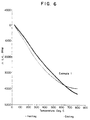
- Figure 6 shows a thermal expansion measurement on a 2 inch (50 mm) sample of the material composition of Example 1 which gives an average negative coefficient of expansion of -78 x 10 -7 /°C (measured between 25°-150°C) and a moderate level of hysteresis as evidenced by the very similar heating and cooling curves.
- a composition containing on a weight percent basis 49.0% SiO 2 , 37.1% Al 2 O 3 , 9.6% Li 2 O and 4.3% TiO 2 is melted at 1600°C in a crucible then the glass is cast onto a cold steel plate to form a disc of about 0.25 to 0.5 in (6.3 mm to 12.7 mm) thick.
- the slab is then cut into bars and heated to 715°C at 300°C/hr, to 765°C at 140°C/hr, to 1300°C at 300°C/hr and held at this temperature for 4 hours, then cooled at the furnace cooling rate for several hours to less than about 100°C.
- the cooled bar is subjected to four cycles of reheating to 800°C and cooling to ambient temperatures to minimize hysteresis.
- Example 2 A composition identical to that of Example 2 was treated to the same conditions except that it is held at 1300°C for only 0.5 hours before cooling, and it was not subjected to further heating cycles.
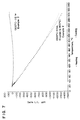
- Figure 7 shows a thermal expansion measurement on the material composition of Examples 2 and 3.
- Example 2 shows an average negative coefficient of expansion of -52.8 x 10 -7 /°C (measured between 25°-150°C) and essentially no hysteresis as evidenced by the very similar heating and cooling curves.
- Example 3 shows zero expansion over the same temperature range without hysteresis.
- the composition be maintained at the top temperature of 1300°C for about 3 to 4 hours to obtain a highly ordered crystal phase. It is evident that the material of Example 3 which was only maintained at 1300°C for 0.5 hour has a zero coefficient of expansion and is still relatively disordered.
- the heat recycling steps are not essential for achieving satisfactory hysteresis. However, 1 to 4 heat recycling steps may be beneficial.
- the heating rate is about 300°C per hour and the bar is maintained at 800°C for about 1 hour each cycle.
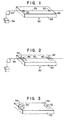
- the optical fiber reflective grating device 20 has a substrate 22 formed from a flat block of a negative expansion material, such as beta-eucryptite.
- An optical fiber 24 having at least one UV-induced reflective grating 26 written therein is mounted on the surface 28 and attached at either end of the surface at points 30 and 32. It is important that the fiber is always straight and not subject to compression as a result of the negative expansion and thus the fiber is usually mounted under tension. Before attachment the fiber is placed under a controlled tension, as shown schematically by the use of a weight 34. The proper choice of tension assures that the fiber is not under compression at all anticipated use temperatures. However, the fiber can be under tension at all anticipated use temperatures. The required degree of tension to compensate for the negative expansion in a particular application can readily be calculated by those with skill in this art.
- the attachment material could be an organic polymer, for example an epoxy cement, an inorganic frit, for example ground glass, ceramic or glass-ceramic material, or a metal.
- the fiber is tacked to the substrate with a UV-cured epoxy adhesive. Mechanical means for attaching the fiber can also be used.
- the optical fiber reflective grating is supplied with a coating material surrounding the fiber.
- the coating in the grating region of the fiber is left intact while it is removed in the substrate attachment region at each end of the grating.
- the device can have the coating completely removed between the attachment locations. Removal of the coating can be accomplished by one of two methods : a non-contact, non-chemical stripping mechanism or by conventional chemical stripping.
- the fiber is not attached directly to the substrate.
- Bonding pads 40, 42 made from a material differing from the substrate, for example a glass or a ceramic, are attached to the substrate at either end.
- the fiber 26 is mounted to the pads at points 44, 46 These pads afford better attachment properties of the pad to the fiber than could be achieved from the substrate directly to the fiber because of the large thermal expansion mismatch.
- Suitable pad materials have a coefficient of thermal expansion intermediate between that of the fiber and the substrate for example between -50 and + 5 x 10 -7 , preferably about -20 x 10 -7 .
- the pad could be a fused silica with a coefficient of expansion closely matching that of the fiber.
- the pad allows the stress of this joint induced by both the thermal mismatch and the tension of the fiber, to be spread out over a wider area, lessening the chances of cracking and detachment.
- the attachment materials for the fiber and pad connections are similar to those used for mounting the fiber directly to the substrate, for example, an epoxy cement, an inorganic frit, for example ground glass, ceramic or glass-ceramic material, or a metal.
- the negative expansion of the substrate material 22 is used to create a clamping force on the fiber.
- the attachment feature which might be a hole or channel 50, 52 in a raised portion 54, 56 of the substrate, is formed in the substrate at room temperature with a gap that is very slightly smaller than the fiber.
- the substrate expands and allows the insertion of the fiber 24 into the channel 50. Warming of the substrate then causes substrate contraction and creates a clamping force for holding the fiber in the channel.
- the fiber 24 is attached to the substrate at points 30, 32 and the intermediate fiber length 60 is cushioned by a low modulus damping material 62.
- This low-modulus material for example a silicone rubber coating surrounding the fiber or a pad of a silicone rubber, a natural or synthetic rubber or mixtures thereof, between the fiber and the substrate protects the fiber reflective grating against external perturbations such as mechanical shock or vibration. Bowing of the fiber is also minimized.
- the low modulus material is adhesively attached to the fiber and the substrate.
- Mounting the fiber under tension will alter the optical properties of the device (for example, the center wavelength of a grating). This can be addressed by biasing the device with a reflective grating written therein to account for the tension, or it can be done by mounting a fiber, for example a germania doped silica fiber, without a reflective grating written therein under tension and then exposing the fiber to UV light in order to fabricate the grating in the device in situ .
- the temperature sensitivity of the center wavelength is about 0.0125 nm/°C
- the stress sensitivity of the center wavelength is 0.125 nm shift for 9g of tension
- the bare fiber has a diameter of 125 microns
- a coated fiber has a diameter of 250 microns.
- the strength of the fiber is >200 kpsi and therefore has a very high reliability.
- the grating was written in a photorefractive-sensitive fiber, Corning SMF-228 fiber, and the fiber was hydrogen loaded at 100 atmospheres in a hydrogen chamber for one week. After removal of the fiber from the hydrogen chamber, a length of approximately 30 mm of coating was removed by mechanical stripping and the fiber was exposed to 240 nm laser irradiation to create the grating. The fiber was then mounted to a substrate of beta-eucryptite, prepared essentially according to the method of Example 2, under a 10 kpsi tension using a UV-curable epoxy adhesive. The assembled grating was heated to 125°C for 2 hours to out diffuse any remaining hydrogen and to eliminate low stability UV-induced traps. The fiber was thermally cycled between -40°C and +125°C.
- a reference fiber was treated in exactly the same way, except it was not attached to a substrate.
- the grating center wavelength ( Figure 8) varies by approximately 1.9 nm from -40°C to +125°C when not attached to the substrate and by only 0.2 nm when attached to the substrate.
- optical fiber couplers and optical waveguides could be athermalized by attachment to a negative expansion substrate.
- An optical fiber fused coupler has two or more fibers fused together at one or more points along their length and is mounted on a substrate.
- Such couplers are thermally sensitive which results in a certain amount of thermal instability.
- biconically tapered couplers in which interferometric effects are used, for example a Mach-Zehnder interferometer.
- Such couplers can be athermalized by mounting the coupler to a negative expansion substrate, such as the beta-eucryptite described in Example 2 above.
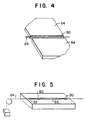
- a fused biconical coupler device 70 which includes a negative expansion substrate 72 to which are mounted two fibers 74, 76.
- the fibers are fused together at regions 78, 80.
- the fibers are attached to the substrate near the ends at locations 82, 84 in the same manner as described above for the optical fiber reflective grating.
- Waveguides can be defined, for example, in optical fibers or planar substrates. Such waveguides are thermally sensitive which results in a certain amount of thermal instability. Such waveguides can be athermalized by mounting the waveguide to a negative expansion substrate, such as the beta-eucryptite described in Example 2 above.
- a planar waveguide device 90 which includes a negative expansion substrate 92 on which is adhesively mounted a layer of material 94 in which a planar waveguide 96 is fabricated by methods well known to those skilled in this art.
- the waveguide material can be, for example, a doped silica such as a germania silicate, other suitable glass compositions, polymers and semiconductors, including semiconductors with gain, such as laser diodes.
- the device of this invention is a completely passive system and mechanically simple, and demonstrates athermalization.
- the method of producing the device is advantageous because it provides temperature compensated optical devices which tolerate shock and vibration and are thermally stable.
Landscapes
- Physics & Mathematics (AREA)
- General Physics & Mathematics (AREA)
- Optics & Photonics (AREA)
- Chemical & Material Sciences (AREA)
- Engineering & Computer Science (AREA)
- General Chemical & Material Sciences (AREA)
- Materials Engineering (AREA)
- Dispersion Chemistry (AREA)
- Life Sciences & Earth Sciences (AREA)
- Chemical Kinetics & Catalysis (AREA)
- Ceramic Engineering (AREA)
- Geochemistry & Mineralogy (AREA)
- Crystallography & Structural Chemistry (AREA)
- Organic Chemistry (AREA)
- Glass Compositions (AREA)
- Optical Fibers, Optical Fiber Cores, And Optical Fiber Bundles (AREA)
- Optical Couplings Of Light Guides (AREA)
- Light Guides In General And Applications Therefor (AREA)
- Re-Forming, After-Treatment, Cutting And Transporting Of Glass Products (AREA)
- Optical Integrated Circuits (AREA)
Claims (27)
- Athermische optische Vorrichtung, umfassend ein Substrat mit negativer Ausdehnung und einer oberen Oberfläche und umfassend ein Material mit einem negativen Wärmeausdehnungskoeffizienten und einen wärmeempfindlichen, optischen Bestandteil mit positiver Ausdehnung, der an der oberen Oberfläche des Substrats an mindestens zwei voneinander beabstandeten Stellen befestigt ist.
- Vorrichtung nach Anspruch 1, wobei das Substrat ein einheitliches Substrat ist, das ein Material mit einem intrinsischen negativen Wärmeausdehnungskoeffizienten umfasst.
- Vorrichtung nach Anspruch 1 oder 2, wobei das Substrat einen negativen Wärmeausdehnungskoeffizienten zwischen -30 x 10-7/°C und -90 x 10-7/°C besitzt.
- Vorrichtung nach einem der Ansprüche 1 bis 3, wobei das Substrat eine Glaskeramik umfasst.
- Vorrichtung nach Anspruch 4, wobei das Substrat eine Beta-Eukryptit-Glaskeramik umfasst.
- Vorrichtung nach Anspruch 4 oder 5, wobei die Glaskeramik SiO2 43-55%, Al2O3 31-42%, Li2O 8-11%, TiO2 2-6% und ZrO4 0-4%, bezogen auf Gewichtsprozent, umfasst.
- Vorrichtung nach einem der Ansprüche 1 bis 6, wobei die Vorrichtung durch eine Schicht aus Befestigungsmaterial befestigt ist.
- Vorrichtung nach Anspruch 7, wobei das Befestigungsmaterial ein Polymer, eine Glasmasse (Fritte) oder ein Metall ist.
- Vorrichtung nach Anspruch 8, wobei das Befestigungsmaterial ein Epoxy-Klebstoff ist.
- Vorrichtung nach einem der Ansprüche 1 bis 9, wobei der optische Bestandteil ein optisches Fasergitter ist.
- Vorrichtung nach einem der Ansprüche 1 bis 9, wobei der optische Bestandteil ein optischer Faser-Koppler ist, wobei der Koppler mindestens zwei optische Fasern umfasst, die an einem oder mehreren Punkten in ihrer Längsrichtung miteinander verschweißt sind.
- Vorrichtung nach einem der Ansprüche 1 bis 9, wobei der optische Bestandteil ein Wellenleiter ist.
- Vorrichtung nach Anspruch 12, wobei der Wellenleiter ein ebener Wellenleiter ist.
- Vorrichtung nach Anspruch 10, wobei das optische Fasergitter in der optischen Faser zwischen zwei Enden des Substrats und in einem Abstand von diesen vorliegt.
- Vorrichtung nach Anspruch 14, wobei die optische Faser am Substrat an ersten und zweiten voneinander beabstandeten Stellen befestigt ist, wobei sich die erste Stelle zwischen dem Gitter und einem ersten Substratende und wobei sich die zweite Stelle zwischen dem Gitter und einem zweiten Substratende befindet.
- Vorrichtung nach einem der Ansprüche 10, 14 oder 15, wobei die optische Faser bei allen beabsichtigten Verwendungstemperaturen unter Spannung gehalten wird.
- Vorrichtung nach einem der Ansprüche 10 oder 14 bis 16, die zudem eine Verbindungsfläche mit einem Ausdehnungskoeffizienten zwischen dem der Faser und dem des Substrates umfasst, die zwischen der optischen Faser und dem Substrat an jeder der Befestigungsstellen montiert ist, wobei die optische Faser an jede Verbindungsfläche gebunden ist und jede Verbindungsfläche am Substrat befestigt ist.
- Vorrichtung nach einem der Ansprüche 10 oder 14 bis 17, die zudem ein Dämpfungsmaterial mit kleinem Modul umfasst, das mit im Wesentlichen der gesamten Länge der Faser zwischen den Befestigungsstellen verbunden ist.
- Vorrichtung nach einem der Ansprüche 10 oder 14 bis 18, wobei jede Befestigungsstelle einen Kanal mit einer solchen Größe umfasst, dass er die Faser bei einer niedrigeren Temperatur als bei irgendeiner beabsichtigten Verwendung der Vorrichtung aufnimmt und die Faser bei üblichen Verwendungstemperaturen festklemmt.
- Verfahren zur Herstellung einer athermischen optischen Vorrichtung nach einem der Ansprüche 1 bis 19, umfassend das Montieren des wärmeempfindlichen optischen Bestandteils mit positiver Ausdehnung auf einer Fläche des Substrats mit negativer Ausdehnung und Befestigen des Bestandteils an diesem an mindestens zwei voneinander beabstandeten Stellen.
- Verfahren nach Anspruch 20 zur Herstellung einer Vorrichtung nach Anspruch 16, wobei vor dem Schritt der Befestigung am Substrat eine ausreichende Spannung an die optische Faser angelegt wird, dass die Faser bei allen beabsichtigten Verwendungstemperaturen unter Spannung gehalten wird.
- Verfahren nach Anspruch 20 oder 21 zur Herstellung einer Vorrichtung nach Anspruch 19, umfassend das Abkühlen des Substrats auf eine niedrigere Temperatur als bei irgendeiner beabsichtigten Verwendung der Vorrichtung, Einführen der Faser in den Kanal an jeder Befestigungsstelle und Erwärmen des Substrats auf den üblichen Verwendungstemperaturbereich, sodass die Faser festgeklemmt wird.
- Verfahren nach einem der Ansprüche 20 bis 22 zur Herstellung einer athermischen optischen Fasergitter-Vorrichtung, umfassend das Montieren einer lichtbrechenden-lichtempfindlichen optischen Faser auf dem Substrat mit negativer Ausdehnung, Anlegen einer ausreichenden Spannung an die optische Faser, sodass die Faser bei allen beabsichtigten Verwendungstemperaturen unter Spannung gehalten wird, Befestigen der optischen Faser am Substrat an mindestens zwei voneinander beabstandeten Stellen und Aussetzen der Faser gegenüber UV-Licht vor oder nach dem Montierschritt, um darin zumindest ein optisches Gitter so festzulegen, dass sich das Gitter zwischen den Enden des Substrats und in einem Abstand von jedem Ende befindet.
- Athermische optische Vorrichtung, umfassend eine optische Faser mit einem Brechnungsindex-Gitter, wobei die optische Faser an zumindest zwei voneinander beabstandeten Stellen an der oberen Fläche eines Substrats mit negativer Ausdehnung und einem negativen Wärmeausdehnungskoeffizienten so befestigt ist, dass die Reflexionszentrumwellenlänge des Brechungsindex-Gitters über den Betriebstemperaturbereich des Brechungsindex-Gitters im Wesentlichen temperaturunabhängig ist, wobei das Substrat ein Material mit einem intrinsischen negativen Wärmeausdehnungskoeffizienten umfasst.
- Vorrichtung nach Anspruch 24, wobei das Substrat ein einheitliches Substrat ist.
- Vorrichtung nach Anspruch 24 oder 25, wobei der Betriebsbereich mindestens einen Teil des Bereichs -40°C bis 125°C umfasst.
- Vorrichtung nach einem der Ansprüche 24 bis 26, wobei die optische Faser eine optische Faser auf Siliziumdioxidbasis ist.
Applications Claiming Priority (3)
| Application Number | Priority Date | Filing Date | Title |
|---|---|---|---|
| US1005896P | 1996-01-16 | 1996-01-16 | |
| US10058P | 1996-01-16 | ||
| PCT/US1996/013062 WO1997026572A1 (en) | 1996-01-16 | 1996-08-07 | Athermal optical device |
Publications (2)
| Publication Number | Publication Date |
|---|---|
| EP0875012A1 EP0875012A1 (de) | 1998-11-04 |
| EP0875012B1 true EP0875012B1 (de) | 2002-10-23 |
Family
ID=21743603
Family Applications (2)
| Application Number | Title | Priority Date | Filing Date |
|---|---|---|---|
| EP96929677A Expired - Lifetime EP0875012B1 (de) | 1996-01-16 | 1996-08-07 | Athermale optische einrichtung |
| EP97924492A Withdrawn EP0880718A4 (de) | 1996-01-16 | 1997-01-16 | Athermische optische einrichtung |
Family Applications After (1)
| Application Number | Title | Priority Date | Filing Date |
|---|---|---|---|
| EP97924492A Withdrawn EP0880718A4 (de) | 1996-01-16 | 1997-01-16 | Athermische optische einrichtung |
Country Status (11)
| Country | Link |
|---|---|
| US (1) | US6087280A (de) |
| EP (2) | EP0875012B1 (de) |
| JP (2) | JP2000503415A (de) |
| KR (2) | KR19990077274A (de) |
| CN (2) | CN1207812A (de) |
| AT (1) | ATE226737T1 (de) |
| AU (2) | AU722410B2 (de) |
| CA (2) | CA2242676A1 (de) |
| DE (1) | DE69624505T2 (de) |
| TW (1) | TW314601B (de) |
| WO (2) | WO1997026572A1 (de) |
Families Citing this family (68)
| Publication number | Priority date | Publication date | Assignee | Title |
|---|---|---|---|---|
| JP3063849B2 (ja) | 1999-01-19 | 2000-07-12 | 住友電気工業株式会社 | 光ファイバ回折格子を有する光学装置 |
| AU713820B2 (en) * | 1995-10-16 | 1999-12-09 | Sumitomo Electric Industries, Ltd. | Optical fiber diffraction grating, a method of fabricating thereof and a laser light source |
| US7254297B1 (en) | 1996-01-16 | 2007-08-07 | Corning Incorporated | Athermal optical devices employing negative expansion substrates |
| US6490394B1 (en) | 1996-01-16 | 2002-12-03 | Corning Incorporated | Athermal optical device |
| US5926599A (en) * | 1996-06-13 | 1999-07-20 | Corning Incorporated | Optical device and fusion seal |
| US5721802A (en) * | 1996-06-13 | 1998-02-24 | Corning Incorporated | Optical device and fusion seal |
| US5694503A (en) * | 1996-09-09 | 1997-12-02 | Lucent Technologies Inc. | Article comprising a temperature compensated optical fiber refractive index grating |
| AUPO745897A0 (en) | 1997-06-19 | 1997-07-10 | Uniphase Fibre Components Pty Limited | Temperature stable bragg grating package with post tuning for accurate setting of center frequency |
| US5978539A (en) | 1997-10-03 | 1999-11-02 | Lucent Technologies Inc. | Optical device having a temperature independent spectral response using nonplanar geometric distortion of a substrate |
| US6011886A (en) * | 1997-10-16 | 2000-01-04 | Lucent Technologies Inc. | Recoatable temperature-insensitive long-period gratings |
| US6081641A (en) * | 1997-11-03 | 2000-06-27 | Applied Fiber Optics, Inc. | Thermal compensated fused-fiber dense wavelength division multiplexer |
| AU736870B2 (en) * | 1997-11-24 | 2001-08-02 | Koheras A/S | Temperature stabilization of optical waveguides |
| FR2772488B1 (fr) * | 1997-12-16 | 2001-12-28 | France Telecom | Dispositif de stabilisation d'un reseau de bragg vis a vis de la temperature, comportant deux materiaux de coefficients de dilatation thermique eloignes l'un de l'autre |
| FR2772487B1 (fr) * | 1997-12-16 | 2002-02-01 | France Telecom | Procede de realisation d'un dispositif de stabilisation de reseau de bragg vis a vis de la temperature |
| EP1064576A1 (de) | 1998-03-17 | 2001-01-03 | Minnesota Mining And Manufacturing Company | Passiv kompensierte optische fasern |
| KR100274807B1 (ko) * | 1998-06-24 | 2000-12-15 | 김효근 | 브래그격자 필터용 광섬유 및 그를 이용한 브래그 격자 필터 |
| US6506699B1 (en) | 1998-10-23 | 2003-01-14 | Kabushiki Kaisha Ohara | Negative thermal expansion glass ceramic and method for producing the same |
| CA2349422A1 (en) | 1998-11-06 | 2000-05-18 | Corning Incorporated | Athermal optical waveguide grating device |
| JP3331180B2 (ja) | 1998-12-18 | 2002-10-07 | 日本電信電話株式会社 | 温度無依存平面型光デバイス |
| IT1305113B1 (it) * | 1998-12-21 | 2001-04-10 | Cselt Centro Studi Lab Telecom | Dispositivo a reticolo di bragg in fibra ottica con compensazionepassiva della temperatura. |
| JP3901892B2 (ja) | 1999-02-24 | 2007-04-04 | 日本電気硝子株式会社 | 温度補償用部材、それを用いた光通信デバイスおよび温度補償用部材の製造方法 |
| JP2000266943A (ja) * | 1999-03-12 | 2000-09-29 | Nippon Electric Glass Co Ltd | 光通信用温度補償デバイス |
| JP2000352633A (ja) | 1999-04-05 | 2000-12-19 | Nec Corp | 光導波路、それを用いた導波路型光デバイス、及び導波路型光デバイスの製造方法 |
| JP3566129B2 (ja) * | 1999-04-06 | 2004-09-15 | 株式会社フジクラ | 温度補償型光ファイバブラッググレーティング |
| US6477299B1 (en) * | 1999-04-23 | 2002-11-05 | Corning Incorporated | Environmentally stable athermalizes optical fiber grating device and method of making a stabilized device |
| WO2000064827A1 (en) * | 1999-04-23 | 2000-11-02 | Corning Incorporated | Method of making stabilized negative thermal expansion optical waveguide substrate and a glass-ceramic substrate |
| WO2001004672A1 (fr) * | 1999-07-07 | 2001-01-18 | Nippon Electric Glass Co., Ltd. | Materiau de compensation de temperature et dispositif de communication optique |
| US6317528B1 (en) * | 1999-08-23 | 2001-11-13 | Corning Incorporated | Temperature compensated integrated planar bragg grating, and method of formation |
| DE19943387A1 (de) * | 1999-09-10 | 2001-11-22 | Siemens Ag | Verfahren zur Herstellung eines optischen Gitters auf einem optischen Leiter und Anordnung mit einem solchen Gitter und solchen Leiter |
| AU1269701A (en) * | 1999-11-11 | 2001-06-06 | Ionas A/S | Compact athermal optical waveguide using thermal expansion amplification |
| DE10004384C2 (de) * | 2000-02-02 | 2003-04-03 | Daimler Chrysler Ag | Anordnung und Verfahren zur Erfassung von Dehnungen und Temperaturen und deren Veränderungen einer auf einem Träger, insbesondere einem aus Metall, Kunststoff oder Keramik bestehenden Träger, applizierten Deckschicht |
| JP4702690B2 (ja) * | 2000-03-29 | 2011-06-15 | 日本電気硝子株式会社 | 結晶化ガラス |
| JP3928331B2 (ja) | 2000-05-09 | 2007-06-13 | 住友電気工業株式会社 | 光導波路デバイスおよびその製造方法 |
| JP4704585B2 (ja) * | 2000-07-07 | 2011-06-15 | 株式会社オハラ | 低膨張透明結晶化ガラス、結晶化ガラス基板及び光導波路素子 |
| US6381387B1 (en) * | 2000-08-02 | 2002-04-30 | Networks Photonics, Inc. | Athermalization of a wavelength routing element |
| JP4773608B2 (ja) | 2000-09-28 | 2011-09-14 | 株式会社オハラ | ガラスセラミックス及び温度補償部材 |
| AU2001293308A1 (en) * | 2000-10-02 | 2002-04-15 | Corning Incorporated | Lithium aluminosilicate ceramic |
| WO2002039160A1 (en) * | 2000-11-09 | 2002-05-16 | Cambridge University Technical Services Ltd. | Platform with controlled thermal expansion coefficient |
| CA2357242A1 (en) * | 2001-02-22 | 2002-08-22 | Teraxion Inc. | Adjustable athermal package for optical fiber devices |
| WO2003014783A1 (fr) * | 2001-08-07 | 2003-02-20 | Nippon Electric Glass Co., Ltd. | Materiau de base pour dispositif de communication optique, et dispositif de communication optique |
| US6603892B1 (en) | 2001-10-24 | 2003-08-05 | Lightwave Microsystems Corporation | Mechanical beam steering for optical integrated circuits |
| US6987909B1 (en) | 2001-11-30 | 2006-01-17 | Corvis Corporation | Optical systems and athermalized optical component apparatuses and methods for use therein |
| US20030125184A1 (en) * | 2001-12-21 | 2003-07-03 | Schott Glas | Glass ceramic product with variably adjustable zero crossing of the CTE-T curve |
| US6975793B2 (en) * | 2002-03-18 | 2005-12-13 | Lightwave Microsystems Corporation | Method and apparatus facilitating mechanical beam steering for optical integrated circuits |
| US6738545B1 (en) * | 2002-03-18 | 2004-05-18 | Lightwave Microsystems Corporation | Athermal AWG and AWG with low power consumption using groove of changeable width |
| TW584749B (en) * | 2002-12-30 | 2004-04-21 | Chow-Shing Shin | Temperature compensation method of fiber device |
| US7004911B1 (en) * | 2003-02-24 | 2006-02-28 | Hosheng Tu | Optical thermal mapping for detecting vulnerable plaque |
| US7171077B2 (en) * | 2003-04-03 | 2007-01-30 | Lxsix Photonics Inc. | Package for temperature sensitive optical device |
| JP2005070751A (ja) * | 2003-08-05 | 2005-03-17 | Nippon Electric Glass Co Ltd | 光通信デバイス用基材、その製造方法およびそれを用いた光通信デバイス |
| US20060245692A1 (en) * | 2004-04-01 | 2006-11-02 | Lxsix Photonics Inc. | Package for temperature sensitive optical device |
| JP2006206407A (ja) * | 2005-01-31 | 2006-08-10 | Kyocera Kinseki Corp | 水晶結晶とその育成方法 |
| TWI249470B (en) * | 2005-03-09 | 2006-02-21 | Univ Nat Central | Structure and method of thermal stress compensation |
| JP2007108325A (ja) | 2005-10-12 | 2007-04-26 | Oki Electric Ind Co Ltd | 波長調整装置および波長調整方法 |
| US20070221132A1 (en) * | 2006-03-24 | 2007-09-27 | General Electric Company | Composition, coating, coated article, and method |
| JP4201023B2 (ja) | 2006-06-06 | 2008-12-24 | 沖電気工業株式会社 | ファイバブラッググレーティング装置 |
| US20080141938A1 (en) * | 2006-12-13 | 2008-06-19 | General Electric Company | Processing apparatus, coated article and method |
| SE532721C2 (sv) * | 2007-10-01 | 2010-03-23 | Mircona Ab | Produkt med vibrationsdämpande keramisk beläggning för spånavskiljning vid materialbearbetning samt metod för dess tillverkning |
| FR2959506B1 (fr) * | 2010-04-30 | 2014-01-03 | Thales Sa | Materiau composite ceramique a base de beta-eucryptite et d'un oxyde et procede de fabrication dudit materiau. |
| JP5435044B2 (ja) * | 2012-01-13 | 2014-03-05 | 沖電気工業株式会社 | ファイバブラッググレーティング装置 |
| US9850172B2 (en) | 2014-10-23 | 2017-12-26 | Industrial Technology Research Institute | Ceramic powder, method of manufacturing the same, and method for laser sinter molding |
| JP6815087B2 (ja) * | 2016-03-28 | 2021-01-20 | 日鉄ケミカル&マテリアル株式会社 | 球状ユークリプタイト粒子およびその製造方法 |
| NL2017647B1 (en) * | 2016-10-20 | 2018-04-26 | Fugro Tech Bv | Probe for determining soil properties |
| JP6889922B2 (ja) * | 2017-08-31 | 2021-06-18 | 三星ダイヤモンド工業株式会社 | ガラス基板の残留応力低減方法及びガラス基板の残留応力低減装置 |
| US11125936B2 (en) | 2019-02-26 | 2021-09-21 | The Government Of The United States Of America, As Represented By The Secretary Of The Navy | Thermal insulator for fiber optic components |
| CN114249529B (zh) * | 2021-12-06 | 2024-03-01 | 北京北旭电子材料有限公司 | 锂铝硅系填料组合物、锂铝硅系填料及其制备方法、玻璃封接材料及其应用 |
| CN115437091B (zh) * | 2022-08-31 | 2024-07-05 | 武汉大学 | 一种时域拉伸显微成像流式检测芯片、时域拉伸成像系统 |
| CN115614779B (zh) * | 2022-09-08 | 2024-07-16 | 中国航发湖南动力机械研究所 | 一种火焰筒及其自适应冷却气量调节方法 |
| CN119882140B (zh) * | 2025-02-28 | 2025-10-31 | 中山大学 | 高温度稳定性的熔锥型光纤耦合器及其制备方法 |
Family Cites Families (20)
| Publication number | Priority date | Publication date | Assignee | Title |
|---|---|---|---|---|
| DE1421927A1 (de) * | 1960-03-26 | 1968-12-12 | Siemens Ag | Kristalliner oder glasig-kristalliner Werkstoff mit negativem oder sehr kleinem thermischem Ausdehnungskoeffizienten |
| DE1596858B1 (de) * | 1967-06-29 | 1970-05-14 | Jenaer Glaswerk Schott & Gen | Glasversaetze zum Herstellen von durchsichtigen ss-Eukryptitmischkristall-haltigen Glaskeramiken |
| US3812689A (en) * | 1972-05-26 | 1974-05-28 | Corning Glass Works | Method of making glass-ceramic articles |
| SE409474B (sv) * | 1975-05-13 | 1979-08-20 | Wennborg Ab C J | Sett vid kontinuerlig och diskontinuerlig elektrokemisk rengoring av legerade stal, serskilt rostfritt stal i form av band, stang, profiler, trad, ror och styckegods med ytor bemengda av mineraloljor och syntetiska ... |
| US4042403A (en) * | 1975-05-19 | 1977-08-16 | Corning Glass Works | Thermally stable glass-ceramic articles |
| US4083727A (en) * | 1977-01-07 | 1978-04-11 | Corning Glass Works | Glass-ceramics with magnetic surface films |
| DE2740053A1 (de) * | 1977-09-06 | 1979-05-03 | Klaus Prof Dr Med Gersonde | Verwendung von allosterischen effektoren mit hilfe von lipidvesikeln ueber eine irreversible inkorporierung zwecks verbesserter o tief 2 -entladung des haemoglobins in erythrozyten |
| US4209229A (en) * | 1978-09-25 | 1980-06-24 | Corning Glass Works | Glass-ceramic coated optical waveguides |
| DE191063T1 (de) * | 1984-08-13 | 1987-01-15 | United Technologies Corp., Hartford, Conn. | Verfahren zum einlagern optischer gitter in faseroptik. |
| US4814297A (en) * | 1987-04-01 | 1989-03-21 | Corning Glass Works | Strengthened glass article and method |
| US5021395A (en) * | 1988-07-01 | 1991-06-04 | E. I. Du Pont De Nemours And Company | Process for making superconductors and their precursors |
| US5126316A (en) * | 1988-08-24 | 1992-06-30 | E. I. Du Pont De Nemours And Company | Bi2 Sr3-x Yx Cu2 O8+y superconducting metal oxide compositions |
| US5042898A (en) * | 1989-12-26 | 1991-08-27 | United Technologies Corporation | Incorporated Bragg filter temperature compensated optical waveguide device |
| US5186729A (en) * | 1991-04-26 | 1993-02-16 | Center For Innovative Technology | Method of making in-situ whisker reinforced glass ceramic |
| CA2083983A1 (en) * | 1992-01-27 | 1993-07-28 | Kishor P. Gadkaree | Low expansion composition for packaging optical waveguide couplers |
| JP2516537B2 (ja) * | 1992-09-14 | 1996-07-24 | 株式会社オハラ | 低膨張透明結晶化ガラス |
| US5322559A (en) * | 1993-05-11 | 1994-06-21 | State Of Oregon Acting By And Through The State Board Of Higher Education On Behalf Of Oregon State University | Negative thermal expansion material |
| US5433778A (en) * | 1993-05-11 | 1995-07-18 | The State Of Oregon Acting By And Through The State Board Of Higher Education On Behalf Of Oregon State University | Negative thermal expansion material |
| JP2668057B2 (ja) * | 1994-09-13 | 1997-10-27 | 株式会社オハラ | 低膨張透明ガラスセラミックス |
| US5514360A (en) * | 1995-03-01 | 1996-05-07 | The State Of Oregon, Acting By And Through The Oregon State Board Of Higher Education, Acting For And On Behalf Of Oregon State University | Negative thermal expansion materials |
-
1996
- 1996-08-07 DE DE69624505T patent/DE69624505T2/de not_active Expired - Fee Related
- 1996-08-07 AU AU68973/96A patent/AU722410B2/en not_active Ceased
- 1996-08-07 CN CN96199621A patent/CN1207812A/zh active Pending
- 1996-08-07 EP EP96929677A patent/EP0875012B1/de not_active Expired - Lifetime
- 1996-08-07 CA CA002242676A patent/CA2242676A1/en not_active Abandoned
- 1996-08-07 KR KR1019980705420A patent/KR19990077274A/ko not_active Ceased
- 1996-08-07 JP JP09525962A patent/JP2000503415A/ja not_active Ceased
- 1996-08-07 WO PCT/US1996/013062 patent/WO1997026572A1/en not_active Ceased
- 1996-08-07 AT AT96929677T patent/ATE226737T1/de not_active IP Right Cessation
- 1996-10-24 TW TW085113088A patent/TW314601B/zh active
-
1997
- 1997-01-16 US US08/785,336 patent/US6087280A/en not_active Expired - Lifetime
- 1997-01-16 CN CN97191685A patent/CN1208396A/zh active Pending
- 1997-01-16 AU AU29903/97A patent/AU725293B2/en not_active Ceased
- 1997-01-16 EP EP97924492A patent/EP0880718A4/de not_active Withdrawn
- 1997-01-16 CA CA002243200A patent/CA2243200A1/en not_active Abandoned
- 1997-01-16 JP JP9527710A patent/JP2000503967A/ja active Pending
- 1997-01-16 KR KR10-1998-0705421A patent/KR100455908B1/ko not_active Expired - Fee Related
- 1997-01-16 WO PCT/US1997/000982 patent/WO1997028480A2/en not_active Ceased
Also Published As
| Publication number | Publication date |
|---|---|
| AU6897396A (en) | 1997-08-11 |
| KR19990077275A (ko) | 1999-10-25 |
| DE69624505T2 (de) | 2003-06-26 |
| WO1997026572A1 (en) | 1997-07-24 |
| AU722410B2 (en) | 2000-08-03 |
| CA2243200A1 (en) | 1997-08-07 |
| EP0880718A2 (de) | 1998-12-02 |
| AU725293B2 (en) | 2000-10-12 |
| ATE226737T1 (de) | 2002-11-15 |
| EP0875012A1 (de) | 1998-11-04 |
| JP2000503967A (ja) | 2000-04-04 |
| CA2242676A1 (en) | 1997-07-24 |
| AU2990397A (en) | 1997-08-22 |
| WO1997028480A2 (en) | 1997-08-07 |
| KR19990077274A (ko) | 1999-10-25 |
| WO1997028480A3 (en) | 1997-11-20 |
| DE69624505D1 (de) | 2002-11-28 |
| TW314601B (de) | 1997-09-01 |
| CN1207812A (zh) | 1999-02-10 |
| EP0880718A4 (de) | 1999-09-22 |
| CN1208396A (zh) | 1999-02-17 |
| KR100455908B1 (ko) | 2005-04-13 |
| US6087280A (en) | 2000-07-11 |
| JP2000503415A (ja) | 2000-03-21 |
Similar Documents
| Publication | Publication Date | Title |
|---|---|---|
| EP0875012B1 (de) | Athermale optische einrichtung | |
| WO1997028480A9 (en) | Athermal optical device | |
| US6209352B1 (en) | Methods of making negative thermal expansion glass-ceramic and articles made thereby | |
| EP0828169A2 (de) | Temperaturkompensiertes Brechzahlgitter einer optischen Faser | |
| US6490394B1 (en) | Athermal optical device | |
| JP2003020254A (ja) | 結晶化ガラス | |
| KR20020038675A (ko) | 온도 보상용 부재 및 이를 이용한 광 통신 디바이스 | |
| US6603900B1 (en) | Athermal optical waveguide grating device | |
| Weidman et al. | A novel negative expansion substrate material for athermalizing fiber Bragg gratings | |
| AU772223B2 (en) | Temperature compensated device for use in optical communication | |
| US6477299B1 (en) | Environmentally stable athermalizes optical fiber grating device and method of making a stabilized device | |
| US7254297B1 (en) | Athermal optical devices employing negative expansion substrates | |
| JP4702690B2 (ja) | 結晶化ガラス | |
| US6465380B1 (en) | Athermal optical device | |
| JP3063849B2 (ja) | 光ファイバ回折格子を有する光学装置 | |
| US20050175310A1 (en) | Substrate for optical communication device, method for production thereof and optical communication device using the same | |
| JP2001072463A (ja) | 温度補償用部材及びそれを用いた光通信デバイス | |
| JP2005162602A (ja) | 温度補償用部材の製造方法 | |
| JP2004295156A (ja) | 光通信用温度補償デバイス | |
| JP2002071961A (ja) | 光学装置 | |
| JP2005035886A (ja) | 温度補償用部材及びそれを用いた光通信デバイス |
Legal Events
| Date | Code | Title | Description |
|---|---|---|---|
| PUAI | Public reference made under article 153(3) epc to a published international application that has entered the european phase |
Free format text: ORIGINAL CODE: 0009012 |
|
| 17P | Request for examination filed |
Effective date: 19980813 |
|
| AK | Designated contracting states |
Kind code of ref document: A1 Designated state(s): AT BE CH DE DK ES FI FR GB GR IE IT LI LU MC NL PT SE |
|
| 17Q | First examination report despatched |
Effective date: 19991104 |
|
| GRAG | Despatch of communication of intention to grant |
Free format text: ORIGINAL CODE: EPIDOS AGRA |
|
| GRAG | Despatch of communication of intention to grant |
Free format text: ORIGINAL CODE: EPIDOS AGRA |
|
| GRAH | Despatch of communication of intention to grant a patent |
Free format text: ORIGINAL CODE: EPIDOS IGRA |
|
| GRAH | Despatch of communication of intention to grant a patent |
Free format text: ORIGINAL CODE: EPIDOS IGRA |
|
| GRAA | (expected) grant |
Free format text: ORIGINAL CODE: 0009210 |
|
| AK | Designated contracting states |
Kind code of ref document: B1 Designated state(s): AT BE CH DE DK ES FI FR GB GR IE IT LI LU MC NL PT SE |
|
| PG25 | Lapsed in a contracting state [announced via postgrant information from national office to epo] |
Ref country code: NL Free format text: LAPSE BECAUSE OF FAILURE TO SUBMIT A TRANSLATION OF THE DESCRIPTION OR TO PAY THE FEE WITHIN THE PRESCRIBED TIME-LIMIT Effective date: 20021023 Ref country code: LI Free format text: LAPSE BECAUSE OF FAILURE TO SUBMIT A TRANSLATION OF THE DESCRIPTION OR TO PAY THE FEE WITHIN THE PRESCRIBED TIME-LIMIT Effective date: 20021023 Ref country code: GR Free format text: LAPSE BECAUSE OF FAILURE TO SUBMIT A TRANSLATION OF THE DESCRIPTION OR TO PAY THE FEE WITHIN THE PRESCRIBED TIME-LIMIT Effective date: 20021023 Ref country code: FI Free format text: LAPSE BECAUSE OF FAILURE TO SUBMIT A TRANSLATION OF THE DESCRIPTION OR TO PAY THE FEE WITHIN THE PRESCRIBED TIME-LIMIT Effective date: 20021023 Ref country code: CH Free format text: LAPSE BECAUSE OF FAILURE TO SUBMIT A TRANSLATION OF THE DESCRIPTION OR TO PAY THE FEE WITHIN THE PRESCRIBED TIME-LIMIT Effective date: 20021023 Ref country code: BE Free format text: LAPSE BECAUSE OF FAILURE TO SUBMIT A TRANSLATION OF THE DESCRIPTION OR TO PAY THE FEE WITHIN THE PRESCRIBED TIME-LIMIT Effective date: 20021023 Ref country code: AT Free format text: LAPSE BECAUSE OF FAILURE TO SUBMIT A TRANSLATION OF THE DESCRIPTION OR TO PAY THE FEE WITHIN THE PRESCRIBED TIME-LIMIT Effective date: 20021023 |
|
| REF | Corresponds to: |
Ref document number: 226737 Country of ref document: AT Date of ref document: 20021115 Kind code of ref document: T |
|
| REG | Reference to a national code |
Ref country code: GB Ref legal event code: FG4D |
|
| REG | Reference to a national code |
Ref country code: CH Ref legal event code: EP |
|
| REG | Reference to a national code |
Ref country code: IE Ref legal event code: FG4D |
|
| REF | Corresponds to: |
Ref document number: 69624505 Country of ref document: DE Date of ref document: 20021128 |
|
| PG25 | Lapsed in a contracting state [announced via postgrant information from national office to epo] |
Ref country code: SE Free format text: LAPSE BECAUSE OF FAILURE TO SUBMIT A TRANSLATION OF THE DESCRIPTION OR TO PAY THE FEE WITHIN THE PRESCRIBED TIME-LIMIT Effective date: 20030123 Ref country code: PT Free format text: LAPSE BECAUSE OF FAILURE TO SUBMIT A TRANSLATION OF THE DESCRIPTION OR TO PAY THE FEE WITHIN THE PRESCRIBED TIME-LIMIT Effective date: 20030123 Ref country code: DK Free format text: LAPSE BECAUSE OF FAILURE TO SUBMIT A TRANSLATION OF THE DESCRIPTION OR TO PAY THE FEE WITHIN THE PRESCRIBED TIME-LIMIT Effective date: 20030123 |
|
| NLV1 | Nl: lapsed or annulled due to failure to fulfill the requirements of art. 29p and 29m of the patents act | ||
| PG25 | Lapsed in a contracting state [announced via postgrant information from national office to epo] |
Ref country code: ES Free format text: LAPSE BECAUSE OF FAILURE TO SUBMIT A TRANSLATION OF THE DESCRIPTION OR TO PAY THE FEE WITHIN THE PRESCRIBED TIME-LIMIT Effective date: 20030429 |
|
| REG | Reference to a national code |
Ref country code: CH Ref legal event code: PL |
|
| ET | Fr: translation filed | ||
| PG25 | Lapsed in a contracting state [announced via postgrant information from national office to epo] |
Ref country code: LU Free format text: LAPSE BECAUSE OF NON-PAYMENT OF DUE FEES Effective date: 20030807 Ref country code: IE Free format text: LAPSE BECAUSE OF NON-PAYMENT OF DUE FEES Effective date: 20030807 |
|
| PLBE | No opposition filed within time limit |
Free format text: ORIGINAL CODE: 0009261 |
|
| STAA | Information on the status of an ep patent application or granted ep patent |
Free format text: STATUS: NO OPPOSITION FILED WITHIN TIME LIMIT |
|
| PG25 | Lapsed in a contracting state [announced via postgrant information from national office to epo] |
Ref country code: MC Free format text: LAPSE BECAUSE OF NON-PAYMENT OF DUE FEES Effective date: 20030831 |
|
| 26N | No opposition filed |
Effective date: 20030724 |
|
| PG25 | Lapsed in a contracting state [announced via postgrant information from national office to epo] |
Ref country code: FR Free format text: LAPSE BECAUSE OF NON-PAYMENT OF DUE FEES Effective date: 20040430 |
|
| REG | Reference to a national code |
Ref country code: IE Ref legal event code: MM4A |
|
| REG | Reference to a national code |
Ref country code: FR Ref legal event code: ST |
|
| PGFP | Annual fee paid to national office [announced via postgrant information from national office to epo] |
Ref country code: GB Payment date: 20050804 Year of fee payment: 10 |
|
| PG25 | Lapsed in a contracting state [announced via postgrant information from national office to epo] |
Ref country code: IT Free format text: LAPSE BECAUSE OF NON-PAYMENT OF DUE FEES Effective date: 20050807 |
|
| PGFP | Annual fee paid to national office [announced via postgrant information from national office to epo] |
Ref country code: DE Payment date: 20050930 Year of fee payment: 10 |
|
| PG25 | Lapsed in a contracting state [announced via postgrant information from national office to epo] |
Ref country code: DE Free format text: LAPSE BECAUSE OF NON-PAYMENT OF DUE FEES Effective date: 20070301 |
|
| GBPC | Gb: european patent ceased through non-payment of renewal fee |
Effective date: 20060807 |
|
| PG25 | Lapsed in a contracting state [announced via postgrant information from national office to epo] |
Ref country code: GB Free format text: LAPSE BECAUSE OF NON-PAYMENT OF DUE FEES Effective date: 20060807 |