EP0875162A1 - Casque - Google Patents
Casque Download PDFInfo
- Publication number
- EP0875162A1 EP0875162A1 EP97933028A EP97933028A EP0875162A1 EP 0875162 A1 EP0875162 A1 EP 0875162A1 EP 97933028 A EP97933028 A EP 97933028A EP 97933028 A EP97933028 A EP 97933028A EP 0875162 A1 EP0875162 A1 EP 0875162A1
- Authority
- EP
- European Patent Office
- Prior art keywords
- shock absorbing
- foams
- helmet
- polyvinylidene chloride
- shell
- Prior art date
- Legal status (The legal status is an assumption and is not a legal conclusion. Google has not performed a legal analysis and makes no representation as to the accuracy of the status listed.)
- Withdrawn
Links
Images



Classifications
-
- A—HUMAN NECESSITIES
- A42—HEADWEAR
- A42B—HATS; HEAD COVERINGS
- A42B3/00—Helmets; Helmet covers ; Other protective head coverings
- A42B3/04—Parts, details or accessories of helmets
- A42B3/10—Linings
- A42B3/12—Cushioning devices
- A42B3/125—Cushioning devices with a padded structure, e.g. foam
-
- G—PHYSICS
- G01—MEASURING; TESTING
- G01N—INVESTIGATING OR ANALYSING MATERIALS BY DETERMINING THEIR CHEMICAL OR PHYSICAL PROPERTIES
- G01N3/00—Investigating strength properties of solid materials by application of mechanical stress
- G01N3/40—Investigating hardness or rebound hardness
- G01N3/48—Investigating hardness or rebound hardness by performing impressions under impulsive load by indentors, e.g. falling ball
Definitions
- the present invention concerns a helmet and it particularly relates to a helmet which is put as a safety cap upon driving two wheeled vehicle or four wheeled vehicle playing sports in which a shock absorbing liner is improved.
- a helmet has a shell on an outer side and a shock absorbing liner disposed to the inside of the shell.
- a shock absorbing liner polystyrene (PS) foams, polypropylene (PP) foams and the like have been used but PS foams have a drawback that they have scarce restorability after releasing compression upon impact shock. Further, PP foams have a drawback of causing large reduction in the compression strength at high temperature.
- An object of the present invention is to provide a helmet showing less temperature dependent change of the compression strength, excellent in impact absorption and restorability, excellent in the impact absorption upon second hitting on an identical portion and also excellent in a dimensional accuracy during manufacture.
- Another object of the present invention is to provide a helmet having satisfactory compatibility between a shock absorbing liner and a shell and a dimensional accuracy without increasing the thickness of the shock absorbing liner and capable of easily satisfying user's demand in view of the design.
- Helmets are specifically defined in "Protective Helmets for Vehicular Users” of Japanese Industrial Standards (JIS-T 8133).
- a helmet includes three types; A, B, C in which A is directed to a vehicle having an exhaustion capacity of 125 cc or less, B is directed to two-wheeled automobiles according to road regulations in Japan and C concerns helmets for racing, as well as B.
- C it is specified in (a) that an impact acceleration of 2945 m/s 2 (300, 3G) is not caused, (b) duration time is 4 ms or less if an impact shock acceleration of 1475 m/s 2 (150, 4G) or higher is caused.
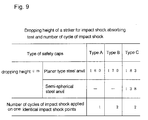
- a striker for impact absorbing test is dropped without vibrations from the height shown in Fig. 9 and impact shock transmitted by way of a safety cap when a predetermined impact point of a specimen collides against a steel anvil is measured by an acceleration gage and a measuring recording device connected therewith, to examine whether the value satisfies the above-mentioned numerical value or not.
- test range is defined as a portion above a head. However, a portion within 50 mm from the edge of the cap body is excluded.
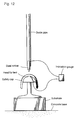
- the impact shock points are determined at optional four positions within the test range, and the distance between each of the impact shock points is defined as 1/5 or greater for the maximum circumference of the safety cap. Further, the number of impact shocks applied on one identical impact shock point is as shown in Fig. 9. An outline of a testing device is shown in Fig. 10 to Fig. 12.
- a helmet according to the present invention has a shell formed by injection molding of a thermoplastic resin and an impact shock absorption liner disposed to the inside of the shell, wherein the liner is formed with polyvinylidene chloride foams.
- the liner comprising polyvinylidene chloride foams suitably has a two layered structure comprising less foamable polyvinylidene chloride foams and highly foamable polyvinylidene foams.
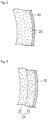
- the present invention concerns a helmet H comprising a shell 10 and an impact shock absorbing liner 20 disposed to the inside of the shell 10, formed, for example, by blow molding or injection molding of a thermoplastic resin.
- the impact shock absorbing liner 20 is formed of polyvinylidene chloride foams.
- the liner composed of the polyvinylidene chloride foams is suitably constituted as a dual layer structure of less foaming polyvinylidene chloride foams 21 and highly foamable polyvinylidene chloride foams 22.
- the shock absorbing liner 20 As described above, by constituting the shock absorbing liner 20 with polyvinylidene chloride foams, it is possible to provide a helmet H showing less temperature dependent change of a compression strength during molding, excellent in an impact shock absorption and a storability, and excellent in impact shock absorption upon second hitting on one identical portion and also excellent in a dimensional accuracy upon manufacture.
- foams of polyvinylidene chloride are used as the impact shock absorbing liner, distortion during molding is small so that a liner of high dimensional accuracy can be manufactured and, in addition, foaming gases escapes scarcely from the foams, so that it is excellent in a dimensional stability a performance of stability for a long period of time.
- the temperature dependent change of the compression strength is small and the compression strength at high temperature is less lowered. Further, it is excellent in the restorability after releasing compression and, in particular, it is excellent in the impact shock absorption performance under condition of +50°C, and impact shock absorption upon second hitting on one identical portion and can sufficiently withstand second impact shock in the helmet in the impact shock test of JIS-T 8133 SNELL M95.
- a helmet showing less temperature dependent change of the compression strength, excellent in the impact shock absorption and the restorability, excellent in impact shock absorption performance upon second hitting on one identical portion and excellent in dimensional accuracy also manufacture, without increase of the weight, increase of the cost, increase for the thickness of the impact shock absorbing liner or the like when the shell is devised so as to maintain the strength.
- Fig. 1 is a schematic cross sectional view of a helmet according to the present invention
- Fig. 2 is an enlarged cross sectional view for a portion A in Fig. 1
- Fig. 3 is an enlarged cross sectional view similar to Fig. 2, showing another embodiment
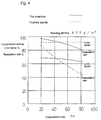
- Fig. 4 is a graph showing a restorability and a compression ratio of an impact shock absorbing liner according to the present invention
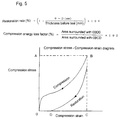
- Fig. 5 is a diagram for a compression strength and a compression strain of an impact shock absorbing liner according to the present invention
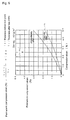
- Fig. 6 is a diagram showing a permanent compression strain of an impact absorbing liner according to the present invention
- Fig. 1 is a schematic cross sectional view of a helmet according to the present invention
- Fig. 2 is an enlarged cross sectional view for a portion A in Fig. 1
- Fig. 3 is an enlarged cross sectional view similar to Fig. 2, showing another embodiment
- Fig. 4 is a graph showing a restorability and a compression ratio
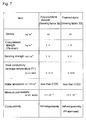
- FIG. 7 is a chart for properties comparing polyvinylidene chloride foams used in this example in comparison with foamed styrol
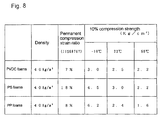
- Fig. 8 is a comparison chart for the physical properties of PVDC foams PS foams and PP foams
- Fig. 9 is an explanatory view showing a dropping height and the number of cycles of impact shocks of a striker for impact shock absorbing test
- Fig. 10 is an explanation view for the outside of an impact shock absorbing test device
- Fig. 11 is an explanatory view for the outline of a striker for impact shock absorbing test
- Fig. 12 is an explanatory view fir a penetration resistant test device.
- a helmet H of this embodiment is a full face type helmet in which a shell 10 is formed at the outside, and a shock absorbing liner 20 is disposed to the inside of the shell 10.
- the shell 10 of this embodiment is formed into a predetermined shape from PP, ABS, PA or the like which is a thermoplastic resin by injection molding, blow molding, or similar other molding.
- the shock absorbing liner 20 is disposed to the inside of the shell 10.
- the shock absorbing liner 20 in this embodiment is composed of forms having a single density of polyvinylidene chloride (PVDC) and is formed to a predetermined thickness on the inside.
- PVDC polyvinylidene chloride
- the shock absorbing liner 20 used in this embodiment has a density of 60 g/l, or 0.06 g/cm 3 and can be manufactured by usual blow molding.
- the shock absorbing liner 20 is constituted conforming with the inner shape of the shell 10 so as to fit to the inside of the shell 10.
- the shock absorbing liner 20 as in this embodiment is satisfactory in heat insulating performance and also satisfactory in gas barrier property. That is, polyvinylidene chloride foams show less reduction of compression strength upon heating at high temperature and is excellent in the restorability after releasing from compression upon impact shock. In view of the above, it is advantageous as compared with foamed styrol upon impact shock. Then, with regard to the dimensional accuracy, it is 0.19% for polyvinylidene chloride foams according to the present invention, 0.3% for PS and 3 - 5% for PE or PP, so that it is more excellent in the dimensional accuracy of molding products compared with the material for the shock absorbing liner used conventionally. Therefore, it is possible to conform it with the shell shape and to be in intimate contact with varying shapes of shells.
- the shock absorbing liner 20 when the shock absorbing liner 20 is constituted with polyvinylidene chloride foams, the thickness can be reduced remarkably compared with foamed styrol or foamed PP.
- the shock absorbing liner 20 of this embodiment is suitable regarding the physical properties required for helmets and, as shown in Fig. 4 to Fig. 8, it has less temperature dependent change of the compression strength, is excellent in the restorability, and resistant to compression or bending and is flexible as well. As shown in fig. 4, it is excellent in the restorability or loss factor compared with foamed styrol.
- a test piece of 25 mm thickness and about 100 mm length was compressed at a rate of 10 mm/min to 25%, 50% and the 75% of the original thickness of the test piece respectively, the load was instantly removed at an identical rate, and a compression stress-compression strain graphs were measured and recorded to obtain the restorability as shown in the figure.
- test piece was 20 mm in thickness and about 50 mm both in length and width, which was put between two parallel flat plates (compression plates), fixed under compression to 10%, 25% and 50% of the original thickness of the test specimen, left for 22 hours, and then the test piece was taken out of the flat plates and the thickness was measured immediately thereafter or after leaving at a room temperature of 23°C for 24 hours and determined according to the equation shown in the figure.
- Fig. 7 is a table for the physical properties of polyvinylidene chloride foams used in this embodiment and foamed styrol in comparison
- Fig. 8 is a table for the physical properties of PVCD foams, PS foams and PP foams in comparison.
- PS foams have a relatively less temperature dependence such as 4.5 at -10°C and 2.2 at 50°C.
- the compression permanent strain ratio is as high as 18%.
- PP foams have the permanent compression strain ratio as small as 8% but the temperature dependence of the compression strength is as high as 6.2 at -10°C and 1.6 at 50°C.
- PVDC foams polyvinylidene chloride foams
- the heat conduction ratio is smaller compared with foamed styrols, and heat insulation is stable in helmet suffering from large temperature difference in summer and winter seasons.
- Fig. 3 shows another embodiment of the present invention, which is an enlarged cross sectional view similar with Fig. 2.
- This embodiment shows an example in which the shock absorbing liner has two layers, with a less foaming (high density) layer 21 being disposed for a shell 10 while a highly foaming (low density) layer 22 being formed for the inside (head).
- the less foaming layer 21 and the highly foaming layer 22 are joined, for example, with an adhesive.
- PS foams are sensitive to second impact shock, and PP foams have temperature dependence.
- the shock absorbing liner is dual-layered by using polyvinylidene chloride foams (PVCD foams), in which the less foaming (high density) layer 21 is formed on the shell 10 and a highly foaming (low density) layer 22 is formed for the inside (head), so that the shock absorbing performance upon second hitting on one identical portion can be made more excellent.
- PVCD foams polyvinylidene chloride foams
- the helmet of the present invention since the foams of polyvinylidene chloride are used for the shock absorbing liner, the strain upon molding is small, so that, it is possible to manufacture a liner at a high dimensional accuracy and provide a helmet of excellent assembling property with the shell.
- the foams of polyvinylidene chloride show extremely less escape of foaming gas from the foams, they are excellent in the dimensional stability and performance stability for a long period of time, can ensure the performance of the helmet for a long period of time and, particularly, can ensure the degree of freedom for the design relative to user's demand in view of the design. Therefore, since this material has a sufficient strength to be used for racing as well as for ordinal use in streets, it can cope with all sorts of helmets.
Landscapes
- Physics & Mathematics (AREA)
- Health & Medical Sciences (AREA)
- Life Sciences & Earth Sciences (AREA)
- Chemical & Material Sciences (AREA)
- Analytical Chemistry (AREA)
- Biochemistry (AREA)
- General Health & Medical Sciences (AREA)
- General Physics & Mathematics (AREA)
- Immunology (AREA)
- Pathology (AREA)
- Helmets And Other Head Coverings (AREA)
Applications Claiming Priority (5)
| Application Number | Priority Date | Filing Date | Title |
|---|---|---|---|
| JP21515096 | 1996-07-26 | ||
| JP215150/96 | 1996-07-26 | ||
| JP9212680A JPH1088415A (ja) | 1996-07-26 | 1997-07-24 | ヘルメット |
| JP212680/97 | 1997-07-24 | ||
| PCT/JP1997/002589 WO1998004164A1 (fr) | 1996-07-26 | 1997-07-25 | Casque |
Publications (2)
| Publication Number | Publication Date |
|---|---|
| EP0875162A1 true EP0875162A1 (fr) | 1998-11-04 |
| EP0875162A4 EP0875162A4 (fr) | 1999-12-29 |
Family
ID=26519360
Family Applications (1)
| Application Number | Title | Priority Date | Filing Date |
|---|---|---|---|
| EP97933028A Withdrawn EP0875162A4 (fr) | 1996-07-26 | 1997-07-25 | Casque |
Country Status (4)
| Country | Link |
|---|---|
| US (1) | US5943706A (fr) |
| EP (1) | EP0875162A4 (fr) |
| JP (1) | JPH1088415A (fr) |
| WO (1) | WO1998004164A1 (fr) |
Cited By (1)
| Publication number | Priority date | Publication date | Assignee | Title |
|---|---|---|---|---|
| EP0985356A3 (fr) * | 1998-08-31 | 2002-06-05 | TS Tech Co., Ltd | Casque |
Families Citing this family (49)
| Publication number | Priority date | Publication date | Assignee | Title |
|---|---|---|---|---|
| US6360376B1 (en) * | 1997-04-10 | 2002-03-26 | Plum Enterprises, Inc. | Protective hat |
| AU5909299A (en) * | 1998-09-03 | 2000-03-27 | Mike Dennis | Body-contact cushioning interface structure |
| US20050166302A1 (en) * | 1998-09-03 | 2005-08-04 | Mjd Innovations, L.L.C. | Non-resiliency body-contact protective helmet interface structure |
| JP4540152B2 (ja) * | 1999-09-22 | 2010-09-08 | 株式会社谷沢製作所 | ヘルメット |
| US6453476B1 (en) | 2000-09-27 | 2002-09-24 | Team Wendy, Llc | Protective helmet |
| AU782830B2 (en) * | 2000-12-04 | 2005-09-01 | Plum Enterprises, Inc. | Improved protective hat |
| MXPA03003843A (es) | 2002-05-01 | 2004-09-03 | Riddell | Casco de futbol americano. |
| AU2003247414A1 (en) * | 2002-05-14 | 2003-12-02 | White Water Research And Safety Institute, Inc. | Protective headgear for whitewater use |
| US20040064873A1 (en) * | 2002-05-29 | 2004-04-08 | Muskovitz David T. | In-mold protective helmet having integrated ventilation system |
| US6871525B2 (en) * | 2002-06-14 | 2005-03-29 | Riddell, Inc. | Method and apparatus for testing football helmets |
| US7398562B2 (en) | 2004-03-10 | 2008-07-15 | Easy Rhino Designs, Inc. | Article with 3-dimensional secondary element |
| US7254874B2 (en) * | 2004-03-10 | 2007-08-14 | Leonard Arnold Duffy | Molded surface fasteners and attachment methods |
| WO2006089235A1 (fr) | 2005-02-16 | 2006-08-24 | Ferrara Vincent R | Element compressible amortissant les chocs a ventilation d'air |
| US20060059606A1 (en) * | 2004-09-22 | 2006-03-23 | Xenith Athletics, Inc. | Multilayer air-cushion shell with energy-absorbing layer for use in the construction of protective headgear |
| US20060059605A1 (en) * | 2004-09-22 | 2006-03-23 | Xenith Athletics, Inc. | Layered construction of protective headgear with one or more compressible layers of thermoplastic elastomer material |
| US20110047685A1 (en) * | 2006-02-16 | 2011-03-03 | Ferrara Vincent R | Impact energy management method and system |
| US7895681B2 (en) * | 2006-02-16 | 2011-03-01 | Xenith, Llc | Protective structure and method of making same |
| US7774866B2 (en) * | 2006-02-16 | 2010-08-17 | Xenith, Llc | Impact energy management method and system |
| US9289024B2 (en) | 2007-04-16 | 2016-03-22 | Riddell, Inc. | Protective sports helmet |
| US20100083423A1 (en) * | 2008-10-06 | 2010-04-08 | Mjd Innovations, L.L.C. | Helmet liner with improved, seam-position-enhanced, rear-sector load management |
| US20100101006A1 (en) * | 2008-10-29 | 2010-04-29 | Cleveland William K | Headguard with temple protecting scallop that does not cover the ears |
| US8214928B1 (en) | 2008-10-29 | 2012-07-10 | Full90 Sports, Inc. | Headguard with an eccentric dimple for accommodating the occipital bone |
| US8042198B1 (en) | 2008-10-29 | 2011-10-25 | Full90 Sports, Inc. | Headguard with independently adjustable upper and lower bands |
| US9226539B2 (en) | 2010-07-13 | 2016-01-05 | Sport Maska Inc. | Helmet with rigid shell and adjustable liner |
| BR112013003368A2 (pt) | 2010-08-11 | 2017-06-27 | G Form Llc | almofada de amortecimento flexíveis, itens que incorporam tais almofadas, e métodos de fabricação e utilização |
| USD681281S1 (en) | 2011-05-02 | 2013-04-30 | Riddell, Inc. | Protective sports helmet |
| USD838922S1 (en) | 2011-05-02 | 2019-01-22 | Riddell, Inc. | Football helmet |
| USD670870S1 (en) | 2011-05-09 | 2012-11-13 | A7 Helmet Systems, Llc | Helmet padding |
| USD670869S1 (en) | 2011-05-09 | 2012-11-13 | A7 Helmet Systems, Llc | Helmet padding |
| USD670868S1 (en) | 2011-05-09 | 2012-11-13 | A7 Helmet Systems, Llc | Helmet padding |
| USD666779S1 (en) | 2011-06-15 | 2012-09-04 | A7 Helmet Systems, Llc | Helmet padding |
| US20130042748A1 (en) * | 2011-08-17 | 2013-02-21 | The Government Of The United States Of America, As Represented By The Secretary Of The Navy | Mesostructure Based Scatterers in Helmet Suspension Pads |
| US9763488B2 (en) | 2011-09-09 | 2017-09-19 | Riddell, Inc. | Protective sports helmet |
| US8950735B2 (en) | 2011-12-14 | 2015-02-10 | Xenith, Llc | Shock absorbers for protective body gear |
| US8814150B2 (en) | 2011-12-14 | 2014-08-26 | Xenith, Llc | Shock absorbers for protective body gear |
| US20180064198A1 (en) * | 2012-03-05 | 2018-03-08 | Paul L. Cote | Helmet |
| CA2770713A1 (fr) * | 2012-03-05 | 2013-09-05 | Paul L. Cote | Casque |
| US10159296B2 (en) | 2013-01-18 | 2018-12-25 | Riddell, Inc. | System and method for custom forming a protective helmet for a customer's head |
| JP2016539253A (ja) | 2013-12-06 | 2016-12-15 | ベル スポーツ, インコーポレイテッド | 可撓性多層ヘルメット及びその作製方法 |
| US10721987B2 (en) | 2014-10-28 | 2020-07-28 | Bell Sports, Inc. | Protective helmet |
| US20160256763A1 (en) * | 2015-03-06 | 2016-09-08 | Michael Henry McGee | Compositions for preventing head injuries in team sports |
| US11033796B2 (en) | 2016-07-20 | 2021-06-15 | Riddell, Inc. | System and methods for designing and manufacturing a bespoke protective sports helmet |
| US10010127B1 (en) * | 2017-06-29 | 2018-07-03 | Bell Sports, Inc. | Protective helmet with multi-density impact liners and method for same |
| CN107836772A (zh) * | 2017-11-06 | 2018-03-27 | 江西联创电声有限公司 | 头盔 |
| WO2020037279A1 (fr) | 2018-08-16 | 2020-02-20 | Riddell, Inc. | Système et procédé de conception et de fabrication d'un casque de protection |
| CA3169309A1 (fr) | 2018-11-21 | 2020-05-28 | Riddell, Inc. | Casque de sport recreatif de protection avec des composants fabriques de facon additive pour gerer des forces d'impact |
| USD927084S1 (en) | 2018-11-22 | 2021-08-03 | Riddell, Inc. | Pad member of an internal padding assembly of a protective sports helmet |
| CN110243565B (zh) * | 2019-07-09 | 2021-01-05 | 浏阳市优登科技有限公司 | 一种安全头盔性能测试装置 |
| EP4149310A4 (fr) | 2020-05-12 | 2024-09-25 | Milwaukee Electric Tool Corporation | Casque de protection doté d'un matériau de protection contre les chocs |
Family Cites Families (5)
| Publication number | Priority date | Publication date | Assignee | Title |
|---|---|---|---|---|
| DE2941019A1 (de) * | 1979-10-10 | 1981-04-23 | Uvex Winter Optik GmbH, 8510 Fürth | Schutzhelm mit daempfend wirkender auskleidung |
| JPS6081307A (ja) * | 1983-10-13 | 1985-05-09 | 株式会社ジヤパントレードアソシエーシヨン | 乗車用安全帽 |
| JPS63282303A (ja) * | 1987-05-12 | 1988-11-18 | 松森 ひとみ | 安全ヘルメット |
| JPH05295607A (ja) * | 1992-04-20 | 1993-11-09 | Asahi Chem Ind Co Ltd | ヘルメット |
| JP3008262B2 (ja) * | 1995-10-23 | 2000-02-14 | 株式会社ホンダアクセス | ヘルメットの帽体 |
-
1997
- 1997-07-24 JP JP9212680A patent/JPH1088415A/ja active Pending
- 1997-07-25 US US09/043,533 patent/US5943706A/en not_active Expired - Fee Related
- 1997-07-25 WO PCT/JP1997/002589 patent/WO1998004164A1/fr not_active Ceased
- 1997-07-25 EP EP97933028A patent/EP0875162A4/fr not_active Withdrawn
Cited By (1)
| Publication number | Priority date | Publication date | Assignee | Title |
|---|---|---|---|---|
| EP0985356A3 (fr) * | 1998-08-31 | 2002-06-05 | TS Tech Co., Ltd | Casque |
Also Published As
| Publication number | Publication date |
|---|---|
| US5943706A (en) | 1999-08-31 |
| JPH1088415A (ja) | 1998-04-07 |
| EP0875162A4 (fr) | 1999-12-29 |
| WO1998004164A1 (fr) | 1998-02-05 |
Similar Documents
| Publication | Publication Date | Title |
|---|---|---|
| EP0875162A1 (fr) | Casque | |
| US6058515A (en) | Helmet | |
| US4429068A (en) | Rubber material | |
| CA1057897A (fr) | Pneu de surete | |
| CA1201250A (fr) | Materiau d'ame pour pare-chocs d'automobiles | |
| US4007917A (en) | Structures for absorbing impact energy | |
| US6116684A (en) | Ultra lightweight closed cell foam bicycle saddle | |
| JP2004537460A (ja) | エネルギ吸収ユニット | |
| JPS61502473A (ja) | 衝撃保護ヘルメット | |
| US6890009B2 (en) | Bumper core | |
| JPH0236419B2 (fr) | ||
| Gilchrist et al. | Protection of the side of the head | |
| EP1800961B1 (fr) | Matériau amortissant les chocs et pare-chocs de véhicule utilisant ce matériau | |
| Mills et al. | Bicycle helmet design | |
| CN116890571B (zh) | 一种仿生学结构的免充气防爆安全轮胎及其制备方法 | |
| Mills | Impact response | |
| Hynčík et al. | Development of a simple motorcyclist helmet finite element model | |
| Williams | Evaluation of the penetration test for bicyclists' helmets: Comparative performance of hard shell and foam helmets | |
| CN217835528U (zh) | 一种epp门护板 | |
| CN223546100U (zh) | 一种高强度复合型丁基内胎 | |
| JP3668871B2 (ja) | チューブレスタイヤ、チューブレスタイヤとホイールとの組立体、及び、その製造方法 | |
| CN213564802U (zh) | 一种可防止形变的epp成型发泡双密度板材 | |
| WO2007067133A1 (fr) | Casque de protection | |
| JPH0355466Y2 (fr) | ||
| JPH053414Y2 (fr) |
Legal Events
| Date | Code | Title | Description |
|---|---|---|---|
| PUAI | Public reference made under article 153(3) epc to a published international application that has entered the european phase |
Free format text: ORIGINAL CODE: 0009012 |
|
| 17P | Request for examination filed |
Effective date: 19980805 |
|
| AK | Designated contracting states |
Kind code of ref document: A1 Designated state(s): IT |
|
| A4 | Supplementary search report drawn up and despatched |
Effective date: 19991111 |
|
| AK | Designated contracting states |
Kind code of ref document: A4 Designated state(s): IT |
|
| 17Q | First examination report despatched |
Effective date: 20011107 |
|
| STAA | Information on the status of an ep patent application or granted ep patent |
Free format text: STATUS: THE APPLICATION IS DEEMED TO BE WITHDRAWN |
|
| 18D | Application deemed to be withdrawn |
Effective date: 20020319 |