EP0875364A2 - Verfahren und Anlage zur Herstellung einer Vielzahl unterschiedlicher Reifen - Google Patents
Verfahren und Anlage zur Herstellung einer Vielzahl unterschiedlicher Reifen Download PDFInfo
- Publication number
- EP0875364A2 EP0875364A2 EP98107809A EP98107809A EP0875364A2 EP 0875364 A2 EP0875364 A2 EP 0875364A2 EP 98107809 A EP98107809 A EP 98107809A EP 98107809 A EP98107809 A EP 98107809A EP 0875364 A2 EP0875364 A2 EP 0875364A2
- Authority
- EP
- European Patent Office
- Prior art keywords
- tires
- production
- series
- vulcanization
- green
- Prior art date
- Legal status (The legal status is an assumption and is not a legal conclusion. Google has not performed a legal analysis and makes no representation as to the accuracy of the status listed.)
- Granted
Links
Images

Classifications
-
- B—PERFORMING OPERATIONS; TRANSPORTING
- B29—WORKING OF PLASTICS; WORKING OF SUBSTANCES IN A PLASTIC STATE IN GENERAL
- B29D—PRODUCING PARTICULAR ARTICLES FROM PLASTICS OR FROM SUBSTANCES IN A PLASTIC STATE
- B29D30/00—Producing pneumatic or solid tyres or parts thereof
-
- B—PERFORMING OPERATIONS; TRANSPORTING
- B29—WORKING OF PLASTICS; WORKING OF SUBSTANCES IN A PLASTIC STATE IN GENERAL
- B29D—PRODUCING PARTICULAR ARTICLES FROM PLASTICS OR FROM SUBSTANCES IN A PLASTIC STATE
- B29D30/00—Producing pneumatic or solid tyres or parts thereof
- B29D30/0016—Handling tyres or parts thereof, e.g. supplying, storing, conveying
-
- B—PERFORMING OPERATIONS; TRANSPORTING
- B29—WORKING OF PLASTICS; WORKING OF SUBSTANCES IN A PLASTIC STATE IN GENERAL
- B29D—PRODUCING PARTICULAR ARTICLES FROM PLASTICS OR FROM SUBSTANCES IN A PLASTIC STATE
- B29D30/00—Producing pneumatic or solid tyres or parts thereof
- B29D30/005—General arrangement or lay-out of plants for the processing of tyres or parts thereof
Definitions
- the present invention refers to the production of tires, referring in particular to a method of production of a plurality of tires and to a related system for their production.
- a tire for vehicle wheels is known to be constituted of an internally hollow torus-shaped structure formed of a plurality of components, and primarily of a textile or metal carcass exhibiting two beads, each bead defined along a circumferential radially inner border of the carcass and intended for anchoring the tire to a corresponding mounting rim. It is additionally comprised of at least one pair of annular circumferentially inextensible reinforcement rings, called cores, introduced into said beads, at least one core per bead.
- Such carcass is composed of a support structure comprising at least one ply of rubberized fabric, reinforced with thin textile or metal cords, running along axially from one bead to the other, which presents the actual borders of each one turned back radially toward the exterior around the corresponding core.
- the thin cords as described are arranged substantially in layers encompassing the axis of rotation of the tire.
- an annular superstructure called a belt or breaker, normally composed of one or more layers of rubberized fabric, wrapped in an arrangement of overlapping reciprocal superimposition to define a so-called "belt assembly," and a tread band of elastomer material, wound around the belt assembly, printed with a design in relief and intended for rolling contact of the tire on the road.
- two sides are arranged on the carcass, in axially opposite lateral arrangements, and they are of elastomer material, each extending radially toward the exterior from the external border of the relevant bead.
- the terminal margins of such sides are applied on the plies of the carcass in such a manner as to be enclosed between these plies and the opposing lateral borders of the tread band (arrangement called "bottom-sidewalls") or else are applied directly superimposed on the opposing lateral borders of the tread band itself (arrangement called "top-sidewalls").
- the internal surface of the carcass is covered with a “liner”, in other words one or more strata (layers) of air-impermeable elastomer material.
- the carcass can be made up of other elements, that is, borders, pads and filling, according to the specific intended use of the tire.
- the procedure generally includes four phases : a) preparation of the mixtures or compounds, b) realization of the separate components, or semimanufactured articles, c) assembly in succession of several components to obtain a raw carcass, d) vulcanization of the carcass with simultaneous molding of the design on the tread band.
- a tire presents a plurality of chemical-physical, structural, dimensional and of appearance features , and the entirety of these features characterizes one particular model of tire.
- Chemical-physical features are those being brought together to define the type and the composition of materials, for example the proportional formulas of the various compounds being used.
- Structural features are those which define the number and type of components, and their reciprocal positioning in the structure of the carcass.
- the dimensional features refer to the geometric measurements and to the linear profile of the tire on the cross-section (external diameter, chord or maximum width, height of the sides, and their relationship, that is, the cross-section ratio) and are those references which hereinafter are simply indicated as "size.”
- the characteristics of the appearance are constituted of the tread design, the ornamental motif and the various words or distinctive symbols reproduced on the sidewalls of the tire, and in the following description are indicated as "tread design.” Variations of the chemical-physical features impact on the procedures and on the machinery used for preparation of the compounds.
- Variations of the structure impact on the selection of materials for reinforcement, on the type, number and dimensions and positioning of the semimanufactured articles and involve processes, machinery and devices the manufacturing process, while variations of the features of dimensions and appearance always require changing of the vulcanization molds.
- the Applicant has instead addressed the problem of producing a plurality of tires subdivided into a great number of models having various different features, in particular different structural and/or dimensional features, in other words the problem of realization of a line of tire production which furnishes the most diverse selection of various models at minimum cost.
- the Applicant has found that the most critical points of the process are connected with : i) the phase of changing of the devices (extrusion die for extruders, drums and other fittings for manufacture of the green tire, molds for the vulcanization) and more in particular with the selection of the best moment within the process of production during which to effect such changes; ii) the costs of storage, in terms of the more the range of models is differentiated, the greater the quantity of product which must be held in storage (a predetermined number of pieces for each model being offered) and iii) the financial costs to immobilize capital relative to the number of molds being used.
- the Applicant has surprisingly found that if the normal production of a series of tires is subdivided into a plurality of small lots of tires having the same dimensional and structural features and if said lots are produced in succession, alternating lots of various tires, then when the number of tires present in any lot is adequately proportioned, the productivity and the costs of the entire process are not negatively influenced.
- the result is the advantage of being able to distribute the production of a series of tires, the tires being equal to one another, in a unit of time selected as desired, greater than that demanded for the continuous manufacture of corresponding green tires, reducing to a minimum or completely eliminating the stock of products to be stored.
- the lots of each model of tire are produced only from time to time when they are already required by the market, and the lots remain in storage only the time necessary for organization of the distribution. It is also possible to minimize the necessary mold stocks.
- the present invention refers to a method for distribution of the production of a series of tires, structurally or dimensionally equal to one another, in a time period (time of production) of greater value than that time period (time of preparation) required for making the green tires , comprising the following phases: preparation of the semimanufactured articles necessary for the making of said series of tires; assembly of said semimanufactured articles to make up as many green tires as correspond to said series; and vulcanization of said green tires in corresponding vulcanization molds, thus to realize the tires of said series, the method being characterized in that it comprises the floowing steps:
- the present invention refers to a method of minimizing the number of vulcanization molds required to produce a predetermined quantity of tires, all equal each other, comprising the following phases: preparation of the semimanufactured articles necessary for the manufacture of said quantity of tires; assembly together of said semimanufactured articles for the manufacture of as many raw carcasses as correspond to said quantity; vulcanization of said raw carcasses in vulcanization molds, so as to realize tires in said predetermined quantity; the method being characterized by the following :
- the present invention refers to a method for the production on the same line of production of a plurality of tires of various characteristics, distributed in at least two separate series, each a series of identical tires, each #3 differing from the other series in terms of at least one structural or dimensional feature of said various tires, comprising the following production steps:
- the production in lots also allows savings in the cost of purchase of the molds.
- this methodology of production it is convenient to use a limited number of identical molds, preferably no greater than 10, advantageously no greater than 8, more preferably no greater than 6, and even more preferably no greater than 4.
- the Applicant has found particularly advantageous the selection of a number of molds equal to or less than 2, also for quantitative considerations, preferably for up to 48,000 tires per year, that is, producing at the maximum one lot of tires which are identical for that day for each day of production.
- the number of tires contained in one lot is comprised between 30 and 150 and still more preferably comprised between 90 and 100 tires.
- the present invention refers to a system comprising at least one line of tire production, for the production of a plurality of tires having various features, distributed in at least two separate series, each vocational of identical tires, one memori differing from the other memori by at least one structural or dimensional feature of said different tires, each line of production comprising means for the preparation of the semimanufactured articles necessary for the production of said tires, means for the reciprocal assembly of said semimanufactured articles to constitute raw carcasses of said tires and means for the vulcanization of said raw carcasses in corresponding vulcanization molds, characterized in that said means of vulcanization do not comprise groups of 10 or more molds equal to one another.
- the aforementioned means for the assembly of said semimanufactured articles comprise one single machine for the manufacture of the raw carcasses.
- the means for preparation of the semimanufactured articles and the means for the vulcanization of the green tires are common to a plurality of separate lines of tire production.
- the invention proposes a system for the production of tires comprising at least one line of production in which the means for vulcanization corresponding to each line of tire production do not comprise groups of more than two molds identical to one another.
- the means for vulcanization comprise exclusively molds which are different from one another.
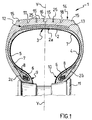
- Figure 1 shows a traditional radial tire for vehicle wheels, indicated in its entirety as 1.
- Tire 1 comprises a toroidal, hollow carcass, including a central crown portion 3, from the borders of which separate two sidewalls 4, 5, directed radially toward the sidewalls, terminating in annular zones which are very rigid, usually called beads, reinforced with at least one pair of bead cores 6.
- the support structure for said carcass comprises at least one reinforcement ply 2a of which the opposite lateral skirts 2b, 2c are turned back, preferably from the interior toward the exterior, each one passing around a corresponding core.
- each core 6 To the external perimetral border of each core 6 is applied an elastomeric filler 8 which occupies the space defined between the reinforcement ply 2a and the respective lateral skirts 2b, 2c of reinforcement ply 2a.
- the axially facing zones of the tire comprising said cores 6, and their fillers 8, form the so-called beads, indicated in their entirety with 9 and 10, intended for anchoring of tire 1 on a corresponding mounting rim 11 of the wheel of a vehicle.
- a belt structure 12 can be coaxially associated with said carcass structure 2 and belt structure 12 can comprise two or more layers of rubberized fabric strips 13 realized by means of thin textile or metal cords incorporated in a sheet of compound.
- a tread band 14 is attached to belt structure 12 and the ground is in contact with tire by means of said tread band.
- the tread band 14 comprises a plurality of incisions 25 and grooves 16, 17, 18 which delimit a corresponding plurality of ribs and/or blocks 15, and all together define a tread design.
- tire structure can comprise many other structural elements such as for example reinforcement borders in the beads, filling pads under the estremities of the belt structure, liner 7 on the ply of the carcass, in radially internal arrangements, and other fittings also, in relation to any specific model of tire.
- the carcass is prepared in the form of a cylindrical sleeve, without the belt and tread, with the sidewalls preferably opened out toward the exterior;
- the sleeve is shaped torically on a suitable expansible drum used for shaping, and the belt structure and the tread band are applied to the crown of the same, preferably having been pre-assembled at some point apart, through a specific auxiliary manufacturing drum, and the sidewalls are folded back axially toward the interior, on the raw carcass. All of the semimanufactured articles necessary for the manufacture of the green tire are fed into the manufacturing system by means of feeding devices associated with the building machine.
- any individual manufacturing machinery preferably comprises one single line of tire production.
- a system of production is indicated in its entirety with 20, which functionally subdivides into 3 principal areas : one area 100 for production of the semimanufactured articles, one area 200 for manufacture or assembly of the semimanufactured articles and one area 300 for vulcanization of the green tires.
- At least one cutter 110 is within the area 100, as are also an extruder arrangement 120 to produce tread bands, an extruder arrangement 130 to produce sidewalls and fillers, and a calender 140 to produce liners.
- extruder arrangements 120 to produce tread bands
- extruder arrangement 130 to produce sidewalls and fillers
- calender 140 to produce liners.
- the cutter has the task of cutting thin strips of the sheets of rubber formed from the component production system for the feed of extruder arrangements 120 and 130 and calender 140, which produced articles are then preferably collected on a spool.
- each spool contains ribbons of appropriate length to allow production of a predetermined number of tires having identical structural and dimensional features.
- a zone 240 is used for the handling and placement of the replacing tools of the manufacturing system 210.
- a system of placement and movement 230 provides for transfer of carcasses 2 from manufacturing area 200 to vulcanization area 300.
- a plurality of presses 330 are located in vulcanization area 300, with the respective positioning for vulcanization, assisted by a common device for removing the cured tires, the entirety indicated as 320.
- a furnace 310 allows for preheating of the vulcanization molds for immediate use as soon as its mounting on the relevant press.
- the vulcanization presses present either one or two postings for vulcanization and each vulcanization posting is equipped with a mold separable in at least two parts to allow for the loading of the green tire and the removal of the vulcanized tire. For purposes of the example there are presented 16 presses, each one with a pair of postings vulcanization, for a total of 32 available postings.
- An inflatable curing bag of elastomeric material works in the traditional manner inside the mold.
- one single mold can be used to mold only one predetermined tread design and/or one predetermined pair of sidewalls for one predetermined tire size.
- primary moving devices to carry the molds from preheating furnace 310 to the press, for assembly in succession in the designated position for the vulcanization, and vice versa.
- Other devices for movement feed the green tire to the position for vulcanization and, once vulcanized, transfer the tire from the vulcanizing machinery to a quality control area.
- Fig. 2 In one area not shown in Fig. 2 are prepared, in a known manner, sheets of compounds which will be used to produce some types of components. Still in a known manner, each of these sheets becomes cut by cutter 110 into thin strips so as to be able to be fed in an adequate manner, according to the type of compound the extruder assemblies 120 for the manufacture of the tread band 14, or the extruder assemblies 130 for the manufacture of sidewalls 4, 5, and of the fillers 8 or the calender 140 for the manufacture of the rubber sheets.
- extruder assemblies 120 and 130 which are for example extrusion dies, and there is carried out the control of the parameters of operation, including the rotation velocity of the extrusion screws on the extruder assemblies or the rotation velocity of the cylinders and the distances center to center of the cutters limiting the width of the liners on calender 140, in such a manner as to obtain components adapted to the model of tire which is desired in the production.
- the graphic symbols used in Fig. 2 indicate roughly the bodies of the extruder assemblies 121, 122, 123, 131, 132, the extrusion dies 124, 133, the basins 125, 134 for collection and cooling of the extruded product, the group of cylinders 141, the table 142 for collecting and cooling the liners, and the spools 126, 135, 143 for storage of semimanufactured articles.
- such a system comprises a preshaping device arranged on the common extrusion opening of three extruders, closed by an extrusion die for the tread band.
- the tread band is produced directing two components, primary and secondary, to the extrusion opening, across extrusion paths defined by corresponding preshaping channels existing in the preshaping device.
- An auxiliary channel is also present in this device, and the terminal part of such a channel flows together perpendicularly in the course of extrusion of the primary and secondary compounds, in proximity with the extrusion opening.
- Tread band 14, sidewalls 4 and 5, fillers 8 and liner 7 are therefore produced in the form of continuous strips which are collected on spools for simpler storage and subsequent distribution to the manufacturing machines.
- other components including the plies 2a of the green tire and the belt layers 13, realized by thin textile or metal cords incorporated in a sheet of compound, all collected on corresponding spools, and cores 6, which are also preferably already assembled with a suitable filler 8.
- Such a system assumes the adoption of a plurality of manufacturing drums which move along a predetermined manufacturing path.
- each drum meets primary work stations, each one assigned to the application of a main component common to a plurality of models of green tire comprised within a certain range of product. All primary work stations are intercalated with auxiliary work stations assigned to the application of accessory components, each one specifically provided for one particular type of green tyre. Each of the auxiliary stations can be removed and replaced with a different station as a function of the type of process in progress, and each is movable between one rest position which is perpendicular and remote from the path of manufacture and one work position in which it is placed for operation in the path of the manufacturing process, to provide application of the respective accessory component.
- the primary work stations are helpful in being reciprocally placed close together and spaced along the path of manufacture.
- Italian Patent Application No. MI96A/001650 describes one particular method and device for the manufacture of a tire with the ends of the sidewalls either overlapping the ends of the tread band (top-sidewalls) or applied under said ends (bottom sidewalls).
- the process comprises the phases of inserting of an anti-adhesive elastic tubular element around the carcass play at each end of a building drum, to wrap around the sidewalls on said elements, to apply another tubular element on said sidewalls and to overturn said tubular elements to open out the sidewalls into open position on the side of the building drum.
- the carcass in the form of a cylindrical sleeve with open sidewalls, is transferred on a shaping drum where it is shaped torically and then pressed against the belt assembly and the tread band which have been previously prepared in another place. Successively, first the ends of the band are dropped on the raw carcass, then the sidewalls are folded back against the raw carcass and over the ends of the tread band. On the contrary, doing first the folding back of the sides with respect to the dropping of the ends of the tread band, we get the tyre below with sidewalls.
- the changing of even one structural or dimensional feature of the desired tire can comprise a modification on the line of production, to modify the process or any controls or directly for the partial or complete change of the tools: for example substituting the drums with other drums of various dimensions, activating or deactivating auxiliary work stations (for example the auxiliary station intended to realize tires with two carcass plies.
- the aforementioned components collected on spools with the exception of the cores, or fed directly from the corresponding preparation machinery, are cut into sections of predetermined size, and assembled together and with all of the remaining components of the tire, including the cores, to form the raw carcass of said tire.
- the manufacturing machine provides double distribution devices for semimanufactured articles, in such a manner as to allow the loading of the semimanufactured articles, and the corresponding arrangement of the machinery, to produce the lot of green tires intended to follow being the one on production without interrupting the normal cycle of production of the manufacturing machine.
- Such a green tire thus is moved on the system 230 for placing and movement, which conducts it into area 300 for subsequent vulcanization.
- the place for vulcanization in which the green tire will be vulcanized, is fitted with a mold of the proper size which presents the predetermined design of sidewalls and tread, in order to work on the same green tire.
- the mold required is not already mounted at the prearranged place, this will be preheated and then mounted in said place.
- the device for a fast mold exchange of the Italian patent comprising blocking means constituted of pins with heads of elliptical shape mounted on the mold, which are introduced into suitable cavities of the body of the mold blocking the same on the corresponding press, causes rotary movement of the aforementioned elliptical heads. Obviously, the movement in inverse direction make free the mold which can be thus moved away in rapid mode, automatically, and without direct intervention of the operator.
- the movement of the mold is made preferably by means of coupling means attaching it to a translatable arm moving along a vertical column, mounted on the vulcanization press, and rotating around said column, in such a manner as to allow the removal of the mold by a means of transport and its mounting on the press, and, in the opposite direction, the release of the mold from the press and its placement on a means of transport for introduction into the molds holder.
- Patent EP 270.022 illustrates means to allow rapid and automatic hooking and unhooking of the vulcanization chamber to and from the corresponding mechanism for movement.
- the two vices which block the beads of the chamber comprise annular framework skeletons coaxial with the axis of the chamber in which are lodged, in work positions, the heads of a plurality of pegs or hooks, mounted in the assembly devices with said vices, which can be radially arranged in both directions, between said work positions and a rest position, in which said pegs or hooks are completely re-inserted in the relative devices, thus allowing the axial unhooking of the chamber of the mechanism.
- the realization of a series of tires having a different width will require the substitution of the extrusion die for the tread band and a different control of calender 140 for production of the liner.
- the new size will possibly require a change of the tools (drums of various sizes) on the manufacturing machinery 210 and new controls. Finally it will be necessary to mount a mold of corresponding size on at least one vulcanization press.
- Area 200 of Fig. 2 includes three manufacturing machines which are all fed from the same machines for preparation of semimanufactured articles in the upstream position, in area 100 and in the other areas cited but not shown, and fed in their turn to the area of vulcanization 300, the downstream position.
- Fig. 2 represents diagrammatically the manufacturing machinery 211 the of the first phase, supplied with semimanufactured articles by an assembly of distribution devices 212, in line with the manufacturing machinery 213 of second phase, this too supplied from the relevant device 214 for distribution of strips of the tread band.
- each manufacturing machine is preferably associated with one single line of tire production : only a share of the machinery for preparation of semimanufactured articles can belong to the same line of production, while included in the line of production are all of the positions of the vulcanization arrangement fed from the manufacturing machinery of said line in the time period of 24 hours, which herebelow are also defined as the global vulcanization unit.
- the single vulcanization mold, or the assembly of all the identical molds working at the same time, are hereinafter also defined as the vulcanization unit for the lot.
- Each series required a manufacturing time equal to twenty-five working days and the 24,000 tires produced were placed in storage to feed an average market demand equal to about 2,000 pieces per month.
- the various series of tires were subdivided beforehand each series into a plurality of lots, where each lot contains preferably the same number of tires, still more preferably equal to the daily production of one mold.
- the ten series of tires were subdivided each into 250 lots of 96 tires each.
- the production of said lots of tires was carried out alternating the production of one lot of green tires of one series with those of a lot of green tires of a different series, changing series continually until exhaustion of the number of series provided, to then begin again back at the beginning.
- the manufacturing machinery suitably fed by the upstream machinery in the process, produces a first lot of raw carcasses the first series, then it goes on to changing the tools and of the relative controls, and thus the manufacturing machinery produces a second lot belonging to the second series and thus and so forth for eight more times until a lot of each series is produced, before beginning again with another lot of the first series.
- the method just described is also applied conveniently to the production of limited or highly limited series of tires since the relevant lot can be introduced into production very few times in the course of the year: in practice, preferably, the minimum number of tires of one series ought to be equal to the number of tires of the minimum lot.
- Series of tires which provide a smaller number of pieces than that of the minimum lot will preferably be added to other series, from which they differ only by features of appearance in such a manner as to require simply the changing of only the mold or the presence of another mold in the global vulcanization unit.
- the possible sequences are comprised between that with the maximum variance, in other words A, B, C, D, E, F, G, H, I, K, and that with the maximum repetition activity, in other words A, A, A, A, A, A, A, B, independently from the positions of the lots in the range of the sequence.
- the corresponding green tires are manufactured intermittently, alternating the manufacture of one lot of green tires, a submultiple of said predefined total quantity to be produced, with the manufacture of other tires of different structure or size, until exhaustion of the aforementioned predefined quantities, maintaining an equal number of molds in operation simultaneously, less than the number of molds required for vulcanization within a prefixed time of the quantity of green tires manufactured in the same time period.
- it is suitable to refer to the quantity of green tires produced daily by the manufacturing machine, and in any case the number of molds in operation simultaneously, equal to one another, which is preferably a ratio equal to one.
- the minimum number of pieces in the lot is that which saturates the vulcanization mold for one day: increasing the number of identical molds permanently in production, it is possible to increase the number of pieces in the same series produced daily and/or the production speed of the lot, but the advantage of minimization of the number of molds is progressively lost.
- the invention will be useful when a series of tires comprising a number of pieces smaller than the yearly production capacity of the line of manufacture should be produced in a limited time, for example to support a campaign for launching a new product or a sales campaign for a seasonal product, which for example could be a winter tire.
- the number of tires contained in said series is subdivided into a group of blocks of tires wherein the tires contained in each block are substantially equal to the ratio between the tires contained in said series and the days (90) included in said production time, in other words, for the case in question, 267 blocks.
- the number of tires contained in said series is again divided into lots of tires where the tires contained in each lot do not exceed the number of tires (96) which can be produced by one single vulcanization mold in the space of one day, and that is to say, still considering the case in question, into 250 lots of 96 tires each.
- the corresponding green tires are manufactured intermittently, alternating the manufacture of one lot of green tires with the manufacture of other raw carcasses of different structure or size, manufacturing daily a number of lots equal to the ratio between the number of tires contained in each block and the number of tires contained in each lot, in other words, in the case in question, three lots per day with the corresponding saturation of three identical vulcanization molds.
- the method according to the invention thus offers the further advantage of not completely saturating a line of production, even for a limited time, with one single model, but of making it available for simultaneous production of other series of different models of tires.
- the invention thus has allowed the solution of still another problem, in other words that of production in parallel instead of in series, in other words in simultaneous mode instead of in succession, of a plurality of tires distributed in a plurality of (at least 2) series or different models of tires.
- Single production unit can be considered, for example: each group of extruder assemblies 120 and 130, the calender 140; each manufacturing machinery 210, each place for vulcanization.
- the assembly of all of the places for vulcanization, provided with identical molds, or having identical "tread pattern-tire size" can be identified as single production unit.
- the number of unit production of five or more identical molds is preferably lower than the number of various lines of production introduced into said system.
- the assembly of all the posting for vulcanization, provided with molds having identical size and different tread design but fed with green tires having the same structural features is also identified as a single production unit.
- the global production vulcanization unit associated with each line of production preferably does not comprise more than four identical molds and, still more preferably, not more than two identical molds.
- the means for comprised introduced into a system of tire production according to the invention comprise only vulcanization molds which are different from one another.
- the number of tires contained in a lot is based on the following factors:
- the number of tires contained in the lot, for each line of production is preferably smaller than the number of corresponding green tires which can be produced on said line in the space of 24 hours.
- the Applicant has preferably fixed the number of green tires contained in the minimum lot between 30 and 150, more preferably between 80 and 120, and still more preferably between 90 and 100, in particular equal to 96 green tires, in other words the daily saturation number of one mold.
- the high number of changes of tools and of variations of tire models comprises temporal overlaps of operations which are separate from one another, for example, in the same moment it is possible to have the machines for preparation of the semimanufactured articles which produce for of one lot of a first series, the manufacturing machines which produce a lot of a second series and the vulcanizing places which vulcanize the lot of a third series: this makes it convenient to control at least part of the flow of materials and to control the machinery by means of automatic control systems, for example by means of the use of a lot code system, controlled by a computer, preferably a bar code, opportunely associated with the semimanufactured articles and all green tires.
- This lot code easily read by a bar code reader, allows for building up a record of and automatic verification of the correctness of the tools and the controls on the production machinery, the feed of suitable component parts to obtain the green tire with the features provided for which particular lot and the setting of the correct mold on the place for vulcanization.
- the method of production in accordance with the invention will in some degree to influence the modality of the request for of the product which will be able, in accordance with the arrangement, to be carried out in small quantities (or lots), thus limiting the necessity of making forecast (in other words governing orders) and long-term investments.
Landscapes
- Engineering & Computer Science (AREA)
- Mechanical Engineering (AREA)
- Moulds For Moulding Plastics Or The Like (AREA)
- Tyre Moulding (AREA)
- Processing And Handling Of Plastics And Other Materials For Molding In General (AREA)
- Heating, Cooling, Or Curing Plastics Or The Like In General (AREA)
- Tires In General (AREA)
Priority Applications (1)
| Application Number | Priority Date | Filing Date | Title |
|---|---|---|---|
| EP98107809A EP0875364B1 (de) | 1997-04-30 | 1998-04-29 | Verfahren und Anlage zur Herstellung einer Vielzahl unterschiedlicher Reifen |
Applications Claiming Priority (3)
| Application Number | Priority Date | Filing Date | Title |
|---|---|---|---|
| EP97107239 | 1997-04-30 | ||
| EP97107239 | 1997-04-30 | ||
| EP98107809A EP0875364B1 (de) | 1997-04-30 | 1998-04-29 | Verfahren und Anlage zur Herstellung einer Vielzahl unterschiedlicher Reifen |
Publications (3)
| Publication Number | Publication Date |
|---|---|
| EP0875364A2 true EP0875364A2 (de) | 1998-11-04 |
| EP0875364A3 EP0875364A3 (de) | 1999-11-17 |
| EP0875364B1 EP0875364B1 (de) | 2003-08-20 |
Family
ID=8226758
Family Applications (1)
| Application Number | Title | Priority Date | Filing Date |
|---|---|---|---|
| EP98107809A Expired - Lifetime EP0875364B1 (de) | 1997-04-30 | 1998-04-29 | Verfahren und Anlage zur Herstellung einer Vielzahl unterschiedlicher Reifen |
Country Status (9)
| Country | Link |
|---|---|
| EP (1) | EP0875364B1 (de) |
| JP (1) | JPH1142651A (de) |
| CN (1) | CN1231346C (de) |
| AR (1) | AR012633A1 (de) |
| AT (1) | ATE247557T1 (de) |
| BR (1) | BR9801526A (de) |
| DE (1) | DE69817249T2 (de) |
| ES (1) | ES2206784T3 (de) |
| TR (1) | TR199800763A1 (de) |
Cited By (15)
| Publication number | Priority date | Publication date | Assignee | Title |
|---|---|---|---|---|
| EP0922561A3 (de) * | 1997-12-08 | 2000-03-15 | Bridgestone Corporation | Produktionssystem zur Herstellung von Luftreifen |
| WO2001032409A1 (en) * | 1999-10-29 | 2001-05-10 | Pirelli Pneumatici S.P.A. | Method and apparatus for manufacturing different types of tyres |
| WO2001089818A1 (en) * | 2000-05-26 | 2001-11-29 | Pirelli Pneumatici S.P.A. | Plant for producing tyres of different types simultaneously |
| WO2002016118A1 (fr) * | 2000-08-21 | 2002-02-28 | Fuji Seiko Co., Ltd. | Systeme de production de pneumatiques et procede de production correspondant |
| WO2002094545A1 (en) * | 2001-05-18 | 2002-11-28 | Marangoni Meccanica S.P.A. | Tire manufacturing method |
| WO2002096630A1 (en) * | 2001-05-29 | 2002-12-05 | Pirelli Pneumatici S.P.A. | Automatic process and plant for tyre manufacture |
| US6908523B2 (en) | 1999-12-01 | 2005-06-21 | Pirelli Pneumatici S.P.A. | Plant for producing tires of different types simultaneously |
| EP1481791A3 (de) * | 2003-05-30 | 2005-07-06 | The Goodyear Tire & Rubber Company | Verfahren zur Reifenherstellung zur Verwendung in einem flexiblen Herstellungssystem. |
| US6979378B2 (en) * | 1999-12-07 | 2005-12-27 | The Yokohama Rubber Co., Ltd. | Tire forming system and tire forming method |
| US7005023B2 (en) | 1999-10-29 | 2006-02-28 | Pirelli Pneumatici S.P.A. | Method of manufacturing tires |
| IT201600121323A1 (it) * | 2016-11-30 | 2018-05-30 | Pirelli | Metodo per controllare apparati di vulcanizzazione per la produzione di pneumatici, linea di vulcanizzazione operante secondo il metodo, unita’ di elaborazione configurata per attuare detto metodo e unita’ elettronica facente parte di detta unita’ di elaborazione |
| WO2018100501A1 (en) * | 2016-11-30 | 2018-06-07 | Pirelli Tyre S.P.A. | Method, curing line, processing unit and associated electronic unit for controlling curing apparatuses for tyre production |
| CN111684476A (zh) * | 2018-02-07 | 2020-09-18 | 米其林集团总公司 | 识别和使用用于在混合周期中重复使用的回收产品的系统 |
| US20220371824A1 (en) * | 2012-10-26 | 2022-11-24 | Pirelli Tyre S.P.A. | Method and plant for producing tyres for vehicle wheels |
| WO2024196244A1 (en) * | 2023-03-20 | 2024-09-26 | Vmi Holland B.V. | Method for manufacturing a tire and tire manufacturing machine |
Families Citing this family (5)
| Publication number | Priority date | Publication date | Assignee | Title |
|---|---|---|---|---|
| MX363105B (es) * | 2012-12-20 | 2019-03-06 | Pirelli | Metodo para controlar la geometria de llantas verdes diferentes unas de otras y un proceso para la fabricacion de llantas diferentes unas de otras. |
| CN112101740A (zh) * | 2020-08-24 | 2020-12-18 | 青岛奥利普自动化控制系统有限公司 | 确定生产计划的方法、装置、设备和存储介质 |
| CN113392479B (zh) * | 2021-05-28 | 2023-10-24 | 安徽佳通乘用子午线轮胎有限公司 | 一种轮胎胶料半成品厚度尺寸的设计方法 |
| CN118170101B (zh) * | 2024-03-16 | 2024-09-03 | 江苏华安橡胶科技有限公司 | 一种子午线轮胎生产控制系统 |
| CN118820670B (zh) * | 2024-09-18 | 2025-01-10 | 咸阳彩虹光伏玻璃有限公司 | 一种生产线上在线产品的统计方法、装置、设备及介质 |
Family Cites Families (2)
| Publication number | Priority date | Publication date | Assignee | Title |
|---|---|---|---|---|
| JPS62251125A (ja) * | 1986-04-25 | 1987-10-31 | Bridgestone Corp | 成型・加硫工程間の生タイヤ自動搬送設備 |
| JPH03270835A (ja) * | 1990-03-22 | 1991-12-03 | Bridgestone Corp | 異サイズタイヤの混合生産方法 |
-
1998
- 1998-04-29 AT AT98107809T patent/ATE247557T1/de not_active IP Right Cessation
- 1998-04-29 EP EP98107809A patent/EP0875364B1/de not_active Expired - Lifetime
- 1998-04-29 BR BR9801526A patent/BR9801526A/pt not_active IP Right Cessation
- 1998-04-29 ES ES98107809T patent/ES2206784T3/es not_active Expired - Lifetime
- 1998-04-29 DE DE69817249T patent/DE69817249T2/de not_active Expired - Fee Related
- 1998-04-30 JP JP10120810A patent/JPH1142651A/ja active Pending
- 1998-04-30 CN CN98107823.0A patent/CN1231346C/zh not_active Expired - Fee Related
- 1998-04-30 TR TR1998/00763A patent/TR199800763A1/xx unknown
- 1998-04-30 AR ARP980102019A patent/AR012633A1/es active IP Right Grant
Cited By (28)
| Publication number | Priority date | Publication date | Assignee | Title |
|---|---|---|---|---|
| US7435068B2 (en) | 1997-12-08 | 2008-10-14 | Bridgestone Corporation | Production system for pneumatic tires |
| US6702912B1 (en) | 1997-12-08 | 2004-03-09 | Bridgestone Corporation | Production system for pneumatic tires |
| EP0922561A3 (de) * | 1997-12-08 | 2000-03-15 | Bridgestone Corporation | Produktionssystem zur Herstellung von Luftreifen |
| WO2001032409A1 (en) * | 1999-10-29 | 2001-05-10 | Pirelli Pneumatici S.P.A. | Method and apparatus for manufacturing different types of tyres |
| US8936058B2 (en) | 1999-10-29 | 2015-01-20 | Pirelli Pneumatici S.P.A. | Method and apparatus for manufacturing different types of tyres |
| US7005023B2 (en) | 1999-10-29 | 2006-02-28 | Pirelli Pneumatici S.P.A. | Method of manufacturing tires |
| US7770622B2 (en) | 1999-12-01 | 2010-08-10 | Pirelli Pneumatici S.P.A. | Plant for producing types of tyres different from each other |
| US6908523B2 (en) | 1999-12-01 | 2005-06-21 | Pirelli Pneumatici S.P.A. | Plant for producing tires of different types simultaneously |
| US6979378B2 (en) * | 1999-12-07 | 2005-12-27 | The Yokohama Rubber Co., Ltd. | Tire forming system and tire forming method |
| US6738686B2 (en) | 2000-05-26 | 2004-05-18 | Pirelli Pneumatici S.P.A. | Apparatus and method for producing tires of different types simultaneously |
| WO2001089818A1 (en) * | 2000-05-26 | 2001-11-29 | Pirelli Pneumatici S.P.A. | Plant for producing tyres of different types simultaneously |
| CN100406241C (zh) * | 2000-08-21 | 2008-07-30 | 不二精工株式会社 | 制造轮胎的设备和方法 |
| WO2002016118A1 (fr) * | 2000-08-21 | 2002-02-28 | Fuji Seiko Co., Ltd. | Systeme de production de pneumatiques et procede de production correspondant |
| US6921446B2 (en) | 2000-08-21 | 2005-07-26 | Fuji Seiko Co., Ltd. | System and method for producing tire |
| WO2002094545A1 (en) * | 2001-05-18 | 2002-11-28 | Marangoni Meccanica S.P.A. | Tire manufacturing method |
| WO2002096630A1 (en) * | 2001-05-29 | 2002-12-05 | Pirelli Pneumatici S.P.A. | Automatic process and plant for tyre manufacture |
| EP1481791A3 (de) * | 2003-05-30 | 2005-07-06 | The Goodyear Tire & Rubber Company | Verfahren zur Reifenherstellung zur Verwendung in einem flexiblen Herstellungssystem. |
| US20220371824A1 (en) * | 2012-10-26 | 2022-11-24 | Pirelli Tyre S.P.A. | Method and plant for producing tyres for vehicle wheels |
| US12129117B2 (en) * | 2012-10-26 | 2024-10-29 | Pirelli Tyre S.P.A. | Method and plant for producing tyres for vehicle wheels |
| WO2018100501A1 (en) * | 2016-11-30 | 2018-06-07 | Pirelli Tyre S.P.A. | Method, curing line, processing unit and associated electronic unit for controlling curing apparatuses for tyre production |
| US11007734B2 (en) | 2016-11-30 | 2021-05-18 | Pirelli Tyre S.P.A. | Method, curing line, processing unit and associated electronic unit for controlling curing apparatuses for tyre production |
| RU2752344C2 (ru) * | 2016-11-30 | 2021-07-26 | Пирелли Тайр С.П.А. | Способ, линия вулканизации, устройство обработки данных и соответствующий электронный блок для управления вулканизационными устройствами для изготовления шин |
| CN110023068A (zh) * | 2016-11-30 | 2019-07-16 | 倍耐力轮胎股份公司 | 用于控制轮胎生产的固化设备的方法、固化线、处理单元和相关电子单元 |
| IT201600121323A1 (it) * | 2016-11-30 | 2018-05-30 | Pirelli | Metodo per controllare apparati di vulcanizzazione per la produzione di pneumatici, linea di vulcanizzazione operante secondo il metodo, unita’ di elaborazione configurata per attuare detto metodo e unita’ elettronica facente parte di detta unita’ di elaborazione |
| CN111684476A (zh) * | 2018-02-07 | 2020-09-18 | 米其林集团总公司 | 识别和使用用于在混合周期中重复使用的回收产品的系统 |
| CN111684476B (zh) * | 2018-02-07 | 2024-02-13 | 米其林集团总公司 | 识别和使用用于在混合周期中重复使用的回收产品的系统 |
| WO2024196244A1 (en) * | 2023-03-20 | 2024-09-26 | Vmi Holland B.V. | Method for manufacturing a tire and tire manufacturing machine |
| NL2034376B1 (en) * | 2023-03-20 | 2024-09-26 | Vmi Holland Bv | Method for manufacturing a tire and tire manufacturing machine |
Also Published As
| Publication number | Publication date |
|---|---|
| CN1231346C (zh) | 2005-12-14 |
| ES2206784T3 (es) | 2004-05-16 |
| EP0875364B1 (de) | 2003-08-20 |
| DE69817249D1 (de) | 2003-09-25 |
| TR199800763A1 (xx) | 1998-11-23 |
| JPH1142651A (ja) | 1999-02-16 |
| EP0875364A3 (de) | 1999-11-17 |
| AR012633A1 (es) | 2000-11-08 |
| ATE247557T1 (de) | 2003-09-15 |
| CN1198379A (zh) | 1998-11-11 |
| DE69817249T2 (de) | 2004-06-09 |
| BR9801526A (pt) | 1999-04-27 |
Similar Documents
| Publication | Publication Date | Title |
|---|---|---|
| EP0875364B1 (de) | Verfahren und Anlage zur Herstellung einer Vielzahl unterschiedlicher Reifen | |
| EP1224074B1 (de) | Verfahren und vorrichtung zur herstellung von unterschiedlichen reifentypen | |
| RU2258608C2 (ru) | Установка для одновременного изготовления разнотипных шин | |
| EP1541325B1 (de) | Reifenherstellungseinheit und Reifenherstellungsverfahren | |
| DE60014010T2 (de) | Verfahren und Anlage zum Reifenaufbau | |
| US6908523B2 (en) | Plant for producing tires of different types simultaneously | |
| CN1772464B (zh) | 充气轮胎及其制造方法 | |
| JP2004358955A (ja) | 融通性に富んだ製造システムでタイヤを製造する方法 | |
| HUE031693T2 (en) | A method and apparatus for producing a tire | |
| US20060090836A1 (en) | Method and apparatus for manufacturing elastomeric material components of a tyre for vehicle wheels | |
| EP1390194B1 (de) | Automatischer prozess und automatische anlage zur reifenherstellung | |
| US7005023B2 (en) | Method of manufacturing tires | |
| KR20050083862A (ko) | 차륜용 타이어 조립 방법 및 그 장치 | |
| JPH08224803A (ja) | グリーンタイヤ成形システム | |
| JPH10100279A (ja) | 無限軌道帯の成形方法及びその成形機 |
Legal Events
| Date | Code | Title | Description |
|---|---|---|---|
| PUAI | Public reference made under article 153(3) epc to a published international application that has entered the european phase |
Free format text: ORIGINAL CODE: 0009012 |
|
| AK | Designated contracting states |
Kind code of ref document: A2 Designated state(s): AT BE DE ES FR GB GR IT LU NL PT SE |
|
| AX | Request for extension of the european patent |
Free format text: AL;LT;LV;MK;RO;SI |
|
| RAP1 | Party data changed (applicant data changed or rights of an application transferred) |
Owner name: PIRELLI PNEUMATICI SOCIETA PER AZIONI |
|
| PUAL | Search report despatched |
Free format text: ORIGINAL CODE: 0009013 |
|
| RIC1 | Information provided on ipc code assigned before grant |
Free format text: 6B 29D 30/00 A, 6G 06F 17/60 B |
|
| AK | Designated contracting states |
Kind code of ref document: A3 Designated state(s): AT BE CH CY DE DK ES FI FR GB GR IE IT LI LU MC NL PT SE |
|
| AX | Request for extension of the european patent |
Free format text: AL;LT;LV;MK;RO;SI |
|
| 17P | Request for examination filed |
Effective date: 20000508 |
|
| AKX | Designation fees paid |
Free format text: AT BE DE ES FR GB GR IT LU NL PT SE |
|
| 17Q | First examination report despatched |
Effective date: 20011005 |
|
| GRAH | Despatch of communication of intention to grant a patent |
Free format text: ORIGINAL CODE: EPIDOS IGRA |
|
| GRAH | Despatch of communication of intention to grant a patent |
Free format text: ORIGINAL CODE: EPIDOS IGRA |
|
| GRAA | (expected) grant |
Free format text: ORIGINAL CODE: 0009210 |
|
| AK | Designated contracting states |
Designated state(s): AT BE DE ES FR GB GR IT LU NL PT SE |
|
| PG25 | Lapsed in a contracting state [announced via postgrant information from national office to epo] |
Ref country code: NL Free format text: LAPSE BECAUSE OF FAILURE TO SUBMIT A TRANSLATION OF THE DESCRIPTION OR TO PAY THE FEE WITHIN THE PRESCRIBED TIME-LIMIT Effective date: 20030820 Ref country code: BE Free format text: LAPSE BECAUSE OF FAILURE TO SUBMIT A TRANSLATION OF THE DESCRIPTION OR TO PAY THE FEE WITHIN THE PRESCRIBED TIME-LIMIT Effective date: 20030820 Ref country code: AT Free format text: LAPSE BECAUSE OF FAILURE TO SUBMIT A TRANSLATION OF THE DESCRIPTION OR TO PAY THE FEE WITHIN THE PRESCRIBED TIME-LIMIT Effective date: 20030820 |
|
| REG | Reference to a national code |
Ref country code: GB Ref legal event code: FG4D |
|
| REF | Corresponds to: |
Ref document number: 69817249 Country of ref document: DE Date of ref document: 20030925 Kind code of ref document: P |
|
| PG25 | Lapsed in a contracting state [announced via postgrant information from national office to epo] |
Ref country code: SE Free format text: LAPSE BECAUSE OF FAILURE TO SUBMIT A TRANSLATION OF THE DESCRIPTION OR TO PAY THE FEE WITHIN THE PRESCRIBED TIME-LIMIT Effective date: 20031120 Ref country code: GR Free format text: LAPSE BECAUSE OF FAILURE TO SUBMIT A TRANSLATION OF THE DESCRIPTION OR TO PAY THE FEE WITHIN THE PRESCRIBED TIME-LIMIT Effective date: 20031120 |
|
| PG25 | Lapsed in a contracting state [announced via postgrant information from national office to epo] |
Ref country code: PT Free format text: LAPSE BECAUSE OF FAILURE TO SUBMIT A TRANSLATION OF THE DESCRIPTION OR TO PAY THE FEE WITHIN THE PRESCRIBED TIME-LIMIT Effective date: 20040120 |
|
| NLV1 | Nl: lapsed or annulled due to failure to fulfill the requirements of art. 29p and 29m of the patents act | ||
| REG | Reference to a national code |
Ref country code: ES Ref legal event code: FG2A Ref document number: 2206784 Country of ref document: ES Kind code of ref document: T3 |
|
| ET | Fr: translation filed | ||
| PLBE | No opposition filed within time limit |
Free format text: ORIGINAL CODE: 0009261 |
|
| STAA | Information on the status of an ep patent application or granted ep patent |
Free format text: STATUS: NO OPPOSITION FILED WITHIN TIME LIMIT |
|
| 26N | No opposition filed |
Effective date: 20040524 |
|
| PGFP | Annual fee paid to national office [announced via postgrant information from national office to epo] |
Ref country code: ES Payment date: 20070426 Year of fee payment: 10 |
|
| PGFP | Annual fee paid to national office [announced via postgrant information from national office to epo] |
Ref country code: LU Payment date: 20070502 Year of fee payment: 10 |
|
| PGFP | Annual fee paid to national office [announced via postgrant information from national office to epo] |
Ref country code: DE Payment date: 20070531 Year of fee payment: 10 |
|
| PGFP | Annual fee paid to national office [announced via postgrant information from national office to epo] |
Ref country code: GB Payment date: 20070425 Year of fee payment: 10 |
|
| PGFP | Annual fee paid to national office [announced via postgrant information from national office to epo] |
Ref country code: IT Payment date: 20070521 Year of fee payment: 10 |
|
| PGFP | Annual fee paid to national office [announced via postgrant information from national office to epo] |
Ref country code: FR Payment date: 20070417 Year of fee payment: 10 |
|
| GBPC | Gb: european patent ceased through non-payment of renewal fee |
Effective date: 20080429 |
|
| PG25 | Lapsed in a contracting state [announced via postgrant information from national office to epo] |
Ref country code: DE Free format text: LAPSE BECAUSE OF NON-PAYMENT OF DUE FEES Effective date: 20081101 |
|
| REG | Reference to a national code |
Ref country code: FR Ref legal event code: ST Effective date: 20081231 |
|
| PG25 | Lapsed in a contracting state [announced via postgrant information from national office to epo] |
Ref country code: FR Free format text: LAPSE BECAUSE OF NON-PAYMENT OF DUE FEES Effective date: 20080430 |
|
| REG | Reference to a national code |
Ref country code: ES Ref legal event code: FD2A Effective date: 20080430 |
|
| PG25 | Lapsed in a contracting state [announced via postgrant information from national office to epo] |
Ref country code: GB Free format text: LAPSE BECAUSE OF NON-PAYMENT OF DUE FEES Effective date: 20080429 |
|
| PG25 | Lapsed in a contracting state [announced via postgrant information from national office to epo] |
Ref country code: ES Free format text: LAPSE BECAUSE OF NON-PAYMENT OF DUE FEES Effective date: 20080430 |
|
| PG25 | Lapsed in a contracting state [announced via postgrant information from national office to epo] |
Ref country code: IT Free format text: LAPSE BECAUSE OF NON-PAYMENT OF DUE FEES Effective date: 20080429 |
|
| PG25 | Lapsed in a contracting state [announced via postgrant information from national office to epo] |
Ref country code: LU Free format text: LAPSE BECAUSE OF NON-PAYMENT OF DUE FEES Effective date: 20080429 |