EP0876010A2 - Optische Sendervorrichtung, optische Empfängervorrichtung und optisches Sender-Empfängersystem - Google Patents
Optische Sendervorrichtung, optische Empfängervorrichtung und optisches Sender-Empfängersystem Download PDFInfo
- Publication number
- EP0876010A2 EP0876010A2 EP97118045A EP97118045A EP0876010A2 EP 0876010 A2 EP0876010 A2 EP 0876010A2 EP 97118045 A EP97118045 A EP 97118045A EP 97118045 A EP97118045 A EP 97118045A EP 0876010 A2 EP0876010 A2 EP 0876010A2
- Authority
- EP
- European Patent Office
- Prior art keywords
- optical
- level
- identification
- identification level
- light
- Prior art date
- Legal status (The legal status is an assumption and is not a legal conclusion. Google has not performed a legal analysis and makes no representation as to the accuracy of the status listed.)
- Withdrawn
Links
Images




Classifications
-
- H—ELECTRICITY
- H04—ELECTRIC COMMUNICATION TECHNIQUE
- H04B—TRANSMISSION
- H04B10/00—Transmission systems employing electromagnetic waves other than radio-waves, e.g. infrared, visible or ultraviolet light, or employing corpuscular radiation, e.g. quantum communication
- H04B10/07—Arrangements for monitoring or testing transmission systems; Arrangements for fault measurement of transmission systems
Definitions
- the present invention relates to an optical transmitting apparatus, an optical receiving apparatus, and an optical transmitting-receiving system.
- the present invention is applicable to a device or a system for a so-called optical interconnection, in which data are sent and received between a plurality of boards and devices by the parallel synchronous transmission of optical signals.
- a so-called optical interconnecting method in which data are sent and received by the parallel synchronous transmission of optical signals, is applied to the transmissions between a plurality of boards or devices (cabinets).
- the application is examined and studied as described in the following document.
- each of a plurality of transmission data in a synchronous state is made an electrical-to-optical conversion by a laser diode corresponding to each of the transmission data, and the data is sent to an optical fiber corresponding to each of the transmission data among a plurality of optical fibers mounted in tape shapes or coaxial shapes.
- each of the transmission data (optical signals) transmitted via the optical fiber is made an optical-to-electrical conversion by a corresponding photodiodes, and thereafter, the size of each transmission data converted into an electric signal is compared to a fixed identification level. The code (logical level) of each transmission data is thereby determined.
- the code (logical level) of each received data is determined at the receiver side by using the fixed identification level
- the higher logical levels in the received data are dispersed due to the temperature characteristic of active elements such as a laser diode and a photodiodes and to the dispersion of optical power transmitted via an optical fiber.
- the fixed identification level must be lowered. Accordingly, the voltages of the lower logical levels in the received data, which are to be sufficiently smaller than the fixed identification level, must be set as small as possible.
- a direct current bias is not applied to the laser diode (e.g., 0 mA).
- the skew is changed due to the sizes of levels of the plurality of received data, which have been made an optical-to-electrical conversion (the larger the difference in levels to some extent, the larger the skew).
- the skew may be also changed.
- a clock signal for regeneration is formed from the regenerated data by using a PLL circuit or the like.
- jittering time-axis variation due to the pattern effect and to the variation in received levels
- an optical transmitting apparatus, an optical receiving apparatus, and an optical transmitting-receiving system in which the time-axis variation in regenerated data can be made small, are desired. Further, if a plurality of transmission data is synchronously transmitted, an optical transmitting apparatus, an optical receiving apparatus, and an optical transmitting-receiving system, in which the phases of each received data are arranged as uniform as possible, are desired.
- a first aspect of the present invention is an optical transmitting apparatus, comprising: a plurality of light emitters for data, each of which performs an electrical-to-optical conversion of transmission data each formed by one or more signals and irradiates toward a corresponding light transmitting path; identification level output means which outputs identification level information which is required when the logical level of each transmission data is determined by a received signal, which has been made an optical-to-electrical conversion by an opposing optical receiving apparatus; and a light emitter for identification level which performs an electrical-to-optical conversion of the identification level information from said identification level output means and irradiates toward a light transmitting path for exclusive use with the identification level information.
- a second aspect of the present invention is an optical receiving apparatus, comprising: a plurality of light emitters for data, each of which performs an optical-to-electrical conversion of each data which has been transmitted from an opposing optical transmitting apparatus via a light transmitting path; a light sensing means for identification level which performs an optical-to-electrical conversion of an optical signal arrived via a light transmitting path for exclusive use with identification level information for logical level identification of the data, said data having been transmitted in the same way by said optical transmitting apparatus; identification level supplying means which outputs an identification level determined by an electric signal from said light sensing means for identification level; and a code identification regenerating circuit which receives the identification level information outputted from said identification level supplying means and compares the identification level with the logical level of a received data, which has been made an optical-to-electrical conversion and obtained by each of said plurality of light sensing means, so as to determine the logical level of the received data.
- a third aspect of the present invention is an optical transmitting-receiving system which includes an optical transmitting apparatus, in which a plurality of light emitters for data corresponding to the respective bits of transmission data performs electrical-to-optical conversions of the transmission data and irradiates toward a plurality of light transmitting paths connected in such a way as to correspond to each of the light emitters, and the optical transmitting-receiving system including an optical receiving apparatus, which opposes the optical transmitting apparatus and in which a plurality of light sensing means for data perform optical-to-electrical conversions and receive the transmission data which have been transmitted via the plurality of light transmitting paths, wherein the optical transmitting apparatus comprising: identification level output means which outputs an identification level information which is required when the logical level of each transmission data received at said optical receiving apparatus is determined; and a light emitter for identification level which performs an electrical-to-optical conversion of the identification level information from the identification level output means and irradiates toward a light transmitting
- the transmitted data can be properly regenerated from the phase or the like.
- a fourth aspect of the present invention is an optical transmitting apparatus in which a light emitter performs an electrical-to-optical conversion of a transmission data and irradiates toward a light transmitting path, comprising: logical level adjusting means which adjusts a logical level such that the logical level whose rate of appearance is high in the transmission data is set to the side in which the intensity of light in an optical signal from the light emitter is large, and the logical level adjusting means providing the logical level to the light emitter.
- a fifth aspect of the present invention is an optical receiving apparatus in which, as a code identification regenerating circuit compares an identification level with a received signal which has been made an optical-to-electrical conversion and obtained by a light sensing means, the logical level of data, which has been transmitted from an opposing optical transmitting apparatus, is determined and regenerated, comprising: logical level returning means which effects reverse processing onto a processing in the logical level adjusting means of the opposing optical transmitting apparatus.
- a sixth aspect of the present invention is an optical transmitting-receiving system which includes an optical transmitting apparatus, in which a light emitter performs an electrical-to-optical conversion of a transmission data and irradiates toward a light transmitting path, and the optical transmitting-receiving system including an optical receiving apparatus which opposes the optical transmitting apparatus and in which the transmission data, which has been transmitted via the light transmitting path, is made an optical-to-electrical conversion and received by a light sensing means, wherein the optical transmitting apparatus comprises: logical level adjusting means which adjusts a logical level such that the logical level whose rate of appearance is high in the transmission data is set to the side in which the intensity of light in an optical signal from the light emitter is large, and the logical level adjusting means providing the logical level to the light emitter; and the optical receiving apparatus comprises: logical level returning means which effects reverse processing onto a processing in the logical level adjusting means of the opposing optical transmitting apparatus.
- the rate in which the light emitter of the optical transmitting apparatus emits light at strong intensity is increased, the average response in the light emission of the light emitter improves, and an unfavorable effect on the phase or the like due to the delay in response to the light emitter can be reduced.
- a seventh aspect of the present invention is an optical transmitting apparatus m which a light emitter performs an electrical-to-optical conversion of a transmission data and irradiates toward a light transmitting path, comprising: bias means which applies a bias current to the transmission data so that, even if a logical level is low in the transmission data, the logical level is set larger than the lowest level in which the light emitter emits light within the range of operating temperature of the optical transmitting apparatus. In this way, even if the logical level of the transmission data is low, since the light emitter invariably rises, an unfavorable effect on the phase surface or the like due to the delay in response to the light emitter can be reduced.
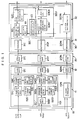
- Fig. 1 is a block diagram which shows the overall structure of a first embodiment.
- Fig. 2 is an explanation auxiliary view of conventional drawbacks.
- Fig. 3 is an explanatory view of a bias current for offset in the first embodiment.
- Fig. 4 is a circuit diagram which shows the detailed structure of an LD current control portion for a clock signal in the first embodiment.
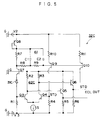
- Fig. 5 is a circuit diagram which shows the detailed structure of a reception processing portion for a clock signal in the first embodiment.
- Figs. 6A to 6E are timing charts (1) of each portion in the first embodiment.
- Figs. 7A to 7E are timing charts (2) of each portion in the first embodiment.
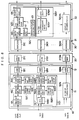
- Fig. 8 is a block diagram which shows the overall structure of a second embodiment.
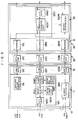
- Fig. 9 is a block diagram which shows the overall structure of a third embodiment.
- Fig. 1 is a block diagram which shows the schematic structure of an optical transmitting-receiving system relating to the first embodiment.
- the optical transmitting-receiving system relating to the first embodiment is formed by a transmitting module 10, an optical fiber array module 20, and a receiving module 30.
- the transmitting module 10 is formed by, for example, an electronic circuit section 11 formed by one LSI and a laser diode (LD) array section 12.
- LD laser diode
- a clock signal CLK (in the first embodiment, the duty ratio is 50%) and N (N is an integer larger than or equal to 1; e.g., in case of a parallel transmission of 8 bits or 32 bits, N is equal to 8 or 32) transmission data Data 1 to DataN are input to the electronic circuit section 11 of the transmitting module 10.
- the electronic circuit section 11 is formed by an LD (Laser Diode, hereinafter it may be referred to just as LD) current control portion 11C for a clock signal and LD current control portions 11D1, ..., 11DN for transmission data Data1, ..., DataN.
- LD Laser Diode
- the LD current control portion 11C for a clock signal is formed by an inversion amplifying circuit 51C equipped with a voltage-to-current converting function (hereinafter, inversion amplifying circuit ), a bias current circuit 52C for determining amplitude (hereinafter, first bias current circuit ), a laser diode minimum current circuit 53C (hereinafter, second bias current circuit ), and a current adding circuit 54C.
- inversion amplifying circuit 51C equipped with a voltage-to-current converting function
- bias current circuit 52C for determining amplitude hereinafter, first bias current circuit
- a laser diode minimum current circuit 53C hereinafter, second bias current circuit
- a current adding circuit 54C a current adding circuit 54C.
- the inversion amplifying circuit 51C inverts/amplifies the clock signal CLK formed by a voltage signal, and at the time of inversion/amplification, the inversion amplifying circuit 51C converts the clock signal into a current signal and supplies the inverted/amplified clock signal (current signal) to the current adding circuit 54C.
- the first bias current circuit 52C supplies to the inversion amplifying circuit 51C a bias current for determining amplitude (difference in currents between the time in which logical level is high and the time in which logical level is low) of a driving current supplied to a laser diode 12C, which will be described later, so as to obtain a desirable amplitude of the amplified current (the clock signal).
- the reason for which the inversion amplifying circuit 51C inverts/amplifies will be described later.
- a bias current for determining amplitude generated by the first bias current circuit 52C may be selected so that the difference between the time in which logical level is high and the time in which logical level is low is large.
- the second bias current circuit 53C outputs the minimum bias current of the driving current to the laser diode 12C, which will be described later.
- this bias current is set to a current larger than the largest threshold value current within the range of operating temperature of the laser diode 12C.
- Fig. 3 is an explanation auxiliary view of the above description and shows a relationship between the driving current of the laser diode 12C and an output power characteristic.
- the light emission of the laser diode 12C is started from a small driving current Il at a low temperature Tl (e.g., 0 °C), and as the driving current is increased, the intensity of light emission is increased.
- Tl a low temperature
- Th a high temperature
- the bias current (IB) from the second bias current circuit 53C is selected to a current which is larger than the driving current (the threshold value current), from which the light emission of the laser diode 12C is started.
- the current adding circuit 54C synthesizes (adds) the clock signal (the current signal) from the inversion amplifying circuit 51C and the bias current from the second bias current circuit 53C so as to supply the driving current to the corresponding laser diode 12C.
- the current from the inversion amplifying circuit 51C is not directly supplied to the laser diode 12C. Instead, the above-described current and the bias current from the second bias current circuit 53C are synthesized (added) and supplied to the laser diode 12C according to the following reason.
- the driving current having low logical level is substantially 0.
- an unfavorable influence due to the pattern effect of the laser diode which was referred to the conventional drawbacks, may occur.
- the laser diode 12C in a case in which the bias current which is larger than the largest threshold value current within the range of operating temperature of the laser diode 12C is added, the laser diode 12C is invariably in an oscillated state, and the adverse influence due to the pattern effect of the laser diode 12C can be prevented beforehand.
- the bias current generated by the second bias current circuit 53C takes a sufficient margin from the largest threshold value current within the range of operating temperature of the laser diode 12C.
- Fig. 4 is a circuit diagram which shows a concrete circuit example of the LD current control portion 11C for a clock signal.
- the LD current control portion 11C for a clock signal shown in Fig. 4 is a circuit in which a ground potential G is a high power supply voltage and which centers around differential amplifying pair of transistors Q1 and Q2.
- a common emitter for the differential amplifying pair of transistors Q1 and Q2 is connected to a constant current source corresponding to the first bias current circuit 52C.
- a corresponding laser diode 12C is serially connected to the collector of the transistor Q2, and the connecting point (corresponding to the current adding circuit 54C) between the laser diode 12C and the collector of the transistor Q2 is connected to a constant current source corresponding to the second bias current circuit 53C.
- the clock signal (the voltage signal) CLK is applied to the base pair of the differential amplifying pair of transistors Q1 and Q2.
- the LD current control portion 11C for a clock signal shown in Fig. 4 as the clock signal (the voltage signal) CLK is applied to the differential amplifying pair of transistors Q1 and Q2, to which a constant current is flowed from the constant current source corresponding to the first bias current circuit 52C, a collector current whose logic is inverted from the logic of the clock signal CLK, flows to the collector of the transistor Q2.
- the collector current and a bias current generated by the constant current source corresponding to the second bias current circuit 53C are added by connection and the added current thereby flows to the laser diode 12C.
- the LD current control portion 11DX (X is 1 to N) for each transmission data includes an inversion amplifying circuit 51DX, a first bias current circuit 52DX, a second bias current circuit 53DX, a current adding circuit 54DX, as in the same way as the LD current control portion 11C for a clock signal.
- the LD current control portion 11DX includes a latch circuit 50DX. Descriptions of functions of the inversion amplifying circuit 51DX, the first bias current circuit 52DX, the second bias current circuit 53DX, and the current adding circuit 54DX are omitted.
- the latch circuit 50DX latches an input transmission data DataX on the basis of the clock signal CLK and supplies the data to the inversion amplifying circuit 51DX. In this way, even if the synchronization of N transmission data; Data1 to Data N, which are transmitted in parallel and input to the electronic circuit section 11 of the transmitting module 10, are disordered more or less, the synchronization of data is made reliable.
- the inversion amplifying circuit 51DX be used in the LD current control portion 11DX for a transmission data.
- the inversion amplifying circuit 51DX serves to flow a large driving current to the laser diode 12DX, which will be described later.
- a processing such as scrambler or the like is not carried out, there are many 0 s in the transmission data DataX (e.g., in case of an RZ signal, there are many 0 s).
- the rate of 0 in the driving pattern is increased and the unfavorable influence due to the aforementioned pattern effect of the laser diode 12DX occurs.
- the inversion amplifying circuit 51DX is provided, and when the rate of 0 in the input transmission data DataX is high, a large driving current is flowed to the laser diode 12DX such that the unfavorable influence due to the pattern effect is prevented.
- a simple voltage-to-current converting circuit may be used instead of the inversion amplifying circuit 51DX.
- an inversion amplifying circuit or a non-inversion amplifying circuit may be selected so as to prevent the pattern effect from occurring to the laser diode 12DX.
- the inversion amplifying circuit 51DX is provided.
- the inversion amplifying circuit 51C may be omitted. However, in case of the first embodiment, as will be described later, it is preferable that the influence due to the temperature variation or the like is the same between the transmission of the clock signal CLK and that of the transmission data DataX. Consequently, the inversion amplifying circuit 51C is also provided for detecting the transmission processing of the clock signal CLK.
- the concrete circuit structure of the LD current control portion 11DX (X is 1 to N) for each transmission data is unillustrated.
- a general concrete structure serving as a D-type flip-flop circuit (a latch circuit) which is added to the circuit structure shown in the aforementioned Fig. 4 can be mentioned.
- the laser diode array section 12 includes laser diodes 12C, 12D1, ..., 12DN corresponding to the number of clock signal CLK and transmission signals of respective transmission data Data X.
- the laser diodes 12C, 12D1, ..., 12DN are provided closely on, e.g., the same wafer substrate.
- the laser diodes 12C, 12D1, ..., 12DN carry out electrical-to-optical conversions in accordance with the driving currents from the current adding circuits 54C, 54D1, ..., 54DN, and the converted optical signals are incident on corresponding optical fibers 21C, 21D1, ..., 21DN.
- the optical fiber array module 20 is formed by the optical fibers 21C, 21D1, ..., 21DN corresponding to the clock signal CLK and the number of transmission signals of respective transmission data DataX.
- the optical fibers 21C, 21D1, ..., 21DN are disposed in a row on a tape member.
- the optical fibers 21C, 21D1, ..., 21DN, which correspond to the clock signal CLK and the number of transmission signals of respective transmission data DataX are disposed in a row in the shape of a concentric circle around a core wire.
- the optical fibers 21C, 21D1, ..., 21DN guide the optical signals from the corresponding laser diodes 12C, 12D1, ..., 12DN to the corresponding photodiodes 31C, 31D1, ..., 31DN, to be described later.
- the receiving module 30 is formed by a photodiodes (PD) array section 31 and an electronic circuit section 32, which is formed by, e.g., an LSI.
- PD photodiodes
- the photodiodes array section 31 includes photodiodes 31C, 31D1, ..., 31DN, which correspond to the clock signal CLK and the number of transmission signals of respective transmission data Data X.
- the photodiodes 31C, 31D1, ..., 31DN are disposed closely on, e.g., the same wafer substrate.
- the photodiodes array section 31 converts the optical signals from the corresponding optical fibers 21C, 21D1, ..., 21DN and outputs electric signals (including current signals or voltage signals converted therefrom).
- the electronic circuit section 32 is formed by a reception processing portion 32C for a clock signal and reception processing portions 32D1, ..., 32DN for respective transmission (received) data.
- the reception processing portion 32C for a clock signal includes an electric signal distributor 60, an integrating circuit 61, a code identification regenerating circuit 62C, and an identification level multiplying circuit 63.
- the electric signal distributor 60 divides an electric signal from the photodiodes 31C in two and distributes one of the branch signals to the integrating circuit 61 and the other of the branch signals to the code identification regenerating circuit 62C.
- the levels of respective branch signals are half the level of the signal before branched.
- the integrating circuit 61 includes a sufficiently large time constant so as to integrate and convert the input branch signal into a signal having a DC level. Because the branch signal input to the integrating circuit 61 has a clock signal component having the duty ratio of 50%, the converted DC level is the center level of amplitudes of the input branch signal.
- the DC level is supplied to the code identification regenerating circuit 62C as an identification level for determining a code. Namely, in the first embodiment, since the identification level is formed by the received signal (the clock signal), the identification level varies in accordance with the level variations or the like of the received signal.
- the code identification regenerating circuit 62C compares the size of the level of the branch signal from the electric signal distributor 60 to that of the identification level from the integrating circuit 61 so as to regenerate a transmitted clock signal (determine a code). In the regeneration processing, a high level and a low level in the input signal is inverted so as to regenerate a clock signal. This corresponds to the fact that the inversion amplifying circuit 51C is provided at the transmitter side.
- the identification level multiplying circuit (DC amplifying circuit) 63 multiplies the level of identification level from the integrating circuit 61 by a predetermined amount and supplies the multiplied level to the reception processing portions 32D1, ..., 32DN for all of the transmission (received) data as the identification level for the circuit.
- the number of multiplication is two. Because the level of the received signal relating to the clock signal is halved by the branching processing of the electric signal distributor 60, the identification level from the integrating circuit 61 cannot be used as it is by the reception processing portions 32D1, ..., 32DN for transmission (received) data.
- the identification level multiplying circuit 63 is thereby provided.
- the number of multiplication at the identification level multiplying circuit 63 may be selected in accordance with the difference in the bias currents.
- Fig. 5 is a circuit diagram which shows the concrete circuit example of the reception processing portion 32C for a clock signal. As shown in Fig. 5, the reception processing portion 32C for a clock signal operates with a positive power supply V2, a negative power supply V3, and a ground potential G serving as power supply voltages.
- a differential amplifying circuit portion which is formed by a pair of NPN transistors Q3, Q4 is a circuit portion which directly determines a code.
- the NPN transistor Q3 includes a load resistor R2 and the NPN transistor Q4 includes a load resistor R3, and the emitters of the NPN transistors Q3, Q4 are connected in common to a constant current source IS.
- the differential amplifying circuit portion formed by the pair of NPN transistors Q3, Q4 operates with the difference between the ground potential G and the negative power supply voltage V3 serving as a power supply voltage.
- the emitter and the collector of a PNP transistor Q8 whose base and collector are connected to the high voltage side of the integrating circuit 61, a resistor R7, the emitter and the collector of an NPN transistor Q7 whose base is set to the ground potential G, a photodiodes 31C, and a resistor R1 are connected serially between the positive power supply voltage V2 and the negative power supply voltage V3.
- the connecting point between the anode of the photodiodes 31C and the resistor R1 is connected to the base of the transistor Q3.
- the current flowed to the photodiodes 31C is converted into a voltage by the resistor R1 and the converted voltage is applied to the base of the transistor Q3.
- a resistor R10, the emitter and the collector of a PNP transistor Q9 whose base is connected to the low voltage side of the integrating circuit 61, and a resistor R4 are connected serially between the positive power supply voltage V2 and the negative power supply voltage V3.
- the connecting point between the collector of the transistor Q9 and the resistor R4 is connected to the base of the transistor Q4.
- the voltage applied to the base of the transistor Q3 is larger than the voltage applied to the base of the transistor Q4, and the collector voltage of the transistor Q3 is smaller than the collector voltage of the transistor Q4.
- the intensity of light to the photodiodes 31C is small and a small current flows to the photodiodes 31C
- the voltage applied to the base of the transistor Q3 is smaller than the voltage applied to the base of the transistor Q4, and the collector voltage of the transistor Q3 is larger than the collector voltage of the transistor Q4.
- an output circuit is structured by a serial circuit (emitter-follower circuit) formed by an NPN transistor Q5 whose base is connected to the collector of the transistor Q3 and a resistor R5 and a serial circuit formed by an NPN transistor Q6 whose base is connected to the collector of the transistor Q4 and a resistor R6.
- a voltage difference between the collector voltages of the transistors Q3 and Q4 is output without being inverted and amplified.
- the circuit portion in which a resistor R8, a capacitor C1, a resistor R9, and a capacitor C2 are connected in a ladder shape, forms the integrating circuit 61.
- One end of the resistor R8 is connected to the connecting point (corresponding to the electric signal distributor 60) between the aforementioned resistor R7 and the collector of the transistor Q7.
- the common connecting point between the capacitors C1 and C2 are connected to the connecting point between the resistor R7 and the collector (and the base) of the transistor Q8. Consequently, in accordance with the voltage generated at the ends of the resistor R7 based on the current flowed to the photodiodes 31C, the integrating circuit 61 is charged or discharged.
- the time constant of the integrating circuit 61 determined by the capacities of the capacitors C1 and C2 is large, the charge voltage of the integrating circuit 61 is stable for the most part.
- the charge voltage of the integrating circuit 61 is applied to the base of the aforementioned transistor Q9, and the transistor Q9 and the resistor R10 form a current source.
- a current generated by the current source is converted into a voltage by the resistor R4, and as mentioned above, the converted voltage is applied to the base of the transistor Q4 as a reverence voltage for determining a code.
- a resistor R11 and a PNP transistor Q10 which are connected serially at the positive power supply voltage V2 side, form a current source circuit and correspond to the level multiplying circuit 63.
- the charge voltage of the integrating circuit 61 is applied to the base of the transistor Q10. Due to the relationship between the resistance value (r) of the resistor R11 and the resistance value (2r) of the resistor R10, a current which is twice as large as that of the transistor Q9 flows to the transistor Q10.
- the collector of the transistor Q10 is connected to the circuit portion, which corresponds to the transistor Q4 and the resistor R4, of a reception processing portion 32DX for any of the transmission (received) data, to be described later.
- Fig. 5 shows only one serial circuit of the resistor R11 and the transistor Q10. However, serial circuits which correspond to the number of reception processing portions 32D1 to 32DN for transmission (received) data may be provided.
- the reception processing portion 32DX (X is 1 to N) for each transmission (received) data includes a code identification regenerating circuit 62DX and a latch circuit 64DX.
- the code identification regenerating circuit 62DX compares the size of the level of the electric signal from the corresponding photodiodes 32DX to the size of the identification level from the level multiplying circuit 63 so as to regenerate a transmitted transmission data DataX (determine a code). In this regeneration processing as well, the high level and the low level of the input signal is inverted so as to regenerate a transmission DataX.
- the latch circuit 64DX delivers the regenerated transmission data DataX to a device in the next stage on the basis of the regenerated clock signal CLK.
- Figs. 6A through 6E and Figs. 7A through 7E are timing charts of respective portions in an optical transmitting-receiving system of the first embodiment.
- the input clock signal (the voltage signal) CLK shown in Fig. 6A is inverted/amplified and is made a voltage-to-current conversion at the inversion amplifying circuit 51C.
- the input clock signal CLK is converted into a signal which has an amplitude determined by the bias current from the first bias current circuit 52C and whose logical level is inverted.
- the signal is then supplied to the current adding circuit 54C.
- a bias current from the second bias current circuit 53C is added to the signal.
- the added signal is converted into a driving signal having a DC offset shown in Fig. 6C.
- the driving signal is supplied to the laser diode 12C so as to be made an electrical-to-optical conversion and is incident on the optical fiber 21C.
- the input transmission data (the voltage signal) Data1 is latched at the latch circuit 50D1 on the basis of the clock signal CLK.
- Data1 is converted into a data synchronized with the clock signal shown in Fig. 7A, and thereafter, the data is inverted/amplified and is made an voltage-to-current conversion at the inversion/ amplifying circuit 51D1.
- the input transmission data Data1 is converted into a signal which has an amplitude determined by the bias current from the first bias current circuit 51D1 and whose logical level is inverted.
- the converted signal is then supplied to the current adding circuit 54D1.
- the bias current from the second bias current circuit 53D1 is added to the signal.
- the added signal is converted into a driving signal having a DC offset shown in Fig. 7C.
- the driving signal is supplied to the laser diode 12D1 so as to be made an electrical-to-optical conversion and is incident on the optical fiber 21D1.
- the same processing is effected on the other transmission data Data2 to DataN, and the signals are incident on the optical fibers 21D2 to 21DN from the laser diodes 12D2 to 12DN.
- the received signal which was made an optical-to-electrical conversion by the photodiodes 31C for a clock signal is divided in two at the electric signal distributor 60.
- the branched signal shown in Fig. 6D is supplied to the integrating circuit 61 and the code identification regenerating circuit 62C.
- the branched signal is illustrated in the shape of square waves, however, an actual branched signal is more sinusoidal than the illustrated signal.
- the identification level L1 shown in Fig. 6D is formed so as to be supplied to the code identification regenerating circuit 62C.
- the code identification regenerating circuit 62C compares the size of the identification level to that of the branched signal (including inversion processing) so as to regenerate the transmitted clock signal shown in Fig. 6E.
- the identification level from the integrating circuit 61 is multiplied by a predetermined amount (e.g., 2) by the identification level multiplying circuit 63, converted into an identification level (e.g., 2 ⁇ L1) for the regeneration of transmission data shown in Fig. 7D, and supplied to the reception processing portions 32D1 to 32DN for all of the transmission (received) data.
- a predetermined amount e.g. 2 2
- an identification level e.g. 2 ⁇ L1
- the received signal which is made an optical-to-electrical conversion by the photodiodes 31D1 for transmission data and shown in Fig. 7D, is supplied to the code identification regenerating circuit 62D1.
- the received signal is illustrated in the shape of square waves, however, the actual received signal is more sinusoidal than the illustrated signal.
- the code identification regenerating circuit 62D1 compares the size of the identification level from the identification level multiplying circuit 63 to that of the received signal (including inversion processing).
- the transmission data Data1 is regenerated.
- the regenerated transmission data1 is latched at the latch circuit 64D1 on the basis of the regenerated clock signal CLK and is delivered to a device in the next stage.
- the optical transmitting apparatus the optical receiving apparatus, and the optical transmitting-receiving system in the aforementioned first embodiment, the following effects can be achieved.
- Fig. 8 is a block diagram which shows the schematic structure of an optical transmitting-receiving system of the second embodiment.
- the portions which are the same as and which correspond to those in Fig. 1 relating to the aforementioned first embodiment are denoted by the same reference numerals.
- a frequency dividing circuit 55 is provided within an LD current control portion 11C for a clock signal, and a frequency multiplying circuit 65 is provided within a reception processing portion 32C for a clock signal.
- the frequency dividing circuit 55 divides the frequency of an input clock signal CLK in two and supplies the divided frequency to an inversion amplifying circuit 51C.
- the frequency multiplying circuit 65 multiplies the frequency of the signal from a code identification regenerating circuit 62C by two so that a clock signal is regenerated at last.
- the basic frequency component of the clock signal CLK is higher than the basic frequency component of the transmission data DataX (see Figs. 6 and 7). Due to the frequency characteristics of the optical fiber, the difference in these frequency components may slightly change the degree of level changes between the received signal relating to the clock signal and the received signal relating to the transmission data. Accordingly, the frequency dividing circuit 55 and the frequency multiplying circuit 65 are provided in the second embodiment, such that the frequency components of optical signals transmitted within all of the optical fibers are made as uniform as possible.
- the effects of the second embodiment are similar to those of the aforementioned first embodiment. Additionally, since the frequency components of optical signals can be made as uniform as possible, the transmission precision at a phase surface can be further improved.
- Fig. 9 is a block diagram which shows the schematic structure of the optical transmitting-receiving system relating to the third embodiment.
- the portions which are the same as or correspond to those in Fig. 1 relating to the aforementioned first embodiment are denoted by the same reference numerals.
- an identification level bias current circuit 56 is provided.
- the identification level bias current circuit 56 supplies a bias current (a driving current), which corresponds to the identification level used for determining the code of a transmission data at the receiver side, and to a laser diode 12C so as to emit a light.
- the optical signal is made an optical-to-electrical conversion into an electric signal (an identification level) by a photodiodes 31C, and the electric signal is supplied to reception processing portions 32D1 to 32DN for all of the transmission data. Namely, the identification level is transmitted directly and not transmitted by using a clock signal.
- the identification level since the information about the identification level is transmitted from the transmitter side to the receiver side, the identification level also varies in accordance with the temperature variations or the like.
- the third embodiment can achieve an effect, which is caused by using a variable identification level and which was referred to the description of the effect in the first embodiment, as it is.
- the influence due to the temperature variations or the like in the electric circuit portion is different between in the transmitting route of the identification level and in that of the transmission data.
- the influence due to the temperature variations or the like is much larger in the optical signal processing system than in the electric signal processing system.
- the effect referred to the description of the effect in the first embodiment can be achieved as it is.
- the third embodiment is applied to a transmitting-receiving system including a circuit which generates a clock component from a received data.
- the clock signal may also be transmitted regardless of the transmission of the identification level information.
- the photodiodes 31C serves as identification level supplying means described in claim 4.
- an identification level information is transmitted by one route.
- the identification level may be transmitted by a plurality of routes. For example, if a transmission data includes 32 bits, the identification level information may be transmitted by a sum of four routes, each per eight bits.
- a set of laser diode for identification level information and an optical fiber corresponding to this diode may be provided in the midway among the sets of laser diodes for 8-bit transmission data and optical fibers corresponding to each of the laser diodes.
- the present invention is applied to a case in which transmission data is conveyed in parallel.
- the present invention is applicable even to a case in which there is only one transmission data.
- the effect of reducing the jittering of regenerated data is expected.
- the present invention is carried out in consideration of an optical transmitting-receiving system in accordance with an optical interconnecting method.
- the present invention is applicable to the other optical transmitting-receiving system.
- the inversion or non-inversion of the logical level may be selected by inputting the rate information from outside as to which logical level appears more frequently.
- this can be achieved by; an inverter circuit which inverts a transmission data, a switch which selects a transmission data which passes through the inverter circuit or a transmission data which does not pass through the inverter circuit in accordance with the rate information, and a circuit which performs a voltage-to-current conversion of the switch output.
- a transmitting system which transmits the rate information to the optical receiving apparatus be provided and the inversion and non-inversion of the logical level can be selected at the optical receiving apparatus.
- the bias currents are the same at the transmitting route of the clock signal and at the transmitting route of the transmission data. However, there is no doubt that the bias currents may be different.
- the identification level information is transmitted between the optical transmitting apparatus and the optical receiving apparatus.
- the identification level at the receiver side includes variations due to the temperatures or the like similar to those of the transmitted data, such that the transmission data can be regenerated properly from the phase surface thereof.
- the optical receiving apparatus of the Fifth aspect and the optical transmitting-receiving system of the sixth aspect, it is arranged such that the transmission data is transmitted in such a mode that the logical level of the transmission data whose rate of appearance is high is the side in which the optical intensity of the optical signal from the light emitter is large. Consequently, the rate in which the light emitter of the optical transmitting apparatus emits light at a strong optical intensity is increased, the average response in optical emission of the light emitter is improved, and the unfavorable effect (pattern effect) on the phase surface or the like due to the delay in response of the light emitter can be reduced.
- the light emitter applies bias to the transmission data and emits light so that the logical level is larger than the lowest level of emission within the range of operating temperature of the optical transmitting apparatus. Therefore, the unfavorable effect (pattern effect) on the phase surface or the like due to the delay in response of the light emitter can be reduced.
Landscapes
- Physics & Mathematics (AREA)
- Electromagnetism (AREA)
- Engineering & Computer Science (AREA)
- Computer Networks & Wireless Communication (AREA)
- Signal Processing (AREA)
- Optical Communication System (AREA)
Applications Claiming Priority (3)
| Application Number | Priority Date | Filing Date | Title |
|---|---|---|---|
| JP10304297A JP3414616B2 (ja) | 1997-04-21 | 1997-04-21 | 光伝送システム |
| JP103042/97 | 1997-04-21 | ||
| JP10304297 | 1997-04-21 |
Publications (2)
| Publication Number | Publication Date |
|---|---|
| EP0876010A2 true EP0876010A2 (de) | 1998-11-04 |
| EP0876010A3 EP0876010A3 (de) | 2002-05-08 |
Family
ID=14343618
Family Applications (1)
| Application Number | Title | Priority Date | Filing Date |
|---|---|---|---|
| EP97118045A Withdrawn EP0876010A3 (de) | 1997-04-21 | 1997-10-17 | Optische Sendervorrichtung, optische Empfängervorrichtung und optisches Sender-Empfängersystem |
Country Status (3)
| Country | Link |
|---|---|
| US (1) | US6166839A (de) |
| EP (1) | EP0876010A3 (de) |
| JP (1) | JP3414616B2 (de) |
Families Citing this family (4)
| Publication number | Priority date | Publication date | Assignee | Title |
|---|---|---|---|---|
| JP3668926B2 (ja) * | 1999-08-27 | 2005-07-06 | 株式会社ルネサステクノロジ | 光インタコネクション受信モジュール |
| JP3857099B2 (ja) * | 2001-10-09 | 2006-12-13 | 株式会社アドバンテスト | データ伝送装置、光電変換回路、及び試験装置 |
| US20030235415A1 (en) * | 2002-06-21 | 2003-12-25 | Peters Frank H. | Optical communication devices and optical communication methods |
| US8036539B2 (en) * | 2005-06-28 | 2011-10-11 | Finisar Corporation | Gigabit ethernet longwave optical transceiver module having amplified bias current |
Family Cites Families (9)
| Publication number | Priority date | Publication date | Assignee | Title |
|---|---|---|---|---|
| US4081670A (en) * | 1976-11-08 | 1978-03-28 | Bell Telephone Laboratories, Incorporated | Automatic bias control circuit for injection lasers |
| IT1159851B (it) * | 1978-06-20 | 1987-03-04 | Cselt Centro Studi Lab Telecom | Perfezionamenti ai sistemi di trasmissione a divisione di lunghezza d'onda |
| JPS60210039A (ja) * | 1984-04-04 | 1985-10-22 | Hitachi Ltd | 光信号伝送装置 |
| JPH05244094A (ja) * | 1992-02-26 | 1993-09-21 | Toshiba Corp | 光伝送装置 |
| JPH0795156A (ja) * | 1993-09-20 | 1995-04-07 | Fujitsu Ltd | 光入力断検出回路 |
| WO1995008879A1 (en) * | 1993-09-22 | 1995-03-30 | Massachussetts Institute Of Technology | Error-rate based laser drive control |
| JPH07307764A (ja) * | 1994-03-18 | 1995-11-21 | Fujitsu Ltd | 光並列受信装置に用いられるデータ識別回路、光並列受信装置、光並列伝送装置及び光伝送ファイバの端末構造 |
| CA2166829A1 (en) * | 1995-02-02 | 1996-08-03 | Attilio Joseph Rainal | System and method for minimizing nonlinear distortion in optical communication systems employing laser intensity modulation |
| JPH08321827A (ja) * | 1995-03-20 | 1996-12-03 | Fujitsu Ltd | データ識別装置及びこれを用いた光受信器 |
-
1997
- 1997-04-21 JP JP10304297A patent/JP3414616B2/ja not_active Expired - Fee Related
- 1997-10-07 US US08/946,253 patent/US6166839A/en not_active Expired - Lifetime
- 1997-10-17 EP EP97118045A patent/EP0876010A3/de not_active Withdrawn
Also Published As
| Publication number | Publication date |
|---|---|
| US6166839A (en) | 2000-12-26 |
| JP3414616B2 (ja) | 2003-06-09 |
| EP0876010A3 (de) | 2002-05-08 |
| JPH10294700A (ja) | 1998-11-04 |
Similar Documents
| Publication | Publication Date | Title |
|---|---|---|
| Greshishchev et al. | A fully integrated SiGe receiver IC for 10-Gb/s data rate | |
| US5069522A (en) | Optical fiber link card | |
| US6594070B2 (en) | Optical communication system, optical receiver and wavelength converter | |
| US20020064193A1 (en) | High-speed laser array driver | |
| JPH07307764A (ja) | 光並列受信装置に用いられるデータ識別回路、光並列受信装置、光並列伝送装置及び光伝送ファイバの端末構造 | |
| US20140270806A1 (en) | Adaptive sampling qualification for extinction ratio control | |
| EP0069760A1 (de) | Optische verbindungsanordnung zur verminderung harmonischer verzerrung | |
| JP2004172237A (ja) | 光送信制御装置 | |
| US6166839A (en) | Optical transmitting apparatus, optical receiving apparatus, and optical transmitting-receiving system | |
| US6201822B1 (en) | Optical signal transmission apparatus and optical signal transmission method | |
| EP0524124B1 (de) | Betriebssystem mit zwei Fasern | |
| US7027741B2 (en) | Phase lock loop circuit and optical repeating apparatus, optical terminal apparatus, and optical communication system having the same | |
| US7039323B2 (en) | Optical transmitter for transmitting a plurality of output signals | |
| US12057887B2 (en) | Optical transmitter | |
| JPS6218133A (ja) | 光周波数変調光通信方法 | |
| KR20080031916A (ko) | 광수신 장치, 시험 장치, 광수신 방법, 시험 방법, 테스트모듈, 및 반도체 칩 | |
| Gui et al. | A 2-Gb/s 0.5-µm CMOS Parallel Optical Transceiver With Fast Power-On Capability | |
| JP4416194B2 (ja) | 光信号送信装置、光信号伝送装置および光信号伝送方法 | |
| JP3059041B2 (ja) | 光送信回路 | |
| EP1071230A1 (de) | Optisches Kommunikationssystem zur Parallelübertragung von mehreren Datensignalen | |
| MIYOSHI et al. | 12-channel DC to 622-Mbit/s/ch parallel optical transmitter and receiver for bit-parallel raw data transmission | |
| JPH07162462A (ja) | バースト信号伝送方法及びバースト信号送信装置 | |
| JP2007049456A (ja) | 光受信装置および光通信システム | |
| JP2002064242A (ja) | レーザダイオード駆動方法および回路 | |
| Soda et al. | A 2.5-Gb/s one-chip receiver module for Gigabit-To-The-Home (GTTH) system |
Legal Events
| Date | Code | Title | Description |
|---|---|---|---|
| PUAI | Public reference made under article 153(3) epc to a published international application that has entered the european phase |
Free format text: ORIGINAL CODE: 0009012 |
|
| AK | Designated contracting states |
Kind code of ref document: A2 Designated state(s): AT BE CH DE DK ES FI FR GB GR IE IT LI LU MC NL PT SE |
|
| PUAL | Search report despatched |
Free format text: ORIGINAL CODE: 0009013 |
|
| AK | Designated contracting states |
Kind code of ref document: A3 Designated state(s): AT BE CH DE DK ES FI FR GB GR IE IT LI LU MC NL PT SE |
|
| AKX | Designation fees paid | ||
| REG | Reference to a national code |
Ref country code: DE Ref legal event code: 8566 |
|
| STAA | Information on the status of an ep patent application or granted ep patent |
Free format text: STATUS: THE APPLICATION IS DEEMED TO BE WITHDRAWN |
|
| 18D | Application deemed to be withdrawn |
Effective date: 20021109 |