EP0879708B1 - Material, das wässerige tinte absorbiert, und verbundfolie, die eine schicht des absorbierenden materials enthält - Google Patents
Material, das wässerige tinte absorbiert, und verbundfolie, die eine schicht des absorbierenden materials enthält Download PDFInfo
- Publication number
- EP0879708B1 EP0879708B1 EP97911459A EP97911459A EP0879708B1 EP 0879708 B1 EP0879708 B1 EP 0879708B1 EP 97911459 A EP97911459 A EP 97911459A EP 97911459 A EP97911459 A EP 97911459A EP 0879708 B1 EP0879708 B1 EP 0879708B1
- Authority
- EP
- European Patent Office
- Prior art keywords
- water
- ink
- absorbing material
- weight parts
- base
- Prior art date
- Legal status (The legal status is an assumption and is not a legal conclusion. Google has not performed a legal analysis and makes no representation as to the accuracy of the status listed.)
- Expired - Lifetime
Links
- 239000011358 absorbing material Substances 0.000 title claims abstract description 189
- XLYOFNOQVPJJNP-UHFFFAOYSA-N water Substances O XLYOFNOQVPJJNP-UHFFFAOYSA-N 0.000 claims abstract description 163
- -1 polyethylene Polymers 0.000 claims abstract description 11
- VTYYLEPIZMXCLO-UHFFFAOYSA-L Calcium carbonate Chemical compound [Ca+2].[O-]C([O-])=O VTYYLEPIZMXCLO-UHFFFAOYSA-L 0.000 claims description 121
- 239000010410 layer Substances 0.000 claims description 91
- VYPSYNLAJGMNEJ-UHFFFAOYSA-N Silicium dioxide Chemical compound O=[Si]=O VYPSYNLAJGMNEJ-UHFFFAOYSA-N 0.000 claims description 67
- 229910000019 calcium carbonate Inorganic materials 0.000 claims description 59
- 239000006096 absorbing agent Substances 0.000 claims description 54
- 239000000203 mixture Substances 0.000 claims description 36
- NIXOWILDQLNWCW-UHFFFAOYSA-M Acrylate Chemical compound [O-]C(=O)C=C NIXOWILDQLNWCW-UHFFFAOYSA-M 0.000 claims description 35
- 239000000377 silicon dioxide Substances 0.000 claims description 33
- 238000004132 cross linking Methods 0.000 claims description 32
- 229920005749 polyurethane resin Polymers 0.000 claims description 25
- 102000008186 Collagen Human genes 0.000 claims description 22
- 108010035532 Collagen Proteins 0.000 claims description 22
- 229920001436 collagen Polymers 0.000 claims description 22
- 239000000126 substance Substances 0.000 claims description 18
- 229920003171 Poly (ethylene oxide) Polymers 0.000 claims description 13
- 229920005862 polyol Polymers 0.000 claims description 12
- 239000004820 Pressure-sensitive adhesive Substances 0.000 claims description 11
- 239000004721 Polyphenylene oxide Substances 0.000 claims description 10
- 229920000570 polyether Polymers 0.000 claims description 10
- 150000003077 polyols Chemical class 0.000 claims description 9
- 239000003431 cross linking reagent Substances 0.000 claims 1
- 238000009736 wetting Methods 0.000 abstract description 48
- 230000035699 permeability Effects 0.000 abstract description 47
- 238000012360 testing method Methods 0.000 abstract description 38
- 239000007788 liquid Substances 0.000 abstract description 30
- 230000000740 bleeding effect Effects 0.000 abstract description 18
- 238000000034 method Methods 0.000 abstract description 12
- 238000001035 drying Methods 0.000 abstract description 8
- 238000005259 measurement Methods 0.000 abstract description 7
- 239000004743 Polypropylene Substances 0.000 abstract description 3
- 229920001155 polypropylene Polymers 0.000 abstract description 3
- 239000004698 Polyethylene Substances 0.000 abstract description 2
- 230000001939 inductive effect Effects 0.000 abstract description 2
- 239000005022 packaging material Substances 0.000 abstract description 2
- 229920000573 polyethylene Polymers 0.000 abstract description 2
- 239000000976 ink Substances 0.000 description 393
- 238000007639 printing Methods 0.000 description 59
- 238000011156 evaluation Methods 0.000 description 57
- 229920005989 resin Polymers 0.000 description 36
- 239000011347 resin Substances 0.000 description 36
- 230000000052 comparative effect Effects 0.000 description 33
- 230000008961 swelling Effects 0.000 description 26
- 239000002904 solvent Substances 0.000 description 23
- 229920002803 thermoplastic polyurethane Polymers 0.000 description 22
- 230000001070 adhesive effect Effects 0.000 description 21
- 238000013329 compounding Methods 0.000 description 19
- 239000000454 talc Substances 0.000 description 16
- 229910052623 talc Inorganic materials 0.000 description 16
- 239000002245 particle Substances 0.000 description 15
- 229910021536 Zeolite Inorganic materials 0.000 description 14
- 239000011248 coating agent Substances 0.000 description 14
- 238000000576 coating method Methods 0.000 description 14
- HNPSIPDUKPIQMN-UHFFFAOYSA-N dioxosilane;oxo(oxoalumanyloxy)alumane Chemical compound O=[Si]=O.O=[Al]O[Al]=O HNPSIPDUKPIQMN-UHFFFAOYSA-N 0.000 description 14
- 239000012086 standard solution Substances 0.000 description 14
- 239000010457 zeolite Substances 0.000 description 14
- 239000000463 material Substances 0.000 description 12
- 239000005871 repellent Substances 0.000 description 12
- 230000002940 repellent Effects 0.000 description 12
- 239000003086 colorant Substances 0.000 description 11
- 239000010445 mica Substances 0.000 description 11
- 229910052618 mica group Inorganic materials 0.000 description 11
- 239000000049 pigment Substances 0.000 description 10
- 239000007787 solid Substances 0.000 description 10
- ZMXDDKWLCZADIW-UHFFFAOYSA-N N,N-Dimethylformamide Chemical compound CN(C)C=O ZMXDDKWLCZADIW-UHFFFAOYSA-N 0.000 description 9
- 230000001965 increasing effect Effects 0.000 description 9
- 238000010521 absorption reaction Methods 0.000 description 7
- TZCXTZWJZNENPQ-UHFFFAOYSA-L barium sulfate Chemical compound [Ba+2].[O-]S([O-])(=O)=O TZCXTZWJZNENPQ-UHFFFAOYSA-L 0.000 description 7
- 230000000694 effects Effects 0.000 description 7
- 239000002075 main ingredient Substances 0.000 description 7
- LYCAIKOWRPUZTN-UHFFFAOYSA-N Ethylene glycol Chemical compound OCCO LYCAIKOWRPUZTN-UHFFFAOYSA-N 0.000 description 6
- ZHNUHDYFZUAESO-UHFFFAOYSA-N Formamide Chemical compound NC=O ZHNUHDYFZUAESO-UHFFFAOYSA-N 0.000 description 6
- MTHSVFCYNBDYFN-UHFFFAOYSA-N diethylene glycol Chemical compound OCCOCCO MTHSVFCYNBDYFN-UHFFFAOYSA-N 0.000 description 6
- 239000002270 dispersing agent Substances 0.000 description 6
- 239000006185 dispersion Substances 0.000 description 6
- 239000000975 dye Substances 0.000 description 6
- 239000004615 ingredient Substances 0.000 description 6
- 230000001846 repelling effect Effects 0.000 description 6
- 239000004925 Acrylic resin Substances 0.000 description 5
- 229920000178 Acrylic resin Polymers 0.000 description 5
- 229920000298 Cellophane Polymers 0.000 description 5
- 230000001747 exhibiting effect Effects 0.000 description 5
- CPLXHLVBOLITMK-UHFFFAOYSA-N magnesium oxide Inorganic materials [Mg]=O CPLXHLVBOLITMK-UHFFFAOYSA-N 0.000 description 5
- 239000003960 organic solvent Substances 0.000 description 5
- 229920000742 Cotton Polymers 0.000 description 4
- 230000006378 damage Effects 0.000 description 4
- 239000004744 fabric Substances 0.000 description 4
- 239000000835 fiber Substances 0.000 description 4
- 239000000395 magnesium oxide Substances 0.000 description 4
- 230000000704 physical effect Effects 0.000 description 4
- 229920001225 polyester resin Polymers 0.000 description 4
- 239000004645 polyester resin Substances 0.000 description 4
- 229920000642 polymer Polymers 0.000 description 4
- ZNQVEEAIQZEUHB-UHFFFAOYSA-N 2-ethoxyethanol Chemical compound CCOCCO ZNQVEEAIQZEUHB-UHFFFAOYSA-N 0.000 description 3
- 229910001369 Brass Inorganic materials 0.000 description 3
- HEMHJVSKTPXQMS-UHFFFAOYSA-M Sodium hydroxide Chemical compound [OH-].[Na+] HEMHJVSKTPXQMS-UHFFFAOYSA-M 0.000 description 3
- YXFVVABEGXRONW-UHFFFAOYSA-N Toluene Chemical compound CC1=CC=CC=C1 YXFVVABEGXRONW-UHFFFAOYSA-N 0.000 description 3
- 125000005907 alkyl ester group Chemical group 0.000 description 3
- 239000012298 atmosphere Substances 0.000 description 3
- 239000011230 binding agent Substances 0.000 description 3
- 230000015572 biosynthetic process Effects 0.000 description 3
- 239000010951 brass Substances 0.000 description 3
- 229910052791 calcium Inorganic materials 0.000 description 3
- 238000005266 casting Methods 0.000 description 3
- 238000006243 chemical reaction Methods 0.000 description 3
- 230000007423 decrease Effects 0.000 description 3
- 230000003631 expected effect Effects 0.000 description 3
- 239000000945 filler Substances 0.000 description 3
- AXZKOIWUVFPNLO-UHFFFAOYSA-N magnesium;oxygen(2-) Chemical compound [O-2].[Mg+2] AXZKOIWUVFPNLO-UHFFFAOYSA-N 0.000 description 3
- 239000003921 oil Substances 0.000 description 3
- 239000012466 permeate Substances 0.000 description 3
- 239000011148 porous material Substances 0.000 description 3
- 229940088417 precipitated calcium carbonate Drugs 0.000 description 3
- 229920005992 thermoplastic resin Polymers 0.000 description 3
- SBASXUCJHJRPEV-UHFFFAOYSA-N 2-(2-methoxyethoxy)ethanol Chemical compound COCCOCCO SBASXUCJHJRPEV-UHFFFAOYSA-N 0.000 description 2
- UPMLOUAZCHDJJD-UHFFFAOYSA-N 4,4'-Diphenylmethane Diisocyanate Chemical compound C1=CC(N=C=O)=CC=C1CC1=CC=C(N=C=O)C=C1 UPMLOUAZCHDJJD-UHFFFAOYSA-N 0.000 description 2
- 239000004372 Polyvinyl alcohol Substances 0.000 description 2
- BZHJMEDXRYGGRV-UHFFFAOYSA-N Vinyl chloride Chemical compound ClC=C BZHJMEDXRYGGRV-UHFFFAOYSA-N 0.000 description 2
- 235000010724 Wisteria floribunda Nutrition 0.000 description 2
- NIXOWILDQLNWCW-UHFFFAOYSA-N acrylic acid group Chemical group C(C=C)(=O)O NIXOWILDQLNWCW-UHFFFAOYSA-N 0.000 description 2
- 239000000853 adhesive Substances 0.000 description 2
- 239000004411 aluminium Substances 0.000 description 2
- XAGFODPZIPBFFR-UHFFFAOYSA-N aluminium Chemical compound [Al] XAGFODPZIPBFFR-UHFFFAOYSA-N 0.000 description 2
- 229910052782 aluminium Inorganic materials 0.000 description 2
- 239000003638 chemical reducing agent Substances 0.000 description 2
- 230000001419 dependent effect Effects 0.000 description 2
- RRAMGCGOFNQTLD-UHFFFAOYSA-N hexamethylene diisocyanate Chemical compound O=C=NCCCCCCN=C=O RRAMGCGOFNQTLD-UHFFFAOYSA-N 0.000 description 2
- 229920000728 polyester Polymers 0.000 description 2
- 229920002451 polyvinyl alcohol Polymers 0.000 description 2
- 102000004169 proteins and genes Human genes 0.000 description 2
- 108090000623 proteins and genes Proteins 0.000 description 2
- 239000000243 solution Substances 0.000 description 2
- 239000003351 stiffener Substances 0.000 description 2
- 238000010998 test method Methods 0.000 description 2
- DVKJHBMWWAPEIU-UHFFFAOYSA-N toluene 2,4-diisocyanate Chemical group CC1=CC=C(N=C=O)C=C1N=C=O DVKJHBMWWAPEIU-UHFFFAOYSA-N 0.000 description 2
- 230000000007 visual effect Effects 0.000 description 2
- 239000000080 wetting agent Substances 0.000 description 2
- SMZOUWXMTYCWNB-UHFFFAOYSA-N 2-(2-methoxy-5-methylphenyl)ethanamine Chemical compound COC1=CC=C(C)C=C1CCN SMZOUWXMTYCWNB-UHFFFAOYSA-N 0.000 description 1
- GOXQRTZXKQZDDN-UHFFFAOYSA-N 2-Ethylhexyl acrylate Chemical compound CCCCC(CC)COC(=O)C=C GOXQRTZXKQZDDN-UHFFFAOYSA-N 0.000 description 1
- 238000004438 BET method Methods 0.000 description 1
- OYPRJOBELJOOCE-UHFFFAOYSA-N Calcium Chemical compound [Ca] OYPRJOBELJOOCE-UHFFFAOYSA-N 0.000 description 1
- UXVMQQNJUSDDNG-UHFFFAOYSA-L Calcium chloride Chemical compound [Cl-].[Cl-].[Ca+2] UXVMQQNJUSDDNG-UHFFFAOYSA-L 0.000 description 1
- 229920001353 Dextrin Polymers 0.000 description 1
- 239000005057 Hexamethylene diisocyanate Substances 0.000 description 1
- CERQOIWHTDAKMF-UHFFFAOYSA-M Methacrylate Chemical compound CC(=C)C([O-])=O CERQOIWHTDAKMF-UHFFFAOYSA-M 0.000 description 1
- 239000004614 Process Aid Substances 0.000 description 1
- 239000004115 Sodium Silicate Substances 0.000 description 1
- 125000000217 alkyl group Chemical group 0.000 description 1
- WNROFYMDJYEPJX-UHFFFAOYSA-K aluminium hydroxide Chemical compound [OH-].[OH-].[OH-].[Al+3] WNROFYMDJYEPJX-UHFFFAOYSA-K 0.000 description 1
- 229910021502 aluminium hydroxide Inorganic materials 0.000 description 1
- 150000001408 amides Chemical class 0.000 description 1
- 125000003118 aryl group Chemical group 0.000 description 1
- 210000000988 bone and bone Anatomy 0.000 description 1
- CQEYYJKEWSMYFG-UHFFFAOYSA-N butyl acrylate Chemical compound CCCCOC(=O)C=C CQEYYJKEWSMYFG-UHFFFAOYSA-N 0.000 description 1
- 239000011575 calcium Substances 0.000 description 1
- 239000001110 calcium chloride Substances 0.000 description 1
- 229910001628 calcium chloride Inorganic materials 0.000 description 1
- AXCZMVOFGPJBDE-UHFFFAOYSA-L calcium dihydroxide Chemical compound [OH-].[OH-].[Ca+2] AXCZMVOFGPJBDE-UHFFFAOYSA-L 0.000 description 1
- 239000000920 calcium hydroxide Substances 0.000 description 1
- 229910001861 calcium hydroxide Inorganic materials 0.000 description 1
- 238000003490 calendering Methods 0.000 description 1
- 150000001768 cations Chemical class 0.000 description 1
- 150000001875 compounds Chemical class 0.000 description 1
- 210000002808 connective tissue Anatomy 0.000 description 1
- 239000013078 crystal Substances 0.000 description 1
- 230000002950 deficient Effects 0.000 description 1
- 210000004268 dentin Anatomy 0.000 description 1
- FYGDTMLNYKFZSV-MRCIVHHJSA-N dextrin Chemical compound O[C@@H]1[C@@H](O)[C@H](O)[C@@H](CO)OC1O[C@@H]1[C@@H](CO)OC(O[C@@H]2[C@H](O[C@H](O)[C@H](O)[C@H]2O)CO)[C@H](O)[C@H]1O FYGDTMLNYKFZSV-MRCIVHHJSA-N 0.000 description 1
- 235000014113 dietary fatty acids Nutrition 0.000 description 1
- 238000010017 direct printing Methods 0.000 description 1
- 239000000194 fatty acid Substances 0.000 description 1
- 229930195729 fatty acid Natural products 0.000 description 1
- 150000004665 fatty acids Chemical class 0.000 description 1
- 235000013305 food Nutrition 0.000 description 1
- 239000011521 glass Substances 0.000 description 1
- 230000005484 gravity Effects 0.000 description 1
- 230000001788 irregular Effects 0.000 description 1
- HCWCAKKEBCNQJP-UHFFFAOYSA-N magnesium orthosilicate Chemical compound [Mg+2].[Mg+2].[O-][Si]([O-])([O-])[O-] HCWCAKKEBCNQJP-UHFFFAOYSA-N 0.000 description 1
- 239000000391 magnesium silicate Substances 0.000 description 1
- 229910052919 magnesium silicate Inorganic materials 0.000 description 1
- 235000019792 magnesium silicate Nutrition 0.000 description 1
- 238000004519 manufacturing process Methods 0.000 description 1
- 239000013081 microcrystal Substances 0.000 description 1
- 239000000178 monomer Substances 0.000 description 1
- 230000002093 peripheral effect Effects 0.000 description 1
- 229920003023 plastic Polymers 0.000 description 1
- 239000004033 plastic Substances 0.000 description 1
- 239000004014 plasticizer Substances 0.000 description 1
- 229920000058 polyacrylate Polymers 0.000 description 1
- 229920006267 polyester film Polymers 0.000 description 1
- 238000006116 polymerization reaction Methods 0.000 description 1
- 229920005672 polyolefin resin Polymers 0.000 description 1
- 239000004800 polyvinyl chloride Substances 0.000 description 1
- 229920000915 polyvinyl chloride Polymers 0.000 description 1
- 229920000036 polyvinylpyrrolidone Polymers 0.000 description 1
- 239000001267 polyvinylpyrrolidone Substances 0.000 description 1
- 235000013855 polyvinylpyrrolidone Nutrition 0.000 description 1
- 239000000843 powder Substances 0.000 description 1
- 239000002244 precipitate Substances 0.000 description 1
- 239000011164 primary particle Substances 0.000 description 1
- 239000000047 product Substances 0.000 description 1
- 150000003839 salts Chemical class 0.000 description 1
- 235000012239 silicon dioxide Nutrition 0.000 description 1
- 239000002002 slurry Substances 0.000 description 1
- NTHWMYGWWRZVTN-UHFFFAOYSA-N sodium silicate Chemical compound [Na+].[Na+].[O-][Si]([O-])=O NTHWMYGWWRZVTN-UHFFFAOYSA-N 0.000 description 1
- 229910052911 sodium silicate Inorganic materials 0.000 description 1
- 238000003892 spreading Methods 0.000 description 1
- 239000003381 stabilizer Substances 0.000 description 1
- 210000002435 tendon Anatomy 0.000 description 1
- 239000001038 titanium pigment Substances 0.000 description 1
- ROVRRJSRRSGUOL-UHFFFAOYSA-N victoria blue bo Chemical compound [Cl-].C12=CC=CC=C2C(NCC)=CC=C1C(C=1C=CC(=CC=1)N(CC)CC)=C1C=CC(=[N+](CC)CC)C=C1 ROVRRJSRRSGUOL-UHFFFAOYSA-N 0.000 description 1
- 125000000391 vinyl group Chemical group [H]C([*])=C([H])[H] 0.000 description 1
- 229920002554 vinyl polymer Polymers 0.000 description 1
Images

Classifications
-
- B—PERFORMING OPERATIONS; TRANSPORTING
- B41—PRINTING; LINING MACHINES; TYPEWRITERS; STAMPS
- B41M—PRINTING, DUPLICATING, MARKING, OR COPYING PROCESSES; COLOUR PRINTING
- B41M5/00—Duplicating or marking methods; Sheet materials for use therein
- B41M5/50—Recording sheets characterised by the coating used to improve ink, dye or pigment receptivity, e.g. for ink-jet or thermal dye transfer recording
- B41M5/52—Macromolecular coatings
-
- Y—GENERAL TAGGING OF NEW TECHNOLOGICAL DEVELOPMENTS; GENERAL TAGGING OF CROSS-SECTIONAL TECHNOLOGIES SPANNING OVER SEVERAL SECTIONS OF THE IPC; TECHNICAL SUBJECTS COVERED BY FORMER USPC CROSS-REFERENCE ART COLLECTIONS [XRACs] AND DIGESTS
- Y10—TECHNICAL SUBJECTS COVERED BY FORMER USPC
- Y10T—TECHNICAL SUBJECTS COVERED BY FORMER US CLASSIFICATION
- Y10T428/00—Stock material or miscellaneous articles
- Y10T428/25—Web or sheet containing structurally defined element or component and including a second component containing structurally defined particles
- Y10T428/259—Silicic material
-
- Y—GENERAL TAGGING OF NEW TECHNOLOGICAL DEVELOPMENTS; GENERAL TAGGING OF CROSS-SECTIONAL TECHNOLOGIES SPANNING OVER SEVERAL SECTIONS OF THE IPC; TECHNICAL SUBJECTS COVERED BY FORMER USPC CROSS-REFERENCE ART COLLECTIONS [XRACs] AND DIGESTS
- Y10—TECHNICAL SUBJECTS COVERED BY FORMER USPC
- Y10T—TECHNICAL SUBJECTS COVERED BY FORMER US CLASSIFICATION
- Y10T428/00—Stock material or miscellaneous articles
- Y10T428/26—Web or sheet containing structurally defined element or component, the element or component having a specified physical dimension
- Y10T428/263—Coating layer not in excess of 5 mils thick or equivalent
-
- Y—GENERAL TAGGING OF NEW TECHNOLOGICAL DEVELOPMENTS; GENERAL TAGGING OF CROSS-SECTIONAL TECHNOLOGIES SPANNING OVER SEVERAL SECTIONS OF THE IPC; TECHNICAL SUBJECTS COVERED BY FORMER USPC CROSS-REFERENCE ART COLLECTIONS [XRACs] AND DIGESTS
- Y10—TECHNICAL SUBJECTS COVERED BY FORMER USPC
- Y10T—TECHNICAL SUBJECTS COVERED BY FORMER US CLASSIFICATION
- Y10T428/00—Stock material or miscellaneous articles
- Y10T428/28—Web or sheet containing structurally defined element or component and having an adhesive outermost layer
- Y10T428/2848—Three or more layers
Definitions
- This invention relates to a water-base ink absorbing material used for printing using a water-base ink and for printing and copying with an ink jet printer using a water-base ink, and relates to a laminated film having a layer of the water-base ink absorbing material.
- Printing by an ink jet printer is made in a manner of directing a jet of ink through a nozzle at a film.
- a solvent type ink is used for this printer, it dries early so that the nozzle is readily clogged up with the dry ink. Therefore, a water-base ink is generally used for the printer.
- the water-base ink includes pigment, dye or both of them as a colorant and includes a dispersing agent soluble in water.
- a target color is obtained by plural coats with water-base inks of four colors, i.e., blue, red, yellow and black.
- the film on which printing is to be made is selected, according to application purposes such as places to be used (for example, outdoor or indoor) and how the film is to be used (i.e., a method of bonding the film to the base material), from among a thermoplastic resin film such as a polyvinyl chloride resin film, a polypropylene resin film, a polyester resin film and an acrylic resin film, paper, cloth, tarpaulin and the like.
- a thermoplastic resin film such as a polyvinyl chloride resin film, a polypropylene resin film, a polyester resin film and an acrylic resin film, paper, cloth, tarpaulin and the like.
- Japanese Patent Application Laid-Open Gazette No. 5-229246 discloses a technique in which an ink absorbing material layer is provided on a surface of a plastic base film in order to increase the definition of images by the ink jet printer and the absorbability to the water-base ink and the ink absorbing material layer is formed by coating the base film with a polyester resin dispersion in water.
- the coating liquid is obtained by modifying polyester resin with a compound having a polymeric double bond such as a vinyl monomer and then copolymerizing it with unsaturated carboxylic amide and the like.
- Japanese Patent Application Laid-Open Gazette No. 8-11421 discloses a technique of forming an ink absorbing material layer by a coating liquid obtained by mixing polyvinyl pyrrolidone, non-water-soluble acrylic resin, silica and organic minute particles with a solvent.
- the water-base ink uses, as a solvent, water and a nonvolatile organic solvent (such as ethylene glycol, diethylene glycol and methyl carbitol), and such a solvent has a low drying speed.
- a nonvolatile organic solvent such as ethylene glycol, diethylene glycol and methyl carbitol
- US-A-4 911 977 discloses a water-base ink absorbing material that includes a water absorbing agent and a polyurethane resin which is synthesized by using polyether polyol including polyethylene oxide whereby among others also silica or calcium carbonate are used as a filler for forming a porous surface in an ink absorbing layer.
- the material as described in this document is believed to form the closest prior art in respect to the present invention so that respective common features are considered for the preamble of claim 1.
- US-A-4 446 174 discloses the use of zeolite as a pigment for absorbing dyes in combination with the use of talc, calcium carbonate or silica as an absorbing material and the use of dextrine or the like as a binder.
- JP-A-03 251 487 discloses the use of porous calcium carbonate as an ink absorbing agent and the use of polyvinyl alcohol as a binder.
- JP-A-63 170 075 discloses the use of silica, zeolite, calcium carbonate, talc or the like as an ink absorbing agent and the use of polyvinyl alcohol or the like as a binder.
- the present invention deals with the object of providing an ink absorbing material of the kind as referred to in the preamble of claim 1 which should facilitate water-absorption of the synthesized polyurethane resin when polyethylene oxide is used as a polyether polyol to thereby improve dryability and fixation of the ink for obtaining when printed clear patterns and images without inducing inconsistencies in color density and bleeding of ink.
- a water-base ink absorbing material having the charaterizing features of claim 1 in general is therefore numerically specified in respect to the amount of those specific substances that are included as the water absorbing agent. More specific mixtures of the material as in particular specified by reference to more differentiated weight parts of those substances in relation to 100 weight parts of the polyurethane resin are further captured by respectively dependent claims.
- the contact angle is a basic physical quantity for determining whether a solid is wettable to a liquid.
- the ink absorbing material hereinafter, referred to as the ink absorbing material
- the contact angle has a small value. Also when the water absorbability of the ink absorbing material is high, the contact angle has a small value.
- the contact angle not only can serve as an alternative characteristic for determining the suitability of the ink absorbing material in terms of wettability to a water-base ink and further for determining the extent to which the printing density can be obtained, but also can serve as an alternative characteristic for determining the suitability of the ink absorbing material in terms of absorbability to solvent ingredients of the water-base ink and further for determining the dryability of the ink.
- the fact that the ink absorbing material is readily wet to water means that when the water-base ink is made contact with the ink absorbing material, the ink absorbing material is readily wet to the water-base ink (i.e., the ink absorbing material readily conforms to the water-base ink).
- the water-base ink does not conform to the ink absorbing material but is repelled by it, the water-base ink locally coheres on the surface of the ink absorbing material and protrudes thereon.
- the dot area on the printed surface becomes smaller than expected and the resultant printed surface exhibits as a whole a coarse finish that the dot interval becomes larger (the area of a blank between the dots becomes larger). Therefore, the obtained printing density is low.
- the water-base ink conforms to the ink absorbing material, i.e., when the ink absorbing material is readily wet to the water-base ink, printing by the ink jet printer is readily performed in the expected dot form, so that the printing density is high. Consequently, the contact angle can serve as an alternative characteristic of the printing density.
- the fact that the ink absorbing material has a good water absorbability means that when the water-base ink is made contact with the ink absorbing material, the ink absorbing material sufficiently absorbs water and a nonvolatile organic solvent (such as ethylene glycol, diethylene glycol and methyl carbitol), which are both solvent ingredients in the water-base ink, so that the water-base ink readily dries. Consequently, the contact angle can serve as an alternative characteristic for determining the dryability of the ink.
- a nonvolatile organic solvent such as ethylene glycol, diethylene glycol and methyl carbitol
- the ink absorbing material has a poor ink dryability, when only a short time has passed after printing, undry ink flows on the printed surface or adheres to fingers, or the ink is readily transferred on another thing put on the printed surface. This makes the workability poor and makes it difficult to obtain a good printing finish.
- the first-colored ink is mixed with the second-colored ink so that bleeding readily occurs. This degrades the printing finish.
- the contact angle is set at 50 degrees or less from the viewpoint of the printing density and the ink dryability.
- the contact angle is preferably 40 degrees or less, and more preferably within the range of 10 to 30 degrees.
- the contact angle depends on both wettability and absorbability to water as described above. Therefore, even when the contact angle is 50 degrees or less, the ink absorbing material can exhibit a poor absorbability while exhibiting a good wettability. On the contrary, the ink absorbing material can exhibit a poor wettability while exhibiting a good absorbability. Accordingly, in order to make the ink absorbing material suitable for printing with the water-base ink, a simple requirement that the contact angle is small is not sufficient.
- the wetting index is the surface tension of a mixture liquid that, when a series of mixture liquids sequentially different in surface tensions are in turn applied on the surface of the ink absorbing material, it is determined that the surface of the ink absorbing material is appropriately wet. Strictly speaking, when the surface tension of a mixture liquid is equal to the wetting index (wetting tension) of the ink absorbing material, the mixture liquid appropriately wets the ink absorbing material.
- the wetting index can serve as an alternative characteristic for determining the suitability of the ink absorbing material in terms of the wettability to the water-base ink and further for determining the extent to which the printing density can be obtained.
- the surface tension of the water-base ink is generally 40 x 10 -5 N/cm (40 dyn/cm) or more. Therefore, when the wetting index of the ink absorbing material is low, i.e., less than 40 x 10 -5 N/cm (40 dyn/cm), the water-base ink does not conform to the ink absorbing material but is repelled by it. As a result, the water-base ink coheres on the surface of the ink absorbing material and protrudes thereon.
- the dot area on the printed surface becomes smaller than expected so that the obtained print exhibits, as a whole, a coarse finish that the dot interval becomes larger (i.e., the area of a blank between the dots becomes larger). As a result, the obtained printing density is low.
- the wetting index of the ink absorbing material is 40 x 10 -5 N/cm (40 dyn/cm) or more
- the water-base ink relatively well conforms to the ink absorbing material and wets it.
- a preferable wetting index is 45 x 10 -5 N/cm (45 dyn/cm) or more and a more preferable wetting index is 54 x 10 -5 N/cm (54 dyn/cm) or more.
- the present invention can set a wetting tension substantially exceeding the uppermost wetting index described in JIS.
- the wetting tension of the present invention can be set such that the contact angle is 0 degree in the case of using water. Note that the wetting tension of the present invention has no strict correspondence with the wetting index of JIS because of a difference in used liquids.
- the wetting tension in this case is 72,75 x 10 -5 N/cm (72.75 dyn/cm).
- the water vapor permeability means an amount of vapor permeating a film material per unit area (1 m 2 ) for a specified time (24 hours). Accordingly, based on the water vapor permeability, there can be determined, when the water-base ink is made contact with the ink absorbing material, the extent to which the ink absorbing material can absorb water and a nonvolatile organic solvent as solvent ingredients of the water-base ink and further the extent to which the ink absorbing material can dry. In other words, the water vapor permeability can serve as an alternative characteristic for determining the suitability of the ink absorbing material in terms of the absorption of the solvent ingredients of the water-base ink and further for determining the ink dryability.
- the present invention adopts the temperature and moisture condition B defined by JIS-Z-0208 (temperature: 40 ⁇ 0.5°C, relative humidity: 90 ⁇ 2%). Further, since the value of the water vapor permeability is dependent on the thickness of the specimen, the water vapor permeability measured according to the requirements of JIS-Z-0208 is converted to the water vapor permeability at a thickness of 0.1 mm.
- the water vapor permeability is preferably 1500 g/m 2 /24h/0.1 mm or more and more preferably, 4800 g/m 2 /24h/0.1 mm or more.
- the upper limit of the water vapor permeability is preferably about 20000 g/m 2 /24h/0.1 mm and more preferably about 10000 g/m 2 /24h/0.1 mm.
- the water-base ink suitably used for the ink absorbing material of the present invention is an ink which uses pigment, dye or both of them as a colorant and whose dispersing agent is soluble in water.
- various types of water-base inks can be used.
- one suitable water-base ink of the present invention is a water-base ink composition which is made of pigment, a dispersing agent and a solvent, whose dispersing agent is a polymer having as a main ingredient alkylester acrylate or alkylester methacrylate which includes as a lipophilic part an alkyl group having an aromatic ring or carbons over a specified number and includes as a hydrophilic part a carboxylic group or a sulfonic group, and whose solvent is a mixture of water and a nonvolatile hydrophilic organic solvent.
- a dispersing agent is a polymer having as a main ingredient alkylester acrylate or alkylester methacrylate which includes as a lipophilic part an alkyl group having an aromatic ring or carbons over a specified number and includes as a hydrophilic part a carboxylic group or a sulfonic group, and whose solvent is a mixture of water and a nonvolatile hydrophilic organic solvent
- the thickness of the above-mentioned ink absorbing material i.e., the thickness of the ink absorbing material layer provided on a surface of the base material, is preferably 5 ⁇ m or more in order to absorb the water-base ink into the ink absorbing material with reliability thereby drying and fixing it. More preferably, the thickness of the ink absorbing material layer is 10 ⁇ m or more.
- the upper limit of the thickness is not particularly limited, in the case where the ink absorbing material layer is formed by coating the base with the ink absorbing material, it is advantageous in terms of the coating workability that the upper limit of the thickness is about 50 ⁇ m. However, even if the thickness is 100 ⁇ m or 200 ⁇ m, no problem occurs in terms of the fixing of the water-base ink. Note that it is not particularly necessary that the ink absorbing material layer has a thickness exceeding 200 ⁇ m.
- the base in this case does not necessarily have a film-like form.
- thermoplastic resin film such as a vinyl chloride resin film, a polyolefin resin film, a polyester resin film and an acrylic resin film, polyester cloth, cotton cloth, tarpaulin or the like can be adopted.
- a pressure sensitive adhesive layer can be formed on the back surface of such a laminated film (one surface of the base layer opposite to the ink absorbing material layer).
- an acrylic resin pressure sensitive adhesive is adopted as a pressure sensitive adhesive in the case where the pressure sensitive adhesive layer is formed on the ink absorbing material or the base.
- an acrylic resin pressure sensitive adhesive is adopted as a pressure sensitive adhesive in the case where the pressure sensitive adhesive layer is formed on the ink absorbing material or the base.
- various kinds of other adhesives can be also adopted.
- the ink absorbing layer on the base surface by the above-mentioned coating
- a primer as a medium for adhesion between them can be first applied and the ink absorbing material can be then applied on the primer.
- the ink absorbing material layer or the laminated film can be subjected to moisture or pressure to give a gloss thereto in a later step.
- the contact angle is 50 degrees or less
- the wetting index is 40 x 10 -5 N/cm (40 dyn/cm) or more
- the water vapor permeability is 800 to 20000 g/m 2 /24h/0.1 mm.
- the ink absorbing material can have a good wettability to the water-base ink thereby achieving a high ink density (printing density), have a good dryability to the water-base ink thereby increasing the printing workability, and increase the fixativity of the water-base ink.
- the ink absorbing material can advantageously obtain the above-mentioned effects.
- Another aspect of the present invention has been made by focusing attention on the point that if the water-base ink absorbing material is prepared so as to include as a main ingredient urethane resin having a water absorbing function, expected effects can be obtained.
- this aspect of the present invention premises a water-base ink absorbing material provided on a surface of a base to fix a water-base ink thereon and is characterized in that the water-base ink absorbing material is prepared in a manner that a water absorbing agent is mixed with polyurethane resin (hereinafter, referred to as water-absorbable urethane resin) synthesized by using polyether polyol including polyethylene oxide.
- a water absorbing agent hereinafter, referred to as water-absorbable urethane resin
- the presence of polyethylene oxide causes the water-base ink absorbing material to absorb water content in the water-base ink through the contact with the ink and concurrently swell.
- a significant characteristic of this aspect of the present invention is in that the ink absorbing material not only has a water absorbing function but also exhibits swelling.
- the water-base ink absorbing material has only a function of permeating water content of the water-base ink.
- pigment or dye in the ink permeates, together with the water content, the ink absorbing material along the surface thereof to spread horizontally and concurrently permeates the ink absorbing material vertically from the surface to the inside. If such a function is too strong, the ink density becomes low due to vertical and horizontal bleeding of pigment or the like, resulting in print lacking in definition.
- the ink absorbing material has an insufficient absorbability to water of the water-base ink, its drying time becomes long. Therefore, when only a short time has passed after printing, undry ink flows on the printed surface, adheres to fingers, or is readily transferred on another thing put on the printed surface. This makes the workability poor and makes it difficult to obtain a food printing finish. Further, in multicolor printing, the first-colored ink is mixed with the second-colored ink so that bleeding readily occurs. This induces a poor printing finish.
- polyethylene oxide gives the ink absorbing material a function of absorbing water content of the water-base ink and further swelling. Therefore, when the water-base ink is made contact with the ink absorbing material, though the water-base ink gives water content to the ink absorbing material to relatively quickly dry, the ink absorbing material swells to hold water content at a part in contact with the ink. Accordingly, it can be prevented that the water content widely spreads from the contact part to the surroundings. This decreases bleeding by pigment or the like thereby preventing a drop in ink density.
- polyurethane resin having the function of absorbing water resin whose area swelling rate is 10% to 200% is preferable.
- the area swelling rate is measured in the following manner.
- the area swelling rate is less than 10%, the printing characteristic of the water-base ink is not sufficient. On the other hand, when the area swelling rate is more than 200%, the water resistance becomes poor.
- polyurethane resin resin synthesized by using polyether polyol including polyethylene oxide is preferable.
- resin are SANPLEN (Registered Trademark) HMP-17A (area swelling rate: 40%) produced by Sanyo Chemical Industries, Ltd. and LACSKIN U-2506-1 (area swelling rate: 20%) produced by Seiko Kasei Kabushiki Kaisha.
- a surface tension reducing agent such as a wetting agent can be added as necessary, in addition to the water-absorbable resin and the water absorbing agent.
- the water absorbing agent in the ink absorbing material aids or accelerates water absorption of polyethylene oxide to increase ink dryability and ink fixativity.
- the water absorbing agent can be either an inorganic substance or an organic substance such as protein, and is preferably silica, collagen, cross-linking acrylate (polyacrylate) and calcium carbonate as mentioned below. By using these substances singly or in combination, expected effects can be obtained. Such water absorbing agents will be described next in detail.
- silica silicon dioxide
- silica silica having a large specific surface area and a large pore capacity is suitable.
- one particle is formed such that sphere primary particles having a size of approximately 20 to 30 nm in the form of hydrate and amorphism undergo secondary or tertiary cohesion.
- the ink absorbing material obtained by adding silica to the water-absorbable urethane resin
- the ink absorbing material can be increased in the function of absorbing water content of the water-base ink thanks to the structural characteristic of silica having a large specific surface area and a large pore capacity in addition to the water absorbing and swelling function of the water-absorbable urethane resin.
- This advantageously increases ink dryability.
- the colorant (pigment or dye) in the water-base ink is captured in pores of silica, it is prevented that the colorant permeates the surroundings more than required. This provides a good-definition print.
- the compounding ratio of silica is preferably 30 to 500 weight parts with respect to 100 weight parts of above-mentioned water-absorbable urethane resin at an amount of solid resin excluding solvent (hereinafter, the compounding ratio of water-absorbable urethane resin is used in the same meaning unless otherwise specified).
- the reason for this is that less than 30 weight parts of silica is not sufficient to obtain the above-mentioned effects while more than 500 weight parts of silica causes damage to the adhesive property of the ink absorbing material to the base.
- the size of silica is preferably about 1 ⁇ m to 15 ⁇ m in mean particle size and more preferably about 1 ⁇ m to 10 ⁇ m in mean particle size.
- Collagen is protein present in connective tissues such as skin and tendon and in hard organizations such as bone and dentin and has a function of absorbing moisture and water.
- the ink absorbing material obtained by adding collagen to the above-mentioned water-absorbable urethane resin
- the ink absorbing material can be increased in the function of absorbing water content of the water-base ink thanks to the water absorbing function of collagen in addition to the water absorbing and swelling function of the water-absorbable urethane resin.
- This increases ink dryability.
- the addition of collagen produces microscopic asperities on the surface of the ink absorbing material, the microscopic asperities capture the colorant of the water-base ink so that the colorant can be prevented from permeating the surroundings more than required, which provides a good-definition print.
- collagen prevents stickness of the printed surface.
- the compounding ratio of collagen is preferably 30 to 500 weight parts with respect to 100 weight parts of the above-mentioned urethane resin.
- the reason for this is that less than 30 weight parts of collagen is not sufficient to obtain the above-mentioned effects while more than 500 weight parts of collagen readily causes poor dispersion in the ink absorbing material, which degrades the surface state of the ink absorbing material layer when the base is coated with the ink absorbing material.
- the size of collagen is preferably about 6 ⁇ m to 15 ⁇ m in mean particle size and more preferably about 6 ⁇ m to 10 ⁇ m in mean particle size.
- Cross-linking acrylate has a three-dimensional structure that long chains of polymers are bonded at some sites and has a water absorbing function. Accordingly, when cross-linking acrylate includes no water, it shrinks to densely solidify as a whole. On the other hand, when cross-linking acrylate is put in water, it begins to spread so as to be solved in water because the chain has many hydrophilic groups (carboxylic groups). Since the electric charge of the hydrophilic group is biased on the minus side, hydrophilic groups repel one another so that the spread of cross-linking acrylate is further accelerated. However, since this salt has a three-dimensional network structure, it spreads in water to a certain extent and then stops spreading to turn into a swelling state that water is enclosed in the network structure.
- the ink absorbing material obtained by adding such cross-linking acrylate to the above-mentioned water-absorbable urethane resin when printing is made with the use of the water-base ink, the ink absorbing material can be increased in the function of absorbing water content of the water-base ink thanks to the water absorbing and swelling function of cross-linking acrylate in addition to the water absorbing and swelling function of the above-mentioned water-absorbable urethane resin. This increases ink dryability.
- the microscopic asperities capture the colorant of the water-base ink so that the colorant can be prevented from permeating the surroundings more than required, which provides a good-definition print.
- the compounding ratio of cross-linking acrylate is preferably 30 to 300 weight parts with respect to 100 weight parts of the above-mentioned urethane resin.
- the reason for this is that less than 30 weight parts of cross-linking acrylate is not sufficient to obtain the above-mentioned effects while more than 300 weight parts of cross-linking acrylate readily causes poor dispersion in the ink absorbing material, which degrades the surface state of the ink absorbing material layer when the base is coated with the ink absorbing material.
- cross-linking acrylate generally has a particle size of about 10 ⁇ m to 50 ⁇ m.
- Calcium carbonate is generally obtained in a manner that CaCO 3 solving in hydrosphere precipitates through living things or due to chemical factors and then piles, and has a certain solubility in water. Because of this property, when calcium carbonate is added to the above-mentioned water-absorbable urethane resin so that the ink absorbing material is obtained, calcium carbonate in the ink absorbing material serves as an ingredient for absorbing water content of the water-base ink to accelerate the drying of the water-base ink.
- calcium carbonate generally has a good compatibility with a resin solution.
- a bar coater, gravure coater or the like calcium carbonate causes no damage to the surface smoothness of the coating film (ink absorbing material layer).
- calcium carbonate has a small mean particle size of 0.1 ⁇ m to 3 ⁇ m, it is easy to uniformly disperse and therefore the obtained ink absorbing material causes no substantial irregular absorption of the water-base ink. This provides an advantage in printing with a proper ink density.
- surfaces of calcium carbonate particles can be coated with fatty acid or cation.
- the present invention uses calcium carbonate as a water absorbing agent, it is preferable to avoid such a coating treatment.
- the compounding ratio of calcium carbonate is preferably 30 to 500 weight parts with respect to 100 weight parts of the above-mentioned urethane resin.
- the reason for this is that less than 30 weight parts of calcium carbonate is not sufficient to obtain the above-mentioned effects while more than 500 weight parts of calcium carbonate readily causes poor dispersion in the ink absorbing material, which degrades the coating surface state.
- the water-base ink applied to the ink absorbing material, the thickness of the ink absorbing material and the formation of the ink absorbing material layer are the same as in the first-mentioned aspect of the present invention.
- the water-base ink absorbing material provided on the surface of the base is prepared in a manner that the water absorbing agent is mixed with polyurethane resin synthesized using polyether polyol including polyethylene oxide, the water-base ink absorbing material exhibits a good wettability to the water-base ink thereby achieving a high ink density (printing density), exhibits a good dryability to the water-base ink thereby increasing printing workability, and increases the fixativity of the water-base ink.
- the ink absorbing material uses, as the water absorbing agent, silica, collagen, cross-linking acrylate or calcium carbonate singly or in combination of two or more selected from among the above substances, this provides an advantage in increasing dryability to the water-base ink.
- the colorant in the water-base ink can be well captured, which provides an advantage in obtaining a printing finish with a high definition.
- the thickness of the ink absorbing material is 5 ⁇ m or more, this provides an advantage in that the ink absorbing material obtains the aforementioned effects.
- Still another aspect of the present invention premises a water-base ink absorbing material provided on a surface of a base to fix a water-base ink and is characterized in that the water-base ink absorbing material is prepared in a manner that water-absorbable resin is mixed with at least one water absorbing agent selected from among porous calcium carbonate, whisker-formed calcium carbonate, water-swellable mica, talc and zeolite.
- the mixture of the water absorbing agent into the water-absorbable resin gives the water-absorbable resin a function of absorbing water content of the water-base ink and further swelling.
- the water-base ink gives its water content to the ink absorbing material on contact with it to relatively quickly dry, whereas the ink absorbing material swells to hold water content at its contact part with the ink. Thereby, it can be prevented that the water content widely spreads from the contact part to the surroundings. This reduces bleeding of pigment or the like and therefore prevents a drop in ink density.
- porous calcium carbonate, whisker-formed calcium carbonate, water-swellable mica, talc or zeolite is preferable and can be selectively used singly or in combination of two or more.
- the water absorbing agent will be described next in detail.
- porous calcium carbonate is obtained by collecting calcium carbonate corpuscles into greater-sized porous particles and has a high porous capacity, a high oil absorption and a high water absorption.
- An example of porous calcium carbonate is Cal-Light (Registered Trademark)-KT produced by Kabushiki Kaisha Shiraishi Chuo Kenkyusho.
- Preferable porous calcium carbonate has an apparent specific gravity of 0.1 to 0.5 g/ml (by tap method), an oil absorption of 50 to 300 ml/100g (by Ogura method) and a specific surface area of 10 to 100 m 2 /g (by BET method).
- Whisker-formed calcium carbonate is calcium carbonate having the form of fibers. Whisker-formed calcium carbonate is produced by introducing CO 2 into a Ca(OH) 2 slurry as in the production of industrial calcium carbonate and growing crystal in a fixed direction through the control of reaction conditions during liquid-vapor chemical reaction of carbonation.
- An example of whisker-formed calcium carbonate is WHISCAL (Registered Trademark) produced by Maruo Calcium Co., Ltd..
- Preferable whisker-formed calcium carbonate has a mean fiber length of 1.0 to 40 ⁇ m and a mean fiber diameter of 0.5 to 3.0 ⁇ m.
- Water-swellable mica is a high-purity fluoric mica synthesized by using talc as a main ingredient and has a property of swelling in water to form a dispersion liquid of viscous microcrystals.
- Examples of water-swellable mica are SOMASHIF (Registered Trademark) ME-100 series produced by CO-OP CHEMICAL CO., LTD.
- Preferable water-swellable mica has a bulk density of 0.2 to 0.8 g/cm 3 and a specific surface area of 2 to 30 m 2 /g.
- talc magnesium silicate
- talc to be used preferably has a small mean particle size of 0.5 ⁇ m to 5 ⁇ m and a whiteness degree of 85% or more.
- An example of talc is LMG-100 produced by Fuji Talc Kogyo Kabushiki Kaisha.
- Preferable talc has a mean particle size of 1.6 ⁇ m to 2.0 ⁇ m and a whiteness degree of 85%.
- Suitable zeolite is synthetic zeolite obtained by chemically reacting sodium silicate, aluminium hydroxide and sodium hydroxide as materials to synthesize them. It is preferable that such zeolite has the form of minute powders.
- An example of zeolite is powder-formed TOYOBUILDER (Registered Trademark) produced by TOSOH CORPORATION.
- Preferable zeolite has a mean particle size of 0.5 ⁇ m to 5 ⁇ m and a bulk density of 0.1 to 0.7 g/cm 3 .
- the compounding ratio of the water absorbing agent is preferably 50 to 500 weight parts with respect to 100 weight parts of the water-absorbable resin (at an amount of solid resin excluding a solvent). The reason for this is that less than 50 weight parts of the water absorbing agent is not sufficient to obtain the above-mentioned effects while more than 500 weight parts of the water absorbing agent causes damage to the adhesive property of the ink absorbing material to the base.
- the above-mentioned preferable range of the compounding ratio of the water absorbing agent can be applied in both the case where the water absorbing agents listed above are singly used and the case where the water absorbing agents are used in combination.
- the water-absorbable resin has not only the water absorbing function but also the swelling function.
- the water-absorbable resin is preferably resin exhibiting an area swelling rate of 10% to 200% as the water absorbing and swelling function. The reason for this is that resin whose area swelling rate is less than 10% is not sufficient for printing characteristic by the water-base ink while resin whose area swelling rate is more than 200% has a problem on water resistance.
- polyurethane resin synthesized by using polyether polyol including polyethylene oxide is preferable.
- polyurethane resin examples include SANPLEN (Registered Trademark) HMP-17A (area swelling rate: 40%) produced by Sanyo Chemical Industries, Ltd. and LACKSKIN U-2506-1 (area swelling rate: 20%) produced by Seiko Kasei Kabushiki Kaisha.
- a surface tension reducing agent such as a wetting agent can be added as necessary, in addition to the water-absorbable resin and the water absorbing agent.
- the water-base ink to be applied to the ink absorbing material, the thickness of the ink absorbing material and the formation of the ink absorbing material layer on the base are the same as in the first-mentioned aspect of the present invention.
- the water-base ink absorbing material provided on the surface of the base is prepared in a manner that the water-absorbable resin is mixed with at least one water absorbing agent selected from among porous calcium carbonate, whisker-formed calcium carbonate, water-swellable mica, talc and zeolite, the water-base ink absorbing material exhibits a good wettability to the water-base ink thereby achieving a high ink density (printing density), exhibits a good dryability to the water-base ink thereby increasing printing workability, and increases the fixativity of the water-base ink.
- the water-base ink absorbing material exhibits a good wettability to the water-base ink thereby achieving a high ink density (printing density), exhibits a good dryability to the water-base ink thereby increasing printing workability, and increases the fixativity of the water-base ink.
- the ink absorbing material uses, as the water-absorbable resin, polyurethane resin synthesized using polyether polyol including polyethylene oxide, the water absorbing and swelling function of the polyurethane resin further increases printability.
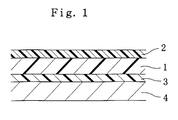
- Fig. 1 is a cross section showing an embodiment of a laminated film of the present invention.
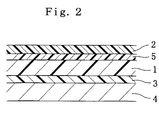
- Fig. 2 is a cross section showing another embodiment of the laminated film of the present invention.
- Fig. 3 is a cross section showing an instrument for measuring water vapor permeability.
- Fig. 1 shows an embodiment of a laminated film for water-base ink of the present invention.
- a reference numeral 1 denotes a base layer
- a reference numeral 2 denotes an ink absorbing material layer formed on the surface of the base layer 1
- a reference numeral 3 denotes a pressure sensitive adhesive layer formed on the back surface of the base layer 1
- a reference numeral 4 denotes a release paper.
- Fig. 2 shows another embodiment of the laminated film of the present invention.
- a primer layer 5 is provided between the base layer 1 and the ink absorbing material layer 2 .
- the primer layer 5 is a layer for supporting the bonding between the base layer 1 and the ink absorbing material layer 2 .
- a primer matching to the material of the base layer 1 e.g., a polyester primer, is used.
- the release paper 4 having a thickness of 170 ⁇ m is coated with an acrylic resin pressure sensitive adhesive (in which the main ingredient is a mixture of 2-ethylhexyl acrylate, butyl acrylate and acrylic acid (SK DINE 1311 produced by SOKEN CHEMICAL & ENGINEERING CO., LTD.), a stiffener is toluene diisocyanate (TDI) and the main ingredient and the stiffener are mixed with a ratio of 100 : 3), and is dried thereby forming the pressure sensitive adhesive layer 3 having a thickness of 30 ⁇ m. Then, the release paper 4 having the pressure sensitive adhesive layer 3 and the base layer 1 are laminated by a pressure roller.
- an acrylic resin pressure sensitive adhesive in which the main ingredient is a mixture of 2-ethylhexyl acrylate, butyl acrylate and acrylic acid
- SK DINE 1311 produced by SOKEN CHEMICAL & ENGINEERING CO., LTD.
- TDI toluen
- the film for base layer, on the back surface of which the release paper 4 is laminated, is coated at another surface thereof with the liquid for ink absorbing material by a bar coater, and the coating surface of the film is dried thereby forming the ink absorbing material layer 2 having a thickness of 30 ⁇ m.
- laminated films of Examples 2 to 30 and laminated films of Comparative Examples 1 to 9 are formed in the same manner as in Example 1. Then, laminated films of Examples 1 to 30 and laminated films of Comparative Examples 1 to 9 are subjected to physical property tests and performance evaluations mentioned later. Test results and evaluations of the above examples are shown in Tables 1 to 4 together with respective compounding ratios thereof.
- the column of compounding in each of Table 1 to 4 shows a composition (solids content) of the ink absorbing material layer of the laminated film in a state that a solvent is removed by drying.
- a composition solids content
- silica is added to 100 weight parts of water-absorbable urethane resin having a resin solids content of 30%.
- a resin solids content (an amount excluding a solvent) included in 100 weight parts of the water-absorbable urethane resin is 30 weight parts.
- Example 1 of Table 1 a water-absorbable urethane resin content is 100 weight parts and a silica content is 120 weight parts.
- the compounding ratios of another Examples and Comparative Examples are obtained in the same manner.
- the thickness of the ink absorbing material layer is shown.
- water-absorbable urethane resin is not used for the ink absorbing material. Instead, 2.0 weight parts of hexamethylene diisocyanate (HDMI) (LACKSKIN U-4000 produced by Seiko Kasei Kabushiki Kaisha) is added to 100 weight parts of ester polyol (LACKSKIN U-46, produced by Seiko Kasei Kabushiki Kaisha; which uses toluene as a solvent and has a resin solids content of 20%), and these substances are stirred for thirty minutes thereby obtaining a liquid for ink absorbing material. With the use of the obtained liquid for ink absorbing material, a laminated film is then formed in the same manner as in Example 1.
- HDMI hexamethylene diisocyanate
- LACKSKIN U-4000 produced by Seiko Kasei Kabushiki Kaisha
- ester polyol LACKSKIN U-46, produced by Seiko Kasei Kabushiki Kaisha; which uses toluene as a solvent and has a
- Example 8 In Comparative Example 8, 2.0 weight parts of methylenebis(4-phenylisocyanate) (MDI), 2 weight parts of silica which is the same as in Example 1 and 2 weight parts of polyether modified silicon oil (KF-618 produced by Shin-Etsu Chemical Co., Ltd.) are added to 100 weight parts of ester polyol. These substances are stirred for thirty minutes thereby obtaining a liquid for ink absorbing material. With the use of the obtained liquid for ink absorbing material, a laminated film is then formed in the same manner as in Example 1.
- MDI methylenebis(4-phenylisocyanate)
- silica which is the same as in Example 1
- KF-618 produced by Shin-Etsu Chemical Co., Ltd.
- TRIAZET Registered Trademark
- CX285-1 As collagen, TRIAZET (Registered Trademark) CX285-1 produced by Showa Denko K.K. is used.
- acrylate As acrylate, SANFLESH ST-100SP produced by Sanyo Kasei Co., Ltd. is used.
- calcium carbonate BRILLIANT (Registered Trademark)-1500 produced by Shiraishi Calcium Kaisha, Ltd. is used.
- DMF is used as in Example 1.
- the amount of use of DMF is different depending upon the amount of addition of the water absorbing agent.
- a solvent content is 100 weight parts in Examples 2, 3, 4, 6 and 11, 150 weight parts in Examples 5, 9, 10, 12, 16, 19 and 20, 200 weight parts in Examples 7, 8, 13, 14, 15, 17, 18 and 23, 300 weight parts in Examples 21, 22 and 24 to 30, and 50 weight parts in Comparative Examples 2 to 7. wherein the mark * shows that ester polyol is used instead of water-absorbable urethane resin and the mark # shows that inconsistencies in the ink density occur.
- the contact angle, the wetting index and the water vapor permeability of the ink absorbing material layer are measured.
- the contact angle is measured, by the liquid drop method using a pure water, at ordinary temperature after a lapse of ten seconds from a liquid drop.
- a contact angle meter used for the measurement is a FACE contact angle meter produced by Kyowa Kaimen Kagaku Kabushiki Kaisha.
- the wetting index is measured in compliance with "Testing method of wettability of polyethylene and polypropylene films" defined by JIS-K-6768.
- the standard solution is a mixture liquid of formamide and ethylene glycol monoethyl ether. The measurement is made in the temperature and moisture condition that the temperature is 23 ⁇ 2°C and the relative humidity is 50 ⁇ 5%. The wetting test will be specifically described next.
- test pieces is left under the above temperature and moisture condition for six hours or more, and is subjected to the test after reaching an equilibrium of the temperature and moisture condition.
- swab sticks each formed by wrapping absorbent cotton around the tip end of a stick of approximately 1 mm diameter are used.
- the amount of absorbent cotton is approximately 15 to 20 mg.
- the absorbent cotton is evenly wrapped around the tip end of the stick so as to have a length of at least 15 mm.
- liquids obtained by mixing a slight amount of high-colorability dye with the respective mixture liquids made at rates shown in Table 5 are used.
- Formamide and ethylene glycol monoethyl ether used in the test are both high-grade products with a high purity.
- As the colorant Victoria pure blue BO is used and its density is preferably 0.03% or less.
- the swab stick is immersed in the standard solution to an extent that a liquid drop does not flow out of the swab stick, is put onto a test piece in a horizontal position and is moved in one direction thereby applying the standard solution to the test piece.
- the standard solution is applied to the test piece such that an applied liquid layer becomes as wide as possible and the application area is approximately 6 cm 2 .
- the application of the standard solution is conducted within 0.5 seconds.
- the wetting index is determined with respect to the liquid layer after a lapse of two seconds from the application of the standard solution.
- the liquid layer keeps a state as applied for two seconds or more without causing breakage, it is determined that the test piece is wet. Also when the liquid layer causes slight shrinkage at its peripheries, it is determined that the test piece is wet.
- the test proceeds to the application of another standard solution having a one level higher surface tension.
- the test proceeds to the application of another standard solution having a one level lower surface tension.
- Such operations are repeatedly conducted until a proper standard solution having a composition nearest to the composition at which the surface of the test piece can be put into a wetting state for just two seconds can be selected. In this manner, the surface tension (N/cm) of the standard solution finally selected is the wetting index of the test piece.
- the water vapor permeability is measured in compliance with "Testing method for determination of the water vapor permeability of water vaporproof packaging materials (dish method)" defined by JIS-Z-0208.
- the temperature and moisture condition is Condition B (temperature: 40 ⁇ 0.5°C, relative moisture: 90 ⁇ 2%). Since the value of the water vapor permeability varies depending upon the thickness of a specimen, the water vapor permeability P' measured in compliance with the requirements of JIS-Z-0208 is converted to the water vapor permeability P at a specimen thickness of 0.1 mm.
- a reference numeral 11 denotes a cup rack made of brass casting
- a reference numeral 12 denotes a cup made of aluminium
- a reference numeral 13 denotes a dish made of glass
- a reference numeral 14 denotes a ring made of aluminium (diameter: 60 mm)
- a reference numeral 15 denotes a guide made of brass casting
- a reference numeral 16 denotes a weight made of brass casting and having a mass of approximately 500 g.
- the surface state of the ink absorbing material layer is visually evaluated.
- the criteria for evaluation are as follows. When the surface is smooth and has no asperity doing harm to printing, the evaluation result is "good”. On the other hand, when the surface has such asperities, the evaluation result is "uneven”.
- the surface of the ink absorbing material layer is cut in a grid pattern by a cutter such that 100 vertical cut lines and 100 horizontal cut lines are formed in every 1 mm, a cellophane tape is adhered to the cut surface of the ink absorbing material layer, and the cellophane tape is abruptly peeled off in a direction of 90° with respect to the surface of the ink absorbing material layer.
- the criteria for evaluation are as follows. When the ink absorbing material layer is not peeled off, the evaluation result is "good”. On the other hand, when the ink absorbing material layer is peeled off, the evaluation result is "not good”.
- Printing is performed onto a printing surface (ink absorbing material layer) of each of the above-mentioned Examples and Comparative Examples by an ink jet printer using a color ink, and visual evaluation is made about the extent to which the printed surface causes bleeding of ink and repelling of ink.
- the criteria for evaluation are as follows. When the printed surface causes neither repelling of ink nor bleeding of ink, the evaluation result is classified into two levels of "very good” and "good”. When the printed surface causes repelling of ink, the evaluation result is "repellent". When the printed surface causes bleeding of ink, the evaluation result is "bleeding".
- the color ink used in the test is a water-base ink composition formed of pigment, a dispersing agent and a solvent.
- the dispersing agent is a polymer including as a main ingredient alkylester acrylate which has a lipophilic part and a hydrophilic part.
- the solvent is a mixture of water and a nonvolatile hydrophilic organic solvent.
- RJ-1300 produced by MUTOH KOGYO KABUSHIKI KAISHA is used.
- the drying condition of the printed surface is evaluated by a tactile impression.
- the criteria for evaluation are as follows. When the printed surface is dry, the evaluation result is "dry”. On the other hand, when the printed surface is not yet dry, the evaluation result is "undry”.
- the ink density and inconsistencies in ink density of the printed surface are visually evaluated.
- the criteria for evaluation are as follows. The ink density is classified into three levels of "very high”, “high” and “low”. The test piece having inconsistencies in ink density is shown in the mark #.
- a cellophane tape is adhered onto the printed surface, the printed surface is rubbed ten times through the cellophane tape by the finger, and the cellophane tape is then peeled off.
- visual evaluation is made about whether the ink is left on the laminated film.
- the criteria for evaluation are as follows. When the ink is left on the laminated film, this means that peeling does not occur, i.e., the evaluation result is "no". On the other hand, when the ink is not left on the laminated film, this means that peeling occurs, i.e., the evaluation result is "yes".
- the total evaluation is made in a manner of considering all the evaluation results of the above six categories.
- a mark O ⁇ shows that the total evaluation is very good
- a mark ⁇ shows that the total evaluation is good next to the mark o ⁇
- a mark ⁇ shows that the total evaluation is a little bad
- a mark ⁇ shows that the total evaluation is worse than the mark ⁇ .
- Comparative Example 5 If the contact angle is over 50 degrees, the evaluation of printing performance is not good even in the case of having a relatively large wetting index of 41 x 10 -5 N/cm (41 dyn/cm) and a relatively large water vapor permeability of 120 g/m 2 , as shown in Comparative Example 5 in Table 6. Since the Comparative Example 5 has a poor conformability to the water-base ink and a poor ink dryability, its ink density is low and its ink fixativity is insufficient. On the contrary, when the contact angle is 50 degrees or less, approximately good evaluation results are obtained.
- Comparative Example 5 since the wetting index is relatively large even though the contact angle is large, this offers the prospect of exhibiting a good wettability to the water-base ink. Further, since the water vapor permeability is relatively large, this offers the prospect of exhibiting a good dryability to the water-base ink. However, Comparative Example 5 cannot obtain such expected effects. Though the reason for this is not certain, it can be said that the actual wettability and dryability of the ink absorbing material to the water-base ink cannot be determined by only the wetting index and the water vapor permeability since the water-base ink itself is a relatively complex composition obtained by mixing materials having various kinds of characteristics.
- the wetting index is preferable 40 x 10 -5 N/cm (40 dyn/cm) or more and more preferably 45 x 10 -5 N/cm (45 dyn/cm) or more in order to secure the wettability to the water-base ink.
- the water permeability is preferably 800 g/m 2 or more and more preferably 1500 g/m 2 or more in order to secure the dryability to the water-base ink.
- the contact angle is 40 degrees or less, particularly in the case where the contact angle is 30 degrees or less as shown in examples in Tables 7 and 8, most of the examples obtain very good evaluation results about the conformability and the dryability to the water-base ink.
- a water absorbing agent such as silica other than resin
- the dispersibility becomes worse. This readily induces a defective coating and provides a poor adhesive property between the ink absorbing material layer and the base layer, resulting in ease to cause ink peeling.
- the ink peeling in this case is a phenomenon that the ink peels from the base layer together with the ink absorbing material layer. Accordingly, it can be said that the contact angle is preferably 10 degrees or more.
- the above problem on dispersibility can be said similarly also in a relation with the water vapor permeability. That is to say, as the water vapor permeability increases, the dryability to the water-base ink becomes better.
- Example 9A and 9B these Examples and Comparative Examples are each obtained in the same manner as in Example 1 by changing the type and the compounding ratio of the water absorbing agent of the ink absorbing material.
- the values in columns in Examples of Table 9A and Comparative Examples of Table 9B each show a compounding ratio (weight parts) and the compounding ratio is a solids content excluding a solvent and the like.
- the thickness of the ink absorbing material layer in each of Examples of Table 9A and Comparative Examples of Table 9B is 30 ⁇ m.
- Tables 9A and 9B the following types of water absorbing materials are used.
- Examples 31 to 35 obtain good evaluation results about all the evaluation categories. Particularly, Examples 31 and 35 obtain very good evaluation results in terms of the ink conformability and the ink density and obtain highest total evaluations.
- Comparative Example 10 using precipitated calcium carbonate as a water absorbing agent, though the adhesive property between the ink absorbing material layer and the base layer is good, bad evaluation results are obtained in terms of the printing performance, i.e., the ink conformability, the ink dryability, the ink density and the ink fixativity. Also in Comparative Example 11 using magnesium oxide as a water absorbing agent, good evaluation results are not obtained in terms of the ink conformability, the ink dryability and the ink fixativity.
- Comparative Example 12 using barium sulfate as a water absorbing agent, though the adhesive property to the base layer and the ink conformability are good, satisfactory evaluation results are not obtained in terms of the ink dryability, the ink density and the ink fixativity.
- Comparative Example 13 uses porous calcium carbonate as a water absorbing agent as in Example 31. However, since the compounding ratio of porous calcium carbonate is small, though the adhesive property to the base layer is good, it is not sufficient to increase the swelling function of the ink absorbing material layer through the use of the water absorbing agent. As a result, a satisfactory printing performance is not obtained. Further, Comparative Example 14 uses the same water absorbing agent (porous calcium carbonate) as used in Example 31 in large quantity. Thereby, though the obtained printing performance is good, the adhesive property to the base layer is poor.
Landscapes
- Laminated Bodies (AREA)
- Ink Jet (AREA)
- Inks, Pencil-Leads, Or Crayons (AREA)
- Ink Jet Recording Methods And Recording Media Thereof (AREA)
- Decoration By Transfer Pictures (AREA)
Claims (14)
- Material (2), welches eine Tinte auf der Basis von Wasser absorbiert und auf einer Oberfläche einer Basis (1) vorgesehen ist, um eine Tinte auf der Basis von Wasser zu fixieren, wobei das Material, welches die Tinte auf der Basis von Wasser absorbiert, ein wasserabsorbierendes Mittel enthält und ein Polyurethanharz, welches durch Verwendung von Polyetherpolyol unter Einschluß von Polyethylenoxid synthetisiert ist,
dadurch gekennzeichnet, daß 30 bis 500 Gewichtsteile wenigstens einer Substanz, ausgewählt aus der Gruppe, bestehend aus Silica, Collagen, Vernetzungsacrylat und Calziumcarbonat als dem wasserabsorbierenden Mittel, mit 100 Gewichtsteilen des Polyurethanharzes vermischt werden, wobei wenn das Vemetzungsmittel als das einzige wasserabsorbierende Mittel zugemischt wird, seine zugemischte Menge 30 bis 300 Gewichtsteile beträgt. - Material, welches eine Tinte auf der Basis von Wasser absorbiert, nach Anspruch 1, bei welchem 30 bis 500 Gewichtsteile eines Gemisches von Silica und Collagen als dem wasserabsorbierenden Mittel mit 100 Gewichtsteilen Polyurethanharz vermischt werden.
- Material, welches eine Tinte auf der Basis von Wasser absorbiert, nach Anspruch 1, bei welchem 30 bis 500 Gewichtsteile eines Gemisches von Silica und Vernetzungsacrylat als dem wasserabsorbierenden Mittel mit 100 Gewichtsteilen Polyurethanharz vermischt werden, wobei die Menge des Vernetzungsacrylats in dem Gemisch 300 Gewichtsteile oder weniger beträgt.
- Material, welches eine Tinte auf der Basis von Wasser absorbiert, nach Anspruch 1, bei welchem 30 bis 500 Gewichtsteile eines Gemisches von Silica und Calziumcarbonat als dem wasserabsorbierenden Mittel mit 100 Gewichtsteilen Polyurethanharz vermischt werden.
- Material, welches eine Tinte auf der Basis von Wasser absorbiert, nach Anspruch 1, bei welchem 30 bis 500 Gewichtsteile eines Gemisches von Collagen und Vernetzungsacrylat als dem wasserabsorbierenden Mittel mit 100 Gewichtsteilen Polyurethanharz vermischt werden, wobei die Menge des Vernetzungsacrylats in dem Gemisch 300 Gewichtsteile oder weniger beträgt.
- Material, welches eine Tinte auf der Basis von Wasser absorbiert, nach Anspruch 1, bei welchem 30 bis 500 Gewichtsteile eines Gemisches von Collagen und Calziumcarbonat als dem wasserabsorbierenden Mittel mit 100 Gewichtsteilen Polyurethanharz vermischt werden.
- Material, welches eine Tinte auf der Basis von Wasser absorbiert, nach Anspruch 1, bei welchem 30 bis 500 Gewichtsteile eines Gemisches von Vemetzungsacrylat und Calziumcarbonat als dem wasserabsorbierenden Mittel mit 100 Gewichtsteilen Polyurethanharz vermischt werden, wobei die Menge des Vemetzungsacrylats in dem Gemisch 300 Gewichtsteile oder weniger beträgt.
- Material, welches eine Tinte auf der Basis von Wasser absorbiert, nach Anspruch 1, bei welchem 30 bis 500 Gewichtsteile eines Gemisches von Silica, Collagen und Vernetzungsacrylat als dem wasserabsorbierenden Mittel mit 100 Gewichtsteilen Polyurethanharz vermischt werden, wobei die Menge des Vemetzungsacrylats in dem Gemisch 300 Gewichtsteile oder weniger beträgt.
- Material, welches eine Tinte auf der Basis von Wasser absorbiert, nach Anspruch 1, bei welchem 30 bis 500 Gewichtsteile eines Gemisches von Silica, Collagen und Calziumcarbonat als dem wasserabsorbierenden Mittel mit 100 Gewichtsteilen des Polyurethanharzes vermischt werden.
- Material, welches eine Tinte auf der Basis von Wasser absorbiert, nach Anspruch 1, bei welchem 30 bis 500 Gewichtsteile eines Gemisches von Collagen, Vernetzungsacrylat und Calziumcarbonat als dem wasserabsorbierenden Mittel mit 100 Gewichtsteilen des Polyurethanharzes vermischt werden, wobei die Menge des Vemetzungsacrylats in dem Gemisch 300 Gewichtsteile oder weniger beträgt.
- Material, welches eine Tinte auf der Basis von Wasser absorbiert, nach Anspruch 1, bei welchem 30 bis 500 Gewichtsteile eines Gemisches von Silica, Vemetzungsacrylat und Calziumcarbonat als dem wasserabsorbierenden Mittel mit 100 Gewichtsteilen des Polyurethanharzes vermischt werden, wobei die Menge des Vernetzungsacrylats in dem Gemisch 300 Gewichtsteile oder weniger beträgt.
- Material, welches eine Tinte auf der Basis von Wasser absorbiert, nach Anspruch 1, bei welchem 30 bis 500 Gewichtsteile eines Gemisches von Silica, Collagen, Vernetzungsacrylat und Calziumcarbonat als dem wasserabsorbierenden Mittel mit 100 Gewichtsteilen des Polyurethanharzes vermischt werden, wobei die Menge des Vernetzungsacrylats in dem Gemisch 300 Gewichtsteile oder weniger beträgt.
- Material, welches eine Tinte auf der Basis von Wasser absorbiert, nach einem der Ansprüche 1 bis 12, bei welchem die Dicke des die Tinte auf der Basis von Wasser absorbierenden Materials (2) 5 µm bis 200 µm beträgt.
- Verbundfolien, bestehend aus einer Basisschicht (1), einer Schicht eines eine Tinte auf der Basis von Wasser absorbierenden Materials (2) nach einem der Ansprüche 1 bis 13, welches auf einer oberen Fläche der Basisschicht (1) ausgebildet ist, und einer druckempfindlichen Adhäsionsschicht (3), die auf einer hinteren Fläche der Basisschicht (1) ausgebildet ist.
Applications Claiming Priority (10)
| Application Number | Priority Date | Filing Date | Title |
|---|---|---|---|
| JP29843496A JP3345281B2 (ja) | 1996-11-11 | 1996-11-11 | 水性インク吸収材及び該吸収材層を有する積層フィルム |
| JP8298431A JPH10138630A (ja) | 1996-11-11 | 1996-11-11 | 水性インク吸収材及び該吸収材層を有する積層フィルム |
| JP29843496 | 1996-11-11 | ||
| JP298434/96 | 1996-11-11 | ||
| JP298431/96 | 1996-11-11 | ||
| JP29843196 | 1996-11-11 | ||
| JP9060640A JPH10249192A (ja) | 1997-03-14 | 1997-03-14 | 水性インク吸収材及び該吸収材層を有する積層フィルム |
| JP60640/97 | 1997-03-14 | ||
| JP6064097 | 1997-03-14 | ||
| PCT/JP1997/004032 WO1998021048A1 (en) | 1996-11-11 | 1997-11-05 | Water-color ink absorbing material and laminated film having layer of the absorbing material |
Publications (3)
| Publication Number | Publication Date |
|---|---|
| EP0879708A1 EP0879708A1 (de) | 1998-11-25 |
| EP0879708A4 EP0879708A4 (de) | 1999-04-07 |
| EP0879708B1 true EP0879708B1 (de) | 2001-03-14 |
Family
ID=27297250
Family Applications (1)
| Application Number | Title | Priority Date | Filing Date |
|---|---|---|---|
| EP97911459A Expired - Lifetime EP0879708B1 (de) | 1996-11-11 | 1997-11-05 | Material, das wässerige tinte absorbiert, und verbundfolie, die eine schicht des absorbierenden materials enthält |
Country Status (7)
| Country | Link |
|---|---|
| US (1) | US6040035A (de) |
| EP (1) | EP0879708B1 (de) |
| AT (1) | ATE199684T1 (de) |
| AU (1) | AU4884197A (de) |
| CA (1) | CA2242956A1 (de) |
| DE (1) | DE69704267T2 (de) |
| WO (1) | WO1998021048A1 (de) |
Families Citing this family (8)
| Publication number | Priority date | Publication date | Assignee | Title |
|---|---|---|---|---|
| US6225381B1 (en) | 1999-04-09 | 2001-05-01 | Alliedsignal Inc. | Photographic quality inkjet printable coating |
| US6767597B2 (en) * | 1999-11-30 | 2004-07-27 | Seiko Epson Corporation | Ink jet recording medium |
| DE60045609D1 (de) * | 1999-12-14 | 2011-03-24 | Mitsubishi Polyester Film Corp | Verpackungsfolie aus Polyester |
| US6916227B2 (en) * | 2002-11-04 | 2005-07-12 | Sae Magnetics (H.K.) Ltd. | Method and apparatus for processing sliders for use in disk drives and the like |
| JP2007055237A (ja) * | 2005-07-26 | 2007-03-08 | Canon Finetech Inc | 被記録媒体 |
| US9752022B2 (en) | 2008-07-10 | 2017-09-05 | Avery Dennison Corporation | Composition, film and related methods |
| EP2542409B1 (de) | 2010-03-04 | 2018-12-19 | Avery Dennison Corporation | Pvc-freie folie und pvc-freies folienlaminat |
| BR112016014704A8 (pt) | 2013-12-30 | 2020-05-26 | Avery Dennison Corp | película protetora, laminado de película, gráfico de publicidade ou informativo, método de produção de uma película protetora, uso de uma película protetora ransparente e rolo ou folha de gráfico de publicidade |
Family Cites Families (17)
| Publication number | Priority date | Publication date | Assignee | Title |
|---|---|---|---|---|
| US4446174A (en) * | 1979-04-27 | 1984-05-01 | Fuiji Photo Film Company, Ltd. | Method of ink-jet recording |
| JPS5699692A (en) * | 1980-01-14 | 1981-08-11 | Ricoh Co Ltd | Recording medium for ink jet recording |
| JPS56148582A (en) * | 1980-04-21 | 1981-11-18 | Canon Inc | Recording material |
| JPS57129779A (en) * | 1981-02-05 | 1982-08-11 | Sanyo Electric Co Ltd | Recording paper |
| JPS59123696A (ja) * | 1982-01-12 | 1984-07-17 | Canon Inc | インクジェット用被記録材 |
| US4496629A (en) * | 1982-01-12 | 1985-01-29 | Canon Kabushiki Kaisha | Material used to bear writing or printing |
| JPS60248387A (ja) * | 1984-05-25 | 1985-12-09 | Canon Inc | インクジェット記録用被記録材 |
| JPS6357277A (ja) * | 1986-08-28 | 1988-03-11 | Honshu Paper Co Ltd | インクジエツト記録シ−ト |
| JPS63170075A (ja) * | 1987-01-09 | 1988-07-13 | Canon Inc | インクジエツト用記録紙の製造方法 |
| JPH03251487A (ja) * | 1990-03-01 | 1991-11-08 | Oji Paper Co Ltd | インクジェット記録用シート |
| JP3094566B2 (ja) * | 1991-10-04 | 2000-10-03 | 王子製紙株式会社 | インクジェット用紙 |
| JP3017805B2 (ja) * | 1993-03-02 | 2000-03-13 | 三菱製紙株式会社 | インクジェット記録シート |
| JPH0781210A (ja) * | 1993-09-16 | 1995-03-28 | New Oji Paper Co Ltd | インクジェット記録用シート |
| JPH07186522A (ja) * | 1993-11-19 | 1995-07-25 | Nitto Denko Corp | 粘着性インクジェット受像体 |
| JP3784872B2 (ja) * | 1994-12-28 | 2006-06-14 | 日立マクセル株式会社 | 再利用可能な水性インク用被記録材とその再利用法 |
| JP2635948B2 (ja) * | 1995-07-31 | 1997-07-30 | キヤノン 株式会社 | インクジェット記録方法 |
| JP3803415B2 (ja) * | 1996-02-15 | 2006-08-02 | 明成化学工業株式会社 | インクジェット記録用シート |
-
1997
- 1997-11-05 DE DE69704267T patent/DE69704267T2/de not_active Expired - Fee Related
- 1997-11-05 EP EP97911459A patent/EP0879708B1/de not_active Expired - Lifetime
- 1997-11-05 AT AT97911459T patent/ATE199684T1/de not_active IP Right Cessation
- 1997-11-05 AU AU48841/97A patent/AU4884197A/en not_active Abandoned
- 1997-11-05 CA CA002242956A patent/CA2242956A1/en not_active Abandoned
- 1997-11-05 US US09/101,191 patent/US6040035A/en not_active Expired - Fee Related
- 1997-11-05 WO PCT/JP1997/004032 patent/WO1998021048A1/ja not_active Ceased
Also Published As
| Publication number | Publication date |
|---|---|
| ATE199684T1 (de) | 2001-03-15 |
| CA2242956A1 (en) | 1998-05-22 |
| EP0879708A4 (de) | 1999-04-07 |
| DE69704267D1 (de) | 2001-04-19 |
| US6040035A (en) | 2000-03-21 |
| AU4884197A (en) | 1998-06-03 |
| EP0879708A1 (de) | 1998-11-25 |
| WO1998021048A1 (en) | 1998-05-22 |
| DE69704267T2 (de) | 2001-08-23 |
Similar Documents
| Publication | Publication Date | Title |
|---|---|---|
| KR101174952B1 (ko) | 인쇄용 시트 | |
| JPH0662001B2 (ja) | インクジェット用被記録材 | |
| KR19990067291A (ko) | 잉크 제트 인쇄용 시이트 | |
| EP1003644A1 (de) | Beschichtete tintenstrahlempfängliche mikroporöse medien und punktdurchmessersteuerverfahren | |
| DE60132058T2 (de) | Aufzeichnungsmaterial und Aufzeichnungsverfahren | |
| US20040091692A1 (en) | Water resistant ink jet printable sheet | |
| US6040035A (en) | Water-color ink absorbing material and laminated film having layer of the absorbing material | |
| EP2716465A1 (de) | Druckbogen und trennfolie zur formung einer druckoberfläche auf dem druckbogen | |
| MXPA04010324A (es) | Sustrato registrable por chorro de tinta resistente al agua. | |
| US20030180523A1 (en) | Water resistant ink jet printable sheet | |
| DE69509244T2 (de) | Bogen für tintenstrahldruck | |
| US8455064B2 (en) | UV inkjet printed substrates | |
| US20040126507A1 (en) | UV inkjet printed substrates | |
| US20060292317A1 (en) | Water resistant ink jet printable sheet | |
| JP2001225422A (ja) | コーテッドフィルム | |
| CN1970308A (zh) | 一种防水型墨水喷射用正喷胶片 | |
| JP2001315433A (ja) | 水性インク受容層用組成物及び水性インクジェットプリンター用記録材料の製造方法 | |
| AU737842B2 (en) | Coating composition for a plastic film | |
| EP0649752B1 (de) | Aufzeichnungsmaterial, Bildformungsverfahren und Druckverfahren, das dieses Material verwendet | |
| JPH0342590B2 (de) | ||
| JP2001277698A (ja) | インクジェット記録用シート | |
| WO2022140066A1 (en) | Flexographically-printable, full-color-inkjet-receptive topcoat formula and article | |
| US20020192482A1 (en) | Coating composition for a plastic film | |
| JPS62222884A (ja) | 被記録材 | |
| JPH10138630A (ja) | 水性インク吸収材及び該吸収材層を有する積層フィルム |
Legal Events
| Date | Code | Title | Description |
|---|---|---|---|
| PUAI | Public reference made under article 153(3) epc to a published international application that has entered the european phase |
Free format text: ORIGINAL CODE: 0009012 |
|
| 17P | Request for examination filed |
Effective date: 19980707 |
|
| AK | Designated contracting states |
Kind code of ref document: A1 Designated state(s): AT DE FR GB NL |
|
| A4 | Supplementary search report drawn up and despatched |
Effective date: 19990219 |
|
| AK | Designated contracting states |
Kind code of ref document: A4 Designated state(s): AT DE FR GB NL |
|
| 17Q | First examination report despatched |
Effective date: 19990506 |
|
| GRAG | Despatch of communication of intention to grant |
Free format text: ORIGINAL CODE: EPIDOS AGRA |
|
| 17Q | First examination report despatched |
Effective date: 19990506 |
|
| GRAG | Despatch of communication of intention to grant |
Free format text: ORIGINAL CODE: EPIDOS AGRA |
|
| GRAH | Despatch of communication of intention to grant a patent |
Free format text: ORIGINAL CODE: EPIDOS IGRA |
|
| GRAH | Despatch of communication of intention to grant a patent |
Free format text: ORIGINAL CODE: EPIDOS IGRA |
|
| GRAA | (expected) grant |
Free format text: ORIGINAL CODE: 0009210 |
|
| AK | Designated contracting states |
Kind code of ref document: B1 Designated state(s): AT DE FR GB NL |
|
| REF | Corresponds to: |
Ref document number: 199684 Country of ref document: AT Date of ref document: 20010315 Kind code of ref document: T |
|
| REF | Corresponds to: |
Ref document number: 69704267 Country of ref document: DE Date of ref document: 20010419 |
|
| ET | Fr: translation filed | ||
| REG | Reference to a national code |
Ref country code: GB Ref legal event code: IF02 |
|
| PLBE | No opposition filed within time limit |
Free format text: ORIGINAL CODE: 0009261 |
|
| STAA | Information on the status of an ep patent application or granted ep patent |
Free format text: STATUS: NO OPPOSITION FILED WITHIN TIME LIMIT |
|
| 26N | No opposition filed | ||
| PGFP | Annual fee paid to national office [announced via postgrant information from national office to epo] |
Ref country code: GB Payment date: 20021030 Year of fee payment: 6 |
|
| PGFP | Annual fee paid to national office [announced via postgrant information from national office to epo] |
Ref country code: DE Payment date: 20021107 Year of fee payment: 6 |
|
| PGFP | Annual fee paid to national office [announced via postgrant information from national office to epo] |
Ref country code: FR Payment date: 20021108 Year of fee payment: 6 |
|
| PGFP | Annual fee paid to national office [announced via postgrant information from national office to epo] |
Ref country code: AT Payment date: 20021113 Year of fee payment: 6 |
|
| PGFP | Annual fee paid to national office [announced via postgrant information from national office to epo] |
Ref country code: NL Payment date: 20021129 Year of fee payment: 6 |
|
| PG25 | Lapsed in a contracting state [announced via postgrant information from national office to epo] |
Ref country code: GB Free format text: LAPSE BECAUSE OF NON-PAYMENT OF DUE FEES Effective date: 20031105 Ref country code: AT Free format text: LAPSE BECAUSE OF NON-PAYMENT OF DUE FEES Effective date: 20031105 |
|
| PG25 | Lapsed in a contracting state [announced via postgrant information from national office to epo] |
Ref country code: NL Free format text: LAPSE BECAUSE OF NON-PAYMENT OF DUE FEES Effective date: 20040601 |
|
| PG25 | Lapsed in a contracting state [announced via postgrant information from national office to epo] |
Ref country code: DE Free format text: LAPSE BECAUSE OF NON-PAYMENT OF DUE FEES Effective date: 20040602 |
|
| GBPC | Gb: european patent ceased through non-payment of renewal fee |
Effective date: 20031105 |
|
| PG25 | Lapsed in a contracting state [announced via postgrant information from national office to epo] |
Ref country code: FR Free format text: LAPSE BECAUSE OF NON-PAYMENT OF DUE FEES Effective date: 20040730 |
|
| NLV4 | Nl: lapsed or anulled due to non-payment of the annual fee |
Effective date: 20040601 |
|
| REG | Reference to a national code |
Ref country code: FR Ref legal event code: ST |