EP0884280A1 - Zirkonoxidpulver, Verfahren zu seiner Herstellung, und seine Verwendung für Zirkonoxidkeramiken - Google Patents
Zirkonoxidpulver, Verfahren zu seiner Herstellung, und seine Verwendung für Zirkonoxidkeramiken Download PDFInfo
- Publication number
- EP0884280A1 EP0884280A1 EP98110918A EP98110918A EP0884280A1 EP 0884280 A1 EP0884280 A1 EP 0884280A1 EP 98110918 A EP98110918 A EP 98110918A EP 98110918 A EP98110918 A EP 98110918A EP 0884280 A1 EP0884280 A1 EP 0884280A1
- Authority
- EP
- European Patent Office
- Prior art keywords
- zirconia
- powder
- raw material
- diameter
- zirconia powder
- Prior art date
- Legal status (The legal status is an assumption and is not a legal conclusion. Google has not performed a legal analysis and makes no representation as to the accuracy of the status listed.)
- Granted
Links
Images
Classifications
-
- C—CHEMISTRY; METALLURGY
- C01—INORGANIC CHEMISTRY
- C01G—COMPOUNDS CONTAINING METALS NOT COVERED BY SUBCLASSES C01D OR C01F
- C01G25/00—Compounds of zirconium
- C01G25/02—Oxides
-
- C—CHEMISTRY; METALLURGY
- C04—CEMENTS; CONCRETE; ARTIFICIAL STONE; CERAMICS; REFRACTORIES
- C04B—LIME, MAGNESIA; SLAG; CEMENTS; COMPOSITIONS THEREOF, e.g. MORTARS, CONCRETE OR LIKE BUILDING MATERIALS; ARTIFICIAL STONE; CERAMICS; REFRACTORIES; TREATMENT OF NATURAL STONE
- C04B35/00—Shaped ceramic products characterised by their composition; Ceramics compositions; Processing powders of inorganic compounds preparatory to the manufacturing of ceramic products
- C04B35/01—Shaped ceramic products characterised by their composition; Ceramics compositions; Processing powders of inorganic compounds preparatory to the manufacturing of ceramic products based on oxide ceramics
- C04B35/48—Shaped ceramic products characterised by their composition; Ceramics compositions; Processing powders of inorganic compounds preparatory to the manufacturing of ceramic products based on oxide ceramics based on zirconium or hafnium oxides, zirconates, zircon or hafnates
- C04B35/486—Fine ceramics
-
- C—CHEMISTRY; METALLURGY
- C01—INORGANIC CHEMISTRY
- C01P—INDEXING SCHEME RELATING TO STRUCTURAL AND PHYSICAL ASPECTS OF SOLID INORGANIC COMPOUNDS
- C01P2004/00—Particle morphology
- C01P2004/60—Particles characterised by their size
- C01P2004/61—Micrometer sized, i.e. from 1-100 micrometer
-
- C—CHEMISTRY; METALLURGY
- C01—INORGANIC CHEMISTRY
- C01P—INDEXING SCHEME RELATING TO STRUCTURAL AND PHYSICAL ASPECTS OF SOLID INORGANIC COMPOUNDS
- C01P2004/00—Particle morphology
- C01P2004/60—Particles characterised by their size
- C01P2004/62—Submicrometer sized, i.e. from 0.1-1 micrometer
Definitions
- the present invention relates to a zirconia powder, a method for producing the same, and a zirconia ceramics including the same. More specifically, the present invention relates to a zirconia powder having uniform quality and suitable for producing a zirconia ceramics with high reliability, a method for producing the zirconia powder with high efficiency, and a zirconia ceramics having uniform quality and high reliability produced by using the zirconia powder.
- Ceramics are widely used in many fields thanks to its excellent mechanical properties such as heat resistance and abrasion resistance, as well as electric and magnetic properties and biocompatibility.
- ceramic sheets including zirconia as a main component can be effectively used as sensor parts, electrolyte film for solid oxide fuel cells and setters for calcination because of its excellent oxygen ion conductivity and heat and corrosion resistance.
- the above-described ceramic sheet including zirconia is produced by the following method.
- a slurry containing zirconia powder, organic binder, and a solvent is formed into a sheet by a doctor blade method, a calendar rolling method or an extrusion method.
- the resultant sheet is dried to evaporate the solvent to form a green sheet.
- the green sheet is arranged to a suitable size by cutting or punching, and then placed on a setter and calcined to decompose or remove the organic binder and to sinter the ceramic powder.
- the zirconia powder used as raw material for ceramics formed products there are various reports on its production methods and the physical properties of the ceramics produced by using the zirconia powder. However, most of them refer to only a particle diameter of the zirconia powder, but are silent regarding the particle size distribution. In fact, few of them refer to both the particle diameter and the particle size distribution.
- Japanese Unexamined Patent Publication No. 1-153530 describes a ceramics formed product produced by using zirconia powder having a primary particle diameter of 0.1 to 0.5 ⁇ m, and the particles of 90 volume percent of the zirconia powder preferably have a diameter of 0.1 to 1 ⁇ m.
- Japanese Unexamined Patent Publication No. 4-130018 describes a ceramics formed product produced by using zirconia powder having an average particle diameter of 1.3 to 3.0 ⁇ m measured by centrifugation, in which particles having a particle diameter of 1 to 20 ⁇ m accounts for 45 to 75 weight percent of the entire zirconia powder.
- zirconia powder having a particle diameter of 0.60 to 4.00 ⁇ m and an average particle diameter of 2.05 to 2.12 ⁇ m, in which the particles having a particle diameter of 1.00 to 3.00 ⁇ m accounts for 87 to 90 percent of the entire zirconia powder; (2) a zirconia powder having a particle diameter of 0.80 to 4.00 ⁇ m and an average particle diameter of 2.18 to 2.22 ⁇ m, in which the particles having a particle diameter of 1.00 to 3.00 ⁇ m accounts for 82 to 85 percent of the entire zirconia powder; and (3) a zirconia powder having a particle diameter of 0.88 to 4.00 ⁇ m and an average particle diameter of 2.00 to 2.04 ⁇ m, in which the particles having a particle diameter of 1.00 to 3.00 ⁇ m accounts for 86 to 90 percent of the entire zirconia powder.
- the ceramic sheets produced by using the above-described conventional zirconia powders are likely to have warping and waviness. Such ceramic sheets do not have a flat surface, and have poor load resistance and bending strength. These problems become especially serious in producing a ceramic sheet having a large size and thin thickness.
- a novel ceramic sheet and a method for producing the same in Japanese Unexamined Patent Publications Nos. 8-151270, 8-151271, and 8-151275.
- a ceramic sheet is produced using a ceramics powder having an average particle diameter of 0.1 to 0.5 ⁇ m, in which the particles of 90 volume percent of the ceramic powder have a diameter of 1 ⁇ m or smaller.
- the ceramic powder is produced by the following method.
- a raw material powder having an average particle diameter of 1.5 ⁇ m, in which the particles of 90 volume percent of the powder have a diameter of 3 ⁇ m or smaller is mixed with water to prepare a slurry containing 20 weight percent of the raw material powder.
- the slurry is milled with a bead mill for 2 hours, thereby obtaining the ceramic powder.
- the slurry contains 20 weight percent of raw material powder and it takes two hours for milling the slurry into the ceramic powder. This results in low productivity. In order to increase the productivity, it may be considered that larger amount of raw material powder is used in the slurry. However, the mere increase in the amount of raw material powder used simply extends the milling time, sometime the slurry becomes too viscous to mill any more and no improvement of productivity will result.
- the ceramic powder has fine particles with narrow particle size distribution, i.e., the standard deviation of the distribution curve is small.
- the ceramic sheet is produced from a green sheet including a ceramic powder having fine particle size, for example, an average particle diameter of 0.1 to 0.5 ⁇ m, in which the particles of 90 volume percent of the ceramics powder have a diameter of 1 ⁇ m or smaller, large amount of binder is required to produce the green sheet.
- the green sheet includes large amount of binder, the binder cannot be sufficiently removed when the green sheet is fired. This results in the formation of warping or waviness in the resultant ceramic sheet, or non-uniformity of the mechanical strength on the surface of the ceramic sheet.
- An objective of the present invention is to provide a zirconia powder, a method for producing a zirconia powder, and a zirconia ceramics produced by using a zirconia powder that have overcome the problems of the prior art.
- a zirconia powder has an average particle diameter of larger than 0.5 to 0.8 ⁇ m, and particles of 90 volume percent of the zirconia powder have a diameter of 1.5 ⁇ m or smaller.
- the zirconia powder is advantageous in efficiently producing a zirconia ceramics.
- the zirconia powder is advantageous in efficiently producing a zirconia ceramics by forming methods such as doctor blade method and calendar rolling method under normal pressure and then by sintering the resultant under normal pressure.
- the diameter of particles of the zirconia powder is measured by a laser beam scattering method.
- volume percent of the zirconia powder means a ratio of a volume of zirconia particles accumulated from the smallest with respect to the whole volume of the zirconia powder.
- a method for producing a zirconia powder includes the step of wet-milling a raw material powder using balls under a condition satisfying a mathematical relation (I), and preferably a mathematical relation (II): 1 ⁇ 10 12 ⁇ (W 1 2 ⁇ W 2 ) ⁇ ( ⁇ 2 ⁇ d) ⁇ T ⁇ 1 ⁇ 10 14 1 ⁇ 10 12 ⁇ (W 1 2 ⁇ W 2 ) ⁇ ( ⁇ 2 ⁇ d) ⁇ T ⁇ 5 ⁇ 10 13
- W 1 is the weight (g) of balls
- W 2 is the weight (g) of the raw material powder
- ⁇ is the peripheral velocity (cm/min) at an outer periphery of a rotor
- d is the diameter (cm) of a milling chamber
- T is the milling time (min).
- a method for producing zirconia powder having an average particle diameter of 0.1 to 0.8 ⁇ m, and particles of 90 volume percent of the zirconia powder having a diameter of 1.5 ⁇ m or smaller includes the step of wet-milling a raw material powder using balls, the raw material powder having an average particle diameter of larger than 0.8 ⁇ m, and particles of 90 volume percent of the raw material powder having a diameter of larger than 1.5 ⁇ m, wherein the wet-milling is conducted under a condition satisfying the mathematical relation (II): 1 ⁇ 10 12 ⁇ (W 1 2 ⁇ W 2 ) ⁇ ( ⁇ 2 ⁇ d) ⁇ T ⁇ 5 ⁇ 10 13 where W 1 is the weight (g) of balls, W 2 is the weight (g) of the raw material powder, ⁇ is the peripheral velocity (cm/min) at an outer periphery of a rotor, d is the diameter (cm) of a milling chamber, and T is the milling time (min).
- a method for producing a zirconia powder includes the step of wet-milling a raw material powder using balls, wherein a slurry containing 30 to 70 weight percent of the raw material powder is wet-milled under a condition satisfying the mathematical relation (I): 1 ⁇ 10 12 ⁇ (W 1 2 ⁇ W 2 ) ⁇ ( ⁇ 2 ⁇ d) ⁇ T ⁇ 1 ⁇ 10 14
- W 1 is the weight (g) of balls
- W 2 is the weight (g) of the raw material powder
- ⁇ is the peripheral velocity (cm/min) at an outer periphery of a rotor
- d is the diameter (cm) of a milling chamber
- T is the milling time (min).
- a zirconia powder having an average particle diameter of 0.1 to 0.8 ⁇ m, in which particles of 90 volume percent of the zirconia powder having a diameter of 1.5 ⁇ m or smaller can be produced with high productivity.
- the zirconia powder of the present invention can be produced with higher productivity.
- a zirconia ceramics is produced by using a zirconia powder as a raw material having an average particle diameter of larger than 0.5 to 0.8 ⁇ m, and particles of 90 volume percent of the zirconia powder have a diameter of 1.5 ⁇ m or smaller.
- a zirconia ceramics is produced by using a zirconia powder as a raw material in which particles of 90 volume percent of the zirconia powder have a diameter of 1.5 ⁇ m or smaller that falls within the range of 1.5 to 2.0 times larger than an average particle diameter of the zirconia powder ranging from larger than 0.5 to 0.8 ⁇ m.
- zirconia ceramics means a product produced by sintering the zirconia powder of the present invention, and a product produced by firing a green body obtained by forming the zirconia powder or a slurry containing the zirconia powder.
- the zirconia ceramics has two-dimensional shapes such as a sheet and a plate, three-dimensional shapes such as a sphere, a cylinder, a rectangular column, and the zirconia ceramics may have holes in the forms described above.
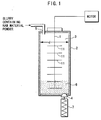
- Figure 1 is a schematic diagram showing a construction of a mill used in embodiments of the present invention.
- the present inventors have found that desired effects can be attained with the use of zirconia powder having a specific particle diameter and a specific particle size distribution which will be described later.
- the zirconia powder can be efficiently produced in a relatively short time, specifically, less than 2 hours, by wet-milling the slurry under the condition where the diameter of the milling chamber, the peripheral velocity at the outer periphery of the rotor, and the weight of the balls are properly determined.
- the zirconia powder is made to have an average particle diameter of larger than 0.5 to 0.8 ⁇ m, and particles of 90 volume percent of the zirconia powder have a diameter of 1.5 ⁇ m or smaller.
- a zirconia powder in which the particles of 90 volume percent thereof have a diameter of 1.5 ⁇ m or smaller that falls within the range of 1.5 to 2.0 times larger than the average particle diameter ranging from larger than 0.5 to 0.8 ⁇ m.
- the zirconia powder is produced by wet-milling a raw material powder using balls under a condition satisfying a mathematical relation (I): 1 ⁇ 10 12 ⁇ (W 1 2 ⁇ W 2 ) ⁇ ( ⁇ 2 ⁇ d) ⁇ T ⁇ 1 ⁇ 10 14
- W 1 is the weight (g) of balls
- W 2 is the weight (g) of the raw material powder
- ⁇ is the peripheral velocity (cm/min) of an outer periphery of a rotor
- d is the diameter of a milling chamber
- T is the milling time (min).
- the zirconia powder can be produced by wet-milling a raw material powder using balls under a condition satisfying a mathematical relation (II): 1 ⁇ 10 12 ⁇ (W 1 2 ⁇ W 2 ) ⁇ ( ⁇ 2 ⁇ d) ⁇ T ⁇ 5 ⁇ 10 13
- W 1 is the weight (g) of balls
- W 2 is the weight (g) of raw material powder
- ⁇ is the peripheral velocity (cm/min) of the outer periphery of a rotor
- d is the diameter of a milling chamber
- T is the milling time (min).
- the raw material powder has an average particle diameter of larger than 0.8 ⁇ m, and particles of 90 volume percent of the raw material powder have a diameter of larger than 1.5 ⁇ m.
- the zirconia powder can be produced by wet-milling a raw material powder having an average particle diameter of larger than 0.8 ⁇ m, and particles of 90 volume percent of the raw material powder having a diameter of larger than 1.5 ⁇ m under the condition satisfying the mathematical relation (II). In this manner, it is possible to produce a zirconia powder having an average particle diameter of 0.1 to 0.8 ⁇ m, in which particles of 90 volume percent of the zirconia powder have a diameter of 1.5 ⁇ m or smaller.
- the zirconia powder can be produced by wet-milling a slurry containing 30 to 70 weight percent of the raw material powder under the condition satisfying the mathematical relation (I).
- the raw material powder When the zirconia powder is produced using the slurry containing the raw material powder at a concentration of 30 to 70 weight percent, the raw material powder has an average particle diameter of larger than 0.8 ⁇ m, and particles of 90 volume percent of the raw material powder have a diameter of larger than 1.5 ⁇ m.
- the slurry may include 0.01 to 5 weight percent of a dispersant with respect to the raw material powder.
- the zirconia ceramics is produced using the zirconia powder having an average particle diameter of larger than 0.5 to 0.8 ⁇ m, in which particles of 90 volume percent of the zirconia powder have a diameter of 1.5 ⁇ m or smaller.
- the zirconia ceramics may have a form of sheet.
- the zirconia ceramics may be produced using the zirconia powder in which particles of 90 volume percent of the zirconia powder have a diameter of 1.5 ⁇ m or smaller that falls within the range of 1.5 to 2.0 times larger than the average particle diameter.
- the zirconia ceramics may have a form of sheet.
- the zirconia powder of the present invention (this powder is for use in producing a zirconia ceramics and is distinguished from "raw material powder" which is for use in producing the zirconia powder.) contains zirconia as a main component. Specifically, the zirconia powder contains 60 weight percent or more of zirconia, and preferably 80 weight percent or more of zirconia.
- the zirconia powder further includes at least one oxide selected from the group consisting of yttrium (Y) oxide, cerium (Ce) oxide, calcium (Ca) oxide, magnesium (Mg) oxide, titanium (Ti) oxide, silica (Si) oxide, and aluminum (Al) oxide, and preferably at least one oxide selected from yttrium oxide, cerium oxide and calcium oxide, and the preferable content thereof is 1 to 20 weight percent.
- Especially preferable zirconia powder includes 5 to 18 weight percent of yttrium oxide and 82 to 95 weight percent of zirconia.
- the zirconia powder of the present invention has an average particle diameter of larger than 0.5 to 0.8 ⁇ m, in which the particles of 90 volume percent of the zirconia powder have a diameter of 1.5 ⁇ m or smaller.
- the particles of 90 volume percent of the zirconia powder have a diameter of larger than 1 to 1.5 ⁇ m.
- the most preferably, the particles of 90 volume percent of the zirconia powder have a diameter 1.5 to 2.0 times, and preferably 1.5 to 1.8 times larger than the average particle diameter of the zirconia powder.
- the maximum particle diameter of the zirconia powder is 10 ⁇ m, and preferably 8 ⁇ m, and more preferably 5 ⁇ m. Therefore, the zirconia powder of the present invention contains only small amount of particles having a diameter as large as 2 ⁇ m or larger, i.e., having a particle size distribution curve with narrow width.
- an average particle diameter and a particle diameter of 90 volume percent are measured by a laser beam scattering method.
- the particle diameter of the zirconia powder is measured in the state where the zirconia powder is suspended in water or an aqueous solution to coagulate the zirconia powder particles from the primary particles into the secondary particles.
- the secondary particle sizes are measured to obtain the average particle diameter and the particle diameter.
- the zirconia powder can be effectively produced by the production method of the present invention.
- a raw material powder is mixed with solvent to produce a slurry, and the slurry is put into a mill where the slurry is wet-milled.
- the raw material powder preferably has an average particle diameter of larger than 0.8 ⁇ m, and the particles of 90 volume percent thereof have a diameter of larger than 1.5 ⁇ m. More preferably the raw material powder has an average particle diameter of 0.9 to 1.5 ⁇ m, and the particles of 90 volume percent thereof have a diameter of 2.0 to 5.0 ⁇ m.
- the raw material powder such as described above may be industrially available.
- examples of such a powder include OZC-8YC (a product of Sumitomo Osaka Cement Co., Ltd.) and TZ-8Y (a product of Tosoh Corporation).
- FIG. 1 is a diagram showing a construction of V-series Kemco Apex Mill (a product of Kotobuki Giken Kogyo Co, Ltd.) which is an example of the mill used in the present invention.
- the mill includes a milling chamber 3 in the form of a cylinder (diameter d) formed with a jacket 2. Inside the milling chamber 3 is filled with balls 6 (total weight W 1 ) for use in wet milling and is provided with a rotor 1. The slurry containing the raw material powder is supplied into the milling chamber 3 through a supply port 5 formed on the jacket 2.
- the rotor 1 has a plurality of pins (as a stirring member) 11 extending from the center of the rotor.
- the rotor 1 is driven by a motor, the slurry and the balls are agitated to wet-mill the slurry. As a result, the zirconia powder is obtained. Then, a valve 4 is opened to let the obtained zirconia powder and the balls 6 pass through the separator 7 where the zirconia powder is separated from the balls 6.
- the AMV-1 type Apex Mill has a specification as follows: the effective capacity of the milling chamber is one liter; the diameter (d) of the milling chamber is 80mm; the height of the milling chamber is 240mm; the maximum peripheral velocity at the outer periphery 11 is 6.03m/sec at the frequency of 50Hz; and the rotation speed is 480 to 1920rpm at the frequency of 50Hz, which corresponds to 570 to 2304 rpm at the frequency of 60Hz.
- the peripheral velocity at the outer periphery of the rotor is meant to be the peripheral velocity at the leading end of pin (a position at the most radially outward from the center of the rotor).
- the mill is not necessarily limited to that shown in Figure 1, and may be of any type as far as it has a hermetically closed-type milling chamber in which balls and a rotor having pins can be set.
- the material of the balls is not necessarily limited either. Notes preferable diameter of the balls however, is 0.3 to 3mm.
- the wet milling is performed under the condition satisfying the mathematical relation (I).
- the zirconia powder can be produced in a relatively short time, specifically, less than 2 hours.
- the slurry may contain large amount of the raw material powder, for example, 40 weight percent in the presence of dispersant. With the dispersant, the slurry containing such a large amount of raw material powder can be sufficiently wet-milled. This results in enhancing productivity and providing industrial advantages.
- the zirconia powder can be more effectively produced by wet-milling the slurry under the condition satisfying the mathematical relation (II).
- the zirconia powder having an average particle diameter of 0.1 to 0.8 ⁇ m, in which the particles of 90 volume percent thereof have a diameter of 1.5 ⁇ m or smaller. It is further possible to obtain the zirconia powder having an average particle diameter of 0.1 to 0.8 ⁇ m, and the particles of 90 volume percent thereof have a diameter of 1.5 ⁇ m or smaller which falls within the range of 1.5 to 2.0 times, and preferably 1.5 to 1.8 times the average particle diameter.
- the zirconia powder having an average particle diameter of larger than 0.5 to 0.8 ⁇ m, in which the particles of 90 volume percent thereof have a diameter of larger than 1 to 1.5 ⁇ m can be also obtained by properly setting the weight (W 1 ) of the balls, the weight (W 2 ) of the raw material powder, the peripheral velocity ( ⁇ ) at the outer periphery of the rotor, the diameter (d) of the milling chamber, and the milling time (T), or alternatively, such a zirconia powder is selectively taken out by classification.
- the raw material powder is mixed with solvent to produce a slurry, and the slurry is put into a mill where the slurry is wet-milled.
- Any solvent can be used as far as it does not inhibit the wet-milling.
- the solvent include water; alcohols having 9 carbon atoms such as methanol, ethanol, isopropanol, butanol, and octanol; aromatic hydrocarbons such as toluene and xylene, esters such as ethyl acetate and butyl acetate; cellosolves such as methyl cellosolve, ethyl cellosolve, and butyl cellosolve.
- mixed solvent examples include a mixture of non-aqueous solvent and aqueous solvent such as toluene/ethanol, ethyl acetate/isopropanol, toluene/butyl cellosolve.
- the slurry contains 30 to 70 weight percent of the raw material powder, and more preferably 30 to 50 weight percent of the raw material powder. If the concentration of the raw material powder is too high, the wet-milling of the slurry becomes difficult.
- a dispersant may be added to the slurry in order that the raw material powder sufficiently disperses in the slurry.
- the dispersant it is possible to sufficiently wet-mill the slurry containing the raw material of high concentration, for example, 40 to 70 weight percent of the raw material powder, and 45 to 55 weight percent of the raw material powder. This results in further enhancing the productivity of the zirconia powder.
- dispersant used in the present invention examples include organic acids such as formic acid, citric acid, and tartaric acid; polymer electrolytes such as polyacrylic acid, and polyacrylic ammonium; surfactants such as branched polymer nonionic surfactant, carboxylic acid type surfactant, ammonium ⁇ -naphthalenesulfonate, polymer surfactant, and nonionic surfactant (for example, Discol: a product of Dai-ichi Kogyo Seiyaku Co., Ltd; and Homogenol: a product of Kao Corporation); ethers such as polyoxyethylene nonyl phenyl ether, polyoxyethylene alkyl ether (for example, Ionet: a product of Sanyo Chemical Industries, Ltd.); copolymers of partially esterified dicarboxylic acid or partially esterified carboxylic acid (for example, Bunsan G-200: a product of Kyoeisha Kagaku Co., Ltd.; and Floren G-700
- Preferable amount of dispersant to be added to the slurry is 0.01 to 5 weight percent with respect to the raw material powder, and more preferably 0.3 to 2 weight percent.
- the raw material powder is mixed with the solvent in the presence of dispersant to produce the slurry.
- the slurry contains 30 weight percent or more of raw material powder, and more preferably 40 to 70 weight percent of the raw material powder, and is wet-milled using the balls.
- the raw material powder, the solvent, and the dispersant may be put into the mill where they are mixed with each other to produce the slurry.
- the raw material powder, the solvent, and the dispersant may be mixed with each other to produce the slurry, and then, the resultant slurry is put into the mill.
- the wet-milling may be conducted batchwise or continuously.
- the wet-milled slurry may be used as a raw material for producing a zirconia ceramics as it is, or may be dried under reduced pressure to obtain a zirconia powder used for producing a zirconia ceramics.
- a predetermined amount of a binder and a plasticizer may be added to the wet-milled slurry to produce a green product.
- the wet-milled slurry can be dried under reduced pressure by a rotary evaporator or an oscillation fluidized drier (for example, VU-60: a product of Chuo Kakoki Co., Ltd.).
- a rotary evaporator or an oscillation fluidized drier for example, VU-60: a product of Chuo Kakoki Co., Ltd.
- the average particle diameter and the particle diameter accounting for 90 volume percent of the raw material powder are measured by a laser diffraction system particle size distribution measuring apparatus (SALD-1100: brand name, manufactured by Shimadzu-Seisakusho K.K.). The measurement was taken by the following manner. About 0.01 to 0.1g of the raw material powder and about 100g of 0.2% sodium hexametaphosphate aqueous solution were put into a beaker, and were stirred with stirrer. Then, after the raw material powder was dispersed for 60 seconds by ultrasonic wave, the particle size measurement of two seconds was repeated four times within the measurement range covering 0.1 to 45 ⁇ m. Thereafter, the values from four times of measurements were averaged to obtain the average particle diameter and the diameter of the particles accounting for 90 volume percent of the raw material.
- SALD-1100 brand name, manufactured by Shimadzu-Seisakusho K.K.
- the zirconia ceramics of the present invention is produced using the zirconia powder of the present invention.
- the zirconia ceramics of the present invention can be produced by a conventional method as far as the zirconia powder of the present invention is used. That is, any conventional forming methods may be employed such as injection molding, pressing, slip casting, extrusion, and sheet forming. However, the zirconia powder is especially preferable in producing a zirconia ceramics by a doctor blade method and a calendar rolling method under normal pressure, and by further sintering process.
- zirconia ceramics will be further described as to the case where the zirconia ceramics is produced from a zirconia green sheet for convenience of explanation.
- the zirconia powder of the present invention is mixed with a binder and a solvent, and further mixed with a dispersant and a plasticizer if necessary by a conventional ball mill method to produce a slurry.
- the slurry is formed into the form of a sheet by a doctor blade method or a calendar rolling method to produce a green sheet.
- the binder used in the present invention is not specifically limited, and may be suitably selected from commercially available organic or inorganic binders.
- organic binders include ethylene-based copolymers, styrene-based copolymers, acrylate and methacrylate-based copolymers, vinyl acetate-based copolymers, maleic acid-based copolymers, vinyl butyral-based resins, vinyl acetal-based resins, vinyl formal-based resins, vinyl alcohol-based resins, waxes, and celluloses such as ethyl cellulose.
- inorganic binders include zirconia sol, silica sol, alumina sol, and titania sol.
- the use amount of the binder may be suitably determined depending upon the required strength and flexibility of the green sheet, and the viscosity of the slurry. For example, 10 to 30 parts by weight of binder is used with respect to 100 parts by weight of zirconia powder.
- the solvent used for preparing the slurry is not necessarily limited, and may be suitably selected from conventionally used organic solvents and water.
- organic solvents include: alcohols such as methanol, ethanol, 2-propanol, 1-butanol, and 1-hexanol; ketones such as acetone and 2-butanone: aliphatic hydrocarbons such as pentane, hexane, and heptane; aromatic hydrocarbons such as benzene, toluene, xylene, and ethylbenzene; and acetic esters such as methyl acetate, ethyl acetate, and butyl acetate.
- the use amount of the solvent can suitably be controlled in such a manner that the viscosity of the slurry preferably falls in a range of 20 to 200 poise.
- the slurry is casted onto a polymer film such as polyethylene terephthalate (PET) by a conventional method such as doctor blade method and calendar rolling method. Then, the resultant is dried to produce a green sheet.
- the green sheet usually has a thickness of 0.1 to 2mm.
- a setter for example, a porous alumina setter
- the quality and reliability of the zirconia ceramics are generally indicated by Weibull modulus (m).
- Weibull modulus (m) shows the variety in mechanical strength by a statistically generated theory. The higher the value of Weibull modulus (m), the smaller the variety in mechanical strength of the zirconia sheet becomes, and therefore, is preferable.
- the zirconia ceramics of the present invention has a value of Weibull modulus (m) of 10 or higher.
- Apex Mill Into Apex Mill (AMV-1 type: a product of Kotobuki Giken Kogyo Co., Ltd. which has a milling chamber of 8cm diameter. Hereinafter, Apex Mill indicates the same type as this.), added were 4kg of commercially available zirconia powder (OZC-8YC: a product of Sumitomo Osaka Cement Co., Ltd.) having an average particle diameter of 0.84 ⁇ m in which particles of 90 volume percent thereof have a diameter of 2.65 ⁇ m as a raw material powder, and 6kg of pure water as a solvent. The Apex Mill included 4kg of zirconia balls having a diameter of 0.5mm (specific gravity: 6g/cm 3 ).
- the raw material powder mixed with pure water was wet-milled at 7m/sec of the peripheral velocity ( ⁇ ) at the outer periphery of the rotor driven by a motor for 1 hour to produce a slurry.
- the value X was 5.3 ⁇ 10 13 .
- Example 2 Into the mill of the same type as used in Example 1, added were 5.5 kg of the same type of the raw material powder as used in Example 1, 44g of formic acid as a dispersant and 5kg of pure water as a solvent. The mill included 4kg of zirconia balls having a diameter of 0.5mm (specific gravity: 6g/cm 3 ). Then, the mixture was wet-milled at 5m/sec of the peripheral velocity at the outer periphery of the rotor driven by a motor for 10 minutes to produce a slurry. In this case, the value of X was 3.3 ⁇ 10 12 .
- the slurry was subjected to the same steps as in Example 1 to produce a zirconia powder.
- the particle size of the zirconia powder was measured by the same manner as in Example 1.
- the zirconia powder had an average particle diameter of 0.48 ⁇ m, and the particles of 90 volume percent of the zirconia powder had a diameter of 1.0 ⁇ m.
- Example 1 Into the mill of the same type as used in Example 1, added were 4kg of the same type of the raw material powder as used in Example 1, 60g of maleic acid type partially esterified polymer dispersant (Floren G-700: a product of Kyoeisha Kagaku Co., Ltd.) as a dispersant, and 4.06kg of a mixture of toluene/ethanol (weight ratio:4/1) as a solvent.
- the mill included 4kg of zirconia balls having a diameter of 0.5mm (specific gravity: 6g/cm 3 ).
- the mixture was wet-milled at 6m/sec at the outer periphery of the rotor driven by a motor for 20 minutes to produce a slurry. In this case, X was 1.3 ⁇ 10 13 .
- the slurry was subjected to the same steps as in Example 1 to produce a zirconia powder.
- the particle size of the zirconia powder was measured by the same manner as in Example 1.
- the zirconia powder had an average particle diameter of 0.27 ⁇ m, and the particles of 90 volume percent of the zirconia powder had a diameter of 0.8 ⁇ m.
- Example 2 Into the mill of the same type as used in Example 1, added were 3.5kg of the same type of the raw material powder as used in Example 1, and 6.5kg of pure water as a solvent. The mill included 4.2kg of zirconia balls (specific gravity: 6g/cm 3 ) having a diameter of 1mm. The mixture was wet-milled at the peripheral velocity of 6.4m/sec at the outer periphery of the rotor driven by a motor for 1 hour and 40 minutes to produce a slurry. In this case, X was 9.3 ⁇ 10 13 .
- the slurry was subjected to the same steps as in Example 1 to produce a zirconia powder.
- the particle size of the zirconia powder was measured by the same manner as in Example 1.
- the zirconia powder had an average particle diameter of 0.49 ⁇ m, and the particles of 90 volume percent of the zirconia powder had a diameter of 1.03 ⁇ m.
- Example 2 Into the mill of the same type as used in Example 1, added were 3kg of commercially available zirconia powder (TZ-8Y: a product of Tosoh Co., Ltd.) having an average particle diameter of 1.12 ⁇ m and in which the particles of 90 volume percent thereof had a diameter of 4.65 ⁇ m as a raw material powder, and 7kg of pure water as a solvent.
- the mill included 4.5kg of zirconia balls having a particle diameter of 0.5mm (specific gravity: 6g/cm 3 ).
- the mixture was wet-milled at the peripheral velocity of 6m/sec at the outer periphery of the rotor driven by a motor for 80 minutes to produce a slurry. In this case, X was 8.8 ⁇ 10 13 .
- the slurry was subjected to the same steps as in Example 1 to produce a zirconia powder.
- the particle size of the zirconia powder was measured by the same manner as in Example 1.
- the zirconia powder had an average particle diameter of 0.74 ⁇ m and the particles of 90 volume percent of the zirconia powder had a diameter of 1.49 ⁇ m.
- Example 1 Into the mill of the same type as used in Example 1, added were 4kg of the same type of the raw material powder as used in Example 1, 30 g of maleic acid type partially esterified polymer dispersant (Bunsan G-200: a product of Kyoeisha Kagaku Co., Ltd.), and 6kg of pure water as a solvent.
- the mill included 4kg of zirconia balls having a diameter of 1mm (specific gravity: 6g/cm 3 ).
- the mixture was wet-milled at the peripheral velocity of 7m/sec at the outer periphery of the rotor driven by a motor for 12 minutes to produce a slurry. In this case, X was 1.1 ⁇ 10 13 .
- the slurry was subjected to the same steps as in Example to produce a zirconia powder.
- the particle diameter of the zirconia powder was measured by the same manner as that conducted in Example 1.
- the zirconia powder had an average particle diameter of 0.61 ⁇ m, and the particles of 90 volume percent of the zirconia powder had a diameter of 1.27 ⁇ m.
- a zirconia powder of Comparative Example 1 was produced by repeating the steps of Example 1, except that 3.5kg of raw material powder, 5.25kg of pure water, and 5kg of zirconia balls were used, and that the wet-milling was conducted for 90 minutes. In this case, X was 1.4 ⁇ 10 14 . The result found that the mill did not operate well because the pipes thereof were clogged with the mixture. Therefore, the mixture could not be wet-milled.
- a zirconia powder was produced by repeating the steps of Example 1, except that 4kg of raw material powder, 5.25kg of pure water, and 2.8kg of zirconia balls were used, and that the wet-milling was conducted at the peripheral velocity of 5m/sec at the outer periphery of the rotor for 4 minutes to produce a slurry.
- X was 8.8 ⁇ 10 11 .
- the slurry was subjected to the same steps as in Example 1 to produce a zirconia powder.
- the particle diameter of the zirconia powder had an average particle diameter of 0.81 ⁇ m and the particles of 90 volume percent of the zirconia powder had a diameter of 2.05 ⁇ m.
- Table 1 shows the relationship between the particle diameters of the zirconia powders produced in Examples 1 to 6 and Comparative Examples 1 and 2, and the value X.
- the resultant zirconia powder had larger average particle diameter and the particles of 90 volume percent thereof had larger diameter, even though using the same type of raw material powder.
- the zirconia powder D of the present invention had an average particle diameter smaller than that of the commercially available zirconia powders A and B, and larger than that of the zirconia powders E and F.
- the zirconia powder D had a particle size distribution curve sharper than that of the commercially available zirconia powder C, although the zirconia powder C had a similar average particle diameter as the zirconia powder D. From these results, it has been found that the zirconia powder D of the present invention had high uniformity.
- ⁇ f breaking bending strength
- m Weibull modulus
- ⁇ 0 a standardized factor
- ⁇ u a stress obtained when P f is 0.
- the obtained three-point bending strength was substituted into ⁇ f .
- the intercept of the graph corresponded to -mln ⁇ 0
- the inclination of the graph corresponded to Weibull modulus (m).
- the value of the inclination of the graph was obtained by a least square method.
- Formula 1 is shown in the report titled “Strength, Reliability and Life Prediction of Ceramics” in "Refractory material” 39-489, 1987-No. 9 written by Yoshiharu Ozaki, on page 11, in right column, as Formula (2).
- the green sheet was sintered at 1450°C for 2 hours to produce a zirconia ceramic sheet having a thickness of 0.2mm.
- Weibull modulus (m) of the sheet was obtained by the above-described method.
- the zirconia powder 1 ⁇ was put into a rubber bag, and hydrostatic pressure of 2000kg/cm 2 was applied thereto for 10 minutes to produce a bulk-shaped zirconia ceramics having a width of 30mm, a thickness of 6mm, and a length of 100mm. Then, the bulk-shaped zirconia ceramics was cut into a piece having a width of 4mm, a thickness of 4mm, and a length of 40mm. After polishing the surface of the cut piece, the piece was sintered at 1500°C for 2 hours. As a result, a test piece was obtained.
- Weibull modulus (m) of the test pieces was obtained by the above-described method.
- the relationship between Weibull modulus (m) and the particle diameters is shown in Table 4.
- Zirconia powder Weibull modulus (m) Kind of zirconia powder Average particle diameter ( ⁇ m) Particle diameter of 90 volume percent ( ⁇ m)
- Maximum particle diameter ( ⁇ m) Sheet-shaped zirconia ceramics Bulk-shaped zirconia ceramics Present Example 1 ⁇ 0.66 1.3 3.7 11 13 Present Example 2 ⁇ 0.6 1.12 3.7 11 12 Comparative Example 3 ⁇ 0.84 2.65 7.8 9 10
Landscapes
- Chemical & Material Sciences (AREA)
- Organic Chemistry (AREA)
- Engineering & Computer Science (AREA)
- Ceramic Engineering (AREA)
- Inorganic Chemistry (AREA)
- Composite Materials (AREA)
- Manufacturing & Machinery (AREA)
- Materials Engineering (AREA)
- Structural Engineering (AREA)
- Compositions Of Oxide Ceramics (AREA)
Priority Applications (1)
| Application Number | Priority Date | Filing Date | Title |
|---|---|---|---|
| DE69800543T DE69800543T3 (de) | 1997-06-13 | 1998-06-15 | Zirkonoxidpulver, Verfahren zu seiner Herstellung, und seine Verwendung für Zirkonoxidkeramiken |
Applications Claiming Priority (6)
| Application Number | Priority Date | Filing Date | Title |
|---|---|---|---|
| JP15626897 | 1997-06-13 | ||
| JP156268/97 | 1997-06-13 | ||
| JP15626897 | 1997-06-13 | ||
| JP9188835A JPH1135323A (ja) | 1997-07-15 | 1997-07-15 | ジルコニア系粉体およびジルコニア系成形体 |
| JP18883597 | 1997-07-15 | ||
| JP188835/97 | 1997-07-15 |
Publications (3)
| Publication Number | Publication Date |
|---|---|
| EP0884280A1 true EP0884280A1 (de) | 1998-12-16 |
| EP0884280B1 EP0884280B1 (de) | 2001-02-28 |
| EP0884280B2 EP0884280B2 (de) | 2013-10-16 |
Family
ID=26484070
Family Applications (1)
| Application Number | Title | Priority Date | Filing Date |
|---|---|---|---|
| EP98110918.4A Expired - Lifetime EP0884280B2 (de) | 1997-06-13 | 1998-06-15 | Zirkonoxidpulver, Verfahren zu seiner Herstellung, und seine Verwendung für Zirkonoxidkeramiken |
Country Status (5)
| Country | Link |
|---|---|
| US (1) | US6068828A (de) |
| EP (1) | EP0884280B2 (de) |
| AU (1) | AU712920B2 (de) |
| DE (1) | DE69800543T3 (de) |
| DK (1) | DK0884280T3 (de) |
Cited By (1)
| Publication number | Priority date | Publication date | Assignee | Title |
|---|---|---|---|---|
| US11411245B2 (en) | 2014-10-16 | 2022-08-09 | Corning Incorporated | Electrolyte for a solid-state battery |
Families Citing this family (24)
| Publication number | Priority date | Publication date | Assignee | Title |
|---|---|---|---|---|
| CN1094467C (zh) * | 1999-02-15 | 2002-11-20 | 上海跃龙有色金属有限公司 | 纳米铈锆复合氧化物、其制备方法及用途 |
| US6204219B1 (en) * | 1999-07-29 | 2001-03-20 | W. R. Grace & Co.-Conn. | Thermally stable support material and method for making the same |
| KR100377776B1 (ko) * | 2000-07-11 | 2003-03-29 | 주식회사 이코바이오 | 수처리용 세라믹 볼의 제조방법 |
| JP2004508261A (ja) * | 2000-09-05 | 2004-03-18 | アルテア ナノマテリアルズ インコーポレイテッド | 混合した金属酸化物及び金属酸化物のコンパウンドの製造方法 |
| US6673063B2 (en) * | 2000-10-06 | 2004-01-06 | Expanding Concepts, Llc. | Epidural thermal posterior annuloplasty |
| NO20030254L (no) * | 2002-01-18 | 2003-07-21 | Ngk Spark Plug Co | Sintret zirkondioksydlegeme, slitasjebestandig element, lagerkule og element for optisk koblingsstykke |
| JP4374869B2 (ja) * | 2002-05-27 | 2009-12-02 | 住友化学株式会社 | セラミックス分散液の製造方法 |
| WO2004004545A2 (en) * | 2002-07-03 | 2004-01-15 | Expanding Concepts, L.L.C. | Ribbon epidural thermal posterior annuloplasty |
| JP4054869B2 (ja) * | 2002-12-25 | 2008-03-05 | 独立行政法人産業技術総合研究所 | 抵抗型酸素センサの酸素分圧検出部分の製造方法 |
| CN100519475C (zh) * | 2003-04-02 | 2009-07-29 | 珠海粤科京华电子陶瓷有限公司 | 由流延法制备氧化锆陶瓷的方法及其由该方法获得的产品 |
| JP4411466B2 (ja) * | 2003-08-05 | 2010-02-10 | Dowaエレクトロニクス株式会社 | 酸化ジルコニウム微粉末およびその製造方法 |
| AU2005271781A1 (en) * | 2004-07-13 | 2006-02-16 | Altairnano, Inc. | Ceramic structures for prevention of drug diversion |
| US7954737B2 (en) | 2007-10-04 | 2011-06-07 | Fellowes, Inc. | Shredder thickness with anti-jitter feature |
| FR2882749B1 (fr) * | 2005-03-01 | 2007-04-27 | Saint Gobain Ct Recherches | Bille frittee a base de zircone et d'oxyde de cerium |
| US20090047562A1 (en) * | 2005-07-27 | 2009-02-19 | Kazuo Hata | Method for Producing Solid Electrolyte Sheet and Solid Electrolyte Sheet |
| AU2006283170A1 (en) * | 2005-08-23 | 2007-03-01 | Altairnano, Inc. | Highly photocatalytic phosphorus-doped anatase-TiO2 composition and related manufacturing methods |
| US20080038482A1 (en) * | 2006-03-02 | 2008-02-14 | Fred Ratel | Method for Low Temperature Production of Nano-Structured Iron Oxide Coatings |
| US20080008843A1 (en) * | 2006-03-02 | 2008-01-10 | Fred Ratel | Method for Production of Metal Oxide Coatings |
| US20080020175A1 (en) * | 2006-03-02 | 2008-01-24 | Fred Ratel | Nanostructured Indium-Doped Iron Oxide |
| US20080254258A1 (en) * | 2007-04-12 | 2008-10-16 | Altairnano, Inc. | Teflon® replacements and related production methods |
| DE102008039668B4 (de) * | 2008-08-26 | 2013-03-28 | H.C. Starck Gmbh | Ventilmetalloxidformulierung und Verfahren zu ihrer Herstellung |
| WO2014105490A1 (en) * | 2012-12-27 | 2014-07-03 | Saint-Gobain Ceramics & Plastics, Inc. | Broad particle size distribution powders for forming solid oxide fuel cell components |
| CN117467199B (zh) * | 2023-10-30 | 2026-04-14 | 信维电子科技(益阳)有限公司 | 一种隔离粉末、隔离粉末的制备方法及应用方法 |
| CN119912257B (zh) * | 2024-12-26 | 2025-11-28 | 先导薄膜材料(广东)有限公司 | 一种氧化锆粉体及其加工方法 |
Citations (11)
| Publication number | Priority date | Publication date | Assignee | Title |
|---|---|---|---|---|
| GB1345631A (en) * | 1970-05-11 | 1974-01-30 | Union Carbide Corp | Finely-divided metal oxides and sintered objects therefrom |
| US4065544A (en) * | 1970-05-11 | 1977-12-27 | Union Carbide Corporation | Finely divided metal oxides and sintered objects therefrom |
| EP0013599A1 (de) * | 1979-01-04 | 1980-07-23 | Commonwealth Scientific And Industrial Research Organisation | Teilweise stabilisiertes Zirkoniumoxid-Keramikmaterial; Verfahren zu seiner Herstellung, aus diesem Keramikmaterial hergestellte Matrizen sowie Schneidwerkzeuge und Stössel mit einer aus diesem Keramikmaterial geformten Auflage |
| JPH01153530A (ja) | 1987-10-31 | 1989-06-15 | Degussa Ag | 結晶性酸化ジルコニウム粉末、その製造法および焼結セラミツクの製造法 |
| EP0392685A2 (de) * | 1989-04-10 | 1990-10-17 | Imperial Chemical Industries Plc | Verfahren zur Herstellung teilchenförmiger keramischer Materialien |
| JPH04130018A (ja) | 1990-06-15 | 1992-05-01 | Tosoh Corp | ジルコニア粉末及び焼結体並びにそれらの製造方法 |
| JPH04202016A (ja) | 1990-11-30 | 1992-07-22 | Tosoh Corp | 酸化ジルコニウム系微粉末の製造方法 |
| JPH06305731A (ja) * | 1993-04-20 | 1994-11-01 | Tosoh Corp | ジルコニア粉末の製造方法 |
| JPH08151271A (ja) | 1994-09-27 | 1996-06-11 | Nippon Shokubai Co Ltd | 大版セラミックスシート |
| JPH08151275A (ja) | 1994-09-27 | 1996-06-11 | Nippon Shokubai Co Ltd | セラミックスシートの製法 |
| JPH08151270A (ja) | 1994-09-27 | 1996-06-11 | Nippon Shokubai Co Ltd | セラミックスシート |
Family Cites Families (15)
| Publication number | Priority date | Publication date | Assignee | Title |
|---|---|---|---|---|
| US4010242A (en) * | 1972-04-07 | 1977-03-01 | E. I. Dupont De Nemours And Company | Uniform oxide microspheres and a process for their manufacture |
| DE3586115D1 (de) * | 1984-08-07 | 1992-07-02 | Nippon Catalytic Chem Ind | Feinteiliges zirkondioxydpulver und herstellungsverfahren. |
| EP0214308B1 (de) * | 1985-03-05 | 1993-07-28 | Idemitsu Kosan Company Limited | Verfahren zur Herstellung von sehr feinen kugelförmigen Metalloxydteilchen |
| US4778671A (en) * | 1986-07-14 | 1988-10-18 | Corning Glass Works | Preparation of unagglomerated metal oxide particles with uniform particle size |
| US4764357A (en) * | 1987-03-09 | 1988-08-16 | Akzo America Inc. | Process for producing finely divided powdery metal oxide compositions |
| KR930011269B1 (ko) * | 1987-10-23 | 1993-11-29 | 닛뽕쇼꾸바이가가꾸고오교 가부시끼가이샤 | 세라믹 그린 시이트 |
| US5188991A (en) * | 1987-10-31 | 1993-02-23 | Degussa Akteingesellschaft | Zirconium oxide powder, process for its preparation and use |
| US5252316A (en) * | 1987-10-31 | 1993-10-12 | Degussa Aktiengesellschaft | Zirconium oxide powder, process for its preparation and its use |
| US5196180A (en) * | 1988-10-13 | 1993-03-23 | Ici Australia Operations Proprietary Limited | Ceramic powders |
| US5275759A (en) * | 1989-02-10 | 1994-01-04 | Nippon Shokubai Kagaku Kogyo Co., Ltd. | Zirconia sol, method for production thereof, porous ceramic-producing slurry, and porous ceramic product obtained by use thereof |
| US5055442A (en) * | 1989-02-17 | 1991-10-08 | Nippon Shokubai Kagaku Kogyo Co., Ltd. | Carrier for catalyst and method for production thereof |
| IT1240673B (it) * | 1990-04-24 | 1993-12-17 | Tenav | Microsfere di aerogels di ossidi inorganici a stretta distribuzione dei diametri dei pori e metodo per la loro preparazione |
| US5447708A (en) * | 1993-01-21 | 1995-09-05 | Physical Sciences, Inc. | Apparatus for producing nanoscale ceramic powders |
| US5358695A (en) * | 1993-01-21 | 1994-10-25 | Physical Sciences, Inc. | Process for producing nanoscale ceramic powders |
| DE69515584T2 (de) * | 1994-09-27 | 2000-09-07 | Kabushiki Kaisha Nippon Shokubai, Osaka | Keramische Schicht und Verfahren zur Herstellung derselben |
-
1998
- 1998-06-10 AU AU70065/98A patent/AU712920B2/en not_active Ceased
- 1998-06-10 US US09/094,481 patent/US6068828A/en not_active Expired - Lifetime
- 1998-06-15 EP EP98110918.4A patent/EP0884280B2/de not_active Expired - Lifetime
- 1998-06-15 DK DK98110918T patent/DK0884280T3/da active
- 1998-06-15 DE DE69800543T patent/DE69800543T3/de not_active Expired - Lifetime
Patent Citations (11)
| Publication number | Priority date | Publication date | Assignee | Title |
|---|---|---|---|---|
| GB1345631A (en) * | 1970-05-11 | 1974-01-30 | Union Carbide Corp | Finely-divided metal oxides and sintered objects therefrom |
| US4065544A (en) * | 1970-05-11 | 1977-12-27 | Union Carbide Corporation | Finely divided metal oxides and sintered objects therefrom |
| EP0013599A1 (de) * | 1979-01-04 | 1980-07-23 | Commonwealth Scientific And Industrial Research Organisation | Teilweise stabilisiertes Zirkoniumoxid-Keramikmaterial; Verfahren zu seiner Herstellung, aus diesem Keramikmaterial hergestellte Matrizen sowie Schneidwerkzeuge und Stössel mit einer aus diesem Keramikmaterial geformten Auflage |
| JPH01153530A (ja) | 1987-10-31 | 1989-06-15 | Degussa Ag | 結晶性酸化ジルコニウム粉末、その製造法および焼結セラミツクの製造法 |
| EP0392685A2 (de) * | 1989-04-10 | 1990-10-17 | Imperial Chemical Industries Plc | Verfahren zur Herstellung teilchenförmiger keramischer Materialien |
| JPH04130018A (ja) | 1990-06-15 | 1992-05-01 | Tosoh Corp | ジルコニア粉末及び焼結体並びにそれらの製造方法 |
| JPH04202016A (ja) | 1990-11-30 | 1992-07-22 | Tosoh Corp | 酸化ジルコニウム系微粉末の製造方法 |
| JPH06305731A (ja) * | 1993-04-20 | 1994-11-01 | Tosoh Corp | ジルコニア粉末の製造方法 |
| JPH08151271A (ja) | 1994-09-27 | 1996-06-11 | Nippon Shokubai Co Ltd | 大版セラミックスシート |
| JPH08151275A (ja) | 1994-09-27 | 1996-06-11 | Nippon Shokubai Co Ltd | セラミックスシートの製法 |
| JPH08151270A (ja) | 1994-09-27 | 1996-06-11 | Nippon Shokubai Co Ltd | セラミックスシート |
Non-Patent Citations (1)
| Title |
|---|
| DATABASE WPI Section Ch Week 9503, Derwent World Patents Index; Class E32, AN 95-018982, XP002077540 * |
Cited By (4)
| Publication number | Priority date | Publication date | Assignee | Title |
|---|---|---|---|---|
| US11411245B2 (en) | 2014-10-16 | 2022-08-09 | Corning Incorporated | Electrolyte for a solid-state battery |
| US12021189B2 (en) | 2016-12-21 | 2024-06-25 | Corning Incorporated | Cathode for a solid-state battery |
| US12183881B2 (en) | 2016-12-21 | 2024-12-31 | Corning Incorporated | Doped-zirconia ceramic ribbon |
| US12537225B2 (en) | 2016-12-21 | 2026-01-27 | Corning Incorporated | Roll to roll sintering system for wide inorganic tape material and sintered articles |
Also Published As
| Publication number | Publication date |
|---|---|
| EP0884280B2 (de) | 2013-10-16 |
| DE69800543T2 (de) | 2001-09-13 |
| DE69800543D1 (de) | 2001-04-05 |
| AU7006598A (en) | 1999-01-21 |
| US6068828A (en) | 2000-05-30 |
| DK0884280T3 (da) | 2001-03-26 |
| EP0884280B1 (de) | 2001-02-28 |
| DE69800543T3 (de) | 2013-12-19 |
| AU712920B2 (en) | 1999-11-18 |
Similar Documents
| Publication | Publication Date | Title |
|---|---|---|
| EP0884280B1 (de) | Zirkonoxidpulver, Verfahren zu seiner Herstellung, und seine Verwendung für Zirkonoxidkeramiken | |
| US6001761A (en) | Ceramics sheet and production method for same | |
| EP1018496B1 (de) | Keramikplatte und verfahren zum herstellen der keramikplatte | |
| KR930011269B1 (ko) | 세라믹 그린 시이트 | |
| US20120231368A1 (en) | Process for production of scandia-stabilized zirconia sheet, scandia-stabilized zirconia sheet obtained by the process, and scandia-stabilized zirconia sintered powder | |
| CN114751728A (zh) | 一种氧化铝陶瓷造粒粉的制备方法 | |
| JP3779481B2 (ja) | セラミックグリーンシート及びそれを用いたセラミックシート、並びにその製法 | |
| EP0406578B2 (de) | Verfahren zur Herstellung eines Sinterkörpers aus Aluminiumoxid und teilstabilisiertem Zirkoniumoxid und Herstellung eines Pulvers zur Sinterung. | |
| JPH04270165A (ja) | シート成形用スラリー組成物及びその焼結体 | |
| JPH1135323A (ja) | ジルコニア系粉体およびジルコニア系成形体 | |
| JP3330321B2 (ja) | ジルコニア系粉体の製造方法 | |
| JP2003020272A (ja) | 緻密質スカンジア安定化ジルコニアシートの製法 | |
| JPH08151271A (ja) | 大版セラミックスシート | |
| EP0704413B1 (de) | Keramische Schicht und Verfahren zur Herstellung derselben | |
| EP3670474A1 (de) | Keramikscheibe und verfahren zu ihrer herstellung | |
| JP3766773B2 (ja) | ジルコニア系セラミックスおよびその製法 | |
| JP2004035403A (ja) | ジルコニア系粉体およびジルコニア系成形体 | |
| JPH06321534A (ja) | 微結晶アルミナ研磨材粒子の製造方法 | |
| JP2900118B2 (ja) | 耐摩耗性アルミナ質セラミックス | |
| JPH069268A (ja) | ジルコニア焼結体の製造方法 | |
| JPH0615191A (ja) | 粉砕機用部材 | |
| JP2001302337A (ja) | 耐熱衝撃抵抗性に優れたセラミック製熱処理用部材 | |
| JP2003128461A (ja) | 耐久性に優れたジルコニア質焼結体およびそれを用いた粉砕・分散機用部材 | |
| EP1840103A2 (de) | Produktionsverfahren eines dichten gesinterten Keramikkörper in Form einer Folie | |
| JP4914588B2 (ja) | ジルコニアシートの製造方法 |
Legal Events
| Date | Code | Title | Description |
|---|---|---|---|
| PUAI | Public reference made under article 153(3) epc to a published international application that has entered the european phase |
Free format text: ORIGINAL CODE: 0009012 |
|
| AK | Designated contracting states |
Kind code of ref document: A1 Designated state(s): CH DE DK GB LI NL |
|
| AX | Request for extension of the european patent |
Free format text: AL;LT;LV;MK;RO;SI |
|
| 17P | Request for examination filed |
Effective date: 19990520 |
|
| AKX | Designation fees paid |
Free format text: AT BE CH CY DE LI |
|
| RBV | Designated contracting states (corrected) |
Designated state(s): CH DE DK GB LI NL |
|
| RTI1 | Title (correction) |
Free format text: ZIRCONIA POWDER, METHOD FOR PRODUCING THE SAME, AND ZIRCONIA CERAMICS USING THE SAME |
|
| RTI1 | Title (correction) |
Free format text: ZIRCONIA POWDER, METHOD FOR PRODUCING THE SAME, AND ZIRCONIA CERAMICS USING THE SAME |
|
| GRAG | Despatch of communication of intention to grant |
Free format text: ORIGINAL CODE: EPIDOS AGRA |
|
| 17Q | First examination report despatched |
Effective date: 20000411 |
|
| GRAG | Despatch of communication of intention to grant |
Free format text: ORIGINAL CODE: EPIDOS AGRA |
|
| GRAH | Despatch of communication of intention to grant a patent |
Free format text: ORIGINAL CODE: EPIDOS IGRA |
|
| RAP1 | Party data changed (applicant data changed or rights of an application transferred) |
Owner name: NIPPON SHOKUBAI CO., LTD. |
|
| GRAH | Despatch of communication of intention to grant a patent |
Free format text: ORIGINAL CODE: EPIDOS IGRA |
|
| GRAA | (expected) grant |
Free format text: ORIGINAL CODE: 0009210 |
|
| AK | Designated contracting states |
Kind code of ref document: B1 Designated state(s): CH DE DK GB LI NL |
|
| REG | Reference to a national code |
Ref country code: CH Ref legal event code: EP |
|
| REG | Reference to a national code |
Ref country code: DK Ref legal event code: T3 |
|
| REF | Corresponds to: |
Ref document number: 69800543 Country of ref document: DE Date of ref document: 20010405 |
|
| PGFP | Annual fee paid to national office [announced via postgrant information from national office to epo] |
Ref country code: DK Payment date: 20010608 Year of fee payment: 4 |
|
| REG | Reference to a national code |
Ref country code: CH Ref legal event code: NV Representative=s name: BOVARD AG PATENTANWAELTE * BOVARD AG PATENTANWAELT |
|
| EN | Fr: translation not filed | ||
| PLBQ | Unpublished change to opponent data |
Free format text: ORIGINAL CODE: EPIDOS OPPO |
|
| PLBI | Opposition filed |
Free format text: ORIGINAL CODE: 0009260 |
|
| REG | Reference to a national code |
Ref country code: GB Ref legal event code: IF02 |
|
| 26 | Opposition filed |
Opponent name: ROBERT BOSCH GMBH Effective date: 20011124 Opponent name: H.C. STARCK GMBH & CO. KG Effective date: 20011121 Opponent name: UNITEC CERAMICS LIMITED Effective date: 20011119 |
|
| PLBQ | Unpublished change to opponent data |
Free format text: ORIGINAL CODE: EPIDOS OPPO |
|
| PLAB | Opposition data, opponent's data or that of the opponent's representative modified |
Free format text: ORIGINAL CODE: 0009299OPPO |
|
| PLBF | Reply of patent proprietor to notice(s) of opposition |
Free format text: ORIGINAL CODE: EPIDOS OBSO |
|
| NLR1 | Nl: opposition has been filed with the epo |
Opponent name: ROBERT BOSCH GMBH Opponent name: H.C. STARCK GMBH & CO. KG Opponent name: UNITEC CERAMICS LIMITED |
|
| R26 | Opposition filed (corrected) |
Opponent name: UNITEC CERAMICS LIMITED * 20011121 H.C. STARCK GMB Effective date: 20011119 |
|
| NLR1 | Nl: opposition has been filed with the epo |
Opponent name: ROBERT BOSCH GMBH Opponent name: H.C. STARCK GMBH & CO. KG Opponent name: UNITEC CERAMICS LIMITED |
|
| PLBF | Reply of patent proprietor to notice(s) of opposition |
Free format text: ORIGINAL CODE: EPIDOS OBSO |
|
| PG25 | Lapsed in a contracting state [announced via postgrant information from national office to epo] |
Ref country code: DK Free format text: LAPSE BECAUSE OF NON-PAYMENT OF DUE FEES Effective date: 20020731 |
|
| PLBF | Reply of patent proprietor to notice(s) of opposition |
Free format text: ORIGINAL CODE: EPIDOS OBSO |
|
| REG | Reference to a national code |
Ref country code: DK Ref legal event code: EBP |
|
| NLR1 | Nl: opposition has been filed with the epo |
Opponent name: ROBERT BOSCH GMBH Opponent name: H.C. STARCK GMBH & CO. KG Opponent name: UNITEC CERAMICS LIMITED |
|
| PLAB | Opposition data, opponent's data or that of the opponent's representative modified |
Free format text: ORIGINAL CODE: 0009299OPPO |
|
| PLAB | Opposition data, opponent's data or that of the opponent's representative modified |
Free format text: ORIGINAL CODE: 0009299OPPO |
|
| PGFP | Annual fee paid to national office [announced via postgrant information from national office to epo] |
Ref country code: GB Payment date: 20060614 Year of fee payment: 9 |
|
| PGFP | Annual fee paid to national office [announced via postgrant information from national office to epo] |
Ref country code: NL Payment date: 20060615 Year of fee payment: 9 |
|
| R26 | Opposition filed (corrected) |
Opponent name: ROBERT BOSCH GMBH Effective date: 20011124 Opponent name: H.C. STARCK GMBH & CO. KG Effective date: 20011121 Opponent name: UNITEC CERAMICS LIMITED Effective date: 20011119 |
|
| NLR1 | Nl: opposition has been filed with the epo |
Opponent name: ROBERT BOSCH GMBH Opponent name: H.C. STARCK GMBH & CO. KG Opponent name: UNITEC CERAMICS LIMITED |
|
| PLAB | Opposition data, opponent's data or that of the opponent's representative modified |
Free format text: ORIGINAL CODE: 0009299OPPO |
|
| R26 | Opposition filed (corrected) |
Opponent name: ROBERT BOSCH GMBH Effective date: 20011124 Opponent name: H.C. STARCK GMBH & CO. KG Effective date: 20011121 Opponent name: UNITEC CERAMICS LIMITED Effective date: 20011119 |
|
| RDAF | Communication despatched that patent is revoked |
Free format text: ORIGINAL CODE: EPIDOSNREV1 |
|
| NLR1 | Nl: opposition has been filed with the epo |
Opponent name: ROBERT BOSCH GMBH Opponent name: H.C. STARCK GMBH & CO. KG Opponent name: UNITEC CERAMICS LIMITED |
|
| APBP | Date of receipt of notice of appeal recorded |
Free format text: ORIGINAL CODE: EPIDOSNNOA2O |
|
| APAH | Appeal reference modified |
Free format text: ORIGINAL CODE: EPIDOSCREFNO |
|
| APBQ | Date of receipt of statement of grounds of appeal recorded |
Free format text: ORIGINAL CODE: EPIDOSNNOA3O |
|
| PLAB | Opposition data, opponent's data or that of the opponent's representative modified |
Free format text: ORIGINAL CODE: 0009299OPPO |
|
| R26 | Opposition filed (corrected) |
Opponent name: ROBERT BOSCH GMBH Effective date: 20011124 Opponent name: H.C. STARCK GMBH & CO. KG Effective date: 20011121 Opponent name: UNITEC CERAMICS LIMITED Effective date: 20011119 |
|
| NLR1 | Nl: opposition has been filed with the epo |
Opponent name: ROBERT BOSCH GMBH Opponent name: H.C. STARCK GMBH & CO. KG Opponent name: UNITEC CERAMICS LIMITED |
|
| GBPC | Gb: european patent ceased through non-payment of renewal fee |
Effective date: 20070615 |
|
| NLV4 | Nl: lapsed or anulled due to non-payment of the annual fee |
Effective date: 20080101 |
|
| PG25 | Lapsed in a contracting state [announced via postgrant information from national office to epo] |
Ref country code: NL Free format text: LAPSE BECAUSE OF NON-PAYMENT OF DUE FEES Effective date: 20080101 |
|
| PG25 | Lapsed in a contracting state [announced via postgrant information from national office to epo] |
Ref country code: GB Free format text: LAPSE BECAUSE OF NON-PAYMENT OF DUE FEES Effective date: 20070615 |
|
| PLAB | Opposition data, opponent's data or that of the opponent's representative modified |
Free format text: ORIGINAL CODE: 0009299OPPO |
|
| APBU | Appeal procedure closed |
Free format text: ORIGINAL CODE: EPIDOSNNOA9O |
|
| REG | Reference to a national code |
Ref country code: CH Ref legal event code: PFA Owner name: NIPPON SHOKUBAI CO., LTD. Free format text: NIPPON SHOKUBAI CO., LTD.#1-1, KORAIBASHI, 4-CHOME, CHUO-KU#OSAKA-SHI, OSAKA 541 (JP) -TRANSFER TO- NIPPON SHOKUBAI CO., LTD.#1-1, KORAIBASHI, 4-CHOME, CHUO-KU#OSAKA-SHI, OSAKA 541 (JP) |
|
| PLAY | Examination report in opposition despatched + time limit |
Free format text: ORIGINAL CODE: EPIDOSNORE2 |
|
| PLAH | Information related to despatch of examination report in opposition + time limit modified |
Free format text: ORIGINAL CODE: EPIDOSCORE2 |
|
| PLAH | Information related to despatch of examination report in opposition + time limit modified |
Free format text: ORIGINAL CODE: EPIDOSCORE2 |
|
| PLBC | Reply to examination report in opposition received |
Free format text: ORIGINAL CODE: EPIDOSNORE3 |
|
| PLAY | Examination report in opposition despatched + time limit |
Free format text: ORIGINAL CODE: EPIDOSNORE2 |
|
| PLBC | Reply to examination report in opposition received |
Free format text: ORIGINAL CODE: EPIDOSNORE3 |
|
| PLAB | Opposition data, opponent's data or that of the opponent's representative modified |
Free format text: ORIGINAL CODE: 0009299OPPO |
|
| PUAH | Patent maintained in amended form |
Free format text: ORIGINAL CODE: 0009272 |
|
| STAA | Information on the status of an ep patent application or granted ep patent |
Free format text: STATUS: PATENT MAINTAINED AS AMENDED |
|
| R26 | Opposition filed (corrected) |
Opponent name: UNITEC CERAMICS LIMITED Effective date: 20011119 |
|
| 27A | Patent maintained in amended form |
Effective date: 20131016 |
|
| AK | Designated contracting states |
Kind code of ref document: B2 Designated state(s): CH DE DK GB LI NL |
|
| REG | Reference to a national code |
Ref country code: CH Ref legal event code: AELC |
|
| REG | Reference to a national code |
Ref country code: DE Ref legal event code: R102 Ref document number: 69800543 Country of ref document: DE Effective date: 20131016 |
|
| REG | Reference to a national code |
Ref country code: DE Ref legal event code: R097 Ref document number: 69800543 Country of ref document: DE Ref country code: DE Ref legal event code: R040 Ref document number: 69800543 Country of ref document: DE |
|
| REG | Reference to a national code |
Ref country code: DE Ref legal event code: R040 Ref document number: 69800543 Country of ref document: DE Effective date: 20150115 |
|
| PGFP | Annual fee paid to national office [announced via postgrant information from national office to epo] |
Ref country code: DE Payment date: 20170606 Year of fee payment: 20 Ref country code: CH Payment date: 20170613 Year of fee payment: 20 |
|
| REG | Reference to a national code |
Ref country code: DE Ref legal event code: R071 Ref document number: 69800543 Country of ref document: DE |