EP0886000A2 - Verfahren zum Bedrucken von textilen Fasermaterialien nach dem Tintenstrahldruck-Verfahren - Google Patents
Verfahren zum Bedrucken von textilen Fasermaterialien nach dem Tintenstrahldruck-Verfahren Download PDFInfo
- Publication number
- EP0886000A2 EP0886000A2 EP98810525A EP98810525A EP0886000A2 EP 0886000 A2 EP0886000 A2 EP 0886000A2 EP 98810525 A EP98810525 A EP 98810525A EP 98810525 A EP98810525 A EP 98810525A EP 0886000 A2 EP0886000 A2 EP 0886000A2
- Authority
- EP
- European Patent Office
- Prior art keywords
- alkyl
- sulfo
- carboxy
- hydrogen
- formula
- Prior art date
- Legal status (The legal status is an assumption and is not a legal conclusion. Google has not performed a legal analysis and makes no representation as to the accuracy of the status listed.)
- Granted
Links
- 0 CC(C=CC=C1)C=C1N=Nc(c(*)n[n]1C2=C*(*)C=CC=C2)c1O Chemical compound CC(C=CC=C1)C=C1N=Nc(c(*)n[n]1C2=C*(*)C=CC=C2)c1O 0.000 description 6
Classifications
-
- D—TEXTILES; PAPER
- D06—TREATMENT OF TEXTILES OR THE LIKE; LAUNDERING; FLEXIBLE MATERIALS NOT OTHERWISE PROVIDED FOR
- D06P—DYEING OR PRINTING TEXTILES; DYEING LEATHER, FURS OR SOLID MACROMOLECULAR SUBSTANCES IN ANY FORM
- D06P5/00—Other features in dyeing or printing textiles, or dyeing leather, furs, or solid macromolecular substances in any form
- D06P5/30—Ink jet printing
-
- D—TEXTILES; PAPER
- D06—TREATMENT OF TEXTILES OR THE LIKE; LAUNDERING; FLEXIBLE MATERIALS NOT OTHERWISE PROVIDED FOR
- D06P—DYEING OR PRINTING TEXTILES; DYEING LEATHER, FURS OR SOLID MACROMOLECULAR SUBSTANCES IN ANY FORM
- D06P1/00—General processes of dyeing or printing textiles, or general processes of dyeing leather, furs, or solid macromolecular substances in any form, classified according to the dyes, pigments, or auxiliary substances employed
- D06P1/38—General processes of dyeing or printing textiles, or general processes of dyeing leather, furs, or solid macromolecular substances in any form, classified according to the dyes, pigments, or auxiliary substances employed using reactive dyes
- D06P1/382—General processes of dyeing or printing textiles, or general processes of dyeing leather, furs, or solid macromolecular substances in any form, classified according to the dyes, pigments, or auxiliary substances employed using reactive dyes reactive group directly attached to heterocyclic group
-
- D—TEXTILES; PAPER
- D06—TREATMENT OF TEXTILES OR THE LIKE; LAUNDERING; FLEXIBLE MATERIALS NOT OTHERWISE PROVIDED FOR
- D06P—DYEING OR PRINTING TEXTILES; DYEING LEATHER, FURS OR SOLID MACROMOLECULAR SUBSTANCES IN ANY FORM
- D06P1/00—General processes of dyeing or printing textiles, or general processes of dyeing leather, furs, or solid macromolecular substances in any form, classified according to the dyes, pigments, or auxiliary substances employed
- D06P1/44—General processes of dyeing or printing textiles, or general processes of dyeing leather, furs, or solid macromolecular substances in any form, classified according to the dyes, pigments, or auxiliary substances employed using insoluble pigments or auxiliary substances, e.g. binders
- D06P1/46—General processes of dyeing or printing textiles, or general processes of dyeing leather, furs, or solid macromolecular substances in any form, classified according to the dyes, pigments, or auxiliary substances employed using insoluble pigments or auxiliary substances, e.g. binders using compositions containing natural macromolecular substances or derivatives thereof
-
- D—TEXTILES; PAPER
- D06—TREATMENT OF TEXTILES OR THE LIKE; LAUNDERING; FLEXIBLE MATERIALS NOT OTHERWISE PROVIDED FOR
- D06P—DYEING OR PRINTING TEXTILES; DYEING LEATHER, FURS OR SOLID MACROMOLECULAR SUBSTANCES IN ANY FORM
- D06P1/00—General processes of dyeing or printing textiles, or general processes of dyeing leather, furs, or solid macromolecular substances in any form, classified according to the dyes, pigments, or auxiliary substances employed
- D06P1/44—General processes of dyeing or printing textiles, or general processes of dyeing leather, furs, or solid macromolecular substances in any form, classified according to the dyes, pigments, or auxiliary substances employed using insoluble pigments or auxiliary substances, e.g. binders
- D06P1/46—General processes of dyeing or printing textiles, or general processes of dyeing leather, furs, or solid macromolecular substances in any form, classified according to the dyes, pigments, or auxiliary substances employed using insoluble pigments or auxiliary substances, e.g. binders using compositions containing natural macromolecular substances or derivatives thereof
- D06P1/48—Derivatives of carbohydrates
- D06P1/50—Derivatives of cellulose
Definitions
- the present invention relates to a method for printing textile fiber materials with reactive dyes according to the inkjet printing process (jet and inkjet processes) as well as the inks used for this process.
- Inkjet printing processes have been in the textile industry for several years applied. These methods make it possible to produce a Eliminate the printing stencil, so that considerable cost and time savings are achieved can be. Especially in the production of sample templates can within reacted to changing needs much less time.
- Corresponding inkjet printing processes should in particular be optimal have application properties. Worth mentioning in this Relationship properties such as viscosity, stability, surface tension and Conductivity of the inks used. There are also increased quality requirements of the prints obtained, e.g. regarding color strength, fiber-dye binding stability as well as wet fastness properties. Of the known methods these requirements are not met in all properties, so there is still a need for there are new processes for textile inkjet printing.
- R 1 , R 2 , R 3 , R 4 and R 5 can be further substituted as alkyl radicals, for example by hydroxy, sulfo, sulfato, cyano or carboxy.
- R 1 , R 2 , R 3 , R 4 and R 5 are preferably, independently of one another, hydrogen or C 1 -C 4 alkyl, in particular hydrogen.
- X 1 is preferably chlorine or in particular fluorine.
- B 1 is preferably a C 2 -C 12 alkylene radical which can be interrupted by 1, 2 or 3 members from the group -NH-, -N (CH 3 ) - or -O- and is unsubstituted or by hydroxyl, sulfo, Sulfato, cyano or carboxy is substituted; or a phenylene radical optionally substituted by C 1 -C 4 alkyl, C 1 -C 4 alkoxy, C 2 -C 4 alkanoylamino, sulfo, halogen or carboxy.
- B 1 is particularly preferably a C 2 -C 12 -alkylene radical which can be interrupted by 1, 2 or 3 members from the group -NH-, -N (CH 3 ) - or in particular -O- and is unsubstituted or by hydroxy, Sulfo, sulfato, cyano or carboxy is substituted.
- the alkylene radical is preferably unsubstituted or substituted by hydroxy, sulfo or sulfato, in particular by hydroxy.
- B 1 is very particularly preferably a C 2 -C 12 alkylene radical, in particular a C 2 -C 6 alkylene radical, which can be interrupted by 1, 2 or 3 members -O- and is unsubstituted or substituted by hydroxy.
- C 2 -C 6 alkylene radicals are of particular interest as bridge members B 1 .
- Alkylene and alkylene ' are independently of each other e.g. a methylene, Ethylene, 1,3-propylene, 1,4-butylene, 1,5-pentylene or 1,6-hexylene radical or their branched isomers.
- Alkylene and alkylene preferably represent a C 2 -C 3 alkylene radical and particularly preferably an ethylene radical.
- Arylene is preferably a 1,3- or 1,4-phenylene radical which is unsubstituted or e.g. by Sulfo, methyl, methoxy or carboxy is substituted.
- the leaving group U 1 is, for example, -Cl, -Br, -F, -OSO 3 H, -SSO 3 H, -OCO-CH 3 , -OPO 3 H 2 , -OCO-C 6 H 5 , - OSO 2 -C 1 -C 4 alkyl or -OSO 2 -N (C 1 -C 4 alkyl) 2 .
- U 1 is preferably a group of the formula -Cl, -OSO 3 H, -SSO 3 H, -OCO-CH 3 , -OCO-C 6 H 5 or -OPO 3 H 2 , in particular -Cl or -OSO 3 H and particularly preferred -OSO 3 H.
- Z is preferably vinyl or a radical of the formula -CH 2 -CH 2 -OSO 3 H, in particular vinyl.
- E preferably represents -NH- and particularly preferably -O-.
- W preferably denotes a group of the formula -NHCO- or in particular -CONH-.
- R is preferably hydrogen or the group -SO 2 -Z, where Z has the meanings and preferences given above. R particularly preferably represents hydrogen.
- R 6 is preferably hydrogen, C 1 -C 4 alkyl or a group -alkylene-SO 2 -Z, in which alkylene and Z each have the meanings given above.
- R 6 is particularly preferably hydrogen or C 1 -C 4 alkyl, in particular hydrogen.
- R 7 is preferably hydrogen or a C 1 -C 4 alkyl radical and particularly preferably hydrogen.
- the number 0 is preferred for t.
- Preferred as fiber-reactive radicals V are those of the formulas (3b) to (3d), in particular that Formula (3b) or (3d) and preferably of formula (3b).
- a 2 is optionally substituted C 1 -C 4 alkyl, phenyl or naphthyl, this may, for example, unsubstituted or substituted by sulfo, sulfato, hydroxyl, carboxyl or phenyl-substituted C 1 -C 4 alkyl; or phenyl or naphthyl which is unsubstituted or substituted by C 1 -C 4 alkyl, C 1 -C 4 alkoxy, carboxy, sulfo or halogen. Phenyl which is unsubstituted or substituted by C 1 -C 4 alkyl, C 1 -C 4 alkoxy, carboxy, sulfo or halogen is preferred.
- a 2 is preferably the residue of a monoazo, polyazo, metal complex azo, anthraquinone, phthalocyanine, formazan or dioxazine chromophore containing at least one sulfo group.
- the radicals A 1 , A 2 and A 3 can contain, as a radical of a monoazo, polyazo, metal complex azo, anthraquinone, phthalocyanine, formazane or dioxazine chromophore on their backbone, the substituents customary in organic dyes.
- substituents in the radicals A 1 , A 2 and A 3 are: Alkyl groups with 1 to 4 carbon atoms, such as methyl, ethyl, propyl, isopropyl or butyl, it being possible for the alkyl radicals to be further substituted, for example by hydroxyl, sulfo or sulfato; Alkoxy groups with 1 to 4 carbon atoms, such as methoxy, ethoxy, propoxy, isopropoxy or butoxy, it being possible for the alkyl radicals to be further substituted, for example by hydroxyl, sulfo or sulfato; phenyl optionally substituted by C 1 -C 4 alkyl, C 1 -C 4 alkoxy, halogen, carboxy or sulfo; Acylamino groups with 1 to 8 carbon atoms, especially those alkanoylamino groups such as acetylamino or propionylamino; benzoylamino optionally
- a 1 , A 2 and A 3 represent the remainder of a monoazo, polyazo or metal complex azo chromophore, the following are particularly suitable:
- D is the remainder of a diazo component of the benzene or naphthalene series
- M is the remainder of a middle component of the benzene or naphthalene series
- K is the remainder of a coupling component of the benzene, naphthalene, pyrazolone, 6-hydroxypyridone (2) or acetoacetic acid arylamide series
- u are the number 0 or 1, where D, M and K are common substituents in azo dyes, for example C 1 -C 4 -alkyl or C 1 -C 4 -alkoxy, halogen, carboxy, sulfo which is further substituted by hydroxy, sulfo or sulfato , Nitro, cyan, trifluoromethyl, s
- the metal complexes derived from the above dye residues of the formulas (4a) and (4b) are also possible, these being, in particular, dye residues of a 1: 1 copper complex azo dye of the benzene or naphthalene series, in which the copper atom is attached to a metallizable group, such as a hydroxy group, is bound on both sides in the ortho position to the azo bridge. If the chromophore radicals of the formula (4a) or (4b) carry a reactive radical, this preferably corresponds to the formula SO 2 Z given above.
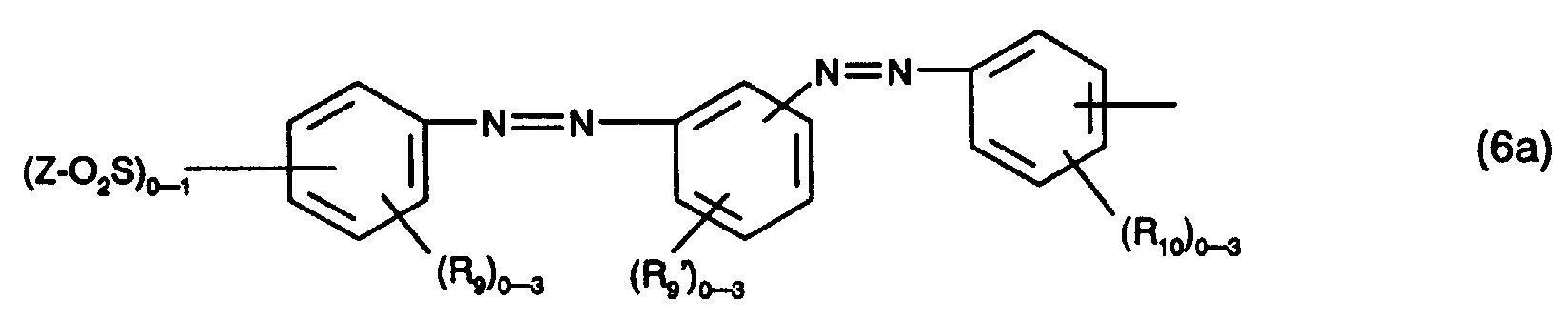
- the radicals of the formulas (4a) and (4b) are preferably those of the formula wherein (R 9 ) 0-3 represents 0 to 3 identical or different substituents from the group C 1 -C 4 alkyl, C 1 -C 4 alkoxy, halogen, carboxy and sulfo and Z has the meaning given above, where Z has the meaning given above, wherein (R 10 ) 0-4 for 0 to 4 identical or different substituents from the group halogen, nitro, cyano, trifluoromethyl, sulfamoyl, carbamoyl, C 1 -C 4 alkyl, C 1 -C 4 alkoxy, amino, acetylamino , Ureido, hydroxy, carboxy, sulfomethyl and sulfo and Z has the meaning given above, wherein (R 11 ) 0-3 represents 0 to 3 identical or different substituents from the group C 1 -C 4 alkyl, C 1 -C 4 alk
- the rest of a formazan chromophore are preferably those of the formula wherein Z has the meaning given above and the benzene nuclei contain no further substituents or are further substituted by C 1 -C 4 alkyl, C 1 -C 4 alkoxy, C 1 -C 4 alkylsulfonyl, halogen or carboxy.
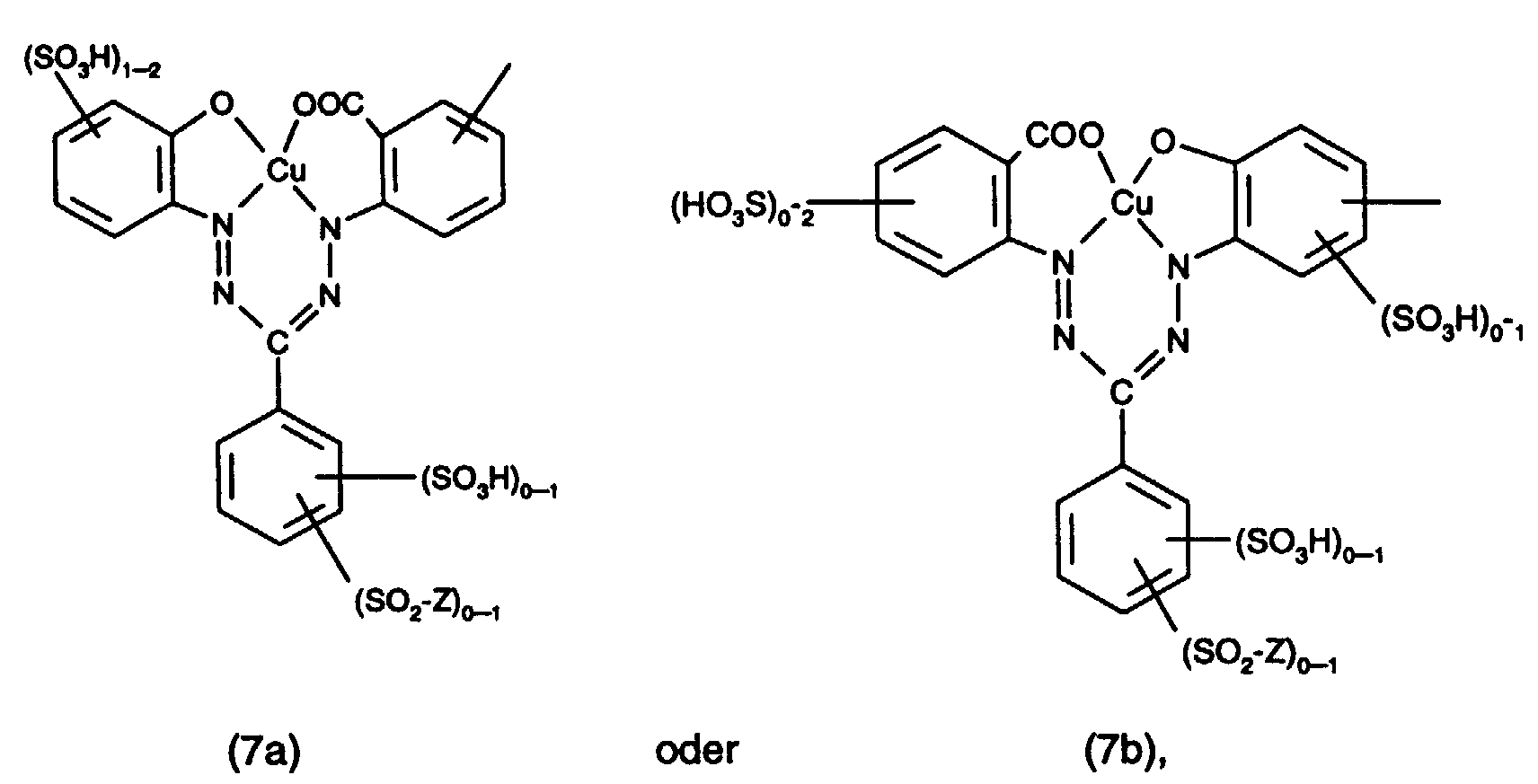
- the radicals of the formulas (7a) and (7b) preferably contain no further substituents and no —SO 2 —Z radical.
- an anthraquinone chromophore is preferably of the formula wherein G is an unsubstituted or substituted by C 1 -C 4 alkyl, C 1 -C 4 alkoxy, halogen, carboxy or sulfo phenylene radical or a cyclohexylene, phenylene methylene or C 2 -C 6 alkylene radical.
- the radicals A 1 , A 2 and A 3 are preferably those of the formulas (5a) to (5e), (6a) to (6d), (7a), (7b), (8), (9) or (10), the radicals of the formulas (6a) to (6d), (7a) and (7b) preferably not containing any fiber-reactive radical.
- the radicals of the formulas (5a) to (5e), (7a), (7b) and (10) are particularly interested.
- the radicals A 1 , A 2 and A 3 preferably each contain 1 to 4 sulfo groups and preferably 1 to 3 sulfo groups.
- the reactive dyes of the formulas (1) and (2) each contain at least two fiber reactive groups.
- the reactive dye of formula (1) contains two fiber-reactive ones Triazine residues and the reactive dye of formula (2) a fiber-reactive triazine residue and a fiber-reactive radical V.
- the reactive dyes of the formulas (1) preferably contain and (2) only two fiber reactive groups at a time.
- Reactive dyes of the formula are of particular interest or
- the reactive dyes of the formulas (1) and (2) are known or can be used in analogy to known compounds, e.g. through usual diazotization, Coupling and condensation reactions.
- the reactive dyes of formulas (1) and (2) used in the inks should preferably low in salt, i.e. a total salt content of less than 0.5 wt .-%, based on the weight of the dyes.
- Reactive dyes that due to their manufacture and / or the subsequent addition of coupé agents have higher salt contents, e.g. by membrane separation processes, such as Ultrafiltration, reverse osmosis or dialysis.
- the inks preferably contain exclusively dyes containing sulfo groups, water-soluble reactive dyes, such as those of formulas (1) and (2) above.
- the inks preferably contain a total reactive dye content of the above Formulas (1) and (2) from 5 to 35% by weight, in particular 10 to 35% by weight and preferably 10 to 20% by weight based on the total weight of the ink.
- cellulose ethers e.g. Methyl, ethyl, Hydroxyethyl, methylhydroxyethyl, hydroxypropyl or hydroxypropylmethyl cellulose in Consideration. Methyl cellulose or, in particular, hydroxyethyl cellulose are preferred.
- the Cellulose ethers are usually used in the ink in an amount of 0.01 to 2% by weight, in particular 0.01 to 1 wt .-% and preferably 0.01 to 0.5 wt .-%, based on the Total weight of ink used.
- Alkali alginates and preferably sodium alginate are particularly suitable as alginates Consideration. These are usually contained in the ink in an amount of 0.01 to 2% by weight, in particular 0.01 to 1 wt .-% and preferably 0.01 to 0.5 wt .-%, based on the Total weight of ink used.
- Both the water-soluble, non-ionic cellulose ether used and the Alginates are used as so-called thickeners and allow the setting of one certain viscosity of the ink.
- Inks are preferred which have a viscosity of 1 to 40 mPas, in particular 5 to 40 mPa ⁇ s and preferably 10 to 40 mPa ⁇ s. Inks with a viscosity of 10 to 30 mPa ⁇ s are particularly preferred.
- the inks may also contain buffer substances, such as borax, borate or citrate.
- buffer substances such as borax, borate or citrate.
- borax borate
- citrate sodium borate, sodium tetraborate and sodium citrate. They are used in particular in amounts of 0.1 to 3% by weight, preferably 0.1 to 1% by weight, based on the total weight of the ink, in order to have a pH of, for example, 5 to 9, in particular 6 to 8, adjust.
- a citrate buffer is preferably used in the case of inks containing alginate.
- the inks can e.g. N-methyl-2-pyrrolidone or in particular 1,2-propylene glycol contain. These are usually present in the ink in an amount of 5 to 30% by weight, in particular 5 to 20% by weight and preferably 10 to 20% by weight on the total weight of the ink used.
- the inks can also contain conventional additives such as e.g. foam suppressants or in particular substances that inhibit fungal and / or bacterial growth. This are usually in amounts of 0.01 to 1 wt .-%, based on the total weight the ink used.
- foam suppressants or in particular substances that inhibit fungal and / or bacterial growth. This are usually in amounts of 0.01 to 1 wt .-%, based on the total weight the ink used.
- the method according to the invention for printing textile fiber materials can with performed on known ink jet printers suitable for textile printing will.
- inkjet printing process individual drops of the ink are checked out sprayed onto a substrate using a nozzle.
- the continuous ink jet method is predominantly used for this as well as the drop on demand method.
- the ink-jet method creates the drops continuously, not for printing required drops are drained into a collecting container and recycled.
- Drop on demand method drops are created and printed as desired; i.e. drops are only generated when this is necessary for printing.
- the Generation of the drops can e.g. by means of a piezo inkjet head or by means of thermal Energy (bubble jet). Pressure is preferred for the method according to the invention using the drop-on-demand method, in particular using a piezo inkjet head.
- fiber materials containing hydroxyl groups come as textile fiber materials into consideration.
- cellulose-containing fiber materials which are made up entirely or in part Cellulose exist. Examples are natural fiber materials such as cotton, linen or Hemp and regenerated fiber materials such as Viscose and lyocell. Especially viscose or preferably cotton are preferred.
- the above Fiber materials are preferably in the form of flat textile fabrics, knitted fabrics or webs.
- the aqueous alkaline liquor contains at least one of the usual bases, which in conventional Reactive printing processes are used to fix the reactive dyes.
- the base is e.g. in an amount of 10 to 100 g / l liquor, preferably 10 to 50 g / l Fleet, deployed.
- Sodium bicarbonate is preferred, sodium carbonate or a mixture of water glass and sodium carbonate is used.
- the pH the alkaline liquor is usually 7.5 to 13.5, preferably 8.5 to 12.5.
- the aqueous alkaline liquor can contain other additives, e.g. Hydrotrope, contain.
- Urea is preferably used as the hydrotroping agent, e.g. in a Amount of 25 to 200 g / l liquor, preferably 50 to 150 g / l liquor is used.
- the fiber material is preferably dried after the above pretreatment.
- the fiber material is advantageously dried, preferably at temperatures up to 150 ° C, especially 80 to 120 ° C, and then a heat treatment process subjected to complete the print, or the dye to fix.
- the heat treatment can e.g. through a warm dwell process, a thermal insulation process or preferably be carried out by a steaming process.
- the printed fiber material is e.g. one treatment in one Damper with possibly superheated steam, conveniently at one temperature from 95 to 180 ° C, advantageously in saturated steam.
- the printed fiber material is usually washed with water in the usual way washed out to remove unfixed dye.
- the prints obtainable by the process according to the invention have good prints General realities on; e.g. they have high fiber-dye binding stability both in the acidic and in the alkaline range, good lightfastness, good Wet fastness properties, such as fastness to washing, water, sea water, over-dyeing and perspiration, one good chlorine fastness, rubbing fastness, ironing fastness and pleating fastness as well as sharp contours and high color strength.
- the printing inks used are characterized by good stability and good viscosity properties. So the viscosity remains even during the Preserved high shear forces almost unchanged.
Landscapes
- Engineering & Computer Science (AREA)
- Textile Engineering (AREA)
- Health & Medical Sciences (AREA)
- Life Sciences & Earth Sciences (AREA)
- Molecular Biology (AREA)
- Coloring (AREA)
- Inks, Pencil-Leads, Or Crayons (AREA)
- Ink Jet Recording Methods And Recording Media Thereof (AREA)
Abstract
Description


- R5 Wasserstoff oder gegebenenfalls substituiertes C1-C4-Alkyl,
- X1 Halogen,
- A3 der Rest eines mindestens eine Sufogruppe enthaltenden Monoazo-, Polyazo-, Metallkomplexazo-, Anthrachinon-, Phthalocyanin-, Formazan- oder Dioxazin-Chromophors und
- V ein faserreaktiver Rest der Formel
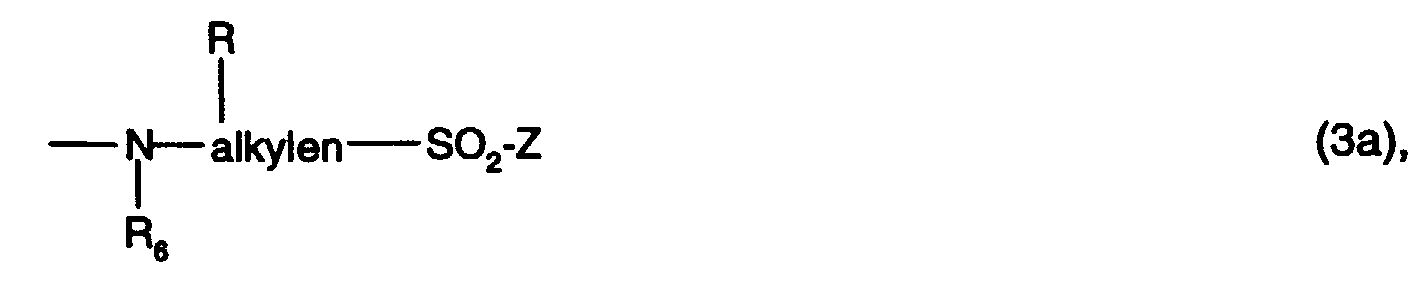

 oder
oder ist, wobei
- alkylen und alkylen' unabhängig voneinander C1-C6-Alkylen sind,
- arylen einen unsubstituierten oder durch Sulfo, Carboxy, C1-C4-Alkyl, C1-C4-Alkoxy oder Halogen substituierten Phenylen- oder Naphthylenrest bedeutet,
- Z Vinyl oder einen Rest -CH2-CH2-U1 bedeutet und U1 eine Abgangsgruppe ist,
- R Wasserstoff, Hydroxy, Sulfo, Sulfato, Carboxy, Cyano, Halogen, C1-C4-Alkoxycarbonyl, C1-C4-Alkanoyloxy, Carbamoyl oder die Gruppe -SO2-Z ist,
- R6 Wasserstoff, unsubstituiertes oder durch Hydroxy, Sulfo, Sulfato, Carboxy oder Cyano
substituiertes C1-C4-Alkyl oder einen Rest der Formel
bedeutet,

- R7 Wasserstoff oder unsubstituiertes oder durch Carboxy, Cyano, Hydroxy, Sulfo oder Sulfato substituiertes C1-C4-Alkyl,
- E der Rest -O- oder -NR8- ist und R8 Wasserstoff oder C1-C4-Alkyl bedeutet,
- W eine Gruppe der Formel -SO2-NR6-, -CONR6- oder -NR6CO- ist und R6 die oben angegebenen Bedeutungen hat, und
- t 0 oder 1 ist, und
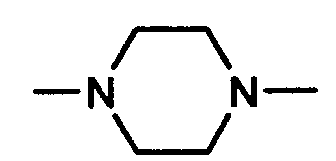
ein gegebenenfalls durch C1-C4-Alkyl, C1-C4-Alkoxy, C2-C4-Alkanoylamino, Sulfo, Halogen oder Carboxy substituierter Phenylenrest.
R und R6 sind hierbei vorzugsweise Wasserstoff.
Alkylgruppen mit 1 bis 4 Kohlenstoffatomen, wie Methyl, Aethyl, Propyl, Isopropyl oder Butyl, wobei die Alkylreste z.B. durch Hydroxyl, Sulfo oder Sulfato weitersubstituiert sein können; Alkoxygruppen mit 1 bis 4 Kohlenstoffatomen, wie Methoxy, Aethoxy, Propoxy, lsopropoxy oder Butoxy, wobei die Alkylreste z.B. durch Hydroxyl, Sulfo oder Sulfato weitersubstituiert sein können; gegebenenfalls durch C1-C4-Alkyl, C1-C4-Alkoxy, Halogen, Carboxy oder Sulfo substituiertes Phenyl; Acylaminogruppen mit 1 bis 8 Kohlenstoffatomen, insbesondere solche Alkanoylaminogruppen, wie z.B. Acetylamino oder Propionylamino; gegebenenfalls im Phenylring durch C1-C4-Alkyl, C1-C4-Alkoxy, Halogen oder Sulfo substituiertes Benzoylamino; gegebenenfalls im Phenylring durch C1-C4-Alkyl, C1-C4-Alkoxy, Halogen oder Sulfo substituiertes Phenylamino; N,N-Di-β-hydroxyäthylamino; N,N-Di-β-sulfatoäthylamino; Sulfobenzylamino; N,N-Disulfobenzylamino; Alkoxycarbonyl mit 1 bis 4 Kohlenstoffatomen im Alkoxyrest, wie Methoxycarbonyl oder Aethoxycarbonyl; Alkylsulfonyl mit 1 bis 4 Kohlenstoffatomen, wie Methylsulfonyl oder Aethylsulfonyl; Trifluormethyl; Nitro; Amino; Cyano; Halogen, wie Fluor, Chlor oder Brom; Carbamoyl; N-Alkylcarbamoyl mit 1 bis 4 Kohlenstoffatomen im Alkylrest, wie N-Methylcarbamoyl oder N-Aethylcarbamoyl; Sulfamoyl; N-Mono- oder N,N-Dialkylsulfamoyl mit jeweils 1 bis 4 Kohlenstoffatomen, wie N-Methylsulfamoyl, N-Aethylsulfamoyl, N-Propylsulfamoyl, N-lsopropylsulfamoyl oder N-Butylsulfamoyl, wobei die Alkylreste z.B. durch Hydroxy oder Sulfo weitersubstituiert sein können; N-(β-Hydroxyäthyl)-sulfamoyl; N,N-Di-(β-hydroxyäthyl)-sulfamoyl; gegebenenfalls durch C1-C4-Alkyl, C1-C4-Alkoxy, Halogen, Carboxy oder Sulfo substituiertes N-Phenylsulfamoyl; Ureido; Hydroxy; Carboxy; Sulfomethyl oder Sulfo sowie faserreaktive Reste.






Sie werden insbesondere in Mengen von 0,1 bis 3 Gew.-%, vorzugsweise 0,1 bis 1 Gew.-%, bezogen auf das Gesamtgewicht der Tinte, verwendet, um einen pH-Wert von z.B. 5 bis 9, insbesondere 6 bis 8, einzustellen. Vorzugsweise verwendet man im Falle alginathaltiger Tinten einen Citrat-Puffer.
- 15 Gew.-% des Reaktivfarbstoffs der Formel

- 0,3 Gew.-% Hydroxyaethylcellulose,
- 0,5 Gew.-% Borax und
- 84,2 Gew.-% Wasser
- 15 Gew.-% des Reaktivfarbstoffs der Formel
- 0,3 Gew.-% Hydroxyaethylcellulose,
- 15 Gew.-% 1,2-Propylenglykol
- 0,5 Gew.-% Borax und
- 69,2 Gew.-% Wasser
- 15 Gew.-% des Reaktivfarbstoffs der Formel

- 0,3 Gew.-% Hydroxyaethylcellulose,
- 15 Gew.-% N-Methyl-2-pyrrolidon,
- 0,5 Gew.-% Borax und
- 69,2 Gew.-% Wasser
- 15 Gew.-% des Reaktivfarbstoffs der Formel

- 0,3 Gew.-% Hydroxyaethylcellulose,
- 0,5 Gew.-% Borax und
- 84,2 Gew.-% Wasser
- 15 Gew.-% des Reaktivfarbstoffs der Formel
- 0,3 Gew.-% Hydroxyaethylcellulose und
- 84,7 Gew.-% Wasser
- 15 Gew.-% des Reaktivfarbstoffs der Formel

- 0,3 Gew.-% Hydroxyaethylcellulose,
- 0,5 Gew.-% Natriumcitrat und
- 84,2 Gew.-% Wasser
- 15 Gew.-% des Reaktivfarbstoffs der Formel (11a),
- 0,3 Gew.-% Natriumalginat,
- 0,5 Gew.-% Natriumcitrat und
- 84,2 Gew.-% Wasser
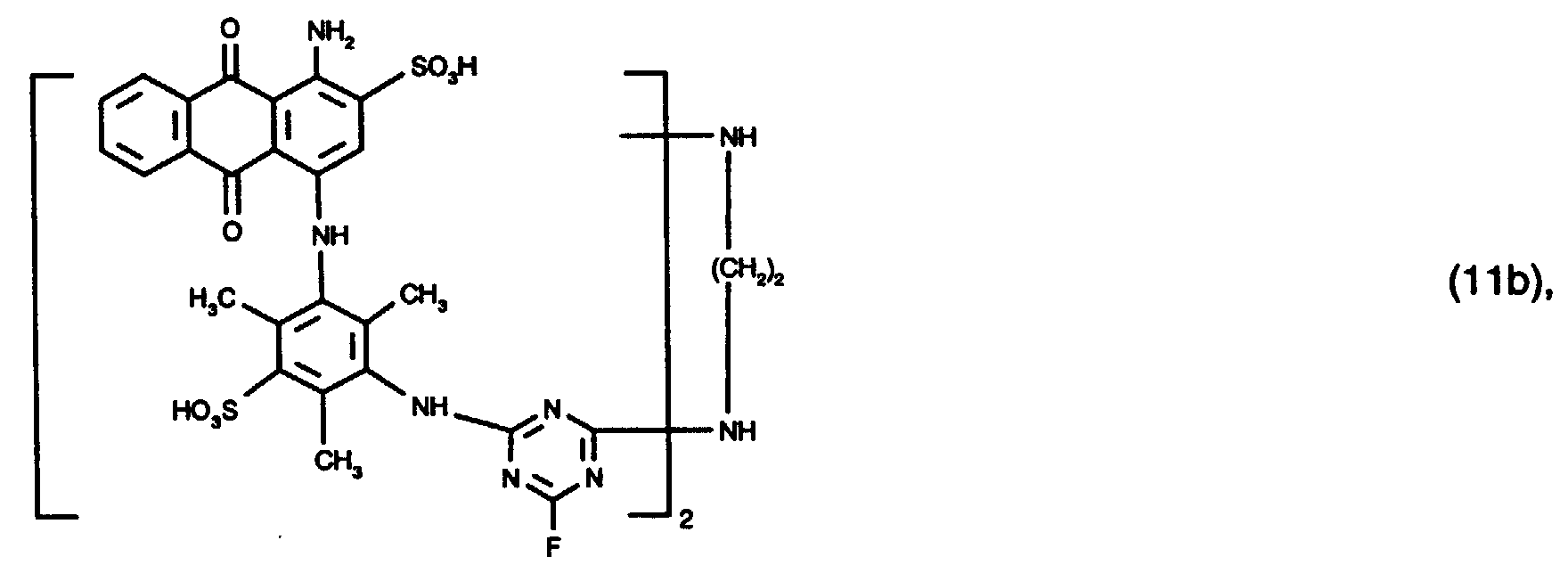
- 15 Gew.-% des Reaktivfarbstoffs der Formel (11b),
- 0,3 Gew.-% Natriumalginat,
- 15 Gew.-% 1,2-Propylenglykol
- 0,5 Gew.-% Natriumcitrat und
- 69,2 Gew.-% Wasser
- 15 Gew.-% des Reaktivfarbstoffs der Formel (11c),
- 0,3 Gew.-% Natriumalginat,
- 15 Gew.-% N-Methyl-2-pyrrolidon,
- 0,5 Gew.-% Natriumcitrat und
- 69,2 Gew.-% Wasser
- 15 Gew.-% des Reaktivfarbstoffs der Formel (11d),
- 0,3 Gew.-% Natriumalginat,
- 0,5 Gew.-% Natriumcitrat und
- 84,2 Gew.-% Wasser
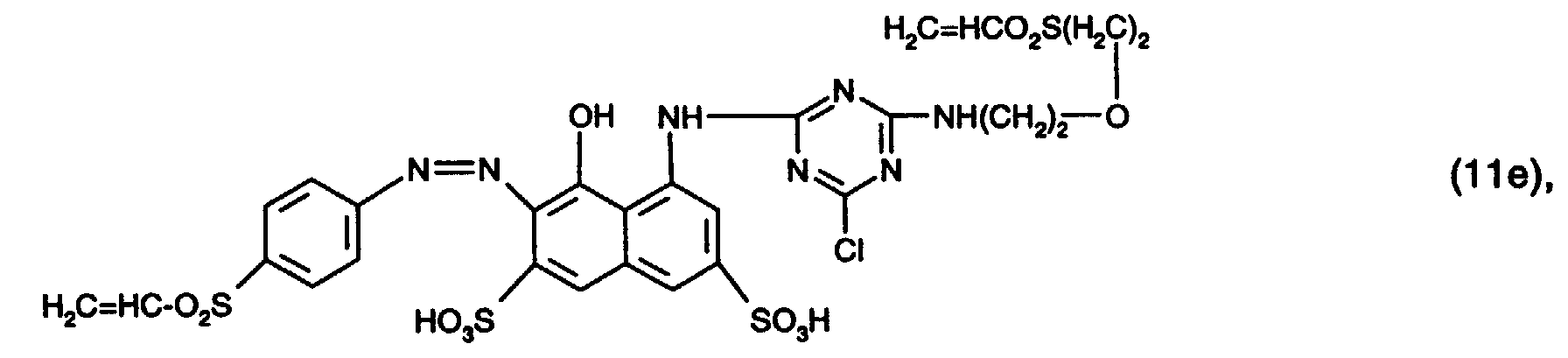
- 15 Gew.-% des Reaktivfarbstoffs der Formel (11e),
- 0,3 Gew.-% Natriumalginat und
- 84,7 Gew.-% Wasser
- 15 Gew.-% des Reaktivfarbstoffs der Formel (11f),
- 0,3 Gew.-% Natriumalginat,
- 0,5 Gew.-% Natriumcitrat und
- 84,2 Gew.-% Wasser
Claims (15)
- Verfahren zum Bedrucken von textilen Fasermaterialien nach dem Tintenstrahldruck-Verfahren, dadurch gekennzeichnet, dass man diese Fasermaterialien mit einer wässrigen Tinte bedruckt, welchea) mindestens einen Reaktivfarbstoff der Formelworin
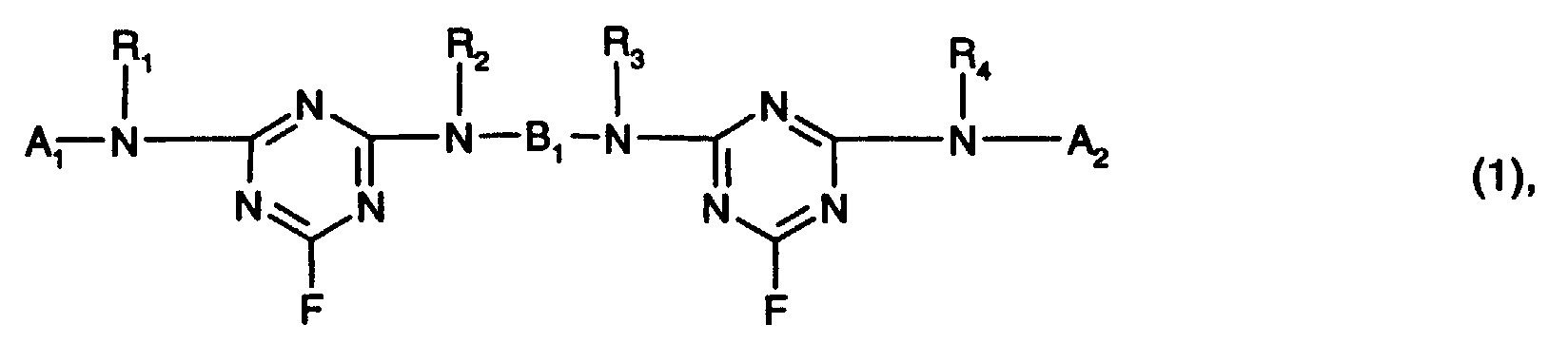 oder mindestens einen Reaktivfarbstoff der FormelR1, R2, R3 und R4 unabhängig voneinander Wasserstoff oder gegebenenfalls substituiertes C1-C4-Alkyl sind,B1 ein organisches Brückenglied,A1 der Rest eines mindestens eine Sufogruppe enthaltenden Monoazo-, Polyazo-, Metallkomplexazo-, Anthrachinon-, Phthalocyanin-, Formazan- oder Dioxazin-Chromophors undA2 die für A1 angegebenen Bedeutungen hat oder Wasserstoff oder gegebenenfalls substituiertes C1-C4-Alkyl, Phenyl oder Naphthyl ist,worin
 R5 Wasserstoff oder gegebenenfalls substituiertes C1-C4-Alkyl,X1 Halogen,A3 der Rest eines mindestens eine Sufogruppe enthaltenden Monoazo-, Polyazo-, Metallkomplexazo-, Anthrachinon-, Phthalocyanin-, Formazan- oder Dioxazin-Chromophors undV ein faserreaktiver Rest der Formel

 oder
oder ist, wobei
 alkylen und alkylen' unabhängig voneinander C1-C6-Alkylen sind,arylen einen unsubstituierten oder durch Sulfo, Carboxy, C1-C4-Alkyl, C1-C4-Alkoxy oder Halogen substituierten Phenylen- oder Naphthylenrest bedeutet,Z Vinyl oder einen Rest -CH2-CH2-U1 bedeutet und U1 eine Abgangsgruppe ist,R Wasserstoff, Hydroxy, Sulfo, Sulfato, Carboxy, Cyano, Halogen, C1-C4-Alkoxycarbonyl, C1-C4-Alkanoyloxy, Carbamoyl oder die Gruppe -SO2-Z ist,R6 Wasserstoff, unsubstituiertes oder durch Hydroxy, Sulfo, Sulfato, Carboxy oder Cyano substituiertes C1-C4-Alkyl oder einen Rest der Formelbedeutet,
 R7 Wasserstoff oder unsubstituiertes oder durch Carboxy, Cyano, Hydroxy, Sulfo oder Sulfato substituiertes C1-C4-Alkyl,E der Rest -O- oder -NR8- ist und R8 Wasserstoff oder C1-C4-Alkyl bedeutet,W eine Gruppe der Formel -SO2-NR6-, -CONR6- oder -NR6CO- ist und R6 die oben angegebenen Bedeutungen hat, undt 0 oder 1 ist, undb) einen wasserlöslichen, nichtionogenen Celluloseäther oder ein Alginat enthält.
 - Verfahren gemäss Anspruch 1, dadurch gekennzeichnet, dass R1, R2, R3, R4 und R5 unabhängig voneinander Wasserstoff oder C1-C4-Alkyl sind.
- Verfahren gemäss einem der Ansprüche 1 und 2, dadurch gekennzeichnet, dass B1 ein C2-C12-Alkylenrest ist, welcher durch 1, 2 oder 3 Glieder aus der Gruppe -NH-, -N(CH3)- oder -O- unterbrochen sein kann und unsubstituiert oder durch Hydroxy, Sulfo, Sulfato, Cyano oder Carboxy substituiert ist.
- Verfahren gemäss einem der Ansprüche 1 bis 3, dadurch gekennzeichnet, dass X1 Fluor oder Chlor, insbesondere Fluor, ist.
- Verfahren gemäss einem der Ansprüche 1 bis 4, dadurch gekennzeichnet, dass V ein Rest der Formel (3b) oder (3d) ist.
- Verfahren gemäss einem der Ansprüche 1 bis 5, dadurch gekennzeichnet, dass alkylen und alkylen' unabhängig voneinander C2-C3-Alkylen sind,R7 Wasserstoff,Z Vinyl oder ein Rest der Formel -CH2-CH2-OSO3H,E der Rest -O-,W eine Gruppe der Formel -CONH- undt die Zahl 0 ist.
- Verfahren gemäss einem der Ansprüche 1 bis 6, dadurch gekennzeichnet, dass A1, A2 und A3 unabhängig voneinander Reste der Formelworin (R9)0-3 für 0 bis 3 gleiche oder verschiedene Substituenten aus der Gruppe C1-C4-Alkyl, C1-C4-Alkoxy, Halogen, Carboxy und Sulfo steht und Z die in Anspruch 1 angegebene Bedeutung hat,
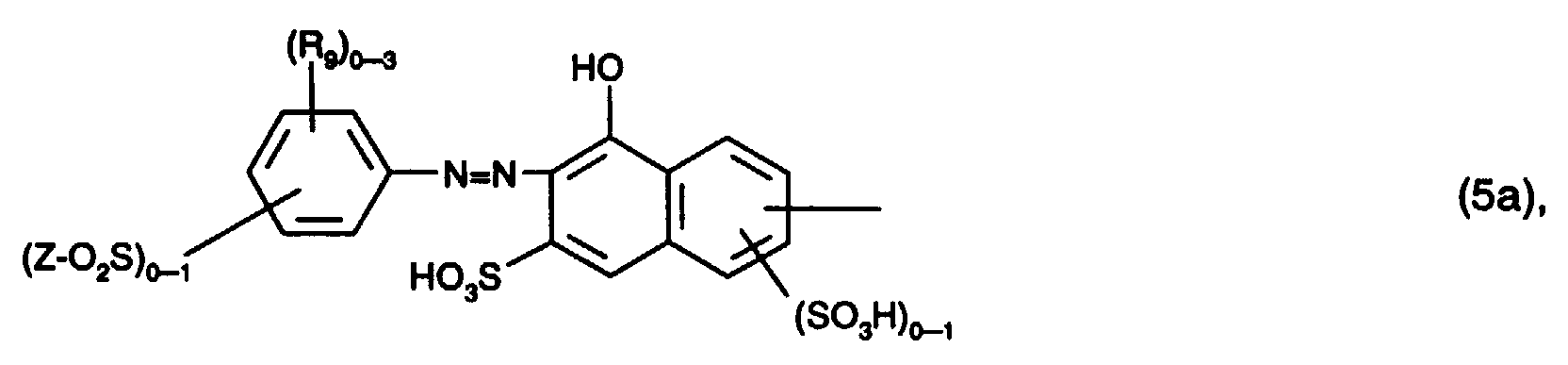 worin Z die in Anspruch 1 angegebene Bedeutung hat,
 worin (R10)0-4 für 0 bis 4 gleiche oder verschiedene Substituenten aus der Gruppe Halogen, Nitro, Cyan, Trifluormethyl, Sulfamoyl, Carbamoyl, C1-C4-Alkyl, C1-C4-Alkoxy, Amino, Acetylamino, Ureido, Hydroxy, Carboxy, Sulfomethyl und Sulfo steht und Z die in Anspruch 1 angegebene Bedeutung hat,
 worin (R11)0-3 für 0 bis 3 gleiche oder verschiedene Substituenten aus der Gruppe C1-C4-Alkyl, C1-C4-Alkoxy, Halogen, Carboxy und Sulfo steht,
 worin R12 und R14 unabhängig voneinander Wasserstoff, C1-C4-Alkyl oder Phenyl, und R13 Wasserstoff, Cyano, Carbamoyl oder Sulfomethyl ist,
 oder
oder oder
oder oder
oder worin (R9)0-3, (R10)0-3, (R11)0-3 und Z jeweils die oben angegebene Bedeutung haben und (R9')0-3 für 0 bis 3 gleiche oder verschiedene Substituenten aus der Gruppe C1-C4-Alkyl, C1-C4-Alkoxy, Halogen, Carboxy oder Sulfo steht,
 worin Z die oben angegebene Bedeutung hat und die Benzolkerne keine weiteren Substituenten enthalten oder durch C1-C4-Alkyl, C1-C4-Alkoxy, C1-C4-Alkylsulfonyl, Halogen oder Carboxy weitersubstituiert sind,
 worin Pc der Rest eines Metallphthalocyanins, insbesondere der Rest eines Kupfer- oder Nickelphthalocyanins ist,W' -OH und/oder -NR16R16' und R16 und R16' unabhängig voneinander Wasserstoff oder gegebenenfalls durch Hydroxy oder Sulfo substituiertes C1-C4-Alkyl sind,R15 Wasserstoff oder C1-C4-Alkyl,A ein gegebenenfalls durch C1-C4-Alkyl, Halogen, Carboxy oder Sulfo substituierter Phenylenrest oder ein C2-C6-Alkylenrest undk 1 bis 3 ist,
 worin A' ein gegebenenfalls durch C1-C4-Alkyl, Halogen, Carboxy oder Sulfo substituierter Phenylenrest oder ein C2-C6-Alkylenrest ist,r, s, v und v' unabhängig voneinander je die Zahl 0 oder 1 bedeuten undZ die zuvor angegebene Bedeutung hat, oderworin G einen unsubstituierten oder durch C1-C4-Alkyl, C1-C4-Alkoxy, Halogen, Carboxy oder Sulfo substituierten Phenylenrest oder einen Cyclohexylen-, Phenylenmethylen- oder C2-C6-Alkylenrest bedeutet, sind.
- Verfahren gemäss Anspruch 1, dadurch gekennzeichnet, dass man als Reaktivfarbstoffe der Formel (1) oder (2) mindestens einen der Reaktivfarbstoffe der Formeln
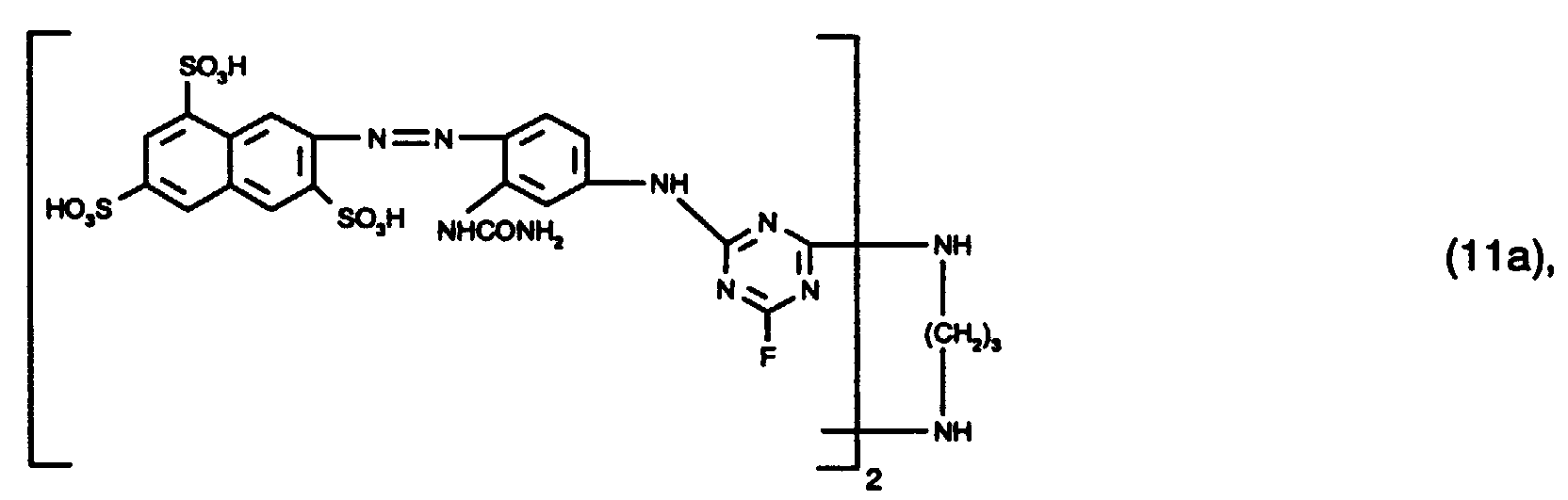
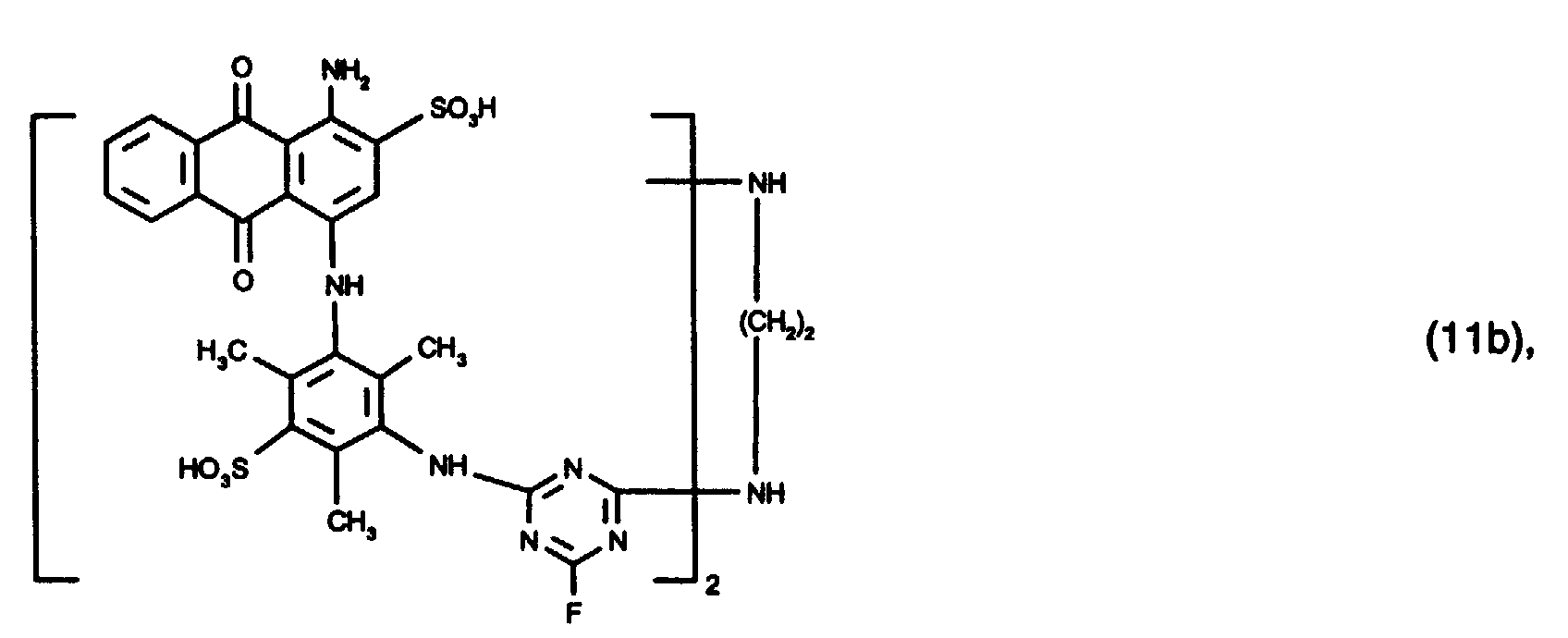
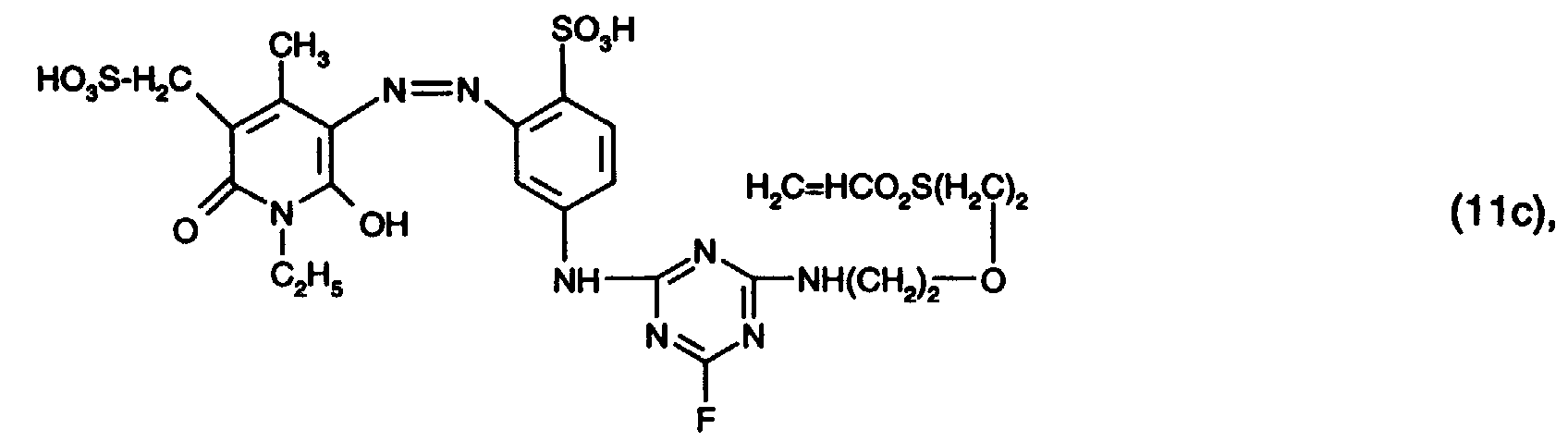
 und
und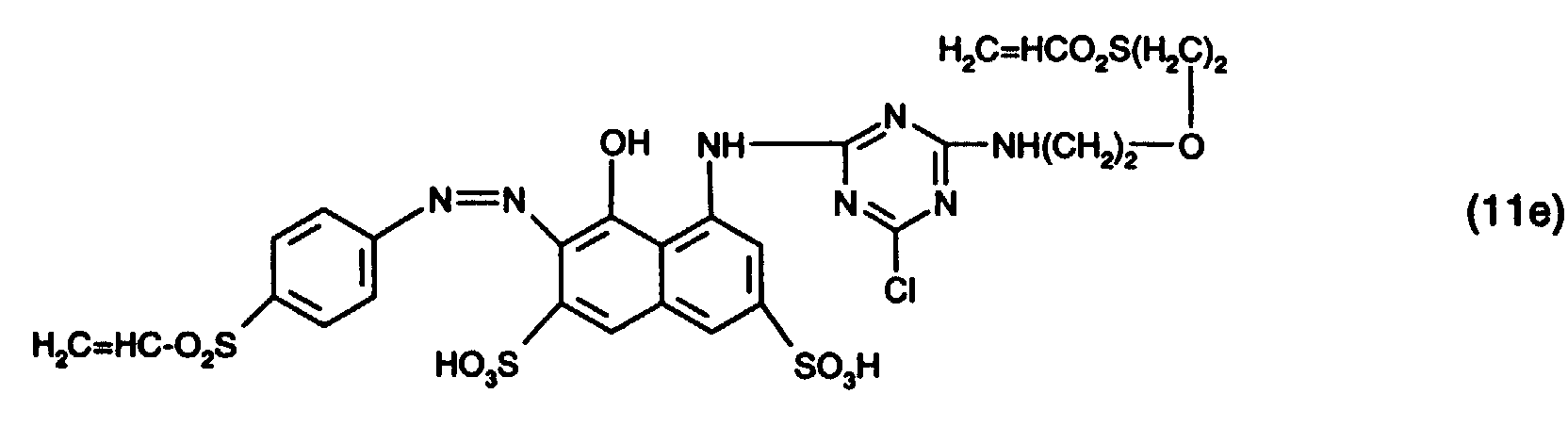 verwendet.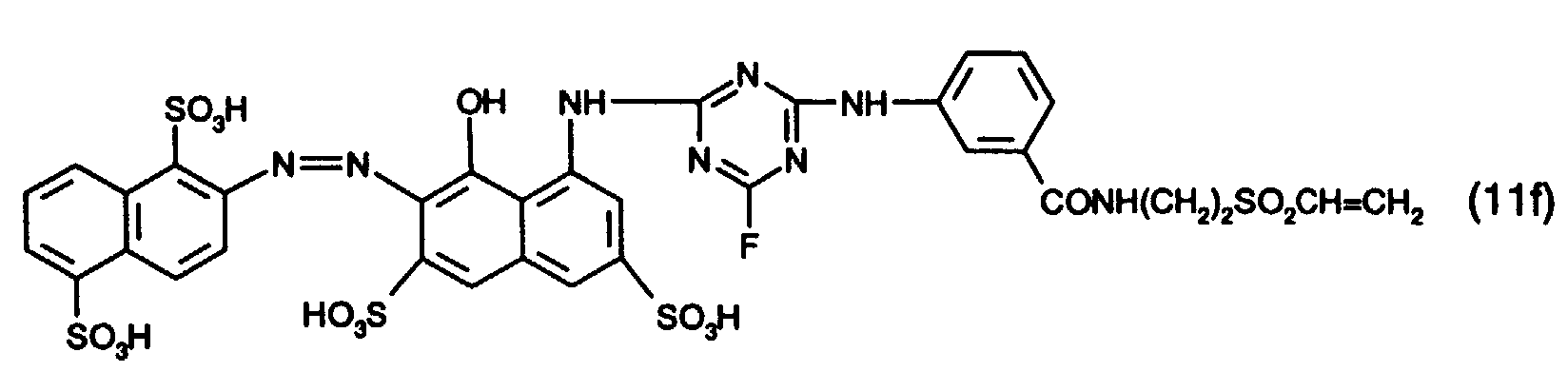
- Verfahren gemäss einem der Ansprüche 1 bis 8, dadurch gekennzeichnet, man als wasserlösliche, nichtionogene Celluloseäther Methylcellulose oder insbesondere Hydroxyäthylcellulose verwendet.
- Verfahren gemäss einem der Ansprüche 1 bis 8, dadurch gekennzeichnet, man eine Tinte verwendet, welche ein Alginat, insbesondere Natriumalginat, enthält.
- Verfahren gemäss einem der Ansprüche 1 bis 10, dadurch gekennzeichnet, man eine Tinte verwendet, welche eine Viskosität von 1 bis 40 mPa·s, insbesondere 10 bis 30 mPa·s, aufweist.
- Verfahren gemäss einem der Ansprüche 1 bis 11, dadurch gekennzeichnet, dass man eine Tinte verwendet, welche eine Puffersubstanz enthält.
- Verfahren gemäss einem der Ansprüche 1 bis 12, dadurch gekennzeichnet, dass man cellulosische Fasermaterialien, insbesondere Baumwolle oder Viskose, bedruckt.
- Wässrige Drucktinte für das Tintenstrahldruck-Verfahren, dadurch gekennzeichnet, dass siea) 5 bis 35 Gew.-% mindestens eines Reaktivfarbstoffes der Formelworin
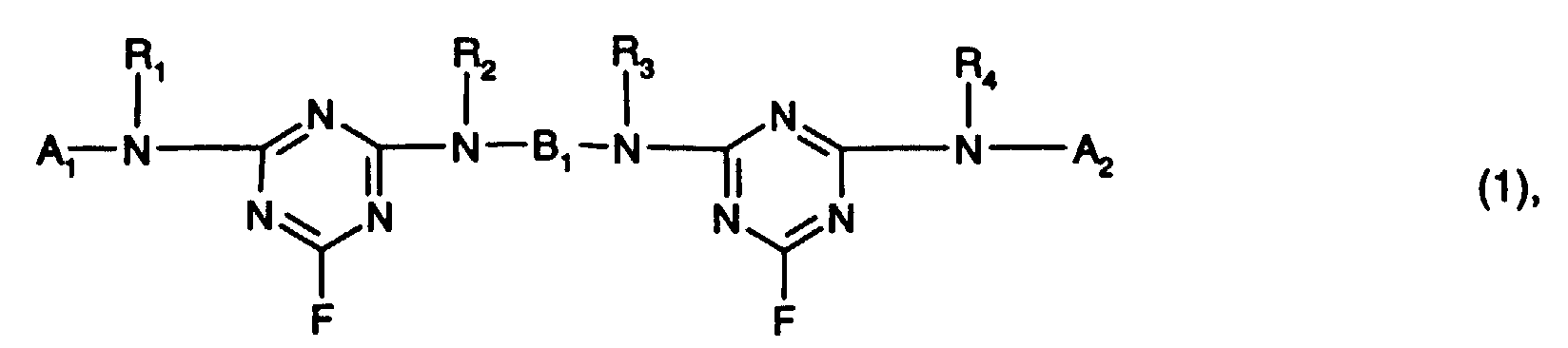 oder mindestens eines Reaktivfarbstoffs der FormelR1, R2, R3 und R4 unabhängig voneinander Wasserstoff oder gegebenenfalls substituiertes C1-C4-Alkyl sind,B1 ein organisches Brückenglied,A1 der Rest eines mindestens eine Sufogruppe enthaltenden Monoazo-, Polyazo-, Metallkomplexazo-, Anthrachinon-, Phthalocyanin-, Formazan- oder Dioxazin-Chromophors undA2 die für A1 angegebenen Bedeutungen hat oder Wasserstoff oder gegebenenfalls substituiertes C1-C4-Alkyl, Phenyl oder Naphthyl ist,worin
 R5 Wasserstoff oder gegebenenfalls substituiertes C1-C4-Alkyl,X1 Halogen,A3 der Rest eines mindestens eine Sufogruppe enthaltenden Monoazo-, Polyazo-, Metallkomplexazo-, Anthrachinon-, Phthalocyanin-, Formazan- oder Dioxazin-Chromophors undV ein faserreaktiver Rest der Formel

 oder
oder ist, wobei
 alkylen und alkylen' unabhängig voneinander C1-C6-Alkylen sind,arylen einen unsubstituierten oder durch Sulfo, Carboxy, C1-C4-Alkyl, C1-C4-Alkoxy oder Halogen substituierten Phenylen- oder Naphthylenrest bedeutet,Z Vinyl oder einen Rest -CH2-CH2-U1 bedeutet und U1 eine Abgangsgruppe ist,R Wasserstoff, Hydroxy, Sulfo, Sulfato, Carboxy, Cyano, Halogen, C1-C4-Alkoxycarbonyl, C1-C4-Alkanoyloxy, Carbamoyl oder die Gruppe -SO2-Z ist,R6 Wasserstoff, unsubstituiertes oder durch Hydroxy, Sulfo, Sulfato, Carboxy oder Cyano substituiertes C1-C4-Alkyl oder einen Rest der Formelbedeutet,
 R7 Wasserstoff oder unsubstituiertes oder durch Carboxy, Cyano, Hydroxy, Sulfo oder Sulfato substituiertes C1-C4-Alkyl,E der Rest -O- oder -NR8- ist und R8 Wasserstoff oder C1-C4-Alkyl bedeutet,W eine Gruppe der Formel -SO2-NR6-, -CONR6- oder -NR6CO- ist und R6 die oben angegebenen Bedeutungen hat, undt 0 oder 1 ist, undb) 0,01 bis 2 Gew.-% eines wasserlöslichen, nichtionogenen Celluloseäthers oder eines Alginats enthält.
 - Wässrige Drucktinte gemäss Anspruch 14, dadurch gekennzeichnet, dass sie 0,01 bis 2 Gew.-% eines Alginats enthält.
Applications Claiming Priority (3)
| Application Number | Priority Date | Filing Date | Title |
|---|---|---|---|
| CH147597 | 1997-06-17 | ||
| CH1475/97 | 1997-06-17 | ||
| CH147597 | 1997-06-17 |
Publications (3)
| Publication Number | Publication Date |
|---|---|
| EP0886000A2 true EP0886000A2 (de) | 1998-12-23 |
| EP0886000A3 EP0886000A3 (de) | 2000-02-23 |
| EP0886000B1 EP0886000B1 (de) | 2005-07-20 |
Family
ID=4211360
Family Applications (1)
| Application Number | Title | Priority Date | Filing Date |
|---|---|---|---|
| EP98810525A Expired - Lifetime EP0886000B1 (de) | 1997-06-17 | 1998-06-09 | Verfahren zum Bedrucken von textilen Fasermaterialien nach dem Tintenstrahldruck-Verfahren |
Country Status (13)
| Country | Link |
|---|---|
| US (1) | US5972084A (de) |
| EP (1) | EP0886000B1 (de) |
| JP (1) | JPH1112963A (de) |
| KR (1) | KR100538666B1 (de) |
| CN (1) | CN1140667C (de) |
| BR (1) | BR9802014A (de) |
| DE (1) | DE59812931D1 (de) |
| ES (1) | ES2246065T3 (de) |
| ID (1) | ID20432A (de) |
| PT (1) | PT886000E (de) |
| SG (1) | SG73520A1 (de) |
| TR (1) | TR199801119A2 (de) |
| TW (1) | TW550281B (de) |
Cited By (4)
| Publication number | Priority date | Publication date | Assignee | Title |
|---|---|---|---|---|
| WO2000046309A1 (en) * | 1999-02-05 | 2000-08-10 | Ciba Specialty Chemicals Holding Inc. | Black-dyeing inks and their use |
| DE10135042A1 (de) * | 2001-07-11 | 2003-02-06 | Dystar Textilfarben Gmbh & Co | Wässrige Tintenformulierungen für das Tintenstrahldruck-Verfahren |
| CN102127333A (zh) * | 2011-01-12 | 2011-07-20 | 郑州鸿盛数码科技股份有限公司 | 一种直接喷墨印花分散染料墨水及其使用方法 |
| CN102153904A (zh) * | 2011-01-12 | 2011-08-17 | 郑州鸿盛数码科技股份有限公司 | 一种陶瓷转移数码印花喷墨墨水及其使用方法 |
Families Citing this family (16)
| Publication number | Priority date | Publication date | Assignee | Title |
|---|---|---|---|---|
| JPH05161473A (ja) * | 1991-12-12 | 1993-06-29 | Tanisake:Kk | 栄養補助食品 |
| GB9608488D0 (en) * | 1996-04-25 | 1996-07-03 | Zeneca Ltd | Compositions, processes and uses |
| GB9702354D0 (en) * | 1997-02-05 | 1997-03-26 | Zeneca Ltd | Compounds and their use |
| US6406525B1 (en) | 1998-04-18 | 2002-06-18 | Clariant Finance (Bvi) Limited | Organic compounds |
| GB9916110D0 (en) * | 1999-07-10 | 1999-09-08 | Avecia Ltd | Compounds and inks |
| DE10004954A1 (de) * | 2000-02-04 | 2001-08-16 | Dystar Textilfarben Gmbh & Co | Wässrige Drucktinten für den Einsatz nach dem Tintenstrahldruck-Verfahren, ihre Herstellung und ihre Verwendung auf textilen Fasermaterialien |
| GB0019464D0 (en) * | 2000-08-09 | 2000-09-27 | Clariant Int Ltd | Organic compounds |
| CN1325573C (zh) * | 2000-10-10 | 2007-07-11 | 克莱里安特财务(Bvi)有限公司 | 对纤维具有活性的单偶氮染料的铜络合物 |
| US6869646B2 (en) * | 2001-08-06 | 2005-03-22 | Hewlett-Packard Company, L.P. | Fast drying images and methods for printing on inorganic porous media |
| US20060185100A1 (en) * | 2003-03-27 | 2006-08-24 | Athanassios Tzikas | Fibre-reactive azo dyes, their preparation and their use |
| TW200512261A (en) * | 2003-07-16 | 2005-04-01 | Nippon Kayaku Kk | Disazocompound and ink composition using same |
| CN102337045B (zh) * | 2011-07-13 | 2014-03-26 | 丽源(湖北)科技有限公司 | 蓝色活性染料混合物及其制备和应用 |
| CN102391683B (zh) * | 2011-09-29 | 2014-05-07 | 刘卫斌 | 一种大红偶氮染料混合物及其使用 |
| CN102504583B (zh) * | 2011-09-29 | 2014-10-08 | 刘卫斌 | 一种大红偶氮染料及其制备和使用 |
| TWI548704B (zh) * | 2015-05-08 | 2016-09-11 | 臺灣永光化學工業股份有限公司 | 高固著數位紡織印花墨水組成物 |
| CN107964258A (zh) * | 2017-12-05 | 2018-04-27 | 湖北丽源科技股份有限公司 | 一种黄色含氟活性染料混合物及其制备方法和应用 |
Family Cites Families (13)
| Publication number | Priority date | Publication date | Assignee | Title |
|---|---|---|---|---|
| JPS61101574A (ja) * | 1984-10-23 | 1986-05-20 | Ricoh Co Ltd | 水性インク |
| JPS60185886A (ja) * | 1985-01-29 | 1985-09-21 | キヤノン株式会社 | 捺染用液媒体 |
| DE3683683D1 (de) * | 1985-05-21 | 1992-03-12 | Canon Kk | Tintenstrahldruckmethode. |
| US4849770A (en) * | 1985-12-13 | 1989-07-18 | Canon Kabushiki Kaisha | Ink for use in ink jet and ink jet printing method using the same |
| JP2890492B2 (ja) * | 1989-07-05 | 1999-05-17 | 三菱化学株式会社 | 記録液 |
| GB9102037D0 (en) * | 1991-01-30 | 1991-03-13 | Ici Plc | Printing process & formulation |
| US5250121A (en) * | 1991-09-26 | 1993-10-05 | Canon Kabushiki Kaisha | Ink-jet textile printing ink and ink-jet textile printing process |
| ATE136324T1 (de) * | 1992-03-06 | 1996-04-15 | Zeneca Ltd | Tintenzusammensetzungen |
| GB9325454D0 (en) * | 1993-01-12 | 1994-02-16 | Zeneca Ltd | Azo compound |
| JP3666895B2 (ja) * | 1993-01-13 | 2005-06-29 | キヤノン株式会社 | インクジェット捺染インク、かかるインクを用いた捺染方法、機器および得られる捺染物 |
| JP3391922B2 (ja) * | 1994-02-08 | 2003-03-31 | キヤノン株式会社 | インクジェット捺染用布帛の製造方法、布帛の処理方法及びインクジェット捺染方法 |
| DE4417718A1 (de) * | 1994-05-20 | 1995-11-23 | Hoechst Ag | Reaktivfarbstoffe für den Tintenstrahldruck |
| US5843217A (en) * | 1996-10-11 | 1998-12-01 | Minolta Co., Ltd. | Ink for ink jet recording |
-
1998
- 1998-06-02 US US09/089,144 patent/US5972084A/en not_active Expired - Lifetime
- 1998-06-09 EP EP98810525A patent/EP0886000B1/de not_active Expired - Lifetime
- 1998-06-09 ES ES98810525T patent/ES2246065T3/es not_active Expired - Lifetime
- 1998-06-09 PT PT98810525T patent/PT886000E/pt unknown
- 1998-06-09 DE DE59812931T patent/DE59812931D1/de not_active Expired - Fee Related
- 1998-06-11 ID IDP980855A patent/ID20432A/id unknown
- 1998-06-12 SG SG1998001403A patent/SG73520A1/en unknown
- 1998-06-15 TW TW087109453A patent/TW550281B/zh not_active IP Right Cessation
- 1998-06-16 TR TR1998/01119A patent/TR199801119A2/xx unknown
- 1998-06-16 BR BR9802014A patent/BR9802014A/pt not_active Application Discontinuation
- 1998-06-16 CN CNB981032303A patent/CN1140667C/zh not_active Expired - Fee Related
- 1998-06-17 JP JP10169542A patent/JPH1112963A/ja active Pending
- 1998-06-17 KR KR1019980022646A patent/KR100538666B1/ko not_active Expired - Fee Related
Cited By (5)
| Publication number | Priority date | Publication date | Assignee | Title |
|---|---|---|---|---|
| WO2000046309A1 (en) * | 1999-02-05 | 2000-08-10 | Ciba Specialty Chemicals Holding Inc. | Black-dyeing inks and their use |
| DE10135042A1 (de) * | 2001-07-11 | 2003-02-06 | Dystar Textilfarben Gmbh & Co | Wässrige Tintenformulierungen für das Tintenstrahldruck-Verfahren |
| CN102127333A (zh) * | 2011-01-12 | 2011-07-20 | 郑州鸿盛数码科技股份有限公司 | 一种直接喷墨印花分散染料墨水及其使用方法 |
| CN102153904A (zh) * | 2011-01-12 | 2011-08-17 | 郑州鸿盛数码科技股份有限公司 | 一种陶瓷转移数码印花喷墨墨水及其使用方法 |
| CN102153904B (zh) * | 2011-01-12 | 2013-06-19 | 郑州鸿盛数码科技股份有限公司 | 一种陶瓷转移数码印花喷墨墨水及其使用方法 |
Also Published As
| Publication number | Publication date |
|---|---|
| TR199801119A3 (tr) | 1999-10-21 |
| TW550281B (en) | 2003-09-01 |
| PT886000E (pt) | 2005-10-31 |
| JPH1112963A (ja) | 1999-01-19 |
| EP0886000B1 (de) | 2005-07-20 |
| ID20432A (id) | 1998-12-17 |
| CN1202551A (zh) | 1998-12-23 |
| CN1140667C (zh) | 2004-03-03 |
| KR19990007044A (ko) | 1999-01-25 |
| BR9802014A (pt) | 1999-07-20 |
| SG73520A1 (en) | 2000-06-20 |
| EP0886000A3 (de) | 2000-02-23 |
| DE59812931D1 (de) | 2005-08-25 |
| ES2246065T3 (es) | 2006-02-01 |
| KR100538666B1 (ko) | 2006-03-28 |
| US5972084A (en) | 1999-10-26 |
| TR199801119A2 (xx) | 1999-10-21 |
Similar Documents
| Publication | Publication Date | Title |
|---|---|---|
| EP0886000B1 (de) | Verfahren zum Bedrucken von textilen Fasermaterialien nach dem Tintenstrahldruck-Verfahren | |
| EP0885998B1 (de) | Verfahren zum Bedrucken von textilen Fasermaterialien nach dem Tintenstrahldruck-Verfahren | |
| EP0885999B1 (de) | Verfahren zum Bedrucken von textilen Fasermaterialien nach dem Tintenstrahldruck-Verfahren | |
| EP1325945B1 (de) | Verfahren zum Färben oder Bedrucken sowie neue Reaktivfarbstoffe | |
| EP0626429B1 (de) | Faserreaktive Farbstoffe, ihre Herstellung und Verwendung | |
| EP1086999B1 (de) | Magentafärbende Tinten enthaltend Kupferkomplexazofarbstoffe auf der Bais von 1-Naphthol-di-oder trisulfonsäuren | |
| EP2035507B1 (de) | Farbstoffmischungen von faserreaktiven azofarbstoffen, ihre herstellung und ihre verwendung | |
| DE102005047391A1 (de) | Farbstoffe und Farbstoffmischungen von faserreaktiven Azofarbstoffen, ihre Herstellung und ihre Verwendung | |
| DE102008054404A1 (de) | Faserreaktive Azofarbstoffe und Farbstoffmischungen, Verfahren zu ihrer Herstellung und ihre Verwendung | |
| EP1508596A1 (de) | Farbstoffmischungen von faserreaktiven Azofarbstoffen, ihre Herstellung und ihre Verwendung | |
| MXPA98004842A (en) | Process for printing textile vibra materials according to the it jet printing process | |
| DE102007005795A1 (de) | Mischungen von faserreaktiven Azofarbstoffen | |
| EP0885997A2 (de) | Verfahren zum Bedrucken von Fasermaterialien | |
| DE60008698T2 (de) | Schwarzfärbende tinten und ihre verwendung | |
| JP2003306627A (ja) | 紡織品インクジェットプリント用インク組成物 | |
| DE60101051T2 (de) | Verwendung einer farbstoffzusammensetzung im tintenstrahldruckverfahren | |
| DE19930858A1 (de) | Verfahren zum Bedrucken von textilen Fasermaterialien nach dem Tintenstrahldruck-Verfahren | |
| DE102009000417A1 (de) | Faserreaktive Azofarbstoffe, Verfahren zu ihrer Herstellung und ihre Verwendung | |
| DE10064496A1 (de) | Schwarze Farbstoffmischungen von faserreaktiven Azofarbstoffen und ihre Verwendung zum Färben von hydroxy- und/oder carbonamidgruppenhaltigem Fasermaterial | |
| EP1102883A1 (de) | Verfahren zum bedrucken von textilen fasermaterialien nach dem tintenstrahldruck-verfahren | |
| DE19930866A1 (de) | Verfahren zum Bedrucken von textilen Fasermaterialien nach dem Tintenstrahldruck-Verfahren | |
| DE102004042521A1 (de) | Farbstoffmischungen von faserreaktiven Azofarbstoffen, ihre Herstellung und ihre Verwendung | |
| EP0761768B1 (de) | Reaktivfarbstoffe, Verfahren zu deren Herstellung und deren Verwendung | |
| KR100685558B1 (ko) | 섬유-반응성 아조 염료들의 염료 혼합물, 및 하이드록시기및/또는 카복스아미도기 함유 물질의 염색을 위한 그의 용도 | |
| DE19930867A1 (de) | Verfahren zum Bedrucken von textilen Fasermaterialien nach dem Tintenstrahldruck-Verfahren |
Legal Events
| Date | Code | Title | Description |
|---|---|---|---|
| PUAI | Public reference made under article 153(3) epc to a published international application that has entered the european phase |
Free format text: ORIGINAL CODE: 0009012 |
|
| AK | Designated contracting states |
Kind code of ref document: A2 Designated state(s): BE CH DE ES FR GB IT LI PT |
|
| AX | Request for extension of the european patent |
Free format text: AL;LT;LV;MK;RO;SI |
|
| PUAL | Search report despatched |
Free format text: ORIGINAL CODE: 0009013 |
|
| AK | Designated contracting states |
Kind code of ref document: A3 Designated state(s): AT BE CH CY DE DK ES FI FR GB GR IE IT LI LU MC NL PT SE |
|
| AX | Request for extension of the european patent |
Free format text: AL;LT;LV;MK;RO;SI |
|
| AKX | Designation fees paid | ||
| 17P | Request for examination filed |
Effective date: 20000529 |
|
| RBV | Designated contracting states (corrected) |
Designated state(s): BE CH DE ES FR GB IT LI PT |
|
| GRAP | Despatch of communication of intention to grant a patent |
Free format text: ORIGINAL CODE: EPIDOSNIGR1 |
|
| GRAS | Grant fee paid |
Free format text: ORIGINAL CODE: EPIDOSNIGR3 |
|
| GRAA | (expected) grant |
Free format text: ORIGINAL CODE: 0009210 |
|
| AK | Designated contracting states |
Kind code of ref document: B1 Designated state(s): BE CH DE ES FR GB IT LI PT |
|
| REG | Reference to a national code |
Ref country code: GB Ref legal event code: FG4D Free format text: NOT ENGLISH |
|
| REG | Reference to a national code |
Ref country code: CH Ref legal event code: EP |
|
| GBT | Gb: translation of ep patent filed (gb section 77(6)(a)/1977) |
Effective date: 20050726 |
|
| REF | Corresponds to: |
Ref document number: 59812931 Country of ref document: DE Date of ref document: 20050825 Kind code of ref document: P |
|
| REG | Reference to a national code |
Ref country code: PT Ref legal event code: SC4A Effective date: 20050913 |
|
| REG | Reference to a national code |
Ref country code: ES Ref legal event code: FG2A Ref document number: 2246065 Country of ref document: ES Kind code of ref document: T3 |
|
| ET | Fr: translation filed | ||
| PLBE | No opposition filed within time limit |
Free format text: ORIGINAL CODE: 0009261 |
|
| STAA | Information on the status of an ep patent application or granted ep patent |
Free format text: STATUS: NO OPPOSITION FILED WITHIN TIME LIMIT |
|
| 26N | No opposition filed |
Effective date: 20060421 |
|
| REG | Reference to a national code |
Ref country code: CH Ref legal event code: PUE Owner name: HUNTSMAN ADVANCED MATERIALS (SWITZERLAND) GMBH Free format text: CIBA SPECIALTY CHEMICALS HOLDING INC.#KLYBECKSTRASSE 141#4057 BASEL (CH) -TRANSFER TO- HUNTSMAN ADVANCED MATERIALS (SWITZERLAND) GMBH#KLYBECKSTRASSE 200#4057 BASEL (CH) |
|
| PGFP | Annual fee paid to national office [announced via postgrant information from national office to epo] |
Ref country code: ES Payment date: 20080618 Year of fee payment: 11 Ref country code: CH Payment date: 20080425 Year of fee payment: 11 |
|
| PGFP | Annual fee paid to national office [announced via postgrant information from national office to epo] |
Ref country code: BE Payment date: 20080630 Year of fee payment: 11 Ref country code: PT Payment date: 20080414 Year of fee payment: 11 |
|
| PGFP | Annual fee paid to national office [announced via postgrant information from national office to epo] |
Ref country code: DE Payment date: 20080630 Year of fee payment: 11 |
|
| PGFP | Annual fee paid to national office [announced via postgrant information from national office to epo] |
Ref country code: IT Payment date: 20080628 Year of fee payment: 11 |
|
| PGFP | Annual fee paid to national office [announced via postgrant information from national office to epo] |
Ref country code: GB Payment date: 20080506 Year of fee payment: 11 |
|
| REG | Reference to a national code |
Ref country code: PT Ref legal event code: MM4A Free format text: LAPSE DUE TO NON-PAYMENT OF FEES Effective date: 20091209 |
|
| BERE | Be: lapsed |
Owner name: *CIBA SPECIALTY CHEMICALS HOLDING INC. Effective date: 20090630 |
|
| REG | Reference to a national code |
Ref country code: CH Ref legal event code: PL |
|
| GBPC | Gb: european patent ceased through non-payment of renewal fee |
Effective date: 20090609 |
|
| REG | Reference to a national code |
Ref country code: FR Ref legal event code: ST Effective date: 20100226 |
|
| PG25 | Lapsed in a contracting state [announced via postgrant information from national office to epo] |
Ref country code: PT Free format text: LAPSE BECAUSE OF NON-PAYMENT OF DUE FEES Effective date: 20091209 |
|
| PG25 | Lapsed in a contracting state [announced via postgrant information from national office to epo] |
Ref country code: LI Free format text: LAPSE BECAUSE OF NON-PAYMENT OF DUE FEES Effective date: 20090630 Ref country code: FR Free format text: LAPSE BECAUSE OF NON-PAYMENT OF DUE FEES Effective date: 20090630 Ref country code: CH Free format text: LAPSE BECAUSE OF NON-PAYMENT OF DUE FEES Effective date: 20090630 |
|
| PGFP | Annual fee paid to national office [announced via postgrant information from national office to epo] |
Ref country code: FR Payment date: 20080424 Year of fee payment: 11 |
|
| PG25 | Lapsed in a contracting state [announced via postgrant information from national office to epo] |
Ref country code: GB Free format text: LAPSE BECAUSE OF NON-PAYMENT OF DUE FEES Effective date: 20090609 |
|
| PG25 | Lapsed in a contracting state [announced via postgrant information from national office to epo] |
Ref country code: DE Free format text: LAPSE BECAUSE OF NON-PAYMENT OF DUE FEES Effective date: 20100101 Ref country code: BE Free format text: LAPSE BECAUSE OF NON-PAYMENT OF DUE FEES Effective date: 20090630 |
|
| REG | Reference to a national code |
Ref country code: ES Ref legal event code: FD2A Effective date: 20090610 |
|
| PG25 | Lapsed in a contracting state [announced via postgrant information from national office to epo] |
Ref country code: ES Free format text: LAPSE BECAUSE OF NON-PAYMENT OF DUE FEES Effective date: 20090610 |
|
| PG25 | Lapsed in a contracting state [announced via postgrant information from national office to epo] |
Ref country code: IT Free format text: LAPSE BECAUSE OF NON-PAYMENT OF DUE FEES Effective date: 20090609 |