EP0887809B1 - Polymer-Isolator - Google Patents
Polymer-Isolator Download PDFInfo
- Publication number
- EP0887809B1 EP0887809B1 EP98304918A EP98304918A EP0887809B1 EP 0887809 B1 EP0887809 B1 EP 0887809B1 EP 98304918 A EP98304918 A EP 98304918A EP 98304918 A EP98304918 A EP 98304918A EP 0887809 B1 EP0887809 B1 EP 0887809B1
- Authority
- EP
- European Patent Office
- Prior art keywords
- ath
- present
- sealing
- polymer insulator
- weight
- Prior art date
- Legal status (The legal status is an assumption and is not a legal conclusion. Google has not performed a legal analysis and makes no representation as to the accuracy of the status listed.)
- Expired - Lifetime
Links
Images


Classifications
-
- H—ELECTRICITY
- H01—ELECTRIC ELEMENTS
- H01B—CABLES; CONDUCTORS; INSULATORS; SELECTION OF MATERIALS FOR THEIR CONDUCTIVE, INSULATING OR DIELECTRIC PROPERTIES
- H01B17/00—Insulators or insulating bodies characterised by their form
- H01B17/32—Single insulators consisting of two or more dissimilar insulating bodies
- H01B17/325—Single insulators consisting of two or more dissimilar insulating bodies comprising a fibre-reinforced insulating core member
Definitions
- the present invention relates to a polymer insulator having a core member, an insulation overcoat member arranged on an outer surface of the core member, and a securing metal fitting fixed to an end portion of the core member in such a manner that the end portion is contacted with the insulation overcoat member.
- Fig. 2 is a cross sectional view showing one embodiment of a known polymer insulator.
- a polymer insulator 1 comprises an FRP rod 2 as a core member, an insulation overcoat member 3 made of rubber such as silicone rubber which is arranged on an outer surface of the FRP rod 2, and securing metal fittings 4 which are secured and fixed to both ends of the FRP rod 2.
- the insulation overcoat member 3 comprises a sheath portion 5 and a plurality of sheds 6.
- the insulation overcoat member 3 is molded on the FRP rod 2, and then the securing metal fittings 4 are secured and fixed to both ends of the FRP rod 2.
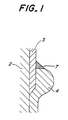
- a seal portion 7 made of a sealing agent such as rubber of silicone system is arranged at a boundary between the insulation overcoat member 3 and the securing metal fittings 4, which is exposed to an external atmosphere, so as to prevent an inclusion of water or the like through the boundary.
- the known polymer insulator having the construction mentioned above shows no problem on tracking-erosion properties of the insulation overcoat member 3 and the seal portion 7.
- the known polymer insulator is used under a severe fouling condition, or, if the known polymer insulator is subjected to an acceleration damage test, there is a case such that an erosion occurs at the seal portion 7. Therefore, in order to improve reliability of the polymer insulator, it is necessary to improve tracking-erosion resistant properties much more.
- the seal portion 7 is arranged at both ends of the polymer insulator 1, to which a high electric field is liable to be applied. Therefore, as shown.in Fig. 3, corona or dry-band-arc is liable to be generated at the seal portion 7, especially if the polymer insulator 1 is used under the severe fouling condition. Owing to this, in the seal portion 7, it is necessary to have excellent tracking-erosion resistant properties in addition to sealing properties which are same as those of the known polymer insulator.
- EP-A-617433 discloses an insulator similar to that of Fig.2.
- JP-A-8-41347 and JP-A-8-41348 describe silicone rubber containing aluminium trihydrater, optionally treated with silane coupling agent, as material of electrical insulators.
- Alumina trihydrater is Al 2 O 3 .3H 2 O.
- the present invention is achieved on the basis of the following finding obtained by various examinations. That is to say, in order to improve tracking-erosion resistant properties, it is effective to use a sealing agent, in which a predetermined amount of ATH preferably having a predetermined particle size and having a predetermined surface finishing is included, for the seal arranged between the insulation overcoat member and the securing metal fitting.
- Fig. 1 is a cross sectional view showing an enlarged main portion of a polymer insulator according to the invention.
- the polymer insulator according to the invention shown in Fig. 1 has fundamentally the same construction as that of the known polymer insulator shown in Fig. 2. Therefore, in the embodiment shown in Fig. 1, reference numerals similar to those of Fig. 2 are denoted by the same reference numerals as those of Fig. 2, and the explanations thereof are omitted here.
- ATH means alumina trihydrate (Al 2 O 3 .3H 2 O)
- Al(OH) 3 alumina trihydrate
- ATH changes in a form of Al 2 O 3 .3H 2 O. That is, the following reaction occurs by heating: 2Al(OH) 3 ⁇ Al 2 O 3 .3H 2 O).
- water is generated, and thus an applied heat is absorbed as a heat of evaporation of water. Therefore, it is known that, if a rubber includes ATH, it is possible to prevent a heat damage of the rubber including ATH.
- any suitable polymer component may be used for the seal agent of the seal portion 7.
- All suitable polymer components of silicone type may be used, and the curing type is not limited. Among them, it is preferred to use poly-dimethyl-siloxane.
- the particle size of ATH included in the sealing agent of the seal portion 7 is not particularly limited from a standpoint of improving tracking-erosion resistant properties.
- the particle size of ATH is preferably limited to 3 ⁇ m or more, more preferably 8 ⁇ m or more from view points of acid resistant properties, sealing properties and water absorbing properties as clearly understood from the following examples.
- an upper limitation of the particle size of ATH is preferably 50 ⁇ m. If the particle size of ATH is not less than 50 ⁇ m, the sealing agent may not be uniformly mixed and thus the seal portion 7 made of such a sealing agent may not have sufficient strength.
- particle size means average particle size.
- Sealing agents according to examples of the present invention some comparative examples , and a known example were prepared by setting conditions of ATH amount, ATH particle size, ATH surface finishing, and curing type as shown in the following Table 1.
- Table 1 poly-dimethyl-siloxane was used as the polymer component.
- the amount of ATH indicated is parts by weight of ATH with respect to 100 parts by weight of poly-dimethyl-siloxane.
- ATH surface finishing was effected by using silane coupling agent. Then, tracking-erosion resistant properties, acid resistant properties, and water absorbing properties of the thus prepared sealing agents were investigated, and also sealing properties of the polymer insulator using the thus prepared sealing agents for the seal portion was investigated.
- a tracking-erosion resistant property test was performed as follows. At first, specimens of the sealing agents shown in Table 1 were prepared on the basis of IEC 587 test method. Then, a tracking test voltage of 4.5 kV was applied constantly to the thus prepared specimens, and it was confirmed whether or not the specimen achieved a standard of 6 hours according to IEC 587 test method in which the specimen was endured for 6 hours under such a voltage applying condition. For the specimens which did not achieve the standard of 6 hours, a time duration until a stop of the tracking- erosion resistant test was measured. The results were shown in the following Table 2.
- sealing agent Name of sealing agent Name of sealing agent Time duration until stop of tracking-erosion resistant test based on IEC587 (hr) Known example 2.0 Comparative example 1 3.0 Example of present invention 1 > 6 Example 2 > 6 Example 3 > 6 Example of present invention 4 > 6 Example of present invention 5 > 6 Example of present invention 6 > 6 Example of present invention 7 > 6 Example of present invention 8 > 6 Example of present invention 9 > 6 Example of present invention 10 > 6 Comparative example 2 > 6
- the sealing agent has no problem if it has the same weight decrease rate as that of the known example. From the results shown in Table 3, it is understood that the examples 2 and 3 have a large weight decrease rate. This is because ATH used in the examples 2 and 3 is not subjected to the surface finishing and thus ATH is eluted. Moreover, it is understood that, if use is made of ATH to which the surface finishing is effected, the specimen has the same weight decrease rate as that of the known example and indicates an excellent acid resistant property.
- a water absorbing property test was performed in such a manner that the sealing agents according to the examples 1-10.
- the comparative examples 1-2, and the known examples were immersed in an ion-exchanged water and water absorbing properties were judged on the basis of the weight increase rate and a variation of volume resistivity of the sealing agent.
- the same water absorbing property test was performed for a silicone rubber constituting the insulation overcoat member. The results were shown in the following Table 4.
- the examples 2 and 3 have a large water absorbing amount. This is because ATH used in the examples 2 and 3 is not subjected to the surface finishing. Moreover, it is understood that the examples 2 and 3 have a large reduction rate of volume resistivity after water absorbing. This is also because ATH is not subjected to the surface finishing and thus a conduction path is liable to be generated after water absorbing. If such a sealing agent is used for an actual product, a performance of the seal portion becomes inferior as compared with a rubber constituting the insulation overcoat member. Therefore, an arc generation due to electric discharge is concentrated on the seal portion, and thus an erosion of the seal portion is liable to be generated.
- ATH it is preferred to use ATH to which the surface finishing using silane coupling agent is effected.
- an amount of ATH is increased in excess as shown in the comparative example 2, a water absorbing amount is increased and a volume resistivity us decreased as compared with that of rubber constituting the insulation overcoat member. Therefore, it is necessary to set an amount of ATH in the sealing agent up to 250 parts by weight with respect to 100 parts by weight of the polymer component.
- a sealing property test was performed as follows on the basis of IEC 1109 test method.
- polymer insulators in which sealing agents according to the examples 1-10, the comparative examples 1-2, and the known example were used for the exposed seal portion between the insulation overcoat member and the securing metal fitting, were prepared.
- the thus prepared polymer insulator was boiled in an NaCl aqueous solution having a concentration of 0.1 % for 100 hours and then immersed into a fuchsine solution. After that, sealing properties were judged on the basis of whether or not dyes were intruded into an inside of the securing metal fitting. The results were shown in the following Table 5.
- the sealing property is thought to be better if such an intrusion of dyes is not detected. From the results shown in Table 5, it is understood that the example 2 shows an intrusion of dyes. The reasons are as follows. That is, since ATH used in the example 2 has a small particle size such as 1 ⁇ m and is not subjected to the surface finishing, an elongation of the seal portion is little and the seal portion does not endure such a boiling stress.
- the examples 3 and 4 use ATH having a particle size of 3 ⁇ m.
- the sealing property is a permissible lower level.
- the seal portion show a sufficient sealing property.
- 150 parts by weight of ATH having a particle size of 1 ⁇ m since ATH is subjected to the surface finishing, its sealing property barely maintains a permissible lower level.
- ATH having a particle size of 8 ⁇ m is used as shown in the examples of present invention 5, 7-10, a sufficient elongation of the seal portion can be achieved if an amount of ATH is large, and thus a sufficient sealing property can be obtained.
- ATH having the same particle size of 8 ⁇ m is used, if 300 parts by weight of ATH is added, an amount of rubber becomes too small, and thus a sufficient elongation can be achieved, thereby decreasing its sealing property.
- Table 6 summarizes the tracking-erosion resistant properties, the acid resistant properties, and the water absorbing properties of the sealing agents, and also the sealing properties of the polymer insulator using the sealing agents for the seal portion. From the results shown in Table 6, it is understood that it is necessary to use a sealing agent in which 80-250 parts by weight of ATH is included with respect to 100 parts by weight of the polymer component, if mainly taking into consideration of the tracking-erosion resistant properties.
- ATH having a particle size of 3 ⁇ m or more, more preferably about 8 ⁇ m, and that it is preferred to use ATH to which the surface finishing using silane coupling agents is performed, if taking into consideration of the another properties other than the tracking-erosion resistant properties for reference.
- the sealing agent in which 80-250 parts by weight of ATH having preferably a predetermined particle size, to which a predetermined surface finishing is performed, is used for the seal portion arranged at a boundary between the insulation overcoat member and the securing metal fitting of the polymer insulator, which is exposed to an external atmosphere. Therefore, the polymer insulator according to the invention has an improved tracking-erosion resistant property.
Landscapes
- Insulators (AREA)
- Insulating Bodies (AREA)
- Compositions Of Macromolecular Compounds (AREA)
- Organic Insulating Materials (AREA)
Claims (3)
- Isolator aus Polymermaterial mit einem Kernteil (2), einem isolierenden Abdeckteil (4), der an einer Außenfläche des Kernteils angeordnet ist, einem Metallfitting (3) zur Befestigung, der an einem Endabschnitt des Kernteils so befestigt ist, dass das Metallfitting (3) den isolierenden Abdeckteil (4) berührt, und einem Abdichtkörper (7), der an einer Grenze zwischen dem isolierenden Abdeckteil (4) und dem Metallfitting (3) zur Befestigung angeordnet ist, wobei der Abdichtkörper aus einem Abdichtmittel hergestellt ist, das eine Polymerkomponente enthält, dadurch gekennzeichnet, dass das Abdichtmittel 80-250 Gew.-Teile Tonerdetrihydratteilchen mit einer Oberflächenbehandlung durch einen oder mehrere Haftvermittler auf Silanbasis pro 100 Gew.-Teile der genannten Polymerkomponente aufweist.
- Polymerisolator nach Anspruch 1, dadurch gekennzeichnet, dass die Polymerkomponente Polydimethylsiloxan ist.
- Polymerisolator nach Anspruch 1 oder 2, dadurch gekennzeichnet, dass die Teilchengröße des Tonerdetrihydrats 3 µm oder größer ist.
Applications Claiming Priority (6)
| Application Number | Priority Date | Filing Date | Title |
|---|---|---|---|
| JP166128/97 | 1997-06-23 | ||
| JP16612897 | 1997-06-23 | ||
| JP16612897 | 1997-06-23 | ||
| JP109292/98 | 1998-04-20 | ||
| JP10929298 | 1998-04-20 | ||
| JP10929298A JP3386715B2 (ja) | 1997-06-23 | 1998-04-20 | ポリマー碍子 |
Publications (3)
| Publication Number | Publication Date |
|---|---|
| EP0887809A2 EP0887809A2 (de) | 1998-12-30 |
| EP0887809A3 EP0887809A3 (de) | 1999-02-17 |
| EP0887809B1 true EP0887809B1 (de) | 2002-03-20 |
Family
ID=26449071
Family Applications (1)
| Application Number | Title | Priority Date | Filing Date |
|---|---|---|---|
| EP98304918A Expired - Lifetime EP0887809B1 (de) | 1997-06-23 | 1998-06-23 | Polymer-Isolator |
Country Status (4)
| Country | Link |
|---|---|
| US (1) | US6118079A (de) |
| EP (1) | EP0887809B1 (de) |
| JP (1) | JP3386715B2 (de) |
| DE (1) | DE69804271T2 (de) |
Families Citing this family (3)
| Publication number | Priority date | Publication date | Assignee | Title |
|---|---|---|---|---|
| US6440344B2 (en) * | 1997-03-11 | 2002-08-27 | Ngk Insulators, Ltd. | Method of manufacturing composite insulator and packing member for use in same |
| US20040071416A1 (en) * | 2002-10-15 | 2004-04-15 | Militaru Cristian I. | Optical cable having an increased resistance to dry band arcing and method for its manufacture |
| EP3404060B1 (de) | 2017-05-19 | 2022-08-03 | Hitachi Energy Switzerland AG | Silikonkautschuk mit ath-füllstoff |
Citations (2)
| Publication number | Priority date | Publication date | Assignee | Title |
|---|---|---|---|---|
| JPH0841347A (ja) * | 1994-05-27 | 1996-02-13 | Shin Etsu Chem Co Ltd | 高電圧電気絶縁体用シリコーンゴム組成物 |
| JPH0841348A (ja) * | 1994-05-27 | 1996-02-13 | Shin Etsu Chem Co Ltd | 高電圧電気絶縁体用シリコーンゴム組成物 |
Family Cites Families (10)
| Publication number | Priority date | Publication date | Assignee | Title |
|---|---|---|---|---|
| US2768264A (en) * | 1953-04-28 | 1956-10-23 | Rostone Corp | Arc-suppressing device |
| US2997526A (en) * | 1957-01-09 | 1961-08-22 | Gen Electric | Electrical apparatus having insulation for eliminating creepage tracking |
| US3042743A (en) * | 1960-03-09 | 1962-07-03 | Mc Graw Edison Co | Coil for electrical rotating machine |
| US3626083A (en) * | 1968-01-12 | 1971-12-07 | Westinghouse Electric Corp | High-voltage insulation and insulated high-voltage apparatus |
| US4001128A (en) * | 1972-07-21 | 1977-01-04 | Raychem Corporation | High voltage insulating materials |
| JPS5866213A (ja) * | 1981-10-15 | 1983-04-20 | 株式会社東芝 | 絶緑体 |
| DE3302788A1 (de) * | 1983-01-28 | 1984-08-16 | Rosenthal Technik Ag, 8672 Selb | Abdichtung zwischen metallarmatur und glasfaserstab bei hochspannungs-verbundisolatoren |
| US4476155A (en) * | 1983-04-18 | 1984-10-09 | Dow Corning Corporation | High voltage insulators |
| JP2664616B2 (ja) * | 1993-03-25 | 1997-10-15 | 日本碍子株式会社 | ノンセラミック碍子の気密構造 |
| JP2820380B2 (ja) * | 1995-02-21 | 1998-11-05 | 日本碍子株式会社 | ポリマー碍子の製造方法 |
-
1998
- 1998-04-20 JP JP10929298A patent/JP3386715B2/ja not_active Expired - Lifetime
- 1998-06-11 US US09/096,872 patent/US6118079A/en not_active Expired - Lifetime
- 1998-06-23 EP EP98304918A patent/EP0887809B1/de not_active Expired - Lifetime
- 1998-06-23 DE DE69804271T patent/DE69804271T2/de not_active Expired - Lifetime
Patent Citations (2)
| Publication number | Priority date | Publication date | Assignee | Title |
|---|---|---|---|---|
| JPH0841347A (ja) * | 1994-05-27 | 1996-02-13 | Shin Etsu Chem Co Ltd | 高電圧電気絶縁体用シリコーンゴム組成物 |
| JPH0841348A (ja) * | 1994-05-27 | 1996-02-13 | Shin Etsu Chem Co Ltd | 高電圧電気絶縁体用シリコーンゴム組成物 |
Also Published As
| Publication number | Publication date |
|---|---|
| US6118079A (en) | 2000-09-12 |
| EP0887809A3 (de) | 1999-02-17 |
| EP0887809A2 (de) | 1998-12-30 |
| DE69804271D1 (de) | 2002-04-25 |
| JPH1173828A (ja) | 1999-03-16 |
| JP3386715B2 (ja) | 2003-03-17 |
| DE69804271T2 (de) | 2002-12-12 |
Similar Documents
| Publication | Publication Date | Title |
|---|---|---|
| DE69700517T2 (de) | Silikonkautschukmischungen | |
| Hackam | Outdoor high voltage polymeric insulators | |
| JP2689281B2 (ja) | 屋外で使用する碍子用シリコーンゴム組成物 | |
| AU577284B2 (en) | Electrical stress control in cable | |
| EP0123487A2 (de) | Verfahren zur Verbesserung von Hochspannungsisolatoren und dafür geeignete Mischung | |
| JPH069129B2 (ja) | 電気絶縁体および電気絶縁体用シリコーン組成物 | |
| DE1621854A1 (de) | Verfahren zur Herstellung von elektrischen Isolatoren | |
| EP0887809A2 (de) | Polymer-Isolator | |
| DE69737335T2 (de) | Festelektrolytkondensator und dessen Herstellungsverfahren | |
| JPH0530626A (ja) | 複合絶縁方式母線 | |
| US4795769A (en) | Electric insulation with a silicic acid additive made by a melt process | |
| CN105719722A (zh) | 一种单芯铝合金电缆及多芯铝合金电缆 | |
| JPH064793B2 (ja) | 雲母の電着用組成物 | |
| JPH11232931A (ja) | 絶縁電線 | |
| EP0805491A3 (de) | Leiterbahnstruktur und Herstellunsgmethode, wobei zwei verschiedene isolierende Materialien mit kleiner Dielektrizitätskonstante verwendet werden | |
| JPH01242655A (ja) | エポキシ樹脂組成物 | |
| Cao et al. | Effects of Heating on the Presence of Fluid in EPDM | |
| JPH04322009A (ja) | 架橋ポリエチレン電力ケーブル | |
| JP2730119B2 (ja) | 絶縁塗料 | |
| US20110003946A1 (en) | Curable reaction resin system | |
| Reid et al. | Water-tree degradation in power cable insulation: understanding and prevention | |
| DE7046308U (de) | Halbleitervorrichtung mit einer intermetallischen passivierung | |
| DE69129046T2 (de) | Glasfrontplatte und damit versehene Kathodenstrahlröhre | |
| JPS61133504A (ja) | 着色架橋ポリエチレン絶縁電線 | |
| SU476618A1 (ru) | Изол ционное покрытие дл подогревателей |
Legal Events
| Date | Code | Title | Description |
|---|---|---|---|
| PUAI | Public reference made under article 153(3) epc to a published international application that has entered the european phase |
Free format text: ORIGINAL CODE: 0009012 |
|
| AK | Designated contracting states |
Kind code of ref document: A2 Designated state(s): DE FR GB |
|
| AX | Request for extension of the european patent |
Free format text: AL;LT;LV;MK;RO;SI |
|
| PUAL | Search report despatched |
Free format text: ORIGINAL CODE: 0009013 |
|
| AK | Designated contracting states |
Kind code of ref document: A3 Designated state(s): AT BE CH CY DE DK ES FI FR GB GR IE IT LI LU MC NL PT SE |
|
| AX | Request for extension of the european patent |
Free format text: AL;LT;LV;MK;RO;SI |
|
| 17P | Request for examination filed |
Effective date: 19990310 |
|
| AKX | Designation fees paid |
Free format text: DE FR GB |
|
| 17Q | First examination report despatched |
Effective date: 20001129 |
|
| GRAG | Despatch of communication of intention to grant |
Free format text: ORIGINAL CODE: EPIDOS AGRA |
|
| GRAG | Despatch of communication of intention to grant |
Free format text: ORIGINAL CODE: EPIDOS AGRA |
|
| GRAH | Despatch of communication of intention to grant a patent |
Free format text: ORIGINAL CODE: EPIDOS IGRA |
|
| GRAH | Despatch of communication of intention to grant a patent |
Free format text: ORIGINAL CODE: EPIDOS IGRA |
|
| REG | Reference to a national code |
Ref country code: GB Ref legal event code: IF02 |
|
| GRAA | (expected) grant |
Free format text: ORIGINAL CODE: 0009210 |
|
| AK | Designated contracting states |
Kind code of ref document: B1 Designated state(s): DE FR GB |
|
| REF | Corresponds to: |
Ref document number: 69804271 Country of ref document: DE Date of ref document: 20020425 |
|
| PLBE | No opposition filed within time limit |
Free format text: ORIGINAL CODE: 0009261 |
|
| STAA | Information on the status of an ep patent application or granted ep patent |
Free format text: STATUS: NO OPPOSITION FILED WITHIN TIME LIMIT |
|
| 26N | No opposition filed |
Effective date: 20021223 |
|
| REG | Reference to a national code |
Ref country code: FR Ref legal event code: PLFP Year of fee payment: 19 |
|
| REG | Reference to a national code |
Ref country code: FR Ref legal event code: PLFP Year of fee payment: 20 |
|
| PGFP | Annual fee paid to national office [announced via postgrant information from national office to epo] |
Ref country code: FR Payment date: 20170511 Year of fee payment: 20 Ref country code: GB Payment date: 20170621 Year of fee payment: 20 |
|
| PGFP | Annual fee paid to national office [announced via postgrant information from national office to epo] |
Ref country code: DE Payment date: 20170621 Year of fee payment: 20 |
|
| REG | Reference to a national code |
Ref country code: DE Ref legal event code: R071 Ref document number: 69804271 Country of ref document: DE |
|
| REG | Reference to a national code |
Ref country code: GB Ref legal event code: PE20 Expiry date: 20180622 |
|
| PG25 | Lapsed in a contracting state [announced via postgrant information from national office to epo] |
Ref country code: GB Free format text: LAPSE BECAUSE OF EXPIRATION OF PROTECTION Effective date: 20180622 |