EP0889736B1 - Compose immunostimulateur ou matrice de composes immunostimulateurs renfermant une substance ciblant le mucus et un antigene - Google Patents
Compose immunostimulateur ou matrice de composes immunostimulateurs renfermant une substance ciblant le mucus et un antigene Download PDFInfo
- Publication number
- EP0889736B1 EP0889736B1 EP97905541A EP97905541A EP0889736B1 EP 0889736 B1 EP0889736 B1 EP 0889736B1 EP 97905541 A EP97905541 A EP 97905541A EP 97905541 A EP97905541 A EP 97905541A EP 0889736 B1 EP0889736 B1 EP 0889736B1
- Authority
- EP
- European Patent Office
- Prior art keywords
- iscom
- ova
- iscoms
- antigen
- matrix
- Prior art date
- Legal status (The legal status is an assumption and is not a legal conclusion. Google has not performed a legal analysis and makes no representation as to the accuracy of the status listed.)
- Expired - Lifetime
Links
- 239000000427 antigen Substances 0.000 title claims description 189
- 108091007433 antigens Proteins 0.000 title claims description 187
- 102000036639 antigens Human genes 0.000 title claims description 187
- 239000011159 matrix material Substances 0.000 title claims description 144
- 210000003097 mucus Anatomy 0.000 title description 52
- 239000000126 substance Substances 0.000 title description 16
- 230000028993 immune response Effects 0.000 claims abstract description 62
- 102000004169 proteins and genes Human genes 0.000 claims abstract description 59
- 108090000623 proteins and genes Proteins 0.000 claims abstract description 59
- 230000008685 targeting Effects 0.000 claims abstract description 55
- 150000002632 lipids Chemical class 0.000 claims abstract description 48
- 210000004400 mucous membrane Anatomy 0.000 claims abstract description 31
- 230000002163 immunogen Effects 0.000 claims abstract description 27
- 229930182470 glycoside Natural products 0.000 claims abstract description 17
- 150000002338 glycosides Chemical class 0.000 claims abstract description 17
- 210000003563 lymphoid tissue Anatomy 0.000 claims abstract description 10
- 150000001720 carbohydrates Chemical class 0.000 claims abstract description 8
- 239000000203 mixture Substances 0.000 claims description 110
- 210000004072 lung Anatomy 0.000 claims description 82
- 241000700605 Viruses Species 0.000 claims description 49
- 239000002671 adjuvant Substances 0.000 claims description 40
- 241000702670 Rotavirus Species 0.000 claims description 39
- 210000002345 respiratory system Anatomy 0.000 claims description 34
- 229960005486 vaccine Drugs 0.000 claims description 32
- 241000725643 Respiratory syncytial virus Species 0.000 claims description 27
- 241001465754 Metazoa Species 0.000 claims description 22
- 102000009016 Cholera Toxin Human genes 0.000 claims description 21
- 108010049048 Cholera Toxin Proteins 0.000 claims description 21
- 101710091045 Envelope protein Proteins 0.000 claims description 21
- 101710188315 Protein X Proteins 0.000 claims description 21
- 210000000936 intestine Anatomy 0.000 claims description 19
- 230000000694 effects Effects 0.000 claims description 15
- 241000894006 Bacteria Species 0.000 claims description 13
- 210000004369 blood Anatomy 0.000 claims description 13
- 239000008280 blood Substances 0.000 claims description 13
- 229930182558 Sterol Natural products 0.000 claims description 9
- 150000003432 sterols Chemical class 0.000 claims description 9
- 235000003702 sterols Nutrition 0.000 claims description 9
- 244000005700 microbiome Species 0.000 claims description 8
- 239000003053 toxin Substances 0.000 claims description 8
- 231100000765 toxin Toxicity 0.000 claims description 8
- 208000009889 Herpes Simplex Diseases 0.000 claims description 7
- 241000204031 Mycoplasma Species 0.000 claims description 7
- 108090000765 processed proteins & peptides Proteins 0.000 claims description 7
- 241000588724 Escherichia coli Species 0.000 claims description 6
- 241000709664 Picornaviridae Species 0.000 claims description 6
- 230000001580 bacterial effect Effects 0.000 claims description 6
- 102000004196 processed proteins & peptides Human genes 0.000 claims description 6
- 241000701161 unidentified adenovirus Species 0.000 claims description 6
- 241000607768 Shigella Species 0.000 claims description 4
- 244000309743 astrovirus Species 0.000 claims description 4
- 230000003308 immunostimulating effect Effects 0.000 claims description 4
- 244000045947 parasite Species 0.000 claims description 4
- 230000009885 systemic effect Effects 0.000 claims description 4
- 241001529453 unidentified herpesvirus Species 0.000 claims description 4
- 241000606161 Chlamydia Species 0.000 claims description 3
- 241000711573 Coronaviridae Species 0.000 claims description 3
- 108090000288 Glycoproteins Proteins 0.000 claims description 3
- 102000003886 Glycoproteins Human genes 0.000 claims description 3
- 241000713772 Human immunodeficiency virus 1 Species 0.000 claims description 3
- 241000711798 Rabies lyssavirus Species 0.000 claims description 3
- 108010008038 Synthetic Vaccines Proteins 0.000 claims description 3
- 239000013543 active substance Substances 0.000 claims description 3
- 230000004936 stimulating effect Effects 0.000 claims description 3
- 241001430294 unidentified retrovirus Species 0.000 claims description 3
- 241000712891 Arenavirus Species 0.000 claims description 2
- 241000701083 Bovine alphaherpesvirus 1 Species 0.000 claims description 2
- 108091006027 G proteins Proteins 0.000 claims description 2
- 102000030782 GTP binding Human genes 0.000 claims description 2
- 108091000058 GTP-Binding Proteins 0.000 claims description 2
- 208000031886 HIV Infections Diseases 0.000 claims description 2
- 241000713340 Human immunodeficiency virus 2 Species 0.000 claims description 2
- 108010052285 Membrane Proteins Proteins 0.000 claims description 2
- 241000714209 Norwalk virus Species 0.000 claims description 2
- 241000713112 Orthobunyavirus Species 0.000 claims description 2
- 241000125945 Protoparvovirus Species 0.000 claims description 2
- 241000607142 Salmonella Species 0.000 claims description 2
- 235000014633 carbohydrates Nutrition 0.000 claims description 2
- 102100021696 Syncytin-1 Human genes 0.000 claims 2
- 241000244160 Echinococcus Species 0.000 claims 1
- 102000002068 Glycopeptides Human genes 0.000 claims 1
- 108010015899 Glycopeptides Proteins 0.000 claims 1
- 241001064231 Goat enterovirus Species 0.000 claims 1
- 241000606790 Haemophilus Species 0.000 claims 1
- 241000244206 Nematoda Species 0.000 claims 1
- 241000242678 Schistosoma Species 0.000 claims 1
- 241000282887 Suidae Species 0.000 claims 1
- 241000223996 Toxoplasma Species 0.000 claims 1
- 241000869417 Trematodes Species 0.000 claims 1
- QPJBWNIQKHGLAU-IQZHVAEDSA-N ganglioside GM1 Chemical compound O[C@@H]1[C@@H](O)[C@H](OC[C@H](NC(=O)CCCCCCCCCCCCCCCCC)[C@H](O)\C=C\CCCCCCCCCCCCC)O[C@H](CO)[C@H]1O[C@H]1[C@H](O)[C@@H](O[C@]2(O[C@H]([C@H](NC(C)=O)[C@@H](O)C2)[C@H](O)[C@H](O)CO)C(O)=O)[C@@H](O[C@H]2[C@@H]([C@@H](O[C@H]3[C@@H]([C@@H](O)[C@@H](O)[C@@H](CO)O3)O)[C@@H](O)[C@@H](CO)O2)NC(C)=O)[C@@H](CO)O1 QPJBWNIQKHGLAU-IQZHVAEDSA-N 0.000 claims 1
- 230000001295 genetical effect Effects 0.000 claims 1
- 244000309711 non-enveloped viruses Species 0.000 claims 1
- 235000018102 proteins Nutrition 0.000 claims 1
- 229940124551 recombinant vaccine Drugs 0.000 claims 1
- 230000010415 tropism Effects 0.000 abstract 1
- 108010058846 Ovalbumin Proteins 0.000 description 160
- 229940092253 ovalbumin Drugs 0.000 description 159
- 238000002649 immunization Methods 0.000 description 148
- 230000005875 antibody response Effects 0.000 description 139
- 210000002966 serum Anatomy 0.000 description 130
- 230000003053 immunization Effects 0.000 description 129
- 230000004044 response Effects 0.000 description 102
- 241000699670 Mus sp. Species 0.000 description 98
- 238000009472 formulation Methods 0.000 description 85
- 230000028327 secretion Effects 0.000 description 81
- 238000002965 ELISA Methods 0.000 description 51
- 238000007920 subcutaneous administration Methods 0.000 description 48
- HVYWMOMLDIMFJA-DPAQBDIFSA-N cholesterol Chemical compound C1C=C2C[C@@H](O)CC[C@]2(C)[C@@H]2[C@@H]1[C@@H]1CC[C@H]([C@H](C)CCCC(C)C)[C@@]1(C)CC2 HVYWMOMLDIMFJA-DPAQBDIFSA-N 0.000 description 47
- 210000004027 cell Anatomy 0.000 description 36
- 210000005000 reproductive tract Anatomy 0.000 description 36
- 238000000034 method Methods 0.000 description 35
- 235000009001 Quillaja saponaria Nutrition 0.000 description 34
- 238000002360 preparation method Methods 0.000 description 34
- 241001092473 Quillaja Species 0.000 description 33
- 238000002474 experimental method Methods 0.000 description 27
- 108020003175 receptors Proteins 0.000 description 25
- 102000005962 receptors Human genes 0.000 description 25
- 210000000056 organ Anatomy 0.000 description 24
- 230000001965 increasing effect Effects 0.000 description 23
- 238000002255 vaccination Methods 0.000 description 22
- 208000015181 infectious disease Diseases 0.000 description 20
- 102100027723 Endogenous retrovirus group K member 6 Rec protein Human genes 0.000 description 19
- 235000012000 cholesterol Nutrition 0.000 description 19
- 229930006000 Sucrose Natural products 0.000 description 18
- CZMRCDWAGMRECN-UGDNZRGBSA-N Sucrose Chemical compound O[C@H]1[C@H](O)[C@@H](CO)O[C@@]1(CO)O[C@@H]1[C@H](O)[C@@H](O)[C@H](O)[C@@H](CO)O1 CZMRCDWAGMRECN-UGDNZRGBSA-N 0.000 description 18
- 239000005720 sucrose Substances 0.000 description 18
- 241000699666 Mus <mouse, genus> Species 0.000 description 17
- 230000000763 evoking effect Effects 0.000 description 16
- 239000000243 solution Substances 0.000 description 16
- 208000037265 diseases, disorders, signs and symptoms Diseases 0.000 description 15
- 238000001493 electron microscopy Methods 0.000 description 15
- UMWKZHPREXJQGR-UHFFFAOYSA-N n-methyl-n-(2,3,4,5,6-pentahydroxyhexyl)decanamide Chemical compound CCCCCCCCCC(=O)N(C)CC(O)C(O)C(O)C(O)CO UMWKZHPREXJQGR-UHFFFAOYSA-N 0.000 description 15
- 239000002245 particle Substances 0.000 description 15
- 241000712461 unidentified influenza virus Species 0.000 description 15
- 238000011161 development Methods 0.000 description 14
- 201000010099 disease Diseases 0.000 description 14
- 239000000284 extract Substances 0.000 description 13
- JZNWSCPGTDBMEW-UHFFFAOYSA-N Glycerophosphorylethanolamin Natural products NCCOP(O)(=O)OCC(O)CO JZNWSCPGTDBMEW-UHFFFAOYSA-N 0.000 description 12
- 241000711920 Human orthopneumovirus Species 0.000 description 12
- 241000283903 Ovis aries Species 0.000 description 12
- 150000008104 phosphatidylethanolamines Chemical class 0.000 description 12
- 208000032843 Hemorrhage Diseases 0.000 description 11
- UZQJVUCHXGYFLQ-AYDHOLPZSA-N [(2s,3r,4s,5r,6r)-4-[(2s,3r,4s,5r,6r)-4-[(2r,3r,4s,5r,6r)-4-[(2s,3r,4s,5r,6r)-3,5-dihydroxy-6-(hydroxymethyl)-4-[(2s,3r,4s,5s,6r)-3,4,5-trihydroxy-6-(hydroxymethyl)oxan-2-yl]oxyoxan-2-yl]oxy-3,5-dihydroxy-6-(hydroxymethyl)oxan-2-yl]oxy-3,5-dihydroxy-6-(hy Chemical compound O([C@H]1[C@H](O)[C@@H](CO)O[C@H]([C@@H]1O)O[C@H]1[C@H](O)[C@@H](CO)O[C@H]([C@@H]1O)O[C@H]1CC[C@]2(C)[C@H]3CC=C4[C@@]([C@@]3(CC[C@H]2[C@@]1(C=O)C)C)(C)CC(O)[C@]1(CCC(CC14)(C)C)C(=O)O[C@H]1[C@@H]([C@@H](O[C@H]2[C@@H]([C@@H](O[C@H]3[C@@H]([C@@H](O[C@H]4[C@@H]([C@@H](O[C@H]5[C@@H]([C@@H](O)[C@H](O)[C@@H](CO)O5)O)[C@H](O)[C@@H](CO)O4)O)[C@H](O)[C@@H](CO)O3)O)[C@H](O)[C@@H](CO)O2)O)[C@H](O)[C@@H](CO)O1)O)[C@@H]1O[C@H](CO)[C@@H](O)[C@H](O)[C@H]1O UZQJVUCHXGYFLQ-AYDHOLPZSA-N 0.000 description 11
- 208000034158 bleeding Diseases 0.000 description 11
- 231100000319 bleeding Toxicity 0.000 description 11
- 230000000740 bleeding effect Effects 0.000 description 11
- 239000003795 chemical substances by application Substances 0.000 description 11
- 238000010348 incorporation Methods 0.000 description 11
- 230000003248 secreting effect Effects 0.000 description 11
- 230000002519 immonomodulatory effect Effects 0.000 description 10
- 210000004379 membrane Anatomy 0.000 description 10
- 239000012528 membrane Substances 0.000 description 10
- 238000004062 sedimentation Methods 0.000 description 10
- 241000283973 Oryctolagus cuniculus Species 0.000 description 9
- 239000000872 buffer Substances 0.000 description 9
- 230000000875 corresponding effect Effects 0.000 description 9
- 238000010790 dilution Methods 0.000 description 9
- 239000012895 dilution Substances 0.000 description 9
- 230000006698 induction Effects 0.000 description 9
- 210000004698 lymphocyte Anatomy 0.000 description 9
- WTJKGGKOPKCXLL-RRHRGVEJSA-N phosphatidylcholine Chemical compound CCCCCCCCCCCCCCCC(=O)OC[C@H](COP([O-])(=O)OCC[N+](C)(C)C)OC(=O)CCCCCCCC=CCCCCCCCC WTJKGGKOPKCXLL-RRHRGVEJSA-N 0.000 description 9
- 238000005199 ultracentrifugation Methods 0.000 description 9
- 238000001262 western blot Methods 0.000 description 9
- 230000001939 inductive effect Effects 0.000 description 8
- 238000012360 testing method Methods 0.000 description 8
- 241000202936 Mycoplasma mycoides Species 0.000 description 7
- 230000008901 benefit Effects 0.000 description 7
- 238000010276 construction Methods 0.000 description 7
- 230000029142 excretion Effects 0.000 description 7
- 230000002209 hydrophobic effect Effects 0.000 description 7
- 239000000463 material Substances 0.000 description 7
- 239000000047 product Substances 0.000 description 7
- 108700012359 toxins Proteins 0.000 description 7
- 241000282414 Homo sapiens Species 0.000 description 6
- 241000701074 Human alphaherpesvirus 2 Species 0.000 description 6
- FAPWRFPIFSIZLT-UHFFFAOYSA-M Sodium chloride Chemical compound [Na+].[Cl-] FAPWRFPIFSIZLT-UHFFFAOYSA-M 0.000 description 6
- 238000002835 absorbance Methods 0.000 description 6
- 238000005119 centrifugation Methods 0.000 description 6
- 238000012512 characterization method Methods 0.000 description 6
- 230000003247 decreasing effect Effects 0.000 description 6
- 239000003599 detergent Substances 0.000 description 6
- 230000006870 function Effects 0.000 description 6
- 210000001035 gastrointestinal tract Anatomy 0.000 description 6
- UCSJYZPVAKXKNQ-HZYVHMACSA-N streptomycin Chemical compound CN[C@H]1[C@H](O)[C@@H](O)[C@H](CO)O[C@H]1O[C@@H]1[C@](C=O)(O)[C@H](C)O[C@H]1O[C@@H]1[C@@H](NC(N)=N)[C@H](O)[C@@H](NC(N)=N)[C@H](O)[C@H]1O UCSJYZPVAKXKNQ-HZYVHMACSA-N 0.000 description 6
- 239000000758 substrate Substances 0.000 description 6
- 238000012412 chemical coupling Methods 0.000 description 5
- 238000006243 chemical reaction Methods 0.000 description 5
- 210000000207 lymphocyte subset Anatomy 0.000 description 5
- 230000003472 neutralizing effect Effects 0.000 description 5
- 210000001986 peyer's patch Anatomy 0.000 description 5
- 230000003362 replicative effect Effects 0.000 description 5
- 229930182490 saponin Natural products 0.000 description 5
- 150000007949 saponins Chemical class 0.000 description 5
- 235000017709 saponins Nutrition 0.000 description 5
- 210000000813 small intestine Anatomy 0.000 description 5
- 241000283707 Capra Species 0.000 description 4
- 206010008631 Cholera Diseases 0.000 description 4
- 229930186217 Glycolipid Natural products 0.000 description 4
- 108010074328 Interferon-gamma Proteins 0.000 description 4
- 239000000654 additive Substances 0.000 description 4
- 238000004458 analytical method Methods 0.000 description 4
- 210000000612 antigen-presenting cell Anatomy 0.000 description 4
- 230000000890 antigenic effect Effects 0.000 description 4
- 238000003556 assay Methods 0.000 description 4
- 238000001514 detection method Methods 0.000 description 4
- 238000003114 enzyme-linked immunosorbent spot assay Methods 0.000 description 4
- 239000000945 filler Substances 0.000 description 4
- 239000012634 fragment Substances 0.000 description 4
- 210000000987 immune system Anatomy 0.000 description 4
- 230000001681 protective effect Effects 0.000 description 4
- 230000002829 reductive effect Effects 0.000 description 4
- 230000000241 respiratory effect Effects 0.000 description 4
- 239000000725 suspension Substances 0.000 description 4
- GVJXGCIPWAVXJP-UHFFFAOYSA-N 2,5-dioxo-1-oxoniopyrrolidine-3-sulfonate Chemical compound ON1C(=O)CC(S(O)(=O)=O)C1=O GVJXGCIPWAVXJP-UHFFFAOYSA-N 0.000 description 3
- UZOVYGYOLBIAJR-UHFFFAOYSA-N 4-isocyanato-4'-methyldiphenylmethane Chemical compound C1=CC(C)=CC=C1CC1=CC=C(N=C=O)C=C1 UZOVYGYOLBIAJR-UHFFFAOYSA-N 0.000 description 3
- APKFDSVGJQXUKY-KKGHZKTASA-N Amphotericin-B Natural products O[C@H]1[C@@H](N)[C@H](O)[C@@H](C)O[C@H]1O[C@H]1C=CC=CC=CC=CC=CC=CC=C[C@H](C)[C@@H](O)[C@@H](C)[C@H](C)OC(=O)C[C@H](O)C[C@H](O)CC[C@@H](O)[C@H](O)C[C@H](O)C[C@](O)(C[C@H](O)[C@H]2C(O)=O)O[C@H]2C1 APKFDSVGJQXUKY-KKGHZKTASA-N 0.000 description 3
- 241000283690 Bos taurus Species 0.000 description 3
- 108091003079 Bovine Serum Albumin Proteins 0.000 description 3
- 108010001336 Horseradish Peroxidase Proteins 0.000 description 3
- 102100037850 Interferon gamma Human genes 0.000 description 3
- 235000019687 Lamb Nutrition 0.000 description 3
- 102100022119 Lipoprotein lipase Human genes 0.000 description 3
- 229920001213 Polysorbate 20 Polymers 0.000 description 3
- 108010090804 Streptavidin Proteins 0.000 description 3
- QAOWNCQODCNURD-UHFFFAOYSA-N Sulfuric acid Chemical compound OS(O)(=O)=O QAOWNCQODCNURD-UHFFFAOYSA-N 0.000 description 3
- 230000000996 additive effect Effects 0.000 description 3
- 230000002776 aggregation Effects 0.000 description 3
- 238000004220 aggregation Methods 0.000 description 3
- 238000013019 agitation Methods 0.000 description 3
- APKFDSVGJQXUKY-INPOYWNPSA-N amphotericin B Chemical compound O[C@H]1[C@@H](N)[C@H](O)[C@@H](C)O[C@H]1O[C@H]1/C=C/C=C/C=C/C=C/C=C/C=C/C=C/[C@H](C)[C@@H](O)[C@@H](C)[C@H](C)OC(=O)C[C@H](O)C[C@H](O)CC[C@@H](O)[C@H](O)C[C@H](O)C[C@](O)(C[C@H](O)[C@H]2C(O)=O)O[C@H]2C1 APKFDSVGJQXUKY-INPOYWNPSA-N 0.000 description 3
- 229960003942 amphotericin b Drugs 0.000 description 3
- 230000002953 anti-rotaviral effect Effects 0.000 description 3
- 230000004888 barrier function Effects 0.000 description 3
- 229940098773 bovine serum albumin Drugs 0.000 description 3
- 239000000969 carrier Substances 0.000 description 3
- 239000011248 coating agent Substances 0.000 description 3
- 238000000576 coating method Methods 0.000 description 3
- 230000001419 dependent effect Effects 0.000 description 3
- 238000006911 enzymatic reaction Methods 0.000 description 3
- 210000004392 genitalia Anatomy 0.000 description 3
- ZDXPYRJPNDTMRX-UHFFFAOYSA-N glutamine Natural products OC(=O)C(N)CCC(N)=O ZDXPYRJPNDTMRX-UHFFFAOYSA-N 0.000 description 3
- 229920000669 heparin Polymers 0.000 description 3
- 229960002897 heparin Drugs 0.000 description 3
- 238000011534 incubation Methods 0.000 description 3
- 210000002011 intestinal secretion Anatomy 0.000 description 3
- 210000005024 intraepithelial lymphocyte Anatomy 0.000 description 3
- 230000021633 leukocyte mediated immunity Effects 0.000 description 3
- 210000004324 lymphatic system Anatomy 0.000 description 3
- 238000004519 manufacturing process Methods 0.000 description 3
- 230000016379 mucosal immune response Effects 0.000 description 3
- 238000013421 nuclear magnetic resonance imaging Methods 0.000 description 3
- 238000001543 one-way ANOVA Methods 0.000 description 3
- 238000007911 parenteral administration Methods 0.000 description 3
- 102000013415 peroxidase activity proteins Human genes 0.000 description 3
- 108040007629 peroxidase activity proteins Proteins 0.000 description 3
- 239000000256 polyoxyethylene sorbitan monolaurate Substances 0.000 description 3
- 235000010486 polyoxyethylene sorbitan monolaurate Nutrition 0.000 description 3
- 230000003389 potentiating effect Effects 0.000 description 3
- 230000037452 priming Effects 0.000 description 3
- 239000001397 quillaja saponaria molina bark Substances 0.000 description 3
- 230000002285 radioactive effect Effects 0.000 description 3
- 239000013049 sediment Substances 0.000 description 3
- 150000003384 small molecules Chemical class 0.000 description 3
- 239000011780 sodium chloride Substances 0.000 description 3
- 229960005322 streptomycin Drugs 0.000 description 3
- 231100000331 toxic Toxicity 0.000 description 3
- 230000002588 toxic effect Effects 0.000 description 3
- 238000005406 washing Methods 0.000 description 3
- XLYOFNOQVPJJNP-UHFFFAOYSA-N water Substances O XLYOFNOQVPJJNP-UHFFFAOYSA-N 0.000 description 3
- PIGTXFOGKFOFTO-FVFWYJKVSA-N (2S,3S,4S,5R,6R)-6-[[(3S,4S,4aR,6aR,6bS,8R,8aR,12aS,14aR,14bR)-8a-carboxy-4-formyl-8-hydroxy-4,6a,6b,11,11,14b-hexamethyl-1,2,3,4a,5,6,7,8,9,10,12,12a,14,14a-tetradecahydropicen-3-yl]oxy]-3,4,5-trihydroxyoxane-2-carboxylic acid Chemical compound O([C@H]1CC[C@]2(C)[C@H]3CC=C4[C@@]([C@@]3(CC[C@H]2[C@@]1(C=O)C)C)(C)C[C@@H](O)[C@]1(CCC(C[C@H]14)(C)C)C(O)=O)[C@@H]1O[C@H](C(O)=O)[C@@H](O)[C@H](O)[C@H]1O PIGTXFOGKFOFTO-FVFWYJKVSA-N 0.000 description 2
- HVCOBJNICQPDBP-UHFFFAOYSA-N 3-[3-[3,5-dihydroxy-6-methyl-4-(3,4,5-trihydroxy-6-methyloxan-2-yl)oxyoxan-2-yl]oxydecanoyloxy]decanoic acid;hydrate Chemical compound O.OC1C(OC(CC(=O)OC(CCCCCCC)CC(O)=O)CCCCCCC)OC(C)C(O)C1OC1C(O)C(O)C(O)C(C)O1 HVCOBJNICQPDBP-UHFFFAOYSA-N 0.000 description 2
- UGSXKTPGBJVRGO-UHFFFAOYSA-N 6-Hydroxyluteolin 7-O-(6''-O-(E)-caffeoyl)-glucopyranoside Natural products O1C(OC=2C(=C(O)C=3C(=O)C=C(OC=3C=2)C=2C=C(O)C(O)=CC=2)O)C(O)C(O)C(O)C1COC(=O)C=CC1=CC=C(O)C(O)=C1 UGSXKTPGBJVRGO-UHFFFAOYSA-N 0.000 description 2
- OXEUETBFKVCRNP-UHFFFAOYSA-N 9-ethyl-3-carbazolamine Chemical compound NC1=CC=C2N(CC)C3=CC=CC=C3C2=C1 OXEUETBFKVCRNP-UHFFFAOYSA-N 0.000 description 2
- 206010002091 Anaesthesia Diseases 0.000 description 2
- NOWKCMXCCJGMRR-UHFFFAOYSA-N Aziridine Chemical compound C1CN1 NOWKCMXCCJGMRR-UHFFFAOYSA-N 0.000 description 2
- 241000702673 Bovine rotavirus Species 0.000 description 2
- 241001471959 Bovine rotavirus A unknown G-type Species 0.000 description 2
- 206010012735 Diarrhoea Diseases 0.000 description 2
- KCXVZYZYPLLWCC-UHFFFAOYSA-N EDTA Chemical compound OC(=O)CN(CC(O)=O)CCN(CC(O)=O)CC(O)=O KCXVZYZYPLLWCC-UHFFFAOYSA-N 0.000 description 2
- 238000012413 Fluorescence activated cell sorting analysis Methods 0.000 description 2
- 241000606768 Haemophilus influenzae Species 0.000 description 2
- 239000012981 Hank's balanced salt solution Substances 0.000 description 2
- HTTJABKRGRZYRN-UHFFFAOYSA-N Heparin Chemical compound OC1C(NC(=O)C)C(O)OC(COS(O)(=O)=O)C1OC1C(OS(O)(=O)=O)C(O)C(OC2C(C(OS(O)(=O)=O)C(OC3C(C(O)C(O)C(O3)C(O)=O)OS(O)(=O)=O)C(CO)O2)NS(O)(=O)=O)C(C(O)=O)O1 HTTJABKRGRZYRN-UHFFFAOYSA-N 0.000 description 2
- 241000282412 Homo Species 0.000 description 2
- 241001135959 Lamb rotavirus Species 0.000 description 2
- 238000011785 NMRI mouse Methods 0.000 description 2
- 229930182555 Penicillin Natural products 0.000 description 2
- JGSARLDLIJGVTE-MBNYWOFBSA-N Penicillin G Chemical compound N([C@H]1[C@H]2SC([C@@H](N2C1=O)C(O)=O)(C)C)C(=O)CC1=CC=CC=C1 JGSARLDLIJGVTE-MBNYWOFBSA-N 0.000 description 2
- 206010035664 Pneumonia Diseases 0.000 description 2
- 241000282849 Ruminantia Species 0.000 description 2
- 241000293871 Salmonella enterica subsp. enterica serovar Typhi Species 0.000 description 2
- PXIPVTKHYLBLMZ-UHFFFAOYSA-N Sodium azide Chemical compound [Na+].[N-]=[N+]=[N-] PXIPVTKHYLBLMZ-UHFFFAOYSA-N 0.000 description 2
- 108010003533 Viral Envelope Proteins Proteins 0.000 description 2
- 238000001949 anaesthesia Methods 0.000 description 2
- 230000037005 anaesthesia Effects 0.000 description 2
- 239000012491 analyte Substances 0.000 description 2
- 230000030741 antigen processing and presentation Effects 0.000 description 2
- 230000015572 biosynthetic process Effects 0.000 description 2
- 230000000903 blocking effect Effects 0.000 description 2
- 125000003178 carboxy group Chemical group [H]OC(*)=O 0.000 description 2
- 210000000170 cell membrane Anatomy 0.000 description 2
- 239000003153 chemical reaction reagent Substances 0.000 description 2
- 230000021615 conjugation Effects 0.000 description 2
- 208000037933 contagious bovine pleuropneumonia Diseases 0.000 description 2
- 210000001151 cytotoxic T lymphocyte Anatomy 0.000 description 2
- 230000034994 death Effects 0.000 description 2
- 231100000517 death Toxicity 0.000 description 2
- 238000000502 dialysis Methods 0.000 description 2
- 210000002249 digestive system Anatomy 0.000 description 2
- 239000003085 diluting agent Substances 0.000 description 2
- LOKCTEFSRHRXRJ-UHFFFAOYSA-I dipotassium trisodium dihydrogen phosphate hydrogen phosphate dichloride Chemical compound P(=O)(O)(O)[O-].[K+].P(=O)(O)([O-])[O-].[Na+].[Na+].[Cl-].[K+].[Cl-].[Na+] LOKCTEFSRHRXRJ-UHFFFAOYSA-I 0.000 description 2
- 238000009826 distribution Methods 0.000 description 2
- 238000005516 engineering process Methods 0.000 description 2
- 230000002708 enhancing effect Effects 0.000 description 2
- 210000000981 epithelium Anatomy 0.000 description 2
- 210000003743 erythrocyte Anatomy 0.000 description 2
- 238000000605 extraction Methods 0.000 description 2
- 229940047650 haemophilus influenzae Drugs 0.000 description 2
- 230000036039 immunity Effects 0.000 description 2
- 230000005847 immunogenicity Effects 0.000 description 2
- 230000017555 immunoglobulin mediated immune response Effects 0.000 description 2
- 238000009169 immunotherapy Methods 0.000 description 2
- 206010022000 influenza Diseases 0.000 description 2
- 238000002347 injection Methods 0.000 description 2
- 239000007924 injection Substances 0.000 description 2
- 230000010354 integration Effects 0.000 description 2
- 230000003993 interaction Effects 0.000 description 2
- 230000014828 interferon-gamma production Effects 0.000 description 2
- 230000000968 intestinal effect Effects 0.000 description 2
- 150000002605 large molecules Chemical class 0.000 description 2
- 210000000265 leukocyte Anatomy 0.000 description 2
- 230000001926 lymphatic effect Effects 0.000 description 2
- 210000003126 m-cell Anatomy 0.000 description 2
- 230000008774 maternal effect Effects 0.000 description 2
- 238000002156 mixing Methods 0.000 description 2
- 230000004048 modification Effects 0.000 description 2
- 238000012986 modification Methods 0.000 description 2
- 210000004877 mucosa Anatomy 0.000 description 2
- UMWKZHPREXJQGR-XOSAIJSUSA-N n-methyl-n-[(2s,3r,4r,5r)-2,3,4,5,6-pentahydroxyhexyl]decanamide Chemical compound CCCCCCCCCC(=O)N(C)C[C@H](O)[C@@H](O)[C@H](O)[C@H](O)CO UMWKZHPREXJQGR-XOSAIJSUSA-N 0.000 description 2
- 238000006386 neutralization reaction Methods 0.000 description 2
- 230000003287 optical effect Effects 0.000 description 2
- 239000008188 pellet Substances 0.000 description 2
- 229940049954 penicillin Drugs 0.000 description 2
- 210000005259 peripheral blood Anatomy 0.000 description 2
- 239000011886 peripheral blood Substances 0.000 description 2
- 239000002953 phosphate buffered saline Substances 0.000 description 2
- 150000003904 phospholipids Chemical class 0.000 description 2
- 229920001184 polypeptide Polymers 0.000 description 2
- 125000002924 primary amino group Chemical group [H]N([H])* 0.000 description 2
- 230000008569 process Effects 0.000 description 2
- 210000005241 right ventricle Anatomy 0.000 description 2
- 238000002415 sodium dodecyl sulfate polyacrylamide gel electrophoresis Methods 0.000 description 2
- 238000007619 statistical method Methods 0.000 description 2
- 238000000856 sucrose gradient centrifugation Methods 0.000 description 2
- 239000006228 supernatant Substances 0.000 description 2
- 208000024891 symptom Diseases 0.000 description 2
- 231100000419 toxicity Toxicity 0.000 description 2
- 230000001988 toxicity Effects 0.000 description 2
- -1 triterpensaponins Chemical class 0.000 description 2
- 230000003612 virological effect Effects 0.000 description 2
- JFRPGRWPRUCLQL-TWYXDQSVSA-N (8r,9s,13s,14s,17r)-3-ethyl-17-ethynyl-13-methyl-7,8,9,11,12,14,15,16-octahydro-6h-cyclopenta[a]phenanthren-17-ol;(8r,9s,10r,13s,14s,17r)-17-ethynyl-13-methyl-2,3,6,7,8,9,10,11,12,14,15,16-dodecahydro-1h-cyclopenta[a]phenanthren-17-ol Chemical compound C1CC[C@@H]2[C@H]3CC[C@](C)([C@](CC4)(O)C#C)[C@@H]4[C@@H]3CCC2=C1.C1C[C@]2(C)[C@@](C#C)(O)CC[C@H]2[C@@H]2CCC3=CC(CC)=CC=C3[C@H]21 JFRPGRWPRUCLQL-TWYXDQSVSA-N 0.000 description 1
- 108091032973 (ribonucleotides)n+m Proteins 0.000 description 1
- 102000040650 (ribonucleotides)n+m Human genes 0.000 description 1
- OTLLEIBWKHEHGU-UHFFFAOYSA-N 2-[5-[[5-(6-aminopurin-9-yl)-3,4-dihydroxyoxolan-2-yl]methoxy]-3,4-dihydroxy-6-(hydroxymethyl)oxan-2-yl]oxy-3,5-dihydroxy-4-phosphonooxyhexanedioic acid Chemical compound C1=NC=2C(N)=NC=NC=2N1C(C(C1O)O)OC1COC1C(CO)OC(OC(C(O)C(OP(O)(O)=O)C(O)C(O)=O)C(O)=O)C(O)C1O OTLLEIBWKHEHGU-UHFFFAOYSA-N 0.000 description 1
- YRNWIFYIFSBPAU-UHFFFAOYSA-N 4-[4-(dimethylamino)phenyl]-n,n-dimethylaniline Chemical compound C1=CC(N(C)C)=CC=C1C1=CC=C(N(C)C)C=C1 YRNWIFYIFSBPAU-UHFFFAOYSA-N 0.000 description 1
- USFZMSVCRYTOJT-UHFFFAOYSA-N Ammonium acetate Chemical compound N.CC(O)=O USFZMSVCRYTOJT-UHFFFAOYSA-N 0.000 description 1
- 239000005695 Ammonium acetate Substances 0.000 description 1
- 101710145634 Antigen 1 Proteins 0.000 description 1
- 102100022717 Atypical chemokine receptor 1 Human genes 0.000 description 1
- 208000035143 Bacterial infection Diseases 0.000 description 1
- 241000606660 Bartonella Species 0.000 description 1
- 241000589969 Borreliella burgdorferi Species 0.000 description 1
- 241000711895 Bovine orthopneumovirus Species 0.000 description 1
- 241000702684 Bovine rotavirus strain UK/G6 Species 0.000 description 1
- OYPRJOBELJOOCE-UHFFFAOYSA-N Calcium Chemical compound [Ca] OYPRJOBELJOOCE-UHFFFAOYSA-N 0.000 description 1
- 201000006082 Chickenpox Diseases 0.000 description 1
- 241001647372 Chlamydia pneumoniae Species 0.000 description 1
- 108010062580 Concanavalin A Proteins 0.000 description 1
- 241000186227 Corynebacterium diphtheriae Species 0.000 description 1
- 201000007336 Cryptococcosis Diseases 0.000 description 1
- 241000221204 Cryptococcus neoformans Species 0.000 description 1
- 108090000695 Cytokines Proteins 0.000 description 1
- 102000004127 Cytokines Human genes 0.000 description 1
- 241000539679 Defiwi virus Species 0.000 description 1
- 102000016911 Deoxyribonucleases Human genes 0.000 description 1
- 108010053770 Deoxyribonucleases Proteins 0.000 description 1
- 108010000912 Egg Proteins Proteins 0.000 description 1
- 102000002322 Egg Proteins Human genes 0.000 description 1
- 241000224432 Entamoeba histolytica Species 0.000 description 1
- 241000709661 Enterovirus Species 0.000 description 1
- 102000004190 Enzymes Human genes 0.000 description 1
- 108090000790 Enzymes Proteins 0.000 description 1
- 241000283074 Equus asinus Species 0.000 description 1
- 241000287828 Gallus gallus Species 0.000 description 1
- 229930182566 Gentamicin Natural products 0.000 description 1
- CEAZRRDELHUEMR-URQXQFDESA-N Gentamicin Chemical compound O1[C@H](C(C)NC)CC[C@@H](N)[C@H]1O[C@H]1[C@H](O)[C@@H](O[C@@H]2[C@@H]([C@@H](NC)[C@@](C)(O)CO2)O)[C@H](N)C[C@@H]1N CEAZRRDELHUEMR-URQXQFDESA-N 0.000 description 1
- 206010069767 H1N1 influenza Diseases 0.000 description 1
- 241000590002 Helicobacter pylori Species 0.000 description 1
- 208000029433 Herpesviridae infectious disease Diseases 0.000 description 1
- 241000228404 Histoplasma capsulatum Species 0.000 description 1
- 101000678879 Homo sapiens Atypical chemokine receptor 1 Proteins 0.000 description 1
- 206010020751 Hypersensitivity Diseases 0.000 description 1
- 108060003951 Immunoglobulin Proteins 0.000 description 1
- 101900222562 Influenza A virus Nucleoprotein Proteins 0.000 description 1
- 102000008070 Interferon-gamma Human genes 0.000 description 1
- 108010002350 Interleukin-2 Proteins 0.000 description 1
- 108090000978 Interleukin-4 Proteins 0.000 description 1
- 241000713326 Jaagsiekte sheep retrovirus Species 0.000 description 1
- 108090001090 Lectins Proteins 0.000 description 1
- 102000004856 Lectins Human genes 0.000 description 1
- FYYHWMGAXLPEAU-UHFFFAOYSA-N Magnesium Chemical compound [Mg] FYYHWMGAXLPEAU-UHFFFAOYSA-N 0.000 description 1
- 201000005505 Measles Diseases 0.000 description 1
- 241001092142 Molina Species 0.000 description 1
- 206010065764 Mucosal infection Diseases 0.000 description 1
- 206010028470 Mycoplasma infections Diseases 0.000 description 1
- 241000202934 Mycoplasma pneumoniae Species 0.000 description 1
- 241000204003 Mycoplasmatales Species 0.000 description 1
- HRNLUBSXIHFDHP-UHFFFAOYSA-N N-(2-aminophenyl)-4-[[[4-(3-pyridinyl)-2-pyrimidinyl]amino]methyl]benzamide Chemical compound NC1=CC=CC=C1NC(=O)C(C=C1)=CC=C1CNC1=NC=CC(C=2C=NC=CC=2)=N1 HRNLUBSXIHFDHP-UHFFFAOYSA-N 0.000 description 1
- GXCLVBGFBYZDAG-UHFFFAOYSA-N N-[2-(1H-indol-3-yl)ethyl]-N-methylprop-2-en-1-amine Chemical compound CN(CCC1=CNC2=C1C=CC=C2)CC=C GXCLVBGFBYZDAG-UHFFFAOYSA-N 0.000 description 1
- 241000588652 Neisseria gonorrhoeae Species 0.000 description 1
- 241000588650 Neisseria meningitidis Species 0.000 description 1
- 239000000020 Nitrocellulose Substances 0.000 description 1
- 102000015636 Oligopeptides Human genes 0.000 description 1
- 108010038807 Oligopeptides Proteins 0.000 description 1
- 241000702244 Orthoreovirus Species 0.000 description 1
- 229910019142 PO4 Inorganic materials 0.000 description 1
- 241001494479 Pecora Species 0.000 description 1
- 241000224016 Plasmodium Species 0.000 description 1
- 241000223810 Plasmodium vivax Species 0.000 description 1
- 241001454523 Quillaja saponaria Species 0.000 description 1
- 239000012980 RPMI-1640 medium Substances 0.000 description 1
- 229940124679 RSV vaccine Drugs 0.000 description 1
- 239000006146 Roswell Park Memorial Institute medium Substances 0.000 description 1
- 241000194019 Streptococcus mutans Species 0.000 description 1
- 201000005010 Streptococcus pneumonia Diseases 0.000 description 1
- 241000193998 Streptococcus pneumoniae Species 0.000 description 1
- 241000193996 Streptococcus pyogenes Species 0.000 description 1
- 102000009843 Thyroglobulin Human genes 0.000 description 1
- 108010034949 Thyroglobulin Proteins 0.000 description 1
- 241000223997 Toxoplasma gondii Species 0.000 description 1
- 239000007983 Tris buffer Substances 0.000 description 1
- 241000223105 Trypanosoma brucei Species 0.000 description 1
- 241000223109 Trypanosoma cruzi Species 0.000 description 1
- 206010046980 Varicella Diseases 0.000 description 1
- 241000607598 Vibrio Species 0.000 description 1
- 241000607626 Vibrio cholerae Species 0.000 description 1
- 108010067390 Viral Proteins Proteins 0.000 description 1
- 208000036142 Viral infection Diseases 0.000 description 1
- 206010047468 Viral lower respiratory tract infections Diseases 0.000 description 1
- 241000607479 Yersinia pestis Species 0.000 description 1
- 238000010521 absorption reaction Methods 0.000 description 1
- 239000008351 acetate buffer Substances 0.000 description 1
- 230000003213 activating effect Effects 0.000 description 1
- 230000000240 adjuvant effect Effects 0.000 description 1
- 230000002411 adverse Effects 0.000 description 1
- 230000007815 allergy Effects 0.000 description 1
- WNROFYMDJYEPJX-UHFFFAOYSA-K aluminium hydroxide Chemical compound [OH-].[OH-].[OH-].[Al+3] WNROFYMDJYEPJX-UHFFFAOYSA-K 0.000 description 1
- 229910021502 aluminium hydroxide Inorganic materials 0.000 description 1
- 229940043376 ammonium acetate Drugs 0.000 description 1
- 235000019257 ammonium acetate Nutrition 0.000 description 1
- 210000004102 animal cell Anatomy 0.000 description 1
- 238000010171 animal model Methods 0.000 description 1
- 239000005557 antagonist Substances 0.000 description 1
- 230000000469 anti-sperm effect Effects 0.000 description 1
- 210000000628 antibody-producing cell Anatomy 0.000 description 1
- 230000002238 attenuated effect Effects 0.000 description 1
- 229940031567 attenuated vaccine Drugs 0.000 description 1
- 208000022362 bacterial infectious disease Diseases 0.000 description 1
- 210000002457 barrier cell Anatomy 0.000 description 1
- VEZXCJBBBCKRPI-UHFFFAOYSA-N beta-propiolactone Chemical compound O=C1CCO1 VEZXCJBBBCKRPI-UHFFFAOYSA-N 0.000 description 1
- 230000017531 blood circulation Effects 0.000 description 1
- 210000004204 blood vessel Anatomy 0.000 description 1
- 244000309464 bull Species 0.000 description 1
- 230000000981 bystander Effects 0.000 description 1
- 239000011575 calcium Substances 0.000 description 1
- 229910052791 calcium Inorganic materials 0.000 description 1
- 238000004364 calculation method Methods 0.000 description 1
- 244000309466 calf Species 0.000 description 1
- 108010026341 choleragen receptor Proteins 0.000 description 1
- 238000010367 cloning Methods 0.000 description 1
- 230000000052 comparative effect Effects 0.000 description 1
- 230000001268 conjugating effect Effects 0.000 description 1
- 229940124462 contraceptive vaccine Drugs 0.000 description 1
- 238000010586 diagram Methods 0.000 description 1
- 230000003467 diminishing effect Effects 0.000 description 1
- 231100000676 disease causative agent Toxicity 0.000 description 1
- 231100000673 dose–response relationship Toxicity 0.000 description 1
- 230000002222 downregulating effect Effects 0.000 description 1
- 235000013345 egg yolk Nutrition 0.000 description 1
- 210000002969 egg yolk Anatomy 0.000 description 1
- 238000001962 electrophoresis Methods 0.000 description 1
- 239000000839 emulsion Substances 0.000 description 1
- 239000002158 endotoxin Substances 0.000 description 1
- 229940007078 entamoeba histolytica Drugs 0.000 description 1
- 231100000249 enterotoxic Toxicity 0.000 description 1
- 230000002242 enterotoxic effect Effects 0.000 description 1
- 210000002919 epithelial cell Anatomy 0.000 description 1
- 238000011156 evaluation Methods 0.000 description 1
- 231100000776 exotoxin Toxicity 0.000 description 1
- 239000002095 exotoxin Substances 0.000 description 1
- 238000013401 experimental design Methods 0.000 description 1
- 210000005002 female reproductive tract Anatomy 0.000 description 1
- 239000012467 final product Substances 0.000 description 1
- 239000012530 fluid Substances 0.000 description 1
- 238000001943 fluorescence-activated cell sorting Methods 0.000 description 1
- 108020001507 fusion proteins Proteins 0.000 description 1
- 102000037865 fusion proteins Human genes 0.000 description 1
- 230000002496 gastric effect Effects 0.000 description 1
- 238000002523 gelfiltration Methods 0.000 description 1
- 239000011491 glass wool Substances 0.000 description 1
- 210000004837 gut-associated lymphoid tissue Anatomy 0.000 description 1
- 230000035931 haemagglutination Effects 0.000 description 1
- 230000036541 health Effects 0.000 description 1
- 229940037467 helicobacter pylori Drugs 0.000 description 1
- 210000002443 helper t lymphocyte Anatomy 0.000 description 1
- 238000004128 high performance liquid chromatography Methods 0.000 description 1
- 231100000086 high toxicity Toxicity 0.000 description 1
- 238000009396 hybridization Methods 0.000 description 1
- 230000000521 hyperimmunizing effect Effects 0.000 description 1
- 210000003692 ilium Anatomy 0.000 description 1
- 230000001900 immune effect Effects 0.000 description 1
- 230000008102 immune modulation Effects 0.000 description 1
- 238000003018 immunoassay Methods 0.000 description 1
- 230000002766 immunoenhancing effect Effects 0.000 description 1
- 102000018358 immunoglobulin Human genes 0.000 description 1
- 229940072221 immunoglobulins Drugs 0.000 description 1
- 239000003022 immunostimulating agent Substances 0.000 description 1
- 229940031551 inactivated vaccine Drugs 0.000 description 1
- 230000002779 inactivation Effects 0.000 description 1
- 239000000411 inducer Substances 0.000 description 1
- 239000012678 infectious agent Substances 0.000 description 1
- 230000002458 infectious effect Effects 0.000 description 1
- 108700010900 influenza virus proteins Proteins 0.000 description 1
- 239000004615 ingredient Substances 0.000 description 1
- 239000002198 insoluble material Substances 0.000 description 1
- 238000009434 installation Methods 0.000 description 1
- 229960003130 interferon gamma Drugs 0.000 description 1
- 210000004347 intestinal mucosa Anatomy 0.000 description 1
- 238000007918 intramuscular administration Methods 0.000 description 1
- 150000002500 ions Chemical class 0.000 description 1
- 238000002955 isolation Methods 0.000 description 1
- 210000001630 jejunum Anatomy 0.000 description 1
- 239000002523 lectin Substances 0.000 description 1
- 239000003446 ligand Substances 0.000 description 1
- 230000029226 lipidation Effects 0.000 description 1
- 229920006008 lipopolysaccharide Polymers 0.000 description 1
- 244000144972 livestock Species 0.000 description 1
- 230000007108 local immune response Effects 0.000 description 1
- 230000005923 long-lasting effect Effects 0.000 description 1
- 208000030500 lower respiratory tract disease Diseases 0.000 description 1
- 210000001165 lymph node Anatomy 0.000 description 1
- 229920002521 macromolecule Polymers 0.000 description 1
- 239000011777 magnesium Substances 0.000 description 1
- 229910052749 magnesium Inorganic materials 0.000 description 1
- 239000000693 micelle Substances 0.000 description 1
- 210000000110 microvilli Anatomy 0.000 description 1
- 230000003278 mimic effect Effects 0.000 description 1
- 230000000897 modulatory effect Effects 0.000 description 1
- 210000002850 nasal mucosa Anatomy 0.000 description 1
- 239000013642 negative control Substances 0.000 description 1
- 229920001220 nitrocellulos Polymers 0.000 description 1
- 210000002741 palatine tonsil Anatomy 0.000 description 1
- 230000036961 partial effect Effects 0.000 description 1
- 230000001717 pathogenic effect Effects 0.000 description 1
- 210000005105 peripheral blood lymphocyte Anatomy 0.000 description 1
- 230000000144 pharmacologic effect Effects 0.000 description 1
- 210000003800 pharynx Anatomy 0.000 description 1
- NBIIXXVUZAFLBC-UHFFFAOYSA-K phosphate Chemical compound [O-]P([O-])([O-])=O NBIIXXVUZAFLBC-UHFFFAOYSA-K 0.000 description 1
- 239000010452 phosphate Substances 0.000 description 1
- 229920001282 polysaccharide Polymers 0.000 description 1
- 230000002265 prevention Effects 0.000 description 1
- 230000001737 promoting effect Effects 0.000 description 1
- 230000000644 propagated effect Effects 0.000 description 1
- 230000000069 prophylactic effect Effects 0.000 description 1
- 230000002797 proteolythic effect Effects 0.000 description 1
- 238000011084 recovery Methods 0.000 description 1
- 230000009467 reduction Effects 0.000 description 1
- 238000003757 reverse transcription PCR Methods 0.000 description 1
- 201000005404 rubella Diseases 0.000 description 1
- 238000007790 scraping Methods 0.000 description 1
- 230000000405 serological effect Effects 0.000 description 1
- YEENEYXBHNNNGV-XEHWZWQGSA-M sodium;3-acetamido-5-[acetyl(methyl)amino]-2,4,6-triiodobenzoate;(2r,3r,4s,5s,6r)-2-[(2r,3s,4s,5r)-3,4-dihydroxy-2,5-bis(hydroxymethyl)oxolan-2-yl]oxy-6-(hydroxymethyl)oxane-3,4,5-triol Chemical compound [Na+].CC(=O)N(C)C1=C(I)C(NC(C)=O)=C(I)C(C([O-])=O)=C1I.O[C@H]1[C@H](O)[C@@H](CO)O[C@]1(CO)O[C@@H]1[C@H](O)[C@@H](O)[C@H](O)[C@@H](CO)O1 YEENEYXBHNNNGV-XEHWZWQGSA-M 0.000 description 1
- 238000001179 sorption measurement Methods 0.000 description 1
- 230000007480 spreading Effects 0.000 description 1
- 238000003892 spreading Methods 0.000 description 1
- 230000000638 stimulation Effects 0.000 description 1
- 238000003756 stirring Methods 0.000 description 1
- 239000011550 stock solution Substances 0.000 description 1
- 238000003860 storage Methods 0.000 description 1
- 230000001629 suppression Effects 0.000 description 1
- 201000010740 swine influenza Diseases 0.000 description 1
- 229960002175 thyroglobulin Drugs 0.000 description 1
- 210000001519 tissue Anatomy 0.000 description 1
- 230000007888 toxin activity Effects 0.000 description 1
- 150000003648 triterpenes Chemical class 0.000 description 1
- 201000008827 tuberculosis Diseases 0.000 description 1
- 238000000108 ultra-filtration Methods 0.000 description 1
- 210000003501 vero cell Anatomy 0.000 description 1
- 229940118696 vibrio cholerae Drugs 0.000 description 1
- 230000003442 weekly effect Effects 0.000 description 1
Images















Classifications
-
- A—HUMAN NECESSITIES
- A61—MEDICAL OR VETERINARY SCIENCE; HYGIENE
- A61K—PREPARATIONS FOR MEDICAL, DENTAL OR TOILETRY PURPOSES
- A61K39/00—Medicinal preparations containing antigens or antibodies
- A61K39/39—Medicinal preparations containing antigens or antibodies characterised by the immunostimulating additives, e.g. chemical adjuvants
-
- A—HUMAN NECESSITIES
- A61—MEDICAL OR VETERINARY SCIENCE; HYGIENE
- A61K—PREPARATIONS FOR MEDICAL, DENTAL OR TOILETRY PURPOSES
- A61K47/00—Medicinal preparations characterised by the non-active ingredients used, e.g. carriers or inert additives; Targeting or modifying agents chemically bound to the active ingredient
- A61K47/50—Medicinal preparations characterised by the non-active ingredients used, e.g. carriers or inert additives; Targeting or modifying agents chemically bound to the active ingredient the non-active ingredient being chemically bound to the active ingredient, e.g. polymer-drug conjugates
- A61K47/51—Medicinal preparations characterised by the non-active ingredients used, e.g. carriers or inert additives; Targeting or modifying agents chemically bound to the active ingredient the non-active ingredient being chemically bound to the active ingredient, e.g. polymer-drug conjugates the non-active ingredient being a modifying agent
-
- A—HUMAN NECESSITIES
- A61—MEDICAL OR VETERINARY SCIENCE; HYGIENE
- A61P—SPECIFIC THERAPEUTIC ACTIVITY OF CHEMICAL COMPOUNDS OR MEDICINAL PREPARATIONS
- A61P31/00—Antiinfectives, i.e. antibiotics, antiseptics, chemotherapeutics
- A61P31/12—Antivirals
-
- A—HUMAN NECESSITIES
- A61—MEDICAL OR VETERINARY SCIENCE; HYGIENE
- A61K—PREPARATIONS FOR MEDICAL, DENTAL OR TOILETRY PURPOSES
- A61K39/00—Medicinal preparations containing antigens or antibodies
- A61K2039/54—Medicinal preparations containing antigens or antibodies characterised by the route of administration
- A61K2039/541—Mucosal route
-
- A—HUMAN NECESSITIES
- A61—MEDICAL OR VETERINARY SCIENCE; HYGIENE
- A61K—PREPARATIONS FOR MEDICAL, DENTAL OR TOILETRY PURPOSES
- A61K39/00—Medicinal preparations containing antigens or antibodies
- A61K2039/555—Medicinal preparations containing antigens or antibodies characterised by a specific combination antigen/adjuvant
- A61K2039/55511—Organic adjuvants
- A61K2039/55577—Saponins; Quil A; QS21; ISCOMS
Definitions
- the present invention relates to the use of immunogenic complex in the form of iscom and/or iscom matrix and mucus targeting molecules for use for preparing vaccines and immune stimulating compositions for oral, nasal, urogenital and/or rectal administration.
- iscoms containing, and iscom matrix mixed with, mucosal targeting molecules or antigens give raise to high titers of antibodies when administrated to mucosas.
- iscoms, containing such mucosal targeting molecules together with antigens which do not readily immunize by the mucosal mode of administration (so called passenger antigens), give raise to an immune response even in several other mucosals remote from the site of administration.
- the mucosal targeting molecules have the capacity to target the lymphatic system following mucosal administration. They may be antigens which assist passenger antigens in inducing immune response and often, they will also induce immune response to themselves. In a complex mixture of antigens, some may exhibit a capacity for being target molecules for passenger molecules as well as for themselves.
- the strategy of using a mixture of two or more components also involves the prospect of modulating the ensuing immune response to itself as well as to passenger antigens.
- the modulatory effect is particularly prominent in iscom formulations with targeting molecules exemplified by IgG2a enhancement, as well as the capacity for iscoms to enhance conversion of the mucosal antibody response to IgA in mucus which is best illustrated by the enhancing effect on the IgA response to CTB.
- Iscom-matrix simply added to other antigens and mixed as a separate entity has similar properties as well but they are often less prominent.
- Lipid-containing and quillaja saponin-containing structures such as iscoms (immunostimulating complexes) and iscommatrices have been reported to be effective carriers of pharmacologically and/or immunologically active substances or molecule complexes. See for example WO-A1-90/03184.
- parenteral immunisation of laboratory animals with structures incorporating different antigens has been demonstrated to give rise to a stronger immune response against the antigens at issue than that which is obtained after immunisation with the corresponding antigen(s) in a free form.
- Iscoms are documented to be effective carriers in enhancing the immunogenicity of small and large molecules (antigens) using parenteral administration. It has been shown that iscoms with incorporated antigens, such as protein, according to EP 0 109 942, and iscoms that are carriers for small molecules, such as small antigens and oligopeptides, according to EP 0 180 564, effectively evoke immune response toward both large and small molecules.
- OVA ovalbumin
- CTL cytotoxic T-cells
- Iscom-matrices (and iscom) have well-documented, built-in adjuvant activity that evokes antibody-mediated and cell-mediated immune response.
- Cell-mediated immune responses under both class 1 and class 2 MHC-restrictions are evoked by iscoms.
- Iscoms like other antigen-presented structures, have a limited ability to penetrate mucus, and, in varying degrees, a limited ability to bind and be absorbed by the epithelium, or to reach and be absorbed by M-cells in PP to thereafter be forwarded to antigen-presented cells (APC) and to stimulate lymphocyte populations.
- APC antigen-presented cells
- CT and LT have been used as mucus targeting molecules but due to high toxicity those are not suitable for use in man and animals.
- the B-subunit of these toxins are not toxic but very much less effective and for that reason not practically suitable for prophylactic or clinical use.
- both oral and nasal administrations in contrast to parenteral administration by injection have the advantage of not requiring medically-trained personnel.
- K. Scheepers, H. Becht (Med Microbiol Immuno (1994) 183: 265.278), describe immunisation with iscoms comprising influenza A virus nucleoprotein antigen.
- the iscoms also comprise a bacterial lipopolysaccharide to make the antigen amphiphatic in order to integrate it into the iscoms. Gastrointestinal administration does not give antibody response or protective immunity. Administration is also tested perorally.
- the invention relates to the use of Immunogenic complex in the form of iscom and/or iscom matrix and mucus targeting molecules for use in preparing vaccines and immune stimulating compositions for oral, nasal, urogenital and/or rectal administration as defined in claim 1.
- claim 1 It has been shown that with the use of claim 1 is possible to provide antibodies against the passenger antigen in serum, local IgA immune response in secretions in the local membrane at the site of the administration and also in membranes in other places, particularly in the respiratory tract in the intestines and in the genital tract.
- One aspect of the invention relates to the use of iscom complexes containing at least one mucus targeting molecule and one passenger antigen for preparing a vaccine or immune modulating composition directed against that molecule and/or antigen.
- Iscom contains at least one glycoside, at least one lipid and at least one type of antigenic substances, especially proteins and peptides. These complexes enhance the immunogenicity of the administered antigens and may contain one or more immunomodulating (adjuvant-active) substances as described in EP 0 109 942 B1, EP 0 242 380 B1 and EP 0 180 564 B1.
- antigens do not require physical integration in the iscom particle, great advantages are also to be gained from local mucosal administration using iscom-matrix mixed with passenger antigen in separate entities.
- antigen is exemplified by gB2 of Herpes simplex 2 virus, which induce immune response by mucosal administration but the immune response is considerably enhanced by both matrix and iscom.
- Matrices contain at least one glycoside that is an adjuvant-active substance and at least one lipid. Matrices have an immunostimulating effect on administration together with antigenic substances, see EP 0 436 620 B1. The matrices may have various kinds of immunoactive, immunoenhancing components (see EP).
- complexes may be composed of an iscom complex with a mucus targeting molecule and/or passenger molecule(s) (that are) integrated into the iscom complex or else tied to a ready-made iscom complex.
- iscom matrices to which the mucus targeting and passenger antigens can be chemically coupled or bound by hydrophobic interactions, making them iscom or iscom matrices that are separate entities mixed with the antigen formula.
- these complexes can be used to prepare vaccines and immunostimulating agents for oral, nasal or rectal modes of administration, or other types of local mucosal administration. They induce immune response in other mucous membranes than the ones they are administrated in, such as the urogenitals, the intestines, the upper respiratory tracts and the lungs as well as circulating antibodies.
- these complexes also modulate the immune response to encompass strong specific IgA in various mucosal secretions and to encompass an increased IgG2a response in serum indicating a praticipation of interferon-gamma and T-helper 1 response.
- Iscom like iscom matrices, can, according to the invention, modulate antibody-mediated immune responses and the cell-mediated immune responses that differ from immunomodulation evoked by a parenteral mode of immunisation.
- Local mucosal administration also gives rise to immune response against other antigens or antigen determinants. From this point of view, new possibilities arise to elicit immune response that is not recognisable in parenteral immunisation, e g against carbohydrate structures.
- Mucus targeting molecules and passenger antigens are derived from microorganisms such as bacteria, viruses or parasites, in particular those named in EP 0 109 942 B1.
- Mucus targeting molecules are substances that target lymphatic tissue to induce immune response in local mucosal administration in various mucosal surfaces as well as systemic immune response.
- antigen substances such as proteins and peptides are intended. They may be glucopeptides.
- Mucus targeting molecules are of bacterial or viral origin, such as the bacterial cholera toxin and its subunit B (CTB), or the heat-labile toxin i E-coli and its subunit B (LTB).
- CTB bacterial cholera toxin and its subunit B
- LTB heat-labile toxin i E-coli and its subunit B
- Other examples are envelope proteins from viruses or outer proteins from bacteria, which can penetrate the mucosal membranes and infect the respiratory passages, such as the influensa virus, respiratory syncytial virus (RSV), corona virus, herpes viruses, pox virus and fimbriae from bacteria such as hexons and pentons from adenovirus, Norwalk virus, rotavirus, and enterovirus from the family of picornaviridae and astrovirus.
- RSV respiratory syncytial virus
- RSV respiratory syncytial virus
- herpes viruses pox virus and fimbriae from bacteria
- usable antigens are the envelope proteins from viruses and motor proteins from bacteria that infect the intestines, such as influenza virus adenovirus, reoviruses, corona virus and fimbriae from Escherichia coli (K88, K99, K981-B), Shigella, Clamydia and membrane proteins from Mycoplasma.
- viruses and motor proteins from bacteria that infect the intestines such as influenza virus adenovirus, reoviruses, corona virus and fimbriae from Escherichia coli (K88, K99, K981-B), Shigella, Clamydia and membrane proteins from Mycoplasma.
- Such microorganisms can be the measles, German measles and chicken pox viruses; Mycoplasma pneumoniae, Mycoplasma mycoides, Chlamydia pneumoniae, Neisseria meningitidis, Neisseria gonorrhoeae, Vibrio cholerae, Salmonella typhi, Streptococcus mutans, Helicobacter pylori, Streptococcus pyogenes, Corynebacterium diphtheriae, Mycobecterium tuberculosis, Yersinia pestis, Salmonella typhi, Borrelia burgdorferi, Plasmodium vivax, Plasmodium falciparium, Toxoplasma gondii, Trypanosoma cruzi Trypanosoma brucei, Gardia lambiia and Entamoeba histolytica; and Cryptococcus neoformans and Histoplasma capsul
- Passenger antigens may be chosen from the group of pharmacological antigen substances that are relevant for immunisation and that less effectively penetrate mucous membranes, for instance gB and gD in various Herpes viruses including Herpes Simplex 1 and 2, bovine herpes virus 1, picorna virus, gp 120 and gp 160 in HIV-1 or the corresponding envelope protein in HIV-2, as well as from other retroviruses, hepadna viruses e.g.
- pox virus pox virus, adenoviruses, cardivirus, togavirus, flavavirus, irdiovirus, birnavirus, parvovirus, popovavirus, picornavirus, calicivirus, astrovirus, arenavirus, bunyavirus, ortomyxovirus, paramyxovirus, G-protein from the rabies virus, or from bacteria such as salmonella, E. coli, Shigella, Chlamydia, ricketsia, bartonella or Mycoplasma.
- They may also be various recombinant products or synthetic antigens that lose or do not lose their capacity after cloning or that increase their capacity to induce immune response via incorporation in iscom with mucus targeting molecules or with matrices since they are mucus targeting to the lymphatic tissue when applied on mucous membranes.
- the complexes are iscoms, they may be prepared as described in the European patent EP 0 109 942 B1.
- viruses, mycoplasma, bacteria, parasites and animal cells are mixed, containing antigens or antigenic determinants, particularly proteins or peptides or isolated molecules that have hydrophobic or amphiphilic regions, are mixed with one or more solubilising agents, after which the antigens or determinants are separated from the solubilising agent in the presence of, or is separated from the solubilising agent and is directly transferred to a glycoside solution, containing cholesterol, phospholipids and one or more glycosides with hydrophobic or hydrophilic domains in a concentration of at least a minimum of the critical micellar concentration, after which a protein complex is formed and then isolated and purified.
- the additive may be put in at any partial stage, as is explained in EP 0 109 942 B1, especially on pp. 4-8.
- the preferred procedure is to put in the additive before adding the lipids and glycosides.
- the lipids used are particularly the kind described in the applicant's patent EP 0 109 942 B1 in particular on p. 3 and in EP 0 436 620 B1, p. 7, lines 7-24.
- Sterols such as cholesterol and phospholipids such as phosphatidylethanolamine and phosphatidylcholine GM1, were particularly used.
- the lipids may also include lipid-containing substances that bind to cell-forming components, for instance glycolipids such as the receptor of cholera toxin, the gangliosid GM1, and fucosed blood group antigen.
- the cell-binding components can then function as mucus targeting molecules and be tied to the lipid-containing substances by simply mixing with complexes that contain them.
- the base could also be matrices that are prepared by solubilising at least one sterol in a solubilising agent, adding the glycoside or the saponins and the other lipids, after which the solution agent may be removed if desired, i e if it cannot be accepted in the final product.
- Matrices are usually transferred to a water solution in which the individual parts are not dissolvable.
- the solubilising agent can be removed, for example, by gel filtration, ultrafiltration, dialysis or electrofores.
- the matrices may then be purified from an excess of sterol and saponin by means of, for example, centrifugation through a density gradient or by gel centrifigation.
- the solubilising agent may be any of those mentioned in EP 0 436 629 B1, p. 5, lines 24-45.
- the other components and the preparation process are also described in this document.
- Passenger and mucus targeting molecule can be bound to the matrices using current binding-conjugation methods, see above. It is also feasible to mix adjuvant molecules and/or passenger antigens with an iscom molecule in which the passenger antigen or the adjuvant molecule has been integrated, or with iscom and/or matrix complexes to which the passenger antigen or the mucus targeting molecule has been connected. It is also possible to mix both mucus targeting molecule and passenger antigen with an iscom complex or matrix in a separate entity, in which case the iscom complex contains a different antigen molecule.
- glycosides used in the preparation may be those described in EP 0 109 942 B1, p. 4, last paragraph.
- the preferred method is to use saponins such as triterpensaponins, particularly Quil A or defined components of it, particularly those described in the applicant's European patent EP 0 436 620 B1 p. 4 lines 19-46. These may be QHA, QHB, QHC or other compositions of Quil A, such as 703.
- Glycosides are adjuvants. Or such components described by Kensil, Kersten or Dalsgaard (Kensil, C.R., Patel, U., Lennick, M. and Marciani, D., J.
- the mucus targeting molecule(s) or the passenger antigen(s) are lacking hydrophobic or amphiphatic groups, they can be added on so that the antigen can bind to the iscom particle.
- examples of such groups are to be found in EP 0 242 380 B1 p. 9 and in EP 0 436 620 B1 p 6 line 33 to p 7 line 6, where the connecting methods are described. They may be lipids as in example 2 below.
- cholera toxin its subunits such as B (CTB) and the heat-labile toxin in E.coli with its subunits such as B (LTB) that are the most preferable.
- CTB cholera toxin
- LTB heat-labile toxin in E.coli with its subunits such as B
- Cholera is one of the most dangerous of all diarrhea diseases and is caused by the Vibrio cholera-bacteria 0 group 1. These bacteria colonise in humans in the small intestine where they secrete an exotoxin protein known as the cholera toxin.
- CT and LT are well defined regarding structure and function. They are oligomer proteins containing a part that binds to the cholera toxin receptor, namely the B-subunit, which in turn contains five subentities that each have an approximate mole weight of 11,600 and have the form of pentamerous rings.
- the A subunits are proteolytic split polypeptides with a mole weight of approximately 28,000 consisting of two disulphid-bound fragments. The larger A1-fragment contains the toxin-enzyme activity while the smaller A2-fragment attaches the A1-fragment to the B5 ring.
- CT binds with close affinity to a class of receptors that exist on the surface of the so-called brush-border membrane in the small intestine, and to the plasma membrane in most malian cells as well.
- the receptors are composed of the gangliosid GM1.
- LT binds as well to an unnamed glycoprotein (Holmgren et al., Infect. Immun., 38, 424-433 (1982)). These proteins can also be incorporated in iscom or bound to iscom or matrices, serving as binding molecules to LT.
- the gangliosid GM1 and other receptors for mucus targeting molecules of lipid type or hydrophobic may be included in the iscom particle's lipid containing region. They may even be a part of the lipid composition in the matrices.
- the receptor When the receptor is incorporated in the iscom particle or the iscom matrix particle, it can be mixed with a corresponding ligand which binds to the receptor incorporated in the particle.
- the carrier or passenger antigen's receptor is a gangliosid, the antigen can be bound to such a receptor through a simple mixing procedure. This procedure is explained in Example 1 below. Similarly, other receptors will bind its antagonist.
- the cholera toxin contains the A subunit, which exerts toxin activity, and the B subentity which attach the toxin to the plasma membrane on the cell via a glycolipid (GM1).
- GM1 glycolipid
- CTB cholera toxin
- the B subunit is not toxic and evokes a relatively weak immune response as compared to CT in local intranasal and parenteral immunisation, for instance subcutaneous or intramuscular immunisation. In other words, the B subentity has low adjuvant activity.
- CTB is also available as a recombinant DNA-product. (rCTB) (EP 368 819).
- mucus targeting molecules in iscoms has many advantages. This holds especially true in the preparation of oral, nasal or rectal vaccines against various diseases.
- Such vaccines can contain a carrier construction with antigen, adjuvant component(s) supplemented with, for example, CTB or LTB in order to localise the construction to the lymphatic organs and cells in the intestinal canal and to other mucous membranes via GALT MALT, NALT (Gut, Mucosal and Nasal-pharyngeal Associated Lymphatic Tissue), such as in the respiratory tracts or directly through local administration.
- the iscom being larger than the mucus targeting molecules there is room for both incorporating chosen passenger antigens and chosen adjuvant components, conjugation or in some other way, such as through hydrophobic interactions or electrostatic binding,
- a common ratio of sterol, another lipid, and glycoside is 0.2-10:0.2-10:1-100, preferably 1:1:5. If using a lipid-containing receptor, it can replace the other lipid completely so that the ratio of sterol, lipid-containing receptor and glycoside will be as above. Another possibility is to use both the lipid-containing receptor and another lipid, preferably phosphatidylcholine or phosphatidylethanolamine plus the receptor, so that the ratio will be sterol;other lipid:receptor:glycoside 0.2-10:0.2-10:0.1-1:5-10, preferably 1:1:0.25:5. The number of receptor molecules depend on the number of molecules one wishes to add on.
- the components can be put in at any ratio whatsoever. It has been shown that the finished product receives the weight ratio between the various components as given above, and that the excess does not enter in. If too much of the other lipid(s) are used, the complex becomes "fatty" and fragile and crumbles easily. Too little of the other lipid leads to the complexes not being formed and annular (ringshaped) subunits being formed instead. This can be determined through electron microscopy.
- Typical matrices or iscoms have a characterically open, spheric structure consisting of circular subunits, as can be seen in fig. 3 in EP 0 109 942 B1 and Fig. 3 in this application.
- the iscoms have a lower sedimentation constant than corresponding micelles and often a higher sedimentation constant than the corresponding monomeric forms of protein or peptide.
- Matrices and iscoms have a sedimentation constant of approximately 12-22 S, in particular 20 S.
- lipid-containing receptors for binding the target or mucus targeting antigens
- the matrices can be prepared with glycoside, sterol, possibly another lipid and a lipid-containing receptor, and then simply mixed with the mucus targeting molecule.
- the process is more effective, less expensive and simpler than if one were to prepare ready-made iscom containing the ingredients above plus the mucus targeting protein antigen or if chemical coupling methods were used to connect the antigen to the ready-made matrix.
- Antigen determinants are denatured when the antigen is activated to covalently bind it to the iscom or to attach a hydrophobic tail to facilitate for integration into iscom or when it is coupled by chemical methods to matrix or iscom (when two antigens are used.) This means that the amount of unmodified antigen is greatly reduced compared with a mode of allowing the antigen to bind to a lipid-containing receptor. This can mean, for example, that approximately five times more antigen is needed compared to the mode of using a lipid-containing receptor. When a lipid-containing receptor is used, the process is much less expensive.
- cholera CTB subunit which has five binding sites subunits, it is possible to bind up to 13 times the weight of the GM1-receptor. This still leaves binding entities in CTB that are able to bind to receptors in the mucous membrane and serve as molecules.
- the weight ratio of sterol, other lipid, protein and glycoside is 0.2-10:0.2-10:2-10:1-100, preferably 1:1:1:5-10 in subcutanous administration.
- the amount of glycoside may be higher in the ratio above, namely 1-200, preferably 5-20.
- the amount of iscom, matrix and antigen is chosen to be pharmaceutically effective and can be estimated by the man of art. For humans at least 1 ⁇ g, especially from 1 up to 200 ⁇ g of the antigen may be used, whereby economical aspects set the upper limit. For animals the dose may be at least 0.1 ⁇ g of the antigen depending on the antigen and the size of the individual.
- Iscom or iscom matrix can be prepared in compositions containing a solubilising agent,e g water or sodium chloride.
- a solubilising agent e g water or sodium chloride.
- the composition may also contain the detergent used in making the complex as a solubilising agent, if it is acceptable from the point of view of human or veterinary medical practice.
- the compositions may contain other additives and filler agents acceptable to human or veterinary medical practice.
- Such a composition may contain, for example, an iscom complex and an inert filler such as sodium chloride. It may also consist of a matrix mixed with antigen.
- the vaccine may be made available for modes of administration that contain an entity with matrix in a composition containing an inert filler and an entity with the antigen in a composition containing an inert filler. These two compositions are intended to be administered at the same time.
- CT Cholera toxin
- B-subunit CTB
- CTB B-subunit
- a formulation is obtained which potenitates the immune response and is efficient by local and parenteral immunization. This effect is interesting in connection with vaccine against cholera and by choice of adjuvant for other antigens especially by local but also by parenteral immunizaiton.
- Recombinant cholera toxin, subunit B (EP 0 368 819) is mixed in different preparations with:
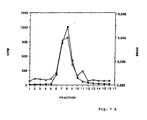
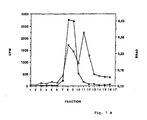
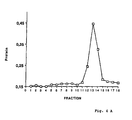
- Fig. 1 shows lipid ( ⁇ ) and rCTB ( ⁇ ) amounts in the fractions at the proportion rCTB:GM1 13:1 (Fig. 1A) and 100:1 respectively (Fig. 1 B).
- iscoms are found in the fractions 7 up to 9 (Fig. 1B).
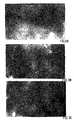
- Fig. 3 is shown EM of different iscom preparations. Similar results are obtained with phosphatidylethanolamine in matrix and iscoms respectively in stead of phospahtidylcholine (results not shown).
- rCTB can efficiently be bound to matrix containing the glycolipid GM1.
- the adding of a suitable amount of GM1 at the preparation of matrix implies an efficient method of preparation for rCTB iscoms.
- the B-subunit of cholera toxin can activively play a role as "target seeking protein” for "passenger antigen” or antigen which is administered together with the B-subunit locally in the mucus e.g. intranasally or orally (Holmgren, J., Lycke, N., Czerkinksy. Vaccine 11, 1179-84, 1993).
- the B-subunit can be sucessfully produced as a recombinant DNA-product (rCTB) and, therefore, it is attractive as a target seeking protein for vaccine antigen administered via mucus membranes.
- the purpose of this example is to show that iscoms in combination with rCTB or without rCTB enhance the immunostimulating effect of incorporated antigen PA (passager antigen) or co-administered antigen (CA) by intranasal (i.n.) application on mucus.
- PA passager antigen
- CA co-administered antigen
- the experiment was carried out to show that iscom constructions and constructions with iscom matrix has an immunomodulating effect by evoking the type of immune response desired for immune protection.
- the specific immune responses against OVA, rCTB or a combination thereof were evaluated.
- the distribution of the immune responses in mucus in the isotypes IgA and IgG and in serum in different IgG-subclasses were studied.
- OVA lipid tail-phosphatidylethanol
- Pierce Rockford, IL, USA
- EDC lipid tail-phosphatidylethanol
- 1 mg PE, 1 mg NHS, 20 mg EDC were incubated for 2 hrs at 37° under agitation in a total volume of 775 ⁇ l H 2 O.
- 1 mg C, 5 mg Quillaja was added to the above mentioned solution.
- 40 ⁇ g GM1 per 1 mg OVA was added to the preparation.
- the final concentration of MEGA-10 reached 2% in a total volume of 1,1 ml.
- rCTB was added to the preparation with or without GMI. rCTB was incorporated in iscoms as described in Example 1 by incorporation of GM1 (see Example 1). In other preparations the GM1 was omitted to avoid binding of the rCTB. Iscom particles containing OVA or rCTB or both, were purified by ultracentrifugation in a 10 - 50% sucrose gradient in PBS for 18 hrs in a TST 41.14-rotor (Kontron) at 39000 rpm in 10°C.
- the gradient was collected in 16 to 18 fractions.
- the fractions were analysed with respect to rCTB by the method for protein determination according to Bradford (Bradford, Analyt. Biochem. 72, 1976, 248-254) and were defined cholormetrically at 595 nm, and with respect to lipids by detection of 3 H-cholesterol, as well as by electron microscopy to examine the existence of possible matrix- or iscom structures.
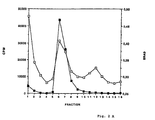
- Fig 4 A shows free rCTB ( ⁇ ) measured by protein determination, analyzed in a 10-50% sucrose gradient centrifugation, i.e. rCTB non-incorporated into iscom sediments slowly and is recovered high up in the gradient, i.e. fractions 12 - 14.
- Fig 4 B shows the lipid radioactivity (CPM) of cholesterol which follows the iscom by ultracentrifugation in a sucrose gradient ( ⁇ ) and lipidated protein OVA measured according to Bradford (Ref. see text)( ⁇ ) iscoms with OVA are detected in fractions 6-8.
- the gradient is a 20-50% sucrose gradient centrifuged for 18 hours in a TST 41.14 rotor at 39000 r.p.m. Some non-integrated protein fractions 11, 12 and 13.
- Bradford was measured as absorbance at 595 nm.
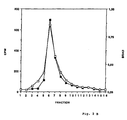
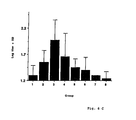
- Fig. 4 C shows incorporation of rCTB in iscoms with GM1. Incorporation of rCTB in iscoms was measured by protein determination (Bradford) ( ⁇ ). Sedimentation of iscoms is shown by radioactively labelled cholesterol (CPM) ( ⁇ )following the iscom in the gradient. Both proteins i.e. rCTB, cholesterol, and iscom structures, the latter verified by electron microscopy, are found in fractions 6 - 9.
- the rCTB can be incorporated by being added to the OVA-iscoms as shown in Fig. 4 D. Incorporation of both lipidated OVA and rCTB is demonstrated by protein determination according to Bradford ( ⁇ ). Sedimentation of iscoms are shown by radioactivity in labelled cholesterol (CPM)( ⁇ ) found in fractions 4 - 6 and the iscom structures were determined by EM.
- Fig. 4 E shows that if rCTB is added to OVA-iscoms which are devoid of GM1-lipids, the rCTB is not incorporated into iscom proven by the fact that the protein, i.e. rCTB, is found on the top of the gradient i.e. the fractions 11 - 13. Iscom incorporated OVA is layered in fractions 5 - 8.
- mice were anaesthetized by inhalation of Metafane in a beaker. For i.n. applicaction, 20 ⁇ l of each preparation was given. When immunizing s.c. the dose was given in a volume of 200 ⁇ l/mouse in PBS.
- mice Two weeks after the first immunisation, serum was tested against OVA and rCTB. After 4 weeks, the mice were given a booster dose and blood samples were taken after additional two weeks. Before the lungs were extracted, the blood vessels were rinsed with 20 ml PBS-0.1% heparin through the right ventricle of the heart and out in the lungs and out through the rest of the blood circulation. The animals were apparently totally drained from blood. Lungs, upper respiratory tracts, genital tract and intestines were disected, dried with a paper towel and put into tubes with PBS-heparin, previously weighed. The organs were weighed and washed with PBS, they were then dried and put into Eppendorf tubes and stored at -20° C.
- the organs were taken from the freezer and 2% spikoside in PBS was added 1:1, the lungs were cut in small pieces and the Eppendorf tubes were stored in a refrigerator over night. Next day, the pieces of organs were centrifuged in an Eppendorf centrifuge for 15 minutes at 13000 r.p.m. The supernatant was analyzed for IgA and IgG against OVA and rCTB respectively. Serum was tested against OVA and rCTB in ELISA and the antibody responses in IgA, IgG subclasses IgG1 and IgG2a total IgG were analyzed.
- rCTB-OVA-formulation does not evoke a serum antibody response against OVA, not after one or even two immunizations.
- Fig. 5 A and Table 1 show serum antibody response against OVA analyzed with ELISA after one intranasal (i.n.) immunization of mice. No antibody response could be measured against OVA without adjuvant or against OVA adjuvanted with rCTB. All mice that were immunized with OVA-iscom formulation and OVA supplemented with iscom-matrix responded by a rise in the antibodies that could be clearly measured.
- Fig. 5 B shows that two weeks after the second immunization all the mice that had been immunized with iscom or matrix formulations responded with high serum antibody titres against OVA.
- Fig. 5 C shows ELISA valiues at increasing dilution of serum from mice after two immunizations.
- the iscom formulations with OVA breaks the tolerance that rCTB evokes for serum antibody response against OVA as "passanger antigen" or co-administered antigen.
- Table 1 shows serum antibody response (log 10 titres) against OVA two weeks after the 2nd i.n. immunization of mice analyzed in ELISA with respect to the total IgG response and the response in IgG1 and IgG2a subclasses.
- the iscoms highly upregulate the IgG2a-response compared to OVA plus iscom matrix. Furthermore, OVA-iscoms and OVA/rCTB iscoms and OVA-iscoms plus free rCTB induce a higher IG1-response compared to the IgG2a-response than OVA iscoms injected s.c. This can be measured as a quota IgG1/IgG2a. OVA without additive of adjuvant evoked a low antibody response which could only be shown in the IgG1 subclass. I.n.
- OVA-iscoms with free rCTB or iscoms containing both rCTB and OVA evoked unexpectedly strong serum antibody response localized to both IgG1 and IgG2a-subclasses.
- the immunomodulating effect is proven by the production of IgG2a. This is an indication of the induction of an IFN- ⁇ response (Coffmann, R.L., Seymour,B.W.P., Lebman, D.A. et al., Immunol. Rev. 102, 5-28, 1988).
- OVA-rCTB evoked a tolerance-like state with respect to the serum antibody response. However, it was unexpected that this state of tolerance was effectively abrogated by the iscom formulations and by the iscom-matrix.
- Fig. 6 B shows a comparison between the different groups with respect to IgA antibody responses in the upper respiratory tract OVA-iscoms and OVA supplemented with matrix evoke significantly higher IgA- rates than OVA-rCTB formulations.
- OVA-iscoms complemented with rCTB evoked significantly higher IgA anti-OVA (10 2 ⁇ 0,38) than OVA adjuvanted with rCTB (10 1,4 ⁇ 0,25) or than control mice (10 1,2 ).
- rCTB incorporated in OVA-iscoms evoked significantly higher IgA titres (10 1,7 ) in genital extract than control mice (10 1,2 ). The latter indicate the background for ELISA (Fig. 6 C).
- iscoms and matrix formulations administered i.n. or s.c. which contained OVA evoked significantly higher IgG antibody titres in extract from mucous membranes of the lungs and upper respiratory tracts than OVA plus rCTB and non-immunized control mice (Fig. 7A and B).
- rCTB seems to induce a powerful tolerance against IgG immune response against OVA in lung extracts which is more pronounced than that against IgA antibody response. This tolerance is clearly abrogated by iscoms and iscom formulations.
- OVA-rCTB-iscoms and iscom-matrix formulations with OVA induced significant and very high IgG antibody responses to OVA compared to that induced by a rCTB OVA formulation.
- Iscoms are unexpectedly and considerably more efficient following mucosal administration as an adjuvant and "target seeker” for "passenger antigen” and SA, here represented by OVA than a formulation of OVA and rCTB.
- the secretory antibody response encompassing the IgA response locally in secretion of the respiratory tract, such as in the lung as well as in the mucous membranes farther away from the site of administration such as in the genital tract and in intestines.
- the IgG antibody responses in secretion from mucous organs such as lungs, upper respiratory tracts, intestines and genital tract are considerably enhanced following mucosal administration of OVA as a model antigen in iscoms or together with iscom matrix compared to the enhancement brought about OVA administered together with rCTB. It is also noteworthy that following the mucosal administration of passenger antigen in iscoms or co-administered with iscom-matrix, the serum antibody response was considerably more enhanced than what rCTB could bring about.
- a corresponding effect as to the enhancement of antibody response in secretion may be obtained if the A-subunit of the cholera toxin is present with its B-subunit, i.e. the whole cholera toxin.
- whole cholera toxin is toxic, pathogenic and not acceptable as an adjuvant (Holmgren, J., Czercinsky, C., Sun, J-B. and Svennerholm, A-M. in Concepts in Vaccine Development, Ed. S.H.E. Kaufmann, 1996).
- the whole toxin LT and its equivalent to CTB i.e. LTB suffer the same problems as LT and CTB.
- the rCTB downregulated the IgG-antibody response in mucous secretion of the co-administered antigen.
- the downregulating or tolerance inducing effect of rCTB on the passenger antigen was effectively abrogated by iscoms and iscom-matrix formulations.
- the immunomodulating effect of iscom, iscom/target seeking molecule or iscom-matrix formulations is demonstrated by the upregulated serum antibody response against IgG2a also following mucosal administration which is an indicator of participation of the IFN- ⁇ immune response, i.e. TH1 response.
- Matrix plus antigen (OVA) administered together on the mucous membrane is more efficient than rCTB plus antigen administered together on the mucous membrane i.n. as for IgA antibody response in secretion from lungs and genital tract. Also the IgG antibody response in secretion from mucous organs such as lungs, respiratory tract and genital tract is considerably enhanced compared to what OVA-rCTB formulations can bring about.
- the specific serum antibody response induced by OVA with matrix as mucous membrane adjuvant was considerably higher than that induced by a formulation of OVA supplemented with rCTB. It was unexpected that matrix could have such a strong adjuvant effect locally in mucous membranes. It is noteworthy that the matrix is very simple to use as an adjuvant by simply being added to the vaccine antigen as opposed to aluminium hydroxide which requires an adsorption under the right conditions, or opposed to oil adjuvants which require a technincal preparation in the form of emulsions which are a complicated procedure in an industrial vaccine production.
- the iscom or iscom-matrix can be used to induce a powerful immune response by mucosal administration.
- the CTB or LTB can be used to down-regulate this immune response.
- These combinations can be used to induce immune response and when desired and to down-regulate this antibody response when desired.
- the possibility to up- and down-regulate an antibody response in the female genital tract which is specific for sperm antigen is of interest in a contraceptive vaccine.
- the induced antisperm antibody needs to be abrogated against sperms.
- Iscom and matrix can be similar as to morphology, e.g. studied in EM, the composition as to triterpenoids, lipids or incorporated adjuvant molecules.
- the iscoms contain an in-built antigen opposed to the matrix which excerts its adjuvant activity on co-administered antigens which are not integrated.
- iscom-matrix and iscom as mucosal adjuvant formulations for administration of OVA were carried out.
- the effects are locally evaluated in secretions extracted from lungs, upper respiratory tracts, genital tracts and intestines.
- iscoms in certain instances are more effective mucous membrane adjuvants than matrix.
- Iscoms e.g., induce a higher IgG2a antibody response in serum which can be advantageous for protection against certain virus diseases.
- the matrix-OVA formulations induce the same level of antibody response as OVA-iscom formulations.
- the IgG-response in mucus of the intestines was considerably higher after i.n. immunization with iscom formulations than with OVA-matrix.
- the simple adding of the matrix to the antigen preparation is a great advantage.
- An interesting feature is that rCTB did not induce IgA antibody responses to itself in mucus of the intestines.
- a suprising example of immune modulation by iscoms and iscom-matrix is demonstrated by the result of rCTB, which by itself does not convert the antibody response in the intestines to encompass an IgA-response, as opposed to the IgA responses in other secretions.
- CTB presented by iscom or co-administered with iscom-matrix converted the antibody response to encompass IgA specific for CTB.
- influenza virus antigen i.e. the envelope proteins from the PR8 isolate which are incorporated into iscom.
- a purified preparation of the H1N1-influenza virus isolate PR8 (A/PR/8/34) with a concentration of 2.6 mg/ml was used.
- the detergent MEGA-10 was added at a final concentration of 2 weight % the solution was incubated at 37° C for 15 minutes and thereafter for 60 minutes at RT.
- the above mentioned solution (1 ml) of 0.6 ml 10% sucrose in PBS containing 2 weight-% MEGA-10 over a 2.8 ml 30 weight-% sucros in PBS, and centrifuged in a TST 55.5 Kontron-rotor at 40000 rpm for 30 minutes. Free envelope proteins were collected in a top layer of 1.5 ml.
- the amount of protein was determined to 0.855 ⁇ g.
- the hemagglutinine activity (HA) of the solubilized envelope proteins (570 ⁇ g/ml) was determined to ⁇ 1:4096 with chicken erythrocytes.
- PR8-iscom (Fig. 2 B) was analyzed by ultra-centrifugation in a 10 - 50% sucrose gradient. Sample volumes exceeding 1.5 ml were divided and distributed on two identical gradients. The samples were centrifuged in a TST 41.14-Kontron-rotor at 39,000 rpm for 18 hrs. In all preparations, there were proteins as a top-layer in fractions 5, 6, 7 and 8 with a maximum value in fraction 6. This is well in line with what is expected of an iscom particle. Radioactive C 14 cholesterol was detected in the same fractions. The protein level was determined according to Bradford. Further characterization was done by EM (Fig. 3). The iscoms were also examined with respect to their capacity of hemagglutination. PR8-iscoms agglutinated red blood cells from hens.
- mice Seven groups of five mice in each were immunized i.n. with 7 ⁇ g PR8-iscoms at an interval of three weeks and the the antibody responses were followed in serum and in lung secretions with ELISA as demonstrated in Fig. 9.
- Fig. 9 A shows that the total antibody response rose to a reciprocal ELISA-titre of approximately 1000 after one immunization.
- a 40-fold rise of the total antibobody titres was obtained.
- day 50 i.e. 30 days after the second i.n. immunization the titres were still at the same elevated antibody level.
- Fig. 9 B shows that high antibody titres were observed in sera of the IgG-subclasses IgG1, IgG2a and in IgG2b.
- Fig. 9 C shows that IgA serum response against PR8 was comparatively low in serum.
- Fig.9 D shows that after one immunization low antibody titres of IgA type can be measured with ELISA by absorbance at 450 nm and in dilution 1/90. After a second immunization, a distinct booster effect can be observed with a clear rise of the IgA-antibody titres against PR8.
- a low dose of PR8-iscoms induce, after only one i.n. immunization, antibody response in serum as well as in lung secretions. After two i.n. immunizations potent rises in both serum and lung secretions are achieved.
- the antibody responses are unexpectedly high after i.n. immunization with low doses of antigen in iscoms compared to other formulations described in the literature, which, therefore, require several immunizations as well as higher doses. This implies that it is feasible to formulate a practical immunization programme based on i.n. immunization with iscoms of the right composition.
- Ovalbumin is a protein which in a low dose does not spontaneously induce immune response when administered via mucous membranes. Furthermore, OVA is a protein which is not spontaneously incorporated into iscoms. In this experiment, a lipid tail is therefore coupled to the OVA. Lipidated OVA and envelope protein from influenza virus were incorporated together with iscoms. These iscoms containing both viral envelope protein (targeting protein) and OVA (passenger antigen) are used for i.n immunization of mice.
- targeting protein targeting protein
- OVA passenger antigen
- Step 1 Lipidation of OVA according to example 2
- Step 2 Formulation of envelope protein from influenza virus (see page 34)
- Step 3 Formulation of iscoms with enevelore proteins PR8 and ovalbumin (OVA)
- OVA-iscoms (fig. 2 A; 3 A), PR8-iscoms (fig. 2 B; 3 B) and OVA-PR8-iscoms (fig. 2 C; 3 C) were characterized by ultra-centrifugation in a 10 - 50% sucrose gradient. Sample volumes exceeding 1.5 ml were divided and applied on two identical gradients. The samples were centrifuged for 18 hrs in a TST 41.14-Kontron-rotor at 39,000 rpm. In all preparations the protein was detected as a peak in the fractions 5, 6 and 7, with a maximum value in fraction 6. The sedimentation and morphology of the particle is well in line with the expectations of an iscom. Radioactive cholesterol and PE were detected and peaked in the same fractions. The protein level was determined according to Bradford. Fig. 2 shows the protein level and the radioactivity of cholesterol or PE as a function of fractions for the prepared iscom particles.
- mice Five groups of five mice (NMRI) were immunized in accordance with the following schedule: Group Immunizing substance Mode of administration A OVA-iscom 5 ⁇ g antigen i.n. B OVA/PR8-iscom 5 ⁇ g antigen i.n. C OVA/PR8-iscom 10 ⁇ g antigen i.n. D PR8-iscom 5 ⁇ g antigen i.n. E OVA/PR8-iscom 5 ⁇ g antigen s.c.
- the dose indicates the total amount of antigen composed approximately of equal parts of OVA and PRS-antigen respectively.
- the mice were anaesthetized with Methophane (Pitman Moore) and the doses of antigen stated in the schedule above were administered i.n. twice four weeks apart in a volume of 20 ⁇ l i.n. or in 200 ⁇ l for the s.c. route.
- Two weeks after the first and second immunizations the antibody titres in serum were analyzed with ELISA (Voller, A., Bartlett, A., Bidwell, D.E. Scand. J. Immunol. 8, 123-129, 1978).
- a third immunization was carried out day 56 in accordance with the schedule above.
- mice Two weeks later (day 70), the mice were anaesthetized and the blood vessles of the lungs were rinsed with PBS/heparin (0.1%) via the right ventricle.
- PBS/heparin 0.1%) via the right ventricle.
- the lungs and the upper respiratory tract were disected and extracted for a few hours with saponin/PBS-solution (0.2%) and the material was stored in a freezer, as described in Example 2, the antibody titres against OVA and PR8 respectively were determined with ELISA.
- Fig. 10 A shows that OVA-PR8-iscoms induce a high serum antibody response against OVA after two immunization i.n. and even higher after three immunizations compared to OVA-iscoms without envelope protein from influenza virus. As expected, 10 ⁇ g of OVA-PR8 iscoms i.n. induced higher antibody response than 5 ⁇ g.
- PR8 proteins function as target seeking molecules in the mucous membrane where they are administered for the "passenger antigen" OVA. It is a striking and unexpected feature that the OVA-iscom did not have an apparent effect on the induction of antibody response, in view of the information found in literature A.M Mowat, A.M. Donachie, ISCOMS-A novel strategy for mucosal immunisation Immunol. Today 12 (1991) 383-385. The reason for this discrepancy is, no doubt, that conventionally unrealistically high doses are used, i.e. from a 100 ⁇ g upto several hundred micrograms of OVA, to be compared with 5 ⁇ g upto 10 ⁇ g which are used in the formulations described above.
- Fig. 10 B shows serum-antibody response against PR8. All iscom formulations containing PR8 induced antibody response after i.n. immunization and the response was enhanced considerably after the second immunization.
- Fig. 10 C shows the IgA-antibody response in secretion extracted from lungs after three immunizations as described above. Both 5 ⁇ g and 10 ⁇ g of the PR8-iscoms induced a dose related, clearcut IgA antibody responses after i.n. immunizations, compared to the OVA-iscoms without PR8-proteins as target seeking molecules.
- OVA-PR8-iscoms did not induce antibody response against OVA in lung secretion
- Fig. 10 D demonstrates that all iscom formulations containing PR8-antigen induce high IgA-antibody responses in lung secretion against PR8.
- the experiment demonstrates that certain antigens in a low dose, such as OVA, require a formulation guiding the antigen to the lymphatic system when it is administered on a mucous membrane, here exemplified by an intranasal administration, in order to induce an optimal antibody response in secretion and serum.
- influenza virus proteins as a mucus targeting molecule for OVA was extended to encompass more mice to achieve 1. better statistical basis 2. to include the defined Quillaja components 703 being used in clinical trials.
- the volume was further reduced from 45 to 40 ⁇ l used in the previous experiments to 20 ⁇ l which would better mimic a realistic volume dose considering the size of the mouse.
- the iscoms and iscom-matrix formulations were prepared as described above.
- the immunization schedule carried out by two administrations six weeks apart was as described below: Total antigen dose OA/703 dose Group 1 OVA-iscom QA i.n. 8 ⁇ g 65 ⁇ g Group 2 OVA-iscom 703 i.n. 8 ⁇ g 65 ⁇ g Group 3 OVA/PR8-iscom QA i.n. 16 ⁇ g 75 ⁇ g Group 4 OVA/PR8-iscom 703 i.n. 16 ⁇ g 65 ⁇ g Group 7 free OVA-matrix QA i.n. 10 ⁇ g 50 ⁇ g Group 9 free OVA-matrix 703 i.n. 10 ⁇ g 50 ⁇ g 10 free OVA non-adjuvanted i.n. 10 ⁇ g - Controls 11 irrelevant antigen 65 ⁇ g
- Serum antibody response to the passenger antigen OVA Serum antibody response to the passenger antigen OVA.
- the antibody responses were in general higher in mice receiving matrix-formulations than mice receiving iscom formulations (A, B and C).
- the total antibody response after the second immunization (in Fig. 10 E the results are summarised) was highest for formulations with OVA as a separate entity mixed with matrix (C).
- the formulations containing the defined Quillaja components i.e. 703 responded with slightly higher IgG titres to OVA than the more crude QA (2 vs 1; 4 vs 3; 9 vs 7).
- the antibody response in the IgG2a subclass was also higher for 703 formulations.
- the IgG2a response was highest in serum from mice immunised s.c. with OVA plus iscom-matrix group.
- the Quillaja formulation with defined Quillaja components 703 is as efficient if not a better inducer of serum antibody response than the more crude spikoside (QA) based formulations.
- the IgA responses to OVA was measured in secretions from lung (Fig. 10 G) and from the genital tract (Fig. 10 H).
- the immunization schedules for the different groups are listed in pages 23 and 24.
- the influenza virus envelope protein incorporated into iscoms are of particular interest to guide the immune response measured by specific IgA antibody in this case to OVA to remote mucosal sites exemplified by here the genital tract.
- the defined components 703 of the origin of Quillaja saponaria molina are at least as efficient if not better than the crude Quil A or spikoside being used i previous experiments by us and others. There have been no reason to expect that until proven by experimenal work. It is unexpected that iscom-matrix formulations should be as efficient or even more efficient for induction of serum antibody response following i.n. administration of antigen than iscoms.
- HSV-2 Herpes simplex 2
- HSV-2 causes infection in genital in a large proportion, up to 10%, of the human population and may cause severe leions and suffering.
- HSV-2 is a virus with an envelope containing several envelope proteins. Two of these, the glycoprotein B (gB2) and glycoprotein D (gD2), are considered to be antigens which, if they induce the right type of immune response, being most important for induction of protecttion against disease and infection under optimal conditions. Since infection with HSV-2 occurs via the genital tract it is desirable to evoke immune response against HSV-2 in the mucous membrane of the genital tract.
- mice were immunized i.n. twice (week 0, 9) and from the lungs, secretions were extracted 2 weeks after booster (day 77) from four mice per group.
- Lungs, upper respiratory tracts, intestines and genital tract from the remaining mice were extracted to obtain the organ secretion on day 113 and the secretion were analyzed for secretory IgA.
- the extracts from these organs were recovered as described in Example 2.
- the antibody responses were tested in ELISA as described in Example 2.
- the antibody responses in organs were tested in ELISA as described in Example 2.
- Antibody responses in organs were tested on individual samples from day 77. Samples from day 113 were tested as a group sample from each organ and group respectively.
- mice immunized i.n. with gB2/PR8-iscom i.e. with PR8 envelope proteins as target seeking molecules gB2-iscoms without a target seeking molecule (10 2.4 ) as well as gB2 mixed with iscom-matrix (10 3.7 ) also induce relatively high antibody titres in the lung secretion although with 10- and 100-fold respectively lower titres.
- Fig. 11 B the IgA-response after two immunizations against gB2 in different secretions (pooled groups) was demonstrated, i.e. in the upper respiratory tract, the genital tract and lungs. Relatively high IgA-responses were obtained against gB2 in genital tract after immunization with gB2-iscoms, gB2/PR8-iscoms and gB2 mixed with iscom-matrix. In the upper respiratory tract the IgA-response after immunization with gB2 supplemented with iscom-matrix was lower than that after immunization with gB2-iscoms and gB2/PR8-iscoms.
- the total IgG serumantibody response to gB2 two weeks after the second i.n. immunization (day 77) (not shown).
- the highest total serum antibody response measured in ELISA day 77 was induced by gB2/PR8-iscom and gB2 complemented with iscom-matrix in separate entities.
- GB2 alone (7) also induced by i.n. administration clearcut specific serum antibody titres although a 10-fold lower titre or more compared to iscom matrix and iscom formulations.
- day 113 post vaccination the total serum titres had increased or remained at the same level except for the preparation with GB-2 alone the serum titres of which had decreased considerably.
- the IgG1 serum antibody response was highest for the gB2/PR8 construction with a titre of 10 6.5 compared with 10 5.2 for the iscom-matrix gB2 formulation and 10 5.3 for gB2 iscom.
- the formulation with gB2 alone induced an almost 100-fold lower serum titre.
- the IgG2 serum antibody response was highest for the gB2-matrix (10 5.0 ) and gB-2/PR8-iscom 10 4.8 by day 77 and approximately a 10-fold lower for gB2-iscoms and gB2 alone (Fig. 11 c).
- mice immunized with gB2-iscom and gB2/PR8-iscom formulations and iscom-matrix formulations increased a 10-fold or more the total as well as subclass IgG1 and IgG2a serum antibody titres.
- the gB2/PR8-iscoms and gB2/iscom-matrix formulations are more efficient with regard to induction of IgG2a response than the other tested formulations.
- the gB2 alone appears to have an inborn capacity for immunomodulation with capacity to induce both IgG1 and IgG2a antibody responses. The latter is considered to require an interferon- ⁇ -production. These results are in contrast to those of gD2 in Example 6 which show that gD2 is poorly immunogenic by itself by i.n. route and does not have the capacity to modulate as IgG2a response. Our results also indicate that gB2 may be useful in modulation of immune responses perhaps even for bystander proteins.
- gB2 has a property of selfaggregating and aggregate and associate with Quillaja components (not shown), which partly explain the difference between gB2 and gD2, the latter being very hydrophilic and having no tendency for aggregation or spontaneously by associating with Quillaja or Quillaja components.
- influenza virus antigen (PR8) incorporated into iscom acts as a target seeker to lymphoid systems in several mucous membranes, i.e. lungs, upper respiratory tract and genital tracts.
- the passenger antigen consists of gD2 from Herpes simplex 2 (HSV-2) causing disease in the genital tracts and a vaccine against HSV-2 is therefore desired.
- gD2 is lipidated with the same method as OVA in Example 2.
- the iscoms were prepared in the same way as in Example 2 and 5.
- Matrix was obtained from Advet, Lule ⁇ , Sweden.
- mice were immunized in accordance with the same schedule described in Example 5 for gB2.
- the antibody response was tested in ELISA which is described in Example 2.
- the antibody response in organs were tested in individual samples on day 77.
- the samples from 113 were tested as a group sample from each organ and each group respectively.
- Fig. 12A shoes that the highest IgA-response in lung secretions was obtained in mice in groups 3, 4 and 6, i.e. mice that have been immunized i.n. with gD2-iscom, gD2/PR8-iscom and gD2 mixed with iscom-matrix resepectively.
- Fig. 12 B shows that the secretions of the genital tract induce gD2-iscom with a target seeking molecule (gD2/PR8-iscoms) efficinet IgA-response after two i.n. immunizations as oposed to other formulations with iscoms or iscom-matrix.
- gD2/PR8-iscoms target seeking molecule
- gD2 The serum antibody response to gD2 two weeks after the second i.n. immunization (day 77) is shown in Fig. 12 C.
- gD2 is different from gB2 Example 5 in the sense gB2 aggregates and is comparatively immunogenic by itself without added adjuvants also shown in Example 5. This property also indicate and "inborn" immunomodulating capacity.
- the gB2 is in contrast to gD2 efficiently associated with iscom and iscom-matrix to form aggregates even with a low ratio Quillaja/gB2.
- gD2 is hydrophilic, monomeric and poorly immunogenic without complementation with adjuvant.
- the highest total serum antibody response measured in ELISA was day 77 induced by gD2/PR8-iscom by gD2-iscoms Most striking is that gD2 by itself (8) (Fig. 12 C) in contrast to gB2 alone did not induce a measureable serum antibody respose by i.n. administration.
- the IgG1 serum antibody response was highest for the gD2-iscom (3) and gD2/PR8-iscom (4) being a 10-fold and significantly higher than that for gD2/iscom-matrix formulation (Fig. 12 c).
- the IgG2a serum antibody titres were considerably or a 300-fold higher for gD2/PR8-iscoms than for gD2-iscoms or a 500-fold higher than for the gD2/iscom-matrix formulation.
- the total serum antibody response remained at about the same level as for day 77 for gD2-iscom and gD2/PR8-iscoms and the gD2 matrix formulation had also reached the levels of the iscom (10 4.8 ).
- the IgG1 levels were similar for the iscom and iscom matrix formulations.
- the IgG2a response to gD2 was a 10-fold higher in serum of mice immunized i.n. with gD2/PR8 iscom formulation i.e. 10 4.1 than for gD2-iscoms without targeting protein and gD2 complemented with iscom-matrix.
- the gD2 protein by its own has, in contrast to gB2 in Example 5, a poor capacity to induce and modulate towards an immune response encompassing the capacity to produce specific IgG2a response.
- the latter is considered to reflect the participation of a Th1 type of response with an interferon- ⁇ -production.
- the gD2/PR8-iscom i.e. an iscom with a mucus guiding or targeting molecule showed a potent capacity to induce serum antibody response by i.n. route a very strong and clearcut capacity to induce (modulate) to an IgG2a serum antibody response considered an important type of immune response for protection against herpes virus infections.
- this example shows that the combination in an iscom with a passenger antigen (gD2), by its own immunologically rather inactive (inert), with immunologically active protein molecules (PR8-molecules) acting as molecules actively targeting the immune system after mucosal mode of administration and activating the immune system is converting the passenger antigen to a potent mucosal antigen in this case a highly immunogenic gD2-molecule.
- gD2 passenger antigen
- PR8-molecules immunologically active protein molecules
- Mycoplasma mycoides subspecies mycoides is the causative organism of Contagious Bovine Pleuropneumonia (CBPP) which is responsible for great economic losses in cattle livestock. It is spreading in many African countries and in some countries in Asia as well as in the south of Europe i.e. in Portugal and Spain. The extended latency period during which infected cattle show no symptoms, makes if difficult to eradicate, and effective control measures against the disease is of paramount interest. Since the beginning of the nineteenth century, vaccination efforts have been carried out encompassing a variety of attenuated vaccine strains and inactivated vaccines (Walker,J., Ann. Rep. Dept. Agric. Kenya, p. 240-243, Kenya, 1929; Curasson, G. Bull. Acad. Vet. Fr. 5, 179-184, 1932; Hudson, J.R., Australian Vet. J. 41, 43-49, 1965).
- an efficient vaccine is lacking inducing long-lasting protection to natural infection taking place via the respiratory tract.
- the detergent octylglucaside was purchased from Boehringer Mannheim, Germany. It was used as a 10% stock solution in water.
- the detergen MEGA-10 was obtained from Bachem, Bubendort, Switzerland.
- Quil A (Spikoside), was from Advet AB (Stockholm, Sweden)(example 2).
- the lipids, cholesterol and 1-3-Phosphatidyl choline from egg yolk (both grade 99%-100%), Thyroglobulin, Bovine serum albumin (BSA), the substrate DAB, Biotinylated lectins; Con A, WGA, SBA, UEA, and Streptavidin conjugated with HRP were from Sigman (St. Louis, Mo. USA).
- MmmSC strains Afade and T1/44 were supplied by Pathotrop laboratory, CIRAD-EMVT, adjoin, France.
- the top fractions consisting of the sample volume and the 10% sucrose layer were collected, and choleserol, phosphatidylcholine and Quil A were added and mixed in a proportion w/w of 10:2:1:20 and extensively dialysed against PBS overnight at room temperature and for further 48 h in cold room.
- the formed iscoms were further purified from unincorporated proteins by sedimentation through a double layer of 10% and 20% sucrose at 39.000 rpm for 19 h at 10°C in a TST 41.14 rotor.
- the sedimented iscoms were resuspended in PBS and kept at -70°C until use.
- mice I.n. administration of MmsmSC of strain Afade iscoms were carried out in mice by installation of antigens into the nostrils of animals under anaesthesia (Methophane). 12 Balb/c female mice 8 weeks old were divided into 4 groups each of 3 animals. The mice in group 1,2 and 3 received 3, 10 and 20 ⁇ g respectively of iscom vaccine i.n. twice 7 weeks apart. Group 4 served as non-immunized control animals. Animals were bled at 2, 4, and 7 weeks after the initial dose and 2 weeks later after the booster dose another bleeding was taken.
- ELISA plates were coated with 100 ⁇ l of MmsmSC cells of strain Afade at a concentration of 0.4 ⁇ g/well in coating buffer (50 mM carboante buffer pH 9.6) and incubated at +4°C for overnight or more. All washings (x 3) were made with phosphate-buffered saline (150 mM, pH 7.5) containing 0.2% Tween-20 (PBS-T). The wells were blocked with 200 ⁇ l of 2% BSA in PBS-T for 1 h at r.t. under shaking. 100 ⁇ l of lung suspension supernatants or serum in blocking buffer were 2-fold diluted and incubated at r.t. for overnight.
- coating buffer 50 mM carboante buffer pH 9.6
- All washings (x 3) were made with phosphate-buffered saline (150 mM, pH 7.5) containing 0.2% Tween-20 (PBS-T).
- PBS-T phosphate-buffered s
- IgA responses in serum Fig. 13 B
- lung secretion Fig. 13 C
- Secretory IgA levels in dilutions up to 1:8000 were detected.
- About similar IgA titres were observed in serum.
- the IgA titres increased with increasing doses.
- Rotaviruses are recognized as the major cause of severe diarrhoeal disease in children younger than 5 years of age in both developed and developing countries, resulting in some 870,000 deaths and several million cases of severe diarrhoea in this age group annually. They are of similar significance as a cause of neonatal dirrhoea in many domesticated animal species. With the exception of a study describing the primary mucosal immune response in rabbits, there has been little detailed characterisation of this response.
- the vaccine virus was a bovine rotavirus strain, UK, grown in MA 104 cells.
- the infecitivity titre, before inactivation was 10 6.8 fluorescent focus units (ffu)/ml, and after treatment with a 5% (v/v) of a 0.1 M binary ethylene imine (BEI) solution at 37°C for 24 hours, no infectivity was detected.
- Virulent lamb rotavirus strain K923 passaged in gnotobiotic lambs was used for challenge. Each lamb received 10 8.5 ffu suspended in 5 mls of sterile PBS.
- Blood for serum and nasal secretions were collected at initial immunization and then at regular intervals to determine the levels of specific and total IgA and IgG antibodies by ELISAs and neutralising titres by virus neutralisation tests. Faecal samples were collected daily after immunization and challenge until rotavirus excretion was no longer detected. Rotavirus excretion was assayed by detection of double-stranded RNA by sodium dodecyl sulphate-polyacrylamide gel electrophoresis (SDS-PAGE). PBLs were collected at initial immunization and then at weekly intervals to determine the numbers of specific IgA and IgG secreting cells by ELISPOTs and the distribution of lymphocyte subpopulations by FACS analysis.
- SDS-PAGE sodium dodecyl sulphate-polyacrylamide gel electrophoresis
- JPPs Jejunum Peyers patches
- IPPs Ilium Peyers patches
- MNs Mesenterial lymphnodes
- IEL and LPL Lamina propria lymphocytes
- Peripheral blood lymphocytes were collected an processed as previously (Puri, N.K., MacKay, C.R., Brandon, M.R. Immunology 55, 725-33, 1985)described and resuspended at the appropriate concentration in complete IMDM containing 1mM glutamine, 100 units/ml penicilling, 0.1 mg/ml streptomycin, 2 ⁇ g/ml amphotericin B (Sigma, St Louis, USA) and processed as previously described. The lymphocytes were finally suspended at the appropriate concentrations in complete IMDM. Pieces of small intestine were collected and processed with minor modifications of previously described methods.
- Small intestine was cut into 10-cm segments, inverted, washed three times at 37°C with gentle stirring in HBSS without calcium and magnesium containing 2 mM EDTA to free epithelial cells and intraepithelial lymphocytes.
- the tissues were washed in RPMI 1640 and placed in RPMI containing 1mM glutamine, 100 units/ml penicillin, 0.1 mg/ml streptomycin, 2 ⁇ g/ml amphotericin B, 5 ⁇ g/ml gentamycin, 80 units/ml collagense XI (Sigma), 0.1 mg/ml deoxyribonuclease type V (Sigma), and 10% FCS at 37 °C to allow the lamina limba lymphocytes to be removed.
- the IEL and LPL suspensions were passed through sterile glasswool columns, layered onto an equal volume of Lymphoprep® and spun down. Lymphocytes were harvested at the interface and washed twice in HBSS containing 1 mM glutamine 100 unit/ml penicillin, 0.1 mg/ml streptomycin, 2 ⁇ g/ml amphotericin B, and 2% FCS before being suspended at the appropriate concentration in complete IMDM.
- Virus neutralising assays for bovine rotavirus strain UK and lamb rotavirus strain K923 were performed in microtitre plates and the endpoints or virus neutralising titre (VNT) were determined by 60% reduction in fluorescent focus units.
- ELISAs Specific-rotavirus ELISAs utilised microtitre plates, (Nunc, Maxisorb), coated with a rabbit antirotavirus capture serum, lamb RV K923 and uninfected MA 104 extracts as negative antigens binding control, the test and control samples, horseradish peroxidase-conjugated donkey anti-sheep IgG (The Binding Site) or mouse anti-bovine IgA, with the colour developed by adding substrate H 2 O 2 and ⁇ -phenylenediamine dihydrochloride to the bound peroxidase. The reaction was stopped with 2 M H 2 SO 4 , and the absorbance measured at 490 nm. The net absorbance was calculated by subtracting the values in the negative wells from the corresponding K923 wells.
- a hyper immune lamb serum for the IgG concentration of 9,600 mg/L for the total IgG ELISA
- a batch of IgA purified from clarified lung fluid of a sheep infected with an ovine retrovirus (Jaagsiekte) (JSRV) for the total IgA ELISA.
- JSRV ovine retrovirus
- Each standard was assayed at eight 2-fold dilutions, and the net absorbance as a function of arbitrary antibody units or mg per ml respectively was fitted to a lin-log sigmoid curve. In each case the resulting standard curve had a fit of r>0.95.
- the resulting parameters were then used to interpolate antibody units or concentration (mg/ml) for each of the test samples, taking into consideration the dilution factor at which each sample was tested. Specific and total ELISA results were combined and expressed in units/mg of IgG or IgA.
- Isotypes anti-rotavirus ELISPOTs utilised mocrotitre plates, (Nunc, Maxisorp), coated with a mouse anti rotavirus capture serum, sucrose-purified rotavirus strain UK as antigen at a concentration of 5 ⁇ g/ml, the PBL suspension (5 x 10 5 cells/ml), horseradish peroxidase-conjugated rabbit anti-sheep IgG (Pierce) or mouse anti bovine IgA, with the spots made visible by adding substrate H 2 O 2 and 3-amino-9-ethylcarbazole (AEC) to the bound peroxidase. The reaction was stopped, when spots were visible, by flicking off the substrate. Spots were counted (mean of 6 replicates) and expressed as spot forming cells (SFC)/10 6 lymphocytes.
- SFC spot forming cells
- Lymphocyte subpopulations were determined with a panel of mouse monoclonals specific for ovine CD4 (17D) (MacKay, C.R., Hein, W.R., Brown, M.H., Matzinger, P. Eur. J. Immunol. 18, 1681-8, 1988; Maddox, J.F., MacKay, C.R., Brandon, M.R. Immunology 55, 739-48, 1985), CD8 (7C2)(Maddox, J.F., MacKay, C.R., Brandon, M.R.
- FIG. 14 A The levels of specific IgG antibodies in blood after immunization was higher for the animals vaccinated with RV iscom matrix (Fig. 14 A). Significantly higher percentages of CD4 + cells at 21 days after immunization in both RV-vaccinated groups (Fig. 14 B). CD45R + cells (Fig. 14 C) were only recorded in the RV/ISC-matrix vaccinated group in blood most important from the point of view that these cells are memory cells and constitute a basis for a fast response for a subsequent infection with rotavirus. Interestingly, the PBS/ISC-matrix, i.e. no-antigen group showed no increase of CD4 + cells but did show a significant higher percentage of ⁇ TCR-cells (not shown).
- the RV/ISC-matrix vaccinated groups had significantly increased numbers of specific IgA (Fig. 14 E) and IgG producing cells in blood indicating a priming effect of the vaccination.
- the priming effect is dependent on the development of memory cells.
- the numbers of specific IgG producing cells was also significantly higher compared to the non-adjuvanted RV-vaccinated group. After challenge, no differences were found in specific IgA or IgG producing cells in the GALT between the three groups.
- the specific IgG response was similar to the specific IgA response.
- RV-adjuvanted with matrix with only one dose would prime an immune response and significantly reduce the infectious period in view of the results of Mowat (Mowat et al., Immunology 72, 317-322, 1991) showing in mice that several immunisations were required to induce IgA response following oral administration of OVA.
- Respiratory syncytial virus is a most important causative agents of viral lower respiratory tract infection in infants and young children world wide. It causes an estimated 91,000 hospitalizations and 4,500 deaths annually in the United Stats alone.
- a closely related virus is bovine respiratory syncytial virus which is an important respiratory virus in young calves.
- Both national and international health organizations view the development of a vaccine to control the virus as a priority in the prevention of morbidity and mortality (Murphy, B.R., Prince, G.A., Walsh, E.E., Kim, H.W., Hemming, V.G., Rodriguez, W. and Chanock, R.M. J. Clin. Microbiol. 24, 197-202, 1986).
- RSV initiates its infection via the respiratory mucosal surface. For this reason a vaccine inducing immune response in the mucus of the respiratory tract is of utmost interest which is most likely to be evoked by i.n. immunization.
- Mucosal mode of immunization has advantages over parenteral administration by the potential of inducing both local and systemic immune responses, increasing safety and minimizing adverse effects, reducing the need for personnel and equipment required for the vaccination and so on.
- the present aim was to compare antibody responses with regard to IgM, IgG isotypes, IgG subclasses and secretory IgA responses in lungs and other mucosal surfaces after intranasal and subcutaneous adminstrations, and to investigate the possibility of developing an RSV ISCOM vaccine based on intranasal adminstration.
- RSV ISCOMs were prepared from two different preparations of virus.
- the virus was propagated in vero cells. After the virus was harvested cell debris was removed by centrifugation. The virus was sedimented to a pellet by ultracentrifugation and further the purified by centrifugation through a 10 to 50% sucrose gradient.
- the preparation procedure and biochemical characterization of ISCOMs were carried out as previously described. Briefly, the virus protein concentration: (1.80 mg/ml) was solubilized with OG at a final concentration of 2%(W/V) for 1 h. at 37°C under constant agitation. The solubilized virus was applied onto a discontinuous sucrose gradient of 2ml 20% sucrose layer containing 0.5% OG, over a cushion of 50% sucrose.
- the sample volume plus the 20% sucrose layer containing viral proteins were collected, and extra lipids i. e. cholesterol and phosphatidycholine and Quillaja (spicoside, Lule ⁇ , Sweden) were added in proportions of 1:0.5:0.5:3.5 (W/W).
- extra lipids i. e. cholesterol and phosphatidycholine and Quillaja (spicoside, Lule ⁇ , Sweden) were added in proportions of 1:0.5:0.5:3.5 (W/W).
- the ISCOMs were purified by centrifugation through 10% sucrose at 40,000 rpm in Kontron TST-41 rotor for 18 hrs at 10°C.
- the pellets containing RSV ISCOMs were resuspended in 200 ⁇ l PBS. Presence of ISCOMs were confirmed by electron microscopy and as described in Example 2.
- the protein pattern of the ISCOMs was determined by electrophoresis and Western blotting.
- the Quillaja concentration was measured by HPLC.
- the ratios between Quillaja and protein in these final ISCOM preparation is 5 mg Quillaja/1 mg iscom.
- the inactivated RSV was prepared by adding 0.5%(W/V) of B-propiolactone to the virus solution and the reaction was kept at 4°C for 7 days to inactivate the viruses.
- mice Female Balb/C mice, 8-12 weeks of age, were obtained from the National Veterinary Institute, Uppsala, Sweden. The mice were screened for viral, bacterial and mycoplasma infections and kept in accordance with the national guidelines.
- mice Seven groups of mice (A through G), each consisting of seven Balb/C mice were immunized twice 6 weeks apart. Mice in different groups were immunized as follows:
- Enzyme-linked immunosorbent assays for serum IgM and IgG antibodies against RSV were carried out in microtiter plates (Nunc, Roskilde, Denmark) which were coated with 200ng purified HRSV per well in 100ul 50mM carbonated buffer, pH 9.6, and kept at 4°C over night. All washings were carried out with phosphate buffered saline containing 0.2% Tween 20 (PBS-Tween). All incubations were done at room temperaure for 60 minutes under constant shaking. The mouse sera were titrated in two-fold dilutions.
- the enzyme reactions were visualized using tetramethylbenzidine (0.19mg/ml) and H 2 O 2 (0.006%) in 0.1M acetate buffer pH 6.0 and the optical density was measured at 450nm with a Titertek Multiscan Spectrophotometer (Flow Laboratories, Irvine, Scotland).
- ELISA for mouse IgG1,IgG2a, IgG2b and IgG3 subclass determination were carried out by a similar procedure, using goat anti-mouse IgG subclass and a rabbit anti-goat HRP conjugate.
- Secretory IgA (sIgA) levels to HRSV in mouse lung extracts were measured by an ELISA with slight modifications.
- Microplates were coated with purified HRSV, 400ng per well in 100ul coating buffer. Two -fold serial diluted Lung extracts were added to the wells. After overnight incubation at RT and subsequent washing with PBS-Tween 20, 100ul biotinylated goat anti-mouse IgA was added to each well.
- IgM, IgG and IgA were tested on individual sample. Due to the limited amount of serum which could be collected from each mouse, IgG subclasses were run on serum pools. The titers are expressed as reciprocal end point dilutions.
- ELISA titers for IgM and IgG are expressed as geometric means of arithmetical values and were compared with respect to the incidence and level of serum antibody by Mann-Whitneys U-test. Confidence limits of 95% for ELISA titers were calculated using Minitab 10 computer software (Minitab Inc., PA, USA)
- the serum IgG was measured twice after the first vaccination and second vaccinations .
- the serum IgG response followed IgM response in a classical manner.
- the ISCOM vaccinated animals (group A, B, C, D and E) developed significantly (p ⁇ 0.01) higher IgG responses than inactivated HRSV vaccinated mice(group F).
- I.n. vaccination with the ISCOMs (group A and C) and combined i.n. and s.c. vaccinations (group E) induced significantly (p ⁇ 0.01) or a 100-fold higher IgG responses than subcutaneously ISCOM vaccinated groups (groups B and D) (Fig. 15 B) .
- the IgG subclasses response was analysed on pooled sera in ELISA. Similar profile of the IgG subclass responses were induced by i.n. and s.c. immunizations with ISCOMs (group A, B, C, D, E) as measured by ELISA. Higher IgG1 and IgG2a responses were detected in the ISCOM immunized mice after i.n. , s.c. and the combination of i.n. and s.c.vaccinations than IgG2b and IgG3. There was no difference in IgG subclass responses between i.n. and s.c. immunized mice ( Figure 15 C). The ratio IgG2a/IgG1 was higher for iscoms immunized mice than for mice immunized with inactivated whole virus indicating a more prominent T H 1 type of response.
- mice from each group were sacrificed, and lung extracts were prepared as described in Material and Methods.
- Lung secretory IgA ELISA titers indicated a strong sIgA response was induced by i.n. administration of ISCOMs (groups A and C) and group E combining i.n. and s.c. administrations.
- s.c. administrations of ISCOMs (groups B and D) and inactivated HRSV(group F) induced no measurable local IgA response in the lung secretion compared to the non-vaccinated control group (group G).
- the highest sIgA response was1:13000 detected in mice from group E immunized by a combination of i.n.
- IgA response was measured in upper respiratory tract, lung, genital and in alimentary tract. The extraction of the various secretions were carried out as described in Example 2. The highest IgA antibody response to RSV was obtained in secretion from genital tract which was about 7-fold higher than in secretion from upper respiratory tract and lung. In the gut secretion the lowest IgA antibody titres to RSV was found i.e. a reciproc titre of about 100. The detailed results are shown in Fig. 15 E.
- RSV-iscoms After i.n. administration, RSV-iscoms induce unexpectedly high serum antibody titres encompassing IgG2a, a subclass considered attractive for protection against disease caused by RSV (Murphy, B.R., Hall, S.L. et al., Virus Res. 32, 13-36, 1994).
- IgG2a IgG2a
- the high IgA antibodies in secretion from the lung and upper respiratory tract give prospect for an efficient vaccine inducing a first line of defence in the "port" of infection, i.e. the respiratory tract.
- RSV envelope proteins F and G are of great interest to test as mucus targeting molecules also for mucosa in remote organs, particularly for induction of antibody response in the genital tract where the highest IgA antibody response was recorded.
- Fig. 1 A shows how iscoms sediment with incorporated rCTB in a 10 - 50% sucrose gradient after an ultracentrifugation.
- the CPM values mark the radioactivity of 3 H-cholesterol ( ⁇ ) follow the iscoms.
- the protein value (CTB) ( ⁇ ) is measured according to Bradford. Iscoms and rCTB are recovered in fraction 6 - 9. Thus most of the CTB are recovered in iscom fractions.
- Fig. 1 B shows the type of diagram as in Fig. 1 A.
- the rCTB concentration was a 100-fold larger than the GM1-concentration. Not-incorporated rCTB is found high up in the gradient i.e. in fraction 10 - 12.
- Fig. 2 characterizes the iscoms by ultracentrifugation:
- Fig 4 A shows sedimentation of free rCTB ( ⁇ ) measured by protein determination in a 10-50% sucrose gradient centrifugation, i.e. rCTB not incorporated into iscom sediments slowly and is recovered high up in the gradient i.e. fractions 12 to 14.
- Fig 4 B shows 14 C phosphatidylethanolamine ( 14 C PEA) radioactivity (CPM) ( ⁇ ) following the iscom in the sucrose gradient at the ultracentrifugation.
- 14 C PEA 14 C phosphatidylethanolamine
- CPM radioactivity
- Fig. 4 C shows incorporation of rCTB in iscoms containig GM1. Incorporation of rCTB in iscom was measured by protein determination ( ⁇ ). Sedimentation of iscoms is shown by radiactively 3 H labelled cholesterol (CPM) ( ⁇ ) following the iscom in the gradient. Both protein i.e. rCTB and 3 H cholesterol follow iscom structures, the latter verified by EM, are recovered in fractions 6 through 9.
- Fig. 4 D shows incorporation of lipidated OVA and rCTB determined by protein determination by Bradford( ⁇ ). Sedimentation of iscoms is shown by radiolabelled 14 C PEA ( ⁇ ) recovered in fractions 4 through 6, where besides radioactivity also iscom structures were demonstrated by EM.
- Fig. 4 E shows that rCTB added to OVA-iscom, not containing GM1-lipid, are not incorporated into iscom, demonstrated by recovery of the protein i.e. CTB in the top fractions of the gradient i.e. 11 through 13. The lipidated OVA is found in fractions 5 through 8.
- Fig. 5 A shows the serum antibody response against OVA analyzed in ELISA (two weeks) after the first intranasal (i.n.) immunization of mice. No antibody response could be measured to OVA without adjuvant or to OVA, which was adjuvanted to rCTB (6).
- Fig. 5 B shows that two weeks after the 2nd immunization all mice which had been immunized with iscom or matrix formulations responded with high serum antibody titres to OVA. Mice that had been immunized with OVA supplemented with rCTB in separate entities showed lower serum antibody titres than mice immunized with OVA alone.
- Fig. 5 C shows the ELISA reading values in increasing dilutions of sera from mice after two immunizations.
- the iscom formulations with OVA abrogates the tolerance which rCTB evoked with respect to serum antibody response to OVA as "passanger antigen" (PA) or administered with matrix.
- PA passanger antigen
- Fig. 6 A shows analysis of IgA antibody response to OVA in lung secretion after two (i.n.) immunizations of mice.
- Fig. 6 B shows a comparison between the different groups with respect to IgA antibody responses to OVA in the upper respiratory tract secretion.
- Fig. 6 C shows a comparison between IgA antibody responses to OVA induced in the secretion from the genital tract of mice in the different immunization groups.
- Fig. 7 The IgG antibody response against OVA is mucous membranes. The same groups as shown in Fig. 5 were included in this immunization experiment.
- Fig. 7 A shows a comparison between IgG antibody responses which were induced in lung secretion of mice in the different immunization groups.
- Fig. 7 B, 7 C and 7 D compare the corresponding IgG antibody responses in the secretions from upper respiratory tract, genital tract and the alimentary tract respectively.
- Fig. 8 A and B Generally, OVA-rCTB in iscoms or free rCTB supplemented with OVA-iscoms, which in this case served as adjuvant in the form of iscom matrix for rCTB, induced considerably higher IgA antibody responses to CTB than rCTB without added adjuvant in all tested secretions, i.e. from lung, upper respiratory tract, alimentary tract and genital tract.
- Fig. 8 C and D High IgG antibody responses were obtained to rCTB in secretions from lungs, upper respiratory tract, genital tract and alimentary tract, with rCTB formulations in iscoms or in iscom-matrix.
- Fig. 9 The development of the serum antibody response (A, B and C) and the response in lung secretion (D) measured in ELISA during an experimental period of 48 days following immunization with influenzavirus iscoms (7 ⁇ g) twice i.n.
- Fig. 10 Five groups of five mice (NMRI) were immunized in accordance with the following schedule: Group Immunizing substance Mode of administration A OVA-iscom 5 ⁇ g antigen intranasally i.n. B OVA/PR8-iscom 5 ⁇ g antigen i.n. C OVA/PR8-iscom 10 ⁇ g antigen i.n. D PR8-iscom 5 ⁇ g antigen i.n. E OVA/PR8-iscom 5 ⁇ g antigen s.c.
- Group Immunizing substance Mode of administration A OVA-iscom 5 ⁇ g antigen intranasally i.n. B OVA/PR8-iscom 5 ⁇ g antigen i.n. C OVA/PR8-iscom 10 ⁇ g antigen i.n. D PR8-iscom 5 ⁇ g antigen i.n. E OVA/PR8-iscom 5 ⁇ g antigen s.c.
- Fig. 10 A shows that OVA/PR8-iscom induce a high serum antibody response to OVA after two immunizations i.n. and even higher after three immunizations compared to OvA-iscoms without envelope protein from the influenza virus. As expected, 10 ⁇ g OVA/PR8-iscoms i.n. induced higher antibody responses than 5 ⁇ g.
- Fig. 10 B shows the serum-antibody response to PR8. All iscom formulations containing PR8 induced antibody response to PR8 after i.n immunization. This response was increased considerably after the second immunization.
- Fig. 10 C shows the IgA-antibody response in secretion from lungs after three immunizations as described above. 5 ⁇ g and 10 ⁇ g of the OVA/PR8-iscoms induced dose dependent, clearcut IgA-antibody responses after i.n. immunizations in contrast to OVA-iscoms administered subcutaneously.
- Fig. 10 D shows that all iscom formulations containing PR8-antigen induce high IgA-antibody responses to PR8 in lung secretion.
- Fig. 10 E shows the serum antibody response to OVA induced by formulations of iscoms containing OVA with and without target seeking molecules or formulations with OVA and iscom-matrix as separate entities after two immunizations as listed on pages 20 and 21 (example 4).
- the highest serum antibody titres measured by ELISA was recorded with OVA-iscom matrix formulations (C).
- Fig. 10 F compares i.n. mode of immunization with the of s.c. mode using OVA/PR8 iscom or OVA-matrix formulations.
- the i.n. mode of immunization induced serum antibodies of similar magnitude or only slightly less than the that induced by s.c. immunization.
- Fig. 10 G shows the IgA antibody responses to OVA in lung secretions induced by formulations of iscoms with and without target seeking molecules (PR8) or by OVA mixed with iscom-matrix as separate entities after two immunizations as listed on pages 39 and 40 (Example 4).
- Fig. 10 H shows the IgA antibody response to OVA in the genital tract secretions induced by formulations of iscoms with and without target seeking molecules or by OVA mixed with iscom-matrix as separate entities after two immunizations as listed on pages 39 and 40 (Example 4).
- Fig. 11 A shows the IgA-response in lung secretion (day 77) from mice two weeks after two i.n. immunizations with an interval of 9 weeks with iscom containing gB from Herpes simplex 2 (gB2) according to Example 5.
- Fig. 11 B shows the IgA-response tp gB2 in secretions (day 113) from different mucous membranes from mice (lungs, upper respiratory tracts and the genital tract) which have been immunized i.n. with iscoms else as described in Fig. 11 A och Example 5.
- Fig. 11 C shows the IgG subclass (IgG1 and IgG2a) response to gB2 in serum (day 77) after i.n. immunizations as described in Fig. 11 A.
- Fig. 12 A shows the IgA-response in lung secretion from mice 14 days after two i.n. immunizations (day 77) with an interval of 9 weeks with iscoms containing gD from Herpes simplex 2 (gD2) according to Example 6.
- Fig. 12 B shows the IgA-response to gD2 in secretions (day 113) from different organs in mice (lungs, upper respiratory tracts and genital tract) which have been immunized i.n. with iscoms that have been described in Fig. 12 A and in Example 6.
- Fig. 12 C shows the IgG subclass to gD2 (IgG1 and IgG2a) in serum (day 77) after i.n. immunizations as described in Fig. 12 A.
- FIG. 13 D Western blot analysis against Mycoplasma mycoides (Mm) antigen: Lane A . Detection with lung secretion obtained from mice two weeks after the second immunization carried out intranasally (i.n.) seven weeks apart with iscoms containing Mm antigens. Lane B . Serum from mice immunized i.n. as described in Lane A; Lane C. Serum from mice immunized subcutaneously (s.c.) as the schedule in Lane A.
- Mm Mycoplasma mycoides
- Fig. 14 A Specific IgG serum antibodies to rotavirus (RV) after oral vaccination; Means of groups were analyzed one-way ANOVA. RV-vaccinated group vs PBS-vaccinated group;
- Fig. 14 B The lymphocyte subpopulation of CD4 + cells (percentage) in peripheral blood at increasing time span after oral vaccination with rotavirus (RV) vaccines with and without iscom-matrix adjuvant and subsequent challenge infection day 21 Means of groups were analysed by one-way ANOVA.
- Fig. 14 C The lymphocyte subpopulation CD45R + cells (percentage) in peripheral blood at increasing time span after oral vaccination with rotavirus (RV) vaccines with and without iscom-matrix adjuvant and subsequent challenge infection day 21 Means of groups were analysed by one-way ANOVA.
- Fig. 14 D Virus excretion after challenge infection.
- Fig. 14 E Specific IgA producing cells in blood after vaccination and subsequent challenge infection day 21.
- Fig. 15 A IgM serum antibody titres (geometric mean titres and 95% confidence limits) of mice to respiratory syncytial virus (RSV) measured by ELISA following two intranasal or two subcutaneous immunizations 6 weeks apart, with HRSV iscoms or inactivated virus.
- First bleeding (1) two weeks after the first immunization.
- Second bleeding (2) five weeks after the first immunization.
- Third bleeding (3) one week after the booster.
- the immunizations of the groups are described in Example 9.
- Fig. 15 B IgG serum antibody titres (geometric mean and 95% confidence limits) of mice to respiratory syncytial virus (RSV) measured by ELISA following with HRSV iscoms or inactivated HRSV as described in Example 9. Bleedings as described in 15 A. First bleeding (1): two weeks after the first immunization. Second bleeding (2): five weeks after the first vaccination. Third bleeding (3): one week after the booster. Fourth bleeding (4): three weeks after the booster.
- RSV respiratory syncytial virus
- Fig. 15 C Serum IgG subclass response to RSV measured by ELISA following intranasal or subcutaneous immunizations with HRSV iscoms or inactivated HRSV as described in Example 9. Bleedings for serum were carried out as described in Fig. 15 B.
- Fig. 15 D IgA antibody titres from lung secretion of mice to respiratory syncytial virus (RSV) 2, 15 and 22 weeks after the booster measured by ELISA following the immunization schedules lined up in the text (Ex. 9). The lungs were collected and secretions extracted as described in Example 2.
- RSV respiratory syncytial virus
- Fig. 15 E IgA antibody response to RSV in secretions from various organs i.e. upper respiratory tract, lung, genital tract and intestine.
- the secretions were extracted from the various organs two weeks after the second immunization as described in Example 2.
- the immunization schedule is described in Example 9.
- Table I The serum antibody response (log 10 titres) to OVA two weeks after the second intranasal immunization of mice analyzed in ELISA with regard to the total antibody response and the responses in the subclasses IgG1 and IgG2a intranasal immunizations.
- Table II A comparison between serum antibody responses to rCTB (log 10 titres) after the second intranasal immunization in mice with regard to IgG isotype and IgG1 and IgG2a subclasses.
Landscapes
- Health & Medical Sciences (AREA)
- Life Sciences & Earth Sciences (AREA)
- Chemical & Material Sciences (AREA)
- Pharmacology & Pharmacy (AREA)
- Veterinary Medicine (AREA)
- Public Health (AREA)
- General Health & Medical Sciences (AREA)
- Medicinal Chemistry (AREA)
- Animal Behavior & Ethology (AREA)
- Epidemiology (AREA)
- General Chemical & Material Sciences (AREA)
- Chemical Kinetics & Catalysis (AREA)
- Bioinformatics & Cheminformatics (AREA)
- Mycology (AREA)
- Microbiology (AREA)
- Immunology (AREA)
- Engineering & Computer Science (AREA)
- Communicable Diseases (AREA)
- Virology (AREA)
- Organic Chemistry (AREA)
- Oncology (AREA)
- Nuclear Medicine, Radiotherapy & Molecular Imaging (AREA)
- Medicines Containing Antibodies Or Antigens For Use As Internal Diagnostic Agents (AREA)
- Medicines Containing Material From Animals Or Micro-Organisms (AREA)
- Emulsifying, Dispersing, Foam-Producing Or Wetting Agents (AREA)
- Cosmetics (AREA)
- Medicinal Preparation (AREA)
- Medicines That Contain Protein Lipid Enzymes And Other Medicines (AREA)
Claims (16)
- Utilisation d'un complexe ou d'une composition immunogènes sous forme d'iscom immunostimulants et / ou de matrice d'iscom comprenant au moins un glycoside et au moins un lipide etpour la préparation des vaccins et des compositions immunostimulantes pour une administration par voie orale, nasale, urogénitale et / ou de la muqueuse rectale.a) au moins une molécule présentant un tissu lymphatique de ciblage à effet de ciblage pour induire une réponse immune par l'administration par voie muqueuse locale sur diverses surfaces de la muqueuse ainsi que pour induire une réponse immune systémique et étant dérivée à partir des microorganismes qui infectent les muqueuses des poumons, la voie respiratoire supérieure, les intestins et des voies urogénitales, où ladite molécule est choisie à partir de la toxine cholérique bactérienne et ses sous-unités, la toxine thermolabile dans l'E.coli et ses sous-unités et des protéines d'enveloppe à partir des virus, des protéines externes à partir des virus non enveloppés et des protéines extérieures à partir des bactéries ; etb) au moins un antigène passager choisi parmi des substances actives pharmacologiquement immunes qui n'atteignent pas aisément le tissu lymphatique à travers la membrane de la muqueuse.
- Utilisation d'un complexe immunogène selon la revendication 1, caractérisée en ce que le complexe est un complexe iscom et que la molécule de ciblage de la muqueuse et / ou l'antigène est intégré dans le complexe iscom ou a été couplé au complexe iscom final ou mélangé avec ce dernier.
- Utilisation d'un complexe immunogène selon la revendication 1, caractérisée en ce que le complexe est une matrice iscom et que la molécule de ciblage de la muqueuse et / ou l'antigène passager a été couplé au complexe de la matrice iscom finale ou mélangé avec cette dernière.
- Utilisation d'un complexe immunogène selon l'une quelconque des revendications 1 à 3 caractérisée en ce que les lipides sont choisis parmi des stérols, des phospholipides et des récepteurs contenant des lipides pour des composants de liaison cellulaire.
- Utilisation d'un complexe immunogène selon la revendication 4, caractérisée en ce que les récepteurs pour les composants de la liaison cellulaire sont des glycolipides.
- Utilisation d'un complexe immunogène selon la revendication 5, caractérisée en ce que les glycolipides sont des GM1 gangliosides et un antigène du groupe sanguin présentant du fucose.
- Utilisation d'un complexe immunogène selon l'une quelconque des revendications 1 à 6, caractérisée en ce que le complexe comprend au moins un adjuvant supplémentaire.
- Utilisation d'un complexe immunogène selon la revendication 7 caractérisé en ce que la molécule de ciblage de la muqueuse et / ou l'antigène passager et / ou l'adjuvant ont été mélangés avec l'iscom et / ou avec le complexe de matrice.
- Utilisation d'un complexe immunogène selon l'une quelconque des revendications 1 à 8, caractérisée en ce que les antigènes passagers proviennent des microorganismes.
- Utilisation d'un complexe immunogène selon la revendication 9, caractérisée en ce que les microorganismes sont des bactéries, des virus ou des parasites.
- Utilisation d'un complexe immunogène selon l'une quelconque des revendications 1 à 10, caractérisée en ce que la molécule de ciblage de la muqueuse et l'antigène passager sont des produits génétiques ou des antigènes synthétiques.
- Utilisation d'un complexe immunogène selon l'une quelconque des revendications 1 à 11, caractérisée en ce que l'antigène passager est sélectionné à partir des peptides, des protéines, des hydrocarbures et des structures d'hydrocarbures.
- Utilisation d'un complexe immunogène selon la revendication 12 caractérisée en ce que les molécules de ciblage de la muqueuse sont des glycoprotéines ou des glycopeptides.
- Utilisation d'un complexe immunogène selon l'une quelconque des revendications 1 à 10, caractérisée en ce que la molécule de ciblage de la muqueuse est choisie parmi les protéines d'enveloppe du virus de la grippe, du virus respiratoire syncytial (VRS), du corona virus, des virus de l'herpès, du poxvirus ou des protéines extérieures de l'adénovirus, du virus Norwalk, de rotavirus, de la famille de picornaviridie par ex. l'entérovirus et l'astrovirus, tels que les hexons et les pentons de l'adénovirus, de fimbriae des bactérie de l'haemophilus, de fimbriae de Escherichia coli infectant les être humains et les animaux, par exemple des cochons (tels que K88, K99, K981-B), DE Shigella, de Chlamydia et des protéines de membranes à partir des mycoplasmes.
- Utilisation d'un complexe immunogène selon l'une quelconque des revendications 1 à 10, caractérisée en ce que l'antigène passager est choisi à partir de gB et gD dans les différents virus de l'herpès incluant l'herpès Simplex 1 et 2, le virus de l'herpès bovin 1, le virus de type picorna, gp 120 et gp 160 dans le VIH-1 pi la protéine correspondant dans le VIH-2, ainsi que depuis d'autres rétrovirus, des virus hepadna, des g-protéines du rhabdovirus, du poxvirus, du papovirus, de l'adénovirus, du cardivirus, du togavirus, du flavavirus, de l'irdovirus, du birnavirus, du bunyavirus, de l'arenavirus, de l'ortomyxovirus, du paramyxovirus, du parvovirus, du popovirus, du picornavirus, du calcivirus, de l'astrovirus, la G-protéine du virus de la rage ou à partir de bactérie telle que la salmonelle, E. coli, Shigella, Chlamydia ou le mycoplasme, ou à partir des parasites tels que Echinococcus, les nématodes, les trématodes, les schistosomes, les protozas tels que le toxoplasme, le trypanosome Leishmania.
- Utilisation d'un complexe immunogène selon l'une quelconque des revendications 1 à 15, caractérisée en ce que les antigènes passagers sont recombinants des antigènes de vaccins.
Applications Claiming Priority (3)
| Application Number | Priority Date | Filing Date | Title |
|---|---|---|---|
| SE9600647A SE9600647D0 (sv) | 1996-02-21 | 1996-02-21 | Ny användning |
| SE9600647 | 1996-02-21 | ||
| PCT/SE1997/000289 WO1997030728A1 (fr) | 1996-02-21 | 1997-02-20 | Compose immunostimulateur ou matrice de composes immunostimulateurs renfermant une substance ciblant le mucus et, facultativement, un antigene |
Publications (2)
| Publication Number | Publication Date |
|---|---|
| EP0889736A1 EP0889736A1 (fr) | 1999-01-13 |
| EP0889736B1 true EP0889736B1 (fr) | 2003-12-10 |
Family
ID=20401481
Family Applications (1)
| Application Number | Title | Priority Date | Filing Date |
|---|---|---|---|
| EP97905541A Expired - Lifetime EP0889736B1 (fr) | 1996-02-21 | 1997-02-20 | Compose immunostimulateur ou matrice de composes immunostimulateurs renfermant une substance ciblant le mucus et un antigene |
Country Status (12)
| Country | Link |
|---|---|
| US (1) | US6607732B2 (fr) |
| EP (1) | EP0889736B1 (fr) |
| JP (1) | JP2000504746A (fr) |
| AT (1) | ATE255905T1 (fr) |
| AU (1) | AU719084B2 (fr) |
| CA (1) | CA2247522C (fr) |
| DE (1) | DE69726712T2 (fr) |
| DK (1) | DK0889736T3 (fr) |
| ES (1) | ES2210495T3 (fr) |
| NZ (1) | NZ331403A (fr) |
| SE (1) | SE9600647D0 (fr) |
| WO (1) | WO1997030728A1 (fr) |
Cited By (5)
| Publication number | Priority date | Publication date | Assignee | Title |
|---|---|---|---|---|
| US10953089B1 (en) | 2020-01-27 | 2021-03-23 | Novavax, Inc. | Coronavirus vaccine formulations |
| WO2022235663A1 (fr) | 2021-05-05 | 2022-11-10 | Novavax, Inc. | Compositions contre les coronavirus et la grippe et leurs méthodes d'utilisation |
| US12257297B2 (en) | 2015-09-03 | 2025-03-25 | Novavax, Inc. | Vaccine compositions having improved stability and immunogenicity |
| US12357684B2 (en) | 2008-12-09 | 2025-07-15 | Novavax, Inc. | Modified RSV F proteins and methods of their use |
| US12691171B2 (en) | 2020-01-27 | 2026-07-28 | Novavax, Inc. | Coronavirus vaccine formulations |
Families Citing this family (20)
| Publication number | Priority date | Publication date | Assignee | Title |
|---|---|---|---|---|
| US6207646B1 (en) | 1994-07-15 | 2001-03-27 | University Of Iowa Research Foundation | Immunostimulatory nucleic acid molecules |
| US6406705B1 (en) | 1997-03-10 | 2002-06-18 | University Of Iowa Research Foundation | Use of nucleic acids containing unmethylated CpG dinucleotide as an adjuvant |
| DK1077722T3 (da) | 1998-05-22 | 2006-11-27 | Ottawa Health Research Inst | Fremgangsmåder og produkter til induktion af mukosaimmunitet |
| US7041296B1 (en) * | 1999-11-12 | 2006-05-09 | The United States Of America As Represented By The Department Of Health And Human Services | Methods of treating inflammatory bowel disease using cholera toxin B subunit |
| US7713942B2 (en) * | 2001-04-04 | 2010-05-11 | Nordic Vaccine Technology A/S | Cage-like microparticle complexes comprising sterols and saponins for delivery of polynucleotides |
| SE0202110D0 (sv) | 2002-07-05 | 2002-07-05 | Isconova Ab | Iscom preparation and use thereof |
| SE0301998D0 (sv) | 2003-07-07 | 2003-07-07 | Isconova Ab | Quil A fraction with low toxicity and use thereof |
| ES2433467T3 (es) | 2005-01-20 | 2013-12-11 | Isconova Ab | Composición de vacuna que comprende una proteína de unión a fibronectina o un péptido de unión a fibronectina |
| CA2698392C (fr) | 2007-09-04 | 2019-12-03 | Baoming Jiang | Inactivation thermique de rotavirus |
| GB0803076D0 (en) | 2008-02-20 | 2008-03-26 | Univ Ghent | Mucosal Membrane Receptor and uses thereof |
| ES2325243B1 (es) * | 2008-02-27 | 2011-05-04 | Universidad De Granada | Antigeno recombinante. |
| CA2805741C (fr) | 2010-07-23 | 2019-08-13 | Karin Bengtsson Loevgren | Composition renfermant une matrice isocom et des ectodomaines |
| ES2639122T3 (es) | 2011-05-13 | 2017-10-25 | Zoetis Services Llc | Composiciones inmunogénicas de glucoproteína G de virus Hendra y Nipah |
| DK2750683T4 (da) | 2011-10-03 | 2021-04-12 | Croda Int Plc | Nanopartikler, fremgangsmåde til fremstilling og anvendelse deraf som bærer for amfipatiske eller hydrofobe molekyler inden for medicin, herunder cancerbehandling, og i fødevarerelaterede forbindelser |
| EP4272750A3 (fr) | 2013-02-07 | 2024-01-24 | Children's Medical Center, Corp. | Antigènes de protéine qui confèrent une protection contre une colonisation et/ou une maladie pneumococcique |
| WO2014163558A1 (fr) | 2013-04-01 | 2014-10-09 | Moreinx Ab | Nanoparticules, constituées de stérol et de saponine de quillaja saponaria molina, leur procédé de préparation et leur utilisation comme support pour des molécules amphipathiques ou hydrophobes dans le domaine médical, notamment pour le traitement du cancer, et composés alimentaires |
| EP3082856A1 (fr) | 2013-12-16 | 2016-10-26 | Zoetis Services LLC | Compositions immunogènes comprenant la glycoprotéine g des virus hendra et nipah |
| CN111148509A (zh) | 2017-07-24 | 2020-05-12 | 诺瓦瓦克斯股份有限公司 | 治疗呼吸系统疾病的方法和组合物 |
| CN120227451A (zh) | 2018-03-19 | 2025-07-01 | 诺瓦瓦克斯股份有限公司 | 多价流感纳米颗粒疫苗 |
| GB202209588D0 (en) | 2022-06-29 | 2022-08-10 | Plant Bioscience Ltd | Methods and compositions |
Family Cites Families (1)
| Publication number | Priority date | Publication date | Assignee | Title |
|---|---|---|---|---|
| US6290962B1 (en) * | 1992-11-03 | 2001-09-18 | Oravax, Inc. | Urease-based vaccine and treatment for helicobacter infection |
-
1996
- 1996-02-21 SE SE9600647A patent/SE9600647D0/xx unknown
-
1997
- 1997-02-20 JP JP9530070A patent/JP2000504746A/ja active Pending
- 1997-02-20 AT AT97905541T patent/ATE255905T1/de not_active IP Right Cessation
- 1997-02-20 AU AU22385/97A patent/AU719084B2/en not_active Expired
- 1997-02-20 CA CA002247522A patent/CA2247522C/fr not_active Expired - Lifetime
- 1997-02-20 EP EP97905541A patent/EP0889736B1/fr not_active Expired - Lifetime
- 1997-02-20 ES ES97905541T patent/ES2210495T3/es not_active Expired - Lifetime
- 1997-02-20 NZ NZ331403A patent/NZ331403A/en not_active IP Right Cessation
- 1997-02-20 DK DK97905541T patent/DK0889736T3/da active
- 1997-02-20 DE DE69726712T patent/DE69726712T2/de not_active Expired - Lifetime
- 1997-02-20 WO PCT/SE1997/000289 patent/WO1997030728A1/fr not_active Ceased
-
1998
- 1998-08-20 US US09/137,236 patent/US6607732B2/en not_active Expired - Lifetime
Cited By (10)
| Publication number | Priority date | Publication date | Assignee | Title |
|---|---|---|---|---|
| US12357684B2 (en) | 2008-12-09 | 2025-07-15 | Novavax, Inc. | Modified RSV F proteins and methods of their use |
| US12257297B2 (en) | 2015-09-03 | 2025-03-25 | Novavax, Inc. | Vaccine compositions having improved stability and immunogenicity |
| US10953089B1 (en) | 2020-01-27 | 2021-03-23 | Novavax, Inc. | Coronavirus vaccine formulations |
| US11253586B2 (en) | 2020-01-27 | 2022-02-22 | Novavax, Inc. | Coronavirus vaccine formulations |
| US11541112B2 (en) | 2020-01-27 | 2023-01-03 | Novavax, Inc. | Coronavirus vaccine formulations |
| US11896664B2 (en) | 2020-01-27 | 2024-02-13 | Novavax, Inc. | Corona virus vaccine formulations |
| US12472246B2 (en) | 2020-01-27 | 2025-11-18 | Novavax, Inc. | Coronavirus vaccine formulations |
| US12491241B2 (en) | 2020-01-27 | 2025-12-09 | Novavax, Inc. | Coronavirus vaccine formulations |
| US12691171B2 (en) | 2020-01-27 | 2026-07-28 | Novavax, Inc. | Coronavirus vaccine formulations |
| WO2022235663A1 (fr) | 2021-05-05 | 2022-11-10 | Novavax, Inc. | Compositions contre les coronavirus et la grippe et leurs méthodes d'utilisation |
Also Published As
| Publication number | Publication date |
|---|---|
| JP2000504746A (ja) | 2000-04-18 |
| US20020131982A1 (en) | 2002-09-19 |
| CA2247522C (fr) | 2009-12-29 |
| ATE255905T1 (de) | 2003-12-15 |
| DE69726712T2 (de) | 2004-10-07 |
| AU2238597A (en) | 1997-09-10 |
| WO1997030728A1 (fr) | 1997-08-28 |
| CA2247522A1 (fr) | 1997-08-28 |
| NZ331403A (en) | 2000-02-28 |
| DE69726712D1 (de) | 2004-01-22 |
| DK0889736T3 (da) | 2004-04-19 |
| EP0889736A1 (fr) | 1999-01-13 |
| US6607732B2 (en) | 2003-08-19 |
| AU719084B2 (en) | 2000-05-04 |
| SE9600647D0 (sv) | 1996-02-21 |
| ES2210495T3 (es) | 2004-07-01 |
Similar Documents
| Publication | Publication Date | Title |
|---|---|---|
| US6607732B2 (en) | ISCOM or ISCOM-matrix comprising a mucous targetting substance and an antigen | |
| Morein et al. | Current status and potential application of ISCOMs in veterinary medicine | |
| EP0944397B1 (fr) | Molecules hydrophobes receptrices de substances antigenes et comprenant des complexes immuno-stimulants ou des matrices de complexes immuno-stimulants | |
| Kensil et al. | QS-21: a water-soluble triterpene glycoside adjuvant | |
| JP4949555B2 (ja) | 改良サポニンアジュバント組成物およびそれに関する方法 | |
| US20100008951A1 (en) | Flu vaccine admixture of mannan and flu antigen | |
| US20130089570A1 (en) | Oral vaccine compromising an antigen and a toll-like receptor agonist | |
| CZ20021045A3 (cs) | Pomocný prostředek | |
| Rask et al. | Mucosal and systemic antibody responses after peroral or intranasal immunization: Effects of conjugation to enterotoxin B subunits and/or of co‐administration with free toxin as adjuvant | |
| Smith et al. | Immune stimulating complexes as mucosal vaccines | |
| Iosef et al. | Systemic and intestinal antibody secreting cell responses and protection in gnotobiotic pigs immunized orally with attenuated Wa human rotavirus and Wa 2/6-rotavirus-like-particles associated with immunostimulating complexes | |
| WO2011005183A1 (fr) | Nouvelle composition | |
| JP5265545B2 (ja) | 免疫応答を誘発または誘導する方法 | |
| US20220257752A1 (en) | New use of cyclic dinucleotides | |
| Ekström et al. | Iscom and iscom-matrix enhance by intranasal route the IgA responses to OVA and rCTB in local and remote mucosal secretions | |
| JP4889175B2 (ja) | 感染性因子に対する免疫応答を刺激するための組成物および方法 | |
| WO2008037033A1 (fr) | Vaccin contre la grippe constitué d'un mélange de mannane et d'antigène de la grippe | |
| Morein et al. | New ISCOMs meet unsettled vaccine demands | |
| AU719191B2 (en) | Immunogenic complex, iscom, for use in preparing a vaccine for juvenile individuals | |
| WO2010089940A1 (fr) | Vaccin mucosique | |
| JP2020050605A (ja) | 粘膜アジュバント | |
| Huckriede et al. | GAStro-InteStInAL deLIVery oF InFLuenzA SuBunIt VAccIne ForMuLAtIon AdJuVAnted WItH GrAM-PoSItIVe enHAncer MAtrIx (GeM) PArtIcLeS | |
| AU2007216697A1 (en) | Method for inducing mucosal humoral and cell-mediated immune responses by sublingual administration of antigens | |
| Saluja | Novel perspectives for influenza vaccine formulation and administration |
Legal Events
| Date | Code | Title | Description |
|---|---|---|---|
| PUAI | Public reference made under article 153(3) epc to a published international application that has entered the european phase |
Free format text: ORIGINAL CODE: 0009012 |
|
| 17P | Request for examination filed |
Effective date: 19980827 |
|
| AK | Designated contracting states |
Kind code of ref document: A1 Designated state(s): AT BE CH DE DK ES FI FR GB GR IE IT LI LU MC NL PT SE |
|
| AX | Request for extension of the european patent |
Free format text: AL PAYMENT 980827;LT PAYMENT 980827;LV PAYMENT 980827;RO PAYMENT 980827;SI PAYMENT 980827 |
|
| 17Q | First examination report despatched |
Effective date: 20020319 |
|
| GRAH | Despatch of communication of intention to grant a patent |
Free format text: ORIGINAL CODE: EPIDOS IGRA |
|
| RTI1 | Title (correction) |
Free format text: ISCOM OR ISCOM-MATRIX COMPRISING A MUCUS TARGETTING SUBSTANCE AND AN ANTIGEN |
|
| RTI1 | Title (correction) |
Free format text: ISCOM OR ISCOM-MATRIX COMPRISING A MUCUS TARGETTING SUBSTANCE AND AN ANTIGEN |
|
| RTI1 | Title (correction) |
Free format text: ISCOM OR ISCOM-MATRIX COMPRISING A MUCUS TARGETTING SUBSTANCE AND AN ANTIGEN |
|
| RTI1 | Title (correction) |
Free format text: ISCOM OR ISCOM-MATRIX COMPRISING A MUCUS TARGETTING SUBSTANCE AND AN ANTIGEN |
|
| GRAS | Grant fee paid |
Free format text: ORIGINAL CODE: EPIDOSNIGR3 |
|
| GRAA | (expected) grant |
Free format text: ORIGINAL CODE: 0009210 |
|
| AK | Designated contracting states |
Kind code of ref document: B1 Designated state(s): AT BE CH DE DK ES FI FR GB GR IE IT LI LU MC NL PT SE |
|
| AX | Request for extension of the european patent |
Extension state: AL LT LV RO SI |
|
| PG25 | Lapsed in a contracting state [announced via postgrant information from national office to epo] |
Ref country code: FI Free format text: LAPSE BECAUSE OF FAILURE TO SUBMIT A TRANSLATION OF THE DESCRIPTION OR TO PAY THE FEE WITHIN THE PRESCRIBED TIME-LIMIT Effective date: 20031210 |
|
| REG | Reference to a national code |
Ref country code: GB Ref legal event code: FG4D |
|
| REG | Reference to a national code |
Ref country code: CH Ref legal event code: EP |
|
| REG | Reference to a national code |
Ref country code: IE Ref legal event code: FG4D |
|
| REF | Corresponds to: |
Ref document number: 69726712 Country of ref document: DE Date of ref document: 20040122 Kind code of ref document: P |
|
| REG | Reference to a national code |
Ref country code: CH Ref legal event code: NV Representative=s name: MICHELI & CIE INGENIEURS-CONSEILS |
|
| PG25 | Lapsed in a contracting state [announced via postgrant information from national office to epo] |
Ref country code: LU Free format text: LAPSE BECAUSE OF NON-PAYMENT OF DUE FEES Effective date: 20040220 |
|
| PG25 | Lapsed in a contracting state [announced via postgrant information from national office to epo] |
Ref country code: MC Free format text: LAPSE BECAUSE OF NON-PAYMENT OF DUE FEES Effective date: 20040228 |
|
| PG25 | Lapsed in a contracting state [announced via postgrant information from national office to epo] |
Ref country code: GR Free format text: LAPSE BECAUSE OF FAILURE TO SUBMIT A TRANSLATION OF THE DESCRIPTION OR TO PAY THE FEE WITHIN THE PRESCRIBED TIME-LIMIT Effective date: 20040310 |
|
| REG | Reference to a national code |
Ref country code: SE Ref legal event code: TRGR |
|
| REG | Reference to a national code |
Ref country code: DK Ref legal event code: T3 |
|
| LTIE | Lt: invalidation of european patent or patent extension |
Effective date: 20031210 |
|
| REG | Reference to a national code |
Ref country code: ES Ref legal event code: FG2A Ref document number: 2210495 Country of ref document: ES Kind code of ref document: T3 |
|
| ET | Fr: translation filed | ||
| PLBE | No opposition filed within time limit |
Free format text: ORIGINAL CODE: 0009261 |
|
| STAA | Information on the status of an ep patent application or granted ep patent |
Free format text: STATUS: NO OPPOSITION FILED WITHIN TIME LIMIT |
|
| 26N | No opposition filed |
Effective date: 20040913 |
|
| PG25 | Lapsed in a contracting state [announced via postgrant information from national office to epo] |
Ref country code: PT Free format text: LAPSE BECAUSE OF NON-PAYMENT OF DUE FEES Effective date: 20040510 |
|
| PGFP | Annual fee paid to national office [announced via postgrant information from national office to epo] |
Ref country code: IE Payment date: 20100222 Year of fee payment: 14 Ref country code: DK Payment date: 20100225 Year of fee payment: 14 Ref country code: CH Payment date: 20100212 Year of fee payment: 14 |
|
| PGFP | Annual fee paid to national office [announced via postgrant information from national office to epo] |
Ref country code: IT Payment date: 20100227 Year of fee payment: 14 |
|
| PGFP | Annual fee paid to national office [announced via postgrant information from national office to epo] |
Ref country code: BE Payment date: 20100218 Year of fee payment: 14 Ref country code: AT Payment date: 20100225 Year of fee payment: 14 |
|
| BERE | Be: lapsed |
Owner name: *EKSTROM JILL Effective date: 20110228 Owner name: *LOVGREN BENGTSSON KARIN Effective date: 20110228 Owner name: *MOREIN BROR Effective date: 20110228 |
|
| REG | Reference to a national code |
Ref country code: CH Ref legal event code: PL |
|
| REG | Reference to a national code |
Ref country code: DK Ref legal event code: EBP |
|
| PG25 | Lapsed in a contracting state [announced via postgrant information from national office to epo] |
Ref country code: CH Free format text: LAPSE BECAUSE OF NON-PAYMENT OF DUE FEES Effective date: 20110228 Ref country code: LI Free format text: LAPSE BECAUSE OF NON-PAYMENT OF DUE FEES Effective date: 20110228 |
|
| REG | Reference to a national code |
Ref country code: IE Ref legal event code: MM4A |
|
| PG25 | Lapsed in a contracting state [announced via postgrant information from national office to epo] |
Ref country code: AT Free format text: LAPSE BECAUSE OF NON-PAYMENT OF DUE FEES Effective date: 20110220 Ref country code: BE Free format text: LAPSE BECAUSE OF NON-PAYMENT OF DUE FEES Effective date: 20110228 |
|
| PG25 | Lapsed in a contracting state [announced via postgrant information from national office to epo] |
Ref country code: IT Free format text: LAPSE BECAUSE OF NON-PAYMENT OF DUE FEES Effective date: 20110220 |
|
| PG25 | Lapsed in a contracting state [announced via postgrant information from national office to epo] |
Ref country code: IE Free format text: LAPSE BECAUSE OF NON-PAYMENT OF DUE FEES Effective date: 20110221 |
|
| REG | Reference to a national code |
Ref country code: FR Ref legal event code: PLFP Year of fee payment: 20 |
|
| PGFP | Annual fee paid to national office [announced via postgrant information from national office to epo] |
Ref country code: ES Payment date: 20160217 Year of fee payment: 20 Ref country code: DE Payment date: 20160302 Year of fee payment: 20 |
|
| PGFP | Annual fee paid to national office [announced via postgrant information from national office to epo] |
Ref country code: SE Payment date: 20160208 Year of fee payment: 20 Ref country code: GB Payment date: 20160127 Year of fee payment: 20 Ref country code: NL Payment date: 20160205 Year of fee payment: 20 Ref country code: FR Payment date: 20160125 Year of fee payment: 20 |
|
| REG | Reference to a national code |
Ref country code: DE Ref legal event code: R071 Ref document number: 69726712 Country of ref document: DE |
|
| REG | Reference to a national code |
Ref country code: NL Ref legal event code: MK Effective date: 20170219 |
|
| REG | Reference to a national code |
Ref country code: GB Ref legal event code: PE20 Expiry date: 20170219 |
|
| REG | Reference to a national code |
Ref country code: SE Ref legal event code: EUG |
|
| REG | Reference to a national code |
Ref country code: ES Ref legal event code: FD2A Effective date: 20170526 |
|
| PG25 | Lapsed in a contracting state [announced via postgrant information from national office to epo] |
Ref country code: GB Free format text: LAPSE BECAUSE OF EXPIRATION OF PROTECTION Effective date: 20170219 |
|
| PG25 | Lapsed in a contracting state [announced via postgrant information from national office to epo] |
Ref country code: ES Free format text: LAPSE BECAUSE OF EXPIRATION OF PROTECTION Effective date: 20170221 |