EP0890564B1 - Verfahren zur Herstellung einer p-dihydroxyaromatischen Verbindung - Google Patents
Verfahren zur Herstellung einer p-dihydroxyaromatischen Verbindung Download PDFInfo
- Publication number
- EP0890564B1 EP0890564B1 EP98110051A EP98110051A EP0890564B1 EP 0890564 B1 EP0890564 B1 EP 0890564B1 EP 98110051 A EP98110051 A EP 98110051A EP 98110051 A EP98110051 A EP 98110051A EP 0890564 B1 EP0890564 B1 EP 0890564B1
- Authority
- EP
- European Patent Office
- Prior art keywords
- carbon atoms
- fuchsone
- radical
- acid
- process according
- Prior art date
- Legal status (The legal status is an assumption and is not a legal conclusion. Google has not performed a legal analysis and makes no representation as to the accuracy of the status listed.)
- Expired - Lifetime
Links
- 238000000034 method Methods 0.000 title claims description 149
- 230000008569 process Effects 0.000 title claims description 130
- 238000002360 preparation method Methods 0.000 title claims description 23
- 150000001491 aromatic compounds Chemical class 0.000 title claims description 14
- MPNBBQFKLWQJIP-UHFFFAOYSA-N 4-benzhydrylidenecyclohexa-2,5-dien-1-one Chemical compound C1=CC(=O)C=CC1=C(C=1C=CC=CC=1)C1=CC=CC=C1 MPNBBQFKLWQJIP-UHFFFAOYSA-N 0.000 claims description 314
- RWCCWEUUXYIKHB-UHFFFAOYSA-N benzophenone Chemical compound C=1C=CC=CC=1C(=O)C1=CC=CC=C1 RWCCWEUUXYIKHB-UHFFFAOYSA-N 0.000 claims description 214
- 239000012965 benzophenone Substances 0.000 claims description 171
- MHAJPDPJQMAIIY-UHFFFAOYSA-N Hydrogen peroxide Chemical group OO MHAJPDPJQMAIIY-UHFFFAOYSA-N 0.000 claims description 155
- -1 hydrocarbon radicals Chemical class 0.000 claims description 133
- 125000004432 carbon atom Chemical group C* 0.000 claims description 131
- ISWSIDIOOBJBQZ-UHFFFAOYSA-N Phenol Chemical compound OC1=CC=CC=C1 ISWSIDIOOBJBQZ-UHFFFAOYSA-N 0.000 claims description 118
- 238000006243 chemical reaction Methods 0.000 claims description 117
- 239000002253 acid Substances 0.000 claims description 80
- 150000003254 radicals Chemical class 0.000 claims description 75
- QIGBRXMKCJKVMJ-UHFFFAOYSA-N Hydroquinone Chemical compound OC1=CC=C(O)C=C1 QIGBRXMKCJKVMJ-UHFFFAOYSA-N 0.000 claims description 72
- VLTRZXGMWDSKGL-UHFFFAOYSA-N perchloric acid Chemical compound OCl(=O)(=O)=O VLTRZXGMWDSKGL-UHFFFAOYSA-N 0.000 claims description 60
- 125000004435 hydrogen atom Chemical group [H]* 0.000 claims description 56
- 239000003960 organic solvent Substances 0.000 claims description 51
- 150000002989 phenols Chemical class 0.000 claims description 49
- OKKJLVBELUTLKV-UHFFFAOYSA-N Methanol Chemical compound OC OKKJLVBELUTLKV-UHFFFAOYSA-N 0.000 claims description 45
- 239000010457 zeolite Substances 0.000 claims description 45
- AFVFQIVMOAPDHO-UHFFFAOYSA-N Methanesulfonic acid Chemical compound CS(O)(=O)=O AFVFQIVMOAPDHO-UHFFFAOYSA-N 0.000 claims description 40
- 150000001875 compounds Chemical class 0.000 claims description 40
- XLYOFNOQVPJJNP-UHFFFAOYSA-N water Substances O XLYOFNOQVPJJNP-UHFFFAOYSA-N 0.000 claims description 35
- WEVYAHXRMPXWCK-UHFFFAOYSA-N Acetonitrile Chemical compound CC#N WEVYAHXRMPXWCK-UHFFFAOYSA-N 0.000 claims description 34
- HNPSIPDUKPIQMN-UHFFFAOYSA-N dioxosilane;oxo(oxoalumanyloxy)alumane Chemical class O=[Si]=O.O=[Al]O[Al]=O HNPSIPDUKPIQMN-UHFFFAOYSA-N 0.000 claims description 34
- 229920005989 resin Polymers 0.000 claims description 32
- 239000011347 resin Substances 0.000 claims description 32
- ITMCEJHCFYSIIV-UHFFFAOYSA-N triflic acid Chemical compound OS(=O)(=O)C(F)(F)F ITMCEJHCFYSIIV-UHFFFAOYSA-N 0.000 claims description 32
- 229910021536 Zeolite Inorganic materials 0.000 claims description 30
- 239000000203 mixture Substances 0.000 claims description 29
- 239000002904 solvent Substances 0.000 claims description 27
- 125000001424 substituent group Chemical group 0.000 claims description 26
- 239000003377 acid catalyst Substances 0.000 claims description 25
- 125000002887 hydroxy group Chemical group [H]O* 0.000 claims description 25
- CIUQDSCDWFSTQR-UHFFFAOYSA-N [C]1=CC=CC=C1 Chemical compound [C]1=CC=CC=C1 CIUQDSCDWFSTQR-UHFFFAOYSA-N 0.000 claims description 24
- YMWUJEATGCHHMB-UHFFFAOYSA-N Dichloromethane Chemical compound ClCCl YMWUJEATGCHHMB-UHFFFAOYSA-N 0.000 claims description 22
- 239000007800 oxidant agent Substances 0.000 claims description 21
- KRHYYFGTRYWZRS-UHFFFAOYSA-N Fluorane Chemical compound F KRHYYFGTRYWZRS-UHFFFAOYSA-N 0.000 claims description 20
- 239000012429 reaction media Substances 0.000 claims description 20
- XEEYBQQBJWHFJM-UHFFFAOYSA-N Iron Chemical compound [Fe] XEEYBQQBJWHFJM-UHFFFAOYSA-N 0.000 claims description 18
- 239000007864 aqueous solution Substances 0.000 claims description 18
- JFDZBHWFFUWGJE-UHFFFAOYSA-N benzonitrile Chemical compound N#CC1=CC=CC=C1 JFDZBHWFFUWGJE-UHFFFAOYSA-N 0.000 claims description 18
- 229920006395 saturated elastomer Polymers 0.000 claims description 18
- QWVGKYWNOKOFNN-UHFFFAOYSA-N o-cresol Chemical compound CC1=CC=CC=C1O QWVGKYWNOKOFNN-UHFFFAOYSA-N 0.000 claims description 17
- 125000001997 phenyl group Chemical group [H]C1=C([H])C([H])=C(*)C([H])=C1[H] 0.000 claims description 17
- XTHFKEDIFFGKHM-UHFFFAOYSA-N Dimethoxyethane Chemical compound COCCOC XTHFKEDIFFGKHM-UHFFFAOYSA-N 0.000 claims description 16
- 150000007513 acids Chemical class 0.000 claims description 16
- 239000004927 clay Substances 0.000 claims description 16
- UENWRTRMUIOCKN-UHFFFAOYSA-N benzyl thiol Chemical compound SCC1=CC=CC=C1 UENWRTRMUIOCKN-UHFFFAOYSA-N 0.000 claims description 15
- RTZKZFJDLAIYFH-UHFFFAOYSA-N Diethyl ether Chemical compound CCOCC RTZKZFJDLAIYFH-UHFFFAOYSA-N 0.000 claims description 14
- 239000000243 solution Substances 0.000 claims description 14
- DGAQECJNVWCQMB-PUAWFVPOSA-M Ilexoside XXIX Chemical compound C[C@@H]1CC[C@@]2(CC[C@@]3(C(=CC[C@H]4[C@]3(CC[C@@H]5[C@@]4(CC[C@@H](C5(C)C)OS(=O)(=O)[O-])C)C)[C@@H]2[C@]1(C)O)C)C(=O)O[C@H]6[C@@H]([C@H]([C@@H]([C@H](O6)CO)O)O)O.[Na+] DGAQECJNVWCQMB-PUAWFVPOSA-M 0.000 claims description 13
- 239000011734 sodium Substances 0.000 claims description 13
- 229910052708 sodium Inorganic materials 0.000 claims description 13
- YUDRVAHLXDBKSR-UHFFFAOYSA-N [CH]1CCCCC1 Chemical compound [CH]1CCCCC1 YUDRVAHLXDBKSR-UHFFFAOYSA-N 0.000 claims description 12
- 125000005843 halogen group Chemical group 0.000 claims description 12
- 229910052751 metal Inorganic materials 0.000 claims description 12
- 239000002184 metal Substances 0.000 claims description 12
- 238000011282 treatment Methods 0.000 claims description 12
- 125000003118 aryl group Chemical group 0.000 claims description 11
- 229930195733 hydrocarbon Natural products 0.000 claims description 11
- 125000002496 methyl group Chemical group [H]C([H])([H])* 0.000 claims description 11
- 239000004215 Carbon black (E152) Substances 0.000 claims description 10
- 229910019142 PO4 Inorganic materials 0.000 claims description 10
- QAOWNCQODCNURD-UHFFFAOYSA-N Sulfuric acid Chemical compound OS(O)(=O)=O QAOWNCQODCNURD-UHFFFAOYSA-N 0.000 claims description 10
- 229910052782 aluminium Inorganic materials 0.000 claims description 10
- XAGFODPZIPBFFR-UHFFFAOYSA-N aluminium Chemical compound [Al] XAGFODPZIPBFFR-UHFFFAOYSA-N 0.000 claims description 10
- LHGVFZTZFXWLCP-UHFFFAOYSA-N guaiacol Chemical compound COC1=CC=CC=C1O LHGVFZTZFXWLCP-UHFFFAOYSA-N 0.000 claims description 10
- 235000021317 phosphate Nutrition 0.000 claims description 10
- 125000000999 tert-butyl group Chemical group [H]C([H])([H])C(*)(C([H])([H])[H])C([H])([H])[H] 0.000 claims description 10
- RWSOTUBLDIXVET-UHFFFAOYSA-N Dihydrogen sulfide Chemical compound S RWSOTUBLDIXVET-UHFFFAOYSA-N 0.000 claims description 9
- ZVEZMVFBMOOHAT-UHFFFAOYSA-N nonane-1-thiol Chemical compound CCCCCCCCCS ZVEZMVFBMOOHAT-UHFFFAOYSA-N 0.000 claims description 9
- QGZKDVFQNNGYKY-UHFFFAOYSA-O Ammonium Chemical compound [NH4+] QGZKDVFQNNGYKY-UHFFFAOYSA-O 0.000 claims description 8
- WYURNTSHIVDZCO-UHFFFAOYSA-N Tetrahydrofuran Chemical compound C1CCOC1 WYURNTSHIVDZCO-UHFFFAOYSA-N 0.000 claims description 8
- QCWXUUIWCKQGHC-UHFFFAOYSA-N Zirconium Chemical compound [Zr] QCWXUUIWCKQGHC-UHFFFAOYSA-N 0.000 claims description 8
- GDTBXPJZTBHREO-UHFFFAOYSA-N bromine Chemical compound BrBr GDTBXPJZTBHREO-UHFFFAOYSA-N 0.000 claims description 8
- WQAQPCDUOCURKW-UHFFFAOYSA-N butanethiol Chemical compound CCCCS WQAQPCDUOCURKW-UHFFFAOYSA-N 0.000 claims description 8
- 125000001495 ethyl group Chemical group [H]C([H])([H])C([H])([H])* 0.000 claims description 8
- RMVRSNDYEFQCLF-UHFFFAOYSA-N thiophenol Chemical class SC1=CC=CC=C1 RMVRSNDYEFQCLF-UHFFFAOYSA-N 0.000 claims description 8
- 229910052726 zirconium Inorganic materials 0.000 claims description 8
- QQOMQLYQAXGHSU-UHFFFAOYSA-N 236TMPh Natural products CC1=CC=C(C)C(O)=C1C QQOMQLYQAXGHSU-UHFFFAOYSA-N 0.000 claims description 7
- FYEHYMARPSSOBO-UHFFFAOYSA-N Aurin Chemical compound C1=CC(O)=CC=C1C(C=1C=CC(O)=CC=1)=C1C=CC(=O)C=C1 FYEHYMARPSSOBO-UHFFFAOYSA-N 0.000 claims description 7
- ZAFNJMIOTHYJRJ-UHFFFAOYSA-N Diisopropyl ether Chemical compound CC(C)OC(C)C ZAFNJMIOTHYJRJ-UHFFFAOYSA-N 0.000 claims description 7
- LFQSCWFLJHTTHZ-UHFFFAOYSA-N Ethanol Chemical compound CCO LFQSCWFLJHTTHZ-UHFFFAOYSA-N 0.000 claims description 7
- RDOXTESZEPMUJZ-UHFFFAOYSA-N anisole Chemical compound COC1=CC=CC=C1 RDOXTESZEPMUJZ-UHFFFAOYSA-N 0.000 claims description 7
- 229910052799 carbon Inorganic materials 0.000 claims description 7
- 125000000113 cyclohexyl group Chemical group [H]C1([H])C([H])([H])C([H])([H])C([H])(*)C([H])([H])C1([H])[H] 0.000 claims description 7
- 150000002148 esters Chemical class 0.000 claims description 7
- 229910052731 fluorine Inorganic materials 0.000 claims description 7
- 229910052901 montmorillonite Inorganic materials 0.000 claims description 7
- SCYULBFZEHDVBN-UHFFFAOYSA-N 1,1-Dichloroethane Chemical compound CC(Cl)Cl SCYULBFZEHDVBN-UHFFFAOYSA-N 0.000 claims description 6
- RYHBNJHYFVUHQT-UHFFFAOYSA-N 1,4-Dioxane Chemical compound C1COCCO1 RYHBNJHYFVUHQT-UHFFFAOYSA-N 0.000 claims description 6
- KFZMGEQAYNKOFK-UHFFFAOYSA-N Isopropanol Chemical compound CC(C)O KFZMGEQAYNKOFK-UHFFFAOYSA-N 0.000 claims description 6
- 239000004793 Polystyrene Substances 0.000 claims description 6
- NINIDFKCEFEMDL-UHFFFAOYSA-N Sulfur Chemical compound [S] NINIDFKCEFEMDL-UHFFFAOYSA-N 0.000 claims description 6
- RTAQQCXQSZGOHL-UHFFFAOYSA-N Titanium Chemical compound [Ti] RTAQQCXQSZGOHL-UHFFFAOYSA-N 0.000 claims description 6
- 125000001931 aliphatic group Chemical group 0.000 claims description 6
- SRSXLGNVWSONIS-UHFFFAOYSA-N benzenesulfonic acid Chemical compound OS(=O)(=O)C1=CC=CC=C1 SRSXLGNVWSONIS-UHFFFAOYSA-N 0.000 claims description 6
- KVNRLNFWIYMESJ-UHFFFAOYSA-N butyronitrile Chemical compound CCCC#N KVNRLNFWIYMESJ-UHFFFAOYSA-N 0.000 claims description 6
- 229920001577 copolymer Polymers 0.000 claims description 6
- SBZXBUIDTXKZTM-UHFFFAOYSA-N diglyme Chemical compound COCCOCCOC SBZXBUIDTXKZTM-UHFFFAOYSA-N 0.000 claims description 6
- UQSQSQZYBQSBJZ-UHFFFAOYSA-N fluorosulfonic acid Chemical compound OS(F)(=O)=O UQSQSQZYBQSBJZ-UHFFFAOYSA-N 0.000 claims description 6
- LRDFRRGEGBBSRN-UHFFFAOYSA-N isobutyronitrile Chemical compound CC(C)C#N LRDFRRGEGBBSRN-UHFFFAOYSA-N 0.000 claims description 6
- 239000003495 polar organic solvent Substances 0.000 claims description 6
- 229920002223 polystyrene Polymers 0.000 claims description 6
- FVSKHRXBFJPNKK-UHFFFAOYSA-N propionitrile Chemical compound CCC#N FVSKHRXBFJPNKK-UHFFFAOYSA-N 0.000 claims description 6
- 125000004805 propylene group Chemical group [H]C([H])([H])C([H])([*:1])C([H])([H])[*:2] 0.000 claims description 6
- 229910052719 titanium Inorganic materials 0.000 claims description 6
- 239000010936 titanium Substances 0.000 claims description 6
- OGRAOKJKVGDSFR-UHFFFAOYSA-N 2,3,5-trimethylphenol Chemical compound CC1=CC(C)=C(C)C(O)=C1 OGRAOKJKVGDSFR-UHFFFAOYSA-N 0.000 claims description 5
- QWBBPBRQALCEIZ-UHFFFAOYSA-N 2,3-dimethylphenol Chemical compound CC1=CC=CC(O)=C1C QWBBPBRQALCEIZ-UHFFFAOYSA-N 0.000 claims description 5
- NKTOLZVEWDHZMU-UHFFFAOYSA-N 2,5-xylenol Chemical compound CC1=CC=C(C)C(O)=C1 NKTOLZVEWDHZMU-UHFFFAOYSA-N 0.000 claims description 5
- NXXYKOUNUYWIHA-UHFFFAOYSA-N 2,6-Dimethylphenol Chemical compound CC1=CC=CC(C)=C1O NXXYKOUNUYWIHA-UHFFFAOYSA-N 0.000 claims description 5
- IXQGCWUGDFDQMF-UHFFFAOYSA-N 2-Ethylphenol Chemical compound CCC1=CC=CC=C1O IXQGCWUGDFDQMF-UHFFFAOYSA-N 0.000 claims description 5
- HMNKTRSOROOSPP-UHFFFAOYSA-N 3-Ethylphenol Chemical compound CCC1=CC=CC(O)=C1 HMNKTRSOROOSPP-UHFFFAOYSA-N 0.000 claims description 5
- ASHGTJPOSUFTGB-UHFFFAOYSA-N 3-methoxyphenol Chemical compound COC1=CC=CC(O)=C1 ASHGTJPOSUFTGB-UHFFFAOYSA-N 0.000 claims description 5
- WLHCBQAPPJAULW-UHFFFAOYSA-N 4-methylbenzenethiol Chemical compound CC1=CC=C(S)C=C1 WLHCBQAPPJAULW-UHFFFAOYSA-N 0.000 claims description 5
- PXGOKWXKJXAPGV-UHFFFAOYSA-N Fluorine Chemical compound FF PXGOKWXKJXAPGV-UHFFFAOYSA-N 0.000 claims description 5
- 229920000557 Nafion® Polymers 0.000 claims description 5
- 229910052794 bromium Inorganic materials 0.000 claims description 5
- 239000000460 chlorine Substances 0.000 claims description 5
- 229910052801 chlorine Inorganic materials 0.000 claims description 5
- ZNEWHQLOPFWXOF-UHFFFAOYSA-N coenzyme M Chemical compound OS(=O)(=O)CCS ZNEWHQLOPFWXOF-UHFFFAOYSA-N 0.000 claims description 5
- 125000001153 fluoro group Chemical group F* 0.000 claims description 5
- 229910052742 iron Inorganic materials 0.000 claims description 5
- WCYWZMWISLQXQU-UHFFFAOYSA-N methyl Chemical compound [CH3] WCYWZMWISLQXQU-UHFFFAOYSA-N 0.000 claims description 5
- GRVDJDISBSALJP-UHFFFAOYSA-N methyloxidanyl Chemical compound [O]C GRVDJDISBSALJP-UHFFFAOYSA-N 0.000 claims description 5
- LQNUZADURLCDLV-UHFFFAOYSA-N nitrobenzene Chemical compound [O-][N+](=O)C1=CC=CC=C1 LQNUZADURLCDLV-UHFFFAOYSA-N 0.000 claims description 5
- CWERGRDVMFNCDR-UHFFFAOYSA-N thioglycolic acid Chemical compound OC(=O)CS CWERGRDVMFNCDR-UHFFFAOYSA-N 0.000 claims description 5
- DGVVWUTYPXICAM-UHFFFAOYSA-N β‐Mercaptoethanol Chemical compound OCCS DGVVWUTYPXICAM-UHFFFAOYSA-N 0.000 claims description 5
- VOLGAXAGEUPBDM-UHFFFAOYSA-N $l^{1}-oxidanylethane Chemical compound CC[O] VOLGAXAGEUPBDM-UHFFFAOYSA-N 0.000 claims description 4
- DURPTKYDGMDSBL-UHFFFAOYSA-N 1-butoxybutane Chemical compound CCCCOCCCC DURPTKYDGMDSBL-UHFFFAOYSA-N 0.000 claims description 4
- KJCVRFUGPWSIIH-UHFFFAOYSA-N 1-naphthol Chemical compound C1=CC=C2C(O)=CC=CC2=C1 KJCVRFUGPWSIIH-UHFFFAOYSA-N 0.000 claims description 4
- AOPDRZXCEAKHHW-UHFFFAOYSA-N 1-pentoxypentane Chemical compound CCCCCOCCCCC AOPDRZXCEAKHHW-UHFFFAOYSA-N 0.000 claims description 4
- PMNLUUOXGOOLSP-UHFFFAOYSA-N 2-mercaptopropanoic acid Chemical compound CC(S)C(O)=O PMNLUUOXGOOLSP-UHFFFAOYSA-N 0.000 claims description 4
- TUAMRELNJMMDMT-UHFFFAOYSA-N 3,5-xylenol Chemical compound CC1=CC(C)=CC(O)=C1 TUAMRELNJMMDMT-UHFFFAOYSA-N 0.000 claims description 4
- ZOXJGFHDIHLPTG-UHFFFAOYSA-N Boron Chemical compound [B] ZOXJGFHDIHLPTG-UHFFFAOYSA-N 0.000 claims description 4
- WKBOTKDWSSQWDR-UHFFFAOYSA-N Bromine atom Chemical compound [Br] WKBOTKDWSSQWDR-UHFFFAOYSA-N 0.000 claims description 4
- OYPRJOBELJOOCE-UHFFFAOYSA-N Calcium Chemical compound [Ca] OYPRJOBELJOOCE-UHFFFAOYSA-N 0.000 claims description 4
- ZAMOUSCENKQFHK-UHFFFAOYSA-N Chlorine atom Chemical compound [Cl] ZAMOUSCENKQFHK-UHFFFAOYSA-N 0.000 claims description 4
- KFSLWBXXFJQRDL-UHFFFAOYSA-N Peracetic acid Chemical compound CC(=O)OO KFSLWBXXFJQRDL-UHFFFAOYSA-N 0.000 claims description 4
- ABLZXFCXXLZCGV-UHFFFAOYSA-N Phosphorous acid Chemical class OP(O)=O ABLZXFCXXLZCGV-UHFFFAOYSA-N 0.000 claims description 4
- 125000002252 acyl group Chemical group 0.000 claims description 4
- 229910052796 boron Inorganic materials 0.000 claims description 4
- 239000011575 calcium Substances 0.000 claims description 4
- 229910052791 calcium Inorganic materials 0.000 claims description 4
- 229920001429 chelating resin Polymers 0.000 claims description 4
- POLCUAVZOMRGSN-UHFFFAOYSA-N dipropyl ether Chemical compound CCCOCCC POLCUAVZOMRGSN-UHFFFAOYSA-N 0.000 claims description 4
- DNJIEGIFACGWOD-UHFFFAOYSA-N ethanethiol Chemical compound CCS DNJIEGIFACGWOD-UHFFFAOYSA-N 0.000 claims description 4
- 239000012013 faujasite Substances 0.000 claims description 4
- 229910001657 ferrierite group Inorganic materials 0.000 claims description 4
- 229910052733 gallium Inorganic materials 0.000 claims description 4
- 229960001867 guaiacol Drugs 0.000 claims description 4
- 125000000654 isopropylidene group Chemical group C(C)(C)=* 0.000 claims description 4
- RLSSMJSEOOYNOY-UHFFFAOYSA-N m-cresol Chemical compound CC1=CC=CC(O)=C1 RLSSMJSEOOYNOY-UHFFFAOYSA-N 0.000 claims description 4
- 229940100630 metacresol Drugs 0.000 claims description 4
- 150000002739 metals Chemical class 0.000 claims description 4
- 125000000956 methoxy group Chemical group [H]C([H])([H])O* 0.000 claims description 4
- OSWPMRLSEDHDFF-UHFFFAOYSA-N methyl salicylate Chemical compound COC(=O)C1=CC=CC=C1O OSWPMRLSEDHDFF-UHFFFAOYSA-N 0.000 claims description 4
- 229910052680 mordenite Inorganic materials 0.000 claims description 4
- SUSQOBVLVYHIEX-UHFFFAOYSA-N phenylacetonitrile Chemical compound N#CCC1=CC=CC=C1 SUSQOBVLVYHIEX-UHFFFAOYSA-N 0.000 claims description 4
- HXJUTPCZVOIRIF-UHFFFAOYSA-N sulfolane Chemical compound O=S1(=O)CCCC1 HXJUTPCZVOIRIF-UHFFFAOYSA-N 0.000 claims description 4
- XTHPWXDJESJLNJ-UHFFFAOYSA-N sulfurochloridic acid Chemical compound OS(Cl)(=O)=O XTHPWXDJESJLNJ-UHFFFAOYSA-N 0.000 claims description 4
- VZGDMQKNWNREIO-UHFFFAOYSA-N tetrachloromethane Chemical compound ClC(Cl)(Cl)Cl VZGDMQKNWNREIO-UHFFFAOYSA-N 0.000 claims description 4
- YLQBMQCUIZJEEH-UHFFFAOYSA-N tetrahydrofuran Natural products C=1C=COC=1 YLQBMQCUIZJEEH-UHFFFAOYSA-N 0.000 claims description 4
- WWGQHTJIFOQAOC-UHFFFAOYSA-N 2,3,5-trichlorophenol Chemical compound OC1=CC(Cl)=CC(Cl)=C1Cl WWGQHTJIFOQAOC-UHFFFAOYSA-N 0.000 claims description 3
- XGCHAIDDPMFRLJ-UHFFFAOYSA-N 2,3,6-trichlorophenol Chemical compound OC1=C(Cl)C=CC(Cl)=C1Cl XGCHAIDDPMFRLJ-UHFFFAOYSA-N 0.000 claims description 3
- UMPSXRYVXUPCOS-UHFFFAOYSA-N 2,3-dichlorophenol Chemical compound OC1=CC=CC(Cl)=C1Cl UMPSXRYVXUPCOS-UHFFFAOYSA-N 0.000 claims description 3
- RANCECPPZPIPNO-UHFFFAOYSA-N 2,5-dichlorophenol Chemical compound OC1=CC(Cl)=CC=C1Cl RANCECPPZPIPNO-UHFFFAOYSA-N 0.000 claims description 3
- DKCPKDPYUFEZCP-UHFFFAOYSA-N 2,6-di-tert-butylphenol Chemical compound CC(C)(C)C1=CC=CC(C(C)(C)C)=C1O DKCPKDPYUFEZCP-UHFFFAOYSA-N 0.000 claims description 3
- HOLHYSJJBXSLMV-UHFFFAOYSA-N 2,6-dichlorophenol Chemical compound OC1=C(Cl)C=CC=C1Cl HOLHYSJJBXSLMV-UHFFFAOYSA-N 0.000 claims description 3
- ISPYQTSUDJAMAB-UHFFFAOYSA-N 2-chlorophenol Chemical compound OC1=CC=CC=C1Cl ISPYQTSUDJAMAB-UHFFFAOYSA-N 0.000 claims description 3
- KDTZBYPBMTXCSO-UHFFFAOYSA-N 2-phenoxyphenol Chemical compound OC1=CC=CC=C1OC1=CC=CC=C1 KDTZBYPBMTXCSO-UHFFFAOYSA-N 0.000 claims description 3
- 125000003903 2-propenyl group Chemical group [H]C([*])([H])C([H])=C([H])[H] 0.000 claims description 3
- LCHYEKKJCUJAKN-UHFFFAOYSA-N 2-propylphenol Chemical compound CCCC1=CC=CC=C1O LCHYEKKJCUJAKN-UHFFFAOYSA-N 0.000 claims description 3
- NGFPWHGISWUQOI-UHFFFAOYSA-N 2-sec-butylphenol Chemical compound CCC(C)C1=CC=CC=C1O NGFPWHGISWUQOI-UHFFFAOYSA-N 0.000 claims description 3
- WJQOZHYUIDYNHM-UHFFFAOYSA-N 2-tert-Butylphenol Chemical compound CC(C)(C)C1=CC=CC=C1O WJQOZHYUIDYNHM-UHFFFAOYSA-N 0.000 claims description 3
- VPOMSPZBQMDLTM-UHFFFAOYSA-N 3,5-dichlorophenol Chemical compound OC1=CC(Cl)=CC(Cl)=C1 VPOMSPZBQMDLTM-UHFFFAOYSA-N 0.000 claims description 3
- ZDWSNKPLZUXBPE-UHFFFAOYSA-N 3,5-ditert-butylphenol Chemical compound CC(C)(C)C1=CC(O)=CC(C(C)(C)C)=C1 ZDWSNKPLZUXBPE-UHFFFAOYSA-N 0.000 claims description 3
- MJQWABQELVFQJL-UHFFFAOYSA-N 3-Mercapto-2-butanol Chemical compound CC(O)C(C)S MJQWABQELVFQJL-UHFFFAOYSA-N 0.000 claims description 3
- HORNXRXVQWOLPJ-UHFFFAOYSA-N 3-chlorophenol Chemical compound OC1=CC=CC(Cl)=C1 HORNXRXVQWOLPJ-UHFFFAOYSA-N 0.000 claims description 3
- HBUCPZGYBSEEHF-UHFFFAOYSA-N 3-phenoxyphenol Chemical compound OC1=CC=CC(OC=2C=CC=CC=2)=C1 HBUCPZGYBSEEHF-UHFFFAOYSA-N 0.000 claims description 3
- CYEKUDPFXBLGHH-UHFFFAOYSA-N 3-tert-Butylphenol Chemical compound CC(C)(C)C1=CC=CC(O)=C1 CYEKUDPFXBLGHH-UHFFFAOYSA-N 0.000 claims description 3
- RXNYJUSEXLAVNQ-UHFFFAOYSA-N 4,4'-Dihydroxybenzophenone Chemical compound C1=CC(O)=CC=C1C(=O)C1=CC=C(O)C=C1 RXNYJUSEXLAVNQ-UHFFFAOYSA-N 0.000 claims description 3
- IYQCIIHCHIGMLJ-UHFFFAOYSA-N 4-aminobutane-2-thiol Chemical compound CC(S)CCN IYQCIIHCHIGMLJ-UHFFFAOYSA-N 0.000 claims description 3
- BXAVKNRWVKUTLY-UHFFFAOYSA-N 4-sulfanylphenol Chemical compound OC1=CC=C(S)C=C1 BXAVKNRWVKUTLY-UHFFFAOYSA-N 0.000 claims description 3
- KZBUYRJDOAKODT-UHFFFAOYSA-N Chlorine Chemical compound ClCl KZBUYRJDOAKODT-UHFFFAOYSA-N 0.000 claims description 3
- 150000001338 aliphatic hydrocarbons Chemical class 0.000 claims description 3
- 229910052784 alkaline earth metal Inorganic materials 0.000 claims description 3
- 239000004411 aluminium Substances 0.000 claims description 3
- 150000005840 aryl radicals Chemical class 0.000 claims description 3
- MIAUJDCQDVWHEV-UHFFFAOYSA-N benzene-1,2-disulfonic acid Chemical class OS(=O)(=O)C1=CC=CC=C1S(O)(=O)=O MIAUJDCQDVWHEV-UHFFFAOYSA-N 0.000 claims description 3
- 125000000484 butyl group Chemical group [H]C([*])([H])C([H])([H])C([H])([H])C([H])([H])[H] 0.000 claims description 3
- 229950005499 carbon tetrachloride Drugs 0.000 claims description 3
- 125000002915 carbonyl group Chemical group [*:2]C([*:1])=O 0.000 claims description 3
- 239000007810 chemical reaction solvent Substances 0.000 claims description 3
- UFULAYFCSOUIOV-UHFFFAOYSA-N cysteamine Chemical compound NCCS UFULAYFCSOUIOV-UHFFFAOYSA-N 0.000 claims description 3
- AFAXGSQYZLGZPG-UHFFFAOYSA-N ethanedisulfonic acid Chemical compound OS(=O)(=O)CCS(O)(=O)=O AFAXGSQYZLGZPG-UHFFFAOYSA-N 0.000 claims description 3
- 125000001449 isopropyl group Chemical group [H]C([H])([H])C([H])(*)C([H])([H])[H] 0.000 claims description 3
- YZMHQCWXYHARLS-UHFFFAOYSA-N naphthalene-1,2-disulfonic acid Chemical class C1=CC=CC2=C(S(O)(=O)=O)C(S(=O)(=O)O)=CC=C21 YZMHQCWXYHARLS-UHFFFAOYSA-N 0.000 claims description 3
- PSZYNBSKGUBXEH-UHFFFAOYSA-N naphthalene-1-sulfonic acid Chemical class C1=CC=C2C(S(=O)(=O)O)=CC=CC2=C1 PSZYNBSKGUBXEH-UHFFFAOYSA-N 0.000 claims description 3
- MCSAJNNLRCFZED-UHFFFAOYSA-N nitroethane Chemical compound CC[N+]([O-])=O MCSAJNNLRCFZED-UHFFFAOYSA-N 0.000 claims description 3
- LYGJENNIWJXYER-UHFFFAOYSA-N nitromethane Chemical compound C[N+]([O-])=O LYGJENNIWJXYER-UHFFFAOYSA-N 0.000 claims description 3
- 150000003013 phosphoric acid derivatives Chemical class 0.000 claims description 3
- 125000001436 propyl group Chemical group [H]C([*])([H])C([H])([H])C([H])([H])[H] 0.000 claims description 3
- 125000002914 sec-butyl group Chemical group [H]C([H])([H])C([H])([H])C([H])(*)C([H])([H])[H] 0.000 claims description 3
- 125000001973 tert-pentyl group Chemical group [H]C([H])([H])C([H])([H])C(*)(C([H])([H])[H])C([H])([H])[H] 0.000 claims description 3
- JOXIMZWYDAKGHI-UHFFFAOYSA-N toluene-4-sulfonic acid Chemical compound CC1=CC=C(S(O)(=O)=O)C=C1 JOXIMZWYDAKGHI-UHFFFAOYSA-N 0.000 claims description 3
- 125000000391 vinyl group Chemical group [H]C([*])=C([H])[H] 0.000 claims description 3
- 229920002554 vinyl polymer Polymers 0.000 claims description 3
- YZUPZGFPHUVJKC-UHFFFAOYSA-N 1-bromo-2-methoxyethane Chemical compound COCCBr YZUPZGFPHUVJKC-UHFFFAOYSA-N 0.000 claims description 2
- ABROBCBIIWHVNS-UHFFFAOYSA-N 2-Ethylbenzenethiol Chemical compound CCC1=CC=CC=C1S ABROBCBIIWHVNS-UHFFFAOYSA-N 0.000 claims description 2
- LXUNZSDDXMPKLP-UHFFFAOYSA-N 2-Methylbenzenethiol Chemical compound CC1=CC=CC=C1S LXUNZSDDXMPKLP-UHFFFAOYSA-N 0.000 claims description 2
- RFCQDOVPMUSZMN-UHFFFAOYSA-N 2-Naphthalenethiol Chemical compound C1=CC=CC2=CC(S)=CC=C21 RFCQDOVPMUSZMN-UHFFFAOYSA-N 0.000 claims description 2
- SLRMQYXOBQWXCR-UHFFFAOYSA-N 2154-56-5 Chemical compound [CH2]C1=CC=CC=C1 SLRMQYXOBQWXCR-UHFFFAOYSA-N 0.000 claims description 2
- OBDVFOBWBHMJDG-UHFFFAOYSA-N 3-mercapto-1-propanesulfonic acid Chemical compound OS(=O)(=O)CCCS OBDVFOBWBHMJDG-UHFFFAOYSA-N 0.000 claims description 2
- WRXOZRLZDJAYDR-UHFFFAOYSA-N 3-methylbenzenethiol Chemical compound CC1=CC=CC(S)=C1 WRXOZRLZDJAYDR-UHFFFAOYSA-N 0.000 claims description 2
- KMTRUDSVKNLOMY-UHFFFAOYSA-N Ethylene carbonate Chemical compound O=C1OCCO1 KMTRUDSVKNLOMY-UHFFFAOYSA-N 0.000 claims description 2
- 229920002125 Sokalan® Polymers 0.000 claims description 2
- ATJFFYVFTNAWJD-UHFFFAOYSA-N Tin Chemical compound [Sn] ATJFFYVFTNAWJD-UHFFFAOYSA-N 0.000 claims description 2
- HRKAMJBPFPHCSD-UHFFFAOYSA-N Tri-isobutylphosphate Chemical compound CC(C)COP(=O)(OCC(C)C)OCC(C)C HRKAMJBPFPHCSD-UHFFFAOYSA-N 0.000 claims description 2
- 150000001298 alcohols Chemical class 0.000 claims description 2
- 150000001342 alkaline earth metals Chemical class 0.000 claims description 2
- PNEYBMLMFCGWSK-UHFFFAOYSA-N aluminium oxide Inorganic materials [O-2].[O-2].[O-2].[Al+3].[Al+3] PNEYBMLMFCGWSK-UHFFFAOYSA-N 0.000 claims description 2
- JEWHCPOELGJVCB-UHFFFAOYSA-N aluminum;calcium;oxido-[oxido(oxo)silyl]oxy-oxosilane;potassium;sodium;tridecahydrate Chemical compound O.O.O.O.O.O.O.O.O.O.O.O.O.[Na].[Al].[K].[Ca].[O-][Si](=O)O[Si]([O-])=O JEWHCPOELGJVCB-UHFFFAOYSA-N 0.000 claims description 2
- JYIBXUUINYLWLR-UHFFFAOYSA-N aluminum;calcium;potassium;silicon;sodium;trihydrate Chemical compound O.O.O.[Na].[Al].[Si].[K].[Ca] JYIBXUUINYLWLR-UHFFFAOYSA-N 0.000 claims description 2
- UNYSKUBLZGJSLV-UHFFFAOYSA-L calcium;1,3,5,2,4,6$l^{2}-trioxadisilaluminane 2,4-dioxide;dihydroxide;hexahydrate Chemical compound O.O.O.O.O.O.[OH-].[OH-].[Ca+2].O=[Si]1O[Al]O[Si](=O)O1.O=[Si]1O[Al]O[Si](=O)O1 UNYSKUBLZGJSLV-UHFFFAOYSA-L 0.000 claims description 2
- 239000003729 cation exchange resin Substances 0.000 claims description 2
- 229940023913 cation exchange resins Drugs 0.000 claims description 2
- 229910052676 chabazite Inorganic materials 0.000 claims description 2
- 229910001603 clinoptilolite Inorganic materials 0.000 claims description 2
- YQHLDYVWEZKEOX-UHFFFAOYSA-N cumene hydroperoxide Chemical compound OOC(C)(C)C1=CC=CC=C1 YQHLDYVWEZKEOX-UHFFFAOYSA-N 0.000 claims description 2
- 229910052675 erionite Inorganic materials 0.000 claims description 2
- PVBRSNZAOAJRKO-UHFFFAOYSA-N ethyl 2-sulfanylacetate Chemical compound CCOC(=O)CS PVBRSNZAOAJRKO-UHFFFAOYSA-N 0.000 claims description 2
- 239000011737 fluorine Substances 0.000 claims description 2
- 229910052732 germanium Inorganic materials 0.000 claims description 2
- GNPVGFCGXDBREM-UHFFFAOYSA-N germanium atom Chemical compound [Ge] GNPVGFCGXDBREM-UHFFFAOYSA-N 0.000 claims description 2
- 150000002432 hydroperoxides Chemical class 0.000 claims description 2
- FGGJBCRKSVGDPO-UHFFFAOYSA-N hydroperoxycyclohexane Chemical compound OOC1CCCCC1 FGGJBCRKSVGDPO-UHFFFAOYSA-N 0.000 claims description 2
- 229960003151 mercaptamine Drugs 0.000 claims description 2
- 229960001047 methyl salicylate Drugs 0.000 claims description 2
- 125000002950 monocyclic group Chemical group 0.000 claims description 2
- 230000007935 neutral effect Effects 0.000 claims description 2
- 150000004965 peroxy acids Chemical class 0.000 claims description 2
- 229910001743 phillipsite Inorganic materials 0.000 claims description 2
- 229920001467 poly(styrenesulfonates) Polymers 0.000 claims description 2
- 125000003367 polycyclic group Chemical group 0.000 claims description 2
- DPLVEEXVKBWGHE-UHFFFAOYSA-N potassium sulfide Chemical compound [S-2].[K+].[K+] DPLVEEXVKBWGHE-UHFFFAOYSA-N 0.000 claims description 2
- 239000002243 precursor Substances 0.000 claims description 2
- 150000003141 primary amines Chemical group 0.000 claims description 2
- KOODSCBKXPPKHE-UHFFFAOYSA-N propanethioic s-acid Chemical compound CCC(S)=O KOODSCBKXPPKHE-UHFFFAOYSA-N 0.000 claims description 2
- RUOJZAUFBMNUDX-UHFFFAOYSA-N propylene carbonate Chemical compound CC1COC(=O)O1 RUOJZAUFBMNUDX-UHFFFAOYSA-N 0.000 claims description 2
- KOUKXHPPRFNWPP-UHFFFAOYSA-N pyrazine-2,5-dicarboxylic acid;hydrate Chemical compound O.OC(=O)C1=CN=C(C(O)=O)C=N1 KOUKXHPPRFNWPP-UHFFFAOYSA-N 0.000 claims description 2
- 150000003839 salts Chemical class 0.000 claims description 2
- NJRXVEJTAYWCQJ-UHFFFAOYSA-N thiomalic acid Chemical compound OC(=O)CC(S)C(O)=O NJRXVEJTAYWCQJ-UHFFFAOYSA-N 0.000 claims description 2
- NBOMNTLFRHMDEZ-UHFFFAOYSA-N thiosalicylic acid Chemical compound OC(=O)C1=CC=CC=C1S NBOMNTLFRHMDEZ-UHFFFAOYSA-N 0.000 claims description 2
- 229940103494 thiosalicylic acid Drugs 0.000 claims description 2
- 229910052718 tin Inorganic materials 0.000 claims description 2
- STCOOQWBFONSKY-UHFFFAOYSA-N tributyl phosphate Chemical compound CCCCOP(=O)(OCCCC)OCCCC STCOOQWBFONSKY-UHFFFAOYSA-N 0.000 claims description 2
- DQWPFSLDHJDLRL-UHFFFAOYSA-N triethyl phosphate Chemical compound CCOP(=O)(OCC)OCC DQWPFSLDHJDLRL-UHFFFAOYSA-N 0.000 claims description 2
- WVLBCYQITXONBZ-UHFFFAOYSA-N trimethyl phosphate Chemical compound COP(=O)(OC)OC WVLBCYQITXONBZ-UHFFFAOYSA-N 0.000 claims description 2
- QJAVUVZBMMXBRO-UHFFFAOYSA-N tripentyl phosphate Chemical compound CCCCCOP(=O)(OCCCCC)OCCCCC QJAVUVZBMMXBRO-UHFFFAOYSA-N 0.000 claims description 2
- MTHSVFCYNBDYFN-UHFFFAOYSA-N diethylene glycol Chemical compound OCCOCCO MTHSVFCYNBDYFN-UHFFFAOYSA-N 0.000 claims 6
- 229910052705 radium Inorganic materials 0.000 claims 5
- 229910052701 rubidium Inorganic materials 0.000 claims 5
- LCGLNKUTAGEVQW-UHFFFAOYSA-N Dimethyl ether Chemical compound COC LCGLNKUTAGEVQW-UHFFFAOYSA-N 0.000 claims 4
- AQZGPSLYZOOYQP-UHFFFAOYSA-N Diisoamyl ether Chemical compound CC(C)CCOCCC(C)C AQZGPSLYZOOYQP-UHFFFAOYSA-N 0.000 claims 2
- 239000005864 Sulphur Substances 0.000 claims 2
- UFWIBTONFRDIAS-UHFFFAOYSA-N naphthalene-acid Natural products C1=CC=CC2=CC=CC=C21 UFWIBTONFRDIAS-UHFFFAOYSA-N 0.000 claims 2
- 150000002790 naphthalenes Chemical class 0.000 claims 2
- CIHOLLKRGTVIJN-UHFFFAOYSA-N tert‐butyl hydroperoxide Chemical compound CC(C)(C)OO CIHOLLKRGTVIJN-UHFFFAOYSA-N 0.000 claims 2
- JSZOAYXJRCEYSX-UHFFFAOYSA-N 1-nitropropane Chemical compound CCC[N+]([O-])=O JSZOAYXJRCEYSX-UHFFFAOYSA-N 0.000 claims 1
- FGLBSLMDCBOPQK-UHFFFAOYSA-N 2-nitropropane Chemical compound CC(C)[N+]([O-])=O FGLBSLMDCBOPQK-UHFFFAOYSA-N 0.000 claims 1
- 229910052783 alkali metal Inorganic materials 0.000 claims 1
- 150000001340 alkali metals Chemical class 0.000 claims 1
- FGRVOLIFQGXPCT-UHFFFAOYSA-L dipotassium;dioxido-oxo-sulfanylidene-$l^{6}-sulfane Chemical compound [K+].[K+].[O-]S([O-])(=O)=S FGRVOLIFQGXPCT-UHFFFAOYSA-L 0.000 claims 1
- CCIVGXIOQKPBKL-UHFFFAOYSA-N ethanesulfonic acid Chemical compound CCS(O)(=O)=O CCIVGXIOQKPBKL-UHFFFAOYSA-N 0.000 claims 1
- QZQVBEXLDFYHSR-UHFFFAOYSA-N gallium(III) oxide Inorganic materials O=[Ga]O[Ga]=O QZQVBEXLDFYHSR-UHFFFAOYSA-N 0.000 claims 1
- 150000002484 inorganic compounds Chemical class 0.000 claims 1
- 229910010272 inorganic material Inorganic materials 0.000 claims 1
- 150000002894 organic compounds Chemical class 0.000 claims 1
- 235000011149 sulphuric acid Nutrition 0.000 claims 1
- 239000001117 sulphuric acid Substances 0.000 claims 1
- XDLNRRRJZOJTRW-UHFFFAOYSA-N thiohypochlorous acid Chemical compound ClS XDLNRRRJZOJTRW-UHFFFAOYSA-N 0.000 claims 1
- 125000004429 atom Chemical group 0.000 description 51
- 239000011541 reaction mixture Substances 0.000 description 51
- XEKOWRVHYACXOJ-UHFFFAOYSA-N Ethyl acetate Chemical compound CCOC(C)=O XEKOWRVHYACXOJ-UHFFFAOYSA-N 0.000 description 42
- 238000003756 stirring Methods 0.000 description 31
- 239000012074 organic phase Substances 0.000 description 20
- YCIMNLLNPGFGHC-UHFFFAOYSA-N catechol Chemical compound OC1=CC=CC=C1O YCIMNLLNPGFGHC-UHFFFAOYSA-N 0.000 description 17
- 239000011521 glass Substances 0.000 description 17
- 239000007795 chemical reaction product Substances 0.000 description 16
- 239000003054 catalyst Substances 0.000 description 15
- 150000002576 ketones Chemical class 0.000 description 15
- 150000003464 sulfur compounds Chemical class 0.000 description 15
- 238000013019 agitation Methods 0.000 description 14
- 229940098779 methanesulfonic acid Drugs 0.000 description 14
- 230000033444 hydroxylation Effects 0.000 description 12
- 238000005805 hydroxylation reaction Methods 0.000 description 12
- 239000000047 product Substances 0.000 description 12
- VSCWAEJMTAWNJL-UHFFFAOYSA-K aluminium trichloride Chemical compound Cl[Al](Cl)Cl VSCWAEJMTAWNJL-UHFFFAOYSA-K 0.000 description 11
- 238000003556 assay Methods 0.000 description 11
- 230000015572 biosynthetic process Effects 0.000 description 11
- 150000001768 cations Chemical class 0.000 description 11
- 239000003153 chemical reaction reagent Substances 0.000 description 11
- 239000012071 phase Substances 0.000 description 11
- 239000011777 magnesium Substances 0.000 description 10
- 230000003647 oxidation Effects 0.000 description 10
- 238000007254 oxidation reaction Methods 0.000 description 10
- 235000013824 polyphenols Nutrition 0.000 description 10
- VEXZGXHMUGYJMC-UHFFFAOYSA-N Hydrochloric acid Chemical compound Cl VEXZGXHMUGYJMC-UHFFFAOYSA-N 0.000 description 9
- 238000004817 gas chromatography Methods 0.000 description 9
- 229910052739 hydrogen Inorganic materials 0.000 description 9
- ATUOYWHBWRKTHZ-UHFFFAOYSA-N Propane Chemical compound CCC ATUOYWHBWRKTHZ-UHFFFAOYSA-N 0.000 description 8
- 150000002500 ions Chemical class 0.000 description 8
- 230000002378 acidificating effect Effects 0.000 description 7
- 239000001257 hydrogen Substances 0.000 description 7
- UHOVQNZJYSORNB-UHFFFAOYSA-N monobenzene Natural products C1=CC=CC=C1 UHOVQNZJYSORNB-UHFFFAOYSA-N 0.000 description 7
- 150000002978 peroxides Chemical class 0.000 description 7
- 229920000642 polymer Polymers 0.000 description 7
- 238000011084 recovery Methods 0.000 description 7
- QGZKDVFQNNGYKY-UHFFFAOYSA-N Ammonia Chemical compound N QGZKDVFQNNGYKY-UHFFFAOYSA-N 0.000 description 6
- XOGTZOOQQBDUSI-UHFFFAOYSA-M Mesna Chemical compound [Na+].[O-]S(=O)(=O)CCS XOGTZOOQQBDUSI-UHFFFAOYSA-M 0.000 description 6
- NBIIXXVUZAFLBC-UHFFFAOYSA-N Phosphoric acid Chemical compound OP(O)(O)=O NBIIXXVUZAFLBC-UHFFFAOYSA-N 0.000 description 6
- ZLMJMSJWJFRBEC-UHFFFAOYSA-N Potassium Chemical compound [K] ZLMJMSJWJFRBEC-UHFFFAOYSA-N 0.000 description 6
- 241001080024 Telles Species 0.000 description 6
- VLKZOEOYAKHREP-UHFFFAOYSA-N n-Hexane Chemical compound CCCCCC VLKZOEOYAKHREP-UHFFFAOYSA-N 0.000 description 6
- CNHDIAIOKMXOLK-UHFFFAOYSA-N toluquinol Chemical compound CC1=CC(O)=CC=C1O CNHDIAIOKMXOLK-UHFFFAOYSA-N 0.000 description 6
- QYLJIYOGHRGUIH-CIUDSAMLSA-N Arg-Ile Chemical compound CC[C@H](C)[C@@H](C(O)=O)NC(=O)[C@@H](N)CCCNC(N)=N QYLJIYOGHRGUIH-CIUDSAMLSA-N 0.000 description 5
- XDTMQSROBMDMFD-UHFFFAOYSA-N Cyclohexane Chemical compound C1CCCCC1 XDTMQSROBMDMFD-UHFFFAOYSA-N 0.000 description 5
- 239000008346 aqueous phase Substances 0.000 description 5
- 238000004519 manufacturing process Methods 0.000 description 5
- UAEPNZWRGJTJPN-UHFFFAOYSA-N methylcyclohexane Chemical compound CC1CCCCC1 UAEPNZWRGJTJPN-UHFFFAOYSA-N 0.000 description 5
- NBIIXXVUZAFLBC-UHFFFAOYSA-K phosphate Chemical compound [O-]P([O-])([O-])=O NBIIXXVUZAFLBC-UHFFFAOYSA-K 0.000 description 5
- 239000010452 phosphate Substances 0.000 description 5
- 238000003786 synthesis reaction Methods 0.000 description 5
- RFFLAFLAYFXFSW-UHFFFAOYSA-N 1,2-dichlorobenzene Chemical compound ClC1=CC=CC=C1Cl RFFLAFLAYFXFSW-UHFFFAOYSA-N 0.000 description 4
- BMYNFMYTOJXKLE-UHFFFAOYSA-N 3-azaniumyl-2-hydroxypropanoate Chemical compound NCC(O)C(O)=O BMYNFMYTOJXKLE-UHFFFAOYSA-N 0.000 description 4
- QGJOPFRUJISHPQ-UHFFFAOYSA-N Carbon disulfide Chemical compound S=C=S QGJOPFRUJISHPQ-UHFFFAOYSA-N 0.000 description 4
- UFHFLCQGNIYNRP-UHFFFAOYSA-N Hydrogen Chemical compound [H][H] UFHFLCQGNIYNRP-UHFFFAOYSA-N 0.000 description 4
- IMNFDUFMRHMDMM-UHFFFAOYSA-N N-Heptane Chemical compound CCCCCCC IMNFDUFMRHMDMM-UHFFFAOYSA-N 0.000 description 4
- PXHVJJICTQNCMI-UHFFFAOYSA-N Nickel Chemical compound [Ni] PXHVJJICTQNCMI-UHFFFAOYSA-N 0.000 description 4
- OFBQJSOFQDEBGM-UHFFFAOYSA-N Pentane Chemical compound CCCCC OFBQJSOFQDEBGM-UHFFFAOYSA-N 0.000 description 4
- 125000003545 alkoxy group Chemical group 0.000 description 4
- 229940092714 benzenesulfonic acid Drugs 0.000 description 4
- QARVLSVVCXYDNA-UHFFFAOYSA-N bromobenzene Chemical compound BrC1=CC=CC=C1 QARVLSVVCXYDNA-UHFFFAOYSA-N 0.000 description 4
- 238000004821 distillation Methods 0.000 description 4
- 238000004811 liquid chromatography Methods 0.000 description 4
- 239000011591 potassium Substances 0.000 description 4
- 229910052700 potassium Inorganic materials 0.000 description 4
- 239000001294 propane Substances 0.000 description 4
- 238000000926 separation method Methods 0.000 description 4
- 0 *C(C1I)=CC(*)=C(*)C1O* Chemical compound *C(C1I)=CC(*)=C(*)C1O* 0.000 description 3
- QTBSBXVTEAMEQO-UHFFFAOYSA-N Acetic acid Chemical compound CC(O)=O QTBSBXVTEAMEQO-UHFFFAOYSA-N 0.000 description 3
- COVZYZSDYWQREU-UHFFFAOYSA-N Busulfan Chemical compound CS(=O)(=O)OCCCCOS(C)(=O)=O COVZYZSDYWQREU-UHFFFAOYSA-N 0.000 description 3
- 229910052684 Cerium Inorganic materials 0.000 description 3
- VYZAMTAEIAYCRO-UHFFFAOYSA-N Chromium Chemical compound [Cr] VYZAMTAEIAYCRO-UHFFFAOYSA-N 0.000 description 3
- VGGSQFUCUMXWEO-UHFFFAOYSA-N Ethene Chemical compound C=C VGGSQFUCUMXWEO-UHFFFAOYSA-N 0.000 description 3
- URLKBWYHVLBVBO-UHFFFAOYSA-N Para-Xylene Chemical compound CC1=CC=C(C)C=C1 URLKBWYHVLBVBO-UHFFFAOYSA-N 0.000 description 3
- QQONPFPTGQHPMA-UHFFFAOYSA-N Propene Chemical compound CC=C QQONPFPTGQHPMA-UHFFFAOYSA-N 0.000 description 3
- XUIMIQQOPSSXEZ-UHFFFAOYSA-N Silicon Chemical group [Si] XUIMIQQOPSSXEZ-UHFFFAOYSA-N 0.000 description 3
- 229910021529 ammonia Inorganic materials 0.000 description 3
- 239000000010 aprotic solvent Substances 0.000 description 3
- 238000010533 azeotropic distillation Methods 0.000 description 3
- 230000008901 benefit Effects 0.000 description 3
- ZMIGMASIKSOYAM-UHFFFAOYSA-N cerium Chemical compound [Ce][Ce][Ce][Ce][Ce][Ce][Ce][Ce][Ce][Ce][Ce][Ce][Ce][Ce][Ce][Ce][Ce][Ce][Ce][Ce][Ce][Ce][Ce][Ce][Ce][Ce][Ce][Ce][Ce][Ce][Ce][Ce][Ce][Ce][Ce][Ce][Ce][Ce] ZMIGMASIKSOYAM-UHFFFAOYSA-N 0.000 description 3
- 229910052804 chromium Inorganic materials 0.000 description 3
- 239000011651 chromium Substances 0.000 description 3
- 238000001914 filtration Methods 0.000 description 3
- NWVVVBRKAWDGAB-UHFFFAOYSA-N hydroquinone methyl ether Natural products COC1=CC=C(O)C=C1 NWVVVBRKAWDGAB-UHFFFAOYSA-N 0.000 description 3
- 229910052500 inorganic mineral Inorganic materials 0.000 description 3
- UZKWTJUDCOPSNM-UHFFFAOYSA-N methoxybenzene Substances CCCCOC=C UZKWTJUDCOPSNM-UHFFFAOYSA-N 0.000 description 3
- 239000011707 mineral Substances 0.000 description 3
- 235000011007 phosphoric acid Nutrition 0.000 description 3
- 239000003507 refrigerant Substances 0.000 description 3
- 239000011593 sulfur Substances 0.000 description 3
- 229910052717 sulfur Inorganic materials 0.000 description 3
- 239000000725 suspension Substances 0.000 description 3
- 150000003573 thiols Chemical class 0.000 description 3
- 238000005406 washing Methods 0.000 description 3
- QPFMBZIOSGYJDE-UHFFFAOYSA-N 1,1,2,2-tetrachloroethane Chemical compound ClC(Cl)C(Cl)Cl QPFMBZIOSGYJDE-UHFFFAOYSA-N 0.000 description 2
- MYRTYDVEIRVNKP-UHFFFAOYSA-N 1,2-Divinylbenzene Chemical compound C=CC1=CC=CC=C1C=C MYRTYDVEIRVNKP-UHFFFAOYSA-N 0.000 description 2
- PQBOTZNYFQWRHU-UHFFFAOYSA-N 1,2-dichlorobutane Chemical compound CCC(Cl)CCl PQBOTZNYFQWRHU-UHFFFAOYSA-N 0.000 description 2
- VYMPLPIFKRHAAC-UHFFFAOYSA-N 1,2-ethanedithiol Chemical compound SCCS VYMPLPIFKRHAAC-UHFFFAOYSA-N 0.000 description 2
- KEQGZUUPPQEDPF-UHFFFAOYSA-N 1,3-dichloro-5,5-dimethylimidazolidine-2,4-dione Chemical compound CC1(C)N(Cl)C(=O)N(Cl)C1=O KEQGZUUPPQEDPF-UHFFFAOYSA-N 0.000 description 2
- ZPQOPVIELGIULI-UHFFFAOYSA-N 1,3-dichlorobenzene Chemical compound ClC1=CC=CC(Cl)=C1 ZPQOPVIELGIULI-UHFFFAOYSA-N 0.000 description 2
- OCJBOOLMMGQPQU-UHFFFAOYSA-N 1,4-dichlorobenzene Chemical compound ClC1=CC=C(Cl)C=C1 OCJBOOLMMGQPQU-UHFFFAOYSA-N 0.000 description 2
- VFWCMGCRMGJXDK-UHFFFAOYSA-N 1-chlorobutane Chemical compound CCCCCl VFWCMGCRMGJXDK-UHFFFAOYSA-N 0.000 description 2
- KEVMYFLMMDUPJE-UHFFFAOYSA-N 2,7-dimethyloctane Chemical group CC(C)CCCCC(C)C KEVMYFLMMDUPJE-UHFFFAOYSA-N 0.000 description 2
- CVIPNXAABKWPHN-UHFFFAOYSA-N 2-(1-ethenoxy-1,1,2,3,3,3-hexafluoropropan-2-yl)oxy-1,1,2,2-tetrafluoroethanesulfonyl fluoride Chemical compound C=COC(F)(F)C(F)(C(F)(F)F)OC(F)(F)C(F)(F)S(F)(=O)=O CVIPNXAABKWPHN-UHFFFAOYSA-N 0.000 description 2
- NPFYZDNDJHZQKY-UHFFFAOYSA-N 4-Hydroxybenzophenone Chemical compound C1=CC(O)=CC=C1C(=O)C1=CC=CC=C1 NPFYZDNDJHZQKY-UHFFFAOYSA-N 0.000 description 2
- BVKZGUZCCUSVTD-UHFFFAOYSA-L Carbonate Chemical compound [O-]C([O-])=O BVKZGUZCCUSVTD-UHFFFAOYSA-L 0.000 description 2
- RYGMFSIKBFXOCR-UHFFFAOYSA-N Copper Chemical compound [Cu] RYGMFSIKBFXOCR-UHFFFAOYSA-N 0.000 description 2
- XFXPMWWXUTWYJX-UHFFFAOYSA-N Cyanide Chemical compound N#[C-] XFXPMWWXUTWYJX-UHFFFAOYSA-N 0.000 description 2
- OTMSDBZUPAUEDD-UHFFFAOYSA-N Ethane Chemical compound CC OTMSDBZUPAUEDD-UHFFFAOYSA-N 0.000 description 2
- GYHNNYVSQQEPJS-UHFFFAOYSA-N Gallium Chemical compound [Ga] GYHNNYVSQQEPJS-UHFFFAOYSA-N 0.000 description 2
- VYPSYNLAJGMNEJ-UHFFFAOYSA-N Silicium dioxide Chemical compound O=[Si]=O VYPSYNLAJGMNEJ-UHFFFAOYSA-N 0.000 description 2
- PPBRXRYQALVLMV-UHFFFAOYSA-N Styrene Chemical compound C=CC1=CC=CC=C1 PPBRXRYQALVLMV-UHFFFAOYSA-N 0.000 description 2
- DKGAVHZHDRPRBM-UHFFFAOYSA-N Tert-Butanol Chemical compound CC(C)(C)O DKGAVHZHDRPRBM-UHFFFAOYSA-N 0.000 description 2
- XSTXAVWGXDQKEL-UHFFFAOYSA-N Trichloroethylene Chemical compound ClC=C(Cl)Cl XSTXAVWGXDQKEL-UHFFFAOYSA-N 0.000 description 2
- 239000000654 additive Substances 0.000 description 2
- 230000000996 additive effect Effects 0.000 description 2
- 150000004945 aromatic hydrocarbons Chemical class 0.000 description 2
- HUMNYLRZRPPJDN-UHFFFAOYSA-N benzaldehyde Chemical compound O=CC1=CC=CC=C1 HUMNYLRZRPPJDN-UHFFFAOYSA-N 0.000 description 2
- 150000001555 benzenes Chemical class 0.000 description 2
- 230000005587 bubbling Effects 0.000 description 2
- 239000003795 chemical substances by application Substances 0.000 description 2
- MVPPADPHJFYWMZ-UHFFFAOYSA-N chlorobenzene Chemical compound ClC1=CC=CC=C1 MVPPADPHJFYWMZ-UHFFFAOYSA-N 0.000 description 2
- 238000004587 chromatography analysis Methods 0.000 description 2
- 229910017052 cobalt Inorganic materials 0.000 description 2
- 239000010941 cobalt Substances 0.000 description 2
- GUTLYIVDDKVIGB-UHFFFAOYSA-N cobalt atom Chemical compound [Co] GUTLYIVDDKVIGB-UHFFFAOYSA-N 0.000 description 2
- 229910052802 copper Inorganic materials 0.000 description 2
- 239000010949 copper Substances 0.000 description 2
- RWGFKTVRMDUZSP-UHFFFAOYSA-N cumene Chemical compound CC(C)C1=CC=CC=C1 RWGFKTVRMDUZSP-UHFFFAOYSA-N 0.000 description 2
- DIOQZVSQGTUSAI-UHFFFAOYSA-N decane Chemical compound CCCCCCCCCC DIOQZVSQGTUSAI-UHFFFAOYSA-N 0.000 description 2
- 230000018044 dehydration Effects 0.000 description 2
- 238000006297 dehydration reaction Methods 0.000 description 2
- XPPKVPWEQAFLFU-UHFFFAOYSA-N diphosphoric acid Chemical compound OP(O)(=O)OP(O)(O)=O XPPKVPWEQAFLFU-UHFFFAOYSA-N 0.000 description 2
- VFNGKCDDZUSWLR-UHFFFAOYSA-N disulfuric acid Chemical compound OS(=O)(=O)OS(O)(=O)=O VFNGKCDDZUSWLR-UHFFFAOYSA-N 0.000 description 2
- SNRUBQQJIBEYMU-UHFFFAOYSA-N dodecane Chemical compound CCCCCCCCCCCC SNRUBQQJIBEYMU-UHFFFAOYSA-N 0.000 description 2
- 239000000706 filtrate Substances 0.000 description 2
- 239000007789 gas Substances 0.000 description 2
- 238000010438 heat treatment Methods 0.000 description 2
- 229910000037 hydrogen sulfide Inorganic materials 0.000 description 2
- QSHDDOUJBYECFT-UHFFFAOYSA-N mercury Chemical compound [Hg] QSHDDOUJBYECFT-UHFFFAOYSA-N 0.000 description 2
- 229910052753 mercury Inorganic materials 0.000 description 2
- 229910000000 metal hydroxide Inorganic materials 0.000 description 2
- 150000004692 metal hydroxides Chemical class 0.000 description 2
- QPJVMBTYPHYUOC-UHFFFAOYSA-N methyl benzoate Chemical compound COC(=O)C1=CC=CC=C1 QPJVMBTYPHYUOC-UHFFFAOYSA-N 0.000 description 2
- GYNNXHKOJHMOHS-UHFFFAOYSA-N methyl-cycloheptane Natural products CC1CCCCCC1 GYNNXHKOJHMOHS-UHFFFAOYSA-N 0.000 description 2
- 125000001624 naphthyl group Chemical class 0.000 description 2
- 229910052759 nickel Inorganic materials 0.000 description 2
- 150000002825 nitriles Chemical class 0.000 description 2
- ZCYXXKJEDCHMGH-UHFFFAOYSA-N nonane Chemical compound CCCC[CH]CCCC ZCYXXKJEDCHMGH-UHFFFAOYSA-N 0.000 description 2
- BKIMMITUMNQMOS-UHFFFAOYSA-N normal nonane Natural products CCCCCCCCC BKIMMITUMNQMOS-UHFFFAOYSA-N 0.000 description 2
- TVMXDCGIABBOFY-UHFFFAOYSA-N octane Chemical compound CCCCCCCC TVMXDCGIABBOFY-UHFFFAOYSA-N 0.000 description 2
- 230000001590 oxidative effect Effects 0.000 description 2
- 125000004430 oxygen atom Chemical group O* 0.000 description 2
- 238000006116 polymerization reaction Methods 0.000 description 2
- 229940005657 pyrophosphoric acid Drugs 0.000 description 2
- 239000002994 raw material Substances 0.000 description 2
- 238000010992 reflux Methods 0.000 description 2
- 229930195734 saturated hydrocarbon Natural products 0.000 description 2
- 229910052710 silicon Inorganic materials 0.000 description 2
- 239000010703 silicon Substances 0.000 description 2
- 239000007787 solid Substances 0.000 description 2
- 238000006467 substitution reaction Methods 0.000 description 2
- BGHCVCJVXZWKCC-UHFFFAOYSA-N tetradecane Chemical compound CCCCCCCCCCCCCC BGHCVCJVXZWKCC-UHFFFAOYSA-N 0.000 description 2
- BFKJFAAPBSQJPD-UHFFFAOYSA-N tetrafluoroethene Chemical group FC(F)=C(F)F BFKJFAAPBSQJPD-UHFFFAOYSA-N 0.000 description 2
- DHCDFWKWKRSZHF-UHFFFAOYSA-L thiosulfate(2-) Chemical compound [O-]S([S-])(=O)=O DHCDFWKWKRSZHF-UHFFFAOYSA-L 0.000 description 2
- 150000004764 thiosulfuric acid derivatives Chemical class 0.000 description 2
- RSJKGSCJYJTIGS-UHFFFAOYSA-N undecane Chemical compound CCCCCCCCCCC RSJKGSCJYJTIGS-UHFFFAOYSA-N 0.000 description 2
- 229930195735 unsaturated hydrocarbon Natural products 0.000 description 2
- 229910052720 vanadium Inorganic materials 0.000 description 2
- GPPXJZIENCGNKB-UHFFFAOYSA-N vanadium Chemical compound [V]#[V] GPPXJZIENCGNKB-UHFFFAOYSA-N 0.000 description 2
- 235000019354 vermiculite Nutrition 0.000 description 2
- UYSQHMXRROFKRN-UHFFFAOYSA-N (2,4-dimethylphenyl)-phenylmethanone Chemical compound CC1=CC(C)=CC=C1C(=O)C1=CC=CC=C1 UYSQHMXRROFKRN-UHFFFAOYSA-N 0.000 description 1
- CKGKXGQVRVAKEA-UHFFFAOYSA-N (2-methylphenyl)-phenylmethanone Chemical compound CC1=CC=CC=C1C(=O)C1=CC=CC=C1 CKGKXGQVRVAKEA-UHFFFAOYSA-N 0.000 description 1
- NEMXTDIPSQOILG-UHFFFAOYSA-N (6,6-dimethylcyclohexa-2,4-dien-1-yl)-phenylmethanone Chemical compound CC1(C(C(=O)C2=CC=CC=C2)C=CC=C1)C NEMXTDIPSQOILG-UHFFFAOYSA-N 0.000 description 1
- WQONPSCCEXUXTQ-UHFFFAOYSA-N 1,2-dibromobenzene Chemical class BrC1=CC=CC=C1Br WQONPSCCEXUXTQ-UHFFFAOYSA-N 0.000 description 1
- 229940006193 2-mercaptoethanesulfonic acid Drugs 0.000 description 1
- LSNNMFCWUKXFEE-UHFFFAOYSA-M Bisulfite Chemical compound OS([O-])=O LSNNMFCWUKXFEE-UHFFFAOYSA-M 0.000 description 1
- XHKCGCRWNBYNRX-UHFFFAOYSA-N CC(C(C=C1)=O)=CC1=C(c1ccccc1)c1ccccc1 Chemical compound CC(C(C=C1)=O)=CC1=C(c1ccccc1)c1ccccc1 XHKCGCRWNBYNRX-UHFFFAOYSA-N 0.000 description 1
- OKTJSMMVPCPJKN-UHFFFAOYSA-N Carbon Chemical compound [C] OKTJSMMVPCPJKN-UHFFFAOYSA-N 0.000 description 1
- 229910005191 Ga 2 O 3 Inorganic materials 0.000 description 1
- CPELXLSAUQHCOX-UHFFFAOYSA-N Hydrogen bromide Chemical compound Br CPELXLSAUQHCOX-UHFFFAOYSA-N 0.000 description 1
- WHXSMMKQMYFTQS-UHFFFAOYSA-N Lithium Chemical compound [Li] WHXSMMKQMYFTQS-UHFFFAOYSA-N 0.000 description 1
- FYYHWMGAXLPEAU-UHFFFAOYSA-N Magnesium Chemical compound [Mg] FYYHWMGAXLPEAU-UHFFFAOYSA-N 0.000 description 1
- ZOKXTWBITQBERF-UHFFFAOYSA-N Molybdenum Chemical compound [Mo] ZOKXTWBITQBERF-UHFFFAOYSA-N 0.000 description 1
- GRYLNZFGIOXLOG-UHFFFAOYSA-N Nitric acid Chemical compound O[N+]([O-])=O GRYLNZFGIOXLOG-UHFFFAOYSA-N 0.000 description 1
- LPKNKSXOLVFTLK-UHFFFAOYSA-N OS(=O)(=O)[ClH](O)(=O)=O Chemical compound OS(=O)(=O)[ClH](O)(=O)=O LPKNKSXOLVFTLK-UHFFFAOYSA-N 0.000 description 1
- CYTYCFOTNPOANT-UHFFFAOYSA-N Perchloroethylene Chemical group ClC(Cl)=C(Cl)Cl CYTYCFOTNPOANT-UHFFFAOYSA-N 0.000 description 1
- KJTLSVCANCCWHF-UHFFFAOYSA-N Ruthenium Chemical compound [Ru] KJTLSVCANCCWHF-UHFFFAOYSA-N 0.000 description 1
- 229910003902 SiCl 4 Inorganic materials 0.000 description 1
- 229910003910 SiCl4 Inorganic materials 0.000 description 1
- XTXRWKRVRITETP-UHFFFAOYSA-N Vinyl acetate Chemical compound CC(=O)OC=C XTXRWKRVRITETP-UHFFFAOYSA-N 0.000 description 1
- HCHKCACWOHOZIP-UHFFFAOYSA-N Zinc Chemical compound [Zn] HCHKCACWOHOZIP-UHFFFAOYSA-N 0.000 description 1
- KXKVLQRXCPHEJC-UHFFFAOYSA-N acetic acid trimethyl ester Natural products COC(C)=O KXKVLQRXCPHEJC-UHFFFAOYSA-N 0.000 description 1
- 238000005903 acid hydrolysis reaction Methods 0.000 description 1
- 238000010306 acid treatment Methods 0.000 description 1
- 230000004913 activation Effects 0.000 description 1
- 150000001299 aldehydes Chemical class 0.000 description 1
- 239000003513 alkali Substances 0.000 description 1
- 150000004996 alkyl benzenes Chemical class 0.000 description 1
- WNROFYMDJYEPJX-UHFFFAOYSA-K aluminium hydroxide Chemical compound [OH-].[OH-].[OH-].[Al+3] WNROFYMDJYEPJX-UHFFFAOYSA-K 0.000 description 1
- 229910000147 aluminium phosphate Inorganic materials 0.000 description 1
- 150000001412 amines Chemical class 0.000 description 1
- 229910052787 antimony Inorganic materials 0.000 description 1
- WATWJIUSRGPENY-UHFFFAOYSA-N antimony atom Chemical compound [Sb] WATWJIUSRGPENY-UHFFFAOYSA-N 0.000 description 1
- VMPVEPPRYRXYNP-UHFFFAOYSA-I antimony(5+);pentachloride Chemical compound Cl[Sb](Cl)(Cl)(Cl)Cl VMPVEPPRYRXYNP-UHFFFAOYSA-I 0.000 description 1
- 239000011260 aqueous acid Substances 0.000 description 1
- 239000007900 aqueous suspension Substances 0.000 description 1
- 239000002152 aqueous-organic solution Substances 0.000 description 1
- 229910052785 arsenic Inorganic materials 0.000 description 1
- RQNWIZPPADIBDY-UHFFFAOYSA-N arsenic atom Chemical compound [As] RQNWIZPPADIBDY-UHFFFAOYSA-N 0.000 description 1
- 239000002585 base Substances 0.000 description 1
- 239000011324 bead Substances 0.000 description 1
- SVPXDRXYRYOSEX-UHFFFAOYSA-N bentoquatam Chemical compound O.O=[Si]=O.O=[Al]O[Al]=O SVPXDRXYRYOSEX-UHFFFAOYSA-N 0.000 description 1
- 229910052790 beryllium Inorganic materials 0.000 description 1
- ATBAMAFKBVZNFJ-UHFFFAOYSA-N beryllium atom Chemical compound [Be] ATBAMAFKBVZNFJ-UHFFFAOYSA-N 0.000 description 1
- 230000002051 biphasic effect Effects 0.000 description 1
- RFVHVYKVRGKLNK-UHFFFAOYSA-N bis(4-methoxyphenyl)methanone Chemical compound C1=CC(OC)=CC=C1C(=O)C1=CC=C(OC)C=C1 RFVHVYKVRGKLNK-UHFFFAOYSA-N 0.000 description 1
- ZWPWLKXZYNXATK-UHFFFAOYSA-N bis(4-methylphenyl)methanone Chemical compound C1=CC(C)=CC=C1C(=O)C1=CC=C(C)C=C1 ZWPWLKXZYNXATK-UHFFFAOYSA-N 0.000 description 1
- 238000001354 calcination Methods 0.000 description 1
- VNSBYDPZHCQWNB-UHFFFAOYSA-N calcium;aluminum;dioxido(oxo)silane;sodium;hydrate Chemical compound O.[Na].[Al].[Ca+2].[O-][Si]([O-])=O VNSBYDPZHCQWNB-UHFFFAOYSA-N 0.000 description 1
- DXHPZXWIPWDXHJ-UHFFFAOYSA-N carbon monosulfide Chemical compound [S+]#[C-] DXHPZXWIPWDXHJ-UHFFFAOYSA-N 0.000 description 1
- 230000003197 catalytic effect Effects 0.000 description 1
- 238000006555 catalytic reaction Methods 0.000 description 1
- 239000007809 chemical reaction catalyst Substances 0.000 description 1
- 150000008280 chlorinated hydrocarbons Chemical class 0.000 description 1
- 150000008422 chlorobenzenes Chemical class 0.000 description 1
- 239000008139 complexing agent Substances 0.000 description 1
- 238000009833 condensation Methods 0.000 description 1
- 230000005494 condensation Effects 0.000 description 1
- 238000001816 cooling Methods 0.000 description 1
- 239000013078 crystal Substances 0.000 description 1
- 238000002425 crystallisation Methods 0.000 description 1
- 230000008025 crystallization Effects 0.000 description 1
- 230000006735 deficit Effects 0.000 description 1
- GUJOJGAPFQRJSV-UHFFFAOYSA-N dialuminum;dioxosilane;oxygen(2-);hydrate Chemical compound O.[O-2].[O-2].[O-2].[Al+3].[Al+3].O=[Si]=O.O=[Si]=O.O=[Si]=O.O=[Si]=O GUJOJGAPFQRJSV-UHFFFAOYSA-N 0.000 description 1
- 238000010494 dissociation reaction Methods 0.000 description 1
- 230000005593 dissociations Effects 0.000 description 1
- PXJJSXABGXMUSU-UHFFFAOYSA-N disulfur dichloride Chemical compound ClSSCl PXJJSXABGXMUSU-UHFFFAOYSA-N 0.000 description 1
- 238000001035 drying Methods 0.000 description 1
- 230000000694 effects Effects 0.000 description 1
- 230000008030 elimination Effects 0.000 description 1
- 238000003379 elimination reaction Methods 0.000 description 1
- 229940082150 encore Drugs 0.000 description 1
- CCIVGXIOQKPBKL-UHFFFAOYSA-M ethanesulfonate Chemical compound CCS([O-])(=O)=O CCIVGXIOQKPBKL-UHFFFAOYSA-M 0.000 description 1
- QUPDWYMUPZLYJZ-UHFFFAOYSA-N ethyl Chemical compound C[CH2] QUPDWYMUPZLYJZ-UHFFFAOYSA-N 0.000 description 1
- 239000000284 extract Substances 0.000 description 1
- 238000000605 extraction Methods 0.000 description 1
- SLGWESQGEUXWJQ-UHFFFAOYSA-N formaldehyde;phenol Chemical compound O=C.OC1=CC=CC=C1 SLGWESQGEUXWJQ-UHFFFAOYSA-N 0.000 description 1
- 125000000524 functional group Chemical group 0.000 description 1
- 239000008187 granular material Substances 0.000 description 1
- 238000007210 heterogeneous catalysis Methods 0.000 description 1
- 239000002638 heterogeneous catalyst Substances 0.000 description 1
- VHHHONWQHHHLTI-UHFFFAOYSA-N hexachloroethane Chemical compound ClC(Cl)(Cl)C(Cl)(Cl)Cl VHHHONWQHHHLTI-UHFFFAOYSA-N 0.000 description 1
- VFDYKPARTDCDCU-UHFFFAOYSA-N hexachloropropene Chemical compound ClC(Cl)=C(Cl)C(Cl)(Cl)Cl VFDYKPARTDCDCU-UHFFFAOYSA-N 0.000 description 1
- 238000004128 high performance liquid chromatography Methods 0.000 description 1
- 238000007172 homogeneous catalysis Methods 0.000 description 1
- 150000002430 hydrocarbons Chemical class 0.000 description 1
- 230000007062 hydrolysis Effects 0.000 description 1
- 238000006460 hydrolysis reaction Methods 0.000 description 1
- XLYOFNOQVPJJNP-UHFFFAOYSA-M hydroxide Chemical group [OH-] XLYOFNOQVPJJNP-UHFFFAOYSA-M 0.000 description 1
- 230000006872 improvement Effects 0.000 description 1
- 229910052738 indium Inorganic materials 0.000 description 1
- APFVFJFRJDLVQX-UHFFFAOYSA-N indium atom Chemical compound [In] APFVFJFRJDLVQX-UHFFFAOYSA-N 0.000 description 1
- 238000003780 insertion Methods 0.000 description 1
- 230000037431 insertion Effects 0.000 description 1
- 230000003993 interaction Effects 0.000 description 1
- 229910052746 lanthanum Inorganic materials 0.000 description 1
- FZLIPJUXYLNCLC-UHFFFAOYSA-N lanthanum atom Chemical compound [La] FZLIPJUXYLNCLC-UHFFFAOYSA-N 0.000 description 1
- 239000007788 liquid Substances 0.000 description 1
- 239000007791 liquid phase Substances 0.000 description 1
- 229910052744 lithium Inorganic materials 0.000 description 1
- 229910052749 magnesium Inorganic materials 0.000 description 1
- 229910052752 metalloid Inorganic materials 0.000 description 1
- 150000002738 metalloids Chemical class 0.000 description 1
- 229940095102 methyl benzoate Drugs 0.000 description 1
- 229910052618 mica group Inorganic materials 0.000 description 1
- 229910052750 molybdenum Inorganic materials 0.000 description 1
- 239000011733 molybdenum Substances 0.000 description 1
- 229910052758 niobium Inorganic materials 0.000 description 1
- 239000010955 niobium Substances 0.000 description 1
- GUCVJGMIXFAOAE-UHFFFAOYSA-N niobium atom Chemical compound [Nb] GUCVJGMIXFAOAE-UHFFFAOYSA-N 0.000 description 1
- 229910017604 nitric acid Inorganic materials 0.000 description 1
- 150000002828 nitro derivatives Chemical class 0.000 description 1
- 150000001451 organic peroxides Chemical class 0.000 description 1
- 150000002898 organic sulfur compounds Chemical class 0.000 description 1
- 230000020477 pH reduction Effects 0.000 description 1
- 210000002741 palatine tonsil Anatomy 0.000 description 1
- AZQWKYJCGOJGHM-UHFFFAOYSA-N para-benzoquinone Natural products O=C1C=CC(=O)C=C1 AZQWKYJCGOJGHM-UHFFFAOYSA-N 0.000 description 1
- QNGNSVIICDLXHT-UHFFFAOYSA-N para-ethylbenzaldehyde Natural products CCC1=CC=C(C=O)C=C1 QNGNSVIICDLXHT-UHFFFAOYSA-N 0.000 description 1
- 239000002245 particle Substances 0.000 description 1
- 239000003208 petroleum Substances 0.000 description 1
- 150000008379 phenol ethers Chemical class 0.000 description 1
- 229920001568 phenolic resin Polymers 0.000 description 1
- LYXOWKPVTCPORE-UHFFFAOYSA-N phenyl-(4-phenylphenyl)methanone Chemical group C=1C=C(C=2C=CC=CC=2)C=CC=1C(=O)C1=CC=CC=C1 LYXOWKPVTCPORE-UHFFFAOYSA-N 0.000 description 1
- 238000004262 preparative liquid chromatography Methods 0.000 description 1
- 230000000750 progressive effect Effects 0.000 description 1
- 239000000376 reactant Substances 0.000 description 1
- 230000036632 reaction speed Effects 0.000 description 1
- 229910052702 rhenium Inorganic materials 0.000 description 1
- WUAPFZMCVAUBPE-UHFFFAOYSA-N rhenium atom Chemical compound [Re] WUAPFZMCVAUBPE-UHFFFAOYSA-N 0.000 description 1
- 229910052707 ruthenium Inorganic materials 0.000 description 1
- YGSDEFSMJLZEOE-UHFFFAOYSA-M salicylate Chemical compound OC1=CC=CC=C1C([O-])=O YGSDEFSMJLZEOE-UHFFFAOYSA-M 0.000 description 1
- 229960001860 salicylate Drugs 0.000 description 1
- 229910052706 scandium Inorganic materials 0.000 description 1
- SIXSYDAISGFNSX-UHFFFAOYSA-N scandium atom Chemical compound [Sc] SIXSYDAISGFNSX-UHFFFAOYSA-N 0.000 description 1
- 239000000377 silicon dioxide Substances 0.000 description 1
- FDNAPBUWERUEDA-UHFFFAOYSA-N silicon tetrachloride Chemical compound Cl[Si](Cl)(Cl)Cl FDNAPBUWERUEDA-UHFFFAOYSA-N 0.000 description 1
- 229910021647 smectite Inorganic materials 0.000 description 1
- 239000011949 solid catalyst Substances 0.000 description 1
- 241000894007 species Species 0.000 description 1
- 239000000126 substance Substances 0.000 description 1
- 239000000758 substrate Substances 0.000 description 1
- 150000003457 sulfones Chemical class 0.000 description 1
- FWMUJAIKEJWSSY-UHFFFAOYSA-N sulfur dichloride Chemical compound ClSCl FWMUJAIKEJWSSY-UHFFFAOYSA-N 0.000 description 1
- 229910052715 tantalum Inorganic materials 0.000 description 1
- GUVRBAGPIYLISA-UHFFFAOYSA-N tantalum atom Chemical compound [Ta] GUVRBAGPIYLISA-UHFFFAOYSA-N 0.000 description 1
- 229950011008 tetrachloroethylene Drugs 0.000 description 1
- 229940071127 thioglycolate Drugs 0.000 description 1
- CWERGRDVMFNCDR-UHFFFAOYSA-M thioglycolate(1-) Chemical compound [O-]C(=O)CS CWERGRDVMFNCDR-UHFFFAOYSA-M 0.000 description 1
- XJDNKRIXUMDJCW-UHFFFAOYSA-J titanium tetrachloride Chemical compound Cl[Ti](Cl)(Cl)Cl XJDNKRIXUMDJCW-UHFFFAOYSA-J 0.000 description 1
- OPSWAWSNPREEFQ-UHFFFAOYSA-K triphenoxyalumane Chemical compound [Al+3].[O-]C1=CC=CC=C1.[O-]C1=CC=CC=C1.[O-]C1=CC=CC=C1 OPSWAWSNPREEFQ-UHFFFAOYSA-K 0.000 description 1
- LZTRCELOJRDYMQ-UHFFFAOYSA-N triphenylmethanol Chemical compound C=1C=CC=CC=1C(C=1C=CC=CC=1)(O)C1=CC=CC=C1 LZTRCELOJRDYMQ-UHFFFAOYSA-N 0.000 description 1
- 239000008096 xylene Substances 0.000 description 1
- 150000003738 xylenes Chemical class 0.000 description 1
- 229910052727 yttrium Inorganic materials 0.000 description 1
- 229910052725 zinc Inorganic materials 0.000 description 1
- 239000011701 zinc Substances 0.000 description 1
Images

Classifications
-
- C—CHEMISTRY; METALLURGY
- C07—ORGANIC CHEMISTRY
- C07C—ACYCLIC OR CARBOCYCLIC COMPOUNDS
- C07C37/00—Preparation of compounds having hydroxy or O-metal groups bound to a carbon atom of a six-membered aromatic ring
- C07C37/06—Preparation of compounds having hydroxy or O-metal groups bound to a carbon atom of a six-membered aromatic ring by conversion of non-aromatic six-membered rings or of such rings formed in situ into aromatic six-membered rings, e.g. by dehydrogenation
- C07C37/07—Preparation of compounds having hydroxy or O-metal groups bound to a carbon atom of a six-membered aromatic ring by conversion of non-aromatic six-membered rings or of such rings formed in situ into aromatic six-membered rings, e.g. by dehydrogenation with simultaneous reduction of C=O group in that ring
-
- C—CHEMISTRY; METALLURGY
- C07—ORGANIC CHEMISTRY
- C07C—ACYCLIC OR CARBOCYCLIC COMPOUNDS
- C07C37/00—Preparation of compounds having hydroxy or O-metal groups bound to a carbon atom of a six-membered aromatic ring
- C07C37/60—Preparation of compounds having hydroxy or O-metal groups bound to a carbon atom of a six-membered aromatic ring by oxidation reactions introducing directly hydroxy groups on a =CH-group belonging to a six-membered aromatic ring with the aid of other oxidants than molecular oxygen or their mixtures with molecular oxygen
-
- C—CHEMISTRY; METALLURGY
- C07—ORGANIC CHEMISTRY
- C07C—ACYCLIC OR CARBOCYCLIC COMPOUNDS
- C07C45/00—Preparation of compounds having >C = O groups bound only to carbon or hydrogen atoms; Preparation of chelates of such compounds
- C07C45/51—Preparation of compounds having >C = O groups bound only to carbon or hydrogen atoms; Preparation of chelates of such compounds by pyrolysis, rearrangement or decomposition
- C07C45/511—Preparation of compounds having >C = O groups bound only to carbon or hydrogen atoms; Preparation of chelates of such compounds by pyrolysis, rearrangement or decomposition involving transformation of singly bound oxygen functional groups to >C = O groups
- C07C45/512—Preparation of compounds having >C = O groups bound only to carbon or hydrogen atoms; Preparation of chelates of such compounds by pyrolysis, rearrangement or decomposition involving transformation of singly bound oxygen functional groups to >C = O groups the singly bound functional group being a free hydroxyl group
-
- C—CHEMISTRY; METALLURGY
- C07—ORGANIC CHEMISTRY
- C07C—ACYCLIC OR CARBOCYCLIC COMPOUNDS
- C07C45/00—Preparation of compounds having >C = O groups bound only to carbon or hydrogen atoms; Preparation of chelates of such compounds
- C07C45/51—Preparation of compounds having >C = O groups bound only to carbon or hydrogen atoms; Preparation of chelates of such compounds by pyrolysis, rearrangement or decomposition
- C07C45/511—Preparation of compounds having >C = O groups bound only to carbon or hydrogen atoms; Preparation of chelates of such compounds by pyrolysis, rearrangement or decomposition involving transformation of singly bound oxygen functional groups to >C = O groups
- C07C45/513—Preparation of compounds having >C = O groups bound only to carbon or hydrogen atoms; Preparation of chelates of such compounds by pyrolysis, rearrangement or decomposition involving transformation of singly bound oxygen functional groups to >C = O groups the singly bound functional group being an etherified hydroxyl group
-
- C—CHEMISTRY; METALLURGY
- C07—ORGANIC CHEMISTRY
- C07C—ACYCLIC OR CARBOCYCLIC COMPOUNDS
- C07C49/00—Ketones; Ketenes; Dimeric ketenes; Ketonic chelates
- C07C49/587—Unsaturated compounds containing a keto groups being part of a ring
- C07C49/657—Unsaturated compounds containing a keto groups being part of a ring containing six-membered aromatic rings
- C07C49/683—Unsaturated compounds containing a keto groups being part of a ring containing six-membered aromatic rings having unsaturation outside the aromatic rings
-
- C—CHEMISTRY; METALLURGY
- C07—ORGANIC CHEMISTRY
- C07C—ACYCLIC OR CARBOCYCLIC COMPOUNDS
- C07C49/00—Ketones; Ketenes; Dimeric ketenes; Ketonic chelates
- C07C49/587—Unsaturated compounds containing a keto groups being part of a ring
- C07C49/703—Unsaturated compounds containing a keto groups being part of a ring containing hydroxy groups
- C07C49/747—Unsaturated compounds containing a keto groups being part of a ring containing hydroxy groups containing six-membered aromatic rings
-
- C—CHEMISTRY; METALLURGY
- C07—ORGANIC CHEMISTRY
- C07C—ACYCLIC OR CARBOCYCLIC COMPOUNDS
- C07C49/00—Ketones; Ketenes; Dimeric ketenes; Ketonic chelates
- C07C49/587—Unsaturated compounds containing a keto groups being part of a ring
- C07C49/753—Unsaturated compounds containing a keto groups being part of a ring containing ether groups, groups, groups, or groups
Definitions
- the present invention relates to the preparation of an aromatic compound para-dihydroxy.
- One embodiment of the invention consists in preparing the compound aromatic p-dihydroxylated, from a p-fuchsone.
- Another variant of the invention consists in oxidizing a phenolic compound in the presence of a p-fuchsone.
- patent FR-A 2 336 364 which relates to a process of hydroxylation of phenols and phenol ethers which consists in producing hydroxylation with hydrogen peroxide, in the presence of a strong acid, of an agent complexing agent and an aldehyde, in particular benzaldehyde.
- the present invention provides a completely different process at the outset of a fuchsone.
- Kozlikovski et al [(Chemical Abstracts 108 , 150241s (1988)] described the condensation of phenol, benzophenone and aluminum phenolate at 190 ° C. Many products are obtained: p-fuchsone (21, 3%), 2.4 '- (diphenylmethylene) diphenol (11.1%) and 4.4' - (diphenylmethylene) diphenol (12.1%).
- a triphenylcarbinol was obtained by irradiation of a solution of 2,6-dialkylphenol and a benzophenone: carbinol being transformed into fuchsone by acidification.
- the objective of the present invention is to provide an industrial process for manufacture of fuchsones and this with good reaction yields.
- the invention relates to a process for the preparation of a compound aromatic p-dihydroxylated, characterized in that it consists in reacting a oxidizing agent with p-fuchsone.
- p-fuchsone means any chemical compound comprising the following 1,4-methylene quinone unit:
- a preferred variant of the process of the invention consists in implementing p-fuchsone obtained according to a process which consists in reacting a compound phenolic having a hydrogen atom in the para position of the group hydroxyl and a non-insoluble ketone compound, in the presence of a quantity effective of an acid and optionally in the presence of an effective amount of a ionizable sulfur compound.
- Another variant of the method of the invention consists in prepare the aromatic p-dihydroxylated compound, according to a process linking the synthesis of p-fuchsone by reaction of a phenolic compound having a hydrogen atom in para position of the hydroxyl group and a compound non-insoluble ketone, in the presence of an effective amount of an acid and optionally in the presence of an effective amount of a sulfur compound ionizable, then carry out the oxidation of the p-fuchsone thus obtained, without separation from the latter.
- Another object of the present invention is a method of preparation of a p-hydroxylated aromatic compound by oxidation of the phenolic compound of departure, in the presence of an effective amount of a p-fuchsone.
- a p-fuchsone by reacting a phenolic compound having a hydrogen atom, in the para position of the hydroxyl group and a compound non-insoluble ketone, in the presence of an acid and possibly a ionizable sulfur compound.
- the starting substrate is an aromatic compound carrying at least one hydroxyl group and having a hydrogen atom in the para position of the hydroxyl group.
- aromatic compound is meant the classic notion of aromaticity as defined in the literature, in particular by Jerry MARCH, Advanced Organic Chemistry, 3 rd edition, John Wiley and Sons, 1985, p.37 et seq.
- non-insoluble ketone compound means: a ketone which has two tertiary carbon atoms in position ⁇ of the carbonyl group,
- ionizable sulfur compound any sulfur compound which ionizes in presence of water to give an ion with a free valence on the atom of sulfur.
- cyclic substituent is meant a saturated, unsaturated or aromatic having, generally, from 4 to 7 carbon atoms, and preferably 6 carbon atoms.
- the phenolic compound of formula (I) can carry one or more substituents R 1 , R 2 , R 3 and R 4 .
- substituents are given below, but this list is in no way limiting. Any substituent can be present on the cycle as long as it does not interfere with the desired product.
- the compounds of formula (I) are chosen in which R ′ represents a hydrogen atom and one of the radicals R 1 , R 2 , R 3 and R 4 represents a hydroxyl group, a methyl radical or a methoxy radical and the other 3 represent a hydrogen atom.
- phenolic compounds of formula (I) preferably phenol, orthocresol, metacresol.
- the characteristic of the ketone compound involved in the variant of the process of the invention is that it is a ketone not enolisable.
- radicals R a and R b there may be mentioned inter alia, branched alkyl radicals having at least 3 carbon atoms and aryl radicals having at least 6 carbon atoms and more particularly the tert-butyl, tert-pentyl, tert-hexyl or phenyl radicals optionally substituted.
- the substituent is chosen so that it does not react within acidity conditions of the invention. It is preferably an electro-donor group.
- Electro-donor group means a group as defined by H.C. BROWN in Jerry MARCH - Advanced Organic Chemistry, chapter 9, pages 243 and 244 (1985).
- ketone compounds chosen very particularly, mention may be made of ketone compounds corresponding to the general formula (IIb) in which R c and R d , identical or different, represent a hydrogen atom or a substituent as mentioned above, preferably in position 4,4 'and n 1 , n 2 identical or different are equal to 0 or 1.
- ketone compounds corresponding to formula (IIb) are used in which R c and R d, which are identical or different, represent a hydrogen atom; a methyl, ethyl, tert-butyl, phenyl radical, a methoxy or ethoxy radical; a hydroxyl group, preferably in the 3.3 ′ or 4.4 ′ position.
- the compound is reacted phenolic of formula (I) with the ketone compound of general formula (II), in presence of an acid catalyst.
- the most suitable catalyst is chosen so that it has an acidity function - Ho of between 5 and 20, preferably between 10 and 15.
- the catalyst involved in the preferred variant of the process of the invention is an acid catalyst. It can be a homogeneous or heterogeneous catalysis.
- acids halogenated such as hydrochloric acid, hydrobromic acid, hydrofluoric acid, halogenated or non-halogenated oxyacids such as sulfuric acid, pyrosulfuric acid, perchloric acid, halosulfonic acids such as fluorosulfonic acid, chlorosulfonic acid or trifluoromethanesulfonic acid, acid methanesulfonic, ethanesulfonic acid, ethanedisulfonic acid, acid benzenesulfonic, benzenedisulfonic acids, toluenesulfonic acids, naphthalene sulfonic acids and naphthalenedisulfonic acids.
- acids halogenated such as hydrochloric acid, hydrobromic acid, hydrofluoric acid, halogenated or non-halogenated oxyacids
- sulfuric acid pyrosulfuric acid, perchloric acid
- halosulfonic acids such as fluorosul
- hydrofluoric acid acid, perchloric, trifluoromethanesulfonic acid, paratoluenesulfonic acid chlorosulfonic, fluorosulfonic acid, methanesulfonic acid, benzene acid sulfonic acid.
- hydrofluoric acid perchloric acid, trifluoromethanesulfonic acid or methanesulfonic acid.
- protonic acid catalysts mention may be made of sulfonic resins.
- the sulfonic resins existing on the market resins sold under different trade names. Mention may be made, among others, of resins following: TEMEX 50, AMBERLYST 15, AMBERLYST 35, AMBERLYST 36, DOWEX 50W.
- the aforementioned resins which are entirely suitable consist of a polystyrenic skeleton which carries functional groups which are groups sulfonic.
- the polystyrene skeleton is obtained by polymerization of styrene and divinylbenzene, under the influence of an activation catalyst, most often a organic peroxide, which leads to a crosslinked polystyrene.
- the polymerization is done most often in suspension and polymer beads or granules are obtained. These are treated with concentrated sulfuric or sulfochloric acid. We obtain a sulfonated styrene-divinylbenzene copolymer.
- sulfonic resins which are phenol-formaldehyde copolymers which carry a group on the aromatic nucleus methylene sulfonic.
- resins there may be mentioned among others, the resin marketed under the name DUOLITE ARC 9359.
- NAFION perfluorinated resins carrying sulfonic groups and, more particularly NAFION which has the general structure given below: in said formula, q is an integer equal to 1,2,3, ---, p is between 5 and 13.5 and y is equal to approximately 1000. NAFION is prepared from a copolymer of tetrafluoroethylene and perfluoro [2- (fluorosulfonylethoxy) -propyl] vinyl ether.
- the resins in question may be of the gel type or of the macroreticulated type. They are used in the acid form.
- They are usually in the form of particles which are substantially spherical having a diameter varying from 0.3 to 1.5 mm, preferably between 0.5 and 1.2 mm.
- the aforementioned resins are preferably used in the variant preferred method of the invention and more preferably resins having a polystyrene skeleton.
- the invention does not exclude the use of resins having a skeleton of another nature insofar as it carries the suitable sulfonic groups.
- the proportion of sulfonic groups relative to the polymer mass may be variable and will be taken into account when determining the quantity of polymer to be used.
- the concentration of acid sites of the sulfonic polymer advantageously varies between 1 and 10 milliequivalents of H + ions per gram of dry polymer, and preferably between 2 and 7 milliequivalents of H + ions per gram of dry polymer.
- catalysts with acidic properties mention may be made, very particularly of combinations of metal and metalloid oxides such as: silica-alumina, silica-Ga 2 O 3 , silica-B 2 O 3 .
- Another type of acid mineral catalyst is quite suitable for implementation of the preferred variant of the process of the invention are clays acids.
- TOT clays are in the form of elementary sheets comprising two layers of tetrahedra of oxygen atoms in which are included the silicon atoms separated by a layer of octahedra of oxygen atoms in which is included the metal M of type MO 4 (OH) 2 or M is a divalent or trivalent cation.
- TOT clays we find the following three classes: smectites, vermiculites and micas.
- the class used preferentially is that of smectites.
- Smectites are classified according to the nature of the metal M (aluminum, magnesium, iron, lithium), the nature of the compensating cation (sodium, potassium, calcium) and the nature of the tetrahedral or octahedral substitution.
- montmorillonites Still more particularly preferred are montmorillonites.
- clays that are already acidic can be used, such as in particular: the following clays: KSF, TONSIL OPTIMUM FF and K 10 sold by Süd Chemie.
- the concentration of the aqueous acid solution is variable, however it must have a pH greater than or equal to 2 so as not to destroy the clay and it must contain a quantity of H + ions expressed in milliequivalents corresponding to at least the clay exchange capacity.
- the exchange capacity of a clay is defined as the number of monovalent cations, expressed in milliequivalents that 1 g of sample can exchange.
- This exchange capacity (or charge per half-mesh) varies for smectites between 0.2 and 0.6 and for vermiculites between 0.6 and 0.9. It is therefore preferable in the context of the present invention to use an acid solution containing as many H + equivalents as there will be cations to be exchanged in the clay, therefore containing at least 0.6 and preferably at least 1 milliequivalent acid for 1 g of clay.
- bridged type clays are also suitable for the implementation of the preferred variant of process of the invention.
- Bridged clay is understood to mean clays between the sheets of which have bridges or pillars have been introduced which maintain basal spacing.
- the basal spacing (or interfoliar distance) is the sum of the thickness of a clay sheet and interfoliar spacing.
- mineral species creating pillars or bridges we can cite those derived from the following elements: aluminum, nickel, cobalt, vanadium, molybdenum, rhenium, iron, copper, ruthenium, chromium, lanthanum, cerium, titanium, boron, gallium, zirconium, niobium, tantalum, silicon.
- the bridged clays preferably used in the variant preferred of the process of the invention are clays bridged by pillars of oxide aluminum, zirconium, chromium, silicon and cerium.
- Said clays are prepared according to the methods described in literature.
- bridged clays special use is made of clays of the type smectite.
- smectites non-limiting examples that may be mentioned include the beidellites, in particular synthetic beidellites and montmorillonites.
- steps a) and b) For the preparation of bridged clays, it is also possible to use than steps a) and b).
- the preferred variant of the process of the invention a beidellite or a montmorillonite bridged using aluminum hydroxide, for example according to the process described in FR-A 2,563,446.
- catalysts also suitable for the preferred variant of the invention, mention may be made of natural zeolites such as for example: chabazite, clinoptilolite, erionite, mordenite, phillipsite, offerite.
- natural zeolites such as for example: chabazite, clinoptilolite, erionite, mordenite, phillipsite, offerite.
- the zeolites synthetics such as zeolite ZSM-5, zeolite Y, ferrierite; the zeolite X of faujasite type, type L zeolite, mordenite, zeolite ZSM-11; the mazzite, offretite.
- zeolite ZSM-5 zeolite ZSM-5
- zeolite Y ferrierite
- zeolite X of faujasite type, type L zeolite, mordenite
- zeolite ZSM-11 the mazzite, offretite.
- the zeolite used in the preferred variant of the process of the invention is a zeolite acidified.
- the alkaline cations can be exchanged by subjecting the zeolite to a treatment carried out with ammonia thus leading to an exchange of the alkaline cation with an ammonium ion and then to calcining the exchanged zeolite in order to thermally decompose the ammonium cation and replace it with an H + ion.
- the quantity of ammonia to be used is at least equal to the quantity necessary to exchange all the alkaline cations into NH 4 + ions.
- the exchange reaction of the cation exchangeable with NH 4 + is carried out at a temperature which is between ambient temperature and the reflux temperature of the reaction medium. The operation lasts a few hours and can be repeated.
- Zeolites can also be acidified by subjecting them to a classic acid treatment.
- This treatment can be carried out by adding a acid such as in particular hydrochloric acid, sulfuric acid, nitric acid, perchloric acid, phosphoric acid and trifluoromethanesulfonic acid.
- the zeolite is acidified by passage of a volume of acid having a normality of between 0.1 and 2 N per gram of zeolite between 10 ml / g and 100ml / g.
- This passage can be carried out in a single step or preferably in several successive steps.
- a modified acid zeolite for example using ZSM-5 and ZSM-11 zeolites in which a part of the aluminum is replaced by an element such as iron, gallium, boron, indium, chromium, scandium, cobalt, nickel, beryllium, zinc, copper, antimony, arsenic, vanadium or a mixture thereof.
- an element such as iron, gallium, boron, indium, chromium, scandium, cobalt, nickel, beryllium, zinc, copper, antimony, arsenic, vanadium or a mixture thereof.
- phosphates such as in particular boron, aluminum or gallium phosphates.
- lamellar phosphates of tetravalent metals corresponding to the formula ⁇ - M (HPO 4 ) 2 , pH 2 O in which M represents a tetravalent metal chosen from titanium, germanium, zirconium or tin and p is a number less than 2.
- M represents a tetravalent metal chosen from titanium, germanium, zirconium or tin
- p is a number less than 2.
- lamellar phosphonates from tetravalent metals and especially the lamellar phosphonates of zirconium (US-A 4,436,899).
- oxides made acidic by treatment Mention may be made of sulfated, chlorinated or fluorinated oxides. Those who are implemented preferably are the sulfated oxides of titanium, zirconium or iron. These oxides are described in the literature and reference may be made, inter alia, to EP-A 0 397,553.
- the preferred embodiments of the invention consist in using the following acid catalysts: hydrofluoric acid, perchloric acid, acid trifluoromethanesulfonic, methanesulfonic acid and sulfonic resins NAFION type.
- Another variant of the invention consists in preparing p-fuchsone, by presence of an additive, namely an ionizable sulfur compound. Indeed, it was found that the use of such a compound increased the kinetics reaction. Thus, it was found that the rate of formation of the fuchsone was considerably increased and that it could be multiplied by ten or even even more.
- the preparation of p-fuchsone by reaction of the phenolic compound of formula (I), and the ketone compound of formula (II), in the presence of the acid catalyst and optionally an ionizable sulfur compound.
- the amount of phenolic compound of formula (I) used and expressed relative to the ketone compound of formula (II) is generally at less equal to the stoichiometric quantity.
- a molar ratio between the phenolic compound of formula (I) and the compound ketone of formula (II) between 1 and 20, preferably between 1 and 10.
- the amount of acid expressed by the ratio of proton equivalents to the number of moles of ketone compound of formula (II) can vary between 1.10 -3 and 1.0, preferably between 5.10 - 3 and 0.5.
- the acid as a reaction medium.
- the aforementioned ratio can be greater than 1.0 and be very high and exceeded 20. Preferably, it is between 5.0 and 10.
- the quantity to be used is determined so that the catalyst represents by weight relative to the committed phenolic compound of formula (I), from 0.1 to 20%, preferably from 0.5 at 10%.
- the process is carried out continuously, for example by making react a mixture of phenolic compound of formula (I) and compound ketone of formula (II), on a fixed catalyst bed, these catalyst ratios / ketone compound of formula (II) have no meaning and at a given time, we may have an excess weight of catalyst relative to the ketone compound of formula (II).
- the amount of sulfur compound used expressed relative to the ketone compound of formula (II) is advantageously chosen so that that the molar ratio between the sulfur compound and the ketone compound of formula (II) is between 0.001 and 1.0, preferably between 0.005 and 0.20.
- fuchsone prepared according to the preferred variant of process of the invention is carried out at a temperature which can be understood between 45 ° C and 200 ° C.
- the temperature is preferably chosen between 60 ° C and 150 ° C.
- the reaction is advantageously carried out at atmospheric pressure.
- Preparation of fuchsone according to the preferred variant of the process of the invention can also be carried out in the presence of an organic solvent.
- One of the advantages of using an organic solvent is the possibility of removing water from the reaction medium, by azeotropic distillation.
- the concentration of reagents in the organic solvent may vary widely.
- the concentration of the non-insoluble ketone in the solvent organic can vary, for example, between 0.1 and 2 mol / liter, preferably between 0.2 and 1.0 mol / liter.
- the process for preparing p-fuchsone carried out according to the preferred mode is simple to implement continuously or discontinuous.
- the different reagents can be introduced in any order. On the one preferably, the order of the following reagents is chosen: the compound is introduced phenolic of formula (I), the ketone compound of formula (II) and the acid catalyst and optionally an ionizable sulfur compound. You can also add a organic solvent.
- the reaction medium is brought to the desired temperature, while maintaining the reaction medium with stirring.
- a preferred variant of the invention consists in limiting the concentration of water in the reaction medium, eliminating it as it goes formation, by any known means, in particular by azeotropic distillation.
- the fuchsone formed is recovered from the medium reaction.
- the reaction mass is washed with water and a solvent is added organic suitable for extracting unreacted reagents and fuchsone formed.
- organic solvents include ethyl acetate, dichloromethane.
- the acid catalyst goes into phase aqueous and the fuchsone formed is recovered in the organic phase and possibly reagents which have not been transformed.
- the acid catalyst is washed solid with water in the presence of an organic solvent which extracts the reagents which not reacted and the fuchsone formed, the catalyst is separated according to the techniques solid-liquid separation standards, preferably by filtration and then separating the organic phase.
- Fuchsone can be recovered from the organic phase, by preparative liquid chromatography on a silica column.
- the sulfur compound this can, depending on its nature, be find either in the aqueous phase or in the organic phase. He can be recovered according to the usual separation processes, in particular by distillation.
- the improvement which consists in adding an ionizable sulfur compound increases the reaction rate of fuchsone formation, appreciably.
- the fuchsone / carbinol molar ratio varies with the amount of water used. works during the treatment of the reaction mass and with the pH of the medium. As examples, it is specified that this ratio can range from 1 to 2.
- the object of the present invention is a process for the preparation of a para-dihydroxy aromatic compound characterized in that it consists in making reacting an oxidizing agent with a p-fuchsone.
- radicals R a and R b which are well suited to the present invention, there may be mentioned, among others, branched alkyl radicals having at least 3 carbon atoms and aryl radicals having at least 6 carbon atoms and more particularly optionally substituted tert-butyl, tert-pentyl, tert-hexyl or phenyl radicals.
- the fuchsones of formula (III) and (IV) can carry one or more substituents R 1 , R 2 , R 3 or R 4 .
- substituents are given above, but this list is in no way limiting. Any substituent can be present on the cycle as long as it does not interfere with the desired product.
- the compounds of formula (IIIa) and / or (IVa) are chosen in which one of the radicals R 1 R 2 , R 3 and R 4 represents a hydroxyl group, a methyl radical or a methoxy radical and the 3 others represent a hydrogen atom.
- the designated substituent Y is chosen such that it does not react in the acidity conditions of the invention.
- fuchsones which are particularly suitable for the invention, mention may be made very particularly of the fuchsones corresponding to the general formulas (IIIb) and / or (IVb) in which R c and R d , which are identical or different, represent a hydrogen atom or a substituting as above; R c and R d preferably being in position 4.4 ′ and n 1 , n 2 identical or different are equal to 0 or 1.
- R c and R d which are identical or different, represent a hydrogen atom; a methyl, ethyl, tert-butyl, phenyl radical; a methoxy or ethoxy radical; a hydroxyl group: R c and R d preferably being in the 3.3 ′ or 4.4 ′ position.
- fuchsone can be used in the process of the invention, whatever its method of production.
- fuchsones obtained according to the methods described in the literature in particular by IS IOFFE et al [J. Gen. Chem. USSR, 19, p.917-28 (1949)] and H. BURTON et al [J. Chem. Soc., 3089-3090 (1955)].
- oxidizing agents capable of being used in the process of the invention there may be mentioned in particular, hydrogen peroxide, peracids such as peracetic acid, hydroperoxides such as hydroperoxide tert-butyl, cyclohexyl hydroperoxide, cumyl hydroperoxide.
- oxidizing agents use is preferably made of hydrogen peroxide.
- the hydrogen peroxide used according to the invention can be under form of aqueous solution or organic solution.
- Aqueous solutions being more readily available commercially are used, preferably.
- the concentration of the aqueous hydrogen peroxide solution is chosen so as to introduce as little water as possible into the reaction medium.
- An aqueous solution of hydrogen peroxide at least 20% by weight of H 2 O 2 and preferably around 70% is generally used.
- the amount of hydrogen peroxide is preferably equal to the stoichiometric amount, ie 1 mole of H 2 O 2 per 1 mole of fuchsone of formula (III) and / or (IV). It is conceivable to use a slight excess of up to 20% of the stoichiometric amount.
- a preferred variant of the process of the invention consists in reacting the fuchsone and the oxidizing agent, in the presence of an acid catalyst.
- an acid catalyst which is a strong acid.
- strong acid is meant in the present invention, a acid with a pKa in water of less than 0.1 and preferably less than - 1.0.
- PKa is defined as the ion dissociation constant of the couple acid / base, when water is used as a solvent.
- acids meeting this definition it is preferable to use those which are stable against oxidation by hydrogen peroxide.
- halogenated or non-halogenated oxyacids such as sulfuric acid, pyrosulfuric acid, perchloric acid, acids halosulfonic such as fluorosulfonic acid, chlorosulfonic acid or trifluoromethanesulfonic acid, methanesulfonic acid, acid ethanesulfonic, ethanedisulfonic acid, benzenesulfonic acid, benzenedisulfonic acids, toluenesulfonic acids, naphthalene sulfonic acids and naphthalenedisulfonic acids.
- acids halosulfonic such as fluorosulfonic acid, chlorosulfonic acid or trifluoromethanesulfonic acid, methanesulfonic acid, acid ethanesulfonic, ethanedisulfonic acid, benzenesulfonic acid, benzenedisulfonic acids, toluenesulfonic acids,
- perchloric acid trifluoromethanesulfonic, paratoluenesulfonic acid, acid chlorosulfonic, fluorosulfonic acid, methanesulfonic acid.
- the amount of acid expressed as the ratio of the number of proton equivalents to the number of moles of hydrogen peroxide can vary between about 1.10 -4 and about 1.0.
- a preferred variant of the process of the invention consists in choosing an H + / H 2 O 2 ratio of between 1.10 -3 and 0.1.
- reaction is advantageously carried out in the liquid phase. So, we begins by dissolving the fuchsone in an organic solvent which can be phenolic compound of formula (I) as defined below or any solvent organic protic or aprotic, polar or apolar insofar as it suitable for the present invention.
- organic solvent can be phenolic compound of formula (I) as defined below or any solvent organic protic or aprotic, polar or apolar insofar as it suitable for the present invention.
- the organic solvent must be stable under the conditions of the invention. Are excluded from the present invention, solvents which are not stable in the reaction medium and which degrade by oxidation.
- the organic solvent should preferably dissolve both the oxidizing agent and the fuchsone present.
- the organic solvent is not too basic that is to say that its basicity is such that it has a lower "donor number" to 25.
- the "donor number” or “donor number” designated so abbreviated DN, gives an indication of the nucleophilicity of the solvent and reveals his ability to give his doublet.
- the amount of organic solvent used depends on the solubility fuchsone in said organic solvent.
- the concentration of fuchsone in the organic solvent may vary widely. It is advantageously between 0.1 and 2 moles / liter.
- the fuchsone and the agent are reacted oxidant, possibly in the presence of an acid catalyst at a temperature which can be between 20 ° C and 150 ° C.
- a preferred variant of the process of the invention consists in choosing the temperature between 30 ° C and 80 ° C.
- the reaction is advantageously carried out at atmospheric pressure.
- the method according to the invention is simple to implement implemented continuously or discontinuously.
- the different reagents can be introduced in any order in the extent that the oxidizing agent is introduced last.
- the reaction medium is brought to the desired temperature and then added the oxidizing agent preferably a solution of hydrogen peroxide, so progressive.
- the oxidizing agent preferably a solution of hydrogen peroxide, so progressive.
- the hydroxylation products are separated according to the usual means, in particular by distillation.
- a preferred variant of the process of the invention consists in starting from a fuchsone of formula (III) and / or (IV) prepared by the process defined above which consists in reacting a phenolic compound having a hydrogen atom in the para position of the hydroxyl group and a non-insoluble ketone compound, in the presence of an effective amount of an acid.
- the preparation of a p-dihydroxy aromatic compound reacting the isolated fuchsone with the oxidizing agent; the fuchsone being isolated according to any mode of separation of which an example is given above by way of illustration.
- the oxidizing agent is directly introduced into the medium. reaction including fuchsone.
- the oxidizing agent is of the same nature as described above.
- the hydroxylation products are separated by the means usual, in particular by distillation.
- the process of the invention makes it possible to selectively obtain compounds para-dihydroxy aromatics.
- Another advantage of the process of the invention is that the implementation of the fuchsone of formula (III) and / or (IV) leads, after reaction with the oxidizing agent, to a para-dihydroxy aromatic compound and a ketone of formula (II); said ketone which can be recycled during the synthesis of the fuchsone of formula (III) and / or (IV).
- the subject of the present invention is a method of preparation of a p-dihydroxy aromatic compound, by reaction of a compound phenolic having a hydrogen atom in para position with the peroxide of hydrogen, in the presence of an effective amount of a strong acid, said process being characterized in that the reaction is carried out in the presence of a effective amount of a p-fuchsone.
- the present invention is particularly applicable to compounds phenolics of general formula (I) as defined above.
- phenolic compounds of formula (I) which may be used work in the process of the invention, non-limiting mention may be made of phenol, anisole, orthocresol, metacresol.
- the characteristic of the the invention consists in using a p-fuchsone, as catalyst.
- the fuchsones preferably used correspond to the formulas (III) and / or (IV) as defined above and, more particularly to formulas (IIIa) and / or (IVa) and, even more preferentially to formulas (IIIb) and / or (IVb).
- the preferred fuchsones are diphenylfuchsone, the acid rosolic, diphenylmethylfuchsone.
- Any fuchsone can be used in the process of the invention, and in particular those described in the literature by IS IOFFE et al [J. Gen. Chem. USSR, 19, p.917-28 (1949)] and H. BURTON et al [J. Chem. Soc., 3089-3090 (1955)] but it is preferred to use that prepared according to the method of the invention, by reaction of a phenolic compound and a non-enolisable ketone.
- Said compound is used in a catalytic amount.
- the amount of fuchsone of formula (III) and / or (IV) is less than 1.0 mole per mole of hydrogen peroxide. It is generally between 1.10 -3 mole and 1.0, preferably between 0.05 and 0.5.
- the amount of hydrogen peroxide can range up to 1 mole of H 2 O 2 per 1 mole of phenolic compound of formula (I).
- the initial content of the medium in water at 20% by weight and preferably at 10% by weight.
- the weight contents indicated are expressed relative to the mixture phenolic compound of formula (I) / hydrogen peroxide / water.
- This initial water corresponds to the water introduced with the reagents and especially with hydrogen peroxide.
- perchloric acid acid trifluoromethanesulfonic or methanesulfonic acid.
- the amount of acid expressed as the ratio of the number of proton equivalents to the number of moles of hydrogen peroxide can vary between about 1.10 -4 and about 1.0.
- a preferred variant of the process of the invention consists in choosing an H + / H 2 O 2 ratio of between 1.10 -3 and 0.1.
- a polar aprotic organic solvent having certain characteristics of polarity and basicity; the presence of said solvent which can improve the regio-selectivity of the reaction.
- a first variant of the method of the invention consists in using a polar and not very basic organic solvent, i.e. having such a polarity that its dielectric constant is greater than or equal to 20 and a basicity such that it has a "donor number" less than 25.
- a second variant of the process of the invention consists in using a organic solvent that is not very polar but basic, that is to say having a polarity such that its dielectric constant is less than about 20 and a basicity such that it has a "donor number" greater than or equal to 15 and less than 25.
- a first characteristic of the organic solvent is that it is aprotic and stable in the reaction medium.
- aprotic solvent a solvent which, in Lewis theory has no protons to release.
- Solvents which are not stable are excluded from the present invention. in the reaction medium and which degrade either by oxidation or by hydrolysis.
- reaction solvents which are not suitable for the invention, mention may be made of solvents of ester type derived from acids carboxylic acids such as in particular methyl or ethyl acetate, phthalate methyl or ethyl, methyl benzoate etc ...
- Organic solvents suitable for carrying out the process of the invention must meet certain requirements in terms of their polarity and of their basicity which is characterized by the donor number.
- a first class of organic solvents very suitable for implementation of the process of the invention are the polar organic solvents and not very basic.
- the upper bound does not is not critical.
- an organic solvent having a high dielectric constant preferably between 25 and 75.
- the organic solvent having the above-mentioned polarity characteristics must also meet certain basic conditions. Indeed, said solvent should not be too basic. To determine if a solvent meets this requirement, we appreciate its basicity by referring to the "donor number”. We choose a polar organic solvent having a donor number less than 25, of preferably less than or equal to 20. The lower bound has no criticality. It is preferable to choose an organic solvent having a donor number between 2 and 17.
- Solvents in this category are organic solvents not very polar but basic.
- the lower bound does not is not critical.
- acetonitrile preferably, acetonitrile.
- the amount of organic solvent to be used is determined in depending on the nature of the organic solvent chosen.
- the molar ratio between the number of moles of organic solvent and the number of moles of phenolic compound of formula (I) varies between 0.1 and 2.0, preferably between 0.25 and 1.0.
- the quantity implementation is determined so that the molar ratio between the number of moles of organic solvent and number of moles of compound phenolic of formula (I) varies between 0.01 and 0.25, preferably between 0.025 and 0.15.
- the hydroxylation of the phenolic compound of formula (I) at a temperature which can be understood between 45 ° C and 150 ° C.
- a preferred variant of the process of the invention consists in choosing the temperature between 60 ° C and 110 ° C.
- the reaction is advantageously carried out at atmospheric pressure.
- the method according to the invention is simple to implement implemented continuously or discontinuously.
- the different reagents can be introduced in any order.
- the order of the following reactants is chosen: the phenolic compound of formula (I), the fuchsone of formula (III) and / or (IV) and the acid catalyst.
- the reaction medium is brought to the desired temperature and then the hydrogen peroxide solution, gradually.
- the unprocessed phenolic compound, and the ketone formed are separated from the hydroxylation products by the usual means, in particular, by distillation.
- the process of the invention thus makes it possible to obtain a mixture of compounds dihydroxy aromatics, i.e. the ortho and para isomer with very good selectivity in the para isomer since the para / ortho ratio is much higher to 1, and preferably between 1.5 and 10.0.
- Examples 1 to 24 relate to the preparation of p-fuchsone.
- Examples 25 to 51 illustrate the use of a sulfur compound ionizable.
- TT KETONE number of moles of ketone processed number of moles of ketone introduced %
- RR fuchsone number of moles of fuchsone formed number of moles of ketone introduced %
- RT fuchsone number of moles of fuchsone formed number of moles of ketone processed %
- RR and RT are given without distinguishing fuchsone from its hydrated form, carbinol. So we call fuchsone, the mixture of fuchsone and its carbinol. As mentioned previously, the amount of hydrated fuchsone depends on the treatment reaction: this ratio is generally close to 1.5.
- the reaction mixture is brought to the chosen reaction temperature 70 ° C, while maintaining it with stirring at 1200 rpm.
- the reaction mixture is then cooled and performs the assay of the reaction products: the diphenylfuchsone obtained and the residual benzophenone are determined by gas chromatography.
- example 1 is reproduced except that the temperature reaction is 80 ° C instead of 70 ° C.
- the reaction mixture is brought to the temperature of 80 ° C., while now with stirring at 1200 rpm.
- example 1 is reproduced except that the temperature reaction is 150 ° C instead of 70 ° C.
- the reaction mixture is brought to the temperature of 80 ° C., while now with stirring at 1200 rpm.
- Example 1 is reproduced with the only difference that is implemented from 70% perchloric acid in the same amount.
- the reaction temperature is also 70 ° C.
- the reaction mixture is brought to the chosen reaction temperature of 150 ° C, while maintaining it with stirring at 1200 rpm.
- the reaction temperature chosen is 120 ° C.
- Example 6 is reproduced with the only difference that the acid is replaced methanesulfonic with pyrophosphoric acid.
- Hydrobromic acid is introduced in gaseous form by bubbling over 1.1 g in the reaction mixture, for 20 minutes.
- the reaction temperature chosen is 75 ° C.
- Example 9 is reproduced but by substituting hydrobromic acid with gaseous hydrochloric acid, by bubbling throughout the duration of the test. We operates in the presence of 1 ml of water.
- the reactor is closed and the reaction mixture is brought to temperature chosen from 80 ° C, while keeping it stirring.
- reaction mixture is sent to 100 ml of water; extracted with dichloromethane.
- the aqueous and organic phases are separated.
- example 11 is reproduced except that the temperature reaction temperature is 120 ° C instead of 80 ° C.
- the reaction mixture is brought to 80 ° C. while keeping it under agitation.
- the products formed are assayed after acid hydrolysis using 100 ml of an aqueous hydrochloric solution 1.2 N and extraction of the organic products with ethyl acetate.
- Example 13 is reproduced with the only difference that the aluminum chloride is replaced by titanium chloride TiCl 4 .
- the US-Y zeolite used is a zeolite sold by the TOSOH company having a Si / Al molar ratio equal to 6.0.
- the reaction temperature chosen is 150 ° C.
- Example 15 is reproduced with the difference that the zeolite is replaced US-Y by a VOLCLAY type KO clay.
- the sulfonic resin used is a perfluorinated resin prepared for from a copolymer of tetrafluoroethylene and perfluoro [2- (fluorosulfonylethoxy) -propyl] vinyl ether sold under the trade name of NAFION®.
- the reaction temperature is 145 ° C.
- the reaction temperature is 150 ° C.
- the reaction temperature is 80 ° C.
- the reaction temperature is 120 ° C.
- the reaction mixture is brought to 110 ° C., while still stirring at 1200 rpm.
- reaction mixture After 4 hours, the reaction mixture is then cooled and the dosing of reaction products.
- the reaction mixture is brought to 80 ° C., while stirring at 1200 rpm.
- the medium is biphasic.
- reaction mixture is then cooled and, in each phase, the reaction products are assayed.
- Example 22 We operate as in Example 22 except that we replace the methylcyclohexane with the same volume of cyclohexane and removing water by azeotropic distillation.
- the reaction mixture is brought to 100 ° C. for 7 hours, while now with stirring at 1200 rpm.
- reaction mixture is then cooled and then 50 ml of water are added and 100 ml of isopropyl ether.
- the ethereal phase is decanted which is washed 3 times per 50 ml of water.
- the reaction mixture is brought to the chosen reaction temperature, 110 ° C, while maintaining stirring at 1200 rpm.
- reaction mixture After 4 hours, the reaction mixture is cooled and the assay of the reaction products: diphenylfuchsone and benzophenone residual are determined by gas chromatography.
- FIG. 1 represents a graph on which are plotted two curves of variation in yield (RR expressed in%) as a function of the duration of the reaction (expressed in hours), one in the presence of benzylmercaptan (B) and the other in the absence of thiol (A).
- the reaction mixture is brought to the chosen reaction temperature, 80 ° C. while maintaining agitation at 1200 rpm.
- reaction mixture After 4 hours, the reaction mixture is cooled and the assay of the reaction products: diphenylfuchsone and benzophenone residual are determined by gas chromatography.
- the reaction mixture is brought to the chosen reaction temperature, 110 ° C. while maintaining agitation at 1200 rpm.
- reaction mixture After 4 hours, the reaction mixture is cooled and the assay of the reaction products: diphenylfuchsone and benzophenone residual are determined by gas chromatography.
- the reaction mixture is brought to the chosen reaction temperature, 80 ° C. while maintaining agitation at 1200 rpm.
- reaction mixture After 7 hours, the reaction mixture is cooled and the assay of the reaction products: diphenylfuchsone and benzophenone residual are determined by gas chromatography.
- the reaction mixture is brought to the chosen reaction temperature, 110 ° C. while maintaining agitation at 1200 rpm.
- reaction mixture After 4 hours, the reaction mixture is cooled and the assay of the reaction products: diphenylfuchsone and benzophenone residual are determined by gas chromatography.
- Example 29 is reproduced except that 0.025 g is used (0.00015 mol) of sodium 2-mercaptoethanesulfonate instead of 0.984 g (0.006 mol).
- BAYER K2431 resin is a macroporous resin with a polystyrene skeleton carrying sulfonic groups, with a concentration of acid sites of 5.1 milliequivalents of H + per gram of dry polymer.
- the reaction mixture is brought to the chosen temperature, 145 ° C., while now stirring at 1200 rpm.
- the resin is separated from the reaction mixture by filtration on sintered glass, washed with 20ml of phenol at 80 ° C. We collect the filtrate and washing.
- the resin is stirred for 1 hour at room temperature with a mixture water and 50/50 ethyl acetate, then filtered. The organic phase is separated by decanting.
- the residual diphenylfuchsone and benzophenone contained in the phenolic phase and in the ethyl acetate phase, are dosed by gas phase chromatography.
- the reaction mixture is brought to the selected temperature 145 ° C. while now stirring at 1200 rpm.
- the resin is separated from the reaction mixture by filtration on sintered glass, washed with 20ml of phenol at 80 ° C. We collect the filtrate and washing.
- the resin is stirred for 1 hour at room temperature with a mixture water and 50/50 ethyl acetate, then filtered. The organic phase is separated by decanting.
- the residual diphenylfuchsone and benzophenone contained in the phenolic phase and in the ethyl acetate phase, are dosed by gas phase chromatography.
- the reaction medium is brought to the chosen temperature, 80 ° C. while maintaining agitation at 1200 rpm.
- reaction mixture After 5 hours of reaction, the reaction mixture is cooled and performs the assay of the reaction products. Diphenylfuchsone and residual benzophenone are determined by high liquid chromatography performance.
- the reaction medium is brought to the chosen temperature, 110 ° C. now stirring at 1200 rpm.
- reaction mixture After 5 hours of reaction, the reaction mixture is cooled and performs the assay of the reaction products. Diphenylfuchsone and residual benzophenone are determined by high liquid chromatography performance.
- reaction mixtures are brought to the chosen temperatures, while now stirring at 1200 rpm.
- reaction mixtures are cooled and the assays of the reaction products.
- the mixture is heated at reflux for 5 hours, azeotropically removing the water. formed.
- This mixture is brought to 110 ° C for 5 hours, while stirring at 1200 revolutions / min.
- reaction mass is then cooled and the benzophenone is assayed residual and the diphenylfuchsone formed.
- Examples 52 to 66 illustrate the preparation of a para-hydroxylated compound by oxidation of a p-fuchsone.
- TT H2O2 number of moles of hydrogen peroxide processed number of moles of hydrogen peroxide introduced %
- TT fuchsone number of moles of fuchsone processed number of moles of fuchsone introduced %
- the reaction mixture is brought to the chosen reaction temperature 30 ° C, while keeping it under agitation.
- reaction mixture is then cooled and the dosing of the reaction products: residual hydrogen peroxide is determined by iodometry and the diphenols formed are determined by liquid chromatography, high performance.
- Benzophenone is recovered with a recovery rate of 96%.
- hydroquinone is carried out by reaction of diphenylfuchsone obtained from phenol and benzophenone, with the hydrogen peroxide, in the presence of perchloric acid
- the reaction mixture is brought to the chosen reaction temperature 70 ° C, while keeping it under agitation.
- the organic phase is dried over MgSO 4 for 1 hour. Filtered and washed MgSO 4 with 20 ml of ethyl acetate which is joined to the organic phase.
- the ethyl acetate is evaporated under reduced pressure of 25 mm of mercury.
- This reaction mass is placed in a reactor.
- a quantity of hydrogen peroxide corresponding to the stoichiometric quantity is introduced therein in the form of an aqueous solution of hydrogen peroxide at 71% (ie 26.2 mmol pure H 2 O 2 ).
- the mixture is heated at 80 ° C for 3 hours.
- the organic phase is dried over MgSO 4 for 1 hour. Filtered and washed MgSO 4 with 20 ml of ethyl acetate which is joined to the organic phase.
- This reaction mass is placed in a reactor and 37 mg (0.26 mmol) of 70% by weight perchloric acid are added.
- the reaction mixture is brought to 30-35 ° C. and 1.225 g of a 71% aqueous hydrogen peroxide solution (ie 25.5 mmol H 2 O 2 pure) are introduced into it.
- the methylhydroquinone formed is 2.85 g (23 mmol), which is metered by gas chromatography, which corresponds to an RR METHYLHYDROQUINONE / FUCHSONE yield of 92.5%.
- the recovery rate of benzophenone is 99.1%.
- phenol, benzophenone, diphenylfuchsone and perchloric acid in molar ratios following: 4/4/1 / 0.015.
- the reaction medium is brought to a temperature of 75 ° C. and a aqueous solution of hydrogen peroxide, while maintaining the temperature at
- the reaction mixture is brought to the chosen reaction temperature 80 ° C, while keeping it under agitation.
- the reaction mixture is then cooled and performs the assay of the reaction products: the diphenylfuchsone obtained is assayed by gas chromatography.
- Example 57 is reproduced with the only difference that is implemented from 70% perchloric acid in the same amount.
- the reaction temperature is also 70 ° C.
- the reactor is closed and the reaction mixture is brought to temperature chosen from 80 ° C, while keeping it stirring.
- reaction mixture is sent to 100 ml of water; extracted with dichloromethane.
- the aqueous and organic phases are separated.
- the dichloromethane is evaporated under reduced pressure.
- This reaction mass is placed in a reactor and 25 mg of 70% by weight perchloric acid are added.
- the reaction mixture is brought to 30-35 ° C and 0.802 g of a 71% aqueous hydrogen peroxide solution (ie 16.7 mmol H 2 O 2 pure) is introduced therein.
- the reaction temperature is 65 ° C.
- the recovery rate of benzophenone is 98.5%.
- the recovery rate of benzophenone is 92%.
- the reaction mixture is brought to the chosen reaction temperature 75 ° C, while keeping it stirred at 1200 rpm.
- 0.0126 is introduced via the pouring bulb over 2 minutes mol of hydrogen peroxide in the form of a 70.5% aqueous solution.
- reaction mixture is then cooled and the dosing of the reaction products.
- reaction temperature rises by itself to 50 ° C.
- Benzophenone is recovered with a recovery rate of 95%.
- This reaction mixture is brought to 110 ° C. for 7 hours, while now with stirring at 1200 rpm.
- reaction mixture is then cooled, then 50 ml of water are added and 100 ml of isopropyl ether.
- the ethereal phase is decanted which is washed 3 times per 50 ml of water.
- This ethereal phase is placed in the previous ball. 0.1 g is added perchloric acid. This reaction mass is brought to 40 ° C. and is introduced therein. in two minutes, 0.035 mol of hydrogen peroxide in the form of 70% aqueous solution.
- Benzophenone is recovered with a recovery rate of 100%.
- This mixture is brought to 75 ° C. and is introduced over two minutes by via the dropping funnel, 0.017 mol of hydrogen peroxide under in the form of a 70% aqueous solution, while stirring with 1200 rpm.
- reaction mass After 30 min of reaction, the reaction mass is cooled; we dose it residual hydrogen peroxide by iodometry and the diphenols formed by high performance liquid chromatography.
- This mixture is brought to 65 ° C. and then poured, in two minutes, by via the dropping funnel, 0.607 g (0.0125 mol) of peroxide of hydrogen as a 70% aqueous solution while maintaining agitation at 1200 rpm. This is done without strong acid.
- This mixture is brought to 75 ° C and poured, in two minutes, 0.60 g (0.0125 mol) of hydrogen peroxide in the form of an aqueous solution 70% by weight, while stirring at 1200 rpm.
- Examples 67 to 83 illustrate the implementation of a fuchsone, such as hydroxylation catalyst of a phenolic compound.
- TTH 2 O 2 number of moles of hydrogen peroxide processed number of moles of hydrogen peroxide introduced
- RT HQ number of moles of hydroquinone formed number of moles of hydrogen peroxide processed %
- RT PC number of moles of pyrocatechol formed number of moles of hydrogen peroxide processed %
- the different quantities (x, y and z) can be determined from the indications given in the summary tables.
- reaction mixture is brought to the selected reaction temperature 75 ° C. (unless otherwise indicated), while keeping it stirred at 1200 rpm.
- the reaction mixture is kept under stirring at 75 ° C. for the duration mentioned in the following tables.
- reaction mixture is then cooled and the dosing of the reaction products: residual hydrogen peroxide is determined by iodometry and the diphenols formed are determined by liquid chromatography, high performance.
- the hydroxylation of phenol is carried out by the hydrogen peroxide, in the presence of perchloric acid and in the absence of organic solvent.
- the fuchsone used is diphenylfuchsone corresponding to the following formula:
- the tests are carried out according to the operating protocol previously defined.
- the hydroxylation of the phenol is carried out by the hydrogen peroxide, in the presence of perchloric acid and in the absence of organic solvent.
- the fuchsone used is rosolic acid corresponding to the following formula:
- the tests are carried out according to the operating protocol previously defined.
- the hydroxylation of the phenol by the peroxide is carried out. of hydrogen, in the presence of perchloric acid and a polar organic solvent and not very basic such as acetonitrile.
- the fuchsone used is diphenylfuchsone defined in the example 67.
- the test is carried out according to the operating protocol previously defined.
- the hydroxylation of the phenol by the peroxide is carried out. of hydrogen, in the presence of perchloric acid and a weak organic solvent polar and basic such as diisopropyl ether.
- the fuchsone used is diphenylfuchsone defined in the example 67.
- the test is carried out according to the operating protocol previously defined.
- This mixture is brought to 75 ° C. and is added in two minutes, by via the dropping funnel, an aqueous solution of peroxide of hydrogen at 70% according to the quantities indicated in table (VIII) and all maintaining stirring at 1200 rpm.
- reaction mixture is cooled and the dosing of reaction products.
- the mixture is brought to 75 ° C. and, while stirring at 1200 rpm, it is poured, in two minutes, 1.21 g (0.0125 mol) of an aqueous solution of peroxide 70% hydrogen.
Landscapes
- Chemical & Material Sciences (AREA)
- Organic Chemistry (AREA)
- Chemical Kinetics & Catalysis (AREA)
- Organic Low-Molecular-Weight Compounds And Preparation Thereof (AREA)
- Low-Molecular Organic Synthesis Reactions Using Catalysts (AREA)
Claims (68)
- Verfahren zur Herstellung einer para-dihydroxylierten aromatischen Verbindung, dadurch gekennzeichnet, daß es darin besteht, ein Oxidationsmittel mit einem p-Fuchson zur Reaktion zu bringen.
- Verfahren nach Anspruch 1, dadurch gekennzeichnet, daß es darin besteht, ein Oxidationsmittel mit einem Fuchson zur Reaktion zu bringen, das der allgemeinen Formel (III) und/oder (IV) entspricht:wobei in den genannten Formeln (III) und (IV)
 Ra und Rb, gleich oder verschieden, Kohlenwasserstoff-Reste mit jeweils 3 bis 30 Kohlenstoffatomen sind, wobei die Kohlenstoffatome von jedem Rest Ra und Rb in Position α zu dem Kohlenstoffatom, das sie trägt, tertiäre Kohlenstoffe sind,R1, R2, R3 und R4, gleich oder verschieden, ein Wasserstoffatom oder irgendeinen Substituenten darstellen,zwei Gruppen R1 und R2 und/oder R3 und R4, die an zwei vicinalen Kohlenstoffatomen angeordnet sind, zusammen und mit den Kohlenstoffatomen, die sie tragen, einen Ring bilden können, vorzugsweise einen ungesättigten oder aromatischen Carbocyclus mit 4 bis 7 Kohlenstoffatomen.
 - Verfahren nach Anspruch 2, dadurch gekennzeichnet, daß das Fuchson ein solches Fuchson ist, das der allgemeinen Formel (III) und/oder (IV) entspricht, in derR1, R2, R3 und R4, gleich oder verschieden, R0 darstellen, eine der folgenden Gruppen:wobei in den genannten Formeln R5 eine Valenzbindung oder einen linearen oder verzweigten, gesättigten oder ungesättigten, divalenten Kohlenwasserstoff-Rest mit 1 bis 6 Kohlenstoffatomen darstellt, wie beispielsweise Methylen, Ethylen, Propylen, Isopropylen, Isopropyliden; R6 einen linearen oder verzweigten Rest Alkyl mit 1 bis 6 Kohlenstoffatomen darstellt; X ein Halogenatom symbolisiert, vorzugsweise ein Atom von Chlor, Brom oder Fluor;ein Wasserstoffatomeinen linearen oder verzweigten Rest Alkyl mit 1 bis 6 Kohlenstoffatomen, vorzugsweise 1 bis 4 Kohlenstoffatomen, wie Methyl, Ethyl, Propyl, Isopropyl, Butyl, sek.-Butyl, tert.-Butyl,einen linearen oder verzweigten Rest Alkenyl mit 2 bis 6 Kohlenstoffatomen, vorzugsweise 2 bis 4 Kohlenstoffatomen, wie Vinyl, Allyl,einen linearen oder verzweigten Rest Alkoxy mit 1 bis 6 Kohlenstoffatomen, vorzugsweise 1 bis 4 Kohlenstoffatomen, wie die Reste Methoxy, Ethoxy, Propoxy, Isopropoxy, Butoxy,eine Gruppe Acyl mit 2 bis 6 Kohlenstoffatomen,einen Rest der FormelR1, R2, R3 und R4, gleich oder verschieden, R7 darstellen, einen der folgenden komplexeren Reste:worin R5 eine Valenzbindung oder einen linearen oder verzweigten, gesättigten oder ungesättigten, divalenten Kohlenwasserstoff-Rest mit 1 bis 6 Kohlenstoffatomen darstellt, wie beispielsweise Methylen, Ethylen, Propylen, Isopropylen, Isopropyliden; und R0 die vorstehend angegebene Bedeutung besitzt und m eine ganze Zahl von 0 bis 4 ist, einen Rest -R5-A-R8 darstellt, worin R5 die vorstehend angegebene Bedeutung besitzt, R8 einen linearen oder verzweigten Rest Alkyl mit 1 bis 6 Kohlenstoffatomen oder einen Rest der Formeleinen gesättigten oder ungesättigten carbocyclischen Rest mit 4 bis 7 Kohlenstoffatomen, vorzugsweise einen Rest Cyclohexyl,einen Rest der Formel
 darstellt, und A eine der folgenden Gruppen symbolisiert -O-, -COO-, -OCOO-, -SO2-,
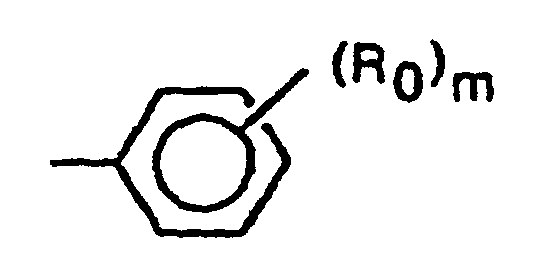 worin in diesen Formeln R9 ein Wasserstoffatom oder einen Rest Alkyl mit 1 bis 4 Kohlenstoffatomen, einen Rest Cyclohexyl oder Phenyl darstellt,
 zwei Gruppen R1 und R2 und/oder R3 und R4, die an zwei vicinalen Kohlenstoffatomen angeordnet sind, zusammen und mit den Kohlenstoffatomen, die sie tragen, einen ungesättigten oder aromatischen Carbocyclus mit 4 bis 7 Kohlenstoffatomen und vorzugsweise 6 Kohlenstoffatomen bilden können.
 - Verfahren nach irgendeinem der Ansprüche 2 und 3, dadurch gekennzeichnet, daß das Fuchson ein solches Fuchson ist, das der allgemeinen Formel (III) und/oder (IV) entspricht, in derR1, R2, R3 und R4, gleich oder verschieden, eine der folgenden Gruppen darstellen:ein Wasserstoffatom,einen linearen oder verzweigten Rest Alkyl mit 1 bis 4 Kohlenstoffatomen,einen linearen oder verzweigten Rest Alkoxy mit 1 bis 4 Kohlenstoffatomen,eine Gruppe Hydroxyl,ein Halogenatom,eine Gruppe -CF3,einen Rest Cyclohexyl,einen Rest Phenyl,zwei Gruppen R1 und R2 und/oder R3 und R4, die an zwei vicinalen Kohlenstoffatomen angeordnet sind, zusammen und mit den Kohlenstoffatomen, die sie tragen, einen benzolischen Ring bilden können.
- Verfahren nach einem der Ansprüche 2 bis 4, dadurch gekennzeichnet, daß das Fuchson ein solches Fuchson ist, das der allgemeinen Formel (III) und/oder (IV) entspricht, in der einer der Reste R1, R2, R3 und R4 eine Gruppe Hydroxyl, einen Rest Methyl oder einen Rest Methoxy darstellt und die anderen drei ein Wasserstoffatom bedeuten.
- Verfahren nach einem der Ansprüche 1 bis 5, dadurch gekennzeichnet, daß das Fuchson ein solches Fuchson ist, das der allgemeinen Formel (III) und/oder (IV) entspricht, in der Ra und Rb einen verzweigten Rest Alkyl mit mindestens 3 Kohlenstoffatomen oder einen Rest Aryl mit mindestens 6 Kohlenstoffatomen darstellen, vorzugsweise einen Rest tert.-Butyl, tert.-Pentyl, tert.-Hexyl oder Phenyl, gegebenenfalls substituiert.
- Verfahren nach einem der Ansprüche 1 bis 6, dadurch gekennzeichnet, daß das Fuchson ein solches Fuchson ist, das der folgenden allgemeinen Formel (IIIa) und/oder (IVa) entspricht:wobei in den genannten Formeln (IIIa) und (IVa)
 Ra1, Ra2, Ra3 und Rb1, Rb2, Rb3, gleich oder verschieden, lineare oder verzweigte Reste Alkyl mit 1 bis 10 Kohlenstoffatomen, Reste Cyclohexyl, Phenyl oder Naphthyl, gegebenenfalls substituiert, darstellen,Ra1, Ra2, Ra3 einerseits und Rb1, Rb2, Rb3 andererseits zusammen und mit dem Kohlenstoffatom, das sie trägt, einen benzolischen oder naphthalinischen Ring bilden können, gegebenenfalls substituiert,R1, R2, R3 und R4, gleich oder verschieden, eine der folgenden Gruppen darstellen:ein Wasserstoffatom,einen linearen oder verzweigten Rest Alkyl mit 1 bis 4 Kohlenstoffatomen,einen linearen oder verzweigten Rest Alkoxy mit 1 bis 4 Kohlenstoffatomen,eine Gruppe Hydroxyl,ein Halogenatom,eine Gruppe -CF3,einen Rest Cyclohexyl,einen Rest Phenyl,zwei Gruppen R1 und R2 und/oder R3 und R4, die an zwei vicinalen Kohlenstoffatomen angeordnet sind, zusammen und mit den Kohlenstoffatomen, die sie tragen, einen benzolischen Ring bilden können.
 - Verfahren nach einem der Ansprüche 1 bis 7, dadurch gekennzeichnet, daß das Fuchson ein solches Fuchson ist, das der
allgemeinen Formel (IIIa) und/oder (IVa) entspricht, in der einer der Reste R1, R2, R3 und R4 eine Gruppe Hydroxyl, einen Rest Methyl, einen Rest Methoxy darstellt und die anderen drei ein Wasserstoffatom bedeuten. - Verfahren nach einem der Ansprüche 1 bis 8, dadurch gekennzeichnet, daß das Fuchson ein solches Fuchson ist, das der folgenden allgemeinen Formel (IIIb) und/oder (IVb) entspricht:wobei in den genannten Formeln (IIIb) und (IVb)
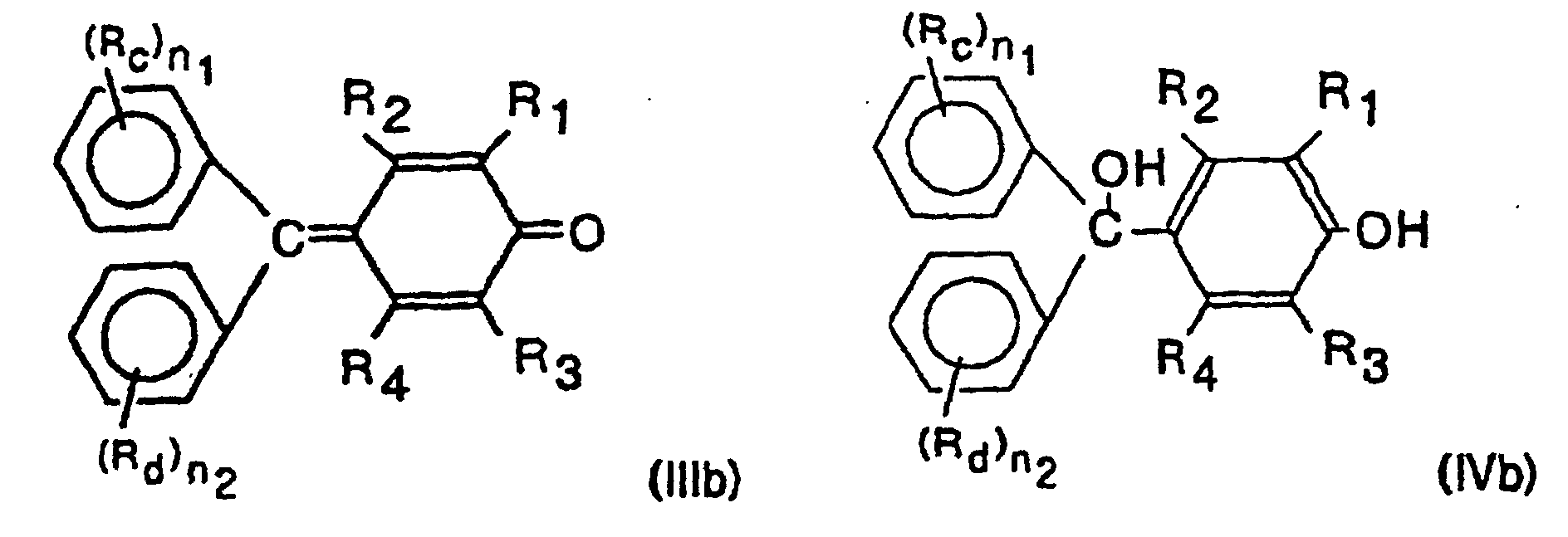 R1, R2, R3 und R4, gleich oder verschieden, eine der folgenden Gruppen darstellen:ein Wasserstoffatom,einen linearen oder verzweigten Rest Alkyl mit 1 bis 4 Kohlenstoffatomen,einen linearen oder verzweigten Rest Alkoxy mit 1 bis 4 Kohlenstoffatomen,eine Gruppe Hydroxyl,ein Halogenatom,eine Gruppe -CF3,einen Rest Cyclohexyl,einen Rest Phenyl,zwei Gruppen R1 und R2 und/oder R3 und R4, die an zwei vicinalen Kohlenstoffatomen angeordnet sind, zusammen und mit den Kohlenstoffatomen, die sie tragen, einen benzolischen Ring bilden können,Rc und Rd, gleich oder verschieden, ein Wasserstoffatom oder einen Substituenten darstellen,n1, n2, gleich oder verschieden, eine ganze Zahl von 0, 1, 2 oder 3 sind.
 - Verfahren nach einem der Ansprüche 1 bis 9, dadurch gekennzeichnet, daß das Fuchson ein solches Fuchson ist, das der allgemeinen Formel (IIIb) und/oder (IVb) entspricht, in der Rc und Rd, gleich oder verschieden, darstellen:lineare oder verzweigte Reste Alkyl mit 1 bis 4 Kohlenstoffatomen,einen Rest Phenyl,Reste Alkoxy R10-O, worin R10 einen linearen oder verzweigten Rest Alkyl mit 1 bis 4 Kohlenstoffatomen oder den Rest Phenyl darstellt,ein Halogenatom, vorzugsweise Chlor, Brom oder Fluor.
- Verfahren nach einem der Ansprüche 1 bis 10, dadurch gekennzeichnet, daß das Fuchson ein solches Fuchson ist, das der allgemeinen Formel (IIIb) und/oder (IVb) entspricht, in der Rc und Rd, gleich oder verschieden, ein Wasserstoffatom oder einen wie in Anspruch 38 definierten Substituenten, vorzugsweise in Position 4,4' darstellen und n1, n2, gleich oder verschieden, gleich 0 oder 1 sind.
- Verfahren nach einem der Ansprüche 1 bis 11, dadurch gekennzeichnet, daß das Fuchson ein solches Fuchson ist, das der allgemeinen Formel (IIIb) und/oder (IVb) entspricht, in der Rc und Rd, gleich oder verschieden, ein Wasserstoffatom; einen Rest Methyl, Ethyl, tert.-Butyl, Phenyl; einen Rest Methoxy oder Ethoxy; eine Gruppe Hydroxyl, vorzugsweise in Position 3,3' oder 4,4' darstellen.
- Verfahren nach einem der Ansprüche 1 bis 12, dadurch gekennzeichnet, daß das Oxidationsmittel unter Wasserstoffperoxid; den Persäuren, vorzugsweise Peressigsäure; den Hydroperoxiden, vorzugsweise tert.-Butyl-hydroperoxid, Cyclohexyl-hydroperoxid, Cumyl-hydroperoxid ausgewählt wird.
- Verfahren nach Anspruch 13, dadurch gekennzeichnet, daß das Oxidationsmittel eine wäßrige Lösung von Wasserstoffperoxid ist.
- Verfahren nach einem der Ansprüche 1 bis 14, dadurch gekennzeichnet, daß die Menge von Wasserstoffperoxid vorzugsweise gleich der stöchiometrischen Menge ist, das sind 1 mol H2O2 pro 1 mol Fuchson der Formel (III) und/oder (IV).
- Verfahren nach einem der Ansprüche 1 bis 15, dadurch gekennzeichnet, daß man das Oxidationsmittel und das Fuchson in Anwesenheit eines sauren Katalysators zur Reaktion bringt, der eine starke protonische Säure mit einem pKa in Wasser von unter -0,1 und vorzugsweise unter -1,0 ist.
- Verfahren nach einem der Ansprüche 1 bis 16, dadurch gekennzeichnet, daß die starke Säure eine halogenierte oder nicht halogenierte Sauerstoffsäure ist, vorzugsweise Schwefelsäure, Pyroschwefelsäure, Perchlorsäure, die Halogensulfonsäuren, vorzugsweise Fluorsulfonsäure, Chlorsulfonsäure oder Trifluormethansulfonsäure, Methansulfonsäure, Ethansulfonsäure, Ethandisulfonsäure, Benzolsulfonsäure, die Benzoldisulfonsäuren, die Toluolsulfonsäuren, die Naphthalinsulfonsäuren und die Naphthalindisulfonsäuren; und noch bevorzugter Perchlorsäure, Trifluormethansulfonsäure oder Methansulfonsäure.
- Verfahren nach einem der Ansprüche 1 bis 17, dadurch gekennzeichnet, daß die Menge an Säure, ausgedrückt durch das Verhältnis der Anzahl der Äquivalente von Protonen zur Anzahl der Mole von Wasserstoffperoxid zwischen etwa 1.10-4 und etwa 1,0, vorzugsweise zwischen 1.10-3 und 0,1 variiert.
- Verfahren nach einem der Ansprüche 1 bis 18, dadurch gekennzeichnet, daß die Reaktion in einem Reaktionslösungsmittel durchgeführt wird, das eine phenolische Verbindung der Formel (I) und/oder ein organisches Lösungsmittel ist.
- Verfahren nach Anspruch 19, dadurch gekennzeichnet, daß das organische Lösungsmittel ausgewählt wird unter:den aliphatischen oder aromatischen Nitrilen, vorzugsweise Acetonitril, Propionitril, Butannitril, Isobutannitril, Benzonitril, Benzylcyanid,den aliphatischen, cycloaliphatischen oder aromatischen Etheroxiden, vorzugsweise Diethyloxid, Dipropyloxid, Diisopropyloxid, Dibutyloxid, Methyl-tert.-butylether, Dipentyloxid, Diisopentyloxid, Dimethylether von Ethylenglycol (oder 1,2-Dimethoxyethan), Dimethylether von Diethylenglycol (oder 1,5-Dimethoxy-3-oxa-pentan), Dioxan, Tetrahydrofuran,den chlorierten aliphatischen Kohlenwasserstoffen, vorzugsweise Dichlormethan, Tetrachlormethan, Dichlorethan,den Alkoholen, vorzugsweise Methanol, Ethanol, Isopropanol, tert.-Butanol.
- Verfahren nach einem der Ansprüche 1 bis 20, dadurch gekennzeichnet, daß die Temperatur der Reaktion zwischen 20 °C und 150 °C, vorzugsweise zwischen 30 °C und 80 °C beträgt.
- Verfahren nach einem der Ansprüche 1 bis 21, dadurch gekennzeichnet, daß man Diphenylfuchson oder Rosolsäure, Diphenylmethylfuchson mit Hilfe einer Lösung von Wasserstoffperoxid im Hinblick darauf oxidiert, jeweils Hydrochinon oder Methylhydrochinon zu erhalten.
- Verfahren nach einem der Ansprüche 1 bis 22, dadurch gekennzeichnet, daß das eingesetzte Fuchson ein solches Fuchson ist, das nach einem Verfahren erhalten wird, das darin besteht, eine phenolische Verbindung mit mindestens einem Wasserstoffatom in para-Position und eine ketonische, nicht enolisierbare Verbindung in Anwesenheit einer wirksamen Menge von einer protonischen Säure, die eine Funktion der Azidität -Ho von mindestens 5 aufweist, und gegebenenfalls in Anwesenheit einer wirksamen Menge einer ionisierbaren Schwefelverbindung zur Reaktion zu bringen.
- Verfahren nach Anspruch 23, dadurch gekennzeichnet, daß die phenolische Verbindung, die mindestens ein Wasserstoffatom in para-Position aufweist, eine phenolische Verbindung ist, die der allgemeinen Formel (I) entspricht:wobei in der genannten Formel (I):
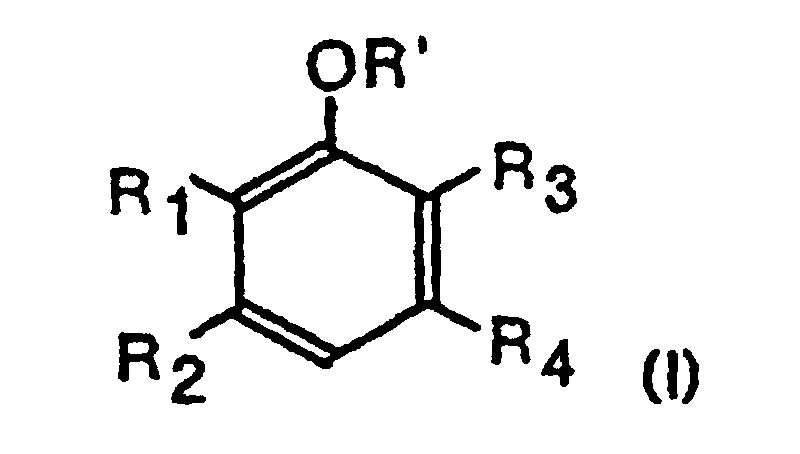 die para-Position frei ist,R1, R2, R3 und R4, gleich oder verschieden, ein Wasserstoffatom oder irgendeinen Substituenten darstellen,zwei Gruppen R1 und R2 und/oder R3 und R4, die an zwei vicinalen Kohlenstoffatomen angeordnet sind, zusammen und mit den Kohlenstoffatomen, die sie tragen, einen Ring bilden können,R' ein Wasserstoffatom oder einen Kohlenwasserstoff-Rest mit 1 bis 24 Kohlenstoffatomen darstellt, der ein linearer oder verzweigter, gesättigter oder ungesättigter, acyclischer aliphatischer Rest; ein gesättigter oder ungesättigter, monocyclischer oder polycyclischer, cycloaliphatischer Rest; ein linearer oder verzweigter, gesättigter oder ungesättigter, aliphatischer Rest sein kann, der einen cyclischen Substituenten trägt.
 - Verfahren nach einem der Ansprüche 23 und 24, dadurch gekennzeichnet, daß die phenolische Verbindung der allgemeinen Formel (I) entspricht, in der:der Rest R' eine der folgenden Gruppen darstellt:ein Wasserstoffatom,einen linearen oder verzweigten Rest Alkyl mit 1 bis 6 Kohlenstoffatomen, vorzugsweise 1 bis 4 Kohlenstoffatomen,einen Rest Cyclohexyl,einen Rest Phenyl,einen Rest Benzyl,R1, R2, R3 und R4, gleich oder verschieden, R0 darstellen, eine der folgenden Gruppen:wobei in den genannten Formeln R5 eine Valenzbindung oder einen linearen oder verzweigten, gesättigten oder ungesättigten, divalenten Kohlenwasserstoff-Rest mit 1 bis 6 Kohlenstoffatomen darstellt, wie beispielsweise Methylen, Ethylen, Propylen, Isopropylen, Isopropyliden; R6 einen linearen oder verzweigten Rest Alkyl mit 1 bis 6 Kohlenstoffatomen darstellt; X ein Halogenatom symbolisiert, vorzugsweise ein Atom von Chlor, Brom oder Fluor;ein Wasserstoffatomeinen linearen oder verzweigten Rest Alkyl mit 1 bis 6 Kohlenstoffatomen, vorzugsweise 1 bis 4 Kohlenstoffatomen, wie Methyl, Ethyl, Propyl, Isopropyl, Butyl, sek.-Butyl, tert.-Butyl,einen linearen oder verzweigten Rest Alkenyl mit 2 bis 6 Kohlenstoffatomen, vorzugsweise 2 bis 4 Kohlenstoffatomen, wie Vinyl, Allyl,einen linearen oder verzweigten Rest Alkoxy mit 1 bis 6 Kohlenstoffatomen, vorzugsweise 1 bis 4 Kohlenstoffatomen, wie die Reste Methoxy, Ethoxy, Propoxy, Isopropoxy, Butoxy,eine Gruppe Acyl mit 2 bis 6 Kohlenstoffatomen,einen Rest der FormelR1, R2, R3 und R4, gleich oder verschieden, R7 darstellen, einen der folgenden komplexeren Reste:worin R5 eine Valenzbindung oder einen linearen oder verzweigten, gesättigten oder ungesättigten, divalenten Kohlenwasserstoff-Rest mit 1 bis 6 Kohlenstoffatomen darstellt, wie beispielsweise Methylen, Ethylen, Propylen, Isopropylen, Isopropyliden; und R0 die vorstehend angegebene Bedeutung besitzt und m eine ganze Zahl von 0 bis 4 ist, einen Rest -R5-A-R8 darstellt, worin R5 die vorstehend angegebene Bedeutung besitzt, R8 einen linearen oder verzweigten Rest Alkyl mit 1 bis 6 Kohlenstoffatomen oder einen Rest der Formeleinen gesättigten oder ungesättigten carbocyclischen Rest mit 4 bis 7 Kohlenstoffatomen, vorzugsweise einen Rest Cyclohexyl,einen Rest der Formel
 darstellt, und A eine der folgenden Gruppen symbolisiert -O-, -COO-, -OCOO-, -SO2-,
 worin in diesen Formeln R9 ein Wasserstoffatom oder einen Rest Alkyl mit 1 bis 4 Kohlenstoffatomen, einen Rest Cyclohexyl oder Phenyl darstellt,
 zwei Gruppen R1 und R2 und/oder R3 und R4, die an zwei vicinalen Kohlenstoffatomen angeordnet sind, zusammen und mit den Kohlenstoffatomen, die sie tragen, einen ungesättigten oder aromatischen Carbocyclus mit 4 bis 7 Kohlenstoffatomen und vorzugsweise 6 Kohlenstoffatomen bilden können.
 - Verfahren nach einem der Ansprüche 23 bis 25, dadurch gekennzeichnet, daß die phenolische Verbindung der allgemeinen Formel (I) entspricht, in der:der Rest R' ein Wasserstoffatom darstellt,R1, R2, R3 und R4, gleich oder verschieden, eine der folgenden Gruppen darstellen:ein Wasserstoffatom,einen linearen oder verzweigten Rest Alkyl mit 1 bis 4 Kohlenstoffatomen,einen linearen oder verzweigten Rest Alkoxy mit 1 bis 4 Kohlenstoffatomen,eine Gruppe Hydroxyl,ein Halogenatom,eine Gruppe -CF3,einen Rest Cyclohexyl,einen Rest Phenyl,zwei Gruppen R1 und R2 und/oder R3 und R4, die an zwei vicinalen Kohlenstoffatomen angeordnet sind, zusammen und mit den Kohlenstoffatomen, die sie tragen, einen benzolischen Ring bilden können.
- Verfahren nach einem der Ansprüche 23 bis 26, dadurch gekennzeichnet, daß die phenolische Verbindung der allgemeinen Formel (I) entspricht, in der R' ein Wasserstoffatom ist und einer der Reste R1, R2, R3 und R4 eine Gruppe Hydroxyl, einen Rest Methyl oder einen Rest Methoxy darstellt und die anderen drei ein Wasserstoffatom bedeuten.
- Verfahren nach einem der Ansprüche 23 bis 27, dadurch gekennzeichnet, daß die phenolische Verbindung Phenol, Anisol, ortho-Kresol, meta-Kresol, 2-Methoxyphenol, 2-Ethylphenol, 3-Ethylphenol, 2-Propylphenol, 2-sek.-Butylphenol, 2-tert.-Butylphenol, 3-tert.-Butylphenol, 2-Methoxyphenol, 3-Methoxyphenol, Salicylsäuremethylester, 2-Chlorphenol, 3-Chlorphenol; 2,3-Dimethylphenol, 2,5-Dimethylphenol, 2,6-Dimethylphenol, 3,5-Dimethylphenol, 2,3-Dichlorphenol, 2,5-Dichlorphenol, 2,6-Dichlorphenol, 3,5-Dichlorphenol, 2,6-Di-tert.-butylphenol, 3,5-Di-tert.-butylphenol; 2,3,5-Trimethylphenol, 2,3,6-Trimethylphenol, 2,3,5-Trichlorphenol, 2,3,6-Trichlorphenol; 1-Hydroxynaphthalin; 2-Phenoxyphenol, 3-Phenoxyphenol ist.
- Verfahren nach einem der Ansprüche 23 bis 28, dadurch gekennzeichnet, daß die ketonische, nicht enolisierbare Verbindung eine ketonische Verbindung ist, die der allgemeinen Formel (II) entspricht:wobei in der genannten Formel (II):
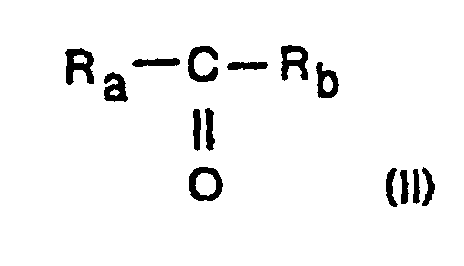
 Ra und Rb, gleich oder verschieden, Kohlenwasserstoff-Reste mit jeweils 3 bis 30 Kohlenstoffatomen sind, wobei die Kohlenstoffatome von jedem Rest Ra und Rb in Position α zur Carbonylgruppe tertiäre Kohlenstoffe sind.
 - Verfahren nach einem der Ansprüche 23 bis 29, dadurch gekennzeichnet, daß die ketonische Verbindung der allgemeinen Formel (IIa) entspricht:wobei in der genannten Formel (IIa):
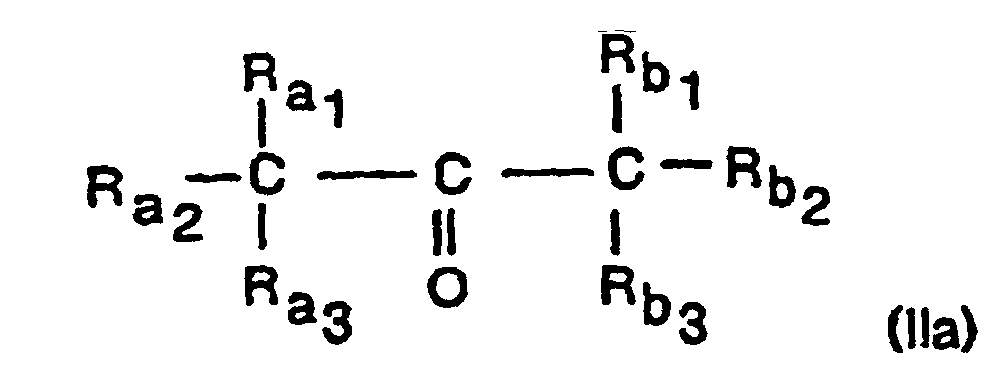 Ra1, Ra2, Ra3 und Rb1, Rb2, Rb3, gleich oder verschieden, lineare oder verzweigte Reste Alkyl mit 1 bis 10 Kohlenstoffatomen, Reste Cyclohexyl, Phenyl oder Naphthyl, gegebenenfalls substituiert, darstellen,Ra1, Ra2, Ra3 und/oder Rb1, Rb2, Rb3 zusammen und mit dem Kohlenstoffatom, das sie trägt, einen benzolischen oder naphthalinischen Ring bilden können, gegebenenfalls substituiert.
 - Verfahren nach einem der Ansprüche 23 bis 30, dadurch gekennzeichnet, daß die ketonische Verbindung der allgemeinen Formel (IIb) entspricht:wobei in der genannten Formel (IIb):
 Rc und Rd, gleich oder verschieden, ein Wasserstoffatom oder einen Substituenten darstellen,n1, n2, gleich oder verschieden, eine ganze Zahl von 0, 1, 2 oder 3 sind.
 - Verfahren nach einem der Ansprüche 23 bis 31, dadurch gekennzeichnet, daß die ketonische Verbindung der allgemeinen Formel (IIb) entspricht, in der Rc und Rd, gleich oder verschieden, darstellen:lineare oder verzweigte Reste Alkyl mit 1 bis 4 Kohlenstoffatomen,einen Rest Phenyl,Reste Alkoxy R10-O, worin R10 einen linearen oder verzweigten Rest Alkyl mit 1 bis 4 Kohlenstoffatomen oder den Rest Phenyl darstellt,eine Gruppe Hydroxyl,ein Fluoratom.
- Verfahren nach einem der Ansprüche 23 bis 32, dadurch gekennzeichnet, daß die ketonische Verbindung der allgemeinen Formel (IIb) entspricht, in der Rc und Rd, gleich oder verschieden, ein Wasserstoffatom oder einen wie in Anspruch 32 definierten Substituenten darstellen, vorzugsweise in Position 4,4', und n1, n2, gleich oder verschieden, gleich 0 oder 1 sind.
- Verfahren nach einem der Ansprüche 23 bis 33, dadurch gekennzeichnet, daß die ketonische Verbindung der allgemeinen Formel (IIb) entspricht, in der Rc und Rd, gleich oder verschieden, ein Wasserstoffatom; einen Rest Methyl, Ethyl, tert.-Butyl, Phenyl; einen Rest Methoxy oder Ethoxy; eine Gruppe Hydroxyl darstellen, vorzugsweise in Position 3,3' oder 4,4'.
- Verfahren nach einem der Ansprüche 23 bis 34, dadurch gekennzeichnet, daß die ketonische Verbindung der allgemeinen Formel (IIb) ist:Benzophenon,2-Methylbenzophenon,2,4-Dimethylbenzophenon,4,4'-Dimethylbenzophenon,2,2'-Dimethylbenzophenon,4,4'-Dimethoxybenzophenon,4-Hydroxybenzophenon,4,4'-Dihydroxybenzophenon,4-Benzoyl-biphenyl.
- Verfahren nach einem der Ansprüche 23 bis 35, dadurch gekennzeichnet, daß der saure Katalysator eine Funktion der Azidität -H0 zwischen 5 und 20, vorzugsweise zwischen 10 und 15 aufweist.
- Verfahren nach Anspruch 36, dadurch gekennzeichnet, daß der saure Katalysator eine starke protonische Säure ist, vorzugsweise Fluorwasserstoffsäure, Perchlorsäure, Trifluormethansulfonsäure, para-Toluolsulfonsäure, Chlorsulfonsäure, Fluorsulfonsäure, Methansulfonsäure, Benzolsulfonsäure, und noch bevorzugter Fluorwasserstoffsäure, Perchlorsäure, Trifluormethansulfonsäure oder Methansulfonsäure.
- Verfahren nach Anspruch 36, dadurch gekennzeichnet, daß der saure Katalysator ein sulfonisches Harz ist, vorzugsweise ein sulfoniertes Copolymer Styrol-Divinylbenzol, ein sulfoniertes Copolymer Phenol-Formaldehyd, ein Copolymer Tetrafluorethylenperfluor-[2-(fluorsulfonylethoxy)-propyl]-vinylether und vorzugsweise die folgenden Harze: TEMEX 50, AMBERLYST 15, AMBERLYST 35, AMBERLYST 36, DOWEX 50 W; DUOLITE ARC 9359; NAFION.
- Verfahren nach Anspruch 36, dadurch gekennzeichnet, daß der saure Katalysator ausgewählt wird unter: Kieselerde-aluminat, Kieselerde-Ga2O3, Kieselerde-B2O3; den sauren Tonen; den Brückentonen (argiles pontées); den natürlichen oder synthetischen Zeolithen; den Phosphaten von Bor, Aluminium oder Gallium; den lamellaren Phosphaten von tetravalenten Metallen, entsprechend der Formel α-M(HPO4)2,pH2O, worin M ein tetravalentes Metall darstellt, ausgewählt unter Titan, Germanium, Zirkonium oder Zinn, und p eine ganze Zahl von unter 2 bedeutet; den lamellaren Phosphaten von trivalenten Metallen, vorzugsweise den lamellaren Phosphaten von Zirkonium; den Oxiden, die durch eine Behandlung sauer gemacht wurden, vorzugsweise den sulfatierten Oxiden von Titan, Zirkonium oder Eisen.
- Verfahren nach Anspruch 36, dadurch gekennzeichnet, daß der verwendete saure Katalysator ausgewählt wird unter:den natürlichen Tonen mit einer sogenannten Struktur "TOT" oder Tetraeder-Oktatetraeder, vorzugsweise aus der Klasse der Smektite und noch bevorzugter der Montmorillonite,den handelsüblichen Tonen, die bereits sauer sind oder auch nicht, oder die durch eine wäßrige Lösung einer Säure behandelt wurden,den Brückentonen, hergestellt ausgehend von Smektiten, vorzugsweise ausgehend von Beidelliten, insbesondere von synthetischen Beidelliten oder von Montmorilloniten; die Brücke des Tones ist vorzugsweise eine Brücke mit Aluminium.
- Verfahren nach Anspruch 36, dadurch gekennzeichnet, daß der saure Katalysator ausgewählt wird unter:den natürlichen Zeolithen wie Chabazit, Clinoptilolit, Erionit, Mordenit, Phillipsit, Offretit,den synthetischen Zeolithen wie Zeolith ZSM-5, Zeolith Y, Ferrierit, Zeolith X vom Typ Faujasit, Zeolith vom Typ L, Mordenit, Zeolith ZSM-11; Mazzit, Offretit, vorzugsweise ein Zeolith US-Y oder ein Zeolith ZSM-5.
- Verfahren nach Anspruch 41, dadurch gekennzeichnet, daß der eingesetzte Zeolith ein sauer gemachter Zeolith ist.
- Verfahren nach einem der Ansprüche 23 bis 42, dadurch gekennzeichnet, daß die ionisierbare Schwefelverbindung eine mineralische Schwefelverbindung oder eine organische Schwefelverbindung ist, vorzugsweise ausgewählt unter:den Schwefelhalogeniden,den Thiosulfaten von Ammonium, Alkalimetallen oder Erdalkalimetallen,Schwefelwasserstoff oder seinen Vorläufern,den Mercaptanen, vorzugsweise den Alkylmercaptanen, Phenylmercaptanen und Phenylalkylmercaptanen,den Thioalkoholen,den Thiophenolen,den thioorganischen Säuren, ihren Salzen oder ihren Estern,den Kationenaustauscherharzen, modifiziert durch Reaktion mit einem Alkyl-mercaptoamin, vorzugsweise den Harzen mit einem Polystyrolgerüst, die sulfonische Gruppen tragen und mit einem Alkyl-mercaptoamin reagiert haben, vorzugsweise mit einem solchen, das eine primären Aminogruppe aufweist und noch bevorzugter, das 1 bis 1 Kohlenstoffatome besitzt.
- Verfahren nach Anspruch 43, dadurch gekennzeichnet, daß die Schwefelverbindung ausgewählt wird unter:Schwefel-monochlorid oder Schwefel-dichlorid,Thiosulfat von Ammonium, Natrium oder Kalium,Schwefelwasserstoff oder Sulfid von Calcium oder Kalium,Ethylmercaptan, Butylmercaptan, 1-Nonylmercaptan, Benzylmercaptan,2-Mercaptoethanol, 3-Mercapto-2-butanol,Thiophenol, o-Thiokresol, m-Thiokresol, p-Thiokresol, Thioxylenol, p-Methylthiophenol, o-Ethylthiophenol, Thiohydrochinon, Thionaphthol,Thioessigsäure, Thiopropionsäure, Thiomilchsäure, Thiosalicylsäure, 2-Mercaptoethansulfonsäure, 3-Mercaptopropansulfonsäure, Mercaptobernsteinsäure, Thioglycolsäure, Thioglycolat von Methyl, Ethyl,den Harzen mit einem Polystyrolgerüst, die sulfonische Gruppen tragen und die mit 2-Mercapto-ethylamin, 2-Mercapto-isopropylamin, 3-Mercapto-butylamin reagiert haben.
- Verfahren nach einem der Ansprüche 23 bis 44, dadurch gekennzeichnet, daß das molare Verhältnis zwischen der phenolischen Verbindung der Formel (I) und der ketonischen Verbindung der Formel (II) zwischen 1 und 20, vorzugsweise zwischen 1 und 10 beträgt.
- Verfahren nach einem der Ansprüche 23, 36 bis 38, dadurch gekennzeichnet, daß die Menge von saurem Katalysator, ausgedrückt durch das Verhältnis der Äquivalente von Protonen zur Anzahl der Mole von ketonischer Verbindung der Formel (II) zwischen 1.10-3 und 1,0, vorzugsweise zwischen 5.10-3 und 0,5 variiert.
- Verfahren nach Anspruch 36 oder 37, dadurch gekennzeichnet, daß das genannte Verhältnis zwischen 1,0 und 20, vorzugsweise zwischen 5,0 und 10 beträgt, wenn die Säure als Reaktionsmedium verwendet wird.
- Verfahren nach einem der Ansprüche 39 bis 42, dadurch gekennzeichnet, daß die Menge von eingesetztem sauren Katalysator, dargestellt in Gewicht und bezogen auf die eingesetzte phenolische Verbindung der Formel (I), 0,1 bis 20 %, vorzugsweise 0,5 bis 10 % beträgt.
- Verfahren nach einem der Ansprüche 23 bis 48, dadurch gekennzeichnet, daß die Menge von eingesetzter Schwefelverbindung, ausgedrückt im Verhältnis zur ketonischen Verbindung der Formel (II) derart ist, daß das molare Verhältnis zwischen der Schwefelverbindung und der ketonischen Verbindung der Formel (II) zwischen 0,001 und 1,0, vorzugsweise zwischen 0,005 und 0,20 beträgt.
- Verfahren nach einem der Ansprüche 23 bis 49, dadurch gekennzeichnet, daß die Temperatur der Reaktion zwischen 45 °C und 200 °C, vorzugsweise zwischen 60 °C und 150 °C beträgt.
- Verfahren nach einem der Ansprüche 23 bis 50, dadurch gekennzeichnet, daß man das Diphenylfuchson durch Reaktion von Phenol und Benzophenon; die Rosolsäure durch Reaktion von Phenol und 4,4'-Dihydroxy-benzophenon; das Diphenylmethylfuchson durch Reaktion von ortho-Kresol und Benzophenon herstellt.
- Verfahren nach Anspruch 23, dadurch gekennzeichnet, daß die para-dihydroxylierte aromatische Verbindung erhalten wird, indem man ein Fuchson nach dem in einem der Ansprüche 23 bis 51 beschriebenen Verfahren herstellt und dieses anschließend durch Zugabe eines Oxidationsmittels zu dem Reaktionsmedium oxidiert, ohne daß das Fuchson isoliert wird.
- Verfahren zur Herstellung einer para-dihydroxylierten aromatische Verbindung durch Oxidation einer phenolischen Verbindung, die ein Wasserstoffatom in para-Position aufweist, mit Wasserstoffperoxid in Anwesenheit einer wirksamen Menge einer starken protonischen Säure, die einen pKa in Wasser von unter -0,1 und vorzugsweise unter -1,0 aufweist, dadurch gekennzeichnet, daß die Reaktion in Anwesenheit einer wirksamen eines p-Fuchsons durchgeführt wird.
- Verfahren nach Anspruch 53, dadurch gekennzeichnet, daß die phenolische Verbindung eine phenolische Verbindung der Formel (I) ist, wie in einem der Ansprüche 24 bis 28 beschrieben.
- Verfahren nach einem der Ansprüche 53 und 54, dadurch gekennzeichnet, daß das p-Fuchson ein Fuchson ist, das der allgemeinen Formel (III) und/oder (IV) entspricht, wie in einem der Ansprüche 2 bis 12 beschrieben.
- Verfahren nach einem der Ansprüche 53 bis 55, dadurch gekennzeichnet, daß das p-Fuchson nach dem Verfahren erhalten wird, wie in einem der Ansprüche 23 bis 51 beschrieben.
- Verfahren nach einem der Ansprüche 53 bis 56, dadurch gekennzeichnet, daß die Menge von Fuchson der Formel (III) und/oder (IV) unter 1,0 mol pro mol Wasserstoffperoxid, vorzugsweise zwischen 1.10-3 und 1,0 mol und noch bevorzugter zwischen 0,05 und 0,5 mol beträgt.
- Verfahren nach einem der Ansprüche 53 bis 57, dadurch gekennzeichnet, daß die starke Säure eine Säure ist, wie in einem der Ansprüche 16 und 17 definiert.
- Verfahren nach einem der Ansprüche 53 bis 58, dadurch gekennzeichnet, daß die Menge der Säure derart ist, daß das Verhältnis H+/H2O2 zwischen etwa 1.10-4 und etwa 1,0, vorzugsweise zwischen 1.10-3 und 0,1 beträgt.
- Verfahren nach einem der Ansprüche 53 bis 59, dadurch gekennzeichnet, daß das molare Verhältnis H2O2/phenolische Verbindung der Formel (I) zwischen 0,01 und 0,3, vorzugsweise zwischen 0,05 und 0,10 beträgt.
- Verfahren nach einem der Ansprüche 53 bis 60, dadurch gekennzeichnet, daß die Reaktion in Anwesenheit eines polaren, aprotischen organischen Lösungsmittels durchgeführt wird, das eine solche Polarität, daß seine Dielektrizitätskonstante über oder gleich 20, vorzugsweise zwischen 25 und 75 beträgt, und eine solche Basizität aufweist, daß es eine "Donatorzahl" von unter 25, vorzugsweise von unter oder gleich 20 und noch mehr bevorzugt zwischen 2 und 17 besitzt.
- Verfahren nach Anspruch 61, dadurch gekennzeichnet, daß das polare organische Lösungsmittel ausgewählt wird unter: den nitrierten Verbindungen, vorzugsweise Nitromethan, Nitroethan, 1-Nitropropan, 2-Nitropropan oder deren Mischungen, Nitrobenzol; den aliphatischen oder aromatischen Nitrilen, vorzugsweise Acetonitril, Propionitril, Butannitril, Isobutannitril, Benzonitril, Benzylcyanid; Tetramethylensulfon und Propylen-carbonat.
- Verfahren nach einem der Ansprüche 61 und 62, dadurch gekennzeichnet, daß die Menge von eingesetztem Lösungsmittel derart ist, daß das molare Verhältnis zwischen der Anzahl von Molen des organischen Lösungsmittels und der Anzahl von Molen der phenolischen Verbindung der Formel (I) zwischen 0,1 und 2,0, vorzugsweise zwischen 0,25 und 1,0 variiert.
- Verfahren nach einem der Ansprüche 53 bis 63, dadurch gekennzeichnet, daß die Reaktion in Anwesenheit eines polaren, aprotischen organischen Lösungsmittels durchgeführt wird, das eine solche Polarität, daß seine Dielektrizitätskonstante unter etwa 20, vorzugsweise zwischen 2 und 15 beträgt, und eine solche Basizität aufweist, daß es eine "Donatorzahl" von über oder gleich 15 und unter 25, vorzugsweise zwischen 15 und 25 besitzt.
- Verfahren nach Anspruch 64, dadurch gekennzeichnet, daß das polare organische Lösungsmittel ausgewählt wird unter: den aliphatischen, cycloaliphatischen oder aromatischen Ether-oxiden, vorzugsweise Diethyloxid, Dipropyloxid, Diisopropyloxid, Dibutyloxid, Methyl-tert.-butylether, Dipentyloxid, Diisopentyloxid, Dimethylether von Ethylenglycol (oder 1,2-Dimethoxyethan), Dimethylether von Diethylenglycol (oder 1,5-Dimethoxy-3-oxa-pentan), Dioxan, Tetrahydrofuran; den neutralen Phosphorestern, vorzugsweise Trimethylphosphat, Triethylphosphat, Butylphosphat, Triisobutylphosphat, Tripentylphosphat; Ethylen-carbonat.
- Verfahren nach einem der Ansprüche 64 und 65, dadurch gekennzeichnet, daß die Menge von eingesetztem Lösungsmittel derart ist, daß das molare Verhältnis zwischen der Anzahl von Molen des organischen Lösungsmittels und der Anzahl von Molen der phenolischen Verbindung der Formel (I) zwischen 0,01 und 0,25, vorzugsweise zwischen 0,025 und 0,15 variiert.
- Verfahren nach einem der Ansprüche 56 bis 66, dadurch gekennzeichnet, daß man bei einer Temperatur zwischen 45 °C und 150 °C, vorzugsweise zwischen 60 °C und 110 °C arbeitet.
- Verfahren nach einem der Ansprüche 56 bis 67, dadurch gekennzeichnet, daß man das Phenol und eine Lösung von Wasserstoffperoxid in Anwesenheit einer wirksamen Menge einer starken Säure und einer wirksamen Menge von Diphenylfuchson und/oder seinem Carbinol zur Reaktion bringt.
Applications Claiming Priority (9)
| Application Number | Priority Date | Filing Date | Title |
|---|---|---|---|
| FR9300119A FR2700332B1 (fr) | 1993-01-08 | 1993-01-08 | Procédé d'hydroxylation de composés phénoliques. |
| FR9300120A FR2700334B1 (fr) | 1993-01-08 | 1993-01-08 | Procédé de préparation de fuchsones. |
| FR9300121 | 1993-01-08 | ||
| FR9300121A FR2700333B1 (fr) | 1993-01-08 | 1993-01-08 | Procédé de préparation de composés aromatiques dihydroxyles. |
| FR9300120 | 1993-01-08 | ||
| FR9300119 | 1993-01-08 | ||
| FR9311262A FR2710339B1 (fr) | 1993-09-22 | 1993-09-22 | Procédé de préparation de fuchsones. |
| FR9311262 | 1993-09-22 | ||
| EP94400020A EP0606183B1 (de) | 1993-01-08 | 1994-01-05 | Verfahren zur Herstellung eines p-Fuchsons |
Related Parent Applications (1)
| Application Number | Title | Priority Date | Filing Date |
|---|---|---|---|
| EP94400020A Division EP0606183B1 (de) | 1993-01-08 | 1994-01-05 | Verfahren zur Herstellung eines p-Fuchsons |
Publications (3)
| Publication Number | Publication Date |
|---|---|
| EP0890564A2 EP0890564A2 (de) | 1999-01-13 |
| EP0890564A3 EP0890564A3 (de) | 2002-05-22 |
| EP0890564B1 true EP0890564B1 (de) | 2004-11-24 |
Family
ID=27446874
Family Applications (2)
| Application Number | Title | Priority Date | Filing Date |
|---|---|---|---|
| EP98110051A Expired - Lifetime EP0890564B1 (de) | 1993-01-08 | 1994-01-05 | Verfahren zur Herstellung einer p-dihydroxyaromatischen Verbindung |
| EP94400020A Expired - Lifetime EP0606183B1 (de) | 1993-01-08 | 1994-01-05 | Verfahren zur Herstellung eines p-Fuchsons |
Family Applications After (1)
| Application Number | Title | Priority Date | Filing Date |
|---|---|---|---|
| EP94400020A Expired - Lifetime EP0606183B1 (de) | 1993-01-08 | 1994-01-05 | Verfahren zur Herstellung eines p-Fuchsons |
Country Status (4)
| Country | Link |
|---|---|
| US (3) | US5466839A (de) |
| EP (2) | EP0890564B1 (de) |
| JP (2) | JP2650845B2 (de) |
| DE (2) | DE69417773T2 (de) |
Families Citing this family (11)
| Publication number | Priority date | Publication date | Assignee | Title |
|---|---|---|---|---|
| DE4310295A1 (de) * | 1993-03-30 | 1994-10-06 | Tuerautomation Fehraltorf Ag F | Karusselltür |
| KR20010012834A (ko) * | 1997-05-23 | 2001-02-26 | 헌츠만 페트로케미칼 코포레이션 | 페인트 및 코팅 제거제 |
| US6395103B1 (en) * | 1997-05-23 | 2002-05-28 | Huntsman Petrochemical Corporation | Degreasing compositions |
| US6159915A (en) * | 1999-06-18 | 2000-12-12 | Huntsman Petrochemical Corporation | Paint and coating remover |
| US6479445B1 (en) | 1997-05-23 | 2002-11-12 | Huntsman Petrochemical Corporation | Paint stripping compositions |
| US6239090B1 (en) | 1997-05-23 | 2001-05-29 | Huntsman Petrochemical Corporation | Thickened paint and coating remover |
| US6169061B1 (en) | 1997-05-23 | 2001-01-02 | Huntsman Petrochemical Corporation | Paint and coating remover |
| US5962699A (en) * | 1998-07-23 | 1999-10-05 | Huntsman Petrochemical Corporation | Process for decolorizing organic carbonates |
| US6548464B1 (en) | 2000-11-28 | 2003-04-15 | Huntsman Petrochemical Corporation | Paint stripper for aircraft and other multicoat systems |
| TWI397533B (zh) * | 2008-04-11 | 2013-06-01 | Chang Chun Plastics Co Ltd | 新穎磷系化合物及其製造方法及用途 |
| CN107722241B (zh) * | 2017-10-27 | 2019-09-20 | 万华化学集团股份有限公司 | 一种环氧固化剂及其制备方法和用途 |
Family Cites Families (16)
| Publication number | Priority date | Publication date | Assignee | Title |
|---|---|---|---|---|
| US2841623A (en) * | 1957-05-08 | 1958-07-01 | Shell Dev | Process for the alkylation of phenols |
| US3649653A (en) * | 1966-09-13 | 1972-03-14 | Gen Electric | Photochemical process of producing 3 5-di-substituted fuchsones |
| FR2071464A5 (de) * | 1969-12-30 | 1971-09-17 | Rhone Poulenc Sa | |
| US4078006A (en) * | 1974-04-04 | 1978-03-07 | Ube Industries, Ltd. | Process for preparing dihydric phenol derivatives |
| GB1448358A (en) * | 1974-04-04 | 1976-09-08 | Ube Industries | Process for preparint dihydric phenol derivatives |
| FR2336364A1 (fr) * | 1975-12-24 | 1977-07-22 | Rhone Poulenc Ind | Hydroxylation de composes aromatiques |
| US4081485A (en) * | 1976-01-01 | 1978-03-28 | Tsukasa Eguchi | Hydroquinone-ketone molecular compound and process for purifying hydroquinone using said molecular compound |
| FR2563446A1 (fr) * | 1984-04-25 | 1985-10-31 | Raffinage Cie Francaise | Nouvelle zeolite a structure bidimensionnelle et application de ladite zeolite |
| JPH01246707A (ja) * | 1988-03-29 | 1989-10-02 | Hitachi Cable Ltd | 半導電性樹脂組成物 |
| JPH0278641A (ja) * | 1988-09-14 | 1990-03-19 | Mitsui Petrochem Ind Ltd | 多価フェノール類の製造方法 |
| US4909966A (en) * | 1988-12-21 | 1990-03-20 | Eastman Kodak Company | Naphthoquinone derivatives |
| FR2646843B1 (fr) * | 1989-05-10 | 1991-12-13 | Rhone Poulenc Chimie | Zircone microporeuse et son procede de preparation |
| FR2667598B1 (fr) * | 1990-10-08 | 1994-05-20 | Rhone Poulenc Chimie | Procede d'hydroxylation de composes phenoliques. |
| DE4119480C2 (de) * | 1991-06-13 | 1998-02-19 | Deutsche Waggonbau Ag | Radvorleger mit Stützarm für Autotransport-Güterwagen |
| EP0558376B1 (de) * | 1992-02-26 | 1997-10-08 | Rhone-Poulenc Chimie | Verfahren zur Monohydroxylierung von Phenolverbindungen |
| FR2700333B1 (fr) * | 1993-01-08 | 1995-03-10 | Rhone Poulenc Chimie | Procédé de préparation de composés aromatiques dihydroxyles. |
-
1994
- 1994-01-05 EP EP98110051A patent/EP0890564B1/de not_active Expired - Lifetime
- 1994-01-05 DE DE69417773T patent/DE69417773T2/de not_active Expired - Fee Related
- 1994-01-05 DE DE69434156T patent/DE69434156D1/de not_active Expired - Lifetime
- 1994-01-05 EP EP94400020A patent/EP0606183B1/de not_active Expired - Lifetime
- 1994-01-07 JP JP6012160A patent/JP2650845B2/ja not_active Expired - Fee Related
- 1994-01-10 US US08/179,234 patent/US5466839A/en not_active Expired - Lifetime
-
1995
- 1995-06-05 US US08/464,311 patent/US5670465A/en not_active Expired - Lifetime
- 1995-06-05 US US08/463,733 patent/US5585526A/en not_active Expired - Lifetime
-
1996
- 1996-03-11 JP JP05326996A patent/JP3272936B2/ja not_active Expired - Fee Related
Also Published As
| Publication number | Publication date |
|---|---|
| EP0606183A1 (de) | 1994-07-13 |
| JPH08245458A (ja) | 1996-09-24 |
| JPH072715A (ja) | 1995-01-06 |
| US5670465A (en) | 1997-09-23 |
| JP3272936B2 (ja) | 2002-04-08 |
| JP2650845B2 (ja) | 1997-09-10 |
| EP0890564A2 (de) | 1999-01-13 |
| DE69417773D1 (de) | 1999-05-20 |
| EP0606183B1 (de) | 1999-04-14 |
| US5466839A (en) | 1995-11-14 |
| DE69417773T2 (de) | 1999-11-11 |
| US5585526A (en) | 1996-12-17 |
| DE69434156D1 (de) | 2004-12-30 |
| EP0890564A3 (de) | 2002-05-22 |
Similar Documents
| Publication | Publication Date | Title |
|---|---|---|
| EP0890564B1 (de) | Verfahren zur Herstellung einer p-dihydroxyaromatischen Verbindung | |
| EP0044260B1 (de) | Verfahren zur Herstellung von Polyphenolen, gegebenenfalls substituiert durch eine Aldehyd-Gruppierung | |
| FR2667598A1 (fr) | Procede d'hydroxylation de composes phenoliques. | |
| EP0558376B1 (de) | Verfahren zur Monohydroxylierung von Phenolverbindungen | |
| EP0877726B1 (de) | Verfahren zur acylierung einer aromatischen verbindung | |
| EP0770051A1 (de) | Verfahren zur herstellung von aromatischen ethern | |
| EP0013532B1 (de) | Verfahren zur Herstellung von Polyglycidyläthern von Polyphenolen | |
| EP2417092B1 (de) | Verfahren zur hydroxylierung von phenolen und phenolethern | |
| FR2624507A1 (fr) | Procede de preparation de derives aromatiques hydroxyles par la reaction de baeyer-villiger | |
| EP1027326B1 (de) | Verfahren zur funktionalisierung eines mit einer elektronendonor-gruppe substituierten phenols | |
| EP0432006B1 (de) | Verfahren zur Hydroxylierung von Phenolen und Phenolethern | |
| FR2700333A1 (fr) | Procédé de préparation de composés aromatiques dihydroxyles. | |
| EP0013250B1 (de) | Verfahren zur Herstellung ungesättigter Monoäther von Diphenolen | |
| EP0882005A1 (de) | Verfahren zur hydroxylierung von phenolische verbindungen | |
| FR2700334A1 (fr) | Procédé de préparation de fuchsones. | |
| FR2730731A1 (fr) | Procede de carboxylation d'un ether aromatique | |
| EP0365440B1 (de) | Verfahren zur Vernichtung von Peroxiden in Aceton | |
| EP0318394B1 (de) | Verfahren zur Thioalkylierung von Phenolen und seine Anwendung in der Synthese von 4-Acyl-2-alkylthiophenolen | |
| EP0436410A1 (de) | Verfahren zur Herstellung von substituierten Hydroxychinonen | |
| US2483566A (en) | Catalytic acylation of aromatic compounds | |
| FR2830861A1 (fr) | Procede de preparation de composes mandeliques et derives | |
| FR2687662A1 (fr) | Procede d'hydroxylation de composes phenoliques. | |
| EP0482979A1 (de) | Verfahren zur Herstellung von Aldehyden aus sekundären alpha-trihalogenierten Alkoholen | |
| FR2687663A1 (fr) | Procede d'hydroxylation de composes phenoliques. | |
| BE617842A (de) |
Legal Events
| Date | Code | Title | Description |
|---|---|---|---|
| PUAI | Public reference made under article 153(3) epc to a published international application that has entered the european phase |
Free format text: ORIGINAL CODE: 0009012 |
|
| 17P | Request for examination filed |
Effective date: 19980603 |
|
| AC | Divisional application: reference to earlier application |
Ref document number: 606183 Country of ref document: EP |
|
| AK | Designated contracting states |
Kind code of ref document: A2 Designated state(s): DE FR GB IT NL SE |
|
| PUAL | Search report despatched |
Free format text: ORIGINAL CODE: 0009013 |
|
| RIC1 | Information provided on ipc code assigned before grant |
Free format text: 7C 07C 45/51 A, 7C 07C 49/683 B, 7C 07C 49/747 B, 7C 07C 49/753 B, 7C 07C 37/60 B, 7C 07C 39/08 B |
|
| 17Q | First examination report despatched |
Effective date: 20030623 |
|
| GRAP | Despatch of communication of intention to grant a patent |
Free format text: ORIGINAL CODE: EPIDOSNIGR1 |
|
| GRAS | Grant fee paid |
Free format text: ORIGINAL CODE: EPIDOSNIGR3 |
|
| GRAA | (expected) grant |
Free format text: ORIGINAL CODE: 0009210 |
|
| AC | Divisional application: reference to earlier application |
Ref document number: 0606183 Country of ref document: EP Kind code of ref document: P |
|
| AK | Designated contracting states |
Kind code of ref document: B1 Designated state(s): DE FR GB IT NL SE |
|
| PG25 | Lapsed in a contracting state [announced via postgrant information from national office to epo] |
Ref country code: NL Free format text: LAPSE BECAUSE OF FAILURE TO SUBMIT A TRANSLATION OF THE DESCRIPTION OR TO PAY THE FEE WITHIN THE PRESCRIBED TIME-LIMIT Effective date: 20041124 Ref country code: GB Free format text: LAPSE BECAUSE OF FAILURE TO SUBMIT A TRANSLATION OF THE DESCRIPTION OR TO PAY THE FEE WITHIN THE PRESCRIBED TIME-LIMIT Effective date: 20041124 |
|
| REG | Reference to a national code |
Ref country code: GB Ref legal event code: FG4D Free format text: NOT ENGLISH |
|
| REF | Corresponds to: |
Ref document number: 69434156 Country of ref document: DE Date of ref document: 20041230 Kind code of ref document: P |
|
| PG25 | Lapsed in a contracting state [announced via postgrant information from national office to epo] |
Ref country code: SE Free format text: LAPSE BECAUSE OF FAILURE TO SUBMIT A TRANSLATION OF THE DESCRIPTION OR TO PAY THE FEE WITHIN THE PRESCRIBED TIME-LIMIT Effective date: 20050224 |
|
| PG25 | Lapsed in a contracting state [announced via postgrant information from national office to epo] |
Ref country code: DE Free format text: LAPSE BECAUSE OF FAILURE TO SUBMIT A TRANSLATION OF THE DESCRIPTION OR TO PAY THE FEE WITHIN THE PRESCRIBED TIME-LIMIT Effective date: 20050225 |
|
| NLV1 | Nl: lapsed or annulled due to failure to fulfill the requirements of art. 29p and 29m of the patents act | ||
| GBV | Gb: ep patent (uk) treated as always having been void in accordance with gb section 77(7)/1977 [no translation filed] |
Effective date: 20041124 |
|
| PLBE | No opposition filed within time limit |
Free format text: ORIGINAL CODE: 0009261 |
|
| STAA | Information on the status of an ep patent application or granted ep patent |
Free format text: STATUS: NO OPPOSITION FILED WITHIN TIME LIMIT |
|
| 26N | No opposition filed |
Effective date: 20050825 |
|
| PGFP | Annual fee paid to national office [announced via postgrant information from national office to epo] |
Ref country code: IT Payment date: 20090127 Year of fee payment: 16 |
|
| PGFP | Annual fee paid to national office [announced via postgrant information from national office to epo] |
Ref country code: FR Payment date: 20090113 Year of fee payment: 16 |
|
| REG | Reference to a national code |
Ref country code: FR Ref legal event code: ST Effective date: 20100930 |
|
| PG25 | Lapsed in a contracting state [announced via postgrant information from national office to epo] |
Ref country code: FR Free format text: LAPSE BECAUSE OF NON-PAYMENT OF DUE FEES Effective date: 20100201 |
|
| PG25 | Lapsed in a contracting state [announced via postgrant information from national office to epo] |
Ref country code: IT Free format text: LAPSE BECAUSE OF NON-PAYMENT OF DUE FEES Effective date: 20100105 |